We are held captive by the winds of fate, and have settled for the month of November in Wheaton, IL, our former home. When we arrived here (11/3 and 11/8 respectively), we planned to stay for a week, visit doctors, stock up on odds and ends not readily available in Peru and leave for points south. We began our stay at the home of our friend Peggy. She has the best yard anywhere.
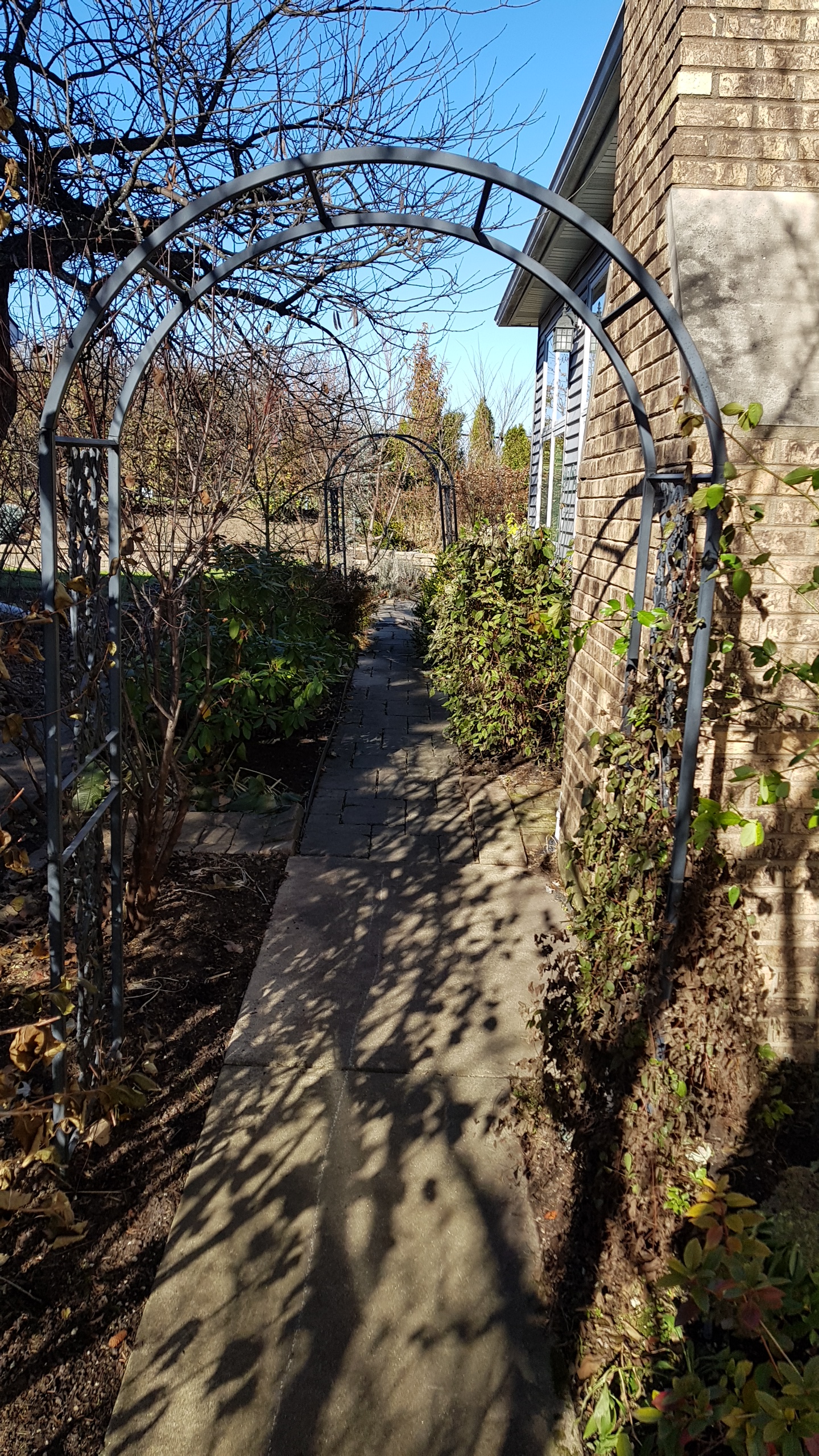
Even in November when her army of tiny Japanese maples have lost their brilliant red leaves, there is lots to see. A few brussels sprouts and some hardy kale hang on despite the bouts of cold weather that have already passed. Arches and walkways lead to hidden nooks. The sun lights the plants and makes the leaves translucent. It is a pleasure to visit and walk through. Somehow I relax just being there.
Peggy’s garden gives me a respite from worrying about test results, delayed flights, travel insurance, waivers of change fees, plans already made that have to be changed. There’s also our lack of winter clothing beyond coats. My fingers are crossed that it doesn’t snow too soon. I remember the year we remodeled our kitchen, tearing everything out the day after Thanksgiving and piling all the debris at the side of the driveway in anticipation of the arrival of a dumpster. Two feet of snow fell the next day and it took us until February to get it cleaned up. This year the days after Thanksgiving are mild and sunny, but I know it will change soon enough.
After ten days with Peggy we rented an apartment for the rest of the month, and another for the first two weeks of December. Are we moving back to the US? That’s not our plan, but we are waiting to get Jonathan a clear bill of health. Here’s our latest home base:
We are on the second floor, right side. The photo on the right is the view from our front door. I’ll add a few pictures of the interior the next time it is presentable.
The days are growing shorter and shorter just when we hoped to be switching hemispheres where the days are growing longer. The last time I noticed how low the sun was on the horizon, it was in Norway above the Arctic Circle in June 2016, and the sun dipped low over the horizon but never set. This is the opposite. The sun is low over the horizon until 11 and after 2pm. We have been traveling for three years and I seem to have forgotten about the short days of late fall. By 3:30 pm the afternoon is on its way out, and the sun has set by 4:30. Still, we’ve had a couple of lovely sunsets on these late afternoons.
Here we are, making the best of a new place. There are lots of places to take a walk. The neighborhood streets yield surprises. There is a path that connects two neighborhoods where the road does not. In a corner of the cul-de-sac on one side, beside the walking path to the next street, someone has decorated their back yard with chandeliers. The glass drops are tiny wind chimes when the wind blows, prisms sparkling when the sun is out, quirky and charming.At first glance, you may not notice the decorations in the trees. Perhaps the sound makes you look again and you see all the chandeliers.
It’s another place that can cheer you up just by being there. Who knows what else we may find as we continue to explore.
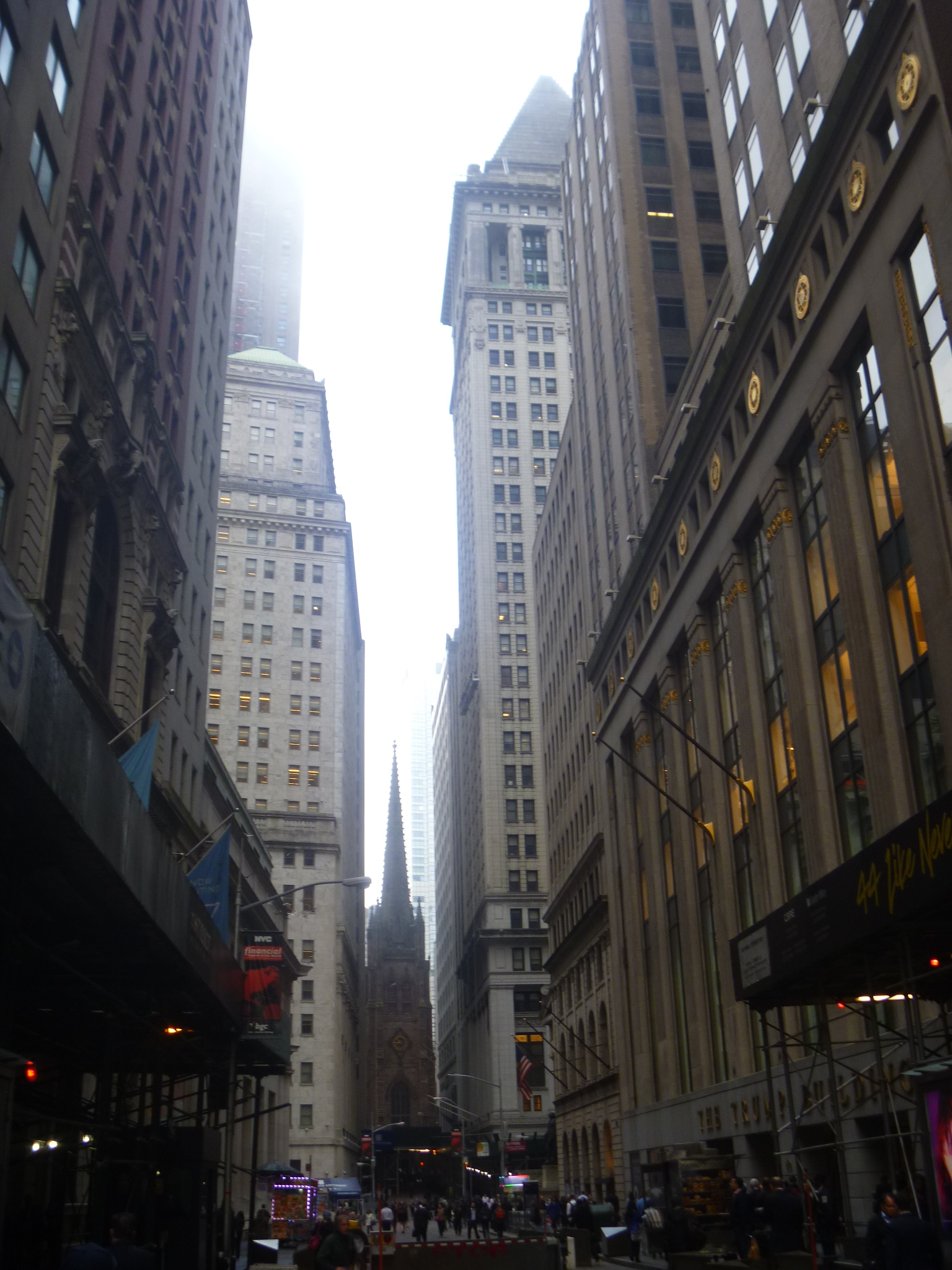
Wall Street with the spire of Trinity Church in the background.
I thought I knew about Manhattan, having visited quite a bit while growing up and having lived in couple of neighborhoods. I’ve ridden on the Staten Island Ferry and been to the Statue of Liberty. Both require you to go to the toe of Manhattan. What I skipped over until this trip was the neighborhood just inland from the Battery that includes Wall Street. Now that Lyra lives there, we stopped in for a visit and it is a very enjoyable part of the city.
We stayed at the Wall Street Inn (on S. William St.), a very comfortable small hotel with an excellent breakfast included. It’s also near subway stops, but its greatest asset is being located right around the corner from our daughter’s apartment, by Delmonico’s. (We did not eat there on this trip.) We did take in the sights nearby and there are many. We stopped in front of Federal Hall on Wall St. where George Washington was inaugurated as the first president of the US.
We saw historic Trinity Church and its churchyard.
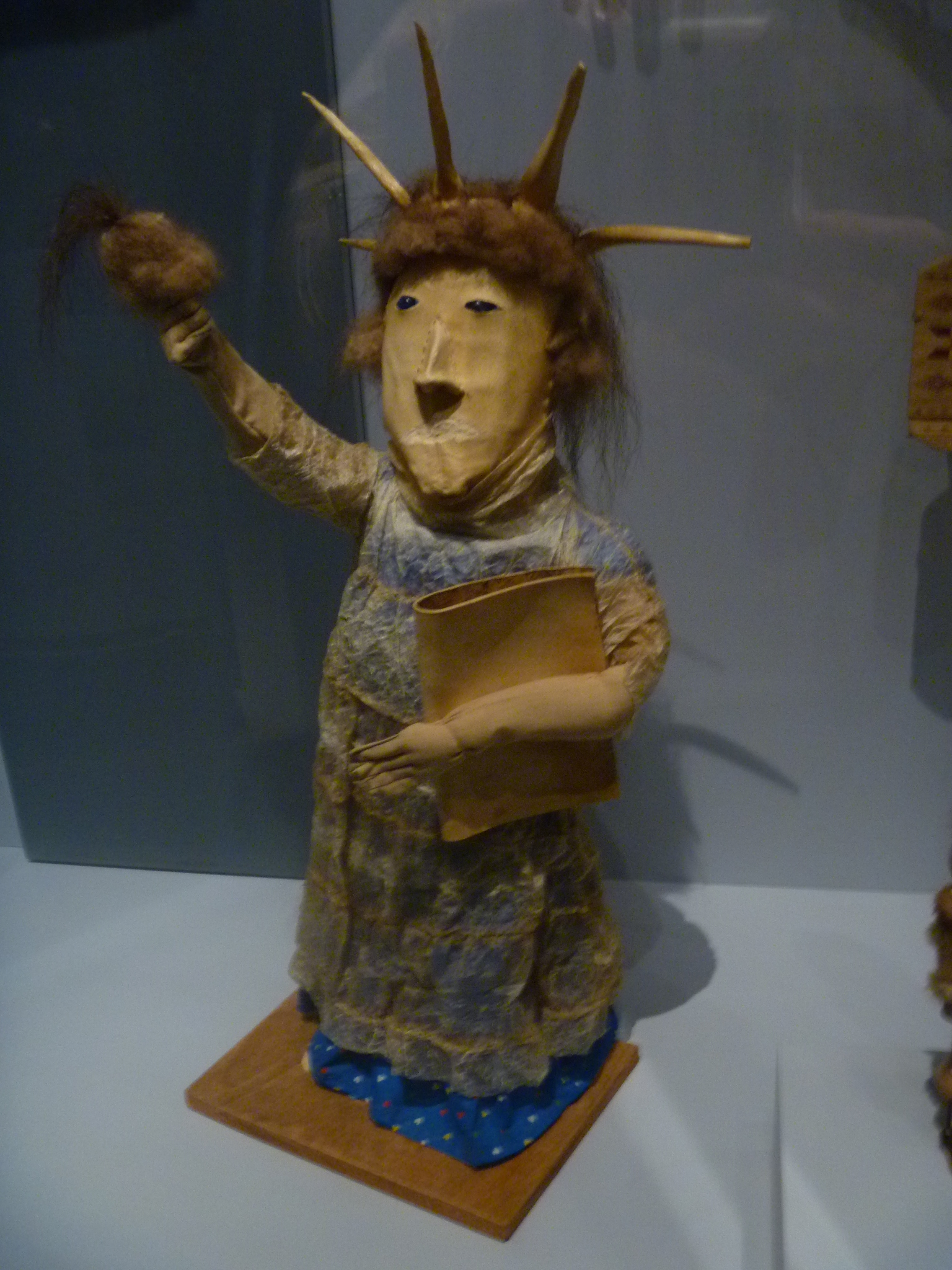
Lady Liberty at the Museum of the American Indian
The former US Customs House, just down the street from Federal Hall, overlooks Bowling Green. Today it is a branch of the National Museum of the American Indian and holds the collections that were formerly the Heye Foundation. It was difficult to visit before moving to the Customs House, because the building was largely storage and had limited display of collections. The museum was located way off the beaten path on 155th St. and Broadway. Now the museum is at the Bowling Green subway stop and the new exhibits show the rich collection of materials from North, Central and South America. I particularly enjoyed seeing the pottery from Costa Rica and Panama that reminded me of the time I spent in Costa Rica while working on my dissertation and how much I admired archaeologist Olga Linares for her book on the imagery on Panamanian pottery, “Ecology and the Arts in Ancient Panama.”
A scary plate from Panama.
“The Thinker” as a rabbit, from Costa Rica
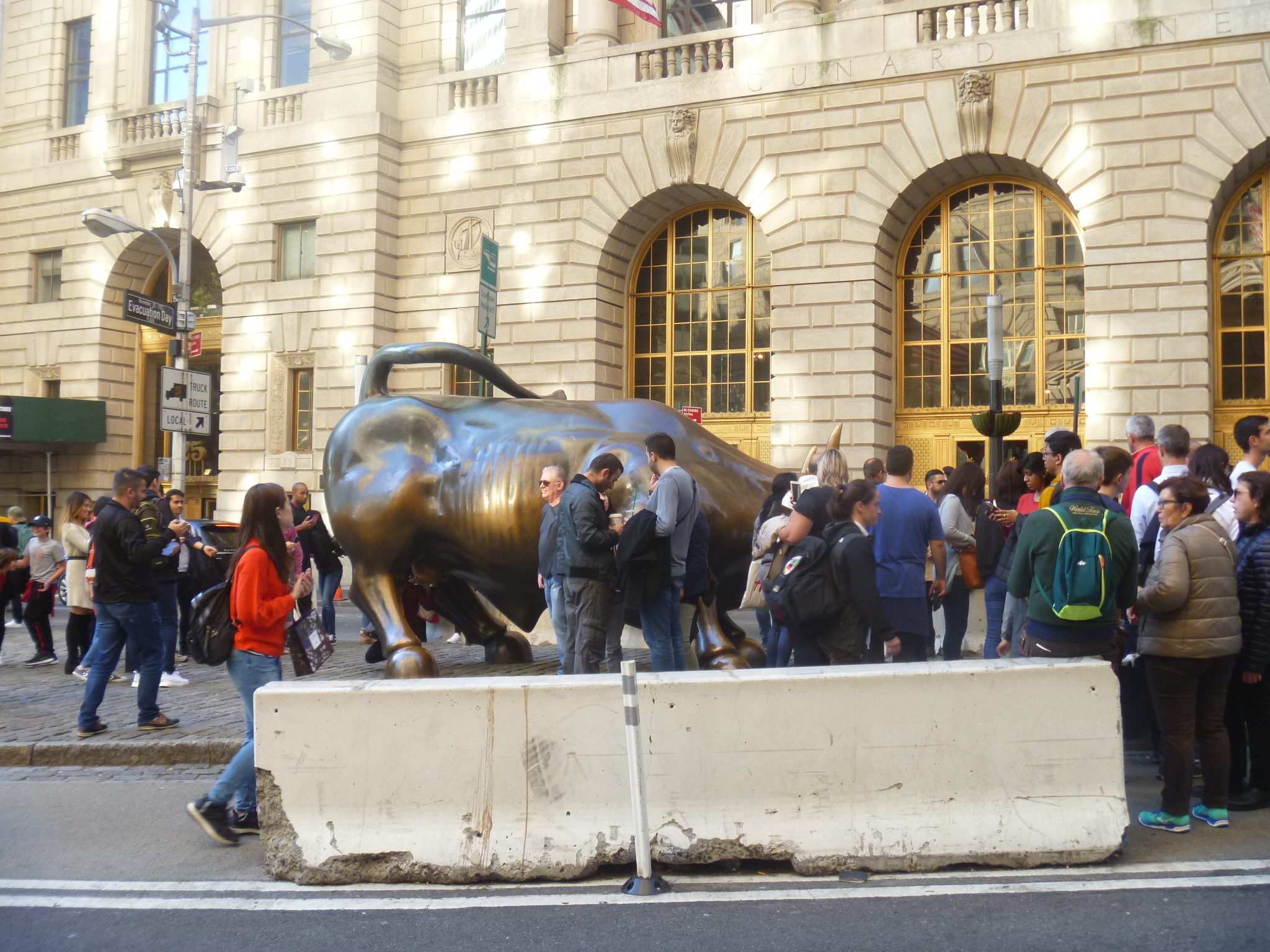
There is also the Wall Street Bull, though it was ass deep in tourists. The “Fearless Girl” statue facing the bull was put in place in March 2017 and was still there.
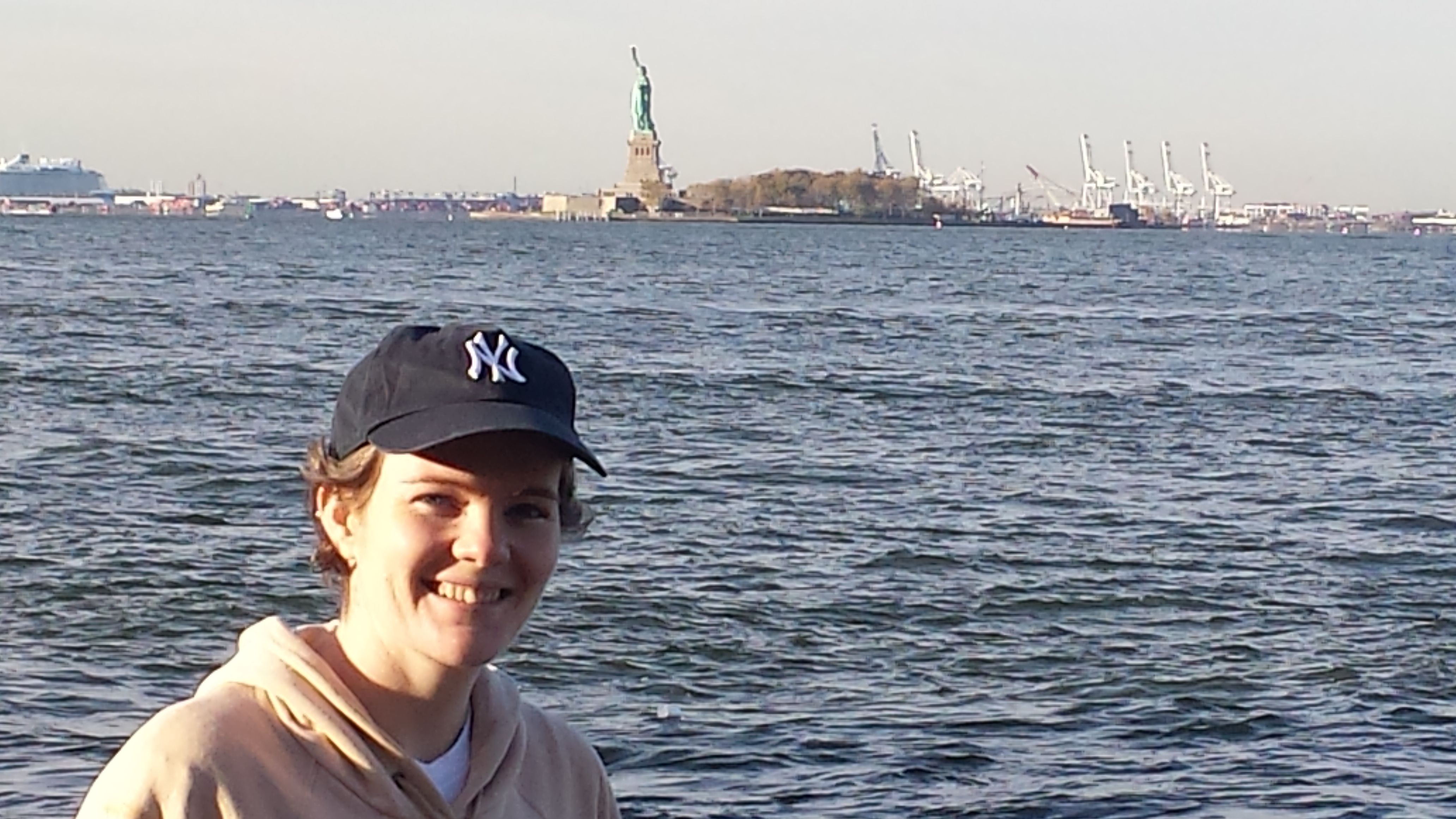
Just two blocks beyond is the shore, lined with a walkway that is used by strollers and joggers alike. Once you get beyond the area where visitors to the Statue of Liberty and Ellis Island congregate, it is a relatively peaceful and uncrowded part of the city. The view out over the water to Liberty herself and Ellis Island are sublime. It’s a great neighborhood.
It is impossible to generalize about Italy. Every region has its own customs, traditions, holidays, food, music, language. We’ve enjoyed our time in Italy this year, seeing many places that figure in the history and archaeology. The spectacular art in many museums has been wonderful to see.There is a cost to visiting Italy. All of its delights are not waiting for you with open arms. I will touch on three areas that have me puzzled, frustrated, angry, or laughing, depending on when I last sat down in a cafe.
The Third World?
Having spent a lot of the past 20 years in Peru, I think I know what the Third World looks like. Why does Italy look a lot like that? They may have some of the world’s oldest universities, and great art, but they have a puzzling ethic that boils down to “If it’s convenient for me, I’ll do it.” That explains parking as an afterthought, double and triple parking, trash on the beach, in the street and burning in the back yard, corruption, rudeness, smoking and a lot of other unattractive habits. Are other people perfect? No, no and no. Do people in Italy that I meet in the store or on the road sometimes drive me crazy with their “Why not? attitude. Yes.
The Environment
Italy is gorgeous. Tuscany has zoning laws to prevent its lovely hill towns from developing urban sprawl. It is clever to put warehouses and highways out of sight in the valleys. People in Italy love going to the beach, they love boating. They appreciate nature and good design.
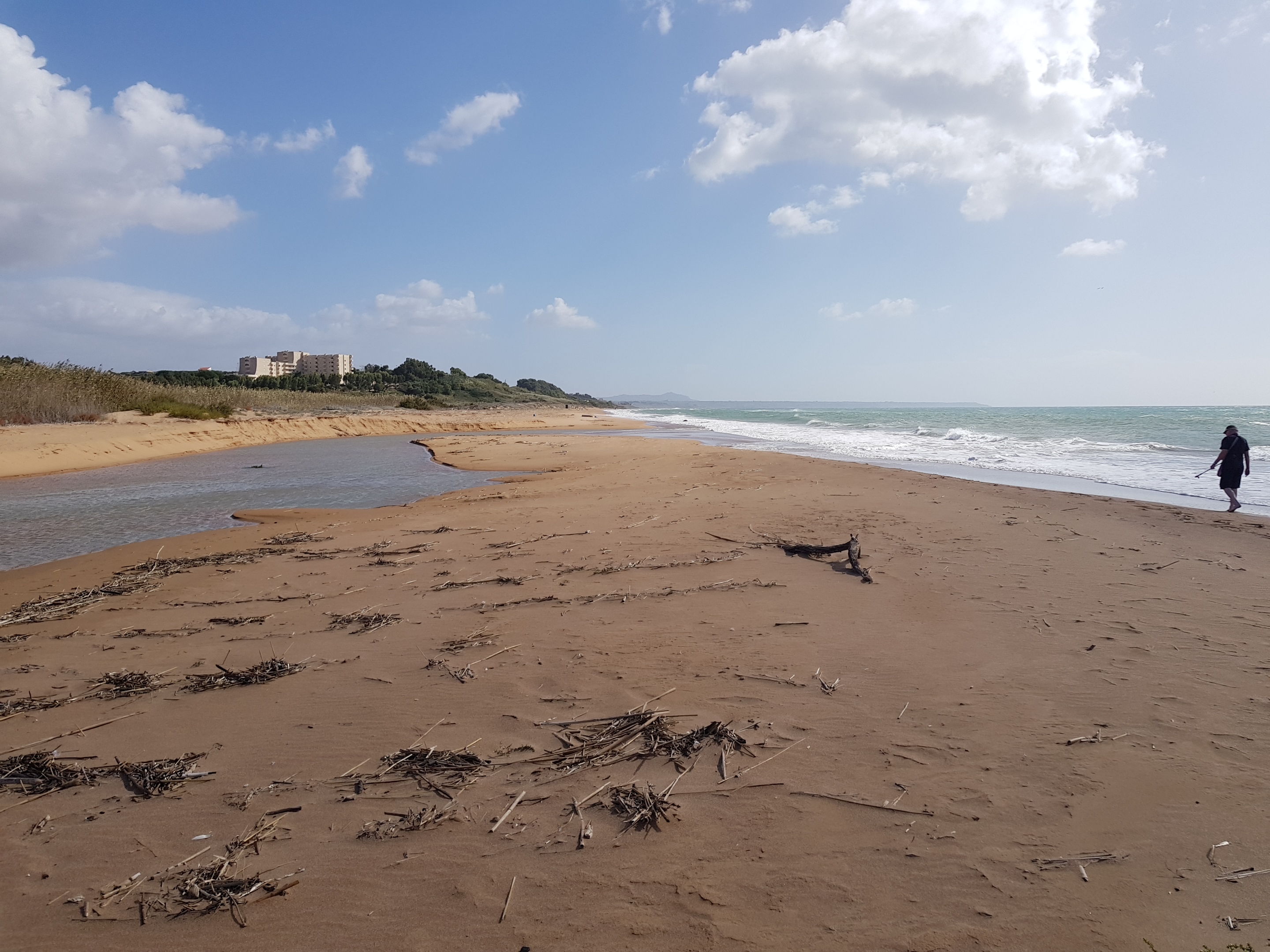
At the same time, they appear unable to corral their trash. On the beach, people just ignore the empty bottles around them, dropping papers and bottle caps as they go. The result is that even beaches that don’t have many visitors have rafts of empty water bottles, jerry cans, styrofoam, plastic cups, silverware, and plates. There are glass bottles, too, but mostly plastic, every kind of container you can imagine. It seems that people become hardened to what is all around them. We did some great beach combing, collecting beautiful bits of polished beach glass, on beaches that were really unsightly, yet they had plenty of visitors.
Recycling seems like part of the answer, but it is underdeveloped. There are collection points, but there is confusion and people ignore the labels on bins, and mess ensues. Worst is yard waste. It’s not recycled/composted, even in agricultural areas. People burn trash and yard waste in the open, creating smog that covers Sicily. At any time of day, you can usually see two or three fires on the horizon. Smog over Palermo is noticeable, not to mention Naples and every other city. Wouldn’t composting all those clippings from grapes, olives and citrus trees be a goal that could be achieved?
Driving In Italy
This should be easy. They drive on the same side as in the US, the major car companies are there, no problem, right?
Wrong.
Before you decide to drive in Italy for more than a single outing, consider a few things. How much driving will you actually be doing? You may spoil your trip if you do a lot of driving in cities where you need to find parking as well as finding your way. The countryside may not be a lot more forgiving, as roads can be narrow, in poor repair, lacking signs, steep and full of curves. How many hours a day of this can you survive with your good spirits intact?
What about those famous Italian autostradas? They have multiple lanes and high speed limits. Not so. Apparently there are so many groups competing for the income from traffic tickets issued by cameras that they are planted all over the place. Speed limits go up and down constantly and in general there is no way to tell what the speed limit really might be. If you actually followed the posted speed limit over most of Italy, you would drive at 50 kilometers (30 miles per hour) 80% of the time.. Literally NO ONE drives the posted speed limit (except farm tractors). Even the agent at the car rental said “Oh, I have sooo many tickets!” What? It turns out that if you drive in Italy you will have tickets. You won’t know when because they come in the mail about three months after the supposed infraction. They can only be challenged if you are in Italy and I have no idea how Italians cope with the situation. As I noted in a previous post (Life in Campania), most Italians drive at least carelessly if not dangerously. That’s how its done. If you do drive, expect to have at least one accident and it matters not who was to blame.
We should never have let him get away.
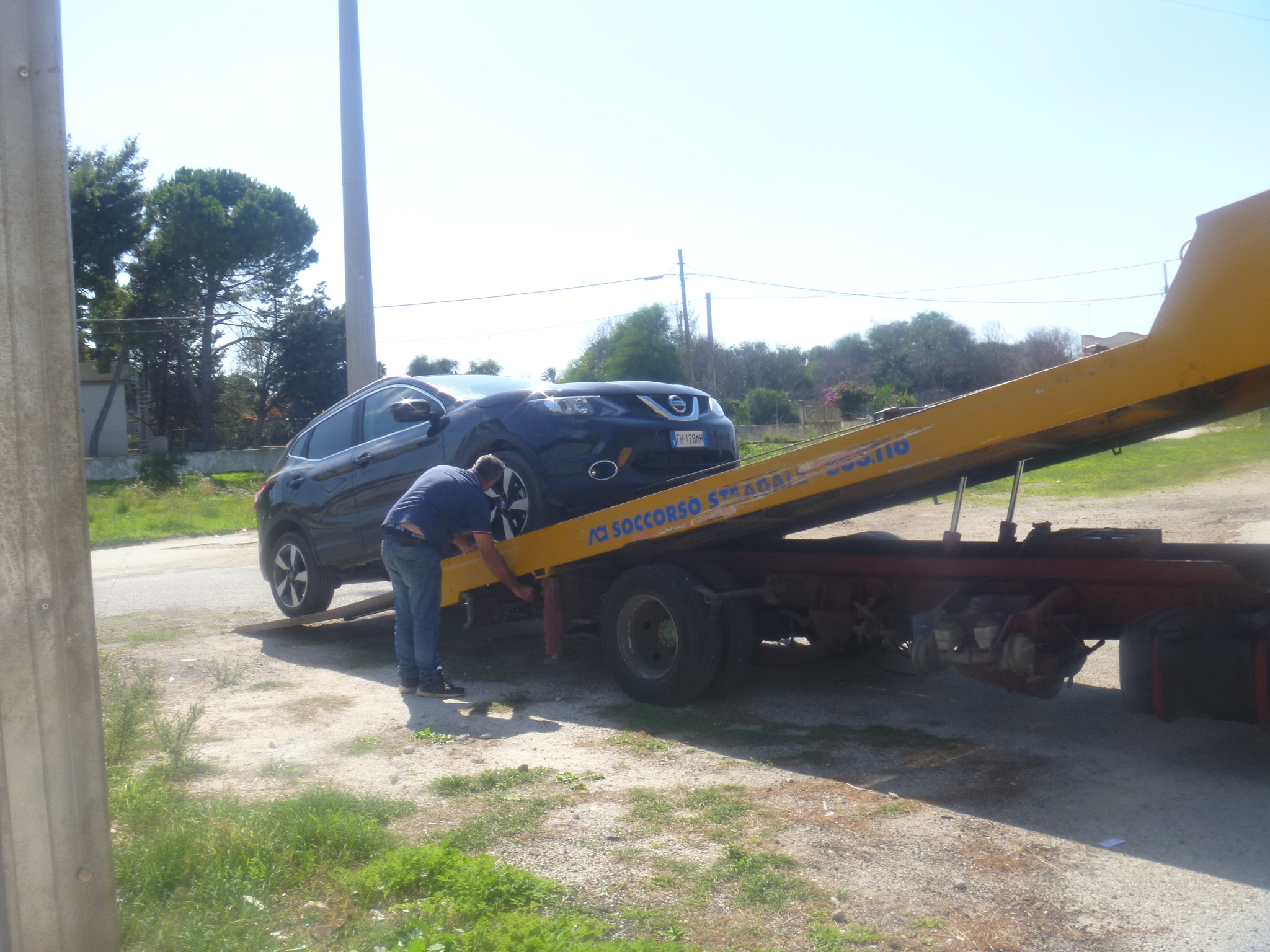
My recommendation is: Don’t drive if you can possibly avoid it. Stay in one place, enjoy what’s around you and go on excursions driven by others. That rules out some activities like our trip to a bird sanctuary yesterday where we saw a red tailed kite, coots and huge gray herons. I would miss that, but not the driving. You have to be ready for the inevitable accident, too. We had a blowout on the way to the beach and when I called the roadside service the woman said we were not authorized to drive on small roads (that would include the exit ramp from the airport and our driveway…). We were told to drive to a numbered road, call back, and “Don’t say you were on a small road.” A passer-by helped us get to a gas station on a nearby numbered road. Hertz eventually sent someone to tow the car but left us stranded. We had to get to an airport 90 minutes drive away on our own on Saturday afternoon in rural Italy at a cost of 220 Euros (20 Euros less if we did not want a receipt, so the driver did not have to declare the ride on his taxes.)
That was before the fish delivery truck drove into the back of our car. The guy tried to get away and when we stopped him, he said “It was the guy behind me!” (There was no one behind him.)
Basta! Enough about driving! Don’t get me started on parking!
Other things about Italy
We used the train in Salerno, tram in Florence, vaporetto in Venice and subway and buses in Rome. They worked, except when there were strikes (only in Rome and only on two days).
Phone service is good except where geography gets in the way. Naturally service was poor where we had our flat tire, but in general our cell phones with Italian SIM cards (Vodafone) worked well and were not expensive.
Food is good and inexpensive to expensive depending on your location. We ate as many cannoli as possible in Sicily. Fresh ricotta in the south and fresh mozzarella in the Naples area were really delicious. We had great inexpensive wine, and tried a lot of wine made from grapes we had not run into before, like grillo, and inzolia (white), and nero d’avola and nero mascalese (red). It was fun to experiment.
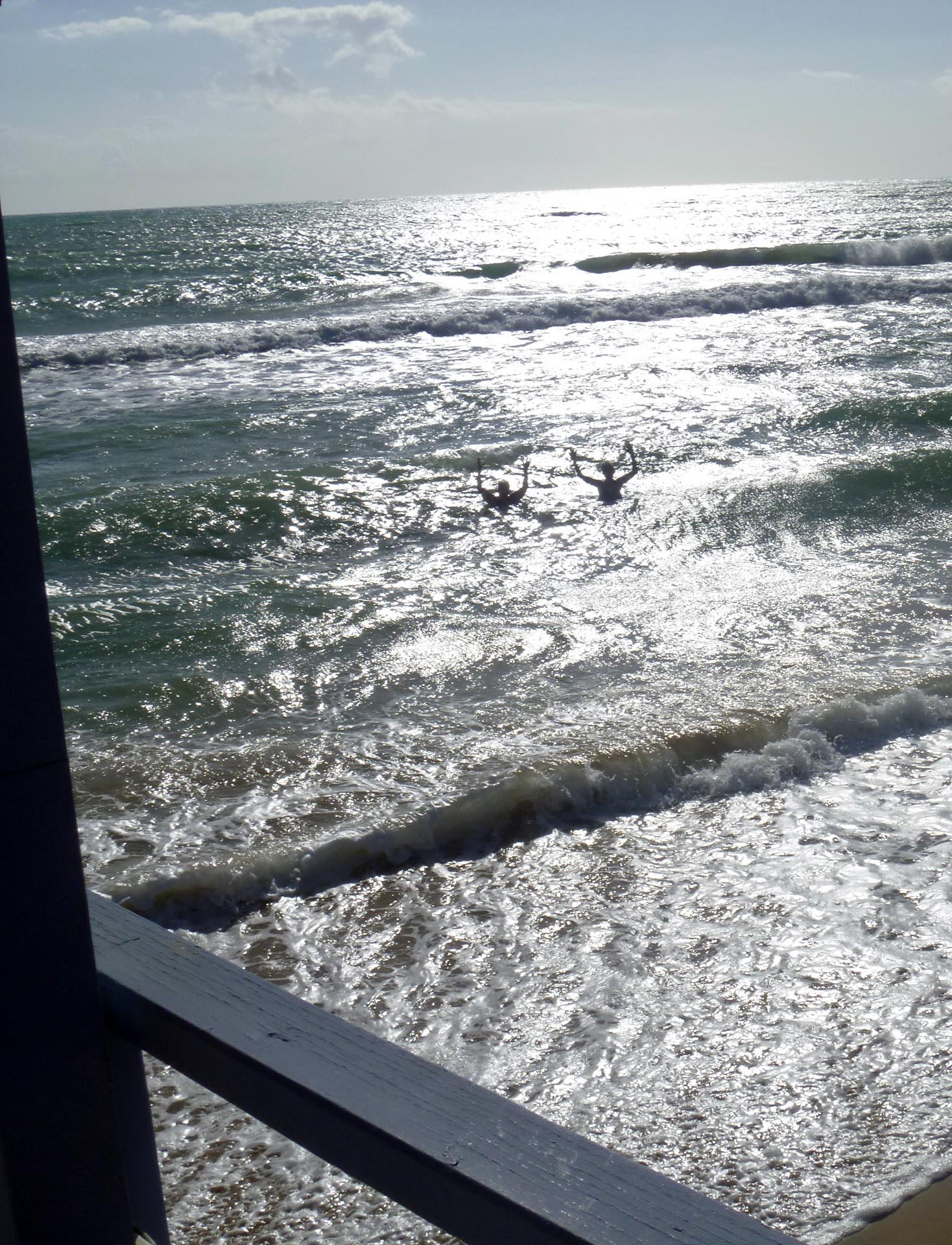
The weather cooperated. I went swimming until the very end of October. The expected two days of rain per week in Sicily in October only materialized the first week. After that we had sun and wind. It was glorious.
Italian people are hospitable and warm if you know them or have been introduced or have some kind of connection. If you are going to Italy, see if you can get an introduction to your friend’s cousin or your neighbor’s uncle in Italy. Friends of professional colleagues might be enjoyable to meet. We had great conversations with our various landlords of our Airbnb rentals, with archaeologists working at sites we visited, even the eye doctors I had to see. A personal connection paves the way for really enjoyable interactions. However, without some kind of connection you may have trouble meeting people who are friendly. It seemed to me that friendliness is viewed as a limited good in Italy, not to be wasted on random, unknown tourists. (Perhaps because there are so many of us.) BUT, a friend of a friend is still a friend and deserves a welcome. Once you’re on their radar, you will see the hospitality that Italy is known for. I hope you have as good a visit as we have had.
The official name of the airport is Fiumicino – Aeroporto Internazionale Leonardo da Vinci though most people call it the Fiumicino or Rome airport. It’s 21 miles from the center of Rome, about a €40 cab ride. There are also train and bus links to the city. We were connecting from Palermo so we stayed overnight at the Hilton Garden Inn at Fiumicino whose redeeming quality is being the only hotel on the airport staff shuttle. It’s a bit confusing until you understand that it is not a hotel shuttle, its he Staff Shuttle, but it works and runs frequently. The hotel also had surprisingly good food that night.
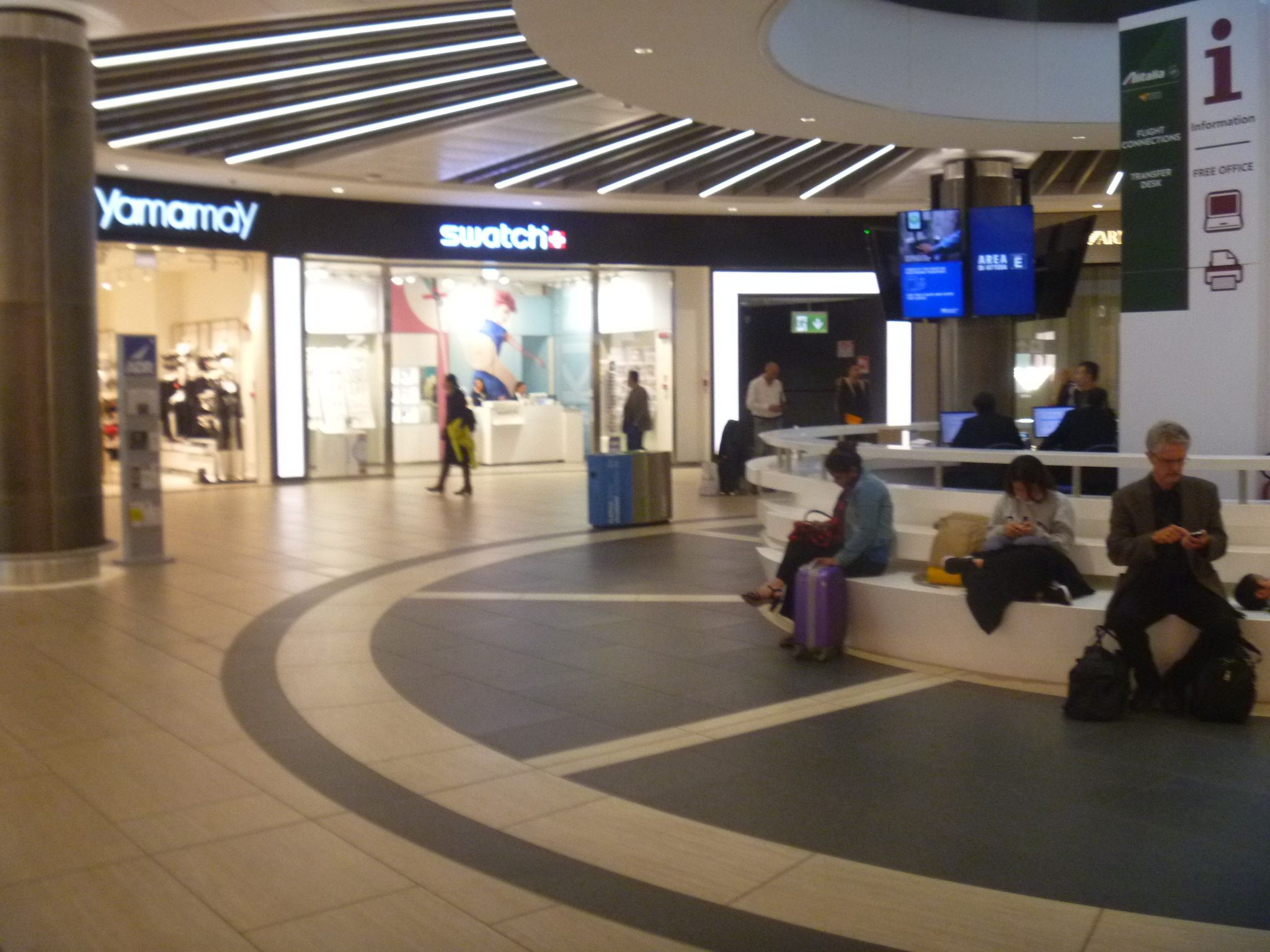
Our flight to New York didn’t leave until 11:25 am, so we planned to do some last minute souvenir shopping with the remainder of our euros. We wanted a book about Italy with lots of photos, among other things. That’s when we discovered that the airport is not really Rome. It’s not really even Italy. It’s “International Airport,” where the only things for sale are high end jewelry and clothing, duty free shops, and restaurants. Further, the shops are all the same whether you are in Rome, New York, or Lima, Peru. This shift has been coming for a few years but really hit me on this trip.
There is a fold-up paper map of the airport showing the location of stores but no signs that show “You are here,” bathrooms, or airport lounges. You’re intended to wander aimlessly and shop. We stopped at several information desks where we were given vague directions. We were told at one desk that there is no bookstore in the airport any more. We passed three shops selling books after that. We were given directions to the Alitalia preflight lounge by three different people and hunted all along the terminal, finding only one sign for the lounge–outside the door. There are a few convenience stores that sell overpriced souvenirs, so we were able to get a couple of things, but be sure to do your shopping before you get to the airport unless you want a new Swatch, a Montblanc pen, or Tumi luggage.
On the bright side, if you have a layover at Fiiumicino for two hours or more, there is a free shuttle from the airport to the entrance of the Ostia Antica archaeological park, just a few minutes away. We had a wonderful day trip to Ostia from Rome. It would be a good use of a few hours to visit from Fiumicino, closer to the site than Rome itself.
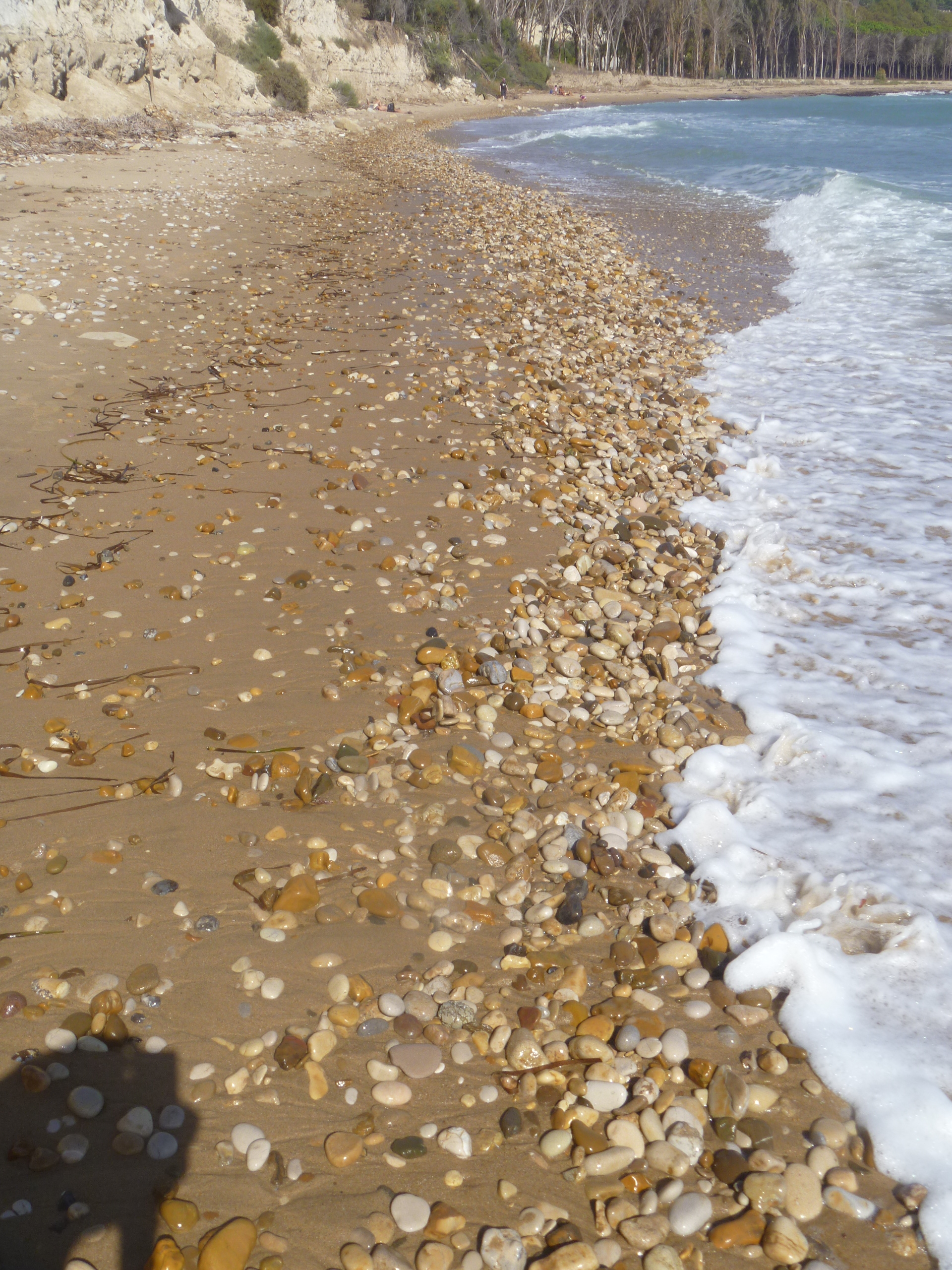
It’s often breezy at the beach. We got out of the car and crossed the fringe of dunes, arriving at the shore to see small waves crashing and the wind rushing east along the sand. Walking into the wind, we started our beach combing, finding smooth oval pebbles and beach glass.
Ow, ow, ow!It wasn’t sand flies or hot feet, but the sand stinging our ankles, whipped along by stronger wind than we had felt before. I only remember the bite of the first gusts, though the wind kept up so strongly I almost lost my footing a couple of times. The sun was as bright as ever, and the water felt warmer than usual. We could feel the seasons changing.
The light is more slanting as fall comes on. Morning and evening shadows are long and last longer every day, as though the sun is resisting Apollo’s horses dragging it upward. One evening I said, “You didn’t need to close the shutters so early”… then realized that they were open and it was already dark.The wind was still blowing in the change of seasons at Morgantina the next day. I had to give up on wearing my hat or it would have flown miles away. Morgantina is another of the mammoth ancient sites in Sicily that had a long and varied history before being sacked by the Romans in 221 BC. Though it continued to be occupied, the city never regained prominence. It’s been a couple thousand years since then and Morgantina is still sitting on its hilltop out of the mainstream.
Heating pipes of a Greek bath house
In the bath house
A large kiln
The wind blew away most of the visitors. We saw a busload of students from a distance and after they disappeared we saw only one or two other visitors at this vast site. (It is 30 minutes each way from the Palermo-Catania highway, and not close to either Catania or Palermo, a bit out of the way.)
The fall scenery is spectacular, silver-brown furrows in the recently plowed fields that curve and dip across the rounded landscape. Mt. Etna sits in the far distance, volcanic ash like snow on the upper slopes and clouds covering the peak. The wind blew clouds overhead, creating patches of light and dark that changed constantly, shifting a hill into sunlight then into shadow as we watched. It was a captivating landscape, half New Mexico’s stony ridges, half midwestern farmland, and definitely its own thing.
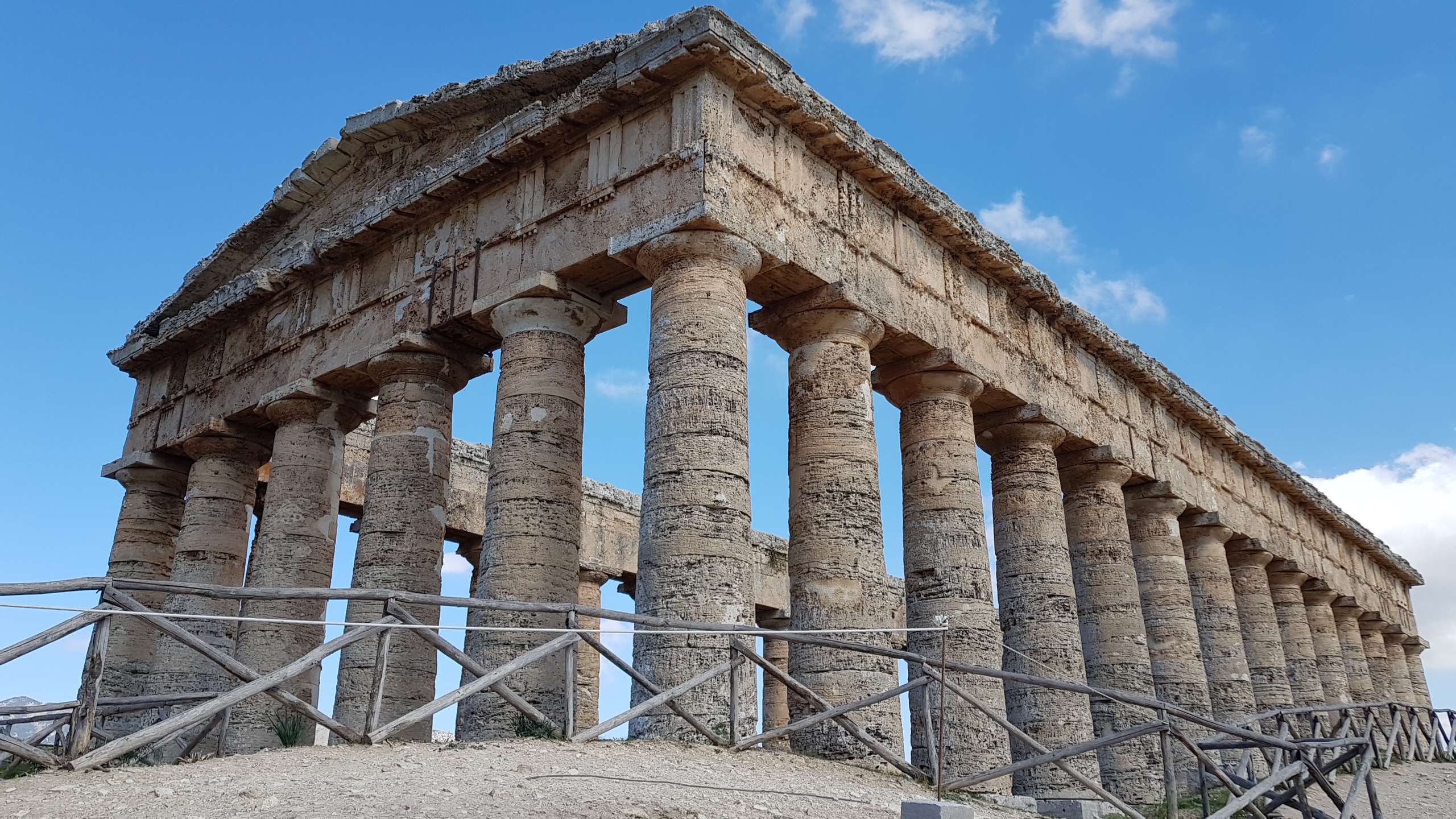
Sicily was the largest colony established by Greece. What that actually means sinks in about the third time you visit a vast, partially excavated archaeological site and find a temple, or several, that appear to be transplanted straight from the Acropolis in Athens.
AgrigentoSelinunteSegesta
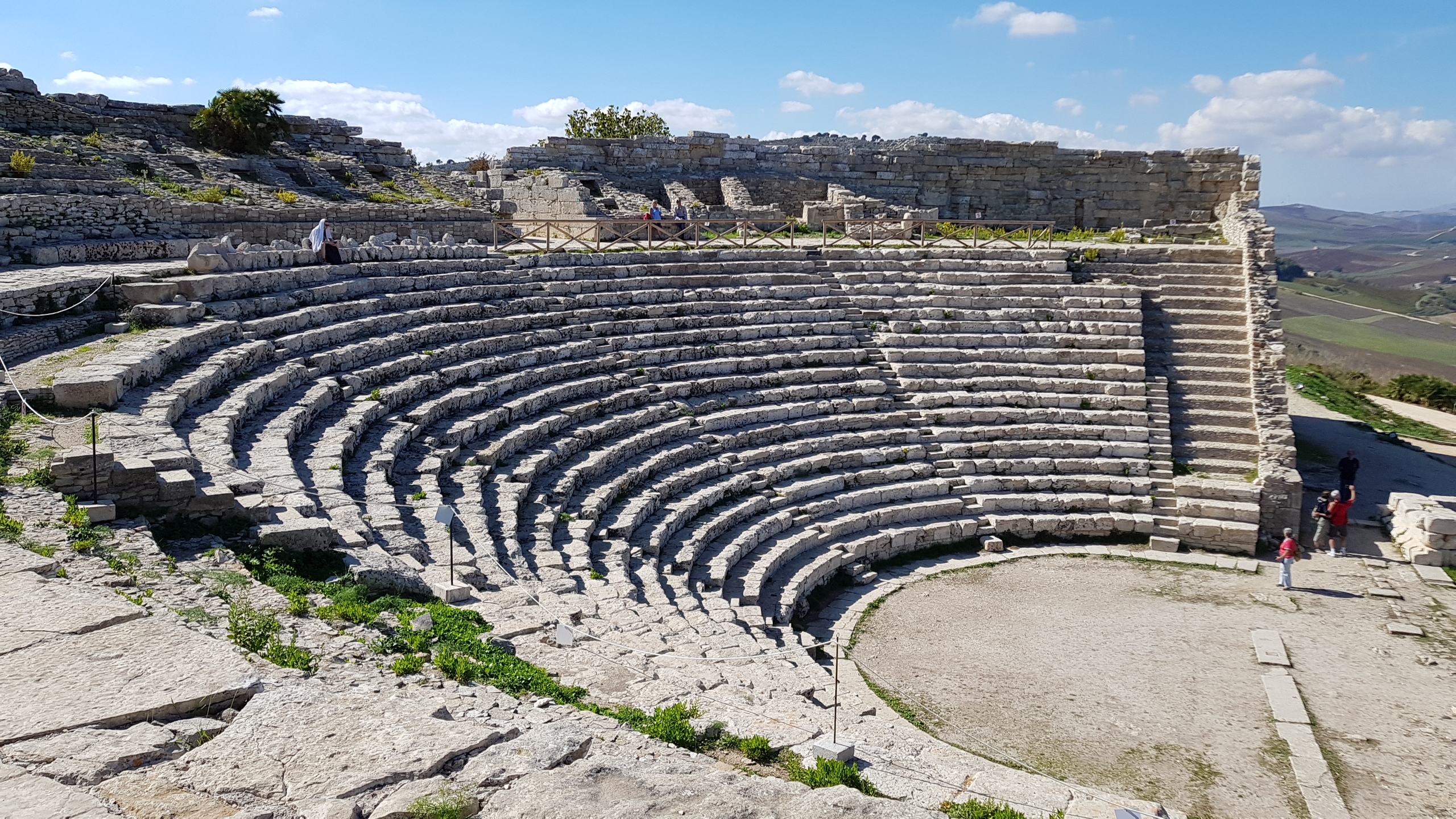
The temples may the most impressive sights, but there are lots of other features. Like a big amphitheater at Segesta.
Amphitheater, Segesta
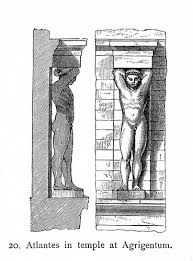
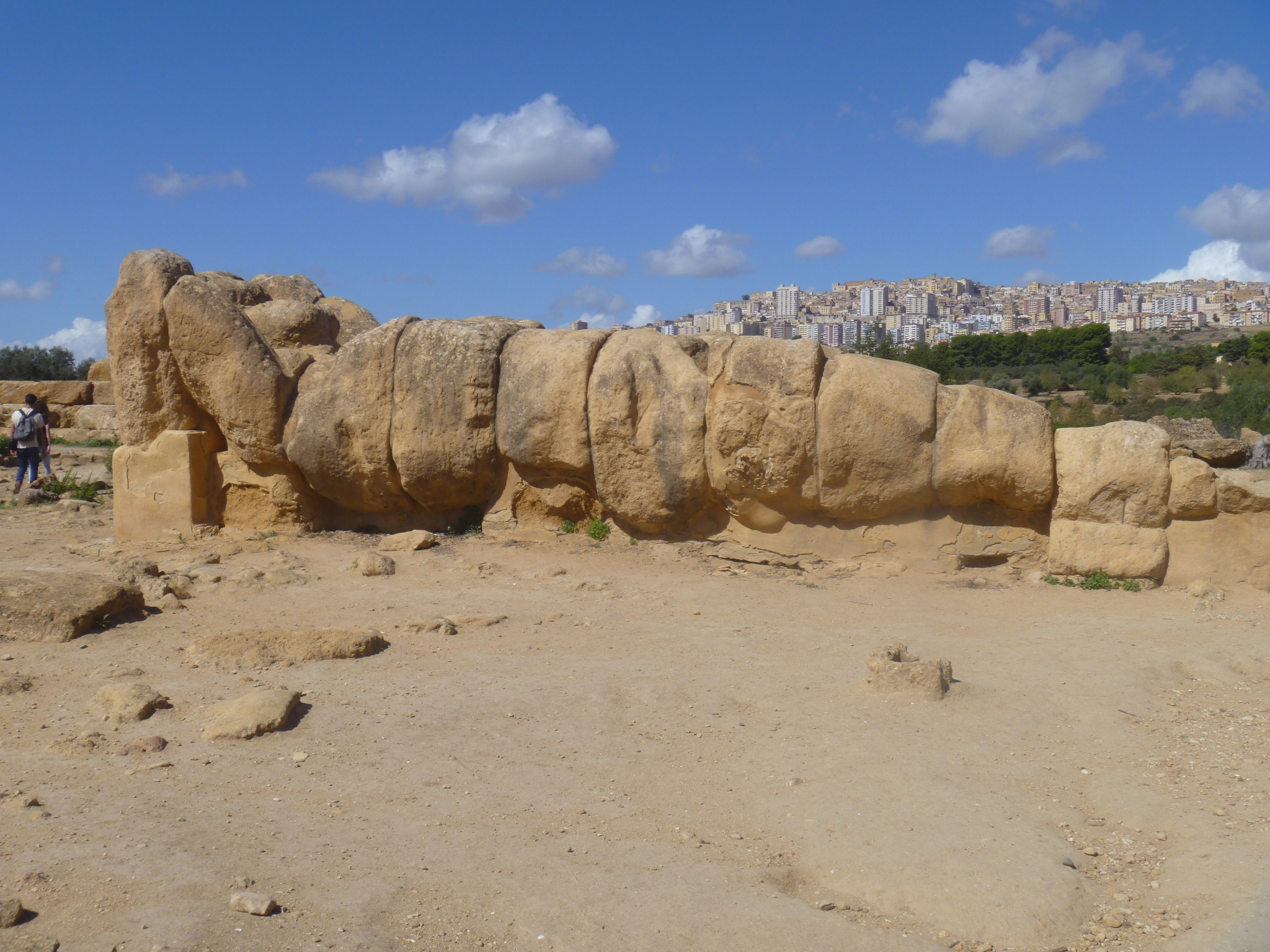
Huge roof supports shaped like gods (telamon):
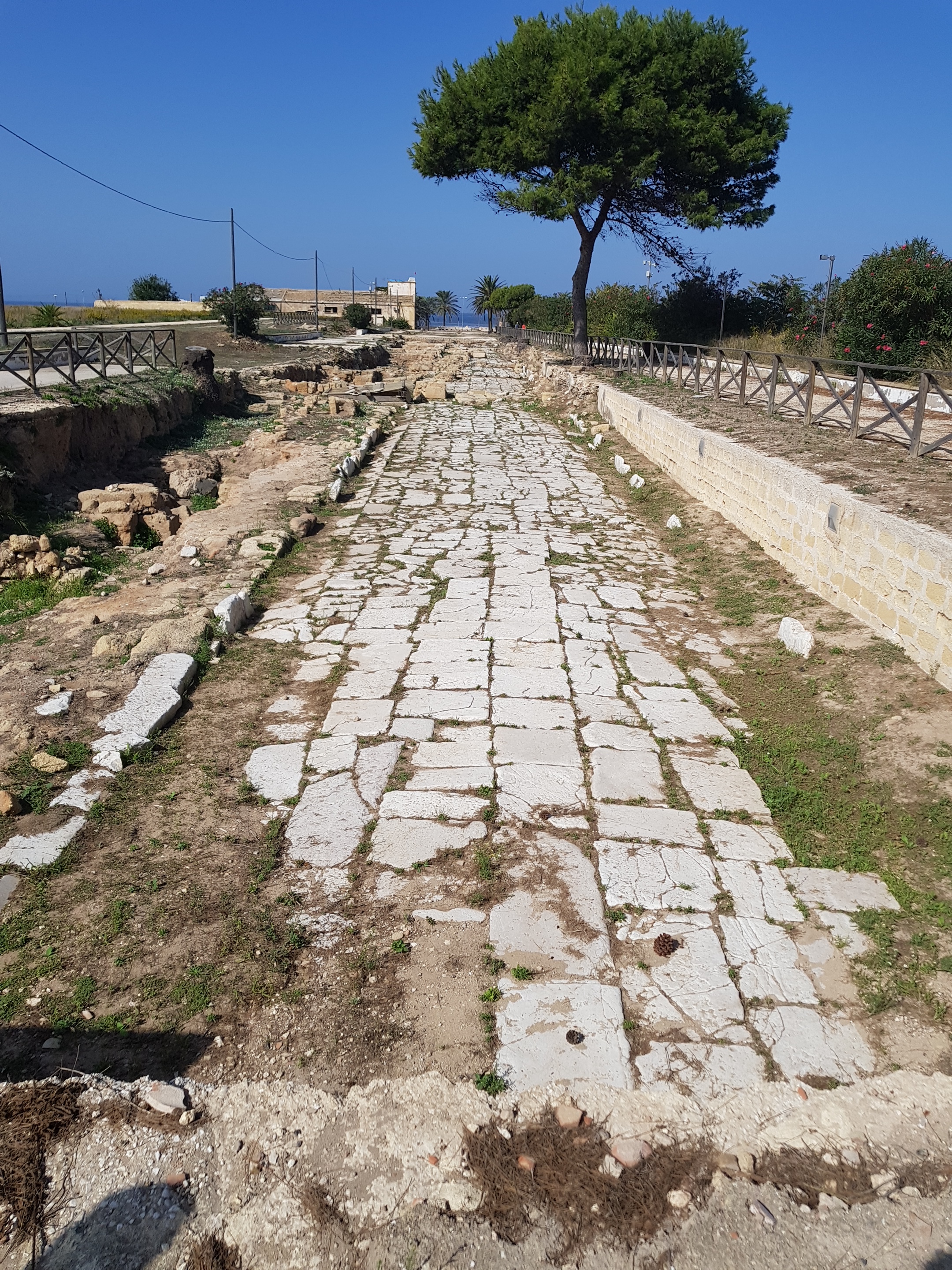
The Greeks were supplanted by the Romans, and then Arabs, then Normans, then others. The Romans left paved main streets (Decumani), like this one in Lilybaeum (Marsala)and elaborate mosaic floors at Villa Romana de Casala (Piazza Armerina), see the previous post for these.
Off topic but interesting: This recent article tells about a New York City resident and art dealer who had a section of mosaic from a ship that belonged to Caligula (Roman emperor 37-41 AD), It was finally repatriated to Italy this week after spending about 40 years as a coffee table.
As if all this were not enough, we’re off to Morgantina, another great pre-Roman site in Sicily, followed by Syracuse (the one in Sicily). I’ll add more from those stops. However, I can say without a doubt that the Greeks were everywhere in Sicily, and in many ways they are still here.
We didn’t know much about Piazza Armerina until we looked for archaeological sites to visit within driving distance of us in Sicily. The guidebook indicated interesting mosaics at the Villa Romana de Casale near the town of Piazza Armerina. The mosaic floors of this villa, owner unknown but possibly the Emperor Maximian (250-310 AD), are wonderfully detailed. We’ve never seen anything like them in all our Italian travels. Why isn’t this site better known? OK, there were ten tour buses parked at the site when we left at 3:30 pm. But seriously, I had heard very little about this particular site and the mosaics are unparalleled.
This slideshow requires JavaScript.
Hunting is a major theme, especially in the Great Corridor where a scene over 200 ft long shows the capture of exotic African animals that were shipped to Rome. There is detail in the shapes and colors of the animals, the individuals capturing the animals, and their transport (the elephant is wrapped in a net). Within the long scene are vignettes that accompany the tale. A slave is whipped, a tiger’s cub is stolen while she is distracted by a reflection. It is remarkable.
One of the most interesting rooms in the Villa Romana shows women competing in sports and being awarded prizes (crown, olive branch) for running and other games. I have not seen another depiction of woman in a palestra (gymnasium) or competition. Nicknamed “the bikini room”, this is popular even though the Blue Guide notes it is of “inferior artistic quality compared with the others.” I think it’s great.
This slideshow requires JavaScript.
Other mosaics include various ways of hunting (nets, clubs), cherubs fishing, boats, children riding animal-drawn carts, children being chased by the animals they were pursuing, and the legend of Anios, who won a music contest in Sicily, was robbed by sailors on his trip home and thrown overboard only to be saved by a dolphin. Areas that were closed during our visit show people getting a massage in the bath complex, and the twelve labors of Hercules in a large atrium.
This slideshow requires JavaScript.
Here are a few details. There are over 4,000 sq meters of mosaic floors in the Villa Romana. Some mosaics are so fine that they average 36,000 tesserae (pieces) per sq meter. The mosaics at the Villa Romana are considered to be Romano-African in style, and some may have been made in sections in north Africa (Libya, where there were large Roman colonies, for example) and shipped by boat to Sicily. The putative owner of the villa, Maximian, was known as a soldier and hunter rather than a statesman, interests that the mosaics support.
Another piece of evidence that is used to associate the structure with an emperor is the decoration of the room called “The Circus”. It depicts horse races around a track from the perspective of the emperor’s box at the end of the arena, where nobles look on from the sides.
Having a guest really gets you up and going. With my sister Catherine we hit high spots of the region so that she could take away a sense of western Sicily. Three themes emerged, landscape, beaches, and archaeology.Sicily’s landscape is Dramatic.
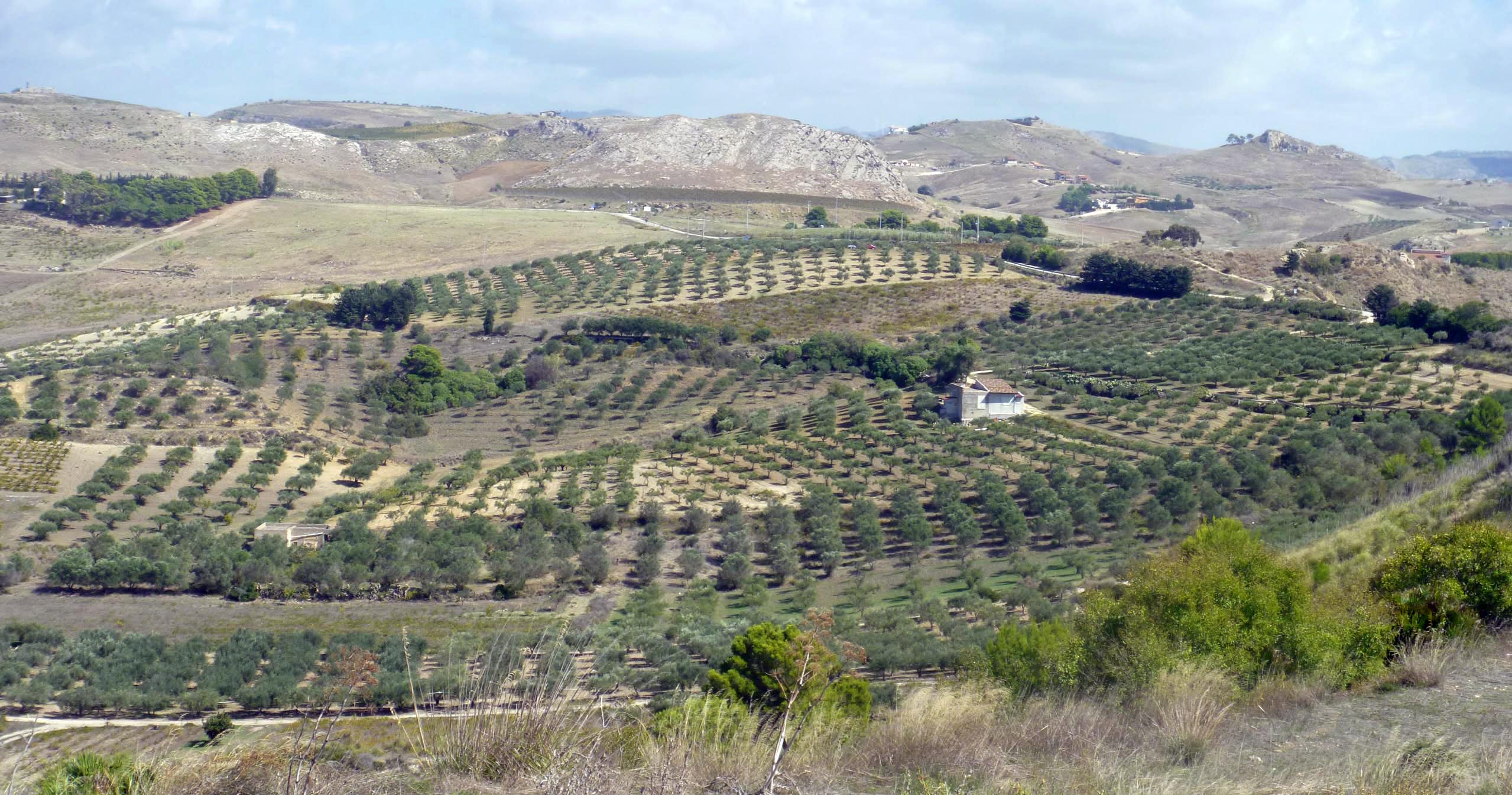
Huge rocky hills emerge from the sea, yet just beyond are broad plains of wheat in one area, olives and grapes in the next, then the dark green citrus leaves of lemons and oranges. The nearest airport to us is Palermo, located on a huge bay called the “Golden Shell”. From there we visited Erice, a tiny town outside Trapani that is perched on a high hill. Its medieval streets are largely intact, and the view out over the coast and the Mediterranean is superb (see opening photo).
Catherine at Erice
Medieval streets
On another day we went to the opposite side of the Golden Shell to Punta Zafferano.
Punta Zafferano
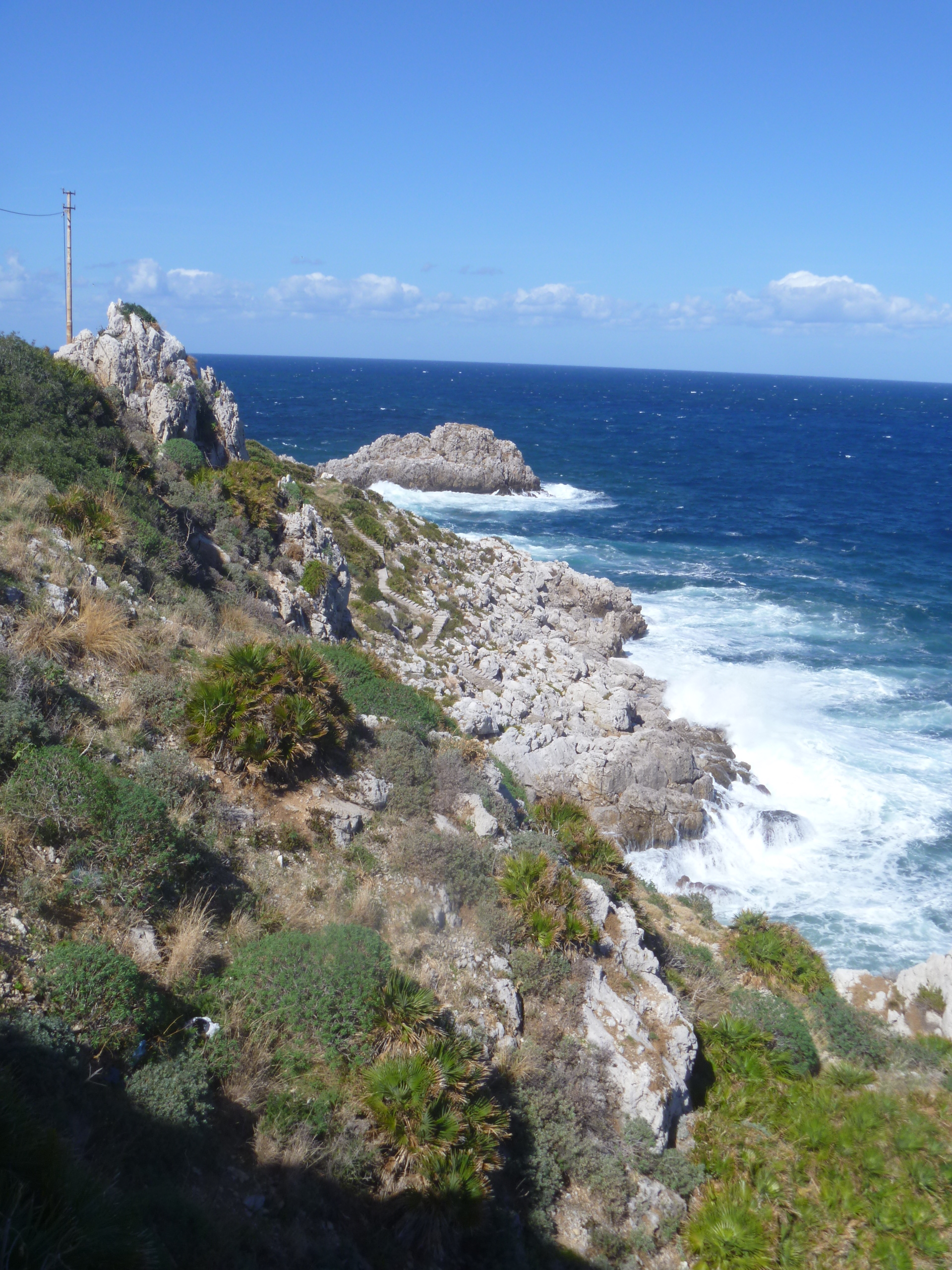
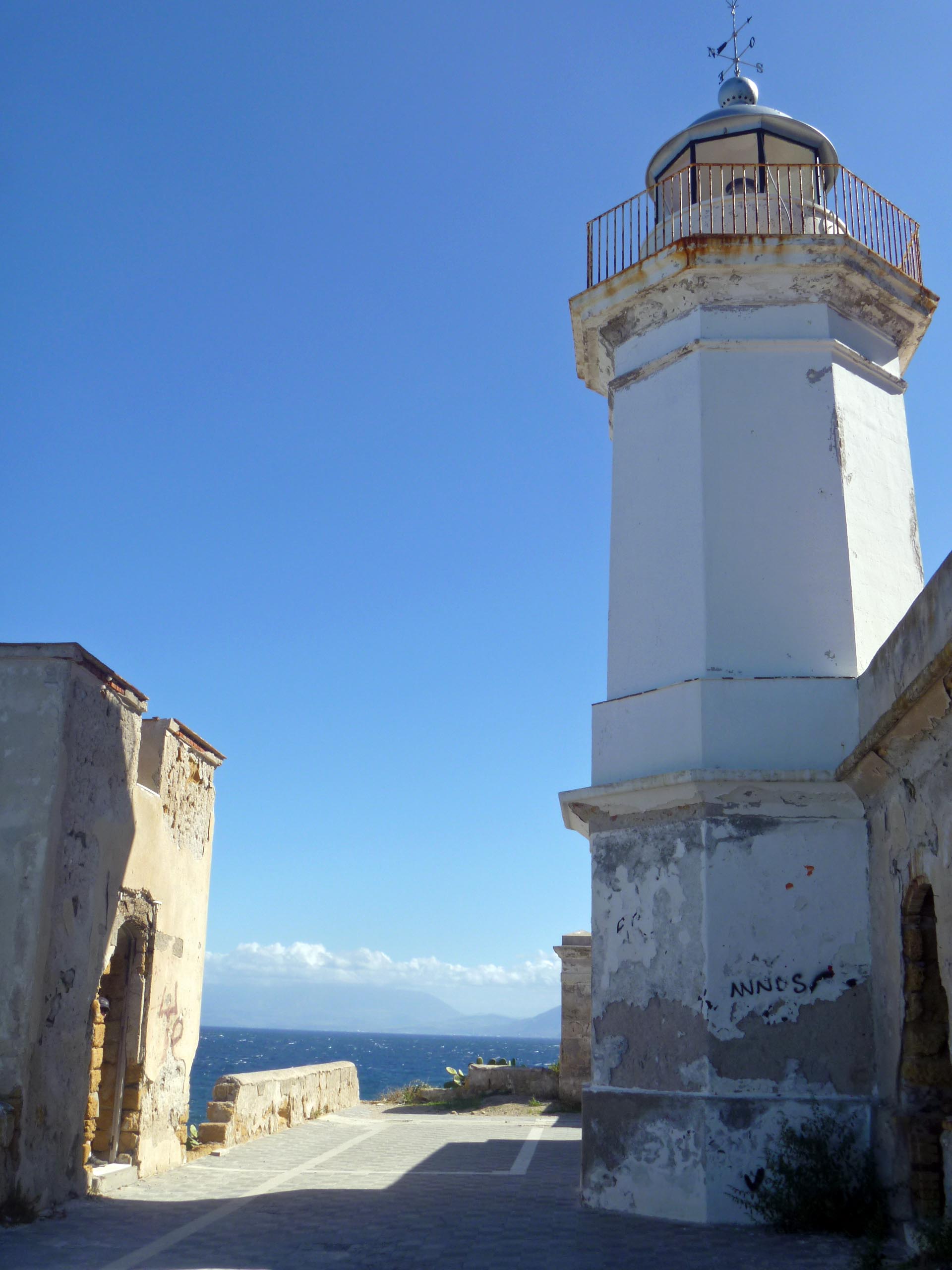
We saw the sea up close, where an abandoned lighthouse presides over the rocky coast and the waves plunge, swirl and surge onto the rocks. The “road” narrows to the width of a cart. Fortunately we were able to make about a 37 point turn and park, so that we could have our picnic. Opened the trunk to find that the picnic was still on the table at home…. “Forced” to eat out, we asked help from a woman we saw in nearby Porticello, and she led us to the improbably named Gasthaus Grill, where we had excellent seafood pasta.
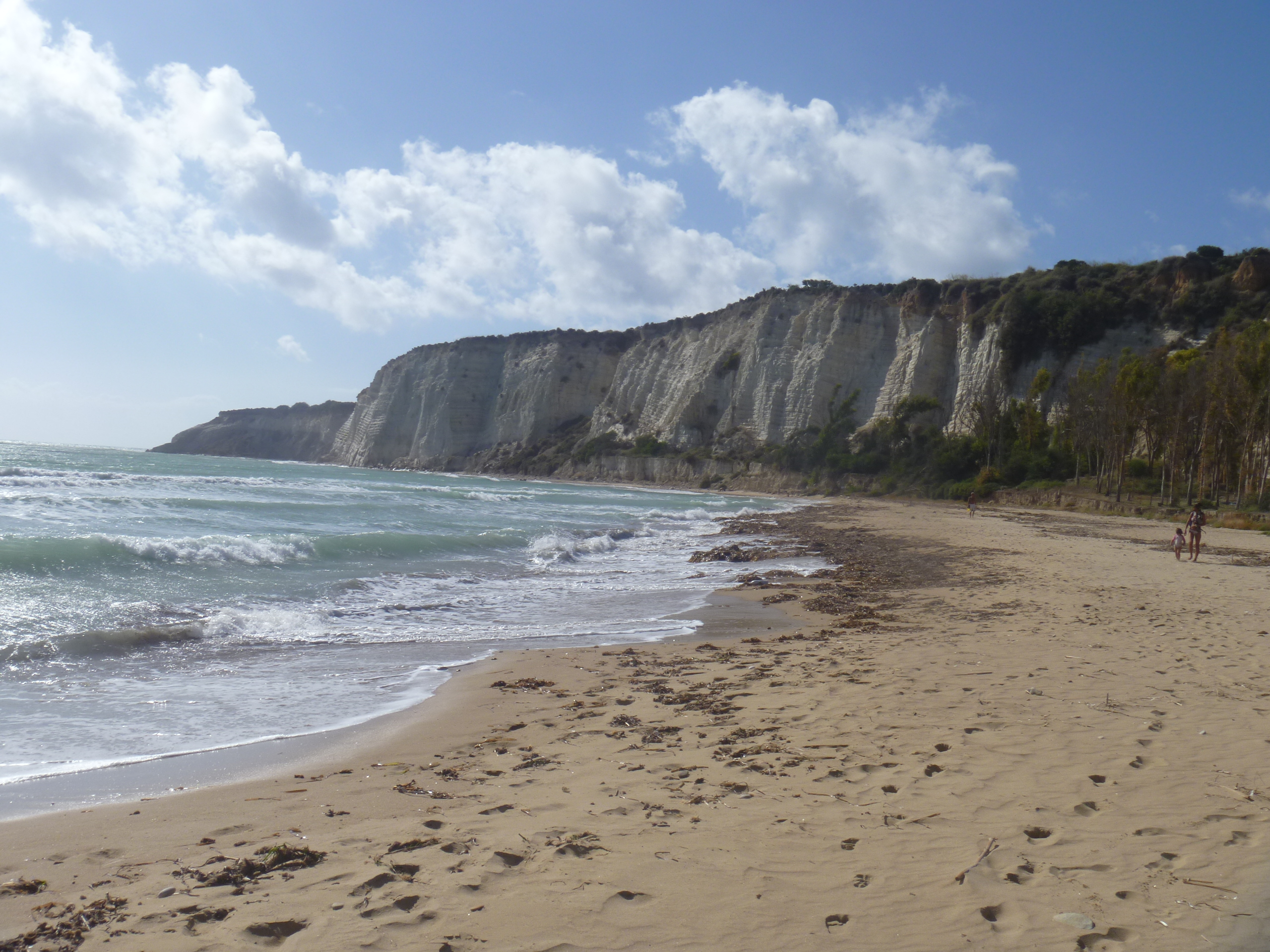
Other days led us to the beach. The beach closest to our house is San Marco, but based on the recommendation of our host, Stefania, we went to Aloha Beach a bit further along. It was good for a swim and had great beachcombing; we found beach glass and intriguing colorful pebbles and sandstone carved into fantastic shapes by the wind and tides. In tandem with visiting an archaeological site we stopped at the beach in Eraclea Minoa, and combined marveling at the chalk cliffs (2nd photo above) and beachcombing followed by drinks on the terrace of Garibaldi, a restaurant/bar/beach club still open at the end of the season. The high tide washes under the building so you feel that you are on a ship. So far we have been to three of the beaches along the Mediterranean coast. We look forward to seeing many more of them.
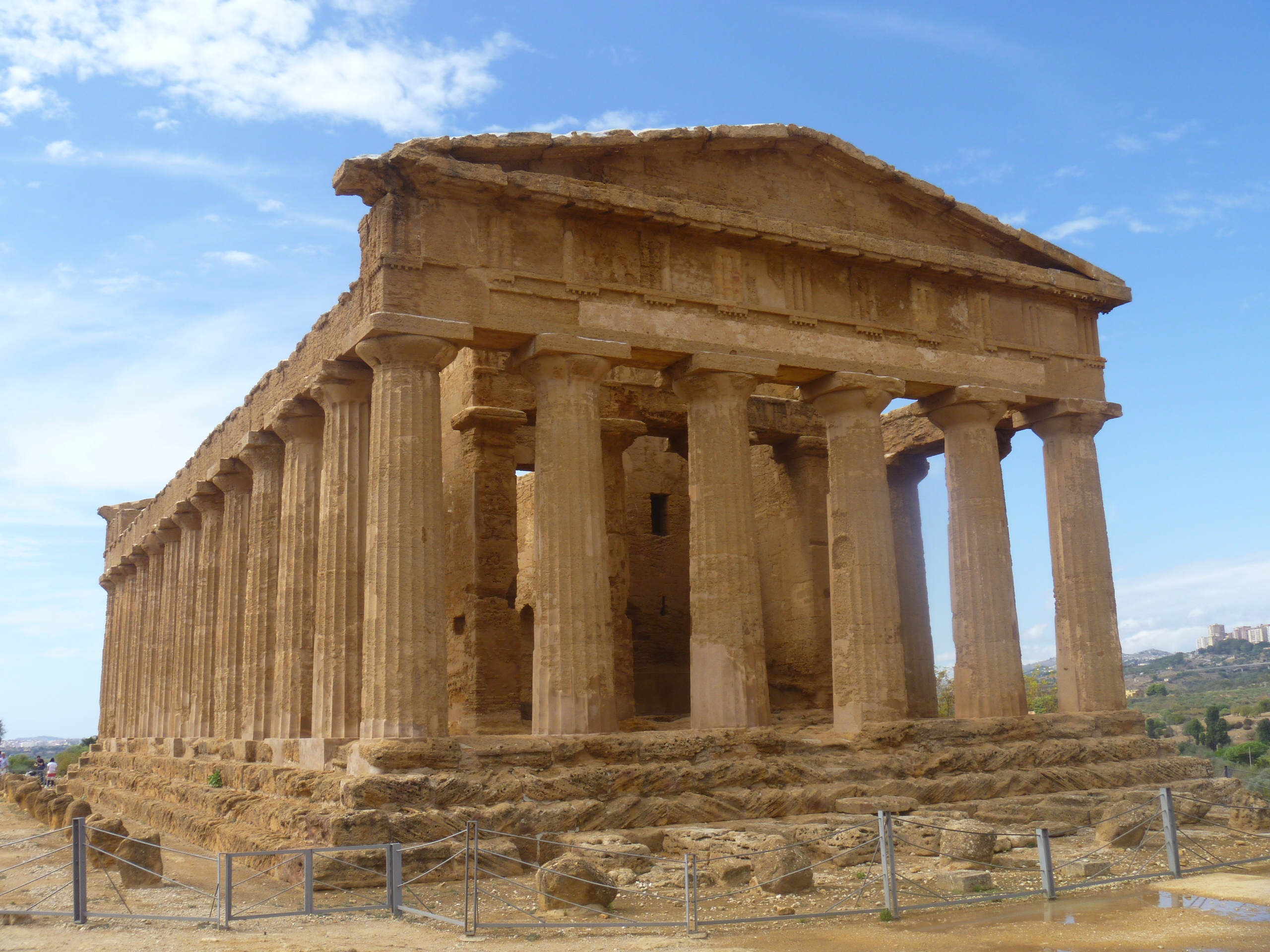
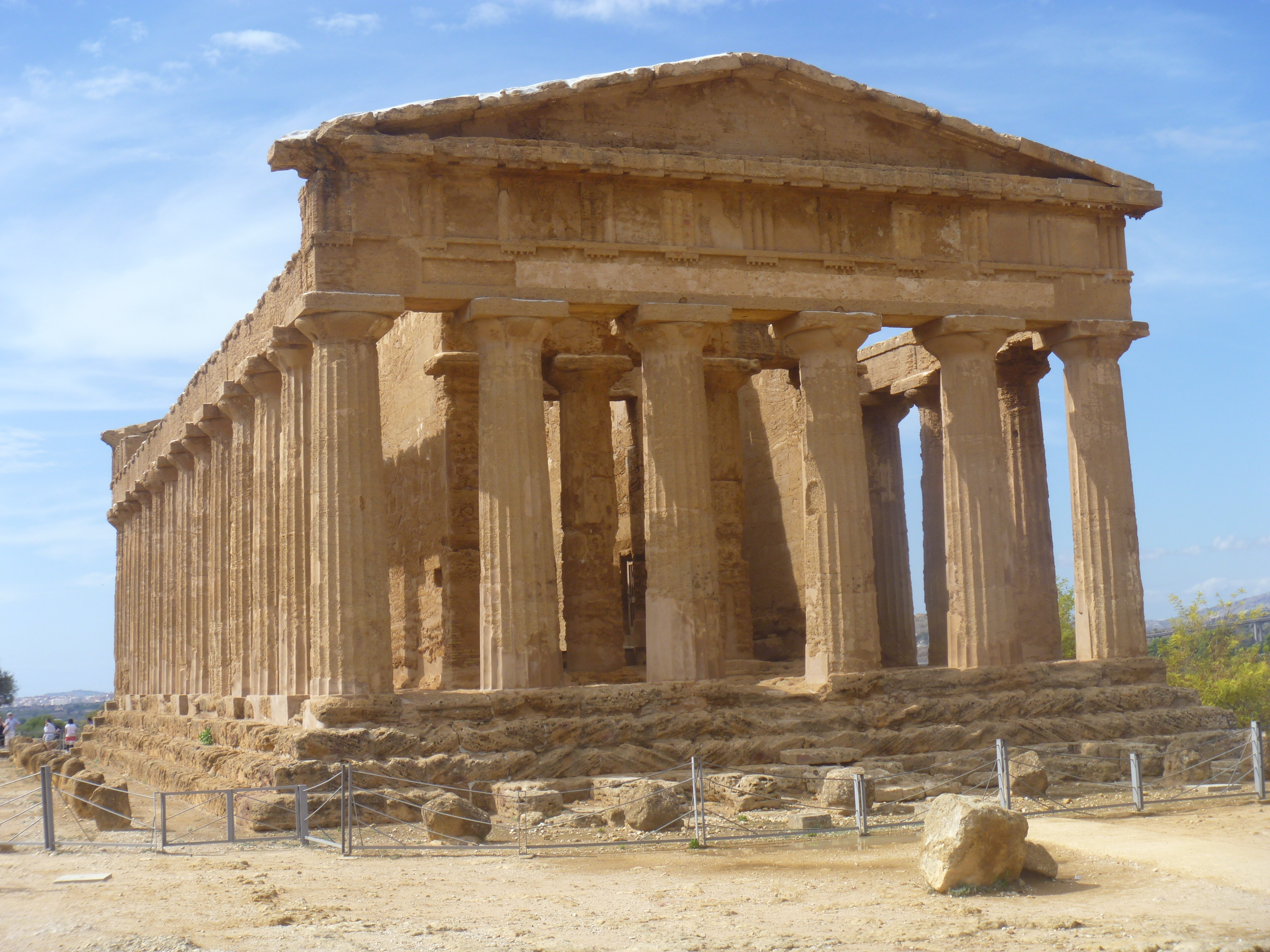
The other resource found everywhere in Sicily is archaeology, and in this Sicily shines. There are many Greek temples on the island, and other layers of history as well, from the Elymi, the earliest named people, to the Greeks, Punic (north African), Roman, Byzantine, Muslim, Viking, Norman, Angevin (French), Aragonese, and Bourbon (Spanish), We began with the biggest and most impressive archaeological site in Sicily, the Valley of the Temples at Agrigento. Great trivia: The Temple of Concordia at Agrigento is the source of the logo for UNESCO World Heritage sites.
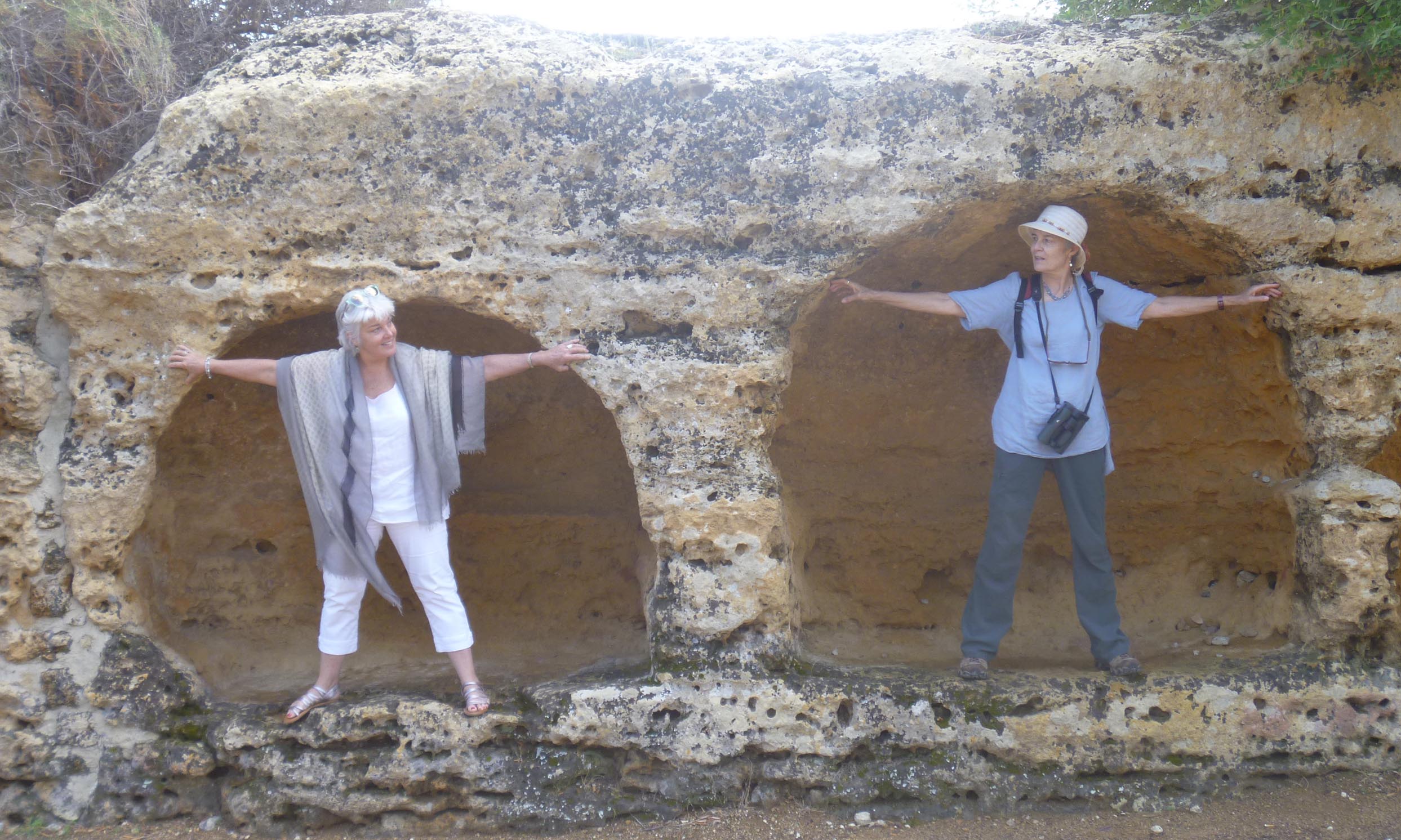
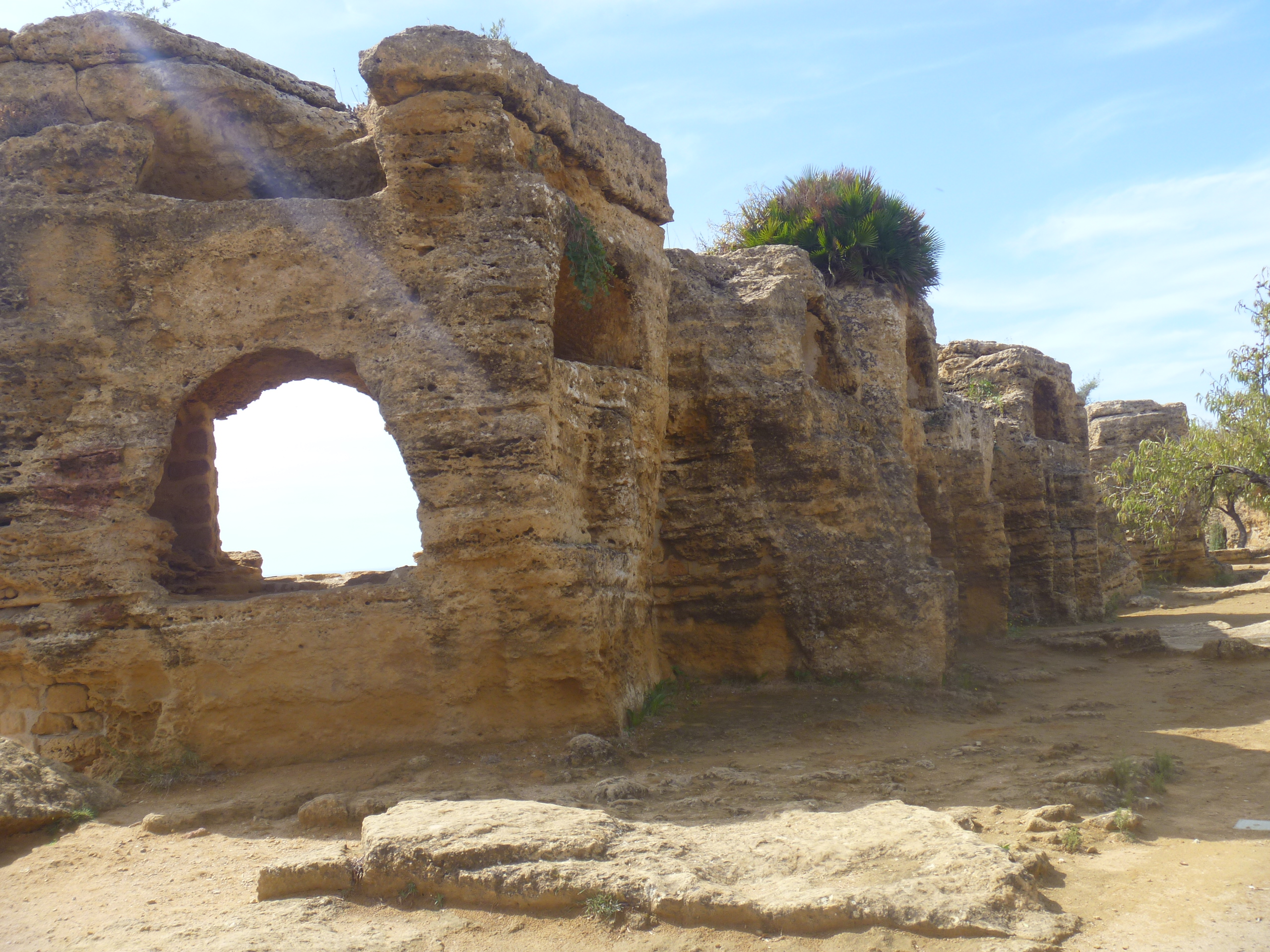
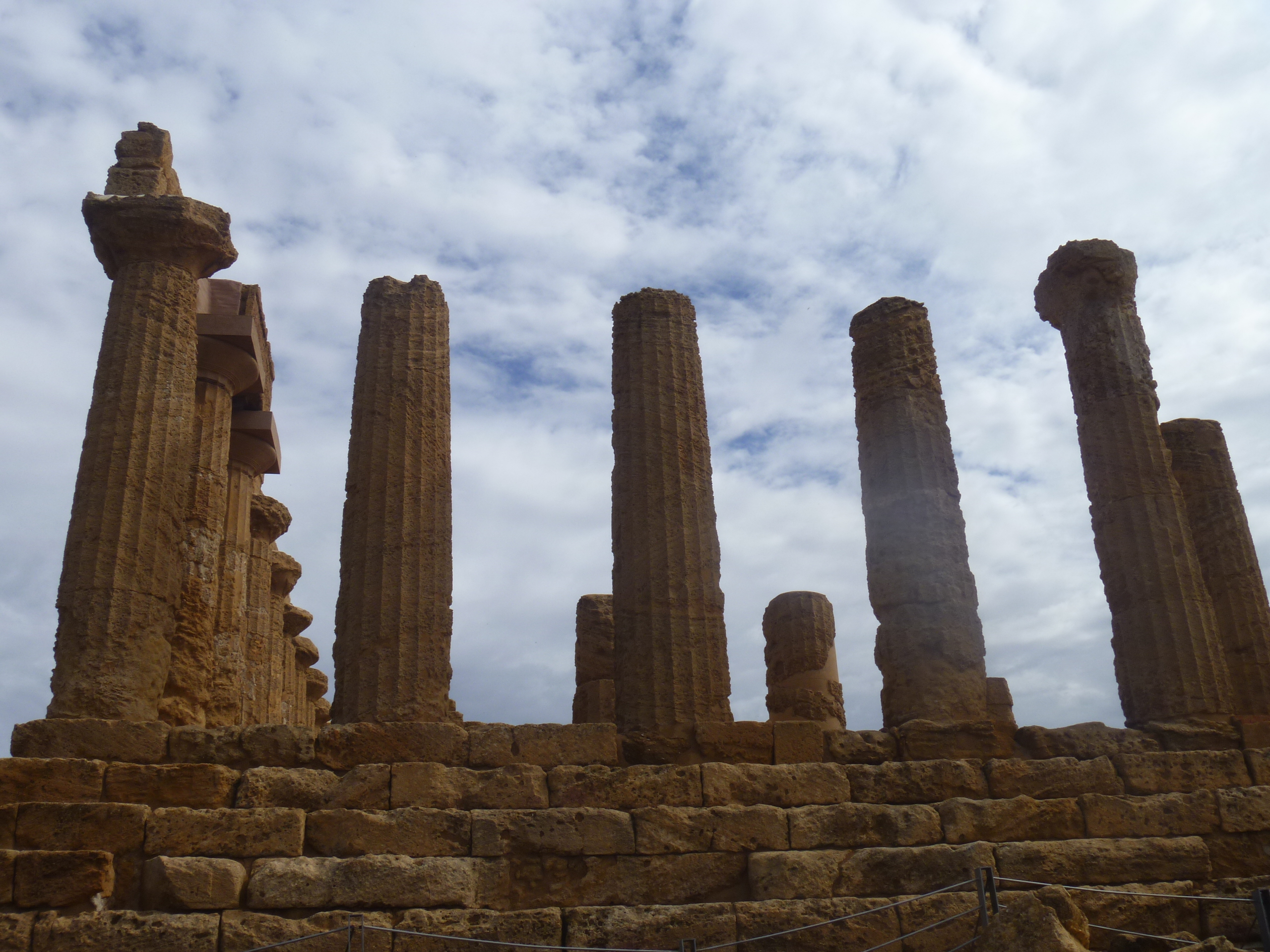
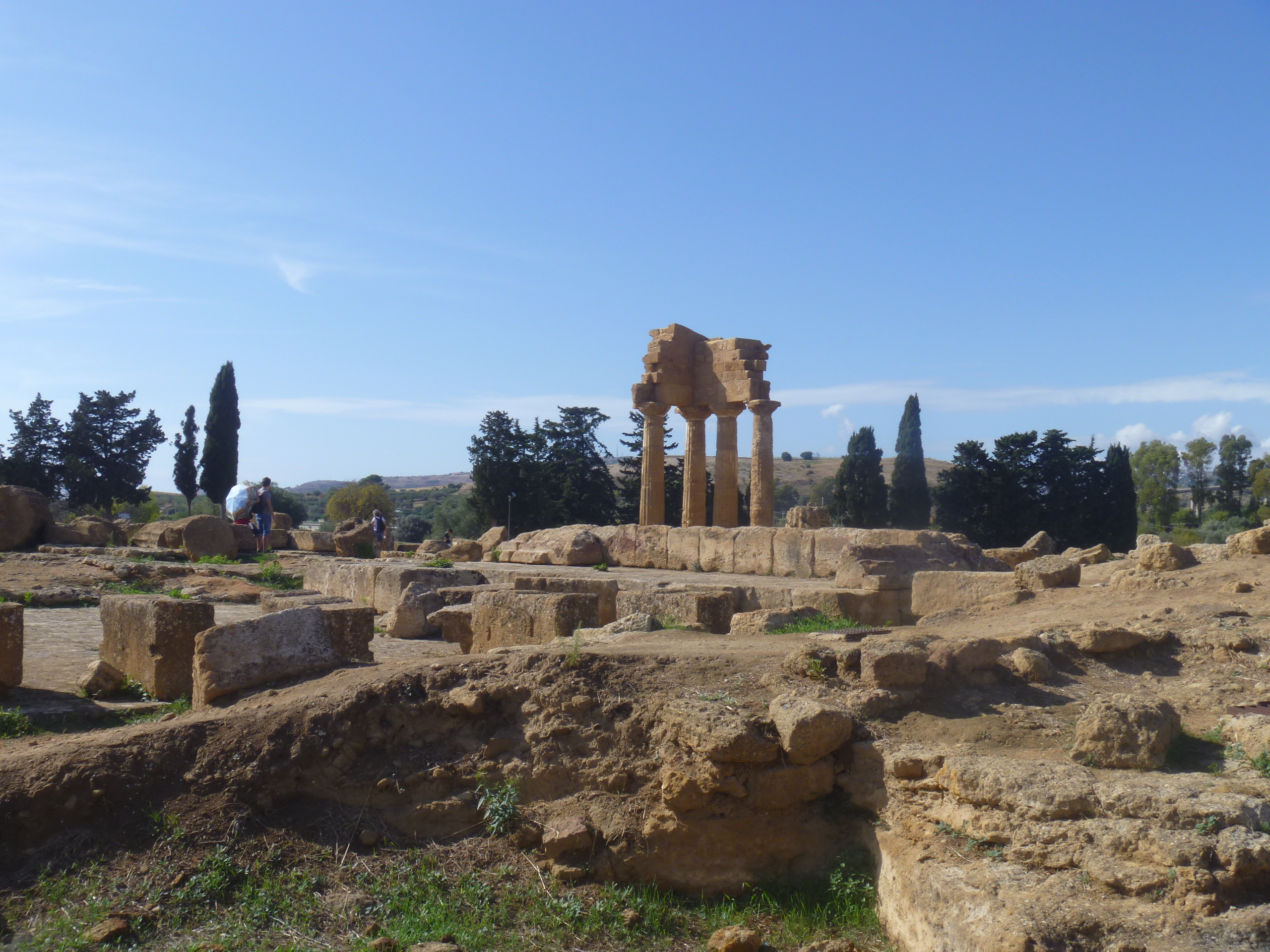
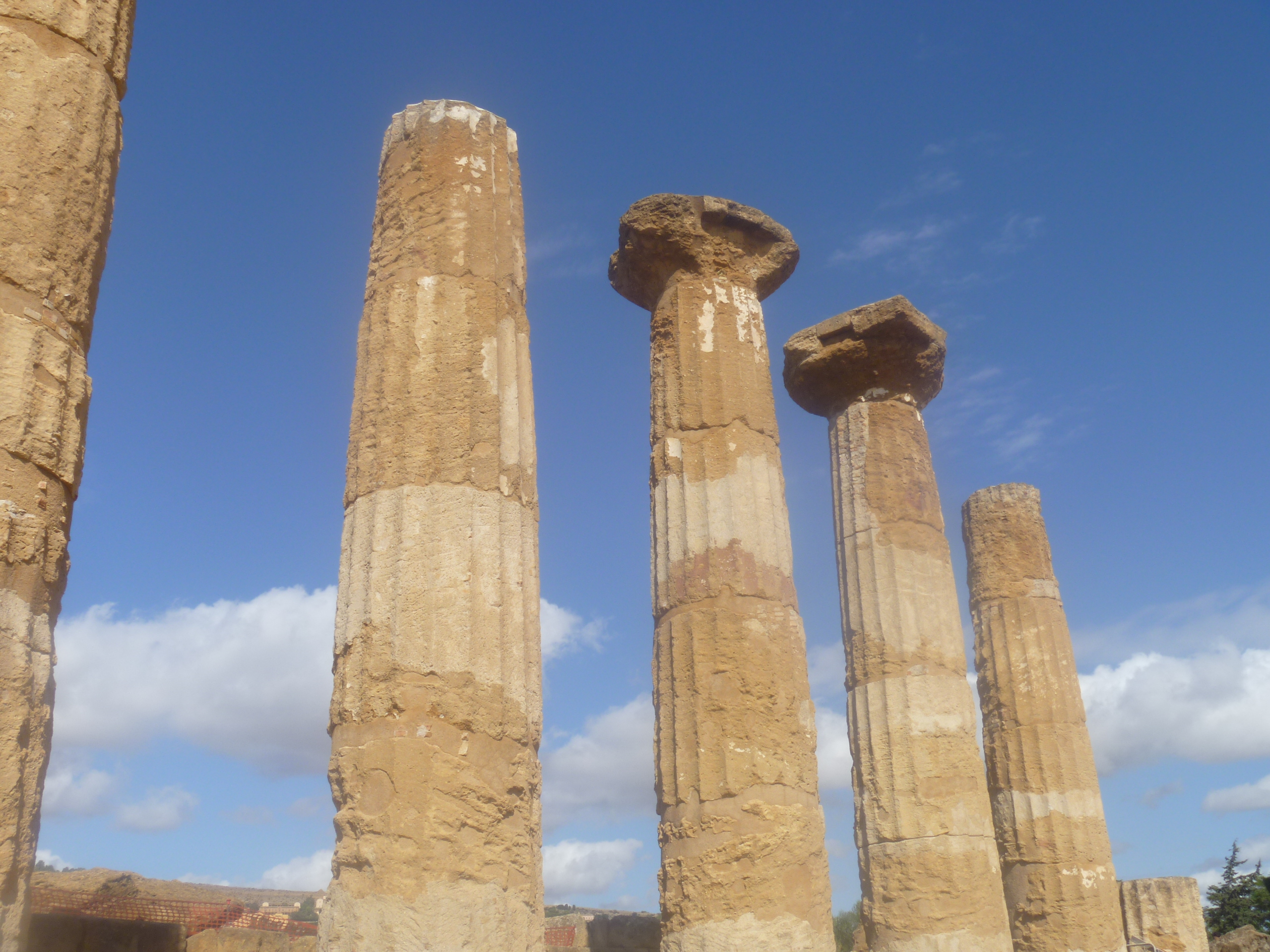
Agrigento is the most visited site in Sicily but was not nearly as crowded as some of the places we visited near Naples. Called the Valley of the Temples, it has five Greek temples built along a ridge overlooking the sea. The Temple of Concordia is most complete, and the others range from nearly complete to a heap of column fragments. A huge wall along the ridge was honeycombed with tombs carved at a later time.These are some of the innumerable tombs that were carved out of the old city walls. Many were so full of tombs that sections collapsed. These tombs are all shapes, from small boxes to large domes.
Temple of Concord
The Temple of Concord is the best preserved, but the other temples are imposing.
There were piles of broken columns, and broken segments with deep U-shaped grooves in them. I don’t know what they could have been used for.
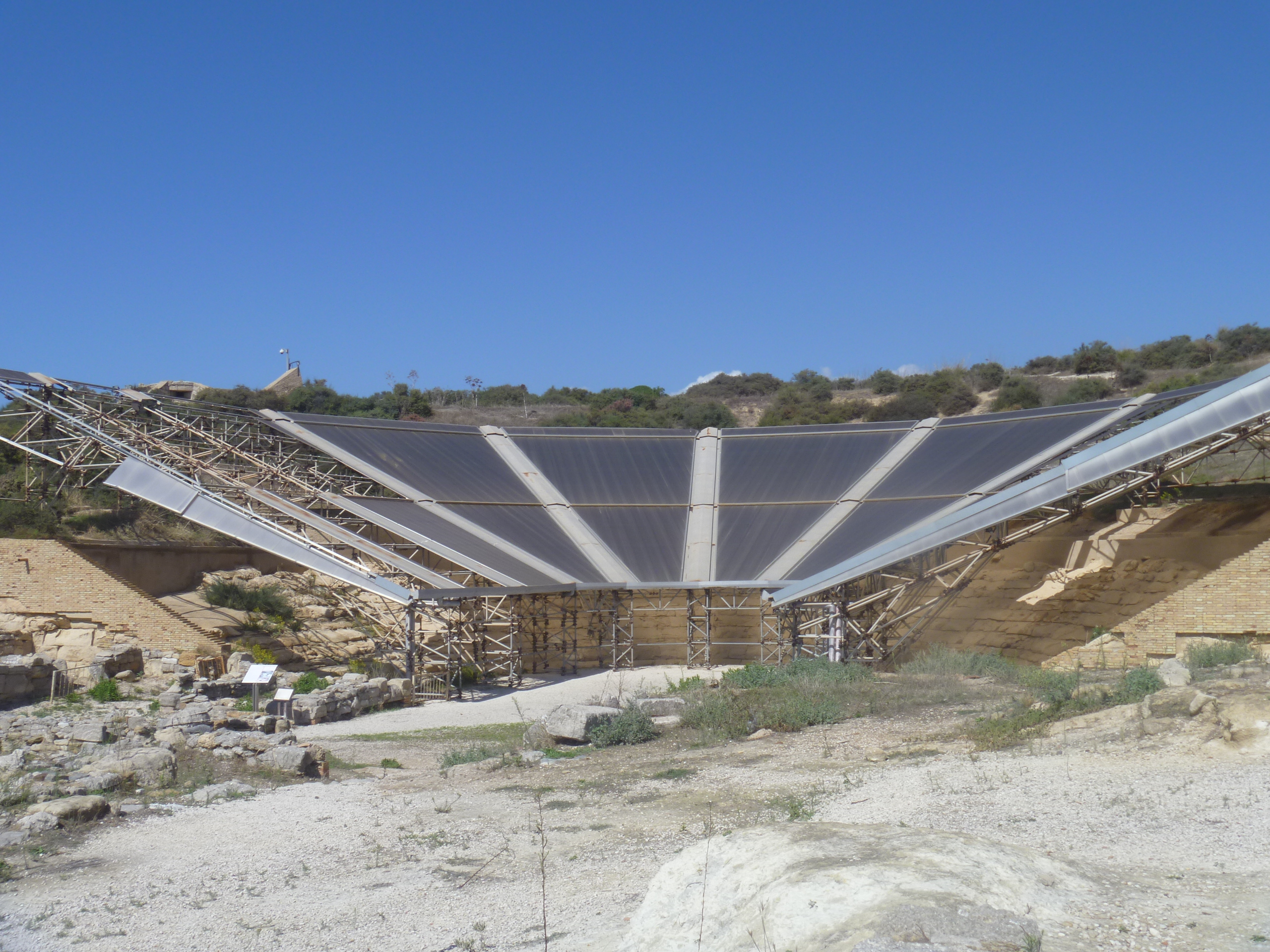
We also visited the site of Heraclea Minoa, a huge valley covered by an ancient city. Most of the site remains unexcavated, and here you see the competition for attention among archaeological sites. Agrigento is the most visited archaeological site in Sicily and who can match five Greek temples? Heraclea Minoa is extensive but not as attention getting as Agrigento. It has far fewer visitors as a result and is also not as well kept up.
The cover over the amphitheater at Heraclea Minoa reminds me of a scene from a James Bond movie.
For the moment, these are the three axes of Sicily: landscape, beaches, archaeology. We’ll see what happens next week.
We just moved to our October home, a house outside the town of Sciacca, Sicily. We were met by our host Stefania and her mother, who showed us around and helped us get settled. Our flight from Naples to Palermo was delayed two hours, so we were later arriving than we’d planned, but they were not at all put out about it, and had even fixed dinner for us, knowing that stores would be closed by the time we arrived on Sunday evening.
Our new house is charming, the accumulation of a family that has stayed here during summer vacations for many years. There is wonderful majolica, lots of rocks picked up from the beach, and driftwood sculpture. The kitchen has stacks of pots and pans and enough plates for an army. It does not have counter space, but we will make do. the view to the ocean is beautiful and there are terraces on both floors. Here are some photos.
Hurricanes have flattened more than one vacation paradise recently. There are many left, and we are just finishing our stay in Salerno, Italy, adjacent to, if not in, vacation paradise (as in Amalfi, Sorrento, Capri).
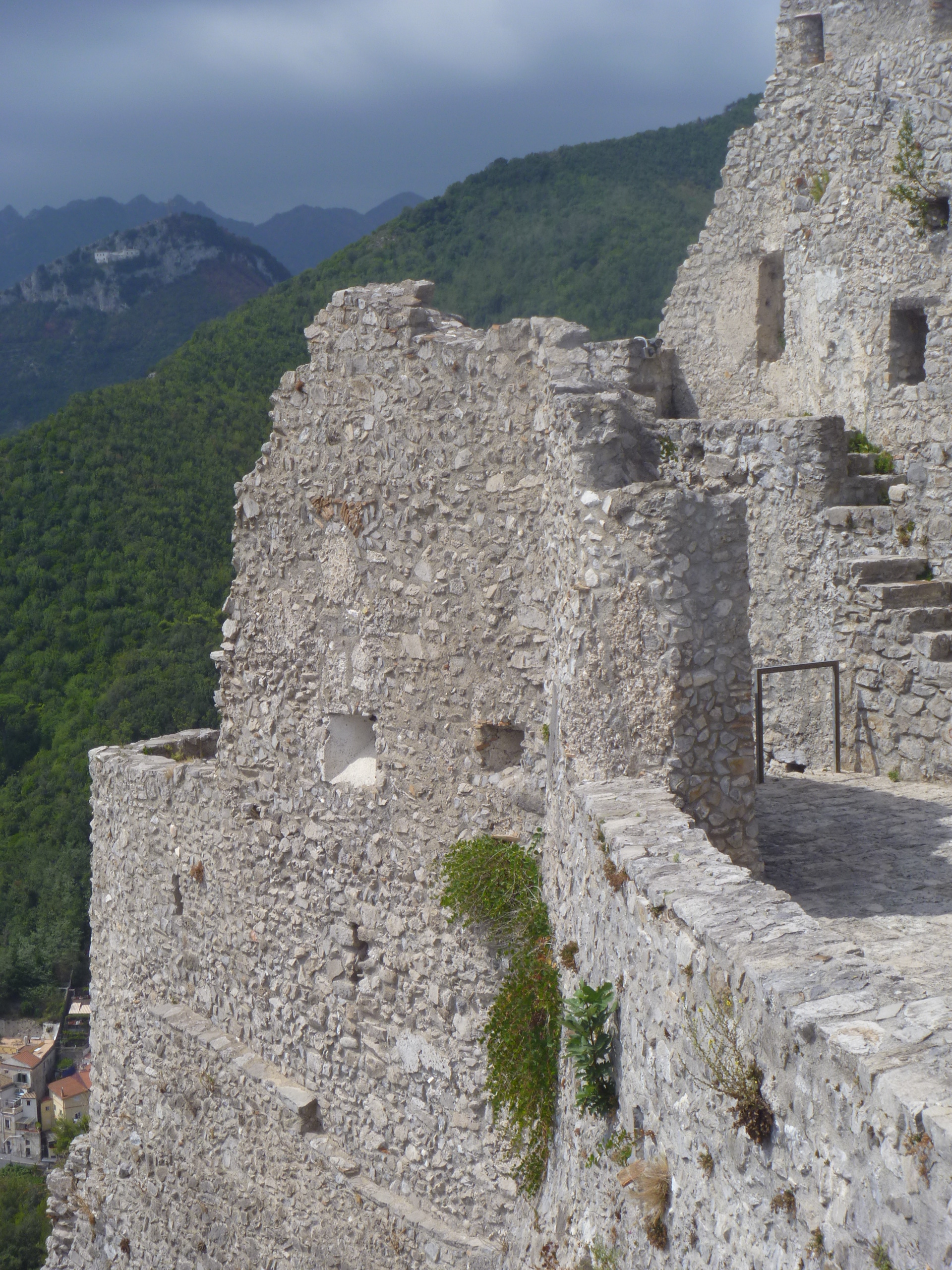
Castello di Arecchi
Our current home ground, the province of Campania, was the breadbasket of ancient Rome, and was occupied both long before and after the Romans. Pompeii is the most famous archaeological site here, and there are countless others. Not just the other Vesuvians (Herculaneum, Stabia, Oplontis, Bosco Reale), but Samnite and Lucanian sites, Etruscans, and Greeks, too. Later came the Lombards, the Angevins, Aragonese and the Hapsburgs building castles and fortresses. Archaeologically, this area is fabulous.
As a vacation paradise, there’s a lot to recommend this area.Gardens and orchards. Lemon, pomegranate, quince, apple trees are all dropping fruit all over the place–olive trees, too. The markets have an excellent variety of fruits and vegetables including multiple varieties of tomatoes and eggplants. You can be a vegetarian without even noticing. All that mozzarella de bufala, so little time!
Food costs are lower than anywhere else we have been in Europe.
Food festivals. We visited Cusano Mutri for its annual mushroom festival, the Sagra di Funghi. We bought porcini and chanterelles, ate mushroom and cheese sandwiches, had coffee in the tiny plaza at the top of the town. (There were no tour buses.)
Archaeology is everywhere. There are ruined towers every 500 yards or so along the coast. Some of these have been transformed into houses and hotels. Others are ruins ready to be visited. The Castello di Arecchi outside Salerno is one of the largest and best-restored.
In Florence, I saw a woman with a nice haircut and asked her whether she was local. When she said no, I asked where she was from and when she told me Salerno, I insisted she write down the name of her hairdresser for me.. 2 1/2 months later, when we were nearby, I visited her hairdresser, who was flattered that I made the effort to track her down. It was fun and I got a good haircut.
We had wonderful hosts, and met some lovely people, both Italians and other visitors.
No one really lives in Paradise, we just vacation there. Everyday life has its struggles whether you live in Bali or Boston, and how would we live with nothing to grouse about? We may only be here for a month, but a few things had to get done that vacationers ignore until the party’s over. That’s where Italy is a challenge.
Repairing anything is complicated, in Italy as in the US. My Samsung phone broke and I took it to a repair place that said the reset I needed could only be done at the other Samsung repair place. I went to the second repair place, left my phone to be fixed and came back the next day to find that they were still unable to fix it.
To get an appointment with an English-speaking eye doctor, I had to call her non-English-speaking receptionist. Fortunately, I can muddle along in basic Italian and receptionists can muddle along in English.
General grousing about Italy:
I have rarely been in such heavy traffic caused by…..nothing. On our first try we missed the ferry to Capri because no cars moved for 40 minutes. When I explained our problem at the ferry office, the agent was sympathetic. “Yes, terrible traffic.” “Do you know why?” I asked. Rolled eyes, a shrug. “No. It just happens.”
People drive badly. Most people drive too fast for the conditions, straddle lane lines, pass too close, tailgate, park haphazardly. If you plan to drive, be warned. There are a lot of cars, and too little space for them.
Traffic cameras send you a ticket three months after you’ve left town–we’ve only gotten one so far. Every person you speak to says they have gotten innumerable tickets. (Shrug. No one has any suggestions for avoiding them.)
Crowds are part of life. I feel crowded on the bus, the subway, walking down the street, shopping, and at the beach. There may be tiny hill towns begging for population, but Greater Naples is bursting at the seams. Eight story apartment buildings surround single story houses from the last century. It looks like the big buildings just shouldered their way in and squatted down.
Woman gardening beside motorcycle repair shop.
Some of my grousing can be turned on its head.
There doesn’t seem to be a lot of zoning concerns in Campania the way there is in Tuscany where preserving views of the landscape is a paramount civic value. In the Naples region there is a patchwork of apartments, cultivated fields and orchards. You could call it lack of zoning, but I like seeing see lemon trees along the highway and eggplants beside the car repair.
History is everywhere. We saw city walls from five different time periods in a two block section of Salerno. You can walk around any ruined structure that isn’t marked Do Not Enter.
I wouldn’t change what I am doing for a different way of life. I appreciate learning what you need to know to actually live in a place, and every different locality has its own charms and aggravations. While I stretch my brain muscles with crosswords, I also stretch myself by living in different environments.




 At first glance, you may not notice the decorations in the trees. Perhaps the sound makes you look again and you see all the chandeliers.














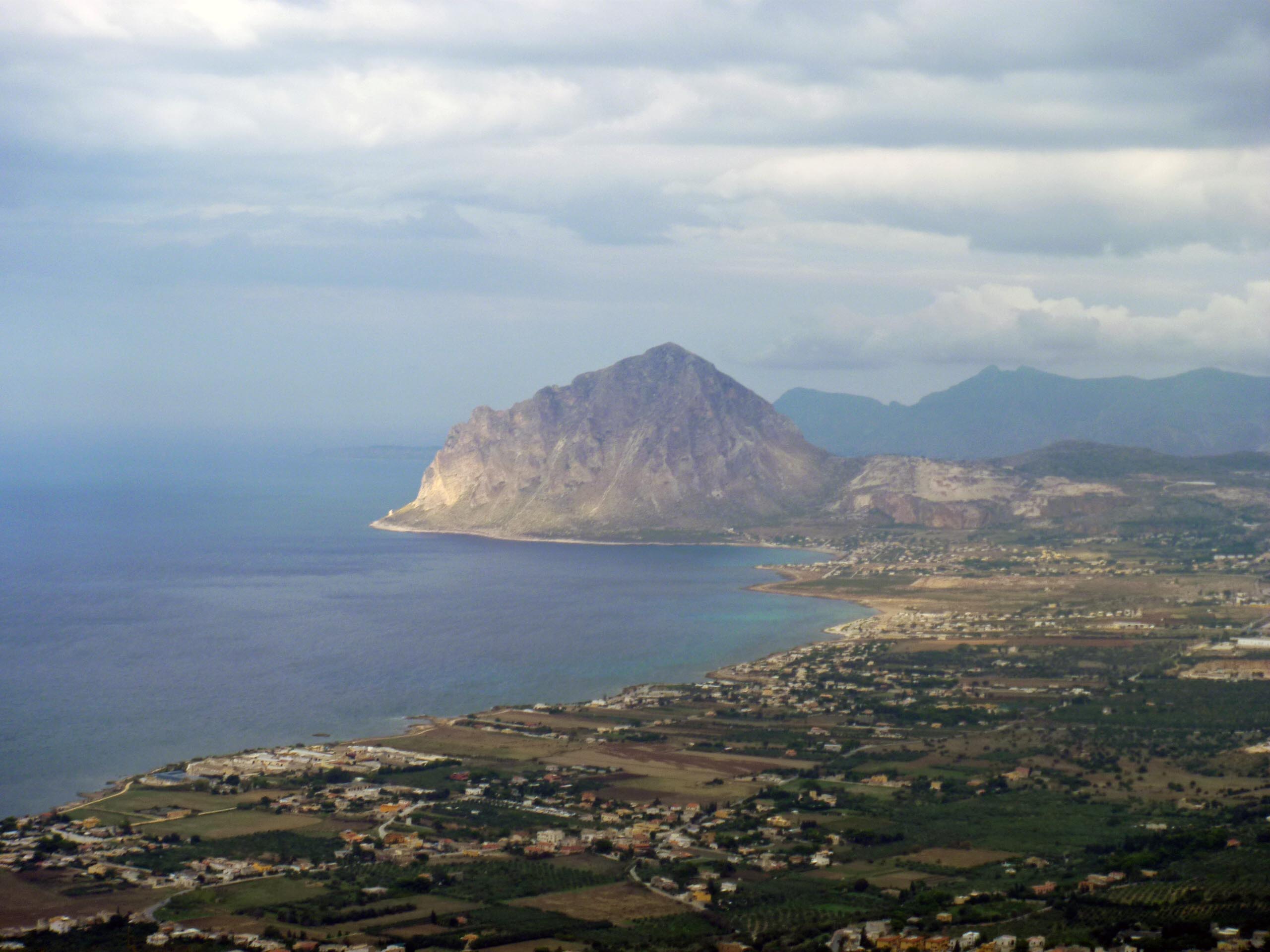 Sicily’s landscape is Dramatic.