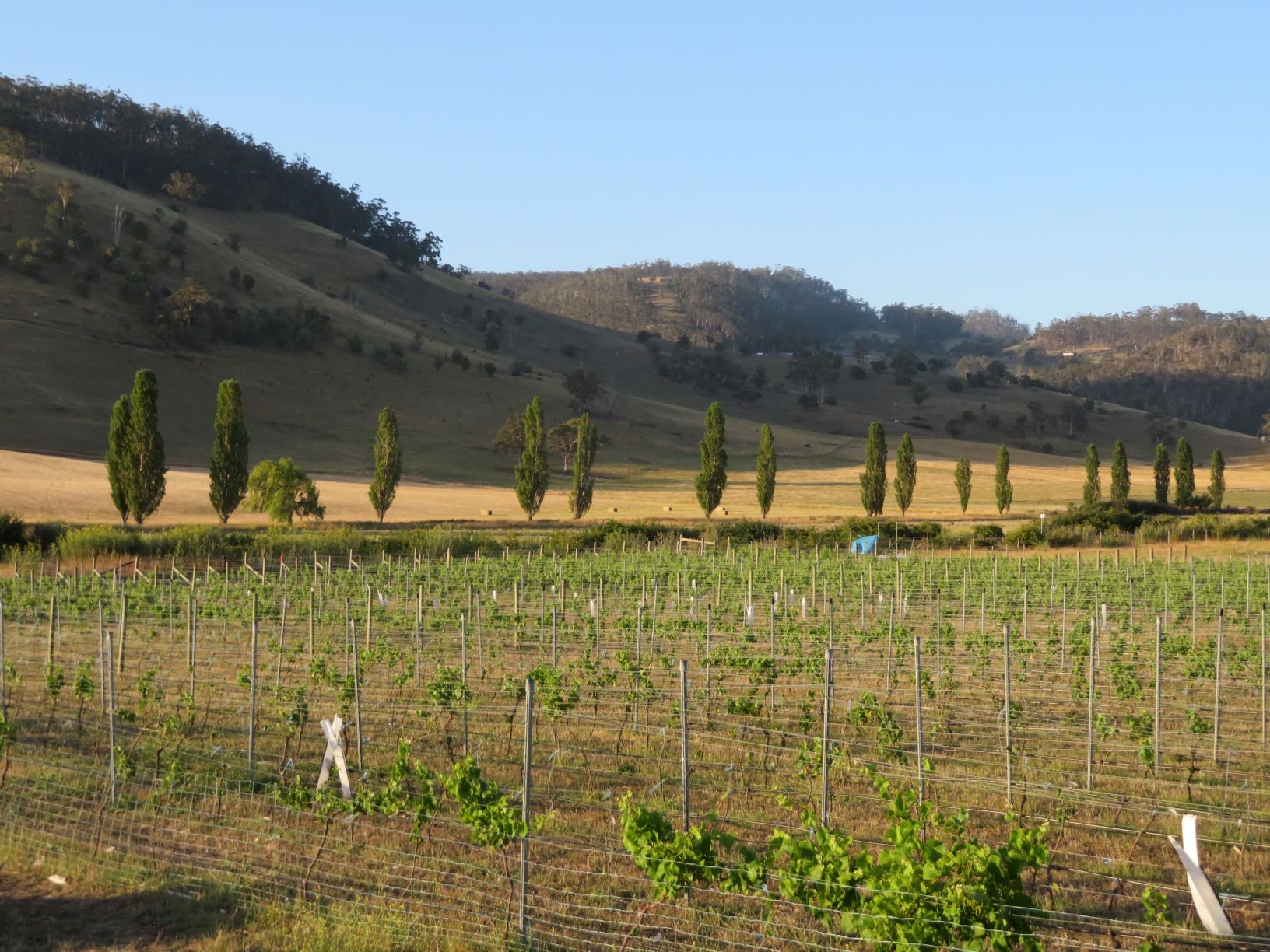
This month our home is a small vineyard outside Hobart, Tasmania. Though the property itself is only a few hectares, it is surrounded by hills of grazing land and it feels like we are in the center of a huge farm. Our house is the only dwelling, the owners live elsewhere. The owner and her two workers come and go, and a couple of repurposed shipping containers are the farm outbuildings. It is a small operation.
For me, this is the best of farm life, the beauty and the comfort of country routines like opening and closing the gate, watching the ducks, geese, sheep, cattle, horses, yet without any of the chores. Across the fence is the water for the geese and ducks. They drift over to the water, then out among the vines to nibble, then back again, all day long. Ten short “baby doll” sheep spend some days browsing among the vines. They are intended to keep the grass down between the rows, though we do see them chewing the vines. I don’t have to feed or water any of the animals, and when the geese all escaped and began browsing along the road, I didn’t have to round them up, put them back in their pen and fix the gap in the fence.
I lean on the gate while Jonathan chats with our host and one of her workmen. The breeze is cool and comfortable and I soak up the sun and the gentle swish of the wind. When we return from our trip to the beach, I hang the laundry out to dry on a rotating clothesline like we used when I was a kid. The scene takes me back to those days, helping my mom hang clothes on the line, and the delicious smell of sheets dried outdoors. Firewood sits in a heap on one side of the yard. I don’t need to think about starting a fire because it is the middle of summer; the pile shelters a family of bunnies that run in and out.
I walked to the top of the hill beyond us one afternoon, following the fenceline past the cattle. Looking over the hill, then back on our house, I see other small farms with their flocks of sheep, horses, and a pasture holding a single ostrich. The stillness and permanence of the landscape in the fading sunlight impresses me with the vastness of the land next to one person. That unchanging presence of the land compared to my tiny being makes me want to see what is just beyond the horizon. There I am in a nutshell. I’ve always wanted to see what’s just around the corner, the next bend in the shoreline, over the next hill, and I always will. The illusion that I am alone meditating on life in a great still silence lasts until the next car passes, and the train pulling its daily load of timber chugs by. I head for home.
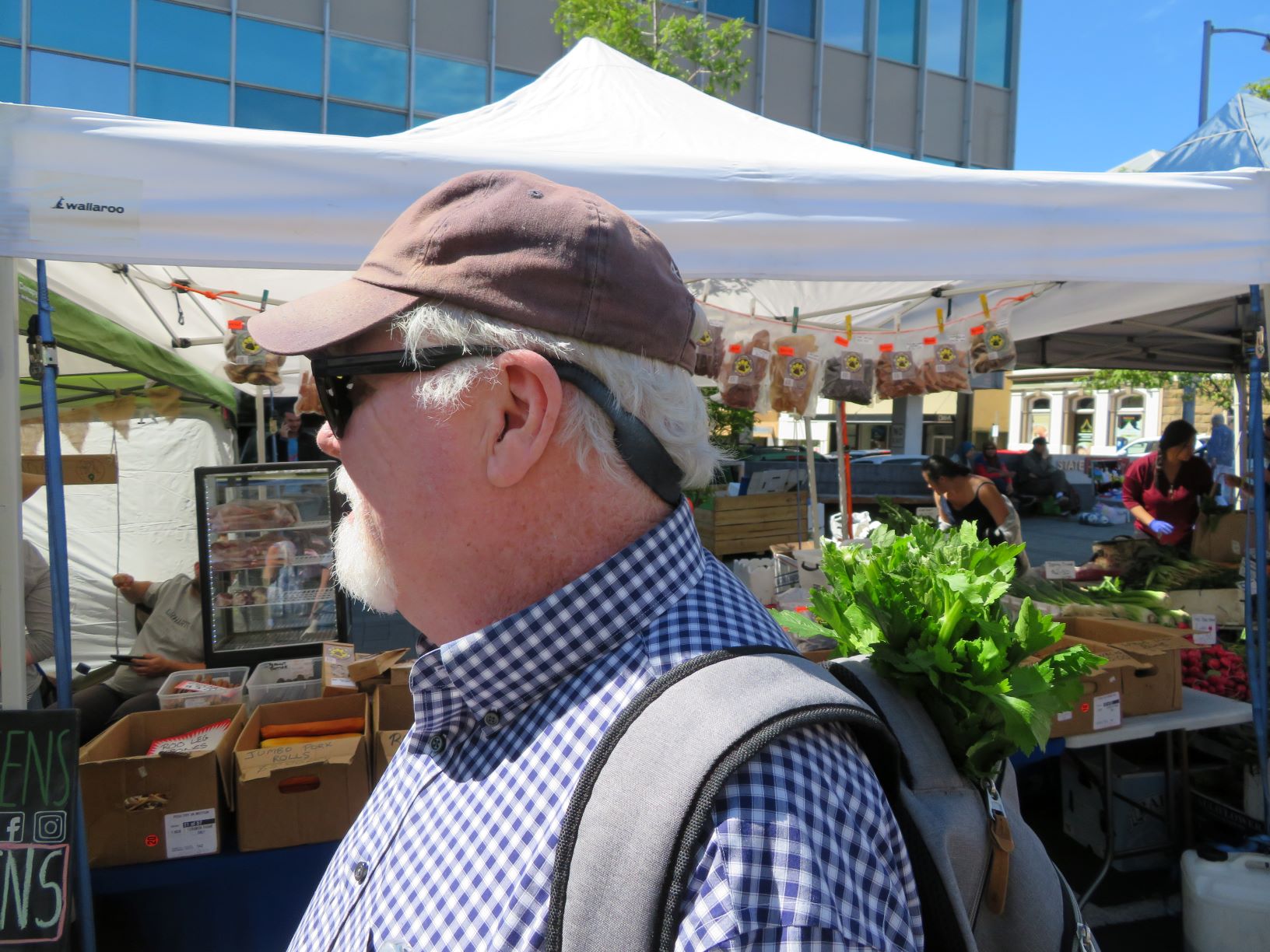
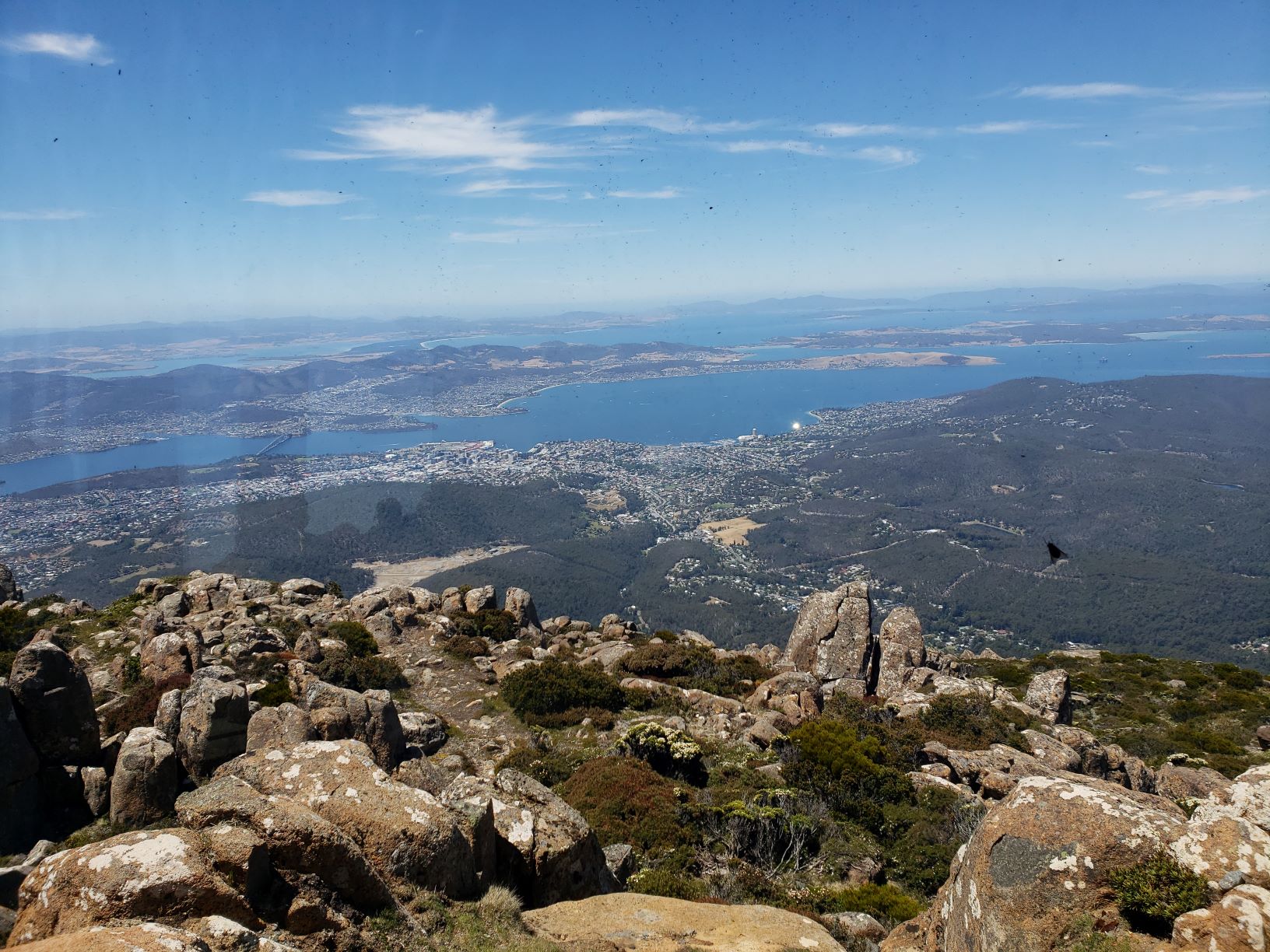
What a week! We visited beaches as beautiful as you can imagine, saw wallabies jumping across a rural road, parrots only found in Tasmania, and flocks of cockatoos landing in the trees! We ended the week with a visit to the Sunday farmer’s market in Hobart–Tasmania has excellent celery, among other things. Then a stop at the flea market at the Hobart Showgrounds, and it was barely noon. We decided to head to the top of Mt. Wellington, and as promised, the view was stunning.We used our visit as a giant atlas, reviewing some of the places we’ve been and spotting new ones. Southeast Tasmania around Hobart has a very long coastline because of the many peninsulas. Each one provides is laced with walking trails, beaches, and vantage points. We are going to visit as much of the coast as we can.
Sunday Farmer’s Market, Hobart: This is also called the Farm Gate market, or Bathurst market, as it’s on Bathurst St. between Elizabeth and Murray Sts. Not large, but with produce, cheese, meat, and baked goods that are really excellent. One stand had a long line the entire time we were there. They make donuts with exotic cream fillings (e.g. saffron ginger). Another stand makes really delicious cinnamon rolls and croissants. There are no bargains here, it’s all top quality at a corresponding price. We parked in a nearby parking structure–first two hours free!
Flea Market, Hobart Show Grounds: This is a large spread of vendors. There’s lots to look at both indoors and out. Outdoor vendors were thinking about packing up early on the day we visited because the sun was so hot! No admission or parking fee.
About Mt. Wellington: This all-ages destination has a road to the very summit, free parking, paths (with stairs) to different viewing spots, and fabulous views. It is up to 10° (C) cooler than Hobart, so take a sweater, even on a sunny day.
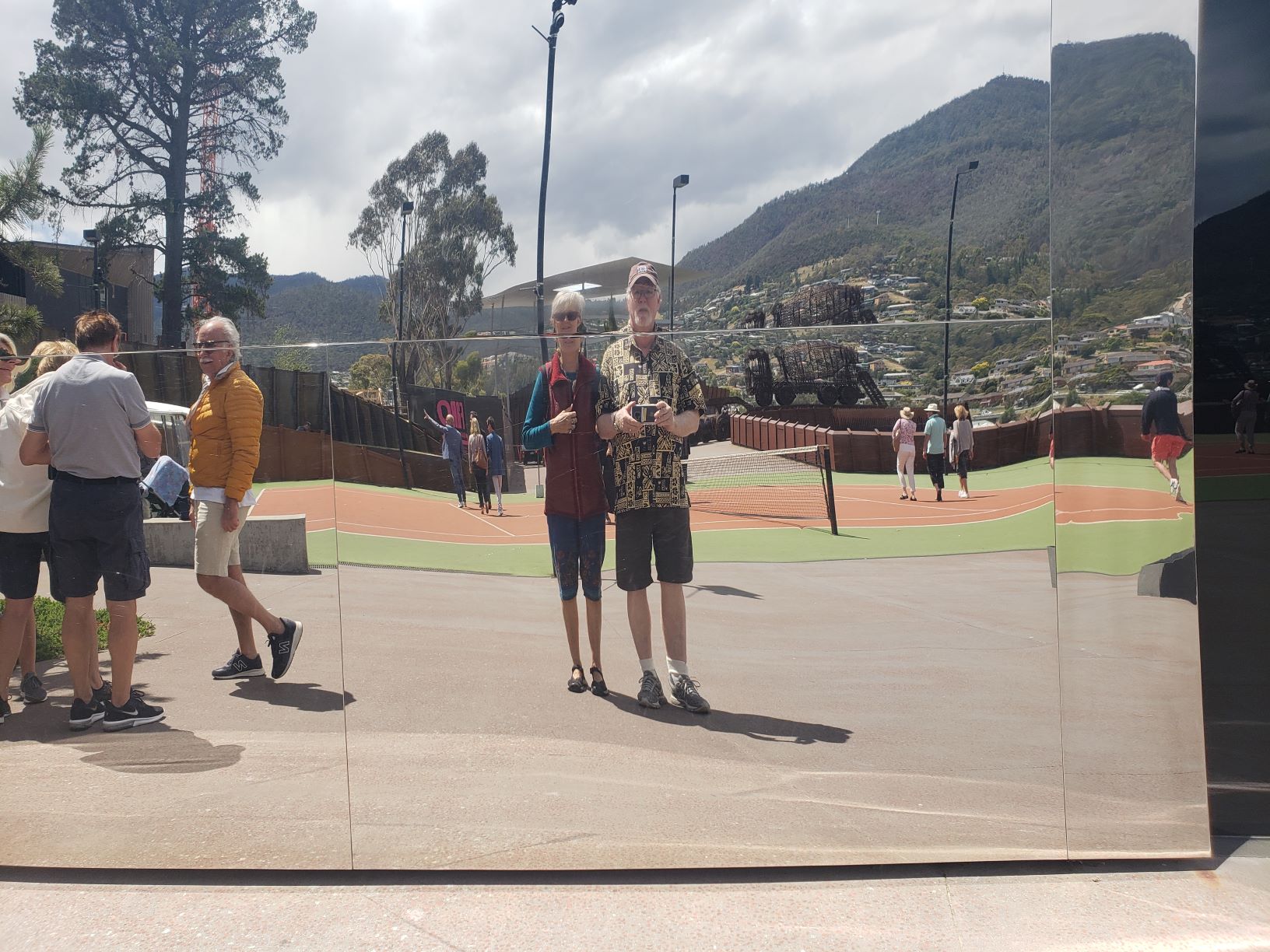
MONA is a new phenomenon just outside Hobart, a huge museum meandering up and down over three floors built into the side of a hill. Visitors arrive via ferry from the city, getting a great view of the Derwent River and the MONA facade as they arrive. Drivers walk down a path beside a band shell and lawn, past a barbecue restaurant and bar, the entrance to the Moorilla winery that is part of the property, and if they’re not lost yet, descend a zig-zag set of stairs and ramps to arrive at the front door of the museum. Clad in mirror-finish brass, it’s a bit disorienting, but that seems to be the point.
I started our visit by sitting on a stool held up by a gloved “Mickey Mouse” hand.
We rambled along the suggested route, from the lowest level upward, then took a break to go off-site for a picnic lunch break. Tickets are good for multiple entries on a single day, and no one paid much attention to our in and out. Musicians were playing in the band shell from around noon until after we left. We didn’t like the music much, but it was entertainment, and people were sitting on the lawn listening.
I enjoyed the moments of participation. We arrived in one room during the period when visitors are allowed to add to a pile of broken glass piled against a section of white wall within the dark room. If you hit the wall with the bottle given to you, a bright light goes off.
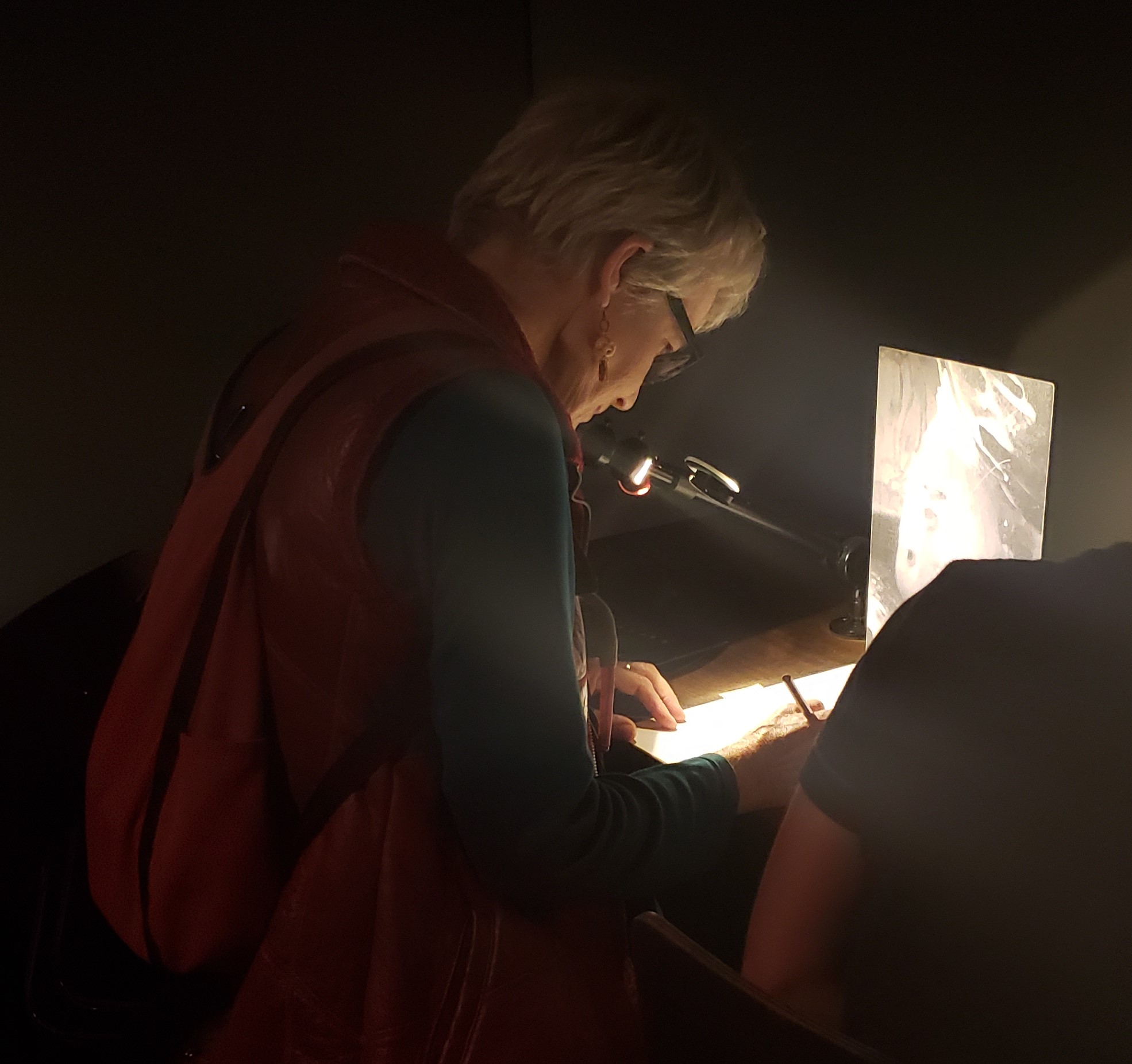
Another installation is a recreated studio of Vermeer with a discussion of whether artists of his period used lenses to project images to enhance the accuracy of their painting. I sat before a blank page with an inverted image pasted on the wall and a lens angled in such a way that I could draw the image on the blank page as if I was tracing it. I did a pretty good job if I do say so.
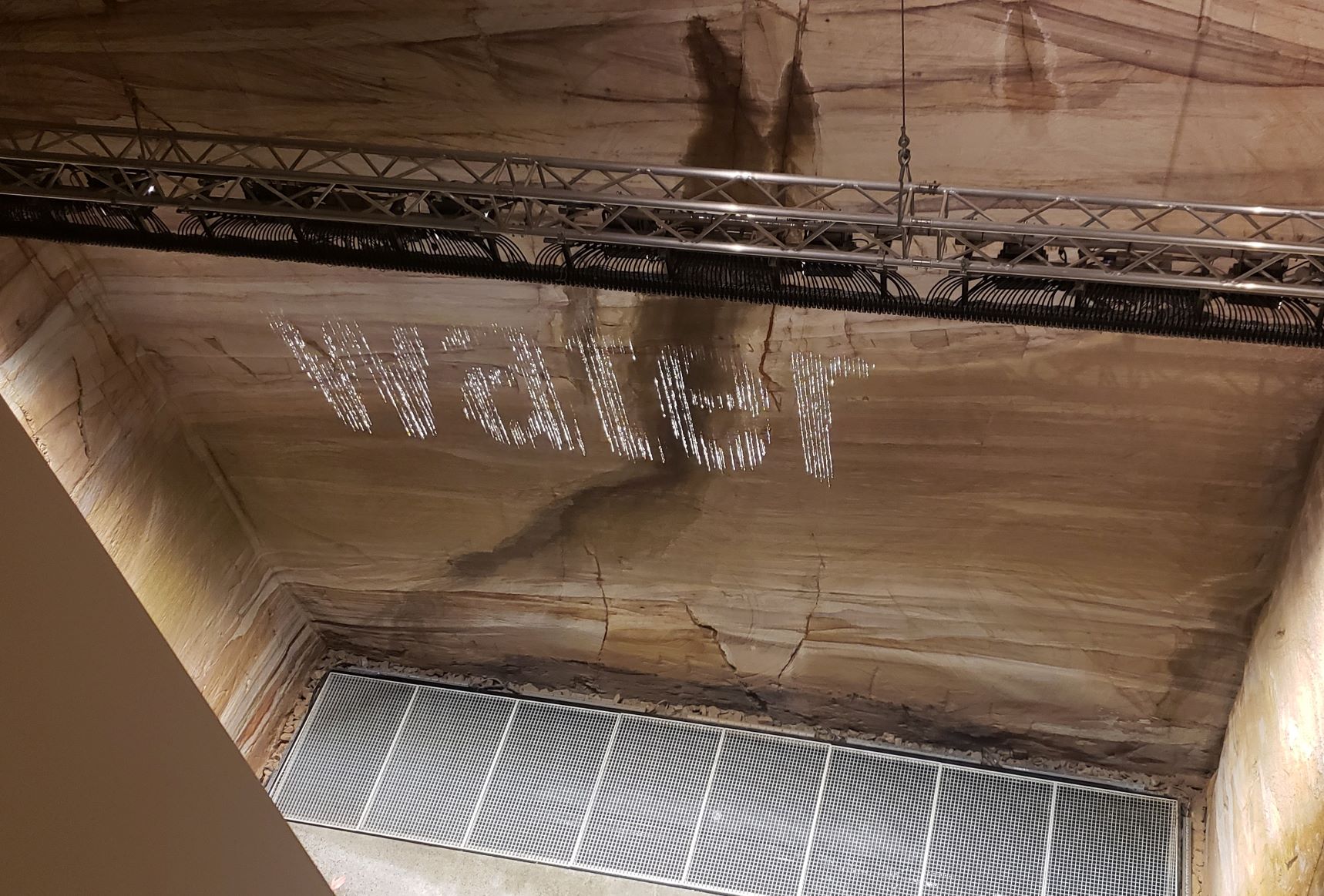
An ingenious piece emits water droplets in patterns that create words out of the falling water. I listened to an interview with the artist who revealed that as soon as he presented his piece he was besieged with requests to use it for advertising. He refused, and someone promptly worked out how he did it, creating a similar device to be used for advertising. It is already in use, with the artist gaining neither credit or money for it.
There was one piece that impressed me as a work of art and a commentary on life and art. This machine was created by Jean Tinguely (1925-1991) as a commentary on the machine age as it runs constantly and does nothing but wear down. The intent was that eventually it would destroy itself. It was created long before Steampunk–I consider Tinguely the grandfather of Steampunk. Watch a very short video of the contraption working:
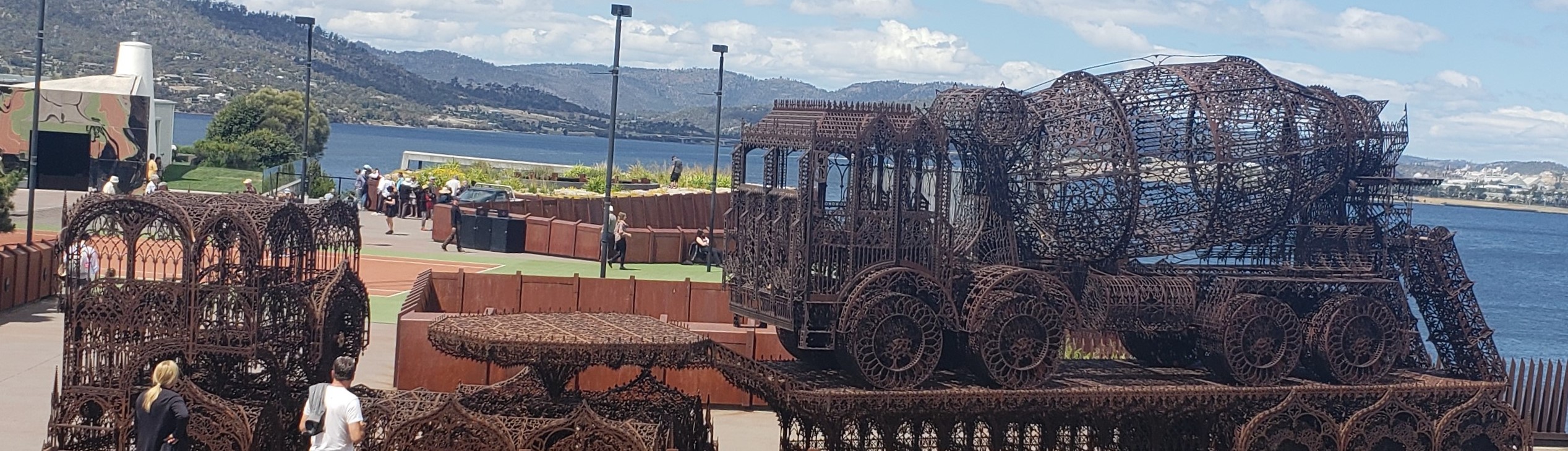
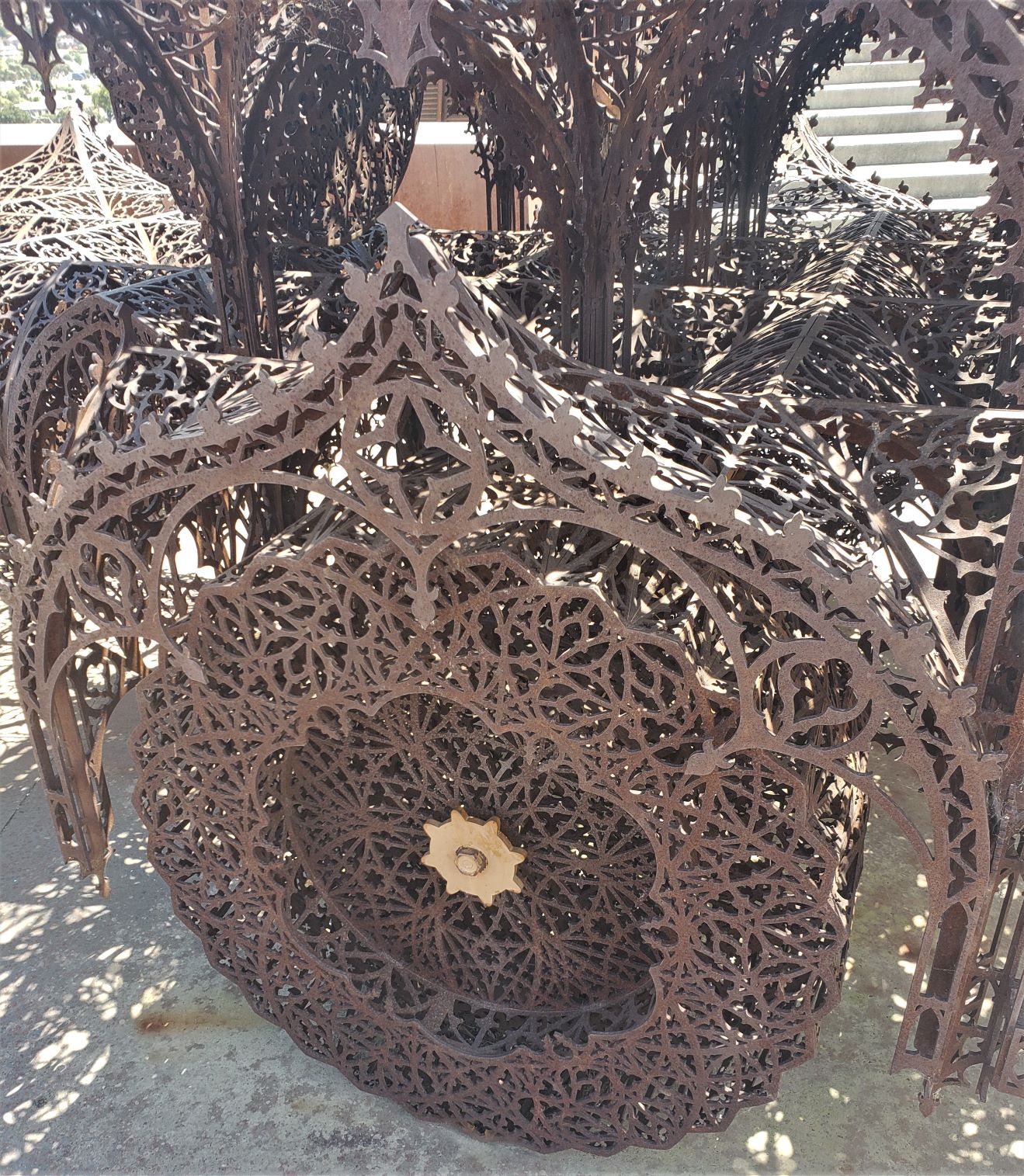
Outdoors was a life-size sculpture of a semi trailer carrying a cement mixer. The strange difference was the fact the entire piece was created from gothic style arches cut into steel.
Whether or not visitors like the art is beside the point. MONA provides all visitors with an “O” device that works easily and well, providing text about all the pieces. Press the button and O reveals what is nearest to you, click on the photo to read a basic description, then on other icons for more extensive comments. Sometimes there is a music or video link, though these are underutilized. The device was an excellent way for the museum to avoid labels and allows them to move things around at any time. The device elicits a “love”, “hate” reaction to each piece, and allows viewers to comment. I liked it better than an audio guide.
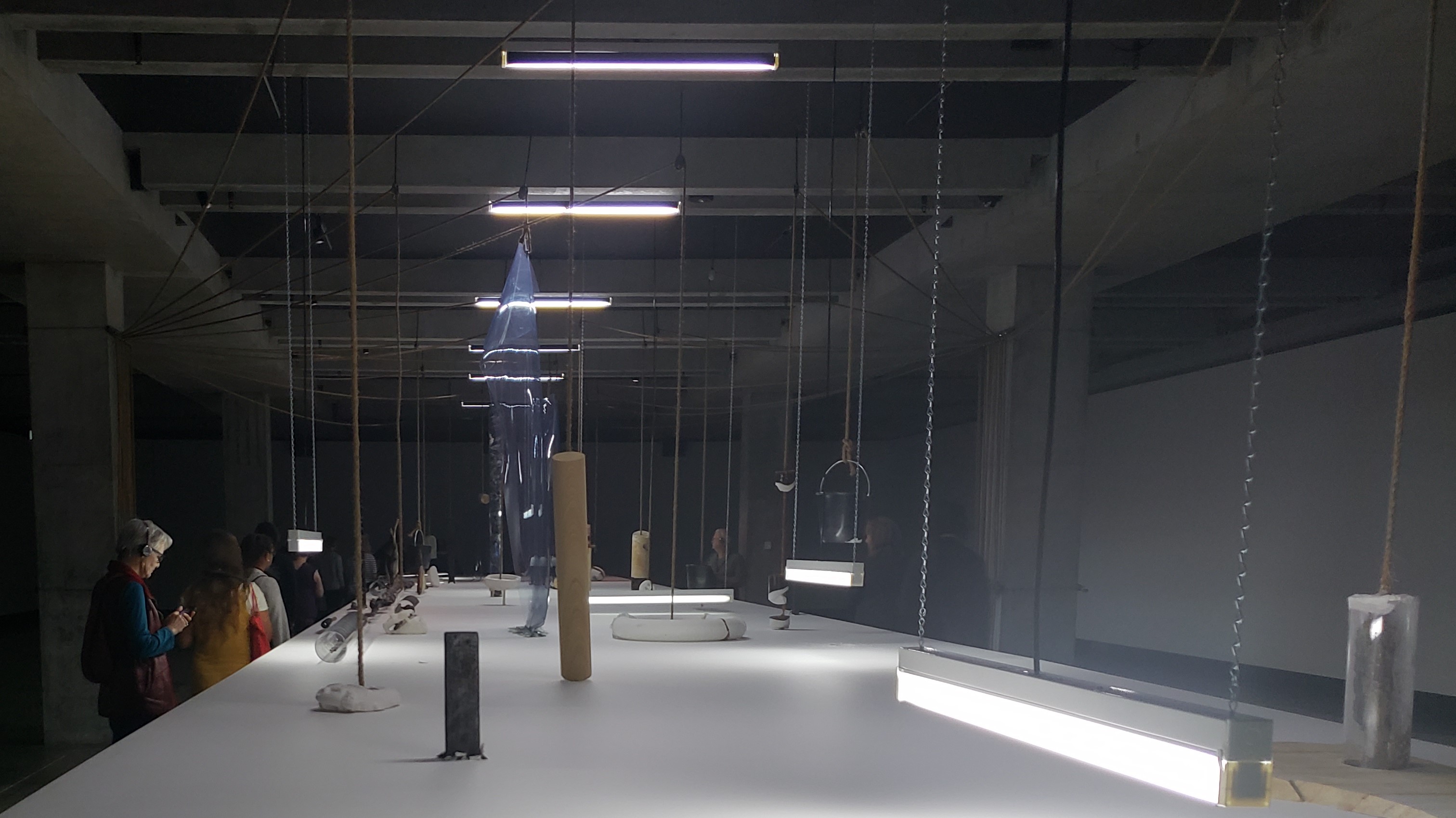
With the O device in hand, a visitor could easily spend many hours viewing and commenting on the pieces. But why? The pieces are sometimes boring, like the white table filled with random bits, or the Porsche covered with fiberglass, aka, the “Fat Car.”
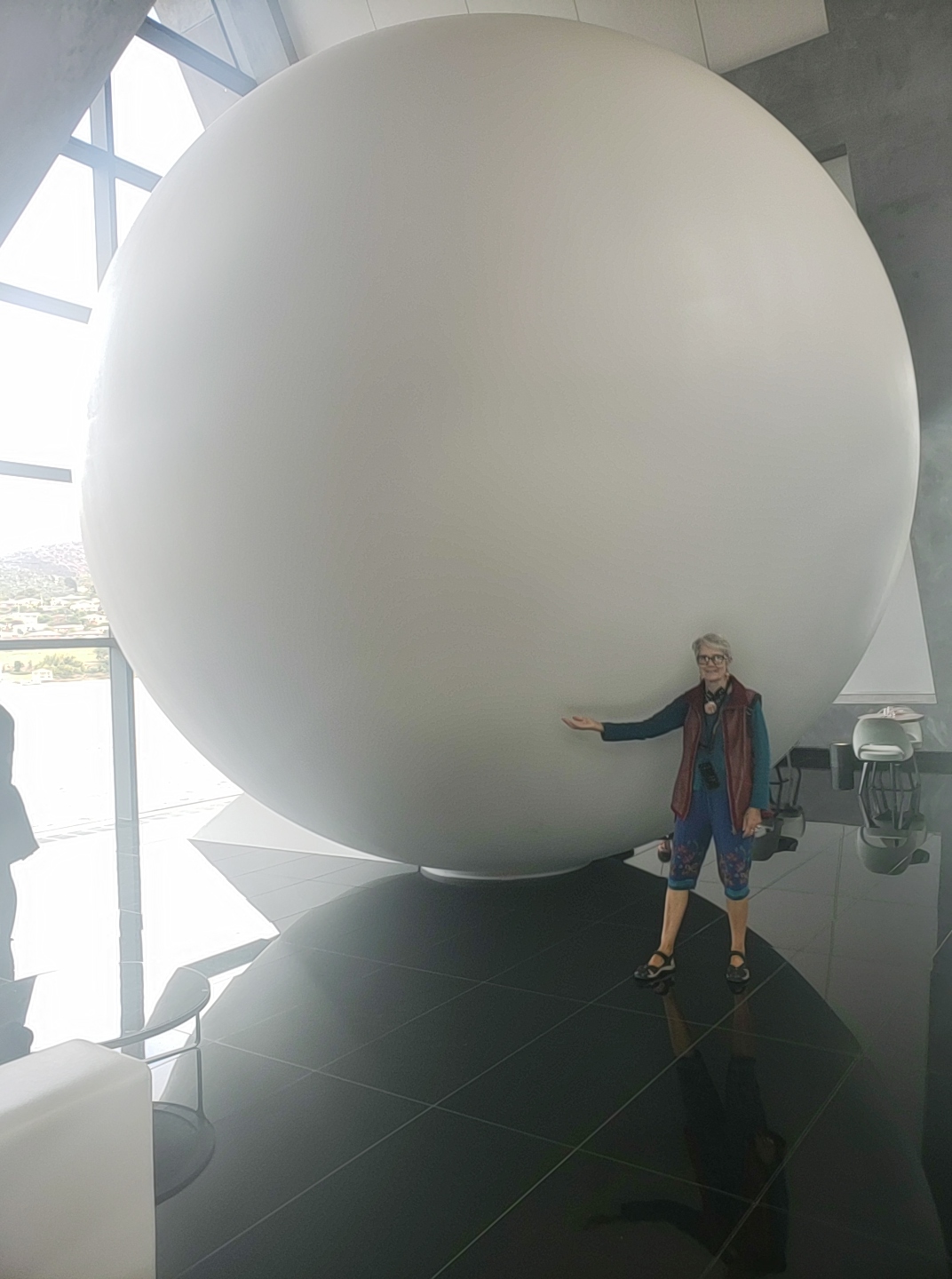
Later, I looked at the MONA web page that shows some of the items in the collection. Most of them were items that I did not see during our visit. It looks like they do rotate material frequently. The web page doesn’t exactly keep up. That is probably intentional. MONA intends to do everything differently, for good or bad. Museum staff are numerous, friendly, and helpful. For example, they ask you not to take in water bottles, and provide water at all the bars/restaurants. There are many opportunities to purchase food and drink, souvenirs or “enhanced visits.” I opted not pay extra to go inside the white sphere. For another opinion of MONA, here is Jonathan’s review of MONA from TripAdvisor:
MONA is a difficult institution to review. Is it a museum, as implied by the name? Not really. It is mostly a money-making entertainment venue. The next big question is: is it art? Well, kind of. It is a bizarre collection made by the wealthy owner with no real focus except “sex and death”. Much of it seems deliberately designed to shock or stymy the visitor and it does succeed at both of those. Does it inspire a greater understanding of anything? Not that I can see. We spent four hours wandering around the dark tunnels and “exhibit” spaces. It’s hard to get really lost, but you do wind up backtracking a lot. My wife and I were reminded of the Dali Theatre-Museum in Spain, where the visitor is invited to put aside traditional pathways and explore the Museum as you wish. The difference is that Dali was a creative genius and the curators of his museum do a stunning job of displaying Dali’s art (and related artists). Mona on the other hand has depressingly little of creative genius and the curators do a particularly bad job of presenting mediocre fare. Go, have a good time, but don’t expect to be enlightened.
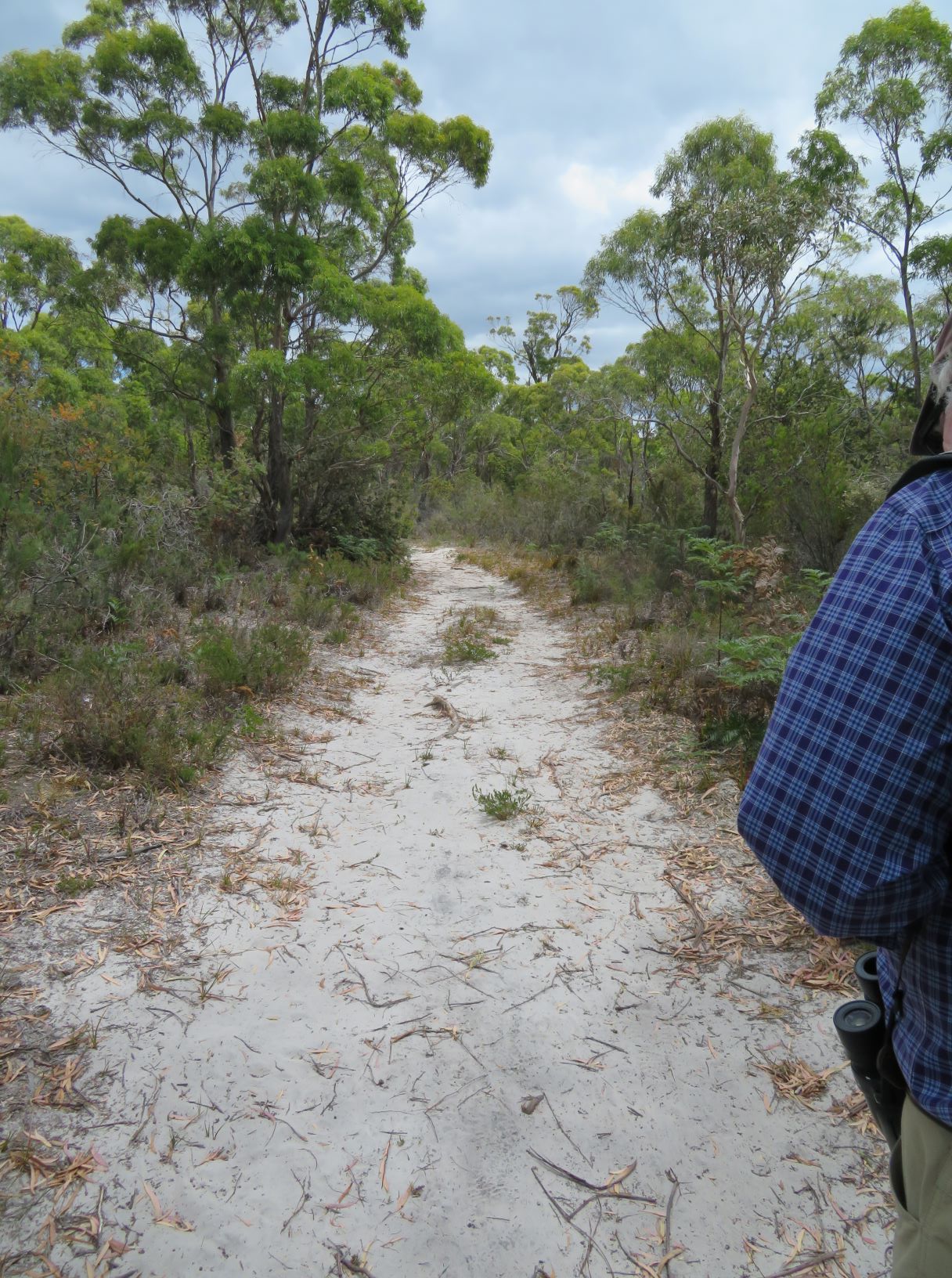
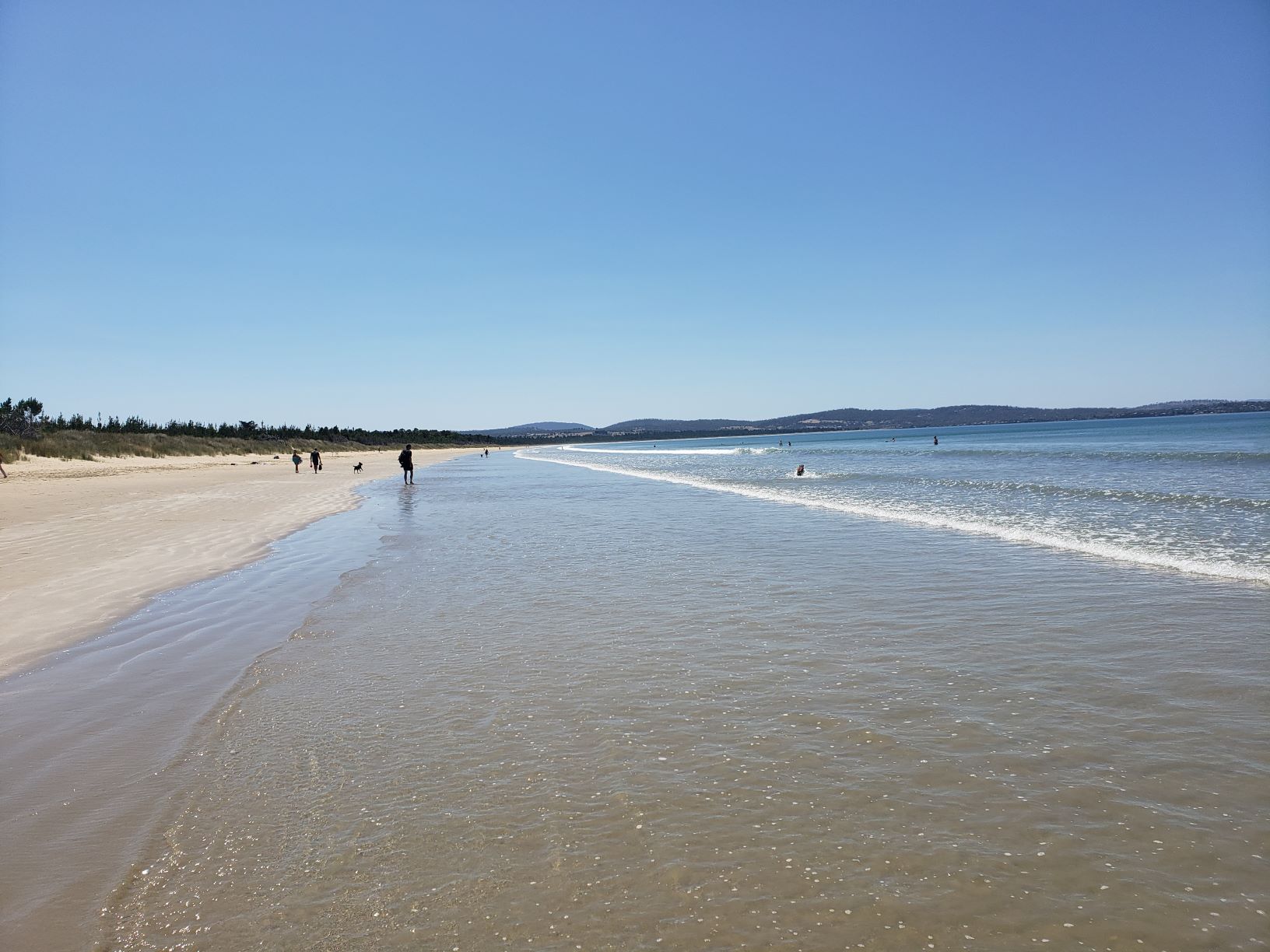
Taking advantage of lovely weather, we’ve been to Seven Mile Beach (where the weather changed), Nine Mile Beach (above, near Swansea), and today Lagoon Beach at the end of the Tasman Peninsula. The peninsula is a big hook, and at the end is the Lime Bay State Reserve. The road ends at a campground bordering the reserve. From there, a trail crosses to the west side of the peninsula at Lagoon Beach. It was an easy walk on a broad, sandy path to a beautiful beach. When the sun shone full on the sand, it looked like the Caribbean.
We picnicked among the dunes with a bit more blowing sand than is ideal, then strolled the shore looking at the seashells, the driftwood, the wombat poop. Wait! What! Yes, we recently read this article and as a result were able to identify wombat scat with 100% accuracy.
We didn’t see a live wombat, as they are mostly “crepuscular and nocturnal” (out at sunset and night). I think they would be afraid of us, but they are biggish (40-70 lb) and I wouldn’t want to get between a wombat and its destination.
We had a lovely walk and beach visit, and an encounter with a wombat’s neighborhood.
We found strange, brown cubes on the edge of the beach, and based on our recent scientific reading, realized that there are wombats living nearby! We didn’t see any, but we saw the undeniable evidence. (click below)
We landed in Hobart around 9 pm, after delays leaving Christchurch and Melbourne. Straight to the hotel and sleep, we woke up to a heat wave! Expecting cool weather similar to New Zealand, it was a bit of a shock when the temperature hit 90° (F.) by mid afternoon when we were settling in to our house in the middle of a vineyard. I was missing the coast already.
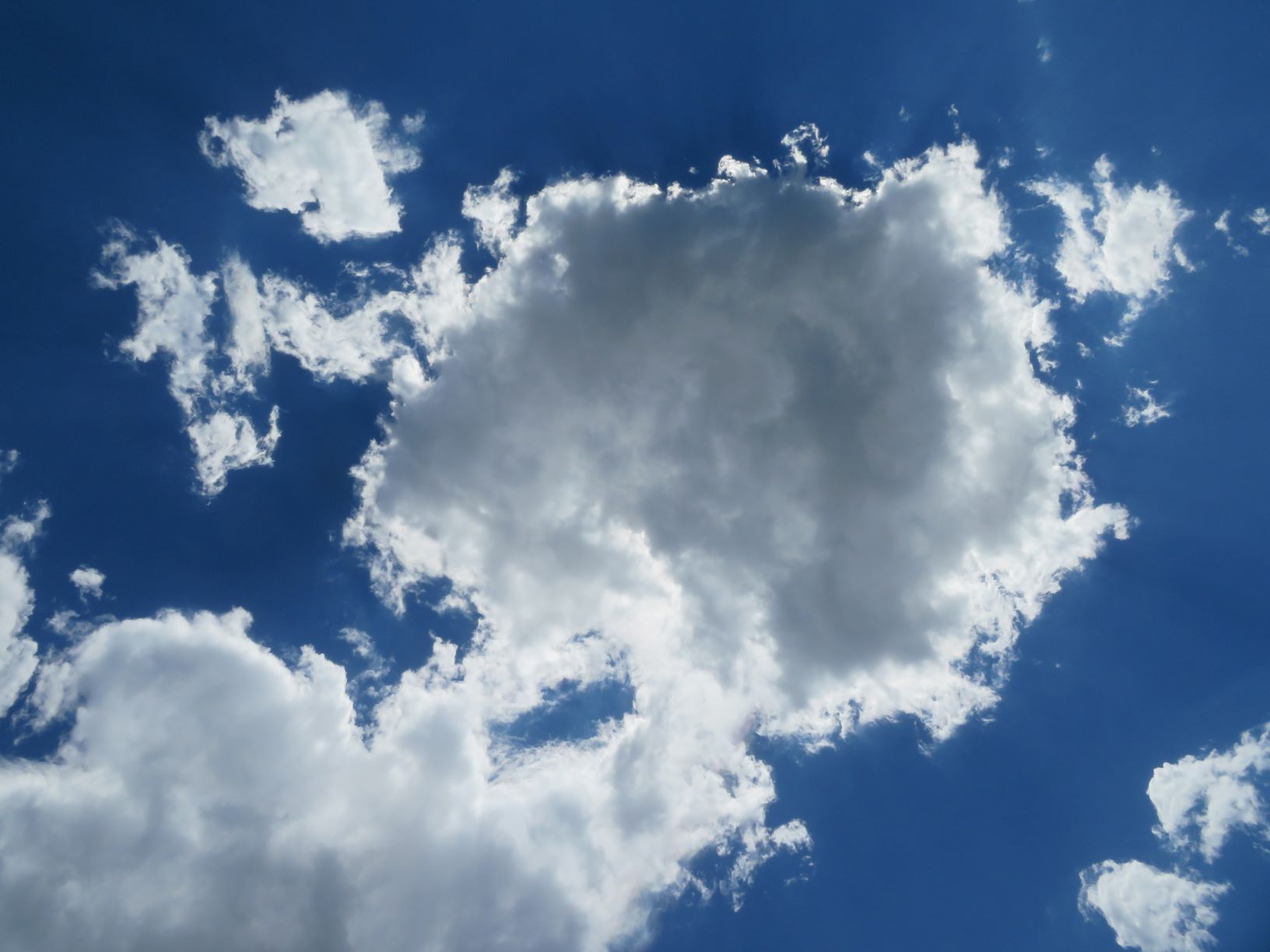
The next morning the forecast was for hot, hot weather and we headed for Seven-Mile Beach, just north of Hobart. Arriving midday, the sand was too hot to go barefoot, so we scuttled down to the tide line and took a long walk splashing in the shallows. Lots of people were on the beach under small tents or umbrellas and we strolled toward the end of the line. Not having a tent, we perched our bags on the edge of the sand and went for a dip. It was perfect, cool water and flat seas, barely a tiny wave to ride in on. We got out planning to find shade for a picnic, when a cloud covered the sun for a moment. We looked up and a long line of clouds were reaching across the sky. It would be overcast soon. A puff of wind came up as I dried myself, steadily increasing in speed. By the time I picked up my capris, the wind was blowing them sideways. We looked out at the water and it was covered in whitecaps. The temperature was already dropping. We were standing on the beach while a front passed through. We trudged back to the car against the now-strong wind and by the time we got there, the temperature dropped from 94° to 78° (F.).Now in a house where the TV works easily, we watched the news about the forest fires elsewhere in Tasmania, which explains the reddish tinge to the clouds. In the morning, the air was faintly misty and smelled of smoke. In another swerve, the following morning both the mist and scent of fire were gone because the wind changed direction. Welcome to Tasmania, land of changes.
The weather has settled a bit and resembles what I had expected, cool at night, warm at midday. The land is much drier than I expected, looking more like Italy or California than New Zealand. After our shocking intro, though, it’s just fine. Below is the view out our window.
We have just spent two months in New Zealand, a truly wonderful place. People are interested in nature and the outdoors, conservation is important, and kids are taught to carry their trash home from the beach at the same time they are taught to surf. I like the balance. Our interests are the outdoor variety and we leave happy. As always, we could have spent more time everywhere we were and we could have spent all our time in other equally wonderful places. No one place is really a must-see. As our daughter Lyra says, there’s no need to take the Hobbiton tour, the entire country is a movie set for Lord of the Rings.
Places we really wanted to see were beaches, the bush (forest), which is amazingly dense and different, birds, and Milford Sound.
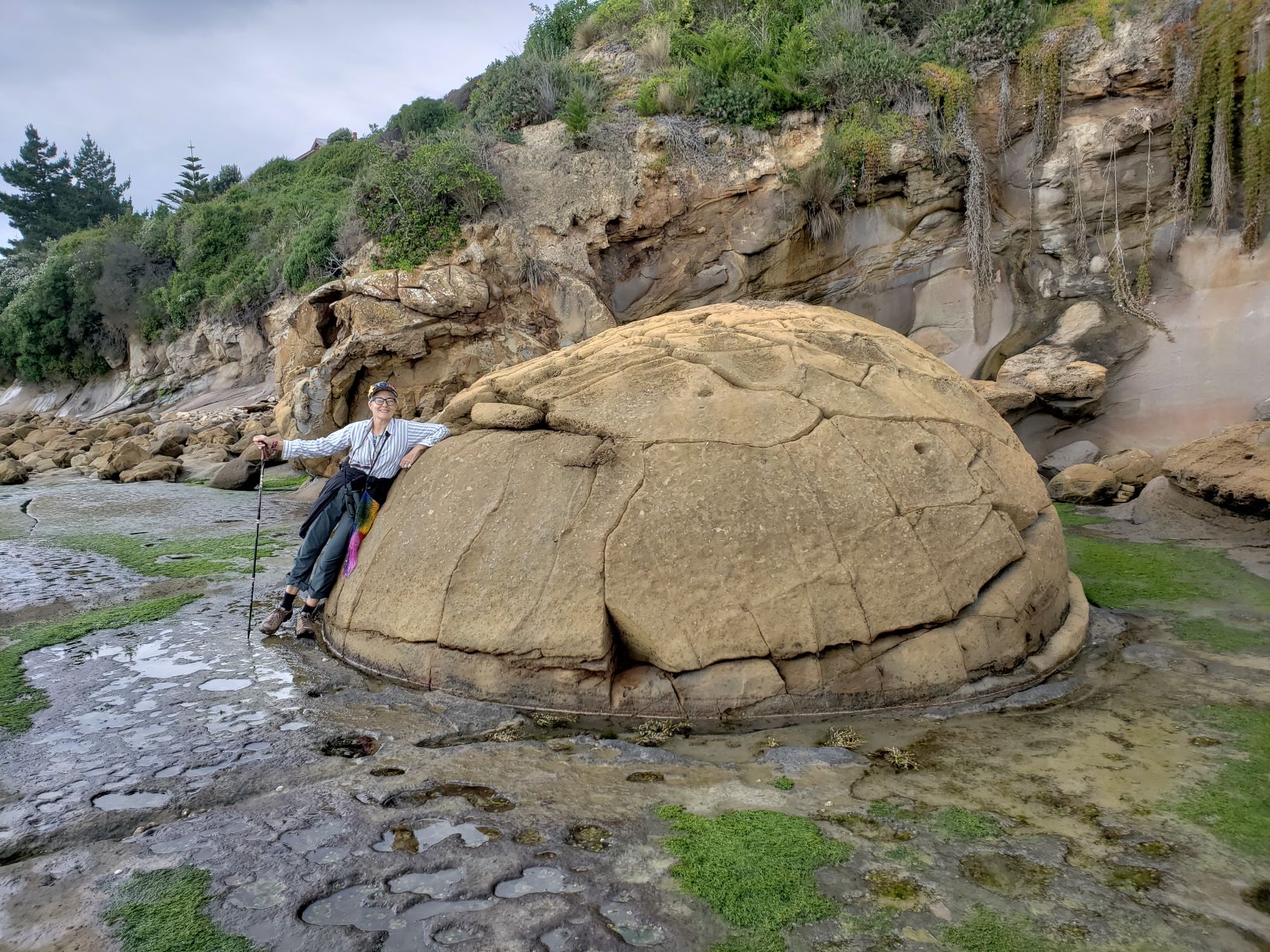
We saw what was on our list, but also ended up with favorites that we hadn’t known about, like the round boulders on the coast near Shag Point, not far from the better known Moeraki boulders.
We were amazed at the number of unique, endemic birds we managed to see. New Zealand has a remarkably large native pigeon, a giant purple chicken (gallinule), and a bell-bird that has a song much larger than its size. And others. We saw a kiwi!!
Efforts to tame nature result in hedges at least 12 feet high that encircle–empty fields. Others surround houses with only a driveway opening. I liked the one with a “window” cut into it. Some hedges were so high that they couldn’t be trimmed into shape. Imagine large trees growing out of the top of your hedge.
I like New Zealand because I felt welcome. People were friendly, and took time to chat. The eye doctors I visited (!) I would like them as my friends. Their advice was excellent, too.
We had some fun with language, finding that we didn’t always understand people. There are entertaining names for things:
Biscuit—Cookie
Caravan—RV
Eftpos—Payment by credit card. The first time someone looks at you and says “Eftpos?” can be confusing. (The technical name for a credit card payment made by a machine in a store is: Electronic Financial Transaction at Point of Sale: Eftpos!)
Forecourt Concierge—Gas station attendant
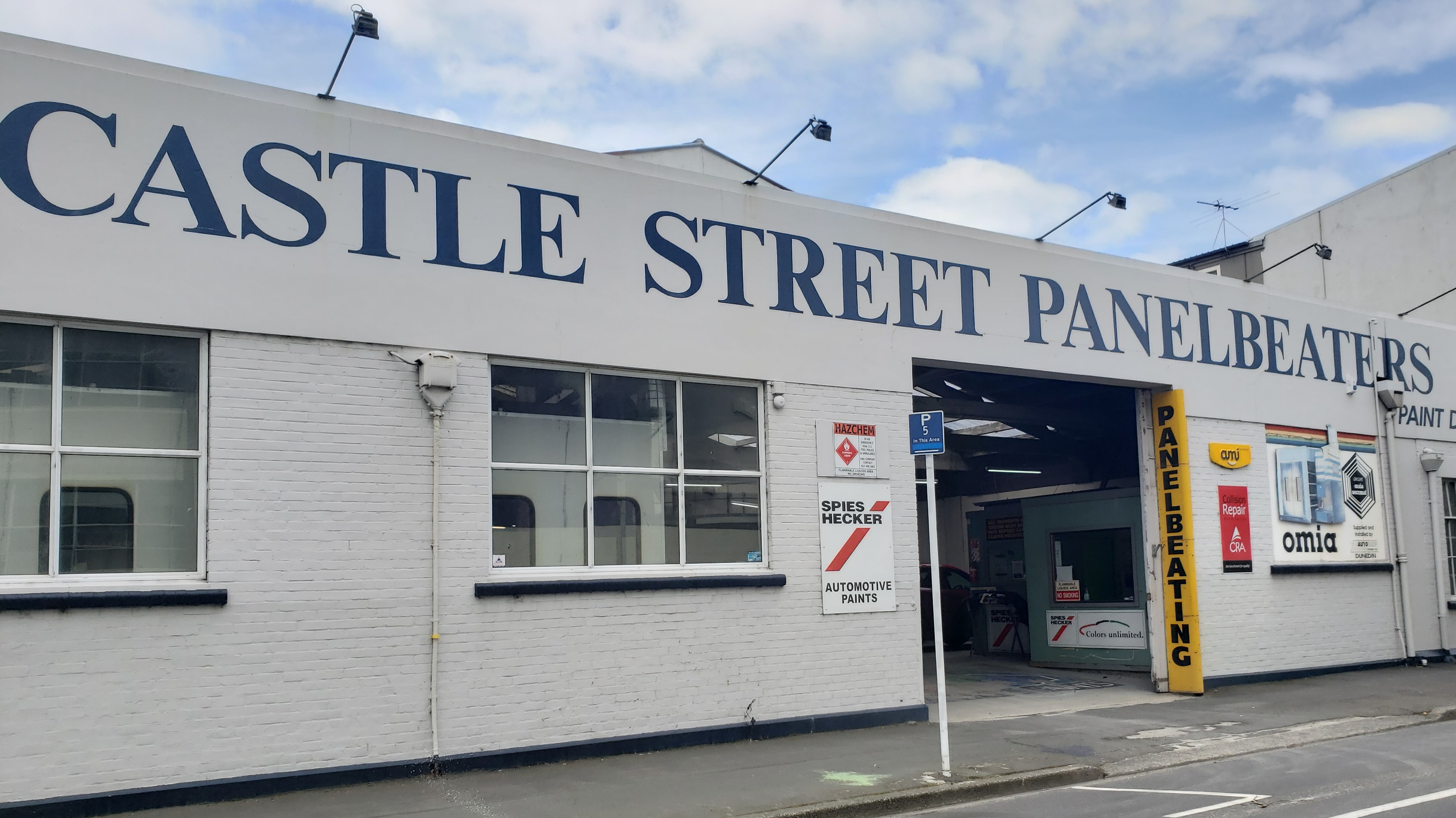
Panelbeaters—Auto body shop
Trolley—Shopping cart
Good to Know About New Zealand
They know we’re coming! The roadside is regularly punctuated with billboards of advice for visiting drivers: you’ll need extra time getting anywhere in New Zealand. They are correct. Take your time, rest if you feel sleepy, don’t use your phone. There was a billboard telling us not to drink coffee while driving, What!!!!!????
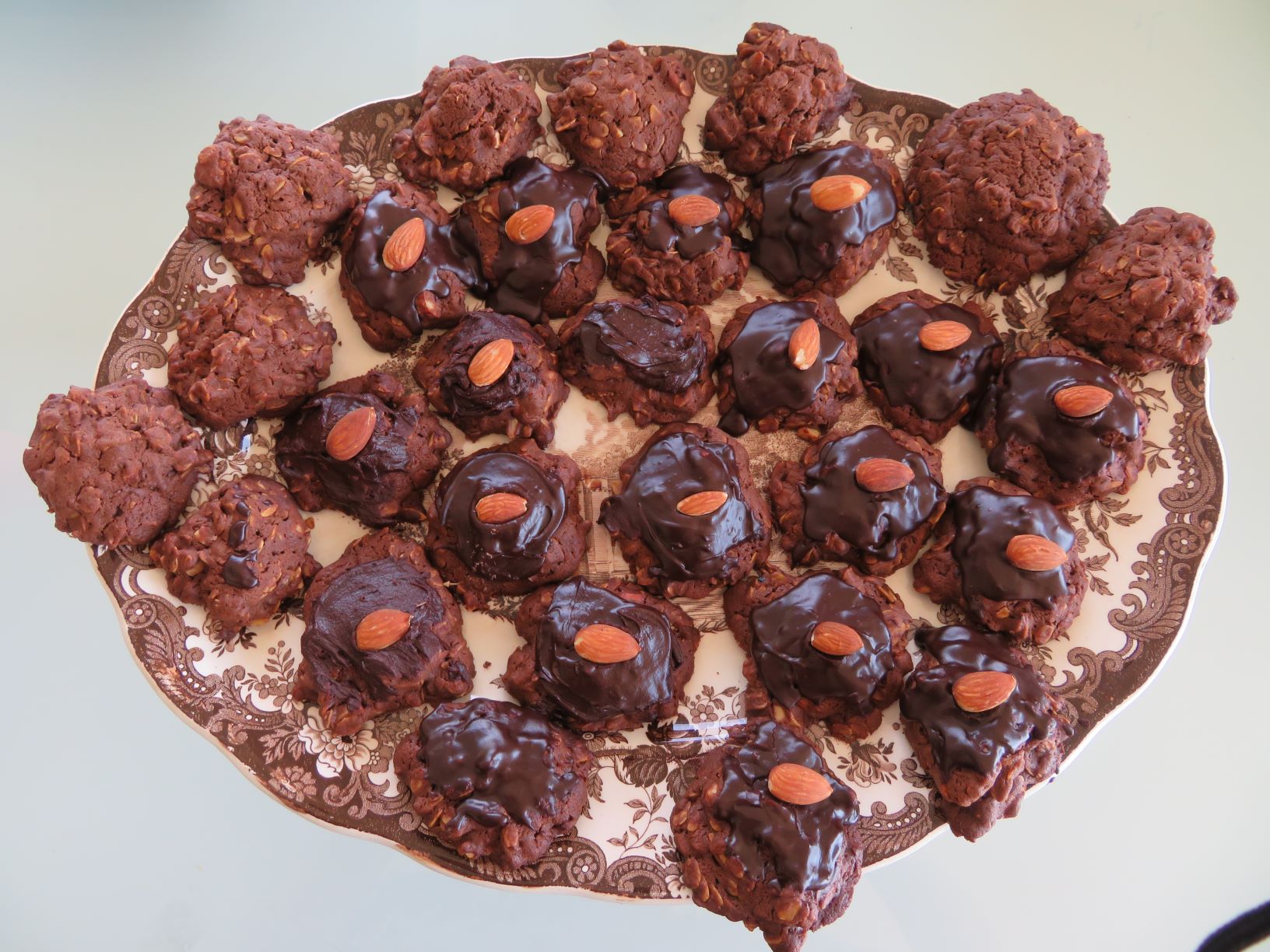
My version of Afghan biscuits.
Biscuits (Cookies): There are crazy and beloved sweets like lolly cake (broken up meringue-like neon colored candy in a paste of sweetened condensed milk and vanilla wafers. Other cookies harken back to the early 20th century wars that New Zealand took part in, the Boer War, and WWI & II. Women sent sweets to soldiers, including Afghans and Anzac biscuits, durable concoctions of corn flakes, oatmeal, coconut, chocolate and such.
Cafes: Our favorite cafe was the Bus Stop Cafe in Te Horo. Say hello to Kirsty for me when you are there. We also liked the corner store in Piha on weekends when they have delicious pastry.
Coffee: New Zealanders (do I have to call people Kiwis?) drink their coffee very, very strong. Order a flat white, but remember, it only looks white.
Driving: Drivers were rational, if generally opposed to passing. That’s not a bad thing, just don’t be in a hurry. We did not find any speed cameras or meet any of the local constabulary. On the other hand, we were never in a hurry. Some roads are narrow and lack shoulders, like places in Ireland and Scotland. You get used to it, sortof.
Sheep vs. Cows: Dairy products are uniformly delicious, from butter and cream to yogurt, cheese and anything else they make. I believe the dairy industry is creeping up on the famous woolen/lamb industry. We didn’t see as many sheep as we expected based on the statistic that there are 23 sheep for every person in New Zealand. All the merino wool products we saw for sale were blended with possum fur in a conservation theme for tourists. (Possums are an invasive pest with very soft fur. I bought gloves.)
Restaurants: We don’t eat out often, but Fleur’s Restaurant in Moeraki is very much worth a visit.
Shopping: Even the grocery store was friendly. The New World chain offers their discount card in visitor form, no local address required, yet it gives you shopping and gas discounts. Thanks, NW.
Weather: We timed our visit to be in the North Island in their Spring season (Nov.) and South Island in their Spring (Dec.), and both proved mostly cool and regularly rainy. People said that “Last Year”….it was much warmer in the spring. If I visit again, I guess I’d wait until January or maybe even February. New Zealand is never hot, it’s a bit like Ireland. People wear heavy wet suits to go in the water in the summer. Children and adults alike swim in wet suits with ear-covering caps. We admired their enthusiasm and did 99% more beach-walking than swimming.
Wine: We did not select a favorite wine since the country is wall to wall wine, but we did like the pink Pinot Gris from Weaver Estate. We visited a number of “cellar doors” (tasting rooms). Tasting is inexpensive compared to California, though wine prices are comparable.
Visa: No visa is required if you stay less than 90 days. That makes life easy. Contrast this with my post on trying to getting a six-month tourist visa for Australia. Stick to 90 days if you can.
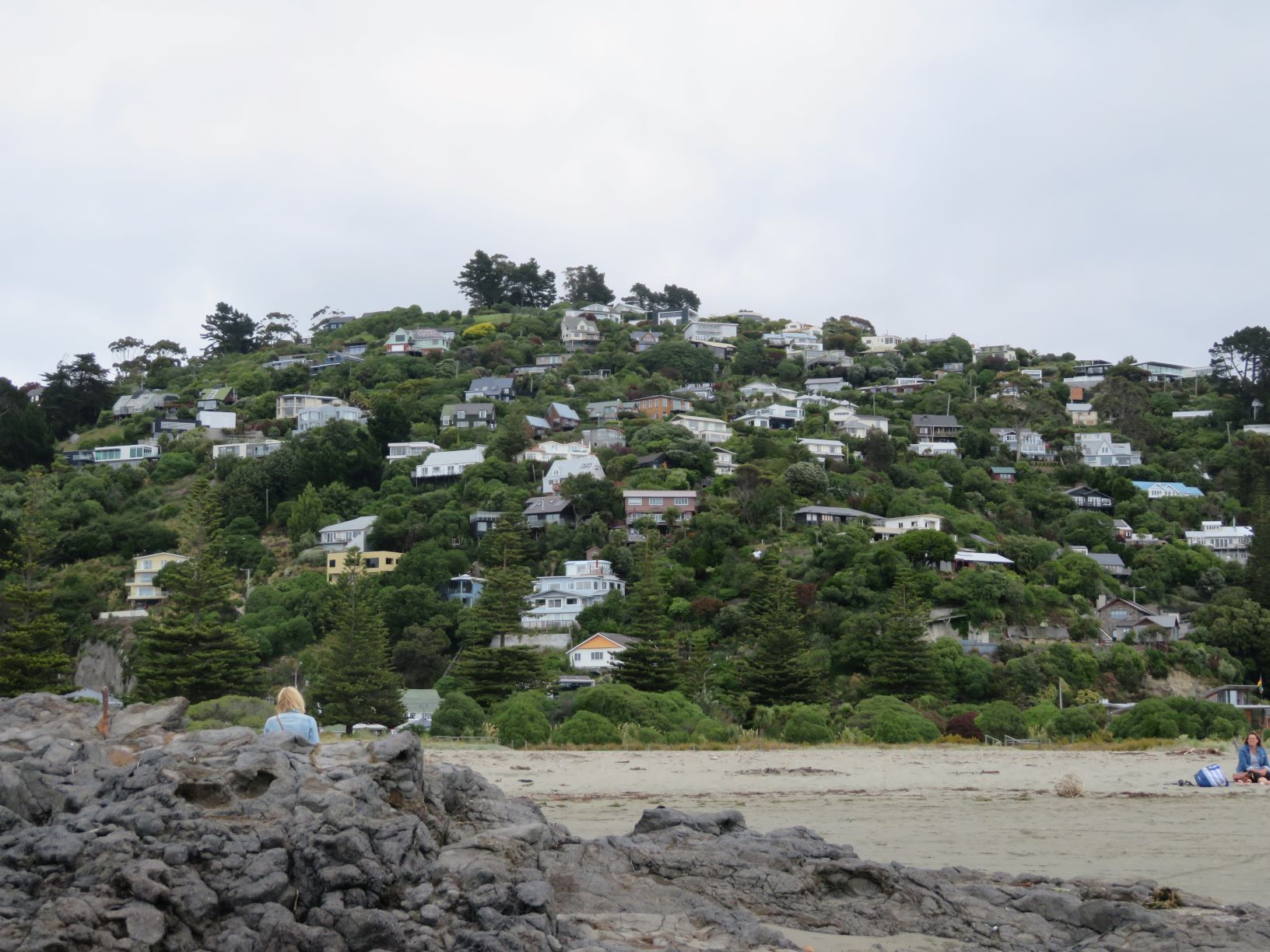
Like other parts of New Zealand, living along the water is a preferred location, and new houses are squeezed onto steep hillsides facing the bays or open ocean. We have seen houses built very close to the roadside, or on stilts that are three stories on the downhill side with the foundation sitting on the hillside at the upper end. I’m not sure how confident I would be of living in a house cantilevered off the side of a cliff in a place prone to earthquakes, but that’s what we see all around us. Most of the time, I think they are fine, though occasionally an earthquake wreaks havoc.
We have seen refreshing experimentation with architecture and design in New Zealand. There are Victorian style buildings that emulate structures built during the 1840s when the island’s first Europeans arrived. Old style houses may be interspersed with contemporary homes built with repurposed shipping containers, corrugated metal quonset huts, acres of glass, and sharp angles.
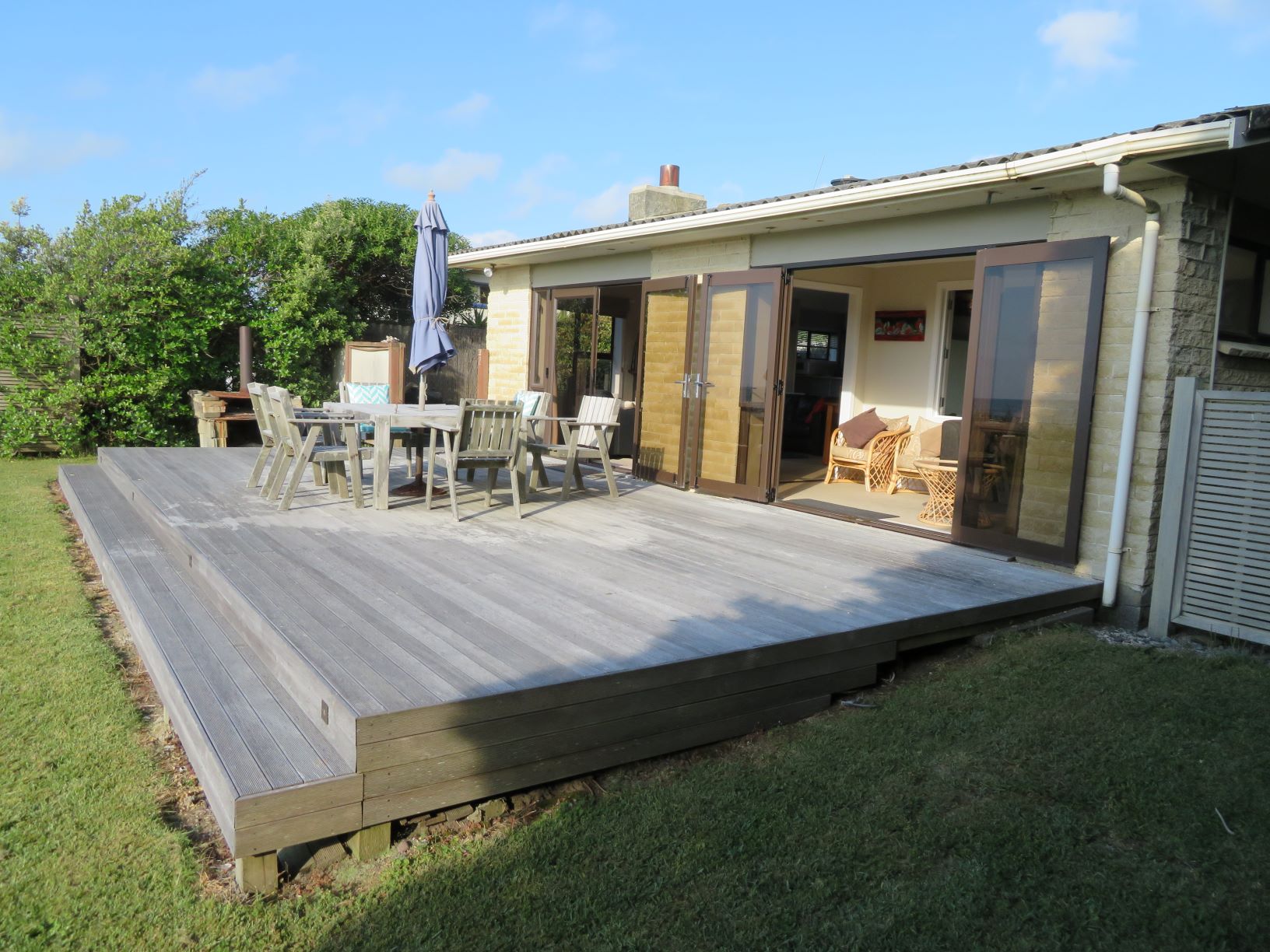
One of our houses…note glass doors to the large deck.
Even traditional-looking homes are likely to have the entire side facing the sun replaced with sliding glass doors to bring the sun in during the cooler part of the year. There is a lot of variety in architecture, from antique to futuristic.
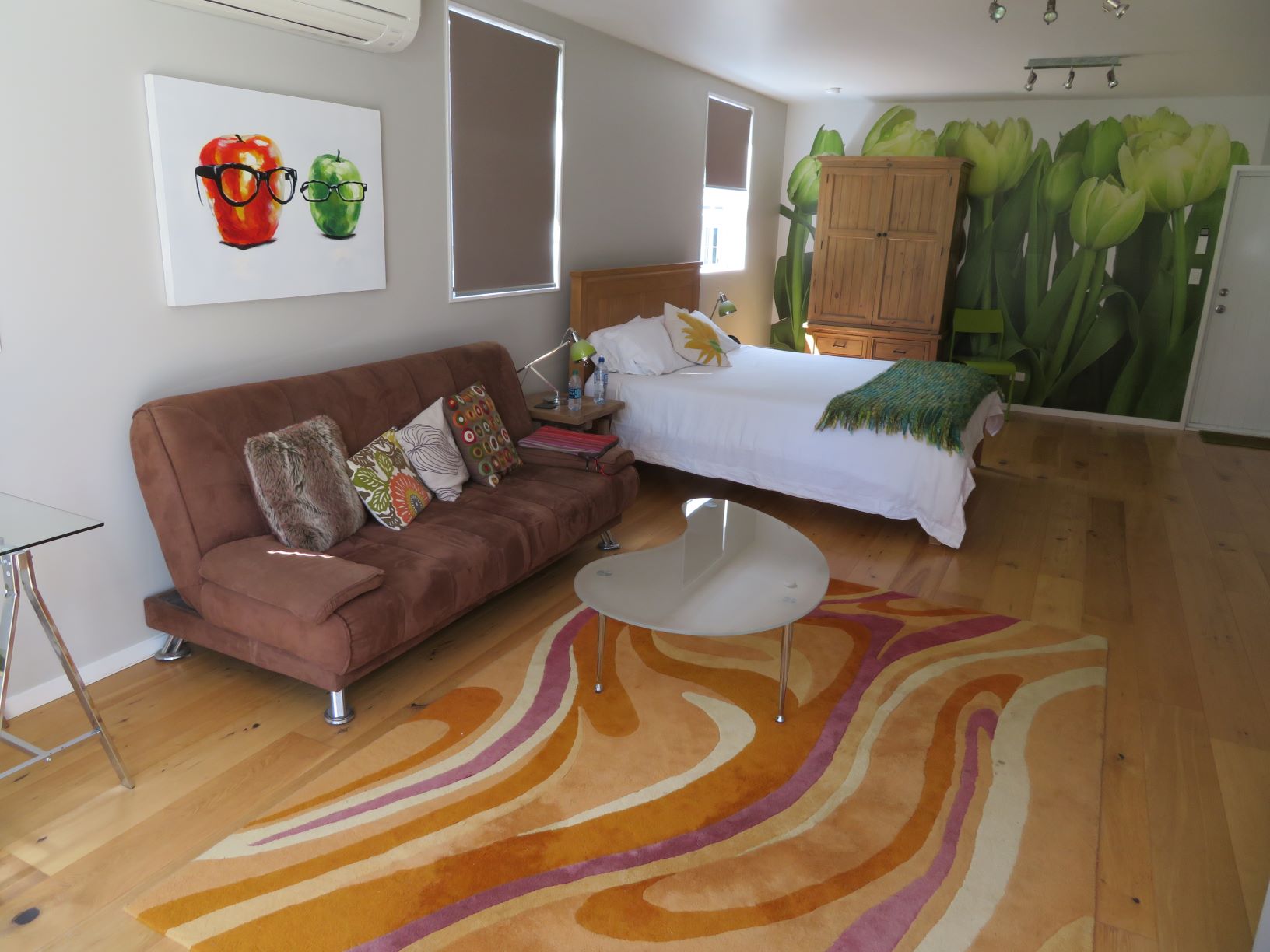
There is an emphasis on nature, focus on the distinctive native wildlife, and bold colors and patterns. Though the houses we have rented tend to be middle of the road family homes, one had a maroon kitchen.
We’ve seen more of stylish New Zealand in hotels. At Lupton Lodge, the exterior was a farm building, while the interior was contemporary.
In Mangonui, the Old Oak used to be the Mangonui Hotel, the first hotel in town. It retains the traditional exterior with an updated interior. The headboard of our bed was an antique wood mantel, while the furnishings were contemporary.
The Old Oak, first hotel in Manganui
Contemporary on the inside
I am sure there is lots more out there, and I enjoyed the stylish places we saw and visited.
My mental map of Christchurch is a triangle. The city center is near the top. The lower right corner is the Banks Peninsula, an ancient volcano that on the map looks like a huge pinwheel. The lower left corner is Lake Ellesmere, a very large, shallow lagoon that is barely connected to the sea through a gap in the dunes. The Pacific Ocean borders two sides of the triangle with one side (left) firmly part of the mainland.
My favorite place in central Christchurch was the Canterbury Museum. It has skeletons of extinct moas, and lots of maori artifacts. The museum is located on the corner of the Botanical Gardens, too, making it possible to visit to both places in one day.
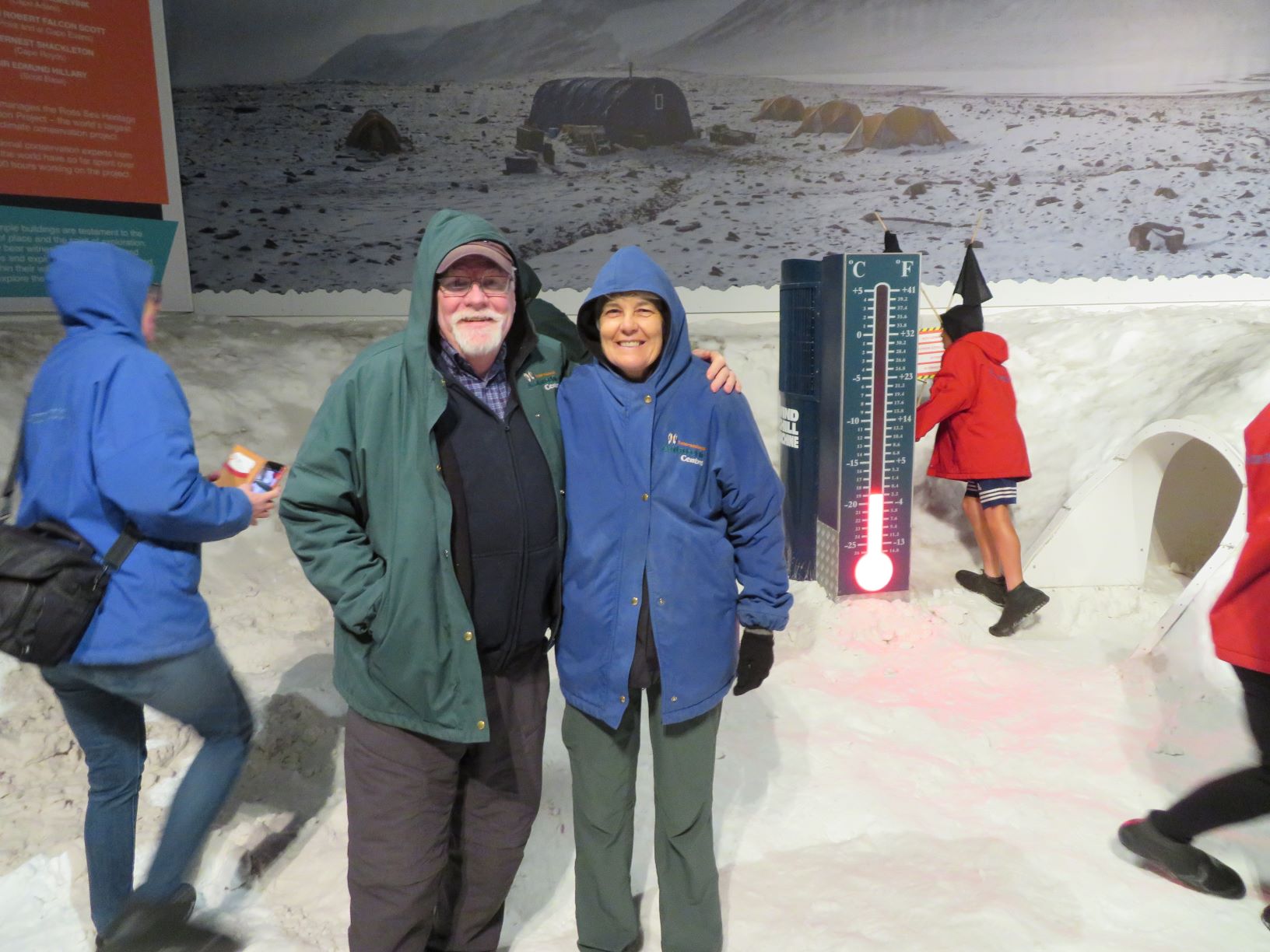
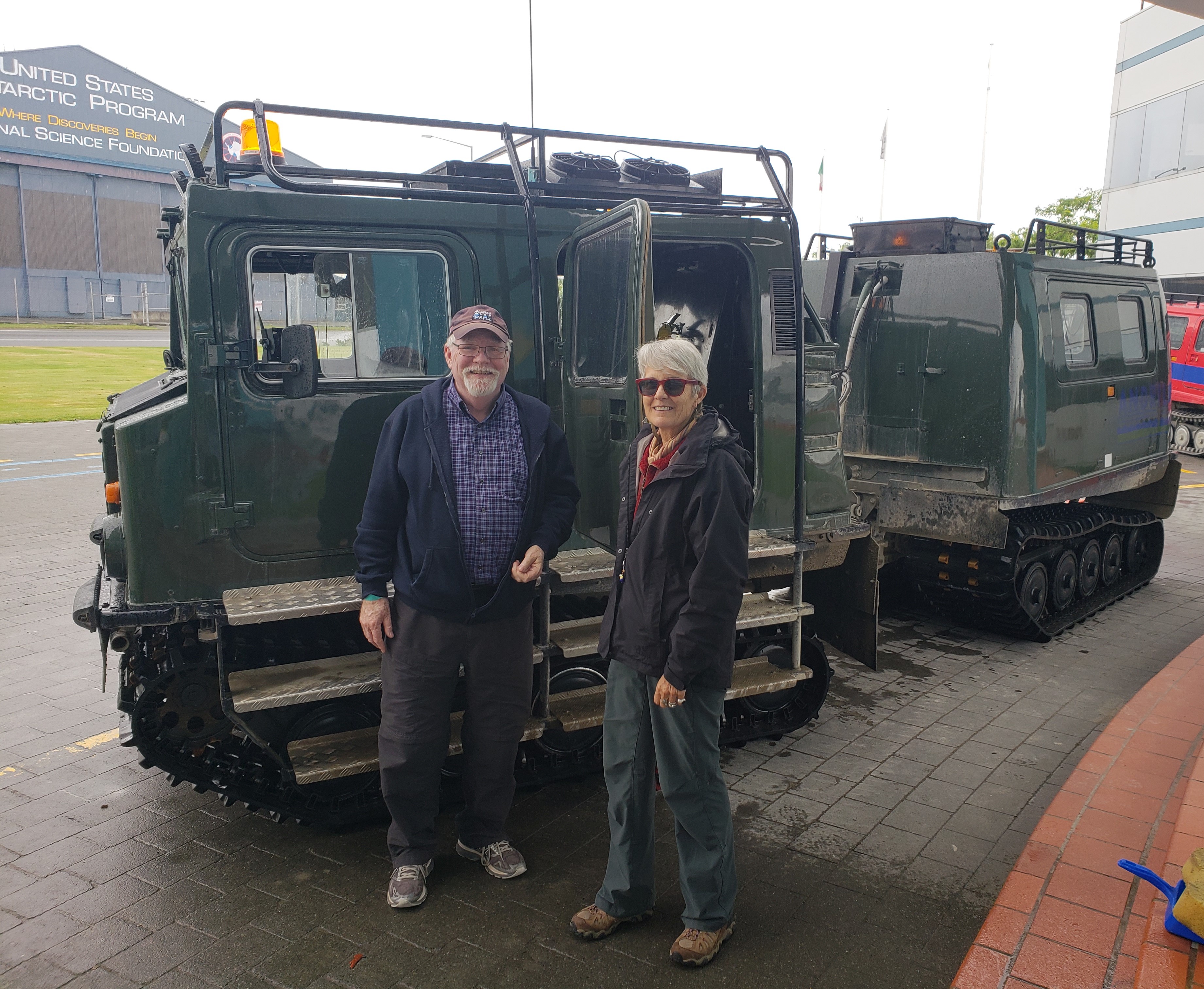
Just outside the city center, right at the airport, is the International Antarctic Centre. I wasn’t sure it would be worth the price of admission, yet we had a great time and were there for at least two hours. There are excellent exhibits on what its like to spend a research season in Antarctica, the clothing, the housing, even an Arctic storm room that simulates a whiteout. The snow and ice covered room not really as cold as the Antarctic, but it’s very cold. You wear an extra expedition jacket over what you are already wearing, and boot covers. Later, we went for a ride in the tank-like vehicles they drive on the snow in Antarctica, including demonstrations of going up and down steep hills and leaning way over to one side. There are penguins, too, blue penguins swimming in a pool with an underwater window. It was a great visit, and I really liked seeing the US National Science Foundation Antarctic Center right across the street, even if there wasn’t an exhibit there. Christchurch is the departure point for all US researchers going to the US Antarctic base at McMurdo Sound, including some of my colleagues from Northern Illinois University. What an adventure that must be!
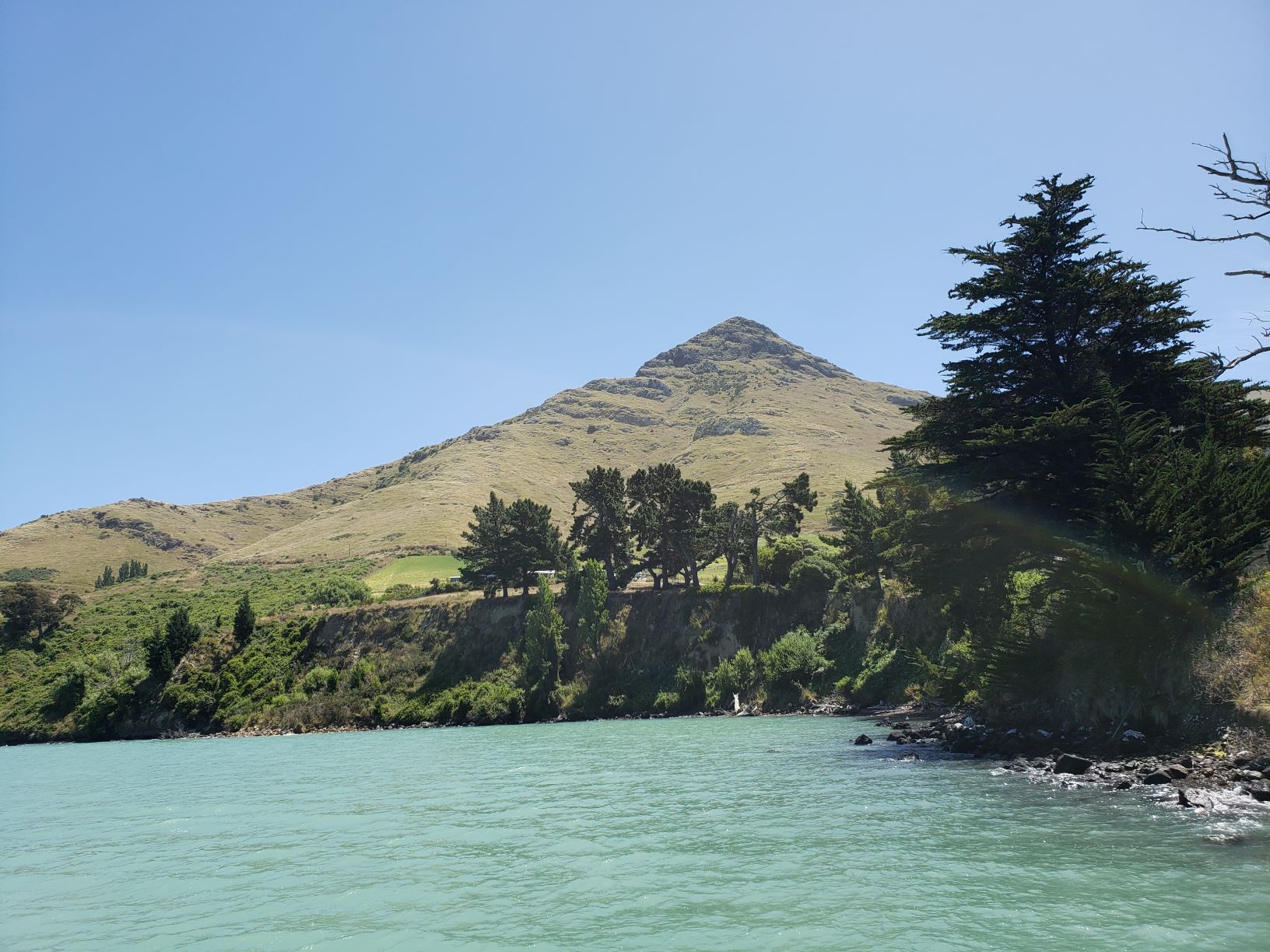
Out on the Banks Peninsula, Akaroa is a small town known for its brief reign as the French outpost in New Zealand. From Christchurch the drive is at least an hour and a half across two old volcanoes. You see the edge of the crater as you go over the hills to Little River, then across the crater to Akaroa. The town offers beaches, lunch, and shopping, an excellent vacation stop. We were there on a day with a cruise ship visit (!), which has the benefit that all the stores and restaurants are open, but the disadvantage that they are all full. We left town to look for a place to have a picnic, and ended up in a cove across from the moored cruise ship, watching tenders carry passengers back and forth, while people paddleboarded, jet skied, and kayaked around the bay. The water is cloudy in other parts of New Zealand from glacial dust and runoff that gives it a bright turquoise color. Akaroa is nowhere near the glaciers but the water has the same slightly cloudy bright blue color.
We explored the north edge of the Banks Peninsula in a separate trip around Governors Bay where the only person we met was a young woman at a family reunion nearby. She told us the name of this mountain in Maori.
Our visits to the third corner, Lake Ellesmere began coincidentally when we turned off the highway to look at shore birds. We ended up at Birdling’s Flat, a long pebbly stretch of beach. On our way out we stopped at a quirky rock shop and museum and found that many of the pebbles at Birdling’s Flat are agates. Once polished, there are all colors, and the shop/museum displayed thousands of polished stones.
On our final trip to Lake Ellesmere to look at birds, we ended up laughing and taking a selfie while slogging around in a muddy tidal flat. The promised birds…..they were all black swans, hundreds of them. (We’d already seen hundreds of black swans.)
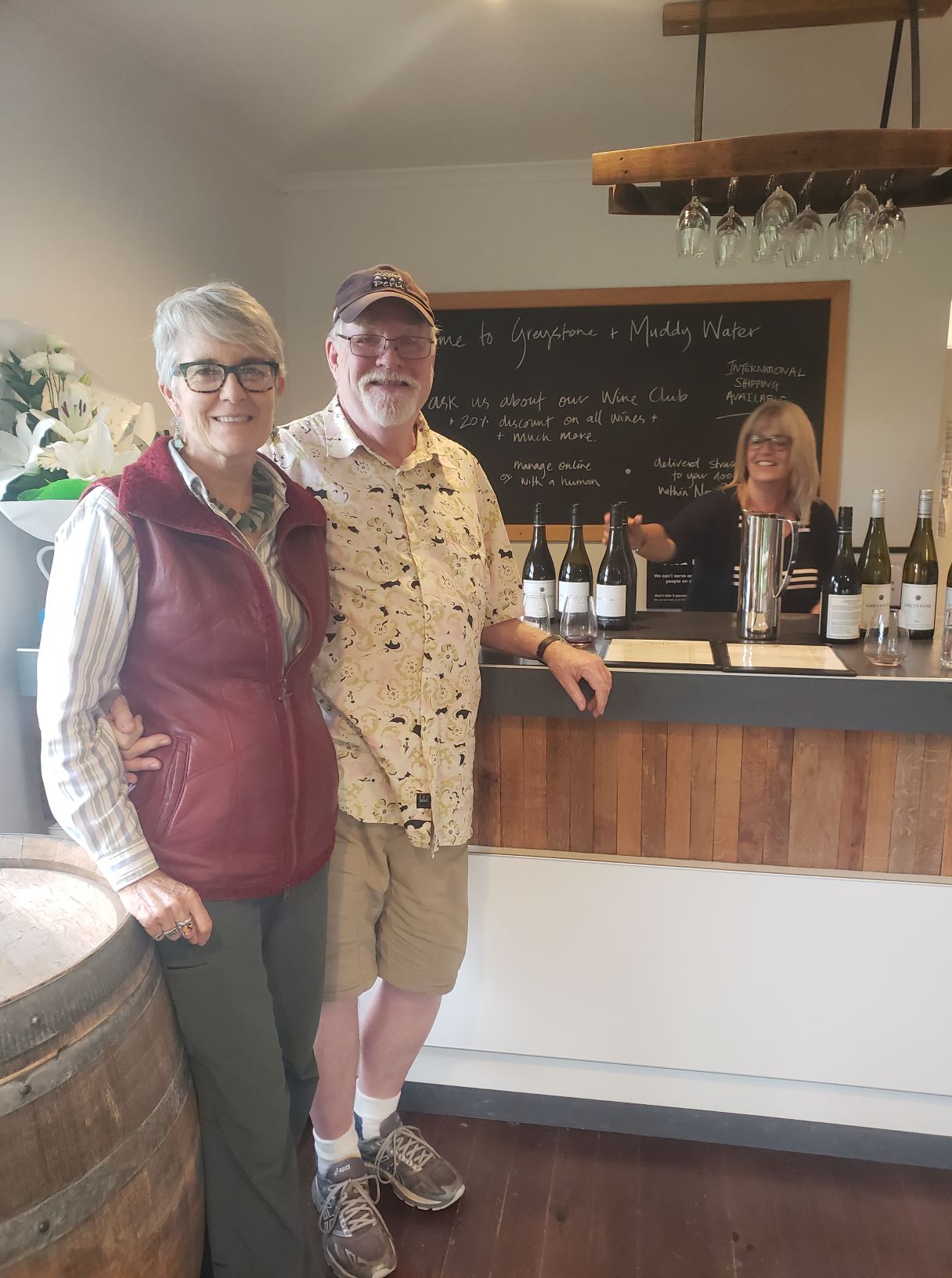
The weather has been unusually rainy and cool, we hear, though since we didn’t know any better, we went out almost every day to visit a beach, or a winery. You could spend a lot of time touring the Marlborough wine region north of Christchurch, but we decided to leave that for another time. We had delicious wine at the wineries we did visit. In New Zealand, a tasting room is a “cellar door.”
Our home in Christchurch is a recently renovated bungalow near the Avon River. A stroll around the neighborhood when we arrived revealed that we are only three houses away from an extensive park along the river. What we subsequently found out is that the park was fully occupied by houses until the Christchurch earthquake of 2010/2011.
A substantial area liquefied during the earthquake and was deemed unsuitable for rebuilding. Houses were removed, the street along the river was closed, and today the riverside park is segmented by the remnant landscaping of the homeowners who had to move away. It is a bit melancholy to see what must have been someone’s yard, minus the house.
Our house was repaired rather than demolished. There is lovely wood paneling that has been retained, along with old-fashioned light switches. Windows have beveled glass panels at the top in living room and bedrooms, but the kitchen and bath are entirely new.
There is still a lot of rebuilding going on throughout the city, as well as construction of new houses, even though the earthquake was almost seven years ago. What is a sharp memory here wasn’t even on my radar.
Before coming to New Zealand, we looked forward to seeing jade being worked, and shopping for a jade pendant or two. After arriving, we began to find out a bit more about jade and jade carving that did not make our search easier. Jonathan and I are well-trained researchers, and we like to know about things. We wanted to know what New Zealand jade really is, mineralogically, where it comes from and how it is carved. We barely got past the first question because there are too many answers.
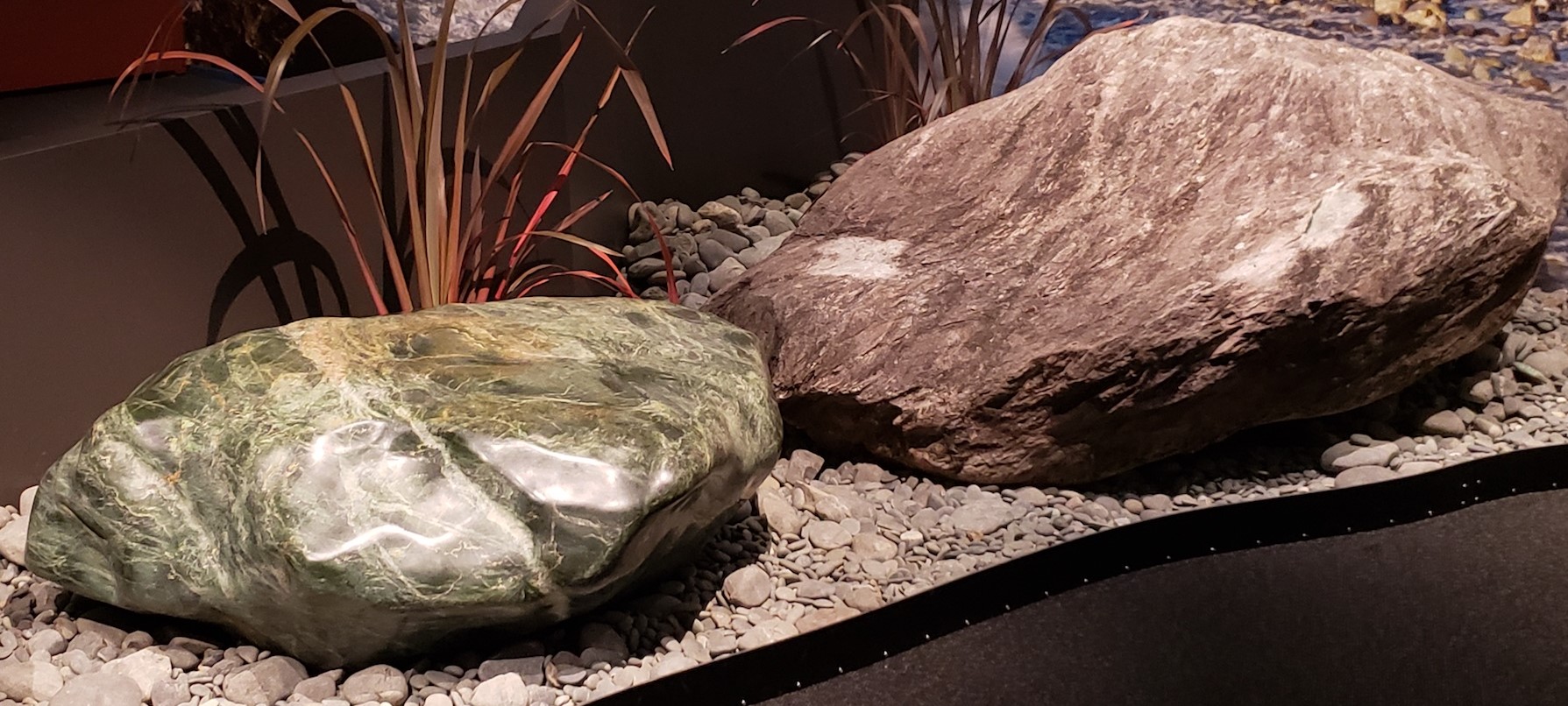
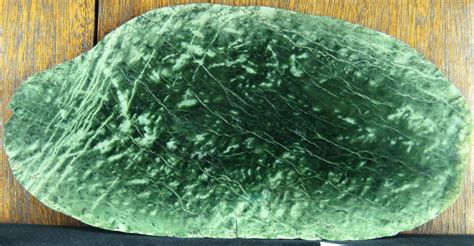
On the right is an unpolished boulder (chipped to show jade interior). On the left is a polished jade boulder.
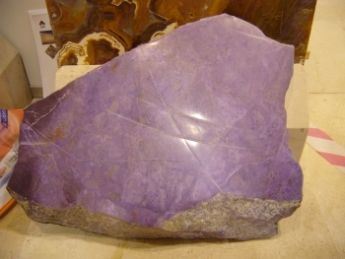
Jade is composed of silica and other minerals and is best known as a translucent green stone. (That is what I think of.) We also found that jade can be hard or soft, and occurs in all shades of green, lavender, blue, red, and black. There are so many varieties that what a carving is made of becomes impossible to determine without spectroscopy.
In New Zealand, jade is known from the earliest arrival of Europeans who observed the Maori people wearing carved jade pieces. In this portrait of Rangi Topeora, one of the few women leaders to sign the Treaty of Waitangi, you can see carved jade objects in two shapes, cylinders and hei-tiki. These are some of the fairly limited repertoire of traditional shapes. I found the limited number of shapes a bit disappointing until I thought a bit about this portrait. The Maori didn’t carve jade to be decorative, they carved it to make symbols of power and personal rank. It was important for a carved piece of jade to be recognizable as a particular shape and carry its associated meaning. Creativity was only valuable within the constraints of a particular shape. A person wearing a hei-tiki wanted those who saw it to recognize it immediately.
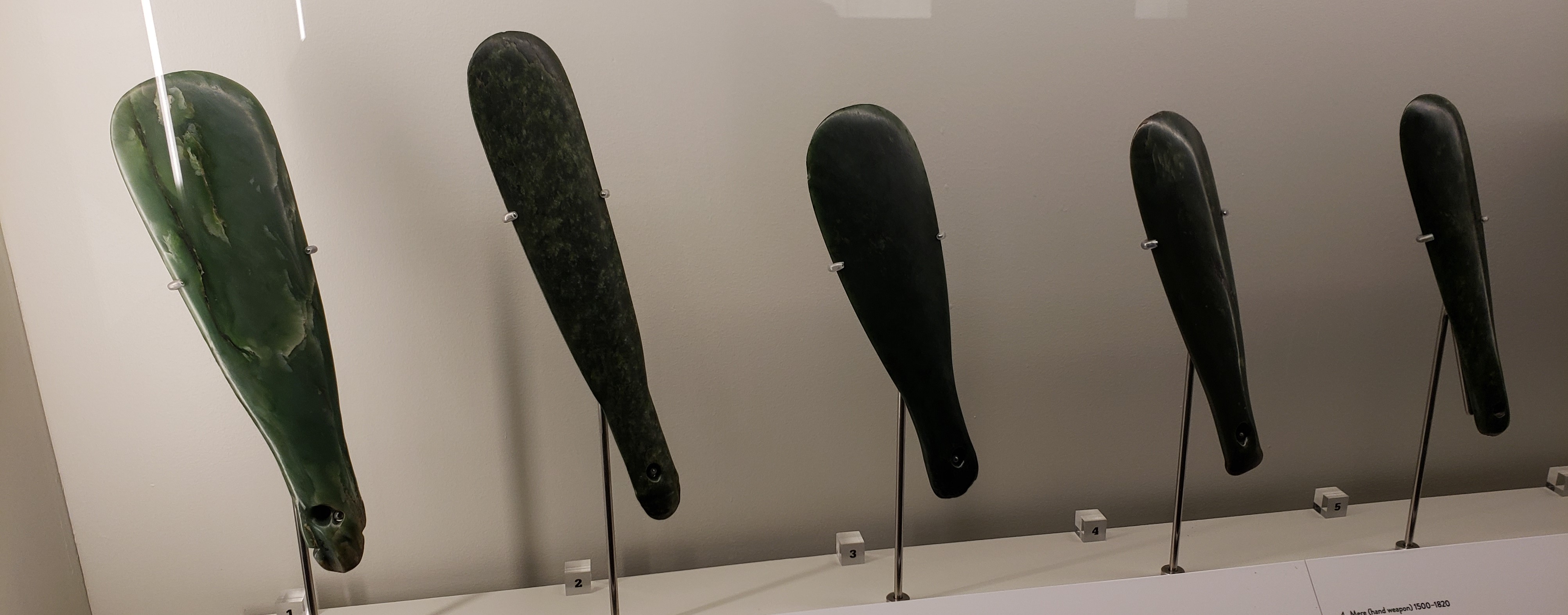
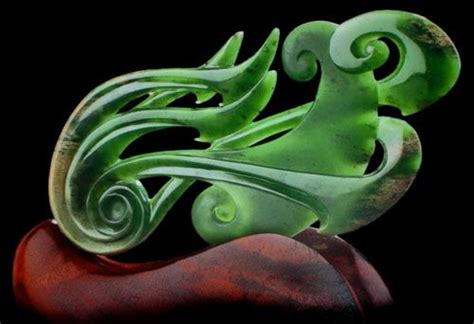
Today, traditional forms are what you see in most stores. I am skeptical of the “meaning” that is described in flowery language on sales materials. What we know is that these shapes have been passed down through generations, providing buyers a memento that gives a nod to Maori history and tradition. In the Canterbury museum in Christchurch there are numerous examples of all the traditional forms along with a lot of jade fighting clubs. Jade was definitely associated with power!Not everything is traditional. There are some contemporary carvings made from jade, and also bone, wood, and stone.
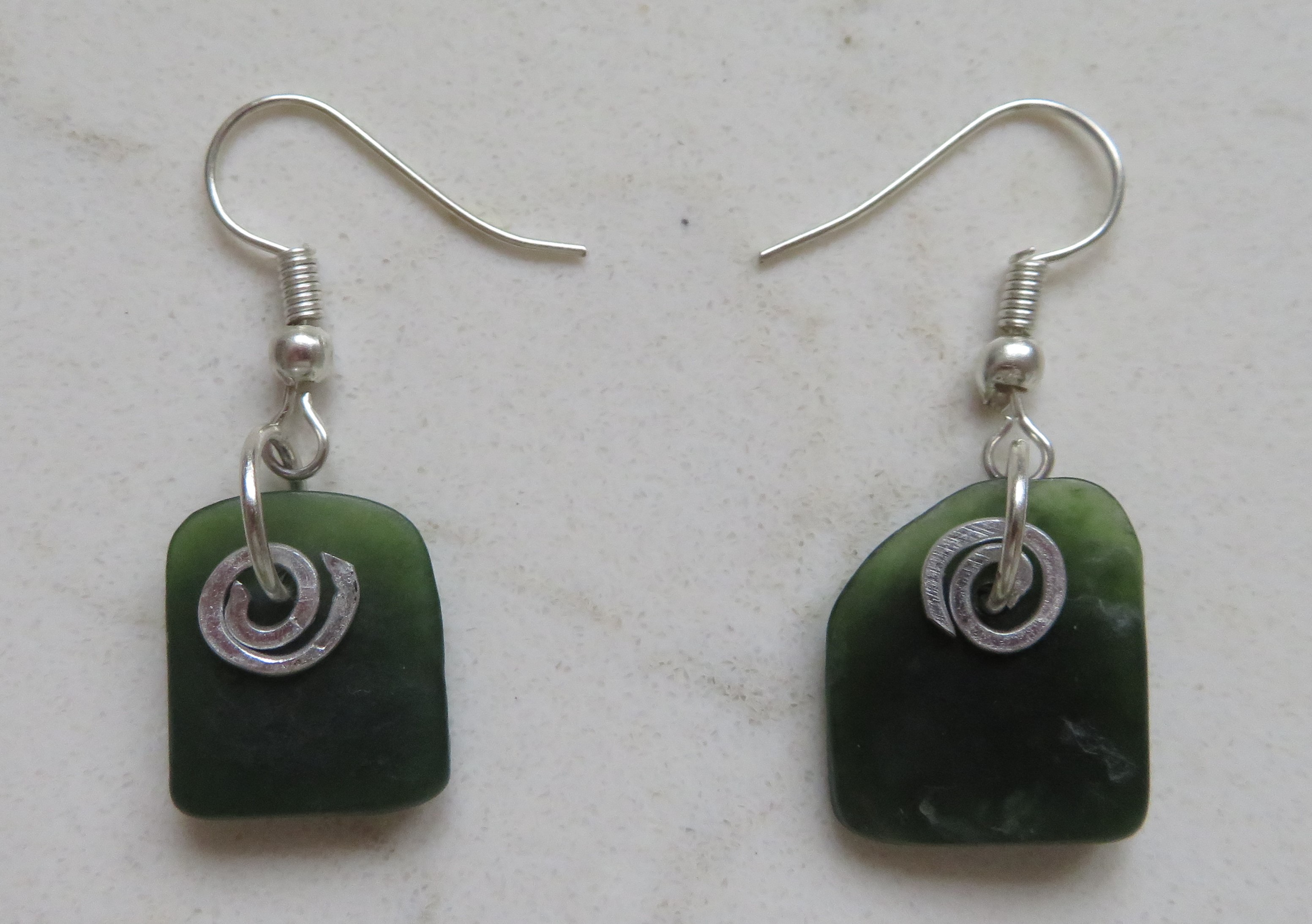
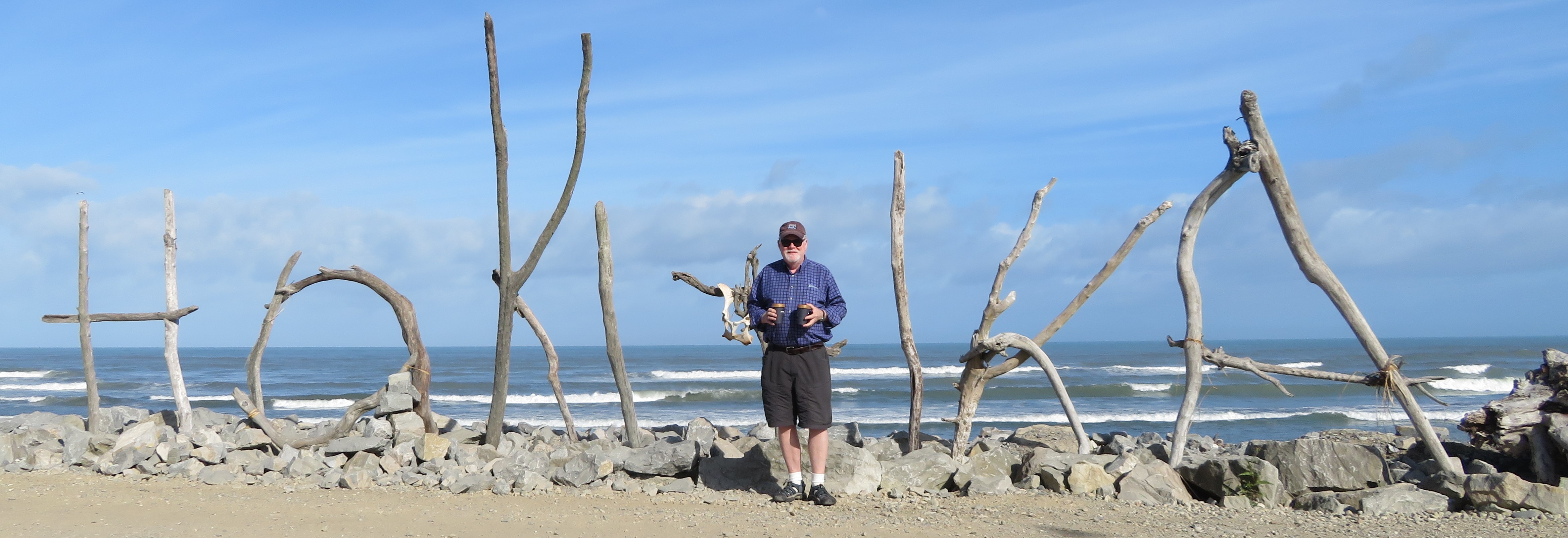
Having given up on what jade is, we looked at where jade is found. New Zealand jade is found in several localities on the west coast of the South Island as pebbles and boulders that wash out of the mountains. Most jade collecting is reserved for authorized members of an ‘iwi’, a traditional Maori group. The jade is carved by Maori carvers, or sold to others to carve. When we heard that it was possible for anyone to search for jade pebbles on the beach in Hokitika, on the west coast of the South Island, we knew we would visit and have a look for ourselves. When we got there, we used our combined archaeological surface collecting expertise and our diligent beach-combing efforts to search out jade pebbles. Jonathan found one, about the size of his thumbnail. This is definitely an activity in the “if it was easy there’d be a lot more people out here” category. I decided against purchasing a carving and instead bought two tiny matte-finished slices of jade out of which I made earrings. I spent a lot less than I would have on anything comparable. It was fun and makes a good story.
Hokitika Beach
We concluded that the best way to purchase jade in New Zealand is to talk to people, especially those who work with jade, rather than buy items in a gift shop. Chatting with people at craft markets can lead to meeting someone who actually carved the jade themselves, or possibly someone who collected the jade personally. A small studio run by an individual or a family may make it possible to find out where the jade you are looking at comes from and who carved it. To me, the greatest enjoyment of an object comes from knowing something of its history. I met a woman selling jade pieces near the beach in Hokitika and she explained that her husband did most of the carving though she was learning and could produce simpler shapes. They purchase their jade from the Maori authorized to collect it, and she could describe the shapes and varieties of stone. I enjoyed our discussion more than any of my visits to the shops in town.
When you find out that jade can be almost anything, you depend upon the honesty of the seller to find what you want. That proves problematic, as a lot of jade is treated to improve the color or to make the piece smooth. These “enhancements” include anything from simply rubbing the piece with wax (the finish on most pieces), to dying, impregnation with resin, or placing stone on plastic backing. Sellers of jade do not mention any of these techniques of ‘enhancement’. How is a person to shop? The color question is amplified by adding the questions of where jade comes from and who carves it. The largest seller of jade carving in Hokitika is Mountain Jade, with at least two stores. Looking around the store we found that though some of the jade was local, most was not. Some items were marked “New Zealand jade”, others “New Zealand greenstone”, others “carved in New Zealand”. This means that carved items not marked “New Zealand” are likely to come from sources in China or Canada, especially as the owners of the business are from China and Canada, where British Columbia produces much of the world’s jade today. Objects not marked “carved in New Zealand” might well be carved in Indonesia or China. A “featured artist” bio in the store described a designer who purchases stone in New Zealand, ships it to Indonesia to be carved and then re-imports it to sell in New Zealand. We were disappointed by this, as we’d rather see work by local artists. Maybe that’s just us.
The jade hunt was very enjoyable, and we learned enough to ask questions and chat with people. A significant part of the beauty and value of jade is based on what the buyer believes, and not on any particular measurement or test, a case of art, and artifice, prevailing over science.[Those of you who read my posts regularly may have noticed a bit of a gap over the past two weeks. I splashed coffee on my keyboard one morning, and despite my rapid actions, part of my keyboard stopped working. I now have a much cleaner laptop and an interim keyboard, though I may never catch up in describing all the great things to see in and around Christchurch.]
 This month our home is a small vineyard outside Hobart, Tasmania. Though the property itself is only a few hectares, it is surrounded by hills of grazing land and it feels like we are in the center of a huge farm. Our house is the only dwelling, the owners live elsewhere. The owner and her two workers come and go, and a couple of repurposed shipping containers are the farm outbuildings. It is a small operation.
 I lean on the gate while Jonathan chats with our host and one of her workmen. The breeze is cool and comfortable and I soak up the sun and the gentle swish of the wind. When we return from our trip to the beach, I hang the laundry out to dry on a rotating clothesline like we used when I was a kid. The scene takes me back to those days, helping my mom hang clothes on the line, and the delicious smell of sheets dried outdoors. Firewood sits in a heap on one side of the yard. I don’t need to think about starting a fire because it is the middle of summer; the pile shelters a family of bunnies that run in and out.
 I walked to the top of the hill beyond us one afternoon, following the fenceline past the cattle. Looking over the hill, then back on our house, I see other small farms with their flocks of sheep, horses, and a pasture holding a single ostrich.
  The stillness and permanence of the landscape in the fading sunlight impresses me with the vastness of the land next to one person. That unchanging presence of the land compared to my tiny being makes me want to see what is just beyond the horizon. There I am in a nutshell. I’ve always wanted to see what’s just around the corner, the next bend in the shoreline, over the next hill, and I always will.
  The illusion that I am alone meditating on life in a great still silence lasts until the next car passes, and the train pulling its daily load of timber chugs by. I head for home.