Welcome to Piha, New Zealand

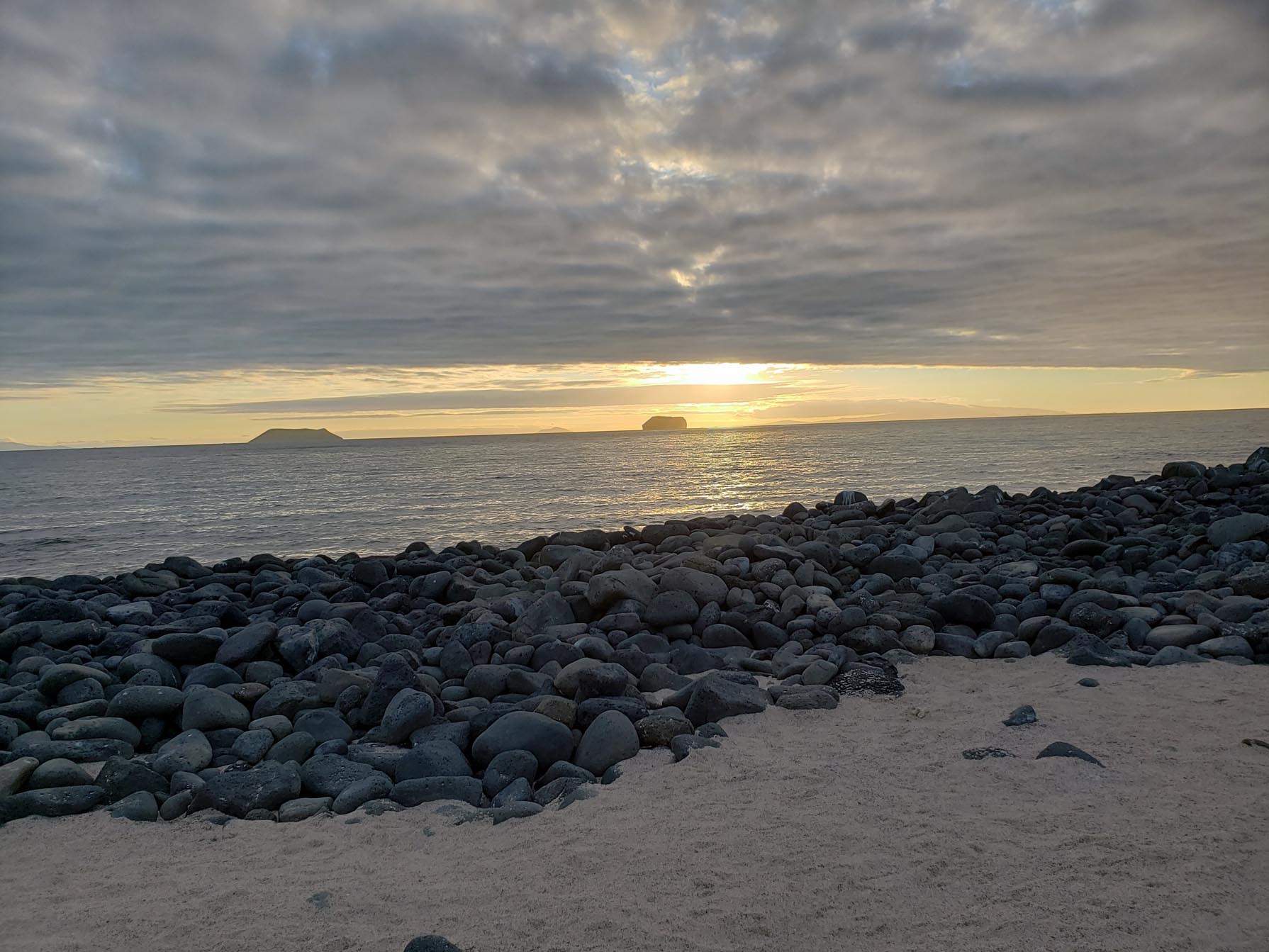
Piha Beach looking north.

Strategizing about how to see as much of New Zealand as possible in two months resulted in our decision to move more frequently than usual. We’re spending two weeks in each of four places, starting with Piha beach outside Auckland and moving south to the Wellington area. In December, we’ll be outside Christchurch and then near Dunedin as we try to see a bit of both islands.

Our travel to Auckland was vastly improved by flying business class. We left Los Angeles an hour late because the trip was going to be too fast! New Zealand officials are as particular about aviation as everything else. Planes have a 30 minute window to arrive, 15 min either side of their scheduled time. Apparently the airlines are fined for non-compliance, and we were scheduled to fly for only 12 hours, not the usual 13.

Business class was worth the cost because we were able to eat something and then sleep–that being a euphemism for lying down with one’s eyes shut, earplugs in, and blanket pulled up, hoping for oblivion that doesn’t actually arrive. I watched Mamma Mia 2 (terrible but fun), then made myself sleep until 6 am Auckland time. Jonathan did something similar (different movies).

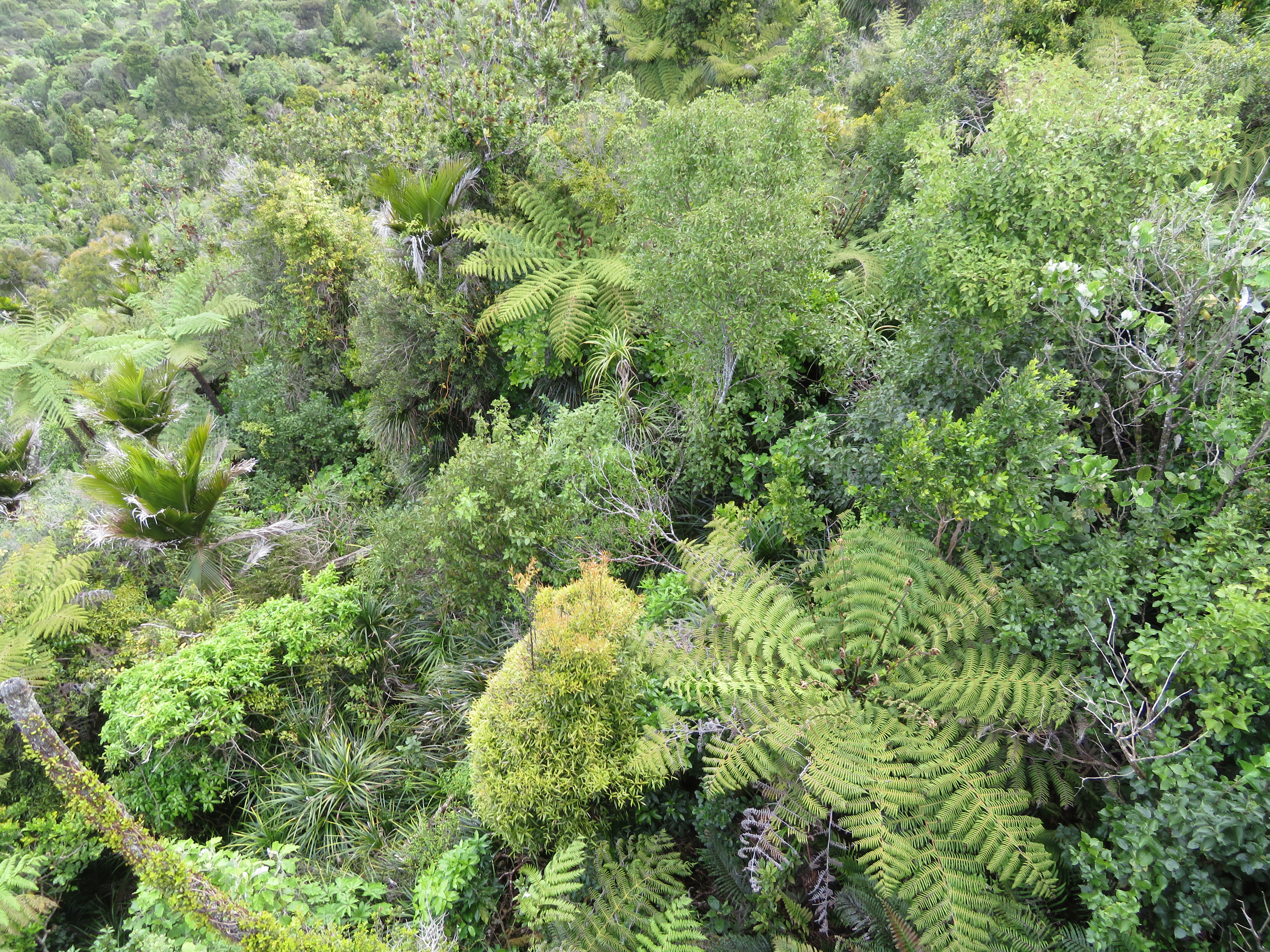
We arrived in pretty good shape, got our car and found our house in Piha. To get there we crossed the Waitakere Ranges Regional Park. New Zealand’s cool, rainy weather produces incredibly dense, dark green vegetation that ranges from palm trees to pines and includes cycads. These look like a fern sitting on top of a palm trunk and they are the living descendants of plants that existed in the time of the dinosaurs, 200 million years ago.

Once across the hills, Piha is a beach community that consists of a strip of houses backed against the steep hillside, facing the ocean. Some are summer cottages, others striking contemporary homes. We have rented a beach cottage with broad glass windows facing the shore. It is a family home–lots of board games, puzzles and decks of cards.

Piha beach has a dramatic formation, Lion Rock, and a broad sandy beach that is popular for surfing. Between the two, the area appears in ads, TV shows and movies (The Piano was filmed nearby). Announcements of filming are circulated to residents and posted in the Piha Store, the only local business apart from the campground and surf school. I saw one that mentioned a one day ad shoot with a “small” crew of around 20 people. I hope they film something while we are here.

California Beaches

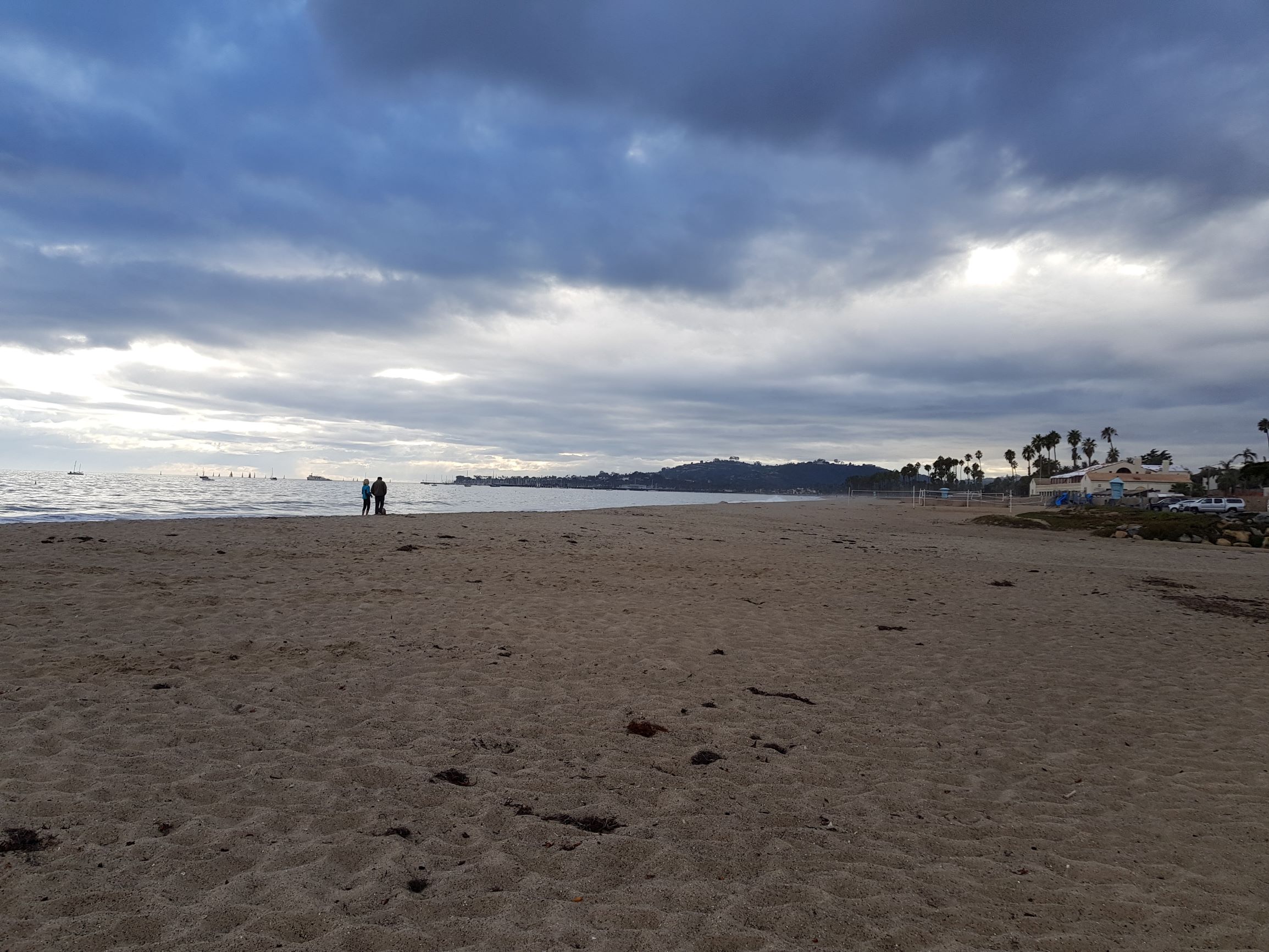
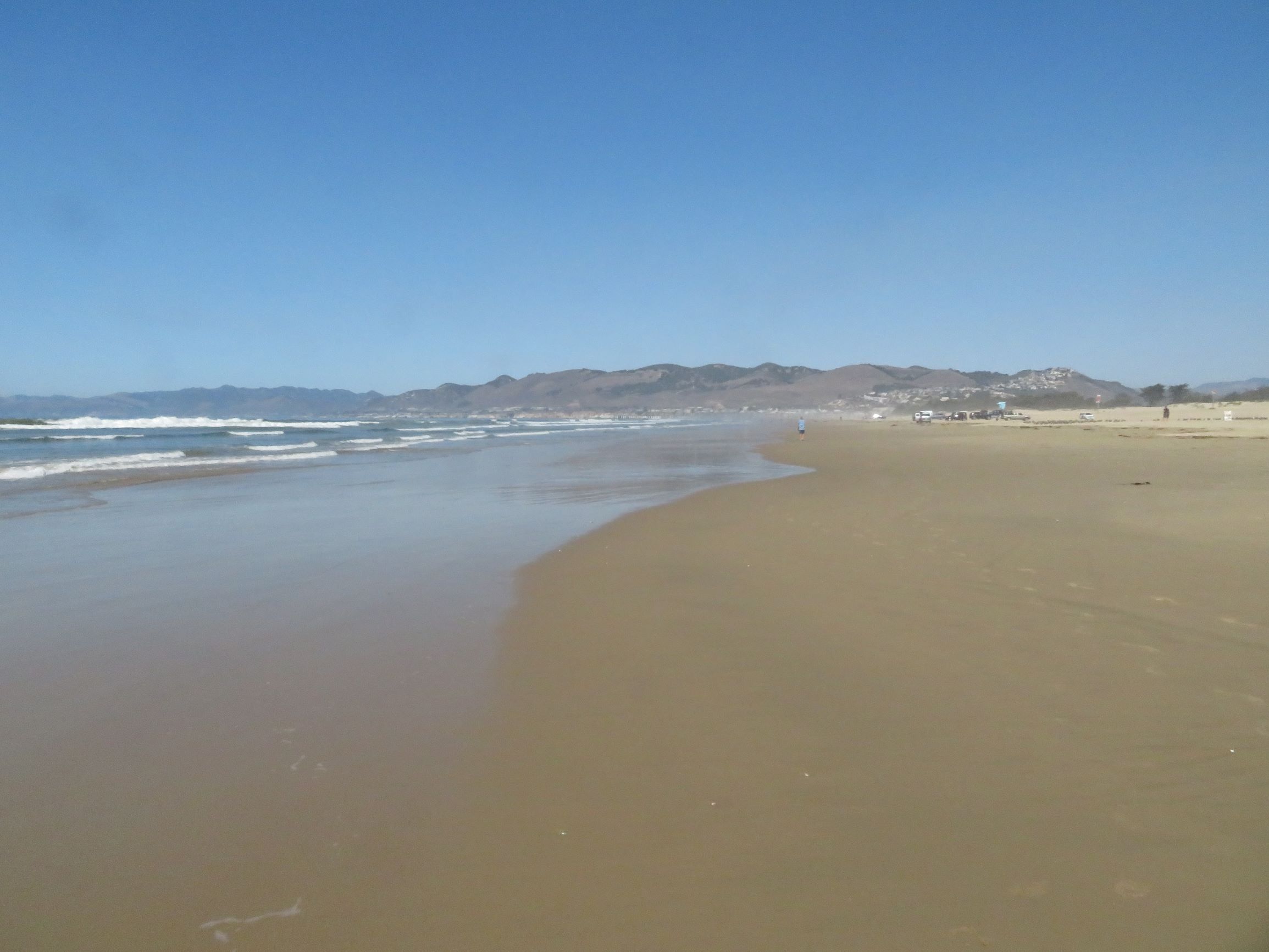
It was a pleasure to find that California beaches are as well-tended in the Santa Barbara area as they were in Mendocino five years ago. I often mention the quantity of debris that we find on beaches around the world in our continuing rounds of beach combing. California beaches are a remarkable exception. Yes, they have driftwood and occasional bits of beach glass, but they are not littered with the unending stream of plastic cups and mylar packaging that we see everywhere else, not to mention orange peels, and worse.

It is no secret why this is the case–people clean the beaches frequently. There isn’t less trash, there is greater effort to clean it up. Many beaches post the meeting time of twice-monthly cleanup gatherings. Clubs and advocacy groups hold periodic beach clean-ups. In addition, the entire state of California holds a beach-cleaning extravaganza at least once a year. The most recent one was Sept. 15, 2018. Our visit began just two weeks later, on Oct. 1, and we benefited from the effort. During our stay we rarely found the kind of beach trash that we usually find. “Eternal vigilance… etc. etc….” keeps the beach clean.  All visitors should be aware that other people work hard to make the beaches attractive. Congratulations to everyone who helps keep California beaches clean.

We visited beaches from Pismo Beach on the north to Mussel Shoals on the south and found them uniformly beautiful, and not particularly crowded, especially toward the end of the month.

There is an exception, isn’t that always the case? In the Santa Barbara area, all the beaches have tar blobs that have washed ashore and cannot easily be removed.  Whether the tar floats in from occasional leaks that aren’t even measurable they are so small, or whether the tar is left over from major oil spills of the past, it’s impossible to walk barefoot on the beach and not acquire a few black spots on your feet. The thickest tar buildups were at Coal Oil Point, perhaps aptly named, though all beaches have some tar. These are the legacy of the offshore oil industry that is still visible in the form of a half dozen oil platforms on the horizon.

Interim–October in Santa Barbara

We left Peru with great fanfare, but didn’t get all the way to New Zealand in one hop, we stopped for a month in Santa Barbara, CA. It was a month of relaxation, walks on the beach, exploring the area, and wine-tasting–this is California, after all.

We visited the Avocado Festival in Carpenteria, and the Harbor Festival opening the season for California spiny lobster in Santa Barbara, and ate a few spiny lobster. We tasted wine in Los Olivos, Solvang, and Ojai. Ojai is a town with family history, as Jonathan attended at least part of 8th grade there during his peripatetic childhood following his artist parents around the western US and Mexico.

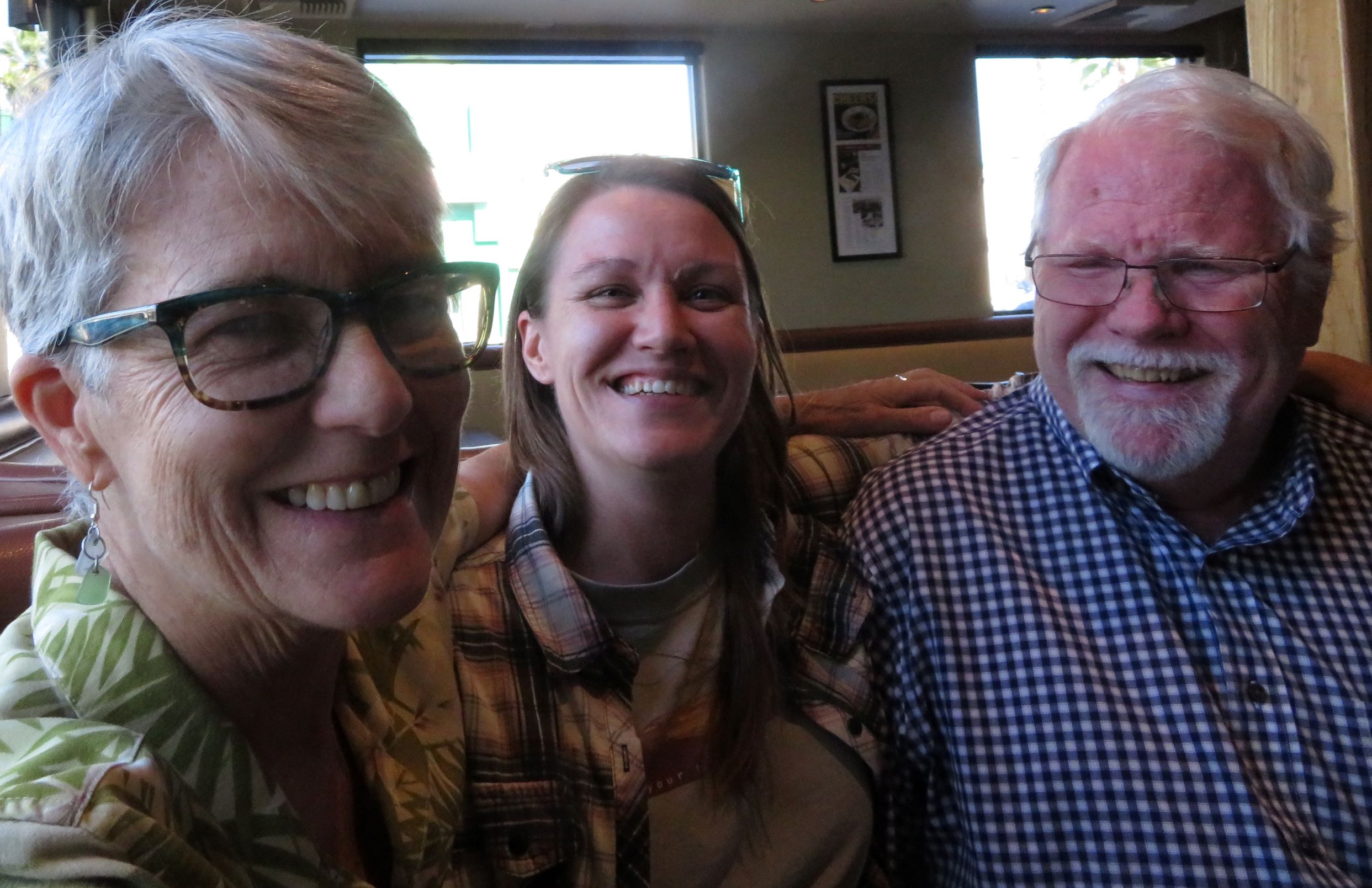
As if this were not enough fun, we had visits with friends and family, taking advantage of being on the west coast. It was wonderful.  We had a chance to visit Cal State Long Beach (CSULB) and see Amanda’s experiment that is the basis for her M.A. thesis. At lunch, Amanda and Jonathan made fun of my taking selfies with a regular camera. Why not?

We stayed in a lovely Airbnb, a bungalow remodeled into an open plan living/dining/kitchen area with seating areas outside on both sides of the house providing shaded seating at all times of day. We shared a bit of the yard, and the outdoor shower, with a neighbor in the apartment on one side, but that did not prove to be a problem in large part because of the delightful tenant, Jackie, and her temporary guests Lucas, Henna, and Montana (3 months). A cute baby is always nice to have as a neighbor.

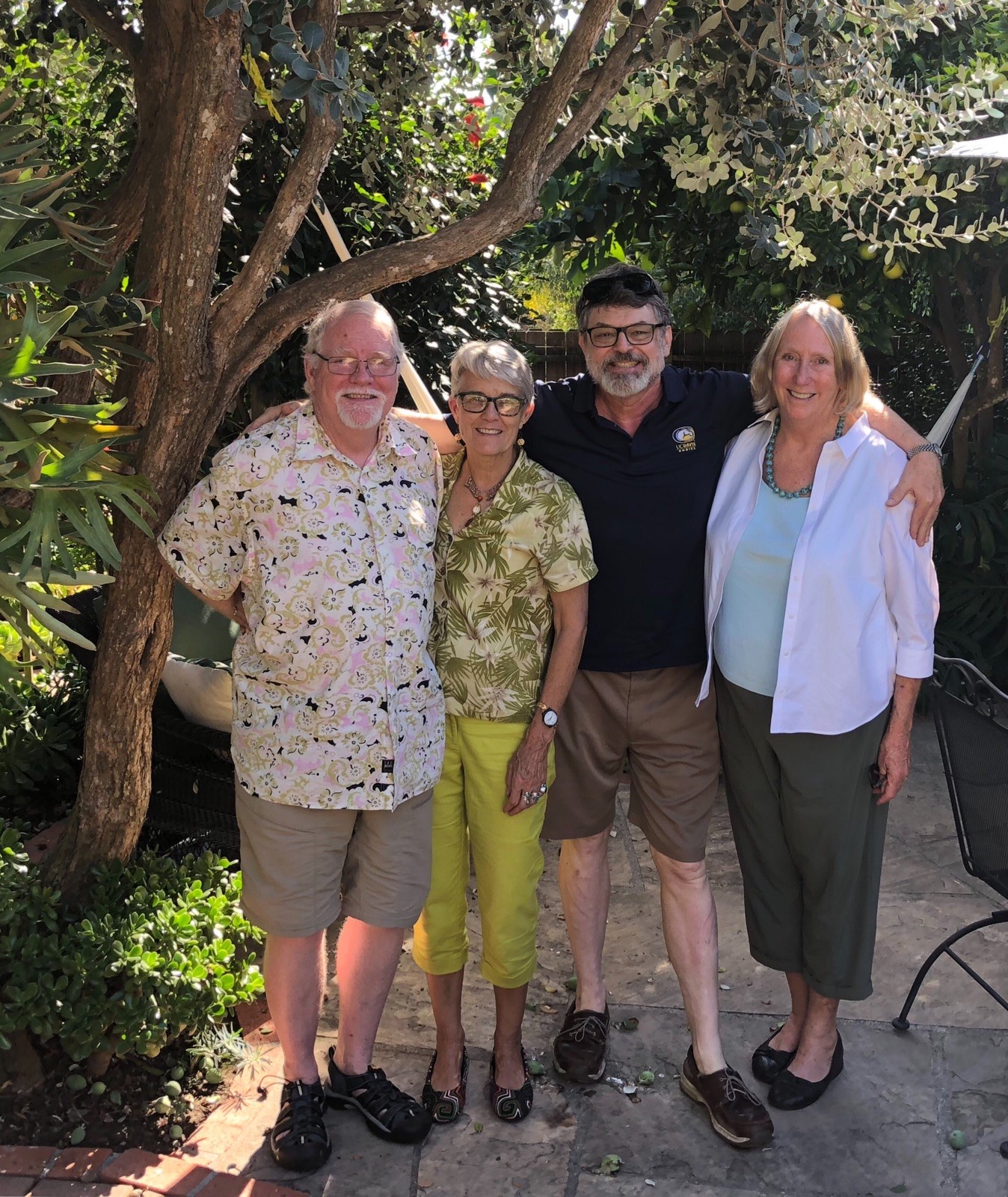
Under the pineapple guava (feijoa) tree with Kneave and Linda.

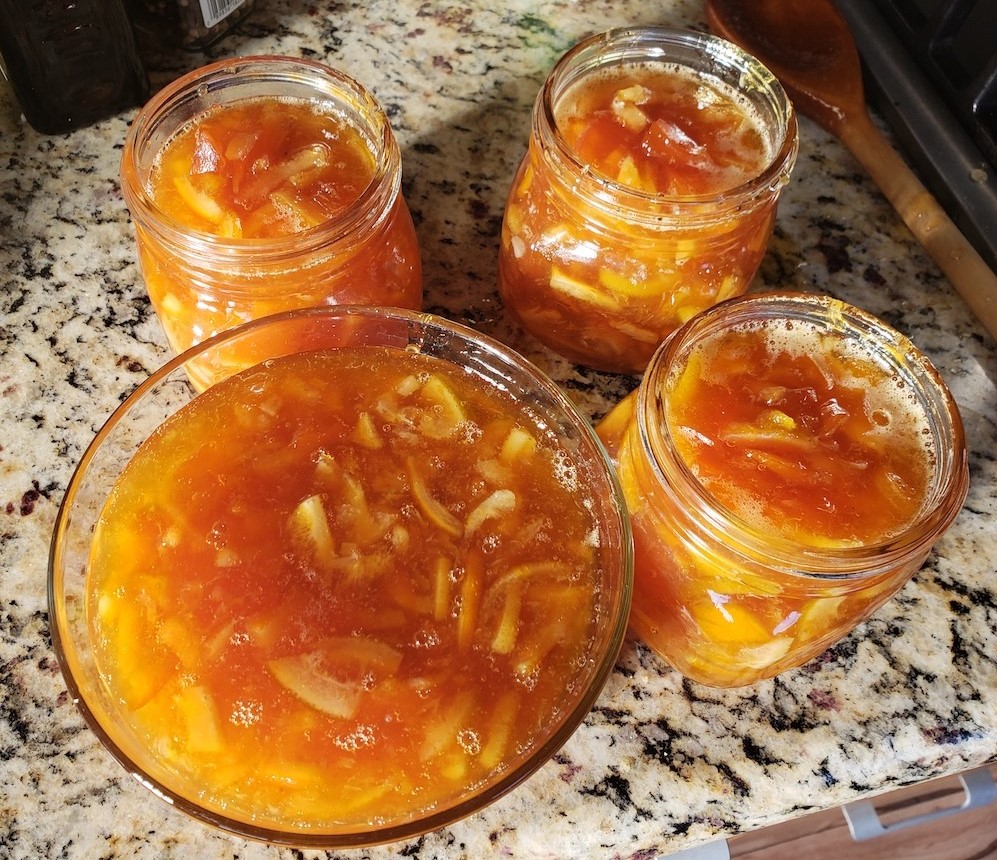
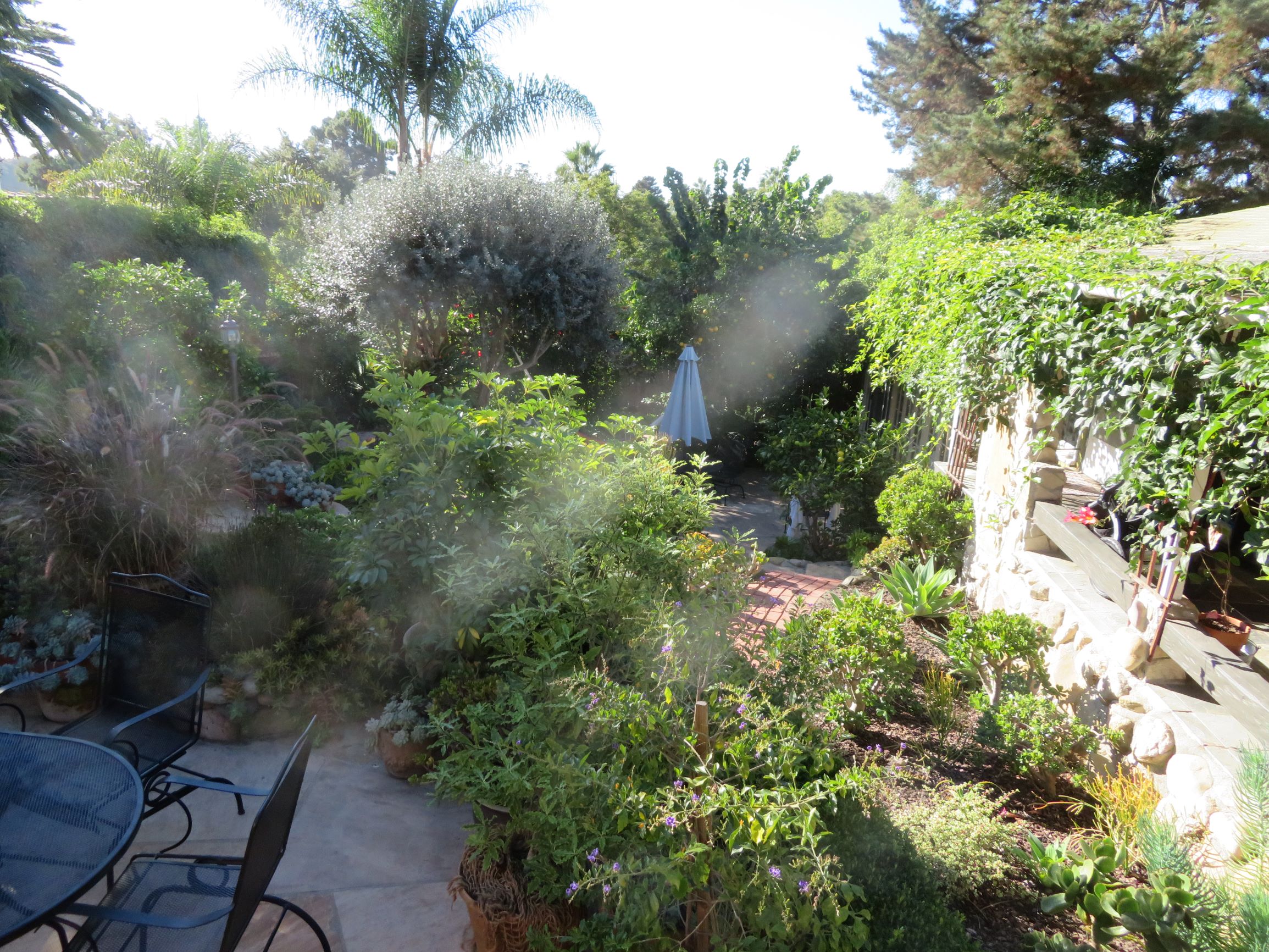
Our home was surrounded by perfect contemporary landscaping, terraces of succulents down the small hillside lot made the area seem larger. The tiers and pots of plants were interspersed with just the right number of citrus trees, one of each: grapefruit, oranges, Meyer lemons, lemons, and limes, along with an avocado and a persimmon tree. The persimmons were just ripening, dotting their tree with small bright orange fruit. Jonathan made multi-citrus marmalade, a gorgeous orange-gold color and tasty into the bargain. There were days when we could easily have sat on the terrace all day. In no time, it was time to leave for the airport again.

It Took A Week to Pack?

We’ve now been traveling for more than four years. From two checked suitcases each we graduated to one checked bag, with our carry-ons packed as tightly as possible. Now there’s always space left over. I still check a bag, though. Eight months is a long time in climate that ranges from hot and wet to cold and rainy. Eight months may be underestimating how long we’re gone this time, but that’s how long we plan to stay in New Zealand and Australia.

Even though I knew what I wanted to pack, it took me all week. It’s much harder to pack when you have more than you need in drawers and closets. Once you’re on the road it’s just a matter of rolling and folding and shoving it all back into the suitcase. In the guest room that became my staging area, I packed the guidebooks we’ve accumulated thus far (4), and a memoir on Australia.

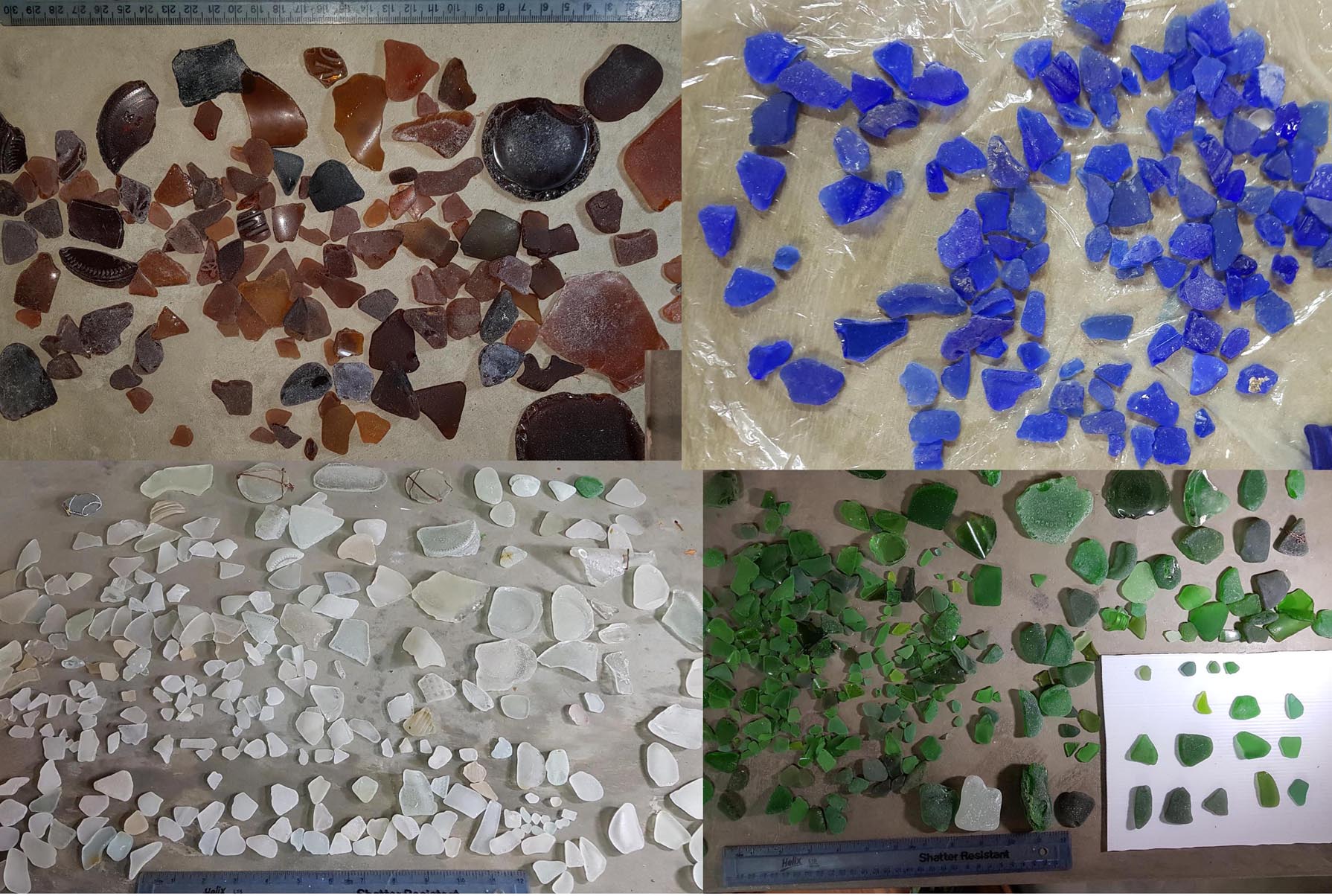
Next, I packed the least crucial elements, my wetsuit and mask, because I really want to go snorkeling in Australia. I experimented with an alternative shoulder bag, but went back to my mini-backpack. Next came arts and crafts. Now that I make oddball jewelry out of things I find on the beach, I want to have a few tools and materials so that if I find something on the beach I can make stuff. After contemplating the giant mess spread across the studio (former lab space), I packed up hundreds of pieces of beach glass that I’ve accumulated, picking out a few pieces to work on in the short run. I set out a small zipper bag to hold tools, deciding that when it was full, no more tools would come along. By the third day I had stowed away my materials so they won’t be too dusty when I return. I have piles of beach glass, beads, watch parts, seashells, and plastic cowboy, Indian, and superheros that have come from beaches around the world.

In went multiple bottles of sunscreen, bug spray, and vitamins all non-negotiable, and the rest of day four was spent emptying out my travel accessories and restocking. I tried to minimize the things that I can purchase there (soap, shampoo, deodorant), and take things like over the counter pain relievers that can be very different. Once I decided on a flashlight and not a clip-on reading light, an extra chapstick of my favorite brand and backup dental floss, the day was over.

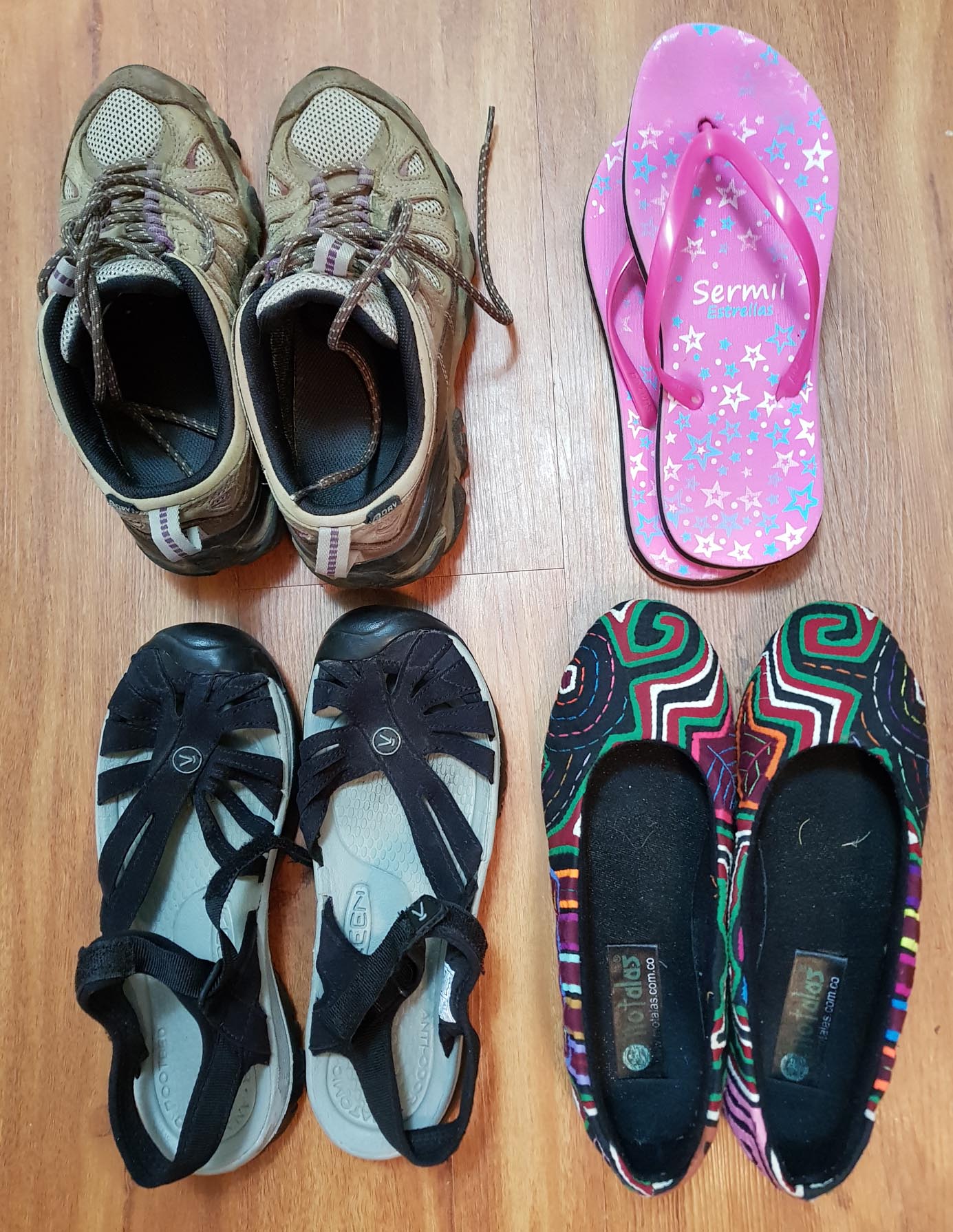
The next day I chose a cap rather than a straw hat, though one scarf rather than two hung on as a question until the last minute. Shoes are another hurdle. One pair has to be waterproof, while another has to be able to go into the water. Which should be the third pair? More sandals, sneakers, flats? I went with flats, common for most people, unusual for me (I usually go with two pairs of sandals. Truth is, I wanted to bring my newest shoes that I just bought in Colombia. They’re covered in mola-style fabric, really pretty. The bed was piling up with possible shirts and pants. The shoes were wrapped and stowed and that was it.

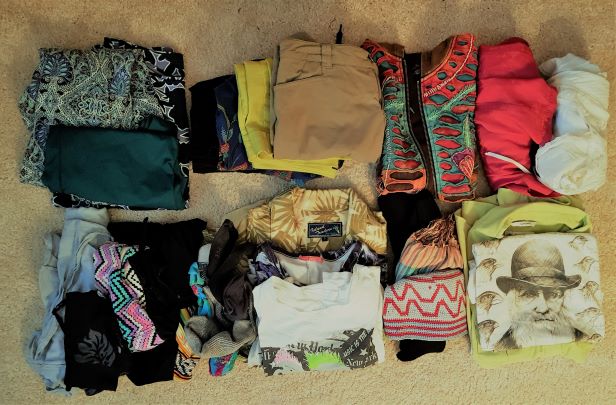
In the morning, I realized that it was really time to pack up. I started with two beach tops and two bathing suits. With one last evaluation, I went with two long sleeved button down shirts, one of which is 100% cotton, the other a built-in sunscreen shirt. Two long sleeved t-shirts because New Zealand is never warm, then short sleeved (2) and t-shirts (3), a sleeveless top, shorts, and capris. My travel slacks were set out to wear to Lima. My travel tunic and leggings went in the carry-on for travel day. Underwear goes in it’s place and I take six cotton hankies to cut down on Kleenex.

The final packing day was dedicated to electronics, making sure my tablet, phone, and laptop were charged, the cables packed. New batteries went in the flashlight, and I squeezed in the travel scrabble game. Paperwork to take included printing itineraries, copies of all important cards, and my passport, as well as storing copies on a jump drive to take along. I made back-ups of files from the past six months and left them on the storage device in our office in Peru, then spent a while tracking down our yellow-fever vaccination documents. I don’t think we’ll need them but you never know.

Last minute additions included a pair of insoles, flip-flops, and an alpaca sweater. I had room in my carry-on for some snacks and lunch on the road to Lima, a big bottle of water, and go-cup of coffee for the road. (I sent the cup back home with Carlos.) That’s how you spend a week packing for a long trip. By doing all my picking and choosing over a week, I managed to be ready to go promptly at 9 am on Saturday, when Carlos and I left for Lima. We were at the hotel by 1 pm, and he turned around for the trip back to Barranca. He would be home before sunset, the safest way to drive in Peru. Meanwhile, I would spend the night in Lima and head to my flight at 7 am on Sunday, packed and ready to go.

Good to Know About the Galapagos

If you’re thinking about a trip to the Galapagos, there are several things to consider.

-Land or Sea? I prefer sea because you can get to more of the islands, even though I am not a cruise person.

-Choose your tour company carefully. Ask for recommendations from friends who have been to the Galapagos, keeping in mind their interests and personalities. Read reviews online. The tour company organizes your experience and that will be fundamental to whether you enjoy yourself and are satisfied with the itinerary and range of activities.

-Size of ship. We were on a ship that holds 48 passengers, with only 29 on board. Ships range from about eight to 96 passengers. The trade-off is that there are more amenities onboard larger ships.

-Promises, promises. Read all of the tour materials carefully. If an amenity is not specifically mentioned, it is not available. Be sure to as many questions as you can before you book. Do you need internet? Do you want a double bed? Would you like air-conditioning? Need a special diet? Refrigerator for medications? Everything has to be specified before you book. Once you book, you have no leverage.

-Who else will be there? For best results, recruit people you enjoy to go along. That way you know what your company will be. We were fortunate to be with family and an interesting group of fellow passengers, but there are no guarantees. If you are an outgoing, friendly person you’ll be fine, but not everyone has that gift.

-Check to see that your guides will be appropriate. There are highly qualified guides that do not speak English. If you do not speak Spanish make sure that you will have guides of the highest qualification level who are also English speaking–or who speak the language you want.

-Keep your expectations reasonable. Every group sees the Charles Darwin Research Center, but not every group sees everything else.

-Take responsibility/do your homework. Some months the weather is hot and you can burn easily on the water. Other months the water is frigid and the days often overcast. You won’t get sunburned, but you might feel chilly.

If you have your heart set on seeing an albatross, or a white-tipped shark, find out when and where you are most likely to see them. Ask about it before you book, too, as the odds of seeing particular animals vary by season and location. You don’t want to get there and find that you are in the right place, but at the wrong time, or that you are on a ship with a different itinerary than the one that would take you to see your favorite animal.

-Have a great time. Once your plans are made, relax and enjoy the trip. The stark landscape is beautiful and if the animals aren’t posing exactly where you would like them to be, it’s still beautiful  all around you. Talk to the other passengers, learn new things and enjoy the experience.  Sitting on deck in a lounge chair or a hammock with a cold drink and a book can be as worthwhile an experience as seeing a giant tortoise. Trust me, I’ve done both…..


Cruising the Galapagos

Boarding a ship in the Galapagos puts you in a different world. Your cabin is compact, the windows and decks reveal water everywhere, the ship rolls, and you rapidly become accustomed to constant movement underfoot. I didn’t get seasick, and enjoyed most of the motion. Being surrounded by water was a pleasure. Any free time we had could be spent staring at the sea, waiting for a dolphin to jump or a turtle’s head to emerge for a moment. In the distance whales spouted. While we were having lunch looking out over the water, a huge manta ray leapt into the air, somersaulted and slapped back into the water. I couldn’t believe it.

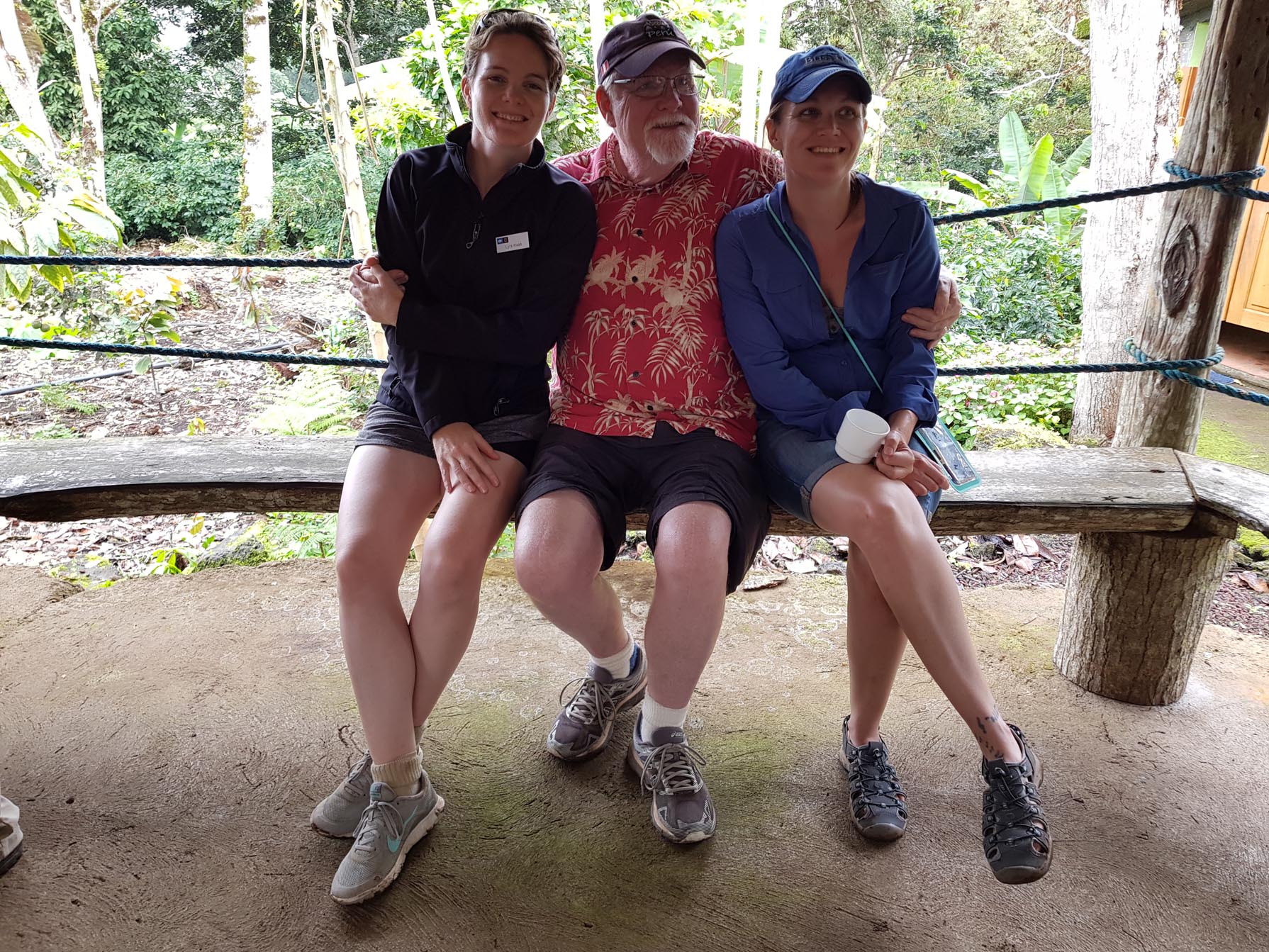
The biggest plus to our visit was having two of our children and one’s partner, along. They made it much more fun, and it was a pleasure to have time to sit together and chat. We tended to stick with the kids, wanting to soak up as much time with them as possible, so we may not have been as sociable as we should have. Other people on the trip all had interesting stories and I was always impressed when I got talking to one of the other passengers. Everyone had traveled different places, had interesting careers or hobbies. It was an excellent group.

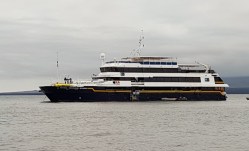
We cruised the Gapalagos on a relatively large ship the Lindblad/National Geographic Islander, with room for 48 passengers. Perhaps because of the season, the boat only carried 29 passengers, so there was always extra space in the dining room, the lounge, and on deck. It was the best possible cruising arrangement. Larger ships like ours are able to travel further, and as a result we managed to visit both Isabela and Fernandina Islands, a trip that would take too long for a land based group to reach and might be too rough for a smaller vessel. In addition, we stopped at N. Seymour, Rabida, Santa Cruz, and San Cristobal. We did not stop at Floreana, however, the island with the famous mail box (You leave a letter and perhaps take one going to a destination near you to deliver/mail).

By far the best way to see the Galapagos is by cruise ship. Not only can you see more of the islands but you don’t have to pack and unpack every day or two. All your visits are already scheduled, permissions applied for, fees paid. These are significant advantages. With all the advantages we had, I still have to say that I don’t enjoy organized tours. Sometimes it’s the best way, or the only way, but overall it’s not my favorite mode of travel. I am not a cooperator. I dislike mandatory timetables, even when I benefit from them. That is, there were two or three time slots for activity each day. Often the early slot was a walk, which I usually skipped to sleep in. Each of the other time slots offered two activities, one in the water and the other a hike or boat ride. There was always something for those who didn’t want to get wet. Scheduling all this meant that people had to wake up and have breakfast at specific times. Some announcements over the ships PA system could be muted, but many were mandatory and broadcast in all cabins and public areas. I found it difficult to accept that these were necessary.
Our cabin was the best on the ship, large and comfortable, the best bed we’ve had away from home that I remember. We had great views over the bow of the ship and off to the starboard side, as well as seating areas and a desk. We had a real shower in our bathroom, not the mini shower that wets the entire bathroom. Staff straightened up three times a day! They left us chocolates every night–it was fabulous.

This slideshow requires JavaScript.

The pictures of our room show how good we had it. Though the other cabins were much smaller, the public spaces were very nice, and with a smaller than average number of passengers, there was plenty of space for people to spread out and avoid spending time in their cabins during the day.

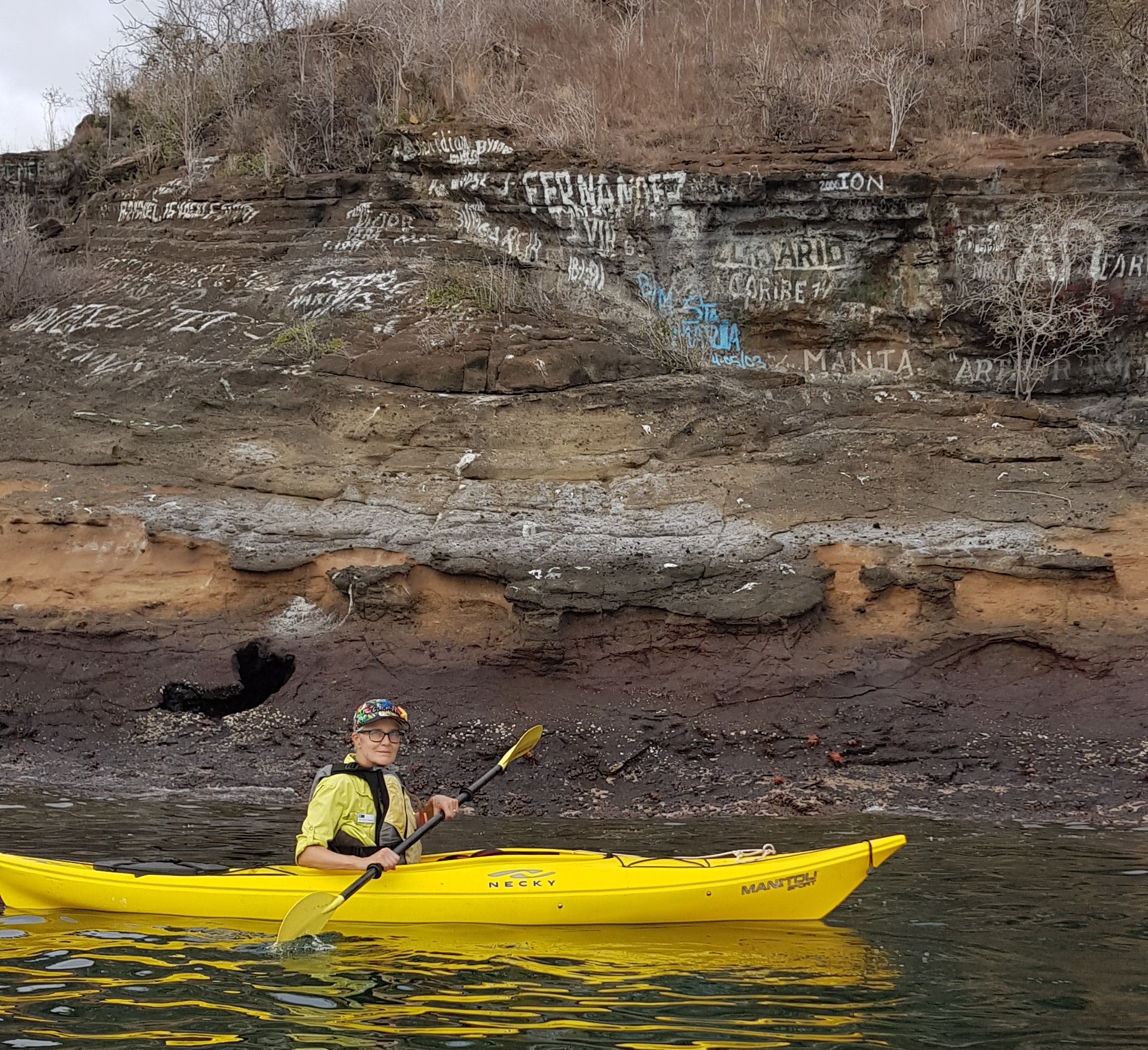
In addition to snorkeling and bird-watching, I went stand-up paddleboarding and looked at a animals at the same time. Another day I went kayaking along the coast and saw graffiti that has been left behind over the years. (It’s not permitted today.) Add snorkeling and boat rides and we were busy all the time and we knew what to do, very important in the Galapagos. There are lots of rules, one of which is that you cannot visit most places outside the towns without a guide. Each tour receives permission to visit specific places at specific dates and times. There is no pulling in to a pretty white sand beach to explore, as large areas of the Galapagos are closed to anyone without a specific research permit. It’s limiting, but also protective. No plastic is allowed, even on cruise ships. I appreciated the effectiveness of the Galapagos rules and regulations on the beaches where there was no trash at all. Not any. In a full week I found one tiny knot of nylon rope (1/2″ clump), Jimmy found a Gatorade bottle, and we saw a floating apple core and two halves of an orange. That was it. I have not been on such clean shores in many years.

We had guides who were qualified at the highest level, all Ecuadoreans who speak English. One had a background as a biologist, the others completed a training course for Galapagos guides. I would have preferred that all our guides had a background in science, and I regretted that our ship didn’t have a guide interested in birds, but that wasn’t promised. Our entire staff, guides, crew and captain were Ecuadorean–not a single American or Brit apart from the passengers. Now and then passengers filled in a word when the guide couldn’t come up with the correct one, but they got the job done.

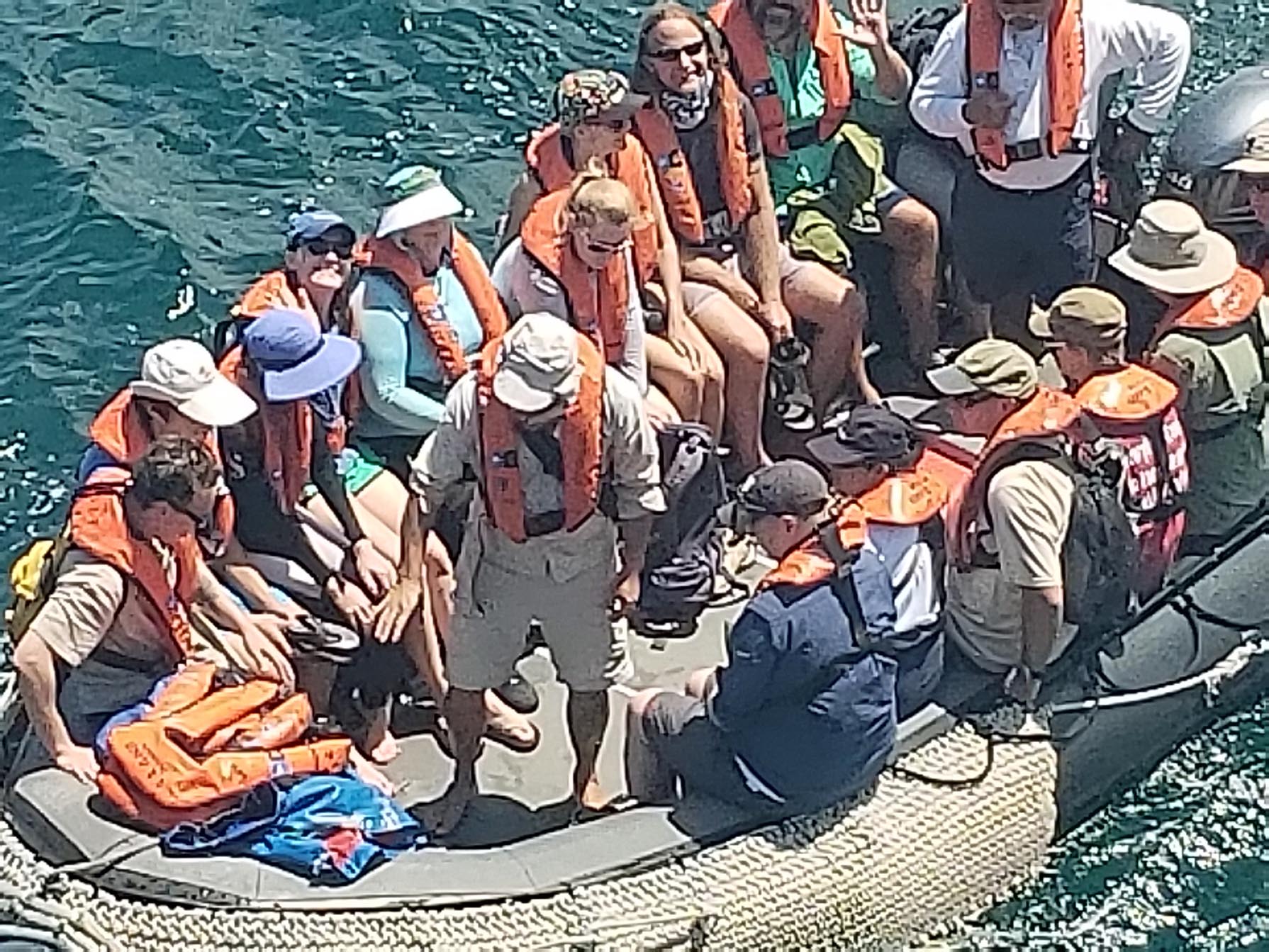
The staff was well trained and rapidly instructed us on how to do what was required. This included wearing life-jackets, how to board and disembark from small boats, where to clean swimming gear, how to make onboard purchases.

Although we had a wonderful trip, why don’t I want to go on another cruise, ever? Most are built-in aspects of cruising that I would prefer to avoid if I have a choice.

-The tour companies exaggerate, even Lindblad/Nat Geo. You’d think they wouldn’t need to. Our trip was billed as ten days and it lasted seven. They count every minute of travel as part of the tour, and it’s not.

-On the final day of the tour, the seventh actual day, we were awakened at 6 am, told to have our luggage outside our doors at 6:15, given breakfast at 7 am and required to completely vacate our rooms at 8 am. Our flight back to Guayaquil didn’t leave until after 11 am. Why were we given the shove? Another tour was arriving on the plane we were taking back to the mainland and they needed time to spruce the place up. Wait! We were still guests! (No, by then we were nothing but outgoing flotsam). The final hour was spent in the lounge where a long loop of Lindblad cruise ads played. This was a tour day? Seriously?

-The tour was very expensive. Yes, we got the best cabin, but even the least expensive cabin was costly. Yet every evening during the 30 minutes before dinner there was a “recap” that never reviewed the day. Rather, someone spent 20 minutes telling us about how much our donations to Lindblad/Nat Geo organizations are needed. We had to sit through this to get to the final ten minutes before dinner, when they told us the details of the next day’s events. These are not provided in advance, so that you don’t forget, and so that you attend the briefing. It was a frustrating experience. We weren’t the only ones with a newspaper or crossword.

-Tipping. I hate the common practices of cruise tipping. I’ll leave it at that.

-Begging. We were all asked to donate at least $500 to the Lindblad/Nat Geo good works funds.

-Food. My husband is a fabulous cook and I am utterly spoiled. Only rarely are meals out better than what I get at home.

Ending on the bright side, here are some of my favorite photos from the trip.

This slideshow requires JavaScript.

Someone who shares my opinion:

At Sea and Underwhelmed, by Joyce Wadler

Bloobies, Roobies and Nazoobies

The High-Noon Birding Society held a meeting as we looked toward the skies from lounge chairs on the upper deck of our cruise ship in the Galapagos.  We glanced upward and realized we were being shadowed by magnificent frigate birds. (That’s their official name “Magnificent Frigate birds”). Frigate birds float over the ocean and are incapable of diving into the water (their feathers aren’t waterproof), meaning they steal most of their food from other birds, or skim it off the surface. They look like a cross between a bat and a bird skeleton, and show the close relation of birds and dinosaurs by resembling pterodactyls of the dinosaur era. They attract females by inflating a pouch under their beaks and squawking pathetically. Go figure.

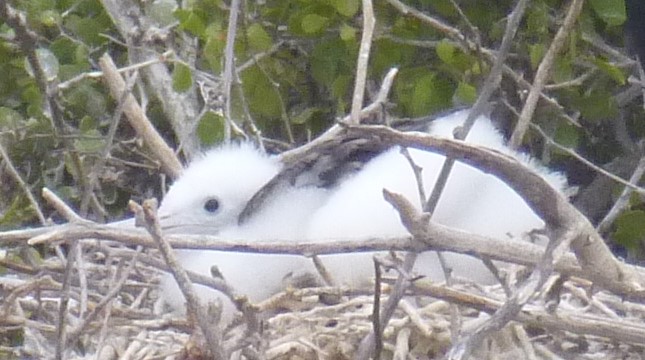
Our first excursion off the ship took us to N. Seymour Island to see nests of frigate birds. The chicks are very cute, the youngest looking like stuffed toys, the slightly older ones rather regal sitting on their pile of sticks.

Here we met our first bloobies (blue footed boobies). Our guides had mentioned three species of birds and we discovered that Bloobies are blue-footed boobies, Roobies are red-footed boobies and Nazoobies are Nazca Boobies (in guide-speak).

Later in the trip, we visited an area where all three species of booby nest in the same area. We have seen Nazoobis, or Nazca boobies, on the coast of Peru, but not the Roobies, Red-footed booby, a tropical species that likes islands. Weird fact, red footed booby feet bend, while the blue footed booby’s feet don’t. Reds nest in trees, blues on the ground.

9.4.18 Pta.Espinoza Fernandina-031crsm.jpg9.5.18 Tagus Cove Isabela boat ridecrsm.jpg

Other birds of note include the Galapagos Flightless Cormorant, such a good swimmer that its wings no longer have much purpose and are small and stunted. The other is everyone’s favorite Humboldt penguin, an unbelievably fast swimmer. In the Galapagos, their motto is “so many fish, so little time.”

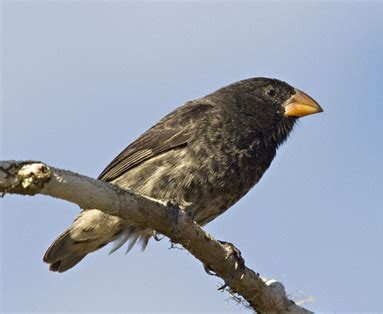
What surprised me was that on our tour there was very little discussion of Galapagos finches. These are Darwin’s finches, the ones that adapted from a single original species to the conditions on each island in ways that resulted in their beaks ranging from very thin and pointed (picking insects out of cracks) to very strong and wide (cracking large seeds). There’s even one nicknamed “the vampire finch” because it dive bombs the booby’s tail and sips a bit of blood from it. The speciation of finches is one of Darwin’s observations that led him to consider the question of how evolution occurs. They are very important historically and scientifically.

However. Finches are small and mostly dark colors. They are difficult to see even with binoculars and most people didn’t bring binocs. We realized that Darwin made his observations while sketching specimens that had been killed. Dead birds don’t fly away, and you can measure their beaks carefully. It was a different era, when collecting specimens was more acceptable than it is today.

I was searching for a bird that Amanda was pointing out…..and finally found it.


Wonders of the Galapagos

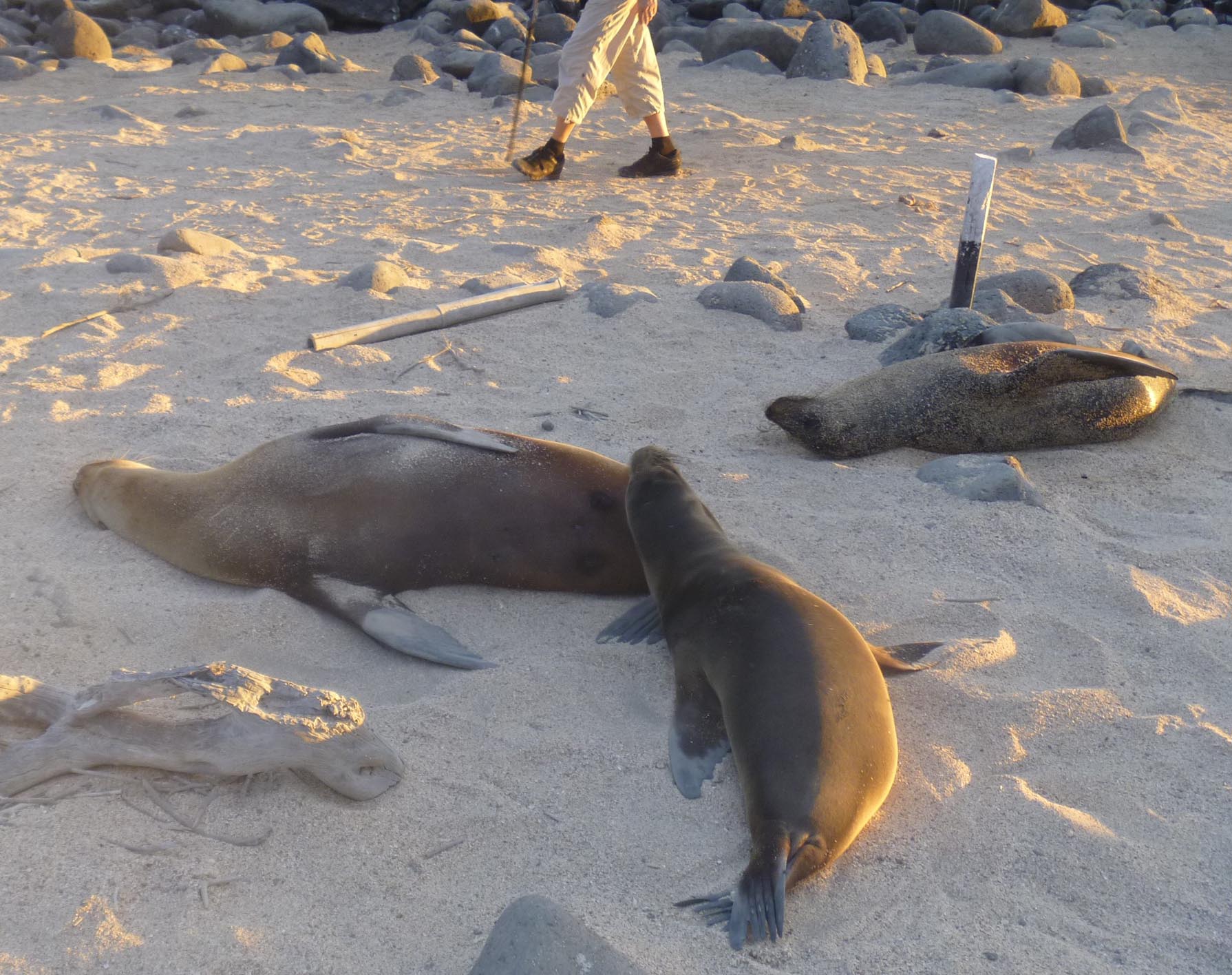
What makes the Galapagos strange is not the variety of birds and animals. Most are familiar. Pelicans, cormorants, and other seabirds are in the air, sea lions and iguanas on the beach, turtles in the water. We’ve seen these before, on beaches and in documentaries about the Galapagos. It’s their indifference to us. We ride by sea lions in the zodiacs, and we swim with them. Young sea lions are curious about us and circle as we snorkel, they dive and approach, they hang upside down, even blowing bubbles in the faces of some lucky swimmers. The sea lions flop around in the surf while we stand in the water only a few feet away, they loaf on the rocks as we hike along the beach trails.

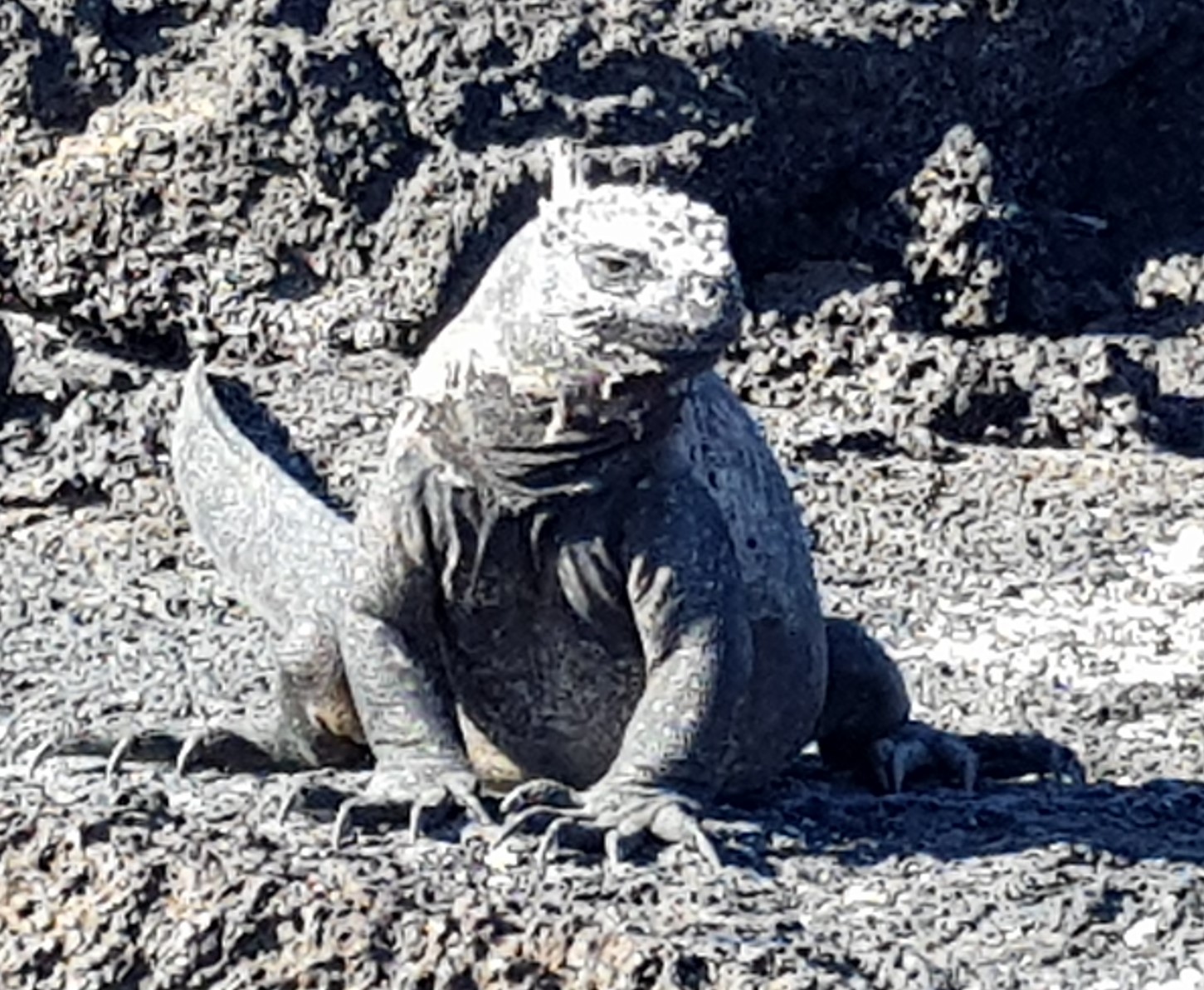
In the water with our snorkeling gear, penguins come in for a dip, though they zoom by so fast most people don’t see them. Cormorants and boobies dive for fish just a few feet away. One day we swam in an area where sea turtles were stacked four deep, just hanging in the water. The largest tropical fish I’ve ever seen swim around and below the turtles and sea lions. Some move like flocks of underwater sheep, grazing  across the bottom, lazily waving their bright yellow triangular tails. Visitors may not touch any of the animals, but animals may brush against visitors and that’s a bit unnerving. What happens when a turtle wipes their shell on your chest, or kicks you? Do we want to swim along with marine iguanas? The iguanas don’t dog paddle with their tiny claws, but propel themselves along with their tail, like a snake. On shore, they pile up against one another in huge clusters.

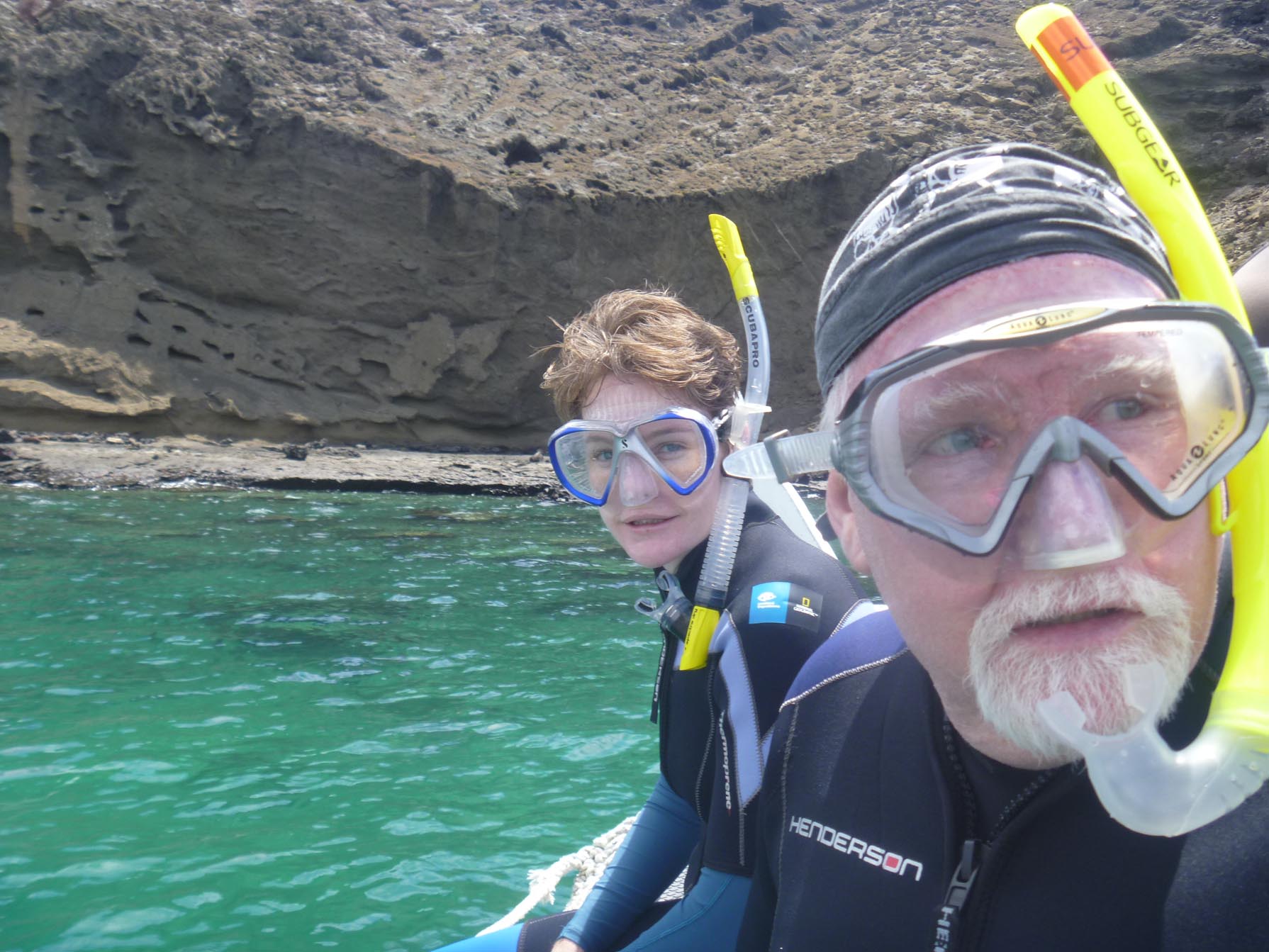
The water is breathtakingly cold and an hour is as much as anyone can take. Snorkelers put up a hand to be collected by the boatman. We swim toward the zodiac, the ladder is lowered. We hand in our fins and climb out of the water, get a towel and sit on the black rubber surface, enjoying the heat it has absorbed from the sun. We may sip from our metal water bottle as we wait for the others. When everyone is back on board and our life jackets are on, we head to the ship where we disembark one at a time, wearing our mesh bags of gear so that our hands are free to grab a hand or railing and haul ourselves onto the ship. On a side deck we begin to shed layers of protective gear, rinsing mask, snorkel, fins, wet suit, and then hanging it all up. More flights of stairs to our room to shed the rest of our layers in the hot shower. Once dried and dressed, the wet gear goes back down to the spinner to squeeze out as much water as possible. There may be more snorkeling in the afternoon and we want it to be as dry as possible. Once all the gear is settled, we go for the drinks and snacks set out near our entry point to the ship. The process has taken a while, giving each person time to contemplate what they’ve seen as they transition from sea to land.

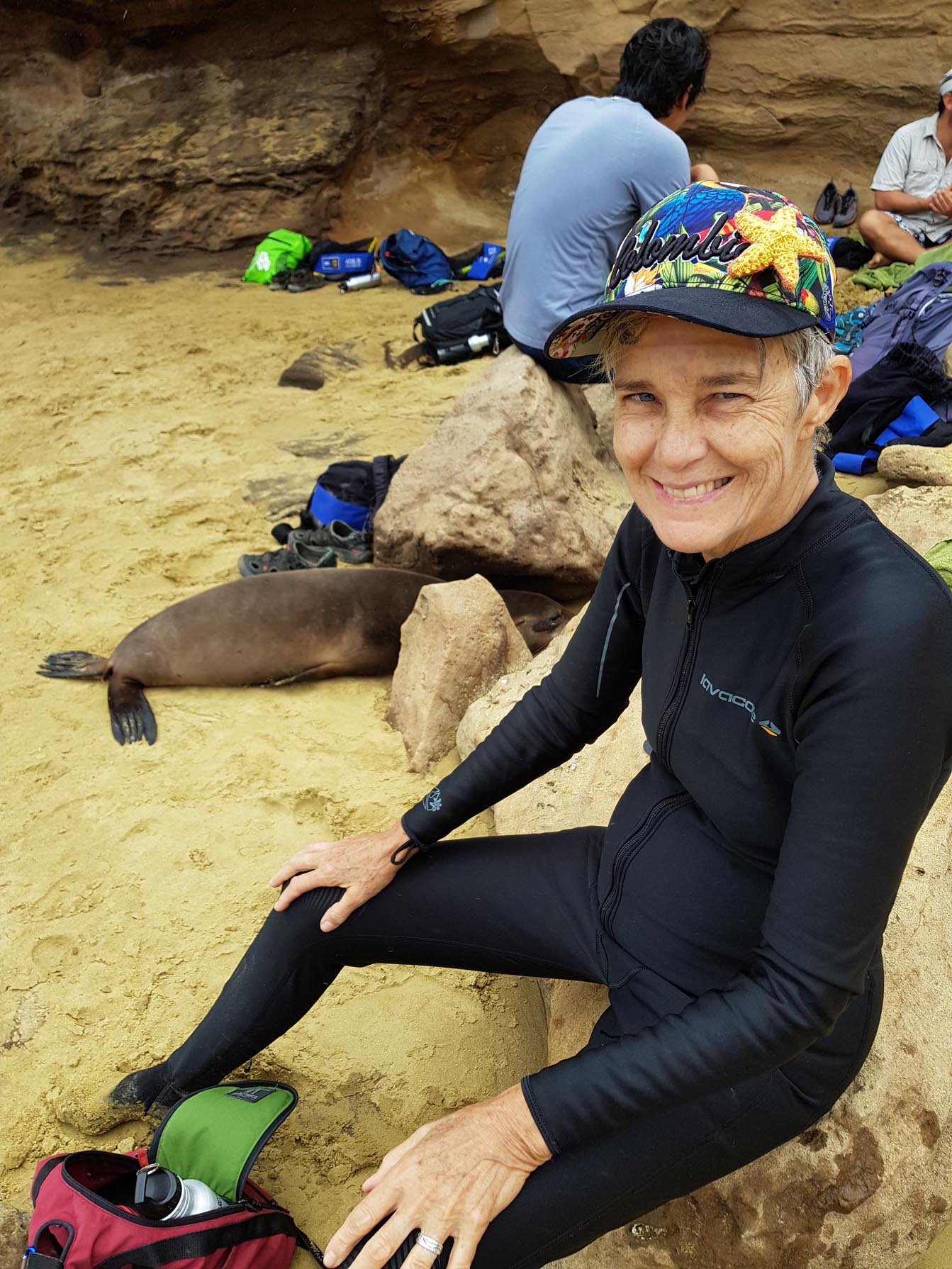
For me, snorkeling is a high point, and also the most taxing activity. I wear all the layers I have available: bathing suit, leggings, full body thin wet suit, shorty neoprene wet suit, dive socks, headcover. I wish I had gloves–a complete water ninja. As soon as I get in the water, I make fists and tuck them under my arms to keep my fingers warm as long as possible. I move with my fins and keep my hands tucked in, taking in the view without uncoiling my arms, trying to keep warm as long as I can. Even with all my layers, a wet suit can only keep me warm for about thirty minutes. After that, I either grit my teeth and keep swimming, or I raise my hand and head back. I don’t mind waiting for the others, it is comfortable bobbing with the zodiac, watching for penguins and turtles. I can barely believe I am in the Galapagos Islands, as seen on TV. This week, my life could be narrated by David Attenborough. A segment of his documentary of the islands is shown each evening.

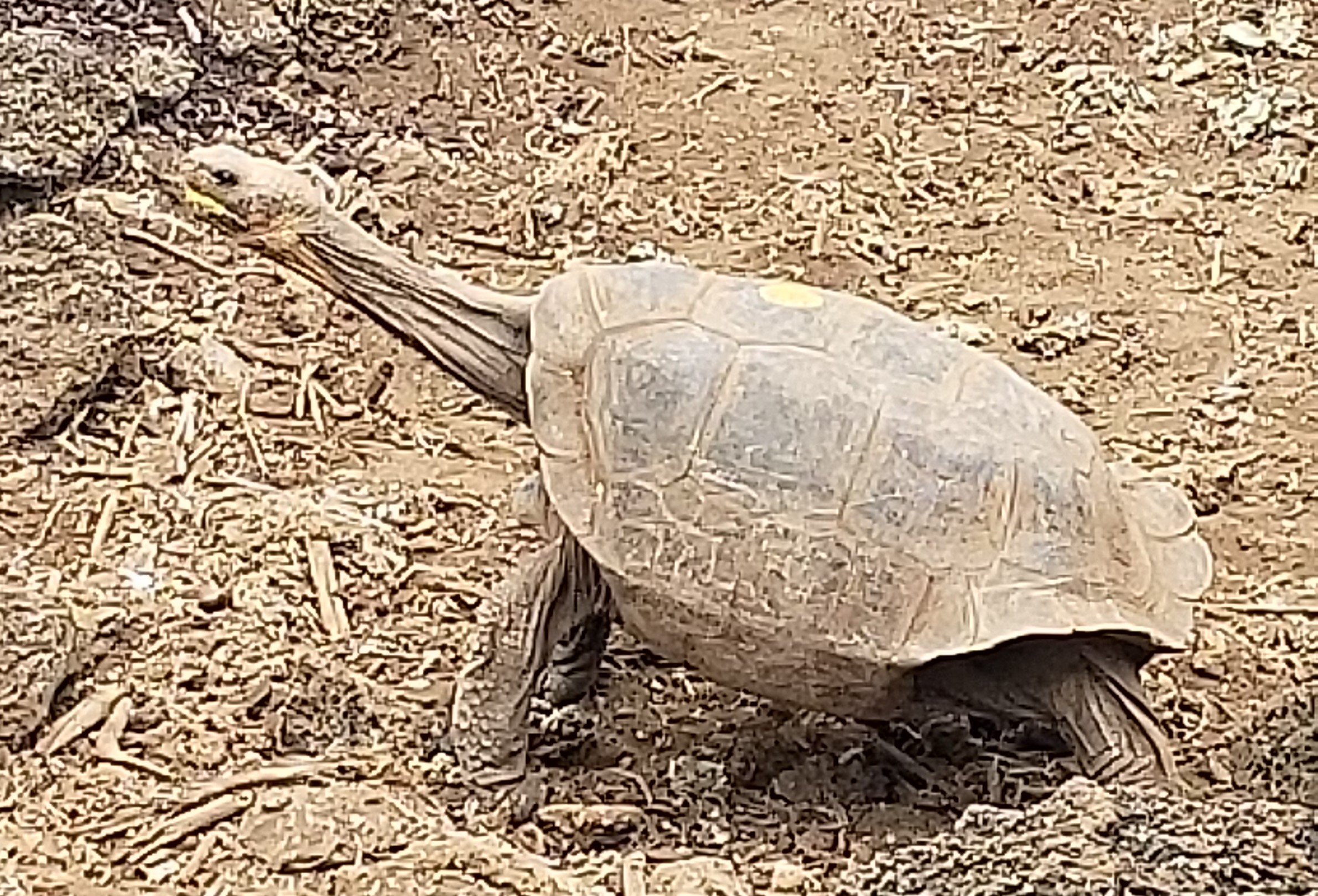
Lonesome George wannabe sticking out his long neck.

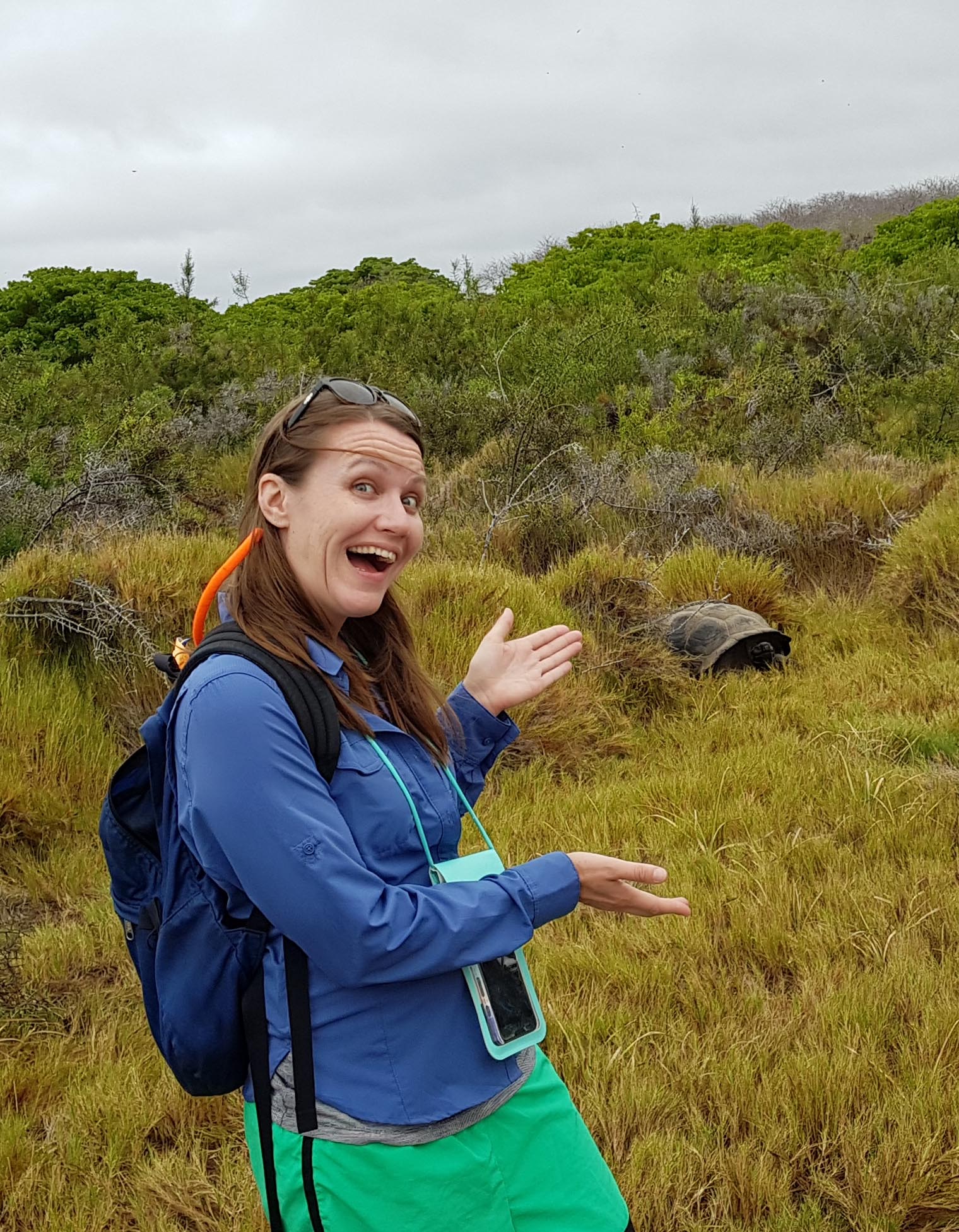
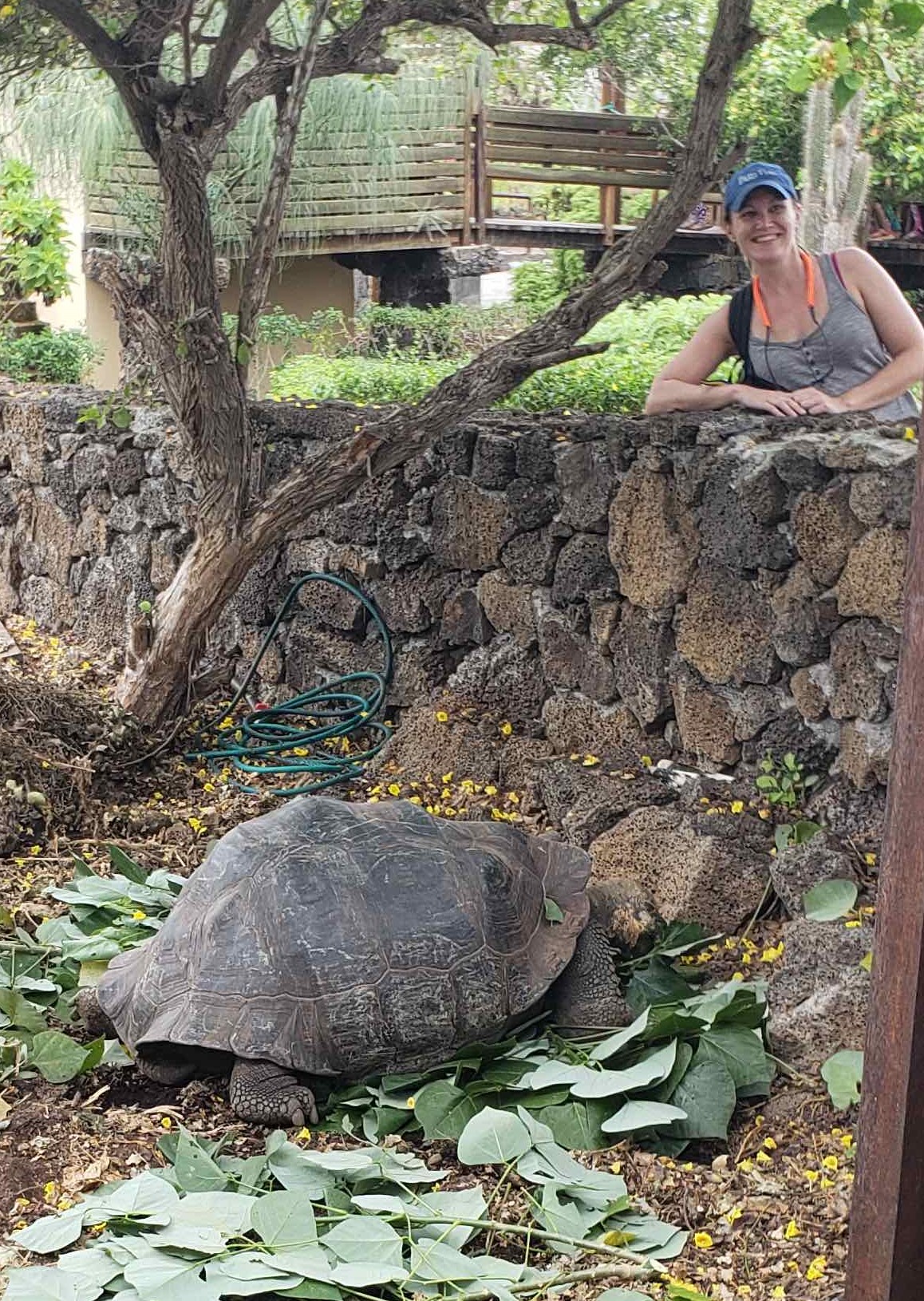
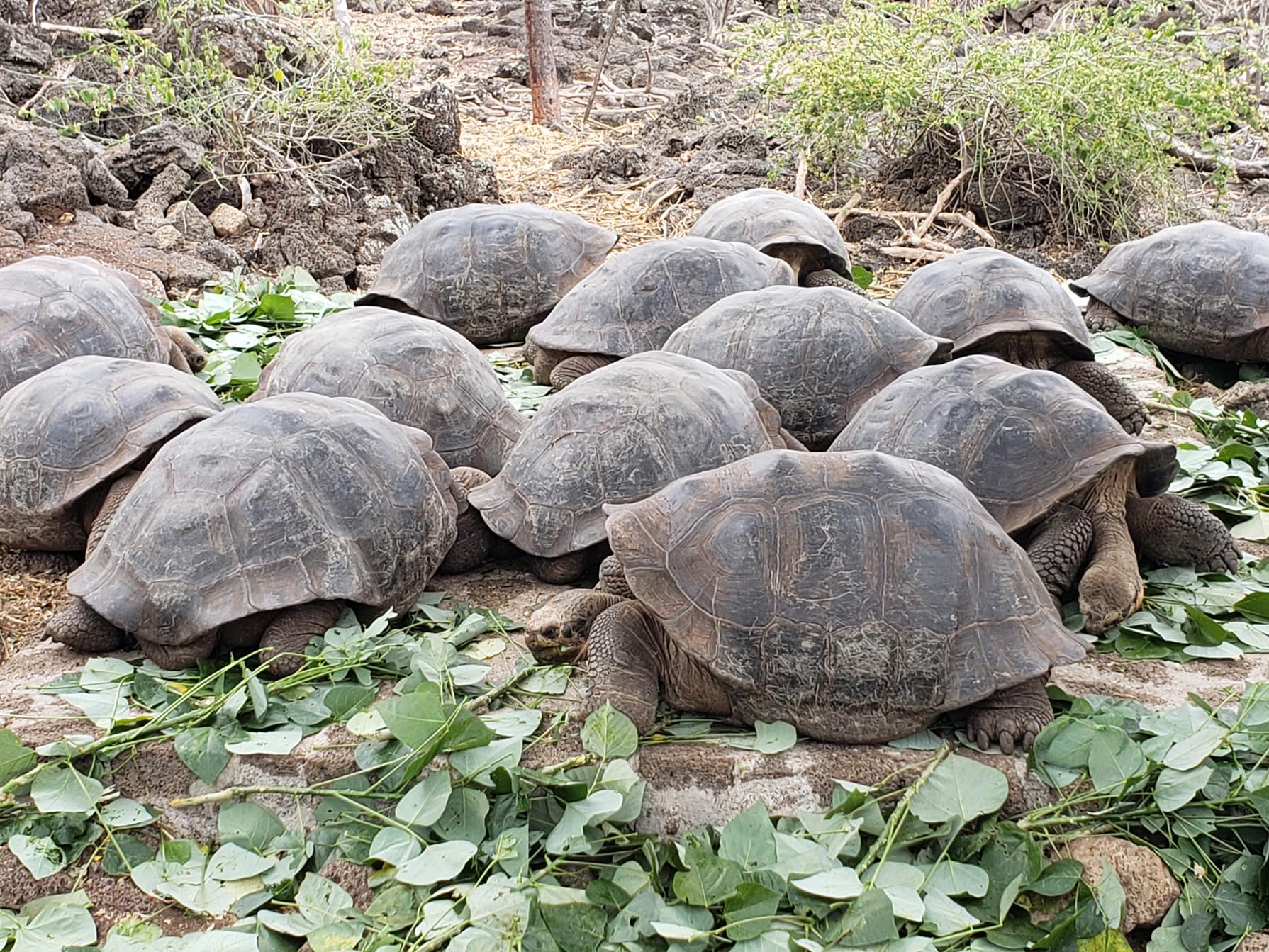
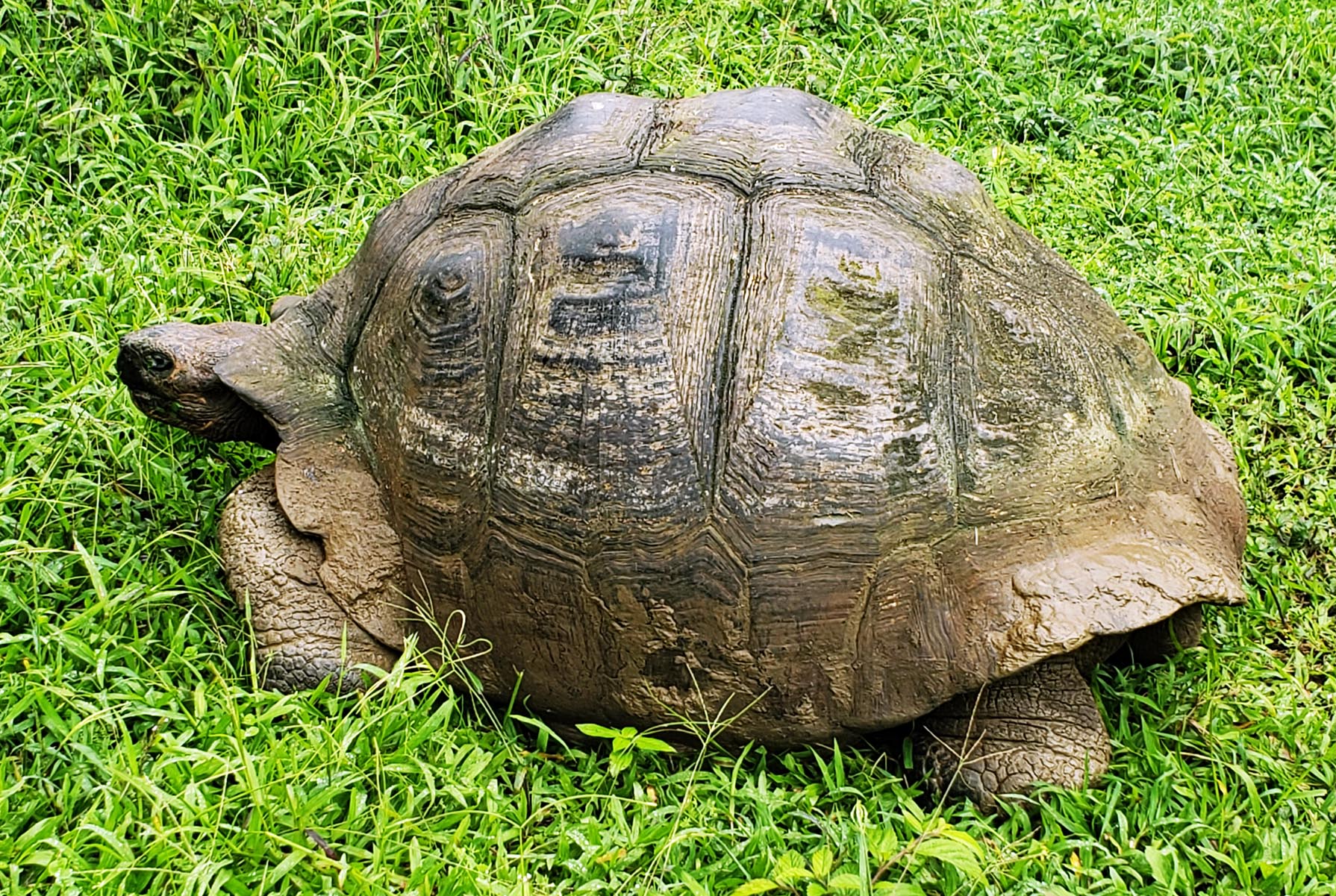
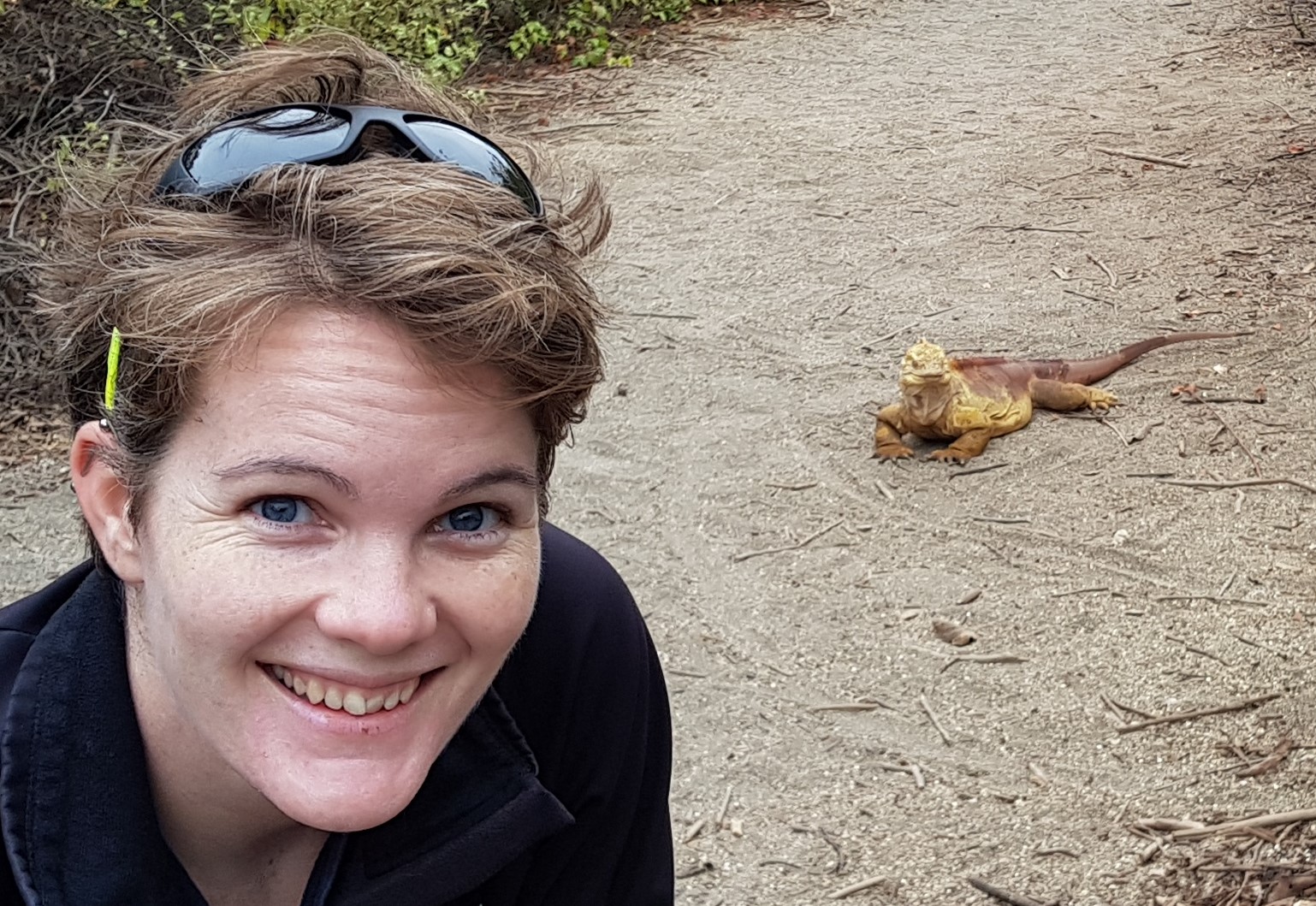
Even on land, this trip is a bit surreal—we are really here in the land of the giant tortoises. We walked by two of them on a hike and they blandly watched us as we stared at them, then turned and crept into the bushes when they’d had enough. At the Charles Darwin Research Center, we saw tortoises born this year, just a few inches across, and groups of larger and larger sizes. Tortoises are not released into the wild until they are around 25 years old. Lonesome George, the last surviving Pinta Island giant tortoise, has a place of honor at the center. Since his death in 2012 at the ripe old age of 100+ he is a taxidermied specimen, posed with his long neck extended as though nibbling at leaves on a bush. He left no offspring, but don’t worry. Another tortoise, SuperDiego, has 1000 offspring and counting. We visited tortoises in the highlands of Santa Cruz Island, where they roam very, very slowly around cattle pastures, or what look like pastures. Some have numbers that were carved into their shells years ago, before the development of RFID tagging used now. They ignore us as they munch methodically on grass, leaves, and branches. We tried not to step on them or trip over them. The land iguanas were not troubled by our group of visitors at all, and sat unmoving in the center of the path.  We tiptoed around them and continued on our way, circling the next one, the next one, and the next. The lack of fear in creatures, and the multitudes of them, is what makes the Galapagos remarkable. Birds, iguanas, sea lions, sea turtles, and tortoises permit us in their environment rather than hiding from us or running away. Anywhere else, they would be rare or extinct. In the Galapagos, the animals turn their cold eyes on humans and are unimpressed.

Ballenita, our base in Ecuador

During our two weeks on the Santa Elena Peninsula, Ecuador, we rented a house in Ballenita. There were beds for many more than the two of us and we loved the huge outdoor area with a view of the ocean. Yes, there were container ships parked offshore, but we got used to it.

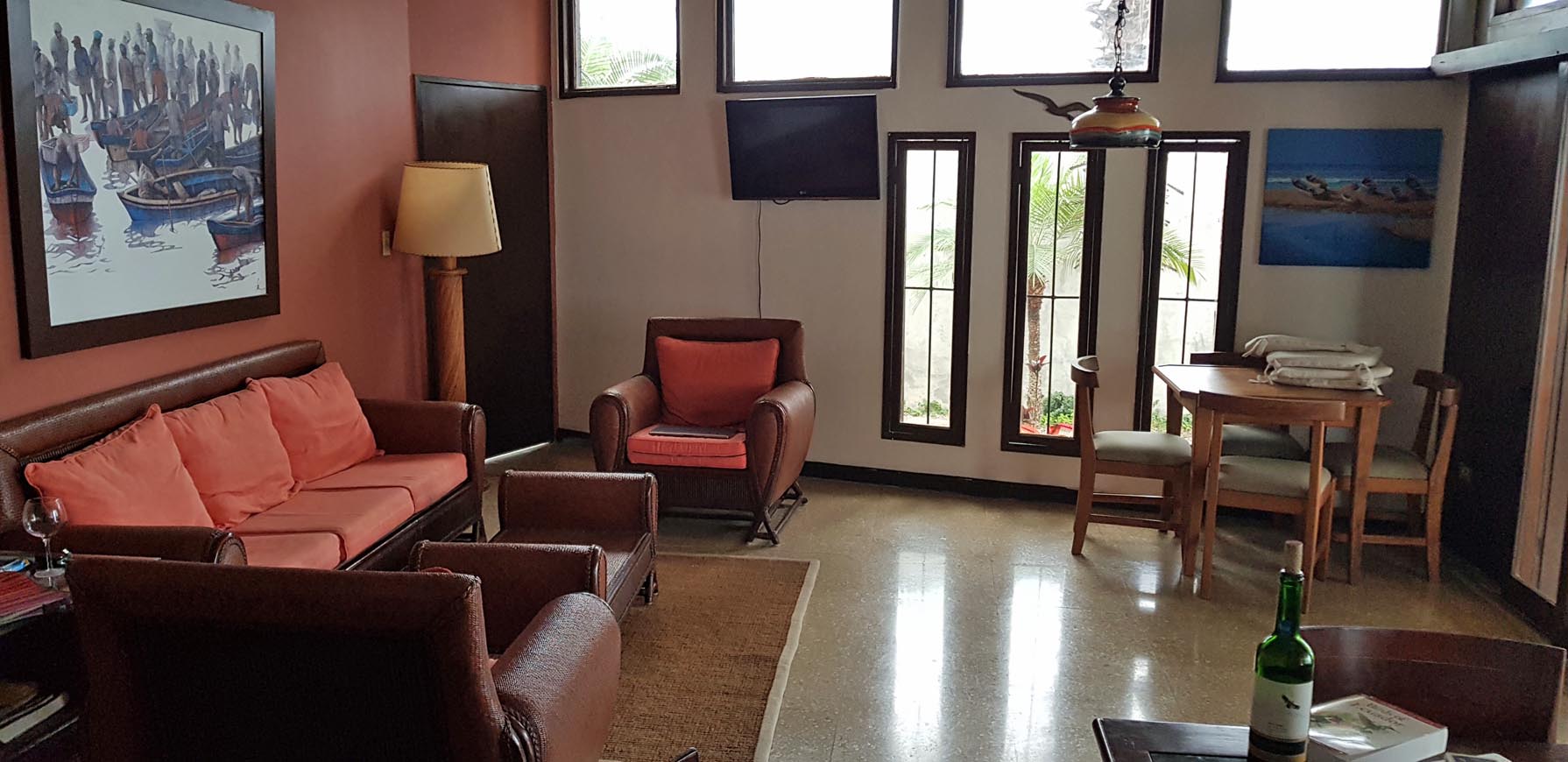
The indoor living room was also spacious and comfortable and there was an ocean view.

The bedroom was comfortable and had its own bathroom. The only down side to the house was the kitchen. A woman is available to cook and clean and apparently most visitors take advantage of this service. At $25 a day, it would be very attractive for a visiting group. As a result, visitors aren’t expected to use the kitchen, where we found an antique toaster oven, a stove with one burner that wouldn’t light and a toaster that toasts only one side of bread at a time. No dishwasher, naturally. Jonathan made do as best he could–which was pretty great. We ate shrimp almost every day.

Fishing and Fishermen

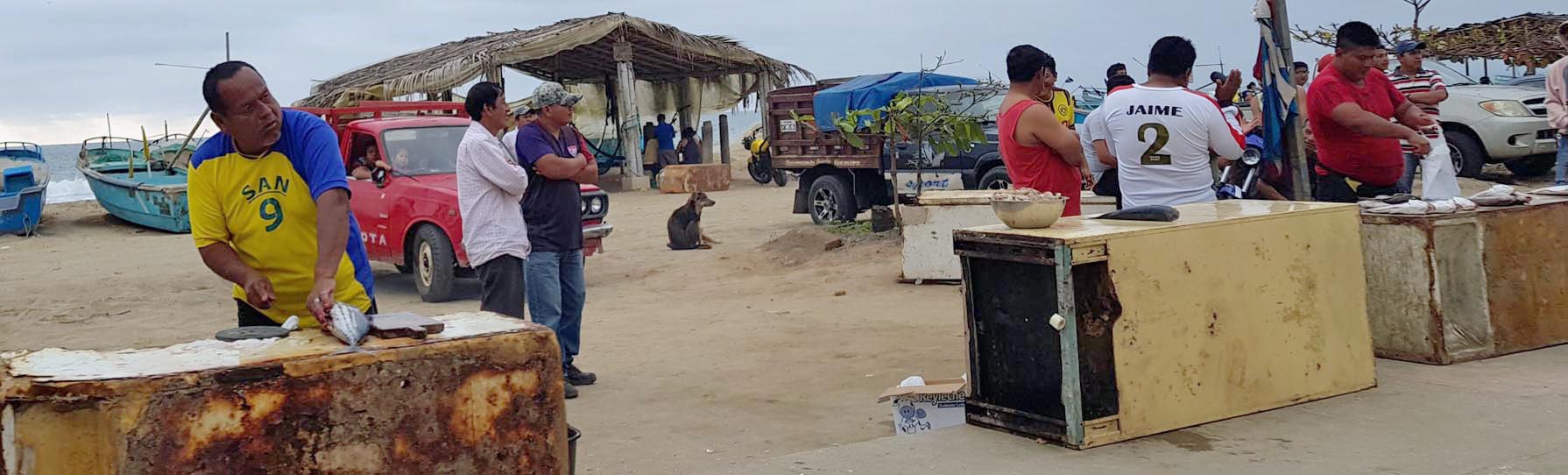
Artisanal fishing, where one or more individuals push a boat out into the ocean and spend the day fishing, then land and sell their catch, is a grueling existence. The sea can be dangerous, and yet there’s no pay if there are no fish. Fishing communities in Ecuador, like those in Peru, tend to be pretty humble places. We drove through the town of Valdivia on a Saturday and the boats had just come in, for there were fish on cutting tables right beside the street and people would pull up, roll down their window and buy fish on the spot.

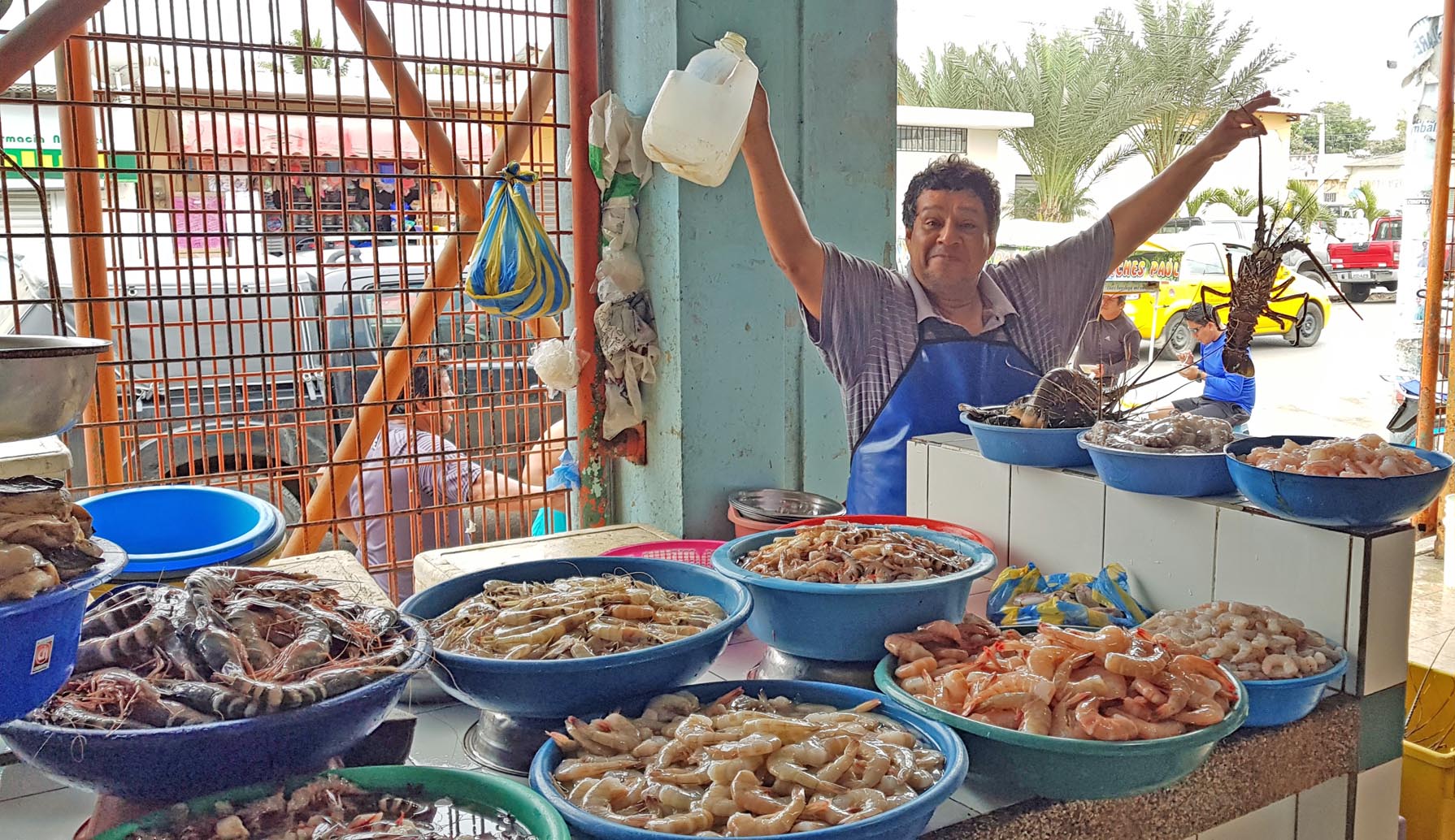
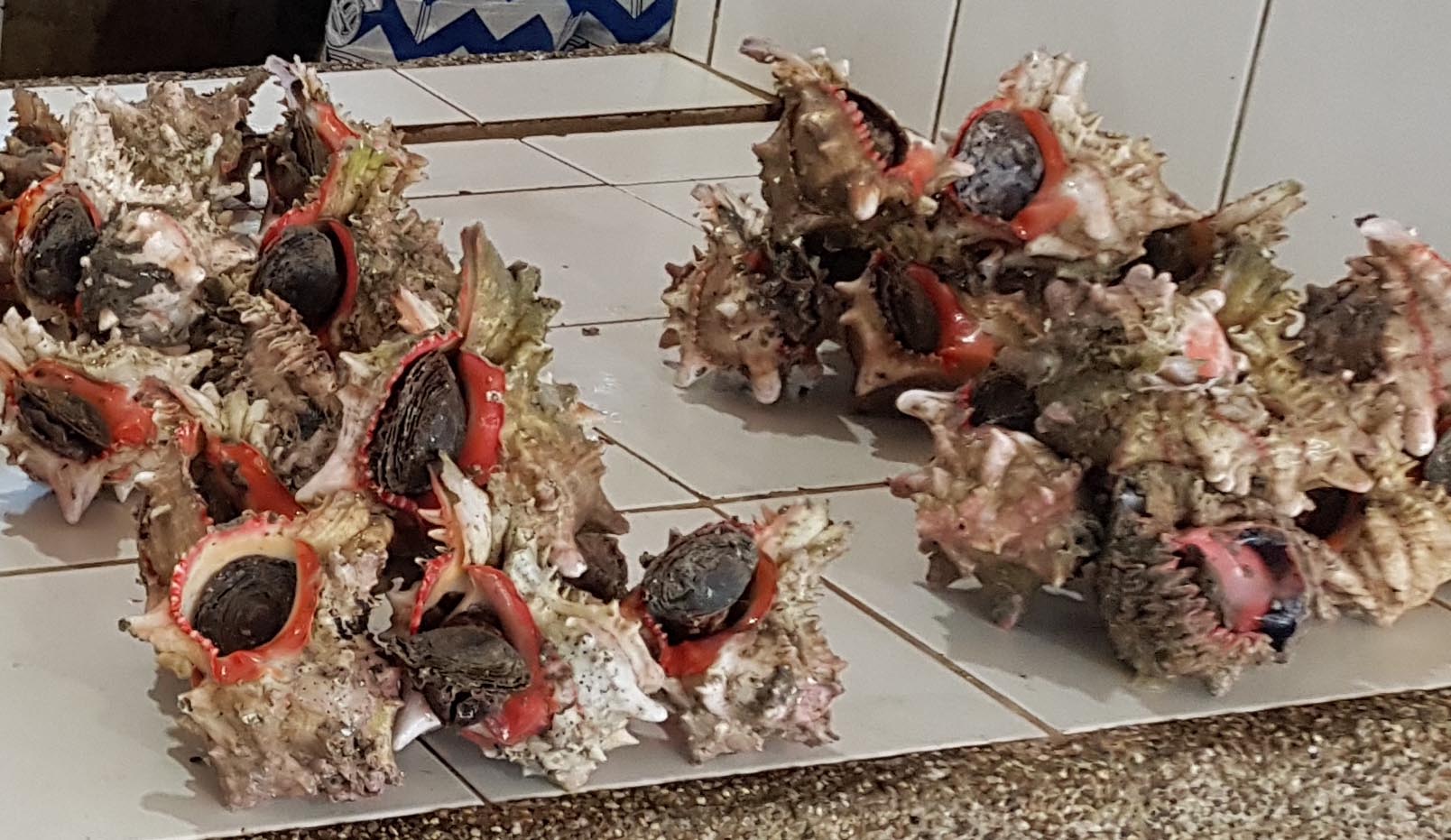
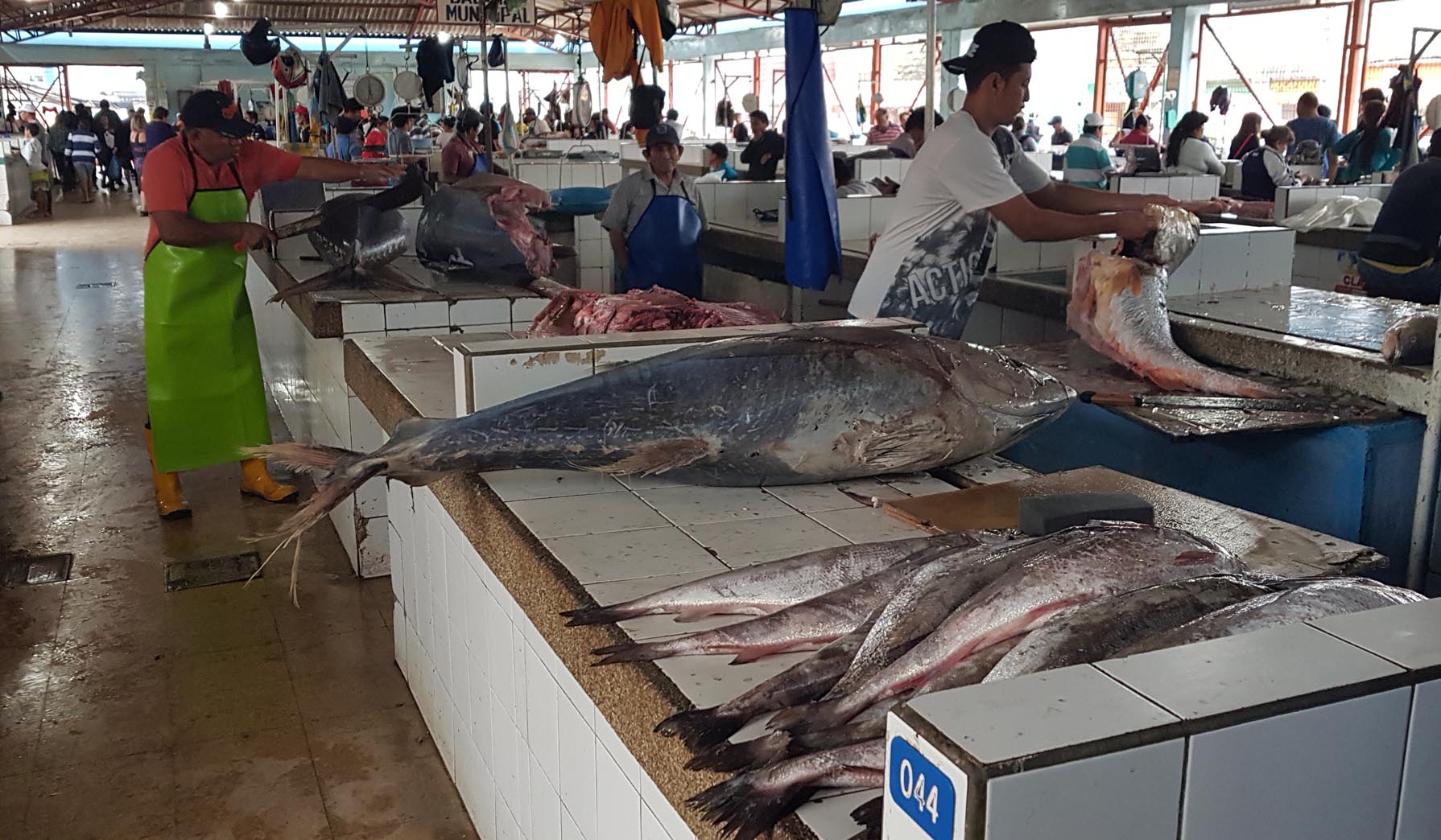
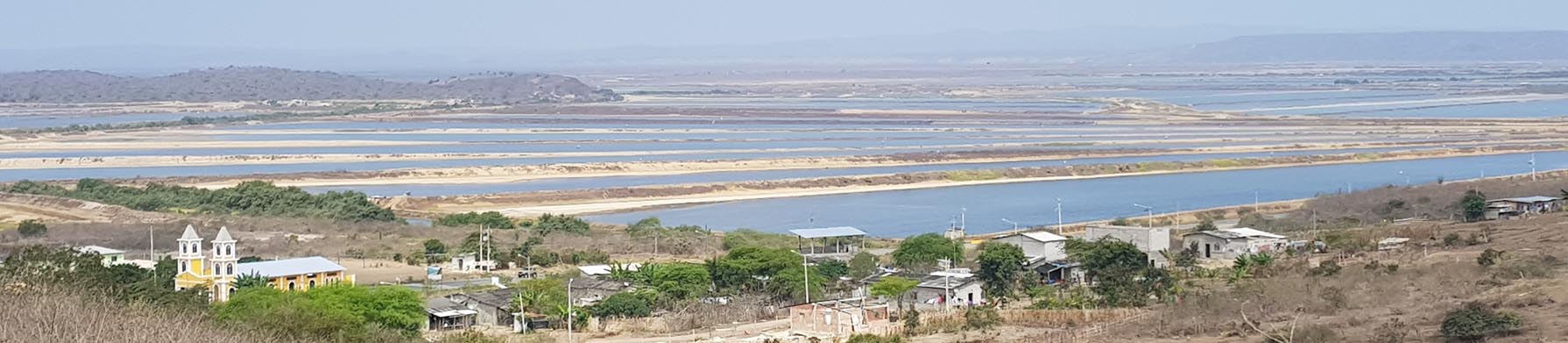
There are huge fishing fleets. The smallest boats we saw were in Valdivia and Ancon, with larger boats in Anconito. All of these are the very smallest of the fishing fleets. Boats under repair are parked anywhere space can be found, including in the plaza by the museum in Valdivia. There’s not much room for boats to be parked among the fishermen’s houses along the shore.We went to the regional fish market in La Libertad, closer to us in Ballenita than driving to Valdivia and hoping the boats were in. This is among the largest fish markets we’ve been in, rivaling the fish on the Rialto in Venice (I’m sure it’s bigger). Sunday is the busiest day, and there were lobster in addition to all the fish and shellfish we saw on visits during the week. About ten varieties of shrimp are sold here, from huge tiger prawns to tiny peeled shrimp. In addition are octopus and a range of clams, mussels and scallops, along with a species that I’ve seen beachcombing, but never eaten. There are huge fish, too, mahi mahi and tuna that can be six feet long. All these fish are cleaned, scaled, skinned, filleted or cut into steaks according to the buyer’s requests. The floor is wet from the water used to sluice off the countertops.Outside the fish market is the market for fruits, vegetables and household goods. We were there around 9 am on Sunday, and found that lots of people visit the market and stop for a breakfast of fried fish. Smoke from the open fires used for grilling drifts out over the alley.We were impressed by the quantity of shrimp at the market and found that Ecuador is one of the world’s largest exporters of shrimp along with Thailand, Vietnam, and China. Shrimp farms cover low ground near the ocean all along the coast. We found a vantage point near Playa Santa Rosa where we could see the ponds fanning out across the horizon. The good result for consumers is that at the market, shrimp cost $3-$6 a pound. More good news is that to compete internationally, Ecuadorean shrimp farms are phasing out all chemicals. This gives their product an edge over Asian growers, at least for now.  We ate shrimp for dinner almost every night.