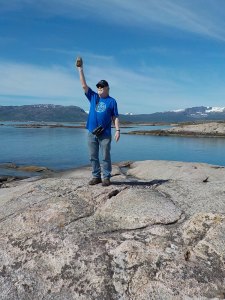
Beachcombing is not so simple in our area–most of the shore is rock. There are a variety of clams, whelks and we learned that little sand trails come from lugworms. (Amanda is our visiting marine biologist.) There is still a lot to look at when there is a sandy spot, and a surprising quantity of junk along the high tide line. Most of it probably washes in from boats, garbage escaping from the ferry, etc., but some is local. Originally, I said that the person who found a piece of narwhal tusk would be the beachcombing champion. After we arrived, I looked up narwhal and found they live in Canada and Greenland and are nowhere to be found in Norway. No narwhal for me. In any case, our first day walking along the rocky shore in Kjerstad, Jonathan took the prize for the entire Norway beachcombing season, by finding this:
A blown glass float in its netting. I concede.
Today we woke up to 9 degrees C (48 degrees F), howling wind and rain. When it let up we went exploring to the nearest town with a store, Ramsund, only about 35 minutes drive (vs. a hour to the next closest store). We bought more fishing tackle (fishing post soon) and picnicked in the car (still cold out). We saw a new bird, too. A redwing.
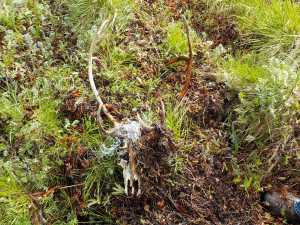
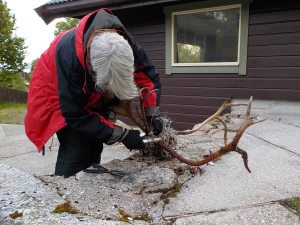
In the late afternoon, the rain stopped and we went for a walk along the shore near Kjerstad, just looking at the birds, the new snow on the mountains that surround us, naval vessels going by, beachcombing. Then I made my find:
A reindeer skull
It may have died from being tangled in plastic rope.
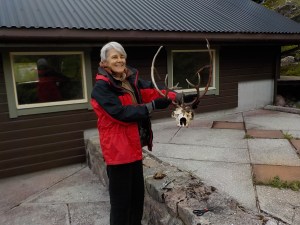
My trophy.
The reindeer skull and antlers are in a place of honor on the shed roof. The beachcombing stakes have gone up. Who knows what we will find next!
We’re not exactly roughing it here in Norway. Our rental home is spacious and light, as well as very nicely decorated. There are some Norwegian folk art bowls in the kitchen on a shelf above a painted chest dated 1855, though most of the furnishings are quite a bit more recent. See the photos below for some additional comments.
Kjerstad, Norway is a degree or two of latitude north of the Arctic Circle. We have been here two days and already experienced the midnight sun–or as good as. Both nights Jonathan has said, “OK, going to bed now,” and I’ve said “What time is it?” and been a couple of hours off. It’s light all night as far as I can tell, so I close my eyes and then it’s dark. Works great, especially if you just had a long day or two of travel from Portugal.
Norway from the air. There’s lots of water.
We are here because of Airbnb. Almost a year ago, Jonathan was browsing places in Europe we might visit and called me over to look at a house in Norway. The house was attractive and the price moderate. He discovered that it was above the Arctic Circle; we could be in the Land of the Midnight Sun for a whole month. After some contemplating, he contacted the owner to see whether the house would be available in June 2016 and we signed up. This is the only time we’ve selected a rental on Airbnb on a whim. June is here and we’ll see how it goes.
View from the upstairs window.
Terrace facing the water.
The island where Kjerstad is located is called Tjeldøya, Oystercatcher Island. We have already seen the namesake bird here. This area is the northernmost (northeasternmost) end of the Lofoten Islands.
Though it’s not the farthest north you can get, it’s pretty far north. Interesting factoid: The Lofoten chain has the greatest differential between actual temperature and the temperature expected based on latitude. That is, it’s relatively warm for the location. Lucky for us! Our first day in Kjerstad was so warm that I didn’t need a jacket. I found an ancient Norwegian tanning bed:
The temperature was in the 70s (about 20°C). Today the temperature was 9° C (the 50s), and I wore all my layers.
It’s an eye-opener to compare Norway to the other countries we’ve visited. It is smaller than both Morocco and Peru, with a population of 5.1 million (one-sixth or less of the population of Morocco or Peru), It’s population density 17 people per sq km, the lowest of any country I’ve looked at. Keep in mind that more than 30% of the surface of the country is classified as “other.” In this case it means “rock and mountains,” ruling it out as living area. Rather than being an underdeveloped backwater, however, Norway has one of the highest PPP (per capita income) recorded, $47,513. Compare that to Portugal ($14,101), Peru ($12,195), and Morocco ($8,165). Further, Norway has one of the highest scores on the Human Development Index, .934, meaning that an individual has a lot of opportunity for education and employment. We notice that the Norwegian language is used as a tool for incorporating immigrants. The night clerk at our hotel in Oslo spoke Norwegian to other guests, and though we couldn’t guess where he might have come from originally, his Norwegian had only a slightly different accent than the people he was speaking with.
Norway is a bit different than the countries of the EU. It is not a member, so uses the Krone (NOK) rather than the Euro. Norway is a member of the European Economic Area (EEA), and that provides free movement of people and goods through the EU. The only country besides Norway with this status is Iceland. It might sound like Norway has the best of both worlds, EU access without the Euro. That’s not necessarily the case. Though Norway has free movement of people and goods, it does not receive the benefits of EU price supports for certain products. For this reason, food prices in Norway are on average 75% (or more) higher than the same products in EU countries.
There were delicious breads and crackers at the breakfast buffet–at what cost?
High costs are offset by the fact that Norway has the largest oil and gas reserves and is the largest producer and exporter of oil and gas in Europe (though 21st globally). The petroleum industry is heavily regulated, and contributes about 45% of total exports and 20% of GDP. What makes Norway different than other countries during the downturn in oil prices today is that it holds the largest “sovereign wealth fund” in the world. That is, Norway has been saving money from the oil and gas industry in a rainy-day fund that will help it weather the present upheaval. The government can spend up to 4% of the fund each year to stabilize economic conditions.
I believe it is no coincidence that Norway is one of the world’s least corrupt countries. The top personal income tax rate is 47.8 percent, and the corporate tax rate is 27 percent. Other taxes include a value-added tax, a tax on net wealth, and environmental taxes. Summary: there are no bargains and individuals pay a lot of taxes, BUT they get what they pay for in excellent services and infrastructure.
We’ve already seen wonderful landscape and fun, quirky things. Here are a few:
This is my last post on Portugal, where I provide a few observations that may prove useful to anyone considering a visit. Portugal is a wonderful place, so very much worth planning your trip.
Language
How disappointed we were to find that speaking Spanish is of so little assistance in Portugal! For people who don’t speak Spanish, however, this may be a good thing, because far more Portuguese people speak English than speak Spanish. We could read some signs, but the accent is very specific and it was difficult to follow spoken conversation. Many words are similar to Spanish, but not all words, so Spanish speakers get lost trying to follow the familiar. For example, ygrega=iglesia (church), praia=playa (beach). But also, lettuce=alface, apple=maça, turkey-peru (I am not kidding.)
Rental cars
Driving can be expensive. In addition to the cost of renting a car, fuel is expensive and there are significant tolls. For example, the highway toll for our drive to the Algarve and back (2 ½ hour drive) on excellent highway was €19.45 (about $22.50) each way. There can be cash tolls on additional short segments and bridges, and there is also the cost of parking that ranges from € 1 for 24 hours to the same amount for 20 minutes, depending on your location. Most parking is marked if payment is required and the hours that must be paid (e.g. 7:00-20:00). Usually there is a kiosk nearby where you insert coins and retrieve a slip of paper marked with the time your parking expires that you put on your dashboard. Not all meters take credit cards.
In Sesimbra, we met the most helpful Tourist Information person ever (!) by mistakenly putting the credit card too far into the parking kiosk where it fell inside. At the tourist office, we explained what had happened and a young woman got on the phone for a bit then said she would call us and tell us when to return to the kiosk. “We will solve your problem” she said. After dubiously giving her our cell number (it was our second day in Portugal and we had visions of having to get a replacement credit card) we went off to the market and indeed got a return call, telling us to be at the kiosk at 3 pm. We went, and a guy came up the street, opened the kiosk, fished out the credit card and gave it back. (I love the Sesimbra tourist office—it’s in the fortress.) It seems unlikely that we will ever have a more impressive experience at any tourist office anywhere.
Parking!
In the city, a car is not necessary, but if you plan to go beyond Lisbon you need fortitude and patience to take the train or bus to visit other towns. If you have a car, you can park and take the train into Lisbon, or like us, drive in and look for parking. I had some luck finding parking on:
though the information only applies to part of the city. We had pretty good luck just driving around looking for parking, but that probably is not much of a plan on sunny weekends, during the summer, etc.
Along the coast, only a few beaches have parking lots, much of the parking is along the road. It was much easier to park for beaches in the off season. Even small beaches may have a café/restaurant and 40 or more beach umbrellas. With only 15 parking spaces along the road, I can’t really understand where people park in the summer and what it will be like to drive along the coast.
This is legal parking for the beach.
Pedestrians have the right of way on every striped/zebra crossing.
In Portugal, people tend to cross the street at striped crossings, BUT, they know you are looking out for them and that you will naturally stop, even if you are going at a good clip and they can see you coming. They still step out and you need to stop. There’s also something of an expectation that a driver will stop under most circumstances zebra crossing or not. You might get a look, or a wave, but you might just get a young person lighting up a cigarette while talking on the phone wandering out into the intersection, or a mom with a stroller, or an older gentleman who will take about 75 steps to get across that lane. Be prepared.
Signage is a problem, and I’m not saying that because I don’t speak Portuguese. Road signs sometimes appear right before you need to make a turn leaving you no time to get to the turning lane, sometimes they appear so far before the turn that there are two or three other unmarked options before the correct turn. This lets you tour the neighborhoods around the base of the big bridges into Lisbon, usually when you are most wishing to go home. It is much easier to find your way to beaches, even well-known ones, by checking maps before you leave home. There may be one road sign off the highway and nothing else, or every road may be marked as going where you are headed. For example, in Portimao it seemed like every street had an arrow that said “Praia de Rocha.” We occasionally provided directions to lost drivers—Portuguese ones!
A thought about restaurants
As in other places in Europe you’ll often be served bread, olives and cheese when you sit down in a restaurant. This can be very nice, especially if you are starving before a late lunch. BUT, keep in mind that these are not complimentary, so if you are not interested in them or on a tight budget, tell the waiter to take them back. You are not obliged to have these items, but you need to speak up. At the end of the meal it is too late to refuse to pay for them. (We had a really good meal at a very moderate price at Portofino in Sesimbra. It’s right on the beach.)
We’ve seen a lot of decorative tile in Portugal. It covers many buildings, sometimes as an overall pattern: exterior walls, interior walls, decorative wainscoting, decorative details.
This slideshow requires JavaScript.
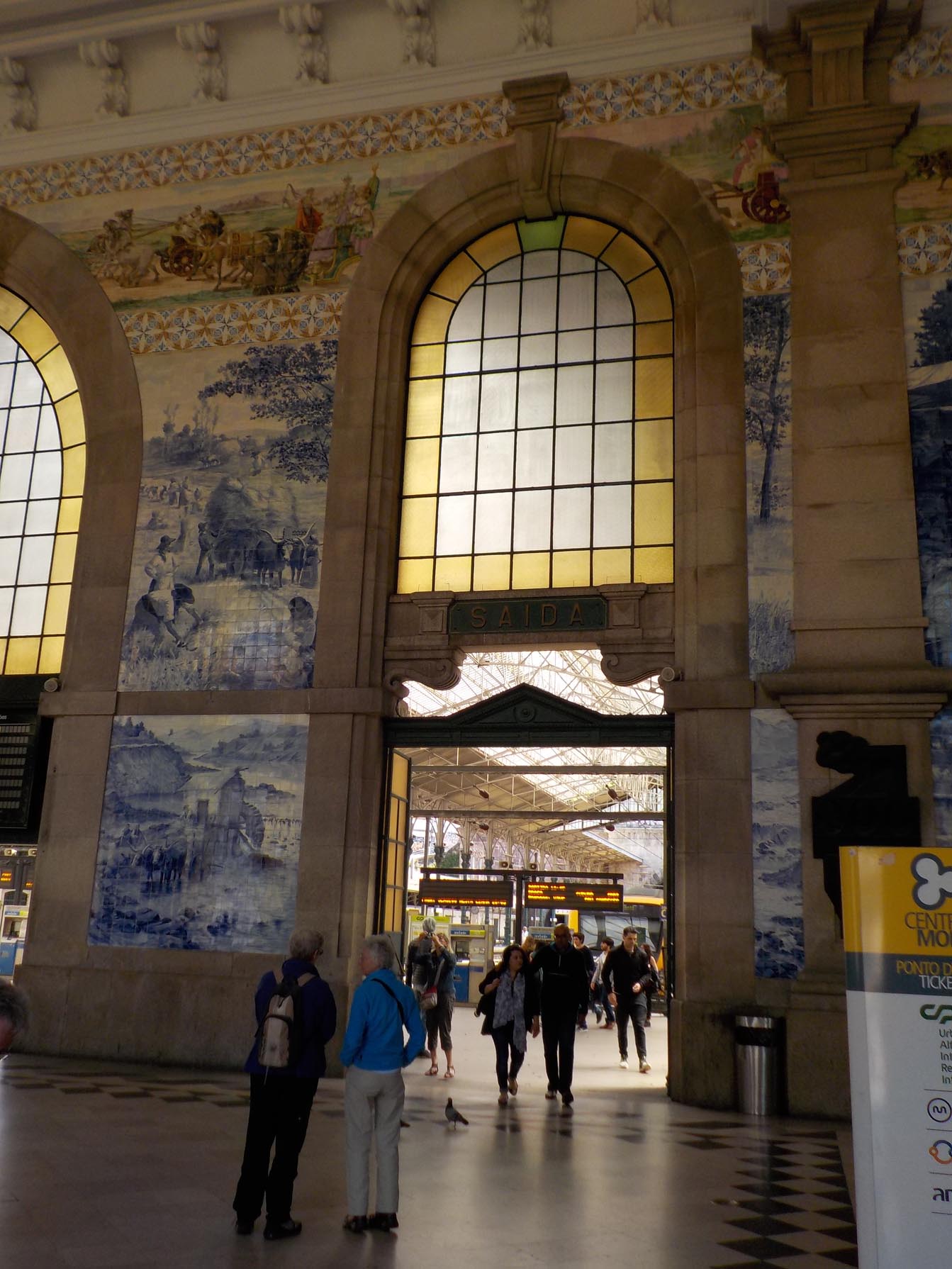
Sometimes there are scenes created from tile. The Porto train station is one such place,
The blue and white tile was installed in the 19th c. when the station was built. The multicolored tile was added during the 20th century.
Here is a church that is completely tiled with religious scenes on the exterior (Porto).
Scenes created from tiles are put on walls.
It’s an adventure to walk anywhere in Portugal, to see what tile you may find.
Empedrada is a particular kind of square cobblestone surface that is found all over Portugal. The material tends to be a uniform pale color and it covers lots of sidewalk and many public plazas, private patios and even streets. Contrasting designs are made with black stone, and very rarely colors. There are some typical patterns such as crosswalks, and there are some very appealing decorative designs, all very durable. These pictures go from the simple to the complex, so if you watch for a minute you’ll get to the octopus and sailing ship!
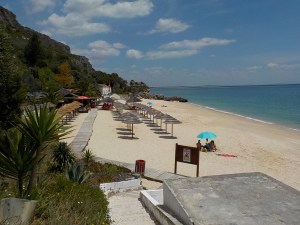
We’ve visited many of the beaches along the coast from Setubal past Sesimbra
From east to west, around Cabo Espichel and up the coast, they included:
Praia de Troia, Bico das Lulas on the Troia Peninsula
I love the beach.
My new friend.
Future Troia.
Where umbrellas go to die.
An alligator/sea monster!
A scallop as big as my foot.
Praia da Figuerinha is just west of Setubal. The long sand spit is a great walk at low tide.
Praia dos Galapos, our last day:
Praia Galapos
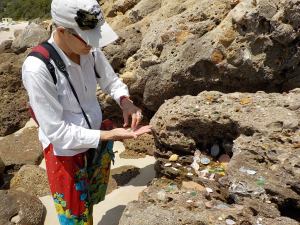
Arranging shells and
beach glass to leave behind.
Praia do Creiro (Portinho de Arrabida)
Praia California (Sesimbra)
Praia do Ribeira do Cavalo was the one we couldn’t reach. The trail was too steep. Praia do Cavalo on Cabo Espichel is near the dinosaur footprints from the Upper Jurassic.
Praia dos Lagosteiros is nearby and has more dinosaur prints, from the Lower Cretaceous. The boundary between Cretaceous and Jurassic runs through the area of Cabo Espichel.
By the footprints
Comparing my stride with the dino
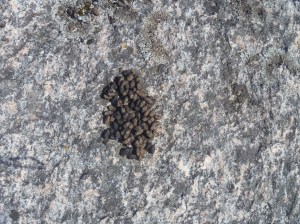
Praia da Foz is just up the coast from the dinosaur footprints, though there are several small bays that can be reached on foot in between. We drove to the end of the road, then walked for a while to reach this beach. In the mud left from the rain we saw the tracks of deer, a biggish animal (Iberian lynx?), and birds.
Praia de Foz is where we found partially fossilized snails, clams, oysters and scallops:
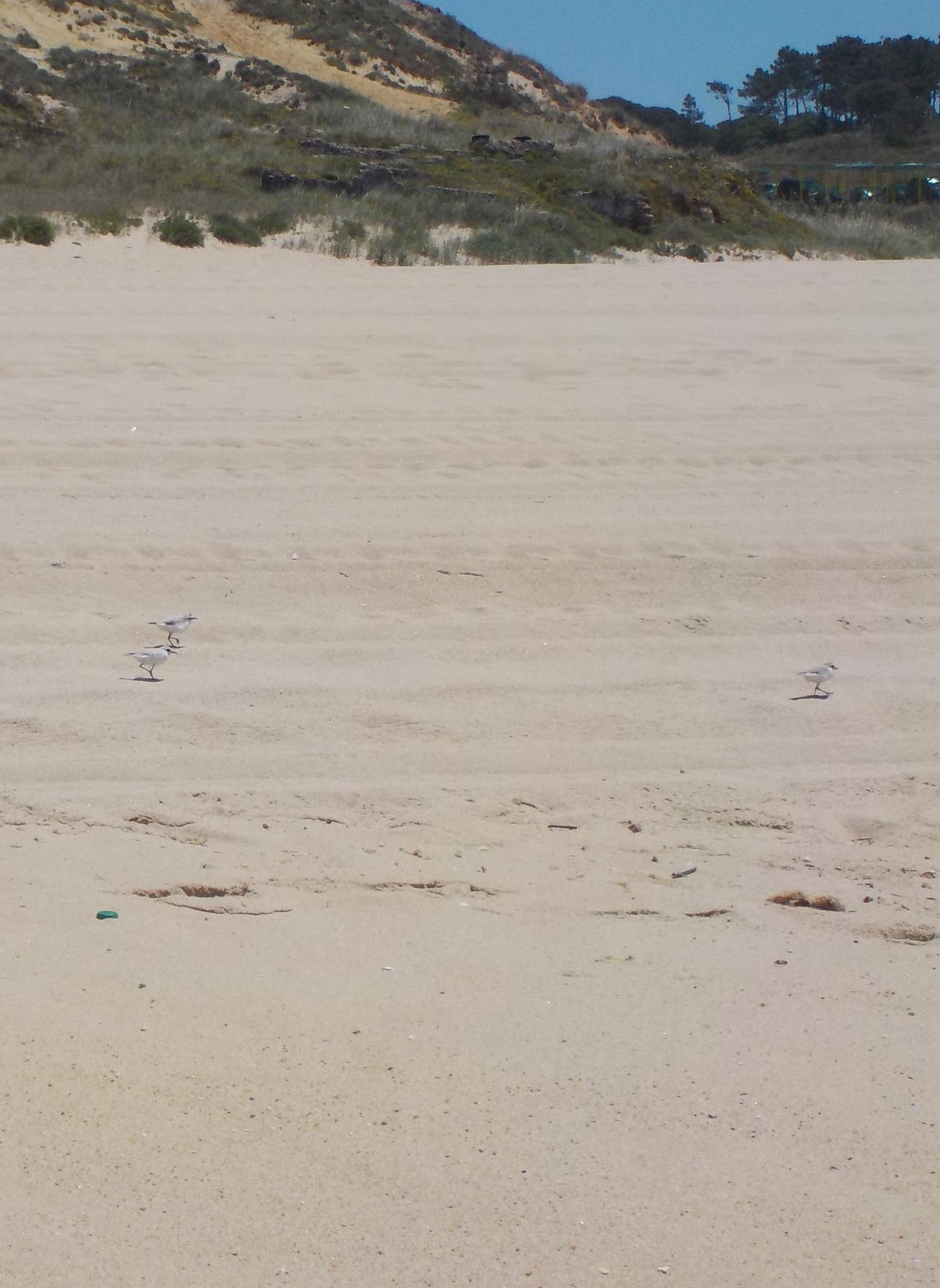
Praia do Meco is part of a long, long beach that stretches for kilometers toward Lisbon. We spent two days, first walking south from the parking area, and walking north the next visit. Here are some of the tiny birds we saw:
Praia da Lagoa de Albufeira was the furthest we got on our tour of beaches. There is a town of vacation homes but since we arrived before the high season, it was very quiet. There is a huge lagoon/lake on the edge of the ocean, with a large sandbar separating the two. Something for everyone. There were lots of people fishing on the lagoon, apparently the fishing shacks are still in use.
Now you know how we spent a lot of our time this month. In addition to beach combing up and down, we saw a lot of birds. Storks, flamingos, kestrels and all kinds of shore birds and two really unusual birds (for us), a pair of nesting bee-eaters:
And on our very last day in Portugal, we saw a flock of Iberian magpies:
Until recently, these were thought to be the same species as the Azure-winged magpie of Asia, but separated by 9000 km. DNA testing shows that the two are different species.
These were both very cool birds to see. (Note: neither bird photo is by me.)
And thus ended a very eventful visit to Portugal. We left behind a lot of wonderful sights that will have to wait for another time or another person.
On our last weekend in Portugal, we decided to head south for a day trip to the Algarve, as the south coast is called. In particular, Jonathan wanted to see Cabo Sao Vicente, the southwesternmost point in mainland Europe. We planned to go on Saturday, but rain was forecast, so we opted for Sunday and hit the road by about 10 am, typical for us. The landscape shifted toward grassland, and we saw some flocks of grazing sheep and goats. Nearer the coast, the soil was sandy and scrub covered.
Our first stop was in Portimao. Based on my previous shopping failures, I had looked up every weekend market in the Algarve for something interesting to visit. I found “lota cool market,” an annual design-oriented event put on by local artisans. After I double-checked that it was actually going to take place (recent google mentions, facebook page), I looked for an address. What I found was “the ribeira” (riverside) in Portimao. I looked on google maps and didn’t see an area with that name. I checked further and kept finding the same information, then I found “near the velho porto” (old fishing port). Having never been to Portimao, I didn’t know what that meant and again, there wasn’t a label on a map that said “old port.” Finally, I followed a few facebook posts to, “if you’ve never been here before, we’re at the foot of the old bridge coming into town from Parchal.” None of the bridges were named on my map, but I found Parchal. The post included a photo of the old bridge, showing a blue, lattice structure below the bridge that finally let me identify the likely spot for the fair.
Ribeira/riverfront in Portimao.
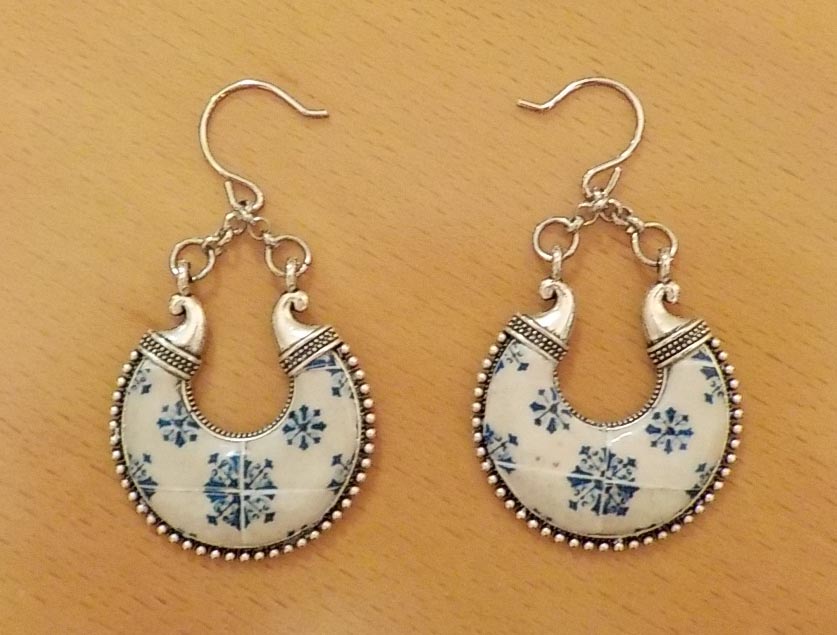
With this homework, we arrived in Portimao and immediately lost sight of the water. My GPS reception was so poor that it didn’t even show the river. We headed toward the center of town to ask questions when I saw a sign, “Ribeira.” We got to the river and there in the distance was the old bridge with its distinctive blue structure. There was even parking. We strolled down to the event. It was small but interesting, with local food producers including a cake designer who had a Barbie-sized fondant figure on her demo cake (impressive). There was clothing, mostly for babies and children, toys, wood cutting boards, cork products including a bicycle and chairs with cork in place of upholstered seats and backs. Jewelry was made of coiled newspaper, laser-cut lucite and polymer clay. The earrings I bought have images of traditional Portuguese tile baked onto the clay. It’s a contemporary application of traditional tile designs that I haven’t seen elsewhere.
These earrings are by “Love in Boxes.” See facebook for more. She participates in many summer markets in the Algarve including ‘lota cool’ market in Portimao, the Saturday market in Loule, and the ‘Mercado de Culturas….a Luz das Velas’ a candlelight market in Lagoa July 7-10, 2016.
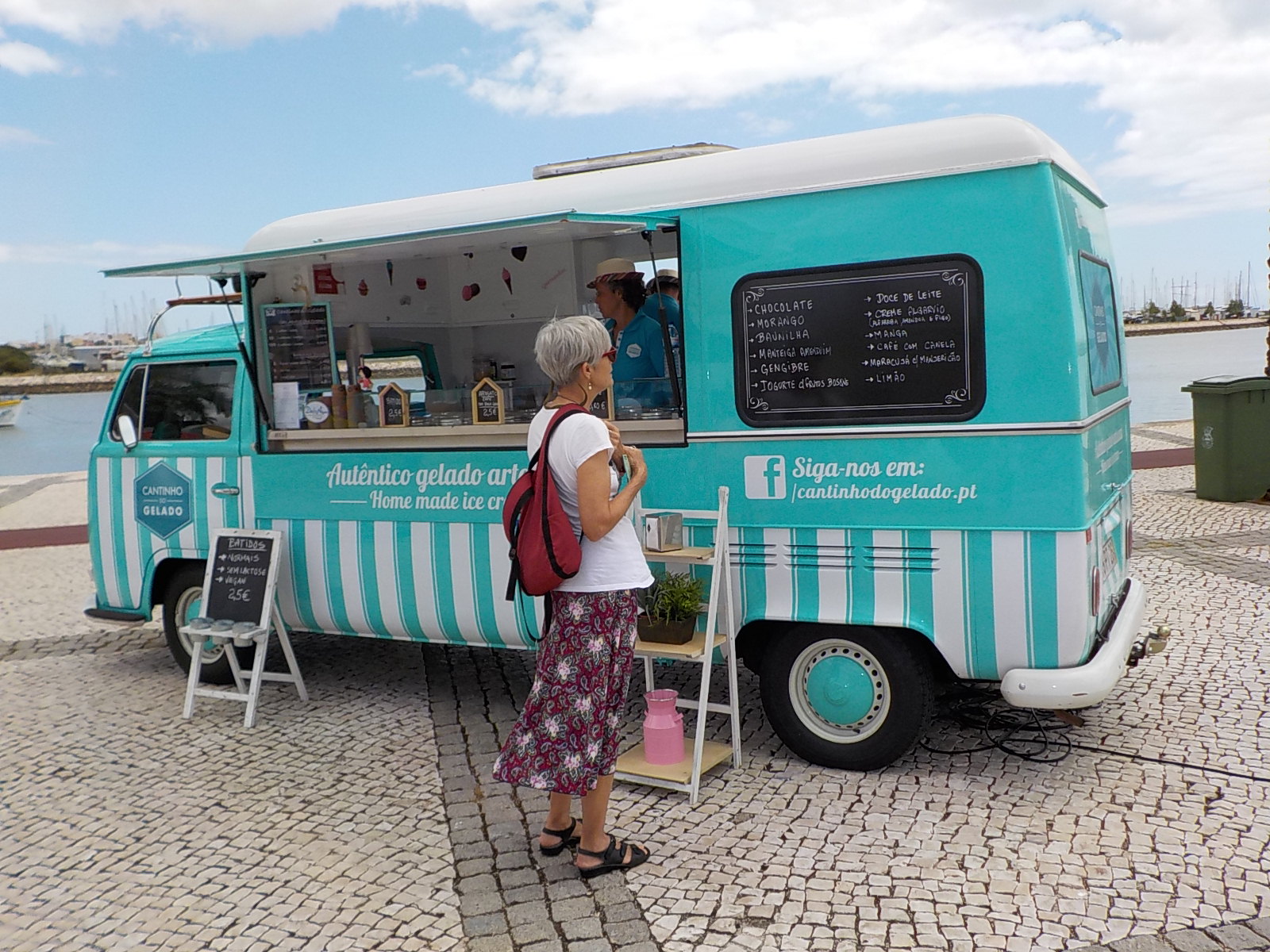
Leaving the market, I ate an “artisan” ice cream of chocolate with fig and almond. It was a good stop, but we weren’t to the end of Europe yet. Next was Sagres.
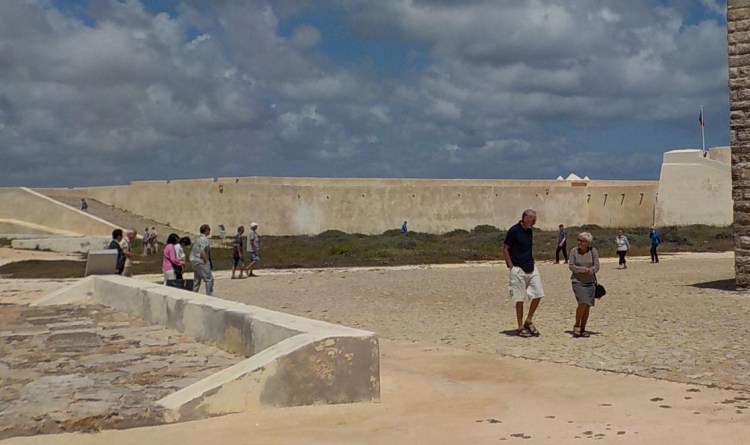
There are two southwesternmost points in Europe, 6 km apart. Sagres is home to a huge fort in the process of being restored. There is a long walking trail along the cliffs, signage about flora, fauna, and the ocean, with great views.
Part of the Sagres fort.
Visitors have built many small cairns of rock.
A small platform lets you look into a deep blowhole. Along the cliffs (40 ft, 60 ft.?), a dozen or so men were fishing using long poles, big reels and a heavy weight. I was curious to know what they caught when one man reeled in a slender fish about 12 in long. It looked small compared to his equipment but he promptly killed it, gutted it and put it in a cooler. We also saw a black redstart on our walk back to the car and wished we’d brought binoculars, because there were a number of birds in the scrub.
Cabo Sao Vicente from Sagres.
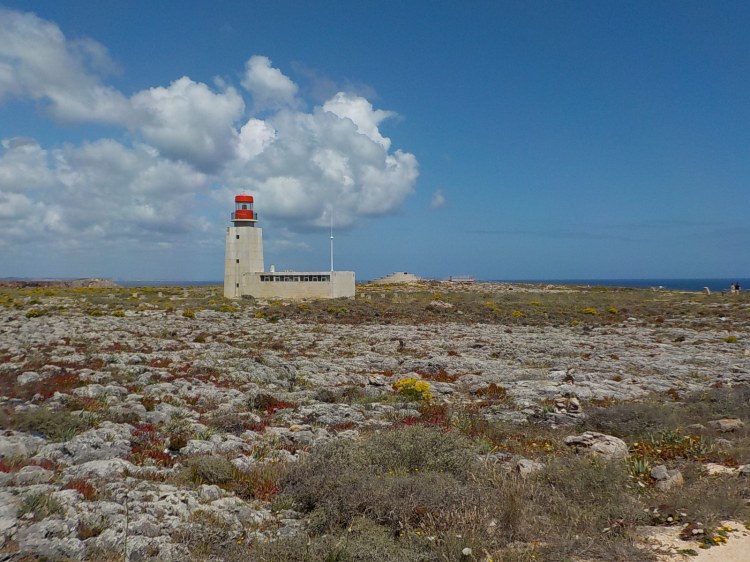
Last but not least was the official furthest point out to the SW, Cabo Sao Vicente. The site is not quite as developed as Sagres, but on a Sunday afternoon, there was a line of food trucks and souvenir vendors that covered a much larger area than the overlook of the ocean. Much of the actual point is blocked off by a lighthouse, though some of this may be due to construction. As a result, you can look out over the neighboring cliffs.
For looking right out to sea, imagining what it was like when no one knew what was beyond the horizon…….for that you visit Sagres. We picnicked along our route, and stopped for coffee on the long drive home. We got back before 8 pm. With only a couple of days left in Portugal, all our meals are leftovers, so it was quick to set the outdoor table, pour a bit of vinho verde and watch the sunset over a late dinner.
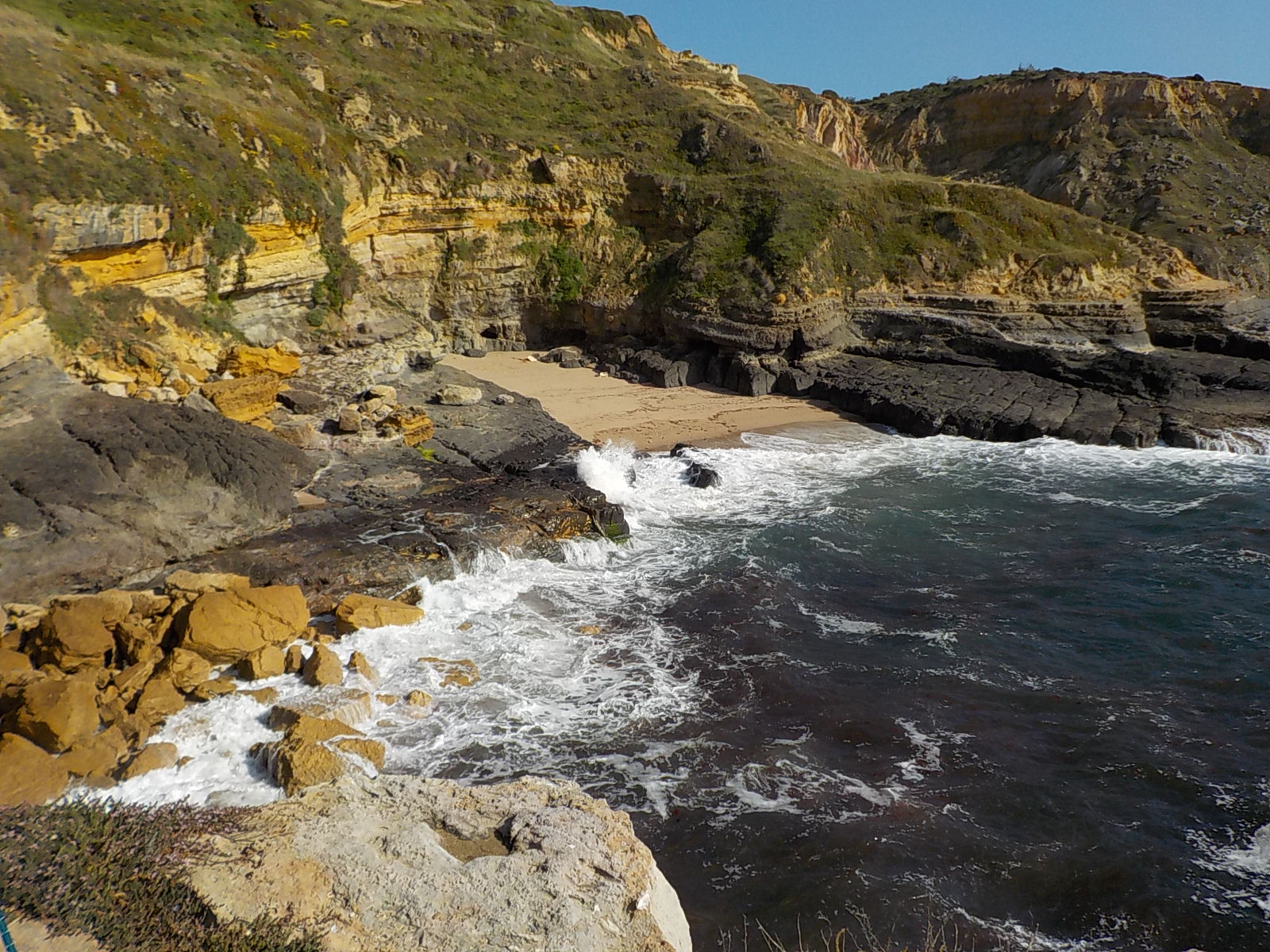
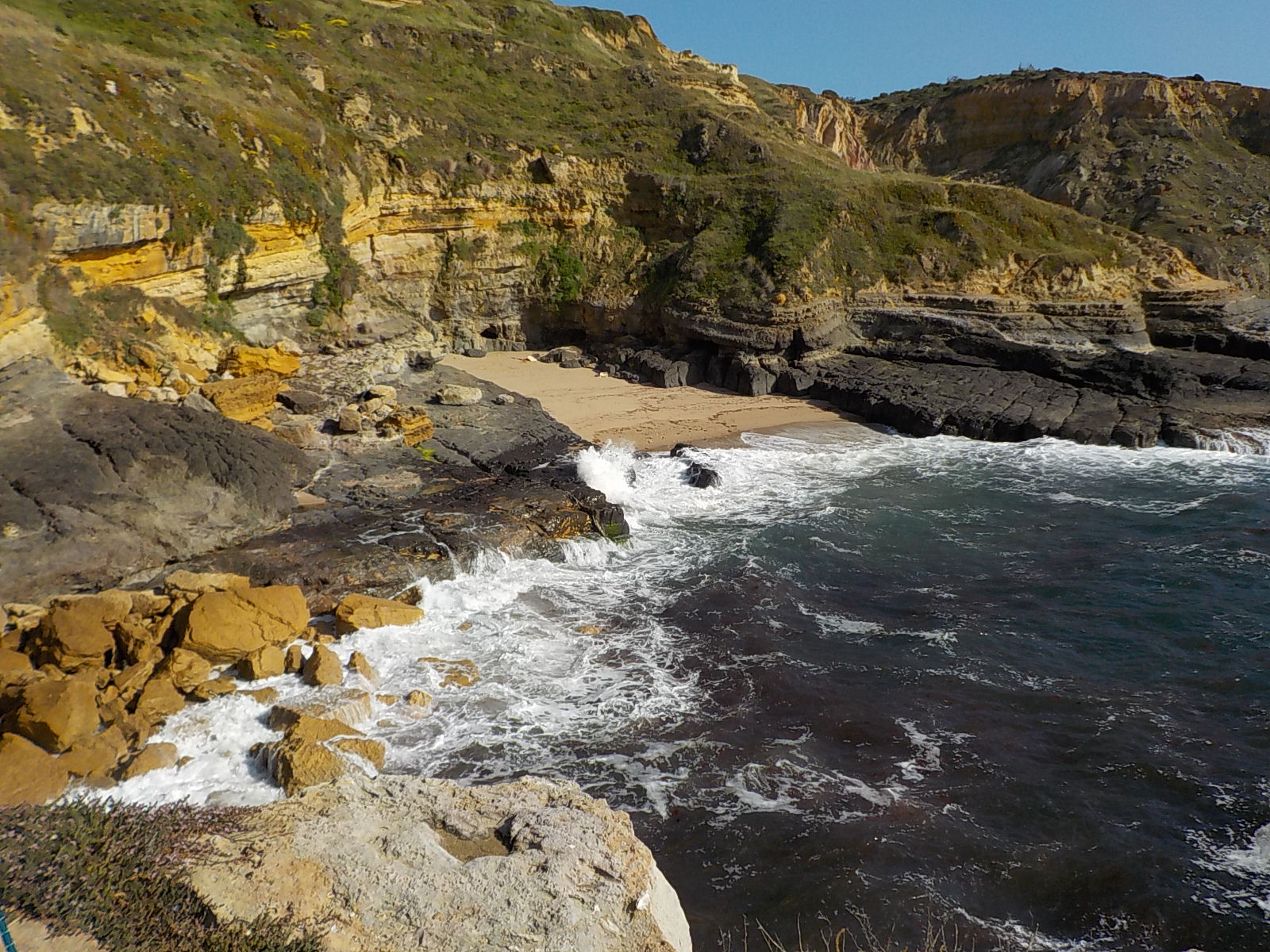
The Praia de Foz is a small beach that is easy to find if you’ve already located it on Google Earth and translated that to your phone, or the equivalent. A single sign marks the turnoff onto a graded, graveled road from the main road but there are no other signs. You choose the various turnoffs at your peril. We were prepared, and even gave directions to a Portuguese couple.
It’s a spectacular setting.
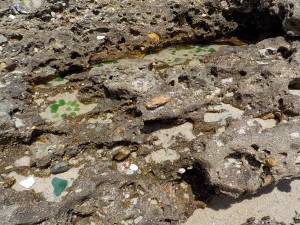
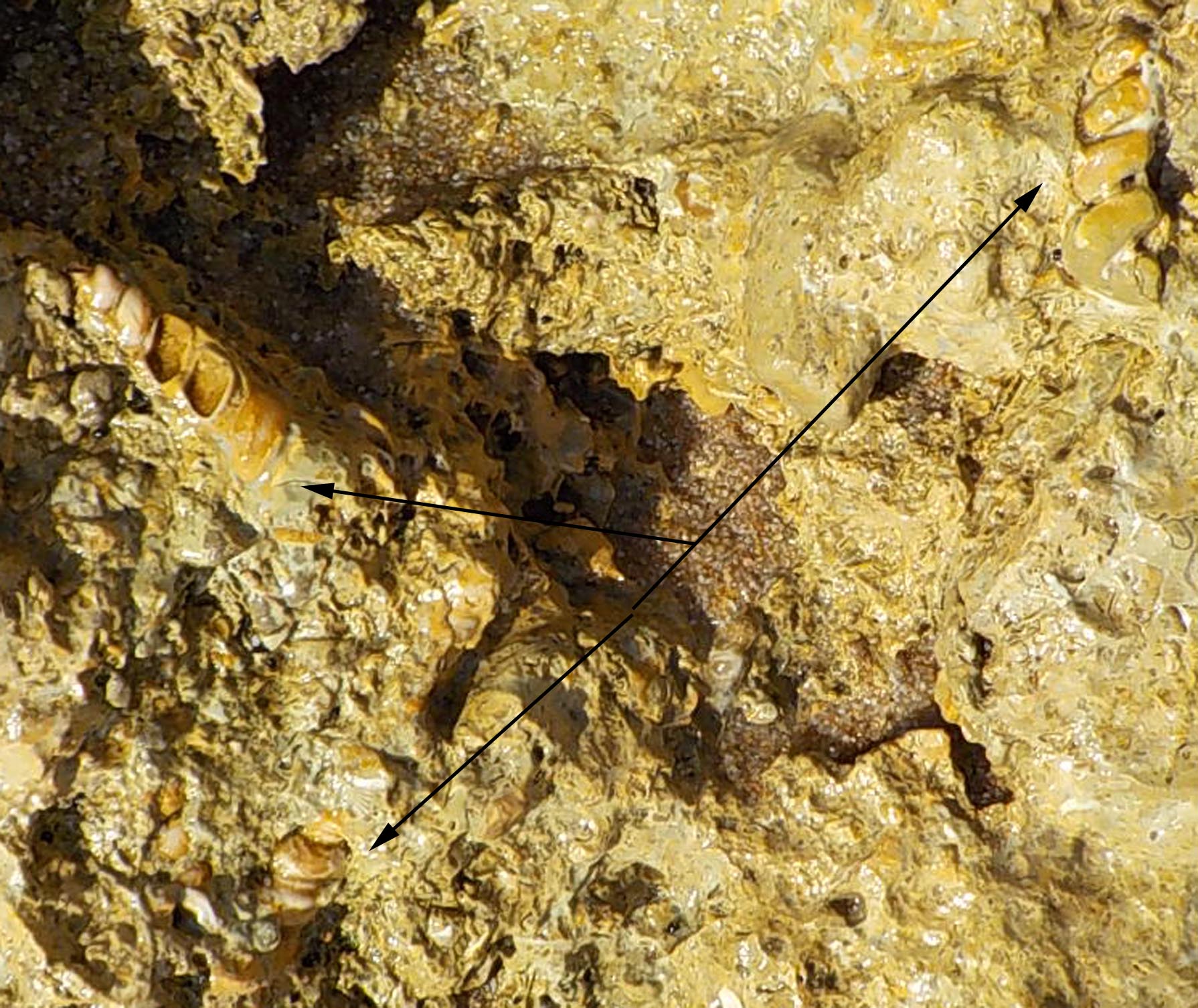
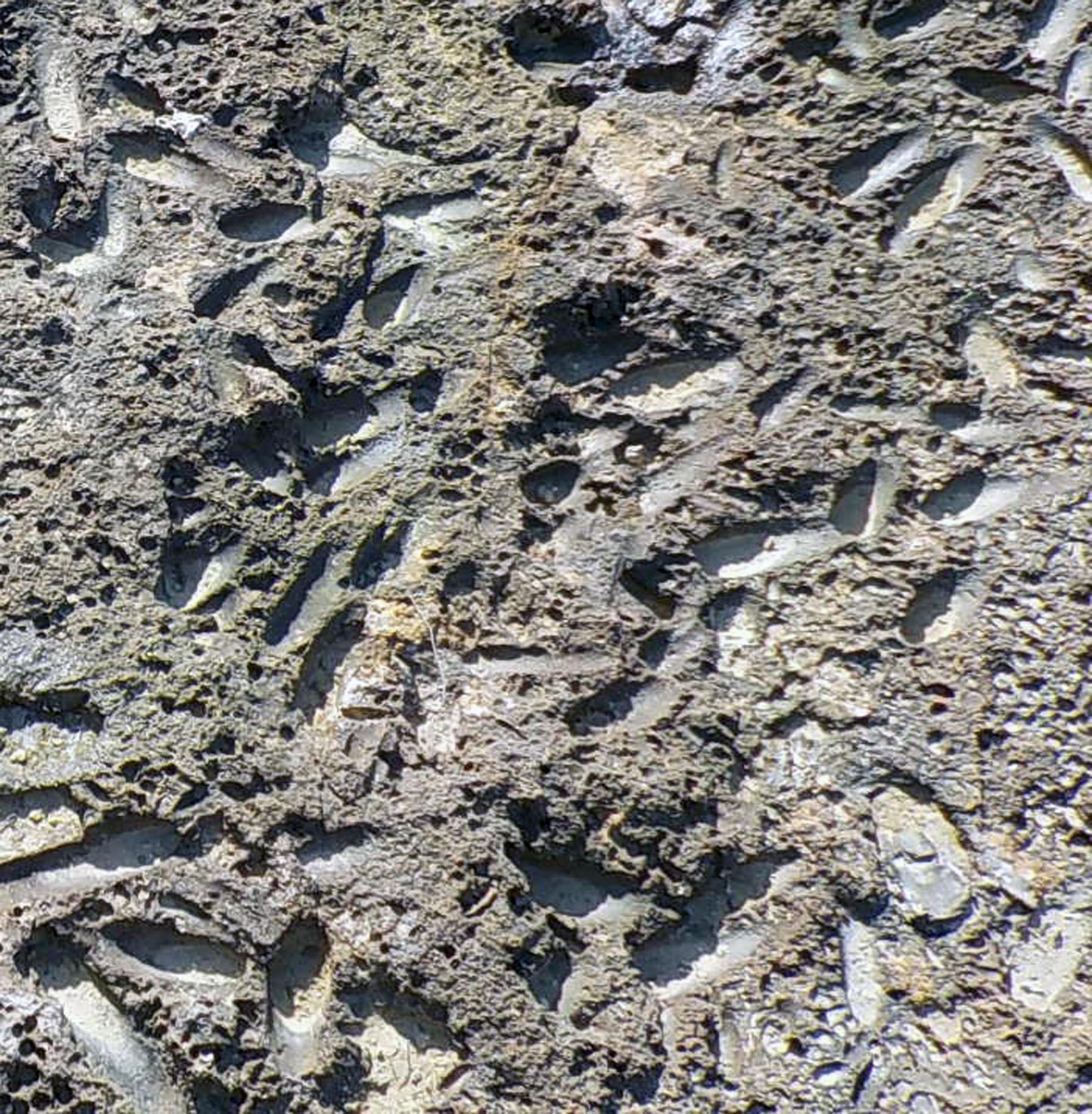
We walked along the shore as the tide rose, picking up a few tiny pieces of beach glass and looking at the rocks. They are full of fossils! I’m not sure all the sea creatures in these rocks are completely fossilized, but most are on their way. Jonathan dug out a spiral worm for me which proved to be very soft, like mudstone. I then broke it into several pieces. I could see other spirals, but the rock was too hard and I couldn’t get anything out. A rock far above us in the escarpment was full of scallop shells, others were full of huge oysters.
Here are spiral worms.Look at the difference between rocks that are side by side.All the bright/white patches on this rock are shells that are embedded in the rock.
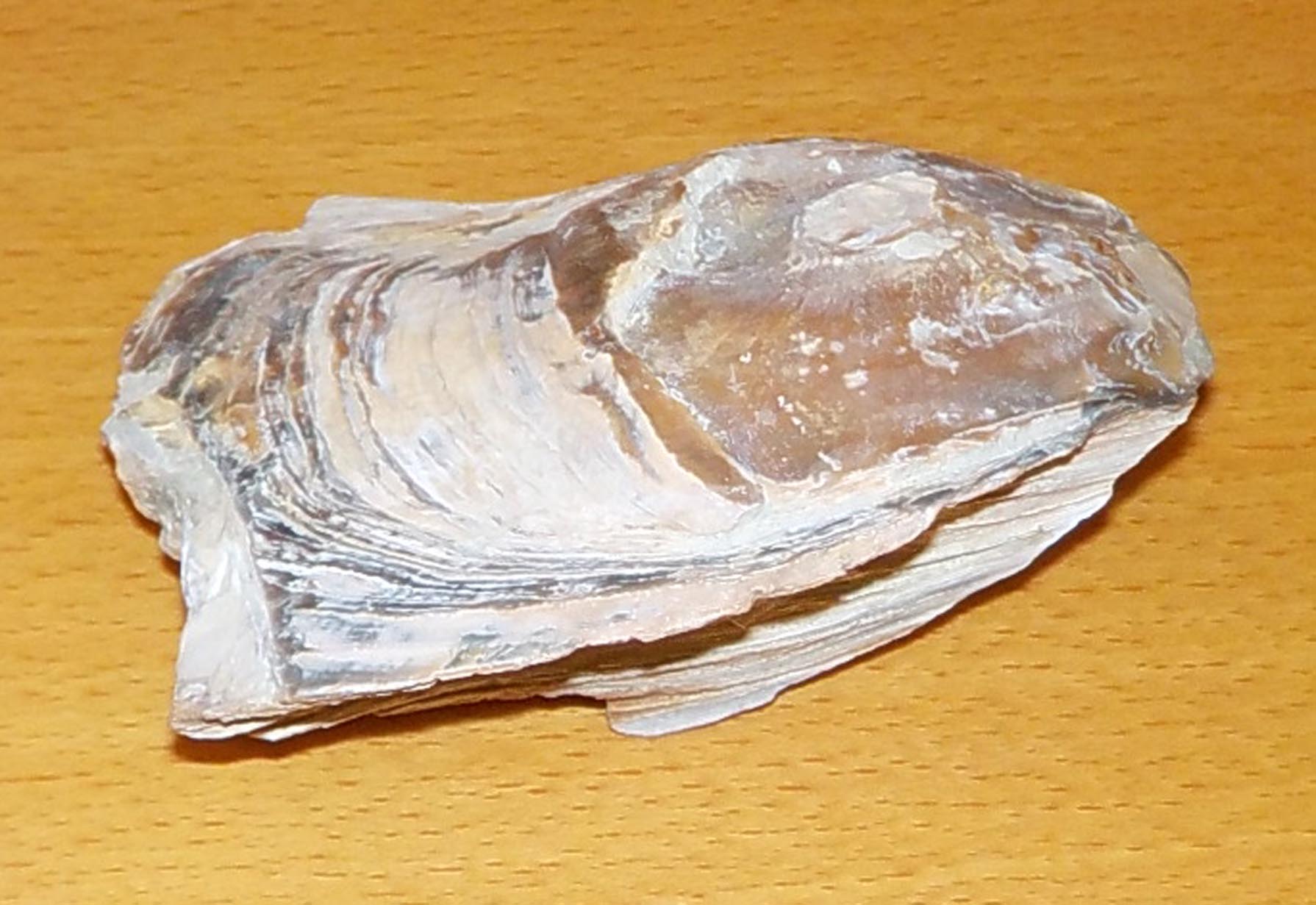
These seem to be places where shells or fossils have eroded out of the rock. The layers that have all the shell in them are high over the beach, 40 to 60 feet up. The big rocks on the beach have fallen from the escarpment. You could spend an entire day digging sea creatures out of the rocks along the shore. I came up with an oyster.
It’s probably a good thing I didn’t have a rock hammer with me.
Portugal is full of churches, palaces, fortresses and restored historic houses containing private art collections. Possibly there are more historic sites per capita in Portugal than anywhere in Europe. Older houses, too, are frequently architecturally interesting, with curved roof lines, angled windows, wrought iron balconies, tiled facades and other graceful details.
This slideshow requires JavaScript.
We even see the occasional Art Deco structure, though most of these are past their prime.
That really is a peacock on the top balcony.
Every city has a lot of older buildings in need of remodeling or repair. We saw this in Lisbon and Porto as well as in the smaller places that we passed through.
This reminded me of the Fez medina where buildings are cantilevered over narrow streets. They often look like they need additional support.
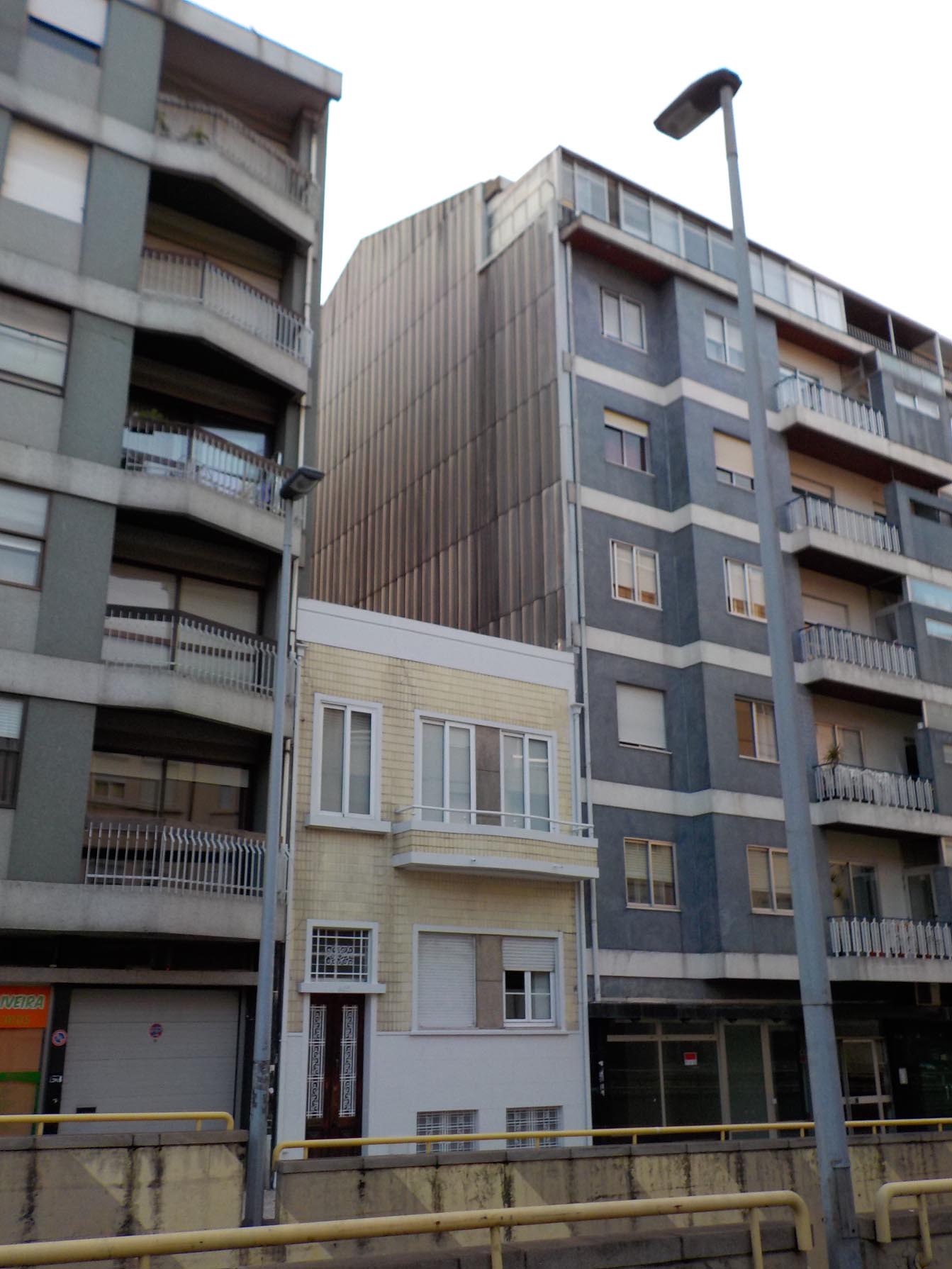
These structures will probably be demolished because they are narrow.
Even though this building is in need of rehab, the iron balcony is still in place and the windows and roof line detail have personality.
The house on the right is part of a larger property and that suggests it will be demolished to build a much taller structure.
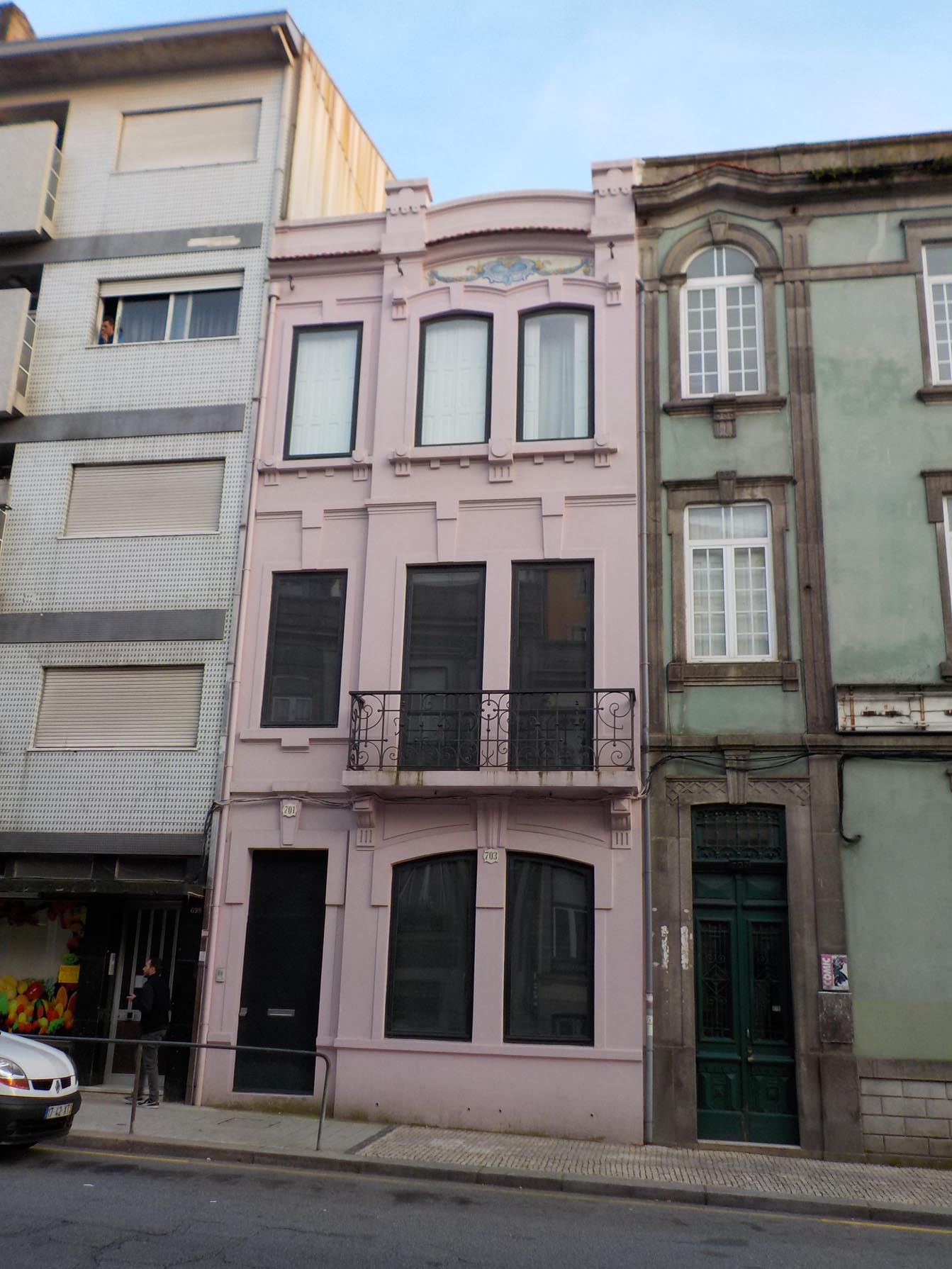
When older buildings are renovated the results can be very attractive, like the pink house below:Other houses persist as they are hemmed in by taller buildings:
I have nothing against large apartment buildings in general (well, not a lot), but in Portugal, new buildings generally ignore every possible reference to the architectural past, resulting in whitewashed boxes. If there are balconies, they are usually made of cement–they have no detail at all.
This slideshow requires JavaScript.
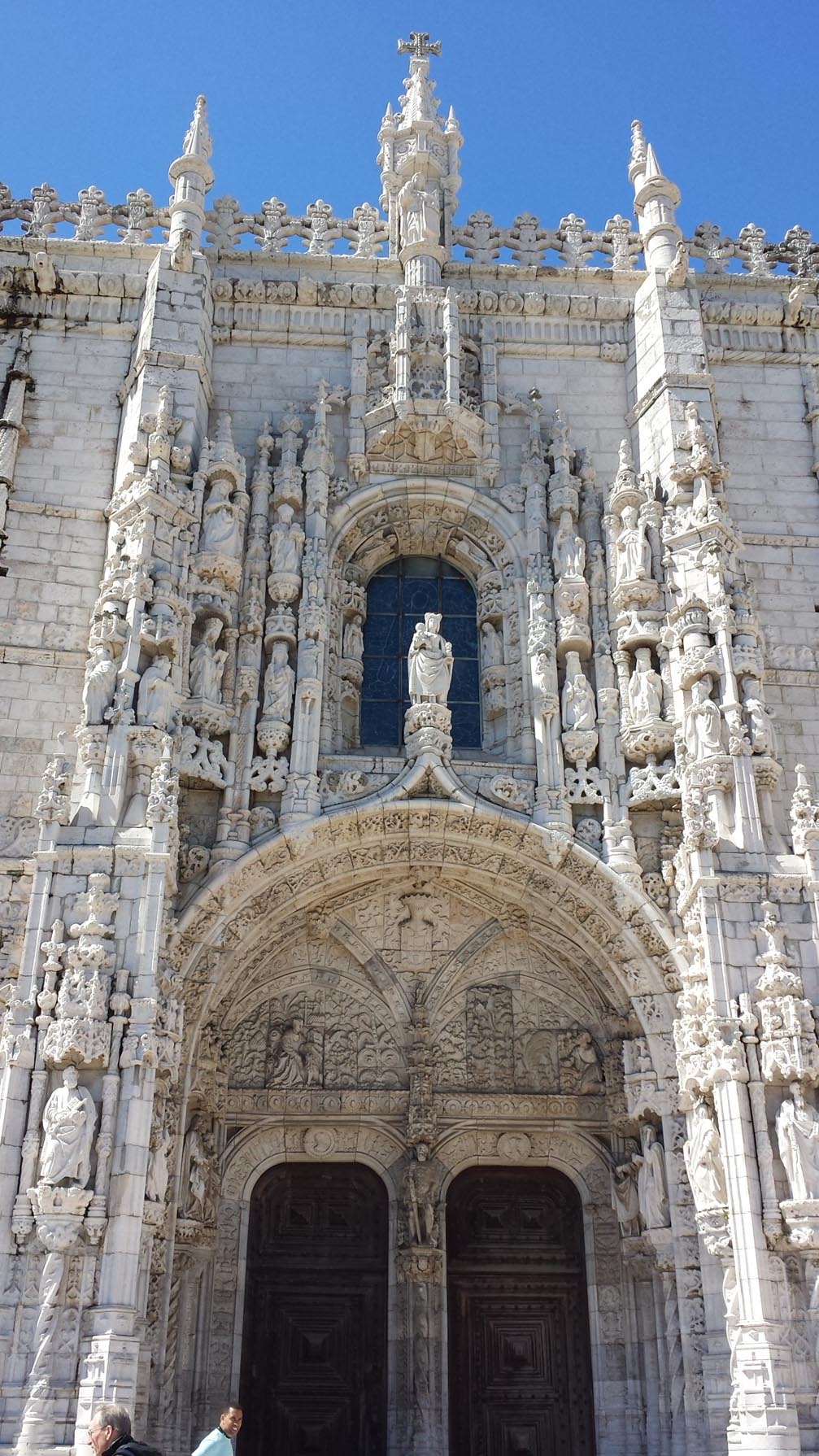
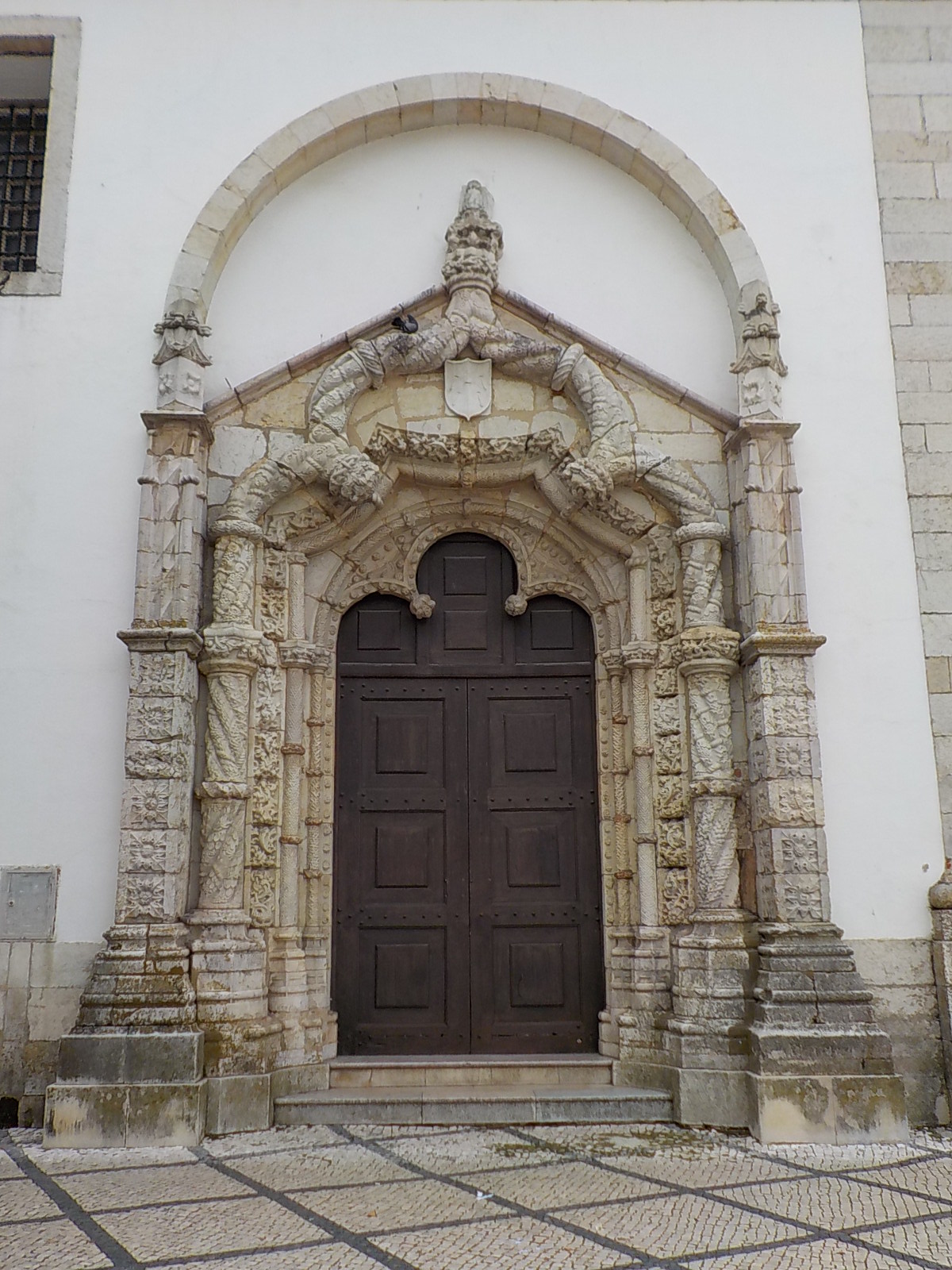
Why can’t new buildings in Portugal have any of the attractive features of older buildings? The tall piles of stacked featureless boxes come from the descendants of the creators of Manueline architectural style, possibly the most ornate in history. I don’t particularly want to live in a Baroque nightmare of twisting snakes and crowns. Here’s an all out example of a Manueline doorway. This probably wouldn’t work for every doorway…
 Beachcombing is not so simple in our area–most of the shore is rock. There are a variety of clams, whelks and we learned that little sand trails come from lugworms. (Amanda is our visiting marine biologist.) There is still a lot to look at when there is a sandy spot, and a surprising quantity of junk along the high tide line. Most of it probably washes in from boats, garbage escaping from the ferry, etc., but some is local. Originally, I said that the person who found a piece of narwhal tusk would be the beachcombing champion. After we arrived, I looked up narwhal and found they live in Canada and Greenland and are nowhere to be found in Norway. No narwhal for me. In any case, our first day walking along the rocky shore in Kjerstad, Jonathan took the prize for the entire Norway beachcombing season, by finding this:
 A blown glass float in its netting. I concede.