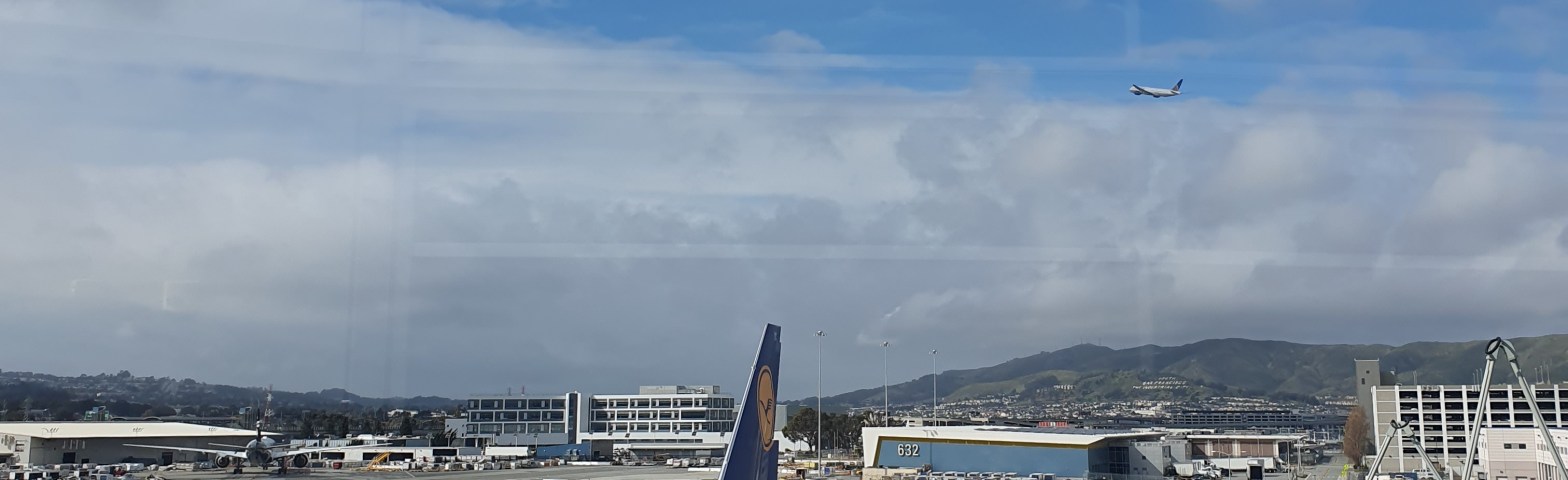
We arrived in Athens after as seamless a journey as possible. It’s a long way from Eureka, and we were glad to have made the hop from the Arcata-Eureka airport to San Francisco on the day before our flight. Our long leg went from San Francisco to Frankfurt, Germany, when I stopped looking at the time, as it didn’t seem to mean much. After whizzing through passport control in Frankfurt, we waited for about an hour and then boarded for Athens. Upon arrival, we collected our bags and walked through an unmanned Customs post. Welcome to Athens. Despite the smooth trip, it still took about 20 hours, from 2:40 pm in San Francisco to 4:30 pm the next day in Athens!
There is a taxi stand at the Eletherio Venizelos Airport, and we made our first minor error there. Always confirm the price before you put the first suitcase in the car! We were very tired, and happy to be on the last leg of our voyage, so we loaded up and got in and then pestered the driver about price. It’s a flat rate, and we’d already been advised not to chip in for tolls or suitcases or anything extra. Still, we paid 45 E rather than the 40 E we heard was the going rate. When I asked “When did the rate go up?” our driver chuckled. Still, we were in a cab on our way to our Airbnb, and it was worth almost anything to be done traveling. We counted ourselves lucky.
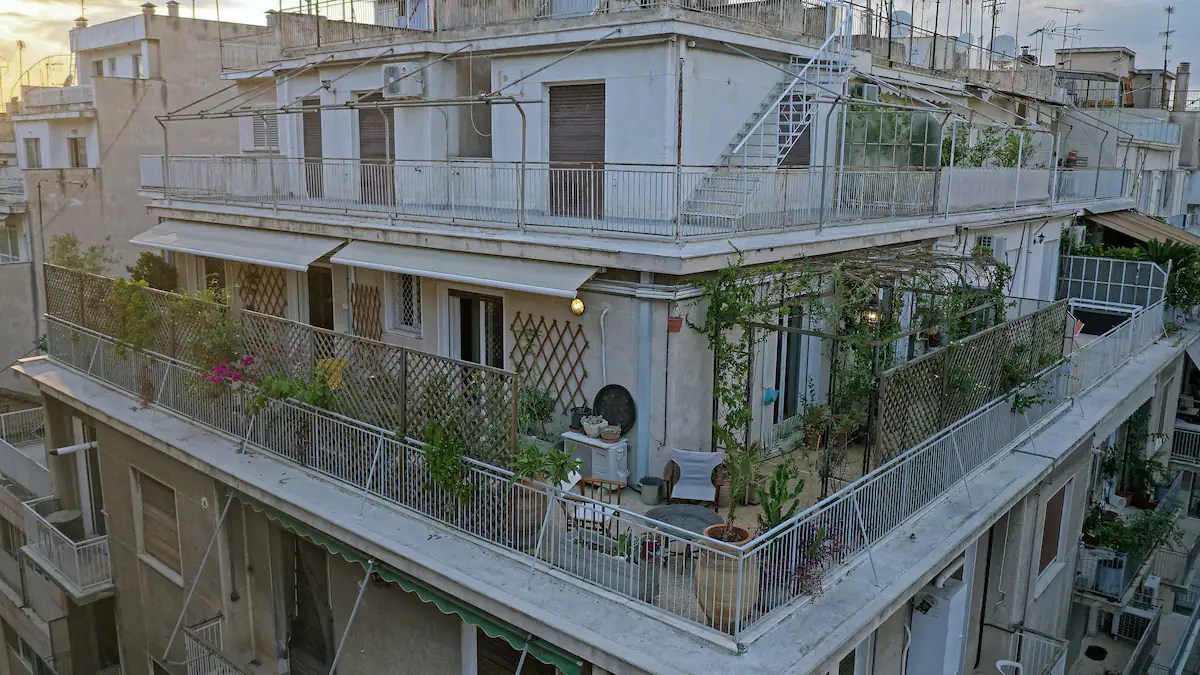
One of the difficult points of traveling from the US to Europe is getting communications set up at arrival. There is a moment when your new phone chip hasn’t been activated (or purchased!). If you use your US phone, the international plan has to appear on your phone and function. We decided to get Jonathan a data plan through our US provider, US Mobile, so we’d have a US number this month. I am getting a Greek SIM card, but I don’t have it yet. Arriving at our Airbnb, we had a familiar problem. We’d agreed to contact our host with WhatsApp, but Jonathan’s data plan didn’t seem to work yet. There we were on the doorstep of our building, with instructions to ring the 6th floor apartment, but there were four buzzers. Just as we were about to begin ringing all our neighbors in search of our host, the buzzer woke up and a voice said, “Hello?” It was our host, wondering whether we were arriving.
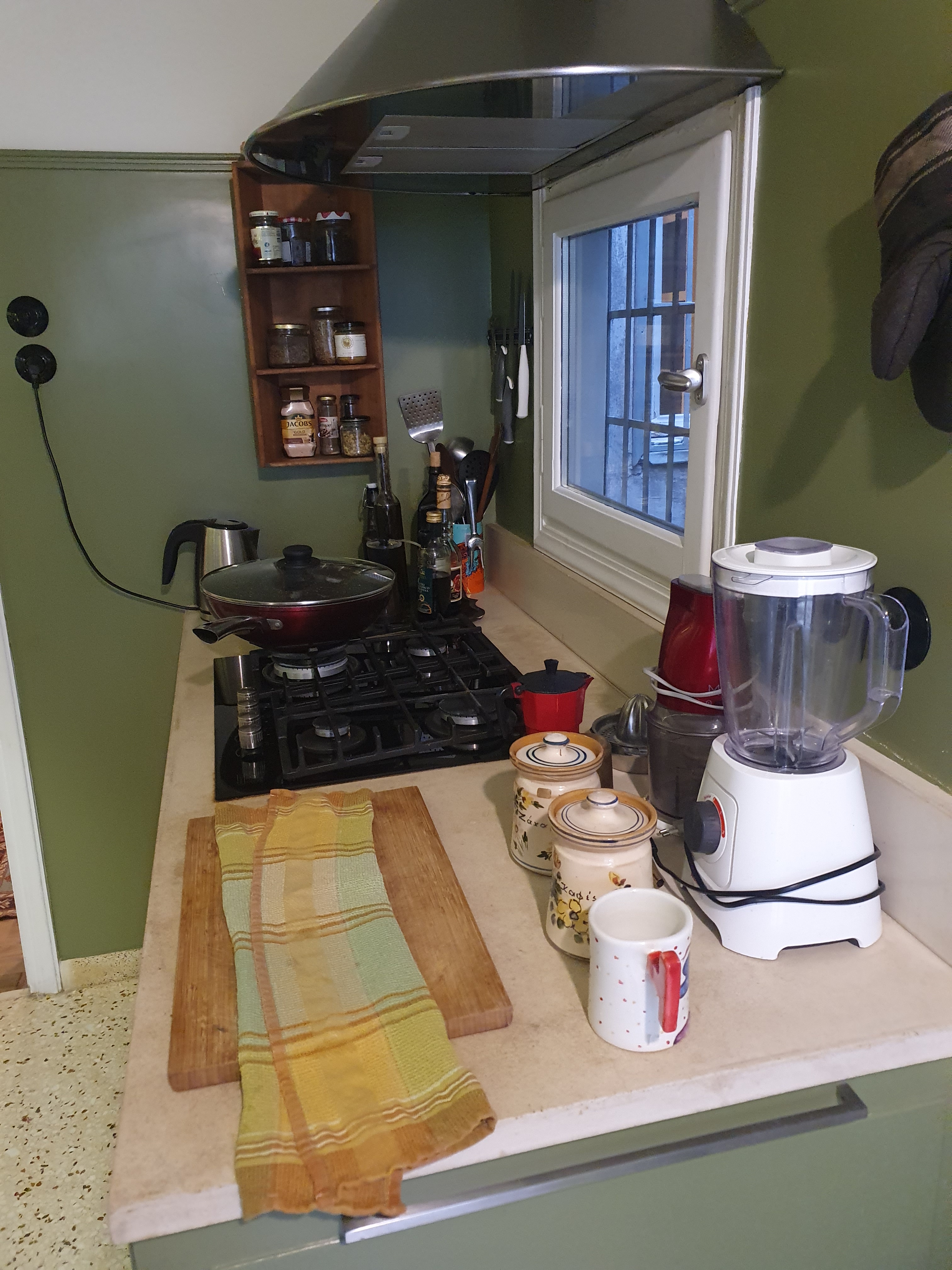
We rode the tiny elevator to the 6th floor. We got the grand tour, instructions on heat & AC, stove & oven, keys & doors, trash disposal, and shopping. We can always text our host questions now that we are logged in to the apartment’s wifi. All is well. We sat to decompress while I drank tea. We nibbled a few things and went to bed.
I woke up feeling much better, ready to take a shower, make coffee, and get the new day going. As I began to throw off the covers, Jonathan murmured, “You’re not getting up, are you? It’s 11 o’clock.” I’d only been asleep for two hours. I was startled, but after pondering the flexibility of time for a minute, I turned over and went back to sleep.
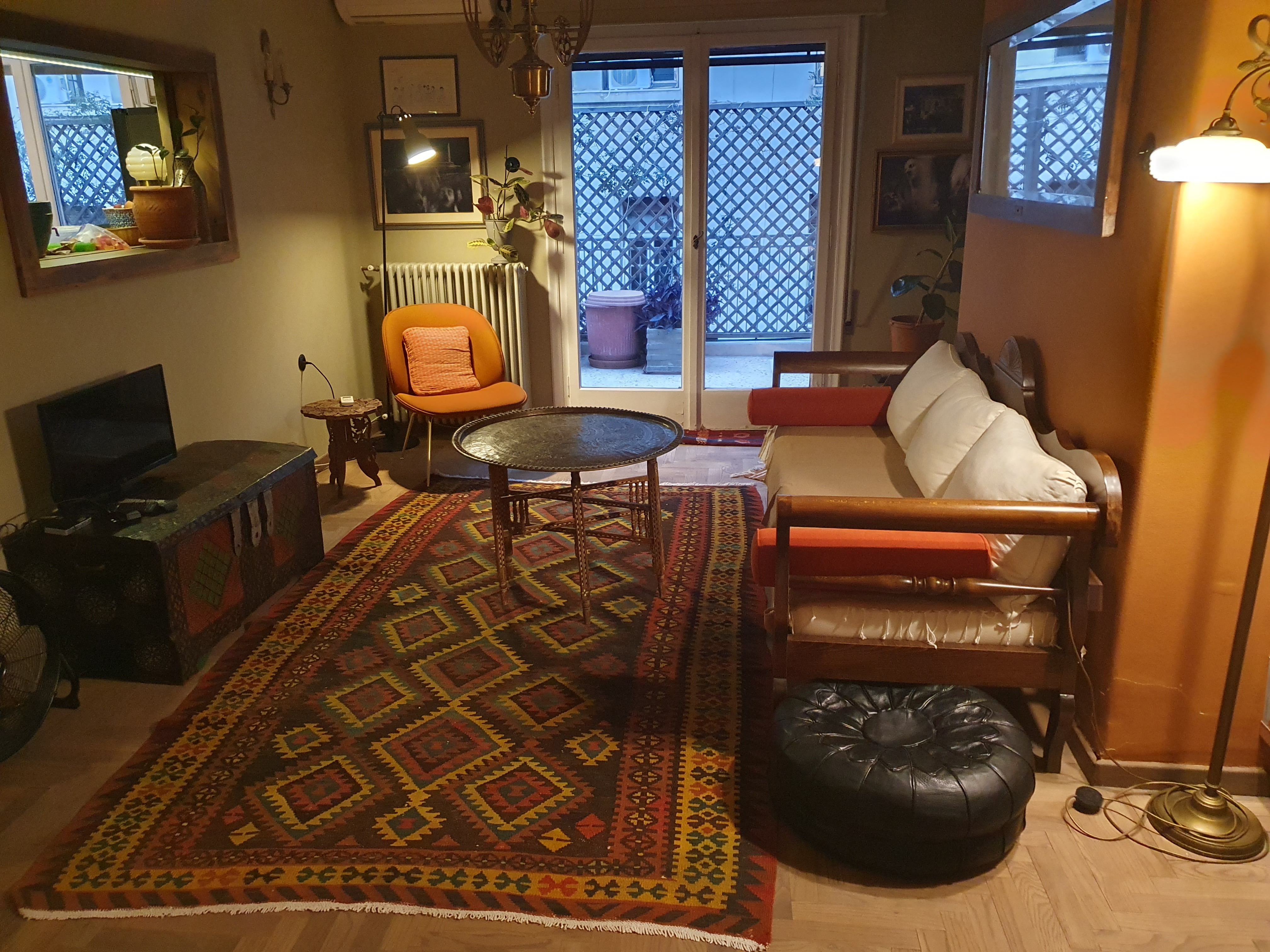
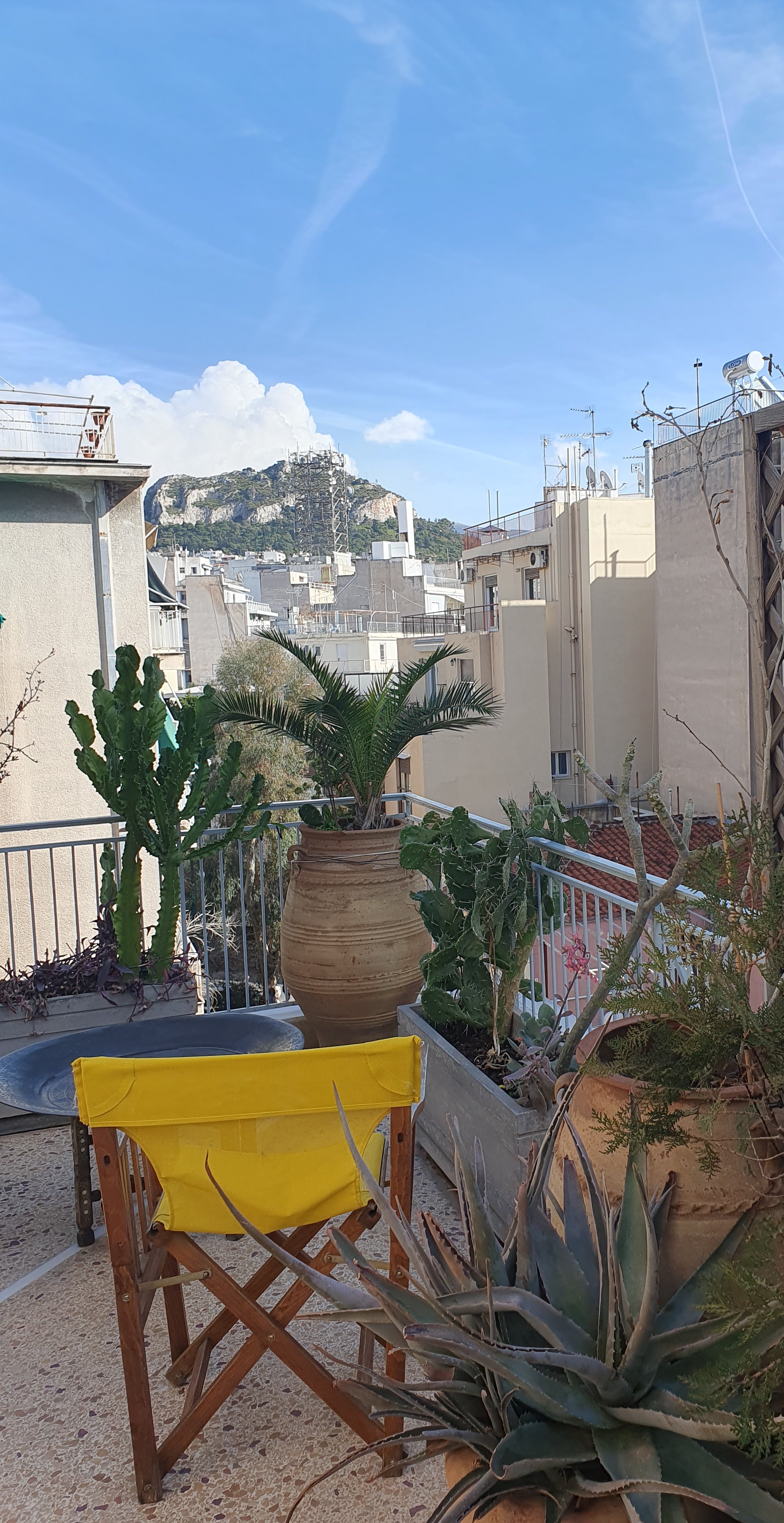
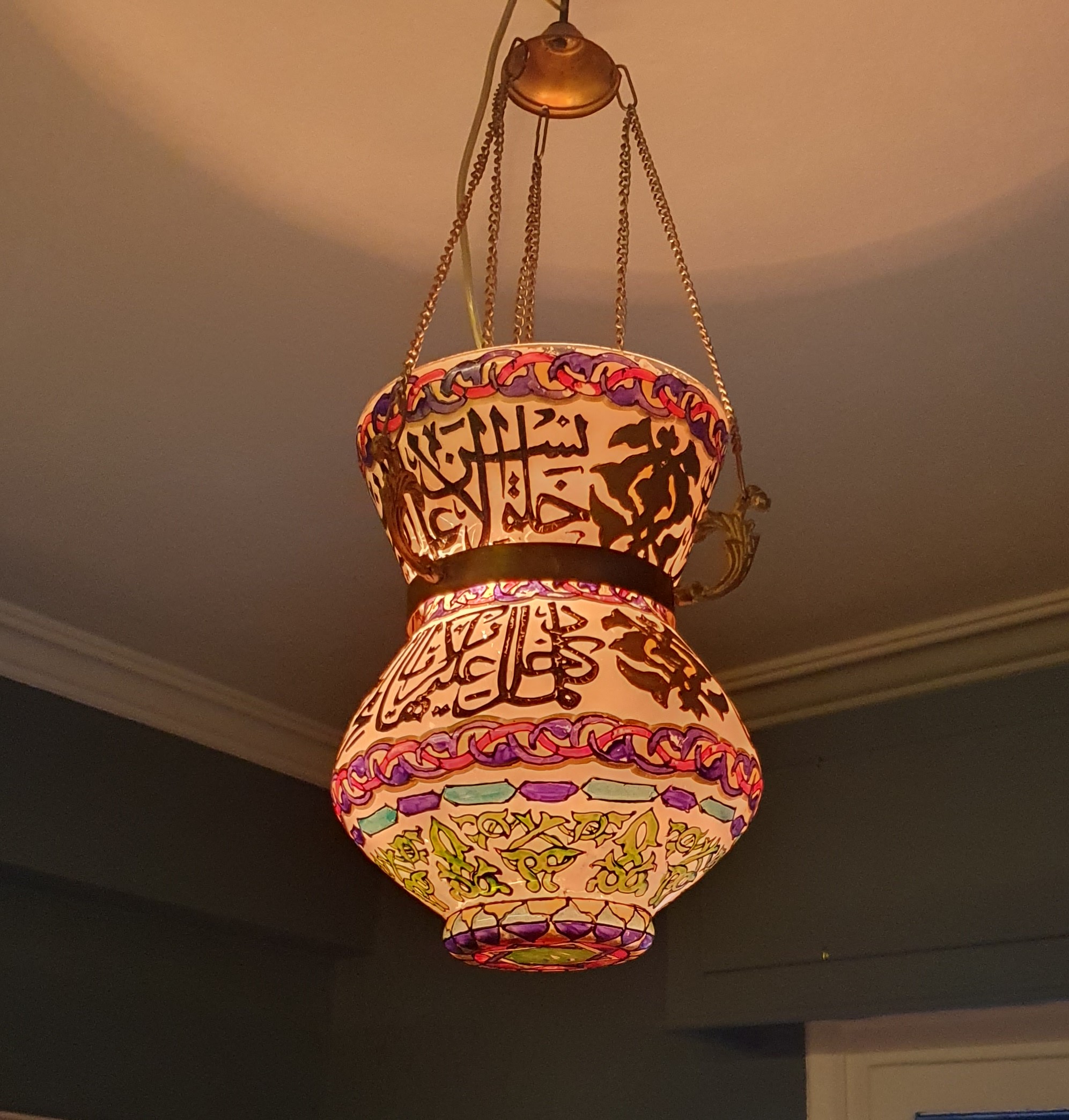
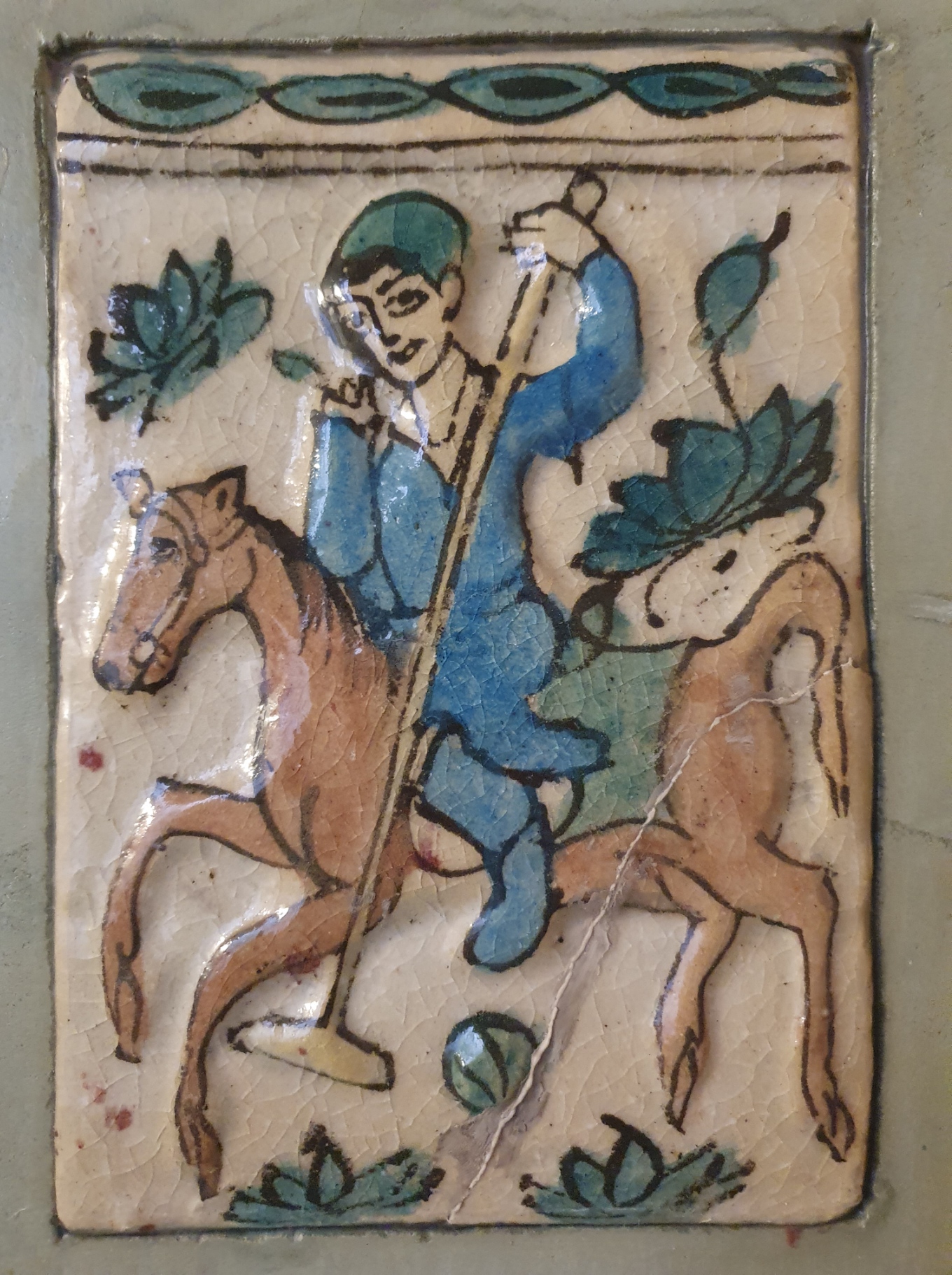
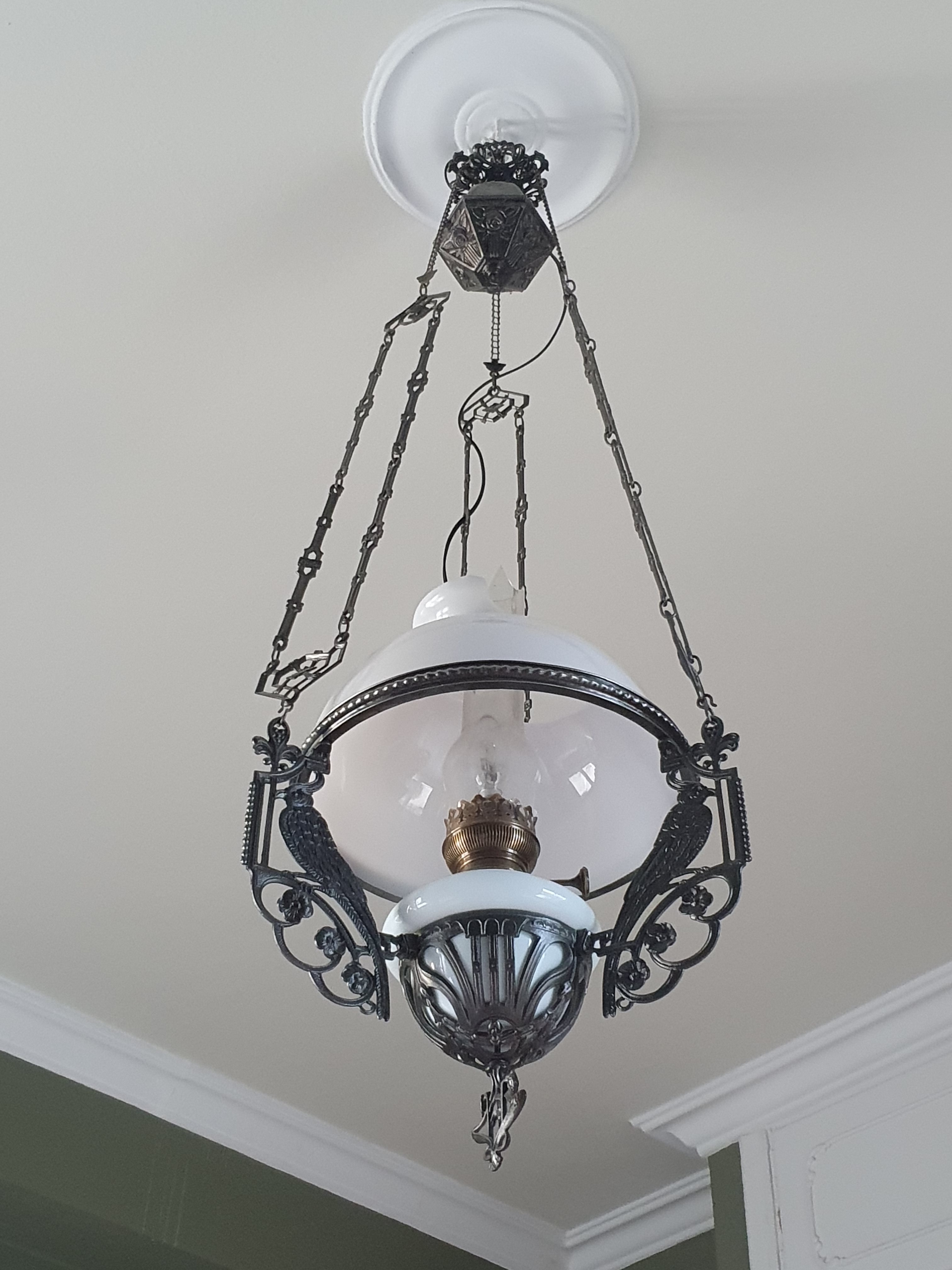
The next day, we set out to equip our new home with food before we fell asleep from jet lag. I began to notice our interesting decor from our host’s travels in Afghanistan, Iran, and North Africa. It is wonderful to have such lovely lamps and rugs and furniture around us. When you get a good Airbnb like this one, you get to experience a different environment–we’re borrowing this exotic setting for a while, and enjoying it very much.
I’ve been using Duolingo to learn a bit of Greek. It’s been fun to learn the letters and how to read the words. I am SO SLOW at reading, though, I don’t think I will be able to do more than say please, thank you, and where’s the bathroom.
I have learned a number of interesting words that are the same in English and in Greek, like “toast”, “avocado”, “coffee”, and “drama”. Who knows when they might come in handy?
On the bright side, friends who’ve been to Greece point out that most people there speak English, and it is not difficult to communicate. We have an Airbnb in Athens for the month of March and are looking forward to visiting the Parthenon and lots of other ruins. We plan to spend the final portion of our visit on an archaeological tour of the Peloponnese, visiting Sparta and other landmarks of ancient Greece.
Along the way, I expect to do some beachcombing. The shore of the Mediterranean has been home to human settlement for a very long time, and people have been losing things in it for that entire span. I hope to find some interesting beach glass.
Let me know if you have suggestions of what to see and do, especially in Athens!
Eureka is known for Humboldt Bay, yet the entrance to the huge, shallow bay was so narrow that it was not recognized by Spanish and Russian explorers sailing up and down the Pacific coast of North America in the era of European exploration.
Looking out to the Pacific over the channel that connects Humboldt Bay to the ocean.
The channel between land and sea was discovered by Josiah Gregg and companions, traveling from newly discovered gold fields inland, looking for a likely port. Between early November 1849 and Jan 1850, the explorers made their way on horseback from the mountains to the coast, emerging at what is now Trinidad. The group arrived on Humboldt Bay in December, after a difficult time making their way south along the coast, and there they identified the channel connecting the bay and the sea. Along the way, the explorers gave the rivers the names we use today (Little, Mad, Elk, Eel, Van Duzen). Eventually quarreling, half the group followed the Eel River to the east and home, while Gregg and the others continued south along the coast. Gregg’s group eventually turned back, but weakened by starvation, he died along the way. The surviving explorers shared the bay’s location, and the first American ship entered Humboldt bay just months later.
Since those early days, travel has followed waterways. The main highway into the area, Rte. 101, was completed in 1923. It follows the South Fork of the Eel River, just as the survivors of Josiah Gregg’s expedition did in 1850. It was a very long drive from San Francisco to Eureka until the Golden Gate Bridge was completed in 1937.
In the Eureka area, Myrtle Ave. and the Old Arcata Road run along the base of the hills at the edge of the coastal plain, for a good reason. Initially, all the level land around Humboldt Bay, from Arcata to Loleta, was tidal marsh. Rivers emptied into the ocean, but not until they’d looped back and forth across the low land at the edge of the bay, a mirage of land perched on the water.
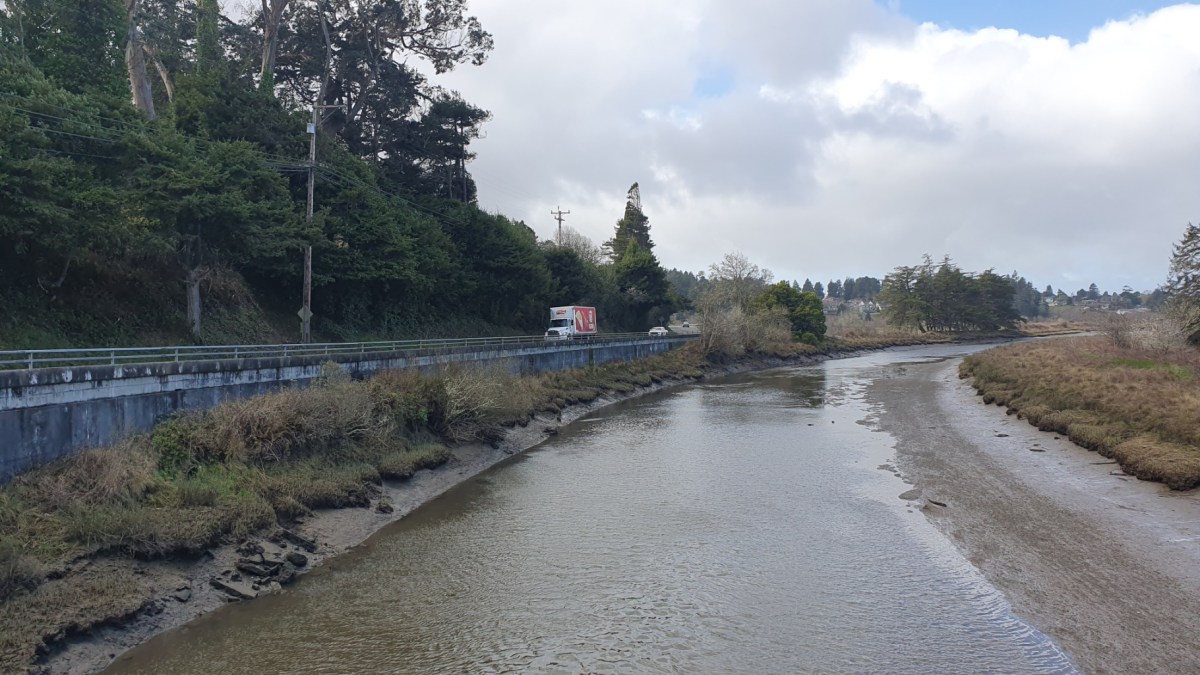
Myrtle Ave., sandwiched between a creek and the foothills.
Nothing was solid, yet an attraction of Humboldt Bay was the open land around it. First settled as a port for gold miners, and then the lumber industry, businesses needed docks, wharves, and warehouses. Land was created by dredging and filling in the marshy shore, turning the watery plain into dry land.
Cattle grazing on drained and filled pasture, formerly coastal wetland. Myrtle Ave. runs along the back of the field at the base of the hills.
The isolation of the region from the rest of the country, and the cost of importing food by ship, fostered both cattle ranching and farming. Many people who moved west during the gold rush found a better life farming or ranching than working in mines. Almost all the level land around the bay was drained and dry by the mid-20th century. As access to the area increased, more and more drained land was used for housing rather than fields and pastures.
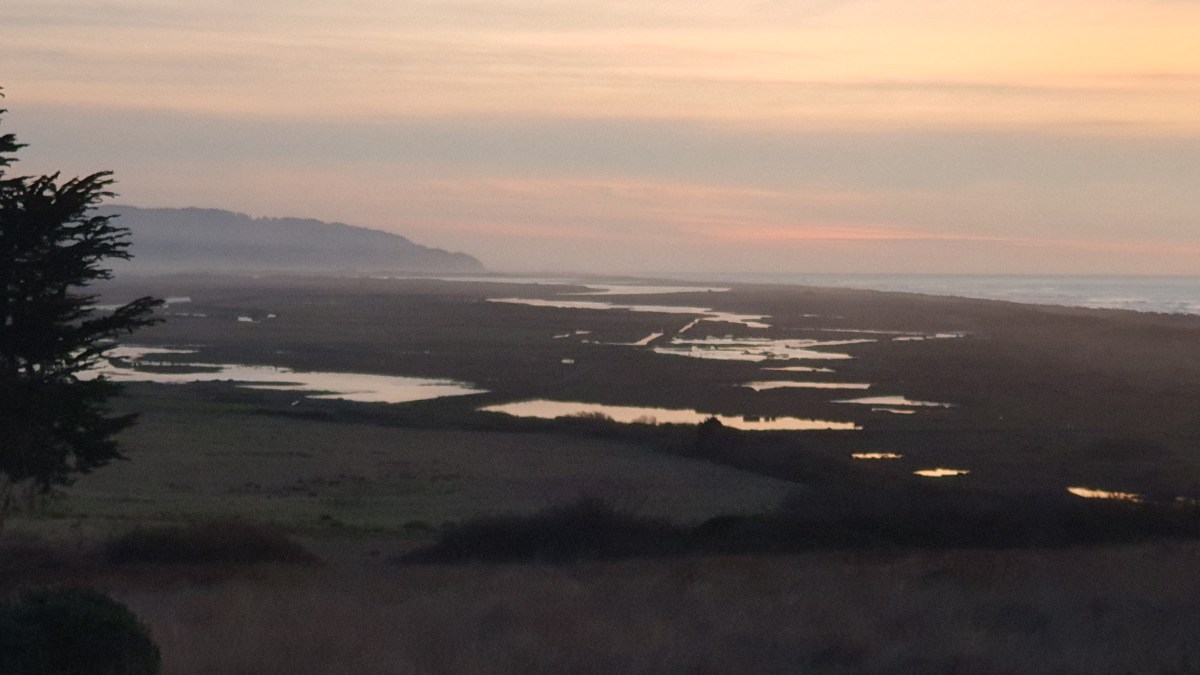
Climate change is also making people rethink the boundary between land and water. After many years of drought or near-drought, winter 2022-2023 brought heavy rain, and though all that rain heads to the ocean, it doesn’t get there right away. Any remnant of low-lying land becomes a shallow pool, harking back to the pre-European swampy channels that made up the coastal margin.
Herrick Rd. pasture now returned to tidal marsh.
County planners are working to convince farmers and ranchers that more draining will not fix a problem that has no solution, but change proceeds slowly. In 2022, a parcel of about 95 acres of cattle pasture adjacent to the coast was given to the county. The animals were moved, and heavy machinery carved channels along low spots. Two culverts through the old railroad embankment reconnected the ocean with the channels. We happened to go for a walk in this area the week before the transformation began, and we’ve been amazed by the rapid change from cattle pasture to tidal flats. We’ve driven by recently when the entire area looked like a lake, though when the tide is out, the area has large grassy hillocks. Shore birds congregate in the shallow water. This is not the only place where the conversion of pasture and farmland back to tidal marsh has taken place, though this is one where the change is intentional. Patches of land around the bay have been converted as one group or another converts drained land back into marsh, the wave of the future.
As more rain falls, and as sea level rises, watery change will affect more land, whether it is prepared to become tidal basin or not. Hwy 101 turns north directly across marshland between Eureka to Arcata, and now the road occasionally floods. Myrtle Avenue and the Old Arcata Road, long ago superseded by Hwy 101, may become important all over again, as everything between the hills and the ocean may one day be reclaimed by the sea.
The sun, moon, and earth are aligned only at the new moon or the full moon. When this happens in combination with the earth’s closest approach to the sun (winter) the gravitational effects of all these bodies are combined and produce king tides. The high tide is above normal levels, and the low tide as low as it gets. This year there are two king tides in California, December and January.
We made plans to go to Mendocino during the January king tide to do some beachcombing. We love Mendocino and were happy to have a reason to visit. Our plan was to drive down on Friday, stop to walk on the beach before low tide in the late afternoon, then continue on to our B&B. The next day we’d return to the beach in the afternoon, because by low tide at 5:45 pm, the sun would be down and the sky losing light. It’s difficult to beachcomb in the dark. Some London mudlarks use headlamps and go out in the dark, but it’s not for me.
We drove south from Eureka, watching the mist rise from pockets in the hills. In Ft. Bragg we had lunch at Mayan Fusion, cochinito pibil, Mayan roast pork, served shredded with black beans and home-made corn tortillas and spicy salsa. I haven’t had home-made tortillas in ages, and they are so much better than anything you can buy at the store. It was the perfect lunch.
We were ready for beach combing and headed to the parking lot at Glass Beach then walked south. We could see people collecting beach glass all along the shore, but there are no stairs to the beach (about 50 ft below), and we had to find a place we could manage the climb down.
Though the tourist site is Glass Beach, there is a lot of beach glass along the rocky shore. The extra low king tide made it possible to see a bit more of the beach than usual. I focused on finding nicely frosted and fully rounded pieces of glass that can be used in my jewelry projects. Jonathan did the same. He has a mesh scoop on the end of an adjustable stick that lets him pick things up without having to bend. At the end our our outing, I’m sure I was more sore from crouching down and leaning over to pick pieces up than he was from scooping.
We left the beach around sunset and went to our hotel. For a short stay like this one, we didn’t get an Airbnb, but stayed at the Seagull Inn Bed and Breakfast. It’s right in Mendocino, which is a tiny town, and that meant we could walk everywhere. We emptied out our pockets and looked at our finds.
We went to dinner at Luna Trattoria, just around the corner, and had a delicious appetizer of polenta and mushrooms. We each had pasta as our main dish, mine with clams and Jonathan’s with sausage. The service was slow, but the food was good. We ended by sharing a tiramisu, a very good example of the genre.
On our short walk home, we realized that Mendocino has very few street lights and the sky was darker than we’ve seen in quite a while. The night was cold and clear and the sky was breathtaking, bright constellations everywhere, and thousands of stars. Orion was high in the sky, and we could see its stars clearly, down to the knife hanging from Orion’s belt. We stood and stared, enjoying the stars in the dark heavens.
Saturday morning after breakfast, fresh fruit yogurt parfait with home made granola, and excellent coffee, roasted in (relatively) nearby Santa Rosa, we went down to the local beach at Big River, on the south side of Mendocino. There’s a lot of driftwood on this broad beach at the river mouth. Back up the stairs, we walked a section of the shore to watch the waves. It was a sunny, clear day, absolutely beautiful. We stopped for lunch at Flow. It took a while to get seated, but the food was excellent and the service was good. I had a fried green tomato salad with a soft boiled egg on top. Jonathan had Korean tacos. It set us up for the afternoon of beachcombing.
We got back to the beach in Ft. Bragg after 3 pm, and walked a bit further south than the previous day. There was a broader range of colors in this section, but the pieces were quite small. We picked up less than on the previous day, though I now have a good quantity of material for making jewelry.
Once again, there were people collecting glass in every nook and cranny of the beach. We made our way down the steep slope, and stopped to talk to a mother and daughter who were about to leave. They live near the beach and come down to beach comb regularly. They didn’t seem to have any objection to people collecting, as that was something they enjoy themselves.
There is controversy over whether people should collect beach glass from the area around Glass Beach. We chatted with a man who calls himself Retired Ranger Rick. He answers questions about the glass deposit that has made Ft. Bragg famous, and answered one long-standing question of ours. Why aren’t there more places like Glass Beach, with a thick layer of waterworn glass? People say Glass Beach is where the city dump used to be, right along the beach, but other places had similar dumps, yet there are only one or two other “glass beaches” in the entire world.
It turns out there was a bottling plant in Ft. Bragg in the early 20th century that went out of business in the 1940s. Everything left at the plant was dumped on the shore, in the city dump of the time. Ranger Rick said that at one point the pile was about eight feet thick. Ft. Bragg’s dump had much more glass piled into in than the average landfill, especially now that a lot of glass is recycled and doesn’t get as far as landfills.
I did a little bit of reading, and the California law that protects coastal access makes it virtually impossible to prohibit glass collecting along the tide line. Anything below the mean high water mark is public land. Access cannot be prohibited, and it would be very difficult to keep people from picking up glass. There is a sign that asks people to leave the glass on Glass Beach, and to ask others to do the same. The steps to the beach have been removed since our last visit, probably to deter visitors. There are still many people who visit the beach to collect glass every day. During the summer months, there can be over 1,000 visitors to Glass Beach each day. No wonder the deposit has thinned out.
We emerged on the bluffs just after sunset and were startled by the beauty of the sun’s afterglow. We had a complete 360o view of the horizon and the sky changed color all the way around, from lavender, pink, and pale blue in the northeast, through pale blue, streaks of yellow and orange by the setting sun and more golden and peach colors over the ocean. We rarely see the entire sky lit up all around us so impressively. By the time we actually left, it was cold out and I insisted on stopping for a cup of tea to warm up–it really hit the spot.
Dinner our second evening in Mendocino was at Trillium, another short walk from the Seagull Inn. The food was delicious. I had shrimp and risotto, while Jonathan had short ribs. We have different tastes in wine. Our dessert was toasted chocolate babka with coffee ice cream. It was the most interesting thing on the menu, and I was curious after having made a chocolate babka a few months ago. It was unusual and delicious. As we ate our dinner, we struck up a conversation with the couple next to us who live in Santa Rosa and had suggestions about restaurants to try when we are there on one of our monthly visits.
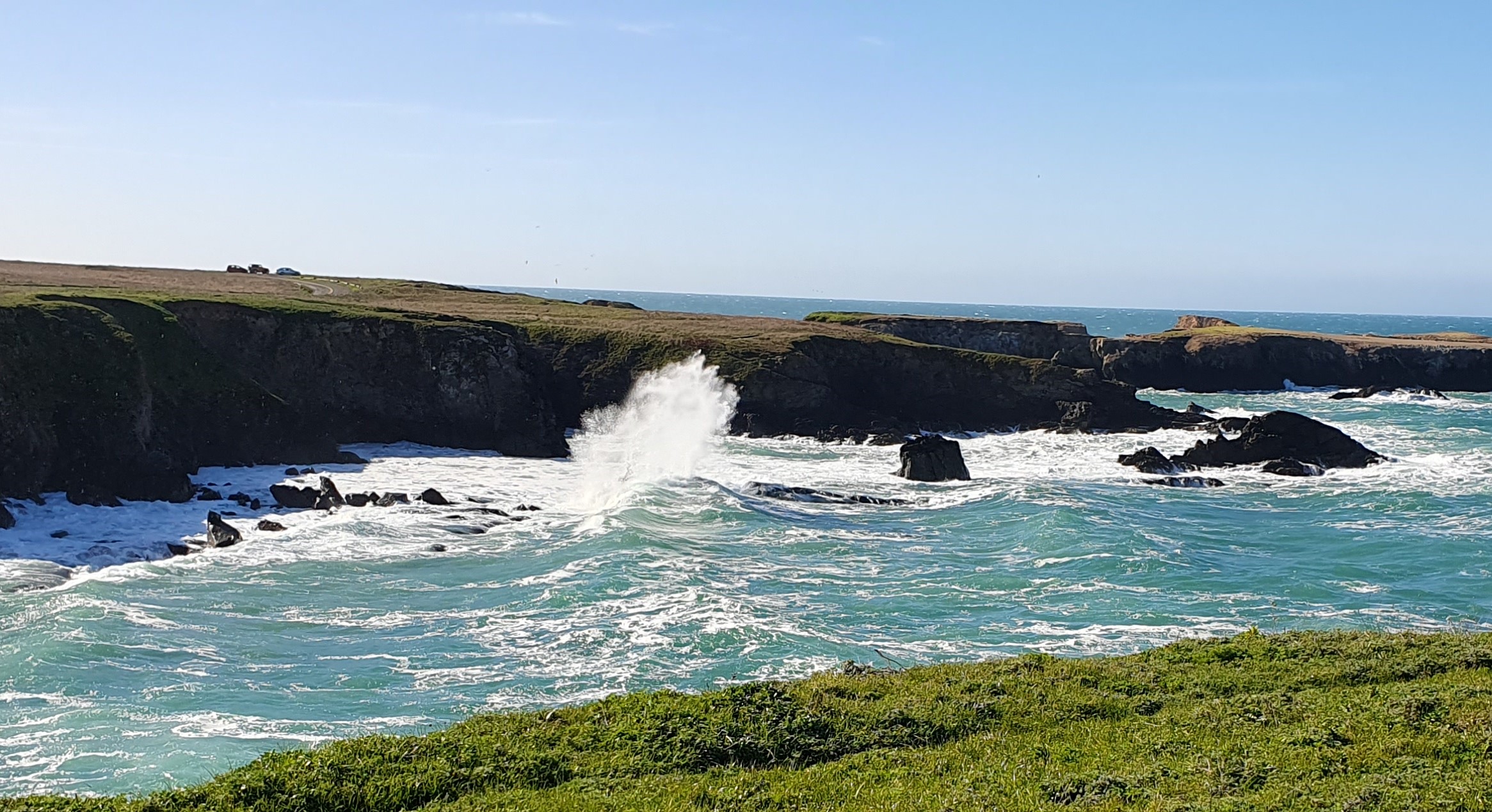
Rough waters off Mendocino Headlands
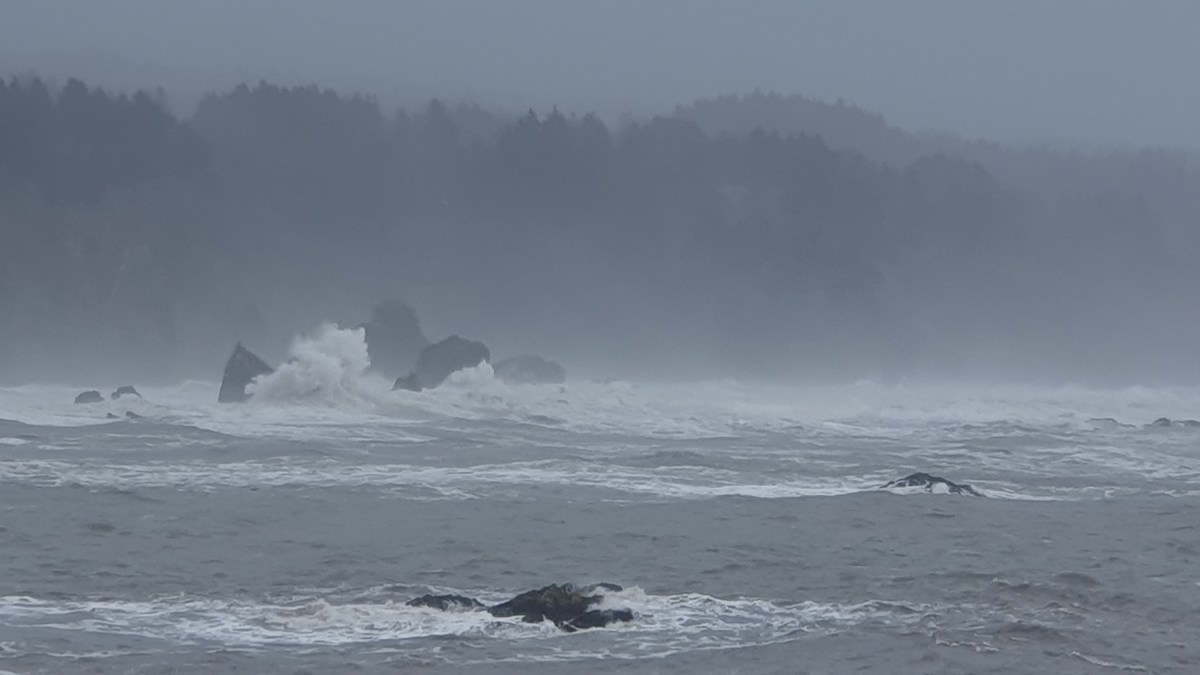
Sunday morning, we were served crustless quiche, and bread from the local Cafe Beaujolais with more good coffee. We didn’t plan on any more beach combing, as low tide would be after dark. We walked the Mendocino Headlands trail around the west and north sides of town. It was bright and sunny, but cold and windy. We were glad to have our layers. We stopped at several places to watch the ocean. An occasional whale spouted, but there were so many whitecaps it was difficult to spot them. The surf was very rough, making the water among the inlets and sea stacks boil with white foam. We were happy to be on the bluff safely above the ocean. At the far end of our walk we stopped on a point where the breaking waves below us showered us with mist. When the sun caught the mist, rainbows flashed in midair. It was a beautiful end to our walk.
From the headlands, we stopped at the Mendocino Art Center to look at the current exhibit. There are a lot of talented people in this area, and we enjoyed looking at the painting, sculpture, ceramics, glass, and jewelry.
It was time to head home to Eureka, so we turned north to Ft. Bragg, making a stop at Cow Licks Ice Cream. They make a wide range of flavors, and I had to try some. I think every flavor is delicious, though I have no plans to try their mushroom ice cream.
We made good time getting home, only waiting at one spot on Highway 101 that is partially blocked while a serious landslide gets fixed. We could see the big crack in the hillside where the land slipped.
I’d forgotten to take my UV flashlight with me to Mendocino to examine all my glass to see whether any was fluorescent. Back at home, I found a few fluorescent pieces in different colors. The yellow comes from uranium, but the red-orange color was new to me. I believe it is from manganese in the glass. I’m keeping all my fluorescent pieces separate until I have enough to make a fluorescent necklace. (And no, the pieces don’t give off a harmful level of radiation.)
Now that we’re home, I already miss Mendocino, the rocky coast, beautiful walks, stars at night, and the beach combing. Maybe we’ll visit again next winter.
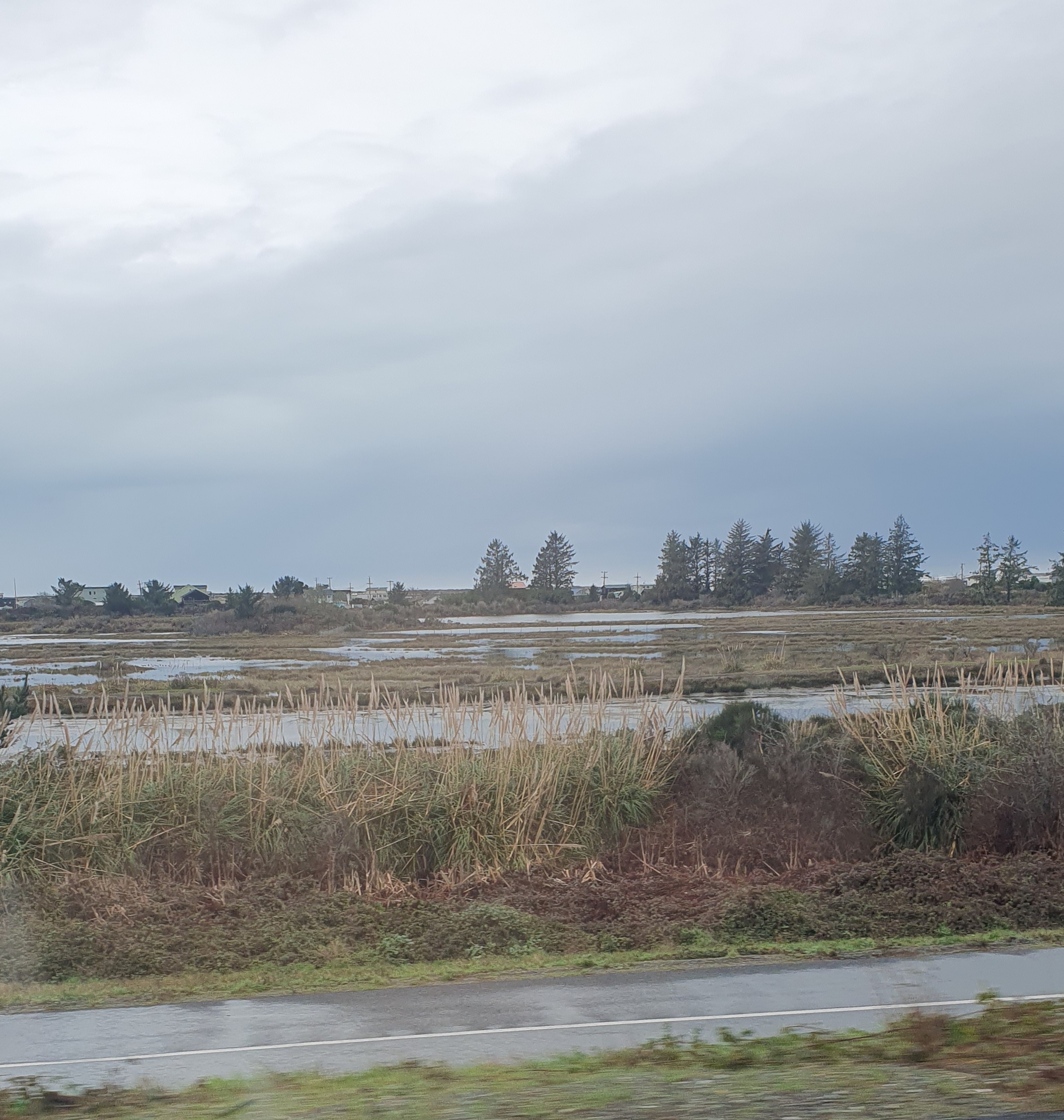
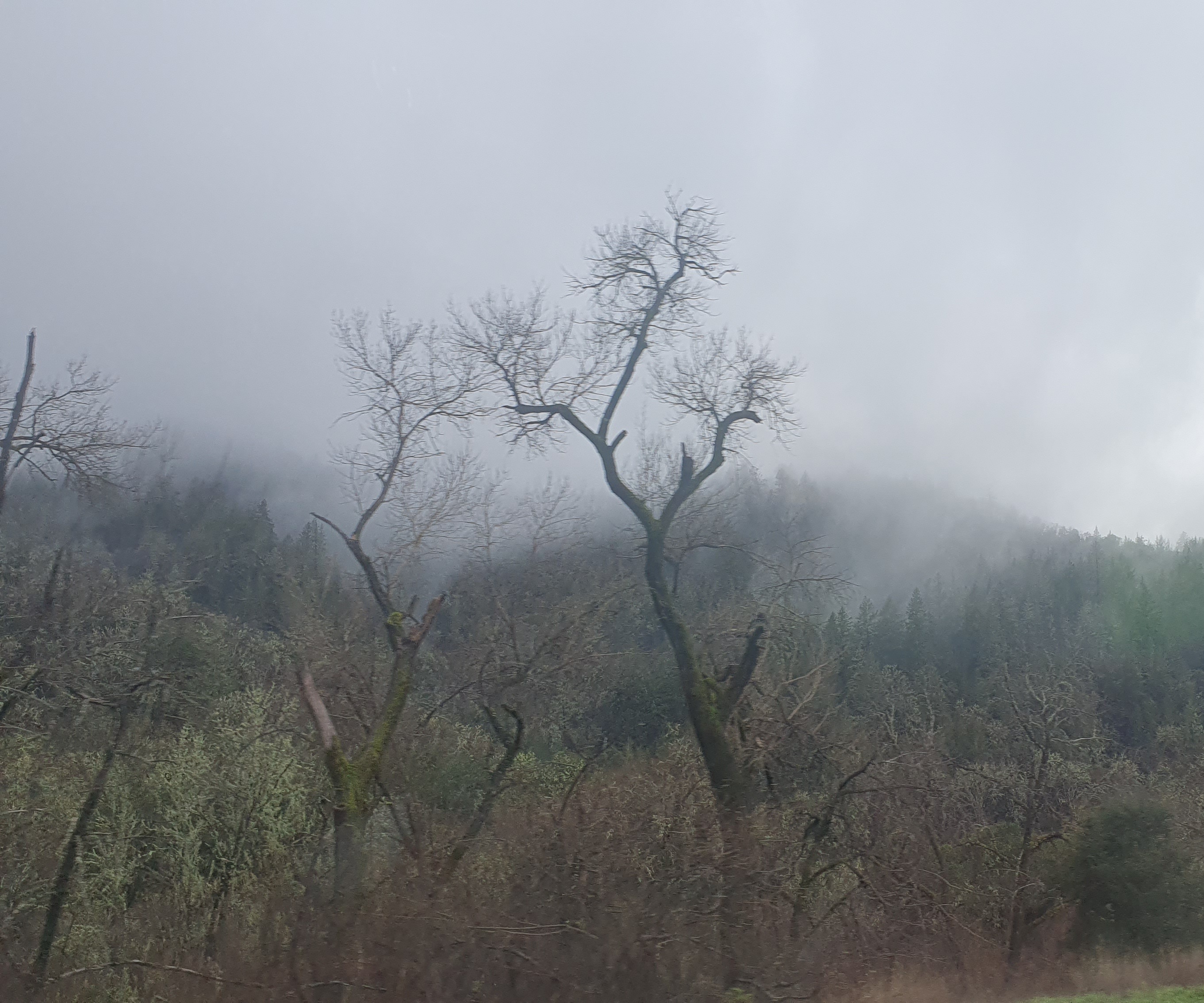
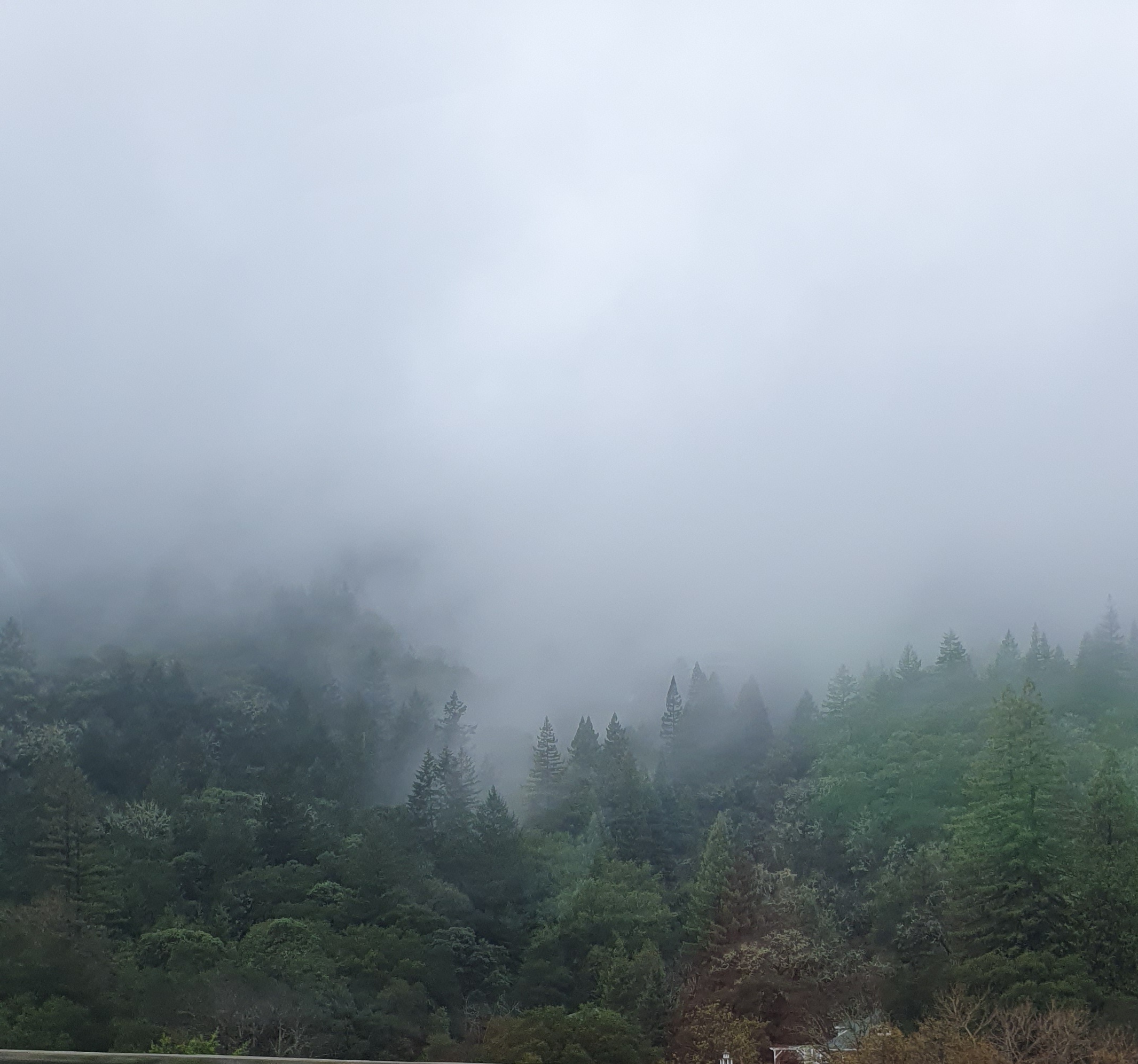
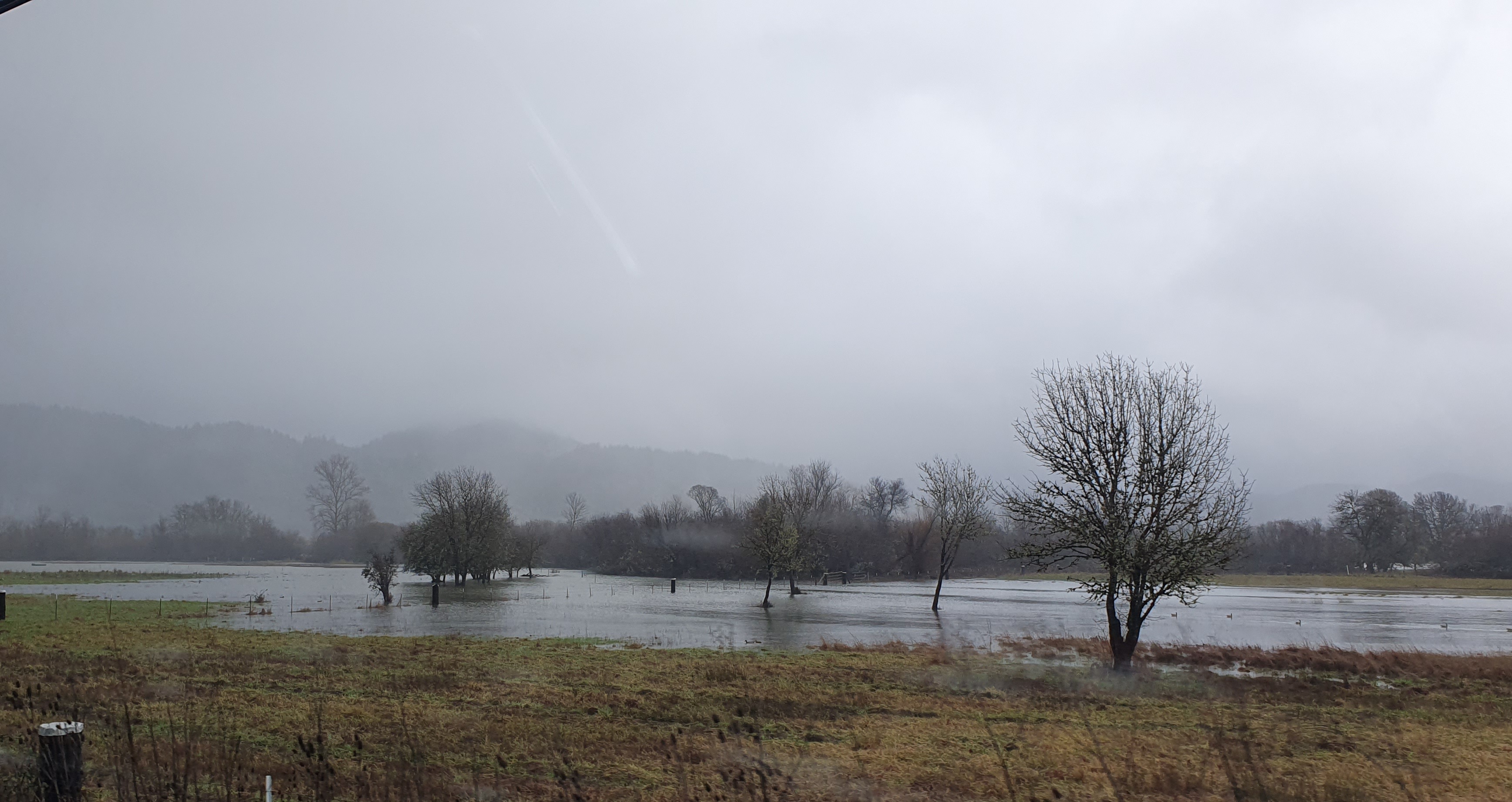
I wouldn’t have driven all the way to Santa Rosa from Eureka (150+ miles) without a good reason. My doctor’s appointment could not be put off, and Jonathan did most of the driving. I took advantage to stare out the window at the mist and rain and take a lot of photos.
We did not have to detour around flooded roadways, and our route was not blocked by mudslides, though we passed places where cones blocked one lane while crews cut up fallen trees. Highway crews were out in their raingear, moving from one incident to the next. On the 101, they stayed ahead of disaster, and we were not held up at all. We drove a bit more slowly than usual to cope with the rain and water running off the roadway, but the trip was as easy as possible considering it rained most of the time.
Along the Russian River
Our trip back began around 10 am the next day as rain pelted down. We drove north out of Healdsburg past the Russian River, where the water was very high, only a couple of feet below the road, but not yet near enough to be threatening. We stopped at the Jaxon Keys Winery and I took a photo of the sodden fields.
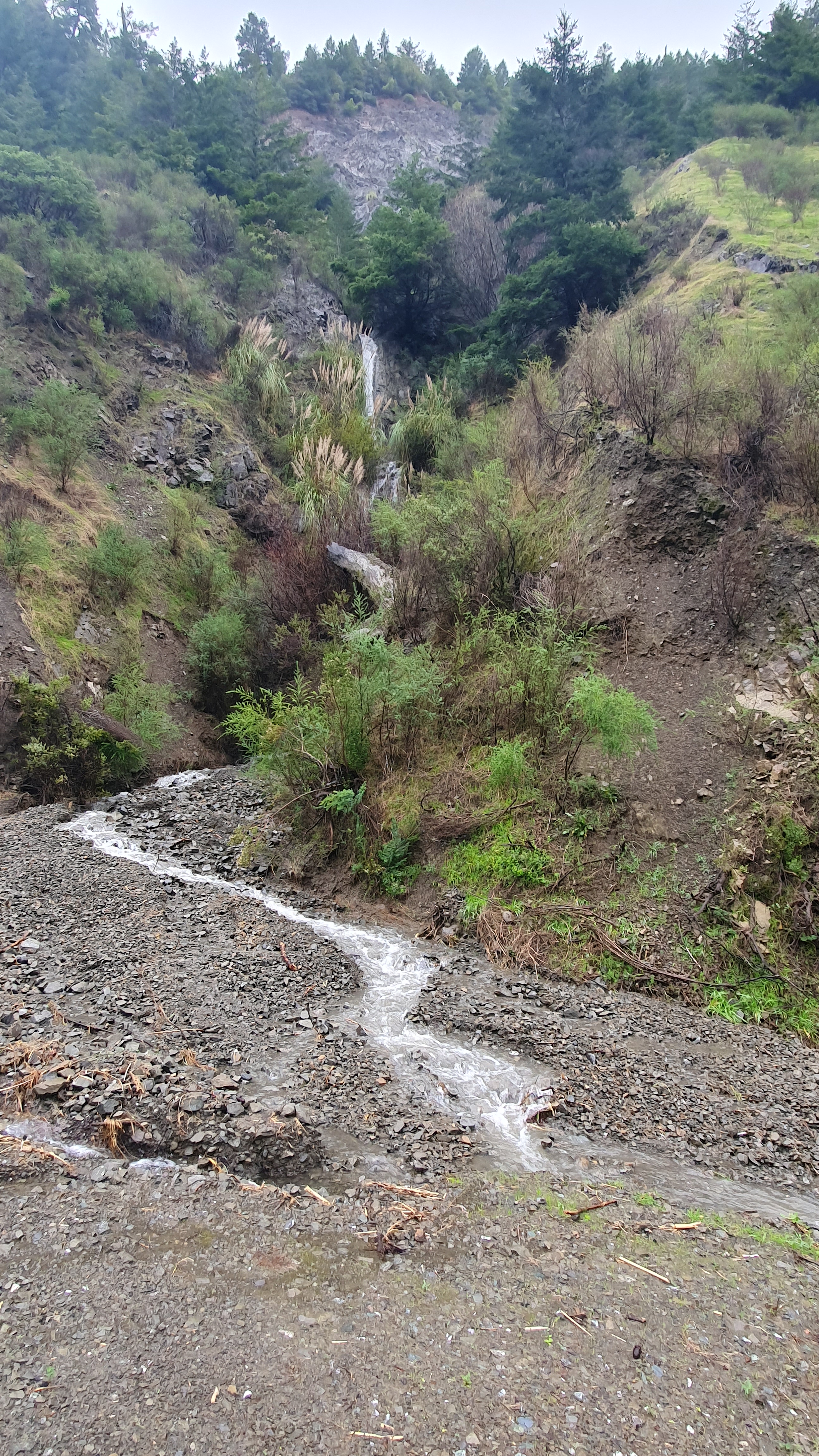
Something about the wind and the mountains results in more rainfall between Santa Rosa and the middle of our journey around Willets. The second half of the journey took us along the south fork of the Eel River, and as the highway approached the river and veered away, we could see tiny waterfalls, rushing streams, and the growing span of the river as its course widens over the descent to sea level on the coast.
January first the new year comes in whether or not we’re ready. We’ve been out walking most days, as the weather forecast is for strong winds and heavy rain later this week. It’s been cold for this region, low 50s, high 40s during the day and occasional frost at night. This is nothing compared to the annual week or so of -10 we usually planned on in Chicago, so we add another layer and go out.
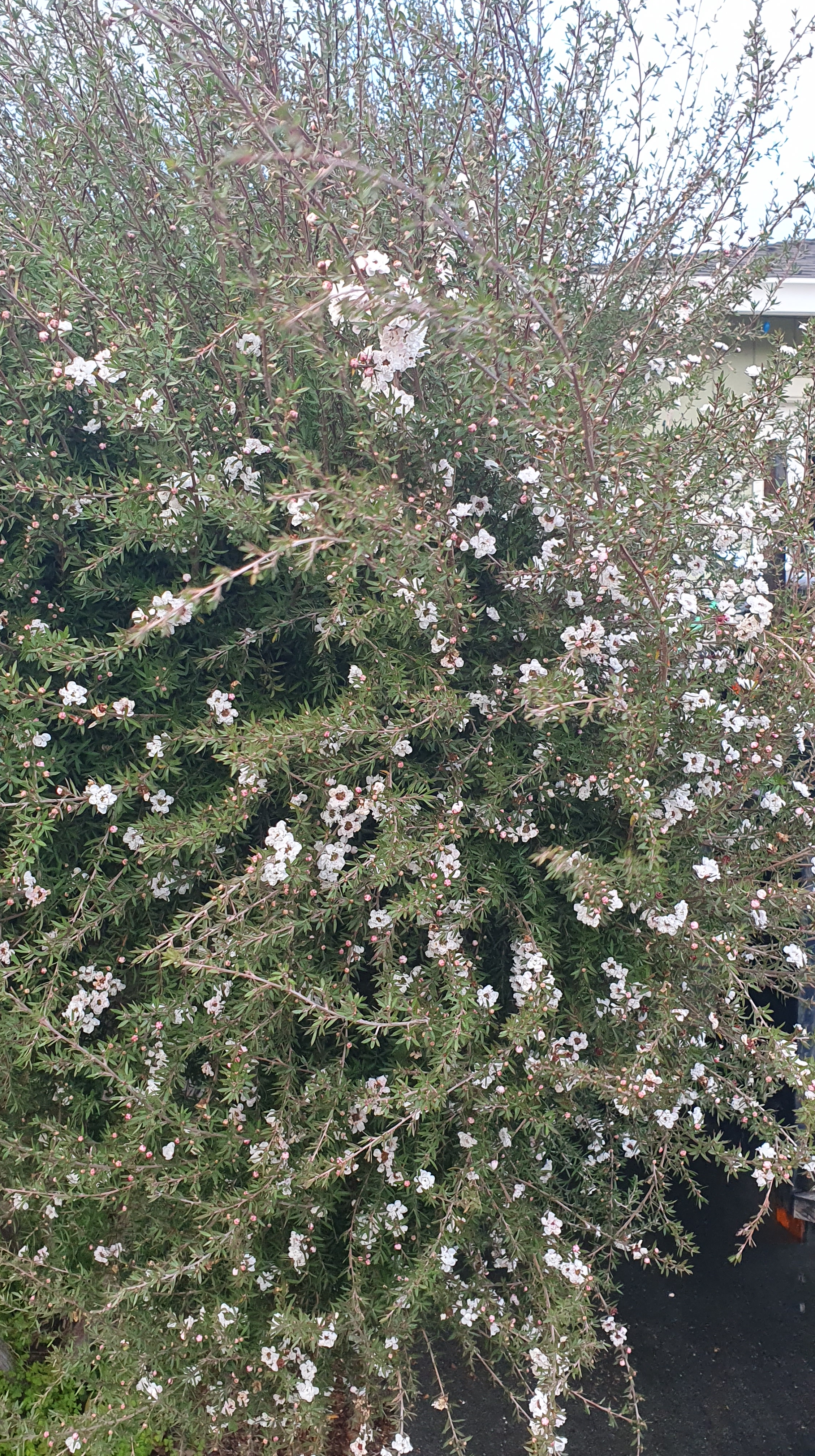
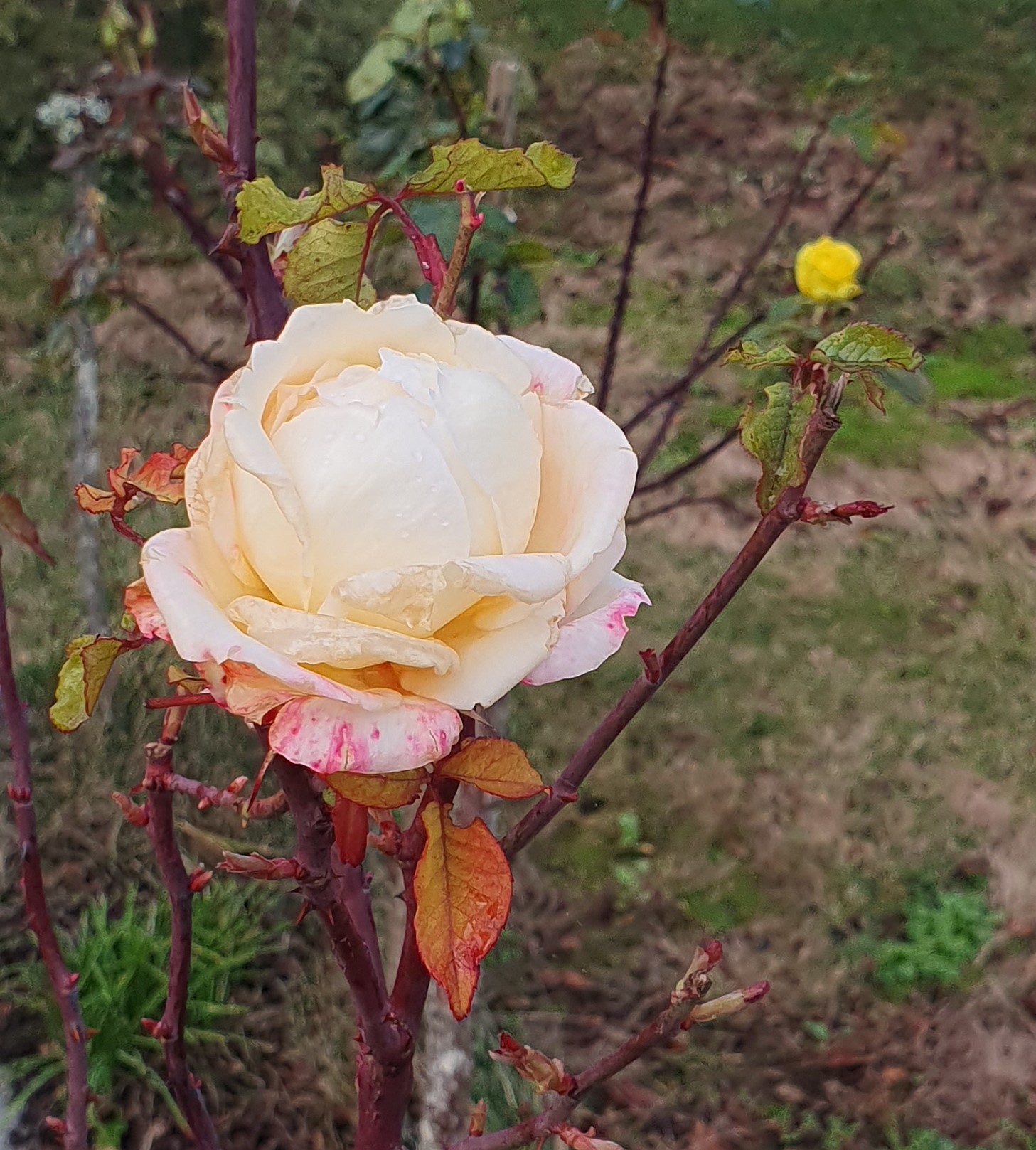
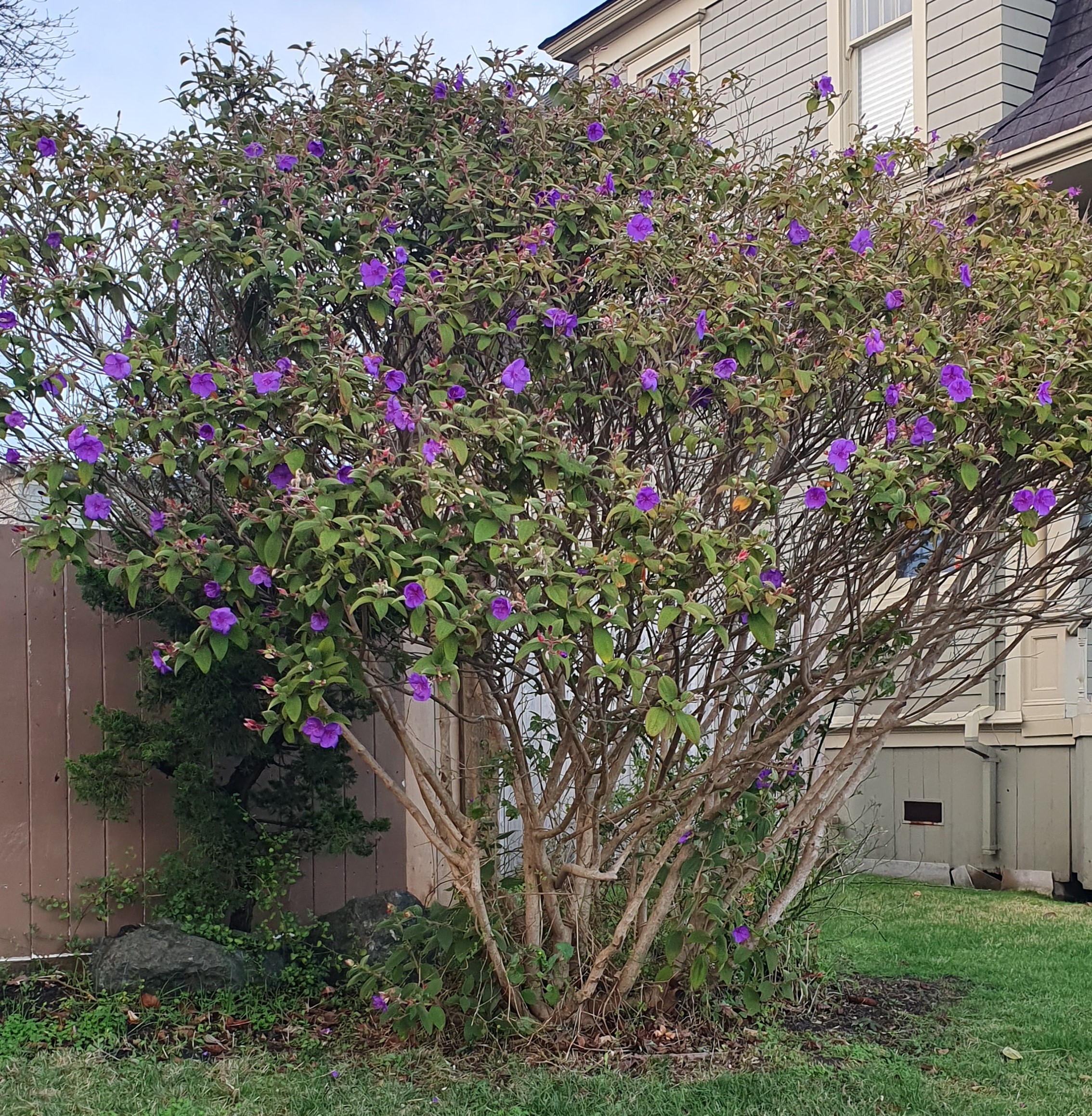
Most surprising to me this week is the suggestion of spring that we’ve seen all around us. Magnolia buds are about to burst open. Calla lilies are greening up; I saw two that already bloomed in a sheltered corner of downtown. Certain shrubs have bright red bark. I call them all redbud since I’m not that good at plant ID.
Sunset has already pushed a few more minutes into our day. The winter solstice was two weeks ago, and I notice that we can stay out until 4:45pm before we notice the failing light. We’ve definitely turned a corner. The photo at the top of this post was taken about that time. The rays of light and cloud always remind me of two things, sunset photos by Eliot Porter that were everywhere when we lived in New Mexico, and “god the father” sunsets: the light and clouds around saints depicted on holy cards when I was in Catholic elementary school. (Holy cards are the size of baseball cards, printed with god or saints in all their glory, often on a cloud surrounded by rays of light.)
As soon as I noticed the plants beginning to flower, the wind picked up and it began to rain. Weather reports showed a huge swirl of white cloud just off the coast. My brother pointed out that of all the cities on the Pacfic coast, the single one identified on the national weather map was Eureka. It’s rained off and on since New Year’s Day.
We look outside in the morning and if it is not already raining, we try to get going for a walk. By lunch time it is usually raining, and sometimes the wind tries to blow loose items around the neighborhood. The cover of our barbecue already blew away once, so now we tighten it and put a few rocks on top. The sun umbrella is stowed in the garage, outdoor chairs lean against the garage, folding chairs folded and piled up. We don’t want to let anything get away.
Waves were forecast to be 20 ft high along the coast, so we drove up to Su Meg State Park to have a look and found the park closed while a crew removed trees that fell across the access road. We turned around and went to Trinidad, figuring an entire town couldn’t be closed. The art gallery was closed, and stores looked pretty closed. It wasn’t until later we found that the town was without power during our visit.
The waves were big, but not impinging on the parking lot, so we stopped and watched the roiling sea. Waves thrown up by a blowhole across the bay topped a very tall rock. It was impressive and interesting to be out. The weather wasn’t all that bad judging by the number of people climbing up to have a look at the waves, walking their dogs, and looking around. After a short hike to look out to sea, we went down to the high tide line to have a look. Sure enough, not five minutes into our walk, a larger wave came in and swamped Jonathan. Wet to the ankles, we decided our visit was over.
Our climb up Trinidad Head was a bit drippy.
Since our day out in the storm, Eureka has been the center of a small spot not getting much rain. We still take our walk early in the day, but generally everyone around us is getting rained on more than we are.
Here we are in far northern California, January is just getting started, we’ve got spring in the air and big waves coming off the ocean. A little of everything.
It was a wonderful weekend. Our youngest daughter Lillian and her husband Neil flew out of Chicago before the big winter storm hit. They arrived in Eureka on Dec. 22, completing our family group. Amanda and Jim finished cleaning up after Monday’s earthquake, Lyra finished up pre-holiday work, and we were ready to celebrate.
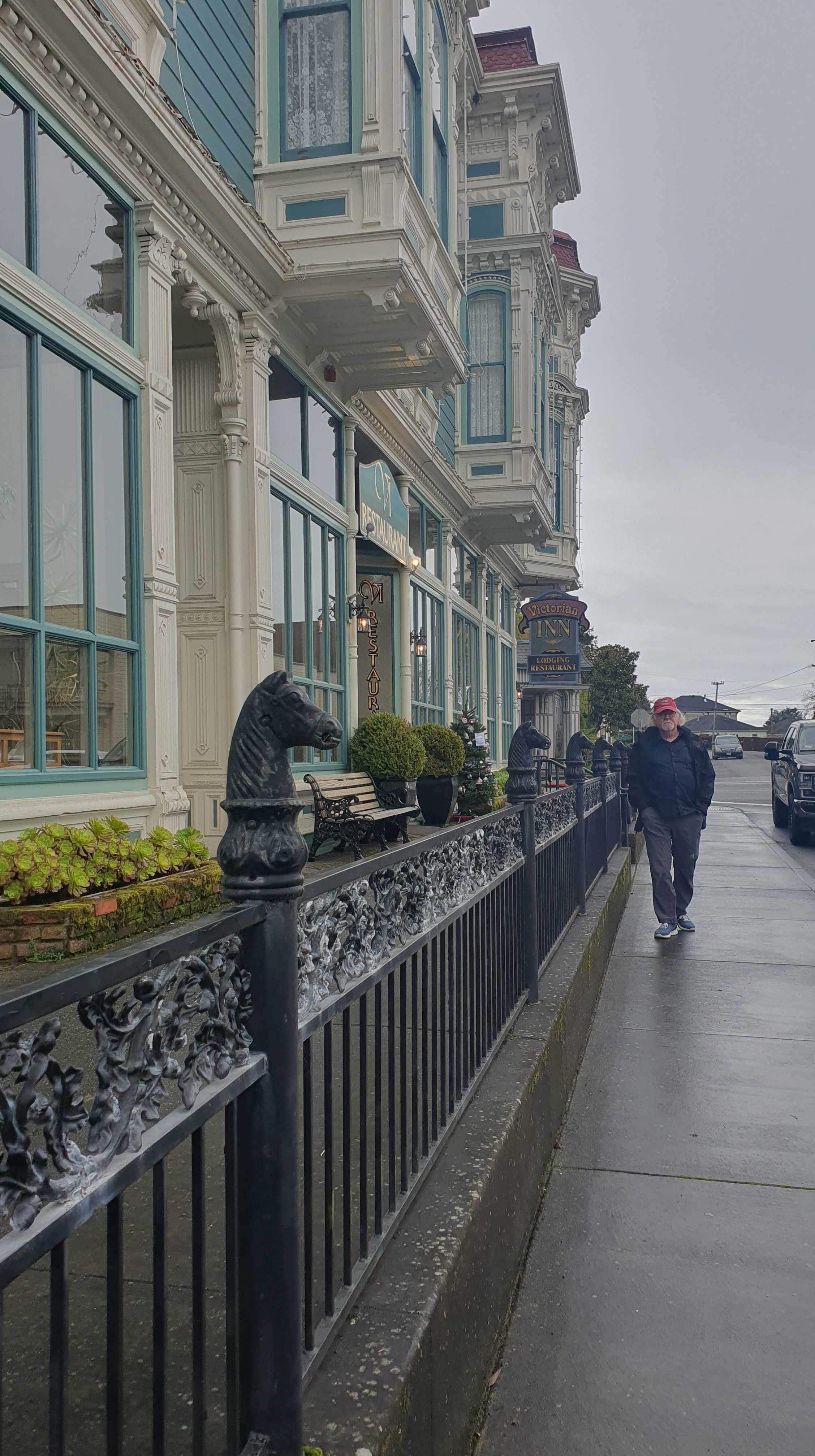
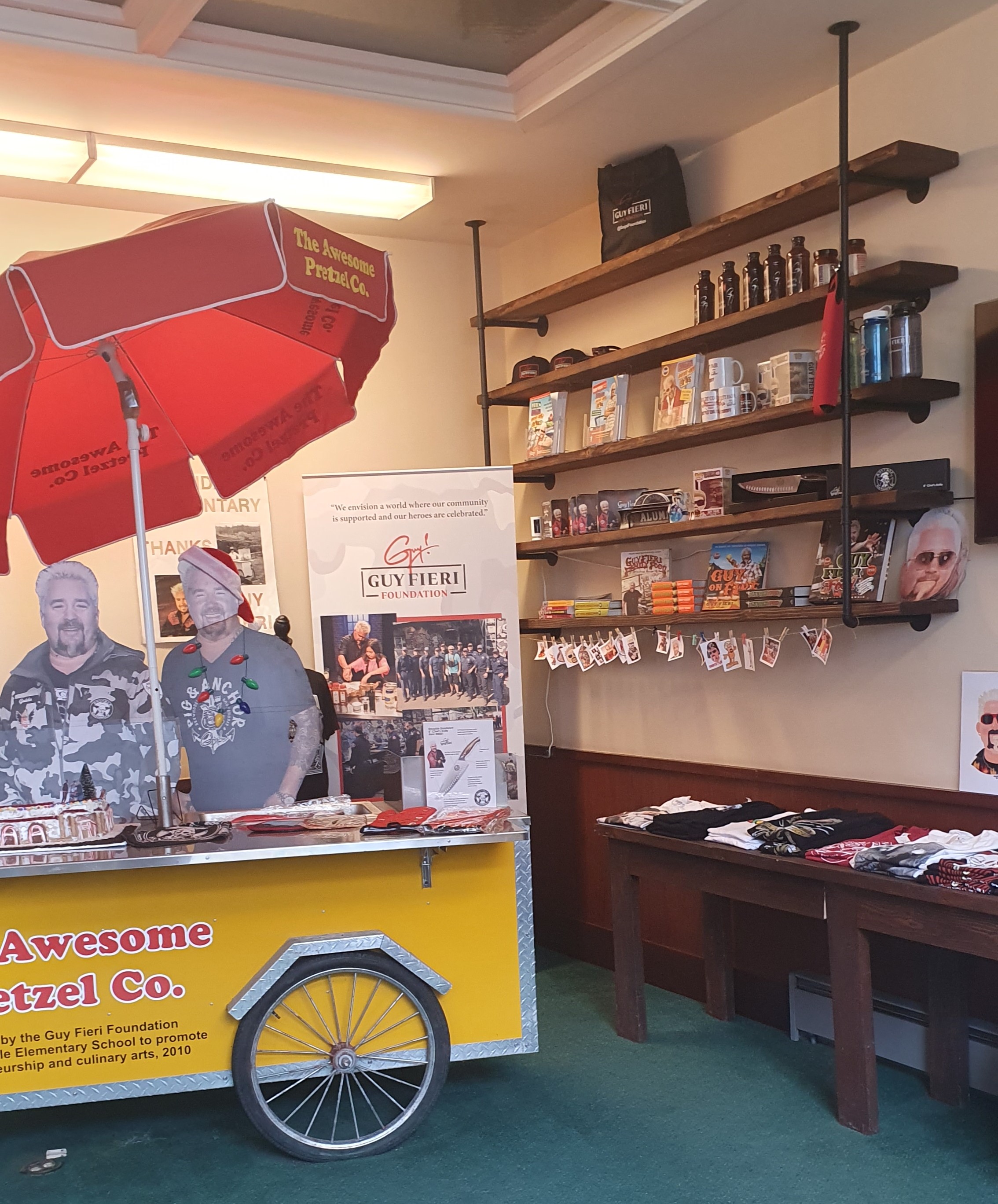
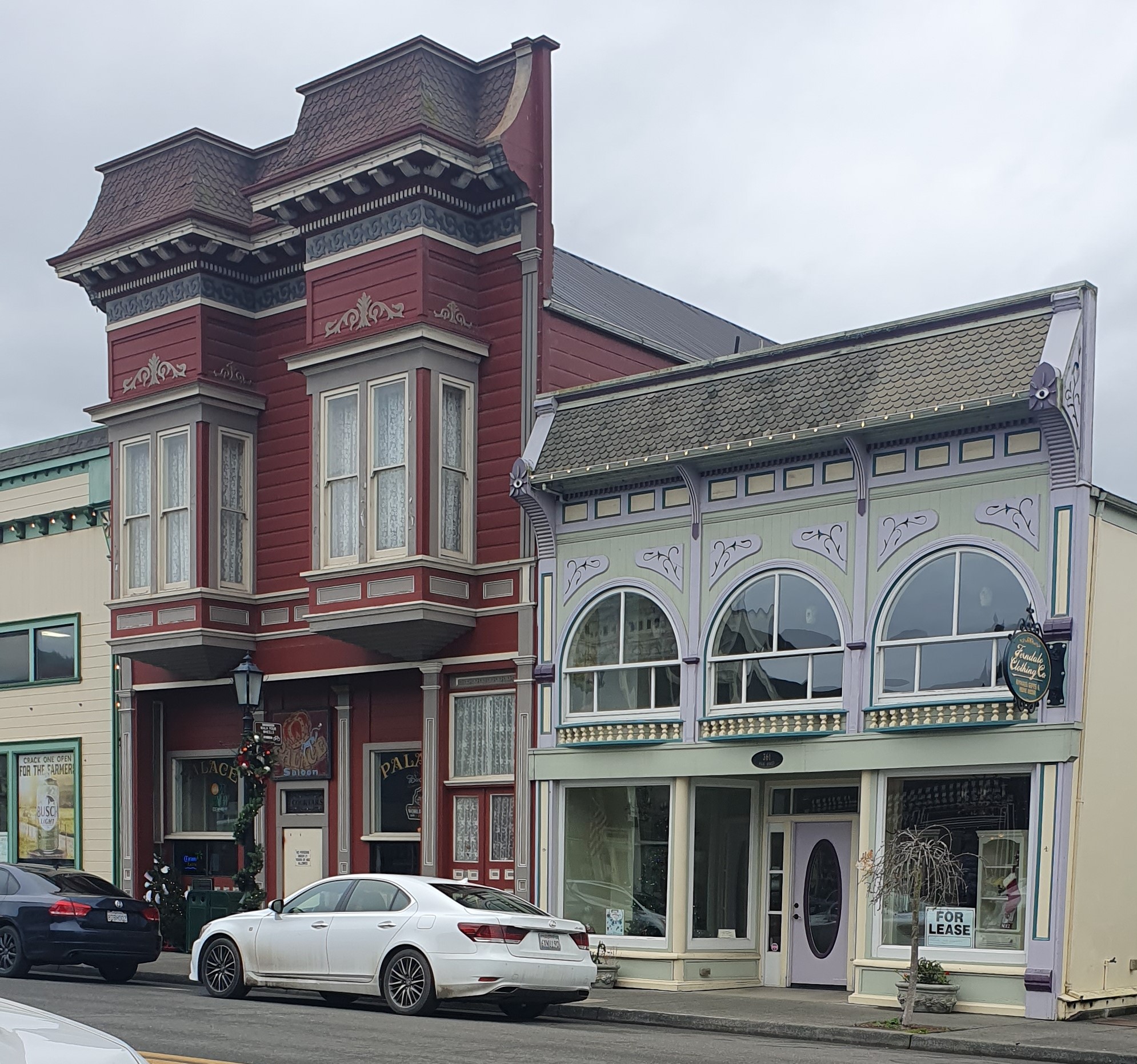
On the 22nd, we went to Ferndale for some pre-Christmas shopping. It’s a lovely, small town with lots of Victorian storefronts. It’s also where TV food personality Guy Fieri grew up. After window shopping, we had lunch at Tuyas, a very good Mexican restaurant.
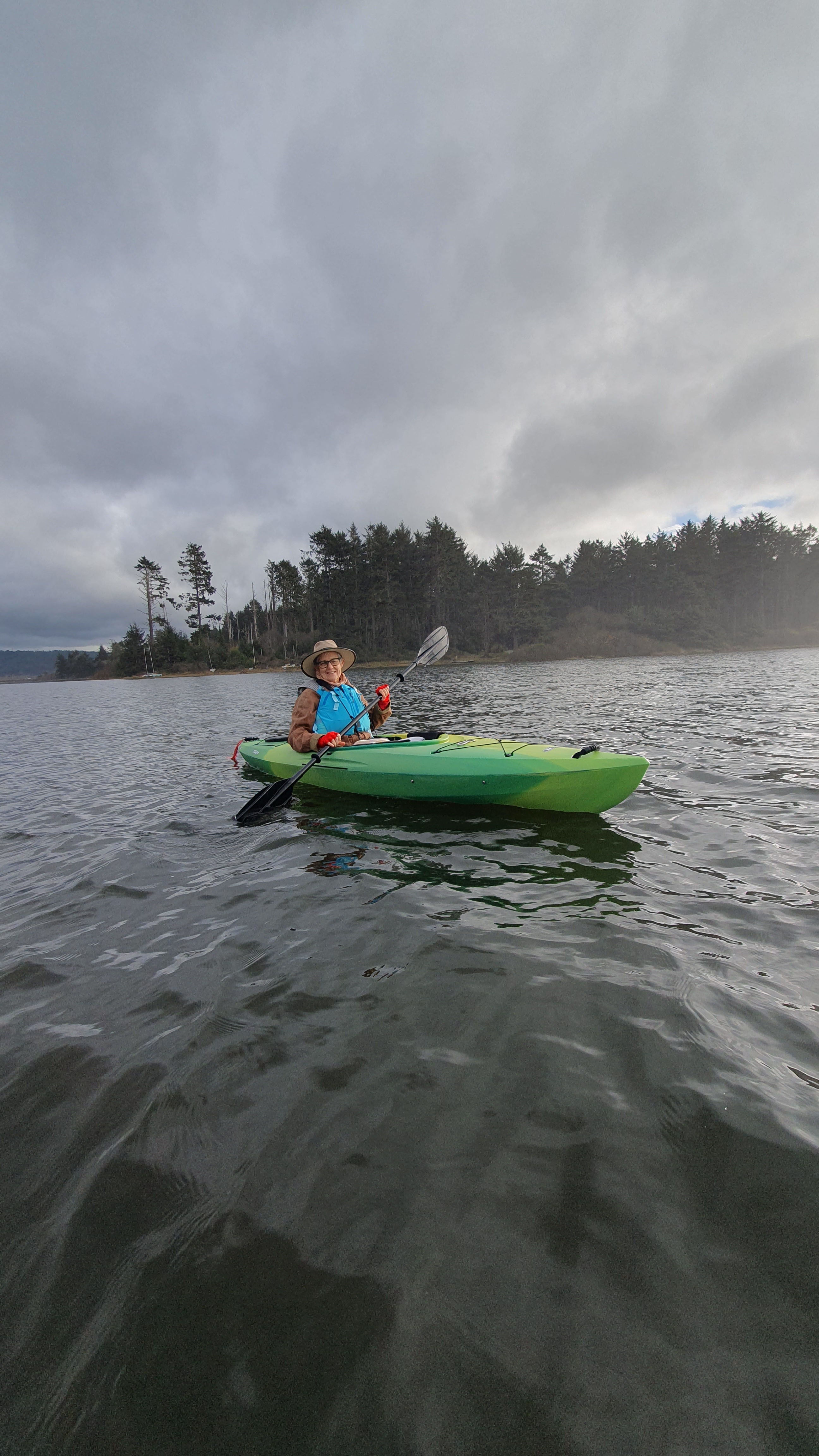
The next day, we stopped at Piled High Deli for sandwiches and took them to Big Lagoon for a picnic lunch and some agate hunting. Everyone found a few tiny agates. We strolled the beach, and took turns going out in Amanda and Jim’s kayaks. It was a beautiful day for a ride around the lagoon, and we stayed until the afternoon clouds started to come in and the temperature began to drop.
Christmas Eve we all got together to hug Aurora and have salmon for dinner. It was delicious and fun to be together.
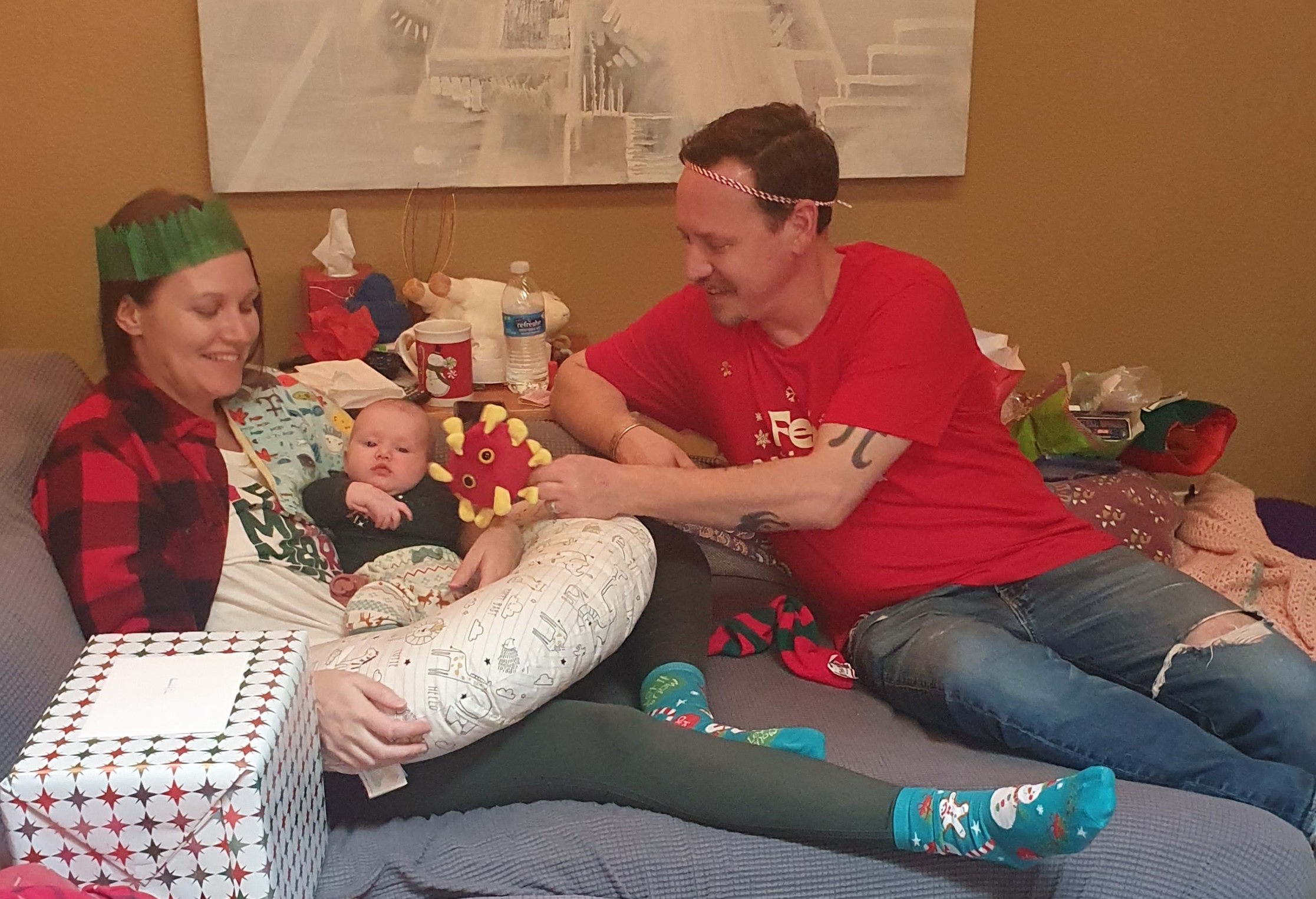
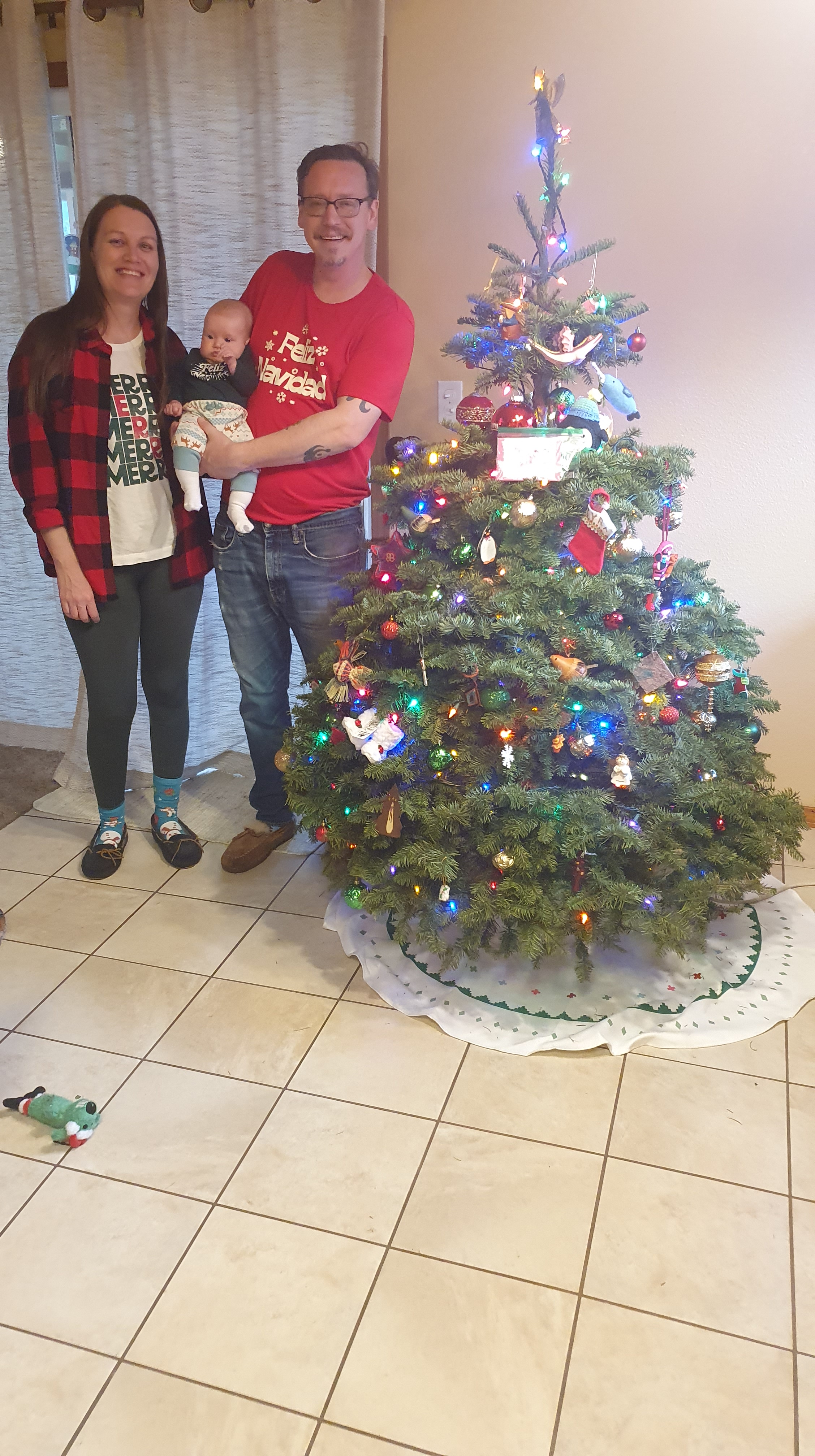
We reconvened the next day for Christmas breakfast, and to open Christmas stockings and gifts. There were a lot of fun things for Aurora, clothing, toys, and books. We took a walk with the dogs, watched Christmas movies including The Santa Clause, then had a collaborative dinner. Jonathan baked the ham, Neil made brussells sprouts, Jim made cicvara (Serbian polenta), Amanda and Lillian made cranberry pie, and I made pumpkin cheesecake. It was a Christmas feast for us all.
I’ve already heard jokes about the lengths I’ll go to get material for my blog, but I promise you I had nothing to do with the earthquake that hit Tuesday at 2:34 am. We were jolted awake and wondered briefly whether we should put on coats and go outside. The shaking stopped by then and we got up to check on what happened. The power was out. A bottle of bourbon flew off the shelf and smashed on the floor, but other bottles that fell off didn’t break.
Jonathan’s knives are attached to magnetic strips along the wall by the stove and fridge. The shock of the earthquake threw knives across the kitchen. It looked like a failed circus act. I’m glad we were in bed.
We got back into bed and called the girls. Lyra was ok though her Christmas tree tipped over, spilling water all around. Amanda was distraught but she and her family were unscathed. Their house was a shambles, damage uncertain. We told her to try and get some sleep and that we’d come help in the morning.
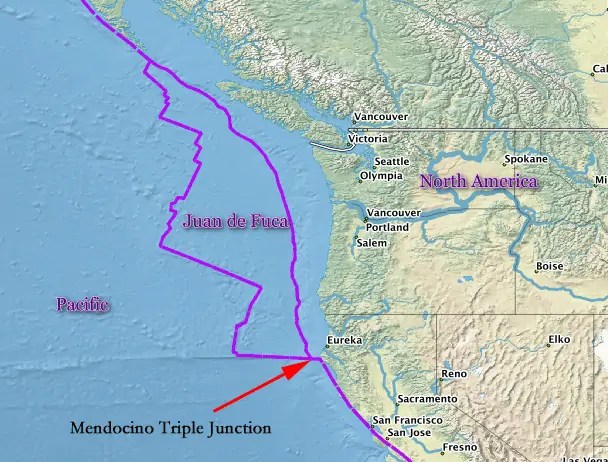
It took a while to get back to sleep, especially with the occasional aftershock reminding us of the general instability of our region. The epicenter of Tuesday’s magnitude 6.4 earthquake was almost exactly on the Mendocino Triple Junction. The Triple Junction is where three of the tectonic plates that make up the earth’s crust come together. The meeting of three of these is a bit unusual. Along the Pacific Rim of North and South America, one plate is pushed below another where they meet. A triple junction makes things more complex. Often, when the plates move they cause earthquakes.
We got some sleep, and in the morning it was raining. Jonathan heated water for instant coffee over the extra burner of our gas grill, not a great solution in the rain and wind, but we got some caffeine. The power was still out. We left for Rio Dell to help Amanda and Jim and hoped the power would come on while we were away. Outside the house, I could hear the hum of generators, as everyone who has a home generator fired them up to run their refrigerator or a heater.
Traffic lights were blinking, but people seemed to remember how a four-way stop works, and we got on to the highway without difficulty. Most stores were closed, and there was no place to get coffee.
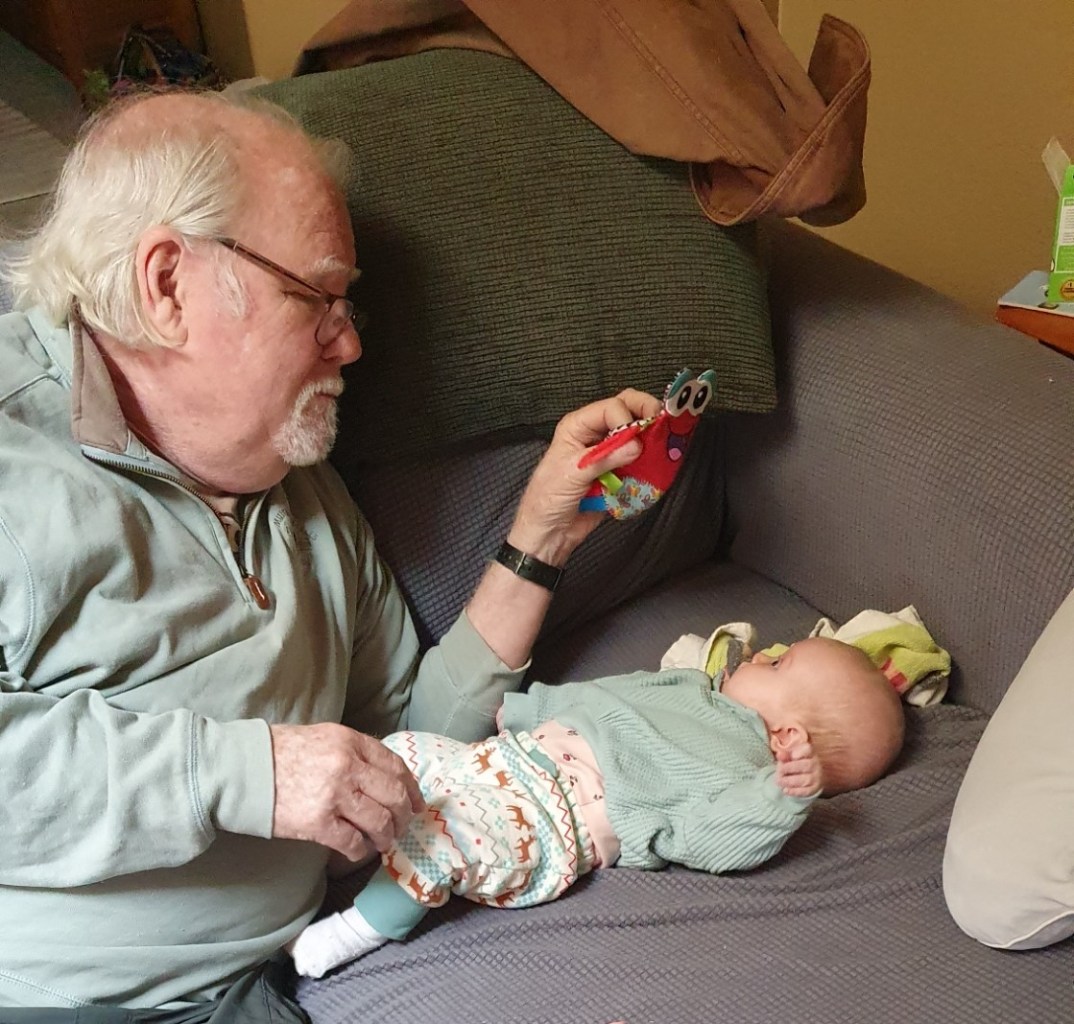
Jonathan and Aurora wore matching outfits!
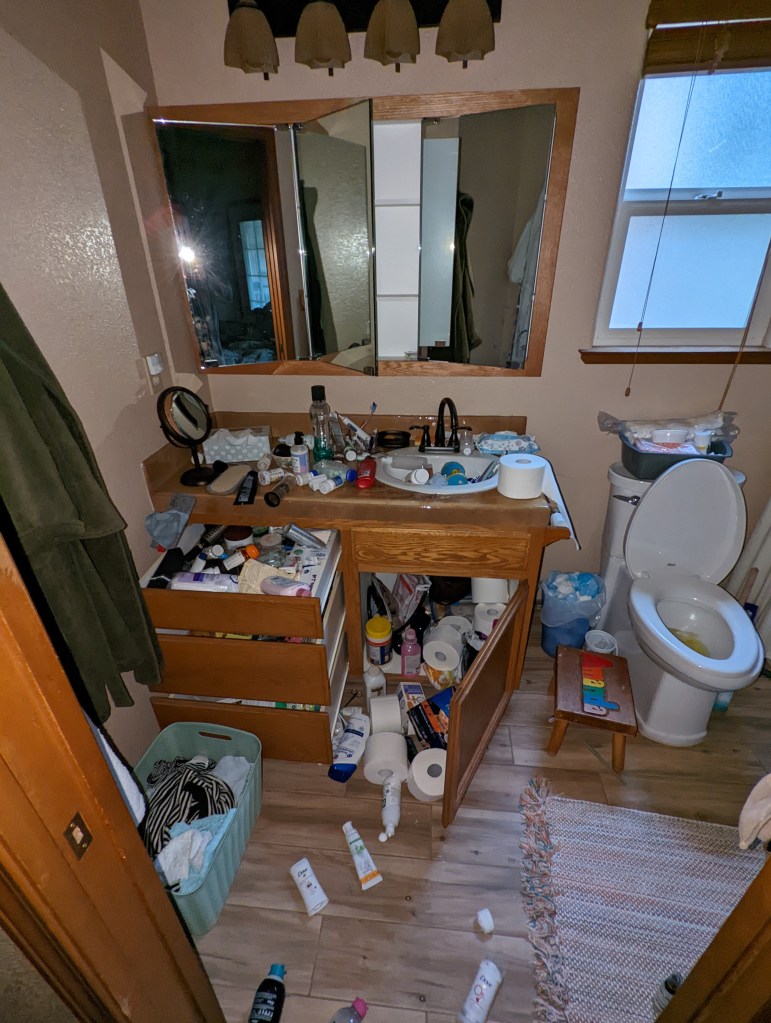
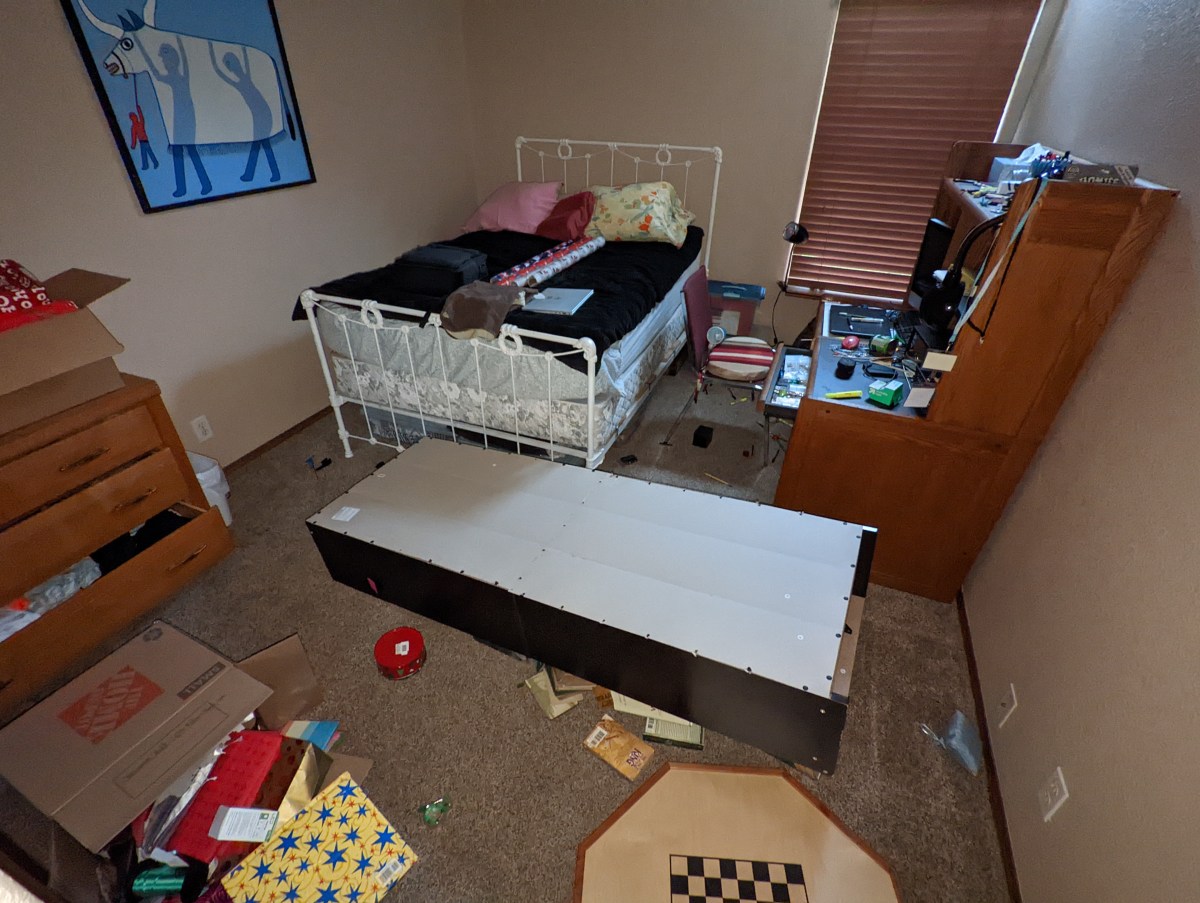
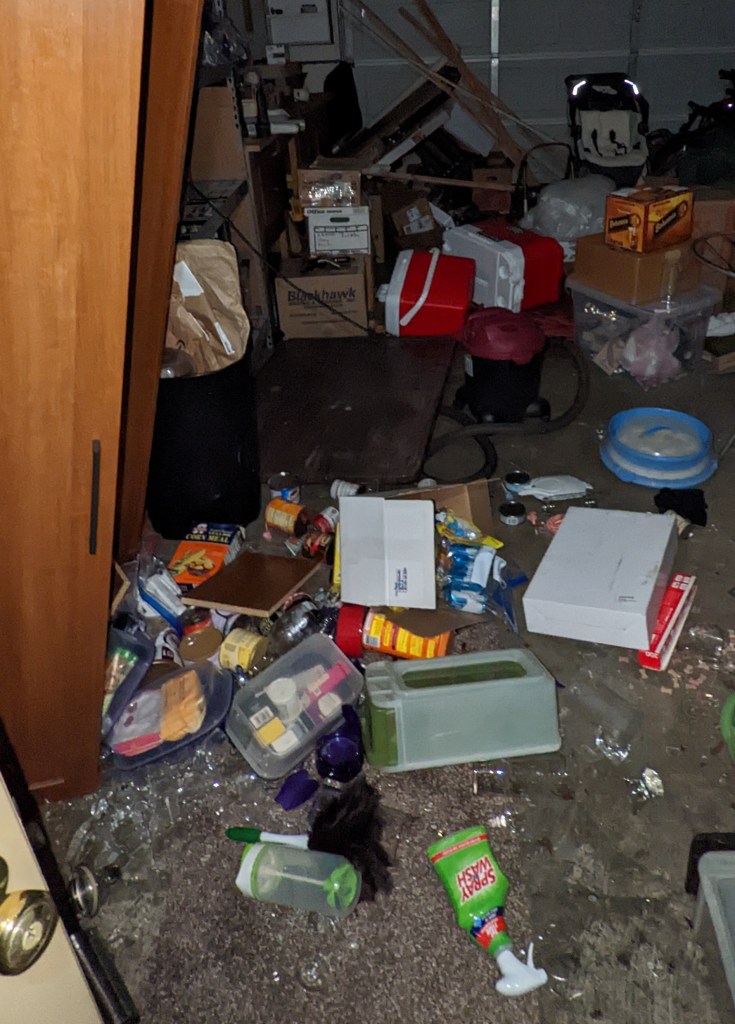
We arrived with a gallon of water and work gloves. A quick tour showed that most cupboards and cabinets had disgorged their contents onto the floor, into the sink or the bathtub. A set of curio shelves dumped tiny agates, beach rocks, sea glass, and small souvenirs in a pile of glass shards. We put glass into paper bags and rocks into cloth bags. When we eventually got all the objects and larger bits of glass picked up, we vacuumed the area, picking tiny crumbs of glass up as they sparkled in the light.
Everyone took a turn with the baby, keeping Aurora changed and fed and entertained while the others picked up. Their two dogs were corralled in the hallway by the bedrooms to keep them out of the glass. Every now and then we’d carry them outside for a moment of freedom, but even after the rain stopped, the ground was wet and cold.
The garage was full of crushed glass from the cabinet of wine glasses and flower vases. Jim worked on picking up fallen cans of paint, oil, and piles of wood, then he and Jonathan swept up glass fragments.
Lyra arrived with her camping gear. She and Jim set up a table and her camp stove in the driveway, and Jim set about making coffee. He offered it to the neighbors, too, and spent a few minutes exchanging earthquake stories. We were happy to have another sip of coffee. Friends from work stopped by to deliver ten gallons of drinking water, and soup ready to be heated. Every phone filled with texts asking how we all were faring.
The kitchen was covered with broken glass and the remnants of a bottle of cooking oil. First, we picked up and swept up glass, then Lyra went over it with degreaser and we could finally walk across the room safely. Others restored order to the bathrooms and bedrooms, and started in on cleaning up the sunroom, where a number of plant pots had crunched on the tile and needed repotting as well as cleanup. Little by little the mess receded.
Though there was still some cleanup left, we left at 2:30 pm, with the house in much better shape. Everyone came to our house for dinner, and Amanda, Jim, and Aurora will stay until there is power and water again in Rio Dell. We made a stop at the grocery store. Stores were open in Eureka by mid-afternoon. At home, the power was still off, and with the inside the same mid-50s temperature as outside, taking a short nap seemed the only practical thing to do. I lay in bed reading, then tried to sleep. Suddenly, the lights came back on. Then the heat! We were back in business.
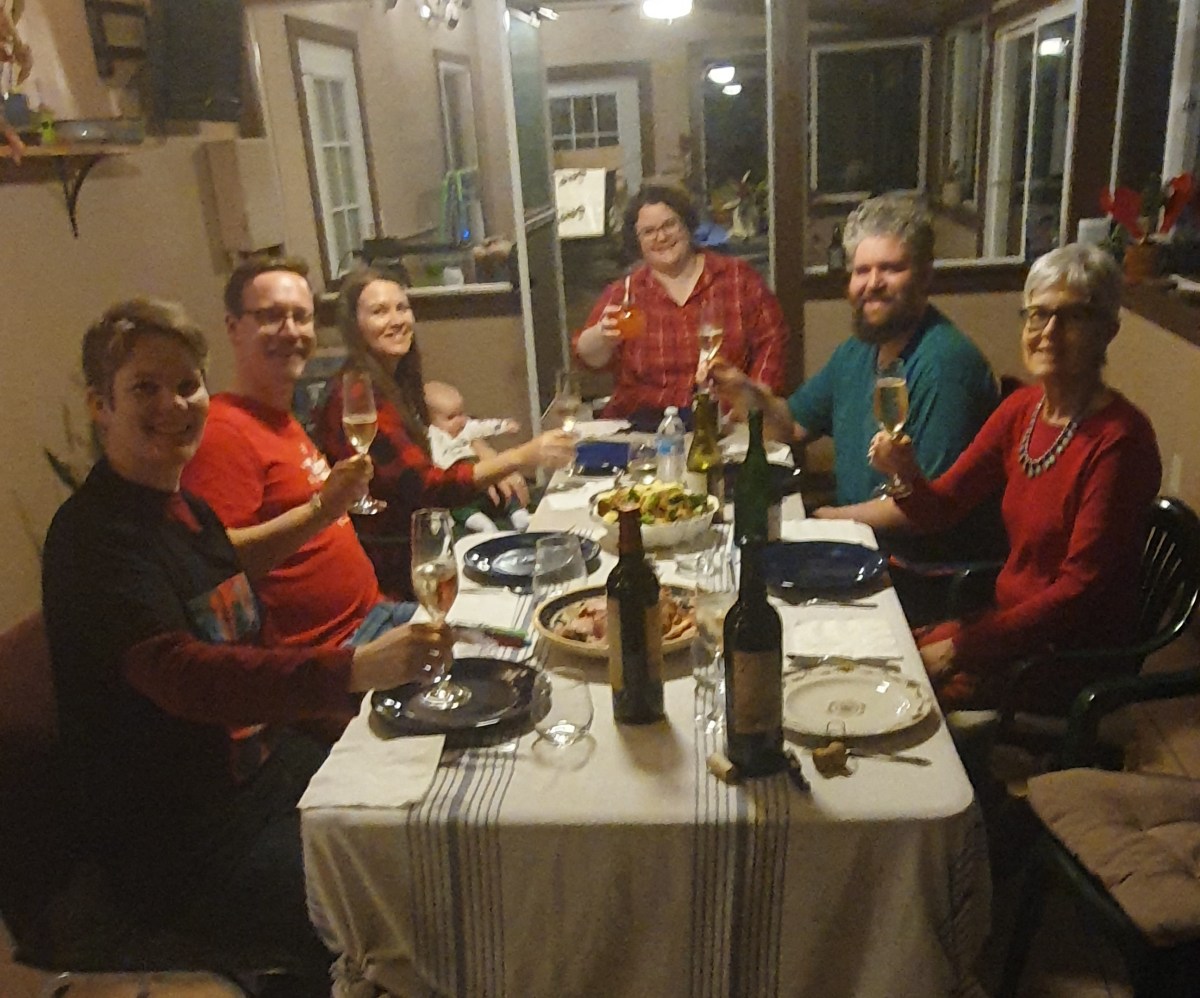
By the time the kids arrived just after 6 pm, I was baking cookies and Jonathan had the chicken for dinner marinating. We had a delicious dinner and everyone agreed that we’d turned a bad day into a pretty good one. Having family and neighbors to call on during the aftermath of the earthquake was a huge relief. People smiled and spoke to one another, we all worked together without any complaints or harsh words, and we had everything back in order more quickly than anyone thought possible. The losses are just things. Some were sentimental favorites, and I did bring home a bag of pieces that may eventually be made into other things, but overall we were happy to be together. We’re the lucky ones, grateful to have friends, neighbors, and each other.
Postscript: Last year, on Dec. 20, 2021, just after noon, a magnitude 6.2 earthquake hit almost the same spot, just a bit further off shore. This year, same day, a magnitude 6.4 earthquake hit. What will happen next year?
South Spit is a long narrow finger of land that extends around the west side of South Bay, the south end of Humboldt Bay that includes the mouth of the Eel River. Getting there requires a drive south along Rte. 101 to the turnoff at Beatrice, then west along the marshy land south of Humboldt Bay. The Humboldt National Wildlife Refuge occupies the marshy side of the road, and the water was covered with birds when we drove past. Hundreds, possibly thousands of pintail ducks were resting, and we pulled over to have a look.
A large group flew up, and we thought we’d spooked them. Then another group did the same, and we saw that a hawk was swooping low over the marsh, scaring the birds into the air. We saw a second hawk doing the same thing and stood transfixed watching the waves of ducks rise and settle back onto the water as the hawks dove and passed overhead. We did not see the hawks catch anything. Maybe they need a particular distance, angle, or individual duck to catch something, but it looked a lot like they were playing.
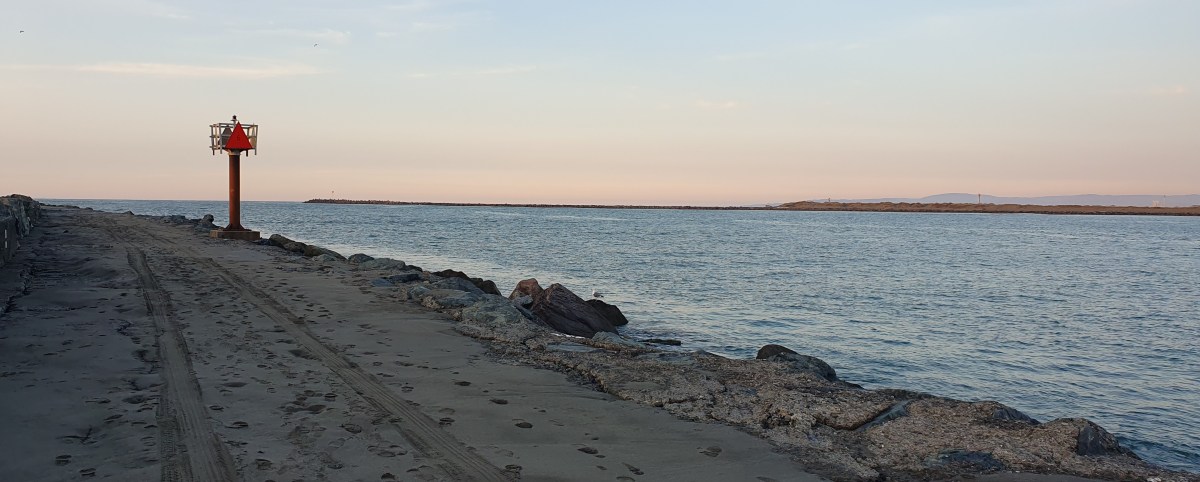
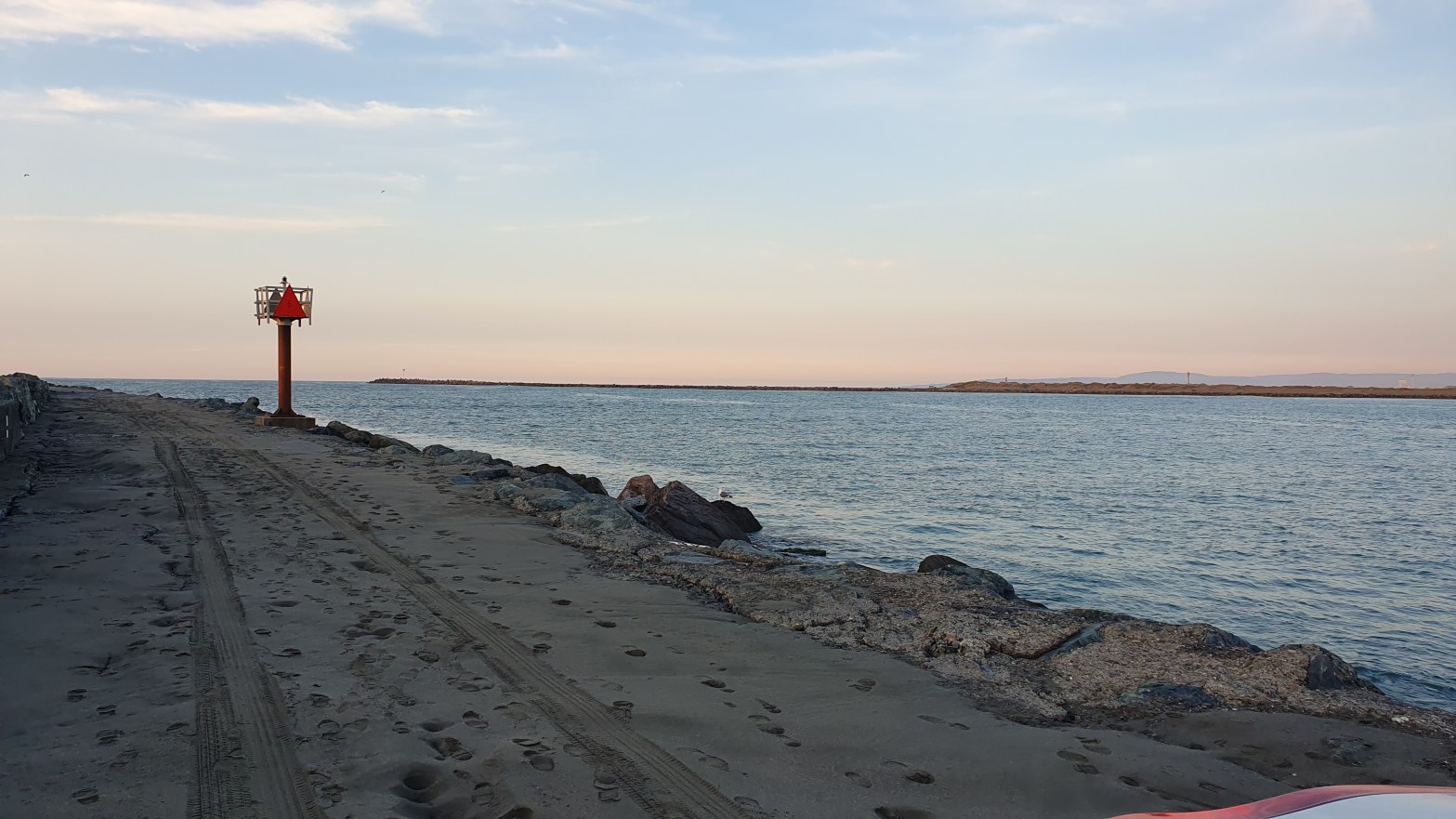
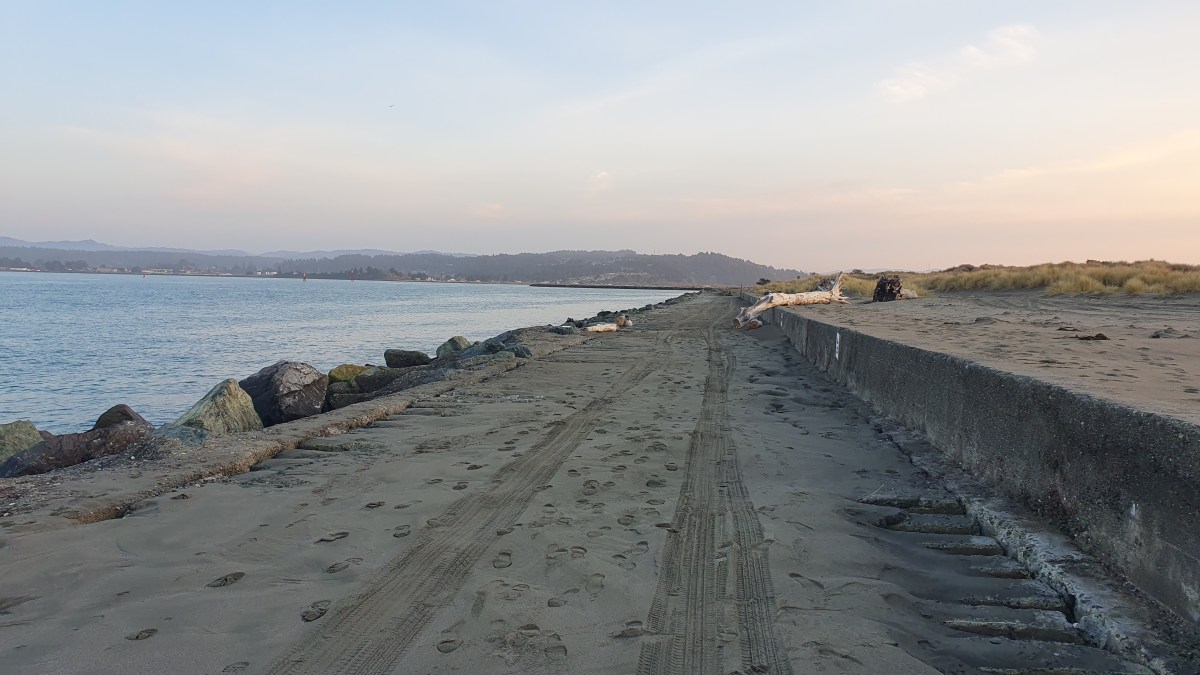
We drove on to the ocean. There’s a parking area at the south end of the spit where we’ve stopped in the past, but I wanted to go out to the end of the road. Long, narrow spits of land are often without roads, or the trail is gated, but this one is wide open. Once a paved road, the remnant is passable, with sections that test the mettle of a Prius. We did see another sedan out there, though most visitors drove trucks. It takes about 20 minutes to drive all the way to the end. A jetty extends out along the channel that connects Humboldt Bay to the ocean.
We watched a few boats going out. An unpaved road goes out some distance on the jetty, but erosion has left the concrete structure exposed. It was like driving on a road composed entirely of large speed bumps. We turned back to the end of the spit.
It looks harmless, but this is not a road for cars. We turned back.
Surprisingly, the spot overlooking the channel is prepared for visitors. There’s a restroom and parking area. Not much, but more inviting than just a sand dune.
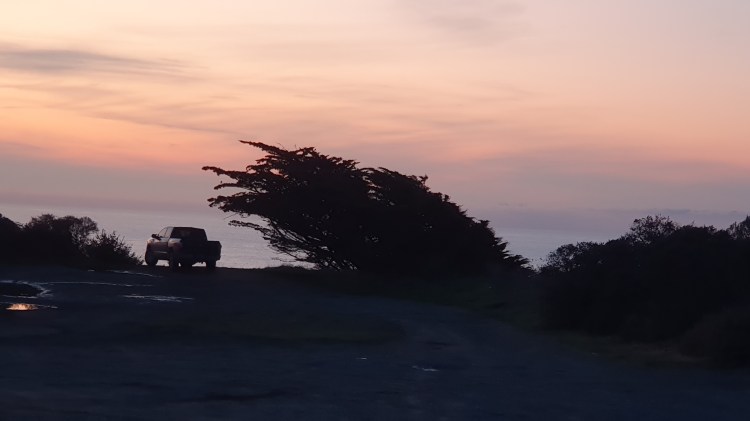
We started our drive mid-afternoon, meaning it was already getting dark by 4:30 when we got to the jetty. We walked around, looked at the birds and the water, then headed back. Unpaved roads marked as hunter’s access points lead toward the bay. We saw deer grazing peacefully by the roadside (none had antlers). There’s a beach on the bay side of the spit almost all the way back to the south end of the peninsula. It looks like it would be good for swimming in the summer. Not much in the way of beach-combing, the broken glass was all recent, and there were very few shells. It was good to walk up and down, consider interesting pebbles, and decide to return another time to walk on the ocean side.
We’re having a stretch of good weather, sunny and clear, with none of the rain winters here are known for. We decided to go for a walk in King Salmon, a tiny town on a peninsula south of Eureka. It’s all low-lying land, and floods whenever there’s an especially high tide. I wanted to have a look. We drove out, and parked at Gill’s By The Bay, a seafood restaurant at the far end of the road.
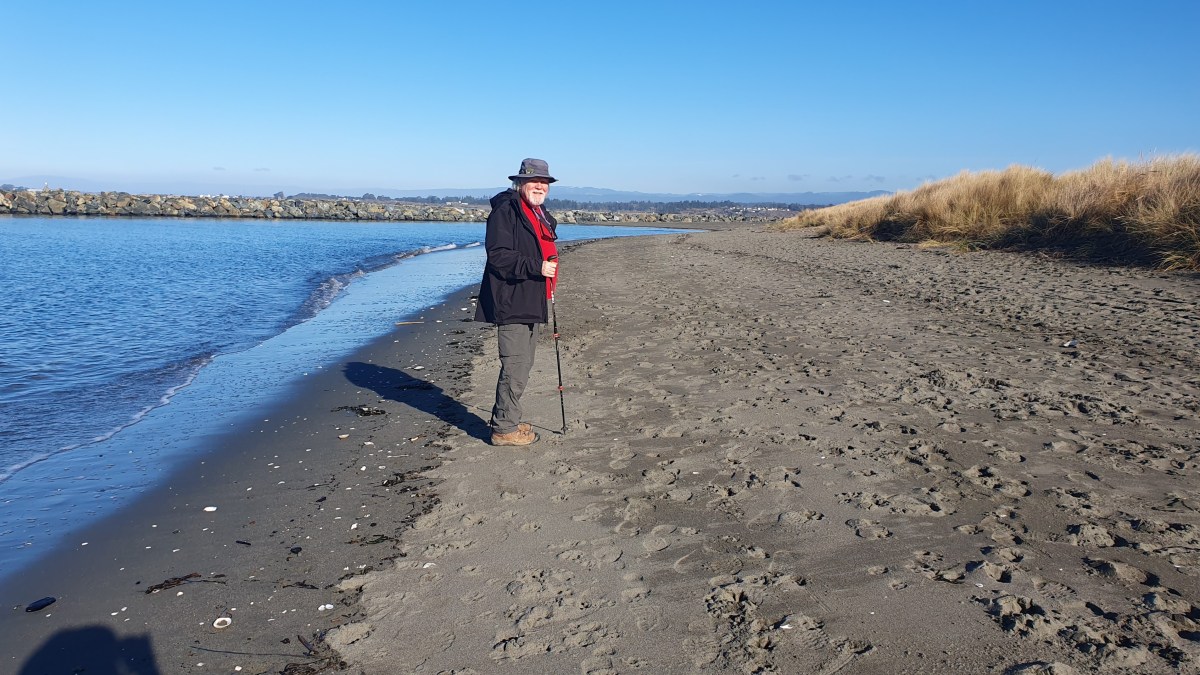
We walked along the shore on the Halibut Trail, past the pet cemetery, and along the beach. We passed a few other people walking, and saw a couple of fishermen on the jetty, though it was very quiet. There were a surprising number of large clam shells. Usually they’re broken, and it’s hard to find whole ones, but one after another turned up along the beach. The bright sun made it a lovely walk. We’ll go back another day and pick up where we left off. I’d like to walk the entire shoreline of the region, though a lot of it is too far from roads and parking lots for us. Still, it’s a good goal, or starting point for exploration.