My first exposition as an artist was this week. I participated in North Coast Open Studios (NCOS), an event that invites people to visit the places artists work to see what they do and how they do it. There is the opportunity to purchase finished work, too. The event starts with Eureka’s First Friday art night in June, and continues over the first two weekends in June. Anyone in Humboldt County can register and participate.
We arrived in Eureka last year just as NCOS began, and visited a number of artist studios. On the very first night we went out, I met the event’s organizer, Monica Topping, an energetic artist with a couple of day jobs, one of which is coordinating NCOS. (I am a big fan of her work, beads made from recycled glass)
This was the first necklace that I sold during NCOS
When we are out, I always wear one of my necklaces. They’ve become a good conversation starter. As we visited the studios of NCOS artists last year, a number of people asked about my jewelry and encouraged me to join the event this year. I registered to have visitors for one of the two weekends of NCOS 2023. I also submitted one piece to be shown in the Brenda Tuxford Gallery in downtown Eureka for the month prior to NCOS.
We went to the opening of the exhibit on May 6, part of the local Arts Alive, first Friday night event in Eureka. A good crowd came to see the preview. Lots of them were like me, people who had a piece on display, plus their friends and family. It made a for easy conversation, by asking “Which one did you make?” I was surprised and pleased to find that my necklace was photographed for the 2023 NCOS poster! It looks wonderful.
I was out of town from mid-May through June 5, arriving back in Eureka just in time to prepare for my NCOS weekend. I set my jewelry out and put out my signs directing people from our front door to the alley behind our house, where the garage door opens and my “studio” is located. Our neighbors don’t drive in and out very much, so when the occasional visitor pulled up and stopped in the middle of the alley, it didn’t matter.
I was very happy with the weekend’s visitors. More than 40 people stopped by on Saturday and Sunday, Lots of questions led to lots of discussion. Many of my visitors are artists themselves. It was fun to hear about other peoples’ projects.
The weekend paid for itself, too. I sold a few necklaces, bracelets, earrings, and pins. I made a few hundred dollars, enough to pay for the NCOS registration, and jewelry supplies for the rest of the year. Whether or not I participate in more art fairs this year, I plan to be part of Open Studios again in 2024.
We drive to Santa Rosa once a month to see doctors, and rather than spend 8 hours in the car for a one hour appointment, we stay overnight, have dinner at a nice restaurant, and do a bit of exploring and wine tasting. It keeps us both much happier about the scarcity of medical specialists in the Eureka area.
We stay at the Best Western Dry Creek Inn in Healdsburg. Formerly a tiny farming settlement, Healdsburg is now a real wine town, full of restaurants and boutiques. It can get hot in the summer, and the motel has a pool.
Del Rio Woods Regional Park
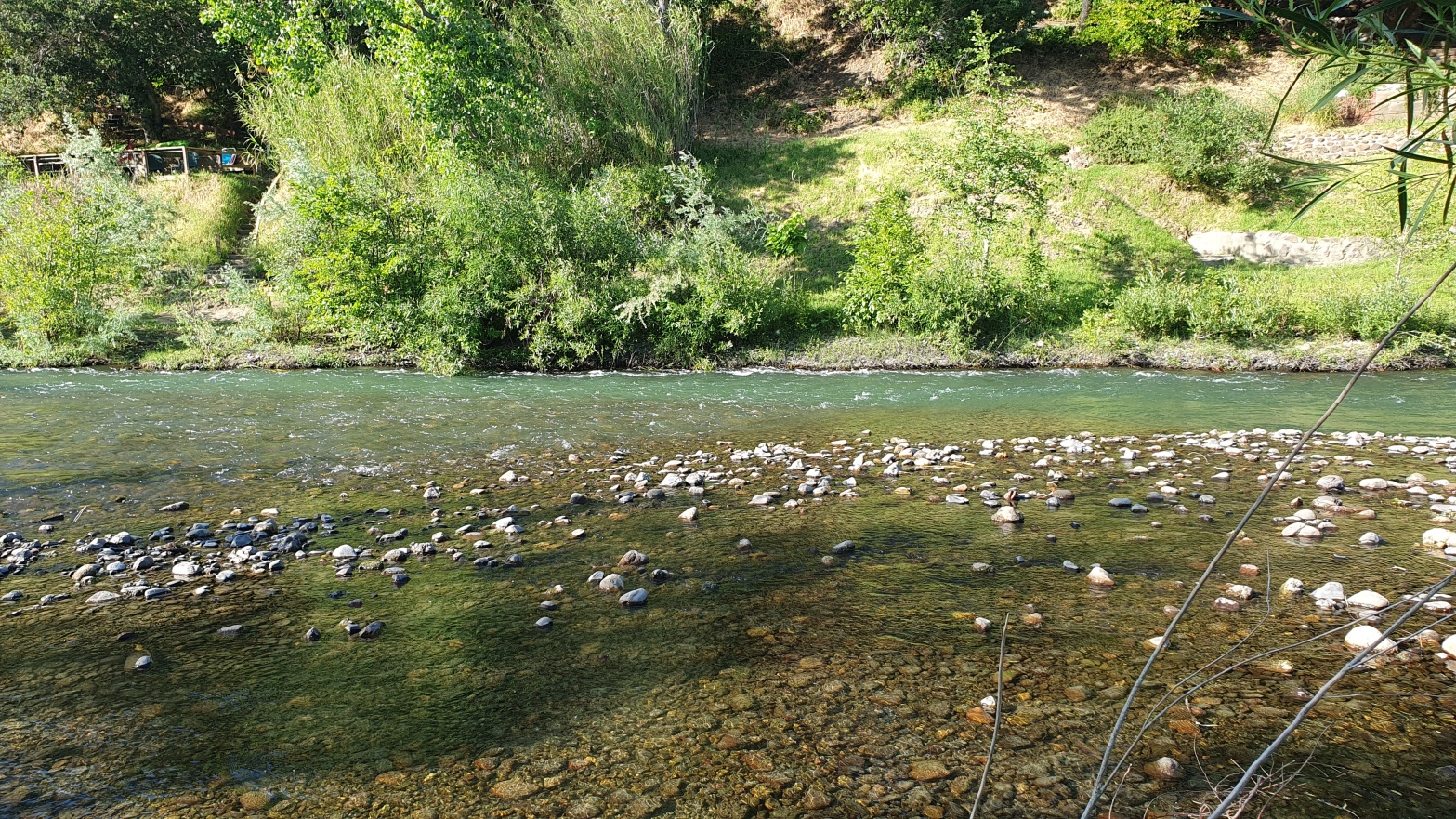
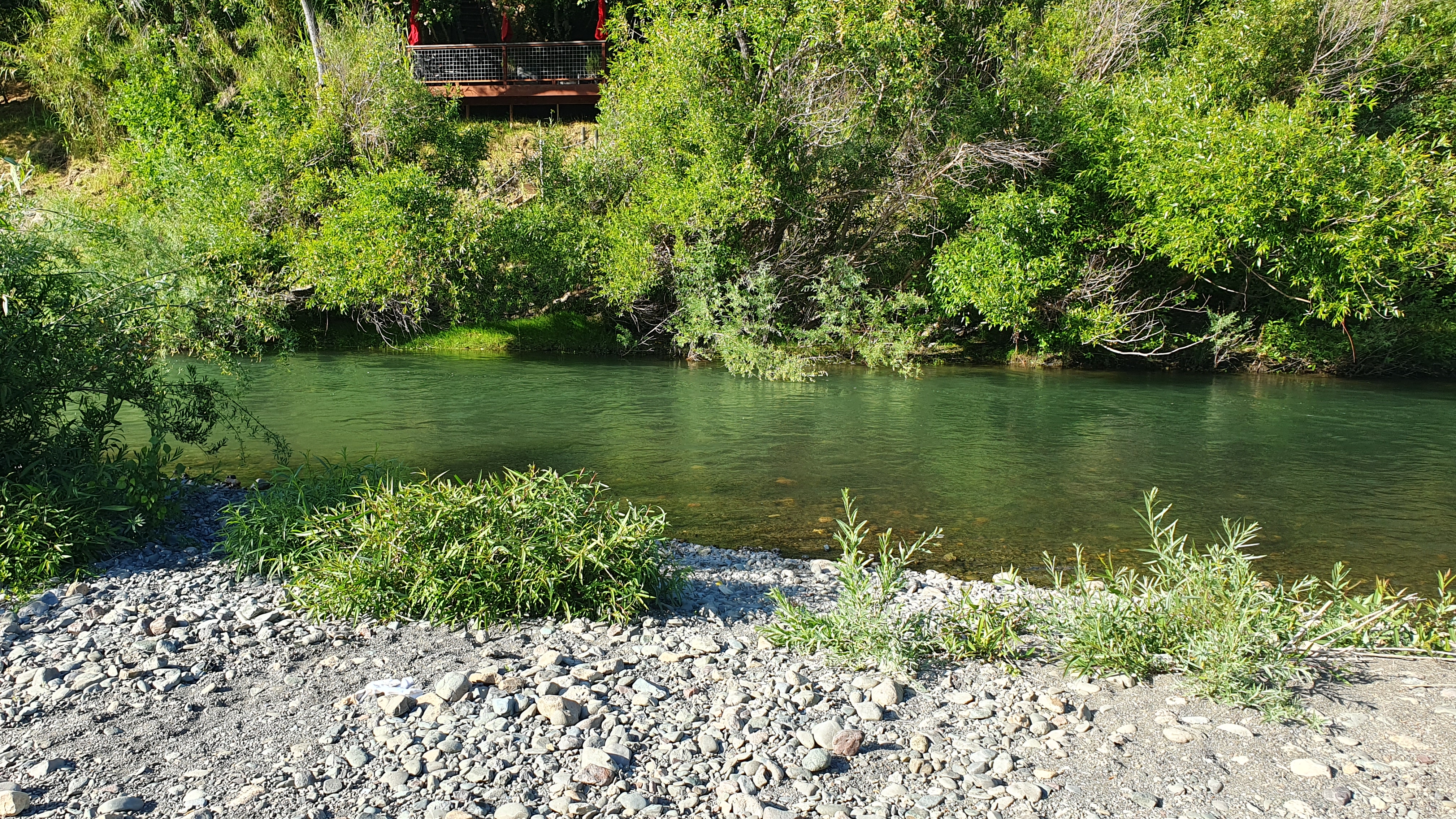
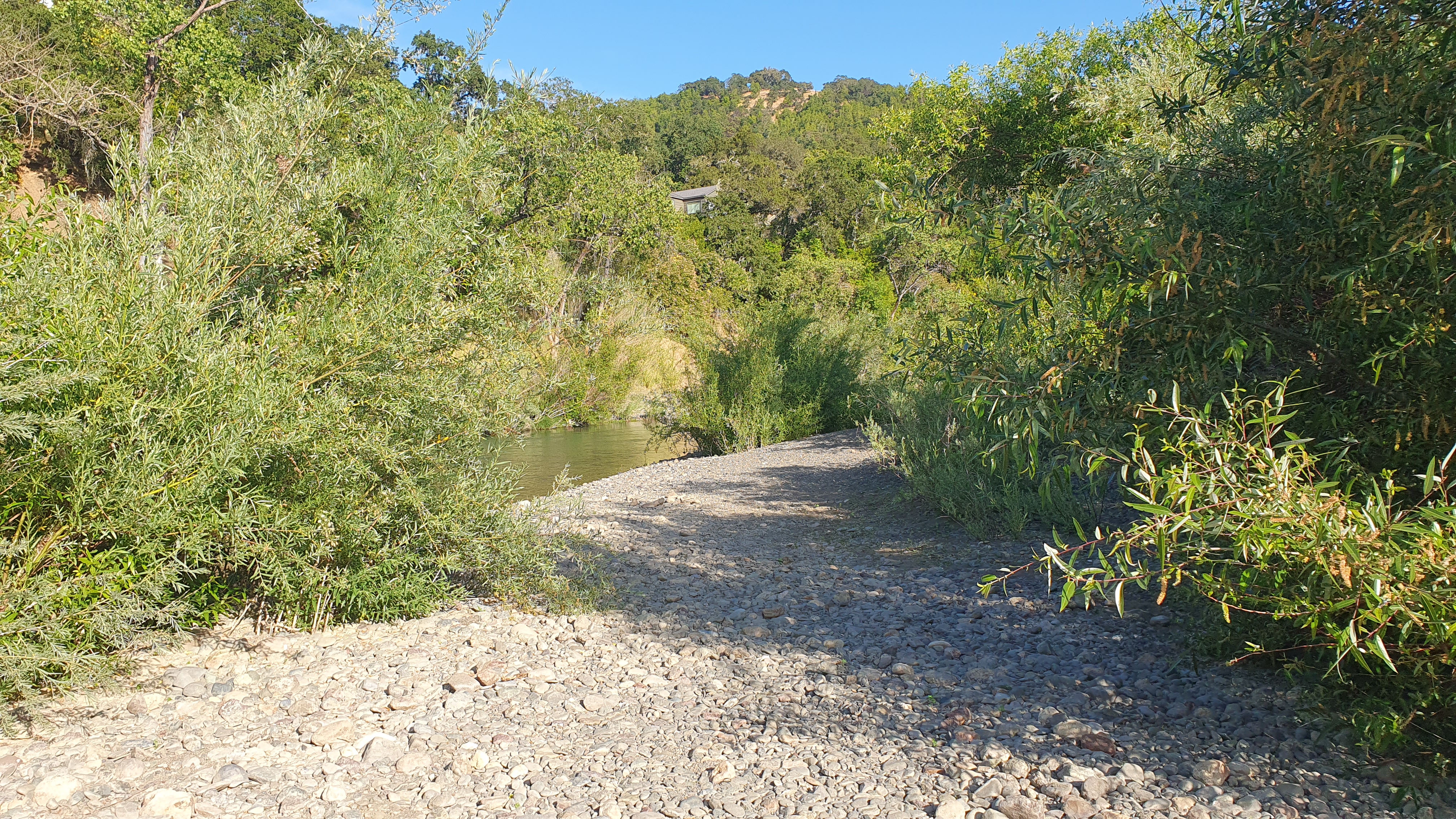
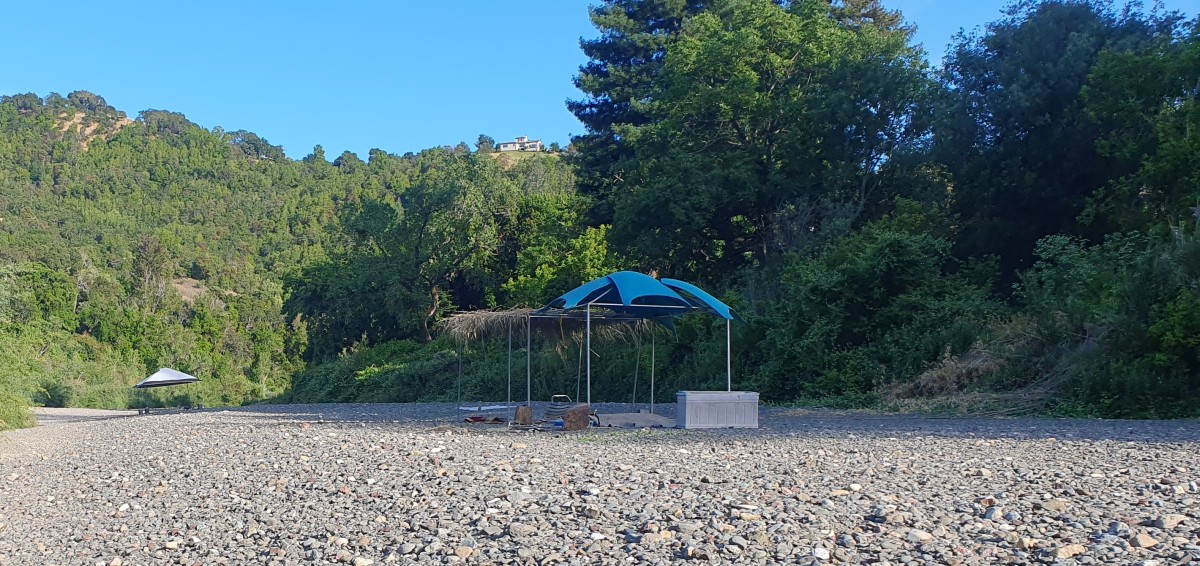
On this trip, we looked for a place to explore after my appointment, and found Del Rio Woods Regional Park just a few miles away. The park surrounds a stretch of the Russian River, and the gravelly banks have become a local beach. You can tell that the area was underwater earlier in the year, but now that it’s June the water has receded to its normal banks. There are warnings online about taking care when swimming because of the speed of the current. In the Del Rio Woods area, though, the river is so shallow that all you’d need to do is put your feet down and stand up to get out of the current. Kids might enjoy a life vest for some floating fun, walking upstream and then zipping to the opposite end of the beach.
We walked along the shore, not tempted by the water on this particular day when the wind was blowing. There are some substantial beach shelters set up by those who own houses nearby.
Along the Russian River at Del Rio Woods park
We saw a few birds along the river, too, though we heard many more than we saw. It was a lovely afternoon along the water.
We had dinner at Baci, and Italian restaurant in Healdsburg, sharing a generous salad, orechiette with broccolini, and saltimbocca. It was all delicious. Making a reservation was a good idea on a Thursday evening in the summer.
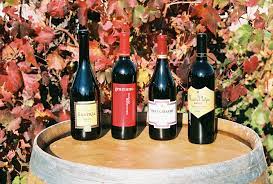
The next morning, we decided to stop and taste some wine on the way home. There are a lot of vineyards in this area, and many of them offer tastings, especially at this time of year when tourists begin to venture north. We stopped at the Graziano Winery Tasting Room in Hopland, CA, to chat with John, who is usually there and is always full of good humor. We picked up the wine we were due from our wine club membership, and added a few others (They have a new white, Greco di Tufo.). Then we went on to try a new place a bit further north, Nelson Family Vineyards, on the outskirts of Ukiah. We tasted and bought a bottle of viognier, petite sirah, and the sparkling rose. We won’t join the wine club, as we have joined two so far, and that’s enough. We spat most of our wine in the cups and buckets used for the purpose, which makes it possible to drive home afterward.
We arrived home in time for a late lunch around 3 pm, having made the most of my visit to the doctor.
Hotel: Best Western Inn Dry Creek, Healdsburg, CA
Dinner: Baci, Healdsburg, CA (we made a reservation)
Breakfast: Quail & Condor, Healdsburg, CA (best croissants this side of Paris)
It was quite a week. On Tuesday, we checked in to the Sheraton Commander Hotel in Cambridge, MA so that we would be walking distance from events, and for the next four days, we dove into my 50th Harvard Reunion.
It seems impossible that so many years have gone by since I graduated, and even longer since I arrived freshman year to take on the role of Harvard student. I’d always been a studious smart kid, and getting into Harvard was the culmination of my young life, when all I knew was that good kids went to college. I graduated with my class (1973), even though I took a term off, and stayed an extra semester at the end of my four years.
Reunions are a combination of convention, retirement party, and seminar. Even before the reception the first evening, we met old friends and began to connect with the group I know best. I found friends from Comstock (my freshman dorm) and Adams House (my upperclass dorm), and sure enough, everyone was recognizable, though name tags helped.
Women who lived in Comstock Hall my freshman year, fall of 1969. (L-R): Vivian Lewis, Sharon Shurts Tisher, Sophia Lee, Louise Reid Ritchie, Sandra Matthews. Far right photo top row (L-R): Christine Pittel, Leslie Tolbert, Winifred Creamer, Linda Jackson Sowell. Bottom row (L-R): Ann Fay Mick, Amanda Cross, Joyce Heard, Cyndi Mitchell.
After conviviality and dinner, we moved to the adjacent theater for the evening’s program, a documentary on the WPA project to record accounts by survivors of slavery. Created by classmate Donna Brown Guillaume for HBO, the show was moving and impressive. It didn’t need to take a side, it quoted directly from the narratives of former slaves as they described how hard they worked, how little free time they had, and how deep the cruelty of slave-owners could be, separating families, couples, siblings, friends. From there we went home to get some rest.
Annenberg Hall was a drafty, mournful cavern called Memorial Hall when we were undergrads. Now it is a Hogwarts-style dining room, a nice place for breakfast (Harvard Alumni Association)
Breakfast was each day’s first opportunity to find more long lost classmates. I have attended reunions of my class every five years or so, and find that as the years go by, people are increasingly friendly, and it becomes a pleasure to talk with anyone with whom I can find a common thread, whether I knew them in days past or not. One person I chatted with was in a production of Die Fledermaus our freshman year that remains the best English translation I’ve ever heard. I wasn’t in it, but I did attend several performances to see a friend in the chorus, and because there was a talented and handsome senior in one of the roles. I still remember it fondly.
The program began with the class survey. A general questionnaire is produced every five years. The results are always interesting–as a group, we are much more contented today than we might have once thought we’d be. A panel discussion on aging did not yield a new magic bullet to deter our gradual disintegration. Next up was lunch and more conversation. I enjoyed finding people I remembered and catching up on their families, the exotic locations in which they live or have lived, and their interests (travel, music, family, travel, and travel).
A memorial service was held in the early afternoon. Though not a churchgoer, I enjoy the memorial as a moment to think about the people who have not made it this far in life. Time takes its toll. I know the stories of only a very few: AIDS, murder, brain aneurysm, and have read about others in the compilation of personal accounts called the Red Book that comes out every five years for each class. The readings and music of the service were comforting as well as an opportunity to appreciate the vocal and instrumental ability of class members who volunteered their talents.
I don’t have a copy of our recent class photo. This is from our 40th, or 45th, or 35th………
Following the memorial service, we met for a class photo in front of Widener Library, the building that dominates Harvard Yard. Afterward, I gathered the members of my freshman dorm for a photo. From there, I scurried to the next event called “Me in Three”, when classmates were invited to spend 3 minutes talking about whatever they wanted to. As a member of the organizing committee interested in alternative programming, I was recruited to be one of the speakers, and I practiced my bit to fit in the time constraints. My talk was, “An Indelible Memory”, about move-in day of freshman year. It is attached at the end of this post.
I had to skip the end of the session to prepare for our next event, a dinner of former Crimson staffers, called Crimeds. I was a photographer for the Crimson (campus newspaper), even though not everyone could remember me. At the Crimson I learned how to roll bulk film onto a cassette for a 35 mm camera, how to develop and print black and white photos, how to dodge and how to burn. It was an important moment for me, both building a skill, and belonging to a group, (I failed in my initial effort to be accepted as a writer, and was very pleased to make the photo board). The Crimson Photo Board was essential but very much behind the scenes. I was often around as pages and pages of text were proof-read, laid out, and pasted up for printing, and I was there when the basement press was retired.
Crimeds at Class of 1973 Harvard Reunion (Harvard Crimson)
The dinner was excellent, and the company sublime. So many people from the Crimson had careers as writers, people whose bylines you’ve read in the New Yorker, the New York Times, Washington Post, LA Times, Dallas Morning News; in addition to reporters and writers, there were politicians, ambassadors, entrepreneurs. The requisite documentary photo was taken, and we were all released back into our particular habitats, talked out for the day.
The benefit of the Sheraton Commander during reunion week is location, location, etc. It is easy walking distance to Harvard’s Science Center, ground zero for all things reunion, and made it possible to rush home and drop into bed, while still being able to arise for another day of earnest conversation.
So much to talk about, so little time. Thursday began with symposium on American democracy that didn’t have much new to say, but allowed people to express their concerns. This was followed by a symposium on the current state of the arts as a force for change, a session that I found gratifying. There are theater groups trying to become more inclusive, and museums trying to find new audiences. A different group discussed the cleanup of the Charles River and looked for threads of optimism in the area of the environment.
Another break for lunch and conversation, followed by a visit to what remains of Radcliffe, which is very little. The Radcliffe Yard was the administrative and classroom center when the two schools were separate, when I was a freshman. Today, Radcliffe consists of a post-graduate center, the Radcliffe Institute (recently renamed the Harvard-Radcliffe Institute), and a library of women’s history, though with the latest name change, Harvard seems about to execute the coup de grace and erase Radcliffe entirely. My visit to the Radcliffe Yard evoked pleasant memories, but by the afternoon (It was day three) I had to return to the hotel for some rest before the evening’s events. The weather was glorious, with higher temperatures each successive day, which put us in the 80s on Thursday.
There was a wine tasting, hot and crowded (the wine was good) and then a lengthy bus ride to travel a short distance (one way streets!) to the Radcliffe Quad for our dinner dance. A large tent and tables provided lots of space, and entertainment began with the Kuumba Singers, went to the Reunion Chorus, and ended with Sundance, the rock band of classmates that has entertained at every reunion I’ve attended.
Clockwise from upper L: Ron & Bob, Hurlbut freshmen, Sandy & Mara, Marc, me, Elizabeth, Ira, Ann, Ray, Michele, & Ron, Jonathan & Jeff
The evening was summery, allowing us to float around in our dresses and leave coats hanging on chairs. Even with all this chatting and sitting around, I still missed the chance to visit with some of the people I’ve known the longest. Perhaps I can pick up via email with those I missed, or with some of those who were unable to get to Cambridge on these particular days, though I am not sanguine about seeing Larry-who-moved-to-Australia any time soon (but I’ll read his latest book).
By Friday, the final morning of the reunion, many friends had already departed for home, vacation, or on their way to other places. I still managed to meet a few old friends and make a new one. The final symposium was one of the best, focusing on efforts at Harvard and elsewhere at racial reconciliation. Each speaker had a different perspective, a black woman who has headed a largely white prep school (Rebecca Sykes), a white man who led Harvard’s defense of affirmative action in admissions before the Supreme Court (Seth Waxman), a young Harvard chaplain, a member of the Harvard Remembrance Project, and another classmate as moderator (Sylvester Monroe).
We had to leave before the end of the session to get to our scheduled visit to the Harvard Art Museums. There was an opportunity to see a series of prints by Edvard Munch. Though he’s best known for The Scream, Munch was something of a mad printmaker, often changing prints as they were about to go to press. Parents of classmate Phil Strauss collected many versions of some of Munch’s prints and eventually donated them to Harvard. The staff were informative and welcoming, and pointed out characteristics of different time periods in the various works. I include two images that show the broad range of work that Munch produced:
The final day had many events, as the end of our 50th reunion overlapped with the new Alumni Day begun two years ago when reunions were moved away from graduation weekend. From the Art Museums, I went into Harvard Yard and heard Larry Bacow give his final remarks as president of the university. I haven’t been much of a fan of Bacow as president, not just because I was looking forward to being at graduation for our reunion (Tom Hanks spoke). Others have pointed out that Bacow was not a Harvarad undergrad and will never understand why the 50th reunion (and possibly others) want to be at graduation. I’m also disgruntled at how Harvard has handled the allegations of improper behavior among Anthropology professors. We’ll see how the new president does. Claudine Gay starts her term as president of Harvard on July first.
Mary Louise Kelly (Harvard Alumni Association)Larry Bacow (Harvard Alumni Association)
After the platitudes, there was some good music, but the invited speaker, NPR reporter and host Mary Louise Kelly, didn’t get to speak until almost 1 pm. That was when lunch began all over Harvard Yard and in the adjacent buildings. Thus, the most interesting part of the program began as people started to drift toward the food trucks invitingly parked nearby. I heard a bit of her talk, though I had agreed to meet Jonathan at 1 pm and could only push the time a few minutes.
We left Cambridge after lunch and headed back to Boston for our final day and a half. I was exhausted from all the visiting and walking back and forth, but happily so, and an afternoon nap fixed me up. I am glad that I went to the reunion. It was wonderful to meet up with old friends. I stand by my assertion that people grow kinder and friendlier as they grow older. If you have a notable reunion coming up, high school or college, I highly recommend attending and talking to absolutely everyone.
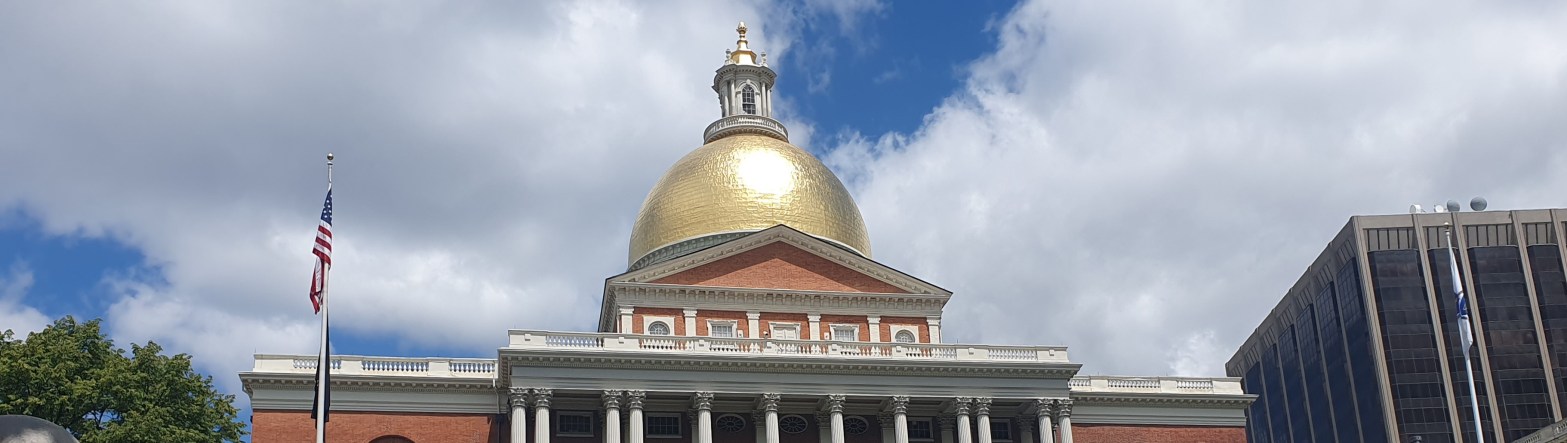
We’re in Boston, having a look around before my reunion gets underway, and it happens to be Memorial Day Weekend. The city is in high gear, as this is the official start of summer.
On Thursday, I saw the display of 37,000 American flags planted on Boston Common to honor Massachusetts residents who died in combat. A military brass quintet played lovely music on a beautiful sunny day.
I also walked past the most recent sculpture added to Boston Common, the first in 100 years, and the only one that isn’t a sober-faced white man, from the look of it. Naturally, these bronze arms, modeled after a photo of Martin Luther King, Jr and Coretta Scott King, is controversial. I’m not sure I like it, but it is impressive.
The weather is glorious, Boston at its best.
We are staying at the Godfrey Hotel, centrally located and comfortable. We walked to Boston Common, the Public Garden, and along the Charles. Another day, we walked to Long Wharf by way of Faneuil Hall, Quincy Market, and the farmers market. The farmers market has amazing prices, shop there if you are staying at a place where you can cook.
We’ve eaten at Jumbo Seafood in Chinatown (try the clams in black bean sauce!). The sushi was good at Irashai on Beach St. (pink lady roll++). French Quarter, just down the street from the hotel, was also good.
We tried Ruka, the Japanese-Peruvian restaurant next door to the hotel. With our long experience in Peru, it didn’t seem very Peruvian, and our waitress explained that they used Peruvian ingredients in Japanese style food. In that context, the menu made more sense, and we enjoyed sushi with a few Peruvian touches. It’s not Peruvian food, but Peru-inflected Japanese food, worth a visit.
We woke up to a clear day in Kalamata and set out for Messene, ancient capital city of the SW Peloponnese, a rare ancient city that was abandoned and not covered with later structures. Founded during the Bronze Age (3000-1000 BC) at the foot of Mt. Ithome, the settlement prospered based on agricultural richness of the region. Around 800 BC, Sparta began conquest of Messene, and after a series of wars, subjugated the area. People went into exile or were made serfs (helots) to Spartan landowners for the next 400 years. At last, in 369 BC, Spartan rule was overthrown and the city of Messene was founded to be the capital of the region.
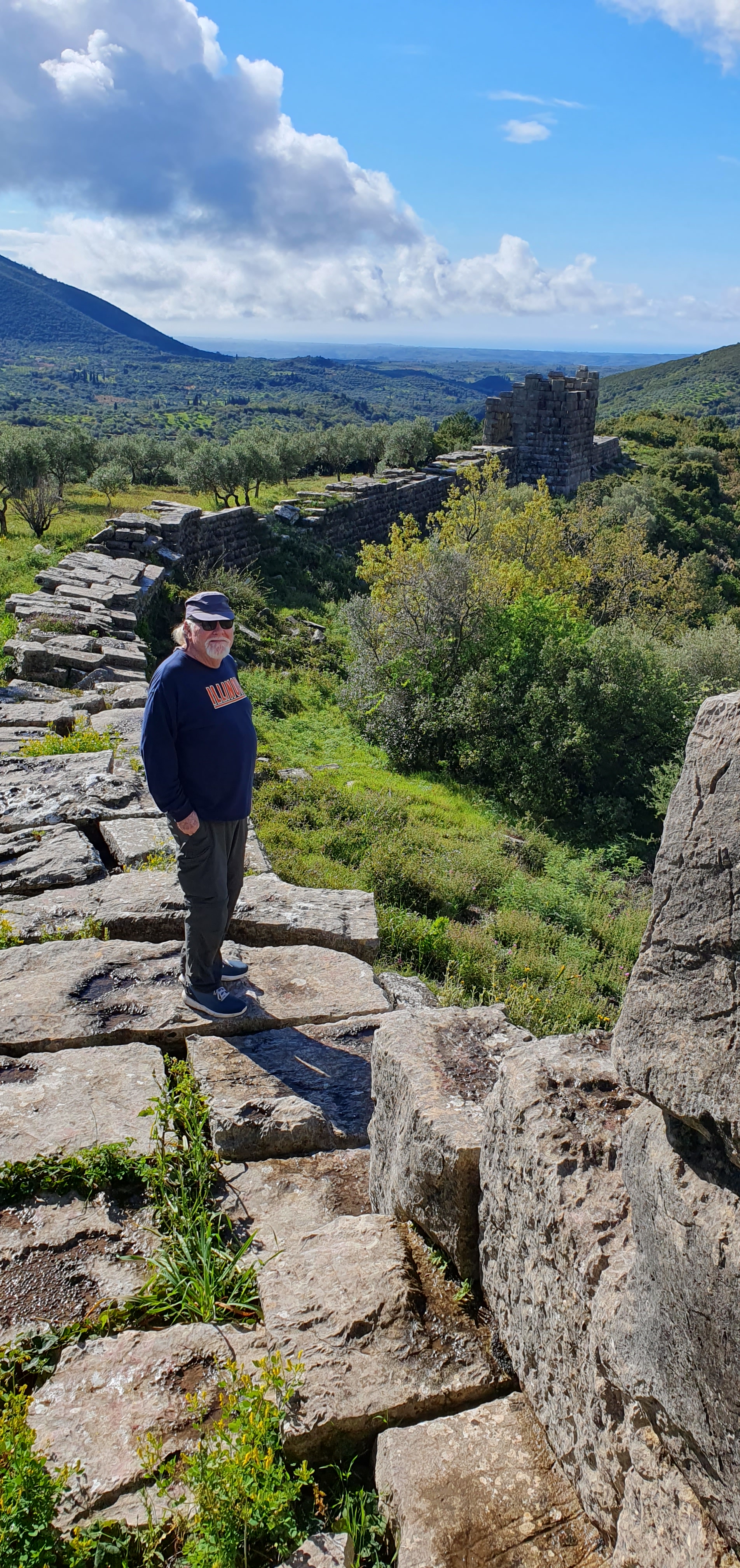
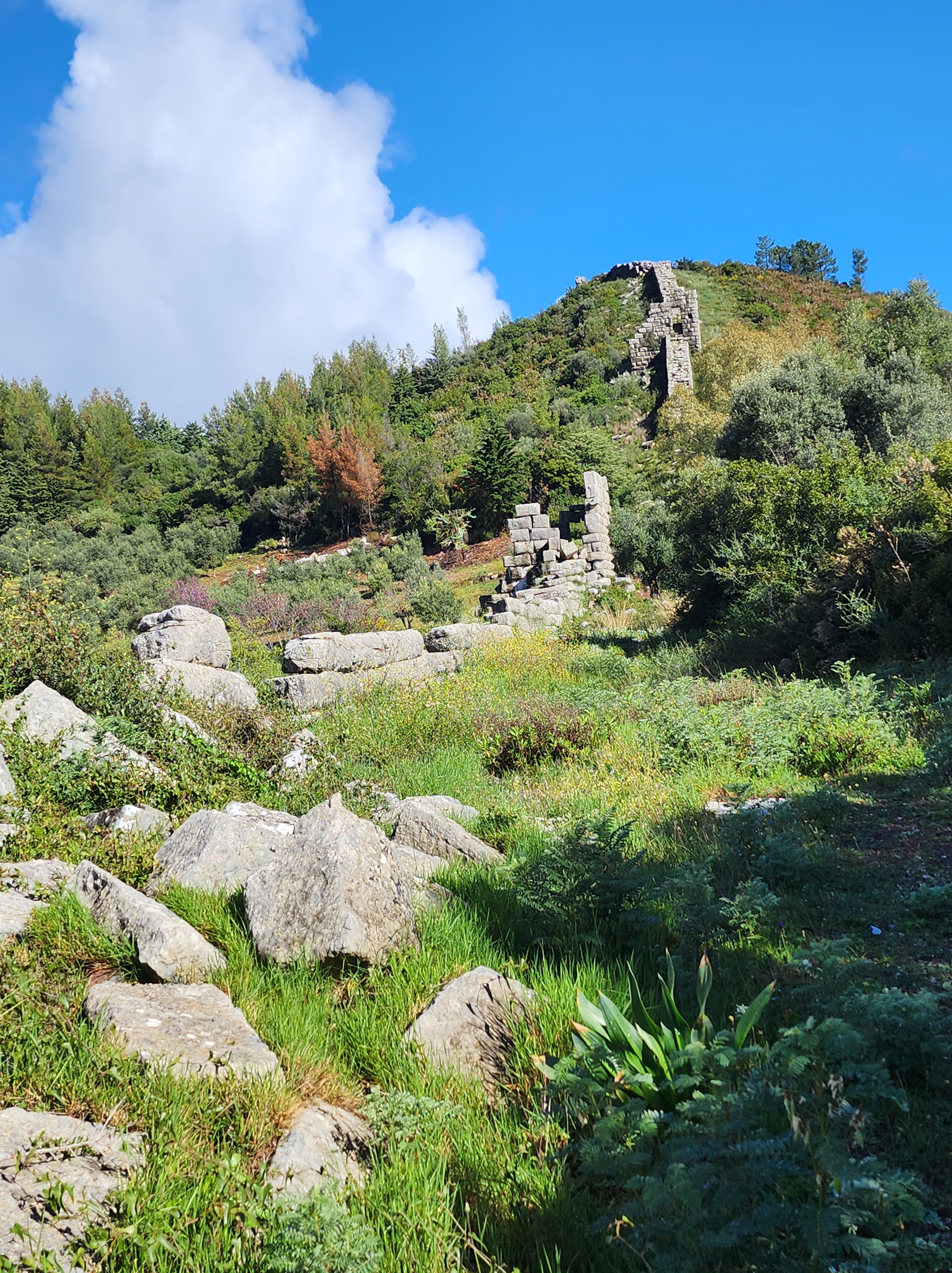
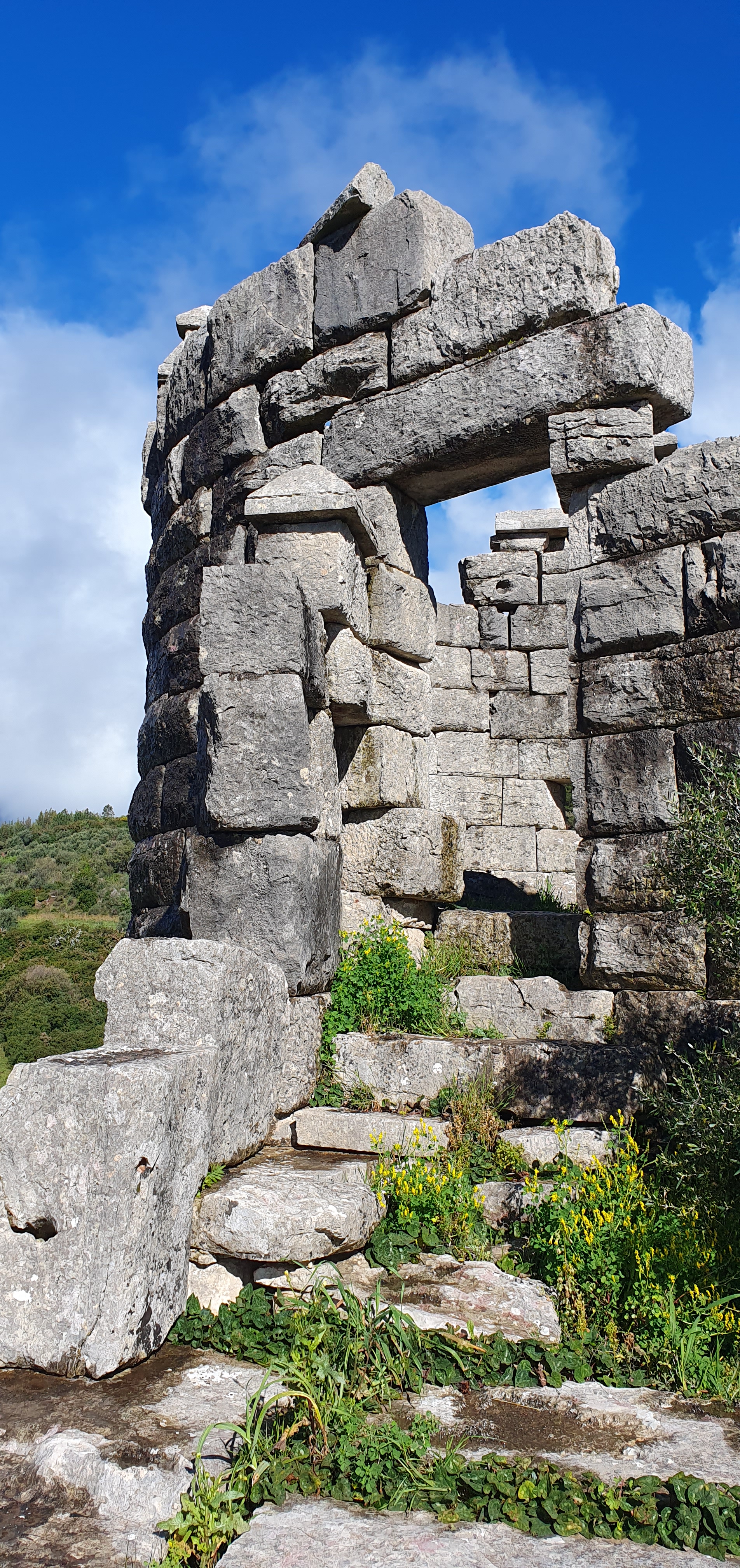
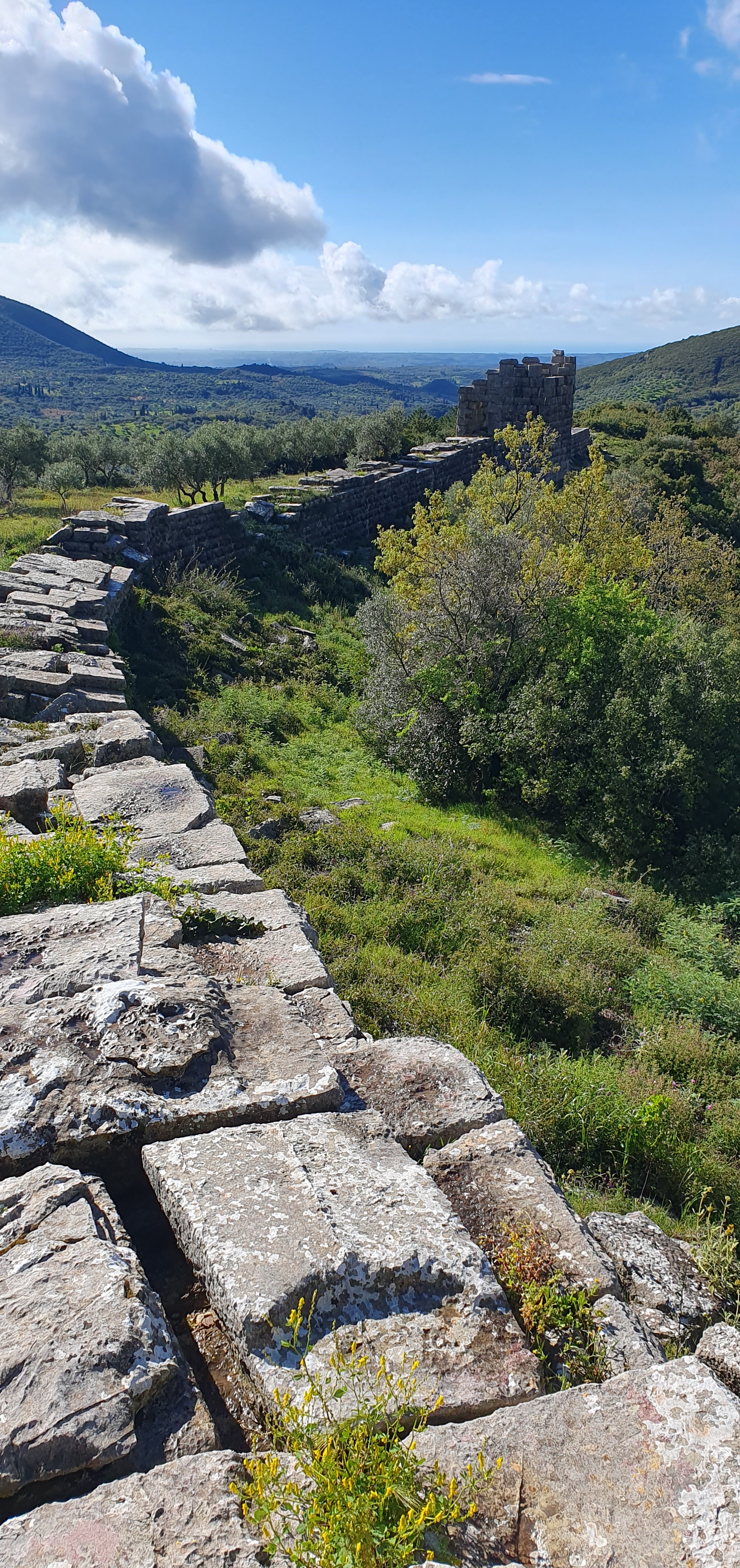
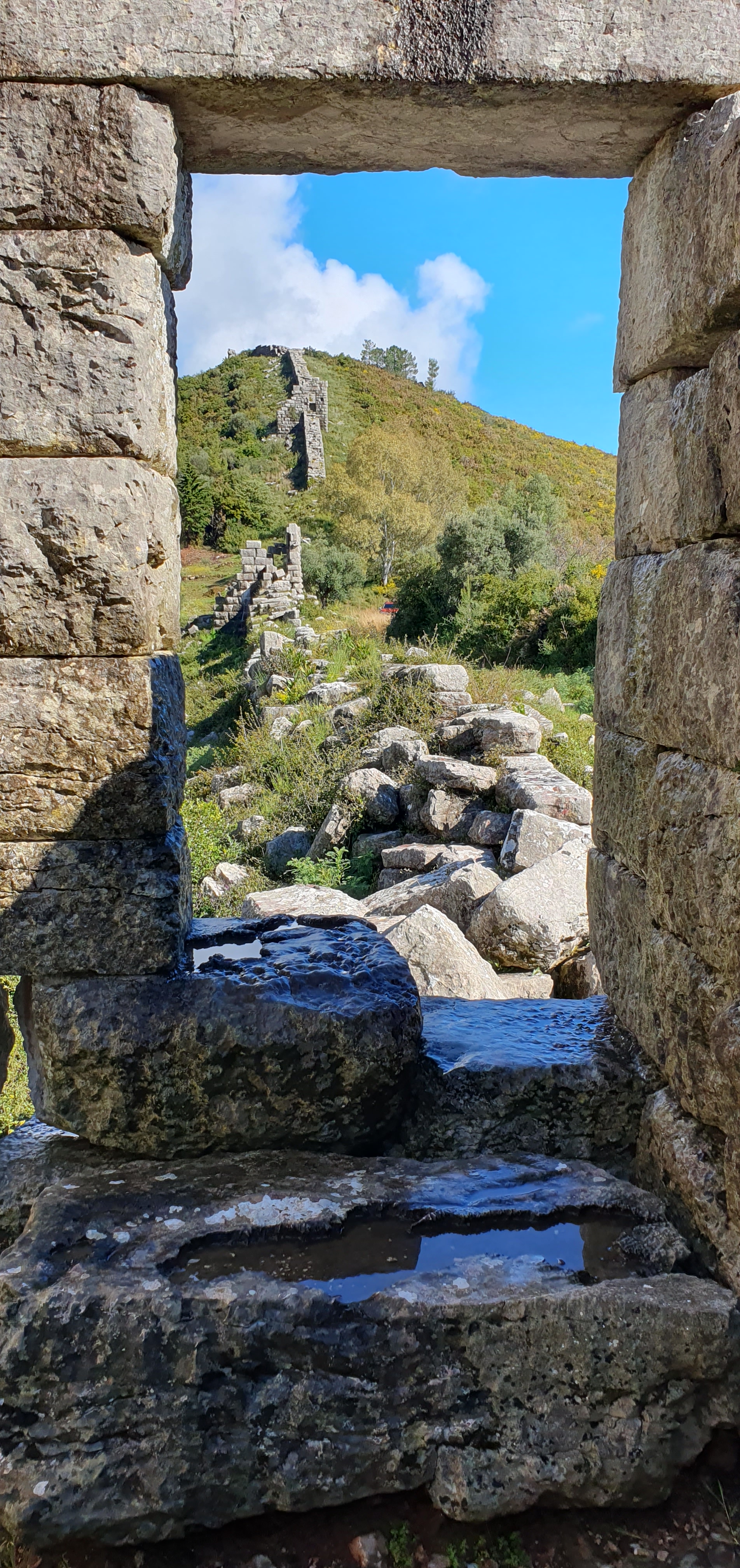
The walls of Messene are impressive, and are reported to have been built in 85 days by the victors along with exiled Messenians returning from Sicily, North Africa, and elsewhere around the Mediterranean. That’s quite a feat for the time, as the walls encircled the city and Mt. Ithome, more than 5 1/2 miles of stonework and guard towers.
Inside the massive though collapsed Arcadian gate, all the elements of an ancient city of classical Greece are present.
The lintel of the Arcadian Gate, Messene.
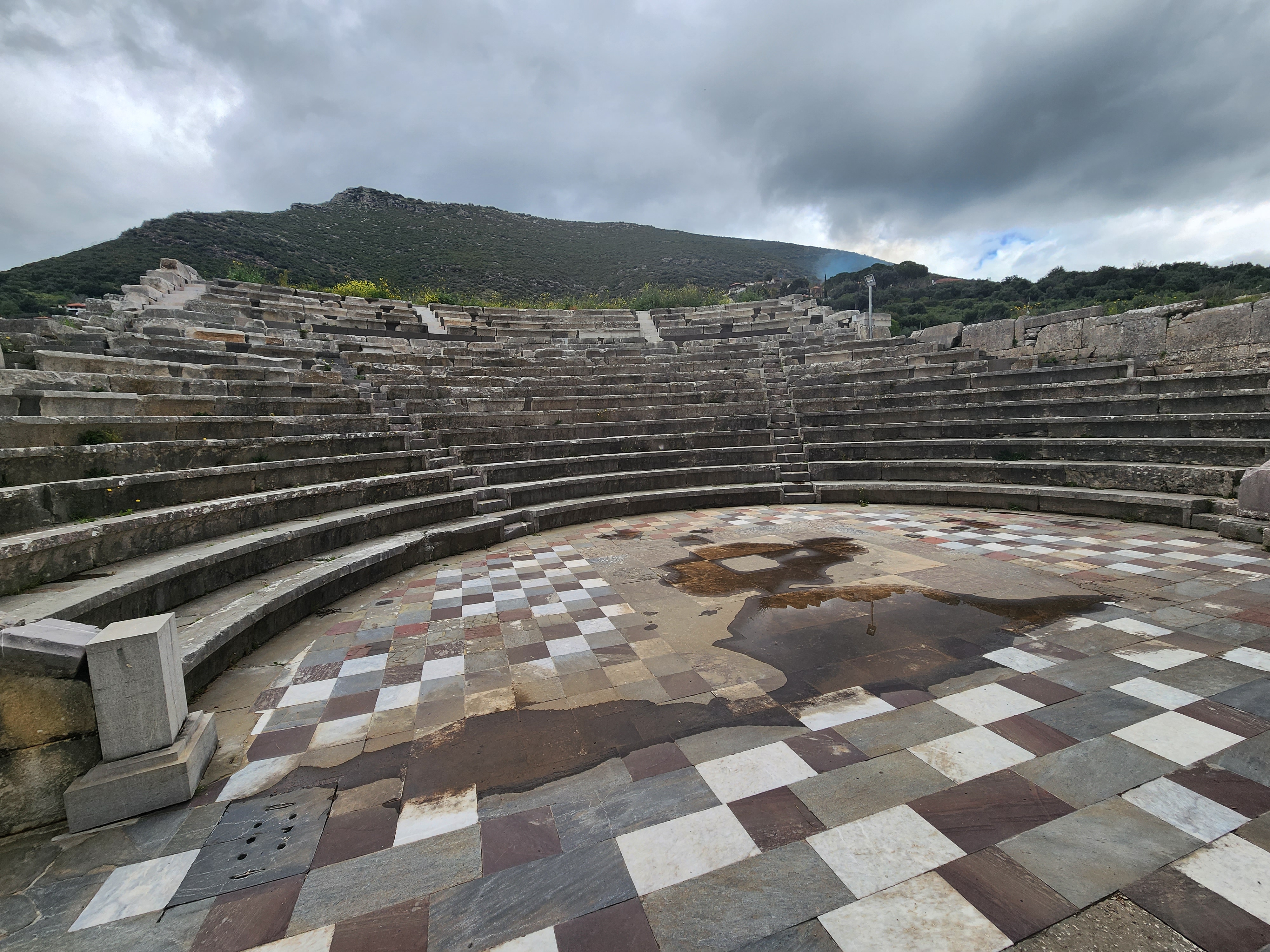
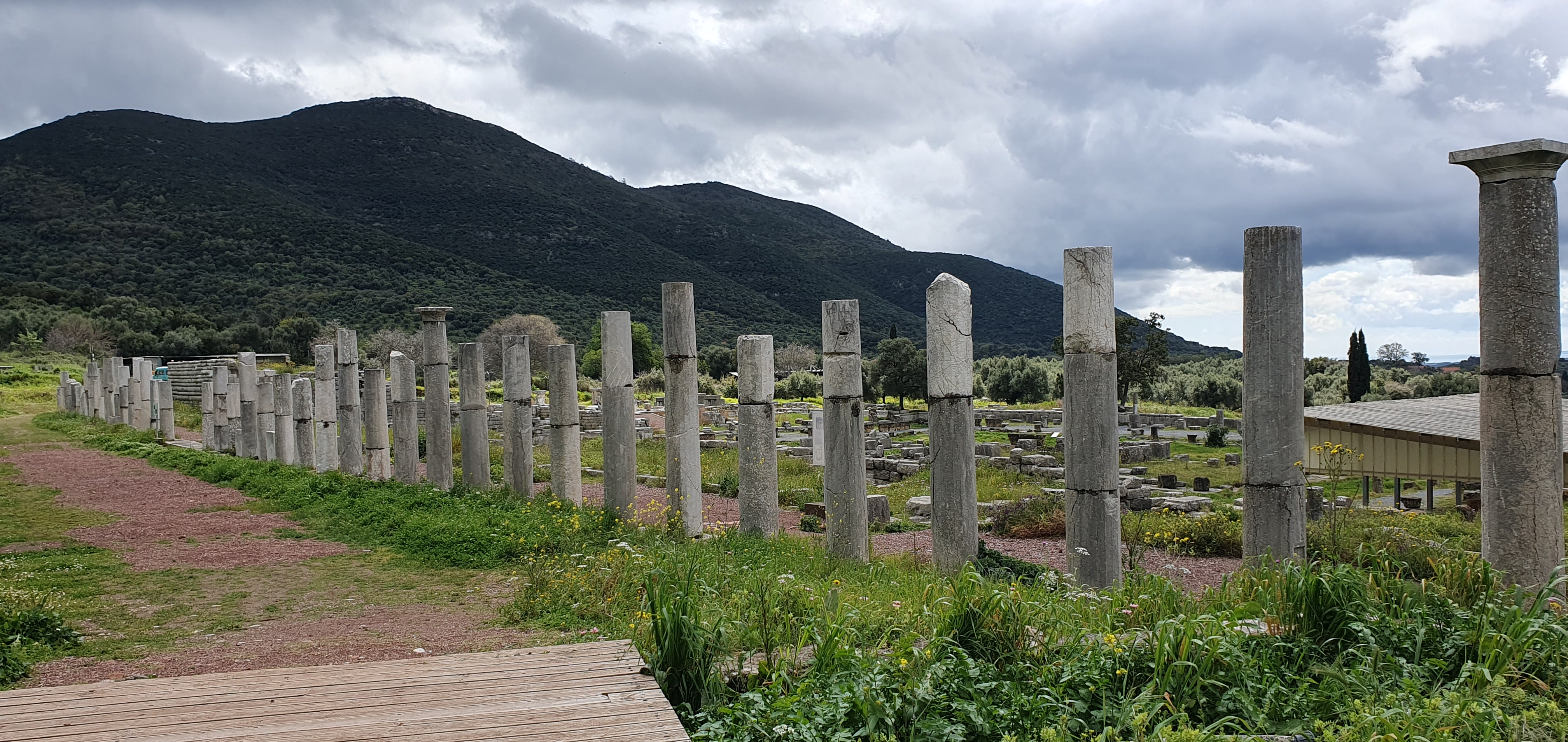
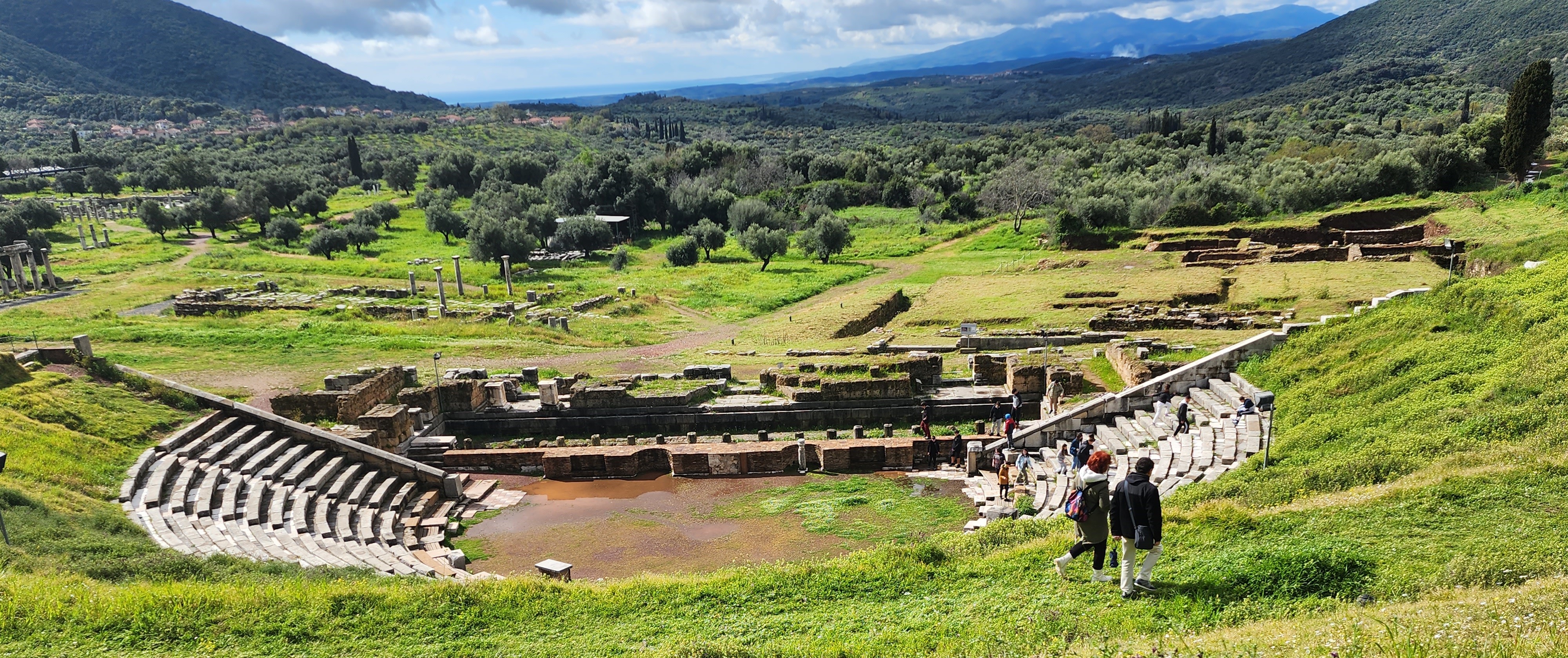
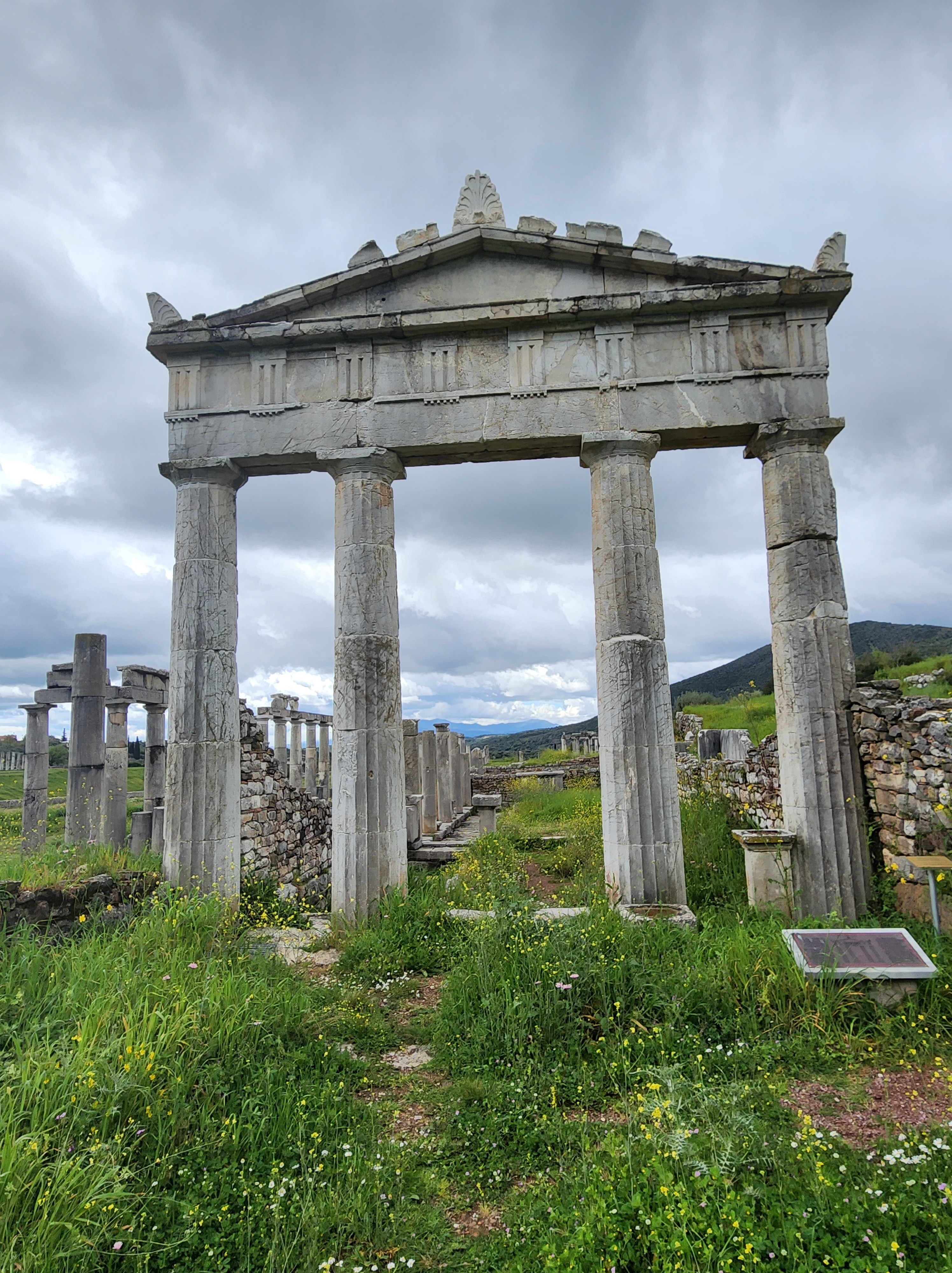
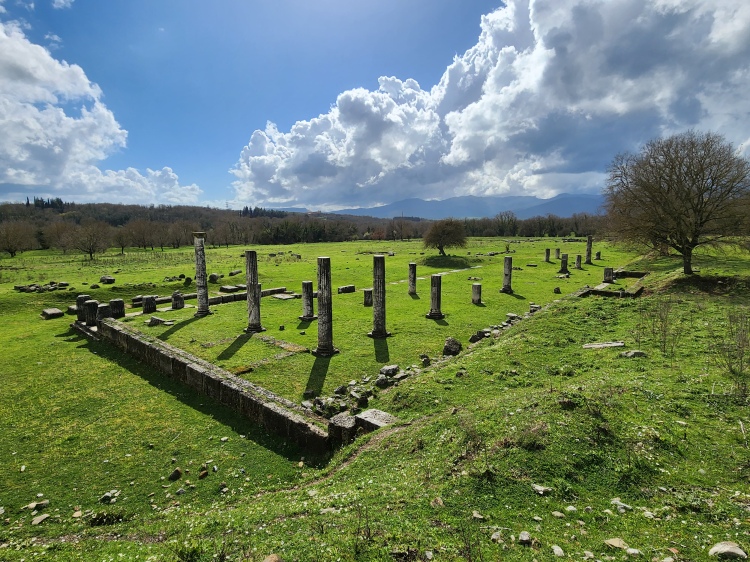
The agora at Messene was the town square, shopping precinct, and civic meeting area. At the small amphitheater, or Bouleuterion, a council of citizens met to decide public affairs. Its tile floor is an unusually well-preserved checked pattern. There was also an Asklepion, or healing area, though healing was not the entire focus as it was at Epidaurus.
Messene had a large amphitheater built into an artificial hillside. The stage area included areas for dragging scenery on and off with large wheeled carts.
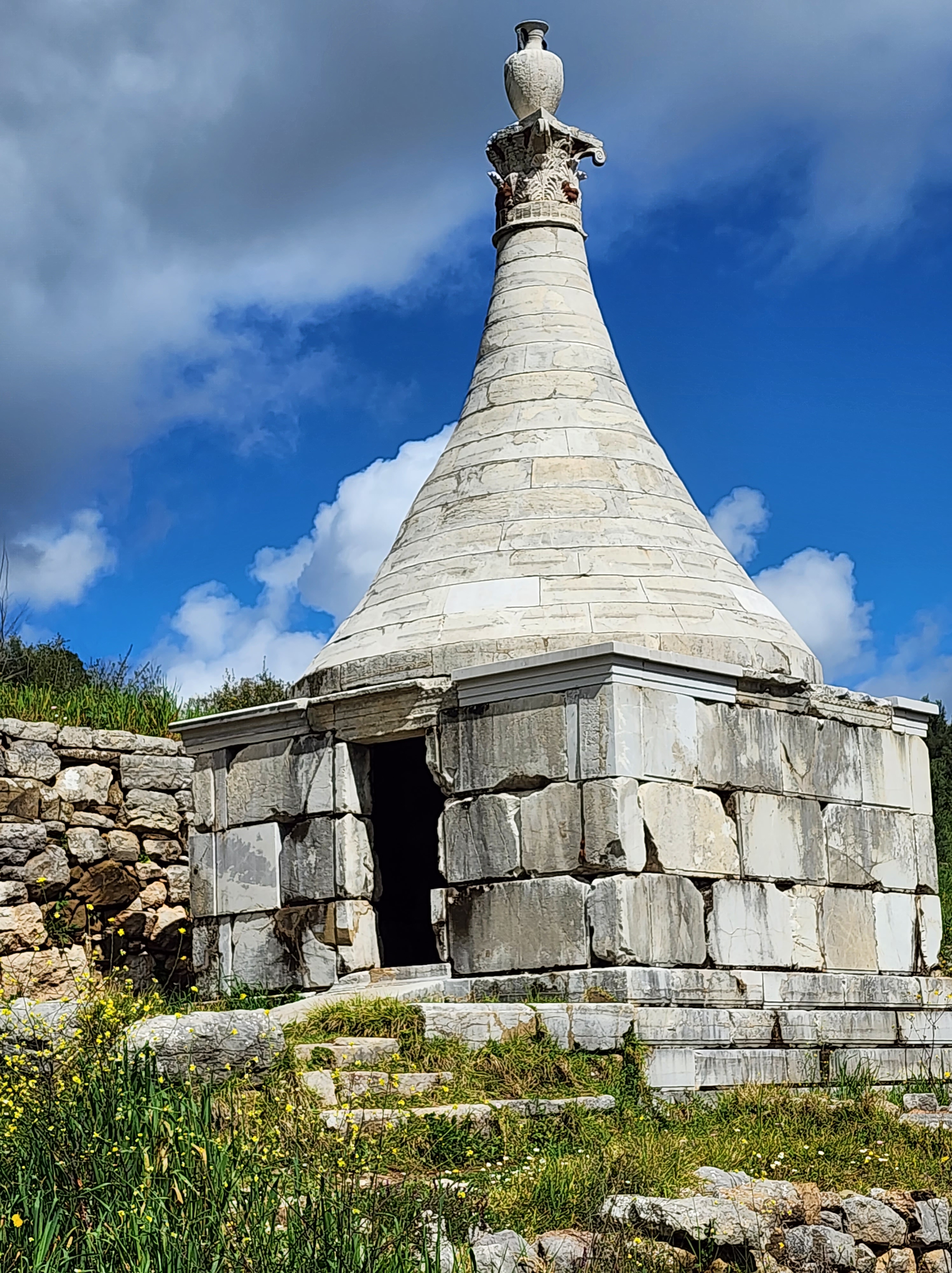
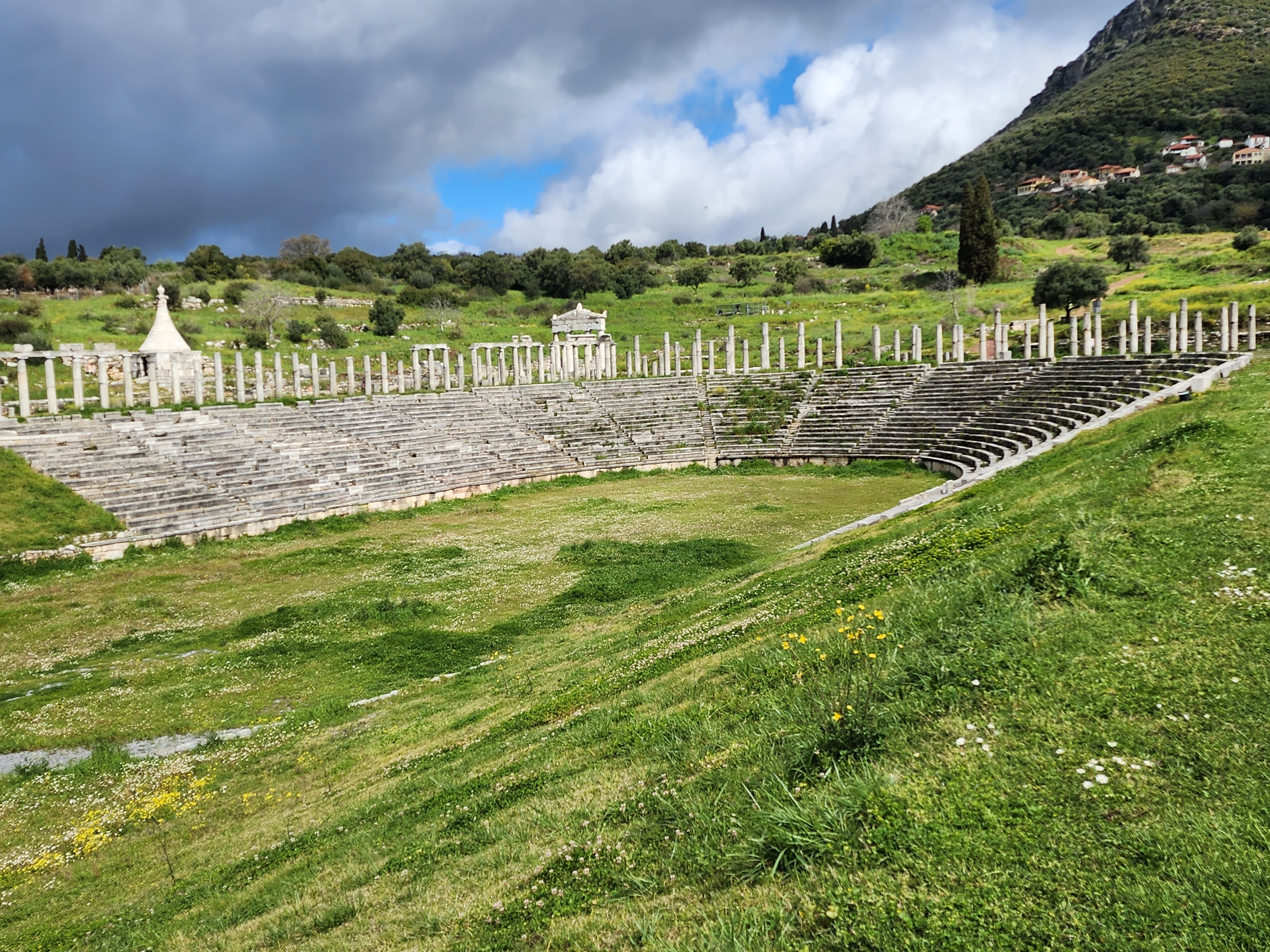
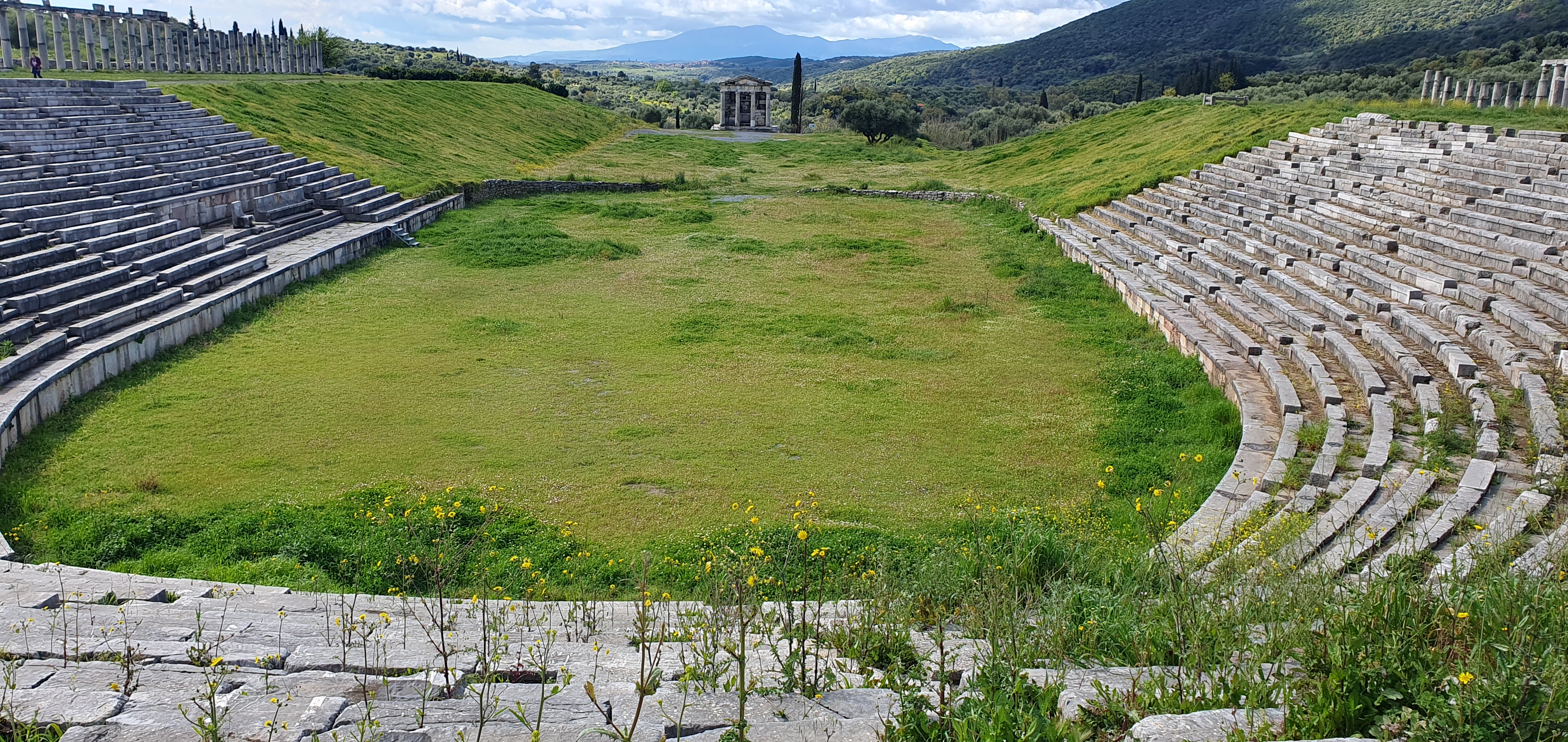
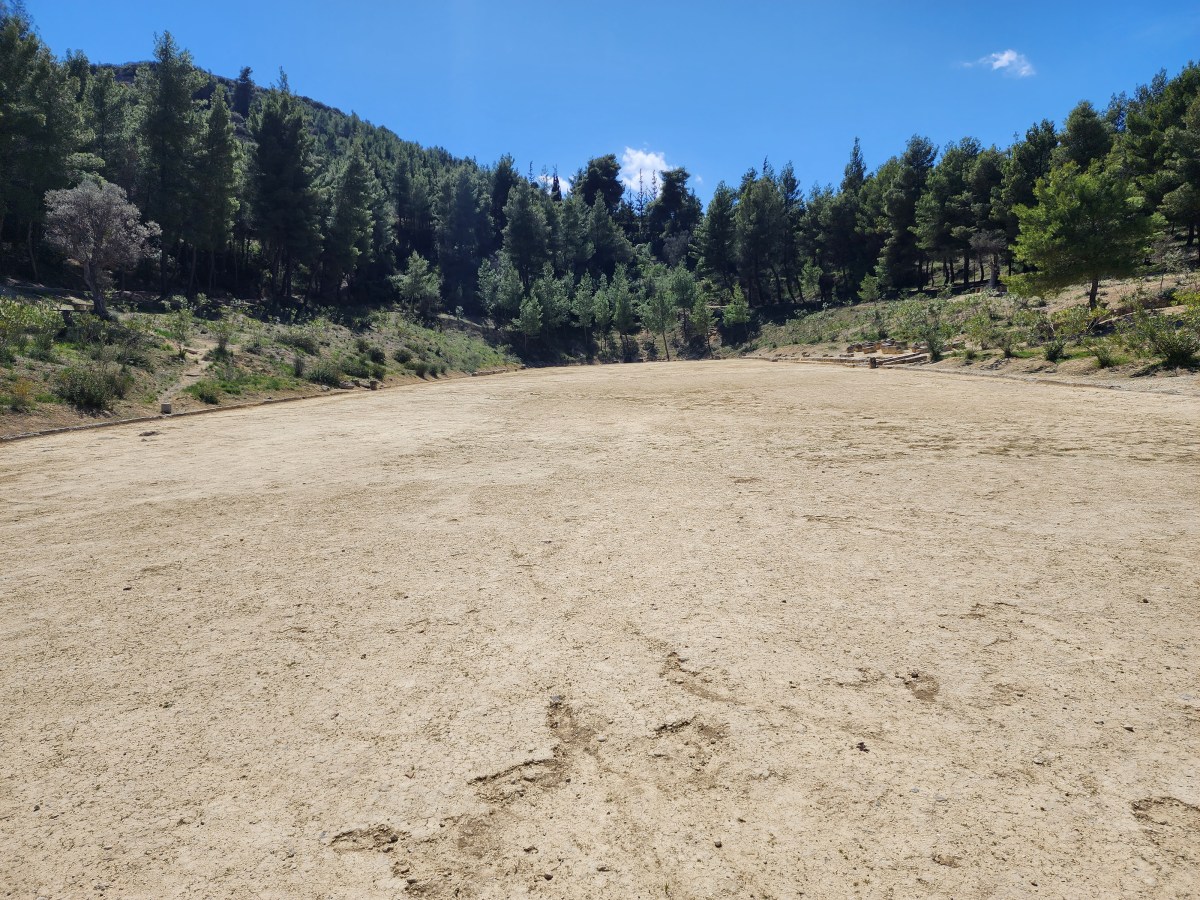
Messene also had a large stadium surrounded by colonnades, statues, markers, and stele celebrating those who participated in events at the stadium, offerings to patron gods, and efforts to invoke a winning competition. One of the monuments is unique in having a conical roof. The Messene stadium has its starting line in the curved end of the stadium, and the distance was always measured so that the finish line was in the same place–spectators got to see all the exciting parts.
Aristotle showed us a place where athletes sat and whiled away the time playing a game like checkers or tic-tac-toe on a board scratched into a stone step.
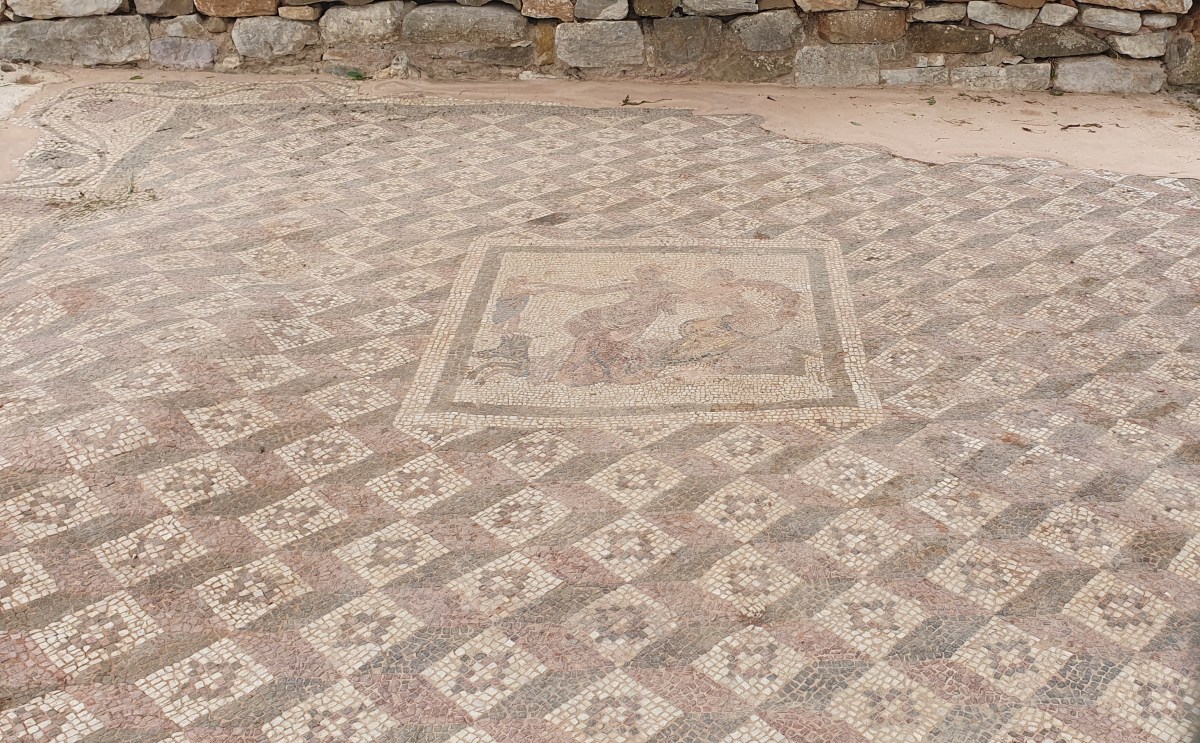
By the middle of the second century BC, Rome began to expand, and eventually took control of Greece. In Messene, that meant the addition of Roman villas to the city–the conquest seems to have been more economic than battle-driven. Some of the villas have been excavated, revealing elaborate mosaic floors like the one below.
We enjoyed the completeness of the city of Messene. It was easy to recognize structures and sometimes to distinguish their function. The Bouleterion, amphitheater, and the stadium show that it was large and cosmopolitan city, with people coming from all around to worship, take part in healing ceremonies, trade, or participate in games.
That wasn’t the end of our day, either.
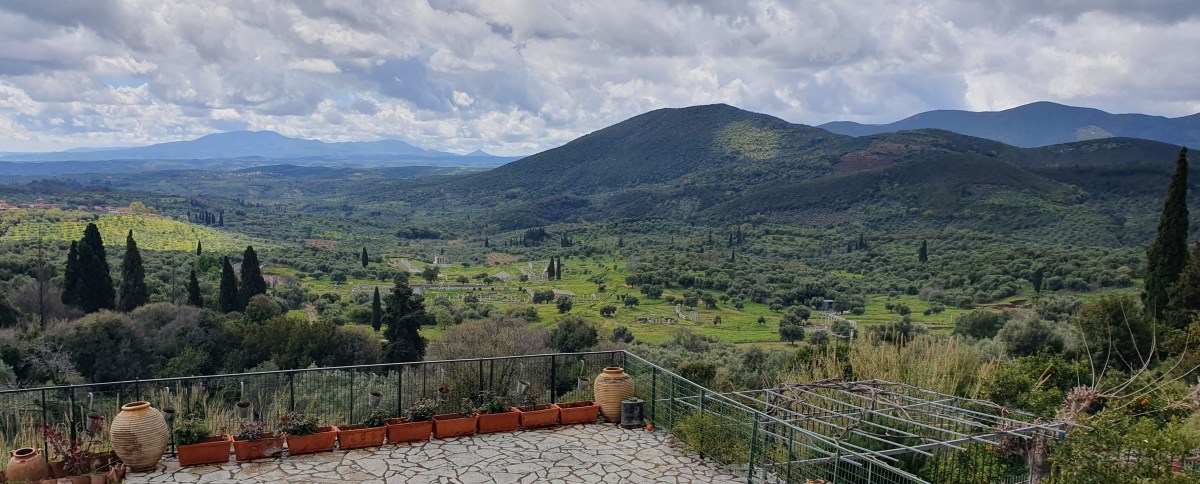
We stopped for lunch in Chora, a town in the hills near Messene. Sitting outside, the view was lovely
In the afternoon, we drove across the hills to the coast to Pylos, another Greek city mentioned by Homer and Pausanias. On the way, we stopped at a large Mycenean (1700-1000 BC) site called Nestor’s Palace. In the Iliad, Nestor is king of Pylos, and though he could have lived at this site, it isn’t certain whose palace it was.
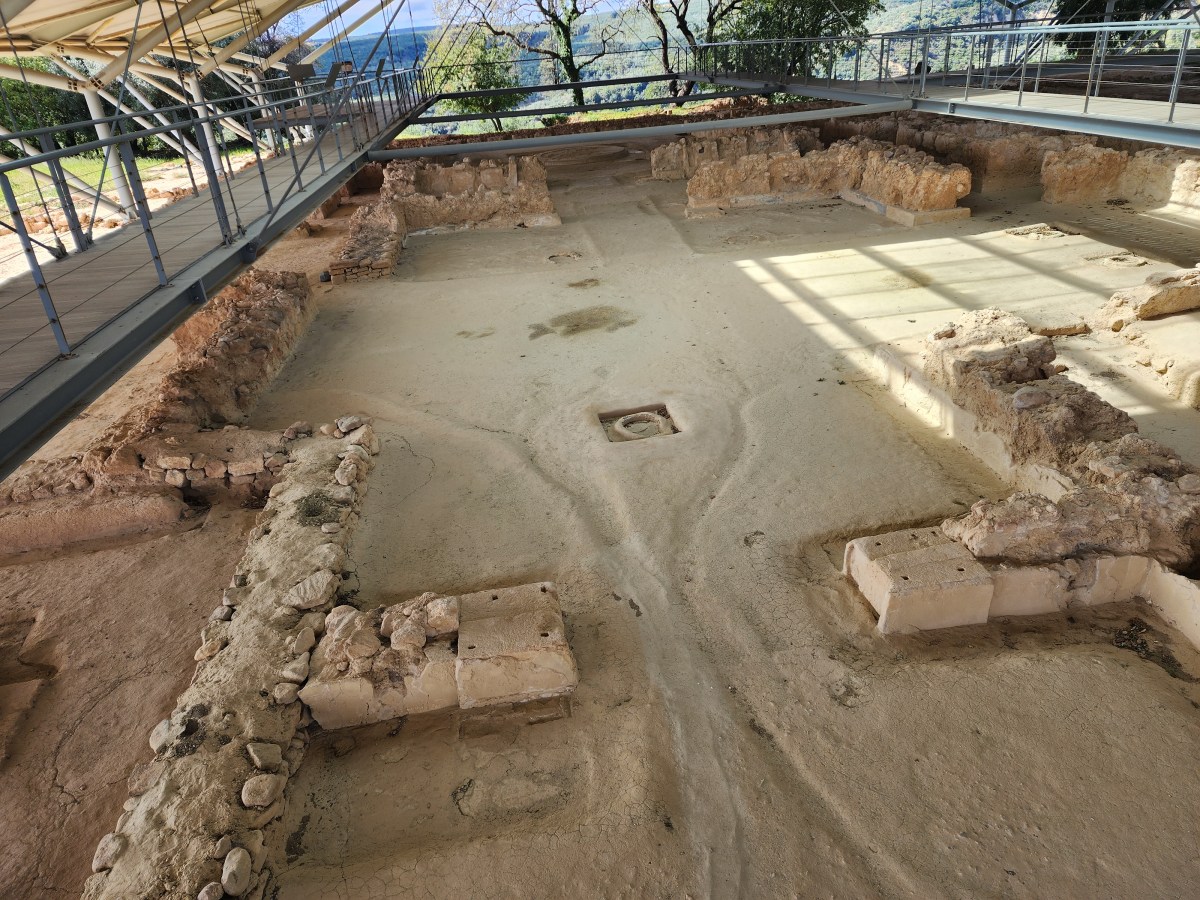
It doesn’t look like much now, but Nestor’s Palace was a grand place in Mycenean times.
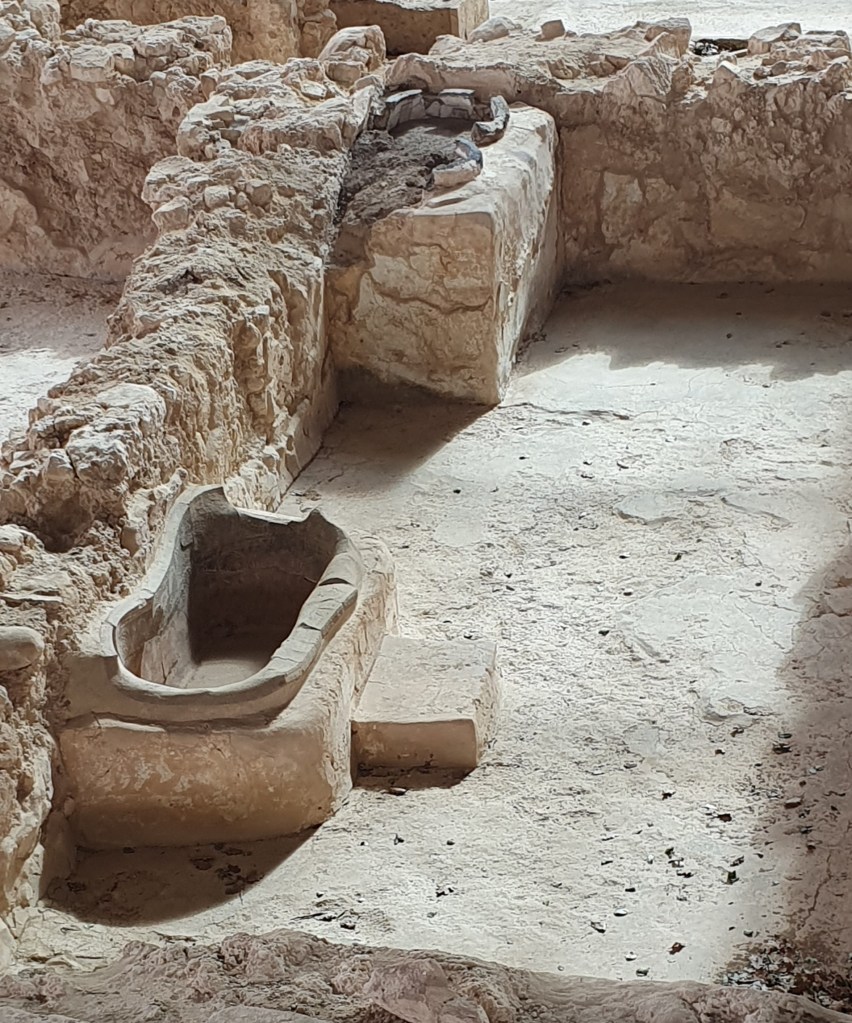
Bathing facilities included a row of sinks, and even a bathtub.
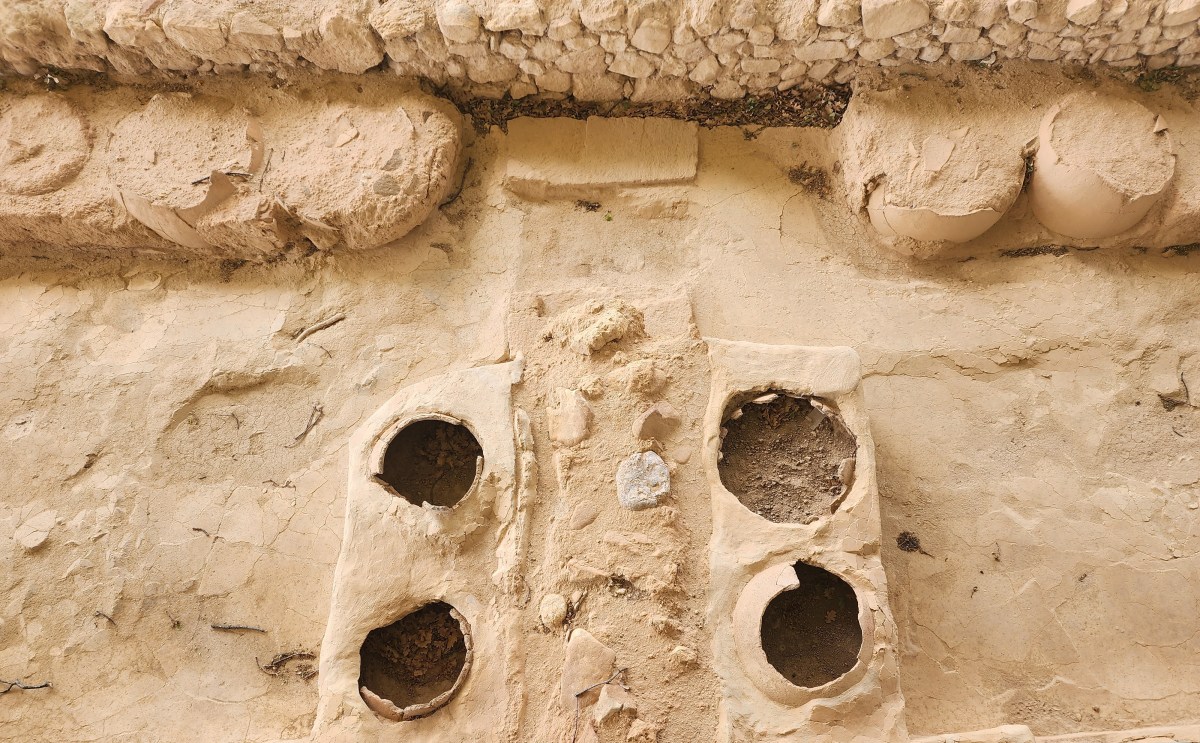
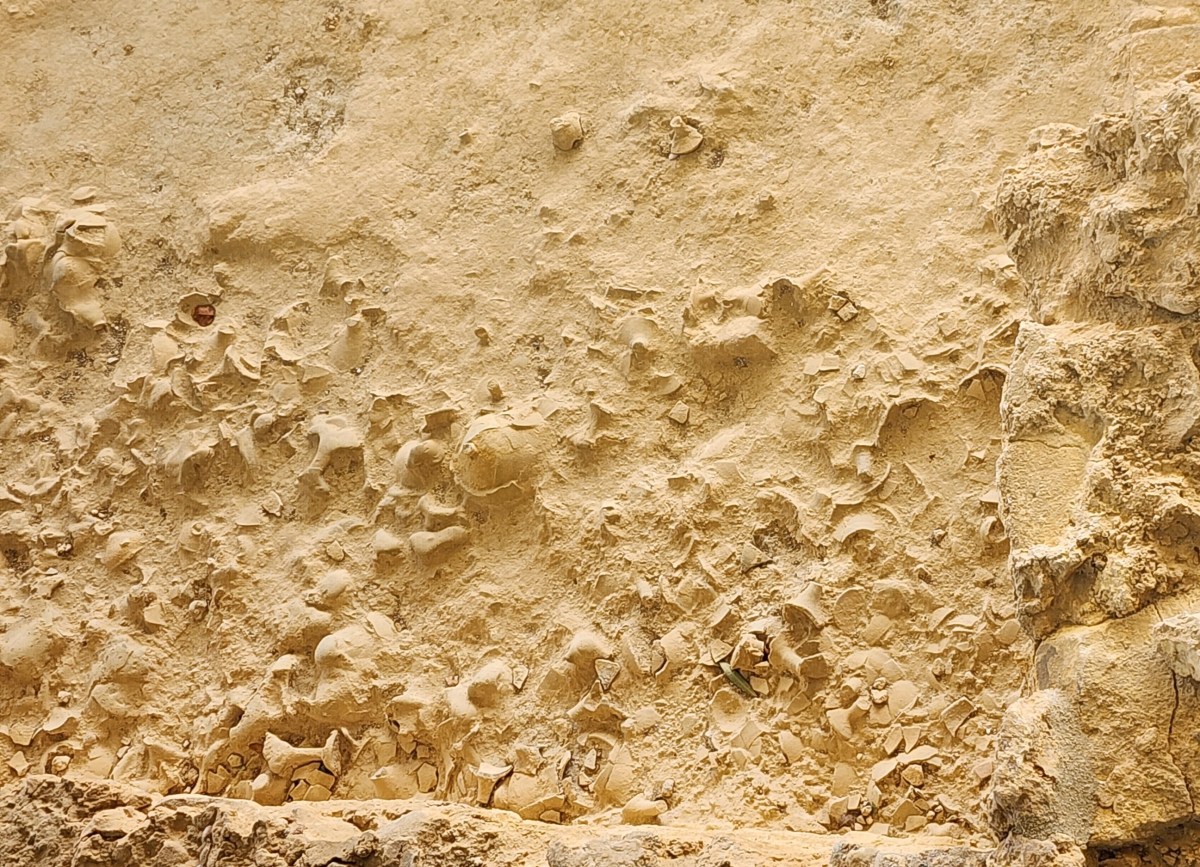
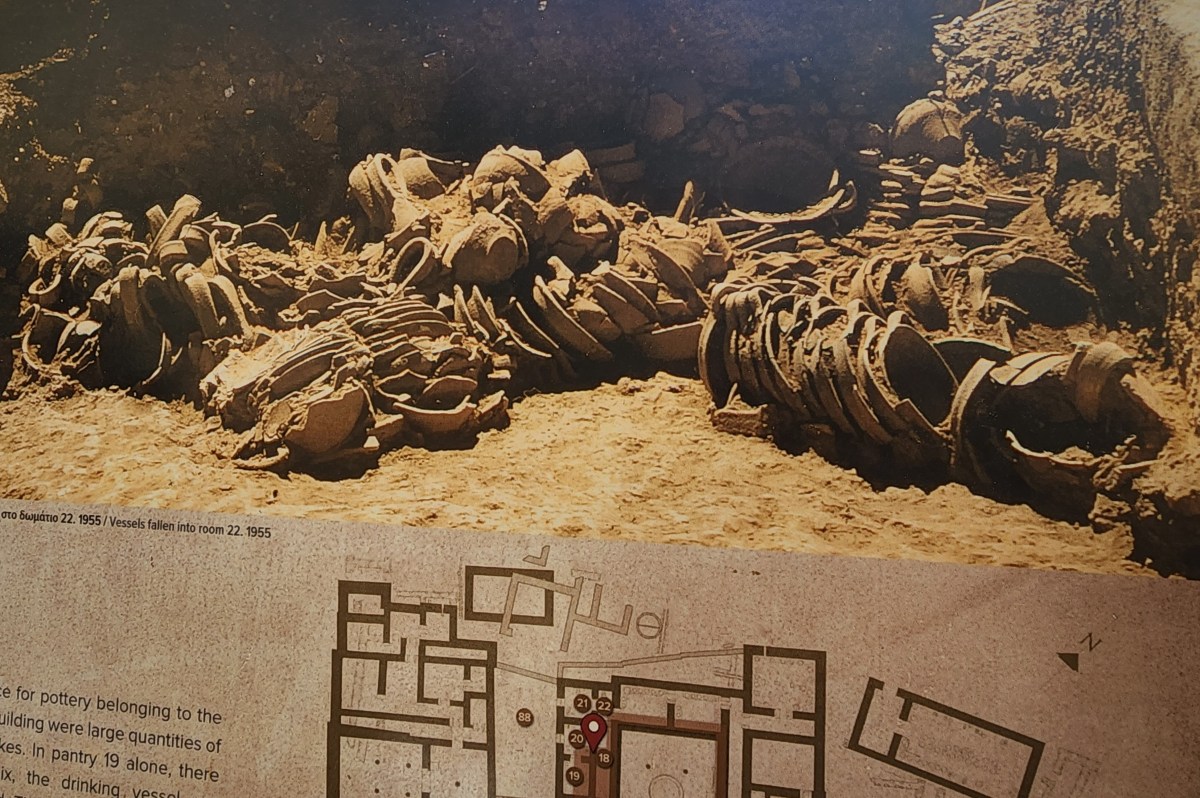
There were stores of oil, grain, and perhaps wine, and lots of staff to keep the place going. During the excavations, stacks of dishes were uncovered, and a roomful of broken cups, possibly the result of an earthquake.
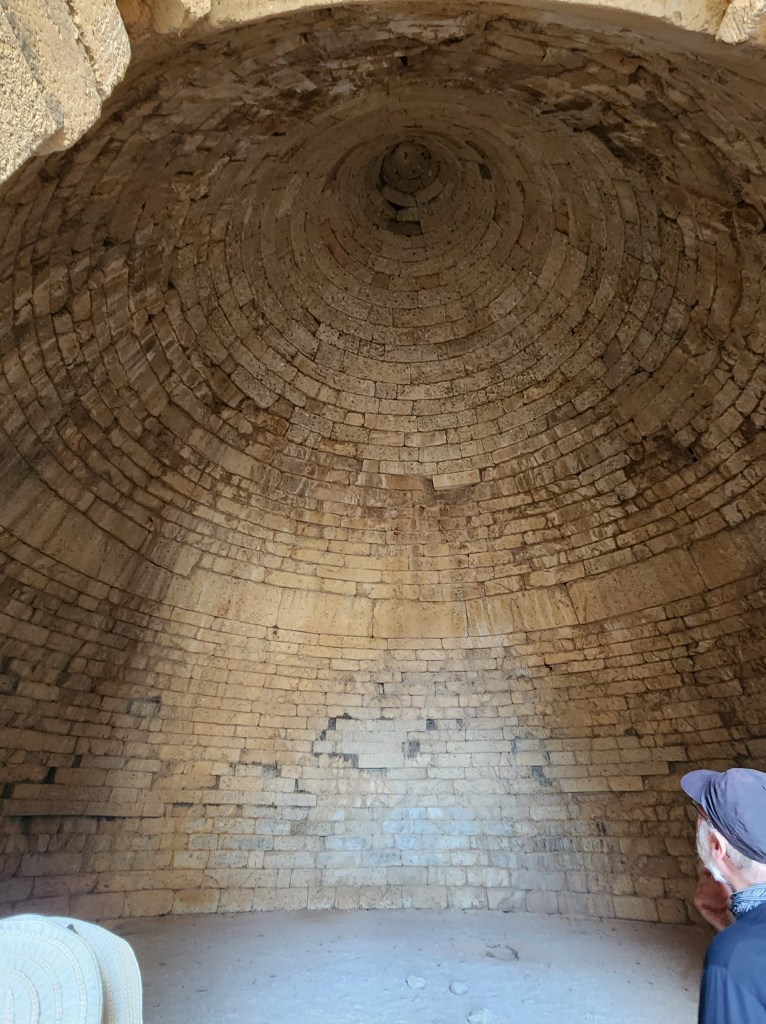
Nearby is a large domed tomb, a tholos. The large size suggests that a very grand person was buried inside. The top of the beehive shaped tomb is at least 15 ft high, and represents a lot of work. Though it was looted long ago, the tomb must have held fancy grave goods, perhaps weapons, gold objects, and lots of pottery vessels.
It was lovely to end the day in Pylos on the coast, looking out over the water. For centuries, the city of Pylos was called Navarino by conquering foreigners, from the Frankish conquest in the 13th century until Greek independence in 1830. The last naval battle between sailing ships, the Battle of Navarino, took place off the coast here, and was a crucial win for Greece in establishing independence.
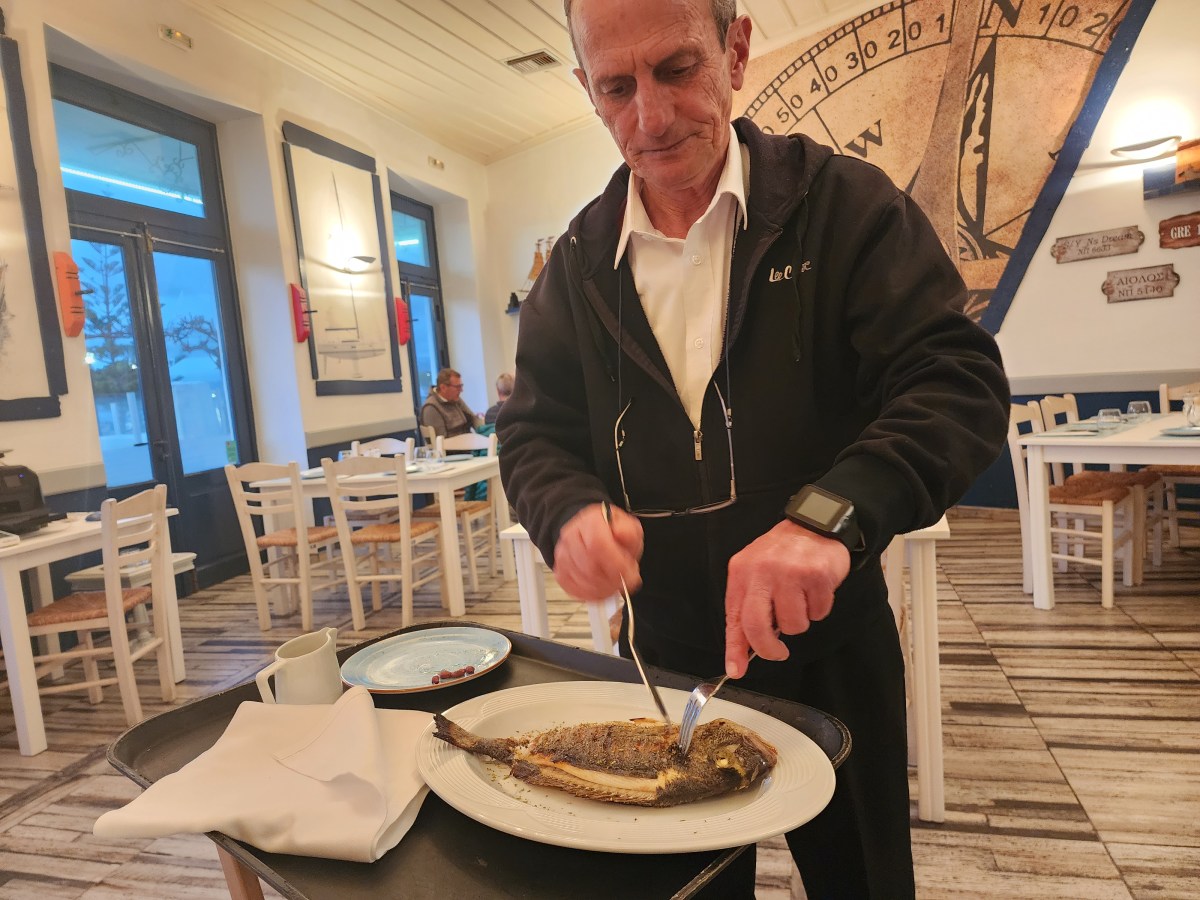
We had dinner along the shore, and ordered a whole fish that the waiter boned at our table.
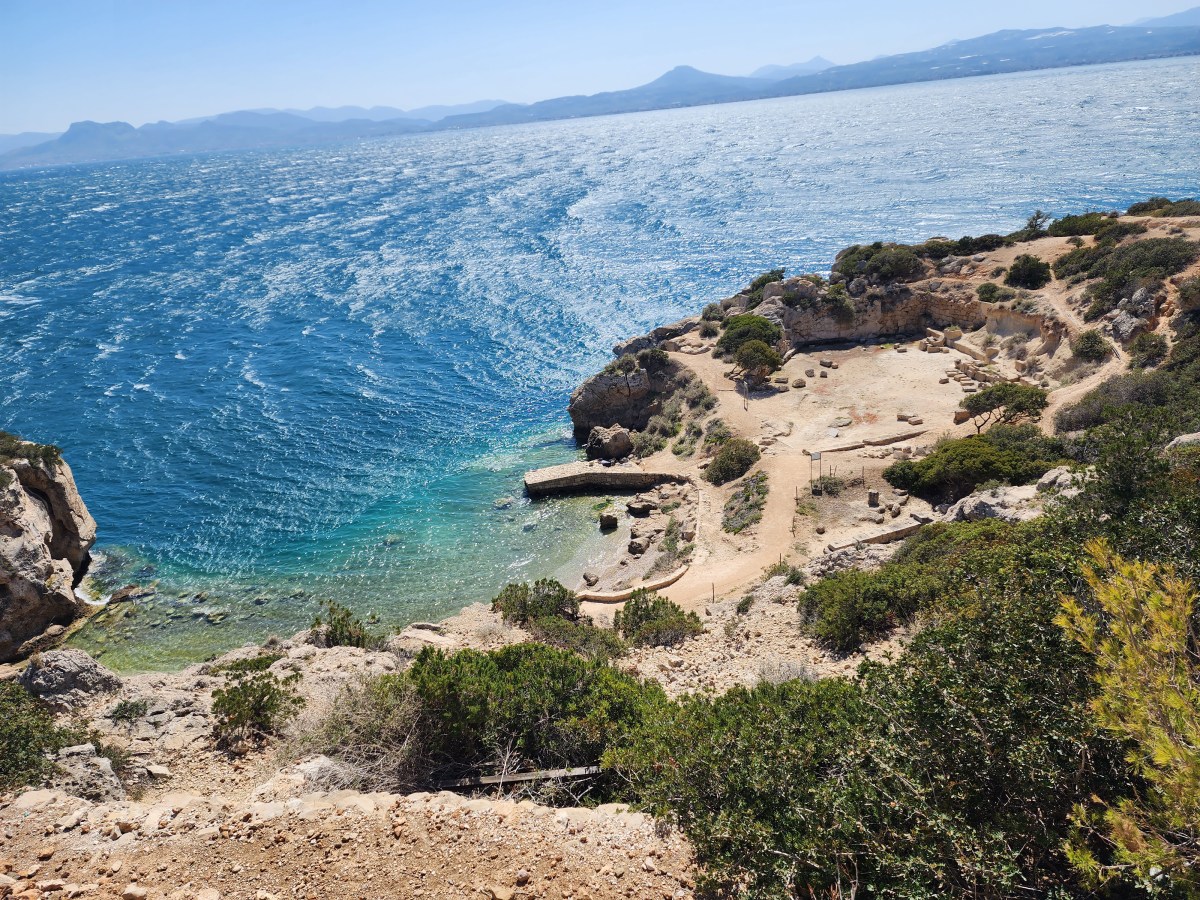
The Temple of Artemis Orthia is in a different part of Sparta, and waiting until the next morning to visit gave us a moment of sun at the site. This temple goes back to the 9th century BC and was in use for over 1000 years. It is where people went to make offerings to Artemis, where they left many of the votives we saw in the museum.
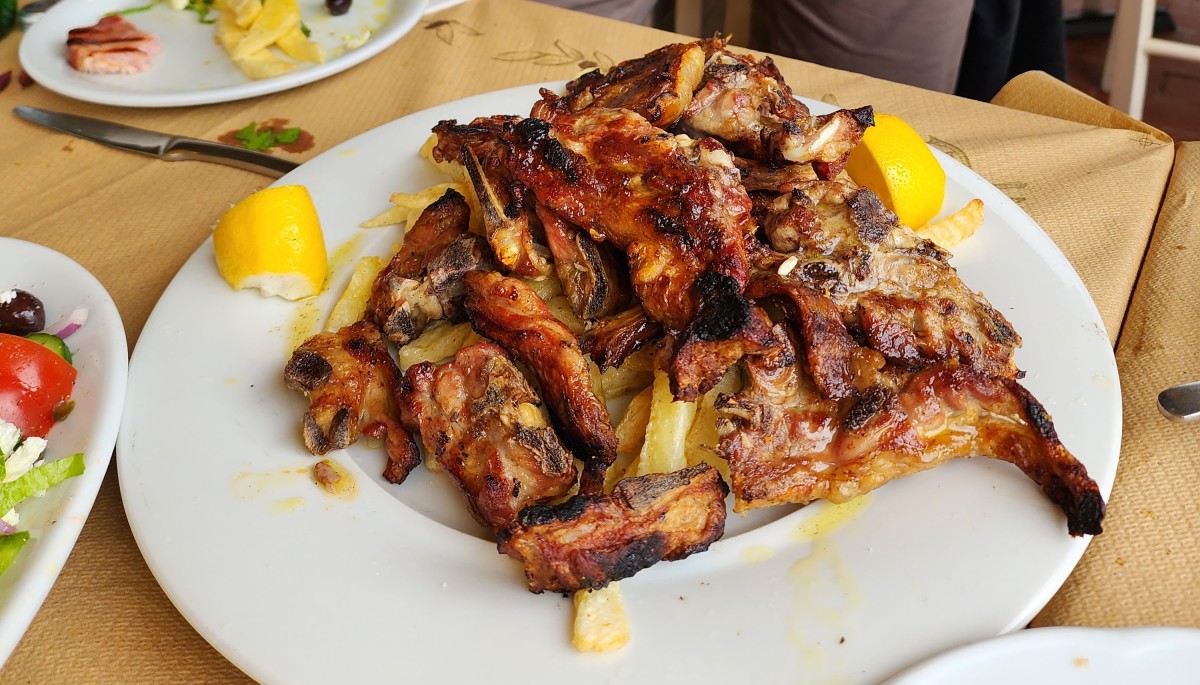
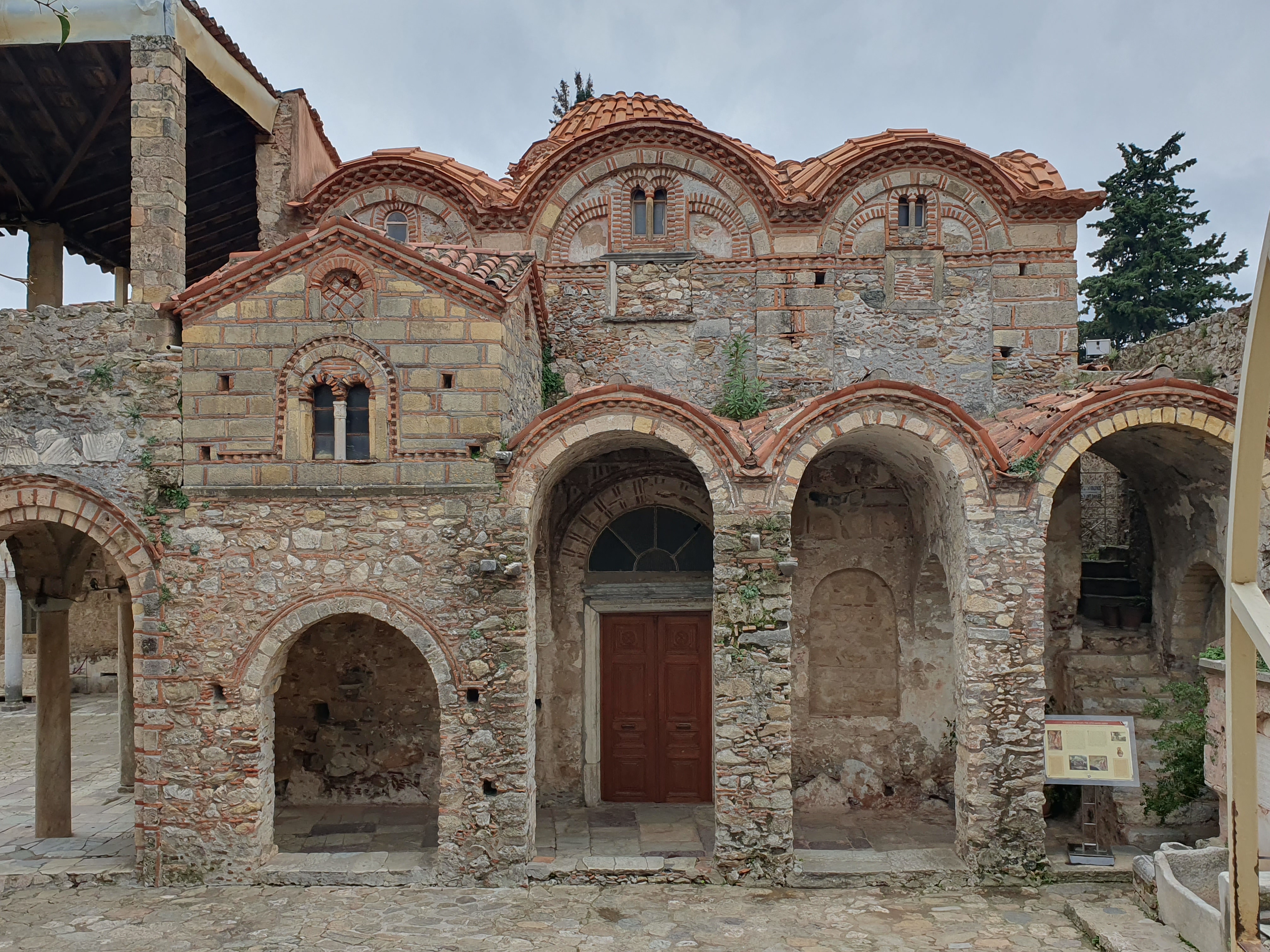
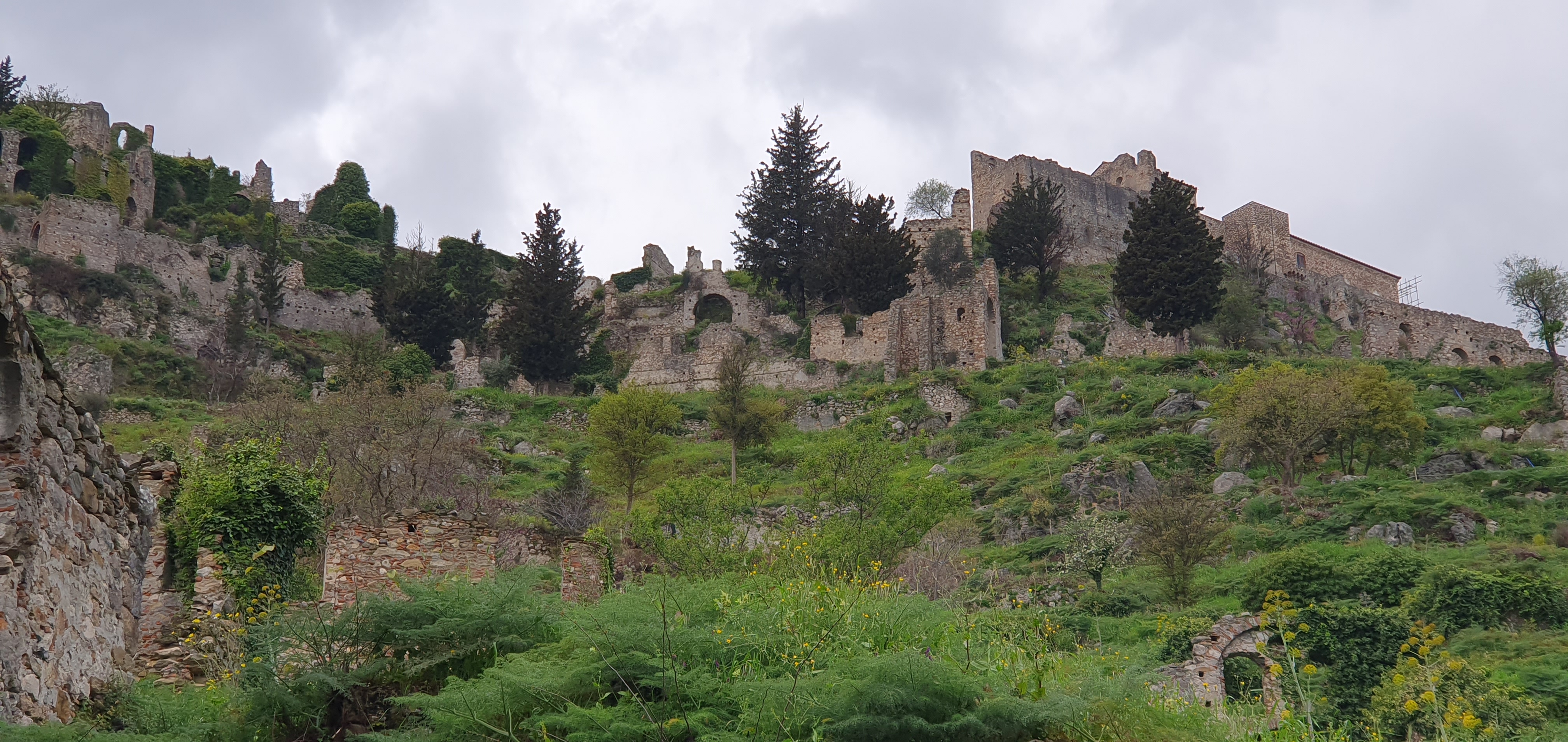
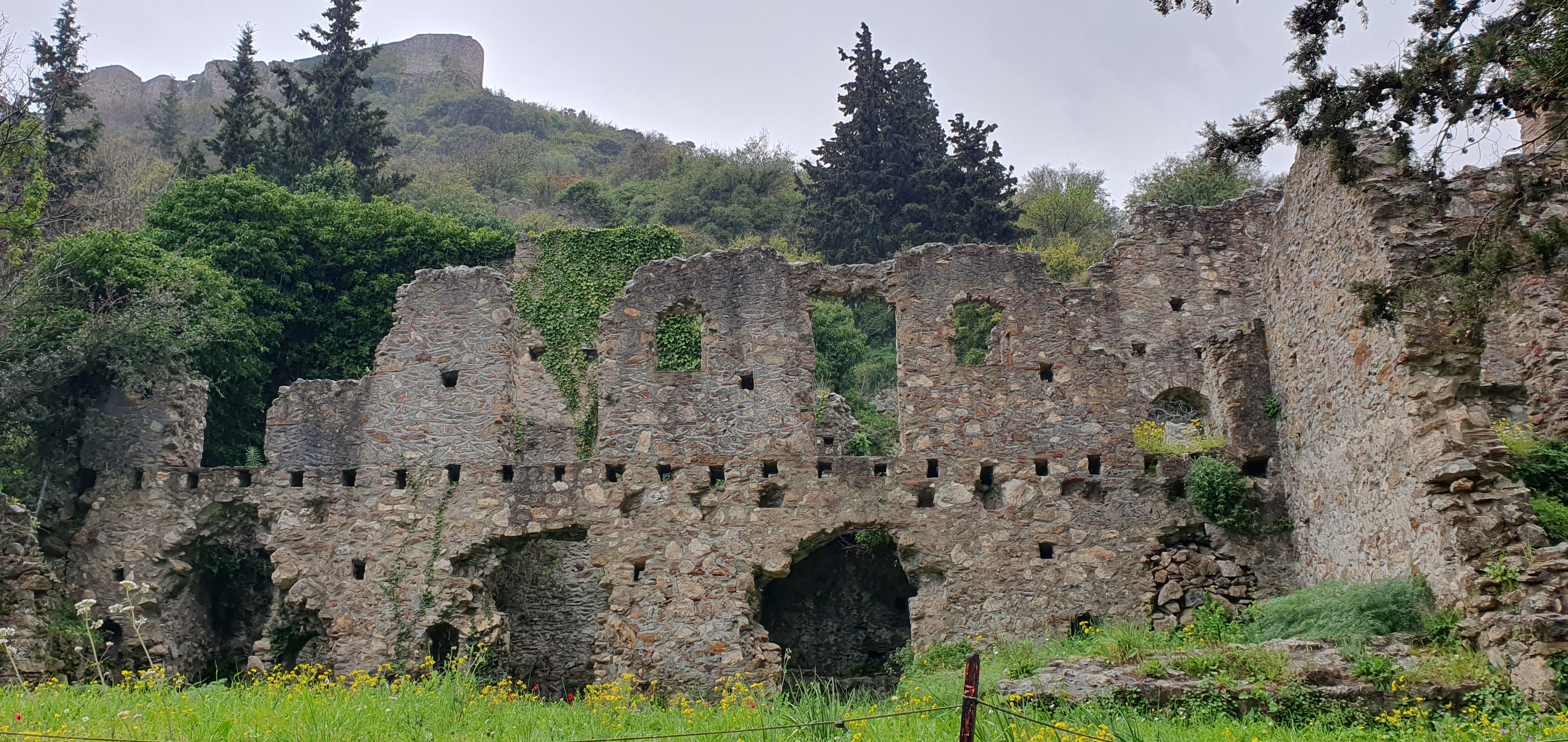
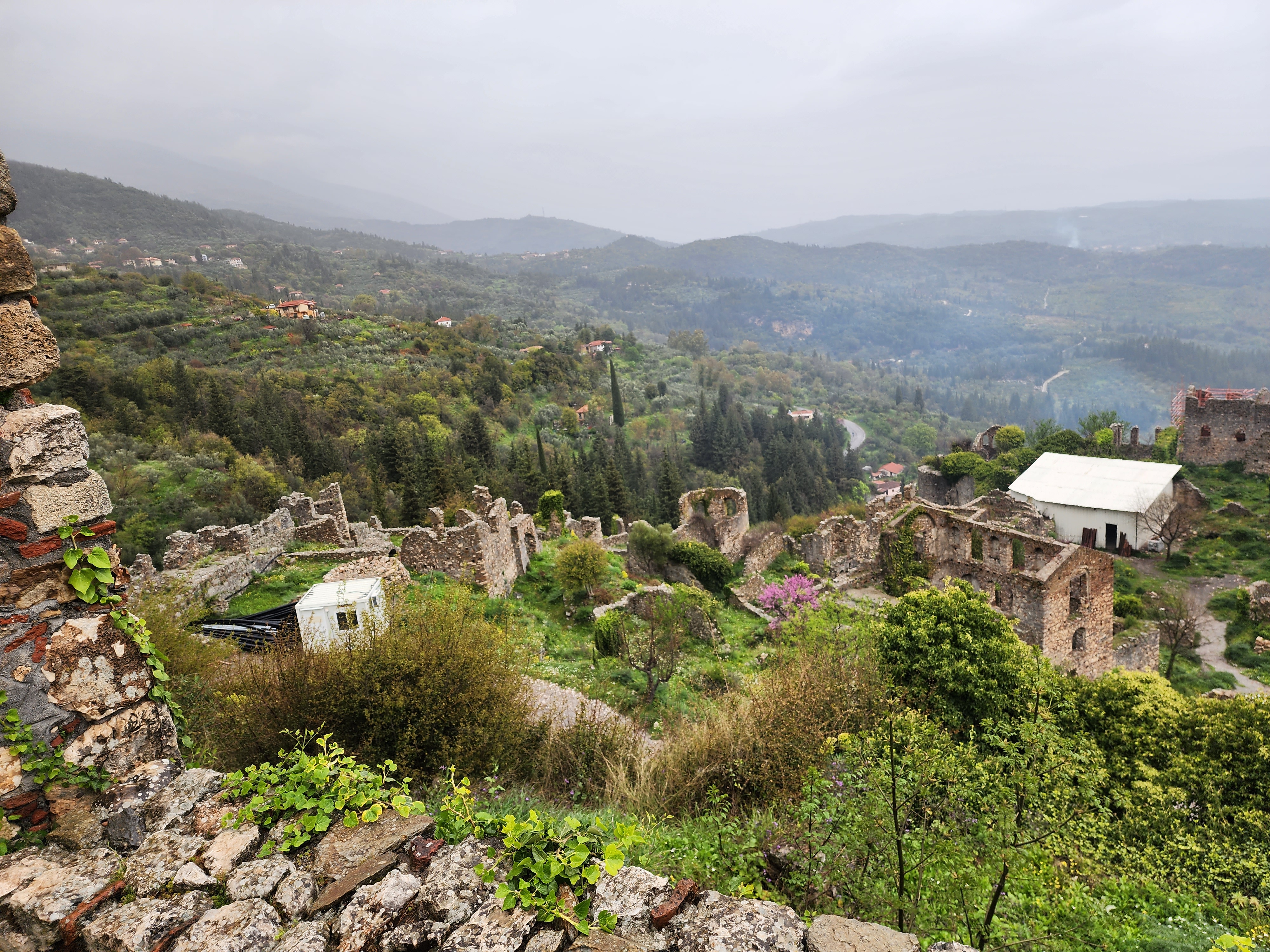
After lunch of grilled lamb, we moved on from Sparta to Mystras, a nearby site that is much later in time, occupied during the 14th and 15th centuries when the Byzantine Empire ruled the region, and continuing through Ottoman rule. Abandoned in the early 1800s when the city moved to the current location of modern day Sparta (Sparti), Mystras is unusually well preserved. We aren’t particularly interested in Byzantine and Ottoman sites, having seen some wonderful ones elsewhere.
If you have never visited a well-preserved archaeological site, Mystras is a marvel, with many structures still standing. Churches, a monastery, and a variety of houses. It’s a huge ghost town.
It was misty and drippy at Mystras, quite atmospheric, and we enjoyed our walk, though we did not hike as much as is possible. The hike is steep. From there we drove to Kalamata. Along the way, we stopped to see the theater at Megalopolis. Yes, there is a place with that name that is far older than any megalopolis.
We arrived in Kalamata around 5 pm, and I found time to get out to the beach in front of our hotel for some beach combing. I found some beach glass, but it was starting to rain, so we cut our search short. Kalamata doesn’t really have a beach, it’s a gravelly shingle rather than sand. Usually, this kind of shore is good for finding beach glass, but I didn’t find much and decided not to get soaked.
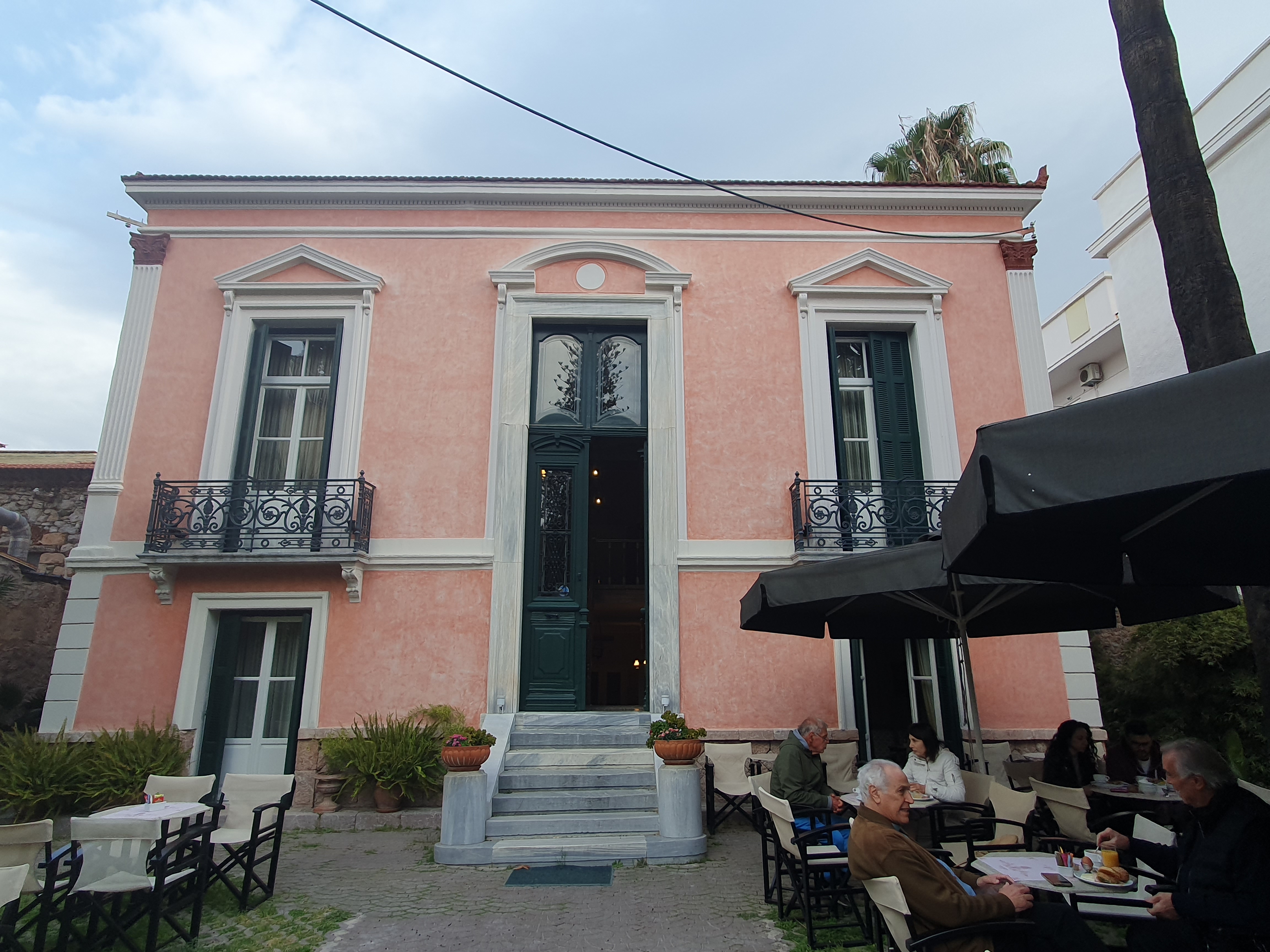
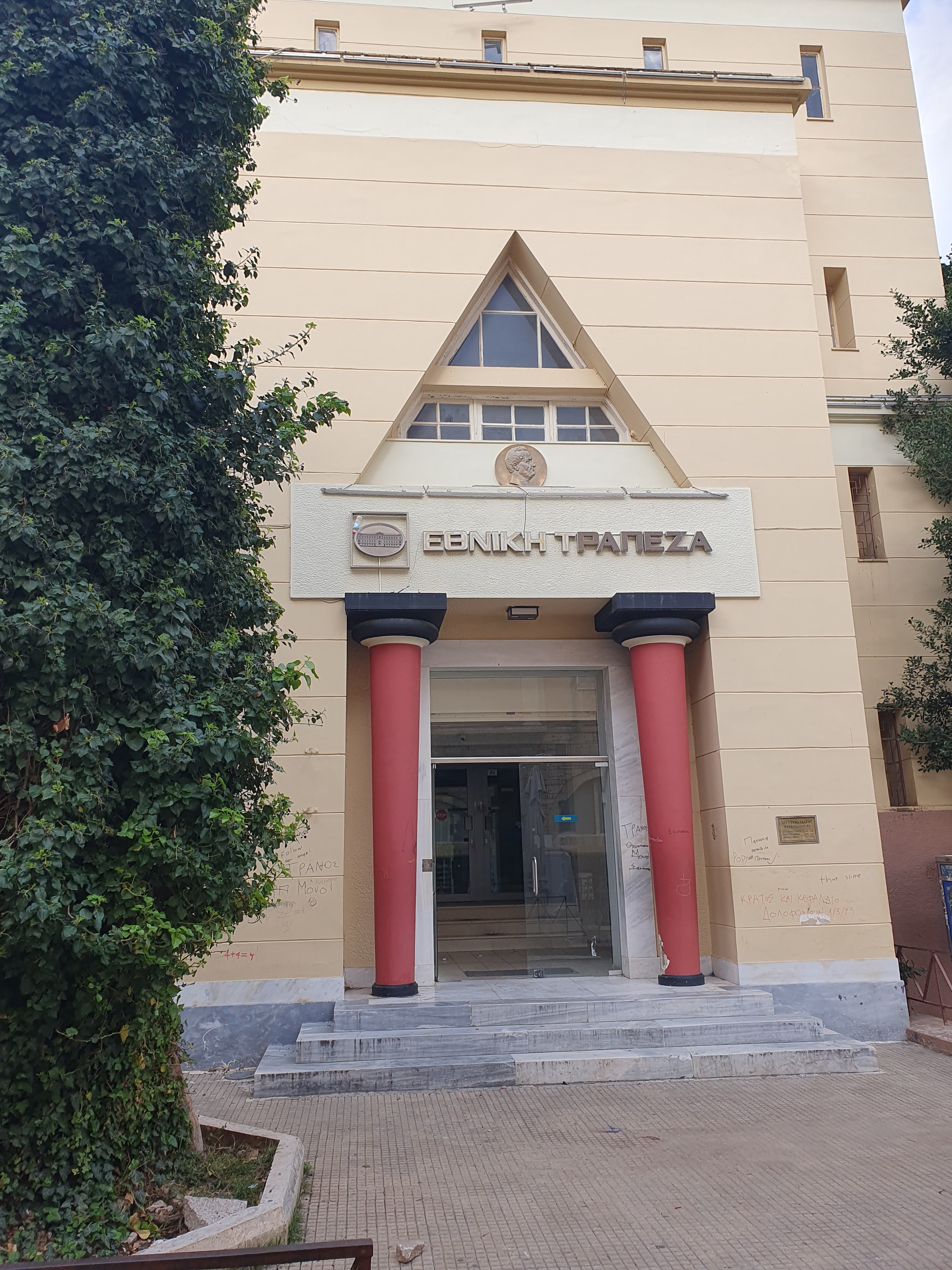
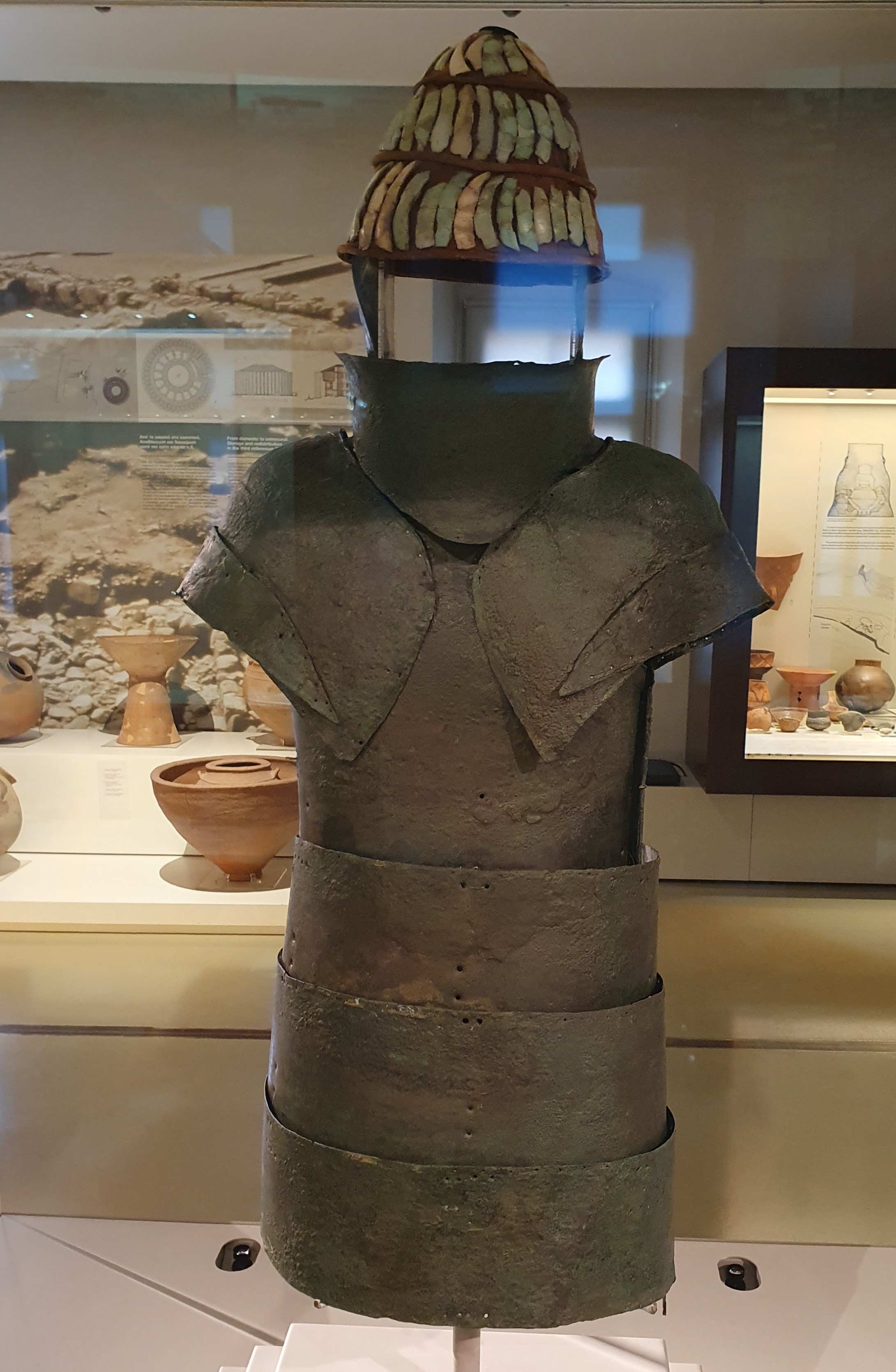
We began the day with a stroll through Nafplio, a lovely seaside town, where I could easily imagine spending a couple of weeks in the summer. There’s even a seaside rock swimming pool that reminded me of the Sydney area. Nafplio was the first capital city of the modern Greek state, 1823-1834. It would be very different today had Athens not taken over as capital. We ended our walk at the fortress that overlooks Nafplio, and stopped in at the museum. As in other places, the Nafplio museum holds treasures from ancient sites. One of the best known is a full suit of ancient Greek armor including a helmet made of boar’s teeth.
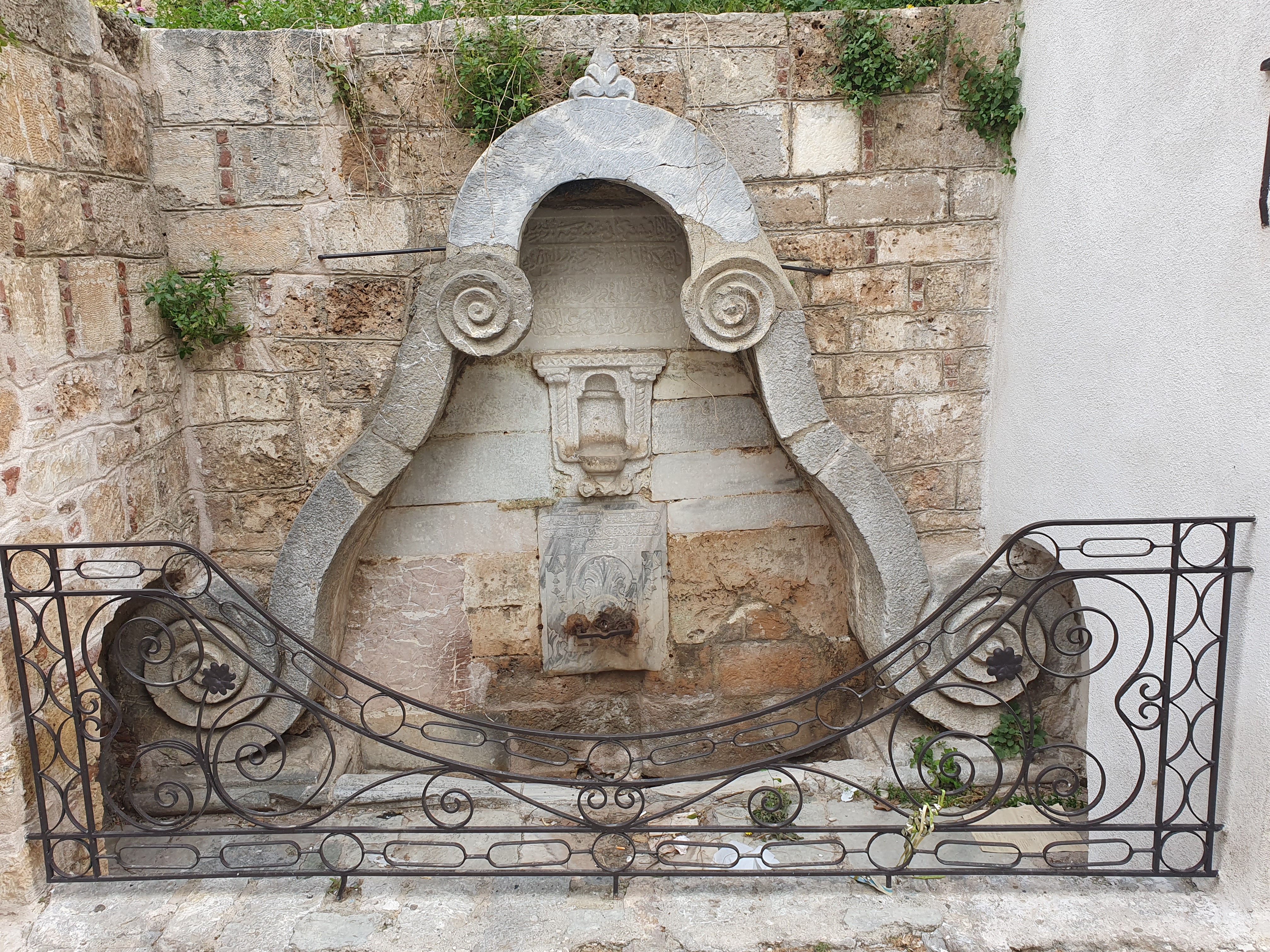
Clockwise from upper L: Nafplio; Ocean swimming area; An Ottoman fountain incorporating earlier Venetian architectural elements; Ancient armor & boar tooth helmet; “Mycenaen” style bank building in Nafplio; Street scene; Our hotel.
From Nafplio, we turned toward our first monumental ruin of the day, Epidaurus. This ancient city claims to be the birthplace of Asclepius, a son of Apollo, hero and god of medicine. The shrine of Asclepius at Epidaurus was the largest and best known healing center of the Classical world. From 600 BC to AD 500, people came from all over to be treated. There was a large dormitory/guest house with 160 rooms.
The large complex of rooms for people seeking healing at the Asclepion of Epidaurus
Part of the treatment was an overnight stay in the “incubator”, the enkoimeteria, where supplicants slept and were visited in their dreams by the healing god who instructed them on how to cure themselves. After dreaming, people visited the shrine, made offerings, perhaps bathed in nearby springs, and were cured. Interesting to think about the placebo effect in this setting–did focusing on one’s illness and how to cure it actually help with a cure? The size of the site is what impressed us. Little of the major temple to Apollo still stands, but the site goes on and on.
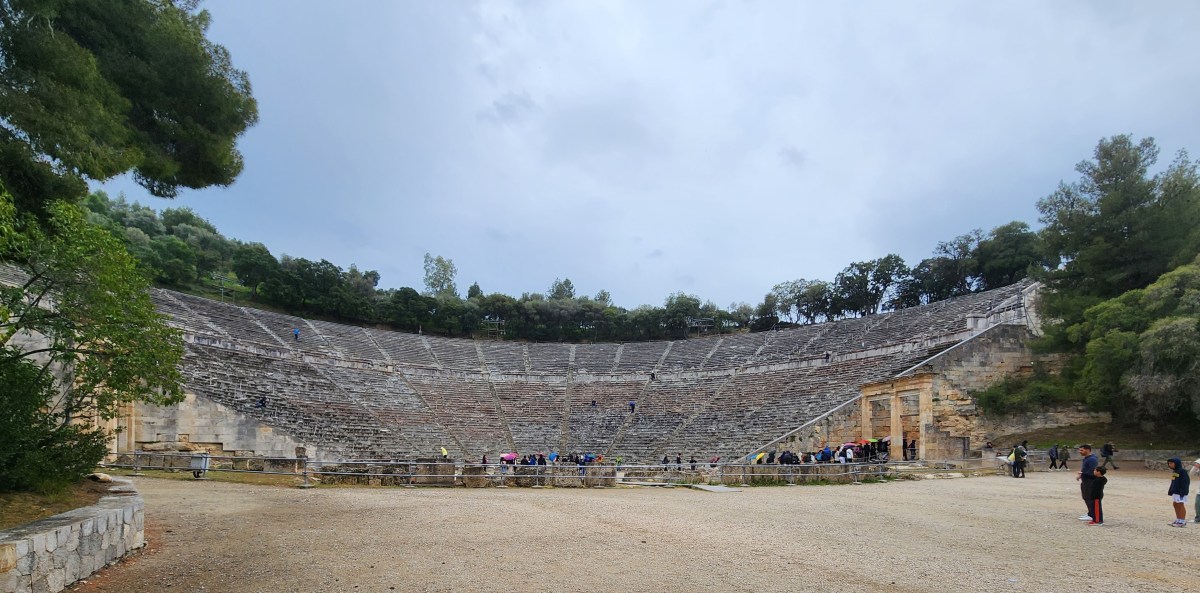
The fame of Epidaurus as a place for healing made it prosperous. The theater seated 14,000 people and there are exaggerated claims of its excellent acoustics. When we visited, school groups were busy declaiming to the upper seats.
The theater of Epidaurus
We drove to Tolo for lunch, slightly out of the way, but it was worth it. Maria’s restaurant is a seafood place, and we shared marinated sardines, spicy shrimp, mussels in lemon sauce, and scallops served in the shell. They were delicious! For dessert, we had what they call spoon fruit, halfway between stewed and candied fruit. Ours was bergamot, which I only know from flavoring Earl Grey tea. Definitely an acquired taste.
Leonidas, the archtypal Spartan
A bit of a drive later, we reached Sparta. It was drizzling, but that meant we had the site to ourselves. Sparta needs no introduction, famed for conquest, disciplined troops, and competition with Athens. We wanted to visit, because it’s Sparta. Sparta! Aristotle provided a fountain of knowledge as we looked out over the theater. Much of the remaining site is covered by olive trees, and it looks untouched, though archaeological excavations have taken place periodically since the 1890s.
Perhaps because of the rain, our visit was a bit melancholy. Sparta was a world capital in its day, praised and vilified in myth and history, yet the archaeological site of Sparta is often skipped on a tour of the Peloponnese today, because the ruins are not on the same scale as other sites.
The theater of Sparta, a broad grove of olive trees that covers more ancient settlement, and the modern city of Sparta.
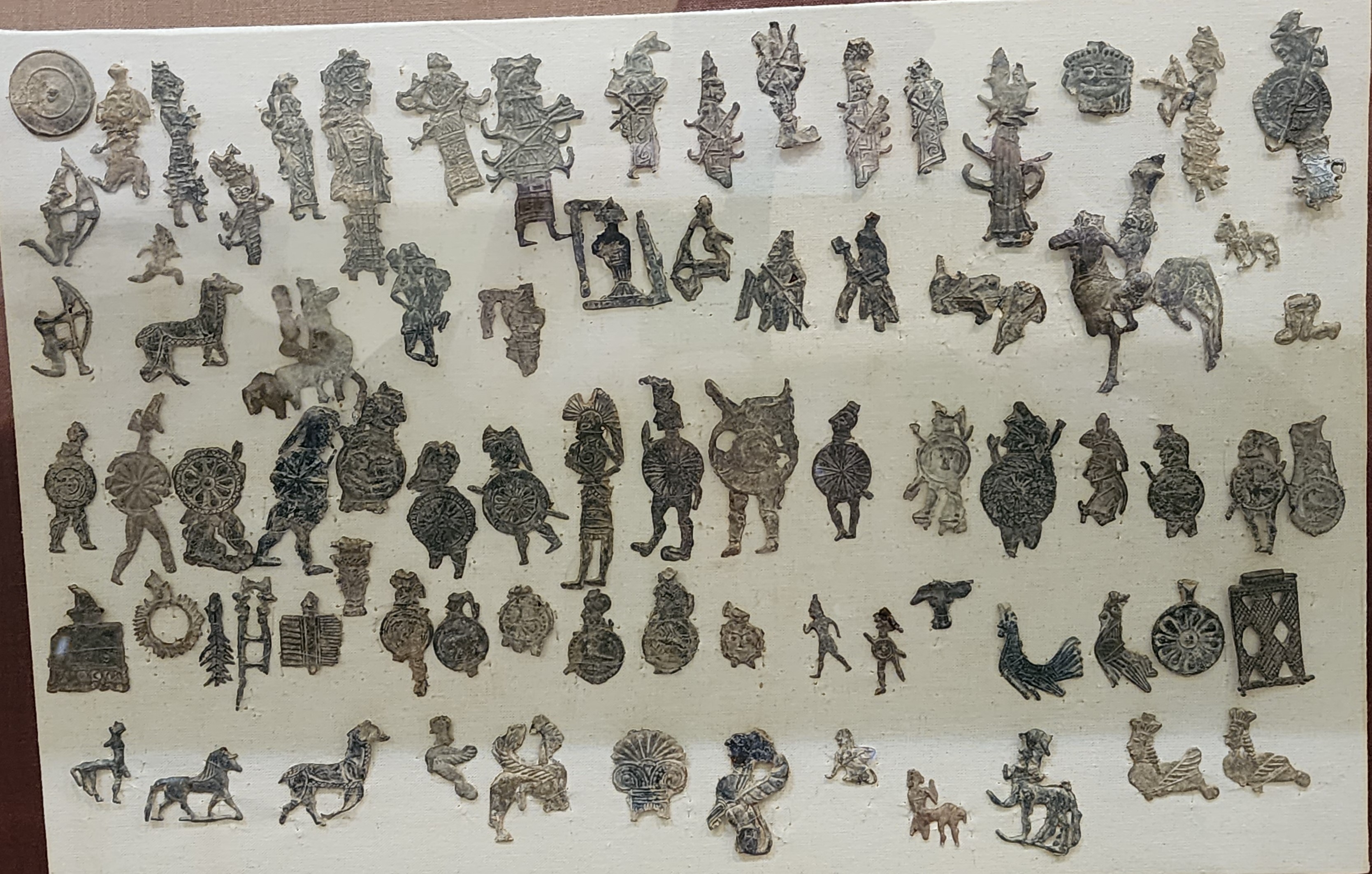
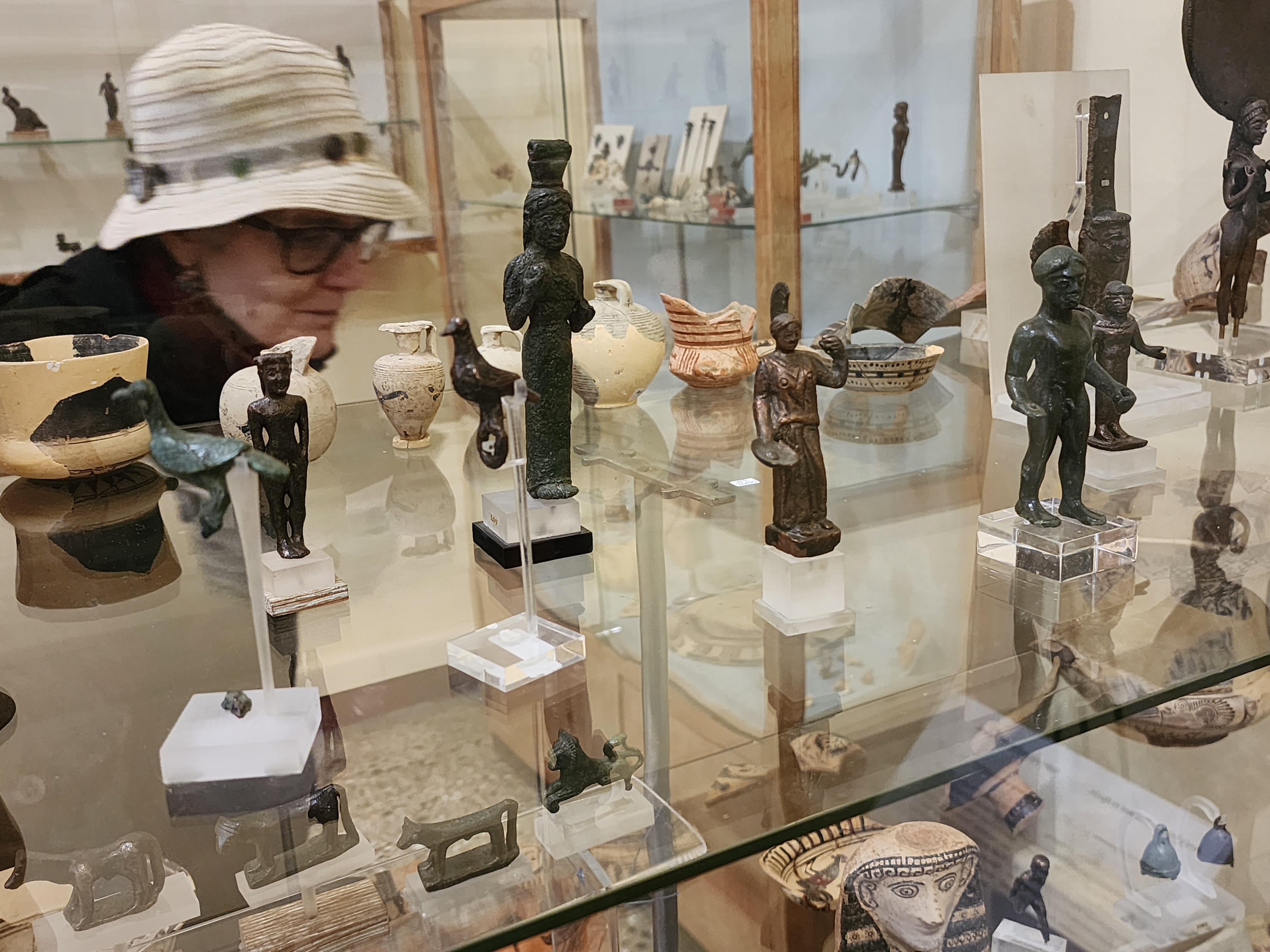
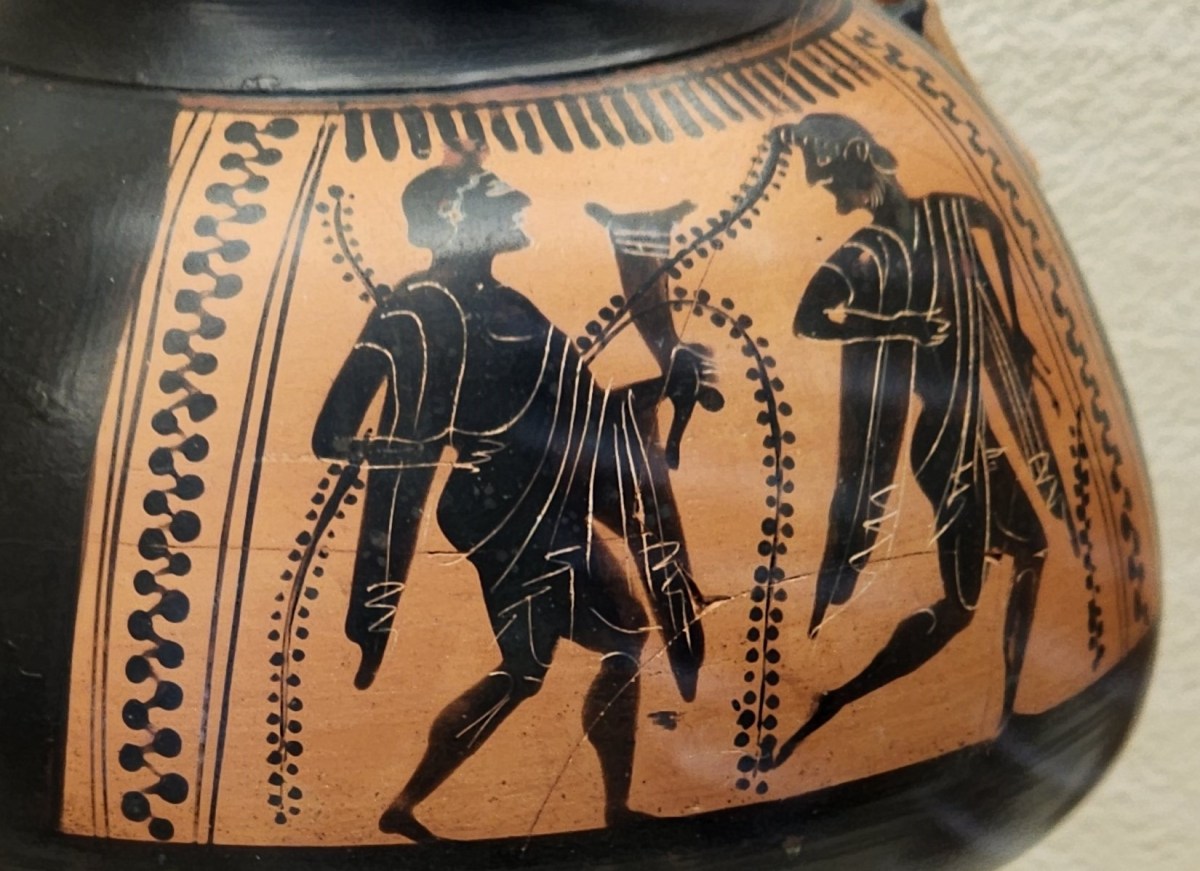
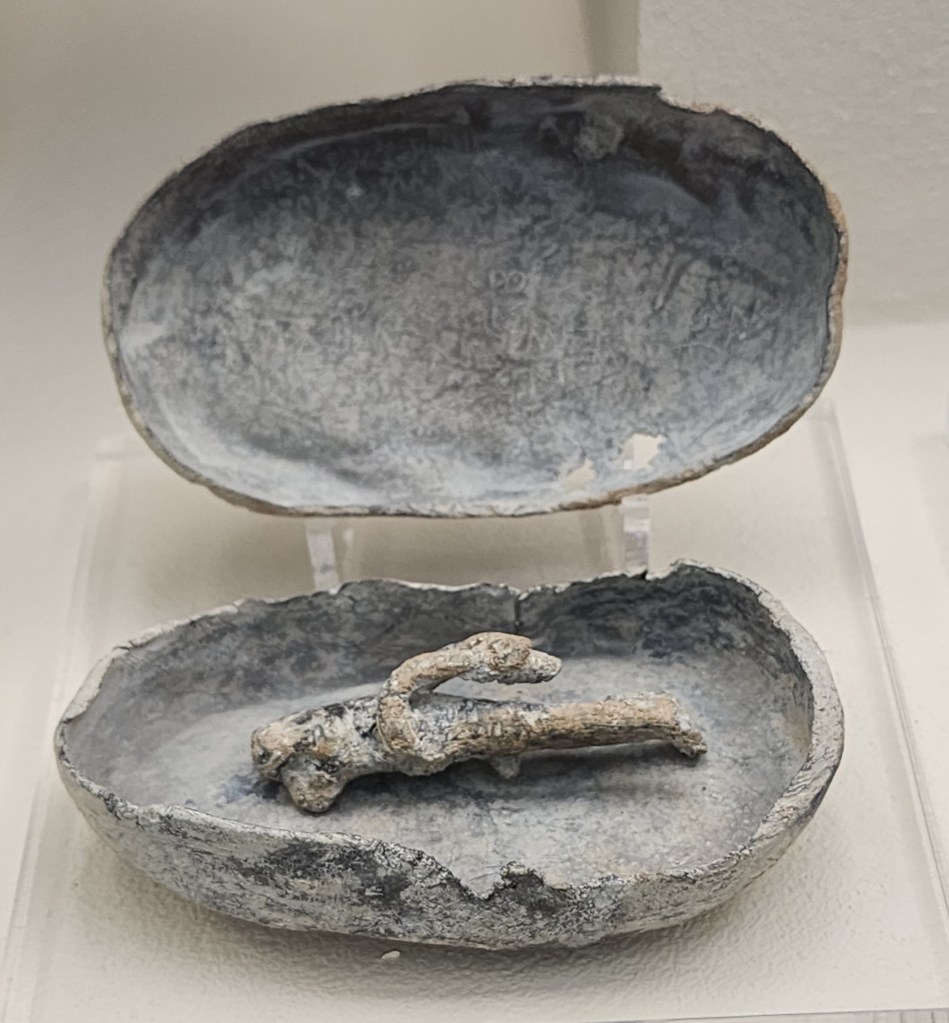
The museum at Sparta was full of rewarding things to see. Thousands of votive offerings from small cut-out bone and metal shapes to cast bronze figurines were buried over the centuries in and around the temple of Artemis Orthia, by people who wished for a favor from the gods.
Other pieces were interesting for their detail:
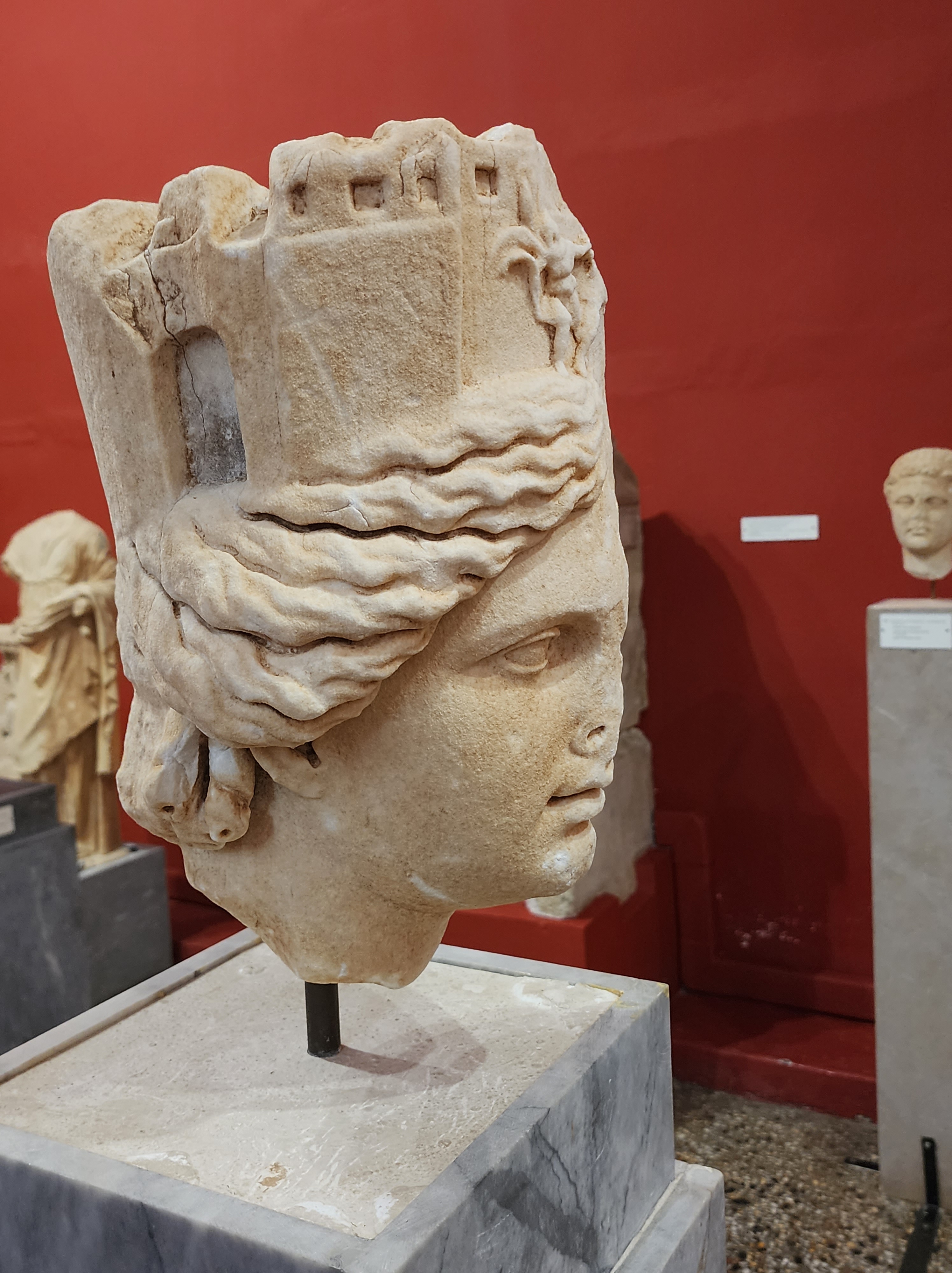
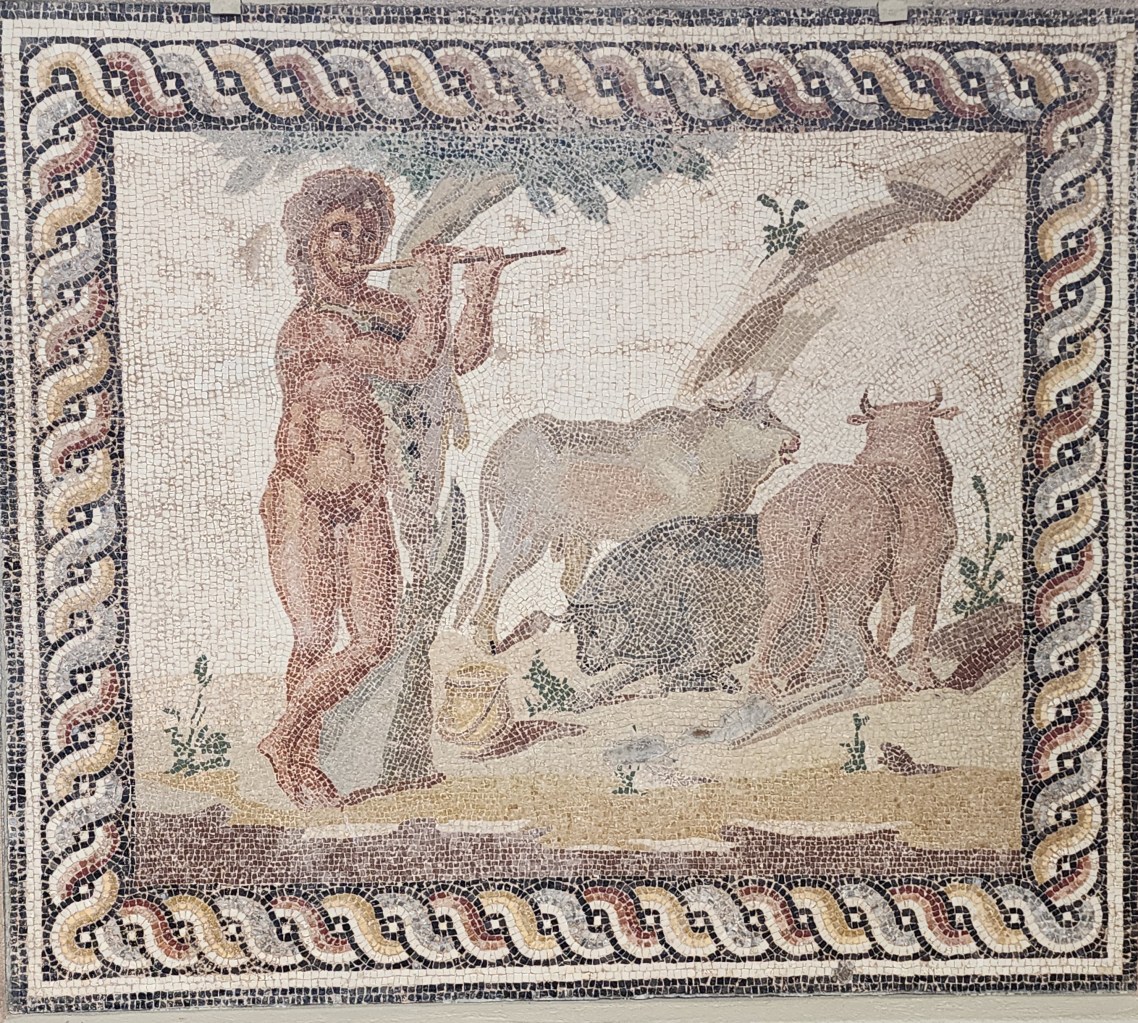
(L-R): Mosaic of a triton; carving of wild boar; “Head of the goddess Tyche (Fortune), the city goddess of Sparta. Her tower-like turreted crown has relief representations of the walls of the city.
Our day ended on a drippy note. The entire week was forecast to be rainy, yet only the afternoon at Sparta and the next morning at Mystras were wet. I can’t complain.
Lunch: Maria’s, Tolo
Dinner and Overnight: Mystras Grand Palace Resort and Spa
We started the day with ancient Corinth, Akrokorinth, a very large site, an ancient city. When I read a brief history of Corinth, I found there is no brief history. Corinth was founded by a descendant of Zeus, the Triton Oceanus, or Sisyphus, depending on what myth you like best. The city was visited by Herodotus (484-425 BC), Thucydides (460-400 BC), Aristotle (384-322 BC), and Pausanias (traveler and writer, 110-180 CE).
Corinth minted coins, developed the trireme (widely used ship on the Mediterranean in ancient times), and was known for it’s decorated pottery. The setting is distinctive, with the city on a broad plain with a high hill in the distance. Corinth became a province of Rome during the first centuries AD, and on top of all the Greek settlement were Roman villas with elaborate mosaic floors, baths, and more temples.
From Corinth, we went on to Nemea, where Hercules completed one of his labors by slaying the Nemean lion. Today, the site of Nemea is known for the temple whose columns appear to have been shaken apart by an earthquake.
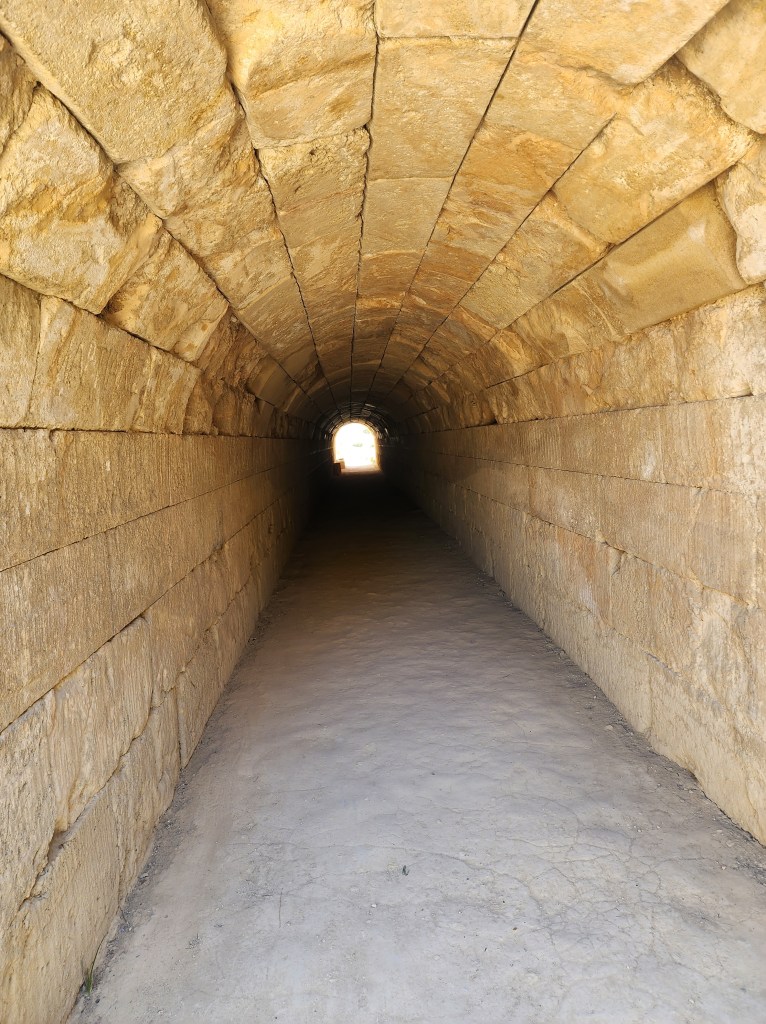
We also found that the tradition of athletes running onto the field from a tunnel in the side of the stadium predates the NFL by many centuries. A true stadium always included an access tunnel for the athletes, even when a hill had to be constructed in order for the tunnel to be dug.
The stadium at Nemea, complete with tunnel, lacking only cheering crowds.
After a break for lunch, we visited one of the high points of the week for me, the site of Mycenae. For this site, we go back in time to 1600-1100 BC, the Bronze age, when Greek city-states were just forming as clusters of settlement around fortified palaces, and Mycenae is the best known example. The tall, fortified walls were nearly impregnable, and the entry way was narrow and angled to make it impossible for more than a few people to enter at a time.
In The Iliad, Homer describes Mycenae as “rich in gold” and as the starting place of the Trojan War, when Myceneans went to war with Troy to return Helen, wife of the king of Greece (Menelaus), who had been abducted by Paris, prince of Troy. The king’s brother was Agamemnon, ruler of Mycenae, and he led the battle against Troy to recapture Helen.
Mycenae has been the focus of study by historians and the very earliest archaeologists, including Heinrich Schliemann. I’ve read a lot about Schliemann, and I have mentioned that his techniques were not exactly scientific, and his ego knew no bounds (who lies in their own diary, in hopes it will one day be published?), but he wanted to show that Mycenae, Tiryns, and Troy, mentioned in the Iliad, were real places, and not dramatic inventions. After his great success at excavating treasure at Troy, Schliemann moved on to Mycenae, where he again named his finds after places in the Iliad. We posed beneath the Lion Gate.
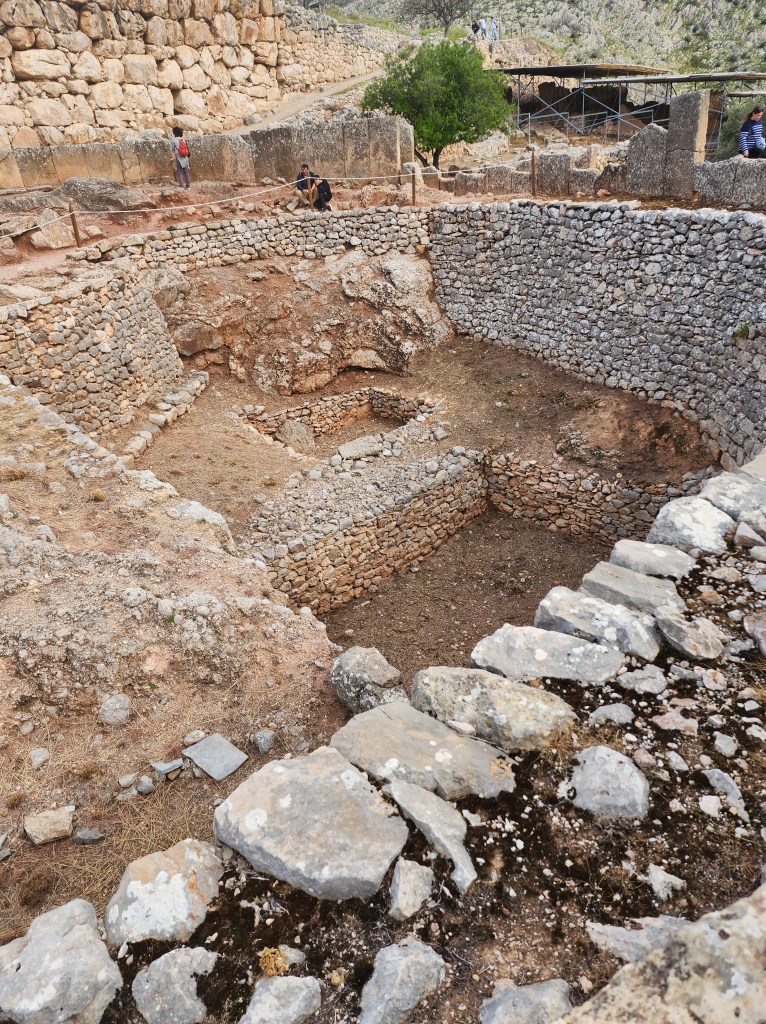
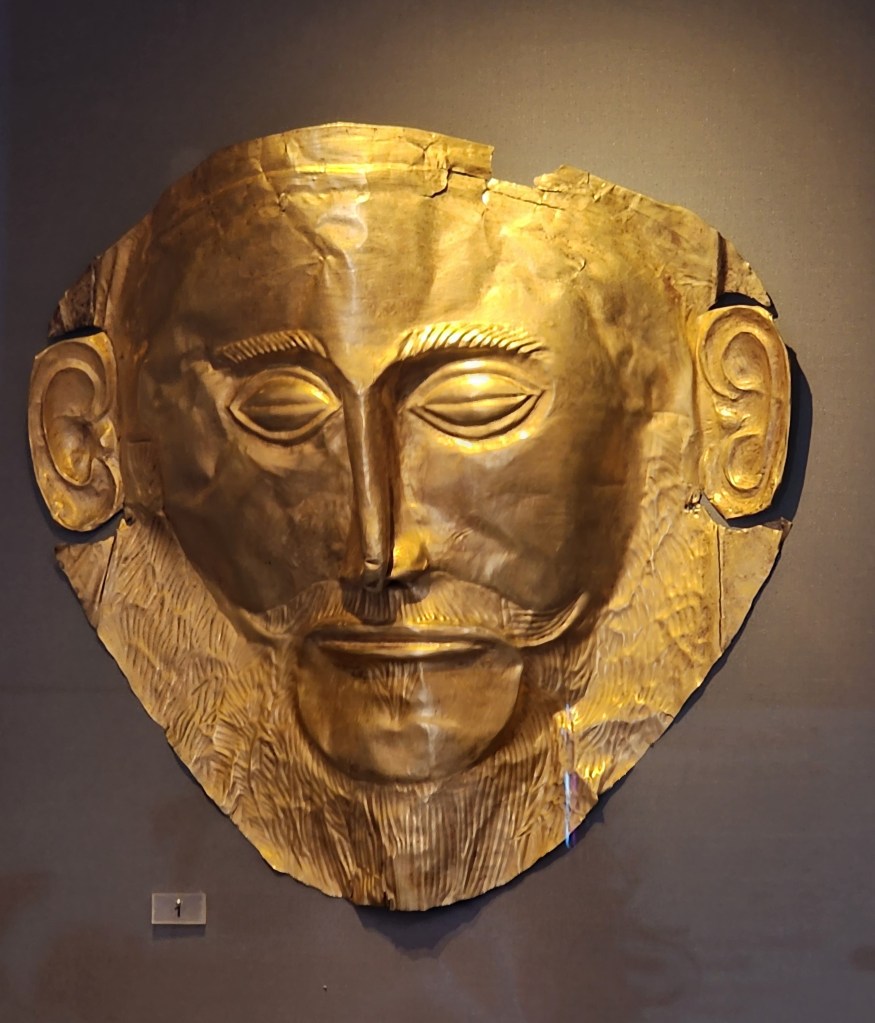
Schliemann’s next great discovery at Mycenae was the gold-laden Grave Circle A (1876). In this part of the site were several stone tombs. The richest of these included the beaten gold mask the inspired Schliemann to send a telegram to the king of Greece, saying, “I have gazed upon the face of Agamemnon.” He was so convinced that the graves were those described by Pausanias that he ceased excavations after finding five tombs, because only five were mentioned by Pausanias. His Greek colleague Panagiotis Stamatakis found a sixth tomb the following year. All the description, cataloguing, and photography of the finds at Mycenae was carried out by Stamatakis, who was assigned to supervise Schliemann’s work, and who Schliemann detested for his efforts to slow the pace of excavation by carefully recording what was found. Stamatakis is the unsung hero of the excavations, because his work lets us know where things were actually found.
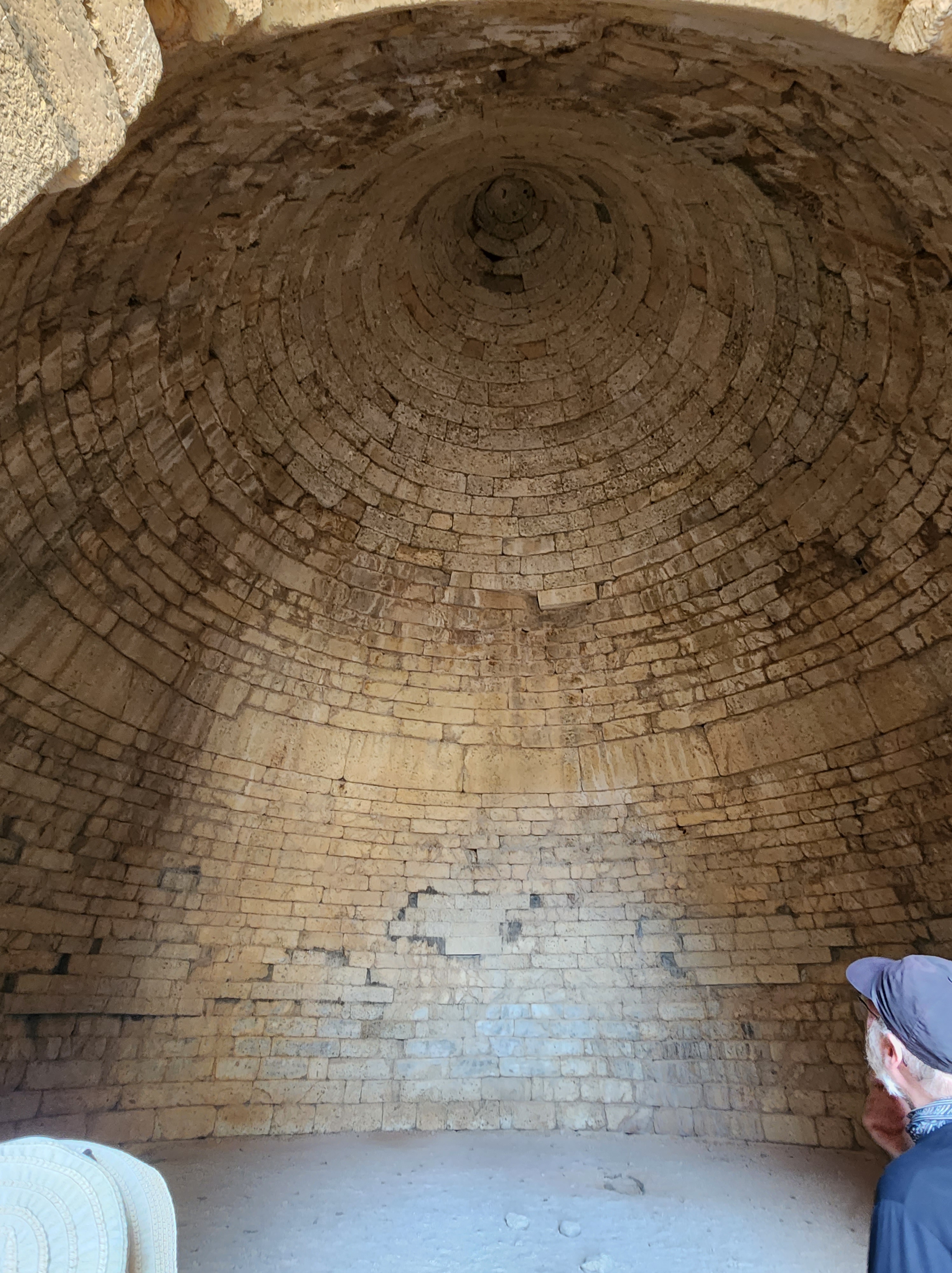
So many stories, so little time! We visited the huge beehive tomb, or tholos, at Mycenae, called the Tomb of Clytemnestra, and another called the Treasury of Atreus, that could have been the actual tomb of Agamemnon, as Shliemann’s grand statement about Agamemnon was never accurate.
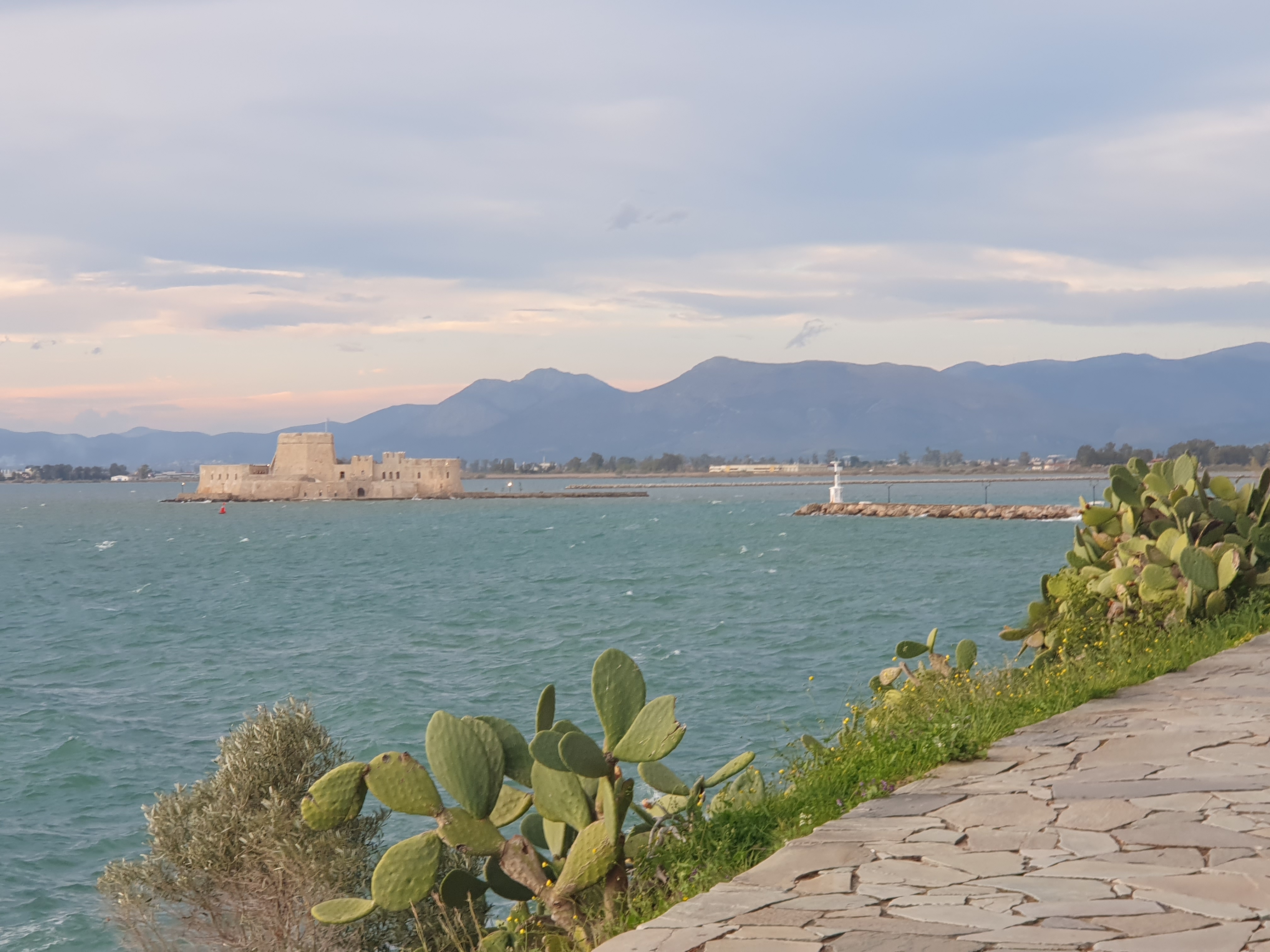
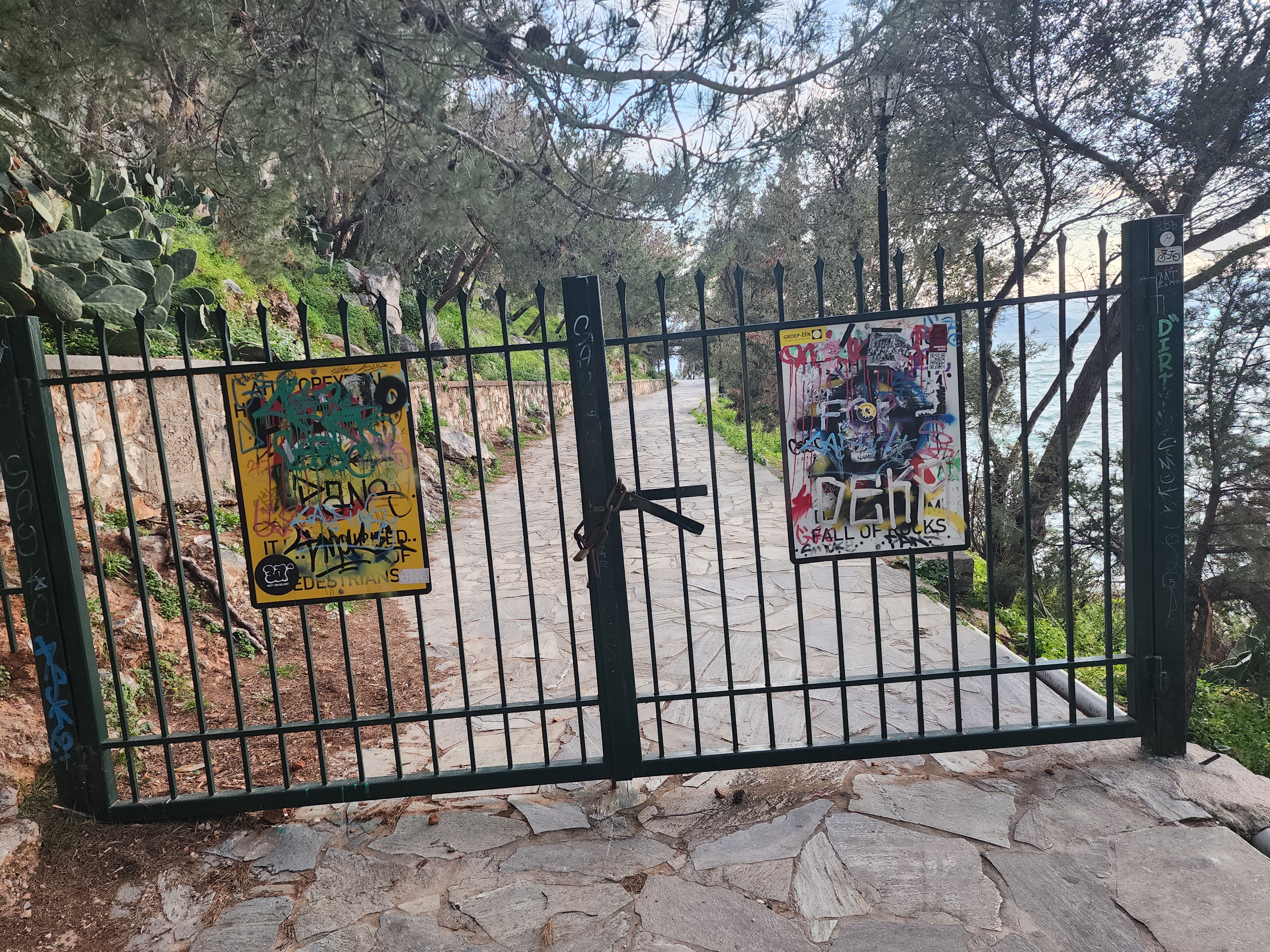
We had an excellent day, arriving at our hotel in Nafplio in time to head to a small beach just over the hill from our hotel. Once we were there, our phones indicated that the best way to get to our dinner spot was by walking around the point. We asked a man fishing if the path went all the way to the seafront on the opposite side and he said, “It’s not allowed, but everyone uses it.” Off we went. The walk took much longer than we had planned, but the spectacular views were worth it. We arrived in time for dinner at Savouras after a gorgeous stroll. After dinner, on our way to the hotel, we saw the illuminated Palamidi fortress on the top of the hill that towers behind Nafplio (bottom of page).
Lunch: Kolizeras, Mykines (specialty is roast lamb)
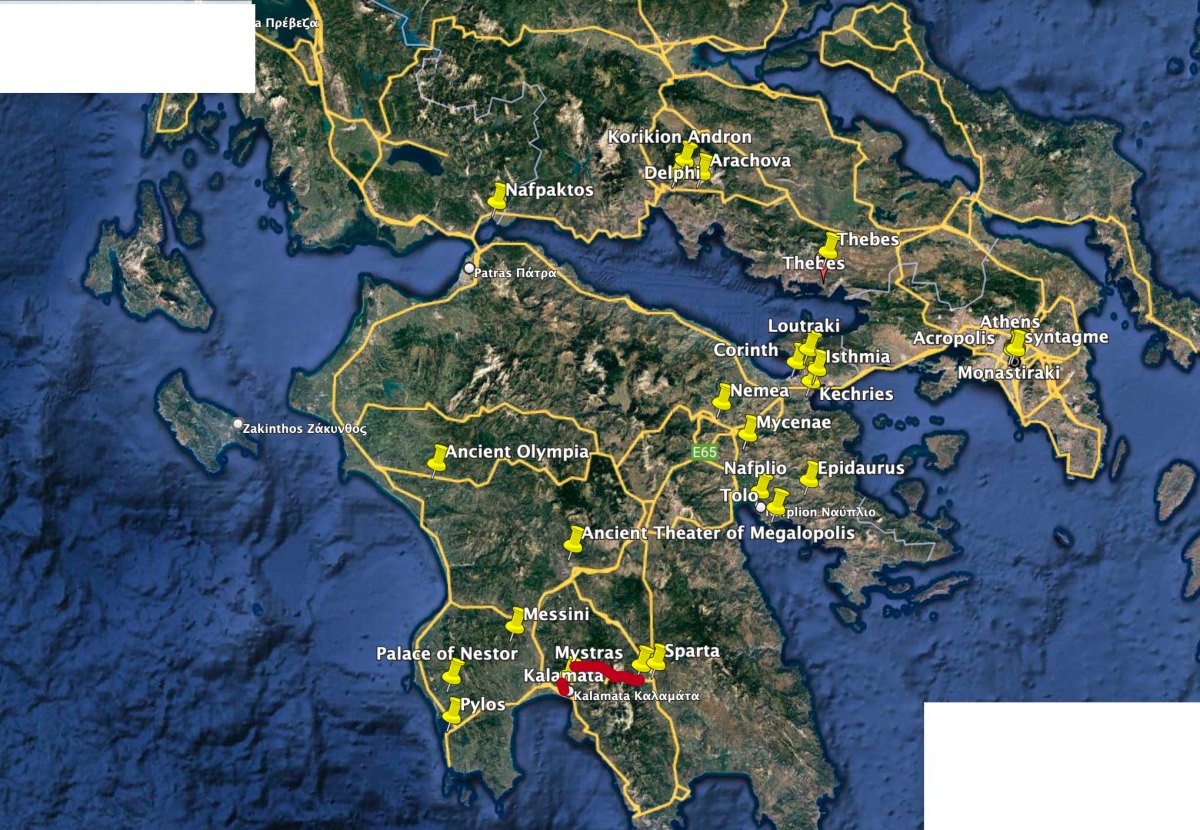
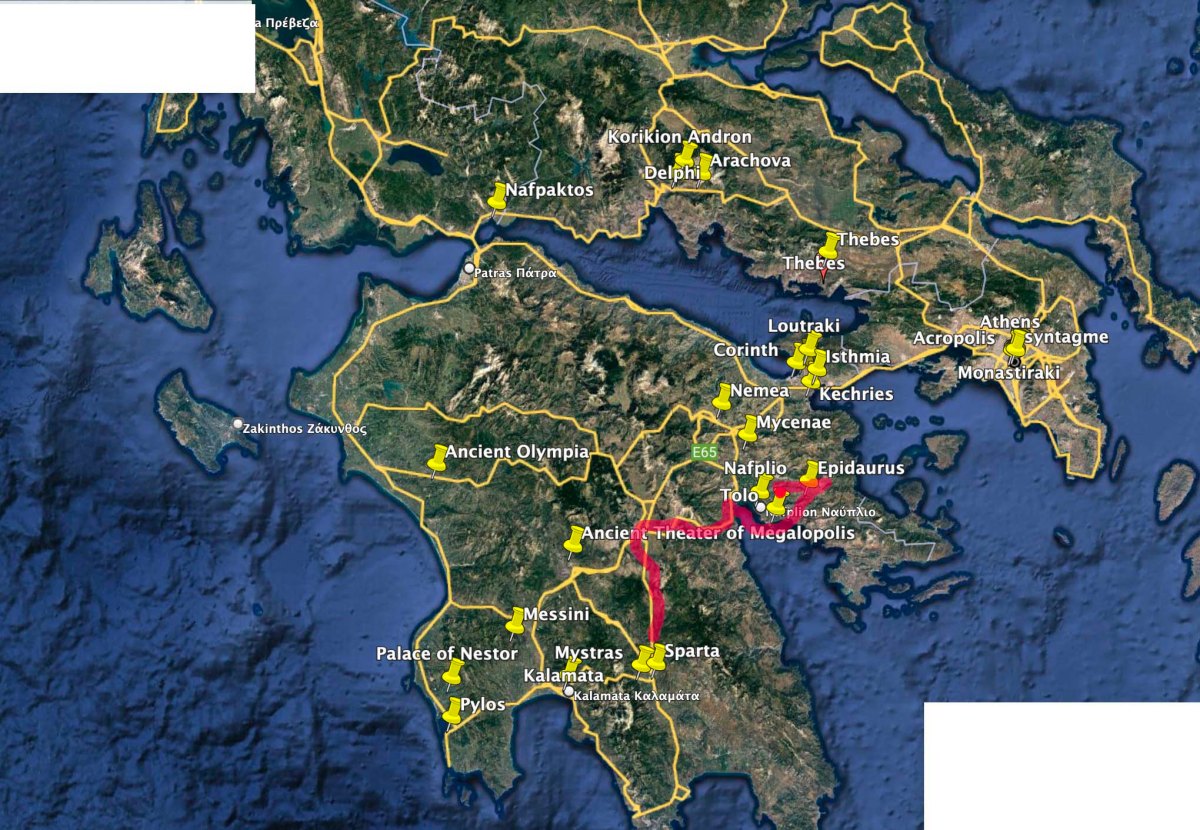
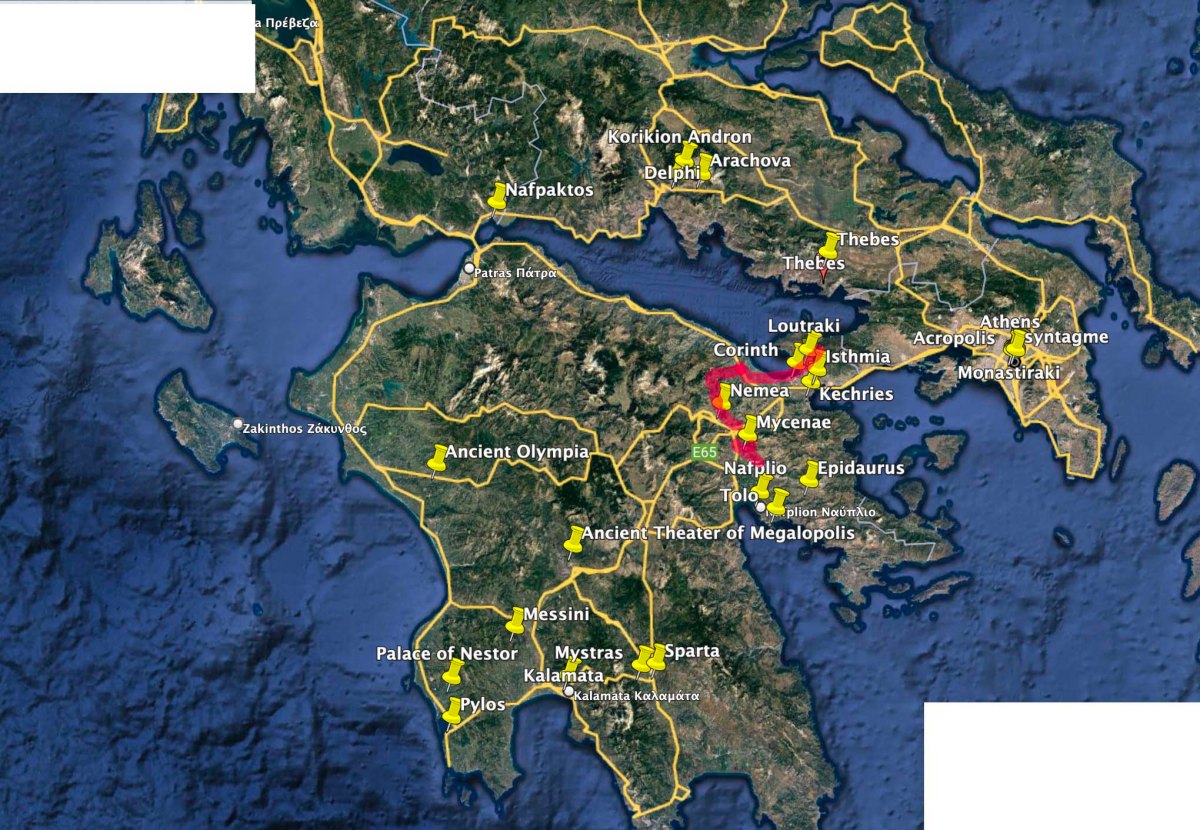
We booked a week-long private tour to see archaeological sites in the Peloponnese, home of Sparta and Mycenae, the “sandy Pylos” of Homer, and other wonderful spots.
One of the reasons we tried a private tour is that we are such terrible tour participants. We’ve each led more tours than gone as participants, and we don’t seem to play well with others. I don’t like to get on a bus at 7:30 am, see four or five places in a day, eat a very tame meal and do it all again the next day, yet that seems to be how tour companies deliver value. Our tour was very expensive, but our tour manager, George, is quite good, and I would recommend you consider contacting him if you have something special you’d like to see in Greece. Contact information is at the end of the post.
We negotiated over the stops on the tour and came up with an itinerary that took us vaguely clockwise around the Peloponnese. We stayed on the coast whenever possible so that I could squeeze in some beachcombing at the end of the day. Our departure time in the morning was 9 am, with the promise that we would finish each day by about 5 pm. Breakfast and lunch were included, and we decided to get dinner on our own to have greater variety in restaurants and dishes. With some restaurant suggestions from George, it worked out well. We ended up being able to include a stop in Delphi toward the end of the trip, and we were all for it, hoping for our own personal prophecies.
Aristotle and I at the temple of Hera, Loutraki
The first big success was our guide, a wonderfully interesting archaeologist and Star Wars/Star Trek fan. Aristotle has an encyclopedic knowledge of Greek history from the beginning of time to the present, but particularly ancient Greece. I was bowled over by his explanations, and every time either of us had a question about a site, or a specific feature, Aristotle had looked into it and knew all the details.
At times, we renegotiated the conversation, because Aristotle is also a fan of military history and as a reenactor, willing to rhapsodize about great battles of the ancient past in detail. He is also rather charming. He wore a succession of archaeology themed tshirts that were highly entertaining. The last day he wore the piece de resistance of his own design, a trowel made into a Millennium Falcon, archaeologizing across the universe. We admired his skill as a tour guide, knowledge, and good humor. We heard lots of good stories.
We were collected from our Airbnb in Athens and headed to Corinth. We stopped to look at the Corinth Canal, a surprisingly deep and narrow channel cutting through the Isthmus of Corinth. Because of the canal, the Peloponnese is technically an island. Cutting a canal in this area was a dream of many, from the ruling Tyrant in the 7th century BC, to Nero, to the 19th century, when it was actually created as a way to shorten the sea route from Sicily, southern Italy, and Venice to Athens. Ironically, it never really worked because it is deep, narrow, and subject to landslides. It would be a treat to make the trip in a trawler or other pleasure craft, almost the only boats that make the transit today.
The Corinth canal, straight as an arrow for 4 miles.
Preserved section of diolkos, stone road built in the 7th c. BC to tow boats across the Isthmus of Corinth, with ruts from the vehicles.
Much as I enjoyed the story of the canal, our day was just beginnning. We spent the rest of the morning at Isthmia, known for the Isthmian Games, held from 582 BC through the first century AD. There are well-preserved mosaics showing sea creatures.
Tritons carrying Nereids (both are creatures of the sea).
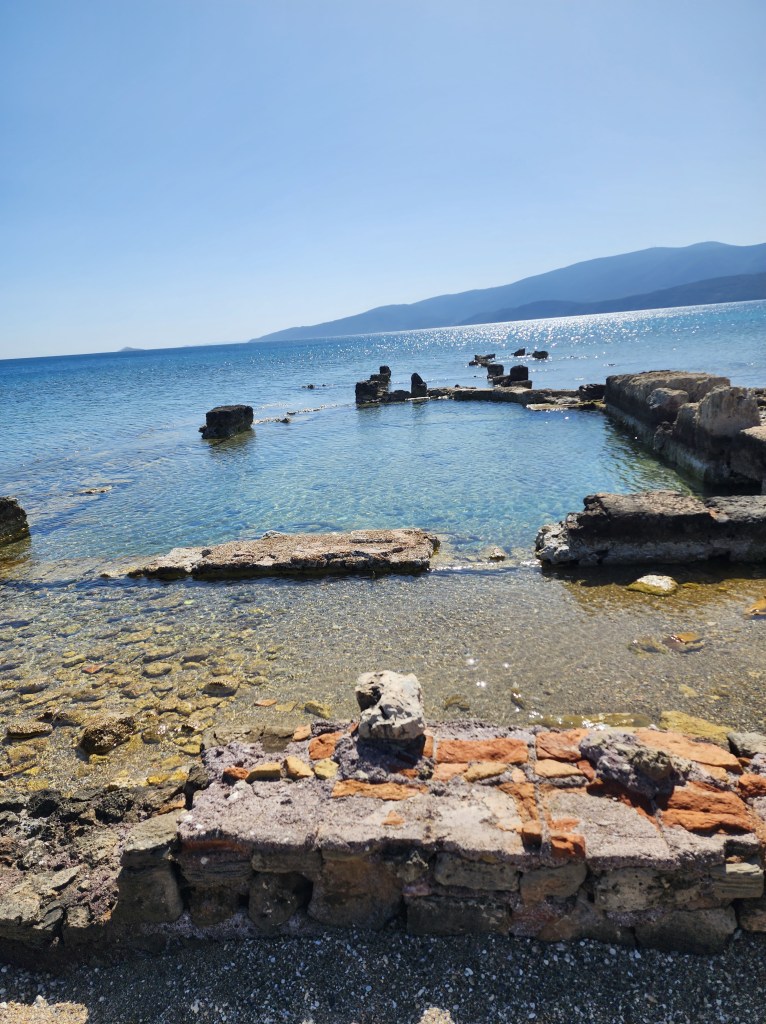
We stopped at Kechries, the ancient port of Corinth. Now partially submerged, it looks like a wonderful snorkeling site.
Kechries, ancient port of Corinth on the Aegean (Saronic Gulf)
After a stop for lunch in Loutraki, we headed to the Temple of Hera, or Heraion, on a promontory that extends into the Gulf of Corinth. A gorgeous seaside spot, the temple was used for almost 1,000 years, and may have had an oracle during part of that time. Aristotle had reconstruction sketches of what the structures looked like in their heyday. The spot was so beautiful in the afternoon sun that we stayed for a while just to enjoy the day.
Temple of Hera
Aristotle shows a reconstruction of the temple
As promised, our tour day wrapped up around 5 pm. Our hotel was on the water in Loutraki, a beach town just east of Corinth. We were able to spend an hour or so beachcombing our way along the shore and have dinner at the restaurant recommended by George. The food was good and the view was excellent, across the Bay of Corinth at sunset.
Did you notice, that we did, in fact, make five stops? Three were very short (canal, diolkos, port of Kechries), but I do have to laugh at myself for criticizing tours with numerous stops.
Lunch: Paladar, Loutraki
Dinner: Maistrali, Loutraki
Overnight: Club Casino Hotel, Loutraki
Tour Organizer: George, Pictours of Greece, +30 697 202 6519
While it’s still fresh in my mind, here are a few impressions that might help you plan your visit to Greece. We stayed for six weeks: a month in Athens, and a week plus in the Peloponnese. We didn’t visit the islands, but for some great information about Greek islands I recommend posts at https://thegenxtravels.com/ by Lori. Her descriptions of Crete, Santorini, and other Greek islands will help you plan your trip, or possibly extend it…
Athens is full of orange trees. In late March and early April, the trees begin to bloom and the air is scented with orange blossoms for at least two weeks. It’s lovely to walk down the street and breathe in the spring air. March may be the best time of year to visit Athens. The weather is cool and the crowds are not bad. It was perfect for us.
For swimming, snorkeling, and boating, however, later in the year will be better. We saw a few people in the water on Aegina and in Loutraki, but I didn’t even consider going for a swim, even if it was the Aegean. I’d recommend May or September for warm water and at least somewhat diminished crowds, but the Greek coast and islands are always popular. The islands are the most famous destinations, but the beaches and towns of the Peloponnese, Loutraki, Nafplio, Kalamata, Pylos, as well as other smaller communities like Tolo, would be lovely vacation spots on the water.
Lots to do in Athens
Athens is a world capital. People have been living here for thousands of years. Since tourism is a big part of the modern economy, you’ll find ruins revealed under your feet all over the city. Sometimes these are labeled, like the area at the Acropolis Museum. Other times, you’ll find a small rectangle of mosaic beneath thick plexiglas in the middle of the sidewalk. Stop and look at some of these, just for fun.
Someone is losing at “Simon Says” (Kerameikos Museum)
Stay in Athens longer than you think you need to. The big museums have treasures, but so do the small museums, and they are often quiet, with only a few other visitors. Try the museum at Kerameikos, for instance. You also need time to walk to the top of Filopappous Hill, take the aerial tramway to the top of Lycabettus Hill, and visit the cafe at the Benaki Islamic Museum (see The Benaki Museums).
“Symposium”= men carousingWomen not allowed to attend symposiumCurse laid on those getting home late from the symposium
(Kerameikos Museum)
We had a wonderful Airbnb for the first month, and stayed at AD Luxury Rooms and Suites for the final three nights. The hotel was comfortable and quiet, yet only a few steps from the Acropolis metro stop. The rooftop dining area has a spectacular view of the Parthenon, and the included breakfast offers expresso, cappucinos, etc. (On our tour, most hotels only offered brewed coffee from a machine.) The staff is helpful and pleasant. One downside though, the lobby and halls are highly scented. Don’t ask me why. I was grateful that the inside of our room was not.
Food and Drink
Greek food is delicious, and with a bit of help from Trip Advisor you can avoid endless meals of grilled meat and Greek salad and eat more adventurously, even in the tourist heart of Athens. We ate the steamed greens that are often on the menu, and in egg/lemon sauce they were a favorite. For restaurants, we liked Mani Mani (Manh Manh), Liondi, and Arcadia, right in the Acropolis area. If there is a down side to Greek restaurants, it is the generous portions. We often left behind more than we ate. There seemed to be no way to get a smaller portion size. We didn’t get started on drinking Greek wine. The house wines were just ok. We drank some ouzo and were often given a bit of mastic liqueur from Chios at the end of a meal (“a digestive!”). Ya mas! (Salut!)
Scallops at Maria’s in ToloCeviche in NafplioSalmon liver in SpartaSea bass in PylosDiscussing the menu in ArachovaLunch with a view
Transportation and Communication
The taxi app, FreeNow, was very useful. We never waited long for a cab, either in the heart of the city or further out. I only used it in Athens, though it may work in the other large cities of Greece. The fare is required to be the same as other cabs, though we saved money by using the app near the Acropolis (see the end of this post). We found the convenience to be worth using the app.
We rode the Athens Metro. Tickets are easy to purchase at machines at the entrance to each stop. We purchased two round trip tickets at a time for just over 4 E. You scan your ticket going into the station and when you come out. (Try not to lose your ticket before you scan out at the end of your ride.) Tickets are good for 90 minutes of onward travel. That means you can get from Athens to Piraeus and change for the tram down the coast for the price of a single ride. There are excellent deals for month-long tickets, and tickets for students and older people if you are willing to take the time to set them up. You can get nearly unlimited rides for about 20 E per person per month; web pages have the details.
We each used a SIM card for Greece from the local Vodafone store for calls. You need to have an unlocked phone. I believe most phones come unlocked now. There are now eSIM cards you can use that will eliminate the whole trip to the store. BUT, if you go into a phone store and purchase a SIM card, the sales person will install it and make sure it works. You can try calling them, and getting access to your data before leaving the store, so you know it all works.
I got a data eSIM for Jonathan from our US carrier (USMobile) before we left and it never worked at all. In the US, eSIMs are new. Jonathan’s new Samsung S22 has the capacity to use them. My Samsung Galaxy S10 does not.
The down side of getting a new SIM is that you have a different number. Having a local phone number was helpful for a few things in Athens, but not for staying in touch with home. We used WhatsApp very successfully for that. You should get the app and get the people you want to be in touch with to set it up, too, before you leave the US. I was able to get to my existing contacts on WhatsApp without difficulty with my Greek SIM installed. Why go to all this trouble? Our Greek phone service cost 12 euros a month per person. US phone service in Europe usually runs $10/day/pp.
Attractions
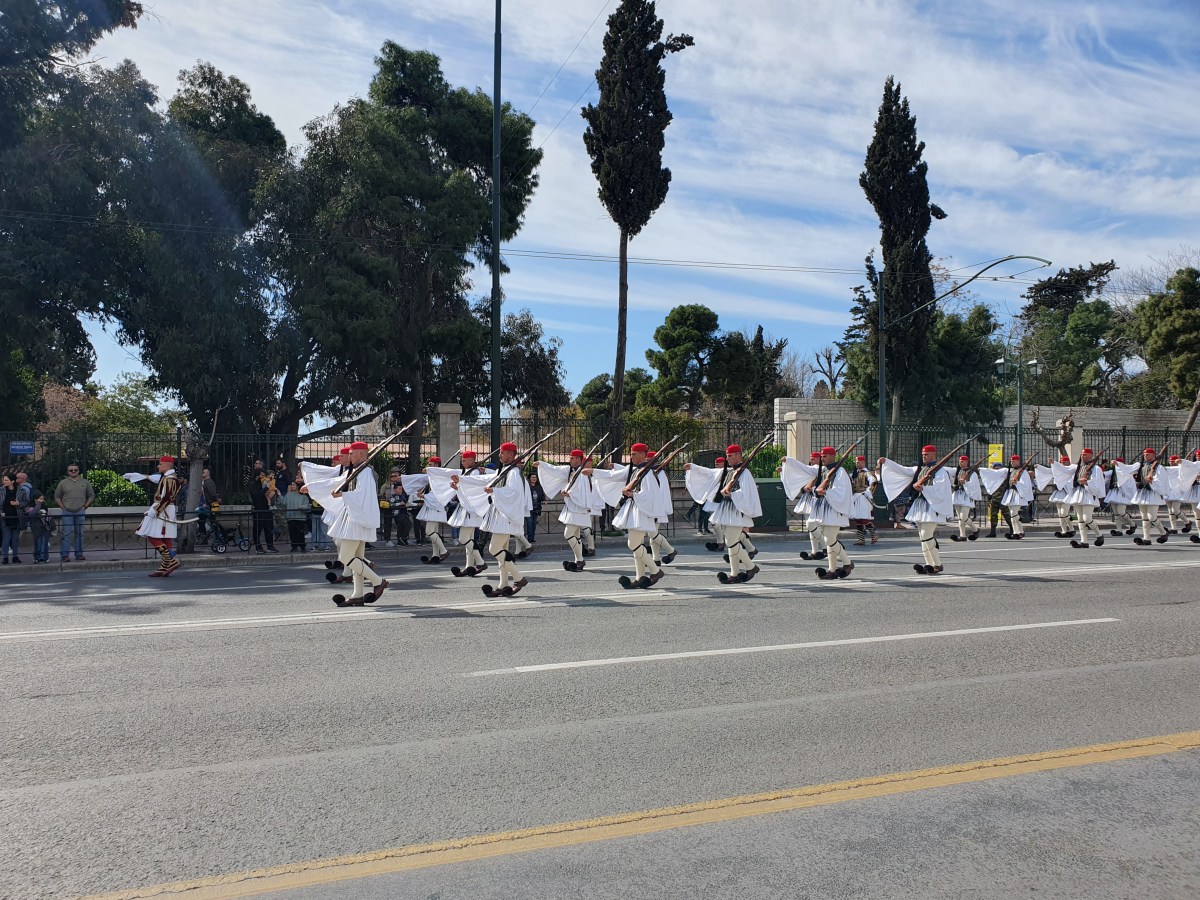
Our first Sunday in Athens, we went to watch the changing of the guard at the Parliament in Syntagma square. It’s a real military pageant, complete with a band. For us, though, the best view was not with the crowd in the square, but around the corner on Leoforas Vasilissis Sofias street. Traffic is stopped and the entire parade, squads of soldiers brightly dressed the traditional Greek uniforms, parades down the block going away from the square at the end of the event. The crowd is thinner and you can easily see all the marchers.
Changing of the guard from Leoforo Vasilissis Sofia
The changing of the guard from Syntagma
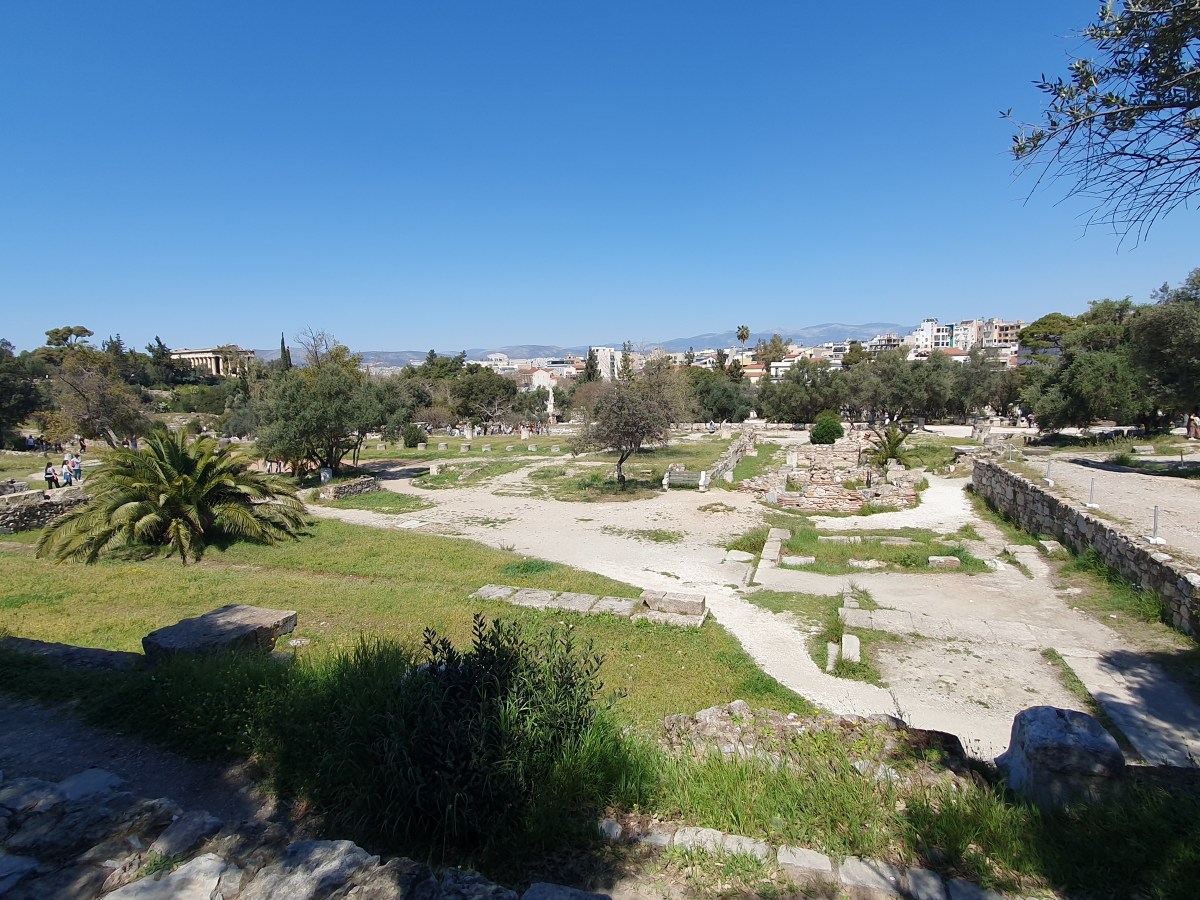
After that, we spent time in the slow lane. Athens doesn’t have many parks for a city its size, but the National Gardens has winding paths, pools of turtles, koi, and ducks. We enjoyed our stroll there. Several of the large archaeological sites are park-like, including Kerameikos, the Temple of Olympian Zeus, and the Agora.
A pool full of turtles in the National Garden
Athens agora
We also visited Athens First Cemetery, but it is not a green cemetery, it is wall to wall monuments. I wanted to see the grave of Heinrich Schliemann, the first person to read Homer’s Iliad, and then excavate to see if he could prove it was a historic account rather than poetry alone. His archaeological technique left a lot to be desired, but he showed that Troy was a real place. A philhellene (lover of all things Greek) to the core, his monument is built like a Greek temple, complete with a frieze of heroic scenes around three sides. On the fourth side, the relief sculptures show his excavations and the carrying-off of treasures, with he and his wife presiding. The man had a healthy ego, but he did leave most of his treasures to Greece.
A few issues with Athens
As a result of its long history, huge sprawling size, and population, Athens has all the big city issues. There is lots of graffiti, sidewalks are often narrow, restaurants have shills out in front trying to steer you in. There are beggars, people who sleep in the street, and pickpockets. Greece may be the home of Arcadia, but it’s not Arcadian all the time. You get used to most of the urban issues, as you would anywhere.
For example, everyone has to put all their trash in streetside dumpsters, and that seems to include construction debris, discarded furniture, appliances, and restaurant garbage. Two of the three dumpsters on our block were set on fire during the demonstrations following the terrible train accident, and people piled trash in the place where they had been until they were replaced about a week later. We are convinced that trash collectors are the hardest working people in Athens. The dumpsters may also be a recycling location. One day we saw a stack of 10 lb weights, a training rope, and a speedbag all piled neatly beside a dumpster. There are places to recycle glass bottles and cardboard, but not other materials.
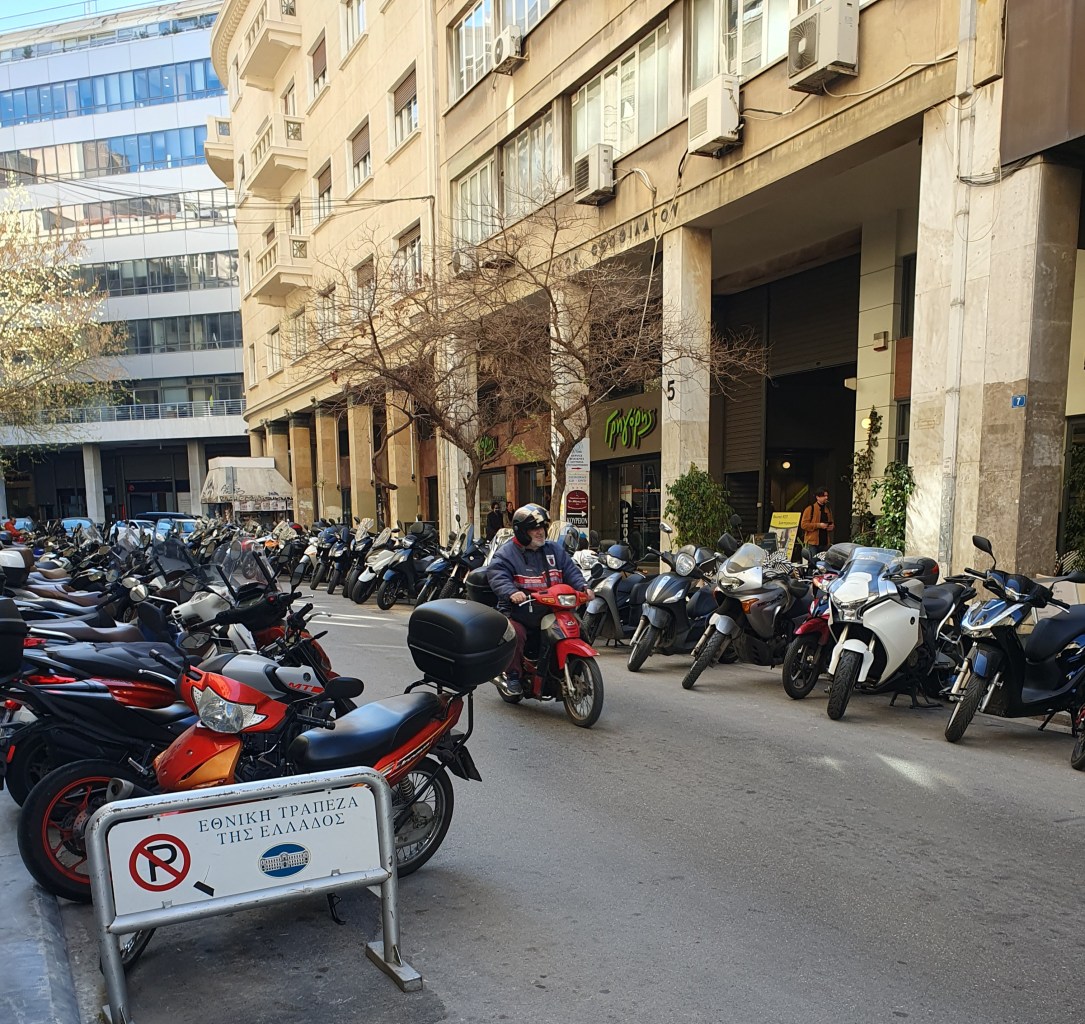
GraffitiRenovation candidate Parking woes
Though the proportion of the population that smokes is only 10% higher than in the US, we noticed a lot of cigarettes and smoke. Restaurants allow smoking in any outdoor seating, even if it is walled in with plexiglas or tented. That can be uncomfortable for non-smokers.
Cat on car, and near the car, and under the car…..
Athens has too many cats. People put out food and water for feral cats, and they are everywhere. There’s a tradition of allowing cats to roam the Acropolis that doesn’t appeal to me. Someone said they kill rats and eat cockroaches, but they also eat millions of songbirds. I am an indoor-cat only person.
When you hear birdsong, it’s usually finches or canaries hanging outdoors in cages. There are invasive monk parakeets, and ring neck parrots, house sparrows, pigeons, and a few blackbirds, but that’s pretty much it.
Last but not least, stay safe. Keep your eyes open and beware of anyone who starts a conversation with you on the Metro. We began to cringe when someone opened a conversation “Hello! Where are you from?” because it was the opening line of the pickpocket group that got Jonathan’s wallet from a zipped front pocket (!) while they distracted us both. There were three of them, acting like they were not together, a gray haired man, a tall young man, and a woman dressed to go to work. It’s a shame to be unfriendly, but don’t talk to people on the Metro. Stand with your back to a wall, or sit with your backpack in your arms. If you need help, stand in line at the ticket window, don’t let kind passers-by assist you, as they may help themselves to your wallet in the process. We didn’t lose as much as we might have, and learned our lesson. Nothing else was stolen during our trip.
Athens is worth visiting, though like every city it has its ups and downs. If you take a bit of time to look carefully, you will see wonderful things. When Heinrich Schliemann brushed the last bit of dirt off the golden mask from Mycenae (below), he said, “I have gazed upon the face of Agamemnon!” It may not have been true, but is a wonderful thought. You can see that same face, and only in Athens.
Gold mask from Grave Circle A at Mycenae (National Archaeological Museum, Athens)
Airbnb: Hosted by Iason. Not always listed.
Hotel: AD Luxury Rooms and Suites, near the Acropolis. Perfectly fine, with a very good location
Restaurants we liked: Mani Mani (Manh Manh), Liondi, and Arcadia, are all very good and near the Acropolis
Sights we recommend: Any national holiday, changing of the guard at Syntagma Square, Sundays at 10 am.