Athens has a renowned Archaeological Museum that holds treasures of ancient Greek culture, but it also has an impressive group of museums started by the Benaki family. The collections started out in a large family house, and the family’s cultural interests seem to have struck a chord in Athens. Expansions were made to the original house to include the numerous additions to the collection donated by other families, and today the collection holds artifacts from the early Neolithic through the founding of the Greek State.
A Greek family of wealth, the Benakis were not longtime Athenians, but Alexandrians. Greeks, English, Lebanese, Turks, and Syrians formed a vibrant polyglot society in 19th century Alexandria, and Antonis Benaki became wealthy working in the cotton industry there. The British takeover of Egypt, the two world wars and the development of Egyptian independence changed everything. The multi-cultural mix of Alexandria became politically precarious, and most, though not all foreigners, left Alexandria either to former home countries, or to Australia, South Africa, and Argentina. Antonis Benaki’s father had been a strong supporter of Greek independence and active in government. The family moved permanently to Athens by 1926. In 1930, Antonis Benaki donated his collection and house to the Greek state.
Today, in addition to the Benaki Museum of Greek Culture near Syntagma Square, there is the Benaki Islamic Museum near Kerameikos, the Benaki Toy Museum in Palaio Faliro, workshops, collections, and homes of several artists (Yianni Pappa, Nikos Hatzikyriakos-Ghikas, Penelope Delta), as well as the home of Patrick Leigh Fermor, writer and Hellenophile, who donated his house in the Peloponnese to the Benaki Museum to be used by researchers and to be open to the public. A recent addition to the Benaki portfolio is Piraeus 138, the Benaki Museum Cultural Center. We visited the two largest museums, the Benaki Museum of Greek Culture, and the Benaki Islamic Museum.
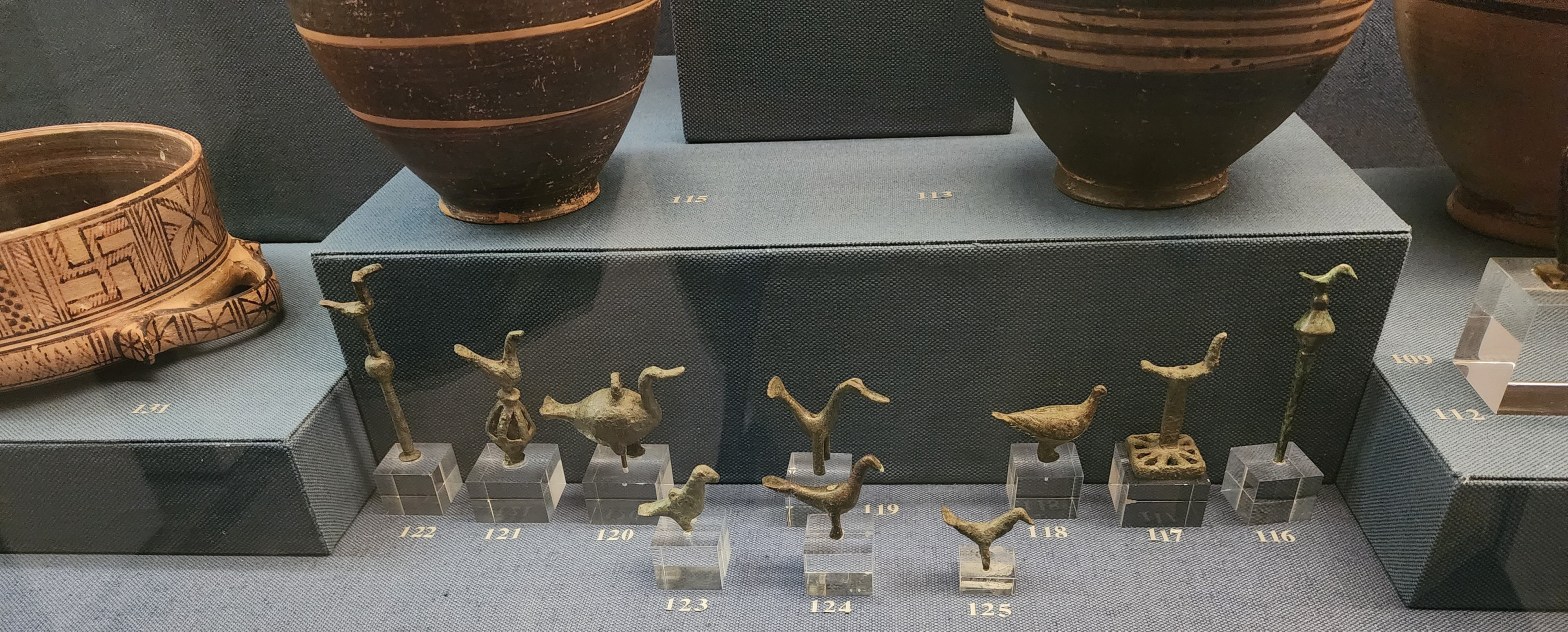
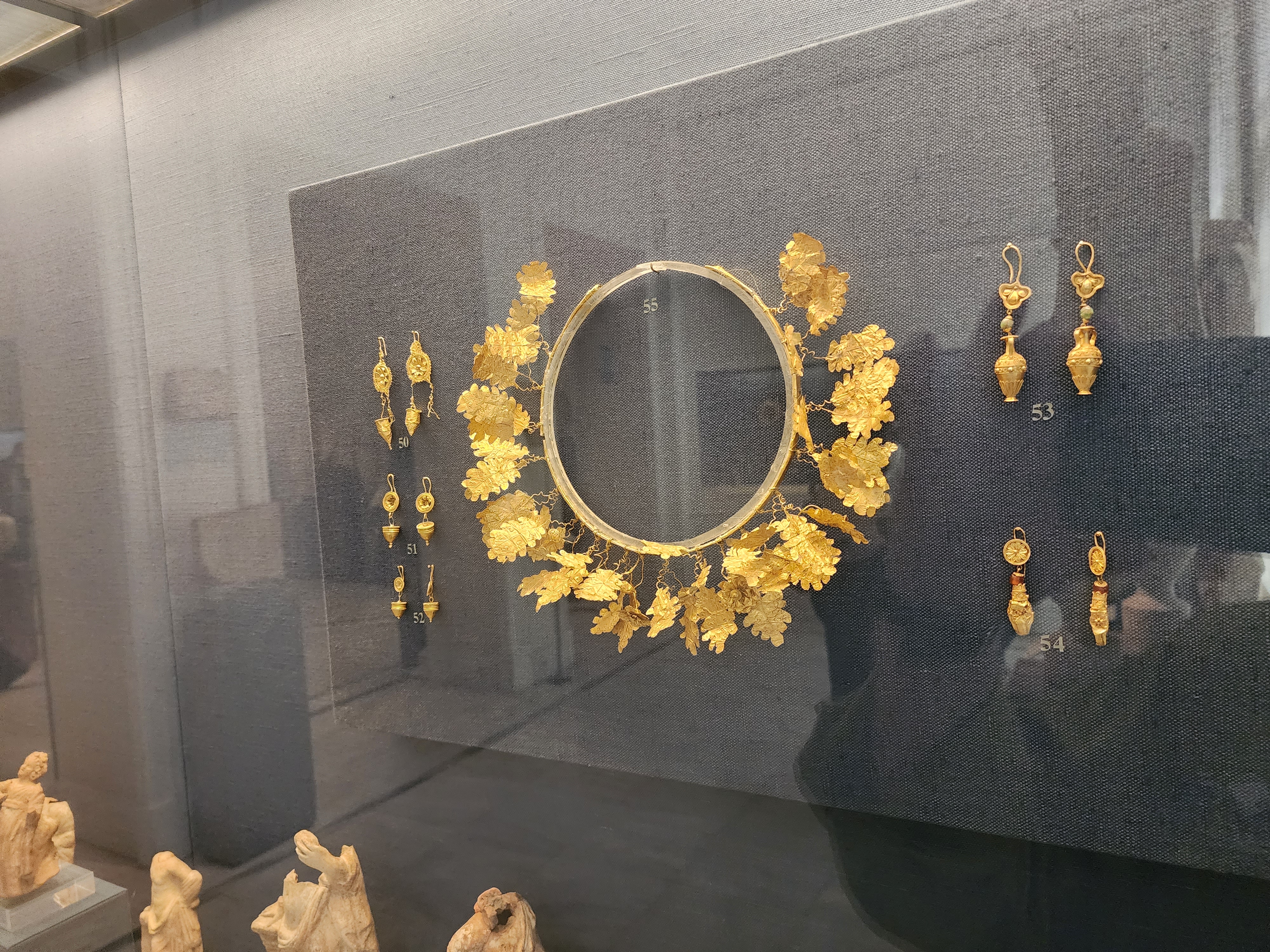
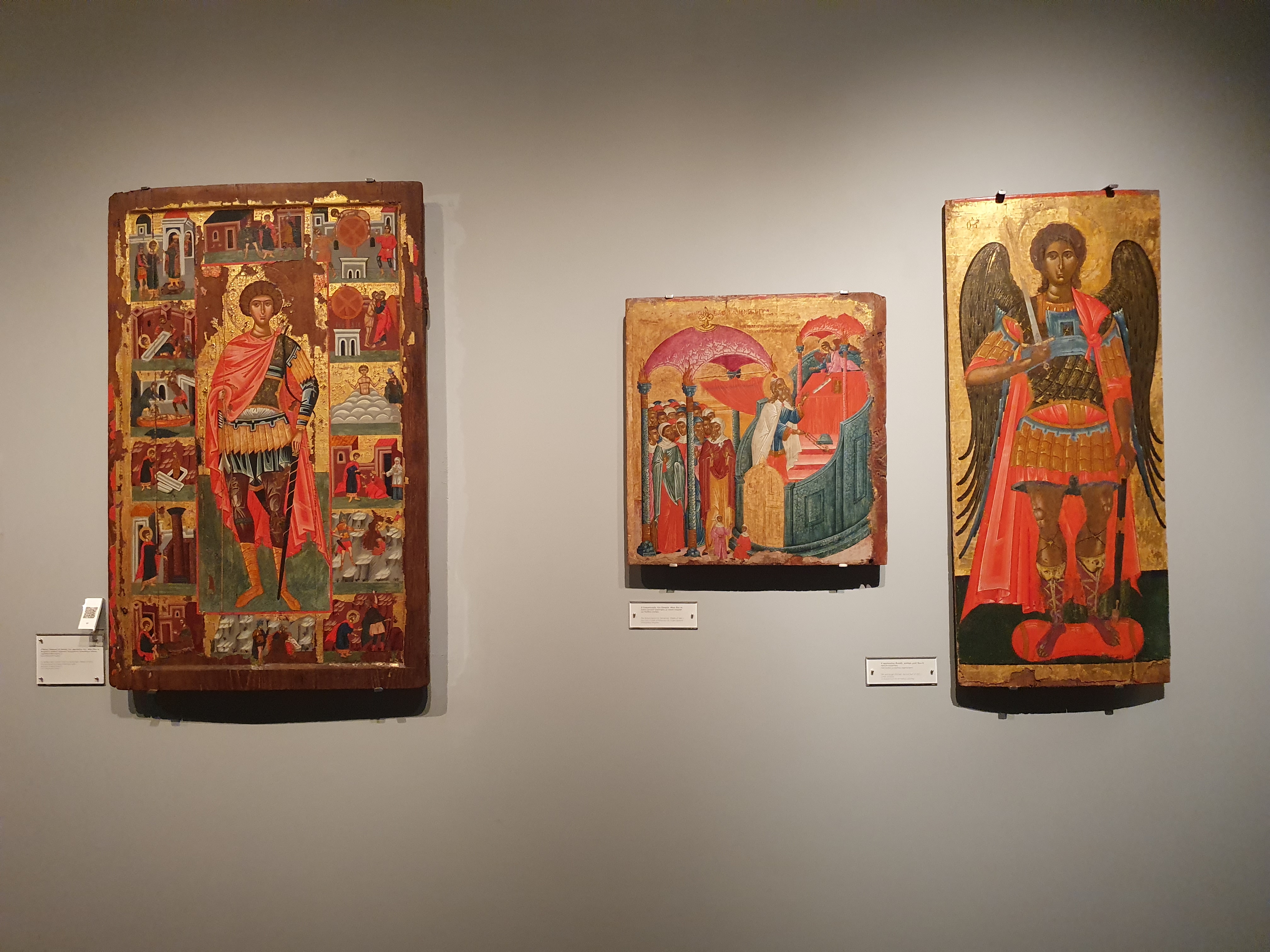
Clockwise from top L: Ancient pottery; Gold leaf crowns (knockoffs are sold on every street corner in the Acropolis area); Detailed embroidery of a ship; Vivid red in Byzantine art
The Benaki Museum of Greek Culture is near Syntagma Square in what was a large family home remodeled to its museum purpose. The collections go from oldest on the ground floor and proceed through ancient history as you go up. The top floor has an educational exhibit spanning ancient history and is presently recommended as the starting spot, with visitors working their way back down and moving back through time.
We saw wonderful things, topped off by an entire room of a 19th century house that was collected from a site that was going to be demolished.
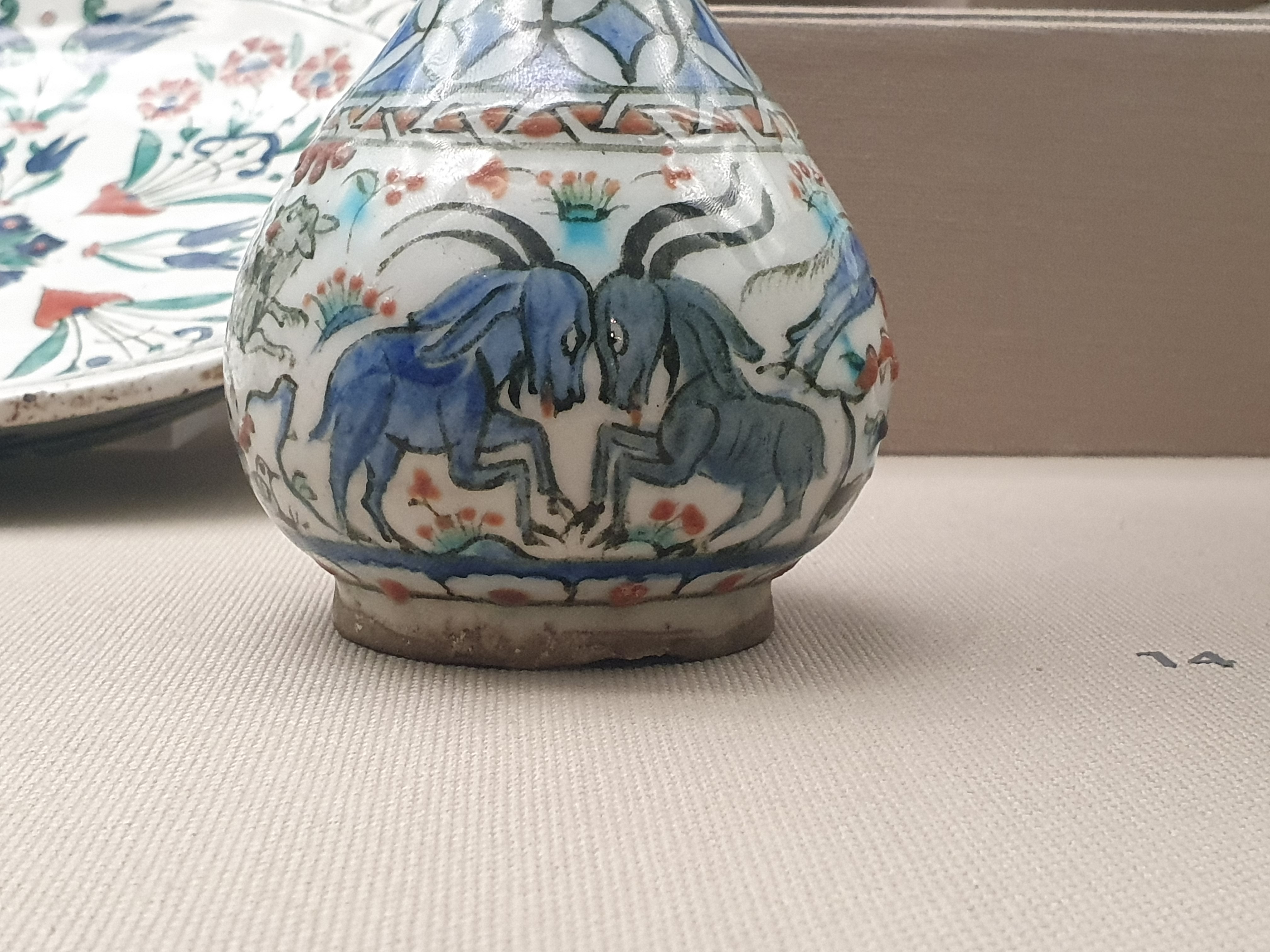
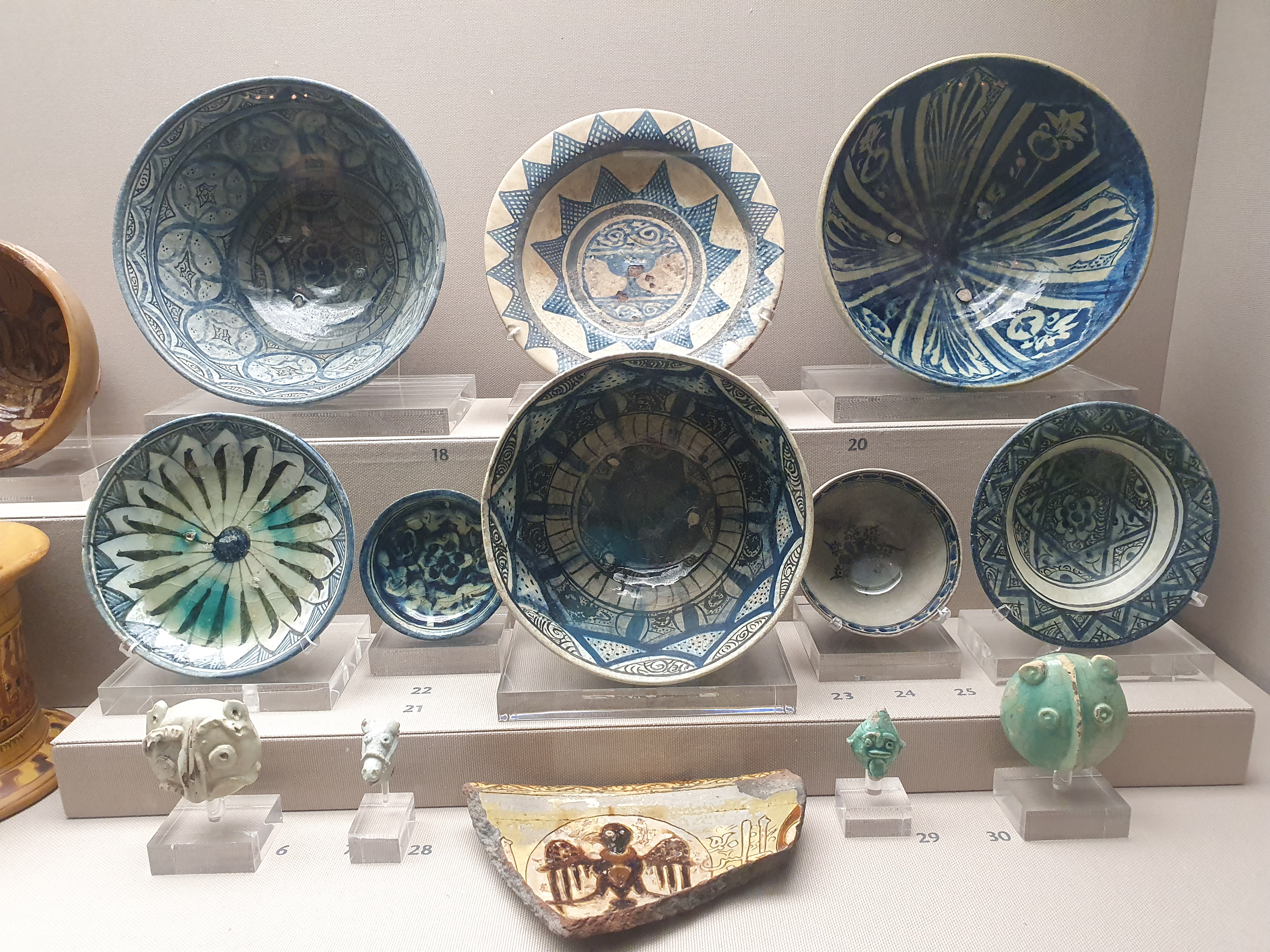
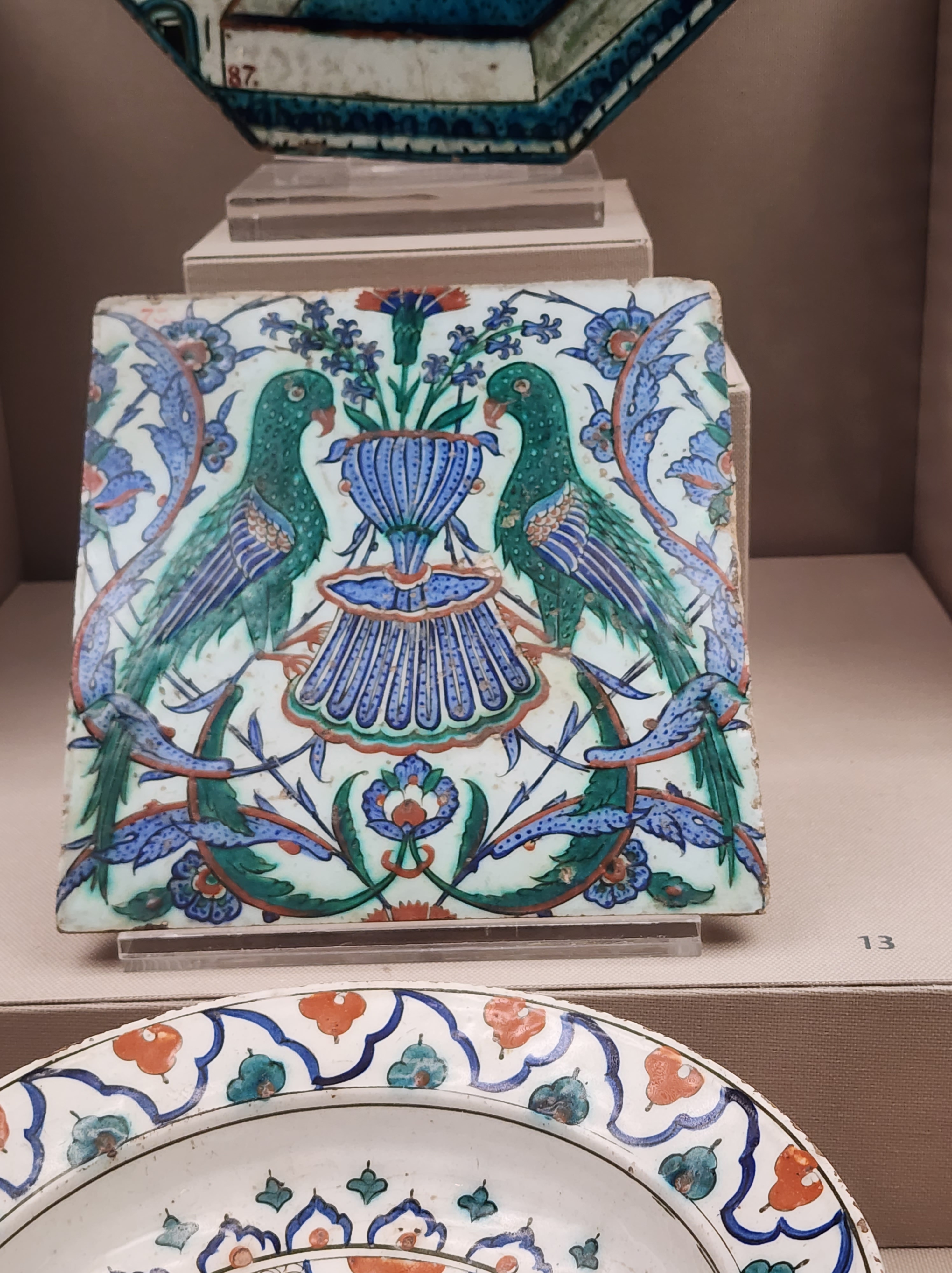
The Benaki Museum of Islamic Culture is a smaller, though full of interesting pieces of art from the entire span of Islamic history, from the 7th century AD to the present. Pottery from Iran to Egypt and glass from the earliest glass-making places caught my eye.
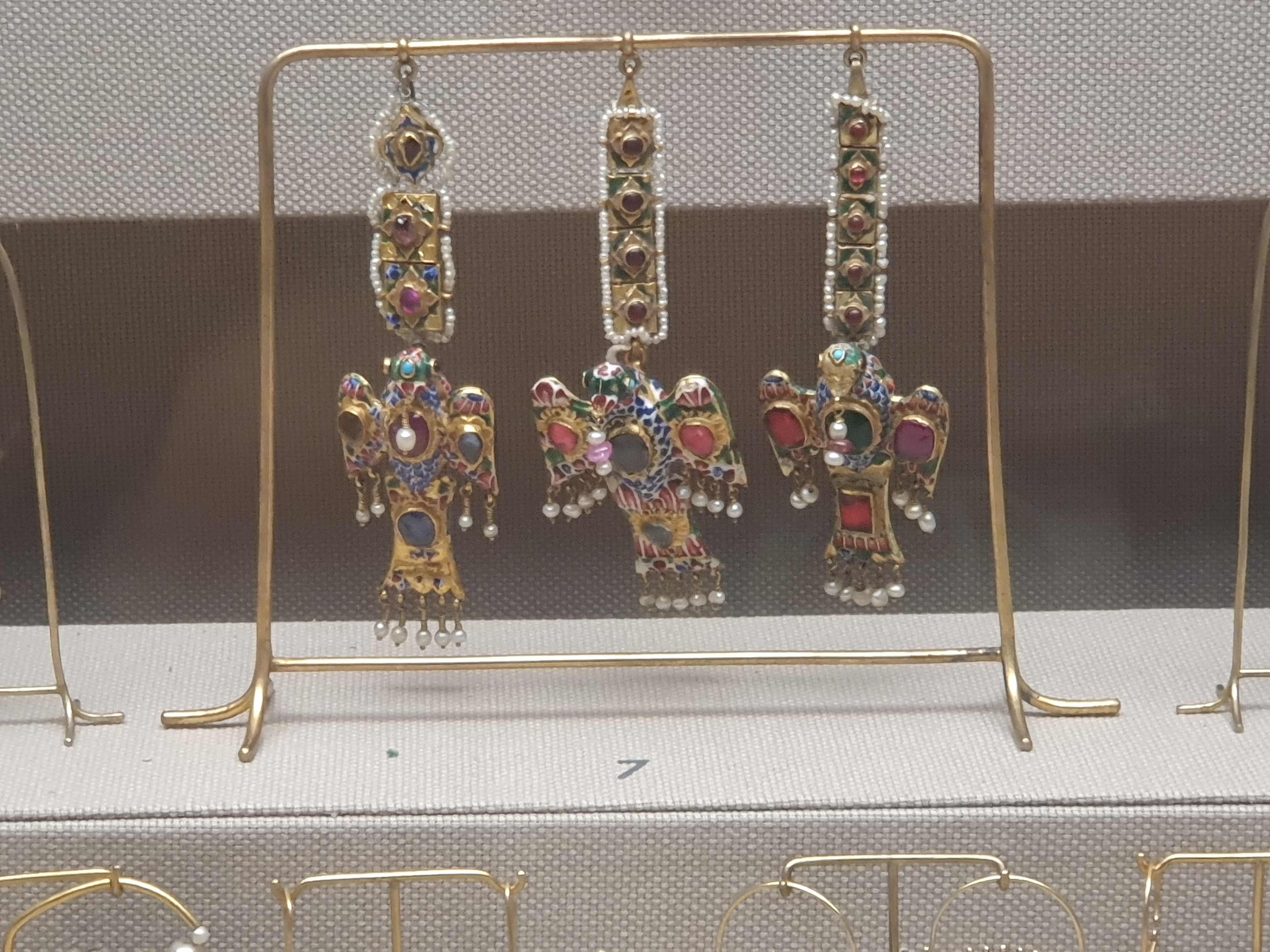
Elaborate jewelry, too.
I was intrigued by the figures painted around the edge of a plate (R). Perhaps it was the monochrome coloring, but it reminded me of the drawings of Marjane Satrapi, author of the graphic novel, Persepolis (which I recommend!).
The Benaki Museum of Islamic Art also has a secret–their cafe. It is lovely, and looks out over the Agora, Filopappos Hill and the Acropolis. Another reason to time your visit to include a coffee break.
The Benaki Museum of Greek Culture is only closed on Tuesdays, while the Benaki Museum of Islamic Art is closed Monday through Wednesday. Check the times before you plan your visit.
Everyone assumes that you’ll visit Greek Islands. They are all so famous, Mykonos, Santorini, Rhodes, and many others. We decided to stick with a one day trip from Athens to Aegina, one of the islands in the Saronic Gulf very close to Piraeus.* We could take the metro from Omonia all the way to Piraeus, walk down the street to the landing, take the fast ferry and be on Aegina an hour later.
We spent a fine day in Piraeus the week prior to our visit, scoping out where exactly the ferry landing is. Guidebooks and information online says Gate E8, but when you get there, E8 extends for about a quarter of a mile, and the ferry to Aegina leaves from just about the farthest point. We were glad to know where we were going in advance. We spent the rest of that day exploring Piraeus, visiting the archaeology museum, having lunch overlooking the sea. It was delightful.
We got up early on a Tuesday, drank our coffee and walked to the Omonia station to catch the metro. About 20 minutes later we were in Piraeus, and we headed for the ferry landing, a 10 minute walk. We arrived well in advance of the 9:30 am fast ferry, bought our tickets and waited to board. The ferry left on time, and I was surprised to find face masks mandatory, since elsewhere in Athens (on the metro) masks are mandatory and only about half the passengers wear them. Boarding was not allowed until the mask was in place. We had reserved seats, though it appeared that others did not.
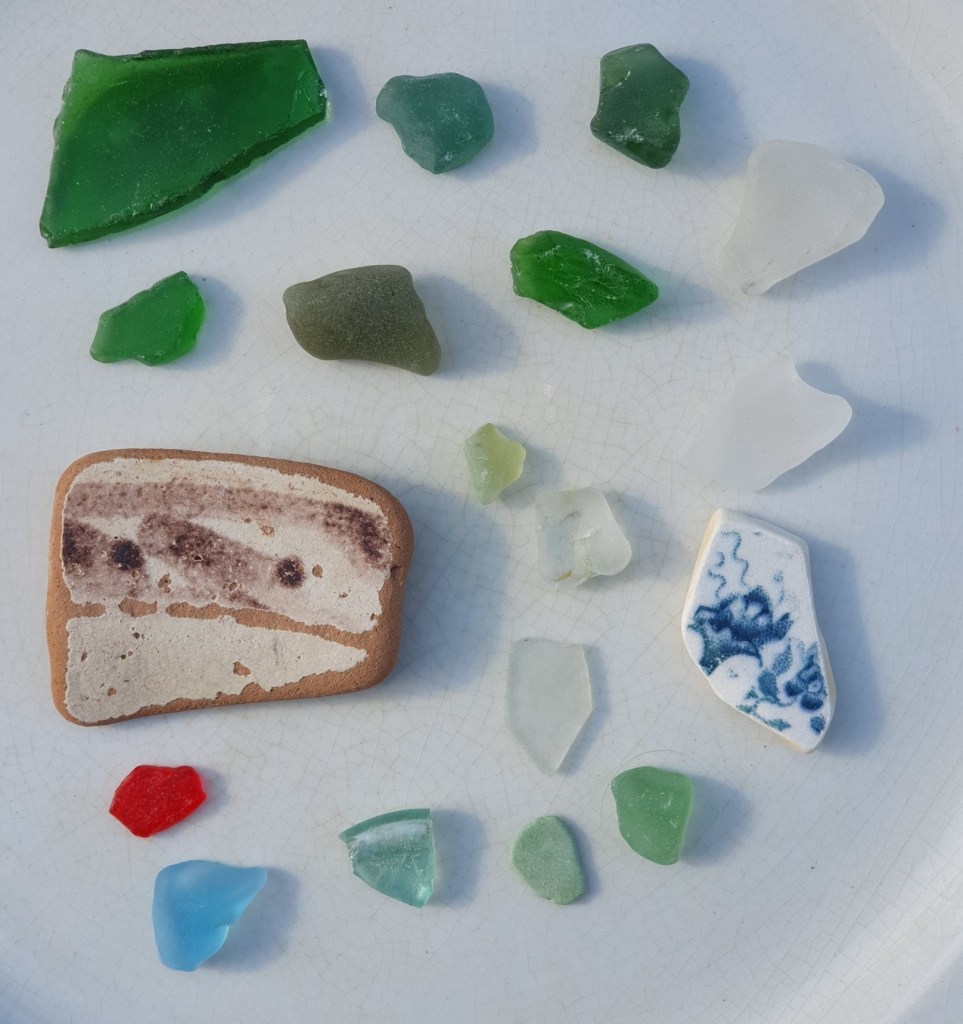
The ride went smoothly, and we disembarked in the center of Aegina town, on the west side of the island. We headed straight for a cafe for cappucino, watching the harbor, the visitors, and the beautiful day. I decided that we had to do some beachcombing, so we strolled south until just beyond the harbor, where we found a small section of beach. A lot of eelgrass had come in on the tide, but there was enough exposed sand and gravel to hunt around a bit. We picked up a few pieces of sea-worn glass, though most of our finds were quite recent and we tossed them back to get a little more polish. Jonathan found a piece of red glass, and that’s quite rare, and pointed out a tiny blue-green piece that may be very old. It has a bit of patina and a folded shape. I found the rim of an old soup plate, and a few other things.
We couldn’t keep going very far, as the beach area was small and there are miles of rocky coast. Perhaps if we’d had a car, we could have looked for more places to visit, but we were content to go on to the next order of business: visiting an archaeological site.
Aegina has several ancient sites, as people have lived there from the late Neolithic around 3000 BC to the present. One of the best known sites is the Temple of Aphaia. We were going to get a taxi out to the site, but decided to look it up first to be sure it was open. It was not. Our fallback choice was the Temple of Apollo on Kolona Point, just north of the port. The site was much larger than it first appeared, as people have lived there for so long. Successive layers of occupation by ancient Greeks, Romans, the later Byzantine empire, and even later groups cover the entire hill.
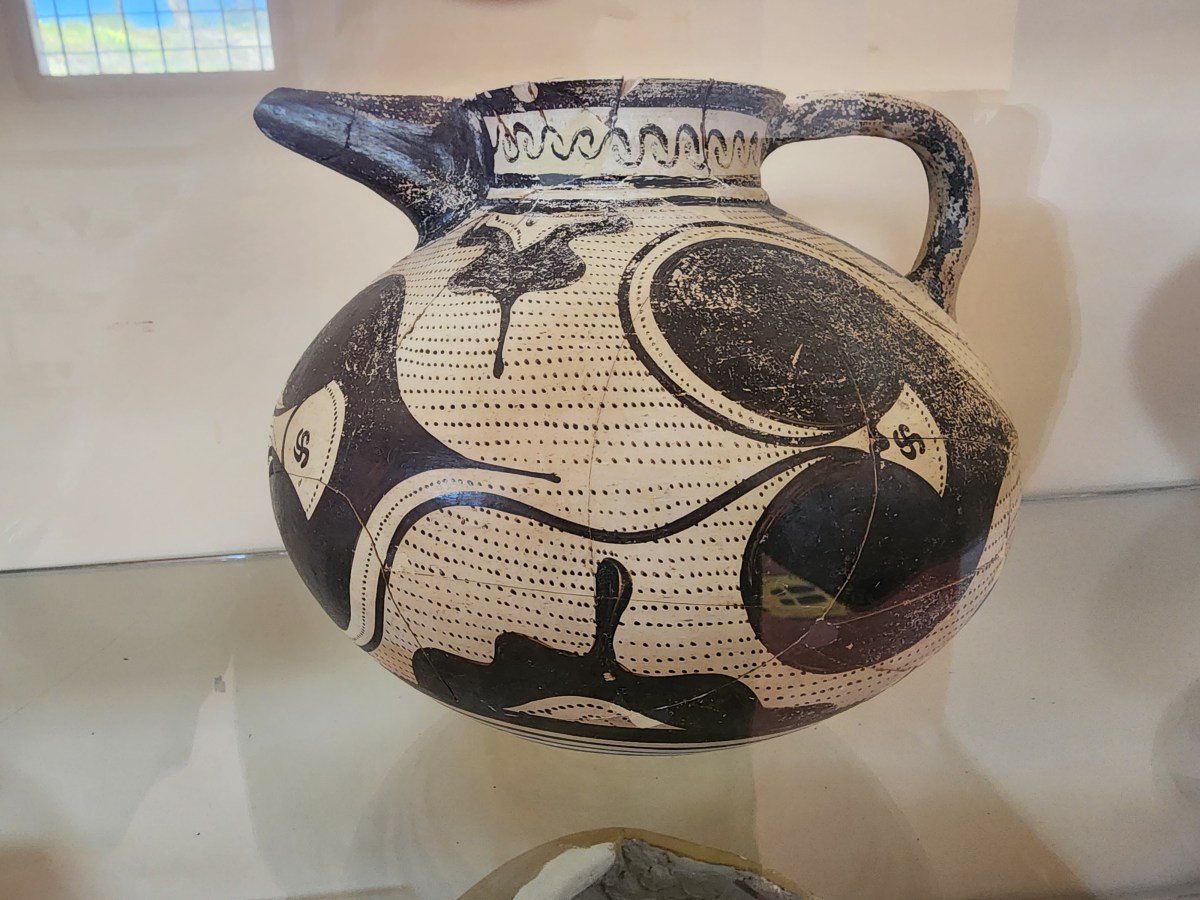
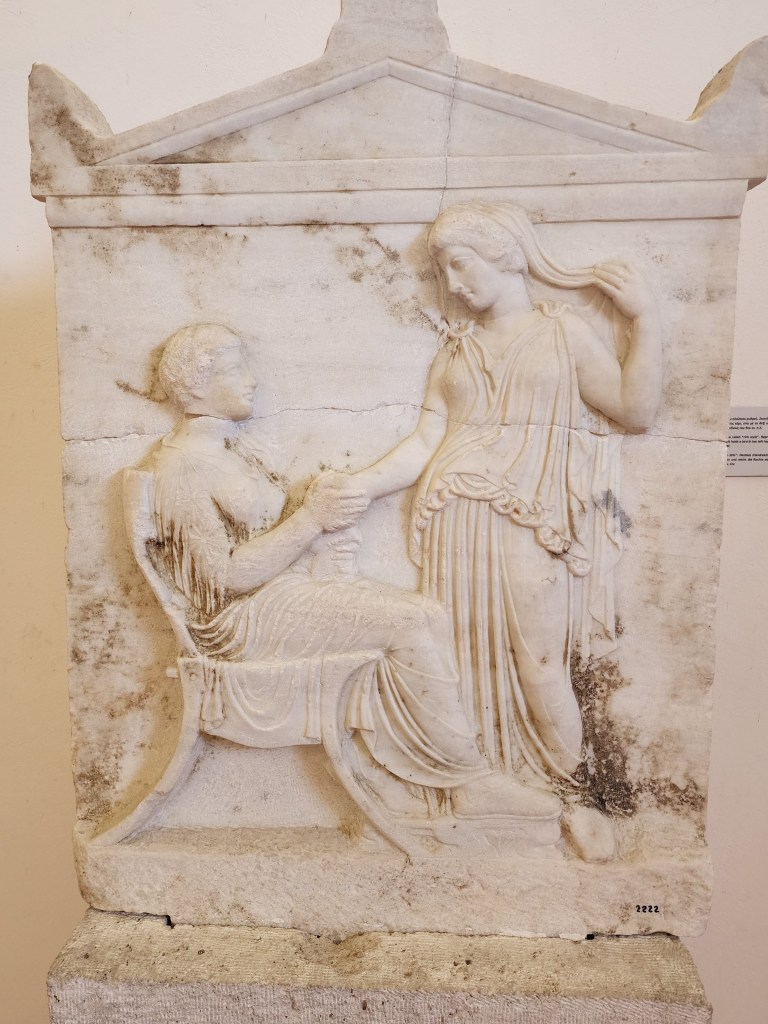
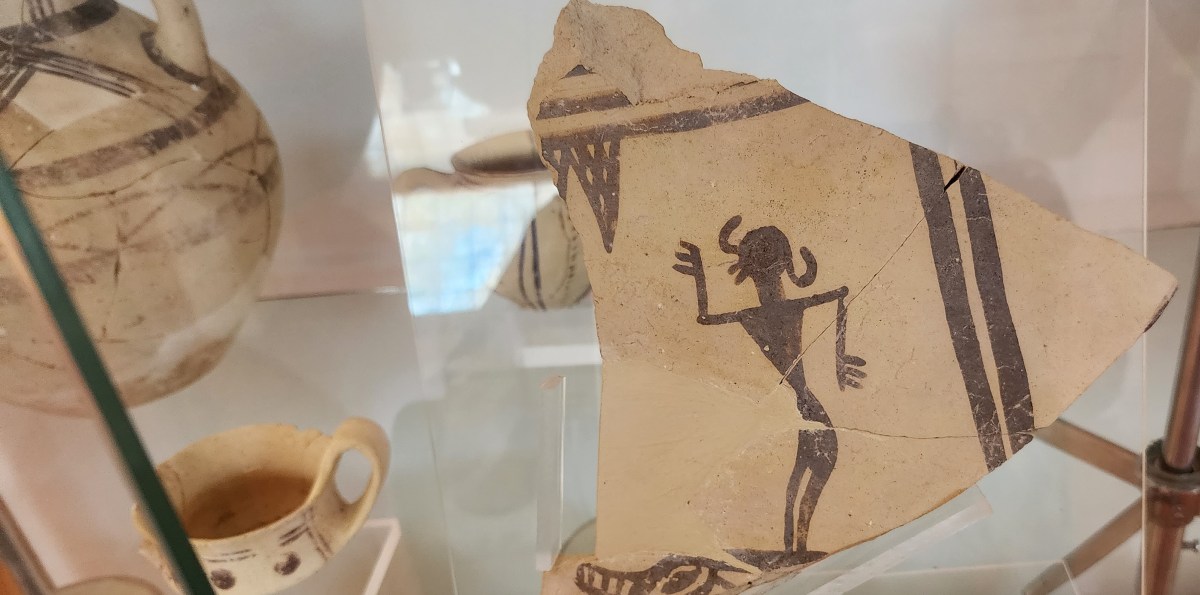
We began with the museum at the base of the site. We’ve found that the small museums (Kerameikos, Piraeus) sometimes have interesting things to see.
A beautiful potA remarkably well preserved grave markerDancer decoration on pottery that reminds of of the Hohokam in the American SouthwestA strange sphinx
After the museum, we climbed Kolona Point to the site. Only a single column remains of Apollo’s Temple. Like other sites, the ground is covered with excavated features and piles of column fragments that cannot be reconstructed. A German group excavates at the site each year; there were signs in Greek, English, and German explaining many of the details and showing the different layers of occupation that are difficult for visitors to identify. The view out over the gulf is spectacular, and we strolled around the point on some of the many paths to admire the view.
Despite the mild weather, I wasn’t interested in taking a swim, but we noticed a number of tourists sunbathing on the beach. We saw some of them on the return ferry in the afternoon, a few burned lobster red.
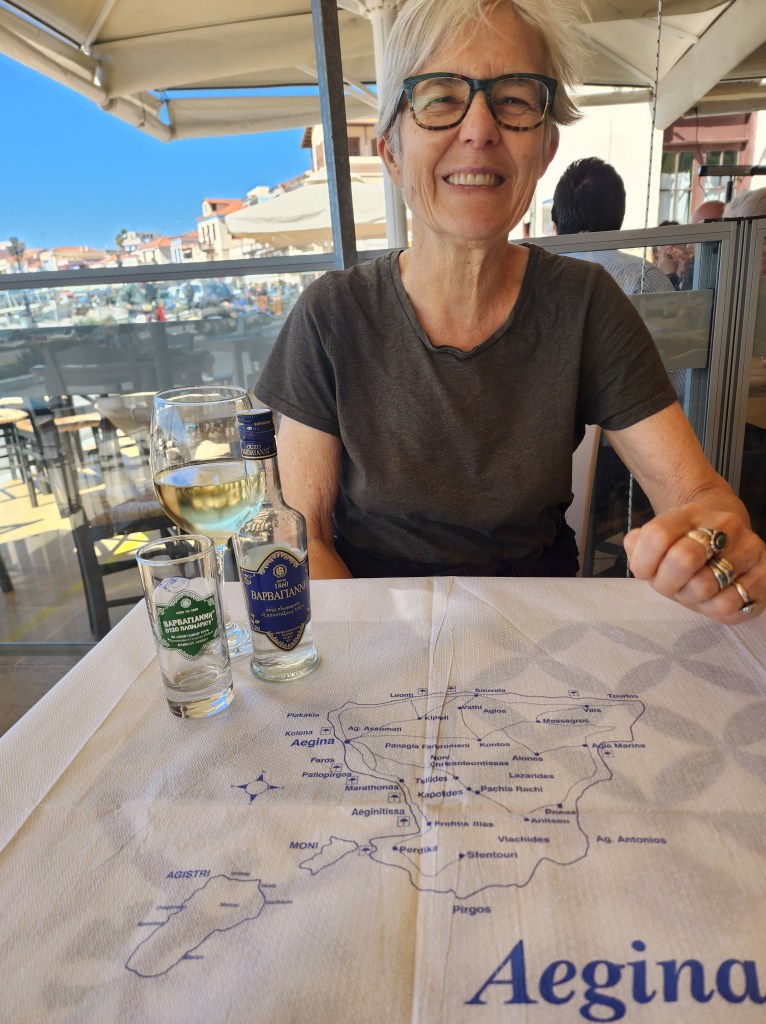
I liked the tablecloth with the map of Aegina.
Having exerted ourselves by climbing the hill and exploring the site, we turned to the important business of having lunch. One of the restaurants recommended to us would involve a cab ride, and we had let it get rather late. We wanted lunch promptly and overlooking the water, so Jonathan consulted his phone and came up with O Pelaϊsos. Once seated, we decided that this stop would take up most of our afternoon. We had more than enough to eat, with taramosalata, saganaki, and fried calamari. Jonathan drank ouzo, and I had white wine. We idled away quite a while people watching and eating. Finally, we had to move.
On the way back toward the port, we stopped to buy pistachios, the Aegina specialty. A local cooperative packages most of the local production, the woman selling them said that every family on Aegina finds space for at least a few trees. The pistachios are a bit smaller than I am used to, but they have excellent flavor, and were not oversalted. The sales crew are generous with samples. We bought a small bag to eat immediately, and more to take home as gifts. It’s something distinctly Greek, and delicious.
Back at the harbor, we found a partially shaded bench and sat to await our ferry, not knowing we would witness the drama of the afternoon. As we sat, the wind got stronger and stronger until I had to jam my hat on my head so it wouldn’t take off. The wind turned the sea into a mass of churning waves exploding across the seafront. A tour boat had left its mooring on the wharf to sit out on the water in the rough sea. Passengers began arriving to board, but the sea had started to break over the wharf, splashing and spraying. The tour boat approached the wharf, ready to extend its gangplank. Bounding on the waves, the crew had difficulty getting a line to shore. After heaving up and down for a bit, the ship pulled offshore again and made another approach, but was still unable to near the wharf without tremendous bobbing up and down. There seemed no way the gangway could be extended safely. On the next try, the crew almost landed, but at the last minute pulled in the gangway and set off again. This kept up for more efforts without success. Part of the problem was that the ship was designed to back in and sit with its narrow stern at the wharf. In rough seas, with everything rising and falling 4 or 5 ft with each wave, the ship was extremely unsteady. It didn’t appear to be equipped to moor with its side to the wharf.
Late to depart, all the tour boat passengers had gathered, some people climbing on the cement planters to keep out of the waves sloshing onto the wharf. Normally, there’s one or two ticket takers, but not anyone to manage the crowd, and some of the waiting passengers were getting panicky, no doubt wondering whether they were about to be stranded for the night on Aegina. As the boat moved offshore again, passengers crowded onto the wharf, retreating only when the captain began another try at backing in. On about the sixth try, the captain brought the boat in at the far end of the wharf, where a large car ferry had just departed. Perhaps there was more protection from the sea, but for whatever reason, the crew got lines across and finally lowered the gangway. I was concerned there’d be a rush to board, and it looked pretty dangerous, but the passengers hustled onto their boat, and it left on their return trip. A very dramatic end of their afternoon. It took five or six tries over almost a half hour for it to get close enough to board people safely. It was quite a performance and a tribute to the captain.
I was happy to be going on the Aero 2 fast ferry, a heavy catamaran that barely rocked in the heavy seas. The wind blew strongly all the way back to Piraeus and on into the night. When we disembarked in Piraeus, the wind blew us down the street to the metro. In no time we were home, though it was almost 8 pm. One of our longest days out, but Aegina was worth it.
* For those who might be wondering WHY we skipped those famous islands, it’s mostly because they are so hilly. Sometimes there are very steep stairs between the road and the beach. Our knees are not up to that any more.
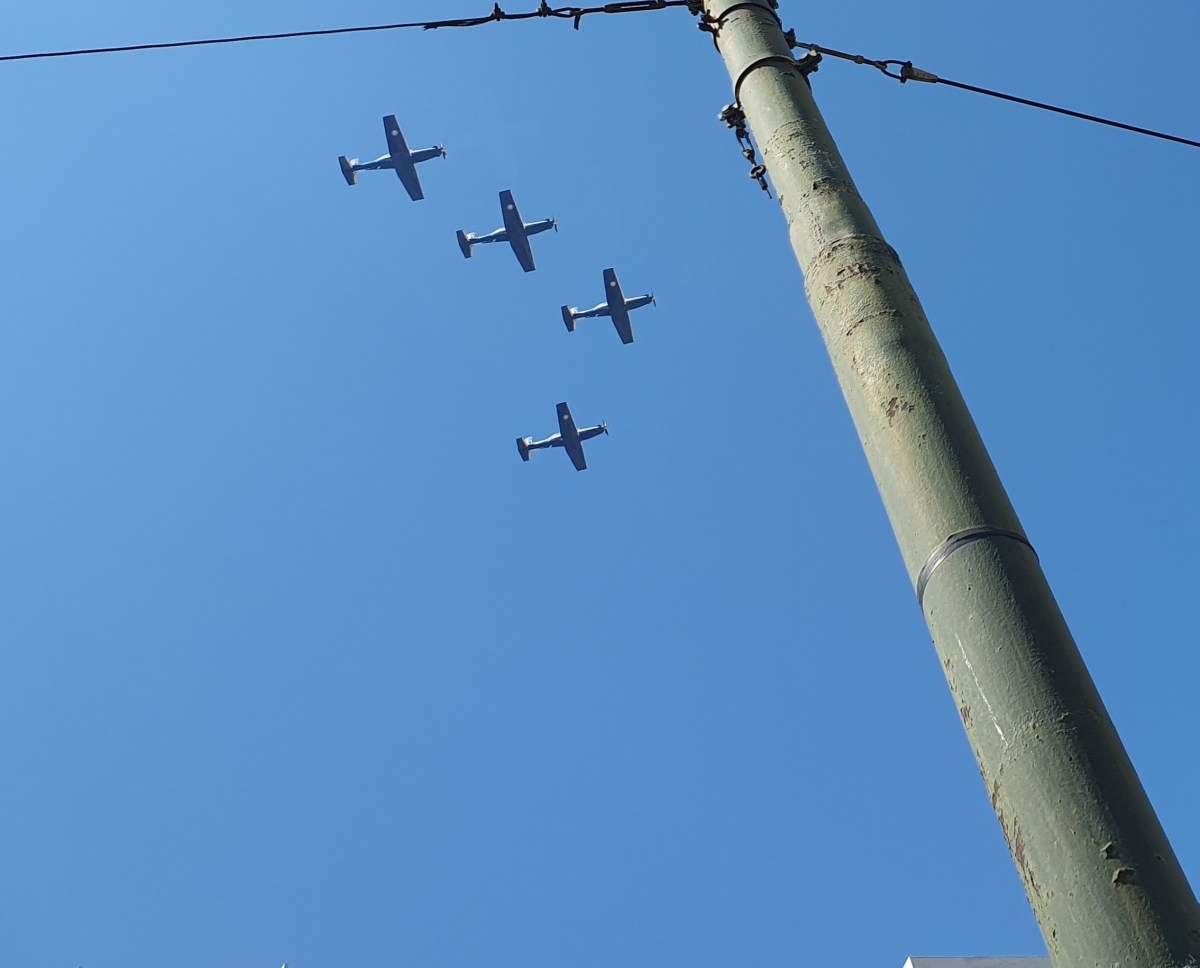
I was startled out of my sleep on Friday by the sound of low-flying jets–a terrifying sound. It happened again a while later, and when we emerged from the apartment, I asked Sassa, our local cafe owner, what was going on. She smiled. “They’re practicing for tomorrow, Independence Day.” “There’s a big parade.” “You should go.”
The availability of places to park on our street shows it was an unusual day.
So we did. The sound of fighter jets was still unnerving, but at least we weren’t under attack. The parade began at the civilized hour of 11 am, which gave us a chance to go to our local Saturday farmer’s market first. When we went down the street, we noticed everything was closed. Oh, yes, it’s a national holiday. There was no farmers market this week. The only thing to do was head to the parade route, just a few blocks from us.
We found a coffee shop that still had tables free. I claimed a table while Jonathan waited in the very long line, but in the end we had coffee and a place to sit until the parade got underway. It may have started at Syntagma Square in the heart of downtown at 11 am, but it didn’t get down the parade route to us by the university until after 11:30. The fighter jet overflight kicked it off, followed by three more groups of four jets zooming overhead, then planes, then helicopters. (The jets went by too fast for me to get a photo.)
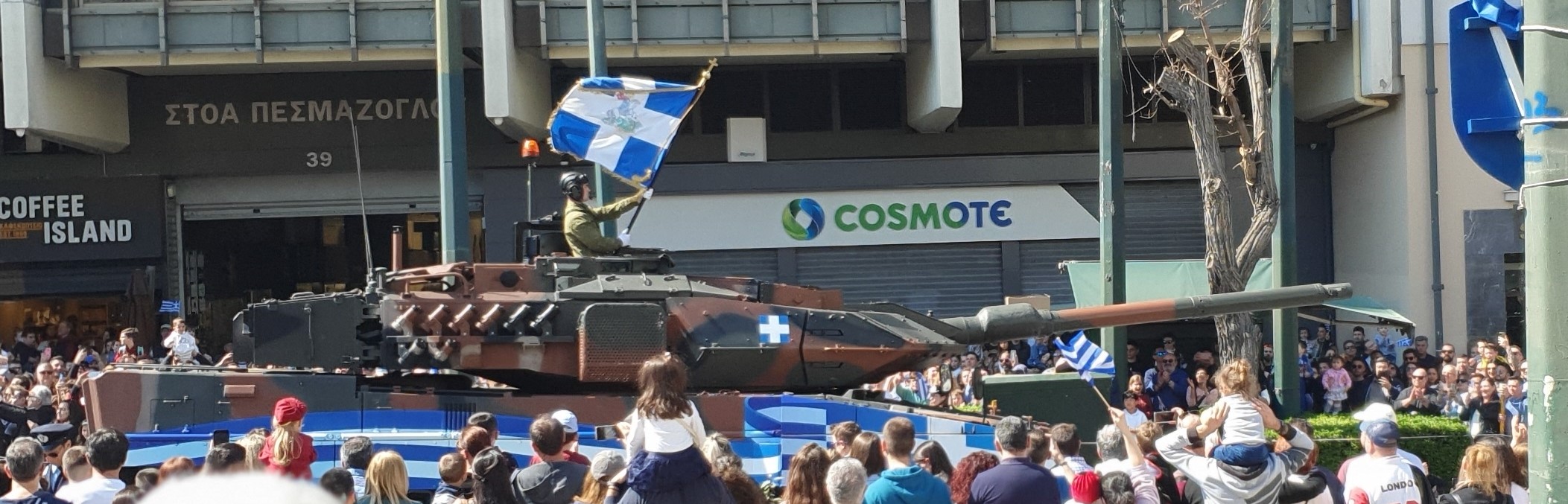
I don’t think I’ve ever been to a real military parade before. Right after the motorcycles came the artillery, troop carriers, tanks with long guns, a truckload of drones, another of missiles, and trucks full of launchers and troops in battle dress. It made me very uncomfortable.
I wondered whether the Greek government went big on military hardware as a warning to those who participated in the recent protests. Those people may not have been in attendance, as the crowd applauded the passing groups, and generally seemed strongly supportive of the military. There were supply trucks, and Red Cross trucks, but they came at the end, right before the fire trucks. The noise from the military hardware made the sides of the buildings vibrate.
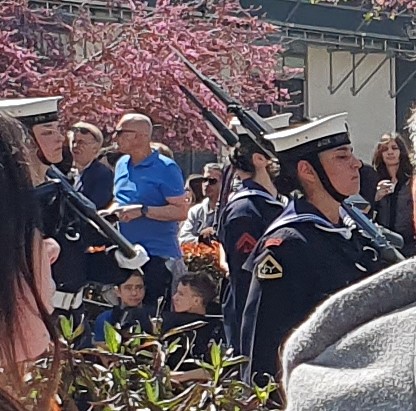
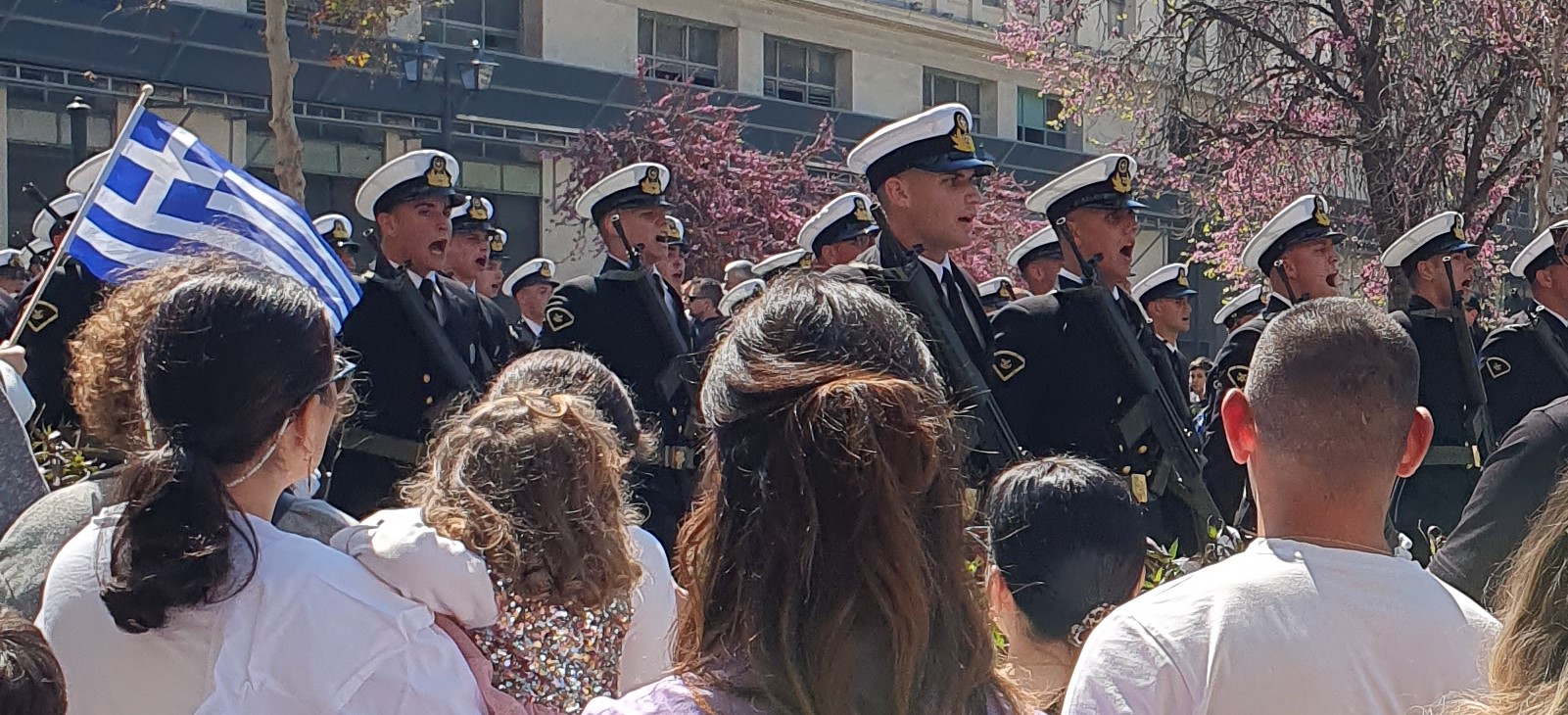
After the show of force there was a gap of another 20-30 minutes, probably because the military hardware was driven along the route going about 20 mph, while the people marching were going about 3 mph. Eventually, squads of soldiers came by, in every possible kind of uniform, hatless, red beret, green beret, helmets, flat caps, even a squad of officers all wearing navy blue jackets with gold epaulets and collar pins. There were firemen, and in their final row, a line of divers carrying scuba tanks on their backs.
It was a gorgeous sunny day, and most of the marchers must have been suffering from the heat, but they all strode along in step. Every three groups or so was a uniformed marching band. I watched a drum major hurl his baton way up in the air and saw it somersaulting back down into his hand. Impressive. I liked the music best–much less threatening than the rest of the parade.
More planes flew over, more helicopters, more groups marched. When the last group filed by, the street filled with people following the marchers toward Omonia Square, where the parade route ended. It was quite a show of military might and Greek patriotism. Lots of people waved small Greek flags and a couple of children were in traditional dress. I found it curious that the traditionally-garbed soldiers of the Parliamentary Guard who are on display every Sunday at the changing of the guard did not walk the parade route. Everyone else was there!
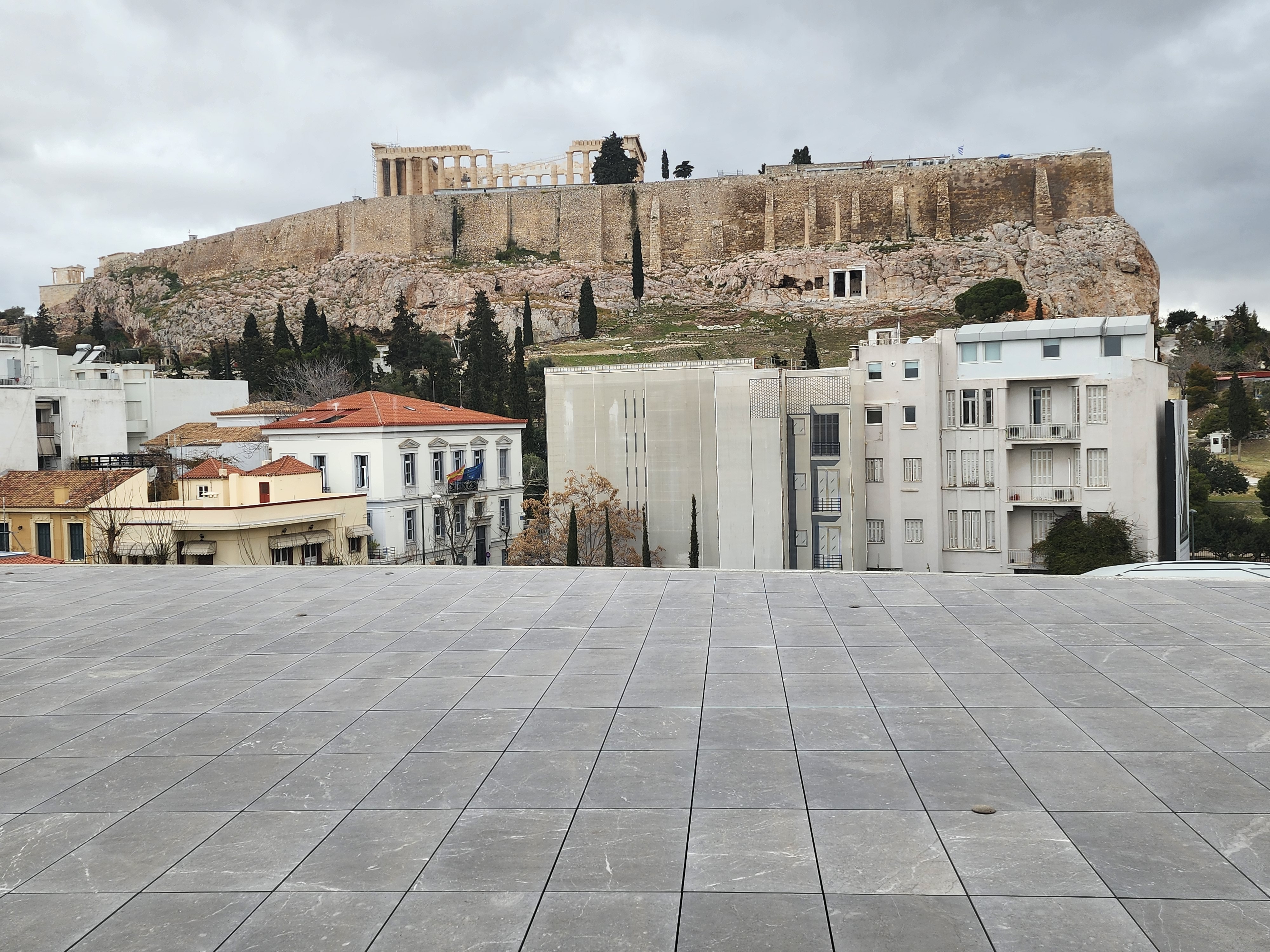
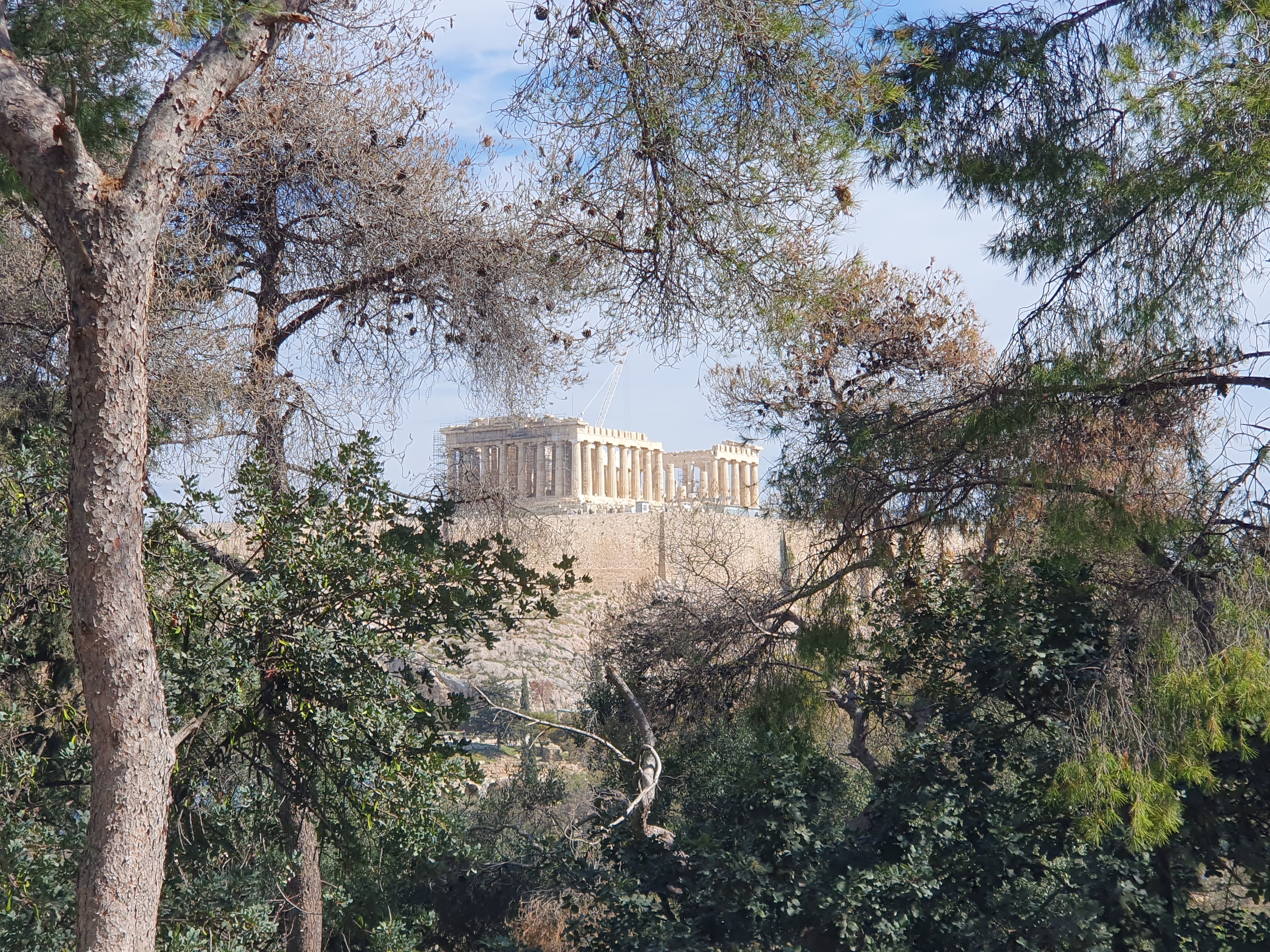
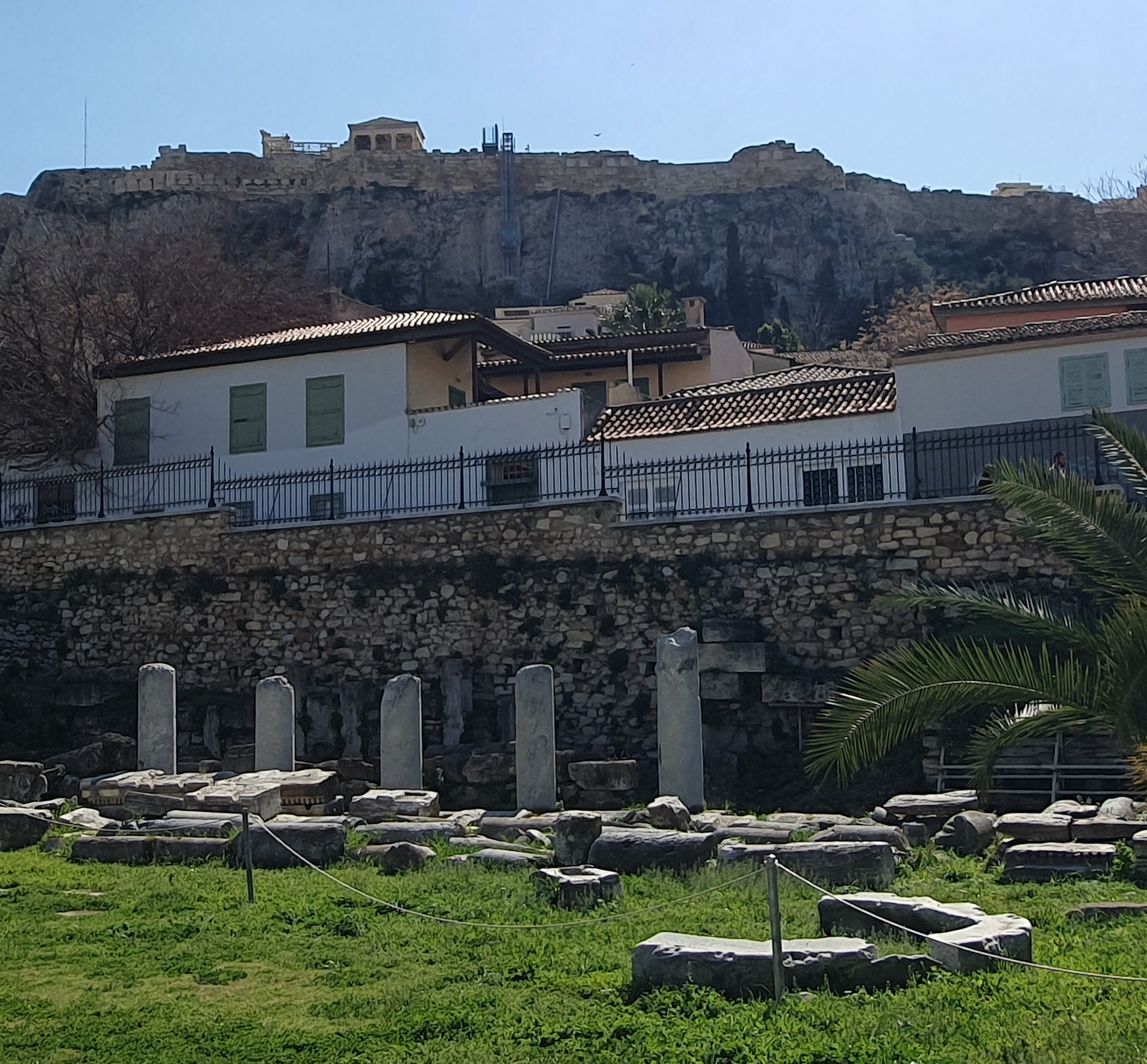
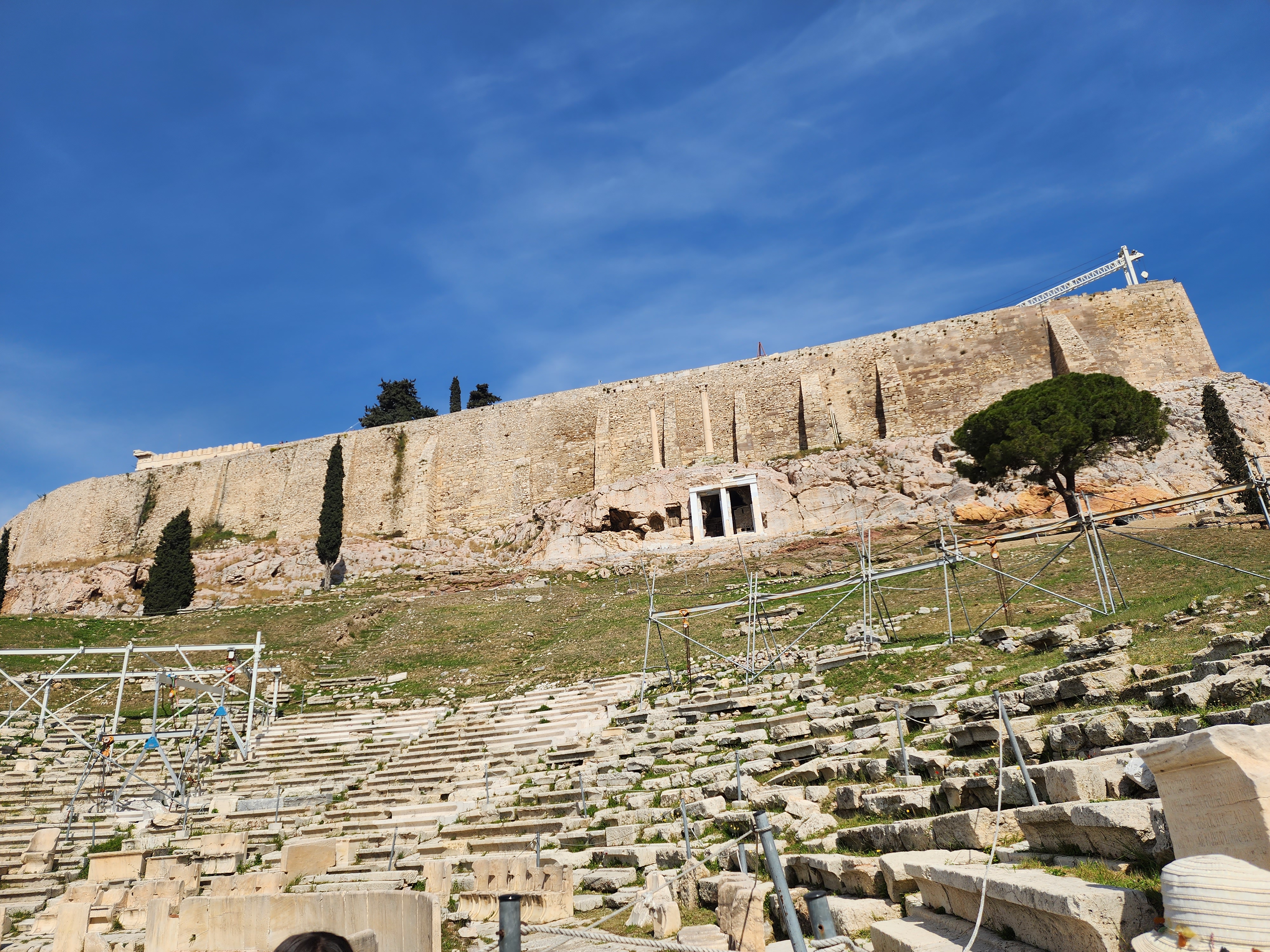
We developed our visit to Athens by seeing the Acropolis from different angles, from the tops of the nearby hills, and from the base of the hill on different sides. The Parthenon is the big central temple, and the day came when it was time to climb to the top and see it up close for ourselves.
Clockwise from upper left: Acropolis from Acropolis Museum (S); from Filopappou Hill (SW), from Lycabettus Hill (NE); from Monastiraki flea market (N); from Roman agora (N).
We’ve had lovely weather almost the entire length of our visit, and I recommend March as a good time to be in Athens–unless you are planning to swim.
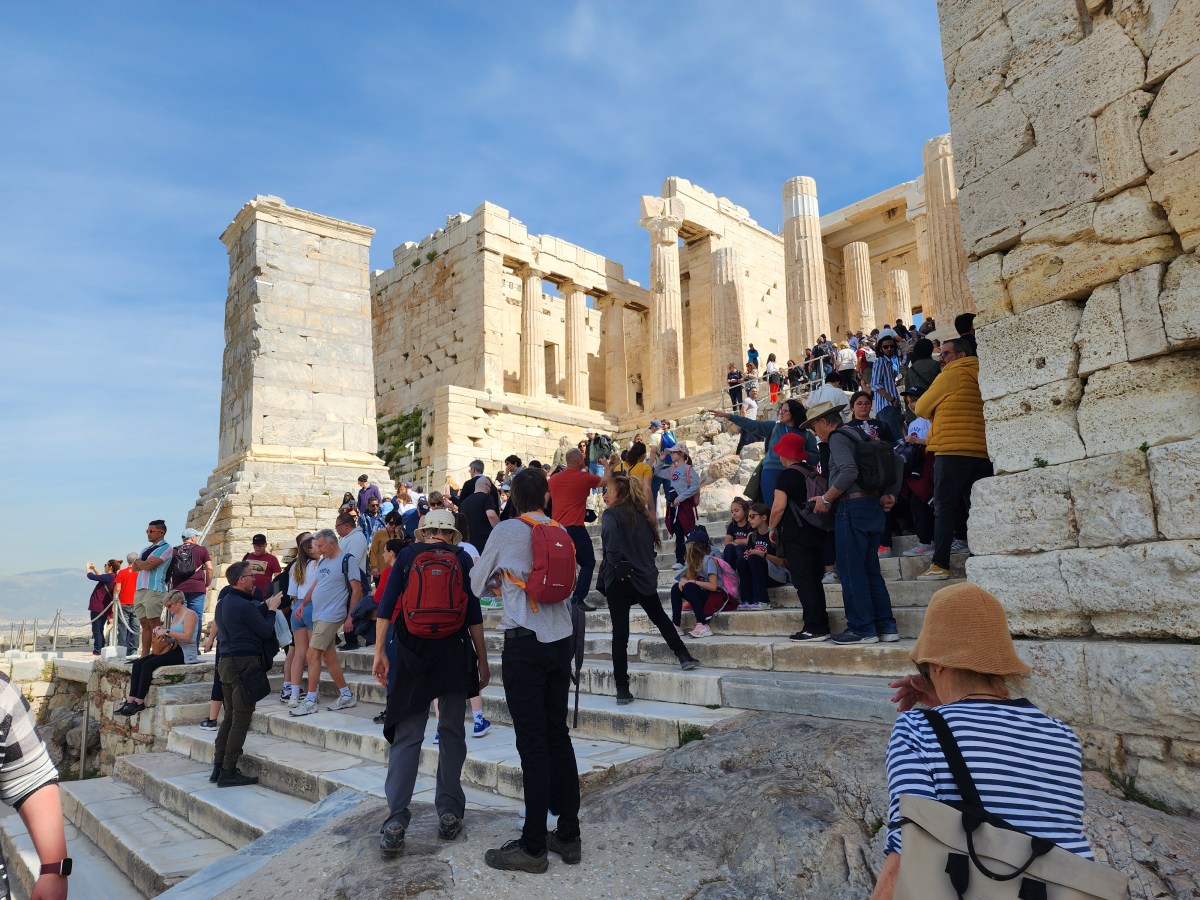
The day we chose to climb up the Acropolis was sunny and warm. By the time we reached the top, I’d shed my gloves, scarf, sweater and tied my jacket around my waist. The Propylaia was the grand entrance to the Acropolis and is still the principal entry point.
Even in March, the Acropolis is popular, and there were hundreds of our fellow visitors. (There is an average of 16,000 visitors every day, all year long.)
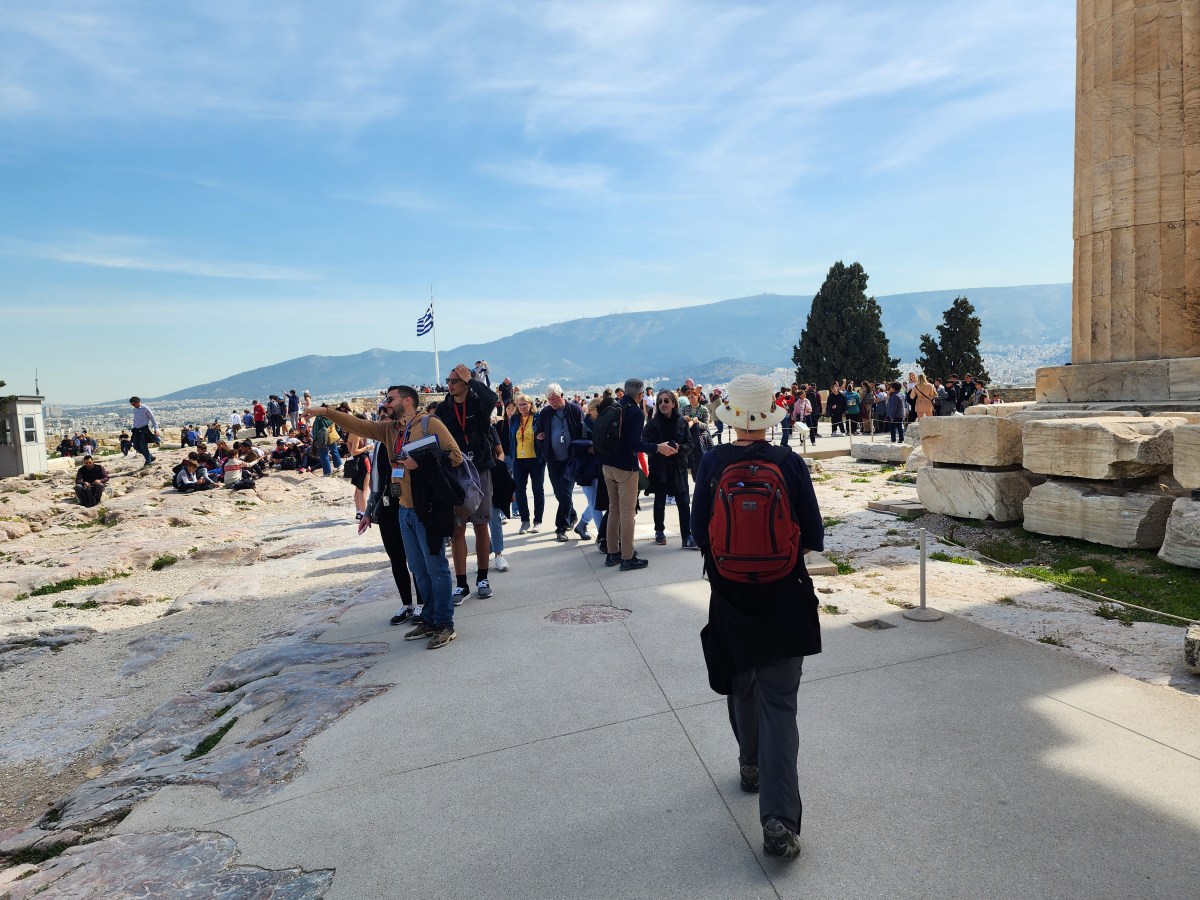
On the Acropolis with a few of our fellow travelers.
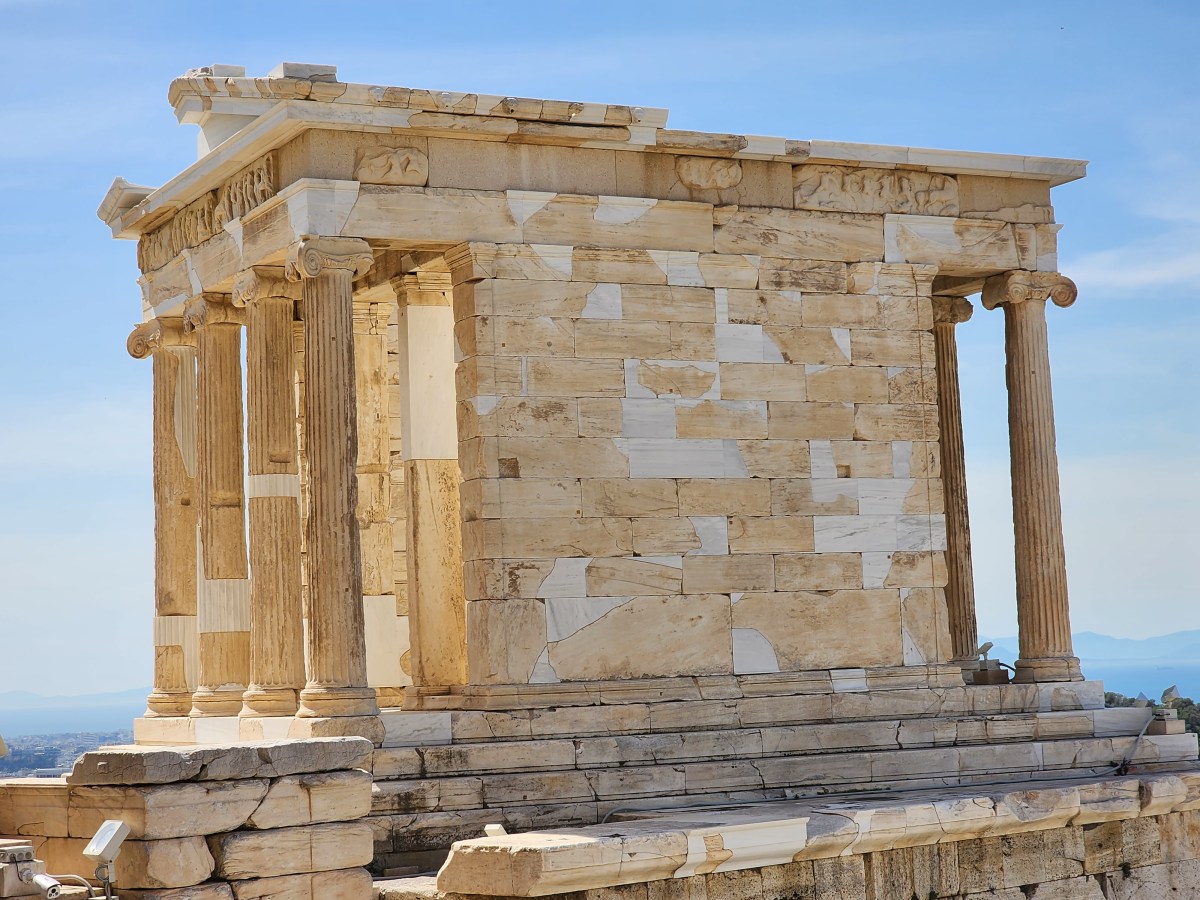
We picked our way from structure to structure, appreciating the monumental undertaking of piecing ancient temples back together from scraps. The Temple of Athena Nike (below) is a good example. First build around 425 BC, it has been completely dismantled and rebuilt, twice! Remaining carvings are in the National Museum, with replicas displayed on the reconstructed building.
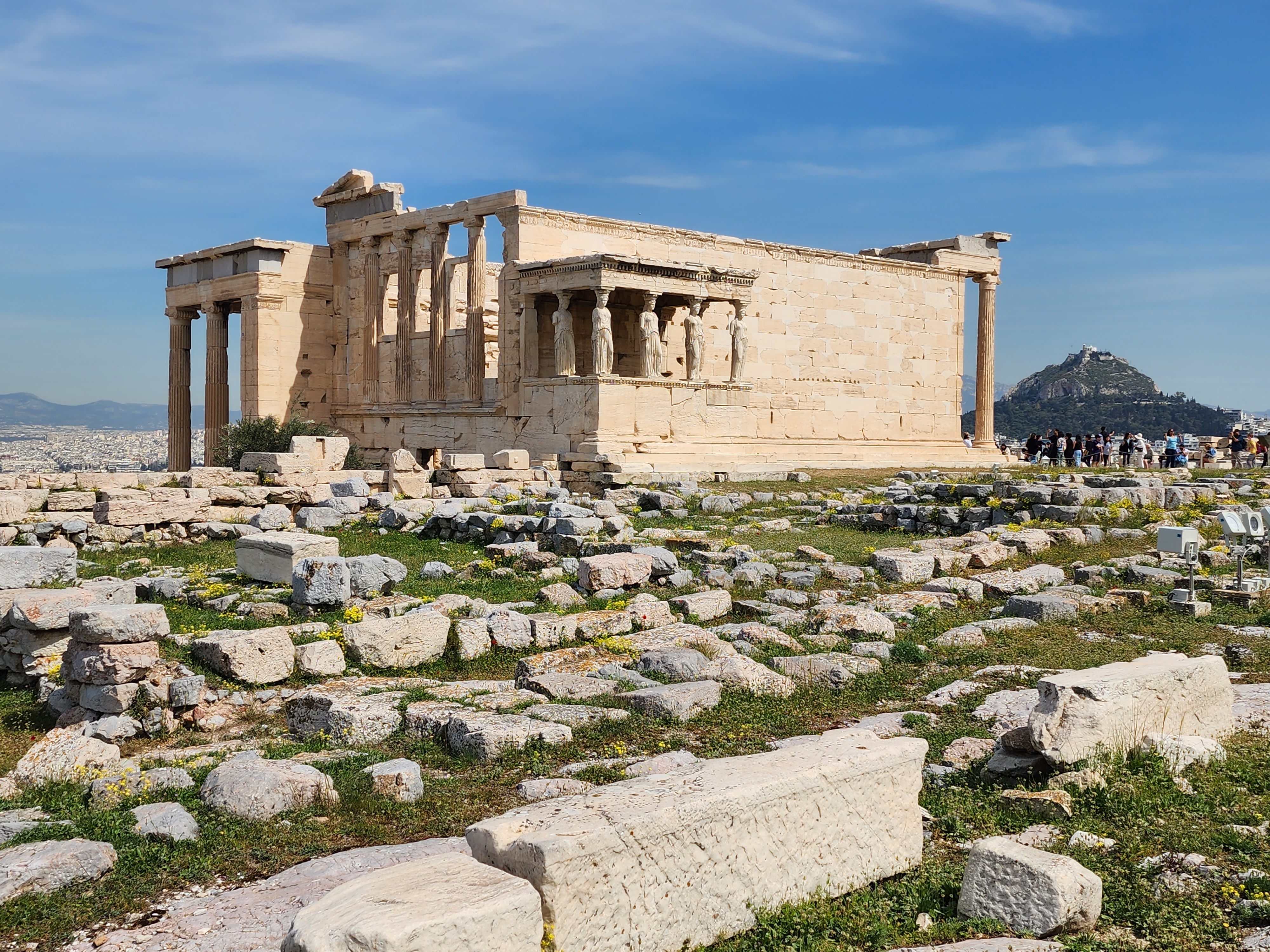
The Erechtheion is not well known to visitors, but has my favorite features of the Acropolis, the Caryatid pillars, six columns in the form of women that hold up the roof of a small side porch. The opposite side of the building has another porch that appears overly tall, as the ground slopes away and the columns fill in the space.
The Caryatid porch of the ErechtheionThe original Caryatids are now in the Acropolis Museum
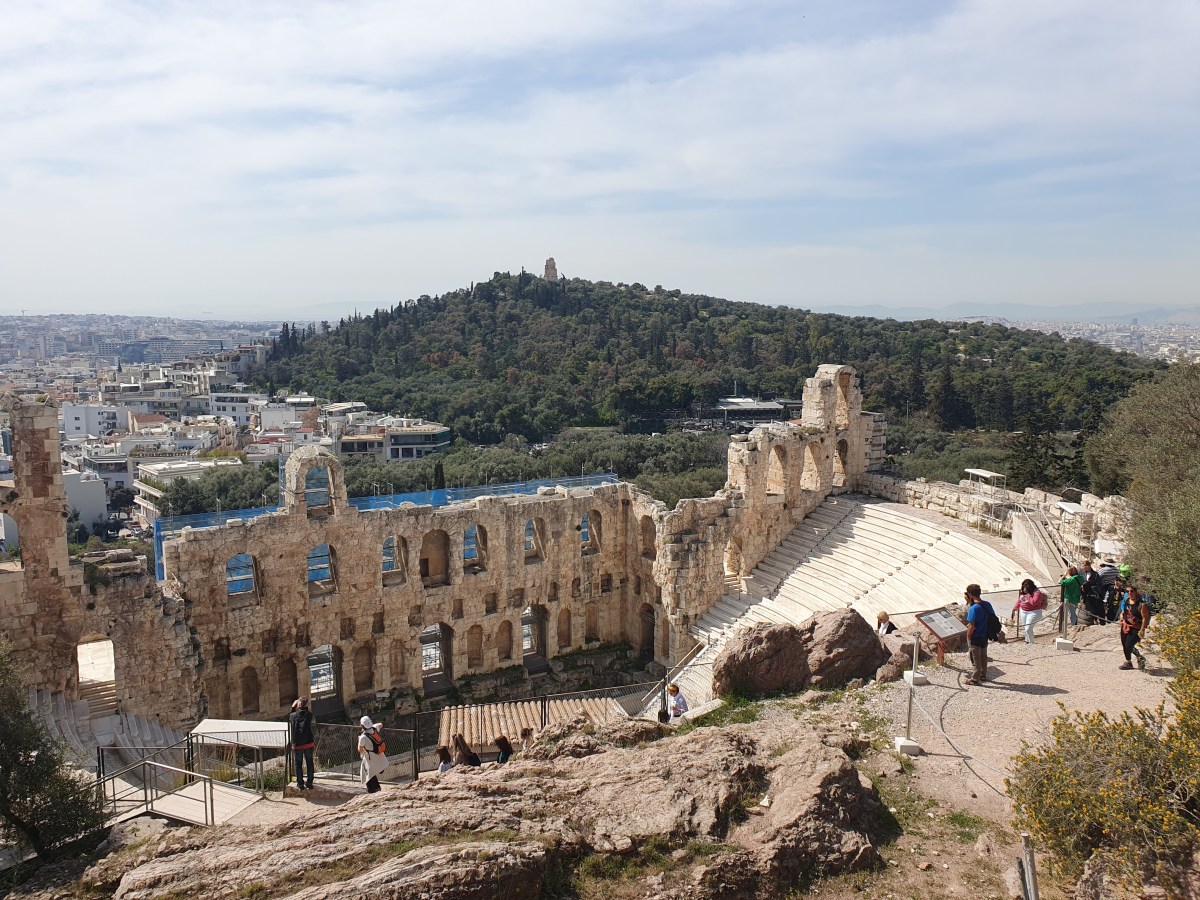
There are two amphitheaters built into the side of the Acropolis. The one below, the Odeon of Herodes Atticus, is used for some performances during the summer. Wouldn’t it be wonderful to see an opera or concert here?
The Odeon of Herodes Atticus is used as a theater today. Filopappous Hill in the background is where the mortar was positioned that blew up the center of the Parthenon in 1687.
The Dionysian Theater is larger, and seated 17,000 people when it was complete. This is where the famous authors of ancient Greece declaimed their work, and the front rows were marble thrones.
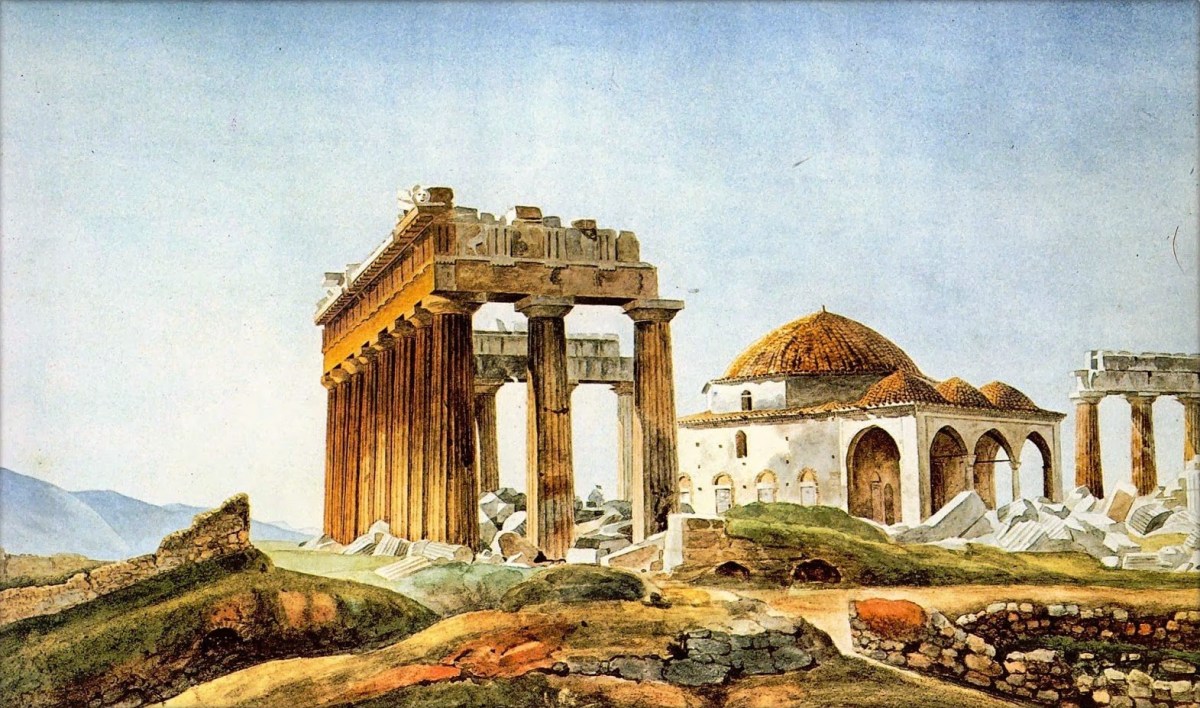
Jean-Pierre Eugene Peytier, Mosque in the ruins of the Parthenon, painted 1830s.
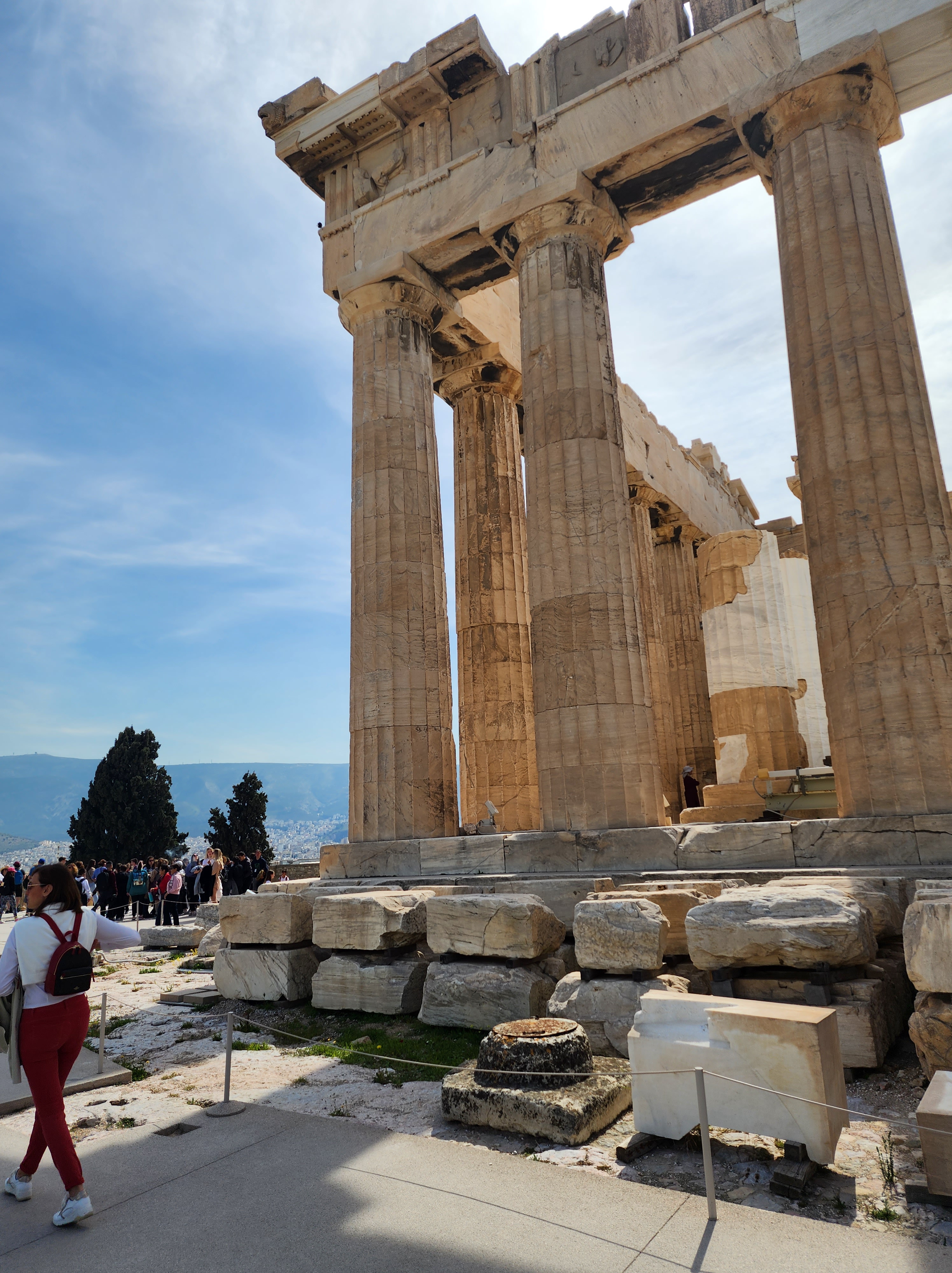
The Parthenon is very different from the Temple of Athena Nike. It is huge, and though never moved, it was reused as a Byzantine church, a Roman Catholic cathedral, and a mosque, as well as for gunpowder storage. Contemporary restoration began in 1900-1917, though that restoration was all replaced starting in 1975. Today, restoration continues, and though there is no public information, it appears that full reconstruction of the Parthenon to its original dimensions with all of its original columns is the project’s goal.
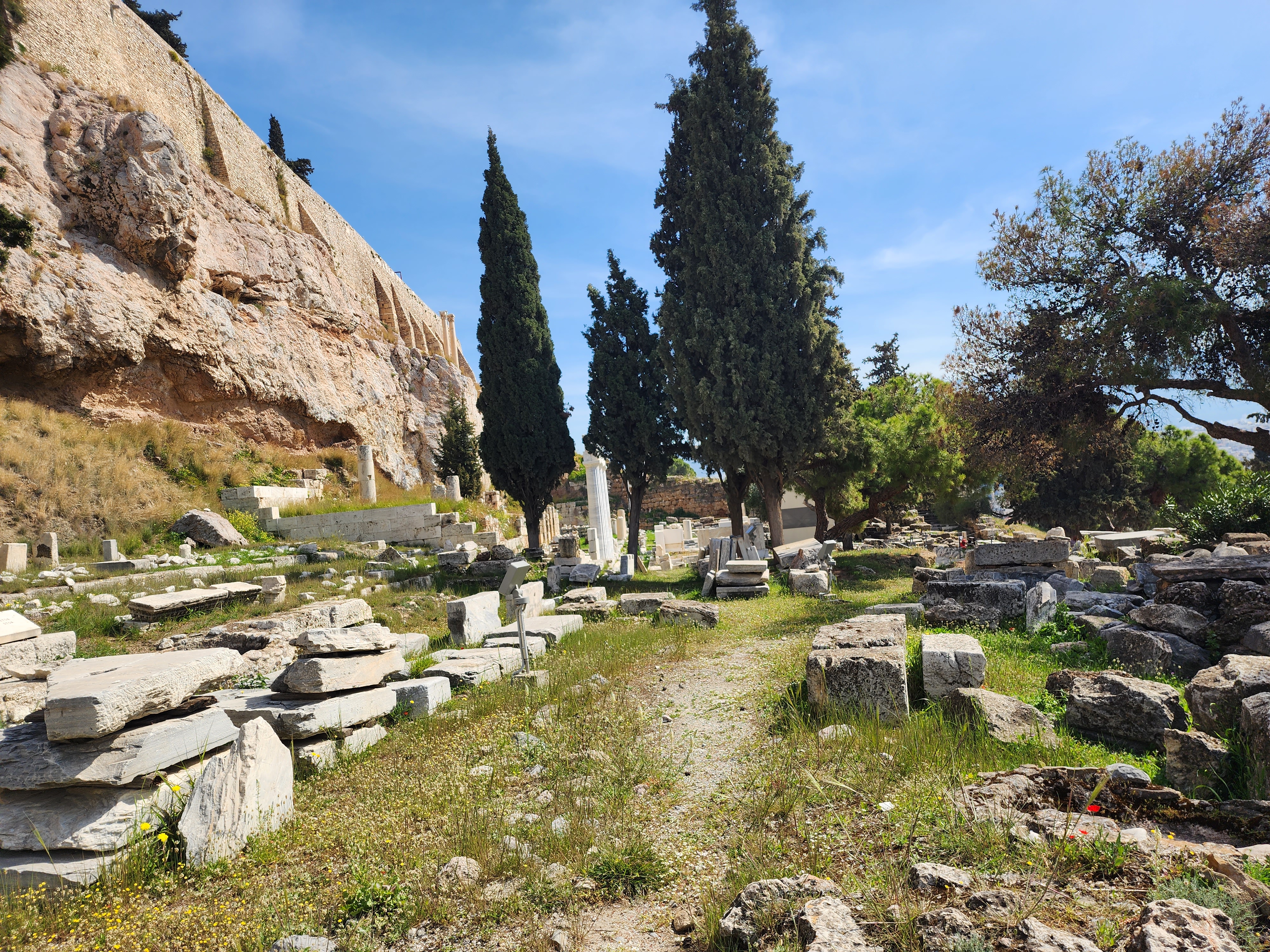
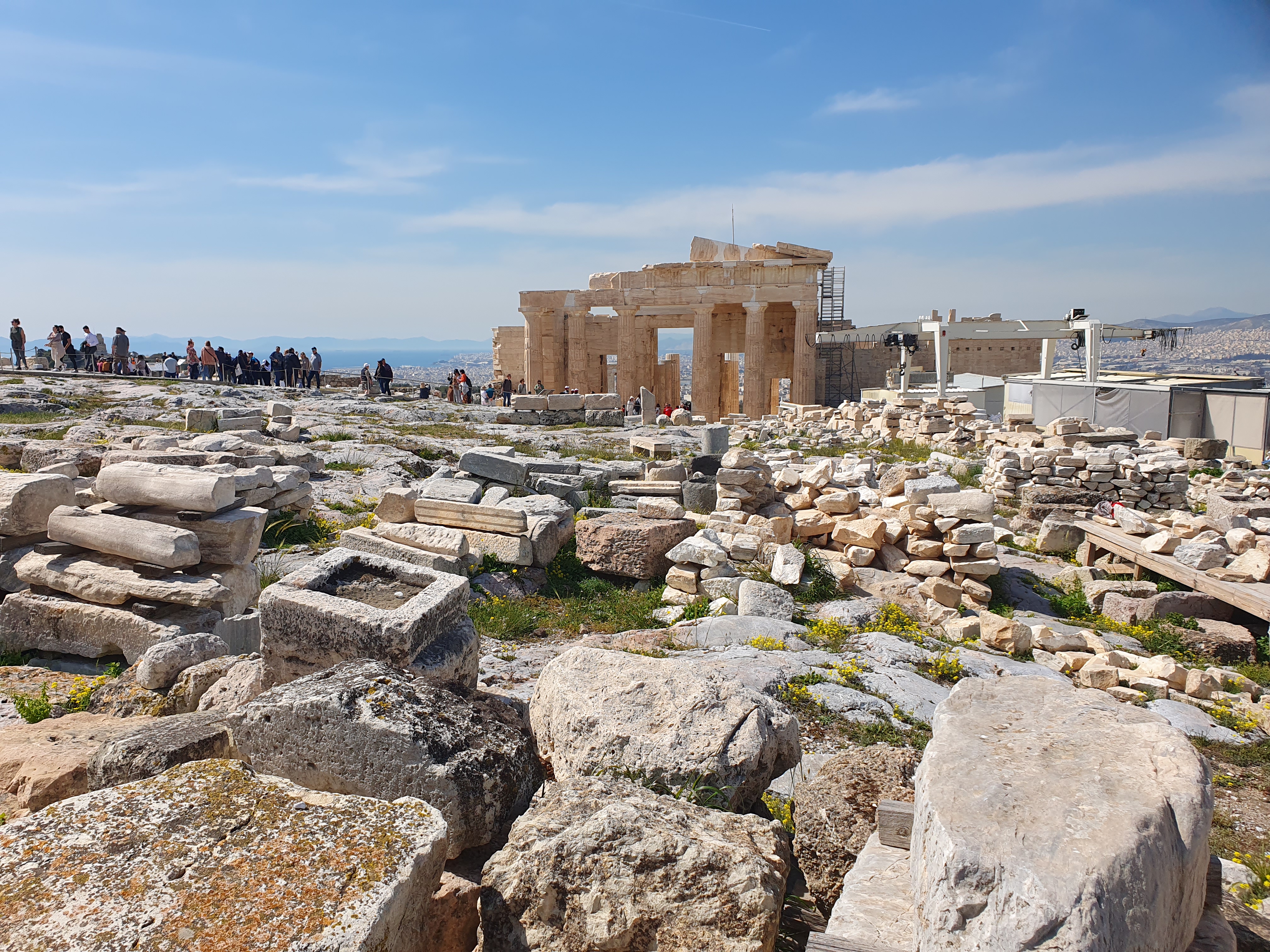
Restoration is ongoing, as we could tell from the huge crane, layers of scaffolding, and construction trailers that compete with temples for space on the Acropolis. There are a lot of pieces of columns and blocks still waiting for something to happen.
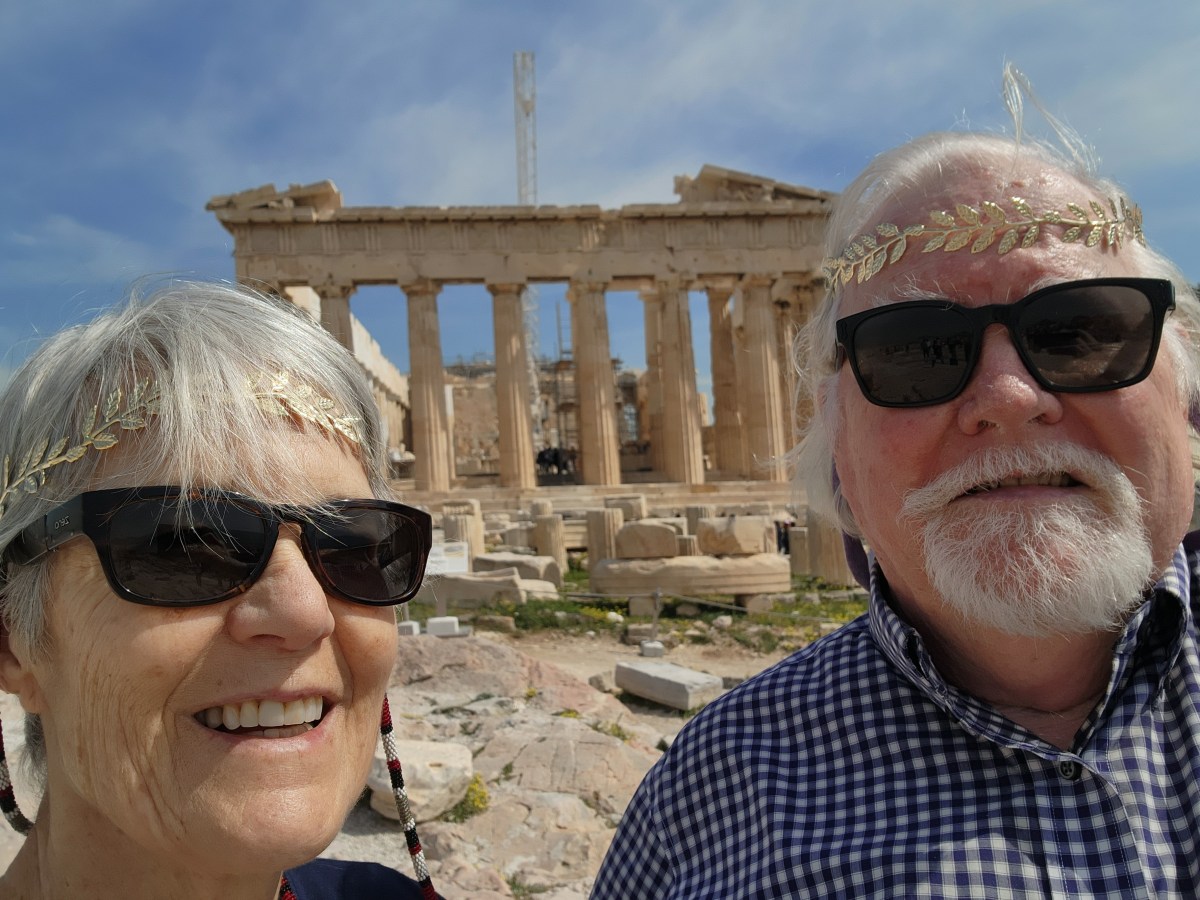
Our selfie as gods of the Athenian sphere.
The crowds didn’t bother us too much, though we had to wait our turn to take some photos while others posed for their Instagram shots. We had to pay attention to the ground, too, as it’s worn smooth from all the visitors shoes and is not only very uneven, but slippery. The climb to the top isn’t difficult, though it is uphill. There’s a lift, but it is tiny and mostly used by people in wheelchairs.
There are also lovely views out over the city and the hills we’ve climbed during our stay.
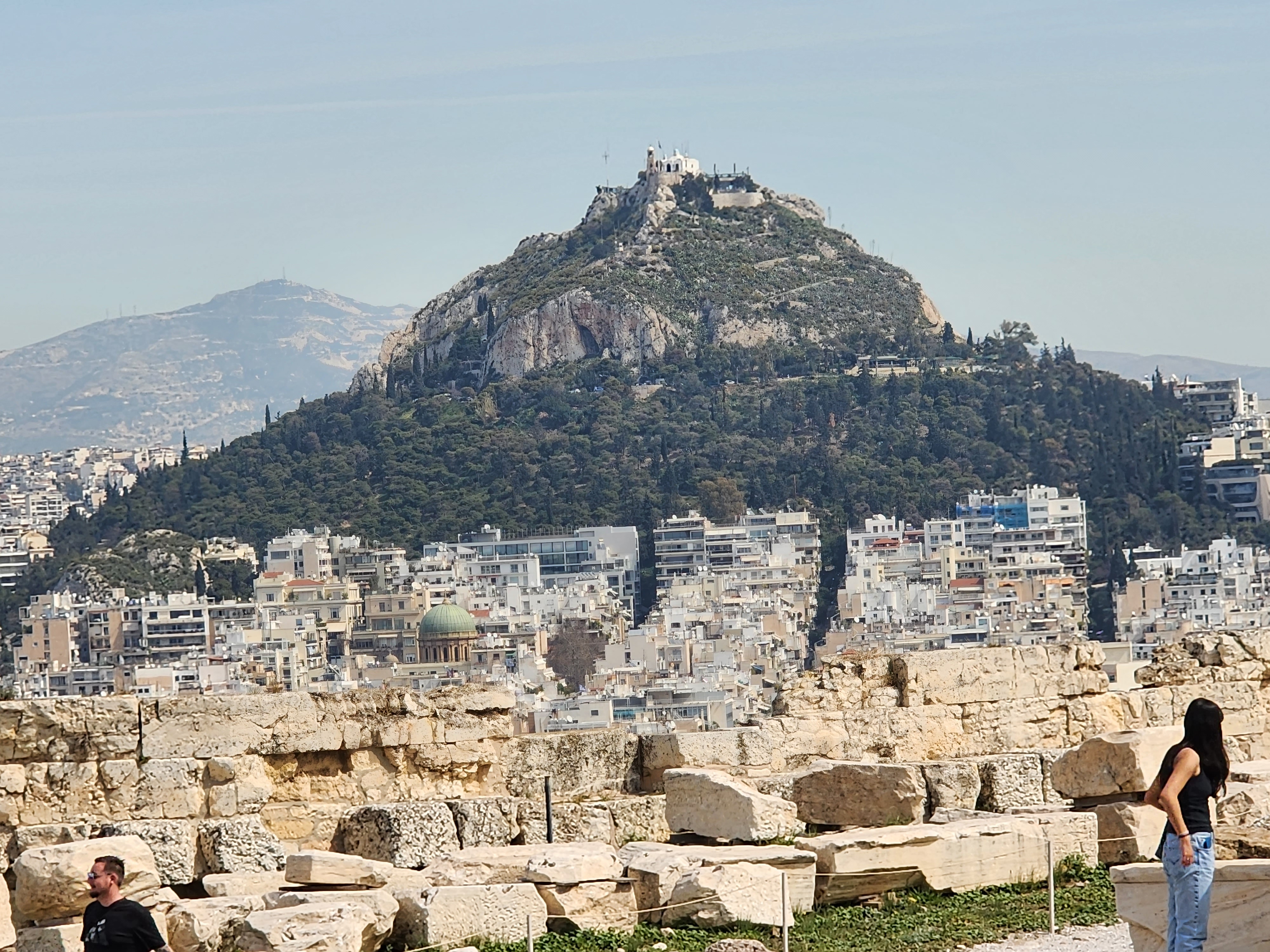
L: Looking over the ancient agora and Athens R: Lycabettus Hill from the Acropolis
We left with more questions than when we arrived. It was an excellent field trip.
Some years ago when Greek authorities were trying (again) to convince the British Museum to return the marble sculptures from the roof of the Parthenon (the Elgin Marbles), it was said that should the sculptures be returned, the Greeks didn’t even have a decent place to put them. That stirred people up.
Everything in Athens is built on ruins, these are under the Acropolis Museum
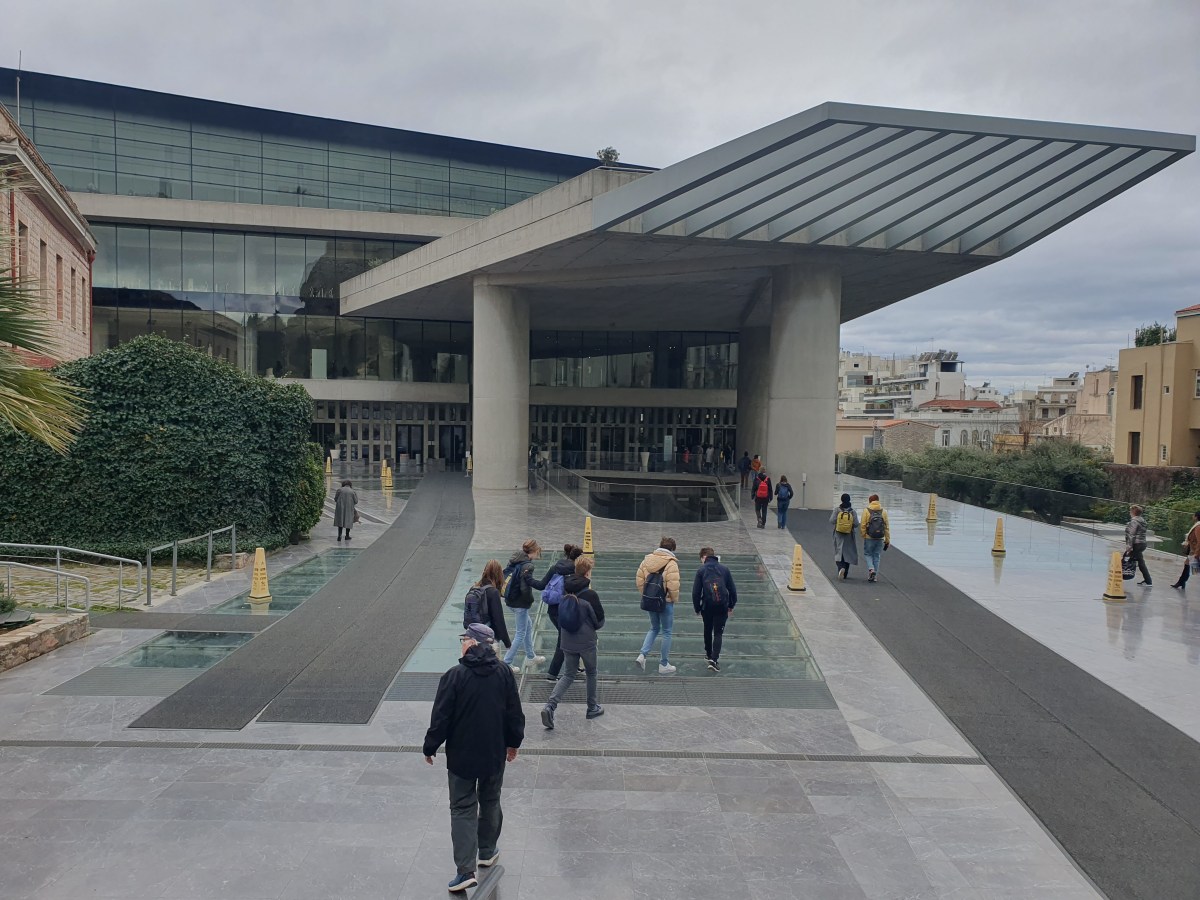
The Acropolis Museum is the Greek response. Completed in 2009, it is a spacious contemporary space tucked in at the foot of the Acropolis. There was a small museum on the Acropolis itself that was chock full of finds from continuing excavation and restoration. The new museum displays many of these items, like votive statues buried to honor Athena, or pottery offered to the various shrines on the Acropolis. As you enter the museum, the main hall is a ramp leading up, lined with cases that show fine examples of pottery, metal work, stone carving, and jewelry. There is information about each type of craft product.
Arriving on the landing of the second floor, you are surrounded by statuary, and there is a lot to see. The highlight for me was the caryatid statues, pillars in the shape of women, that held up the porch of one of the important buildings on the Acropolis, the Erechtheion. The figures are indoors now, and copies have taken their place as porch supports.
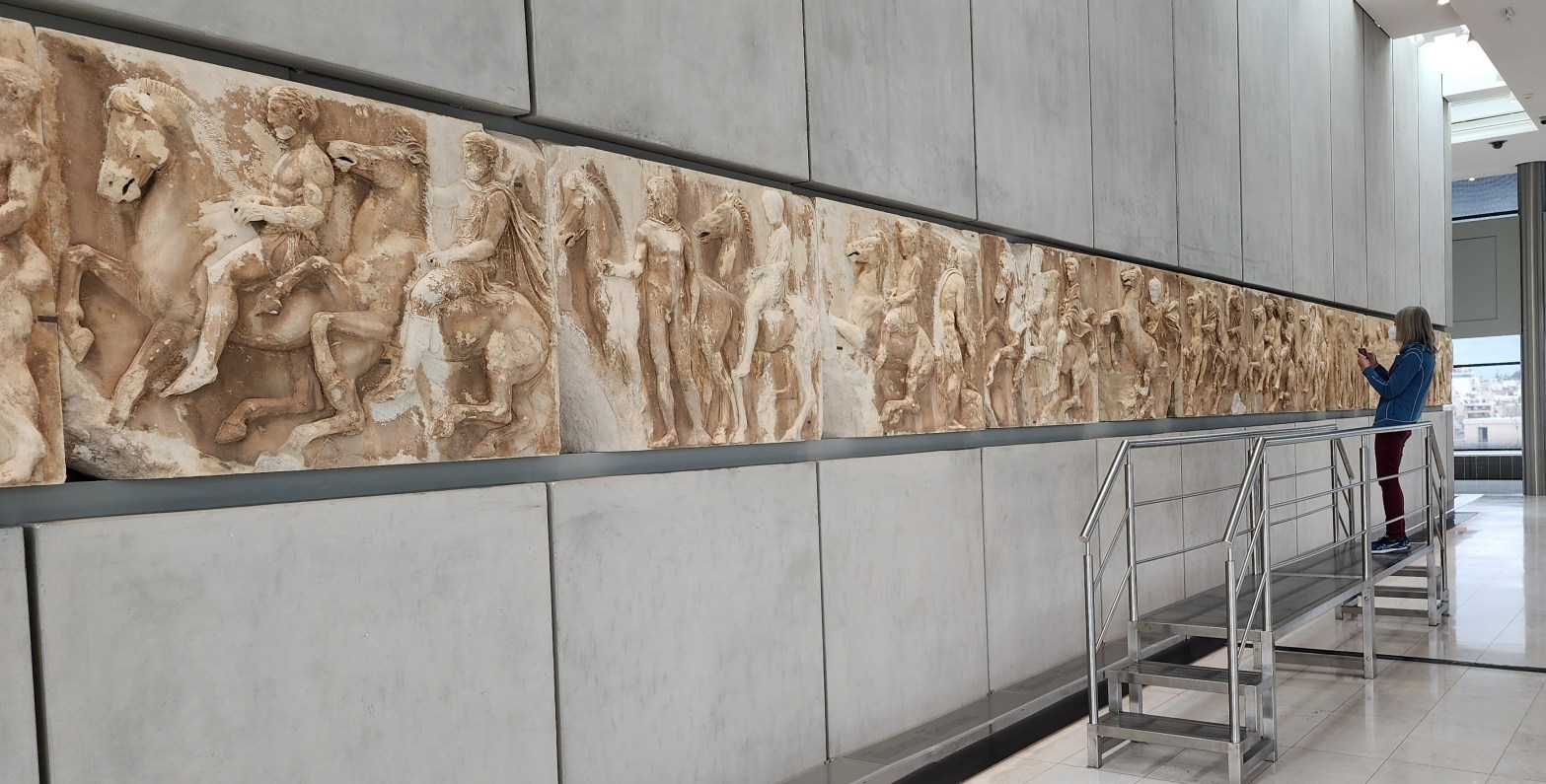
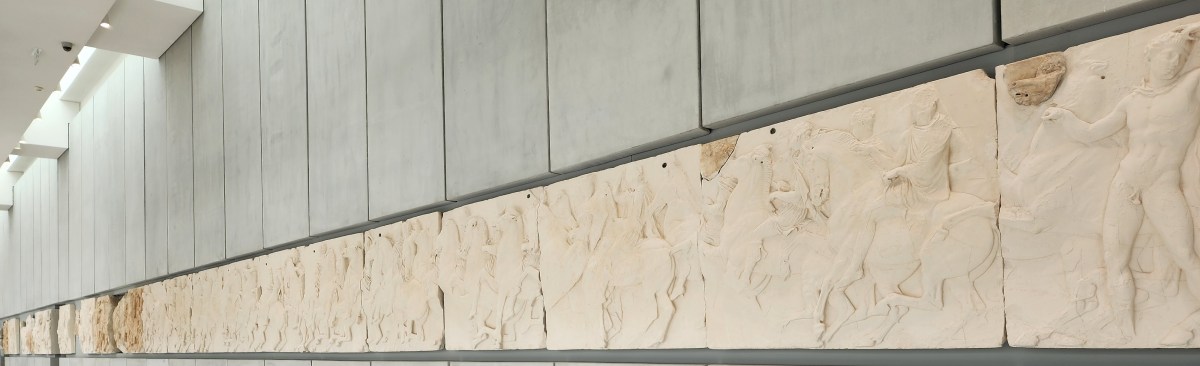
The highlight of the museum is intended to be the third/top floor, where the surviving sculptures from the roof of the Parthenon are positioned at eye level. You can see all the detail of the pieces, AND you can see the spaces that are available for the pieces still in London, should a deal ever be struck to return them to Athens. No one can say there isn’t an appropriate place waiting for the fragments of sculpture to be returned.
There is lots more to this story. During the early 1800s, Thomas Bruce, 7th Earl of Elgin, was a diplomatic representative of Britain to the Ottoman Empire, and at the time, the Ottomans controlled Greece. As part of his diplomatic mission, Bruce commissioned drawings of ancient monuments and artifacts in Greece with the goal of making Greek culture more widely appreciated back in Britain. The sculptures called The Elgin Marbles were collected by employees of Bruce from the ruins of the Parthenon.
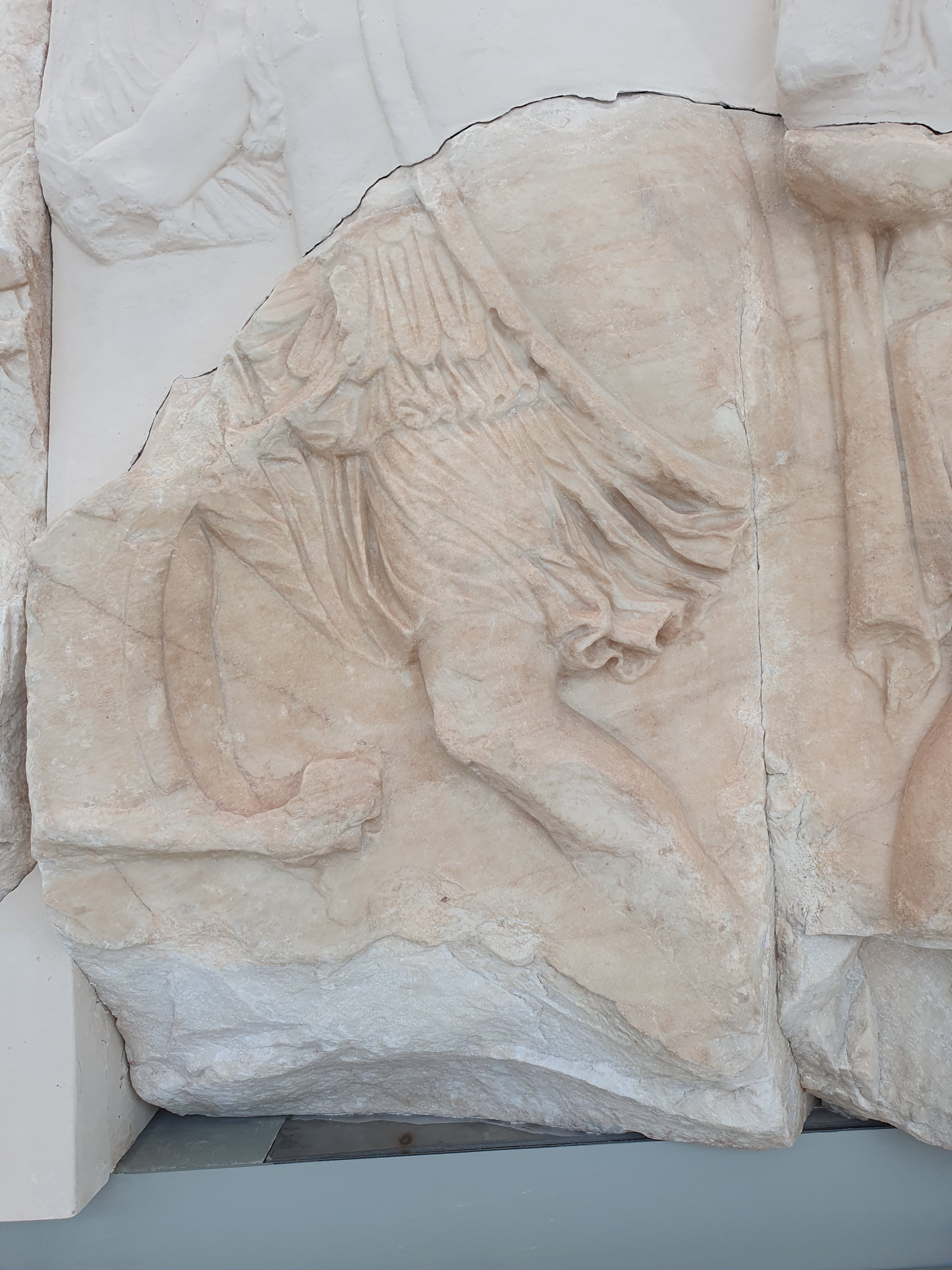
Original pieces of this frieze are the darker tan color, the paler sculpture is a reproduction. As pieces are found or repatriated, they are added. Sketches made in the 1600s were used to create what is missing.
Have you noticed that the sculptures are all in pieces, sometimes small ones? Explosions from gunpowder stored in different structures on the Acropolis demolished the Propylaea in 1656, and the main structure of the Parthenon under shelling in 1687. When the earl’s artist and laborers began to copy remains on the Acropolis around 1800 (more than 100 years later) they found pieces of sculpture on the ground and began to collect them. The ambitions of the group shifted from copying to recovery, and surviving pieces were collected, taken down from the surviving sections of the roof, and shipped to England. Elgin was eventually investigated for taking the remains illegally. He claimed possession of a firman, or permit, to collect what his people could find. He was cleared of charges in England, and the collection was purchased for the nation in 1816. They’ve been in the British Museum ever since.
That is just the short version of the tale. Shipwreck lost the collection, divers recovered it after three years; Elgin and his wife were crossing France on their return to England when war broke out and he was held prisoner, eventually released with a promise to return to France if required. Elgin’s pregnant wife was allowed to return to England before him, and he got home to find her having an affair with a good friend. He sued both of them, for divorce and monetary damages (and won). He remarried and had an additional seven children, but ended his days back in France, where he moved to escape his creditors. He took a bath on the sale of the marbles, getting paid only half of what it actually cost him to move the sculptures to England. (Does this sound like a curse to you?)
Wikipedia has a lot of detail, and there is controversy among scholars around the world on whether the acquisition of the sculptures was legal in the first place.
In recent years, the repatriation of important works of art to their countries of origin has happened with increasing frequency, but in the case of the Elgin Marbles, the UK is a holdout.
Another tiny piece of the sculpture was returned to Greece from Sicily in 2022. The fragment was originally obtained by the collector and British consul to Sicily in 1809, Robert Fagan, who bequeathed it to his wife. She sold it to the Royal Museum of the University of Palermo, an entity from which the Regional Archaeological Museum was formed and from where the piece was returned.
And so it goes. The Acropolis Museum stands ready to receive its ancient patrimony, if and when ongoing secret negotiations between Greece and the UK lead to an agreement. The museum is well worth a visit, and there could be a great adventure novel written about the sculptures.
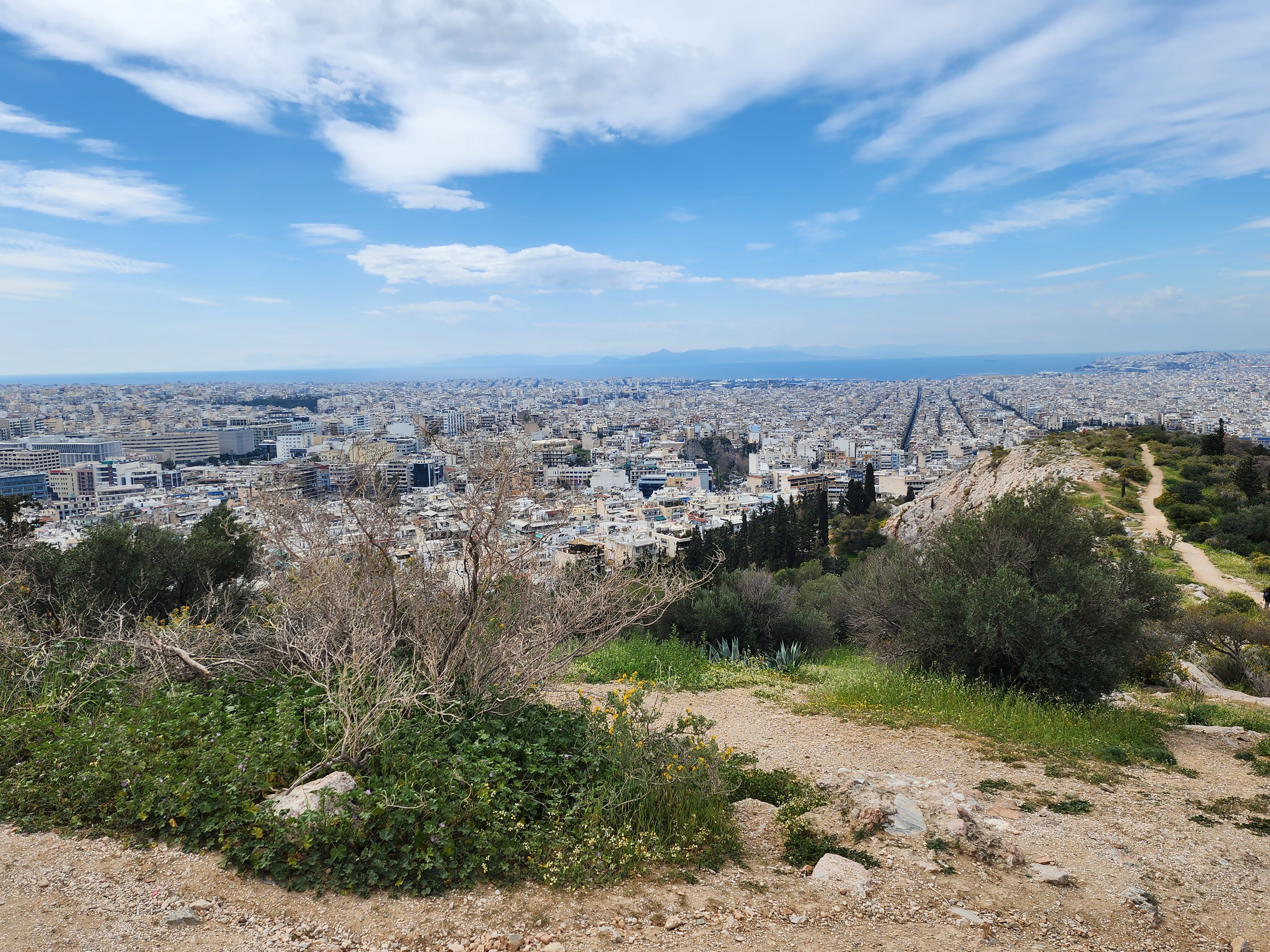
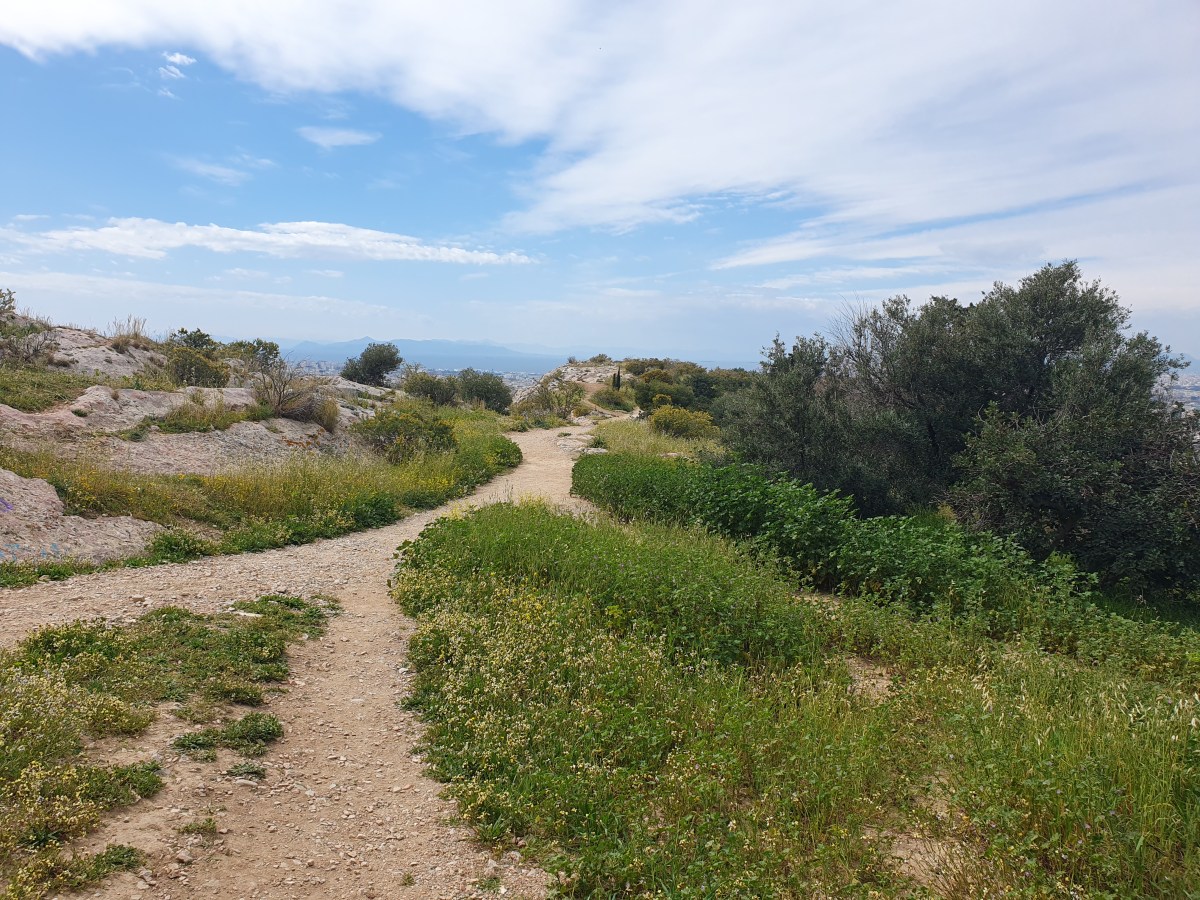
An advantage of spending an entire month in Athens is being able to take walks without feeling our time will vanish. Yes, we’re visiting archaeological sites and museums, but we took another walk up a hill, this time overlooking the Acropolis from the south. Filopappou Hill is a park with a few ancient monuments on it. The entrance is across from the tour bus entrance to the Acropolis. Paths crisscross the slopes, and it’s an easy walk to the top.
Just a few steps into the park we heard birdsong and spent a few minutes birdwatching. We’d even brought our binoculars. A Great Tit, Coal Tit, and a Chiffchaff (gotta love bird names), and we went back to strolling. Tiny wildflowers are in bloom, white stars, yellow cups, and very small deep red poppies.
The peak of the hill holds the Monument of Filopappos, the remains of a monument to a Roman consul built about 500 years after the Parthenon. Not much remains. From the top, there is a walk down a spur of the hill to the south with a view over the sea in the distance.
The park extends quite a bit further to the south and west, but we decided to stick with the hill and went to overlook the Acropolis. Every step provides a slightly different view. We walked back and forth taking photos.
View of the Acropolis, with Lycabettus Hill in the distance (to the right of the Parthenon)
Filopappou is much closer to the Acropolis than Lycabettos, my previous hill, which we could see on the opposite side of the Acropolis. The view of the ruins is even more spectacular at this closer spot.
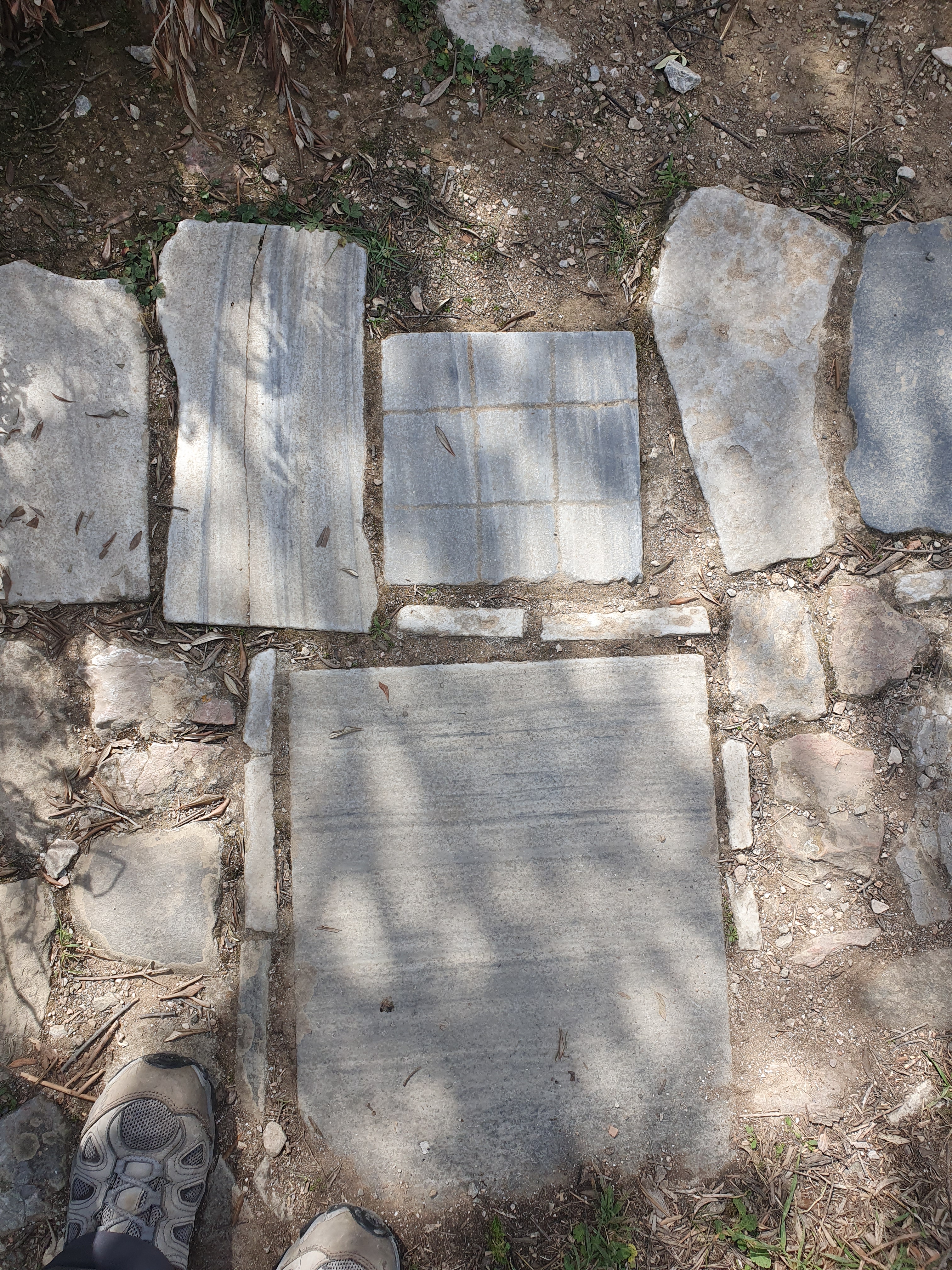
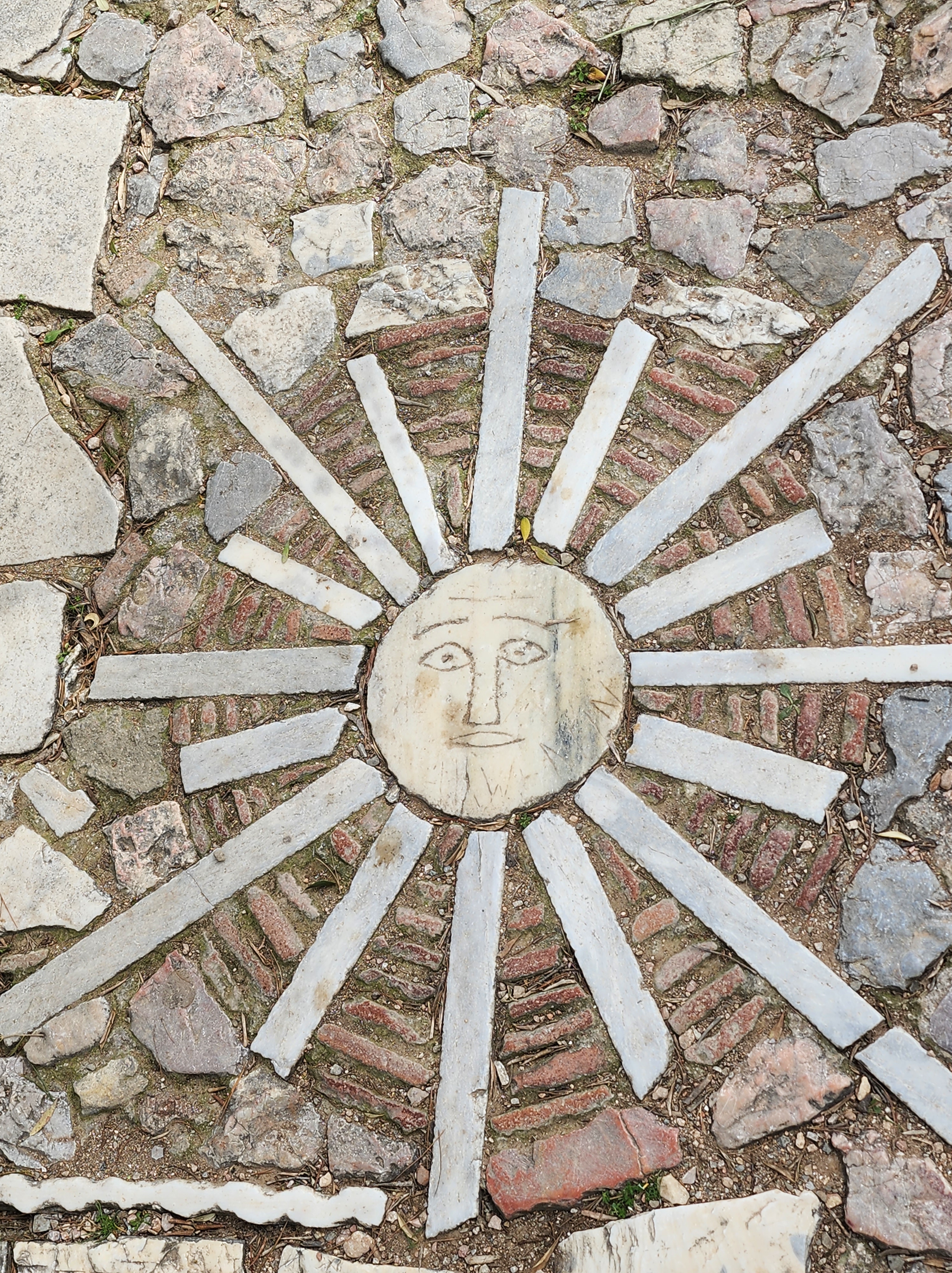
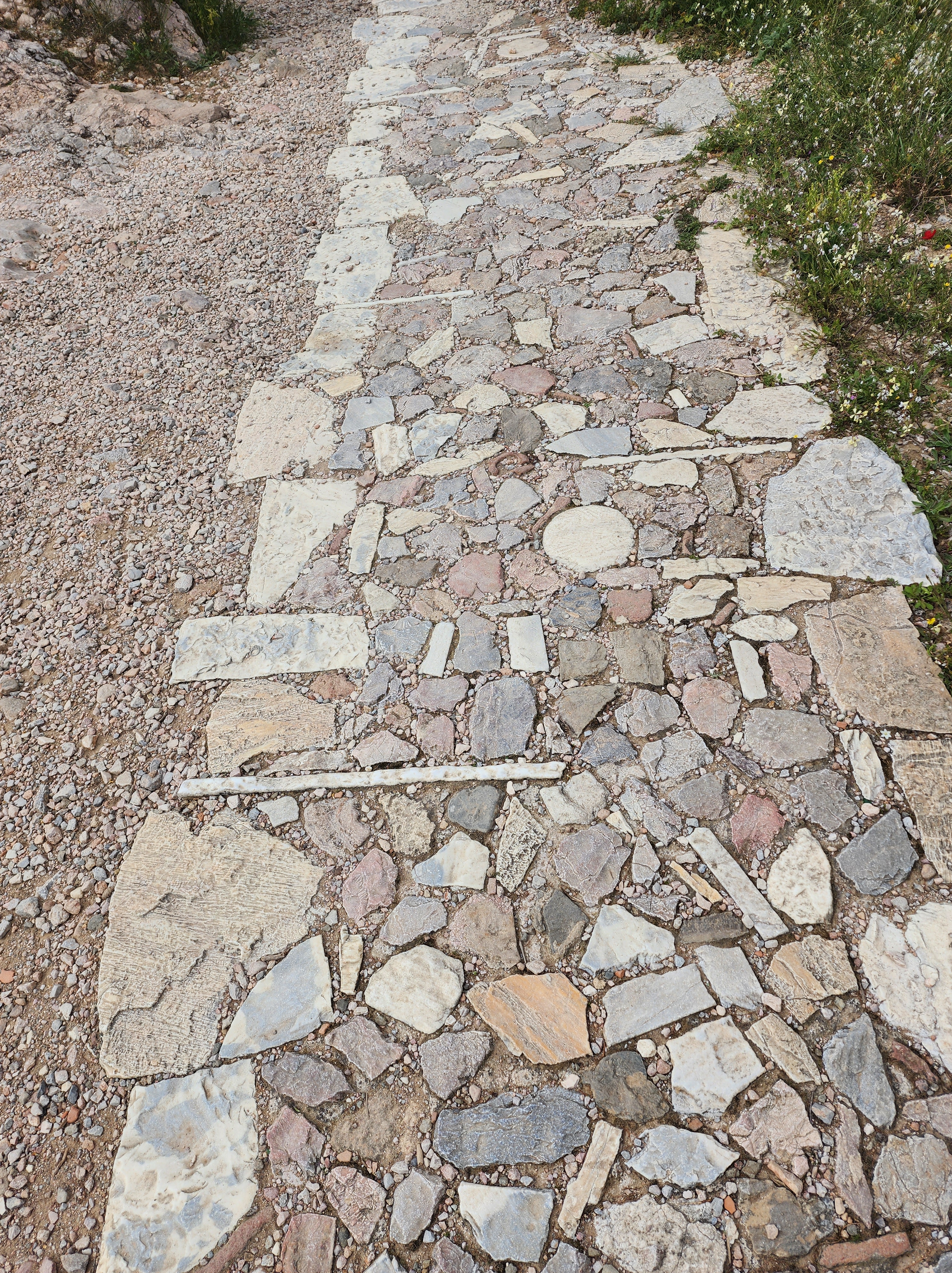
There are some decorative patterns set in the path up the hill. The materials include pieces of marble, worked and unworked, along with local stone. It’s interesting to walk along and look for reused pieces, and for the different patterns.
At the end of our walk, we stopped at Dionysus Zonar’s. There is a Zonar’s cafe nearer our house that was recommended to us. This is the Acropolis version. We sat outdoors with a view over the Acropolis and had drinks and shared a club sandwich. My passionfruit spritz was delicious. No one seems to mind when we share an item to eat, and it keeps us from taking home leftovers most of the time. The restaurant was nearly empty at 1 pm. If tour groups don’t stop here, the crowds won’t build up until later in the spring. (Fine with us.)
Getting Around
We took a taxi to the starting point, partly because it’s a bit of a walk from the nearest Metro station (Akropolis) to the starting point by the bus parking and we wanted to put our energy into the walk, not the to and fro. I’m very happy with the taxi app our Airbnb host recommended, FreeNow. Taxis arrive right away and there’s no need to load a credit card, as the drivers will take cash. The furthest from us a taxi has arrived is across the street. With Uber in the US, I’ve had to walk a block or two to my meeting point (getting charged for being late).
FreeNow helped us get home, too. When we emerged from our stop at Zonar’s, there was a line of cabs along the sidewalk, but when we spoke to a driver, he spun us a story about how there might be a demonstration (we knew there was not), and he’d have to make a big circle, thus the price would be 15 E. Apparently, drivers wait for tourists from the Acropolis, alarm them with tales of strikes and police action, and charge double. We thanked the guy, tried a second driver in line with the same results, then used the app, got picked up in two minutes, and paid 8 E for the same trip (gave him 10 E, just because). I recommend the FreeNow app for Athens.
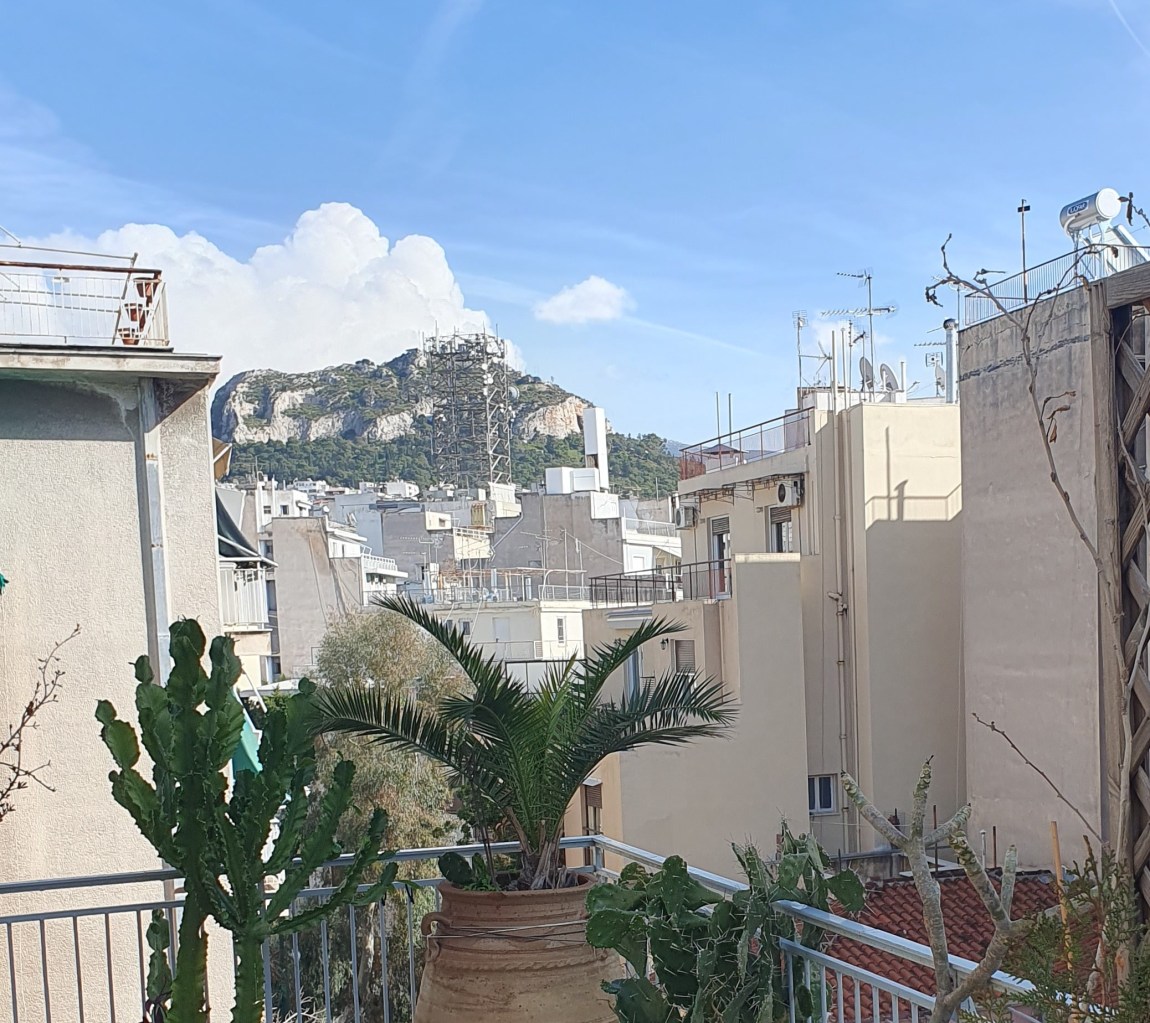
It was a sunny day and Jonathan was resting his knees, so I went for a stroll up Lycabettus, the hill we can see from our terrace. Our view is blocked in part by a large communications antenna, but on the walk over, I could see the hill very clearly. It’s the highest point in Athens, about 900 ft above sea level, and offers views in all directions over the city.
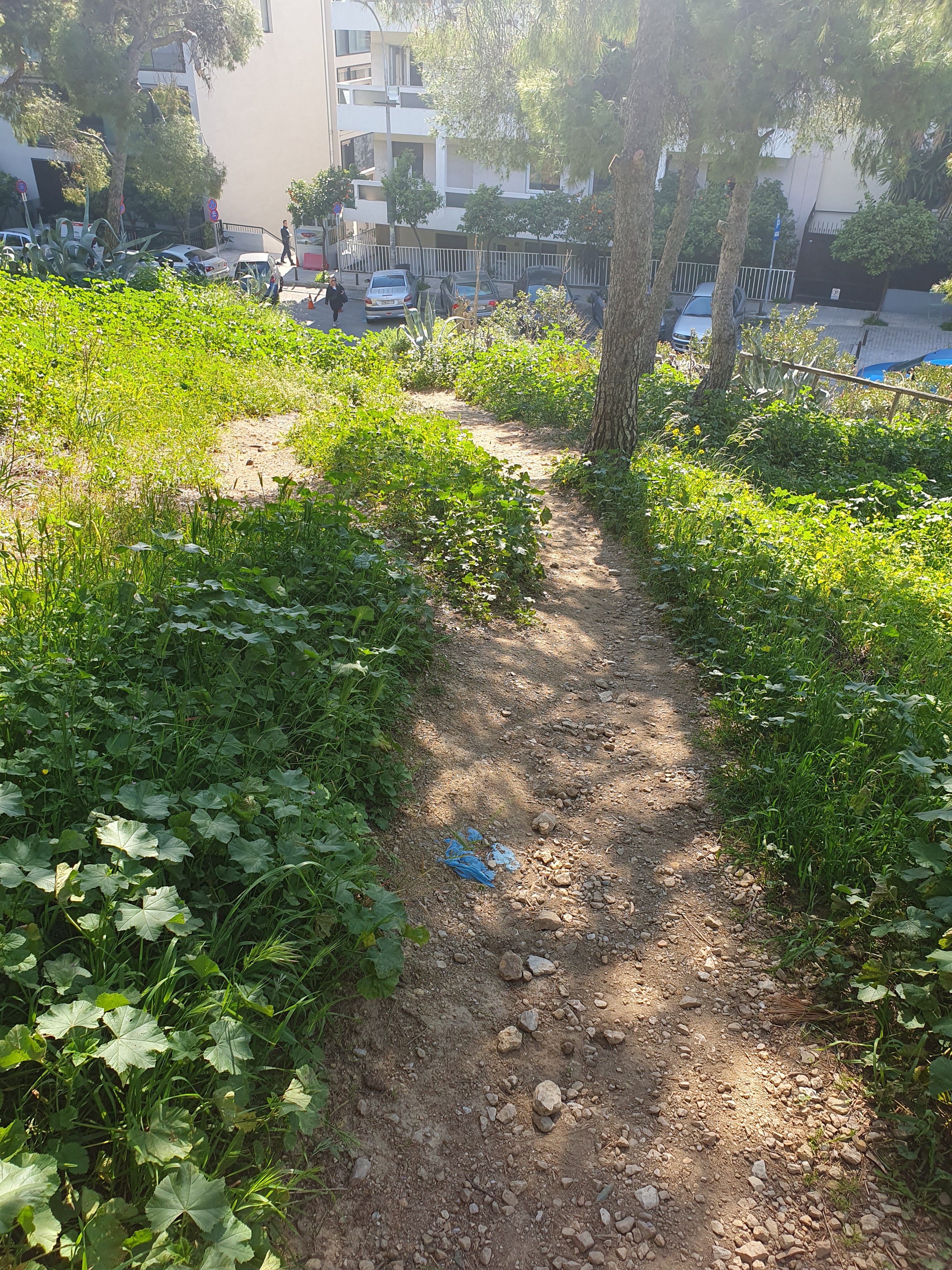
Paths wind up the broad base of the hill, and as soon as you leave the sidewalk, it looks like a country trail. The path loops upward, providing lots of places to appreciate the view and catch my breath.
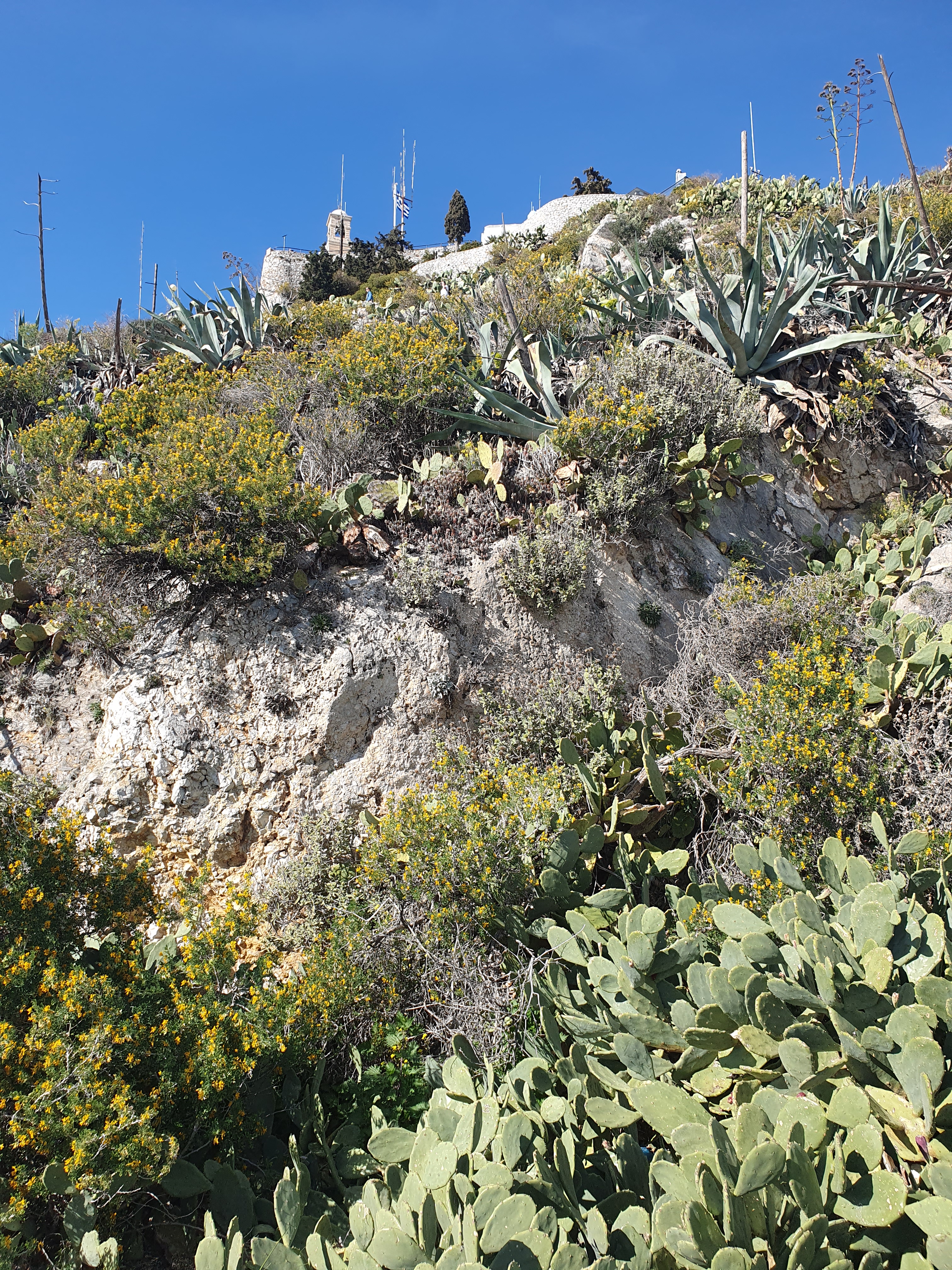
A series of stairs leads you to the cafe that overlooks the Acropolis. It’s a beautiful spot and on the day I visited there were very few people there. Another set of stairs continues to the top of the hill and the Chapel of St. George. Visitors can enter and have a look around under the watchful eye of a caretaker. He’s probably keeping an eye on the large silver icon of St. George and the Dragon.
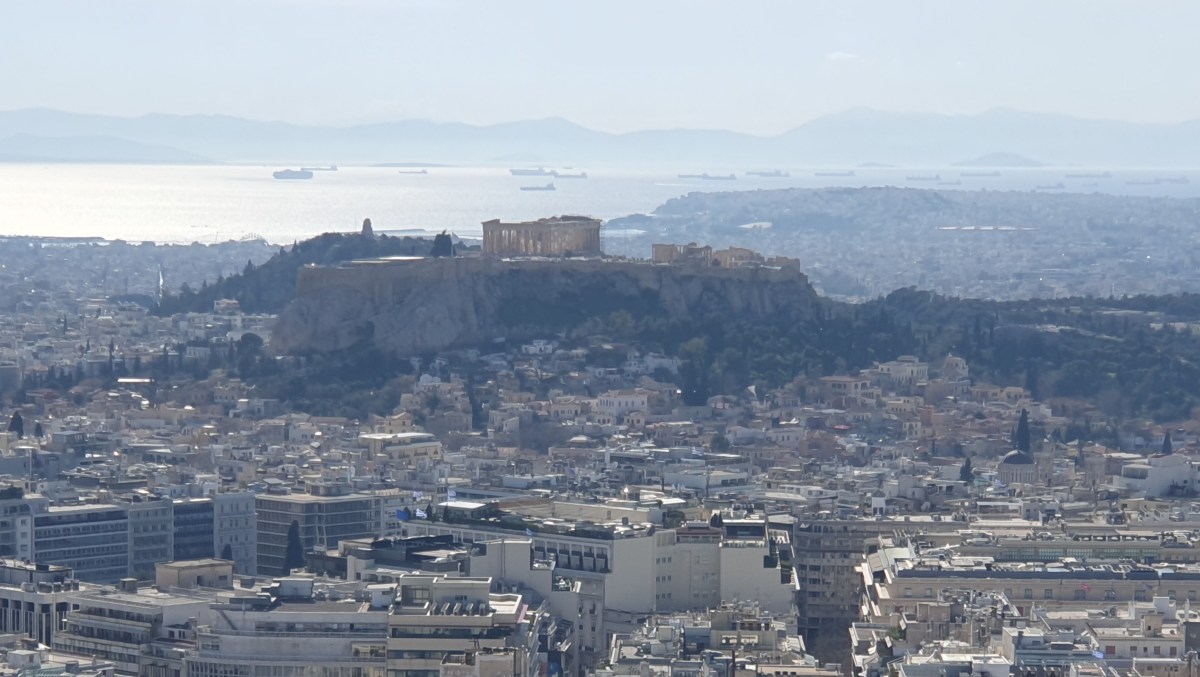
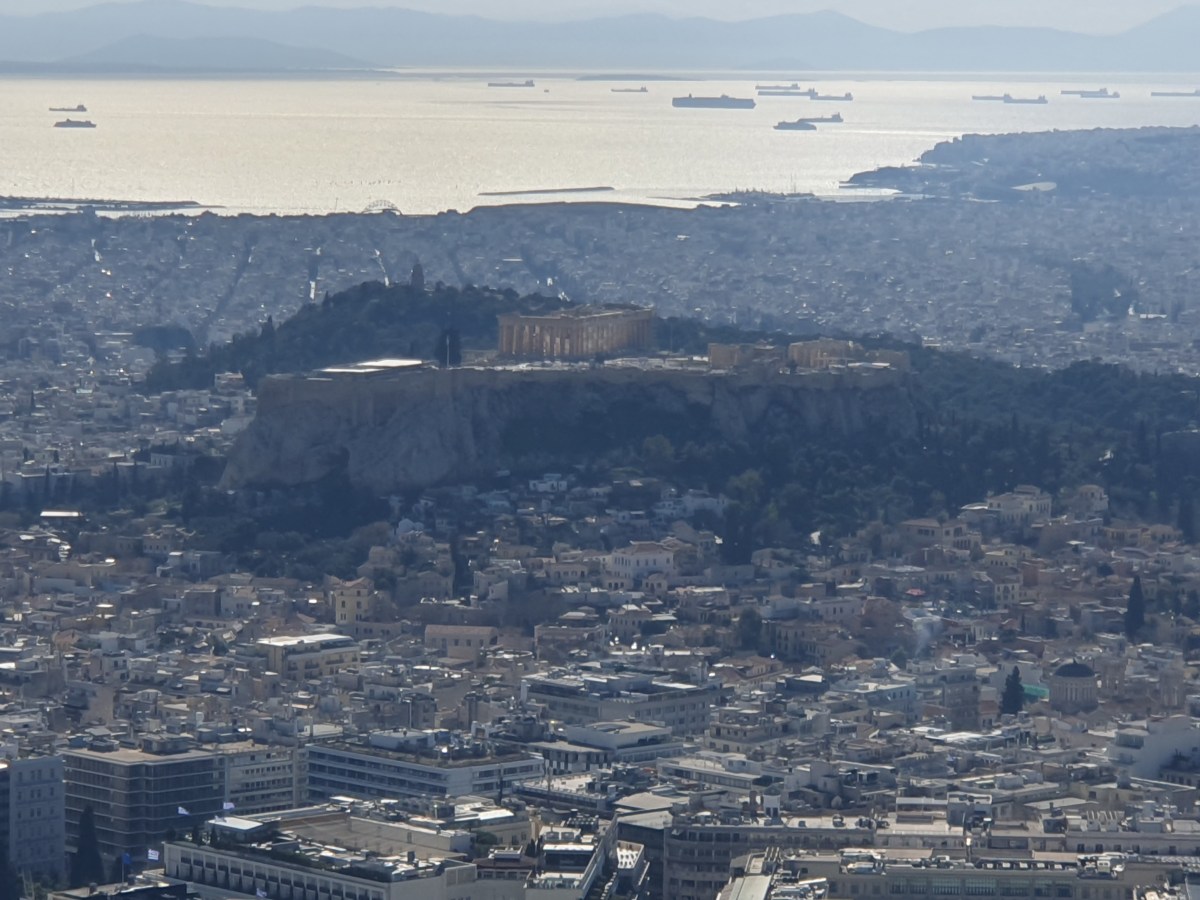
The view from the top of the hill is the big payoff. The breathtaking view of the Acropolis extends all the way to the sea and the Peloponnese beyond. In the late afternoon sun, I could even see the roof of the Niarchos Cultural Center shimmering in the distance. (It’s a distinctive building in Piraeus, miles away.) The Acropolis is such an imposing monument; it made me think about what life must have been like in Athens at the peak of the Greek Empire, so long ago.
The glory of Athens
If you can get enough of looking over the ruins from above, the rest of Athens is spread out around the hill. Miles of buildings stretch into the distance, broken only by the occasional grove of trees. High hills in the distance remind me of Greece’s history of independent city-states protected by the mountains around them.
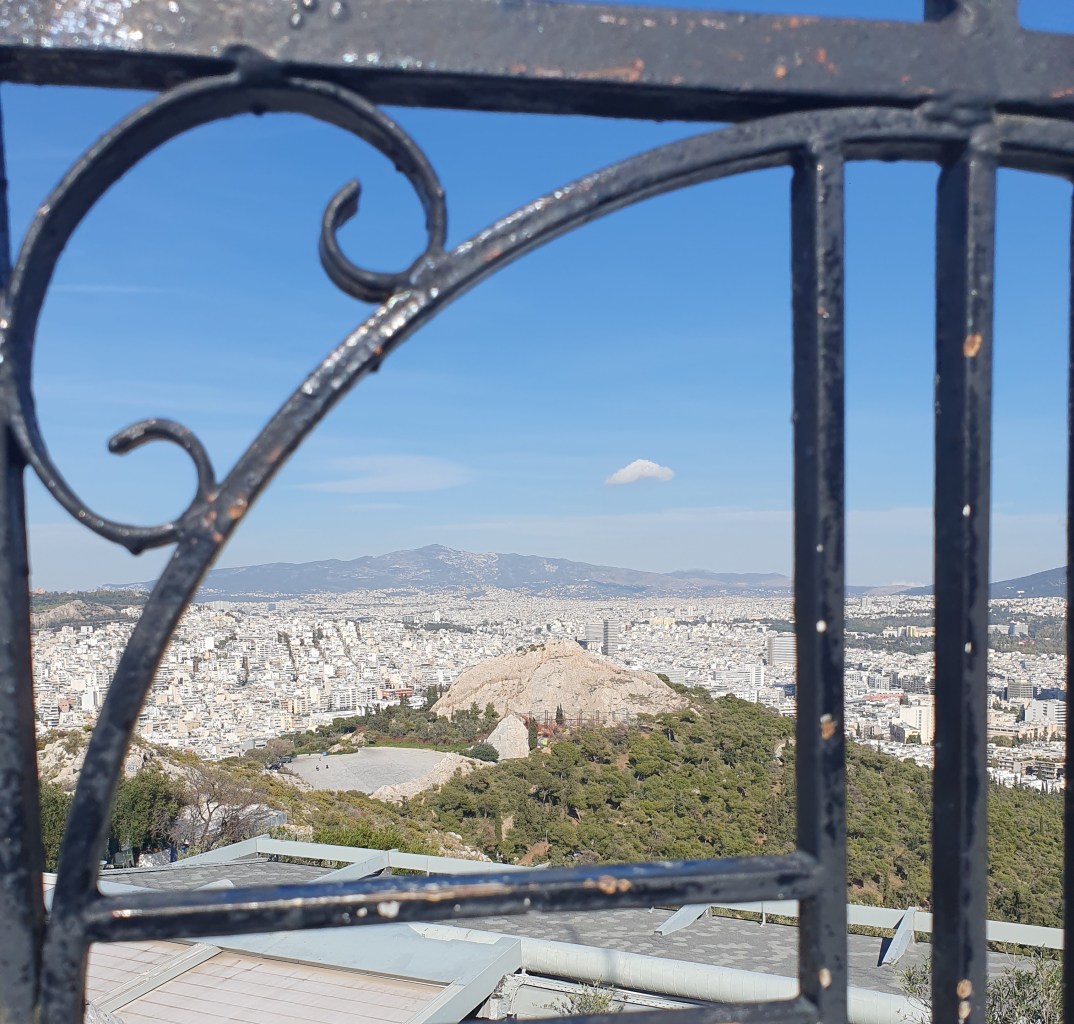
Looking south from Lycabettus HillLooking west from Lycabettus Hill
I spent some time looking at spectacular Athens, enjoying the day.
The walk was uphill, but it was not difficult. I took about a half hour each way going up and down, varying my route to see more of the surroundings. It is also easy to visit the hilltop without a hike. The Lycabettus Hill funicular will take you to the top in just a few minutes from Kolonaki. I plan to make a second visit that way, just to see the view on the ride up!
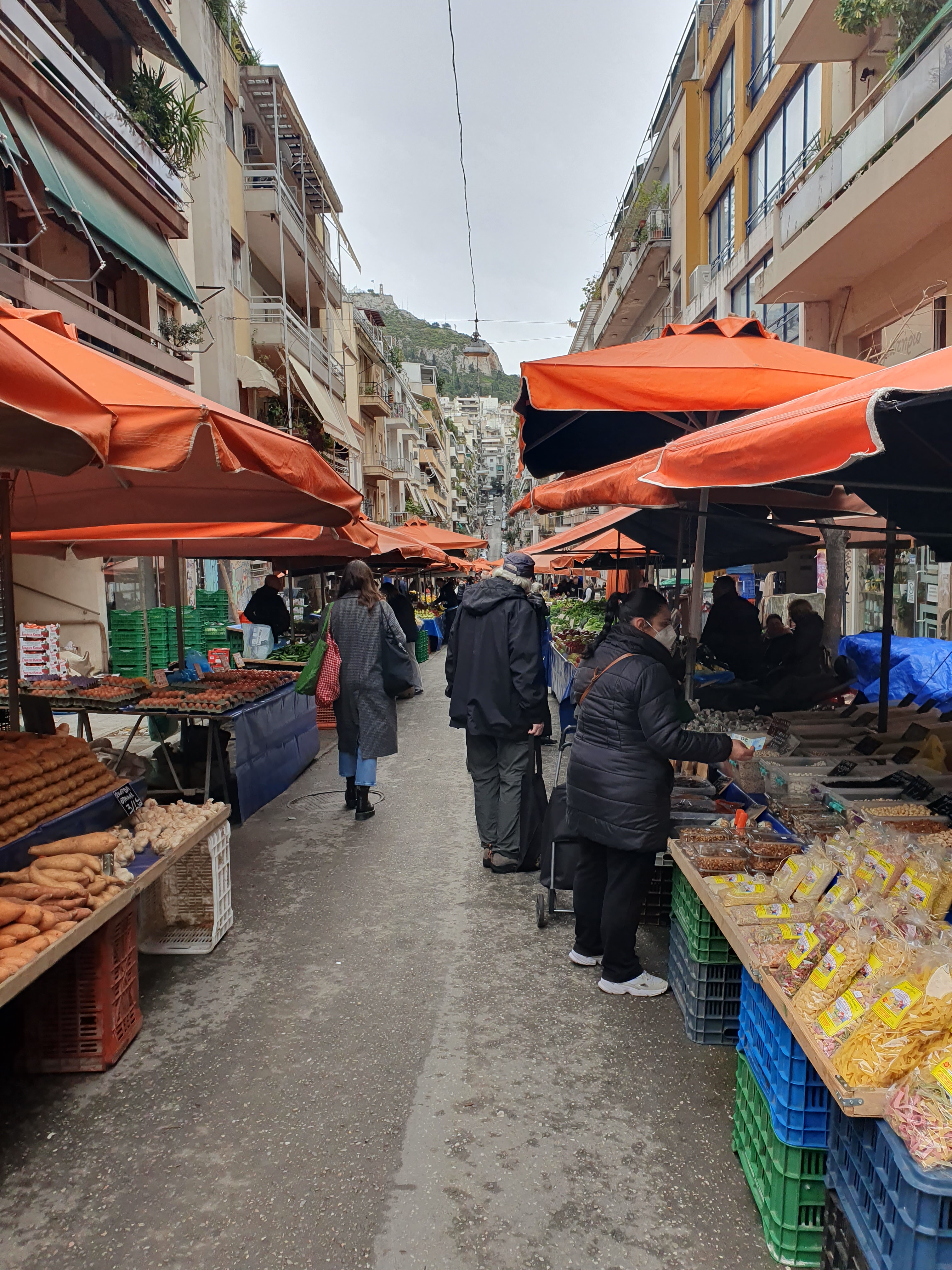
Our central location is good for provisioning. Less than ten minutes walk north is Kallidromiou Street, site of the Saturday Farmers Market. The market sells only fruits, vegetables, and fish, a nice change from “farmers markets” that emphasize tshirts and jewelry. The produce is beautiful. We returned home vowing to take the shopping trolley with us next time. We were laden with a whole red snapper, mushrooms, eggplant, onions, potatoes, oranges, arugula that will need a lot of washing (!), and fresh flowers. We looked in a neat storefront and found a small deli that stocks wonderful Greek products. We bought delicious cheeses, including goat cheese made on a Greek island, and peanut butter made in Thessalonika. Next week, Jonathan will buy blood oranges to make beautiful marmalade. We just couldn’t carry one more thing.
The Kallidromiou Farmers Market is held on Saturdays.
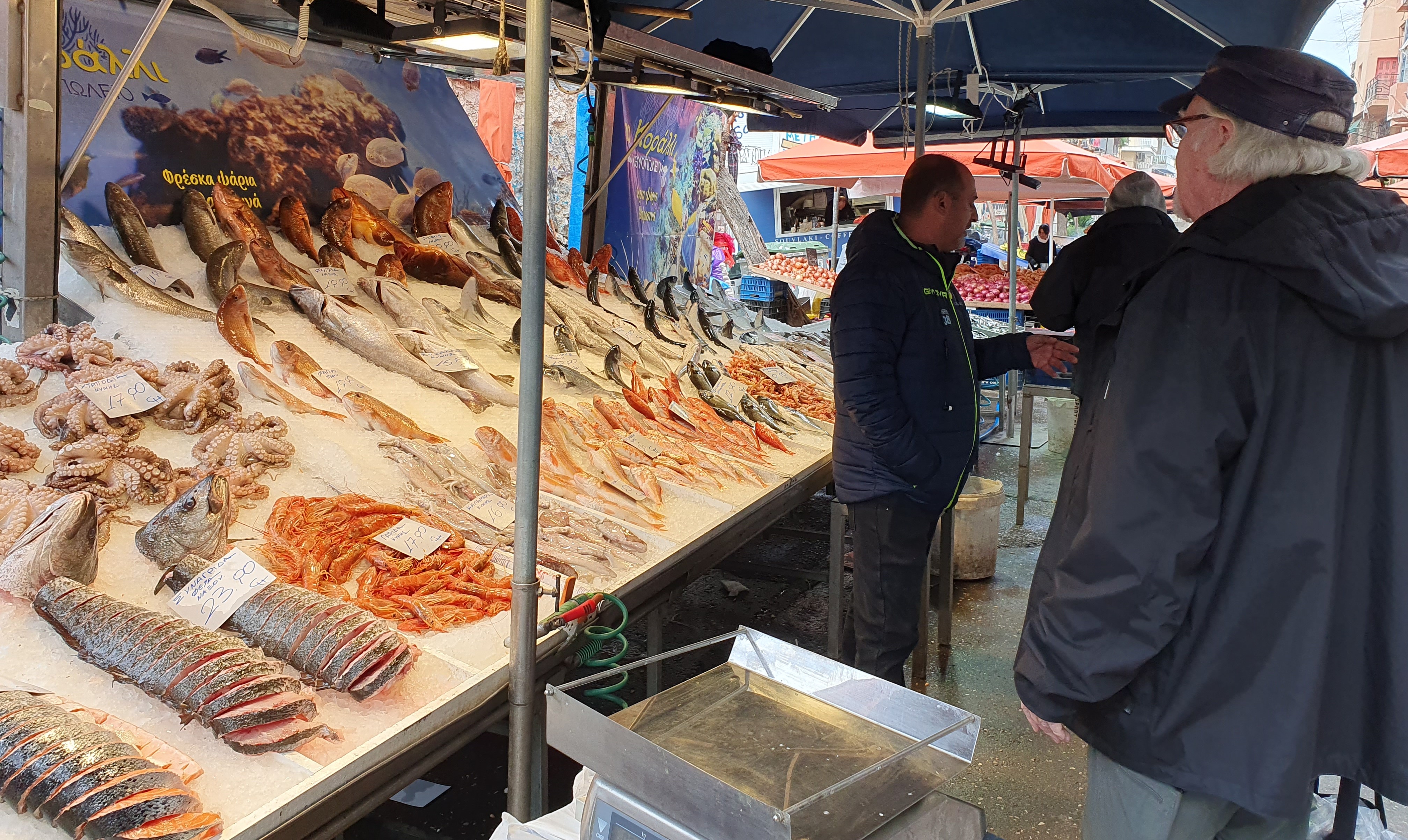
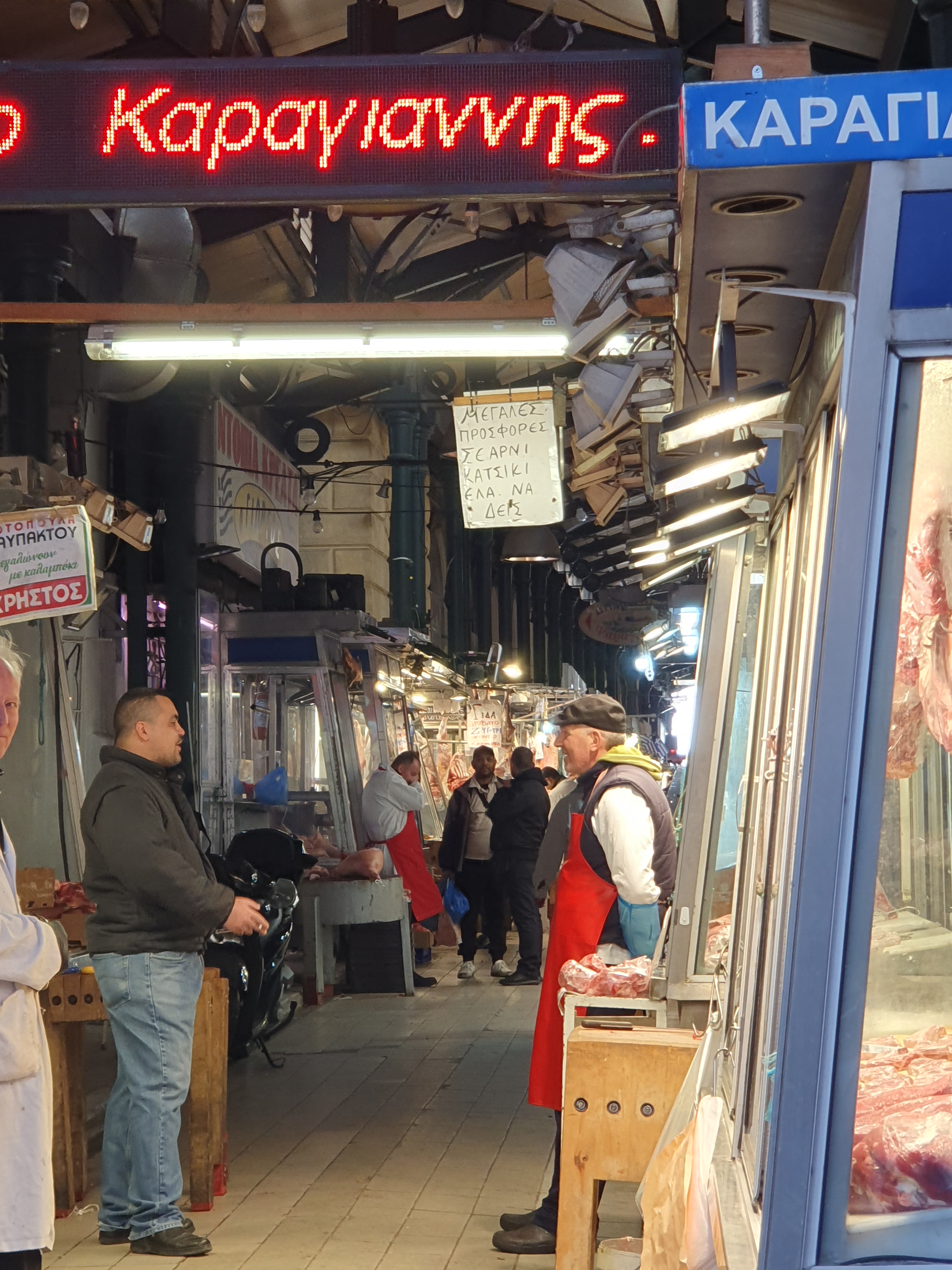
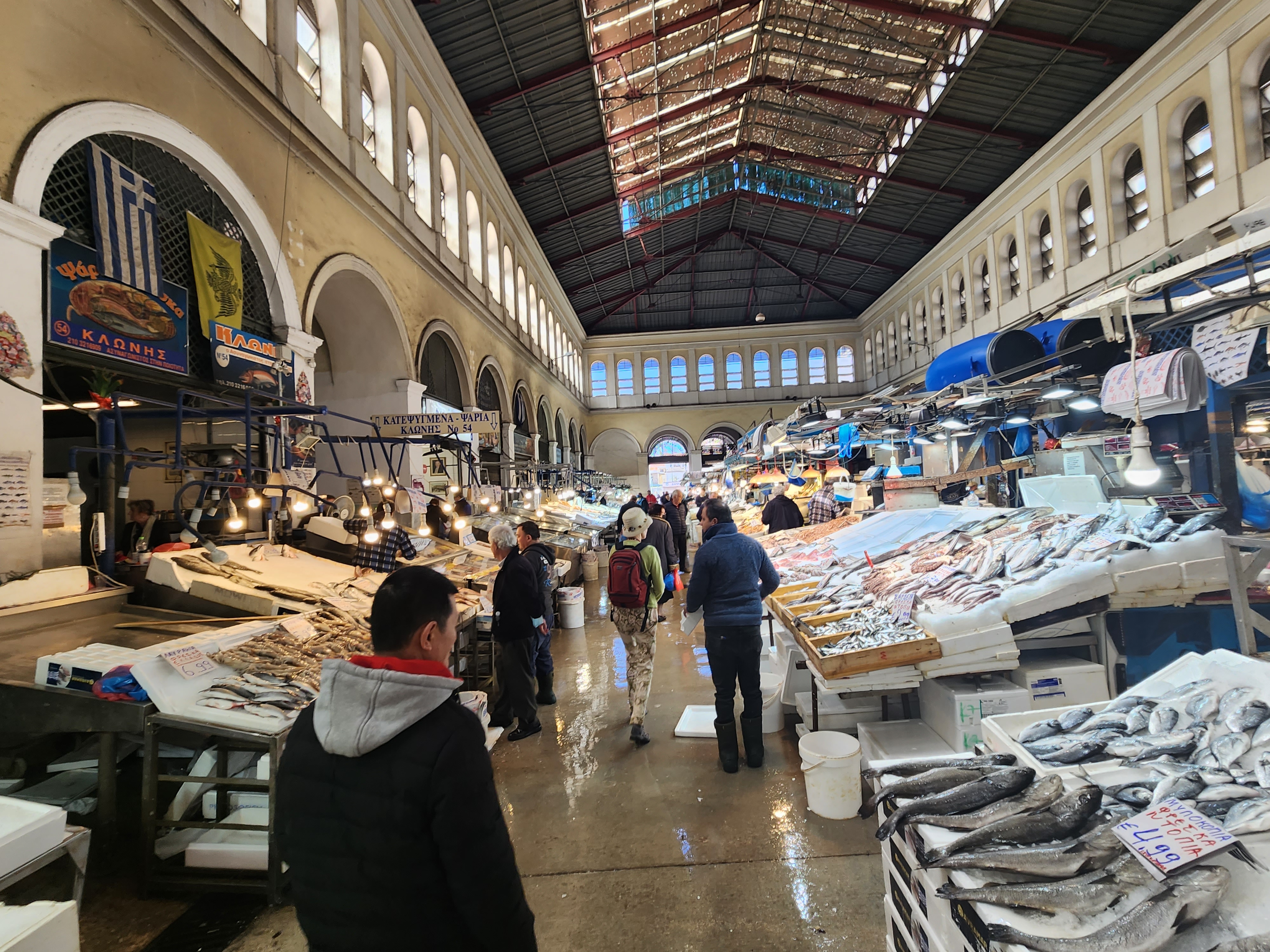
Having seen our neighborhood market, we had to visit the main Varvakios Market that stocks the entire city. For a moment, the market reminded me of Peru, with whole carcasses hung up on display, and the fish zone a bit squishy underfoot from dripping fish. So many squid, fish with sharp teeth, eels, shrimp and crawfish, and fish from tiny anchovies that you would fry by the handful to giant tuna ready to cut steaks. So many octopi! We thought we’d sit down for a fish lunch, but no luck. The restaurants serve fried things. Finally, we found Igeios, a small restaurant down a corridor, and were able to enjoy our fish, salad, and bread. The central market is so big that we walked past all kinds of meat and fish before we finally stumbled on the fruit and vegetable sellers.
The Athens Central Market, or Varvakios Market is open M-S, closed Sunday.
Compared to these huge markets, the regular supermarkets are small, with a limited selection, but useful for necessities like cleaning supplies. We are well stocked and looking forward to return visits to the farmers market.
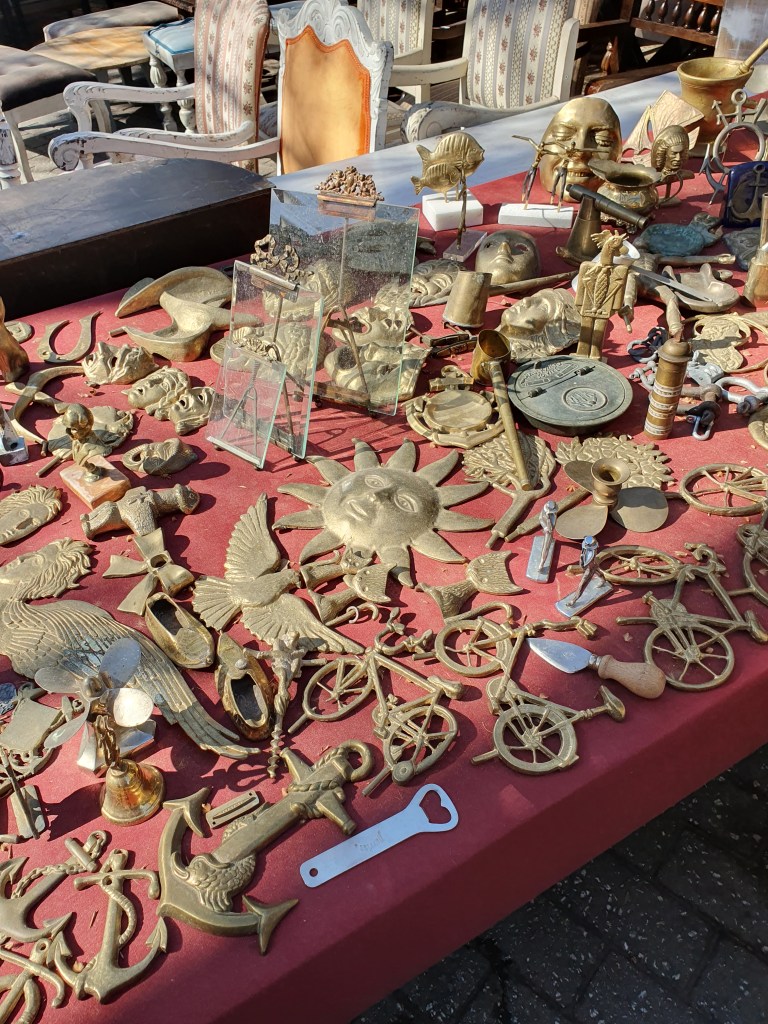
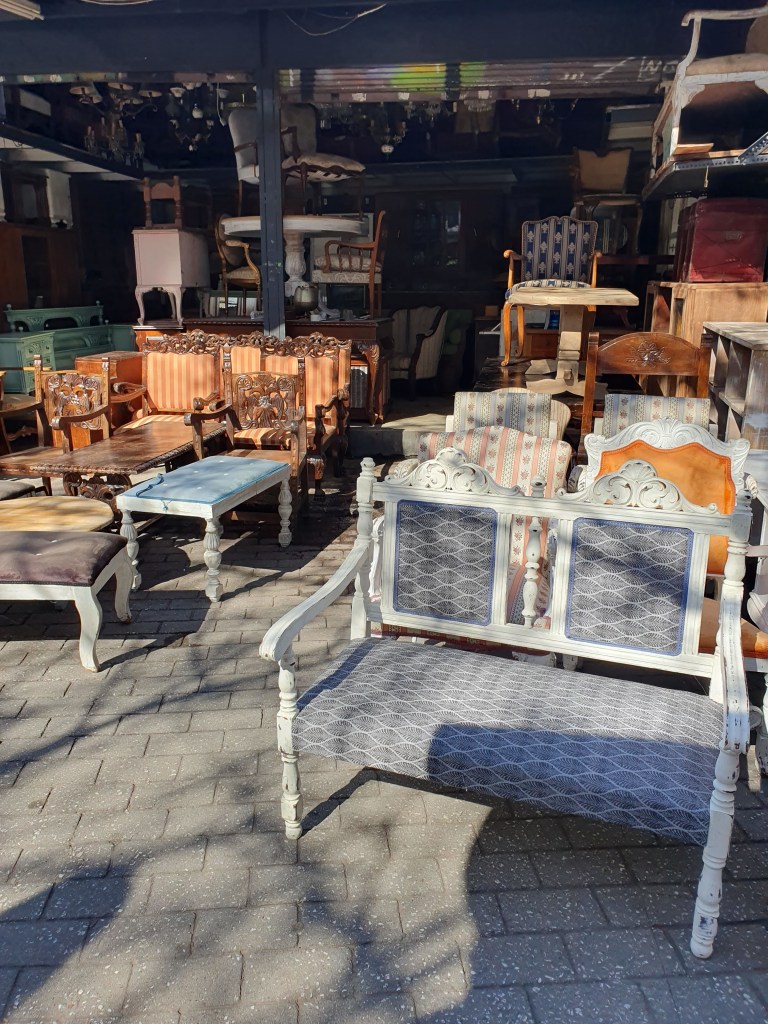
We next visited the Sunday Monastiraki flea market. Emerging from the Metro, we looked around until we saw the big banner “Flea Market”, then headed down the street. Though there are stores that sell used goods and antiques all along both sides that are open every day, on Sundays sellers set up tables everywhere and fill every possible space with items for sale. We took quite a while making our way as far as Avissinias Square, and then found that the vendors continued even further for several blocks, merging with the flea market around the Theseio Metro stop.
Scroll through the slide show above to see more of the flea market.
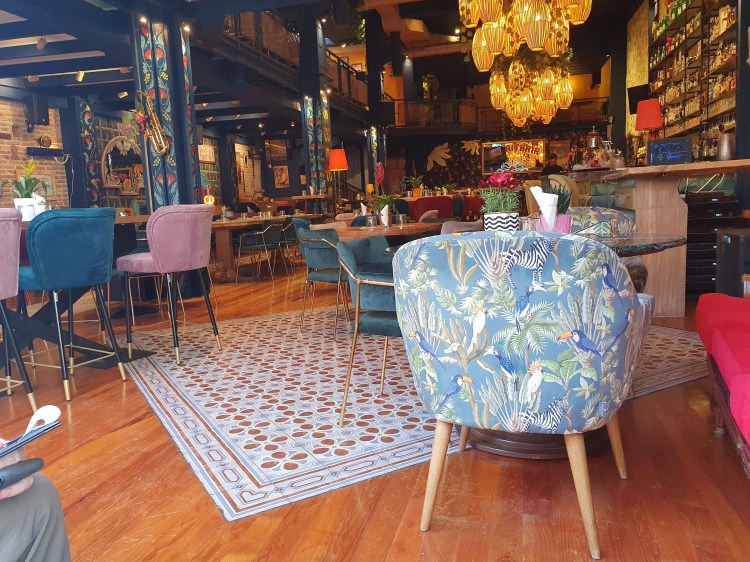
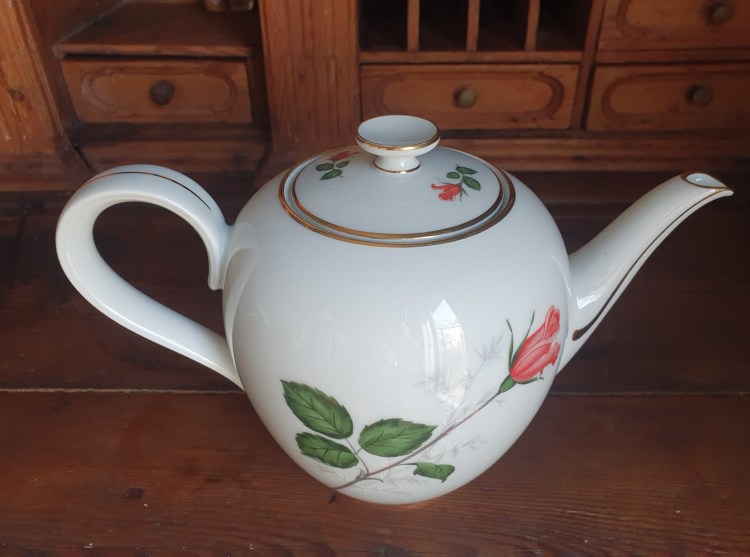
We paused for a delicious cappuchino at a lovely restaurant. I love tropical birds, so we sat by the chairs upholstered in cockatoo print fabric. When we moved on toward the metro and home, I stopped to look at a teapot, as our apartment doesn’t have one. I ended up getting a perfectly nice teapot for 4 E. On the way home, the lid seemed to be clanking a lot in the bag, but when I looked, the pot was not rattling. Finally, I looked inside, and found a tiny metal table favor of some sort that was making the noise. My free find! Maybe it will become dollhouse furniture for my granddaughter?
Our market experiences have been very good, and we will continue to stock up as we go along.
Our apartment is not far from Exarchia Square, the center of the neighborhood of the same name. We didn’t select our apartment because it is here, though we wanted to be centrally located. Now that we’re in this zone of Athens, we are discovering our surroundings have quite a story.
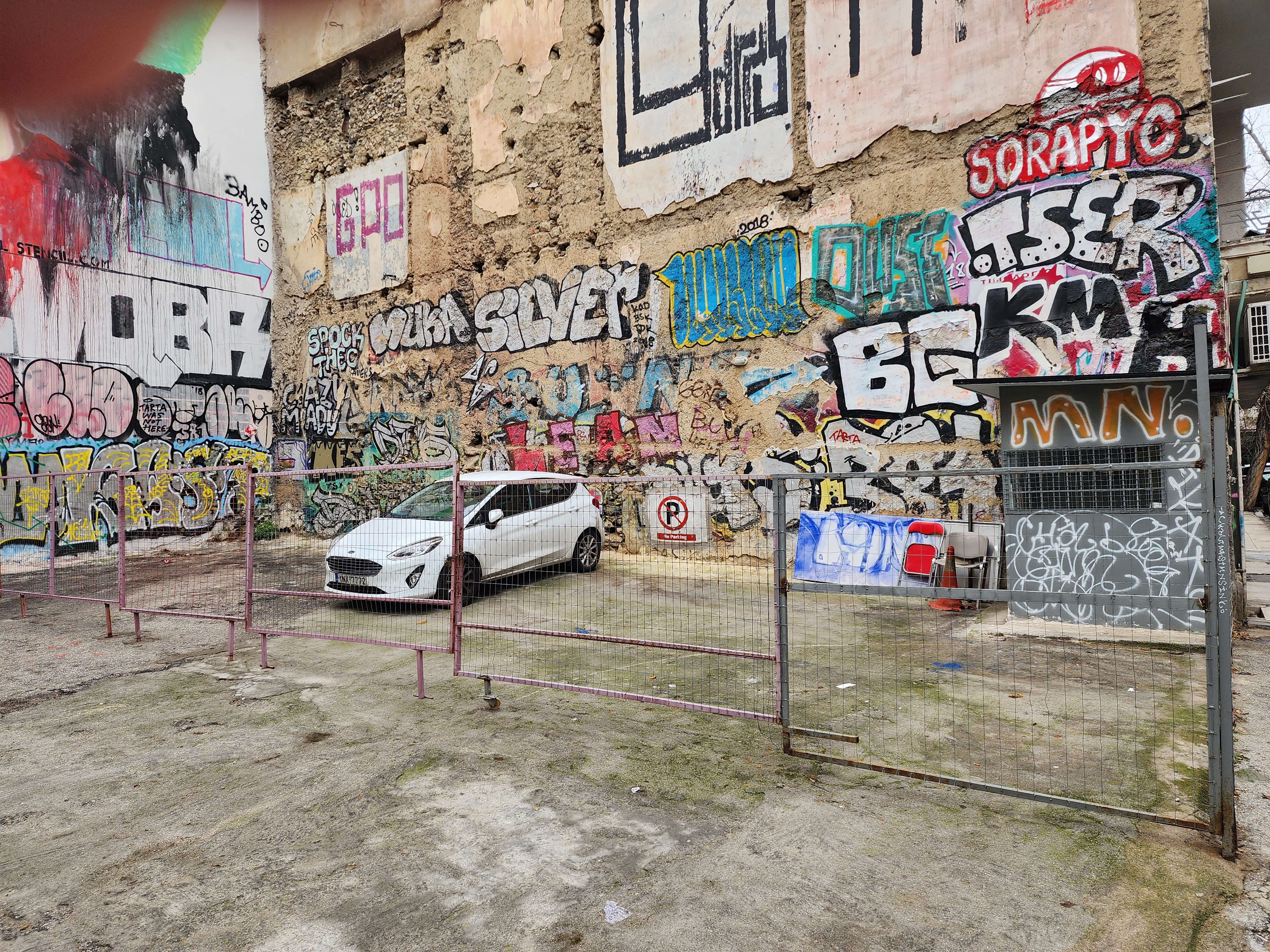
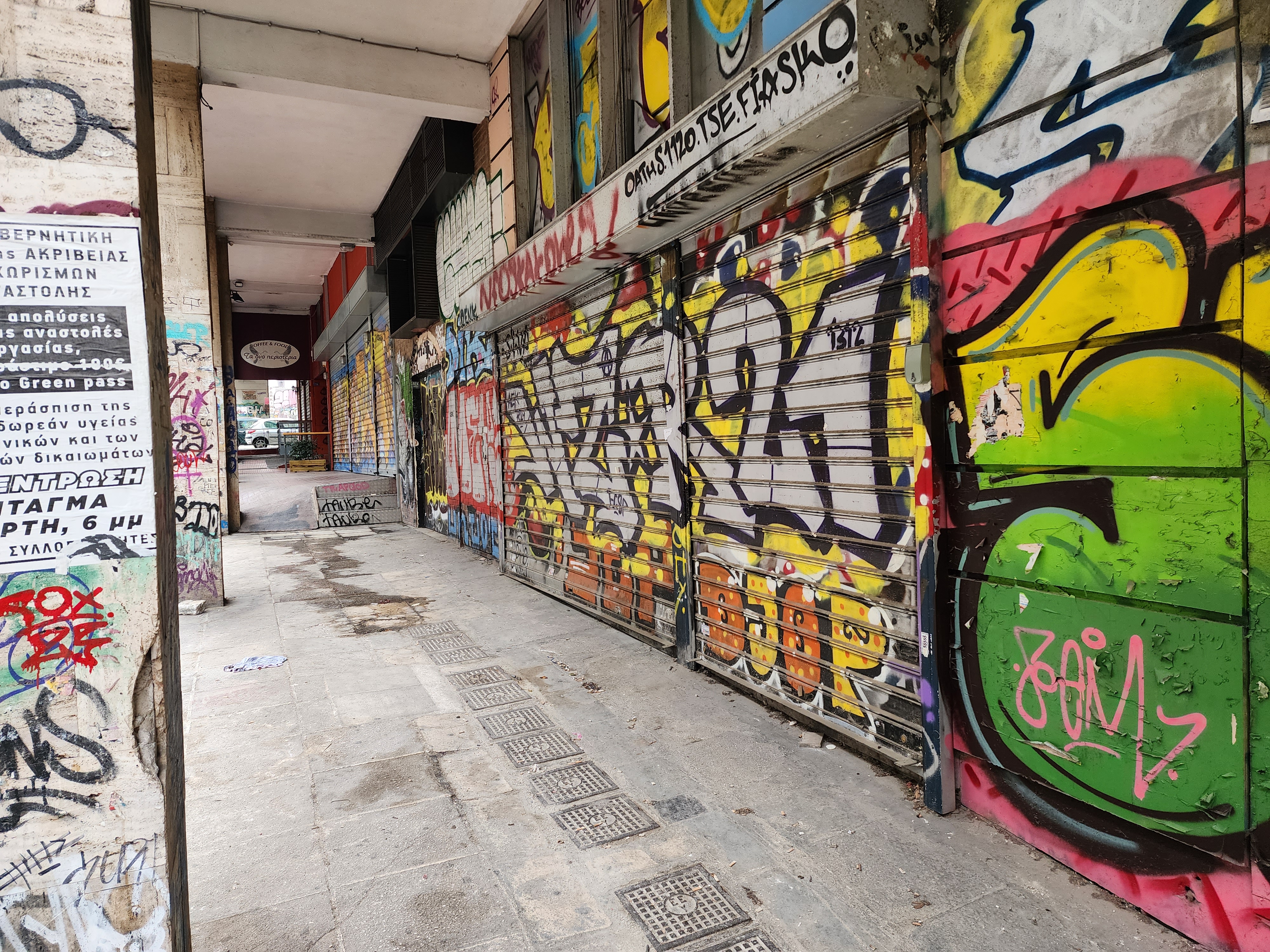
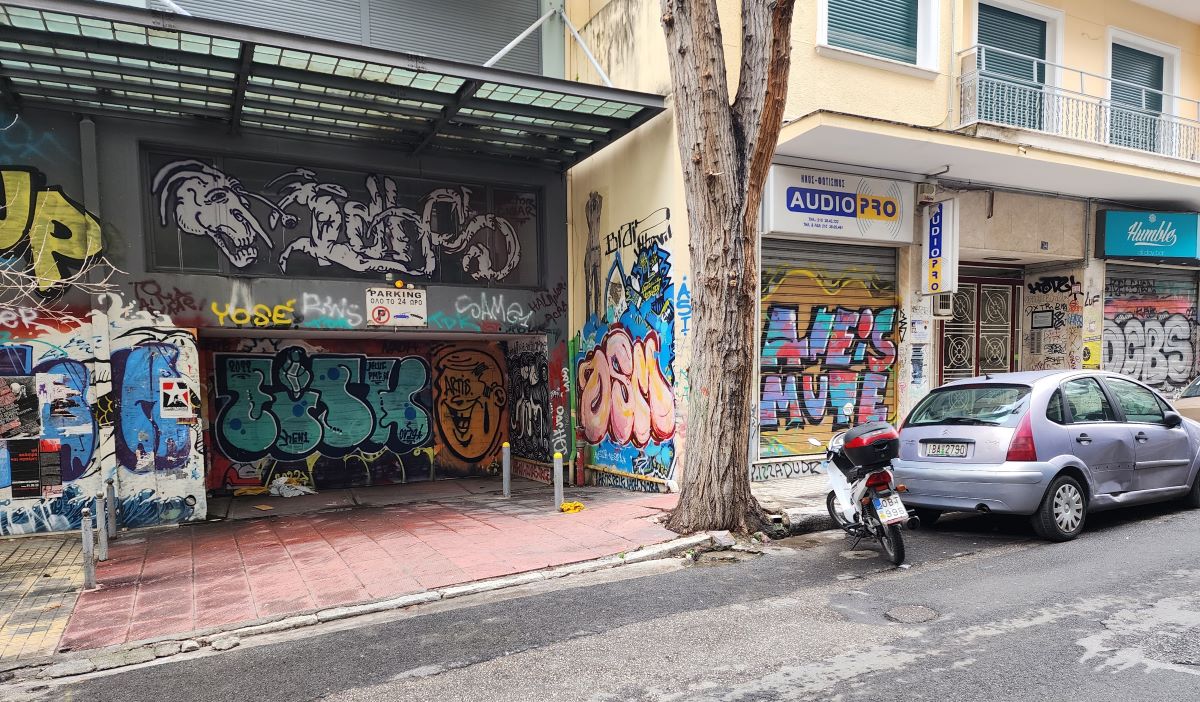
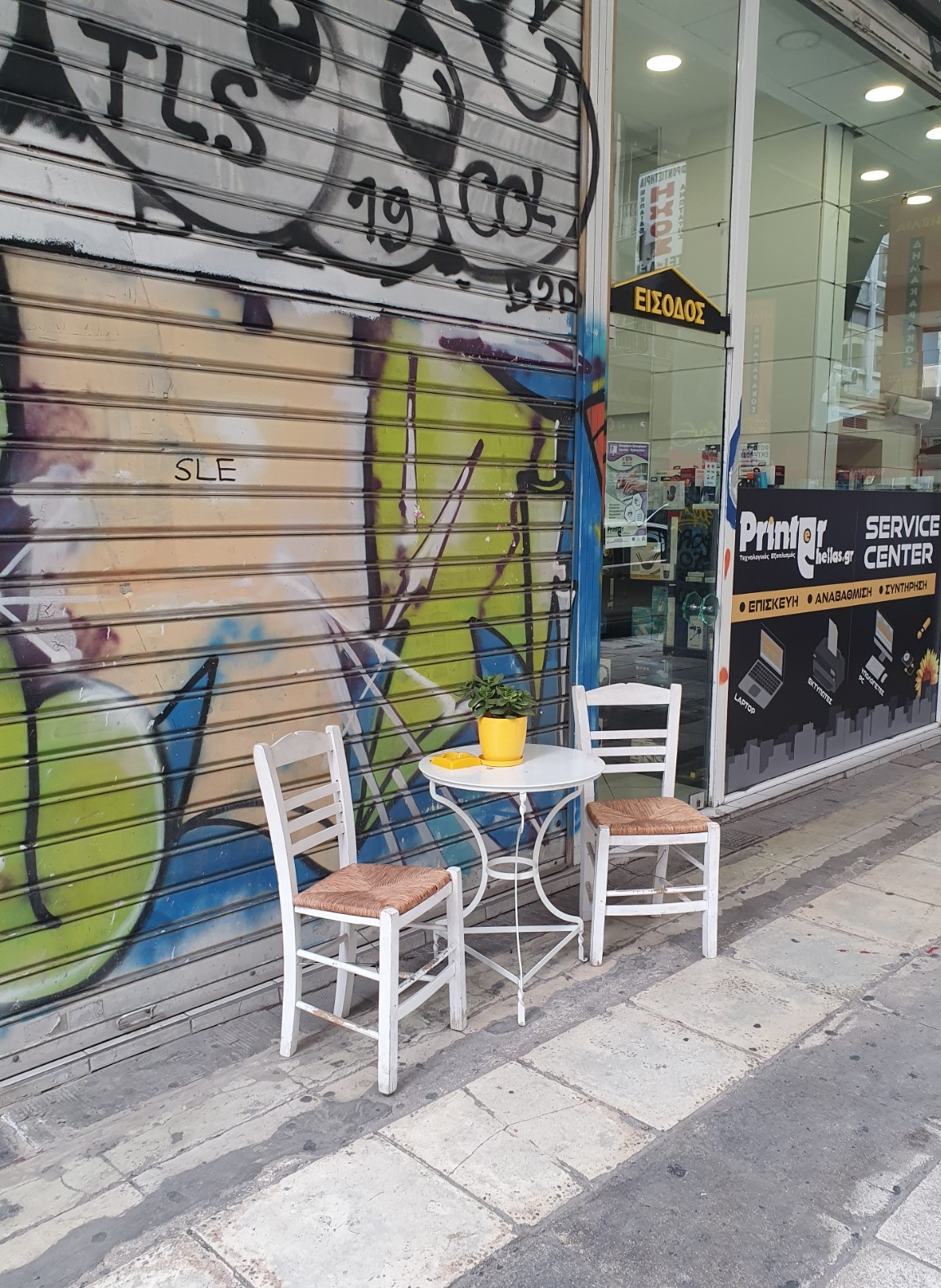
The first thing you notice here is the graffiti. There is graffiti from the ground up farther than a person can climb, jump, or paint from a stepladder. Early in the day, the graffiti is most noticeable because it covers the metal shutters that are pulled down over the doors of most businesses. As businesses open and roll their shutters up during the morning, less graffiti is visible, though there’s plenty left. At first we were shocked. Our apartment is in a nice building, and next door is a pleasant cafe. Still, every wall is graffitied and the result is a bit oppressive.
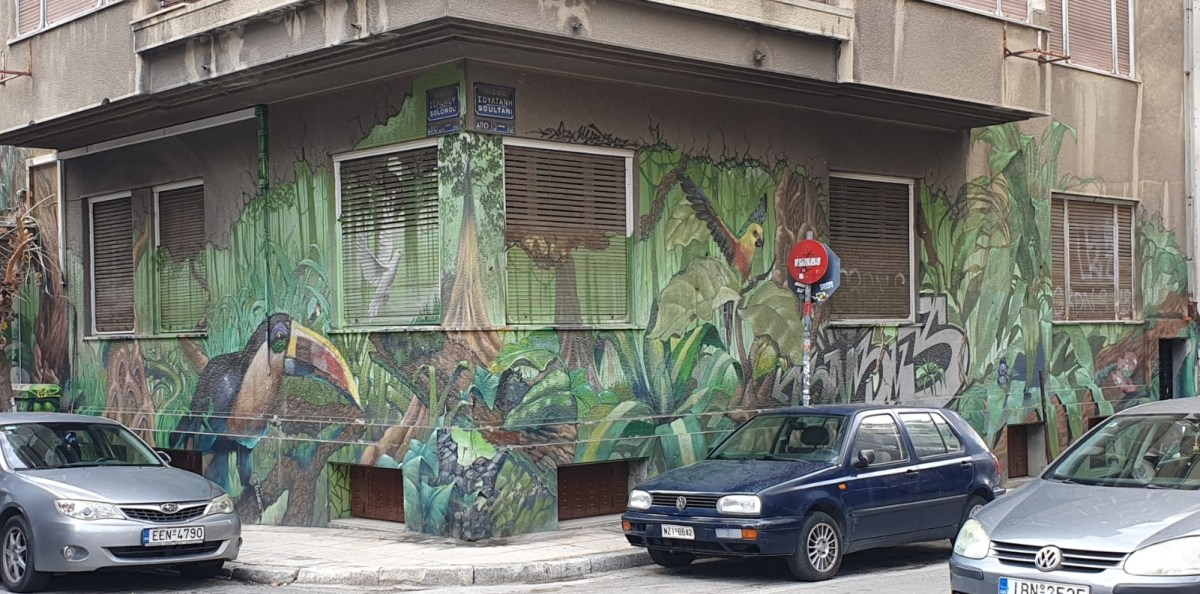
We walk past buildings with extensive murals that seem to be an effort to deter graffiti painters with a pre-emptive strike. In some places it seems to work.
Exarchia Square has been the center of counter-culture groups, students, and generally left-leaning people for some time. The current conservative government does not like this neighborhood at all. I wondered why the garden in the center of the square was blocked off with sheets of metal fencing. I figured it was being refurbished. Not at all! The garden is being cut down in order to build a Metro station, despite an alternative open area without mature plantings being available nearby. Local sentiment is that the neighborhood is being punished for its political leanings. When a demonstration against the Metro was held in August, police were stationed on the corners of the square. They are still there every day and night, eight or more riot police, dressed in camo, armed, some with riot shields leaning on their legs. It is intimidating, and it is supposed to be. I didn’t get very good photos because I didn’t want to be noticed taking them.
On Sunday, there was a large demonstration in downtown’s main Syntagma Square demanding the Greek government accept some responsibility for the fatal train crash last week. We did not know about it and our plans took us elsewhere, but as we were returning, we ran into the tail of the demonstration ending at Omonia Square. We emerged from the subway to see black-clad demonstrators parading toward the square, some carrying long sticks that they pounded on the ground to punctuate their chant. We headed away from the action toward home, but had to pass a line of police who seemed to be monitoring the end of the march. They were wearing full gas masks, and there was a faint tang of tear gas in the air. It made me blink, though nothing worse, but encouraged us to keep moving. At the same time, we passed couples and families out for a Sunday stroll. It was strange indeed, suggesting Athens has been living with protest for quite some time.
As we suspected, when we rode the Metro a couple of stops to Akropolis the next day, we found a neighborhood largely graffiti-free. The authorities appear to spend their energy keeping the touristy areas clean, rather than concerning themselves with a zone that is full of residential buildings, coffee shops, bars, restaurants, and small shops, not to mention the supposedly leftist residents.
Exarchia neighborhood Acropolis neighborhood
Though there are green spaces to walk to, Athens doesn’t boast a lot of parks. Exarchia Square is tiny for all the uproar it has generated. Other nearby squares would barely be considered parklets in the US. Omonia, the large square nearby with our closest Metro stop, consists of a fountain ringed by a strip of grass. There’s not anyplace to walk, other than the usually crowded sidewalk.
The dearth of parks is perhaps made up for by the number of coffee houses and cafes. Every block has a cafe of some sort, from dark wood facades with elegant tables and chairs, to a cafe constructed entirely from Coca Cola crates. Everyone seems to have a regular hangout. When the Lonely Planet guidebook said that Greeks aren’t much for breakfast unless you mean coffee and a cigarette, I laughed, thinking that had to be out of date. It’s not.
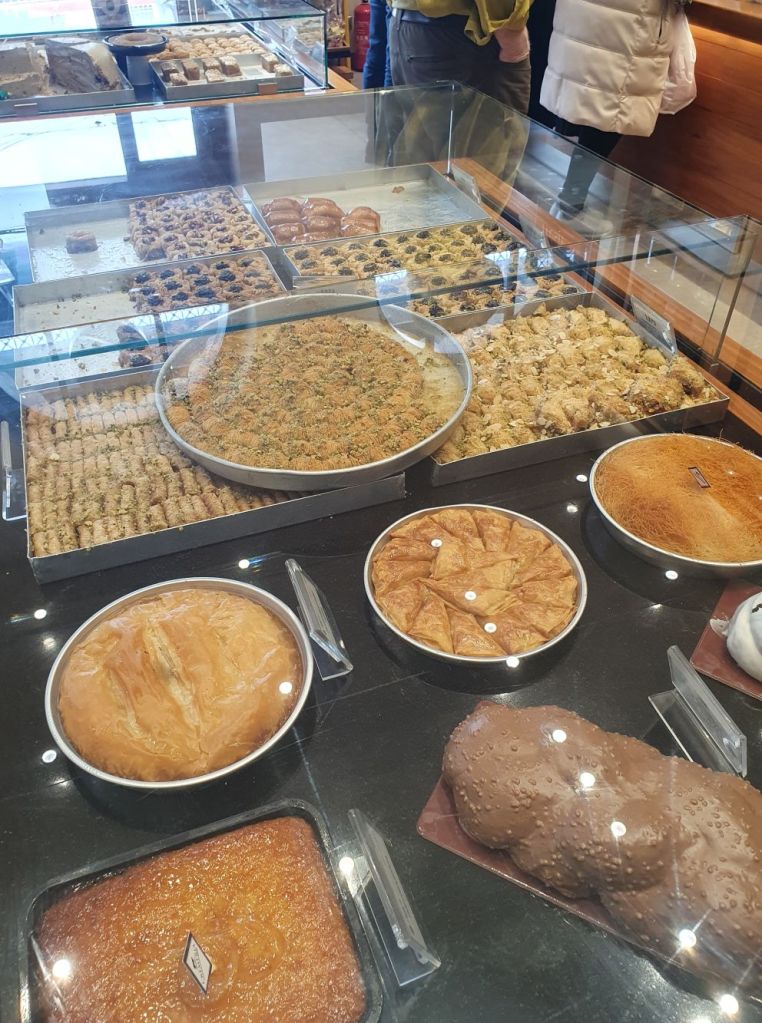
For those of us who don’t survive on Turkish coffee or cold brew, Greek pastries full of nuts and soaked in honey are everywhere, too, and delicious. My breakfasts may not be especially healthful, but they are deeply satisfying (I do also eat some of the delicious Greek yogurt; I’m not living exclusively on sugar.)
Exarchia may be a neighborhood filled with turmoil, but in between events, there are plenty of corners where you can sit at a table, sip a coffee and nibble a delicious pastry. Just make sure to head home if someone wearing a gas mask walks by.
I am old enough to remember Melina Mercouri, famous Greek actress. She is best known to Americans as the star of Never on Sunday, for which she won the Academy Award for Best Actress in 1960. Mercouri is remembered for her political activism and as the first female Minister of Culture and Sport, a post she held for eight years.
In her honor, March 6 is now Melina Mercouri Day, celebrated as a free day at all public museums and monuments in Greece. School groups visit the Acropolis, the Acropolis Museum, the National Museum. There are students and families visiting at every cultural site, on this day. We saw a lot of them.
Not knowing anything about the significance of March 6 in Greece, we set out on the lovely sunny morning for our first visit to the Acropolis. The subway seemed full, and we saw classes of students waiting on the platform. No matter, we forged on to the Akropoli stop and found the ticket line for the Acropolis. It was huge. We looked across at the line for the Acropolis Museum, also very long. A dejected tour guide sitting on the curb looked up and said, “It’s free today. Melina Mercouri Day,” then turned back to her cigarette.
In honor of the hundreds of people enjoying free entrance to the Acropolis, we decided to visit tomorrow, to avoid the crowds. We ambled back along the streets toward home, taking a detour to visit the Athens Central Market, the Varvakios Market. We stopped for lunch at Igeios, a small restaurant without a menu, a taverna where you look at what they have cooking, make your selection and out it comes. We noticed that many people were in and out in about ten minutes, downing a big bowl of soup and heading out the door. We shared a baked fish and a Greek salad that was plenty for both of us.
We stopped at the supermarket (Bazaar is a chain in Athens), and picked a few things, then headed home. It was already after 3 pm, and we were ready to stop walking. We celebrated Melina Mercouri Day a little differently than others might have, but we’ll remember it.