This is our first big adventure since settling in California, and it is a LONG, LONG, way from Eureka to London. We drove to San Francisco to squeeze in an eye appointment for me, and we knew that we could park for a month at the El Rancho motel. (Bad and good news though: the hotel will close in the next year and the property be redeveloped as housing.)
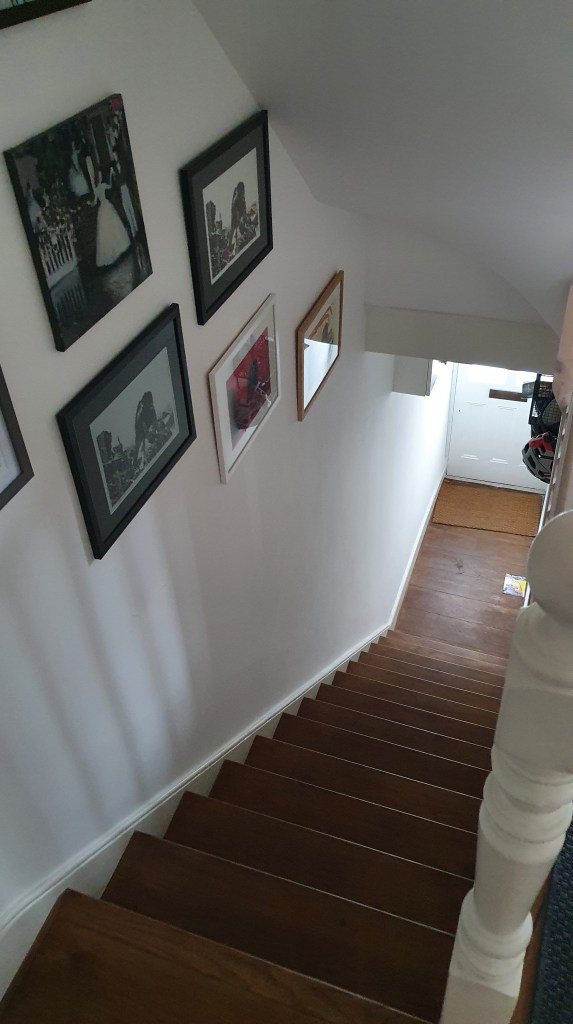
Townhouse = Stairs
We flew Delta to Heathrow via Salt Lake City, and our travel went as smoothly as it could have. We arrived at 1:40 pm and had to wait a while for our prearranged ride to the city. More good news, our phone chips work and I could check with the taxi company. About a half hour late the driver showed up, and off we went. We arrived at our rental townhouse in Kennington, on the south side of the river, at 4 pm, both exhausted.
Tiny sink
Our home for the month is compact. There is a extra bedroom and bath on the third floor that we decided not to use. The upstairs bathroom is a bit larger, but the extra stairs make it less attractive.
The bath attached to our bedroom is similar to the kind you find on a cruise ship. Everything is there, but close together. The sink is the smallest we’ve ever seen, the bowl is 8 x 10 inches, smaller than a sheet of printer paper. It makes us laugh, as we always thought the powder room at our house in Wheaton had the smallest sink we’d ever seen.
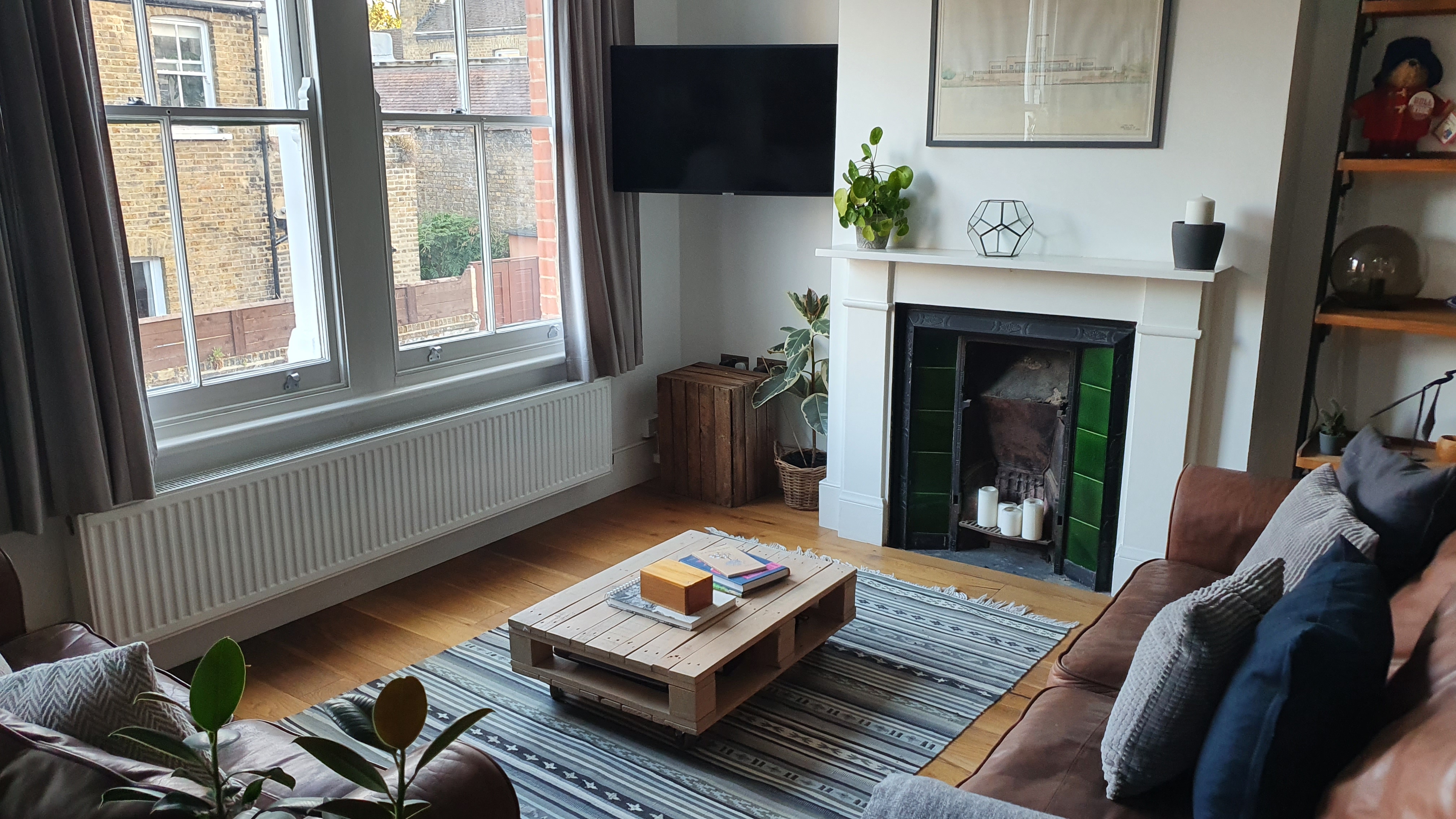
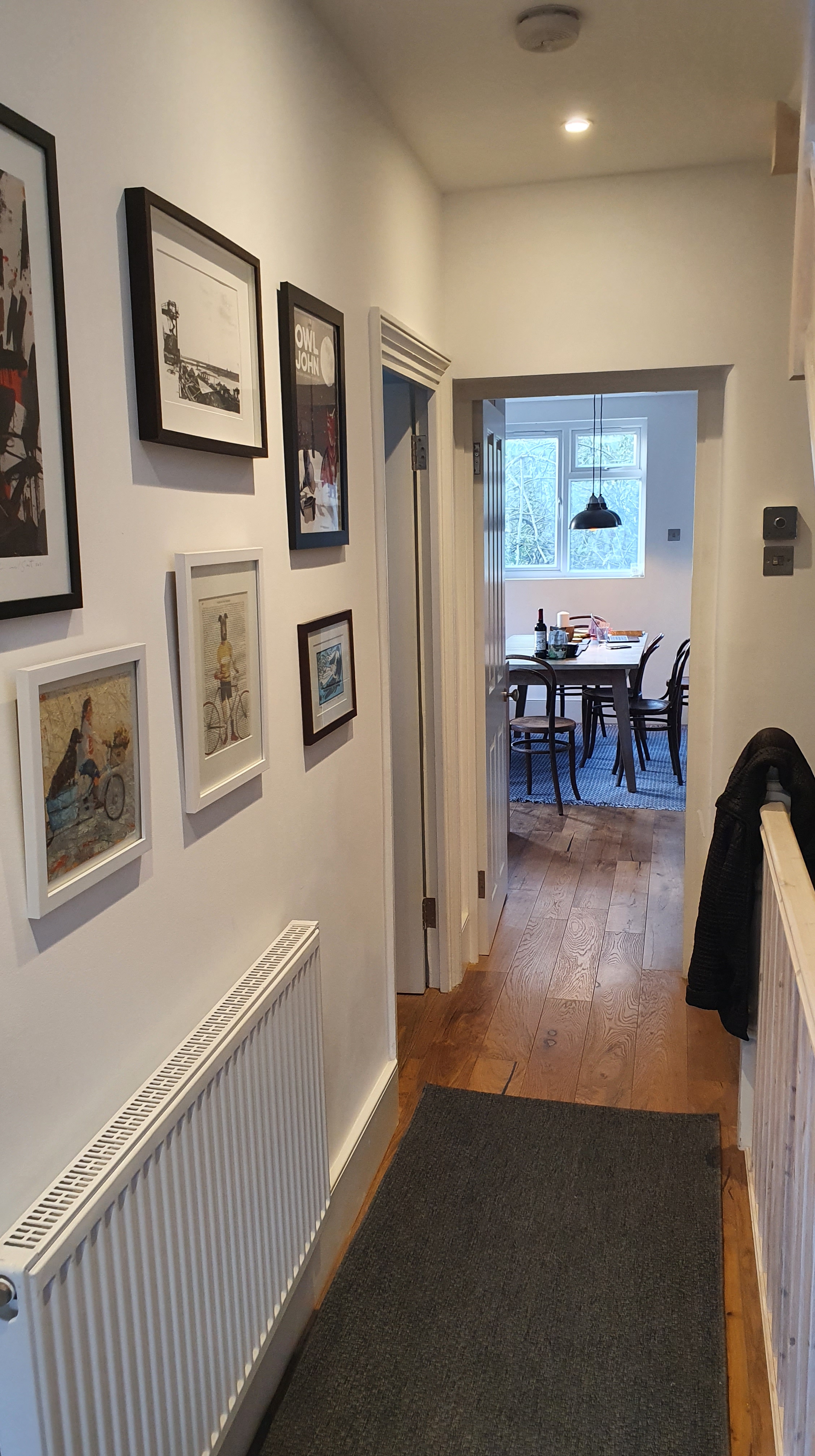
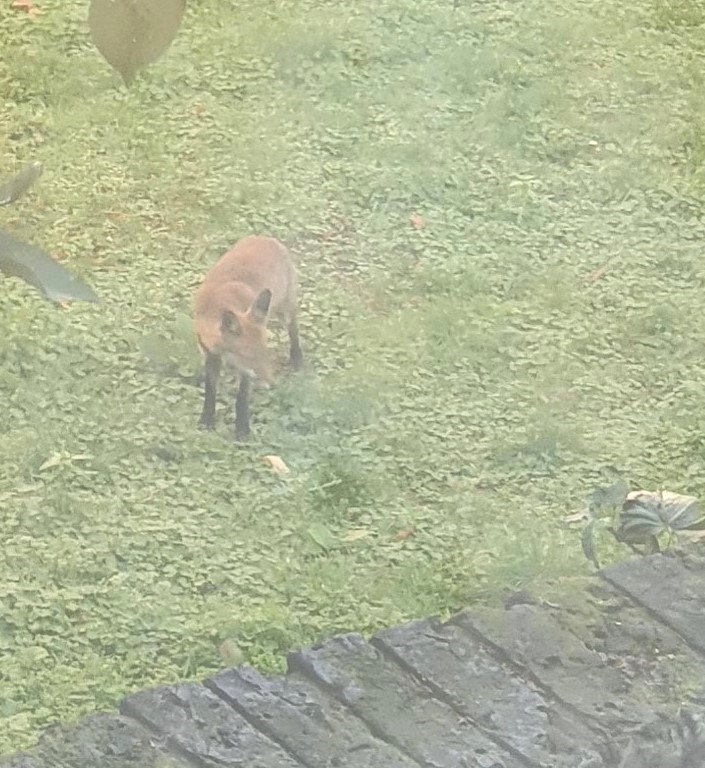
The kitchen is made for cooking, with a large range, all the cookware Jonathan needs, and a full-size fridge. It also has the dining table (photo is at the top of this post). Heat and hot water work very well, and the house gets nice light from windows over the street in the living room, and kitchen windows over the back garden. We hear a few birds in the trees, but haven’t seen any. Our first morning, I looked out the garden window and watched a fox prowling on the lawn. It’s definitely a city dweller, as there’s is not much in the way of woods for quite a distance.
A quick check on the phone and we found a nearby store where we could get something for dinner and breakfast. I love that it is “National Crumpet Week”. The neighborhood appears to have a bit of everyone, meticulously maintained gardens, houses with new paintwork, and some DIY works in progress. Most is town houses and apartments, including a couple of big council estates (subsidized housing).
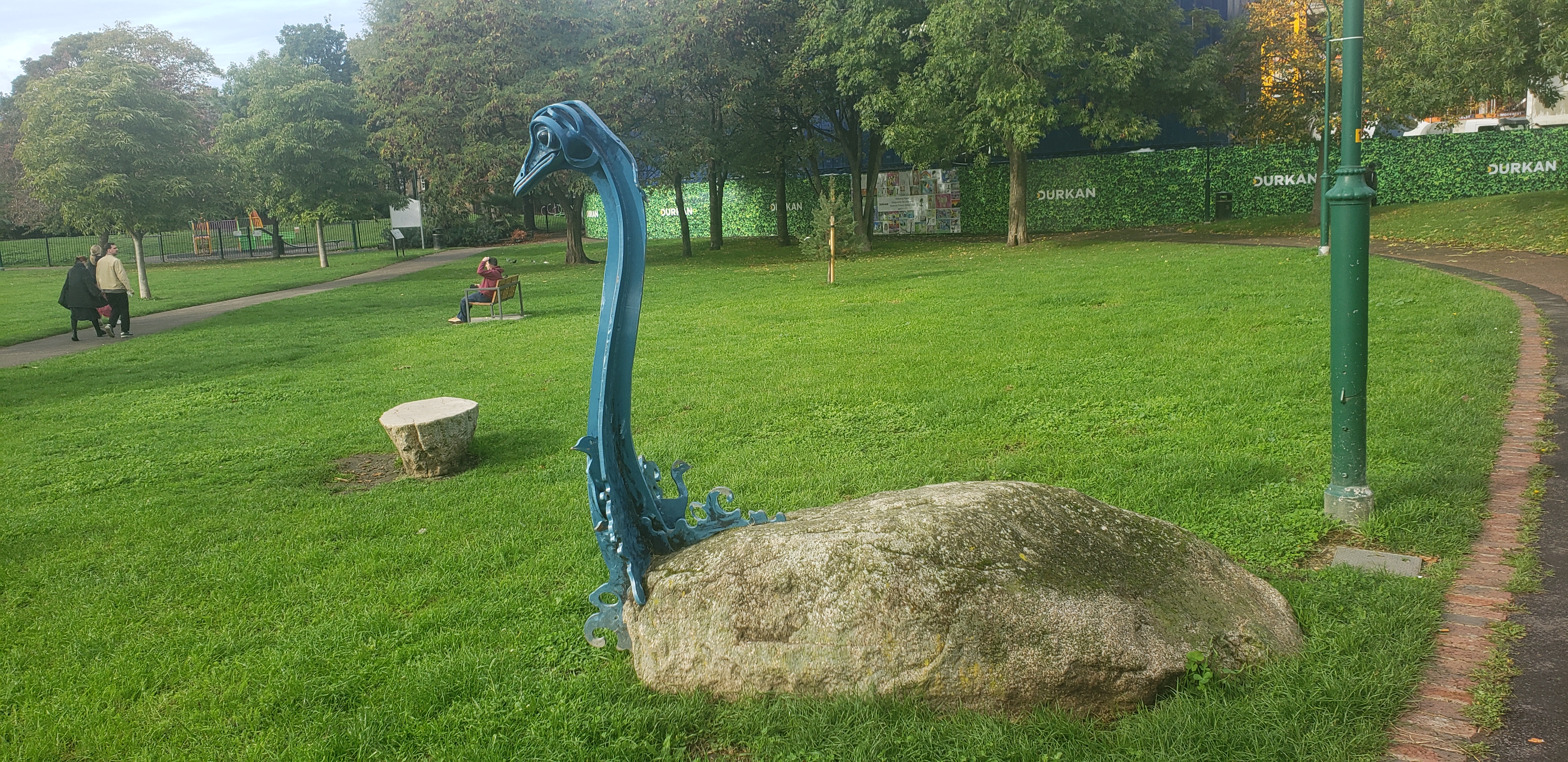
On the way to the closest large grocery store, we cross Pasley Park, where a pair of boulders have been turned into birds. We’ve seen a few live birds, too, the dramatically colored black and white magpies, and rose-ringed parakeets (much larger than pet budgies) that escaped from a cage somewhere. Robins chirp in the bushes. Last night’s sunset was spectacular. All this in the middle of the city.
Despite the comfortable surroundings, we didn’t sleep well the first couple of nights, no surprise considering the 8 hour time difference between London and Eureka. Coffee fixes many things, and before long, we were ready to explore.
Of course, I knew the baby was coming, I just didn’t think she would arrive four weeks early. Amanda very carefully arranged her four weeks pre-natal leave, went to her last day of work on a Monday, and her water broke that night. Best laid plans, and all that.
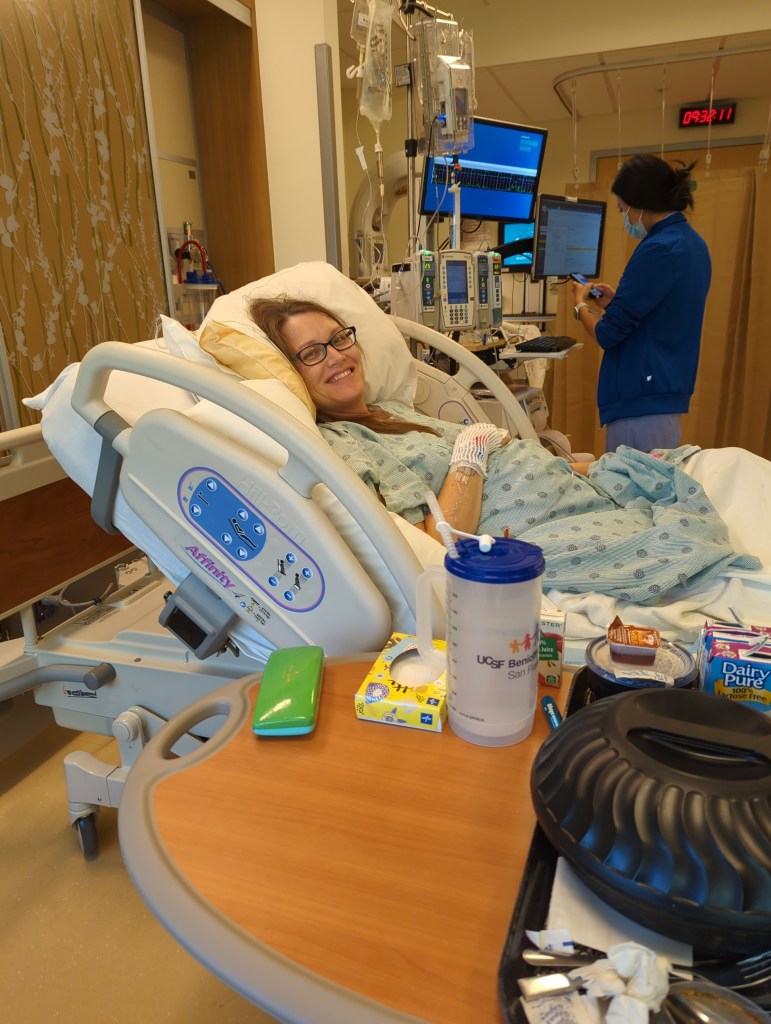
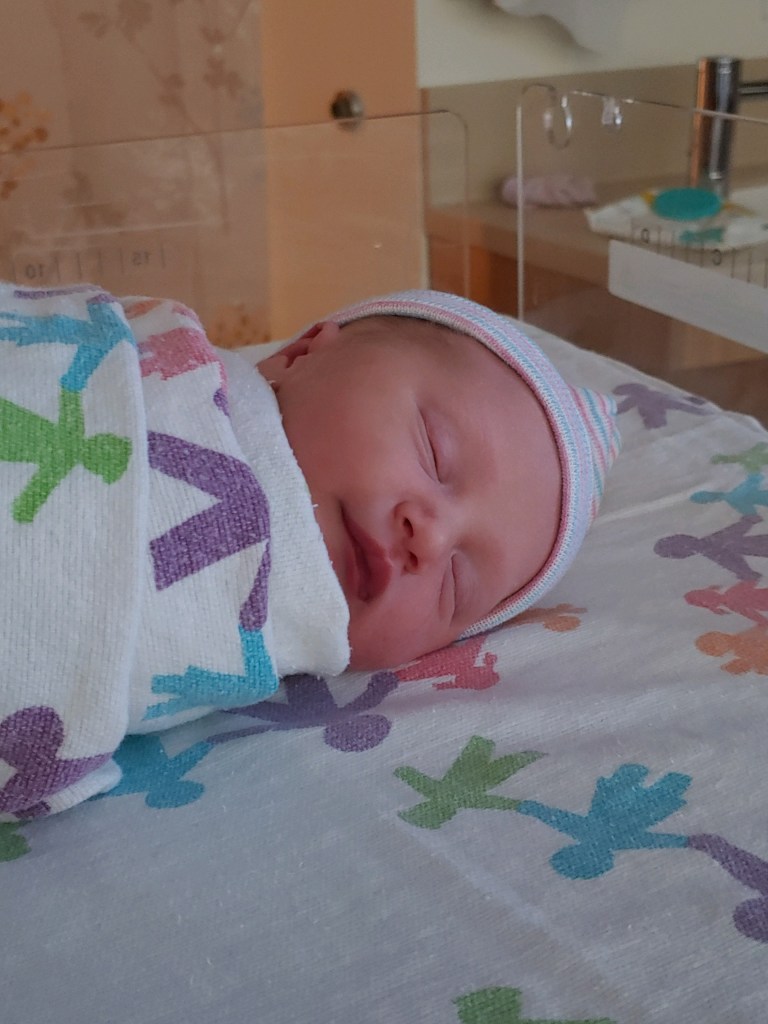
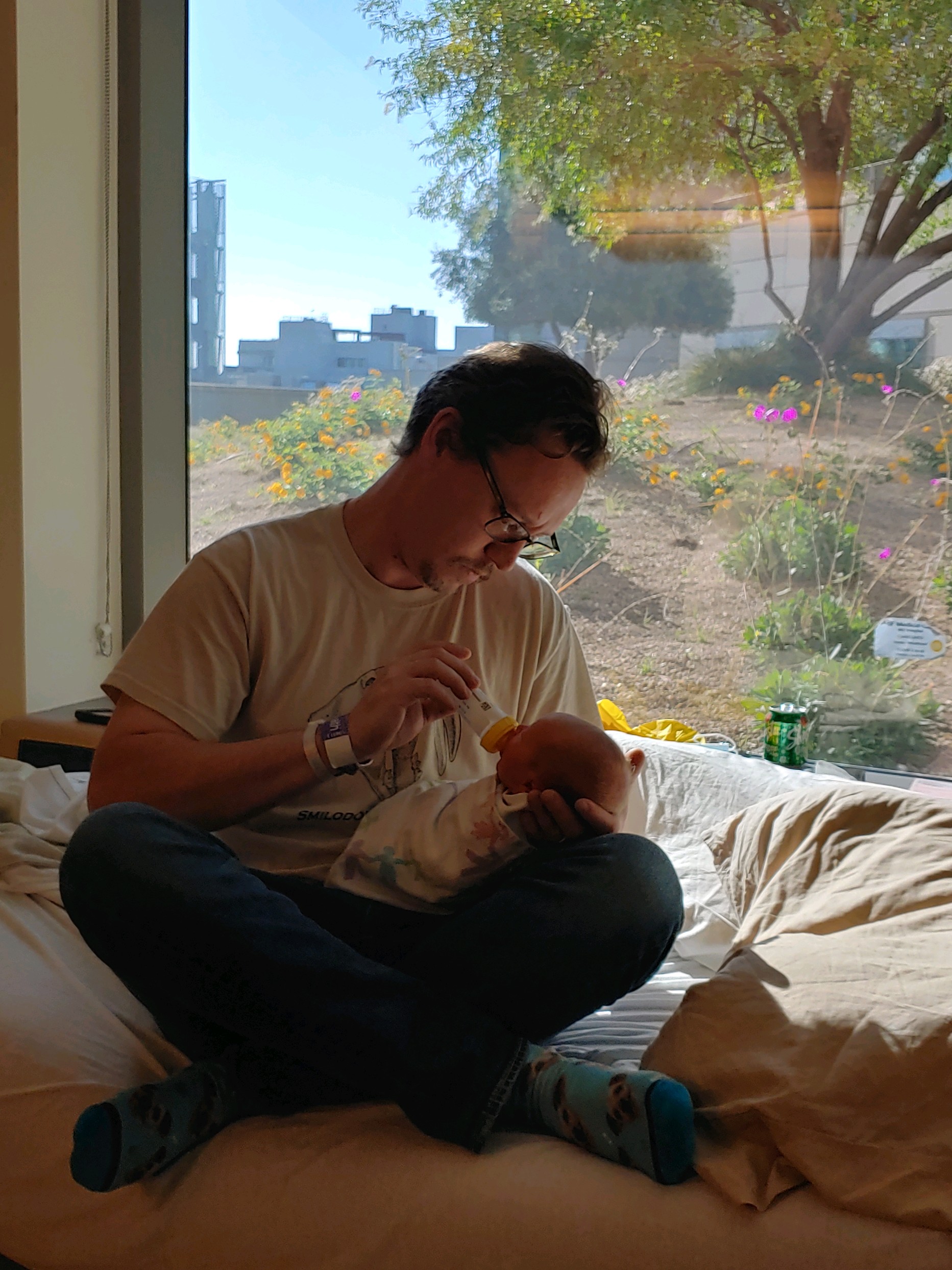
The process of having the baby took some time, once the hospital in Arcata recommended Amanda be moved to the UC San Francisco hospital. Amanda waited for the medical flight, but her husband Jim had to drive himself to San Francisco–the flights take no one but the patient. Eighteen hours after Jim arrived in San Francisco, Aurora Violet Haas Woodhead was born. The family stayed in San Francisco for four nights to make sure that everything was ok. Aurora had a bit of jaundice, and was treated with the hospital’s newest device, in-room blue light treatment. She managed to get her arm free of her wrappings despite the effort to keep her wrapped up.
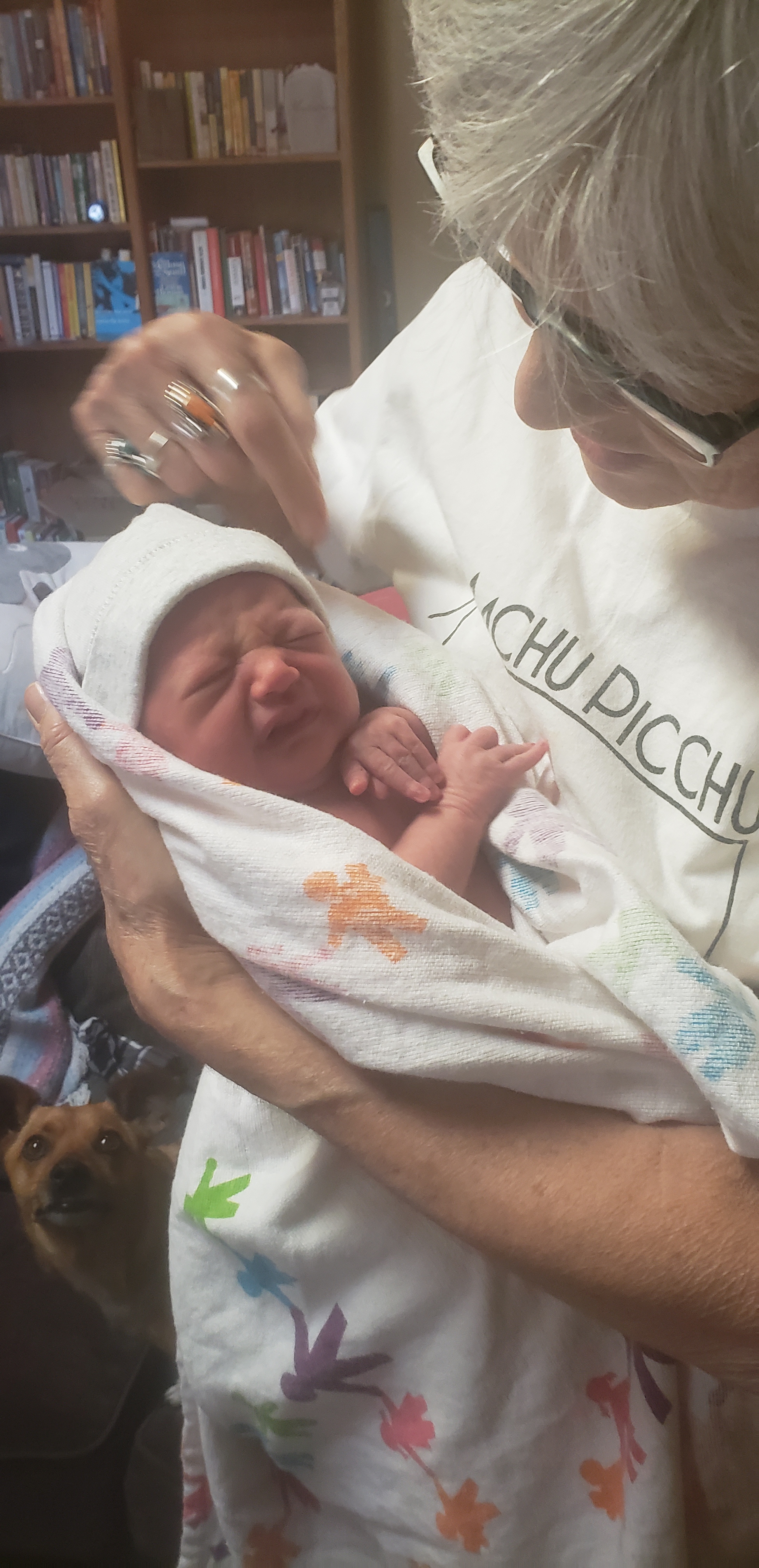
Jim, Amanda, and the baby made their way home on Sunday, and we went for a visit today. Aurora weighed 5 lb. 5 oz when she was born, and weighs just about that now (babies lose a bit of weight after they are born). She’s a tiny thing, with skinny little arms and legs waiting to fill up.
When we met her on Monday, Aurora was busy growing. It was nice to hold her and feel her soft skin, but she was not very interested in her grandparents, she was busy doing her thing, sleeping and occasionally eating, age-appropriate behavior. We’ll see her again soon.
I wrote about what Jonathan and I do every day, just for fun. It was used in the article that appeared on Saturday. This is the excerpt about us:
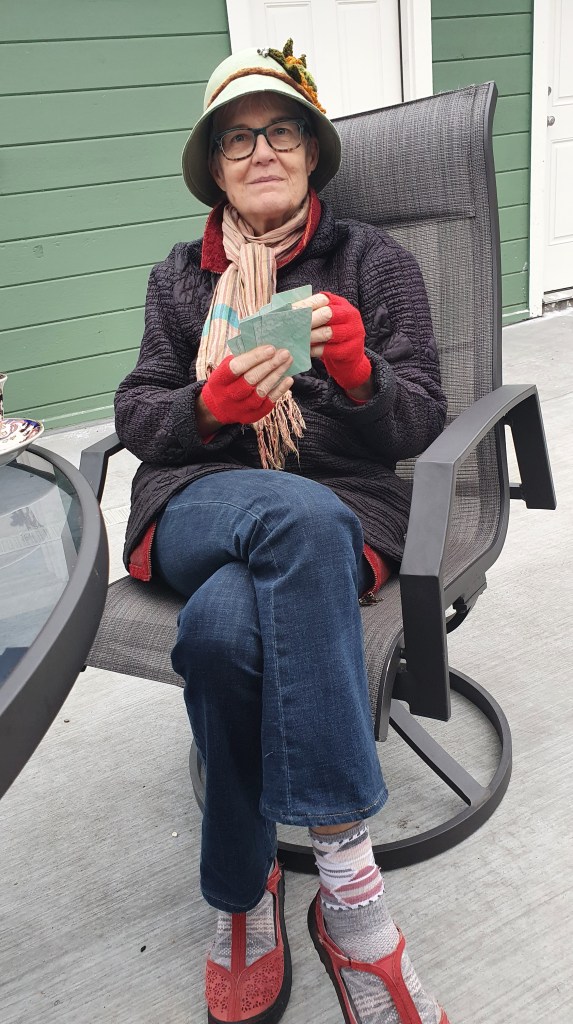
At 6 p.m. every day, my husband of 39 years makes popcorn, I make tea, and then we sit down and play gin rummy, five hands, so there has to be a winner. Our competition is fierce, we play avidly to the last moment. The winner gloats and cheers. Five minutes later, neither of us can remember who won.
— Winifred Creamer, Eureka, Calif.
I’m happy we could share our moment of fun. The photo was taken one afternoon when Jonathan wanted to sit outside and I thought it was a bit chilly. I overdressed just a bit.
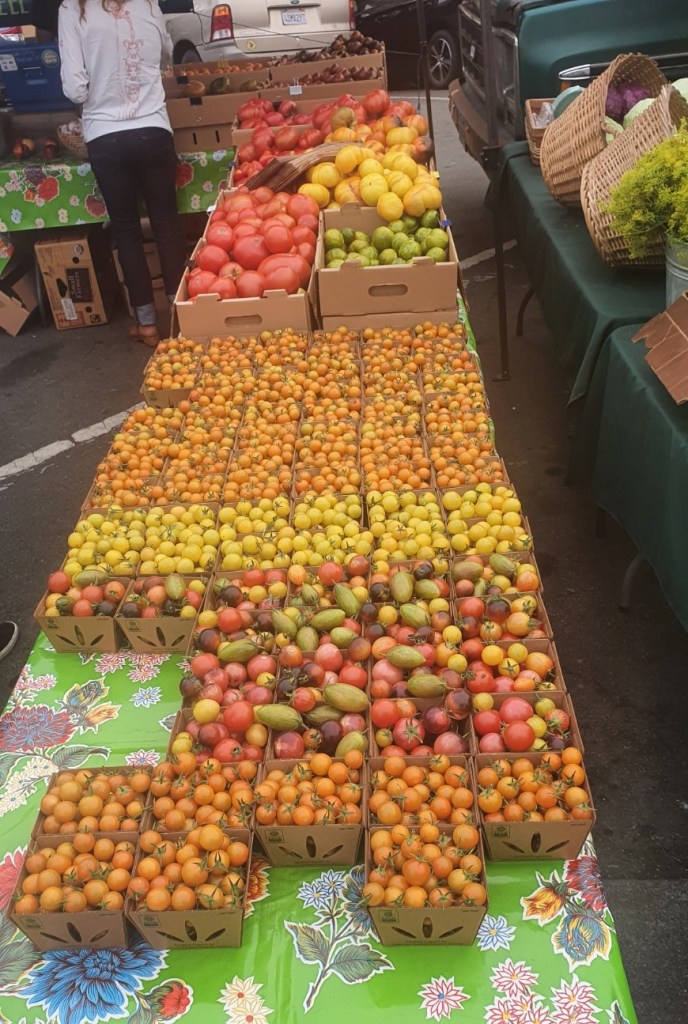
Despite my trip to Chicago and having Covid, we continued exploring our new region. The Arcata Farmer’s Market is full of gorgeous produce during late summer, tomatoes, eggplant, apples.
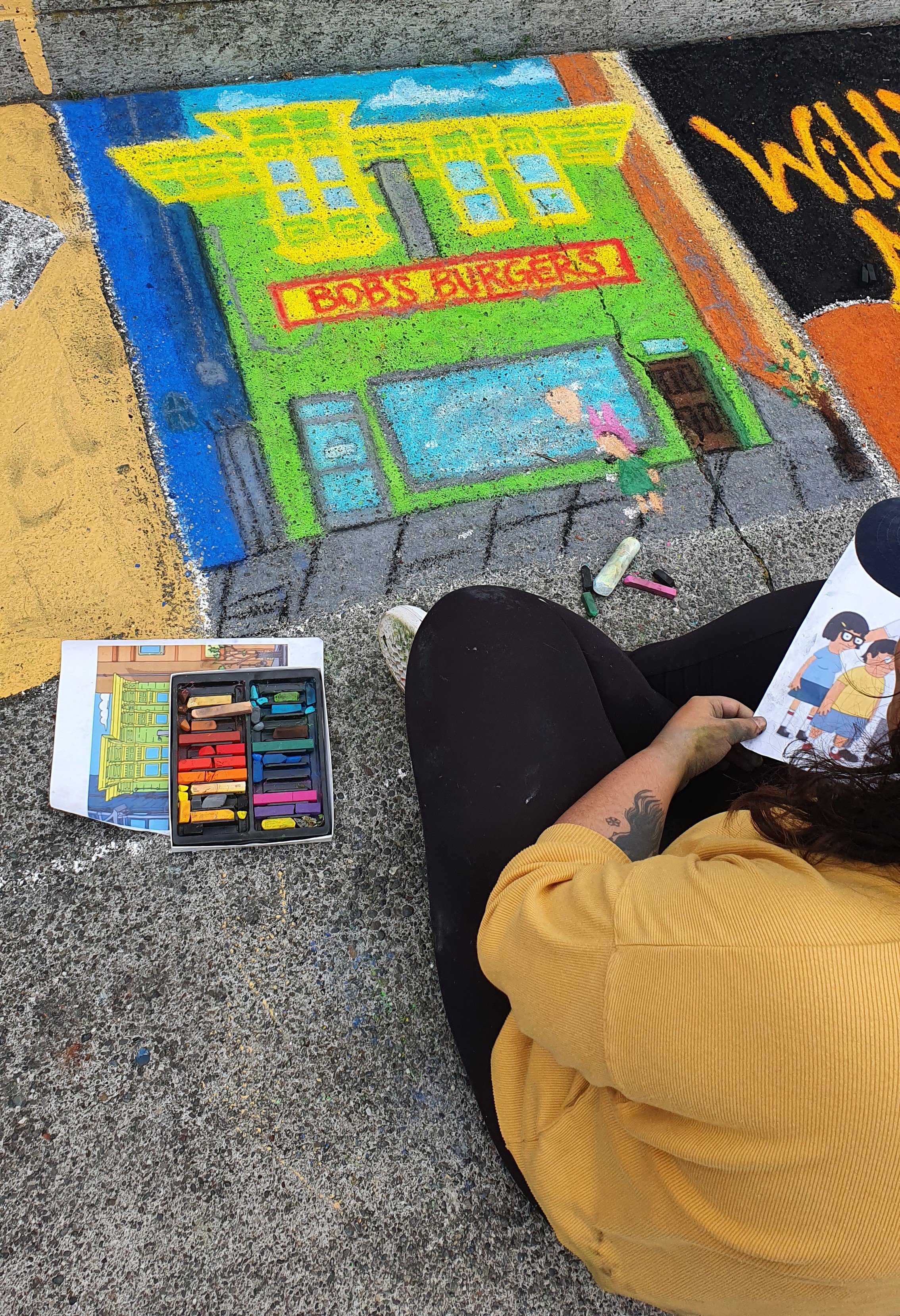
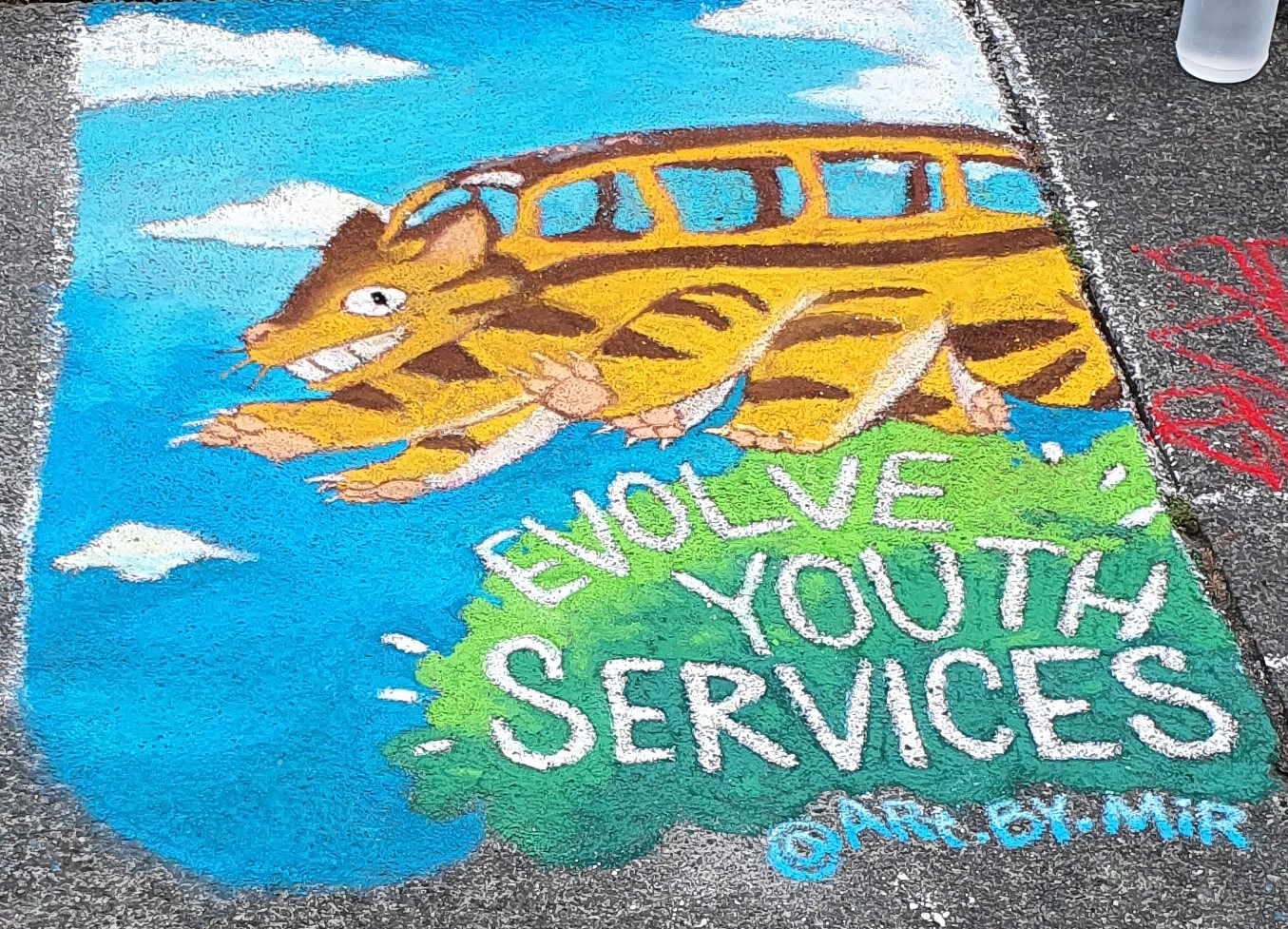
We buy the bread of the week from Beck’s, made with a different freshly ground grain combination each week. Last weekend was also Pastels on the Plaza, with 100 artists decorating sections of the sidewalk around the Arcata Plaza, sponsored by different agencies and businesses.
The monthly Arcata Flea Market was worth visiting, too, and we picked up a few things we needed. It’s fun to have a look around and see what people are selling.
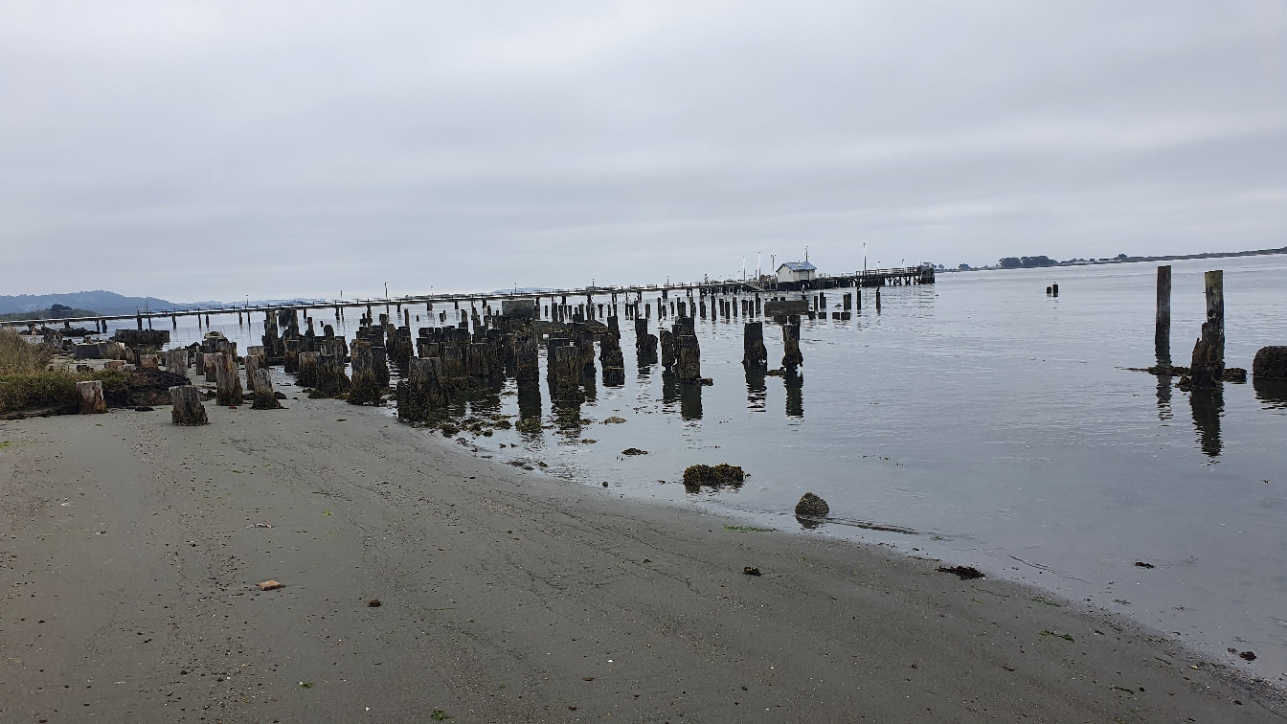
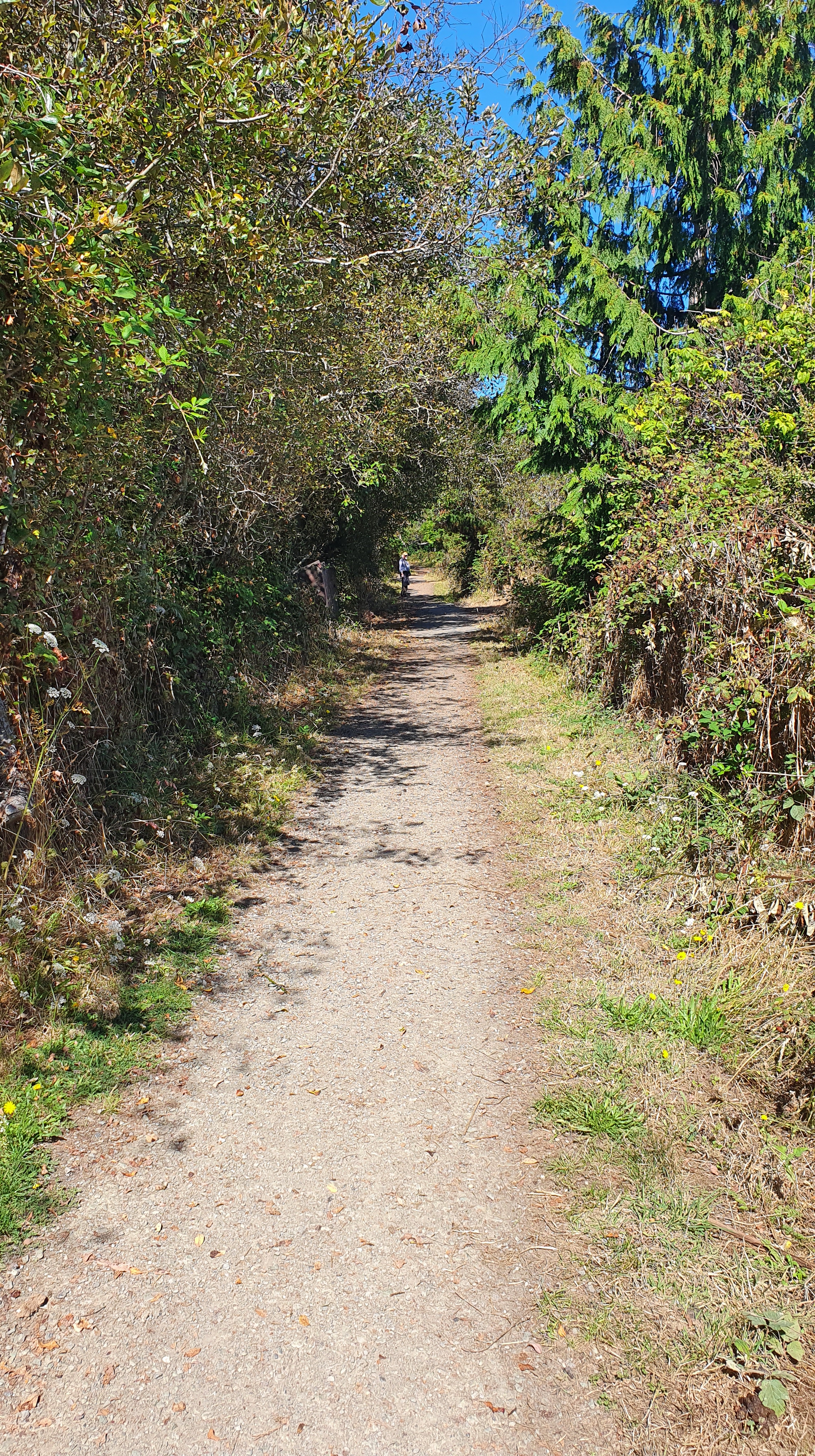
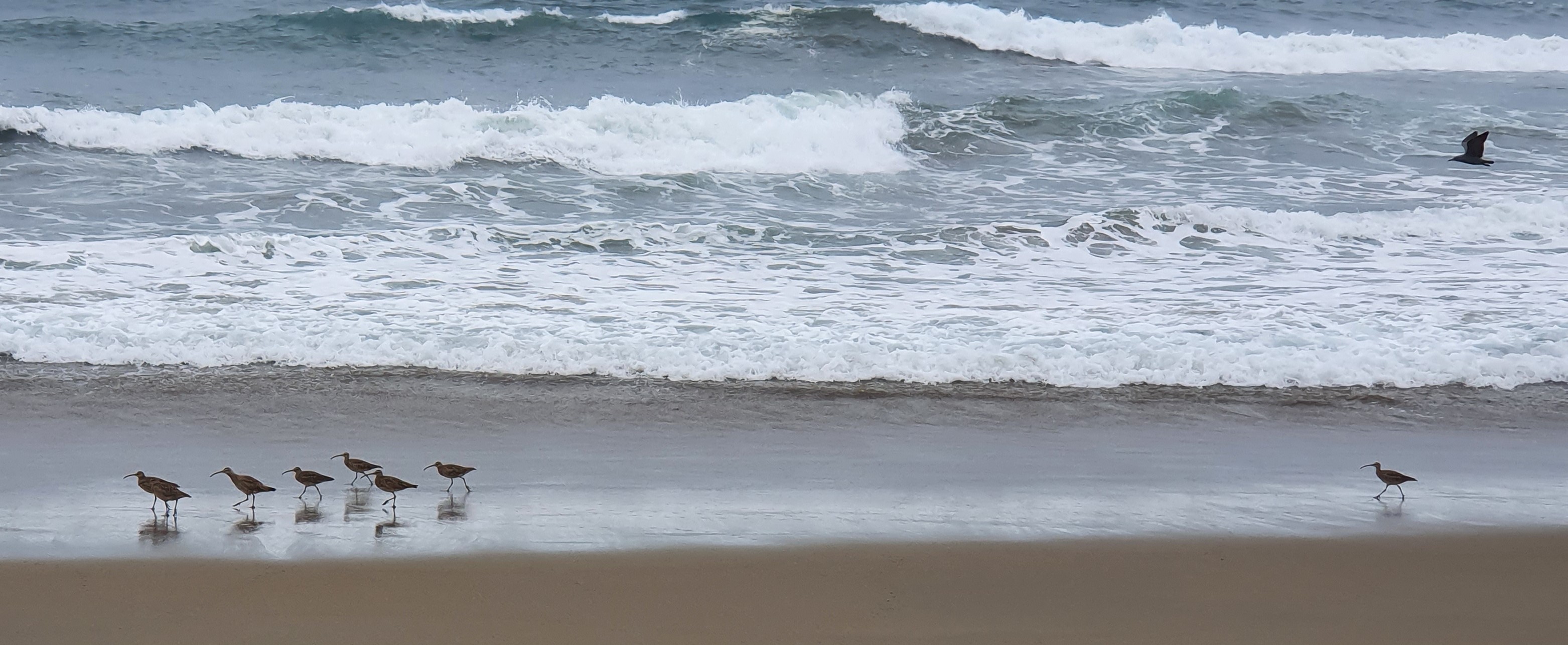
There are also wonderful outdoor places to explore. We started close to home on the Eureka waterfront trail running along Humboldt Bay through the city. Coastal trails continue along an old rail line heading north and connect with the section called the Hammond Trail in Arcata. We have walked on the coast by the Del Norte pier, due west from our house, as well as another segment behind the Walmart. It is a bit odd to be going for coastal walks by parking behind the mall, the Walmart, or the CVS, but that’s how urban trails work. We done some beach combing, not finding much, and seen some interesting birds–these trails get us into the natural world.
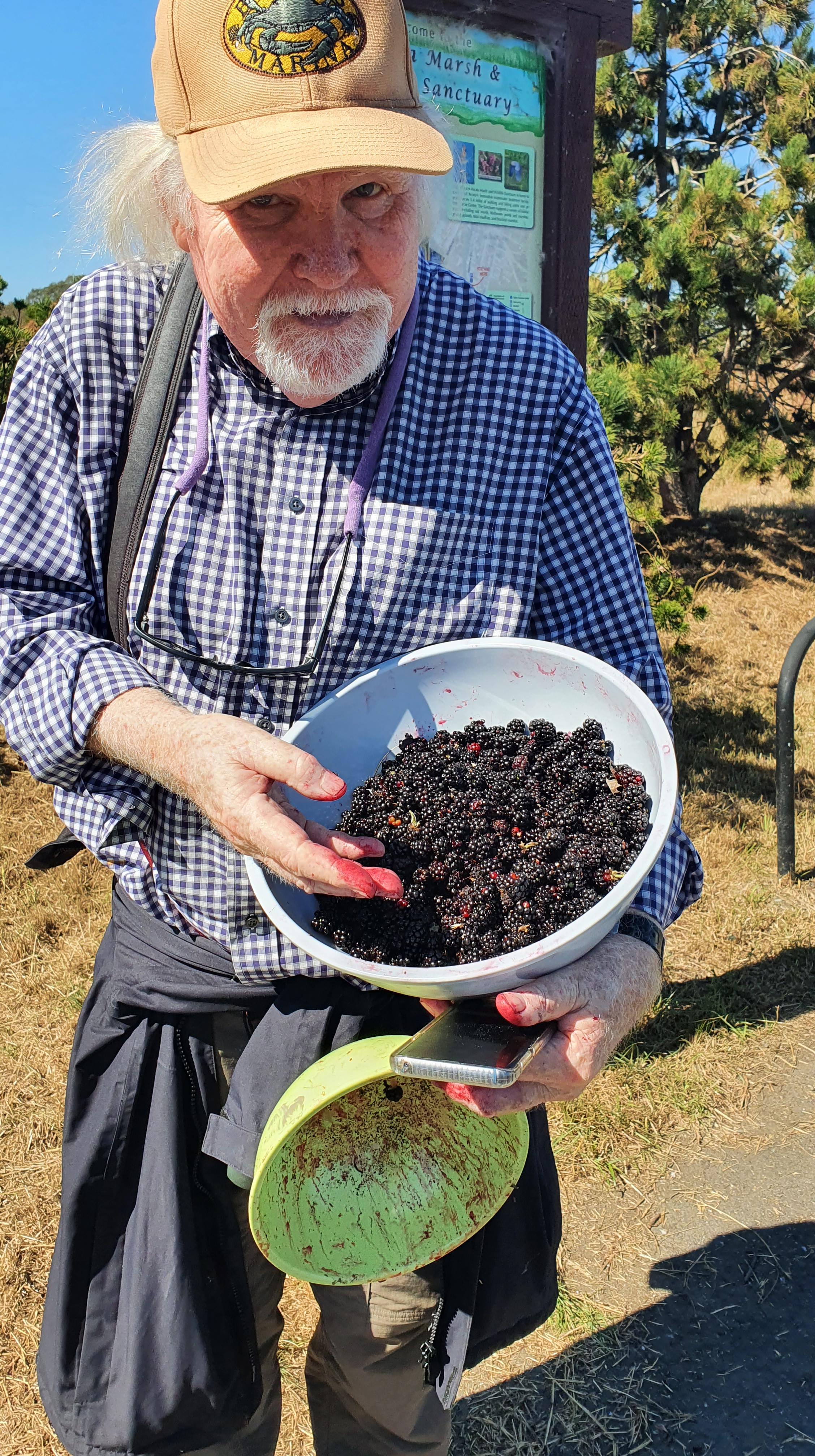
Himalayan blackberries are an aggressive invasive plant found all over the world. We’ve picked them in many places, and stopped at the Arcata Marsh to get some this year. The berries are very seedy, but we’ve found that if you cook the berries briefly and put them through a sieve, most of the seeds can be removed. We picked several quarts in a half hour, then went home and processed the fruit. Jonathan made seedless blackberry jam, I made a custard pie topped with blackberry puree, and took the remaining puree and made blackberry sorbet!
Hawk, Fay Slough
We discovered an excellent trail when we went to pick up our car from the Toyota dealership, too. Called Fay Slough, it runs inland through fields bordered with blackberries and pussy willow trees. We saw a hawk and a kite along with smaller birds, and marveled that such a fine trail was tucked in just off the highway. What is Eureka today was an extensive coastal marsh in the early 19th century when ambitious loggers arrived in the area by steamer. A century and a half of draining and filling turned the swamp into the town and surrounding pastures. Today, cattle are being removed from some of this land and coastal wetlands restored. Wetlands are a crucially important buffer for climate change in this area, providing a place for increasingly heavy rains to run off, rather than flooding streets and homes.
Not all our explorations are just the two of us discovering our surroundings. We joined the local Audubon group and went on a Sunday drive/walk to Titlow Hill Rd. As always, Audubon groups include people with remarkable ability to recognize birds by their chirps and calls. We saw very few actual birds, but the view out over the valley was spectacular.
View from Titlow Hill Rd.
Back from our walks, we finished out the month by attending the first concert of the year by the Eureka Symphony, directed by Carol Jacobson. The theater is relatively small, and the ticket prices are modest compared to Chicago and New York. We had excellent seats and enjoyed the program (Glière and Beethoven). I’m looking forward to their next concert in December.
It was a busy month, not all moving and organizing, and there’s more to come.
When we planned to move our storage unit to California, we agreed that we were in no hurry for our cargo to arrive. The window for delivery ended up being more than two weeks, which we attributed to the relatively remote location of Humboldt County, CA. We were surprised to be notified that our goods would arrive on the earliest possible date,` Monday Sept. 26, 2022, just one week after it was picked up from Carol Stream, IL. For me, the planning and arranging seemed to take ages. I was away from home, caught Covid, and had to sit tight for almost two weeks. Once our things were loaded, it seemed like they arrived in the snap of a finger.
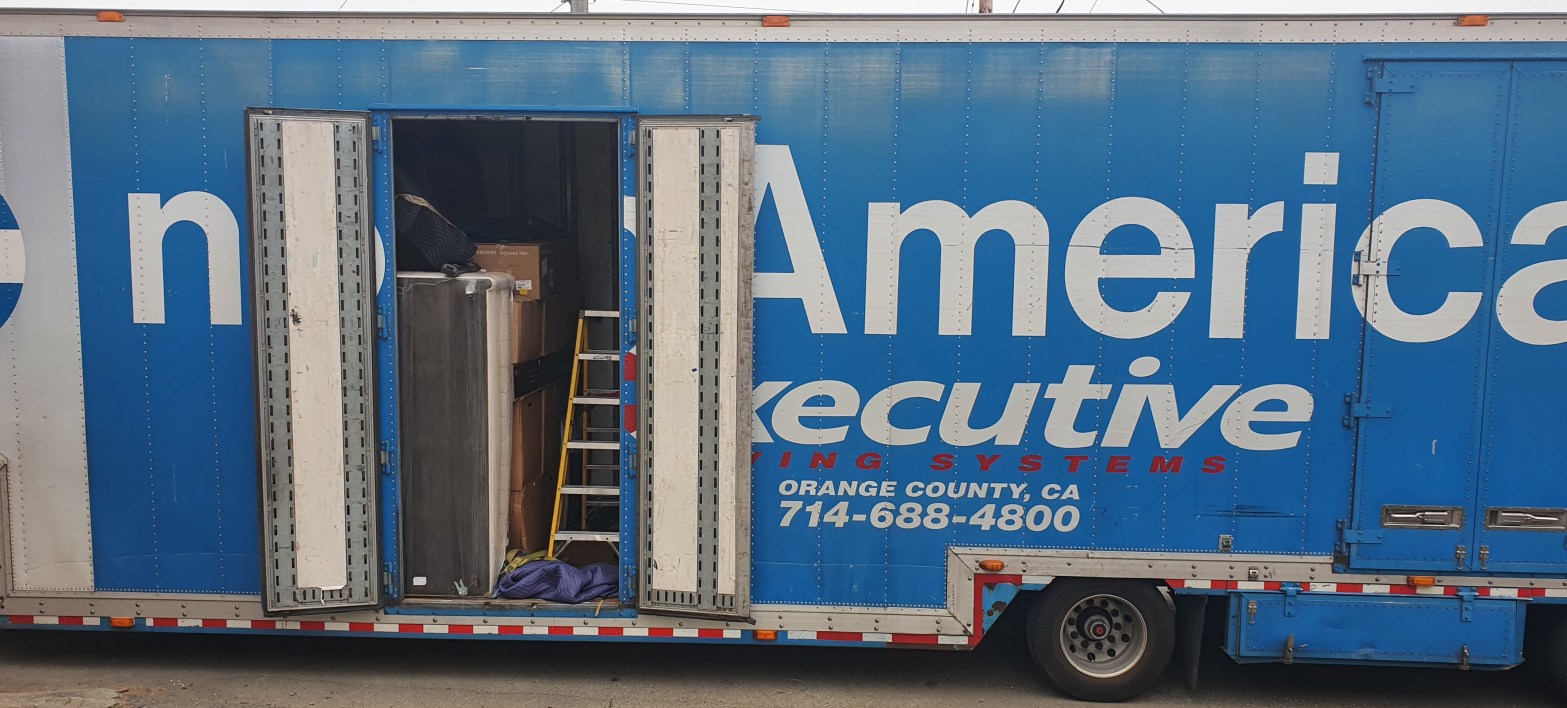
Our cargo floor to ceiling in a tiny slice of the huge van.
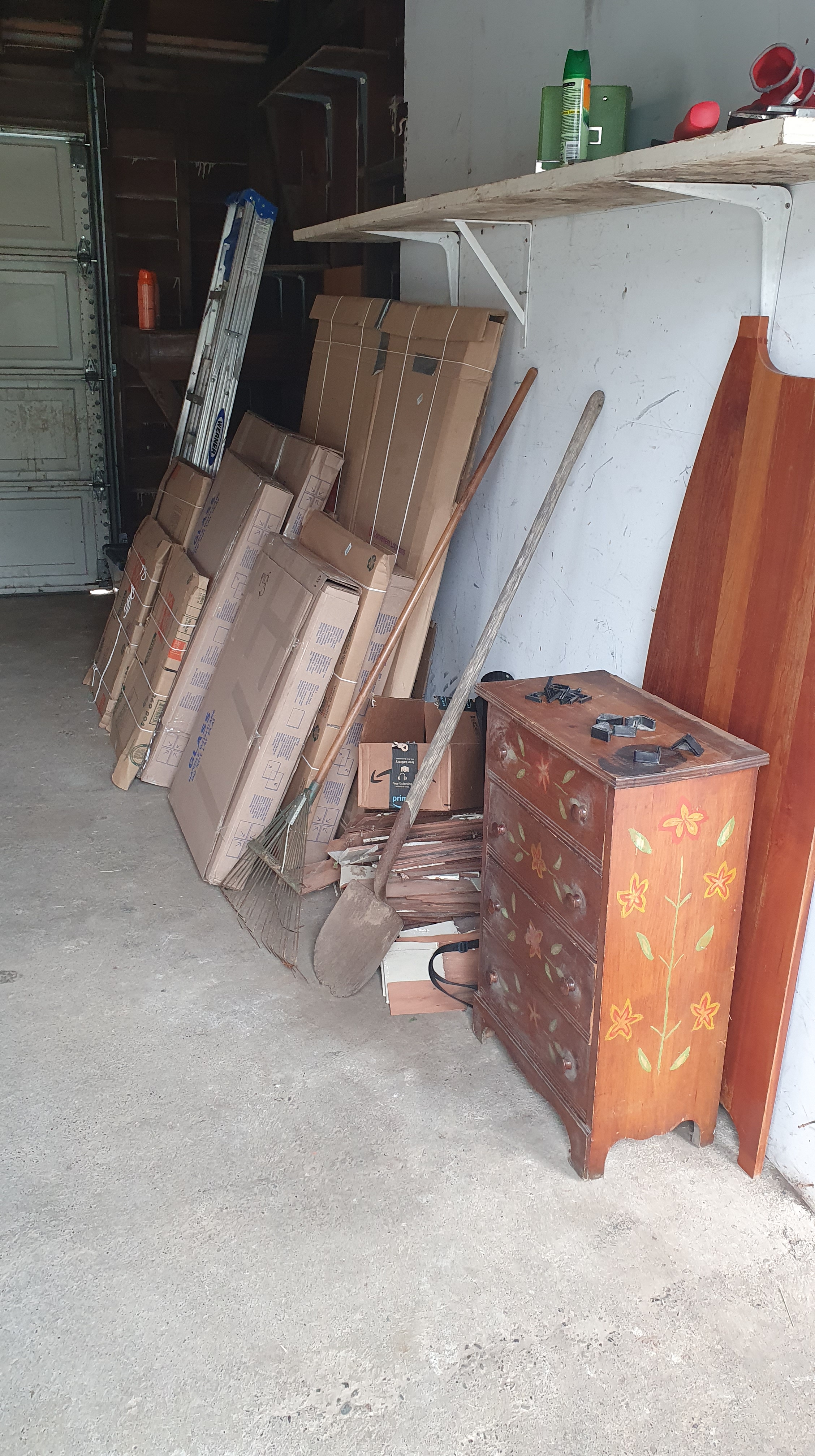
Our driver, Ralph (probably Rafael), arrived at 9 am Monday morning with two assistants. After looking over the possibilities, he pulled the immense moving van (over 70 ft long) across the end of our alley, and the guys hauled our boxes to the garage, avoiding the stairs between the street and the front door. It took about a half hour just for them to maneuver the contents inside the van to extract our boxes. From that point, the delivery went rapidly. By noon, all the boxes were piled in our garage, and the storage shelves disassembled by the packers in Illinois were put back together.
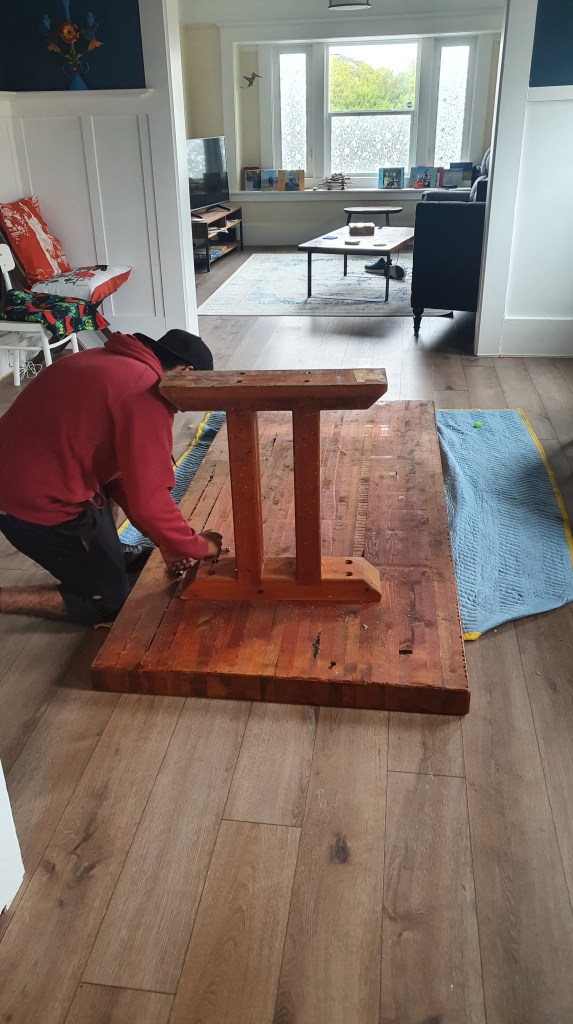
To get the table into the house, the legs had to be removed.
Everyone was pleasant and helpful, and we got to chatting in Spanish. Two of the truckers were born and raised in California. The third, Anthony, was from Chile, so we spent a few minutes discussing our favorite places in Chile, and comparing notes on the differences in vocabulary between South America and North America.
When everything was unloaded, all the inventory tags matched entries on the list, meaning nothing was lost. Nothing was broken, either, a minor miracle. The movers got our dining table through the narrow door, and reconstructed the storage shelves that were disassembled for the journey. By noon, the project was done and the giant van pulled away from the curb. The crew had a very long drive, as vehicles over 40 ft. long are not permitted on Highway 101–they can’t get by the redwood trees! Our driver was heading through the mountains to Redding, to pick up the freeway south toward their next stop outside San Jose.
We began to sort boxes, putting books, papers, and photos on the reassembled shelves, and opening boxes of clothing, memorabilia, and artwork, and carrying things into the house. We took a break for lunch, but couldn’t resist continuing to unpack boxes for the rest of the afternoon. By the time I set down my box cutter for the day it was almost six pm, and I had enjoyed seeing items that hold memories of our years in the Southwest US as well as Peru, and all our travels. It was like a constant stream of Christmas stockings to open, each one full of surprises.
Despite losing a week to Covid, I was able to carry out my mission to the midwest, by getting the contents of our storage unit moved from the Chicago area to Eureka, CA. We’ve had the storage unit since we decided to sell our house in Wheaton, early in 2014. We filled it with items we didn’t need during staging, then emptied it out for our estate sale, then we filled it with the items we wanted to keep while we traveled.
Storage unit contents
Eight years later, we are ready to get rid of the storage unit. The price has crept up and up. We already knew that the value of the items stored in the unit would never equal the money we paid to keep them, but some things have sentimental value. Now that it costs over $200/mo for a 10 x 15 ft. space, though, we will both be relieved to be done with it.
We were a bit concerned about getting access to our storage unit, when the key we left with Peggy didn’t work. I arrived with the one remaining key that might work, and it did, so there was no added drama or need to cut the lock. We’ve been visiting the storage locker a couple of times a year, and we have a general idea of what is in it, but it has also accumulated a deep layer of dust and some lumpy pieces of insulation that seems to have been blown into the roof of these units. It appears to be harmless, just a bit messy.
I met with a “relocation specialist” from our mover, and found that this is the person who negotiates what the client wants: packing, shipping, storage, immediate vs. delayed pick-up, immediate vs. delayed delivery, all the options. Our specialist, Lee, looked over the unit, took photos and video, and discussed the fact that we wanted some fragile items packed by them. Our conversation was straightforward, and the visit was brief.
Lee did a good job of follow-up and that proved important. We followed up with her when the estimate didn’t turn up as scheduled, and she got it to us. Then when we accepted the bid we didn’t get the contract. Lee found out that the office manager she hands her work off to was out sick. She got someone else to send us the paper work. Once that was lined up we got a date for pickup, and again Lee was the person who confirmed the dates.
Movers setting up for the packing job
In the meantime, I had Covid and recovered and then still had a couple of days left over before pickup of our items. I visited the storage unit and by taking a bit of Benadryl and wearing a face mask, I began to sweep and dust the boxes I could reach. Cleaning is not required, but the movers don’t clean anything, they just pack. I figured it would benefit all of us to have a bit less dust on everything. I couldn’t reach it all, there was plenty left on moving day.
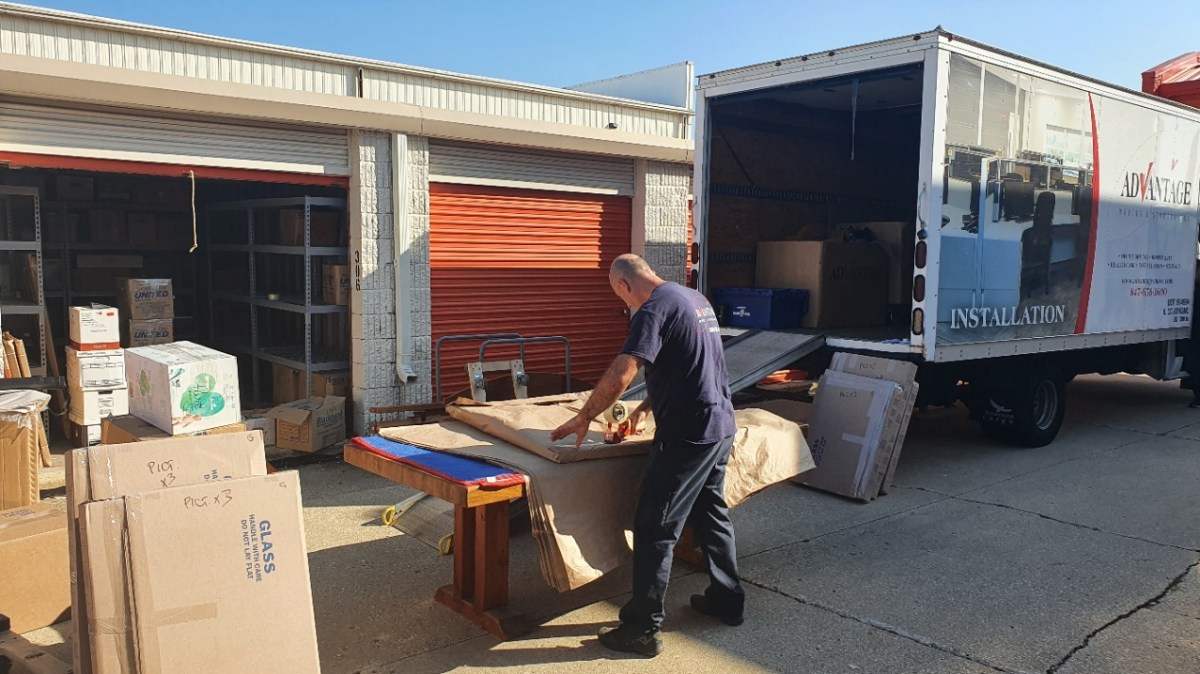
On Monday morning right at 8 am, the two movers arrived at the storage unit. I let them in and watched while they set up. After getting to work and making sure we agreed on what they’d be packing, I left them to it for an hour and went home for coffee. By the time I returned, the packing was well under way. I dozed in the car while they finished up, all done exactly three hours after they arrived.
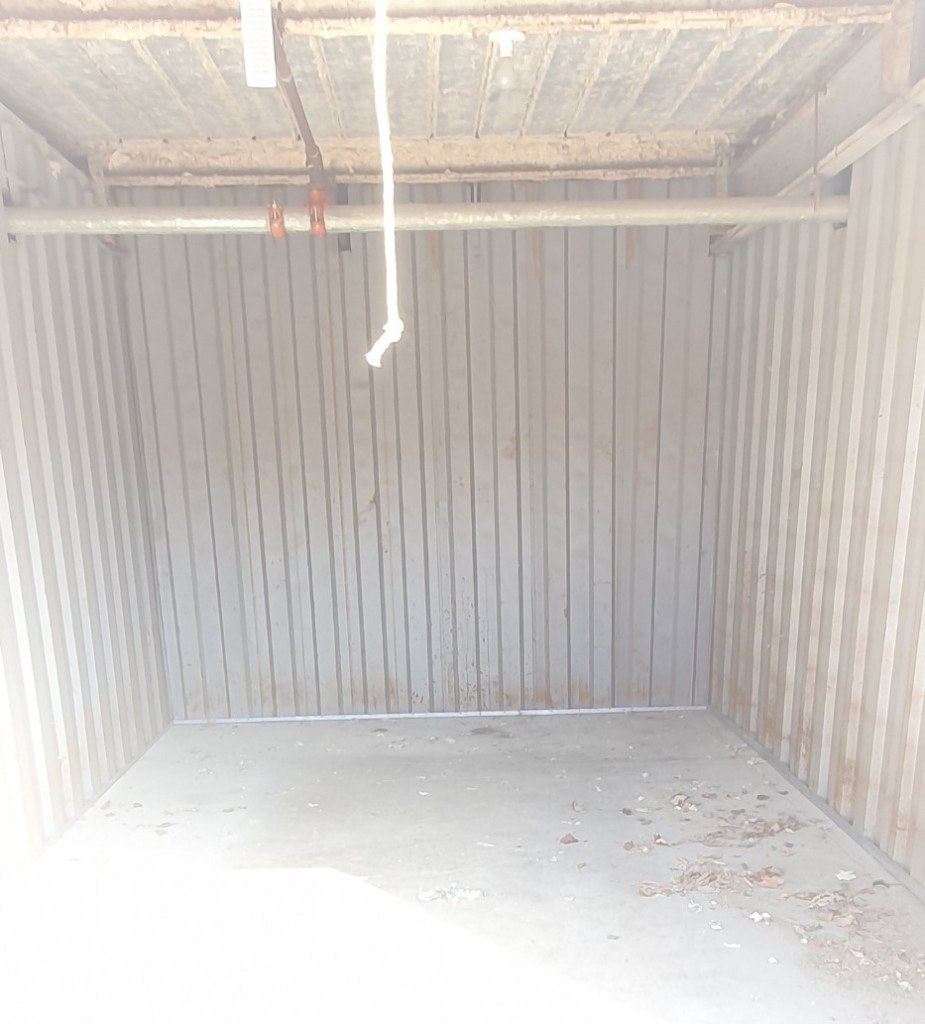
I left a few dried leaves for the clean-up crew.
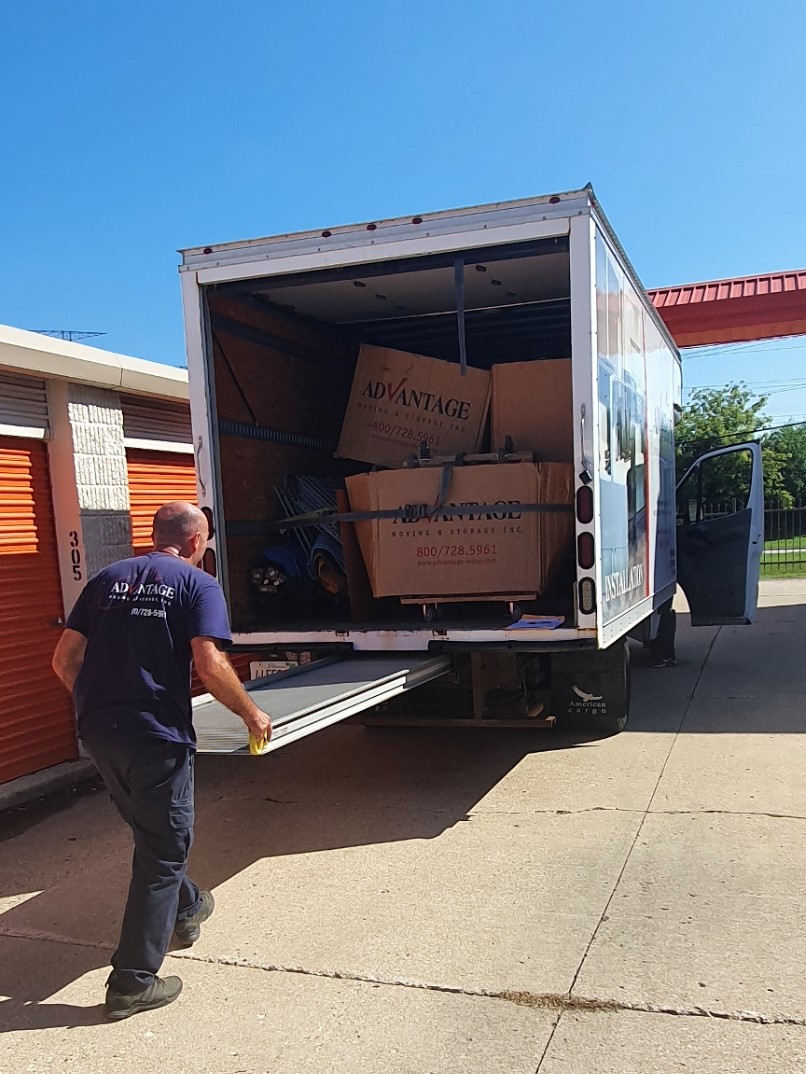
I signed paperwork, and the lead packer advised me to check the inventory carefully when it arrived. He pointed out that our goods were picked up in one truck, and would be transferred to another, and perhaps another after that, and the risk of leaving something behind increases every time the load is moved from one vehicle to another. Now we wait and see how long it takes for our collection to cross the US, and what shape it is in when it arrives in Eureka. We agreed to a very flexible delivery date, figuring it would help with price and scheduling. After all, Eureka is not a major city on the west coast… The packer whistled at the 16 day window for delivery. Fortunately, it doesn’t matter to us.
Arriving on Peggy’s on a Tuesday evening, I was already infectious with Covid, though I didn’t know it. I was there to tackle our storage unit and getting it moved west. The next day we had lunch on the outdoor terrace of a local restaurant, and went to our AAUW branch meeting in the evening. The following morning, on my way home from meeting with a mover’s rep at our unit, I noticed a funny feeling in my chest. That afternoon I took a Covid test, and it was positive.
I felt progressively worse for the rest of the day, my nose ran, my eyes were puffy, I felt feverish and congested. I went to bed. With nothing to do for the five days until I could test again, I rested. Fortunately, Peggy wasn’t sick, and plied me with food and drink. She notified our branch president of my illness. No word yet on who may have become ill.
At the end of my second full day of quarantine, Peggy woke up with Covid. She was hoarse, coughing, and felt sick. She went back to bed. Every day a different symptom has come and gone. Stuffiness, headache, runny nose, chest tightness. On day four I still have some sore throat and cough, but even those are abating. We spend each day alternating between reading in bed and reading in Peggy’s two recliners, one on each side of the living room. In the evening, we watch a movie, before trying to sleep. Having slept most of a rainy Sunday, I laid awake late into the night. Being awake when you want to be asleep is boring, annoying, and uncomfortable. Ask any insomniac.
Our Covid houseparty continues. Tomorrow afternoon I can test, and see whether my infectious phase is over. Fingers crossed my test will be negative.
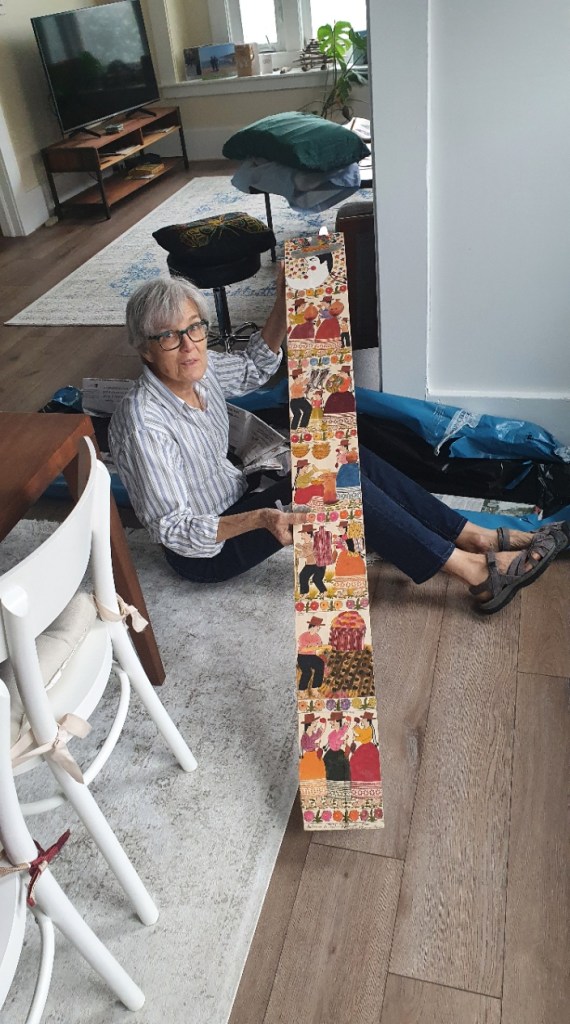
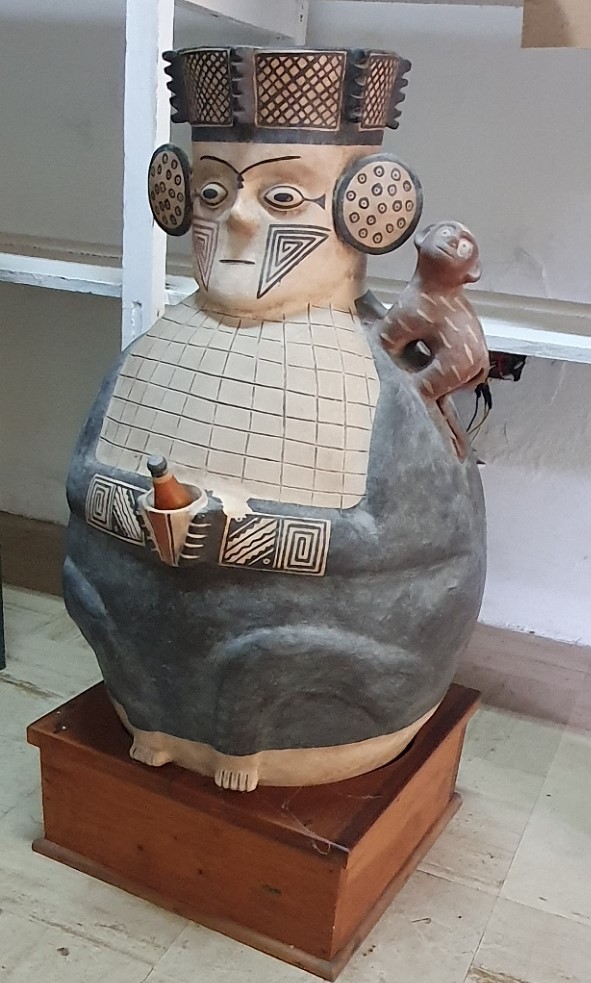
We arrived in San Francisco, CA from Peru with four suitcases and a package holding three decorated boards from Sarhua that we brought with us as oversized/extra luggage. Though the surcharge is a lot (aprox. $235), it is far less than ground shipping. Airlines have pretty strict rules about extra baggage even with the stiff charges, and they will not accept anything that is over 115 inches (L x W x H). This limit excludes our favorite painting and our largest effigy pot. I think we will have to manage without them.
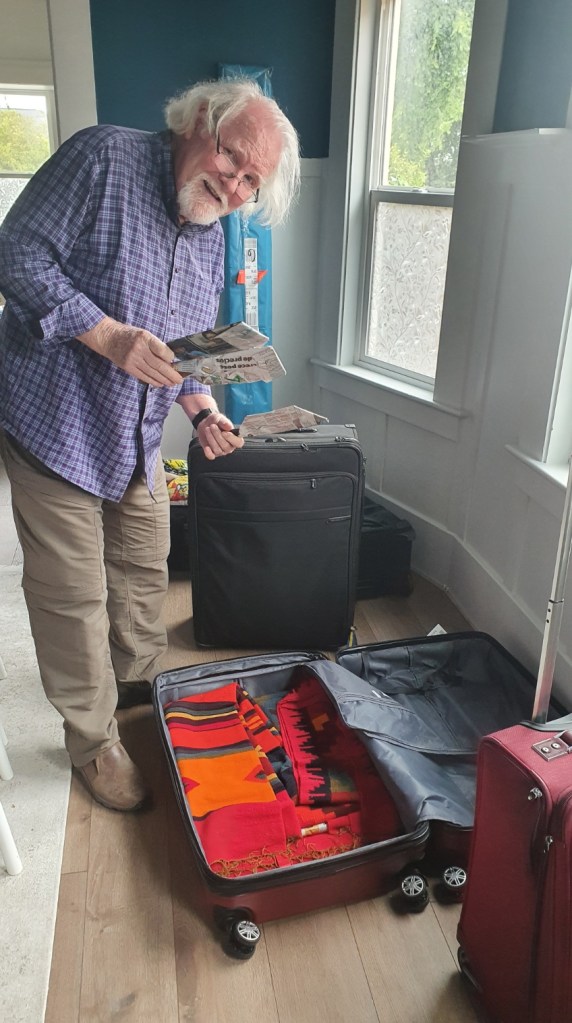
Jonathan unpacking his knives while I unwrap our Sarhua boards.
Regional airlines, even those affiliated with the largest companies, do not have to accept extra luggage, and generally refuse third checked bags (despite the fact that the airlines claim it is possible to check up to ten additional bags!). For that reason we disembarked in San Francisco and rented a car for the rest of our trip home. We do not yet own a car, and decided to keep the rental for a week in hopes of finding a Prius to purchase. All our luggage made it onto and off our flights, and safely into our large vehicle. We saw that TSA opened the package of painted boards, but taped it up thoroughly afterward.
We stayed overnight in the San Francisco area, though we were driving across the Golden Gate bridge in thick fog the next morning at 10 am. We arrived in Eureka by mid-afternoon. It felt good to walk in the door and have familiar things around us rather than another empty Airbnb. We enjoyed opening our bags and pulling out the useful and quirky things that we packed in them, setting objects around the house. By the end of the week, all was unpacked and more rearranging had taken place. There is still a “To Do” list–but isn’t there always?
I began to notice a kind of reverse culture shock. Some of the zoning, or lack thereof, in Eureka, reminds me of the beach in Peru, where ramshackle and upscale sit cheek by jowl, though the truck with two flat front tires parked in front of our house has been repaired over the past six weeks in Eureka. It’s parked in the same spot, but now it also drives around.
We find ourselves comparing things to Peru, some positive (the beach here is cleaner), some negative (the cost of food at the market is much higher). Ironically, the weather is similar, 60s and overcast with heavy fog/light rain.
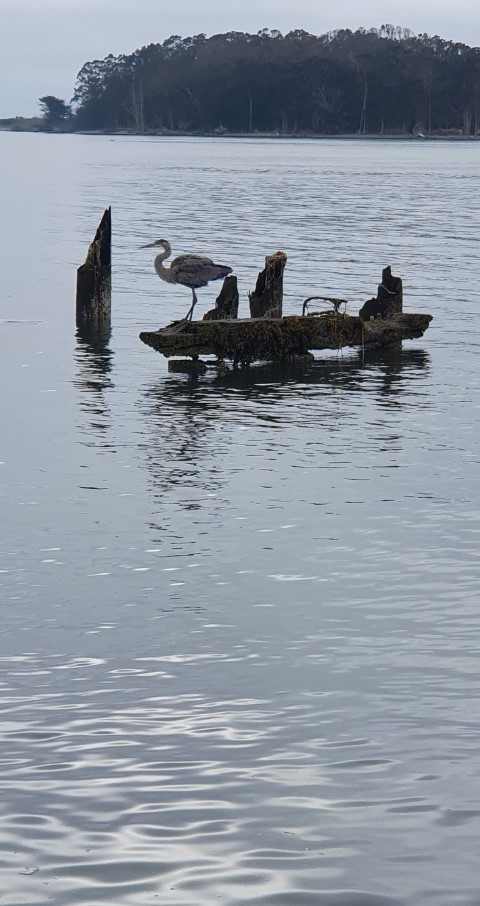
Top and L: Humboldt Bay; Bottom: Barranca, Peru
There are some sunny days now in Eureka because it is summer. When it gets to be summer in Peru, the days will be much hotter and sunnier. I have to remember we live in Eureka to avoid 100+ heat and extreme drought.
There are thrift shops and garage sales in the US, making it easy to find things we need until the contents of our storage unit arrive. In Peru, if you want something specific, you probably can’t get it, though you can usually make do. In the US, there’s Amazon, and you can have anything, any time. That’s a bit scary.
I think about little things: I guess I don’t need to carry my passport everywhere with me. Where should I store it? I can set up a home workshop for my jewelry-making: what should it look like? Do I need more tools, a dust extractor, a desk?
One of the nice things about Eureka that it shares with Barranca, is the range of people we see. Our neighbors in Peru included hacienda managers, artists, bakers, teachers, restaurant owners, taxi drivers, surfing instructors, along with families that ride the bus down from the hills on market day, wearing their best outfits, complete with women in hats encircled with plastic flowers, a signal of where they come from (the town of Pararin).
Eureka has entrepreneurs, journalists, glassblowers, artists of all sorts, lots of people with tattoos, lots of unhoused people who camp wherever they can, college students, and people with regular jobs, like ranchers, lawyers, doctors, and water quality specialists. We like the diversity of people.
Right now, I have no one to speak Spanish with. In the US, Spanish speakers are sometimes insulted to be spoken to in Spanish. If they don’t speak any English it’s ok, but how can I tell? My elderly friends in Peru don’t use much internet, and their postal service is broken. I need to figure out how to send them messages. I’ll work on my Whatsapp skills.
Little by little, we’ll settle in and get used to our new town.
We’re heading back to the US after what is probably our penultimate trip to Peru. Somehow twenty years has gone by since we settled in the beachside neighborhood of Barranca. As we leave, I hold on to my memories and stories from the neighborhood.
When we first visited, the house had been empty for three years. It was owned by San Antonio, a big fish processing company in nearby Supe, as a residence for the plant manager. After a number of years in the house, the manager’s family moved to Lima for the children to attend high school, and the manager decided to live in an apartment close to the plant. We believe he imagined moving back into the house when he retired, so it sat empty. When we visited, it seemed the caretaker rarely entered the front rooms. They were dark and empty, with a single light bulb dangling from a cord in the center of each room. From the almost palpable gloom, he invited us to the back yard, where we stood blinking. It was full of palm trees, flowers, and birds. He told us there had been three full-time gardeners.
During the early days, when the house was still largely empty, Fernando, the caretaker, asked whether we were afraid of ghosts, as the ghost of a small woman dressed in white appeared in one of the front rooms. We dismissed the idea, but the story stuck, and once we had enough beds made and blankets purchased, our field crew moved in and we got to work. Back from our field site one afternoon, the three young men who slept in the front corner room rushed out. One of them felt the ghost!
He laid down for a short nap, and after a while someone sat down beside him. He assumed it was one of his roommates, and heard some low murmuring, but couldn’t understand what was being said, so he opened his eyes, and…..No one was there! He was sure it was the ghost, and swore the mattress had compressed where the phantom sat. He took harassment ever after about it.
Humidity and Salt
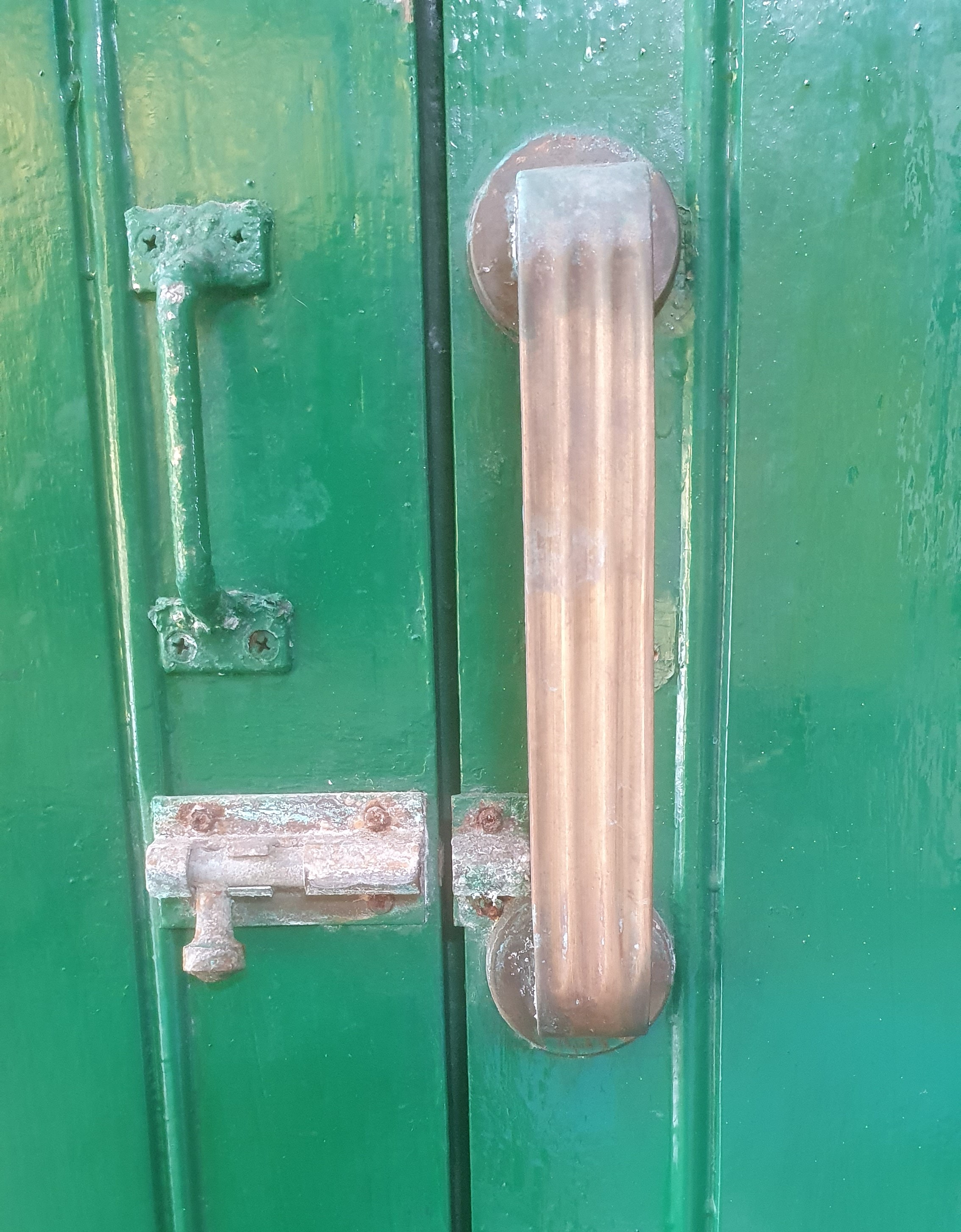
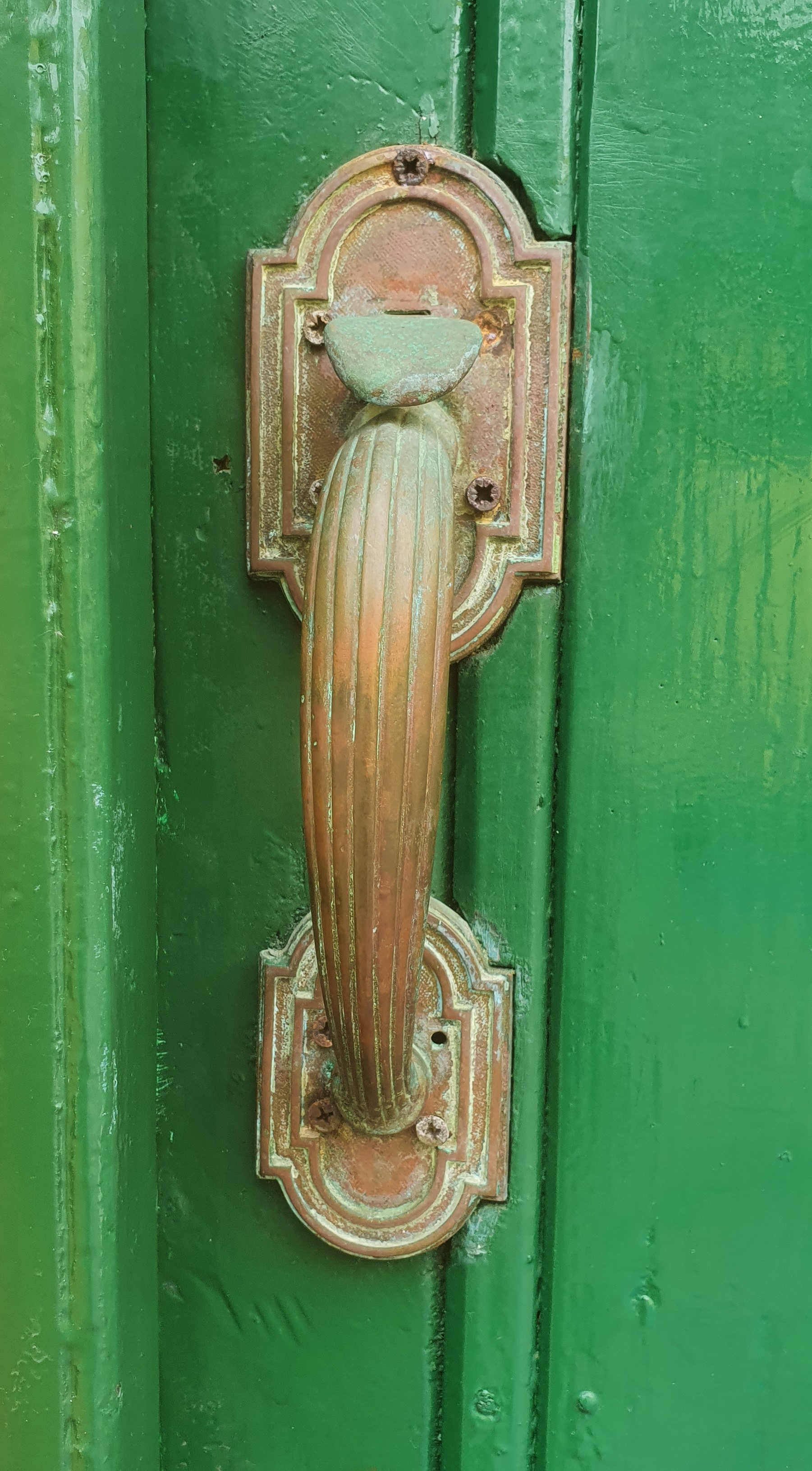
The sea breeze is blamed for everything. Plants that don’t grow, paint peels, doors stick, metal rusts. We learned that the best towel bars are wood, not chrome, that handles and hooks should be brass. Marine paint should be used whenever possible, with annual repainting of every surface.
[Years of garage sale finds of brass door handles and extravagant hooks. One is from a subway or train car, one pair comes from the door of a bank.]
Shrine of appliances
Our kitchen shrine of appliances
We seemed to need a new microwave and toaster oven every year. Somehow, they shorted out after just one season of use. It was quite frustrating, but we view a microwave and toaster as essential appliances. Finally, Dalmira, our housekeeper, explained that the humidity was ruining the appliances, and if we covered them with a towel when they were not in use, they would be protected. It seemed silly, but we tried it and–it worked! We now have a microwave that is a few years old. When it began to short out this year, Fernando took it apart, rinsed some of the wires with fresh water, put it back together and got it to work again. I was astonished. Rinsing wires in water? He says that salt accumulates on everything, and now I believe him.
Size and Shape
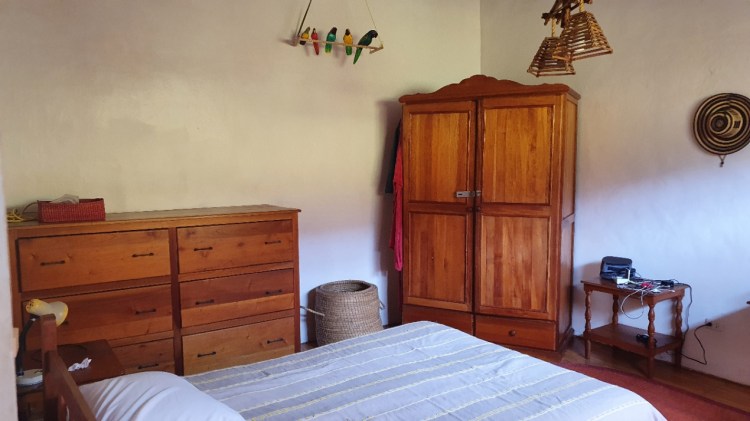
We’re selling our house furnished, in part because the dressers and closets were built for this place. There was a good carpenter, Arquinio, who took on the job of building all the pieces out of wood that wouldn’t get woodworm (cedar?). Jonathan made sketches and measurements. Everyone looked forward to the arrival of furniture. The beds had come first, and we were all tired of keeping our clothing in cardboard boxes or open suitcases on the floor of our rooms. Finally, the dressers began to turn up. They were so big! Everyone was happy to have space to store their clothing, and all were moved in. Next came the closets. A few rooms have built in closets, but they are small and damp, thus a free-standing armoire is very useful. As we moved them it, again they seemed bigger than expected, and when we got to the one for our room in the far corner of the house, it wouldn’t go through the door.
The closet that is firmly in place.
We wrestled the closet in various ways, but it couldn’t bend around the corner, so we took it out and tried coming in through the adjacent storage room. That almost worked. We removed the doorframe, and got the closet in at last. Jonathan could not understand how he could have mis-measured the dimensions, and got out his sketches and measured the finished pieces. The pieces were all equal-sized, but when he compared them to the drawings, he found they were all larger than the specifications. In frustration, he returned to Arquinio and asked how it was that all his furniture was built to different dimensions than those agreed upon. Arquinio shrugged and looked sheepish (very briefly) and said that he hated to waste the high quality wood. Rather than cutting off the boards, he made everything a bit bigger. He was doing us a favor.
Wrangling the refrigerator
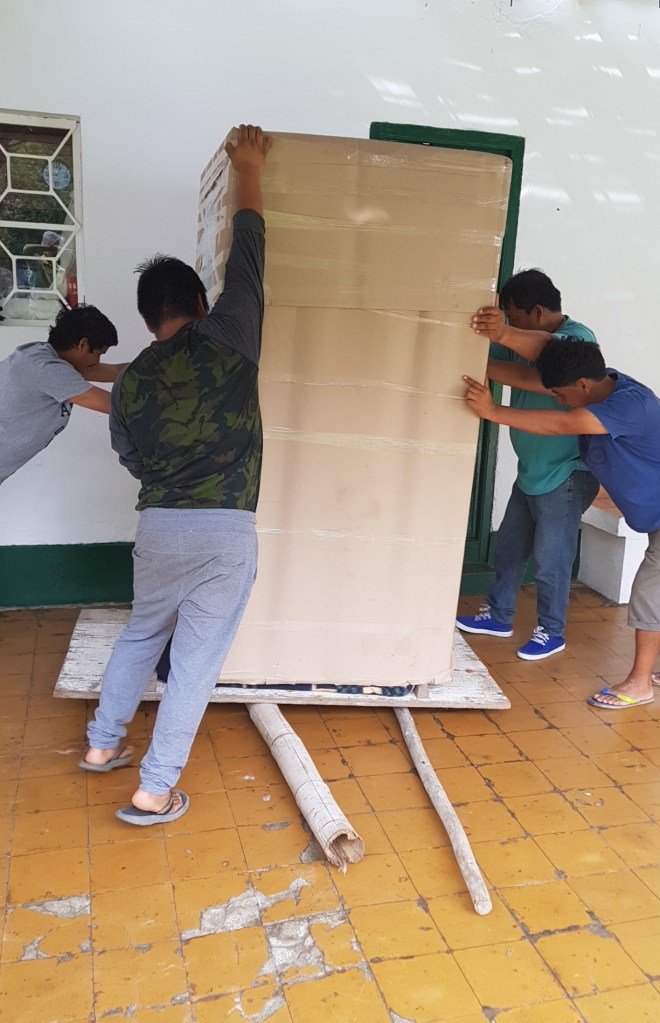
We had to replace our refrigerator after the time we unplugged it, thawed, cleaned, and dried it out between seasons. The wiring all deteriorated from rust or salt. In subsequent years we left the refrigerator running at all times, and that seems to make them last longer. Still, a few years ago we had to purchase a new refrigerator. There is not a lot of choice, and there is usually only one of each model in stock. We found a floor model that was large enough, a few minor dents, but nothing to be concerned about, and we brought it home, only to find that it would not fit into the kitchen through either door or the windows. Returns aren’t generally a thing in Peru, so we were stuck. A lot of measuring revealed that if we removed the door frame, the fridge would fit through. At that time, one section of the door frame was in poor condition, and that decided it. Fernando and Carlos removed the decayed half of the door frame, the fridge was moved in and a carpenter came and replaced one side of the frame. Once plastered and painted, the door was better than before.
That was good for a few years, but we’ve begun to have trouble with the fridge not staying cold. Fernando called a repairman, who after visiting and assessing the situation, said he could repair our fridge in his shop, but would need to take it there. This is a huge appliance, and initially he said he’d tie it to his motorcycle, a laughable image. We finally agreed and went to take the fridge out, which is when Fernando remembered what it had taken to get it in. After much conversation, the repairman agreed to a repair in place, and eventually it was fixed. I’m not sure what will happen when it reaches the end of the line.
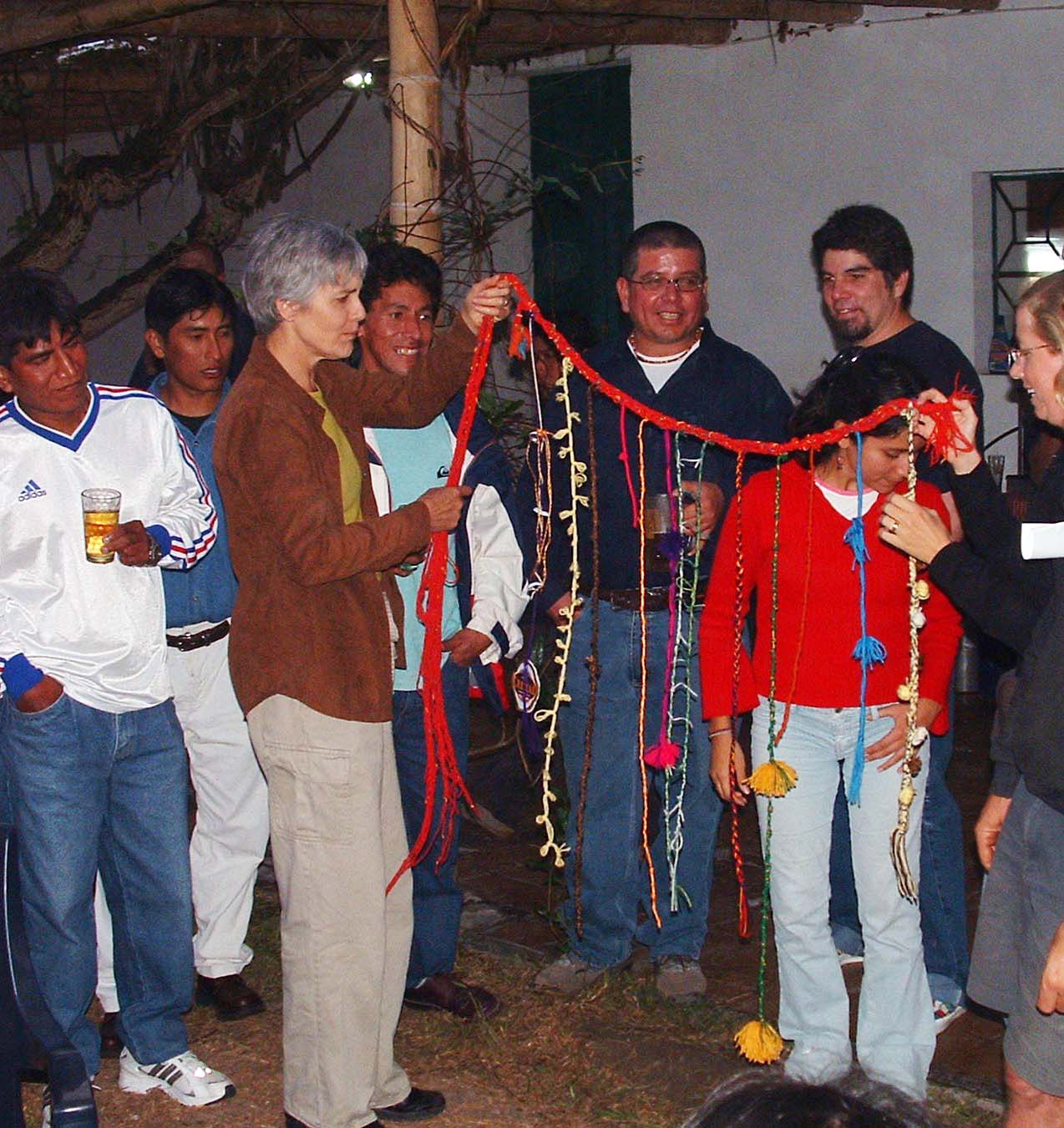
It hasn’t all been repairs. There have been some sensational parties. During our field work, we held an annual pachamanca, where food is cooked over heated rocks. By the time we invited all the crew, our workmen and their families, and our neighbors, there were up to 50 people at the peak moments. One year, our neighbor Gaim brought in a band, and insisted that Jonathan and I have a dance. Other years we put up marquees, and yet another time the students created a “quipu” that recorded all the food, each in a different color or type of yarn or number of knots.
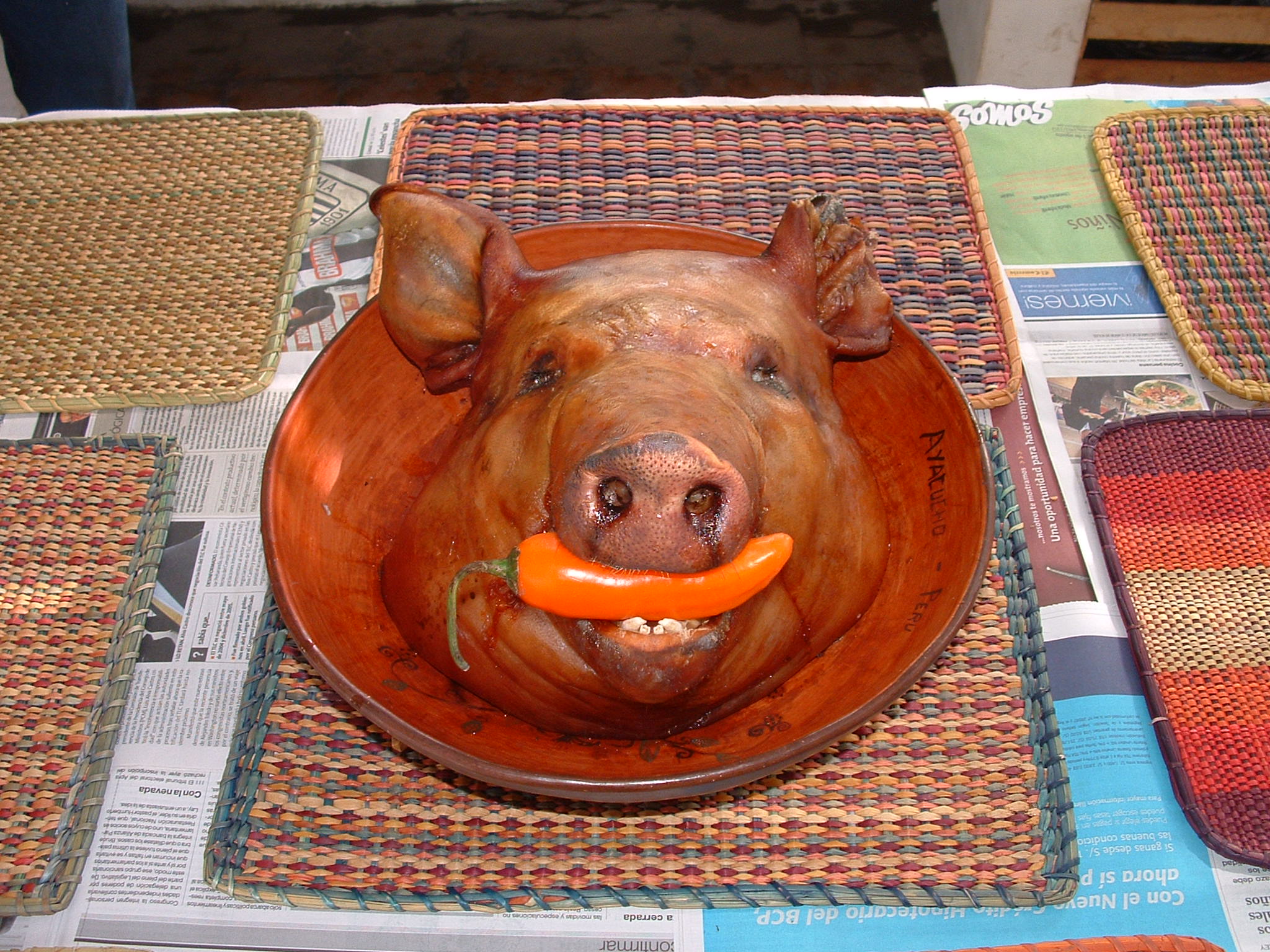
There have been some lovely holiday parties with our daughters and our neighbors’ families. For New Years Eve everyone cooked a dish to share, and son-in-law Neil’s brussels sprouts converted me to actually eating them. Our other son-in-law, Jim, made a Serbian dish popular with his relatives that was a kind of polenta with lots of cheese and cream. (We fought over the leftovers.) Jonathan roasted pigs, I made cake, and everyone celebrated. It is a house full of happy memories.
On our previous trip to Peru in January, we contacted a shipping company to move some of our favorite objects, mostly traditional Peruvian crafts, to the US. We asked for a quote on shipping to Chicago, and were startled to find the cost would be over $4,000. We set that plan aside, and returned to the US in February with full suitcases. By June, we’d decided to move to Eureka, CA, and reconsidered shipping. We’d be near a coast, perhaps lowering the cost a bit (less trucking from a port). Perhaps we could move our treasures, after all.
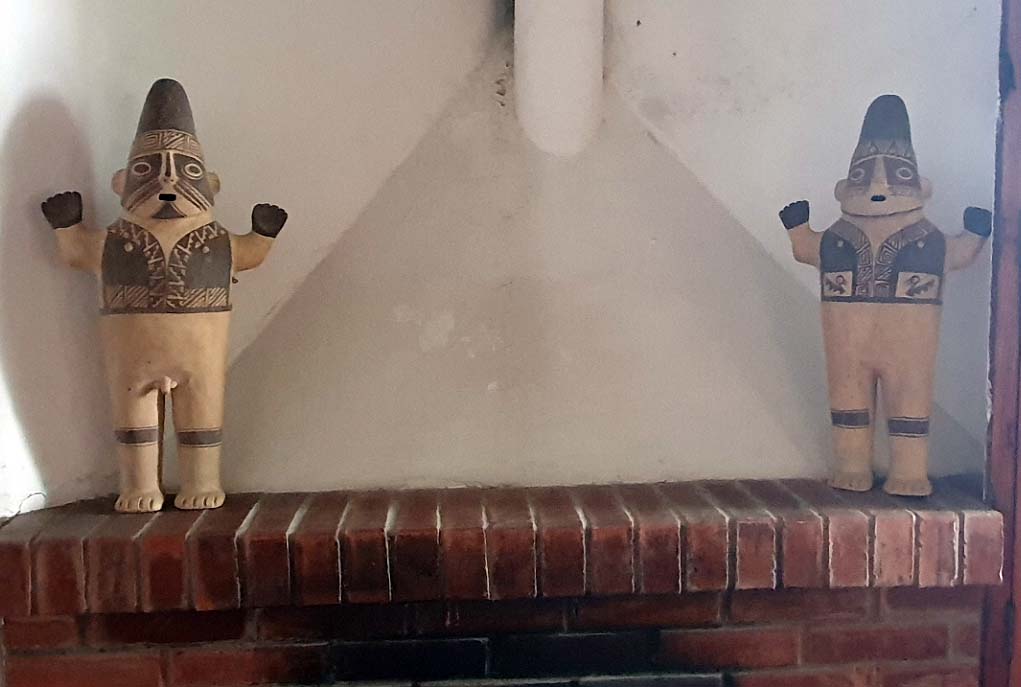
Two replica Chancay figurines on the fireplace mantel.
Now that we have been in Peru for a month and we have found a good real estate agent, we are beginning to plan our return to California, so we contacted the shipping company again and asked for a quote. We sent the same file of photos, and an updated inventory, with our new address in Eureka as the destination. The woman Jonathan spoke to put him off, explaining how busy they are, but promised to get us an estimate by the end of this week.
Replica Chancay figurine, purchased at Larcomar around 2004.
You may recall that the war in Ukraine began Feb. 20, 2022, and that could have changed shipping costs. It did, and when our estimate arrived on Friday afternoon, it was four times the cost quoted in early February. It’s only money, yes, but there’s a limit. We now plan to return to the US with as much as we can pack in our suitcases once again. We’re still looking for a way to take a couple of oversized items. On the other hand, we have wonderful memories of Barranca, and the objects are not central to our well-being.
There is a pair of figures, man and woman, typical of the Chancay region, and a large pot of a man wearing a headdress and earspools, with a monkey on his shoulder, holding a cup. A joker put the little gourd of lime for chewing coca in the cup years ago.
Painting of Barranca beach community by Del Nino Ladron (Jose Humberto Guevara Hurtado) that we commissioned around 2005
We met the painter Jose Humberto Guevara Hurtado in Parque Kennedy, Miraflores, Lima, years ago, when painters set up their easels and work for sale around the sides of the park on Sunday afternoons. We were intrigued by his satirical paintings and over the course of several visits, asked whether he would consider doing a painting for us. He agreed, and spent two or three weekends in Barranca sketching and taking photos. The resulting painting is very large–he said it got away from him. There are a few satirical touches you can find, including the sign “Toledo–Give Me Back My Vote!” that refers to a former president of Peru. These are some of the things that may be just too big to move with us.