Recycling is a mystery

Norway has a system for recycling food waste, paper, glass, metal, plastic packaging, other plastic and everything else (“residual waste”). Sounds great, doesn’t it? The resulting system is so complex that: a) after two weeks, I still don’t know what goes in the green-topped bin vs. the blue-topped bin, and b) it appears that most of our neighbors separate food from everything else and skip most recycling.

Mystery #1–Colors. There isn’t a place, including the multi-page recycling pamphlet in English, that tells you what the color codes are. I’m stumped partly because in Portugal there was a system (yellow, green, blue, battery box, dumpster) that I had figured out. Every home in Norway has four bins: blue, green, brown, black. However, either blue or green is paper and I’m not sure what goes in the other. Brown is food waste that goes in very fragile compostable bags that are provided, and all else goes in the black bin.

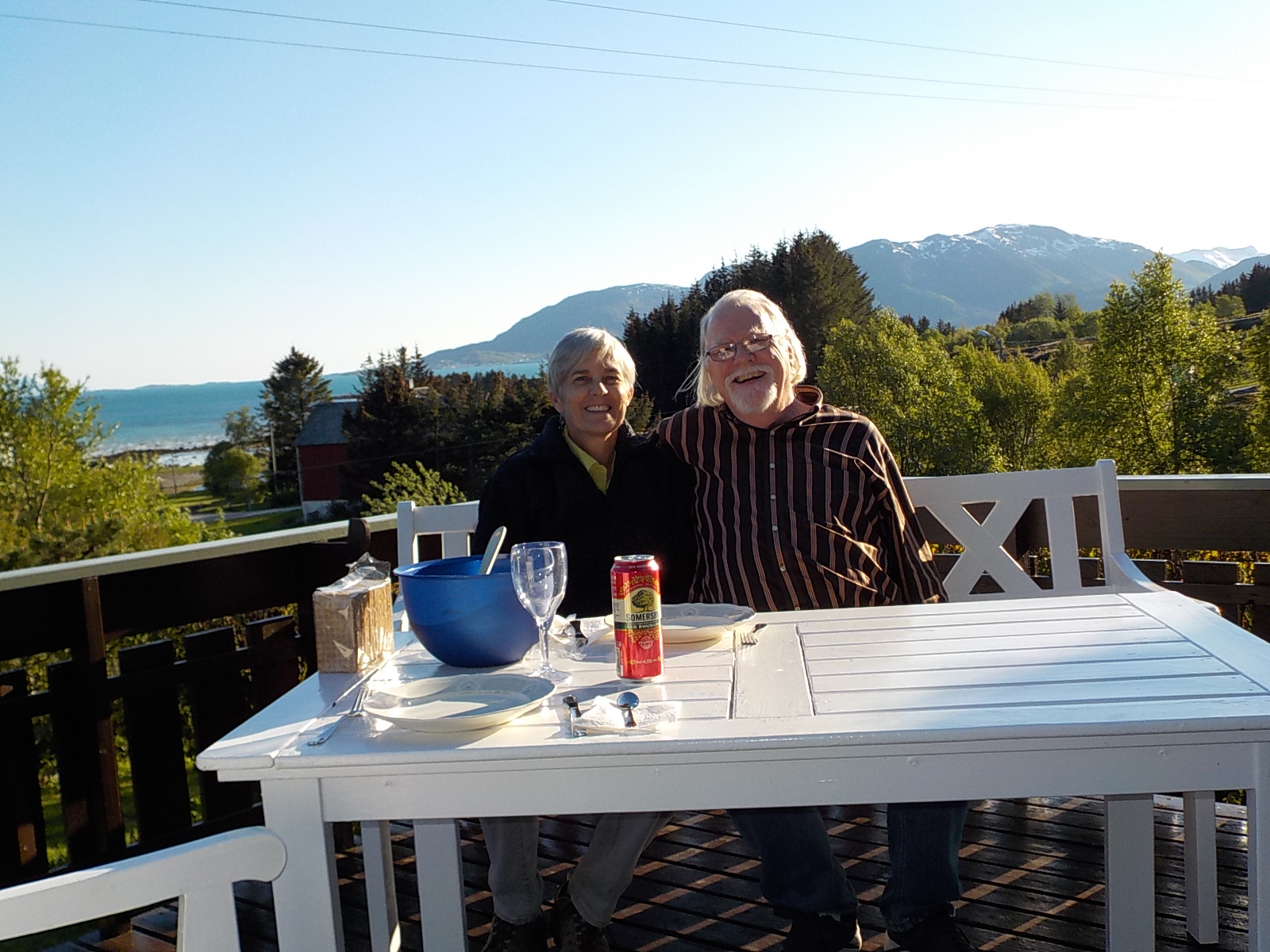
Note the cider can. It has a PANT pf 1.5 NOK.

Mystery #2–PANT. You are charged a deposit on most plastic and metal beverage containers. Marked on the exterior of the container is PANT 1Kr up to 2.50 Kr.

Note the cider can in the photo. It has a PANT pf 1.5 NOK (Norwegian Kronor).

You are instructed to rinse these containers and bring them to the store. I had some trouble finding the machine because it was inside the store in the beverage section. Perfectly logical except that recycling in the US is general done on the margins of the store. The machine takes and read each container. At the end it issues you a credit slip that can be applied to your shopping or redeemed. Not difficult other than the accumulating and rinsing and remembering to take to the store part. (Joke for Americans: How do you get a pair of pants in Norway? Answer: Have two beers.)

Mystery #3– Plastic. Plastic is divided into two groups, plastic packaging and other plastic. Packaging goes in a plastic bag that is put out weekly with your bins–but not in them. Problem: here the wind is usually blowing hard enough that the idea of leaving out a bag full of lightweight plastic is, well, a very bad idea. Other plastic is supposed to be taken somewhere and dropped off to be recycled, but I haven’t been able to figure out where that is. I haven’t found a bin at home or near the store. Right now, it’s just piling up.

I stopped collecting plastic from along the high tide line because it falls into the category that I don’t know how to recycle, such as this boot, rubber gloves, jerry cans and other fishing debris that gets washed off boats.

Mystery #4–Those other things. Having established that bottles/cans, food, paper, and some plastic can be recycled, what do you do with glass, non-PANT metal, and “other” plastic. There are supposed to be places to drop off these materials, but so far, see my previous comment.


I haven’t given up, but I’m starting to think that my neighbors who separate wet from dry and call it a day may be on to something. If you know what goes in the green or blue bins, please let me know!

History, arts and culture–if this is the result of high taxes, give me some.

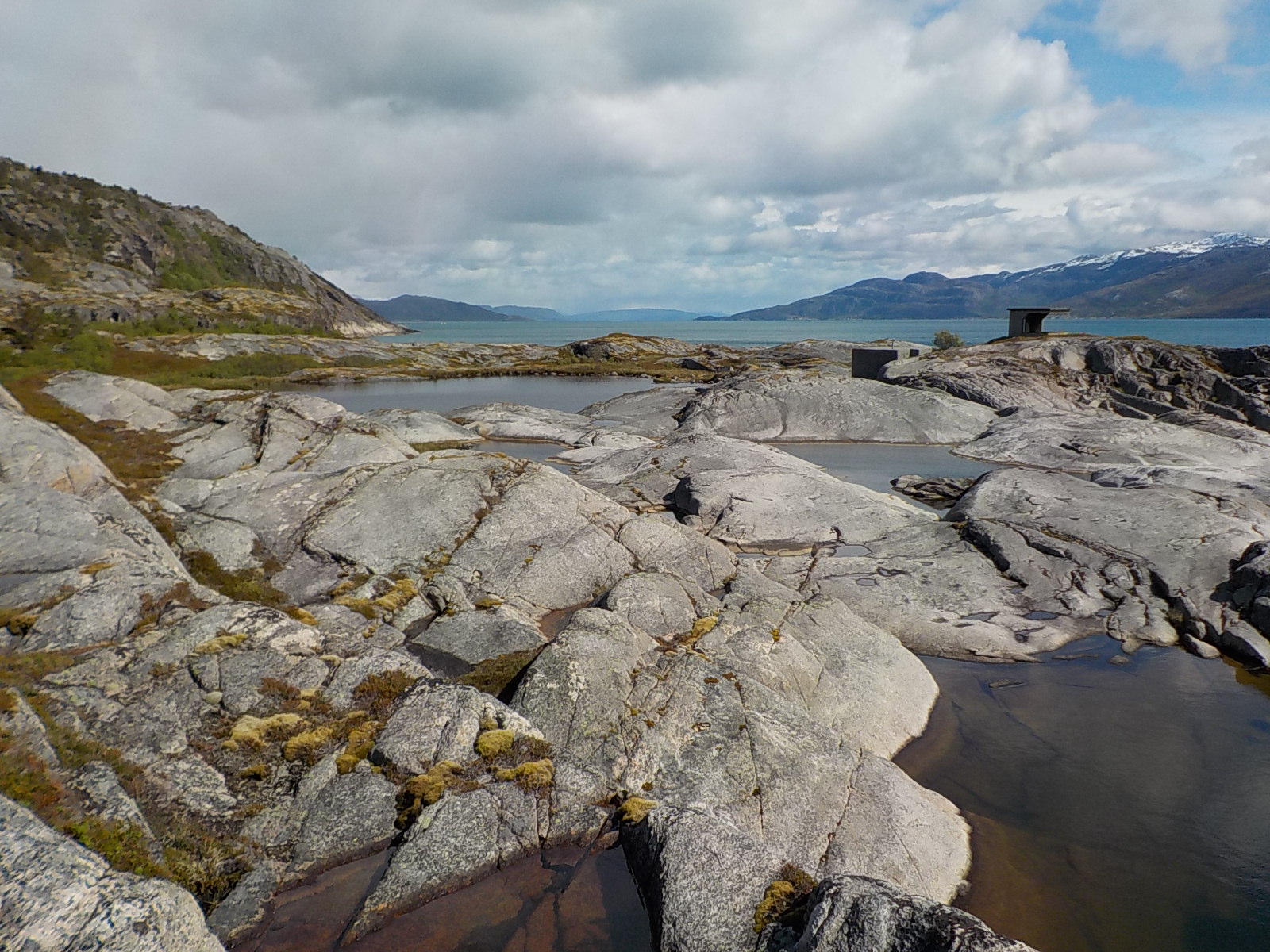
At the end of the road on Tjeldoya Island (and that is saying something) we parked, got out to fish and amid the ruined bunkers of the WWII Fort Tjeldodden we found Georg’s Plass, a picnic spot complete with tables, benches, fire pit, tripod and cooking vessel, dishes, cups and other supplies in a setting with a view over the water. You could have a barbecue for a big crowd here. All the supplies were in order and other than a few plastic cups in the fire pit and a stray coke bottle, it was orderly and without graffiti. One sign asks that users clean up after themselves.

0606161122sm

We were amazed. (See pictures in previous post.)


A few days later we visited an archaeological site from the Viking period and Middle Ages. Beyond the site along the shore was another attractive and well-furnished picnic area, again in perfect condition. Parking along the road and signs directed us.

Another day, we drove to the other end of the road on Tjeldoya (the road doesn’t complete a circle around the island, it’s too steep). We found a beach and rocks and two men camping and fishing from a canoe who had gotten cod and trout (“no salmon,” they said regretfully). We stopped at an area marked for “Parkering” with a sign, and found an article that we couldn’t translate, but we also found a path. We hiked up on the rocks for about 10 minutes and about when we were ready to turn back we found a small structure with big windows facing the ocean. Like fairy tale characters, we went inside.

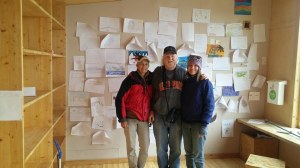
A bench and shelf lines the window, art supplies are provided (paper, colored pencils, watercolors) and the resulting works are pinned to the side walls. Periodically, the works are gathered up, placed in a binder, dated and filed on the back wall. It’s an ongoing art project. We saw artworks from just a day or two before our visit, going back to the opening of the place in 2006. Again, the door was unlocked, the place was in order–it was a respite from the cold and wind and encouraged you to draw and look out the window. In the picture below, you can tell which is by the art student (Jim).

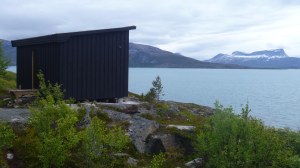
6.12.16 Mykelbostad Tjeldoya-024Back on our own side of the island, we went to investigate a hut at the Tjeldodden fort, (or possibly Fort Tjeldoya). Construction of this German fort began late in 1940 after the takeover of Narvik and all of Norway. It held up to 300 men and was occupied until at least 1944. (See Iron and War post coming up.) We thought the hut would be a view point over the remains of the fort. This is what we found:

We have now visited four of these sites. Three are historic sites set up for cooking/heating and numbers of visitors. The fourth is an art site. All are left unlocked and are unharmed and ungraffitied, their supplies intact. Some even have bathrooms. This island is the most remote in the Lofoten chain (often not included in the “Lofoten”, though it is an island), yet all these sites are equipped to make visits interesting and fun. Each site has information posted or in laminated pages available inside the structure.

How do these places happen? They are great. There should be places like this in the US. If you know of one in the US, please let me know.

Fishing

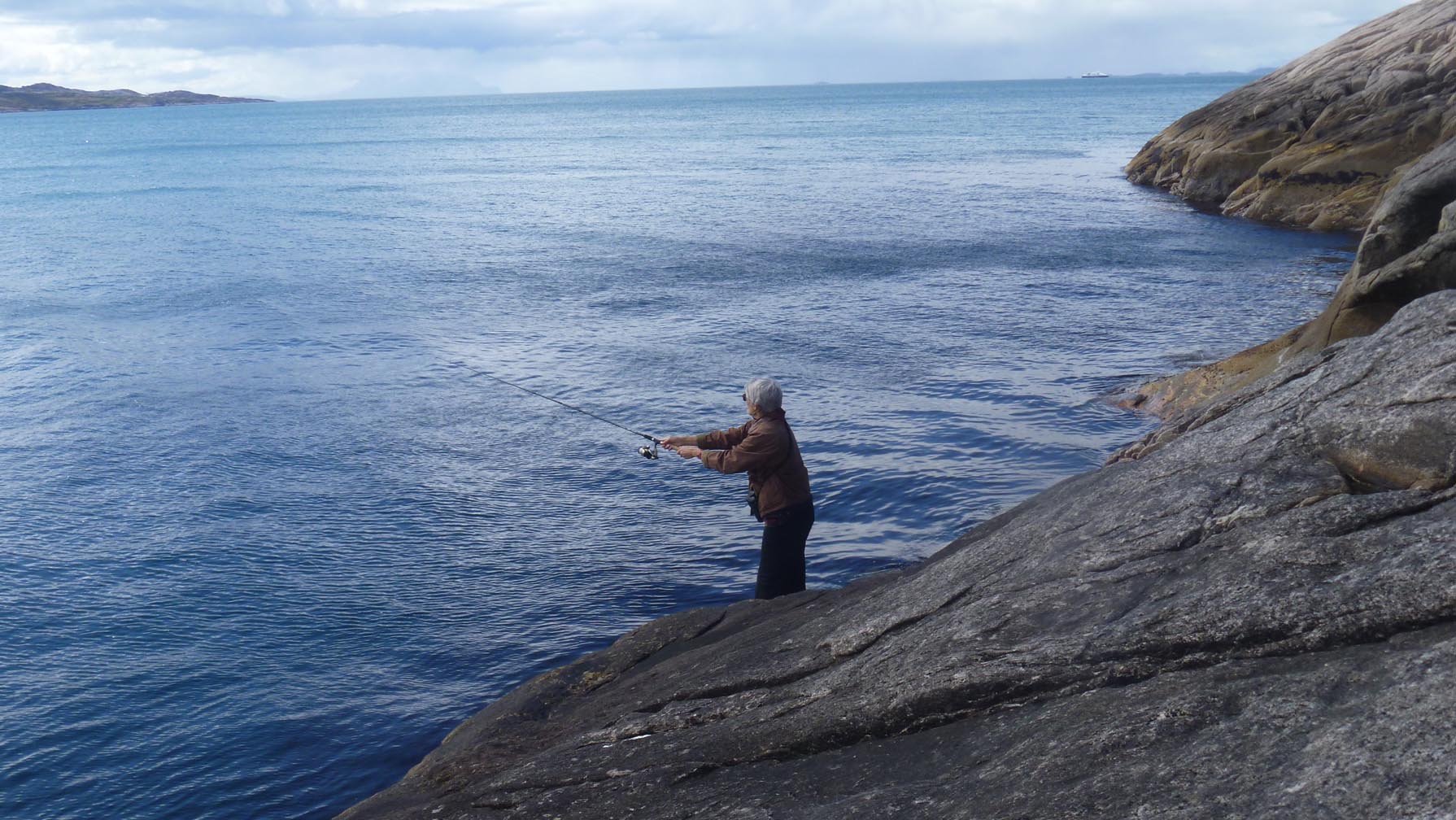
A great day of fishing, everyone caught fish and had to toss them back. We kept enough fish for two meals, one of pollock.

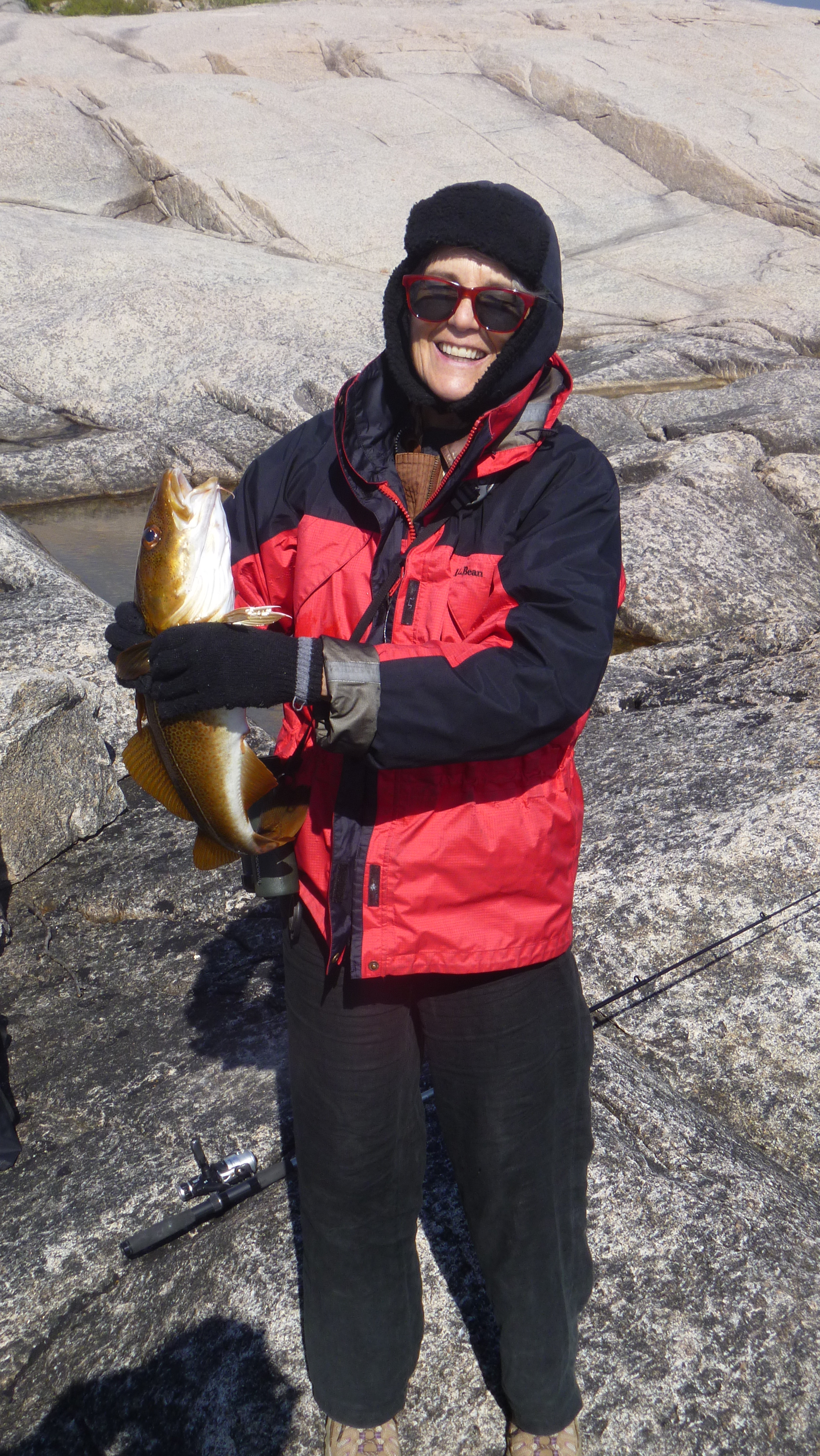
My big moment was catching a cod, the first fish other than a pollock (seithe) that we’ve gotten.

6.9.16 fishing (2)sm


6.9.16 fishing-023


The wind had come up a bit by the time I caught the cod, so I have my winter hat on. For much of the day, it was quite a bit warmer, but whenever clouds cover the sun or the wind picks up it gets pretty chilly.

6.9.16 baked cod


6.9.16 baked cod-003

It was a great fish.


Amanda thinks for a while and then addresses the fjord.

Jonathan caught fish under Jimmy’s watchful eye.

We fished from a wonderful place set up for a huge gathering near the water called George’s Place. The sign says “Please clean up for next time.”

Amanda looks around at the chairs, cooking utensils, fireplace with hanging pot and says, “So…. Norway has no tweakers? This would all be stolen from anyplace near us.” We then discussed whether Norway’s farm support policies help people in rural areas make a living–and therefore people don’t need to resort to producing meth to make money. It’s a thought. The area was spectacular.

6.9.16 Fishing-008

Beachcombing in northern Norway

6.7.16Beachcombing is not so simple in our area–most of the shore is rock. There are a variety of clams, whelks and we learned that little sand trails come from lugworms. (Amanda is our visiting marine biologist.) There is still a lot to look at when there is a sandy spot, and a surprising quantity of junk along the high tide line. Most of it probably washes in from boats, garbage escaping from the ferry, etc., but some is local. Originally, I said that the person who found a piece of narwhal tusk would be the beachcombing champion. After we arrived, I looked up narwhal and found they live in Canada and Greenland and are nowhere to be found in Norway. No narwhal for me. In any case, our first day walking along the rocky shore in Kjerstad, Jonathan took the prize for the entire Norway beachcombing season, by finding this:

6.5.16 Kjerstad-016smA blown glass float in its netting. I concede.

Today we woke up to 9 degrees C (48 degrees F), howling wind and rain. When it let up we went exploring to the nearest town with a store, Ramsund, only about 35 minutes drive (vs. a hour to the next closest store). We bought more fishing tackle (fishing post soon) and picnicked in the car (still cold out). We saw a new bird, too. A redwing.

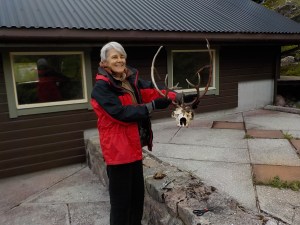
In the late afternoon, the rain stopped and we went for a walk along the shore near Kjerstad, just looking at the birds, the new snow on the mountains that surround us, naval vessels going by, beachcombing. Then I made my find:

The reindeer skull and antlers are in a place of honor on the shed roof. The beachcombing stakes have gone up. Who knows what we will find next!

Our house in the woods

We’re not exactly roughing it here in Norway. Our rental home is spacious and light, as well as very nicely decorated. There are some Norwegian folk art bowls in the kitchen on a shelf above a painted chest dated 1855, though most of the furnishings are quite a bit more recent. See the photos below for some additional comments.

This slideshow requires JavaScript.

You’re where? June in northern Norway

Kjerstad, Norway is a degree or two of latitude north of the Arctic Circle. We have been here two days and already experienced the midnight sun–or as good as. Both nights Jonathan has said, “OK, going to bed now,” and I’ve said “What time is it?” and been a couple of hours off. It’s light all night as far as I can tell, so I close my eyes and then it’s dark. Works great, especially if you just had a long day or two of travel from Portugal.

6.1.16 Oslo to Evenes-001
Norway from the air. There’s lots of water.

We are here because of Airbnb. Almost a year ago, Jonathan was browsing places in Europe we might visit and called me over to look at a house in Norway. The house was attractive and the price moderate. He discovered that it was above the Arctic Circle; we could be in the Land of the Midnight Sun for a whole month. After some contemplating, he contacted the owner to see whether the house would be available in June 2016 and we signed up. This is the only time we’ve selected a rental on Airbnb on a whim. June is here and we’ll see how it goes.

The island where Kjerstad is located is called Tjeldøya, Oystercatcher Island. We have already seen the namesake bird here. This area is the northernmost (northeasternmost) end of the Lofoten Islands.

DSCN3980smThough it’s not the farthest north you can get, it’s pretty far north. Interesting factoid: The Lofoten chain has the greatest differential between actual temperature and the temperature expected based on latitude. That is, it’s relatively warm for the location. Lucky for us! Our first day in Kjerstad was so warm that I didn’t need a jacket. I found an ancient Norwegian tanning bed:

P1060695The temperature was in the 70s (about 20°C). Today the temperature was 9° C (the 50s), and I wore all my layers.

It’s an eye-opener to compare Norway to the other countries we’ve visited. It is smaller than both Morocco and Peru, with a population of 5.1 million (one-sixth or less of the population of Morocco or Peru), It’s population density 17 people per sq km, the lowest of any country I’ve looked at. Keep in mind that more than 30% of the surface of the country is classified as “other.” In this case it means “rock and mountains,” ruling it out as living area. Rather than being an underdeveloped backwater, however, Norway has one of the highest PPP (per capita income) recorded, $47,513. Compare that to Portugal ($14,101), Peru ($12,195), and Morocco ($8,165). Further, Norway has one of the highest scores on the Human Development Index, .934, meaning that an individual has a lot of opportunity for education and employment. We notice that the Norwegian language is used as a tool for incorporating immigrants. The night clerk at our hotel in Oslo spoke Norwegian to other guests, and though we couldn’t guess where he might have come from originally, his Norwegian had only a slightly different accent than the people he was speaking with.

Norway is a bit different than the countries of the EU. It is not a member, so uses the Krone (NOK) rather than the Euro. Norway is a member of the European Economic Area (EEA), and that provides free movement of people and goods through the EU. The only country besides Norway with this status is Iceland. It might sound like Norway has the best of both worlds, EU access without the Euro. That’s not necessarily the case. Though Norway has free movement of people and goods, it does not receive the benefits of EU price supports for certain products. For this reason, food prices in Norway are on average 75% (or more) higher than the same products in EU countries.

There were delicious breads and crackers at the breakfast buffet–at what cost?

High costs are offset by the fact that Norway has the largest oil and gas reserves and is the largest producer and exporter of oil and gas in Europe (though 21st globally). The petroleum industry is heavily regulated, and contributes about 45% of total exports and 20% of GDP. What makes Norway different than other countries during the downturn in oil prices today is that it holds the largest “sovereign wealth fund” in the world. That is, Norway has been saving money from the oil and gas industry in a rainy-day fund that will help it weather the present upheaval. The government can spend up to 4% of the fund each year to stabilize economic conditions.

I believe it is no coincidence that Norway is one of the world’s least corrupt countries. The top personal income tax rate is 47.8 percent, and the corporate tax rate is 27 percent. Other taxes include a value-added tax, a tax on net wealth, and environmental taxes. Summary: there are no bargains and individuals pay a lot of taxes, BUT they get what they pay for in excellent services and infrastructure.

We’ve already seen wonderful landscape and fun, quirky things. Here are a few:


Good to know about Lisbon and Portugal

This is my last post on Portugal, where I provide a few observations that may prove useful to anyone considering a visit. Portugal is a wonderful place, so very much worth planning your trip.

Language

How disappointed we were to find that speaking Spanish is of so little assistance in Portugal! For people who don’t speak Spanish, however, this may be a good thing, because far more Portuguese people speak English than speak Spanish. We could read some signs, but the accent is very specific and it was difficult to follow spoken conversation. Many words are similar to Spanish, but not all words, so Spanish speakers get lost trying to follow the familiar. For example, ygrega=iglesia (church), praia=playa (beach). But also, lettuce=alface, apple=maça, turkey-peru (I am not kidding.)

Rental cars

Driving can be expensive. In addition to the cost of renting a car, fuel is expensive and there are significant tolls. For example, the highway toll for our drive to the Algarve and back (2 ½ hour drive) on excellent highway was €19.45 (about $22.50) each way. There can be cash tolls on additional short segments and bridges, and there is also the cost of parking that ranges from € 1 for 24 hours to the same amount for 20 minutes, depending on your location. Most parking is marked if payment is required and the hours that must be paid (e.g. 7:00-20:00). Usually there is a kiosk nearby where you insert coins and retrieve a slip of paper marked with the time your parking expires that you put on your dashboard. Not all meters take credit cards.

In Sesimbra, we met the most helpful Tourist Information person ever (!) by mistakenly putting the credit card too far into the parking kiosk where it fell inside. At the tourist office, we explained what had happened and a young woman got on the phone for a bit then said she would call us and tell us when to return to the kiosk. “We will solve your problem” she said. After dubiously giving her our cell number (it was our second day in Portugal and we had visions of having to get a replacement credit card) we went off to the market and indeed got a return call, telling us to be at the kiosk at 3 pm. We went, and a guy came up the street, opened the kiosk, fished out the credit card and gave it back. (I love the Sesimbra tourist office—it’s in the fortress.) It seems unlikely that we will ever have a more impressive experience at any tourist office anywhere.

Parking!

In the city, a car is not necessary, but if you plan to go beyond Lisbon you need fortitude and patience to take the train or bus to visit other towns. If you have a car, you can park and take the train into Lisbon, or like us, drive in and look for parking. I had some luck finding parking on:

http://en.parkopedia.pt/parking/lisbon/

though the information only applies to part of the city. We had pretty good luck just driving around looking for parking, but that probably is not much of a plan on sunny weekends, during the summer, etc.

Along the coast, only a few beaches have parking lots, much of the parking is along the road. It was much easier to park for beaches in the off season. Even small beaches may have a café/restaurant and 40 or more beach umbrellas. With only 15 parking spaces along the road, I can’t really understand where people park in the summer and what it will be like to drive along the coast.

5.30.16 Praia Galapos.16-015
This is legal parking for the beach.

Pedestrians have the right of way on every striped/zebra crossing.

In Portugal, people tend to cross the street at striped crossings, BUT, they know you are looking out for them and that you will naturally stop, even if you are going at a good clip and they can see you coming. They still step out and you need to stop. There’s also something of an expectation that a driver will stop under most circumstances zebra crossing or not. You might get a look, or a wave, but you might just get a young person lighting up a cigarette while talking on the phone wandering out into the intersection, or a mom with a stroller, or an older gentleman who will take about 75 steps to get across that lane. Be prepared.

Signage is a problem, and I’m not saying that because I don’t speak Portuguese. Road signs sometimes appear right before you need to make a turn leaving you no time to get to the turning lane, sometimes they appear so far before the turn that there are two or three other unmarked options before the correct turn. This lets you tour the neighborhoods around the base of the big bridges into Lisbon, usually when you are most wishing to go home. It is much easier to find your way to beaches, even well-known ones, by checking maps before you leave home. There may be one road sign off the highway and nothing else, or every road may be marked as going where you are headed. For example, in Portimao it seemed like every street had an arrow that said “Praia de Rocha.” We occasionally provided directions to lost drivers—Portuguese ones!

A thought about restaurants

As in other places in Europe you’ll often be served bread, olives and cheese when you sit down in a restaurant. This can be very nice, especially if you are starving before a late lunch. BUT, keep in mind that these are not complimentary, so if you are not interested in them or on a tight budget, tell the waiter to take them back. You are not obliged to have these items, but you need to speak up. At the end of the meal it is too late to refuse to pay for them. (We had a really good meal at a very moderate price at Portofino in Sesimbra. It’s right on the beach.)

And that’s all I’ve got on Portugal.

Tile is everywhere in Portugal

We’ve seen a lot of decorative tile in Portugal. It covers many buildings, sometimes as an overall pattern: exterior walls, interior walls, decorative wainscoting, decorative details.

This slideshow requires JavaScript.

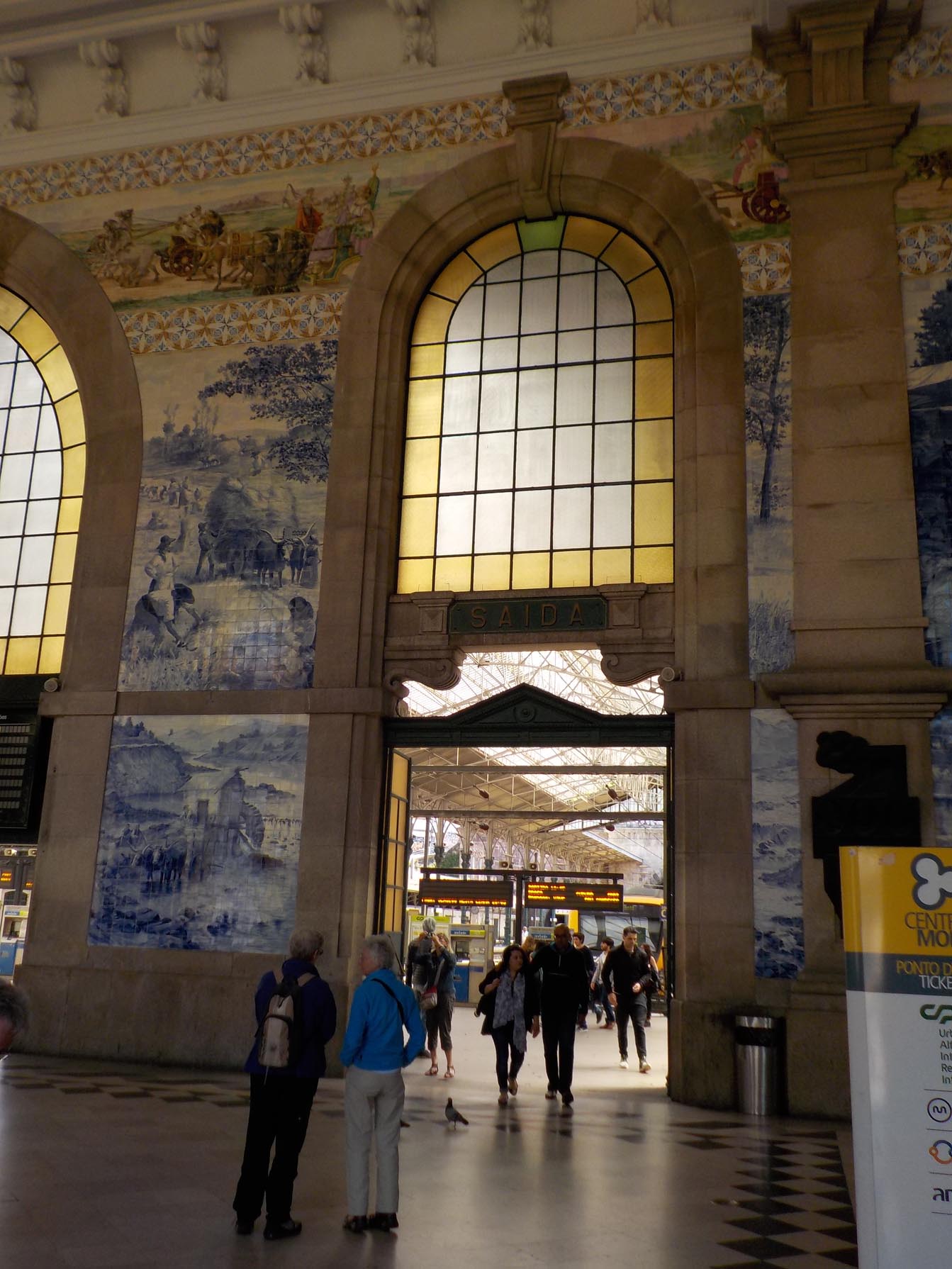
Sometimes there are scenes created from tile. The Porto train station is one such place,

The blue and white tile was installed in the 19th c. when the station was built. The multicolored tile was added during the 20th century.

5.23.16 Porto-014Here is a church that is completely tiled with religious scenes on the exterior (Porto).

Scenes created from tiles are put on walls.

It’s an adventure to walk anywhere in Portugal, to see what tile you may find.

Empedrada is underfoot in Portugal

Empedrada is a particular kind of square cobblestone surface that is found all over Portugal. The material tends to be a uniform pale color and it covers lots of sidewalk and many public plazas, private patios and even streets. Contrasting designs are made with black stone, and very rarely colors. There are some typical patterns such as crosswalks, and there are some very appealing decorative designs, all very durable. These pictures go from the simple to the complex, so if you watch for a minute you’ll get to the octopus and sailing ship!

This slideshow requires JavaScript.

Last Day at the Beach

We’ve visited many of the beaches along the coast from Setubal past Sesimbra

From east to west, around Cabo Espichel and up the coast, they included:

Praia de Troia, Bico das Lulas on the Troia Peninsula

Praia da Figuerinha is just west of Setubal. The long sand spit is a great walk at low tide.

5.26.16 Praia da Figuerinha.005  Praia dos Galapos, our last day:

Praia do Creiro (Portinho de Arrabida)

Praia California (Sesimbra)

Praia do Ribeira do Cavalo was the one we couldn’t reach. The trail was too steep. Praia do Cavalo on Cabo Espichel is near the dinosaur footprints from the Upper Jurassic.

5.27.16 Cabo Espichel-021arrowsPraia dos Lagosteiros is nearby and has more dinosaur prints, from the Lower Cretaceous. The boundary between Cretaceous and Jurassic runs through the area of Cabo Espichel.

Praia da Foz is just up the coast from the dinosaur footprints, though there are several small bays that can be reached on foot in between. We drove to the end of the road, then walked for a while to reach this beach. In the mud left from the rain we saw the tracks of deer, a biggish animal (Iberian lynx?), and birds.

Praia de Foz is where we found partially fossilized snails, clams, oysters and scallops:

5.28.16 Praia de Foz-010Praia do Meco is part of a long, long beach that stretches for kilometers toward Lisbon. We spent two days, first walking south from the parking area, and walking north the next visit. Here are some of the tiny birds we saw:

5.19.16 Praia de Meco-002smPraia da Lagoa de Albufeira was the furthest we got on our tour of beaches. There is a town of vacation homes but since we arrived before the high season, it was very quiet. There is a huge lagoon/lake on the edge of the ocean, with a large sandbar separating the two. Something for everyone. There were lots of people fishing on the lagoon, apparently the fishing shacks are still in use.

Now you know how we spent a lot of our time this month. In addition to beach combing up and down, we saw a lot of birds. Storks, flamingos, kestrels and all kinds of shore birds and two really unusual birds (for us), a pair of nesting bee-eaters:

Guepier d'europe au parc national Ichkeul.jpg

And on our very last day in Portugal, we saw a flock of Iberian magpies:

Blauelester donana.jpg

Until recently, these were thought to be the same species as the Azure-winged magpie of Asia, but separated by 9000 km. DNA testing shows that the two are different species.


These were both very cool birds to see. (Note: neither bird photo is by me.)


And thus ended a very eventful visit to Portugal. We left behind a lot of wonderful sights that will have to wait for another time or another person.