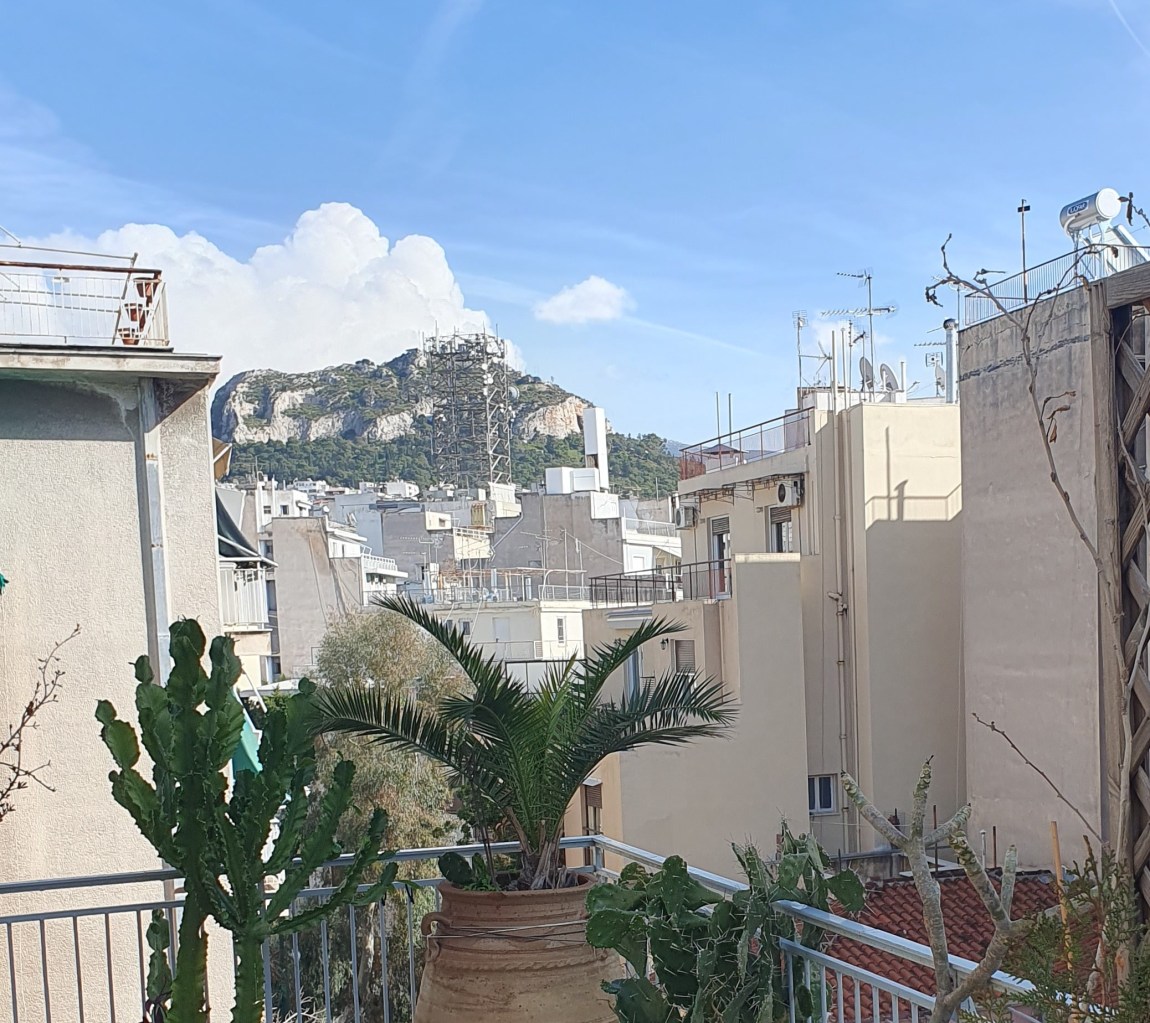
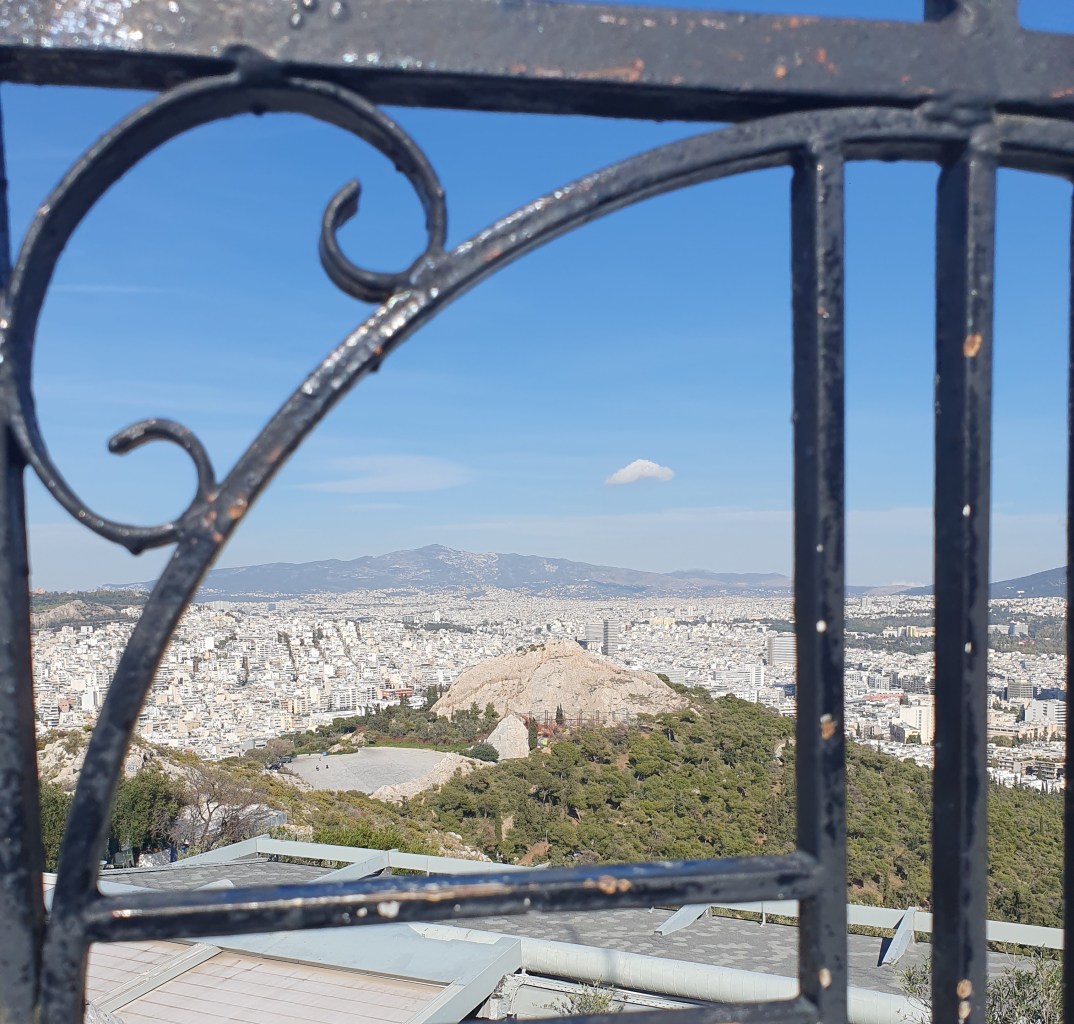
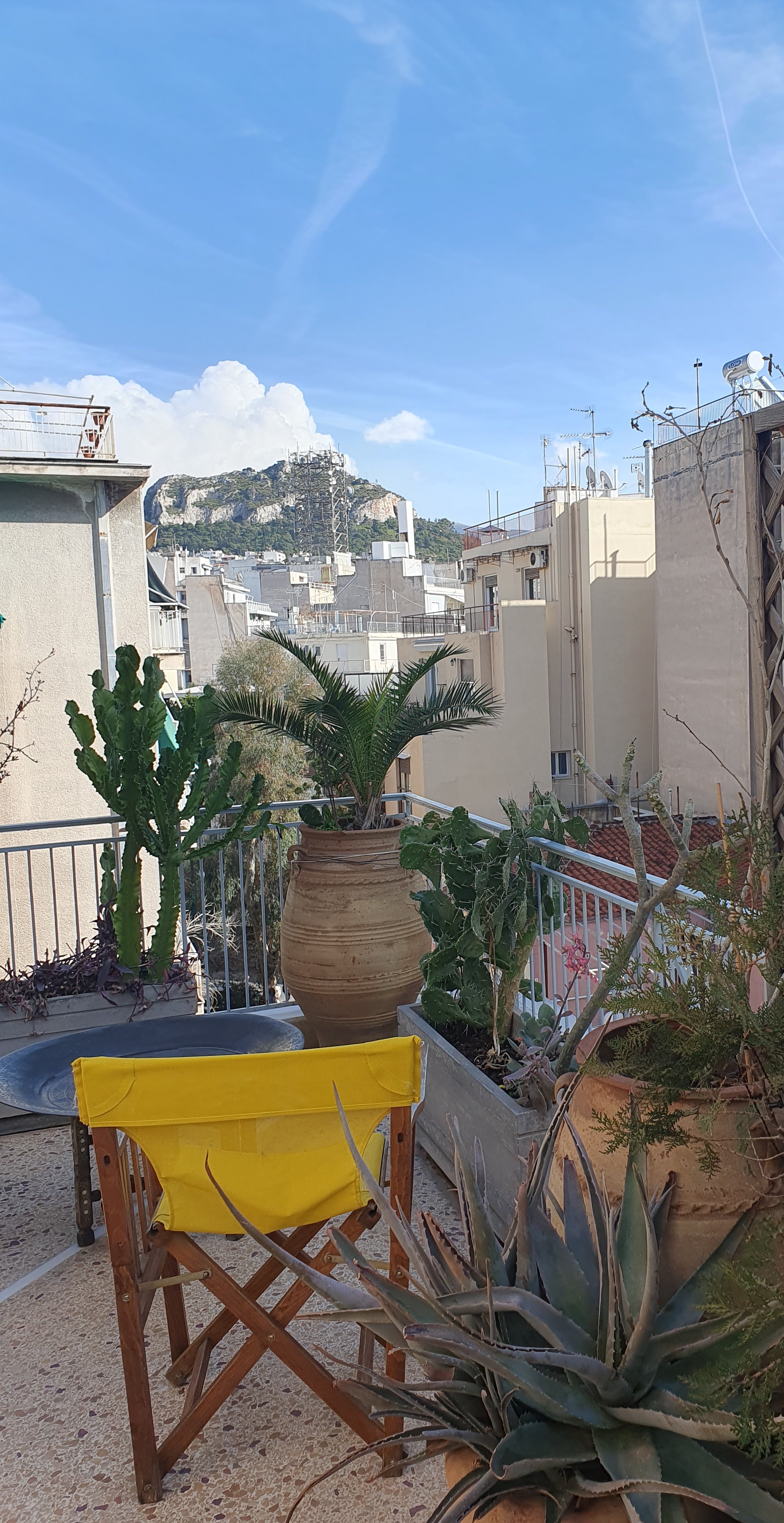
It was a sunny day and Jonathan was resting his knees, so I went for a stroll up Lycabettus, the hill we can see from our terrace. Our view is blocked in part by a large communications antenna, but on the walk over, I could see the hill very clearly. It’s the highest point in Athens, about 900 ft above sea level, and offers views in all directions over the city.
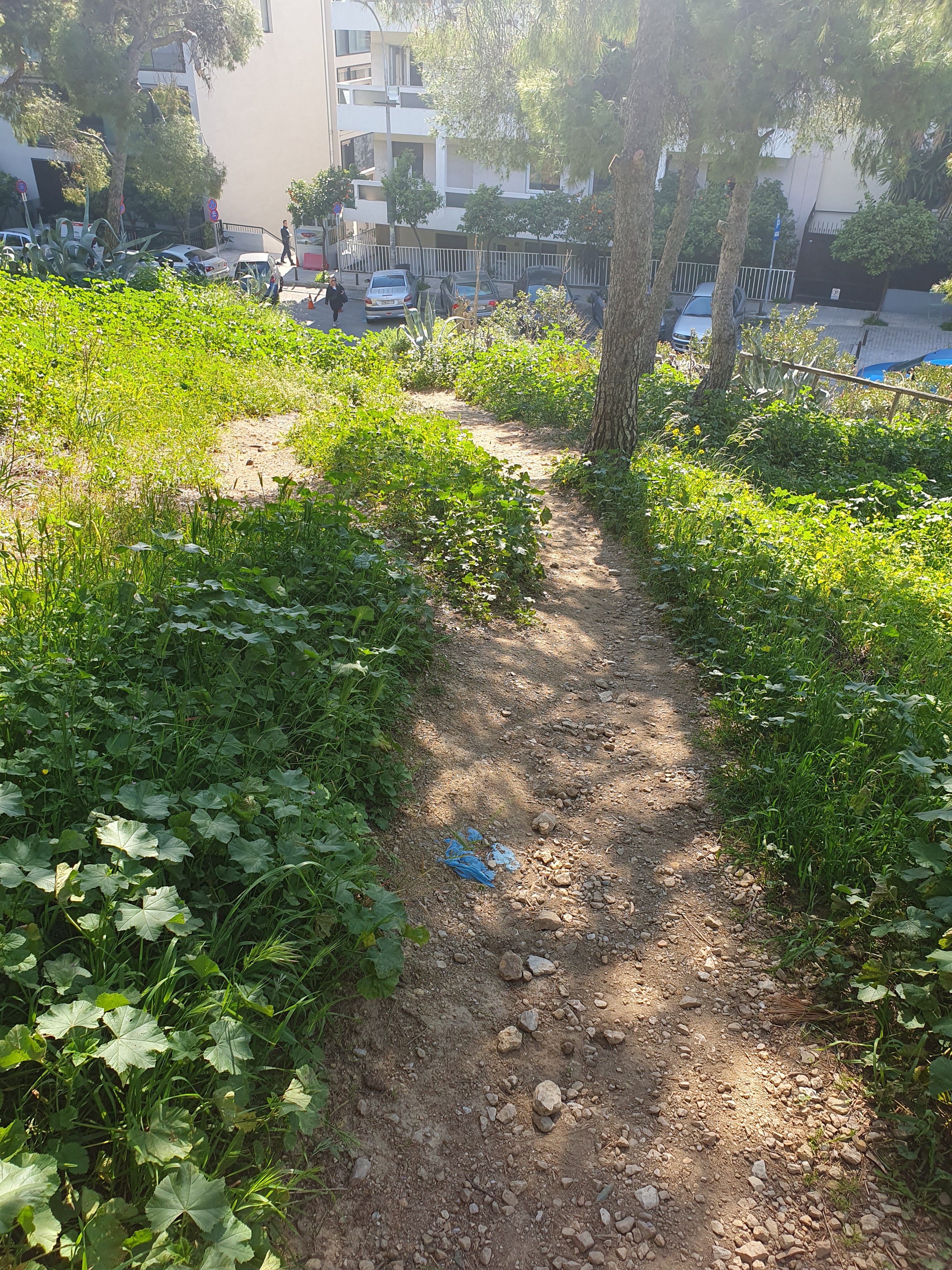
Paths wind up the broad base of the hill, and as soon as you leave the sidewalk, it looks like a country trail. The path loops upward, providing lots of places to appreciate the view and catch my breath.
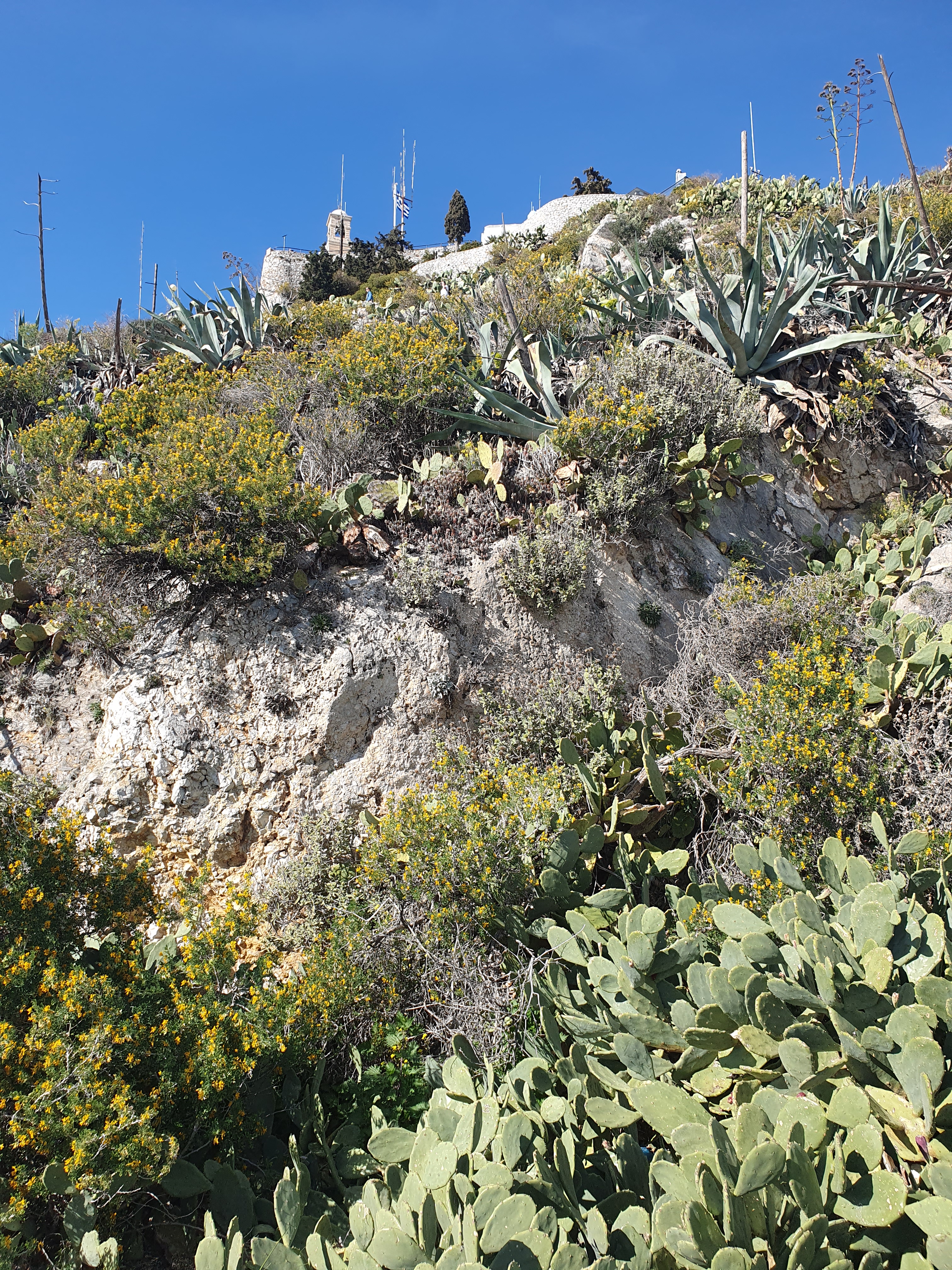
A series of stairs leads you to the cafe that overlooks the Acropolis. It’s a beautiful spot and on the day I visited there were very few people there. Another set of stairs continues to the top of the hill and the Chapel of St. George. Visitors can enter and have a look around under the watchful eye of a caretaker. He’s probably keeping an eye on the large silver icon of St. George and the Dragon.
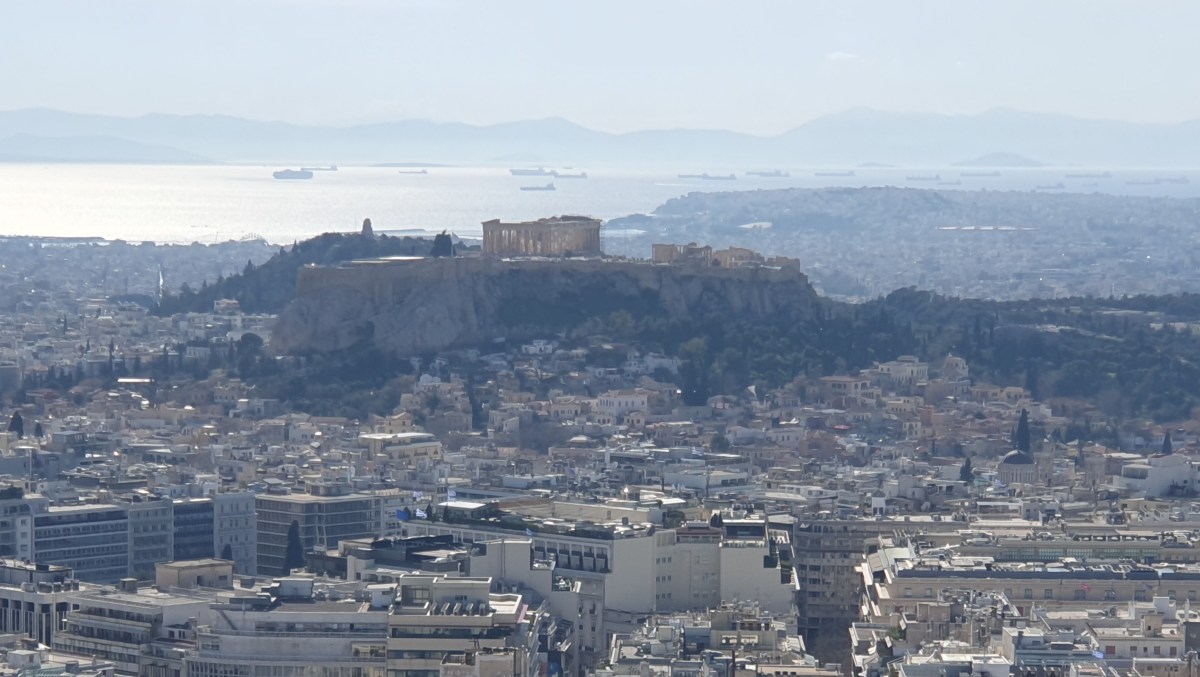
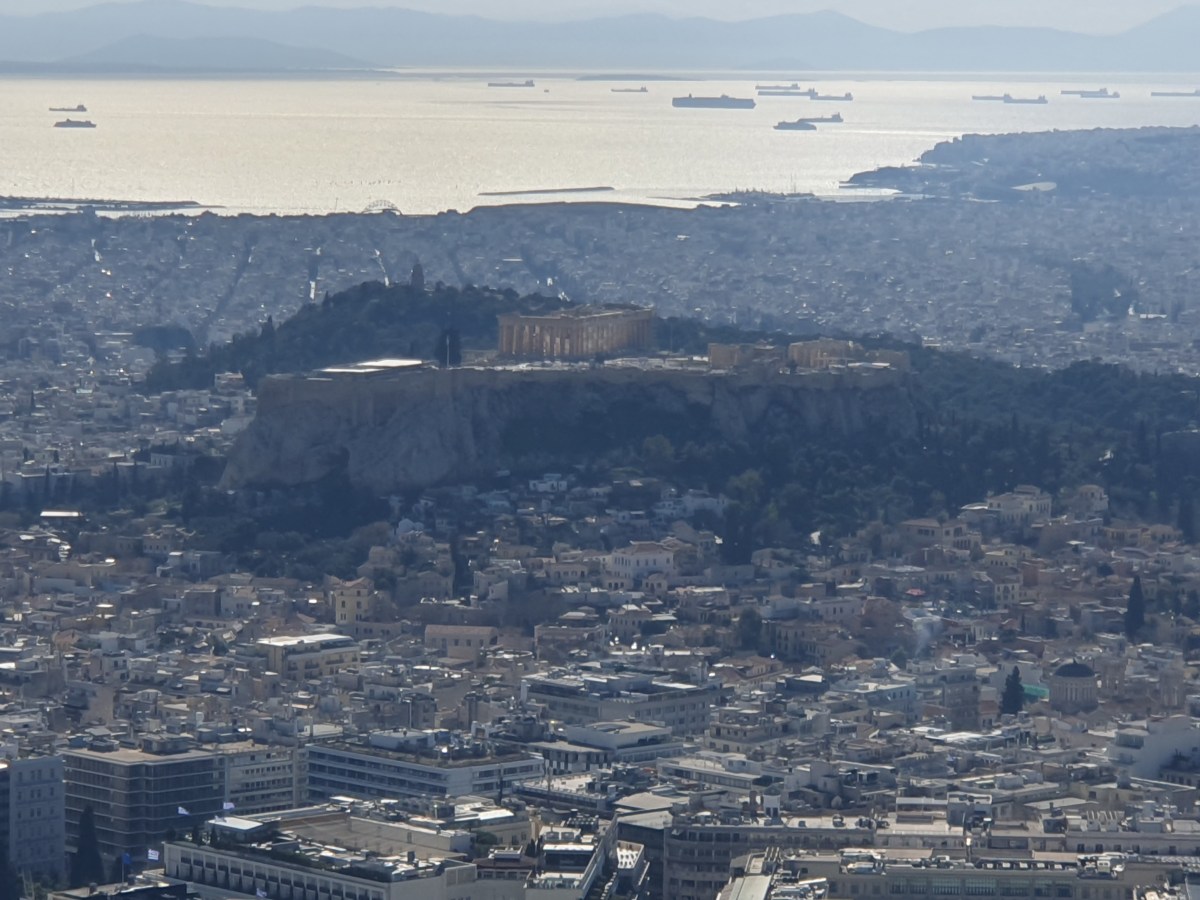
The view from the top of the hill is the big payoff. The breathtaking view of the Acropolis extends all the way to the sea and the Peloponnese beyond. In the late afternoon sun, I could even see the roof of the Niarchos Cultural Center shimmering in the distance. (It’s a distinctive building in Piraeus, miles away.) The Acropolis is such an imposing monument; it made me think about what life must have been like in Athens at the peak of the Greek Empire, so long ago.
The glory of Athens
If you can get enough of looking over the ruins from above, the rest of Athens is spread out around the hill. Miles of buildings stretch into the distance, broken only by the occasional grove of trees. High hills in the distance remind me of Greece’s history of independent city-states protected by the mountains around them.
Looking south from Lycabettus HillLooking west from Lycabettus Hill
I spent some time looking at spectacular Athens, enjoying the day.
The walk was uphill, but it was not difficult. I took about a half hour each way going up and down, varying my route to see more of the surroundings. It is also easy to visit the hilltop without a hike. The Lycabettus Hill funicular will take you to the top in just a few minutes from Kolonaki. I plan to make a second visit that way, just to see the view on the ride up!
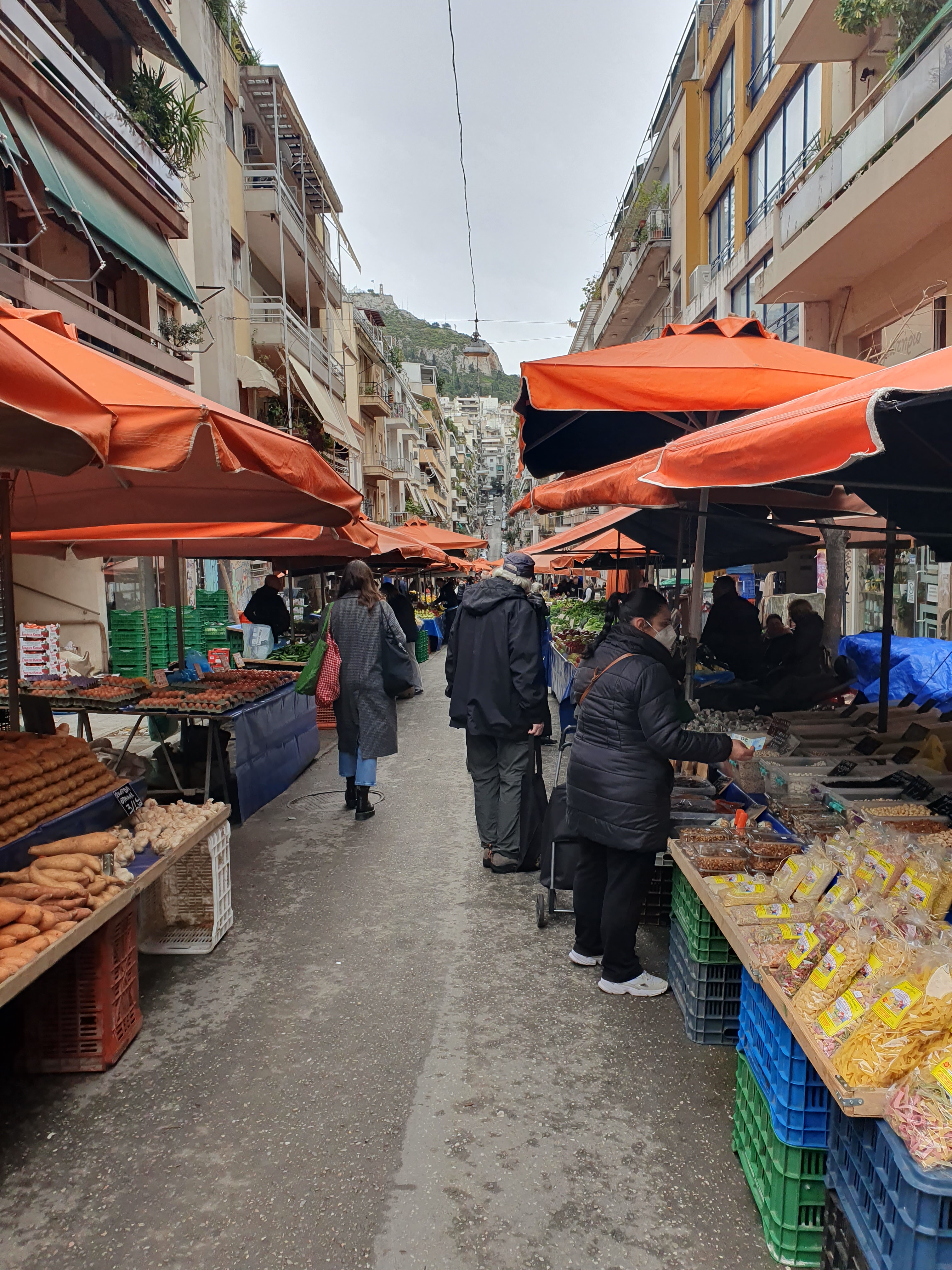
Our central location is good for provisioning. Less than ten minutes walk north is Kallidromiou Street, site of the Saturday Farmers Market. The market sells only fruits, vegetables, and fish, a nice change from “farmers markets” that emphasize tshirts and jewelry. The produce is beautiful. We returned home vowing to take the shopping trolley with us next time. We were laden with a whole red snapper, mushrooms, eggplant, onions, potatoes, oranges, arugula that will need a lot of washing (!), and fresh flowers. We looked in a neat storefront and found a small deli that stocks wonderful Greek products. We bought delicious cheeses, including goat cheese made on a Greek island, and peanut butter made in Thessalonika. Next week, Jonathan will buy blood oranges to make beautiful marmalade. We just couldn’t carry one more thing.
The Kallidromiou Farmers Market is held on Saturdays.
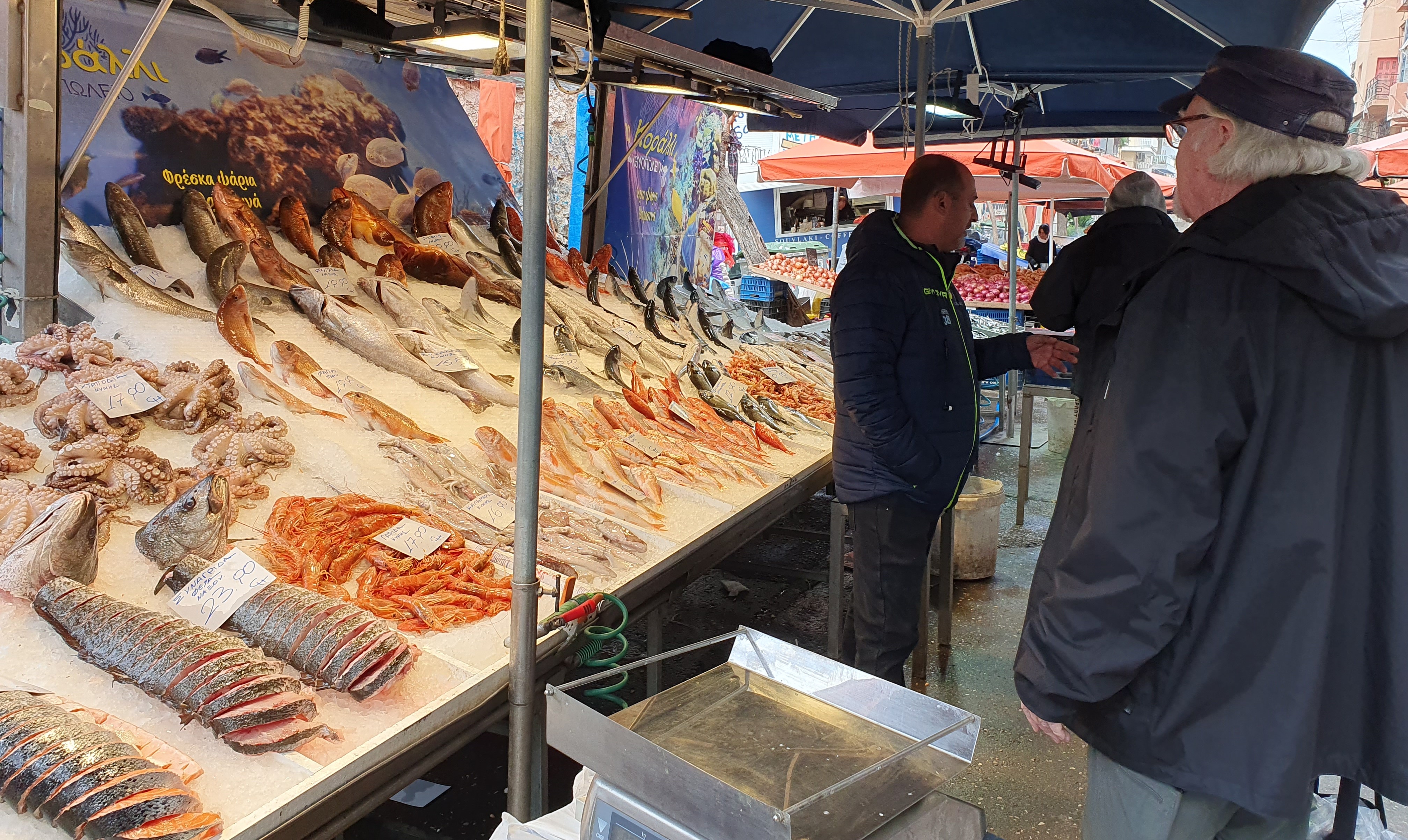
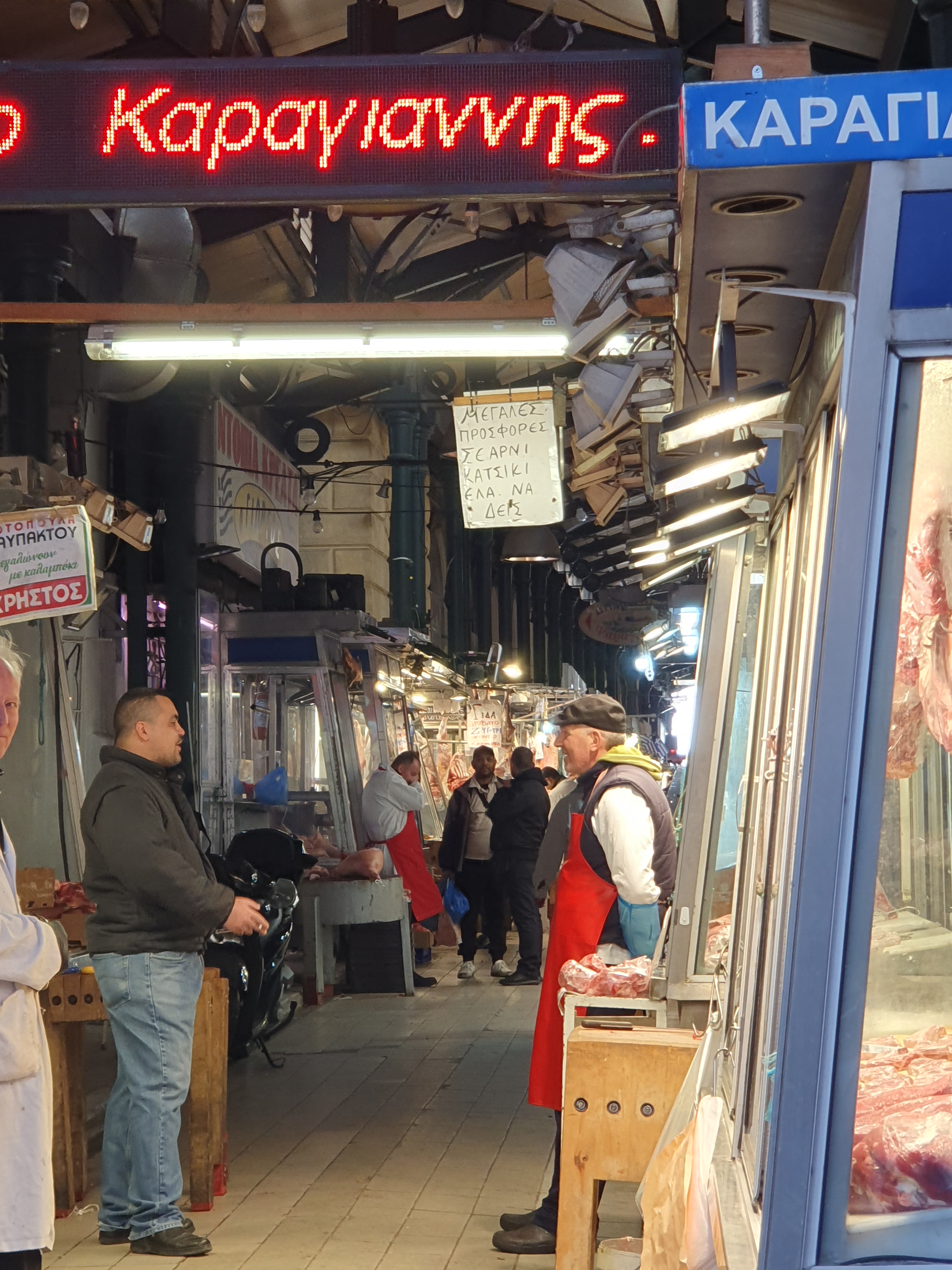
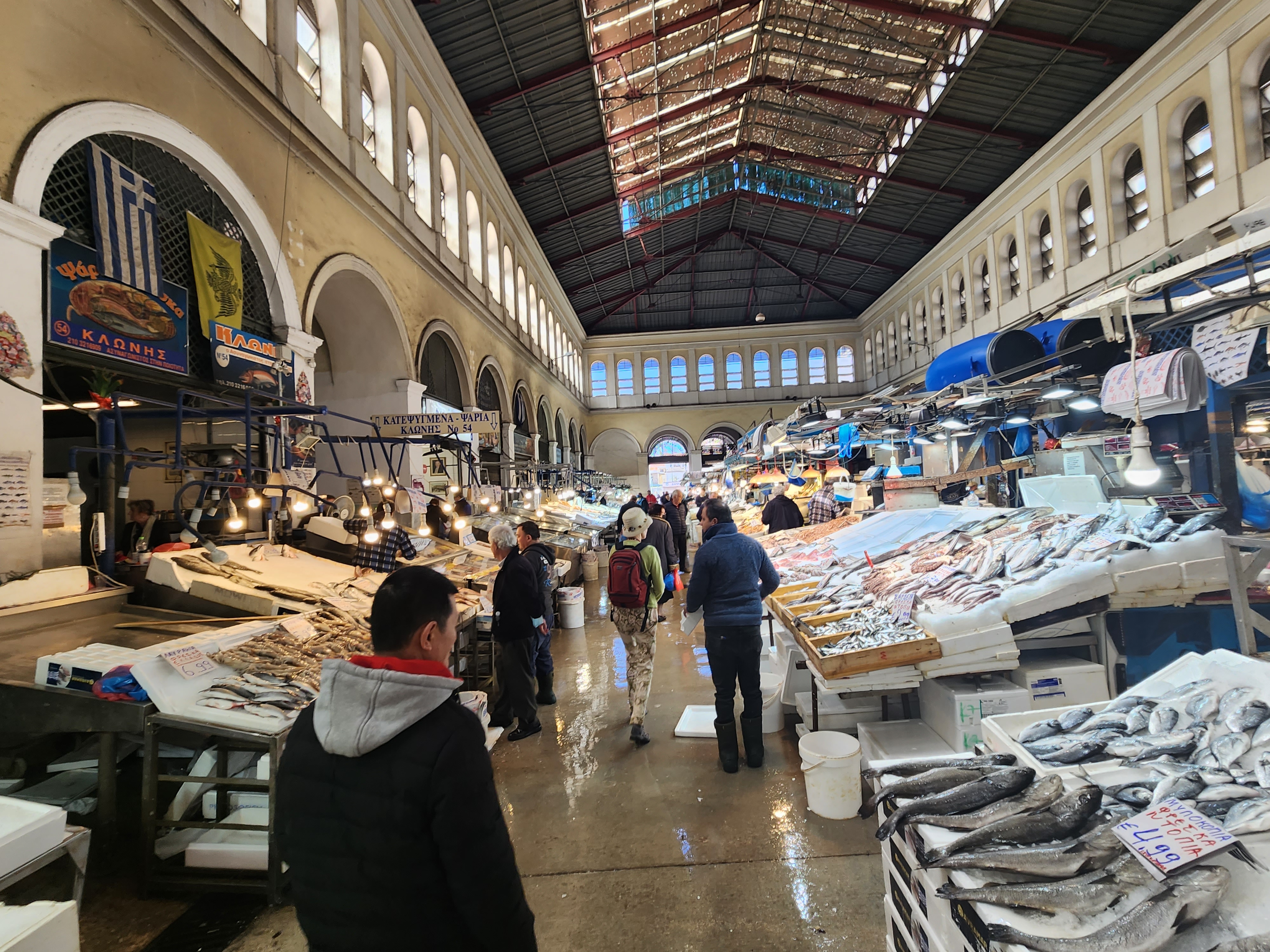
Having seen our neighborhood market, we had to visit the main Varvakios Market that stocks the entire city. For a moment, the market reminded me of Peru, with whole carcasses hung up on display, and the fish zone a bit squishy underfoot from dripping fish. So many squid, fish with sharp teeth, eels, shrimp and crawfish, and fish from tiny anchovies that you would fry by the handful to giant tuna ready to cut steaks. So many octopi! We thought we’d sit down for a fish lunch, but no luck. The restaurants serve fried things. Finally, we found Igeios, a small restaurant down a corridor, and were able to enjoy our fish, salad, and bread. The central market is so big that we walked past all kinds of meat and fish before we finally stumbled on the fruit and vegetable sellers.
The Athens Central Market, or Varvakios Market is open M-S, closed Sunday.
Compared to these huge markets, the regular supermarkets are small, with a limited selection, but useful for necessities like cleaning supplies. We are well stocked and looking forward to return visits to the farmers market.
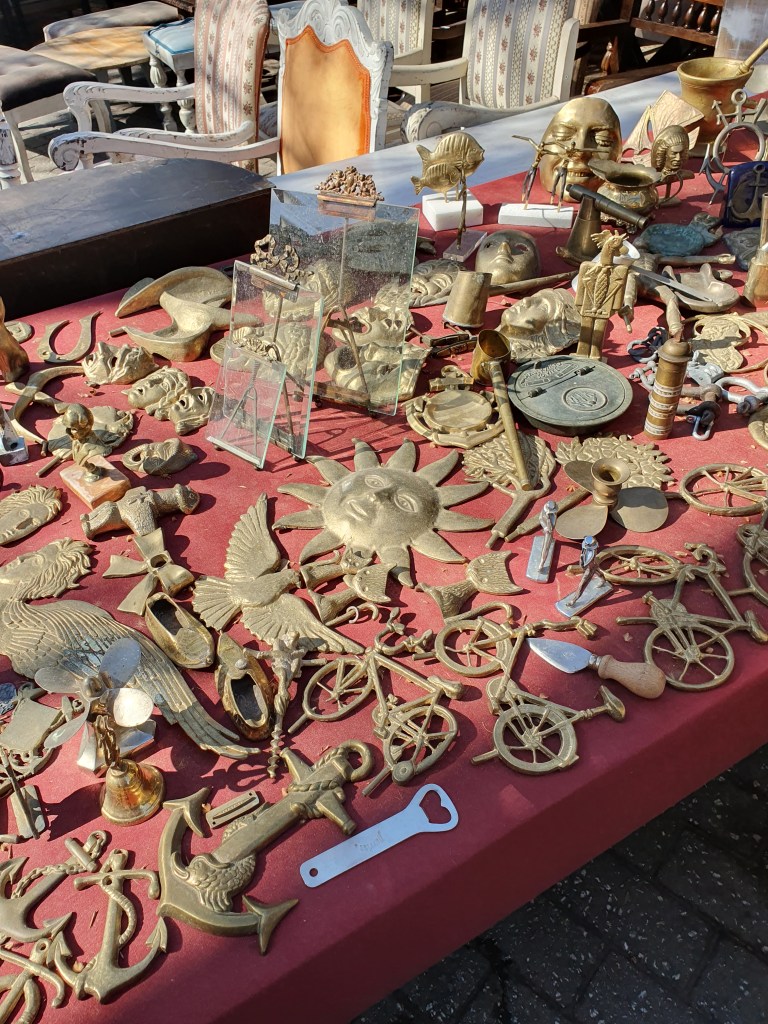
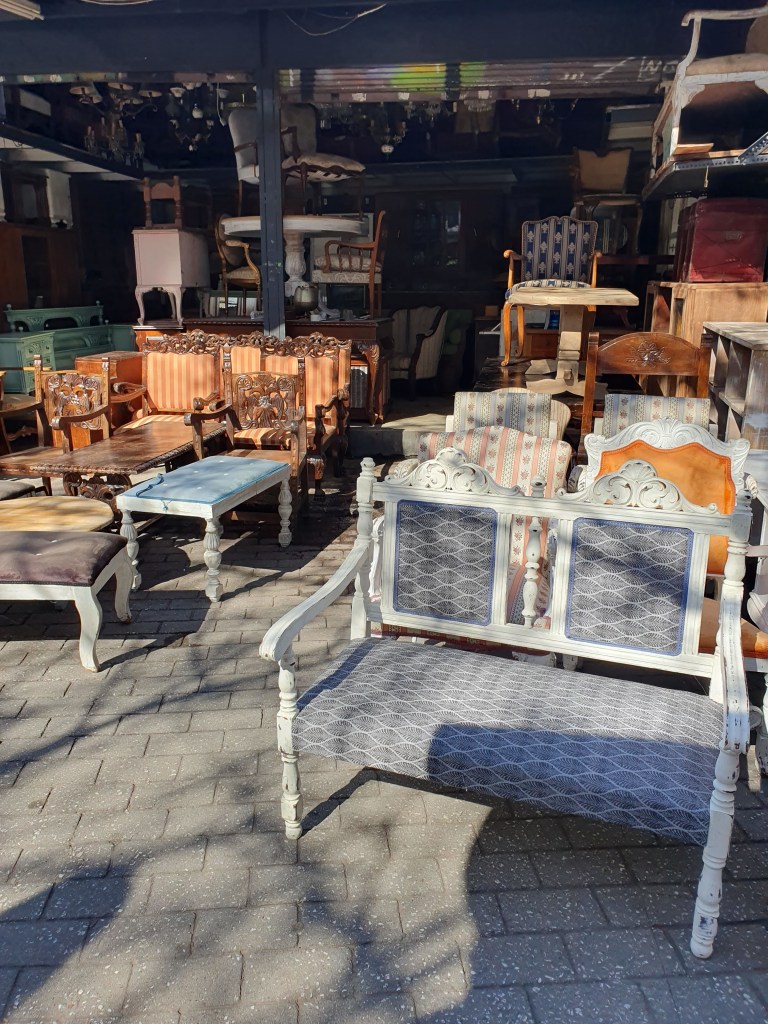
We next visited the Sunday Monastiraki flea market. Emerging from the Metro, we looked around until we saw the big banner “Flea Market”, then headed down the street. Though there are stores that sell used goods and antiques all along both sides that are open every day, on Sundays sellers set up tables everywhere and fill every possible space with items for sale. We took quite a while making our way as far as Avissinias Square, and then found that the vendors continued even further for several blocks, merging with the flea market around the Theseio Metro stop.
Scroll through the slide show above to see more of the flea market.
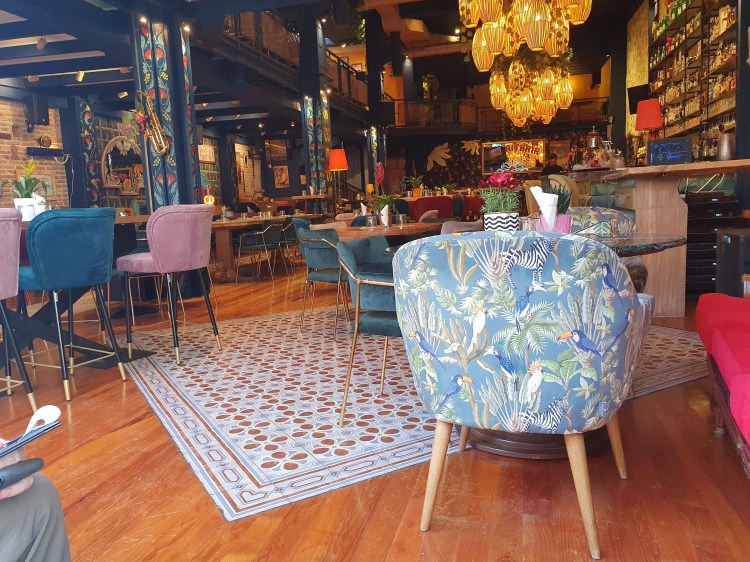
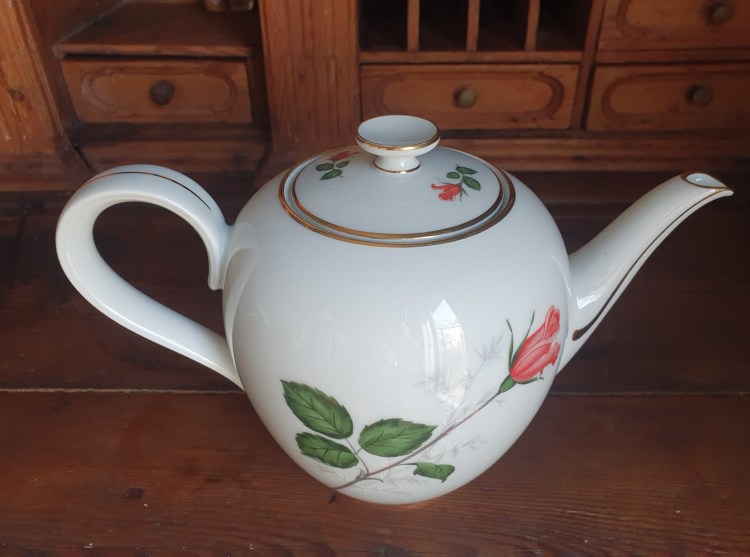
We paused for a delicious cappuchino at a lovely restaurant. I love tropical birds, so we sat by the chairs upholstered in cockatoo print fabric. When we moved on toward the metro and home, I stopped to look at a teapot, as our apartment doesn’t have one. I ended up getting a perfectly nice teapot for 4 E. On the way home, the lid seemed to be clanking a lot in the bag, but when I looked, the pot was not rattling. Finally, I looked inside, and found a tiny metal table favor of some sort that was making the noise. My free find! Maybe it will become dollhouse furniture for my granddaughter?
Our market experiences have been very good, and we will continue to stock up as we go along.
Our apartment is not far from Exarchia Square, the center of the neighborhood of the same name. We didn’t select our apartment because it is here, though we wanted to be centrally located. Now that we’re in this zone of Athens, we are discovering our surroundings have quite a story.
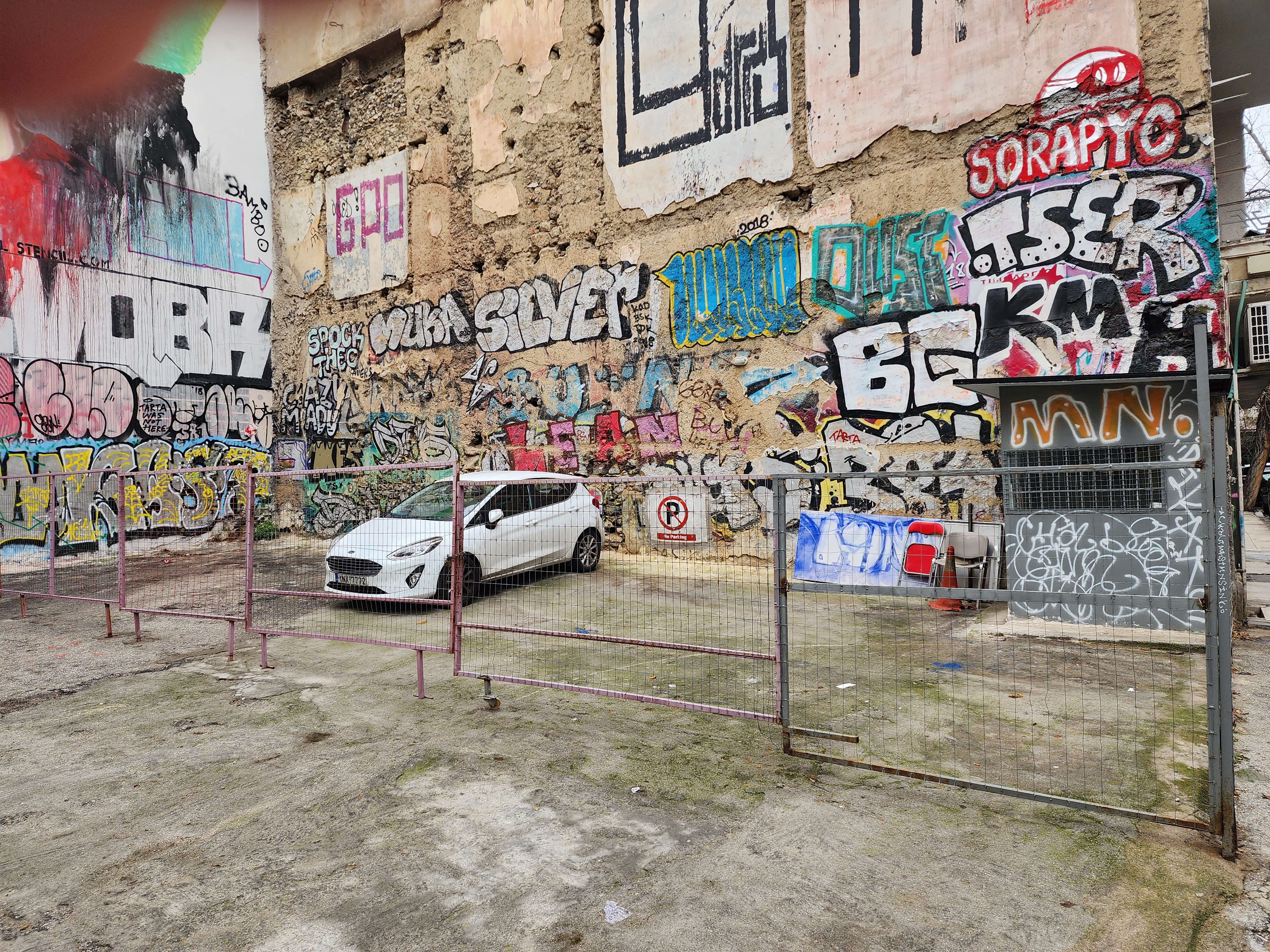
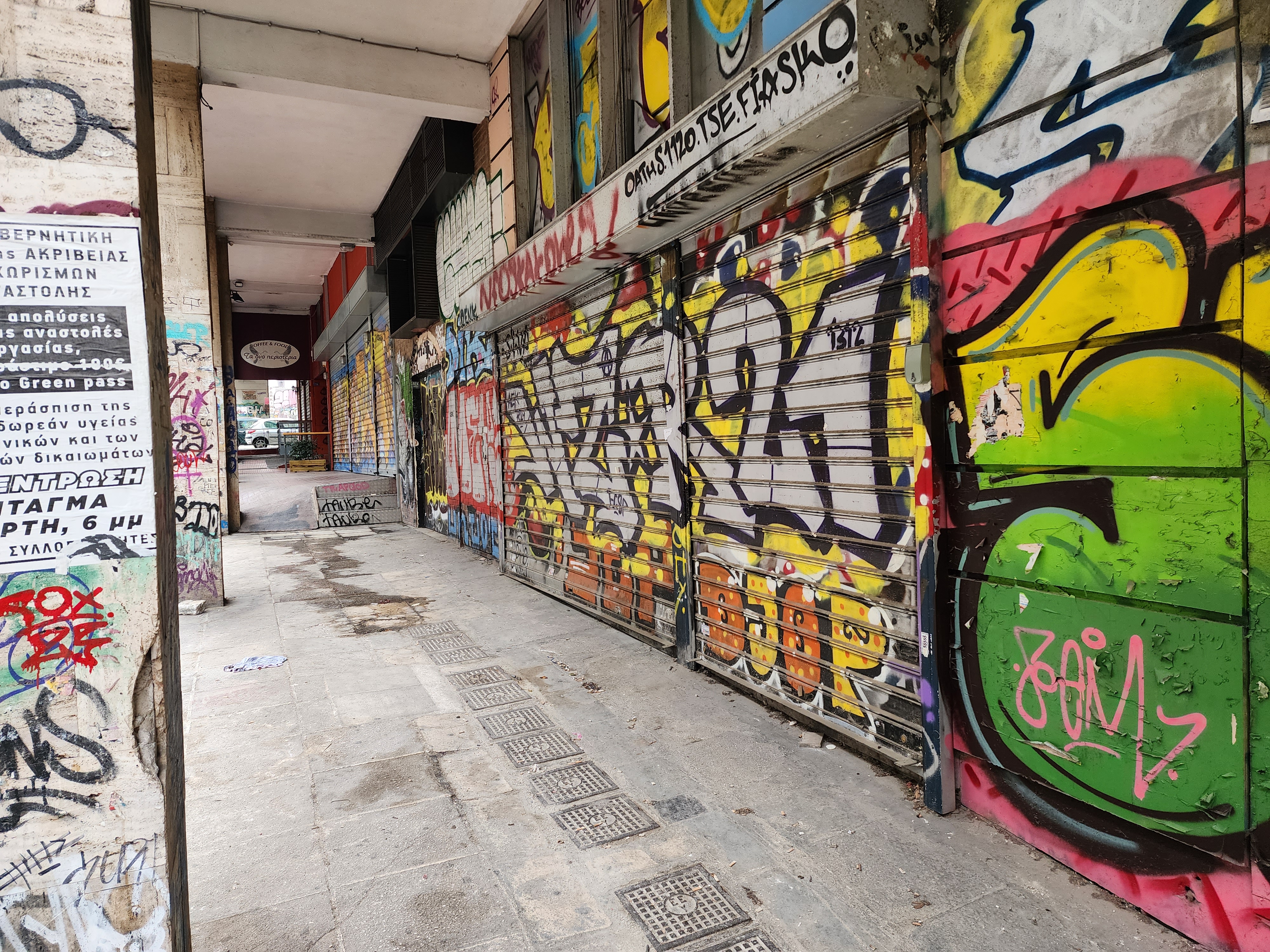
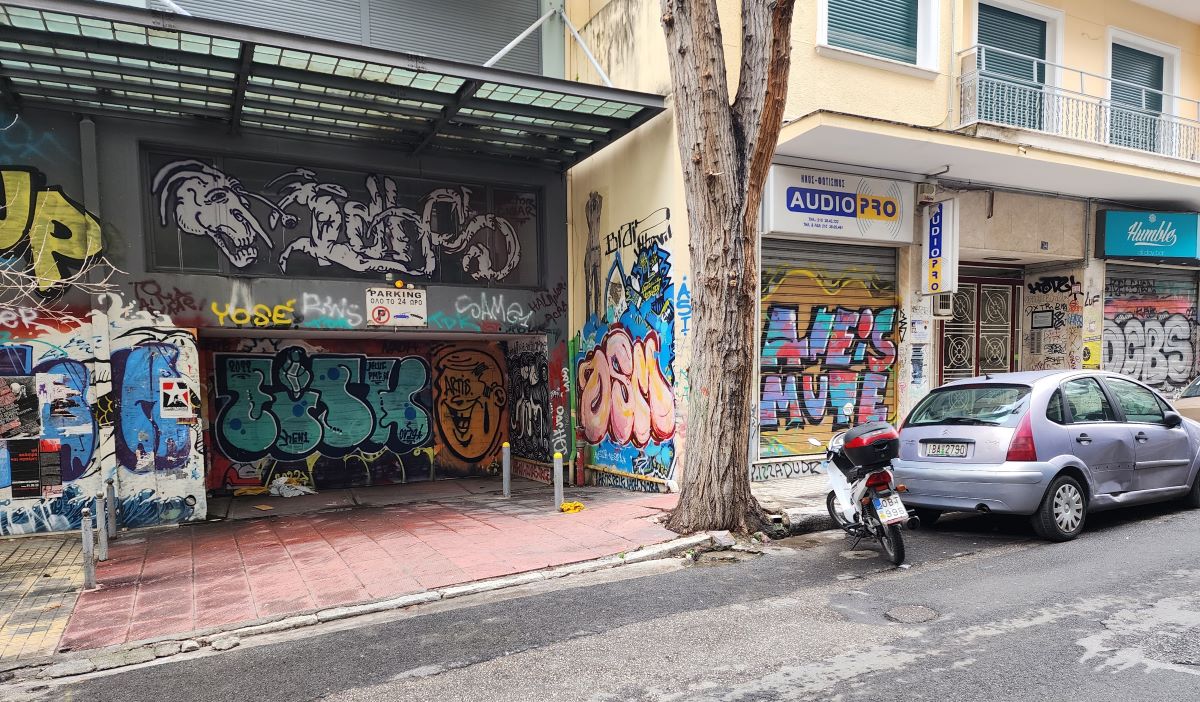
The first thing you notice here is the graffiti. There is graffiti from the ground up farther than a person can climb, jump, or paint from a stepladder. Early in the day, the graffiti is most noticeable because it covers the metal shutters that are pulled down over the doors of most businesses. As businesses open and roll their shutters up during the morning, less graffiti is visible, though there’s plenty left. At first we were shocked. Our apartment is in a nice building, and next door is a pleasant cafe. Still, every wall is graffitied and the result is a bit oppressive.
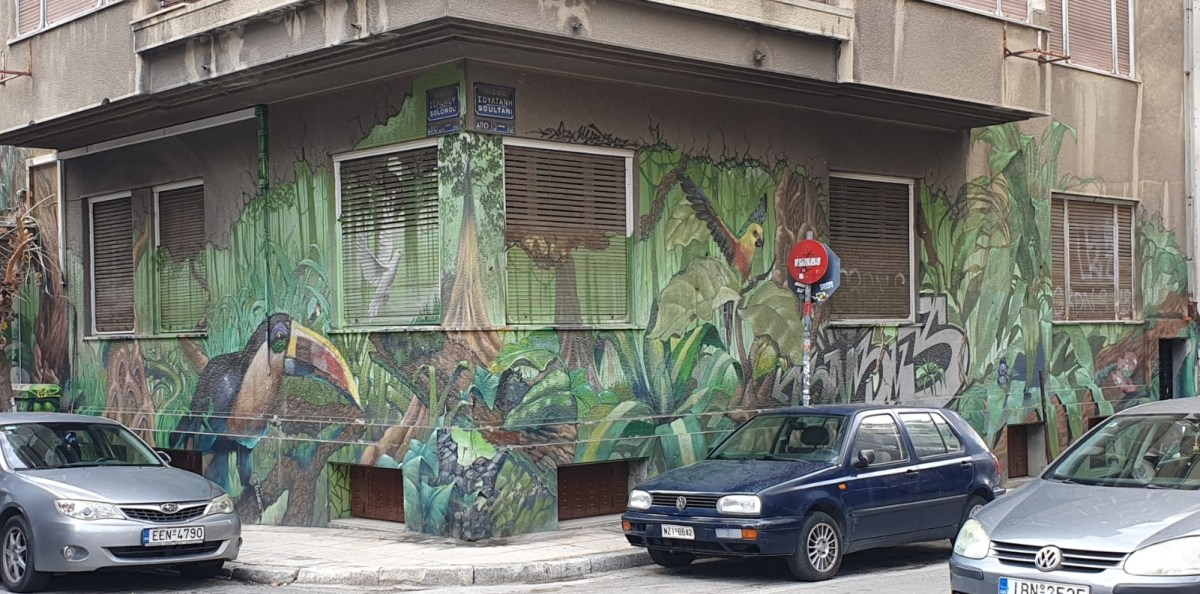
We walk past buildings with extensive murals that seem to be an effort to deter graffiti painters with a pre-emptive strike. In some places it seems to work.
Exarchia Square has been the center of counter-culture groups, students, and generally left-leaning people for some time. The current conservative government does not like this neighborhood at all. I wondered why the garden in the center of the square was blocked off with sheets of metal fencing. I figured it was being refurbished. Not at all! The garden is being cut down in order to build a Metro station, despite an alternative open area without mature plantings being available nearby. Local sentiment is that the neighborhood is being punished for its political leanings. When a demonstration against the Metro was held in August, police were stationed on the corners of the square. They are still there every day and night, eight or more riot police, dressed in camo, armed, some with riot shields leaning on their legs. It is intimidating, and it is supposed to be. I didn’t get very good photos because I didn’t want to be noticed taking them.
On Sunday, there was a large demonstration in downtown’s main Syntagma Square demanding the Greek government accept some responsibility for the fatal train crash last week. We did not know about it and our plans took us elsewhere, but as we were returning, we ran into the tail of the demonstration ending at Omonia Square. We emerged from the subway to see black-clad demonstrators parading toward the square, some carrying long sticks that they pounded on the ground to punctuate their chant. We headed away from the action toward home, but had to pass a line of police who seemed to be monitoring the end of the march. They were wearing full gas masks, and there was a faint tang of tear gas in the air. It made me blink, though nothing worse, but encouraged us to keep moving. At the same time, we passed couples and families out for a Sunday stroll. It was strange indeed, suggesting Athens has been living with protest for quite some time.
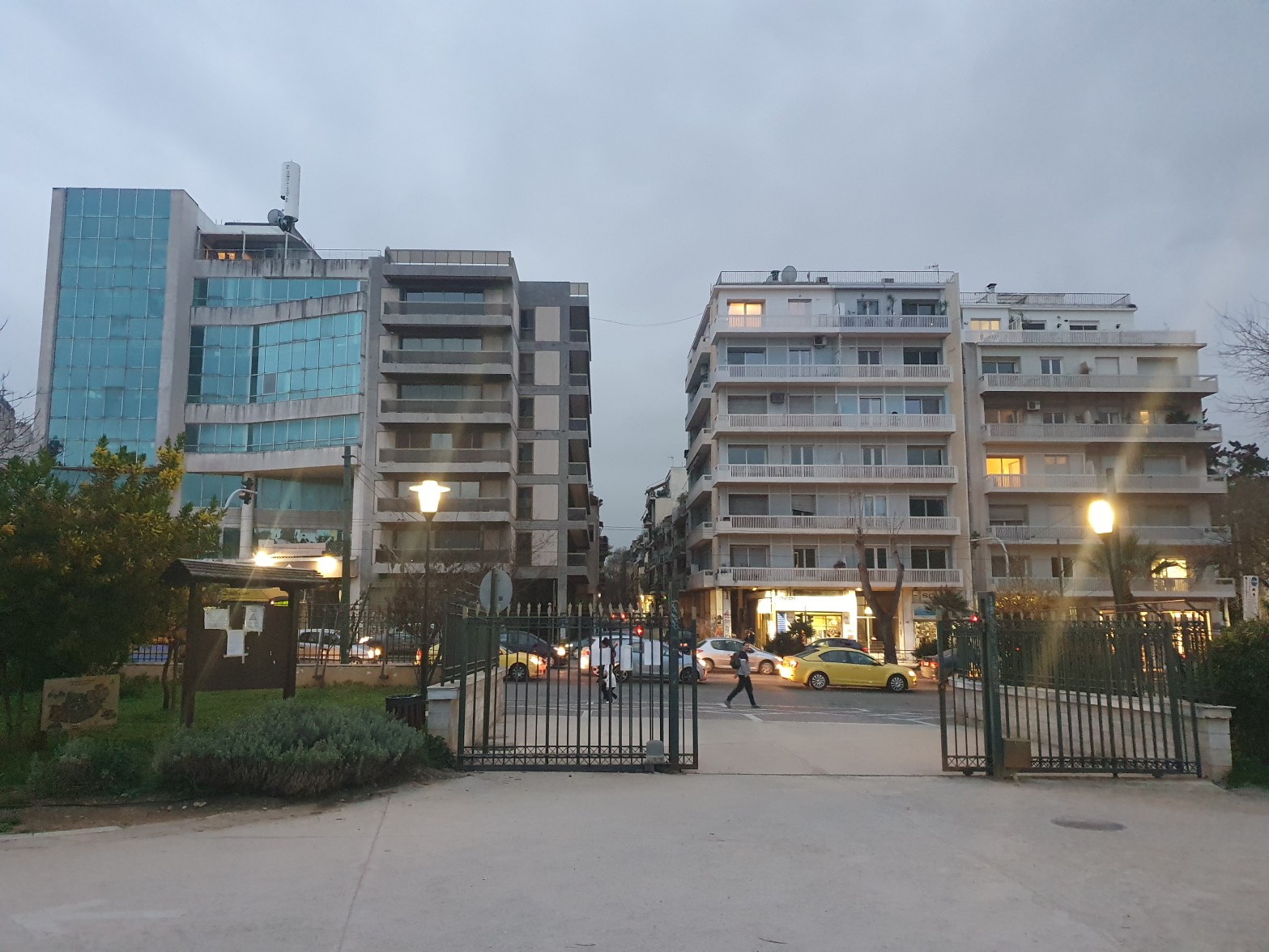
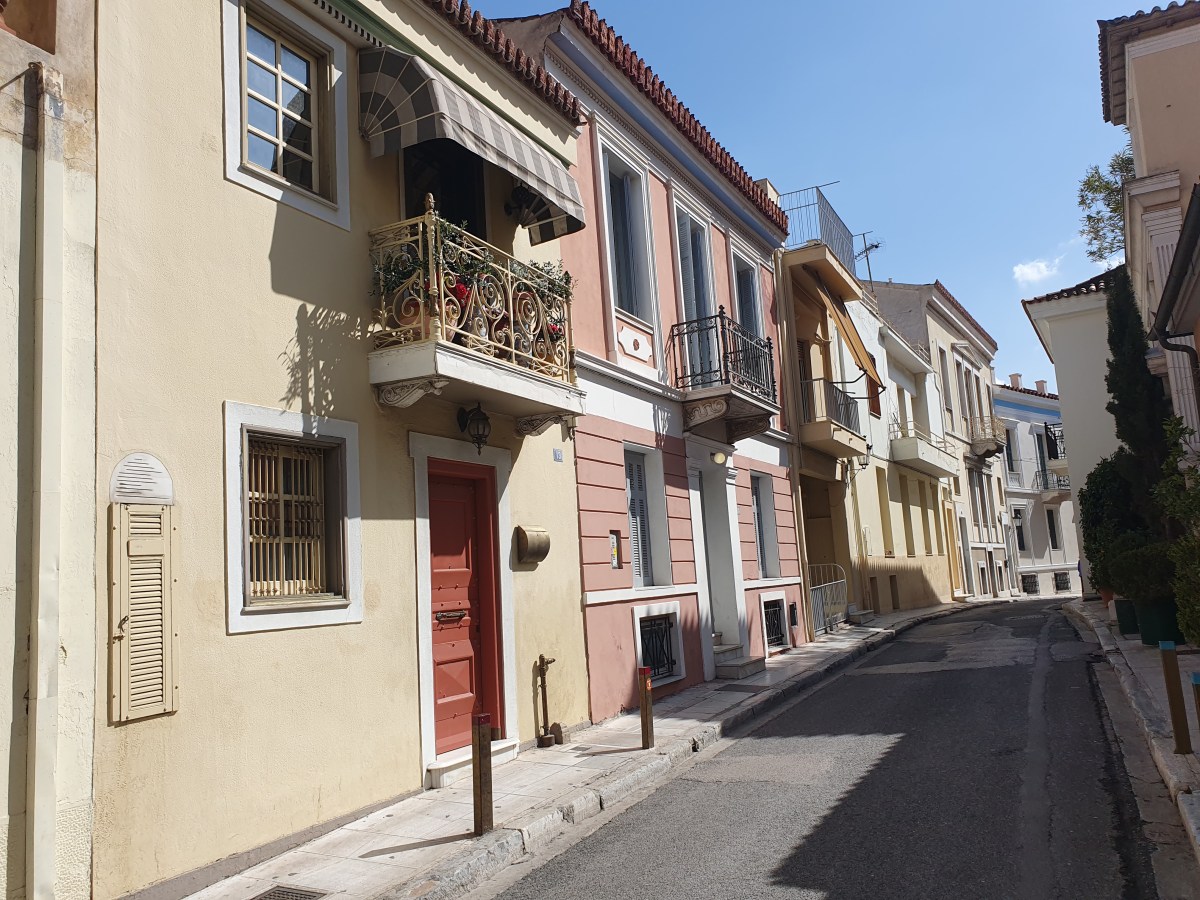
As we suspected, when we rode the Metro a couple of stops to Akropolis the next day, we found a neighborhood largely graffiti-free. The authorities appear to spend their energy keeping the touristy areas clean, rather than concerning themselves with a zone that is full of residential buildings, coffee shops, bars, restaurants, and small shops, not to mention the supposedly leftist residents.
Exarchia neighborhood Acropolis neighborhood
Though there are green spaces to walk to, Athens doesn’t boast a lot of parks. Exarchia Square is tiny for all the uproar it has generated. Other nearby squares would barely be considered parklets in the US. Omonia, the large square nearby with our closest Metro stop, consists of a fountain ringed by a strip of grass. There’s not anyplace to walk, other than the usually crowded sidewalk.
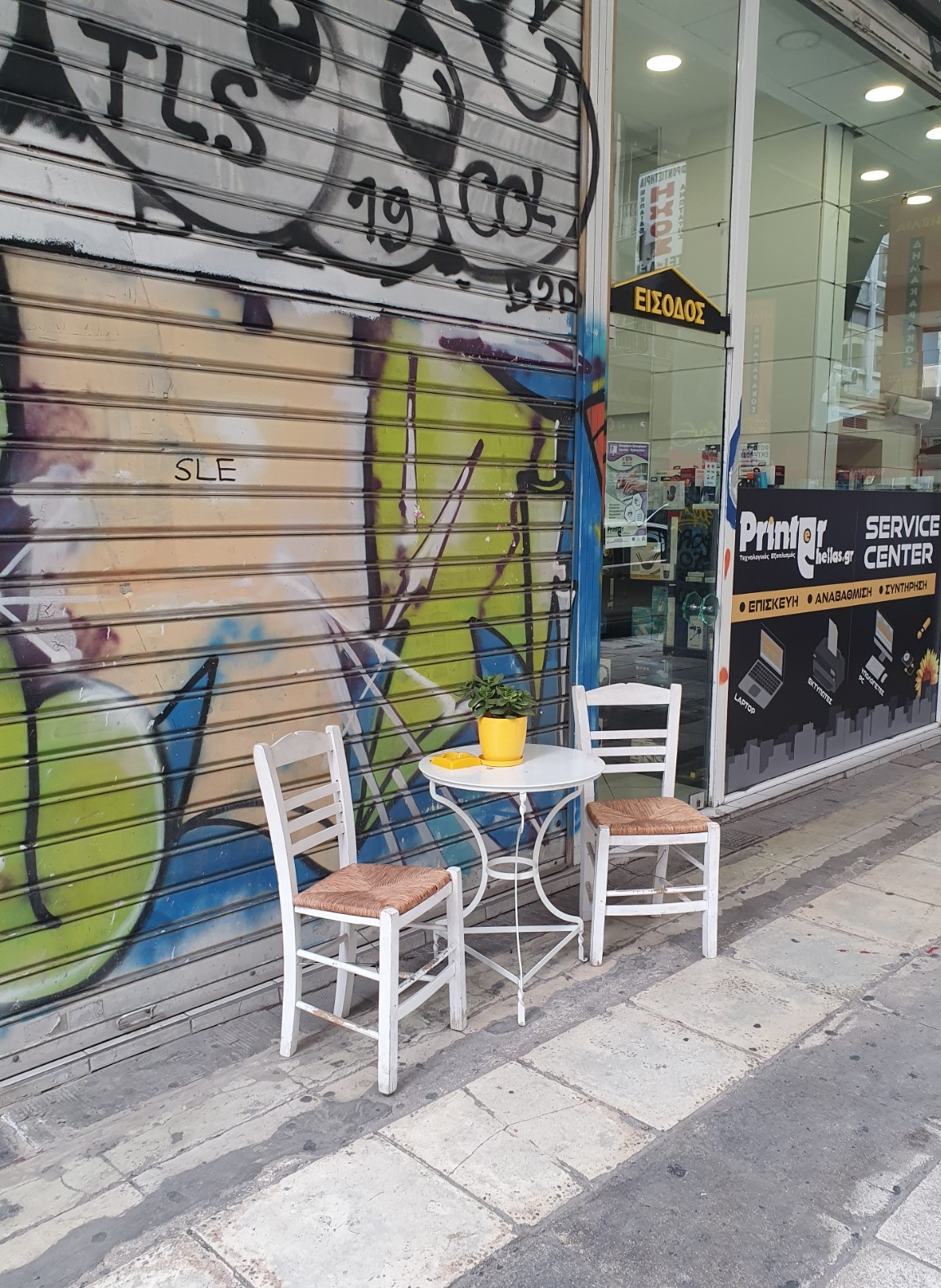
The dearth of parks is perhaps made up for by the number of coffee houses and cafes. Every block has a cafe of some sort, from dark wood facades with elegant tables and chairs, to a cafe constructed entirely from Coca Cola crates. Everyone seems to have a regular hangout. When the Lonely Planet guidebook said that Greeks aren’t much for breakfast unless you mean coffee and a cigarette, I laughed, thinking that had to be out of date. It’s not.
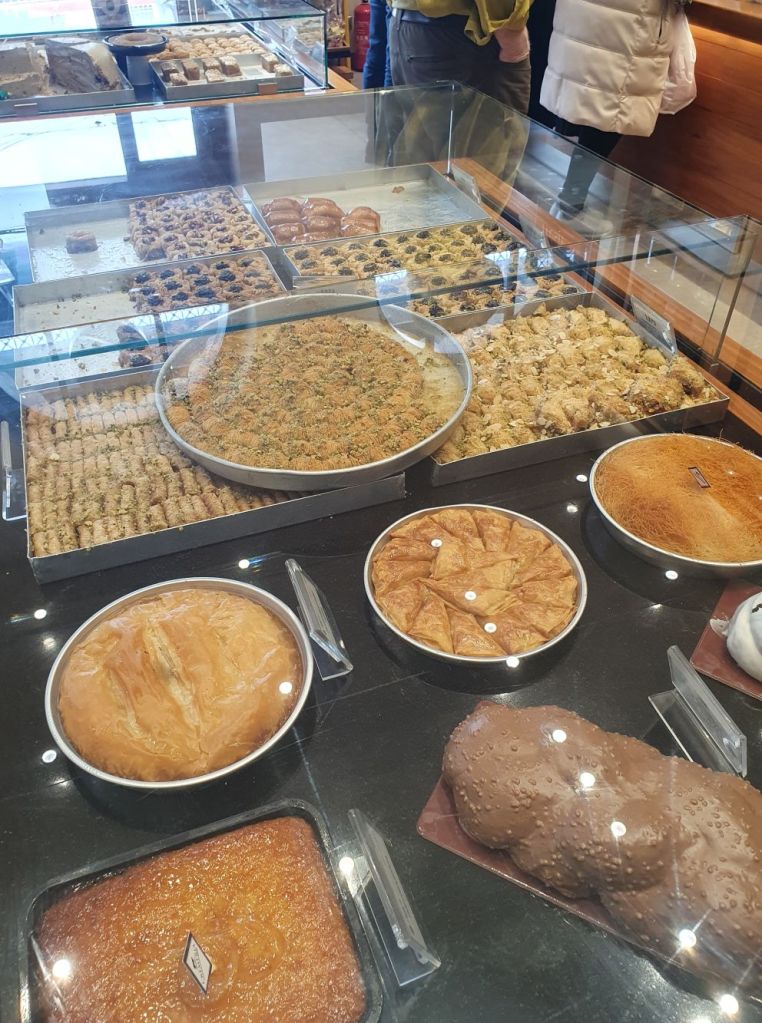
For those of us who don’t survive on Turkish coffee or cold brew, Greek pastries full of nuts and soaked in honey are everywhere, too, and delicious. My breakfasts may not be especially healthful, but they are deeply satisfying (I do also eat some of the delicious Greek yogurt; I’m not living exclusively on sugar.)
Exarchia may be a neighborhood filled with turmoil, but in between events, there are plenty of corners where you can sit at a table, sip a coffee and nibble a delicious pastry. Just make sure to head home if someone wearing a gas mask walks by.
I am old enough to remember Melina Mercouri, famous Greek actress. She is best known to Americans as the star of Never on Sunday, for which she won the Academy Award for Best Actress in 1960. Mercouri is remembered for her political activism and as the first female Minister of Culture and Sport, a post she held for eight years.
In her honor, March 6 is now Melina Mercouri Day, celebrated as a free day at all public museums and monuments in Greece. School groups visit the Acropolis, the Acropolis Museum, the National Museum. There are students and families visiting at every cultural site, on this day. We saw a lot of them.
Not knowing anything about the significance of March 6 in Greece, we set out on the lovely sunny morning for our first visit to the Acropolis. The subway seemed full, and we saw classes of students waiting on the platform. No matter, we forged on to the Akropoli stop and found the ticket line for the Acropolis. It was huge. We looked across at the line for the Acropolis Museum, also very long. A dejected tour guide sitting on the curb looked up and said, “It’s free today. Melina Mercouri Day,” then turned back to her cigarette.
In honor of the hundreds of people enjoying free entrance to the Acropolis, we decided to visit tomorrow, to avoid the crowds. We ambled back along the streets toward home, taking a detour to visit the Athens Central Market, the Varvakios Market. We stopped for lunch at Igeios, a small restaurant without a menu, a taverna where you look at what they have cooking, make your selection and out it comes. We noticed that many people were in and out in about ten minutes, downing a big bowl of soup and heading out the door. We shared a baked fish and a Greek salad that was plenty for both of us.
We stopped at the supermarket (Bazaar is a chain in Athens), and picked a few things, then headed home. It was already after 3 pm, and we were ready to stop walking. We celebrated Melina Mercouri Day a little differently than others might have, but we’ll remember it.
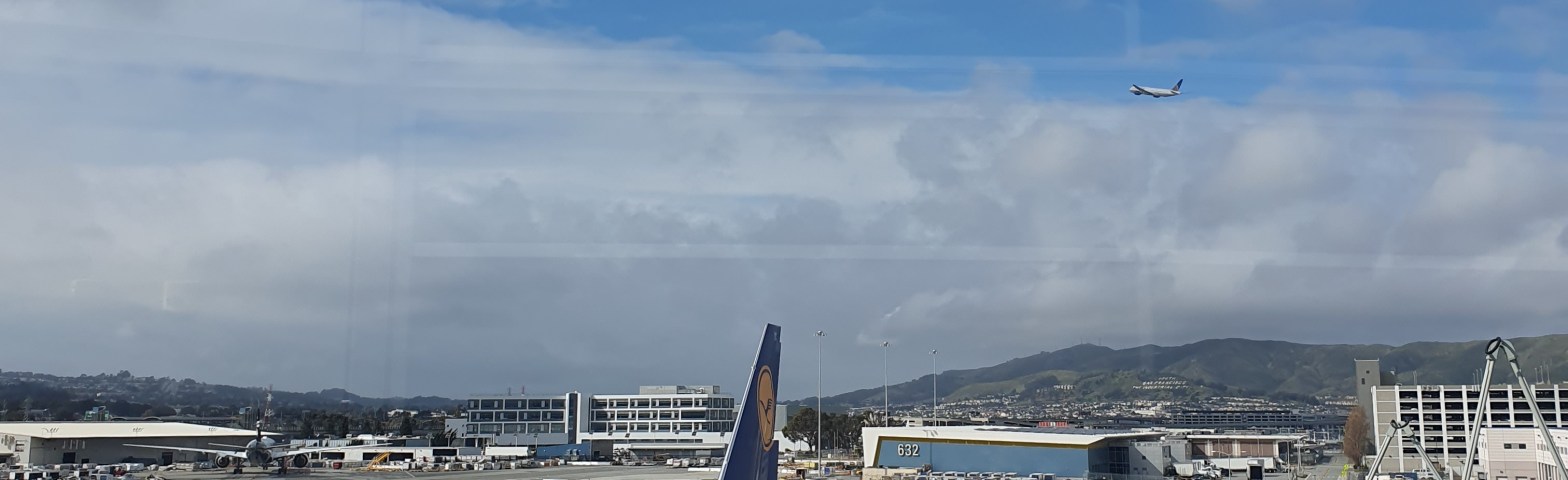
We arrived in Athens after as seamless a journey as possible. It’s a long way from Eureka, and we were glad to have made the hop from the Arcata-Eureka airport to San Francisco on the day before our flight. Our long leg went from San Francisco to Frankfurt, Germany, when I stopped looking at the time, as it didn’t seem to mean much. After whizzing through passport control in Frankfurt, we waited for about an hour and then boarded for Athens. Upon arrival, we collected our bags and walked through an unmanned Customs post. Welcome to Athens. Despite the smooth trip, it still took about 20 hours, from 2:40 pm in San Francisco to 4:30 pm the next day in Athens!
There is a taxi stand at the Eletherio Venizelos Airport, and we made our first minor error there. Always confirm the price before you put the first suitcase in the car! We were very tired, and happy to be on the last leg of our voyage, so we loaded up and got in and then pestered the driver about price. It’s a flat rate, and we’d already been advised not to chip in for tolls or suitcases or anything extra. Still, we paid 45 E rather than the 40 E we heard was the going rate. When I asked “When did the rate go up?” our driver chuckled. Still, we were in a cab on our way to our Airbnb, and it was worth almost anything to be done traveling. We counted ourselves lucky.
One of the difficult points of traveling from the US to Europe is getting communications set up at arrival. There is a moment when your new phone chip hasn’t been activated (or purchased!). If you use your US phone, the international plan has to appear on your phone and function. We decided to get Jonathan a data plan through our US provider, US Mobile, so we’d have a US number this month. I am getting a Greek SIM card, but I don’t have it yet. Arriving at our Airbnb, we had a familiar problem. We’d agreed to contact our host with WhatsApp, but Jonathan’s data plan didn’t seem to work yet. There we were on the doorstep of our building, with instructions to ring the 6th floor apartment, but there were four buzzers. Just as we were about to begin ringing all our neighbors in search of our host, the buzzer woke up and a voice said, “Hello?” It was our host, wondering whether we were arriving.
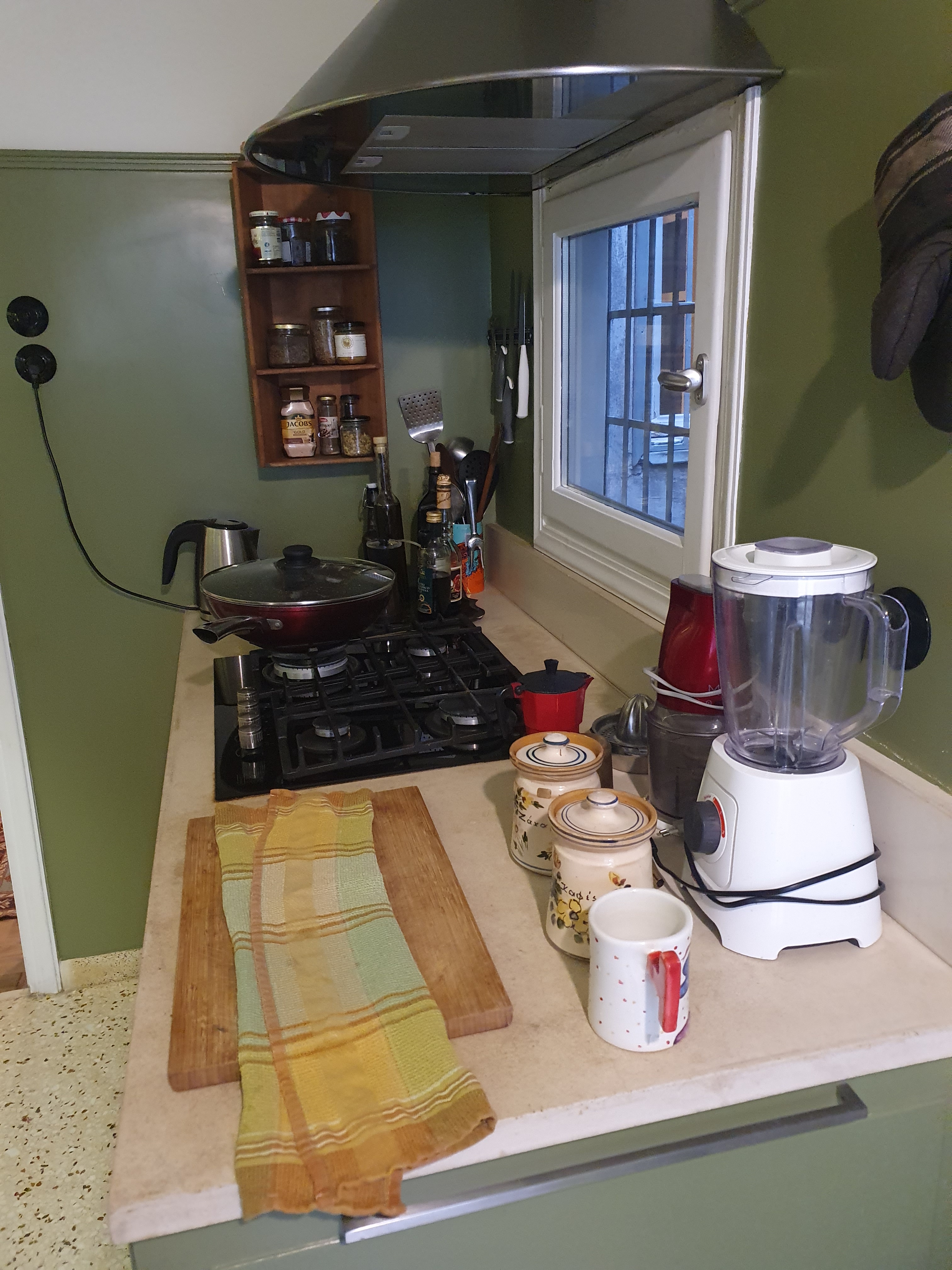
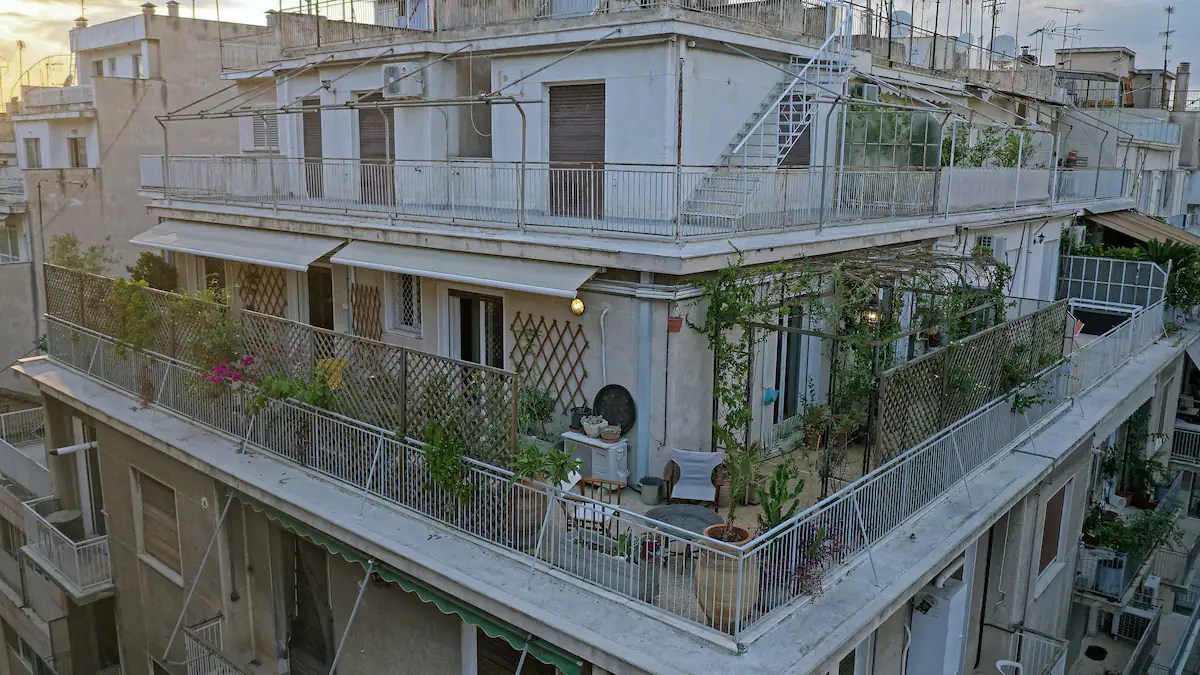
We rode the tiny elevator to the 6th floor. We got the grand tour, instructions on heat & AC, stove & oven, keys & doors, trash disposal, and shopping. We can always text our host questions now that we are logged in to the apartment’s wifi. All is well. We sat to decompress while I drank tea. We nibbled a few things and went to bed.
I woke up feeling much better, ready to take a shower, make coffee, and get the new day going. As I began to throw off the covers, Jonathan murmured, “You’re not getting up, are you? It’s 11 o’clock.” I’d only been asleep for two hours. I was startled, but after pondering the flexibility of time for a minute, I turned over and went back to sleep.
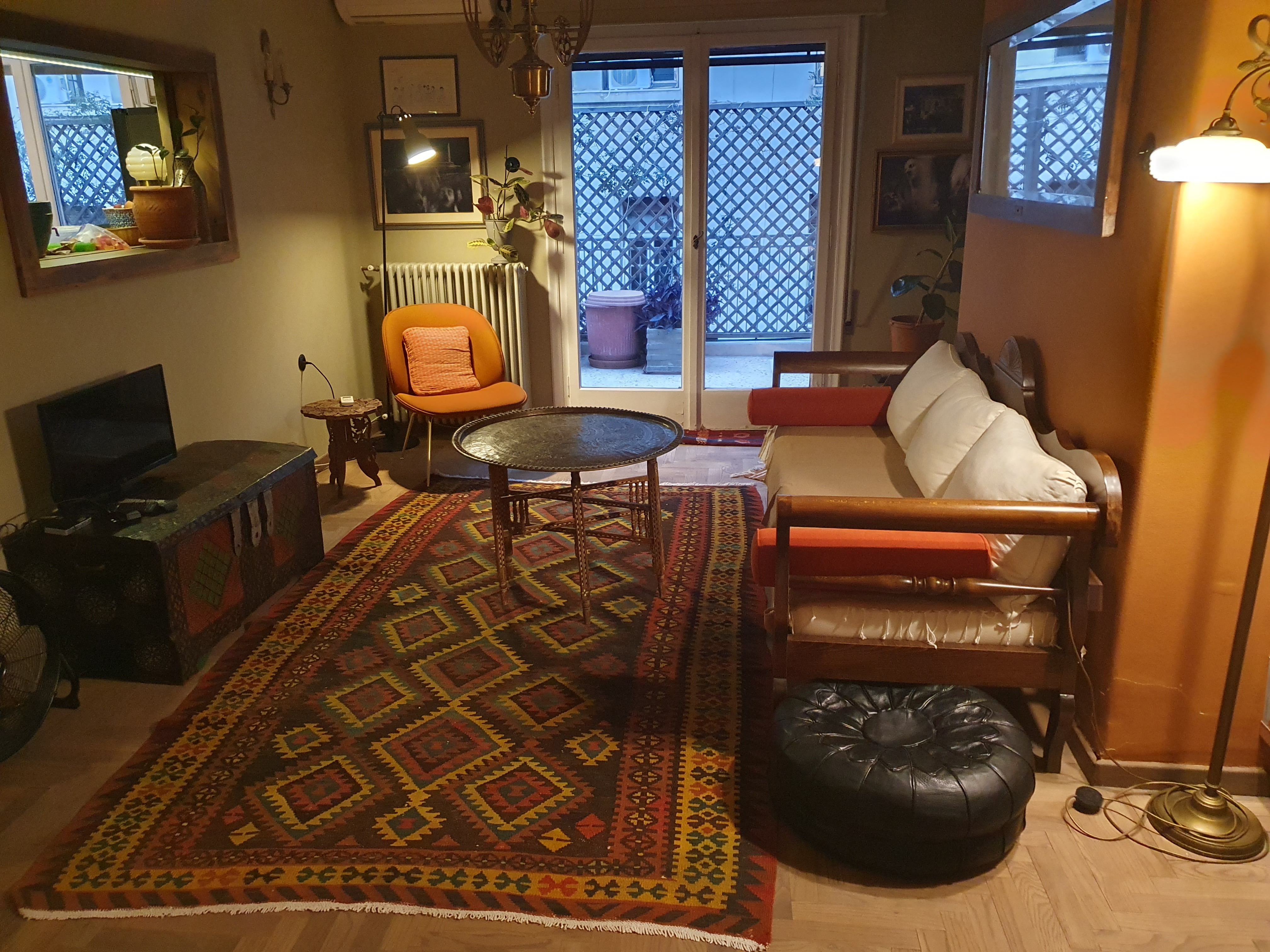
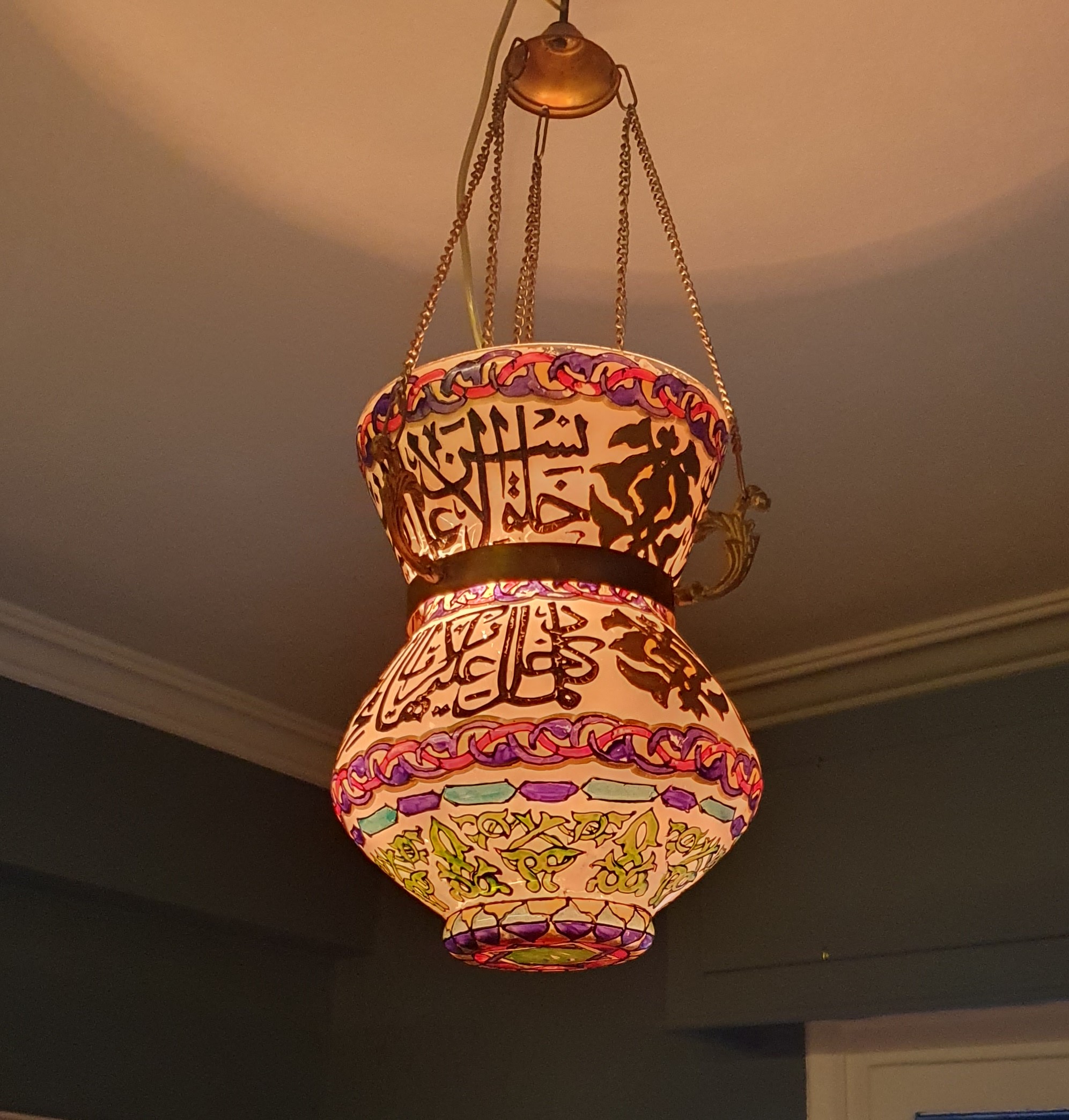
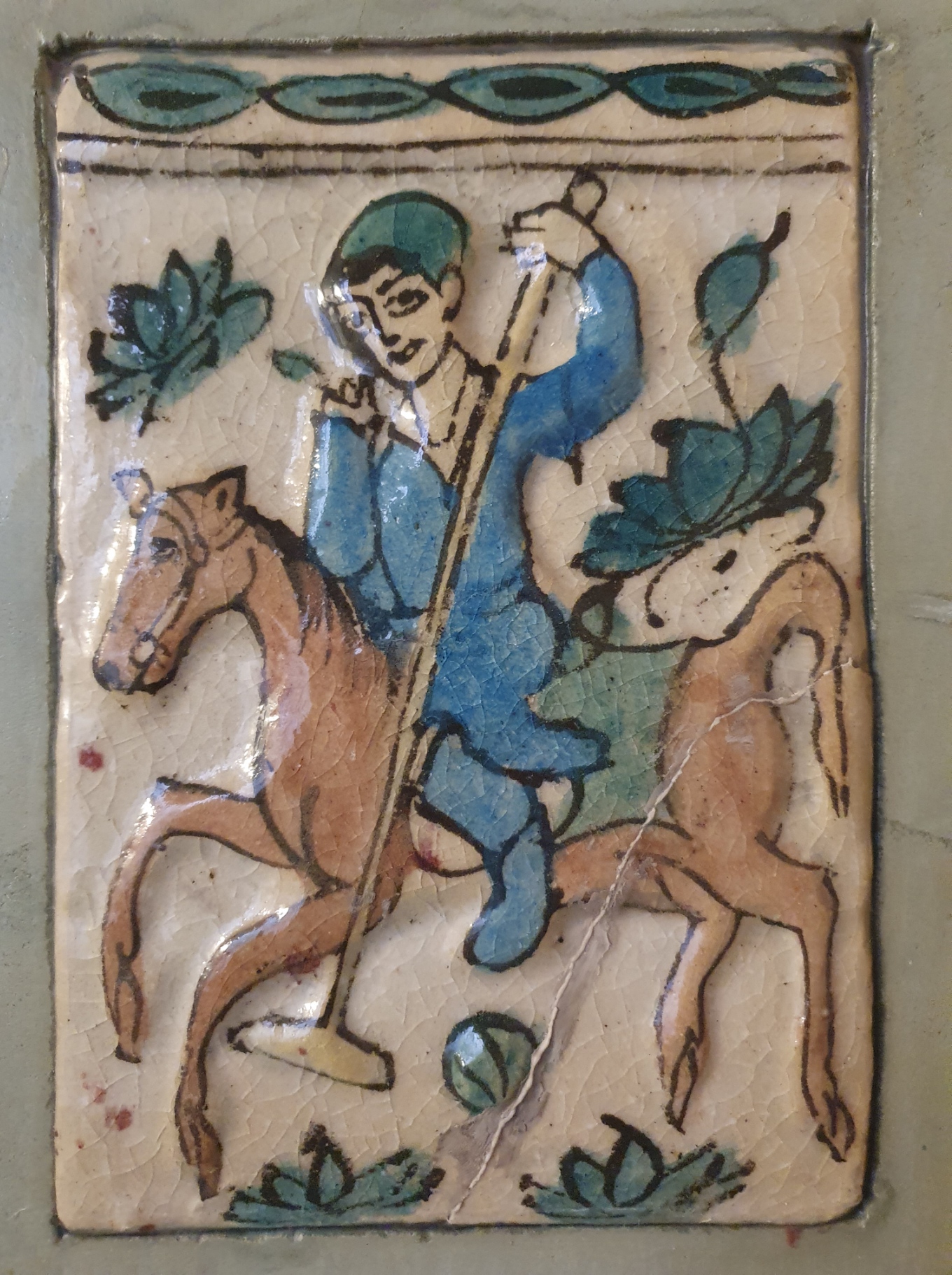
The next day, we set out to equip our new home with food before we fell asleep from jet lag. I began to notice our interesting decor from our host’s travels in Afghanistan, Iran, and North Africa. It is wonderful to have such lovely lamps and rugs and furniture around us. When you get a good Airbnb like this one, you get to experience a different environment–we’re borrowing this exotic setting for a while, and enjoying it very much.
I’ve been using Duolingo to learn a bit of Greek. It’s been fun to learn the letters and how to read the words. I am SO SLOW at reading, though, I don’t think I will be able to do more than say please, thank you, and where’s the bathroom.
I have learned a number of interesting words that are the same in English and in Greek, like “toast”, “avocado”, “coffee”, and “drama”. Who knows when they might come in handy?
On the bright side, friends who’ve been to Greece point out that most people there speak English, and it is not difficult to communicate. We have an Airbnb in Athens for the month of March and are looking forward to visiting the Parthenon and lots of other ruins. We plan to spend the final portion of our visit on an archaeological tour of the Peloponnese, visiting Sparta and other landmarks of ancient Greece.
Along the way, I expect to do some beachcombing. The shore of the Mediterranean has been home to human settlement for a very long time, and people have been losing things in it for that entire span. I hope to find some interesting beach glass.
Let me know if you have suggestions of what to see and do, especially in Athens!
Eureka is known for Humboldt Bay, yet the entrance to the huge, shallow bay was so narrow that it was not recognized by Spanish and Russian explorers sailing up and down the Pacific coast of North America in the era of European exploration.
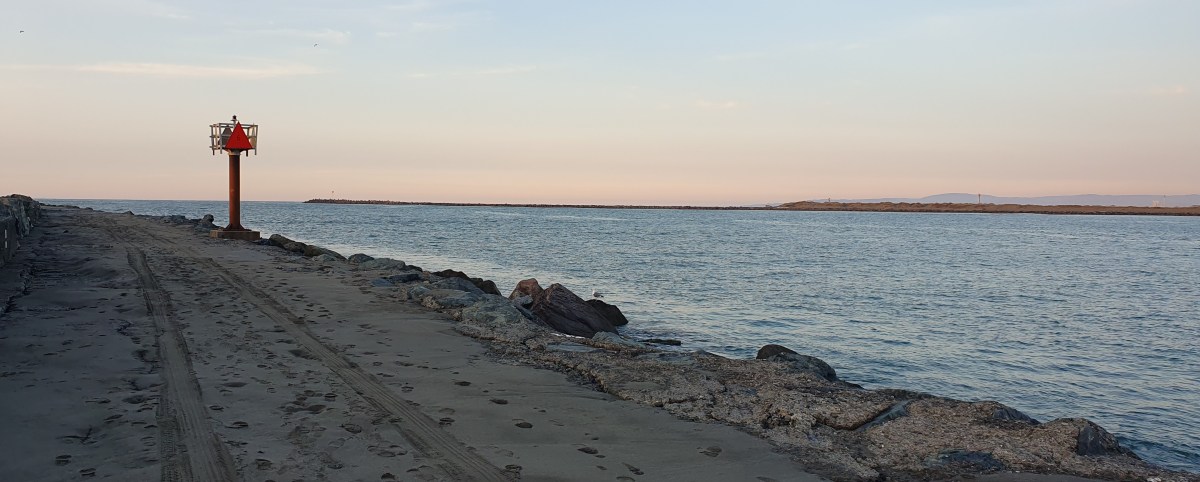
Looking out to the Pacific over the channel that connects Humboldt Bay to the ocean.
The channel between land and sea was discovered by Josiah Gregg and companions, traveling from newly discovered gold fields inland, looking for a likely port. Between early November 1849 and Jan 1850, the explorers made their way on horseback from the mountains to the coast, emerging at what is now Trinidad. The group arrived on Humboldt Bay in December, after a difficult time making their way south along the coast, and there they identified the channel connecting the bay and the sea. Along the way, the explorers gave the rivers the names we use today (Little, Mad, Elk, Eel, Van Duzen). Eventually quarreling, half the group followed the Eel River to the east and home, while Gregg and the others continued south along the coast. Gregg’s group eventually turned back, but weakened by starvation, he died along the way. The surviving explorers shared the bay’s location, and the first American ship entered Humboldt bay just months later.
Since those early days, travel has followed waterways. The main highway into the area, Rte. 101, was completed in 1923. It follows the South Fork of the Eel River, just as the survivors of Josiah Gregg’s expedition did in 1850. It was a very long drive from San Francisco to Eureka until the Golden Gate Bridge was completed in 1937.
In the Eureka area, Myrtle Ave. and the Old Arcata Road run along the base of the hills at the edge of the coastal plain, for a good reason. Initially, all the level land around Humboldt Bay, from Arcata to Loleta, was tidal marsh. Rivers emptied into the ocean, but not until they’d looped back and forth across the low land at the edge of the bay, a mirage of land perched on the water.
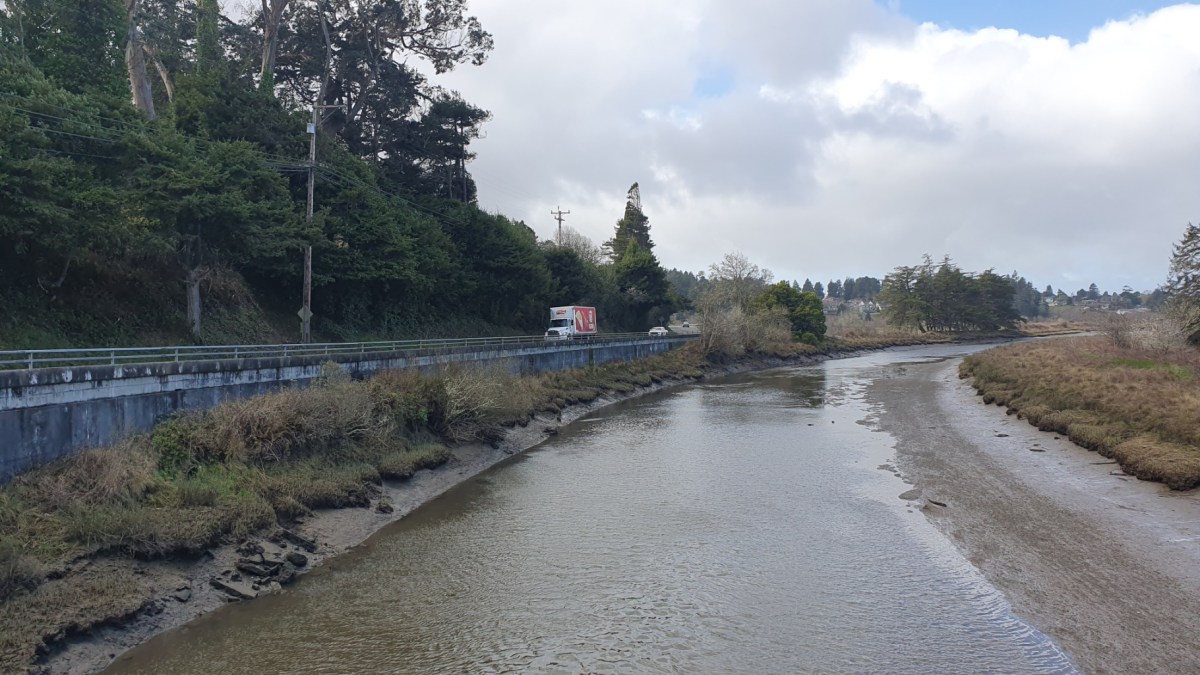
Myrtle Ave., sandwiched between a creek and the foothills.
Nothing was solid, yet an attraction of Humboldt Bay was the open land around it. First settled as a port for gold miners, and then the lumber industry, businesses needed docks, wharves, and warehouses. Land was created by dredging and filling in the marshy shore, turning the watery plain into dry land.
Cattle grazing on drained and filled pasture, formerly coastal wetland. Myrtle Ave. runs along the back of the field at the base of the hills.
The isolation of the region from the rest of the country, and the cost of importing food by ship, fostered both cattle ranching and farming. Many people who moved west during the gold rush found a better life farming or ranching than working in mines. Almost all the level land around the bay was drained and dry by the mid-20th century. As access to the area increased, more and more drained land was used for housing rather than fields and pastures.
Climate change is also making people rethink the boundary between land and water. After many years of drought or near-drought, winter 2022-2023 brought heavy rain, and though all that rain heads to the ocean, it doesn’t get there right away. Any remnant of low-lying land becomes a shallow pool, harking back to the pre-European swampy channels that made up the coastal margin.
Herrick Rd. pasture now returned to tidal marsh.
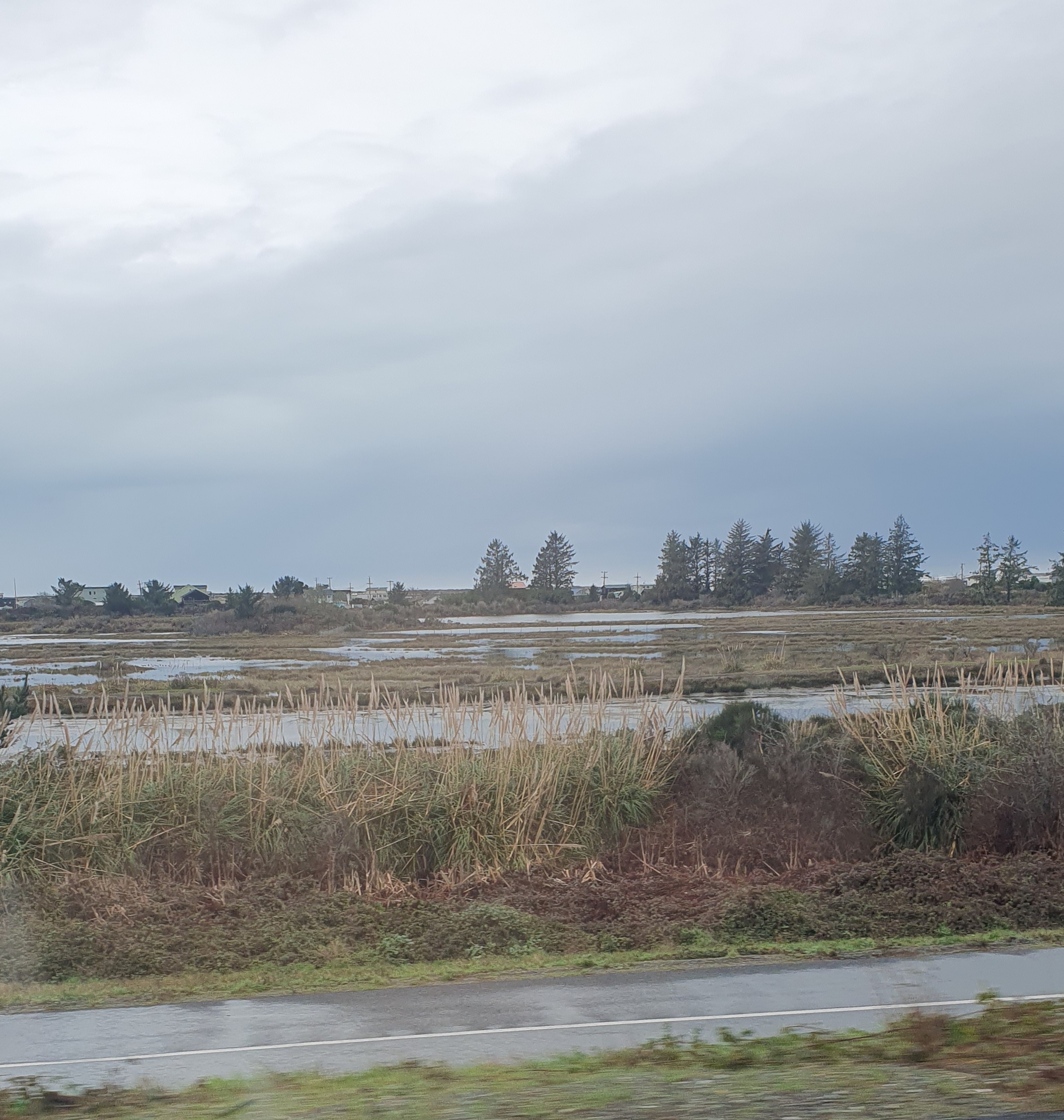
County planners are working to convince farmers and ranchers that more draining will not fix a problem that has no solution, but change proceeds slowly. In 2022, a parcel of about 95 acres of cattle pasture adjacent to the coast was given to the county. The animals were moved, and heavy machinery carved channels along low spots. Two culverts through the old railroad embankment reconnected the ocean with the channels. We happened to go for a walk in this area the week before the transformation began, and we’ve been amazed by the rapid change from cattle pasture to tidal flats. We’ve driven by recently when the entire area looked like a lake, though when the tide is out, the area has large grassy hillocks. Shore birds congregate in the shallow water. This is not the only place where the conversion of pasture and farmland back to tidal marsh has taken place, though this is one where the change is intentional. Patches of land around the bay have been converted as one group or another converts drained land back into marsh, the wave of the future.
As more rain falls, and as sea level rises, watery change will affect more land, whether it is prepared to become tidal basin or not. Hwy 101 turns north directly across marshland between Eureka to Arcata, and now the road occasionally floods. Myrtle Avenue and the Old Arcata Road, long ago superseded by Hwy 101, may become important all over again, as everything between the hills and the ocean may one day be reclaimed by the sea.
The sun, moon, and earth are aligned only at the new moon or the full moon. When this happens in combination with the earth’s closest approach to the sun (winter) the gravitational effects of all these bodies are combined and produce king tides. The high tide is above normal levels, and the low tide as low as it gets. This year there are two king tides in California, December and January.
We made plans to go to Mendocino during the January king tide to do some beachcombing. We love Mendocino and were happy to have a reason to visit. Our plan was to drive down on Friday, stop to walk on the beach before low tide in the late afternoon, then continue on to our B&B. The next day we’d return to the beach in the afternoon, because by low tide at 5:45 pm, the sun would be down and the sky losing light. It’s difficult to beachcomb in the dark. Some London mudlarks use headlamps and go out in the dark, but it’s not for me.
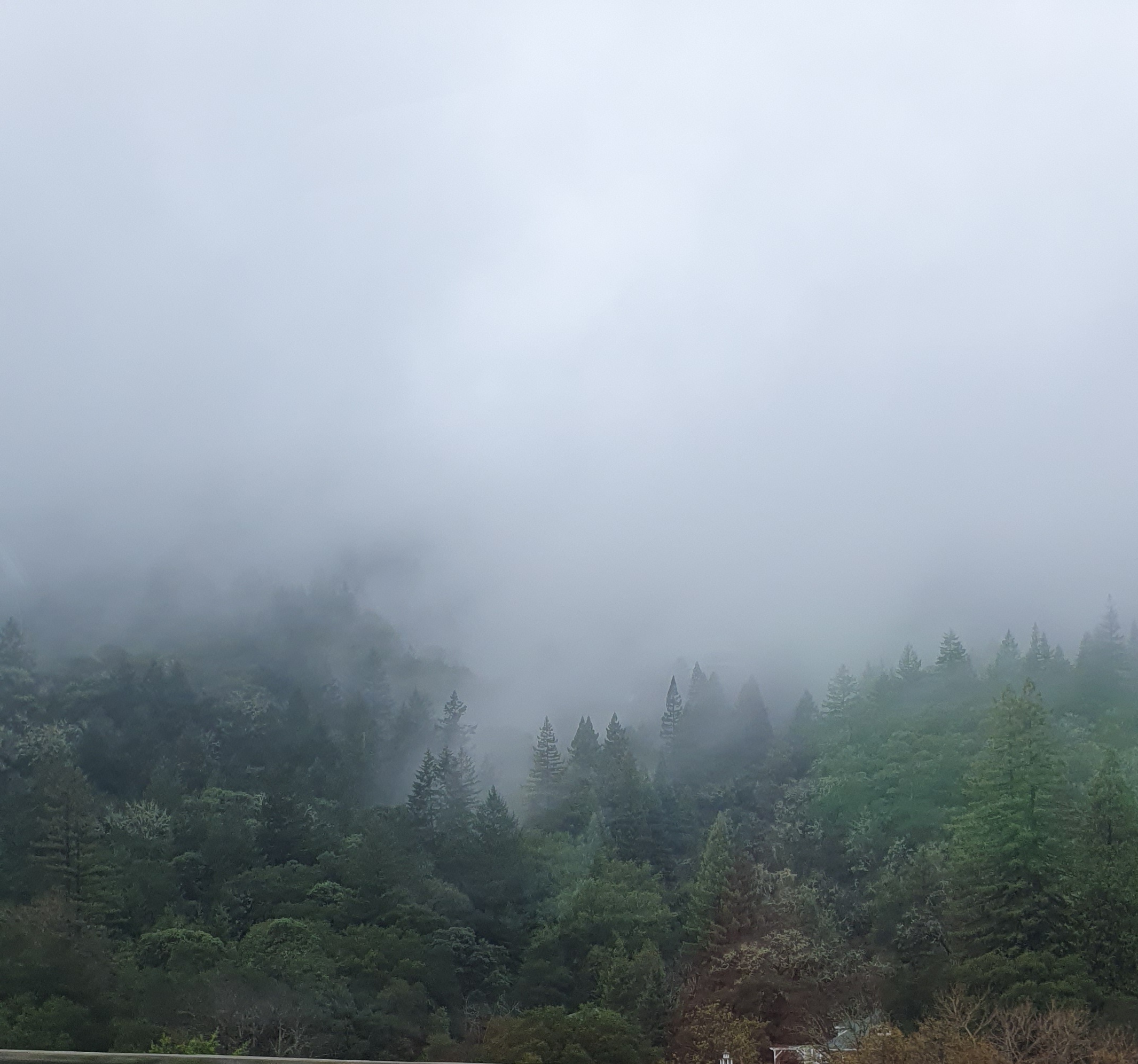
We drove south from Eureka, watching the mist rise from pockets in the hills. In Ft. Bragg we had lunch at Mayan Fusion, cochinito pibil, Mayan roast pork, served shredded with black beans and home-made corn tortillas and spicy salsa. I haven’t had home-made tortillas in ages, and they are so much better than anything you can buy at the store. It was the perfect lunch.
We were ready for beach combing and headed to the parking lot at Glass Beach then walked south. We could see people collecting beach glass all along the shore, but there are no stairs to the beach (about 50 ft below), and we had to find a place we could manage the climb down.
Though the tourist site is Glass Beach, there is a lot of beach glass along the rocky shore. The extra low king tide made it possible to see a bit more of the beach than usual. I focused on finding nicely frosted and fully rounded pieces of glass that can be used in my jewelry projects. Jonathan did the same. He has a mesh scoop on the end of an adjustable stick that lets him pick things up without having to bend. At the end our our outing, I’m sure I was more sore from crouching down and leaning over to pick pieces up than he was from scooping.
We left the beach around sunset and went to our hotel. For a short stay like this one, we didn’t get an Airbnb, but stayed at the Seagull Inn Bed and Breakfast. It’s right in Mendocino, which is a tiny town, and that meant we could walk everywhere. We emptied out our pockets and looked at our finds.
We went to dinner at Luna Trattoria, just around the corner, and had a delicious appetizer of polenta and mushrooms. We each had pasta as our main dish, mine with clams and Jonathan’s with sausage. The service was slow, but the food was good. We ended by sharing a tiramisu, a very good example of the genre.
On our short walk home, we realized that Mendocino has very few street lights and the sky was darker than we’ve seen in quite a while. The night was cold and clear and the sky was breathtaking, bright constellations everywhere, and thousands of stars. Orion was high in the sky, and we could see its stars clearly, down to the knife hanging from Orion’s belt. We stood and stared, enjoying the stars in the dark heavens.
Saturday morning after breakfast, fresh fruit yogurt parfait with home made granola, and excellent coffee, roasted in (relatively) nearby Santa Rosa, we went down to the local beach at Big River, on the south side of Mendocino. There’s a lot of driftwood on this broad beach at the river mouth. Back up the stairs, we walked a section of the shore to watch the waves. It was a sunny, clear day, absolutely beautiful. We stopped for lunch at Flow. It took a while to get seated, but the food was excellent and the service was good. I had a fried green tomato salad with a soft boiled egg on top. Jonathan had Korean tacos. It set us up for the afternoon of beachcombing.
We got back to the beach in Ft. Bragg after 3 pm, and walked a bit further south than the previous day. There was a broader range of colors in this section, but the pieces were quite small. We picked up less than on the previous day, though I now have a good quantity of material for making jewelry.
Once again, there were people collecting glass in every nook and cranny of the beach. We made our way down the steep slope, and stopped to talk to a mother and daughter who were about to leave. They live near the beach and come down to beach comb regularly. They didn’t seem to have any objection to people collecting, as that was something they enjoy themselves.
There is controversy over whether people should collect beach glass from the area around Glass Beach. We chatted with a man who calls himself Retired Ranger Rick. He answers questions about the glass deposit that has made Ft. Bragg famous, and answered one long-standing question of ours. Why aren’t there more places like Glass Beach, with a thick layer of waterworn glass? People say Glass Beach is where the city dump used to be, right along the beach, but other places had similar dumps, yet there are only one or two other “glass beaches” in the entire world.
It turns out there was a bottling plant in Ft. Bragg in the early 20th century that went out of business in the 1940s. Everything left at the plant was dumped on the shore, in the city dump of the time. Ranger Rick said that at one point the pile was about eight feet thick. Ft. Bragg’s dump had much more glass piled into in than the average landfill, especially now that a lot of glass is recycled and doesn’t get as far as landfills.
I did a little bit of reading, and the California law that protects coastal access makes it virtually impossible to prohibit glass collecting along the tide line. Anything below the mean high water mark is public land. Access cannot be prohibited, and it would be very difficult to keep people from picking up glass. There is a sign that asks people to leave the glass on Glass Beach, and to ask others to do the same. The steps to the beach have been removed since our last visit, probably to deter visitors. There are still many people who visit the beach to collect glass every day. During the summer months, there can be over 1,000 visitors to Glass Beach each day. No wonder the deposit has thinned out.
We emerged on the bluffs just after sunset and were startled by the beauty of the sun’s afterglow. We had a complete 360o view of the horizon and the sky changed color all the way around, from lavender, pink, and pale blue in the northeast, through pale blue, streaks of yellow and orange by the setting sun and more golden and peach colors over the ocean. We rarely see the entire sky lit up all around us so impressively. By the time we actually left, it was cold out and I insisted on stopping for a cup of tea to warm up–it really hit the spot.
Dinner our second evening in Mendocino was at Trillium, another short walk from the Seagull Inn. The food was delicious. I had shrimp and risotto, while Jonathan had short ribs. We have different tastes in wine. Our dessert was toasted chocolate babka with coffee ice cream. It was the most interesting thing on the menu, and I was curious after having made a chocolate babka a few months ago. It was unusual and delicious. As we ate our dinner, we struck up a conversation with the couple next to us who live in Santa Rosa and had suggestions about restaurants to try when we are there on one of our monthly visits.
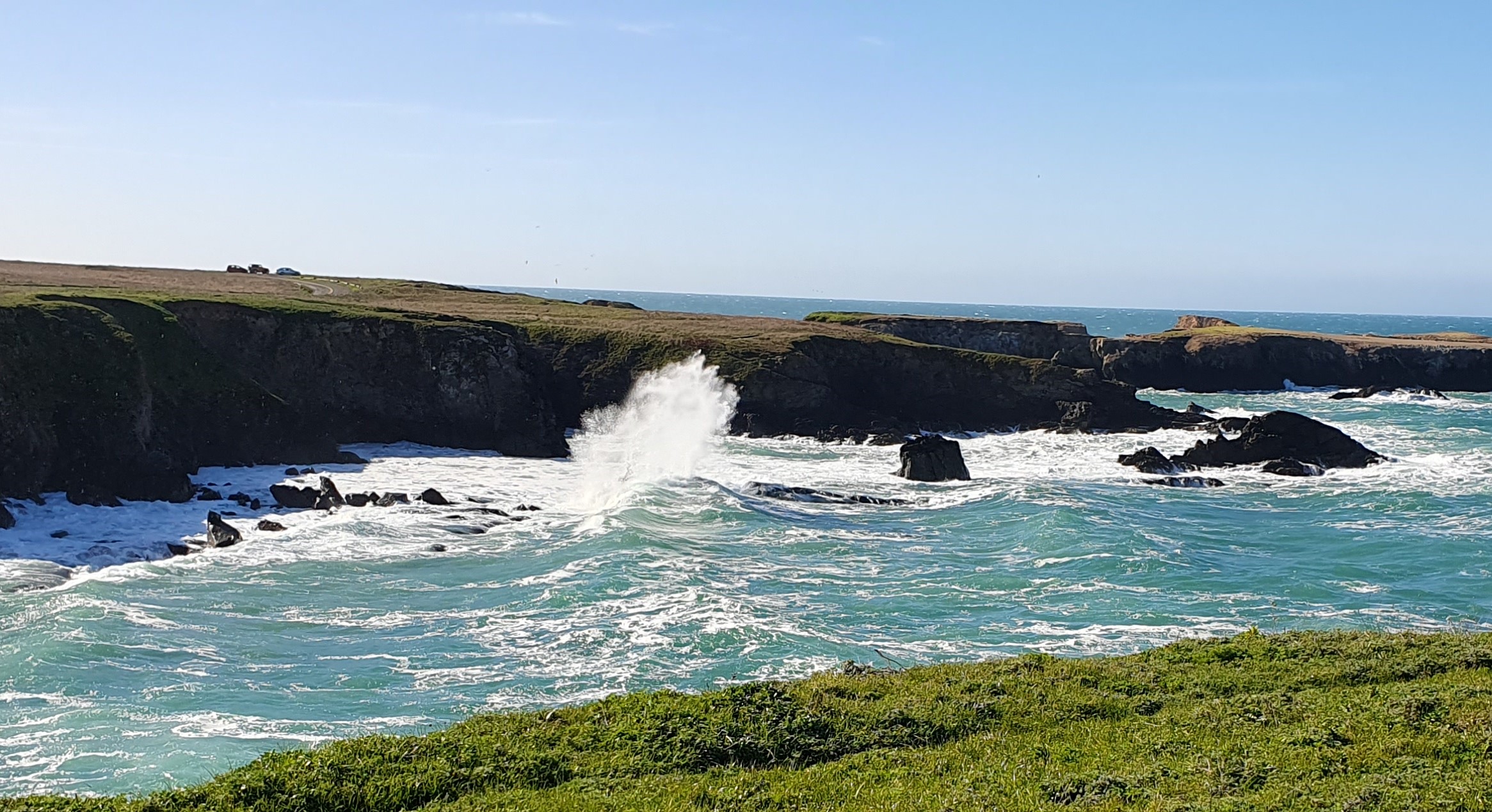
Rough waters off Mendocino Headlands
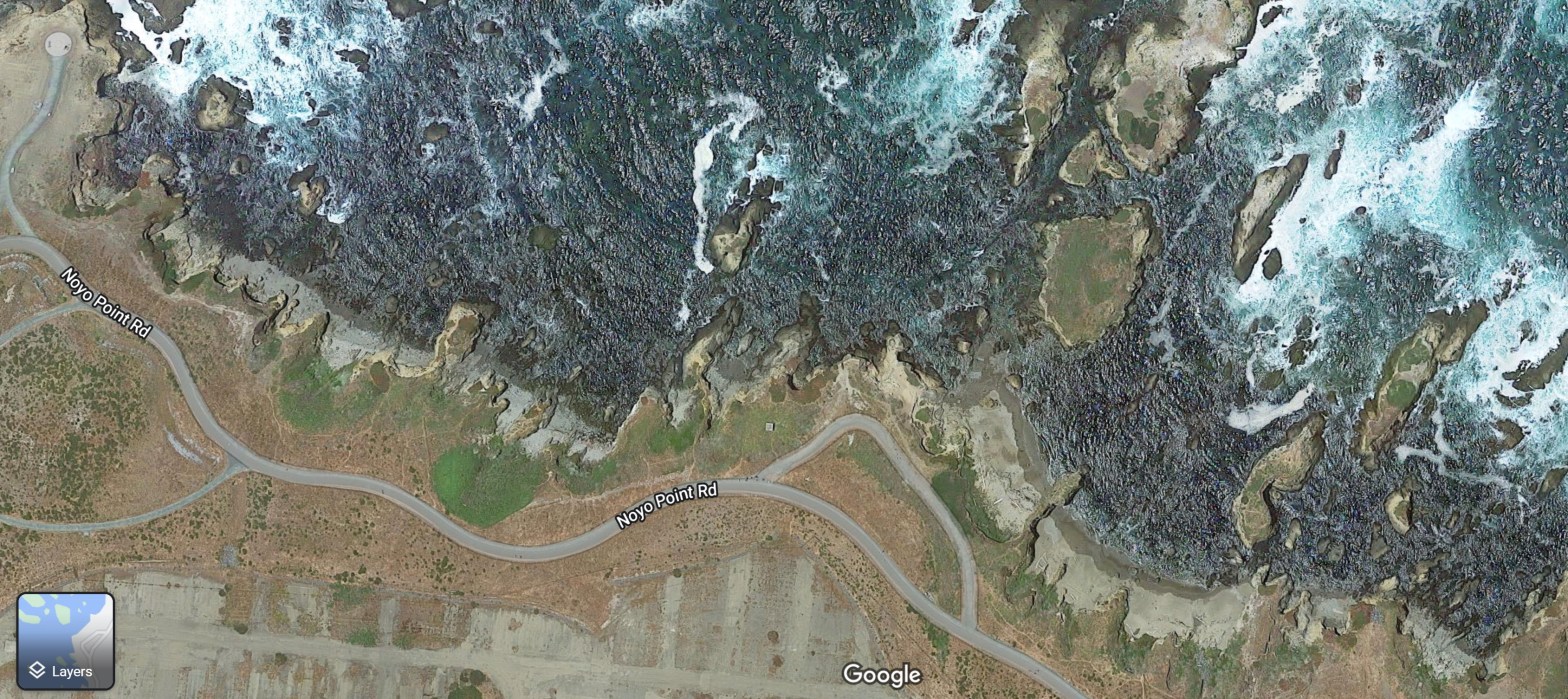
Sunday morning, we were served crustless quiche, and bread from the local Cafe Beaujolais with more good coffee. We didn’t plan on any more beach combing, as low tide would be after dark. We walked the Mendocino Headlands trail around the west and north sides of town. It was bright and sunny, but cold and windy. We were glad to have our layers. We stopped at several places to watch the ocean. An occasional whale spouted, but there were so many whitecaps it was difficult to spot them. The surf was very rough, making the water among the inlets and sea stacks boil with white foam. We were happy to be on the bluff safely above the ocean. At the far end of our walk we stopped on a point where the breaking waves below us showered us with mist. When the sun caught the mist, rainbows flashed in midair. It was a beautiful end to our walk.
From the headlands, we stopped at the Mendocino Art Center to look at the current exhibit. There are a lot of talented people in this area, and we enjoyed looking at the painting, sculpture, ceramics, glass, and jewelry.
It was time to head home to Eureka, so we turned north to Ft. Bragg, making a stop at Cow Licks Ice Cream. They make a wide range of flavors, and I had to try some. I think every flavor is delicious, though I have no plans to try their mushroom ice cream.
We made good time getting home, only waiting at one spot on Highway 101 that is partially blocked while a serious landslide gets fixed. We could see the big crack in the hillside where the land slipped.
I’d forgotten to take my UV flashlight with me to Mendocino to examine all my glass to see whether any was fluorescent. Back at home, I found a few fluorescent pieces in different colors. The yellow comes from uranium, but the red-orange color was new to me. I believe it is from manganese in the glass. I’m keeping all my fluorescent pieces separate until I have enough to make a fluorescent necklace. (And no, the pieces don’t give off a harmful level of radiation.)
Now that we’re home, I already miss Mendocino, the rocky coast, beautiful walks, stars at night, and the beach combing. Maybe we’ll visit again next winter.
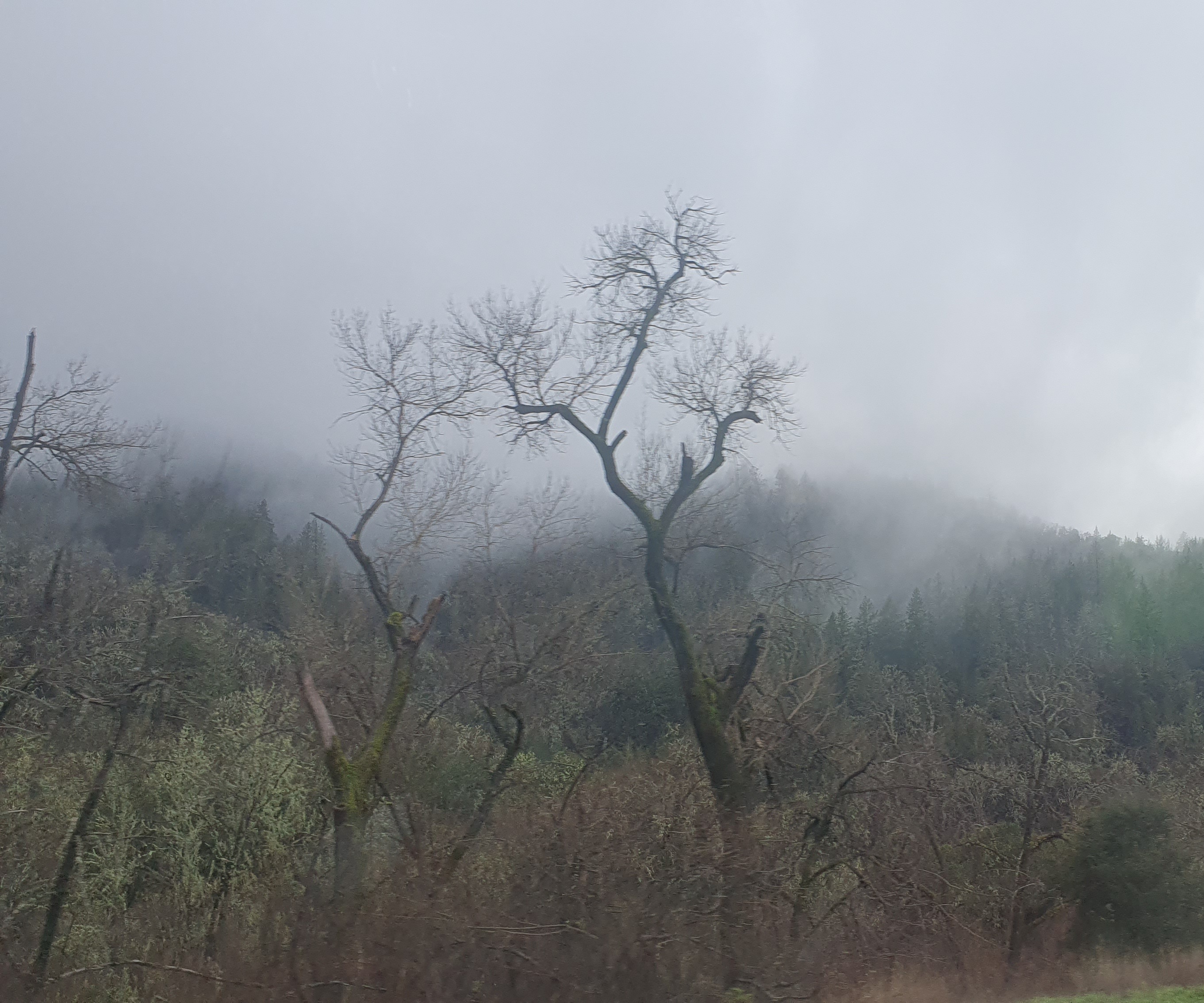
I wouldn’t have driven all the way to Santa Rosa from Eureka (150+ miles) without a good reason. My doctor’s appointment could not be put off, and Jonathan did most of the driving. I took advantage to stare out the window at the mist and rain and take a lot of photos.
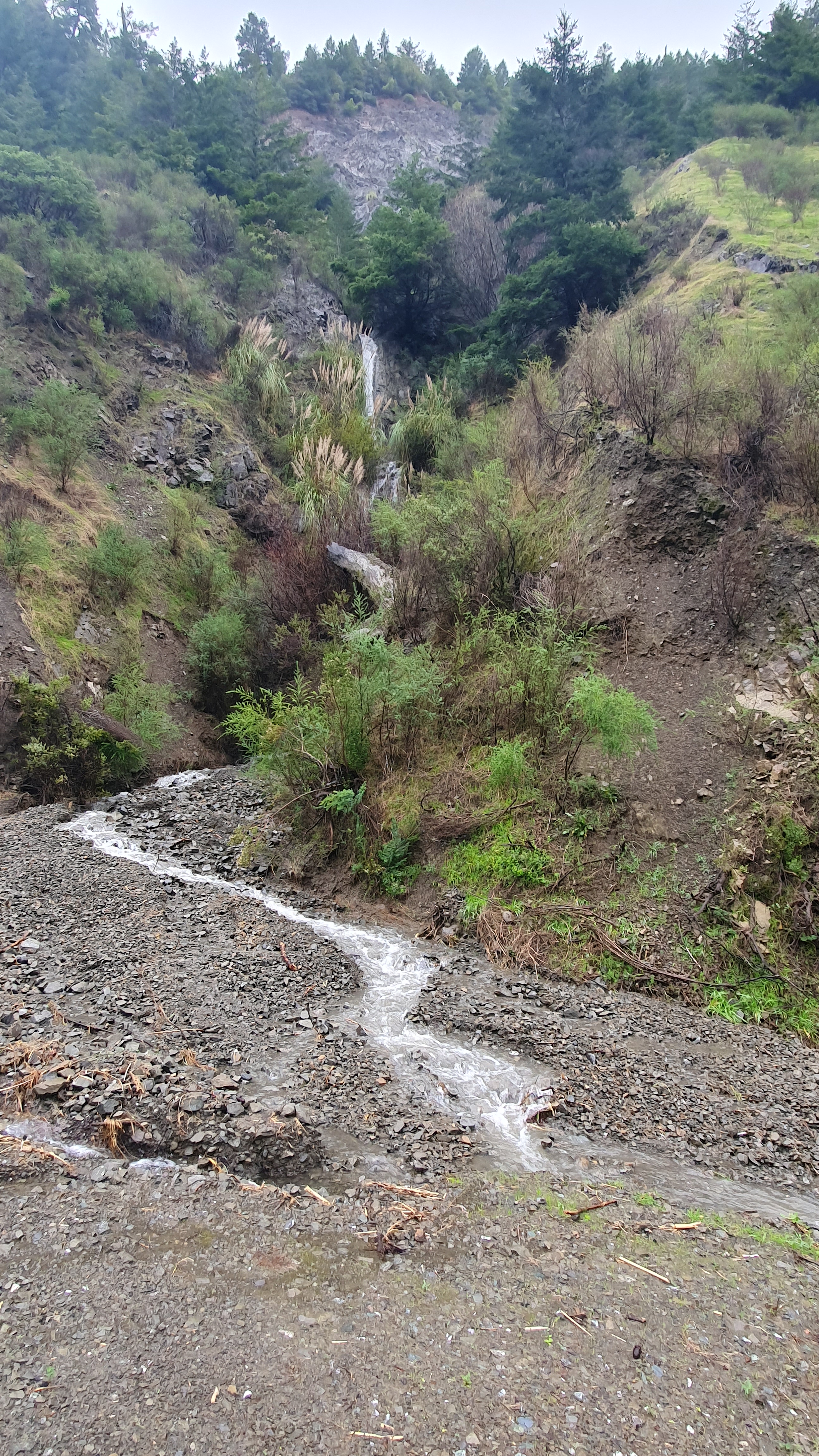
We did not have to detour around flooded roadways, and our route was not blocked by mudslides, though we passed places where cones blocked one lane while crews cut up fallen trees. Highway crews were out in their raingear, moving from one incident to the next. On the 101, they stayed ahead of disaster, and we were not held up at all. We drove a bit more slowly than usual to cope with the rain and water running off the roadway, but the trip was as easy as possible considering it rained most of the time.
Along the Russian River
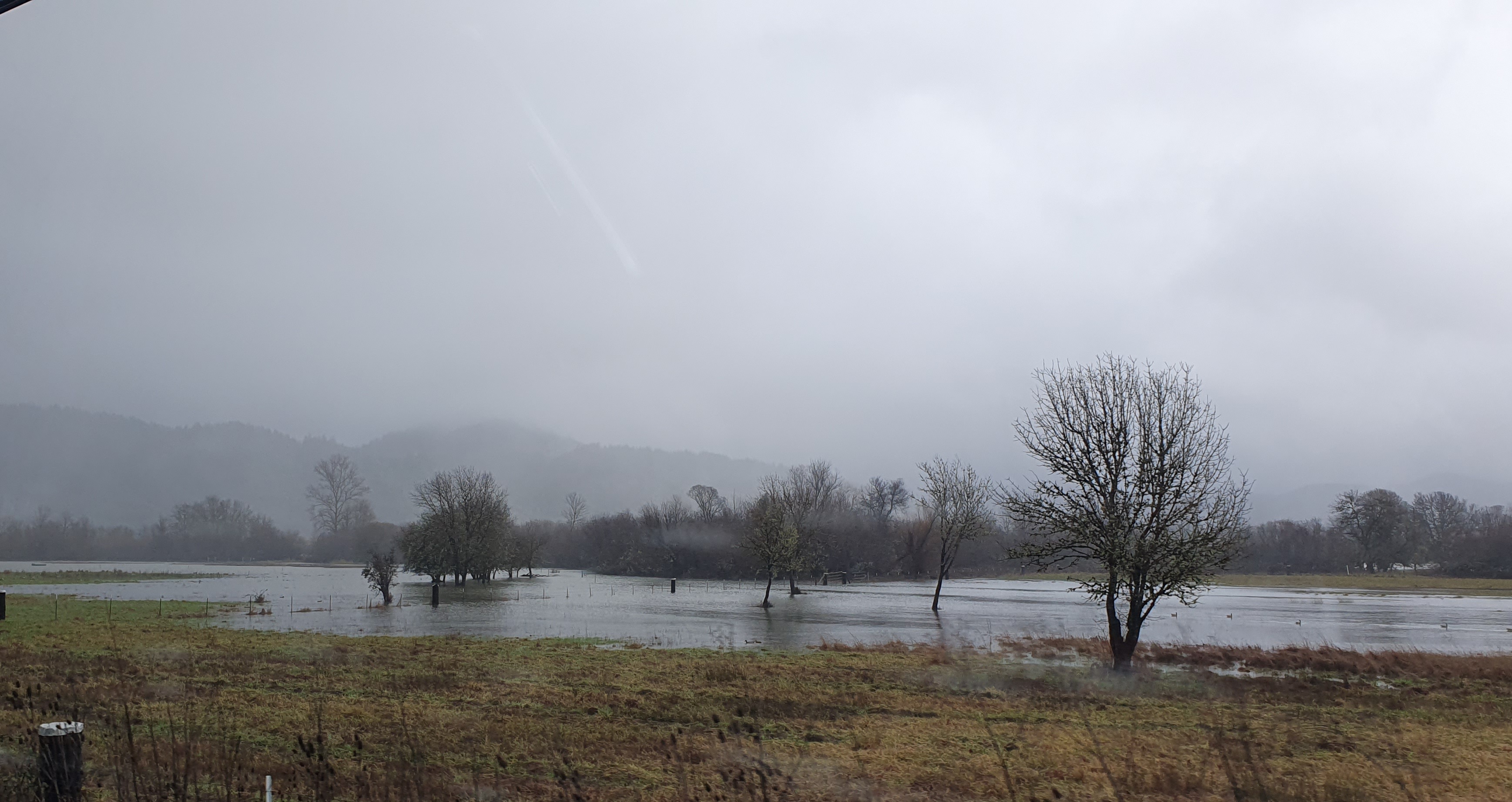
Our trip back began around 10 am the next day as rain pelted down. We drove north out of Healdsburg past the Russian River, where the water was very high, only a couple of feet below the road, but not yet near enough to be threatening. We stopped at the Jaxon Keys Winery and I took a photo of the sodden fields.
Something about the wind and the mountains results in more rainfall between Santa Rosa and the middle of our journey around Willets. The second half of the journey took us along the south fork of the Eel River, and as the highway approached the river and veered away, we could see tiny waterfalls, rushing streams, and the growing span of the river as its course widens over the descent to sea level on the coast.
January first the new year comes in whether or not we’re ready. We’ve been out walking most days, as the weather forecast is for strong winds and heavy rain later this week. It’s been cold for this region, low 50s, high 40s during the day and occasional frost at night. This is nothing compared to the annual week or so of -10 we usually planned on in Chicago, so we add another layer and go out.
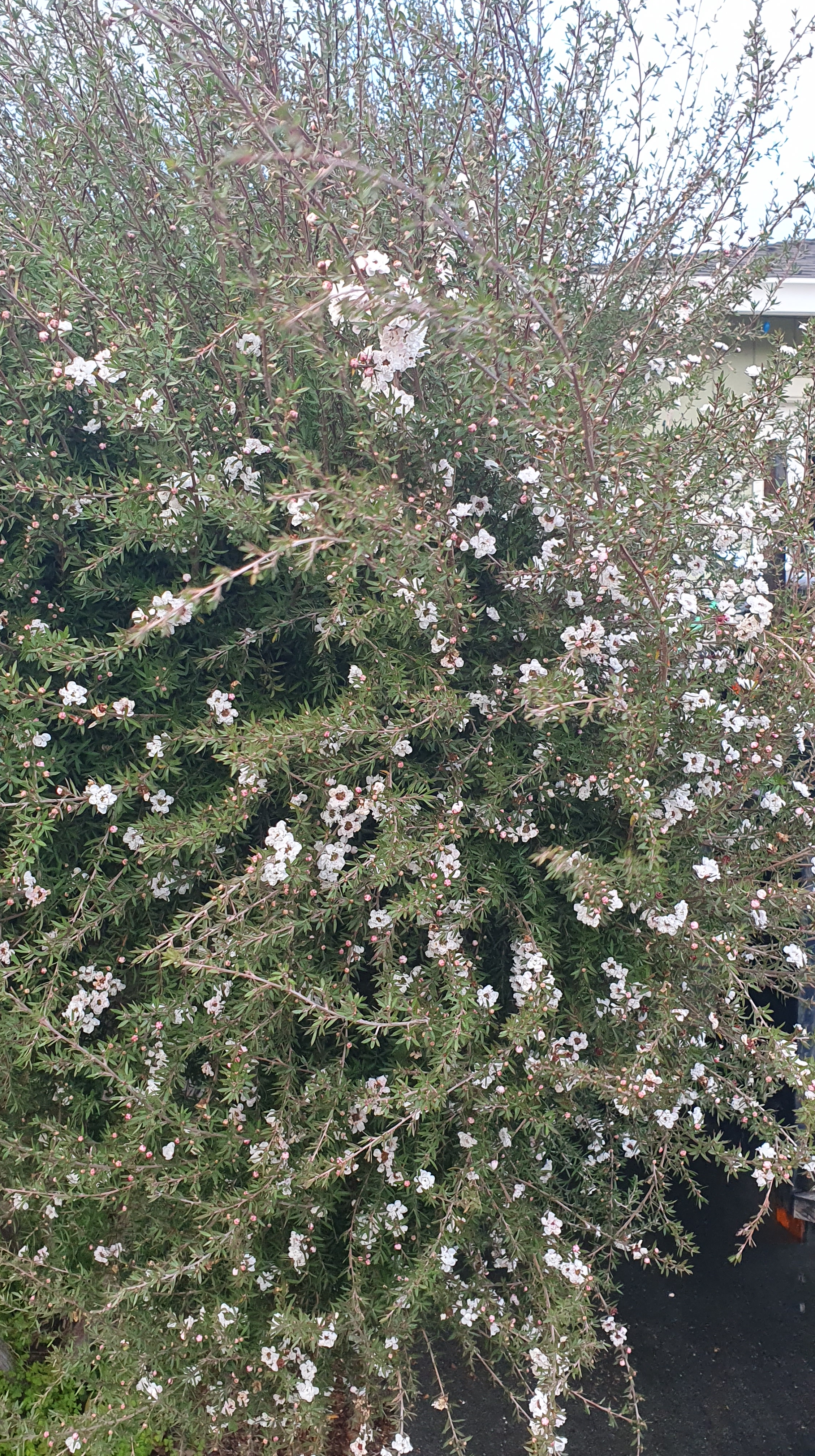
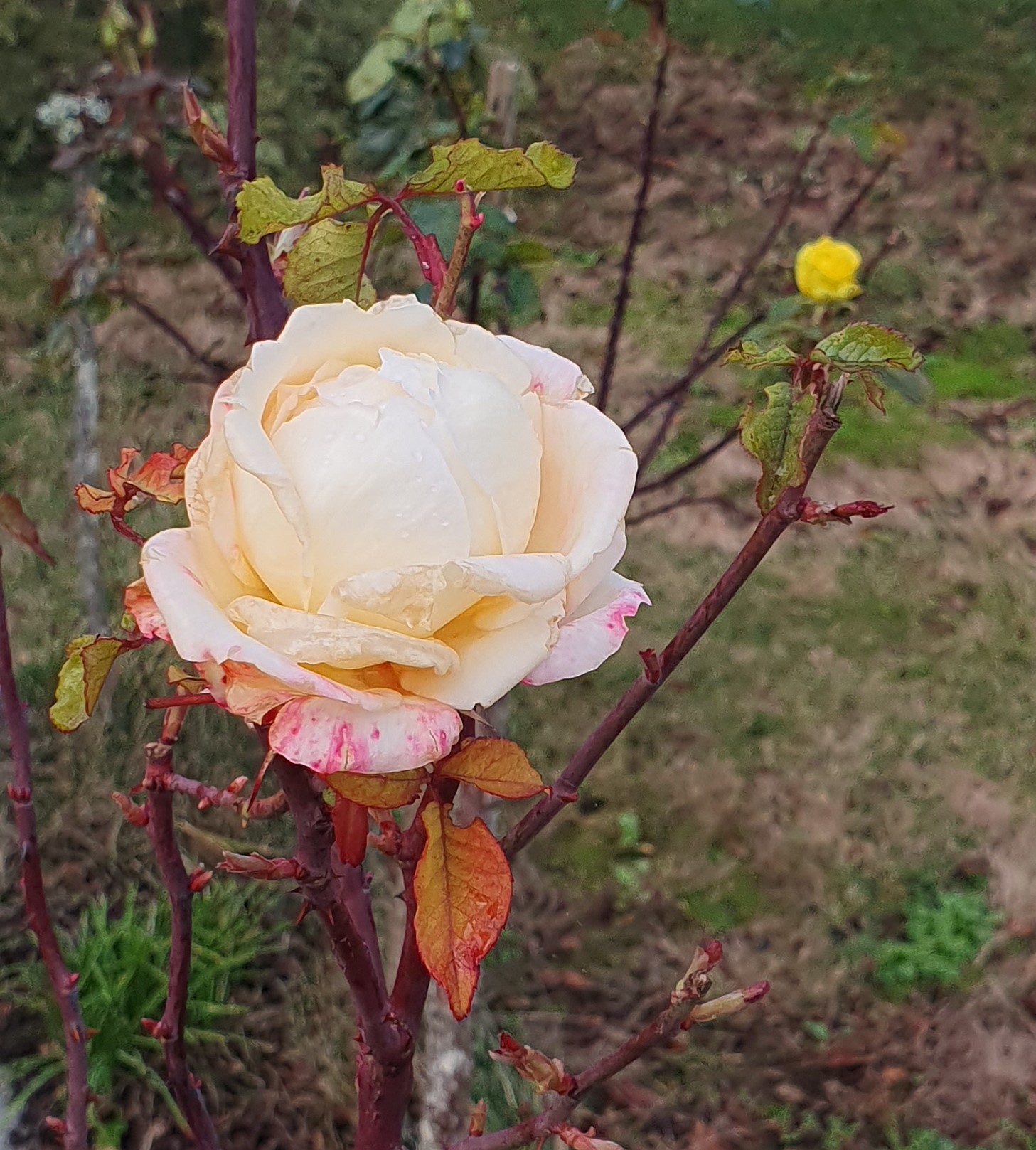
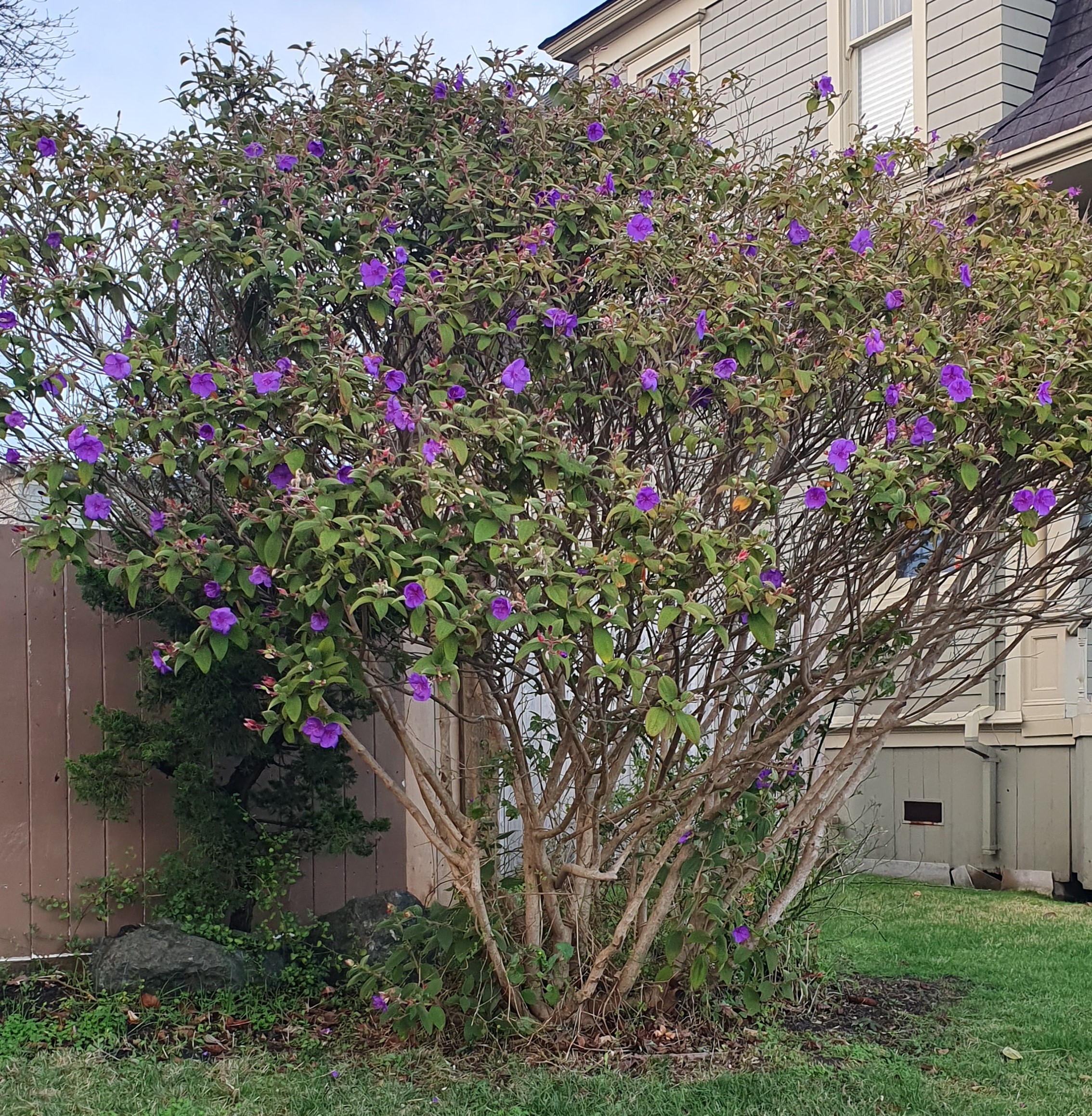
Most surprising to me this week is the suggestion of spring that we’ve seen all around us. Magnolia buds are about to burst open. Calla lilies are greening up; I saw two that already bloomed in a sheltered corner of downtown. Certain shrubs have bright red bark. I call them all redbud since I’m not that good at plant ID.
Sunset has already pushed a few more minutes into our day. The winter solstice was two weeks ago, and I notice that we can stay out until 4:45pm before we notice the failing light. We’ve definitely turned a corner. The photo at the top of this post was taken about that time. The rays of light and cloud always remind me of two things, sunset photos by Eliot Porter that were everywhere when we lived in New Mexico, and “god the father” sunsets: the light and clouds around saints depicted on holy cards when I was in Catholic elementary school. (Holy cards are the size of baseball cards, printed with god or saints in all their glory, often on a cloud surrounded by rays of light.)
As soon as I noticed the plants beginning to flower, the wind picked up and it began to rain. Weather reports showed a huge swirl of white cloud just off the coast. My brother pointed out that of all the cities on the Pacfic coast, the single one identified on the national weather map was Eureka. It’s rained off and on since New Year’s Day.
We look outside in the morning and if it is not already raining, we try to get going for a walk. By lunch time it is usually raining, and sometimes the wind tries to blow loose items around the neighborhood. The cover of our barbecue already blew away once, so now we tighten it and put a few rocks on top. The sun umbrella is stowed in the garage, outdoor chairs lean against the garage, folding chairs folded and piled up. We don’t want to let anything get away.
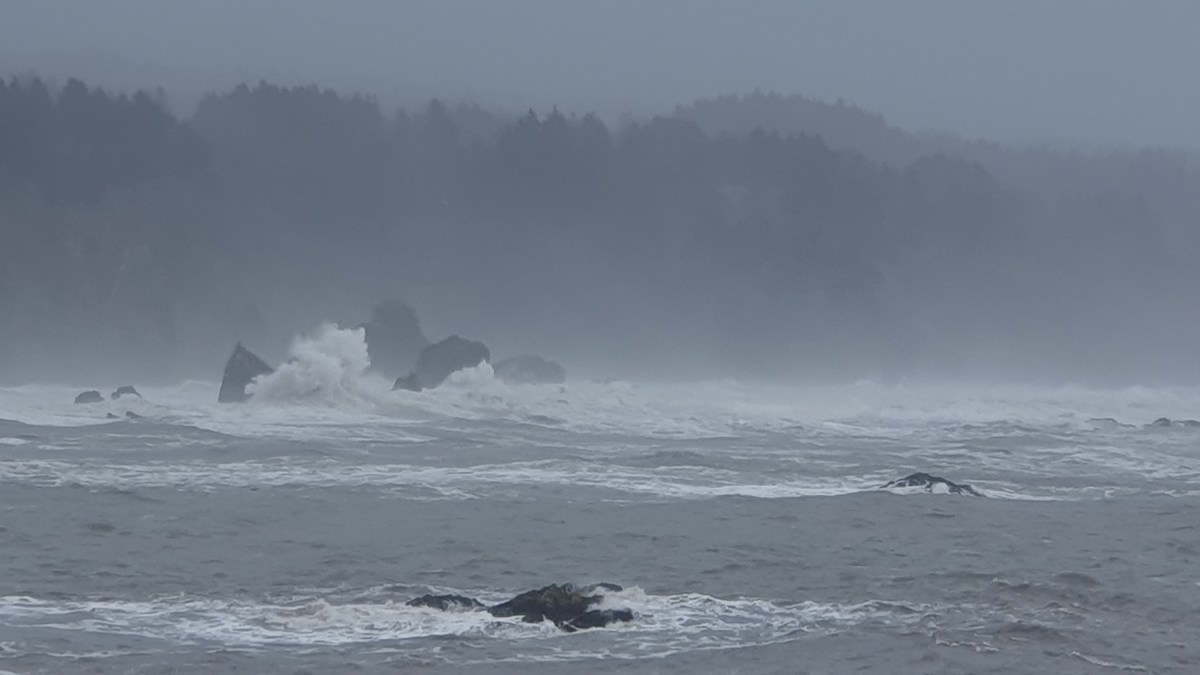
Waves were forecast to be 20 ft high along the coast, so we drove up to Su Meg State Park to have a look and found the park closed while a crew removed trees that fell across the access road. We turned around and went to Trinidad, figuring an entire town couldn’t be closed. The art gallery was closed, and stores looked pretty closed. It wasn’t until later we found that the town was without power during our visit.
The waves were big, but not impinging on the parking lot, so we stopped and watched the roiling sea. Waves thrown up by a blowhole across the bay topped a very tall rock. It was impressive and interesting to be out. The weather wasn’t all that bad judging by the number of people climbing up to have a look at the waves, walking their dogs, and looking around. After a short hike to look out to sea, we went down to the high tide line to have a look. Sure enough, not five minutes into our walk, a larger wave came in and swamped Jonathan. Wet to the ankles, we decided our visit was over.
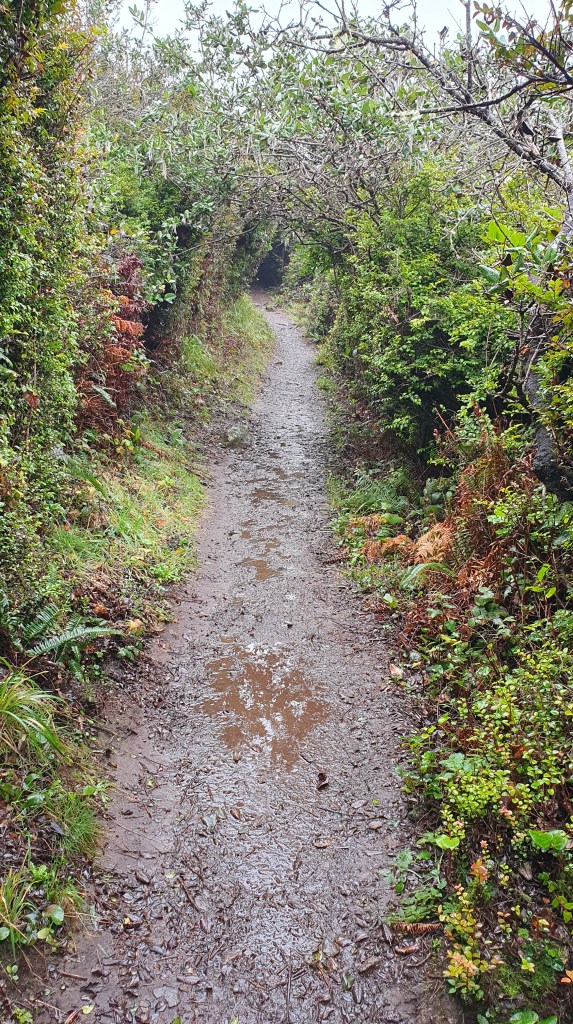
Our climb up Trinidad Head was a bit drippy.
Since our day out in the storm, Eureka has been the center of a small spot not getting much rain. We still take our walk early in the day, but generally everyone around us is getting rained on more than we are.
Here we are in far northern California, January is just getting started, we’ve got spring in the air and big waves coming off the ocean. A little of everything.











































 Llywindatravels 2025