The weather was absolutely perfect. The sky was clear and bright blue and the sun shone. We walked on a path along the Water of Leith, a stream really, to get to the Scottish National Gallery of Modern Art. The entrance was inviting. Can you believe we’re in the middle of the city?
The exhibit on Surrealism was so good that you didn’t have to have any particular interest in the topic to enjoy the art, the explanations, the description of the three particular collectors whose donations have made Edinburgh’s collections on Surrealism one of the world’s finest.
The permanent collection includes Scottish artists and other works, though we were most attracted to the sculpture on the lawn, itself sculpted into a piece of landscape art. Signs indicate that you are allowed to walk on the sculpture. There is a somewhat arty play area for kids. It’s a very welcoming museum. There’s even some sculpture by women.
Conversation with Magic Stones
by Barbara Hepworth. It looks archaeological.
Conversation with Magic Stones by Barbara Hepworth. It looks archaeological.
At the end of the day, the sun still shone, but the wind picked up and blew clouds fast across the sky, the air cooled and I could feel the cold on my cheeks. We’d had a day of all-out, full on summer, and yet I could already feel autumn in the air. Yes, there was one hot day two weeks ago–but that would make summer have lasted two days in total, if clouds and rain don’t count. That may be it for summer in Scotland.
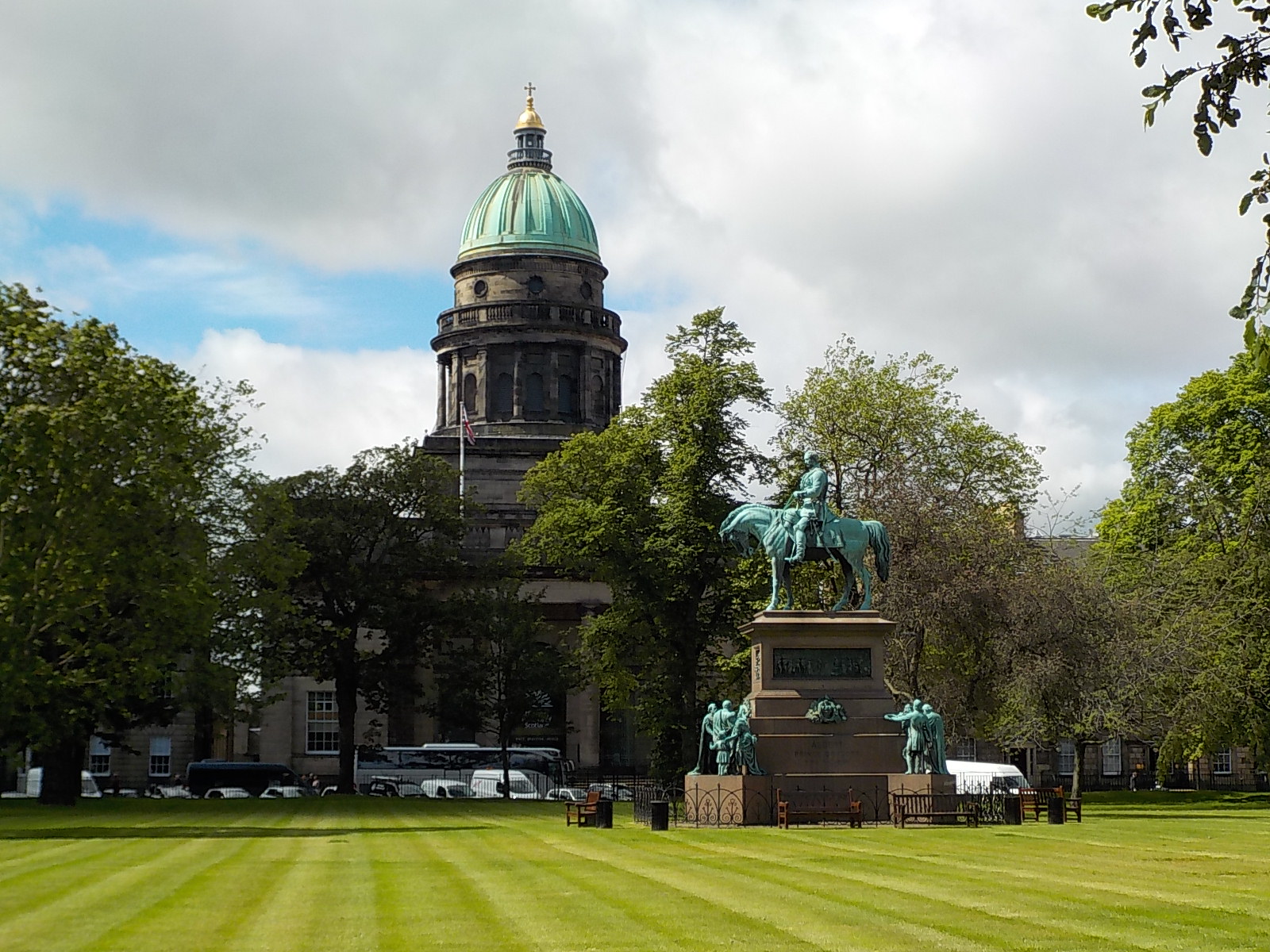
Yes, there is a statue of Queen Victoria that dominates all of Princes Street from its perch on top of the Scottish National Academy. However, the rest of Edinburgh hosts an unusual number of life-size or larger statues of men. Some of the figures are more recognizable than others.
August 16, 2016
It turns out that men on plinths is not just an Edinburgh phenomenon.
But surprise!, it’s Robert Burns (again).
In southern Scotland, animals are an alternative to men.
Kirkudbright has kelpies.
Moffat’s sheep
Kelpies are malevolant water spirits in Scottish mythology that are impossible to tame, but if caught, have the power of ten horses. This story was recast by artist Andy Scott as two monumental horse heads 30 ft high that now stand by a canal in Falkirk, Scotland. The figures have become so popular that a pair travel around Scotland, spending time in many communities. This summer a pair of kelpies is in Kirkudbright, near us.
As readers of Alexander McCall Smith and Ian Rankin, each of whom set their stories in and around Edinburgh, it was easy to find landmarks that relate to the work of both authors.
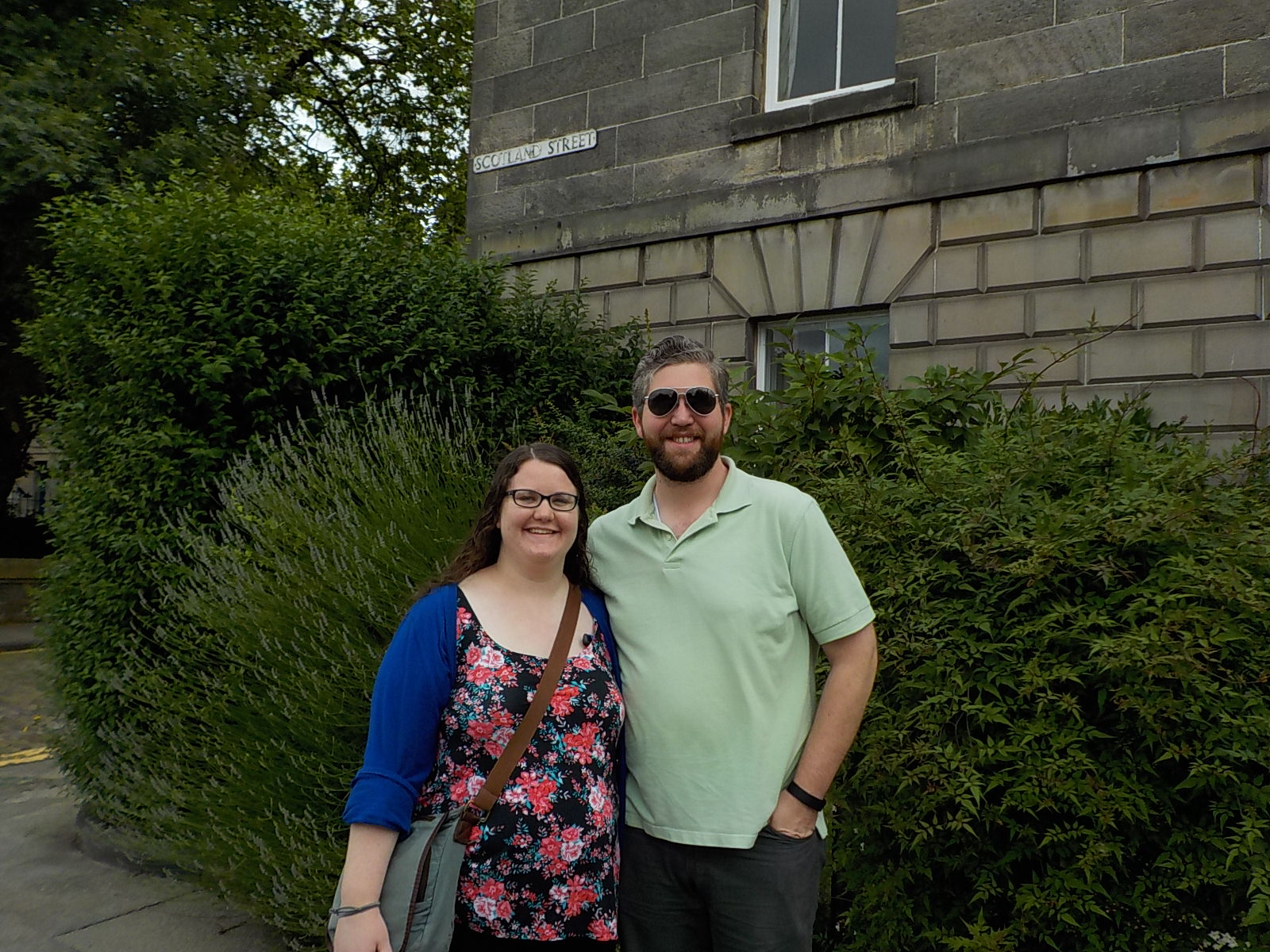
In the background of the photo you see here is the street sign for Scotland Street. (There is no number 44). The series 44 Scotland Street recounts the goings-on of the people who live at that address. I think Lillian’s favorite is Bertie, the precocious, saxophone-playing little boy.
Thanks to a quiz app on Lillian’s cell phone, we had a pleasant introduction to the New Town and the landmarks used in the books. It was a bit surreal to find there really is a “Flotarium” (sensory deprivation tanks in which you float in salt water in the dark). The Cafe St. Honore is a couple of turns off a main street, with a charming facade.
The photo is from the restaurant’s web page.
We passed the Queen Street Gardens, which unlike the gardens along Princes Street, are private, behind locked gates.
This made it a bit difficult to answer one of the questions on our tour app, (the inscription associated with this statue), but never mind. I’m sure there is some historic explanation, though I don’t much like the fact that a very extensive garden covers several downtown blocks yet is not open to visitors. Blog post discussion of Edinburgh’s private parks:
New Town is called a masterwork of city planning, though it almost seems overly spacious to me. We found lovely neighborhoods in addition to the long streets of Georgian stone houses. I think I’d prefer a cozy mews to a stately home.
A true manifestation of “location, location, location” are the apartments that are two stories below street level. You’ve heard of a walk-up. How about a walk-down?
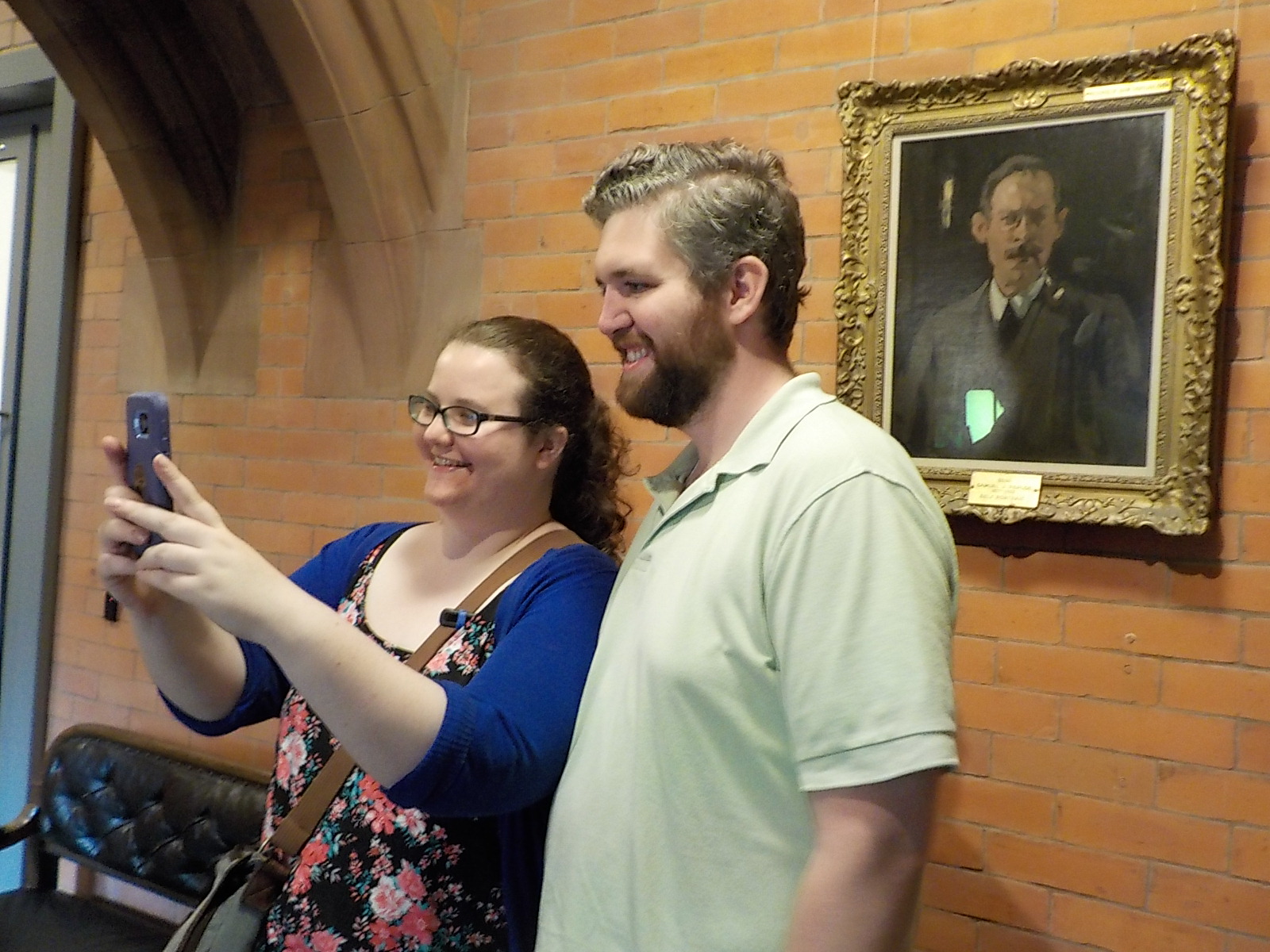
The Scottish National Portrait Gallery is one of the museums that the characters of 44 Scotland Street like, and it is also a favorite of Isabel Dalhousie, of the Sunday Philosophy series, also by Alexander McCall Smith. I like Isabel, and was happy to see the self-portrait of Samuel Peploe, among her favorite Scottish artists. Lillian and Neil decided to take a selfie with him.
By this time, we were ready for a break, and it had to be at Valvona & Crolla, a venerable Edinburgh institution, and a favorite of Bertie and his mom. An early importer of fine Italian food, I thought we were mistaken about finding a cafe when we walked in. A long case lines one side, but if you keep walking and don’t get distracted by the meat and cheese, you turn a corner and go up a few steps and Voila! there is the cafe. Everything was delicious.
That stop completed the McCall Smith tour, though I did go to Bruntsfield, Isabel’s domain. I didn’t see Isabel there, but she could have gone by, pushing Charlie in his stroller, while we were having coffee. At George Hughes & Son Fish, we bought some excellent Scottish salmon and some smoked haddock that with some bacon, onions, potatoes and a dash of double cream made a delicious chowder.
We haven’t embarked specifically on an Ian Rankin tour. I had my hair cut by a woman who lives in his neighborhood and says he does sometimes show up at the pub (“He can be a bit cranky,” she says.) I do enjoy seeing bits of Edinburgh that overlap with his writing. Now I know what they see when he and Siobean go out for a drive around Arthur’s Seat. I’ve seen Fettes Street (where the main police offices are located), and I’ve passed Gayfield Square and even St. Leonard’s (other police outposts in his books). I know that the Oxford Bar, his main character John Rebus’ watering hole, is visited by readers almost every night, but I think I’ll pass. I don’t want to make him cranky….
Ignore the menu, it’s Fleshmarket Close, site of one of Ian Rankin’s novels. There could be some very creepy stuff down there after dark.
It’s a great city for readers and their imaginations.
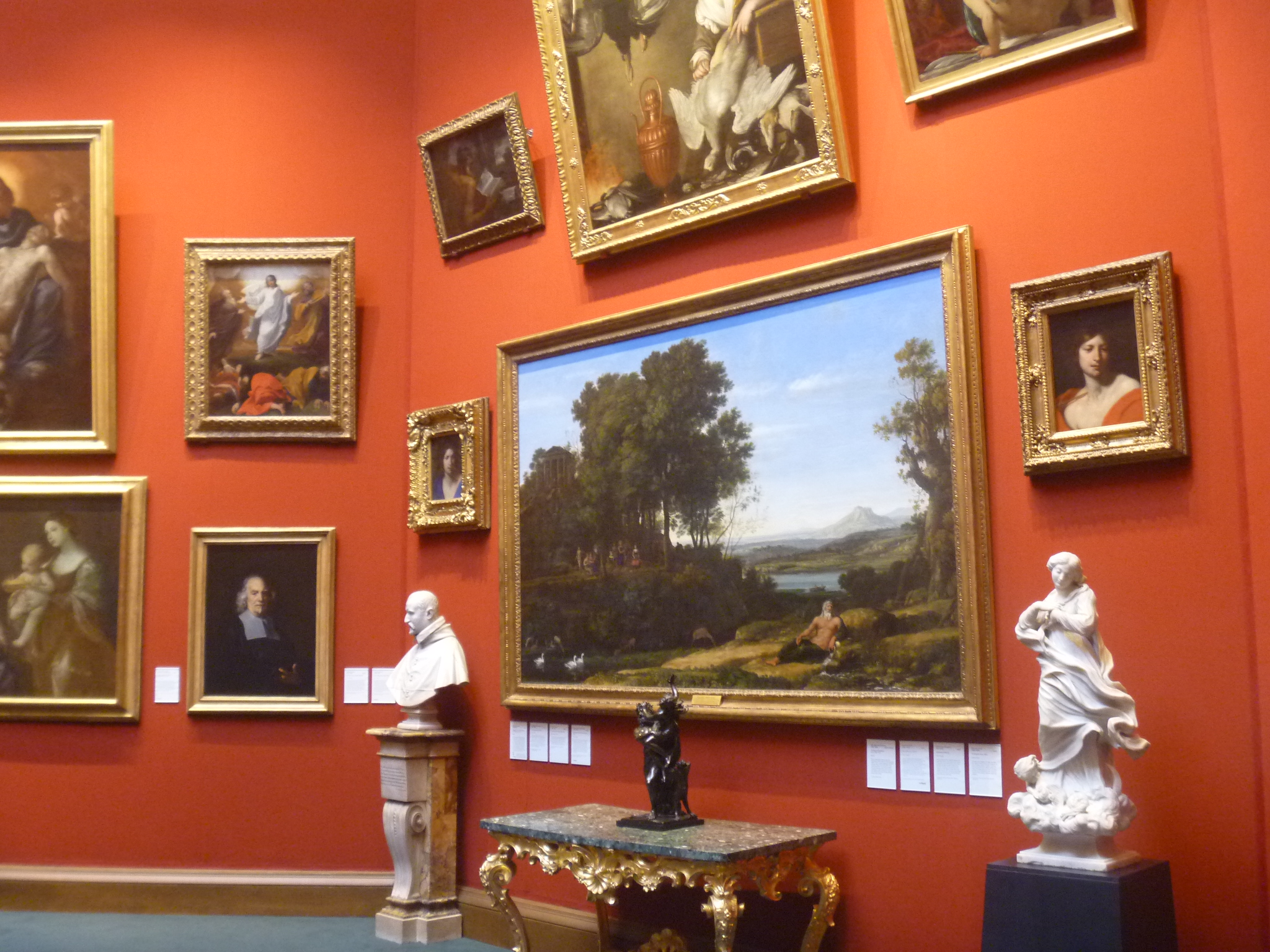
The good weather having deserted us, we headed indoors to check out some of the museums of Edinburgh. We started at the Scottish National Gallery, where we admired art from the Renaissance to 1900.
It’s a traditional art museum and we enjoyed the broad range of work.
(The Scottish National Academy is nearby, but we didn’t get there yet.)
We moved uphill to the National Museum of Scotland, an enormous natural history museum. On my first visit, I saw the current exhibit on the Celts. It is very extensive, with objects from Bulgaria to the Orkney Islands.
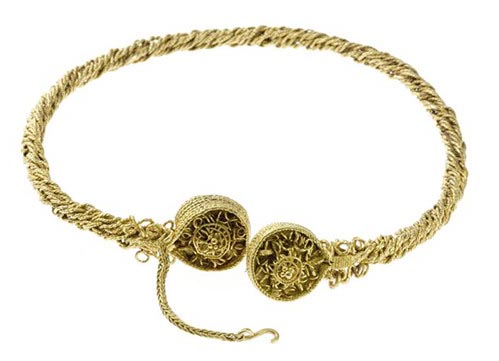
Here’s a piece from Scotland, part of the Blair torcs find (also called the Stirling torcs). The four neck-rings, or torcs, were found by a metal detectorist in 2009. The UK policy toward archaeological finds by amateur treasure hunters, mostly with metal detectors, differs from that in the US. There is a clear policy that defines what is considered “treasure” and what must be reported. Portable Antiquities Scheme–UK
In the UK, finds must be reported, but are then evaluated and the nation has right of first refusal (the government can purchase the items). After being valued at over £400,000 the four “Blair torcs” were acquired for the National Museums of Scotland with funds raised by a public appeal. All four torcs are part of the “Celts” exhibit.
[In the US, metal detecting is only permitted (legal) on private land. Anything found belongs to the landowner and does not need to be reported. Anything found on federal land is the property of the US government and is a felony to remove.] There is a lot more cooperation between detectorists and government in the UK than in the US
For comic relief, see the British TV comedy, The Detectorists. It’s on Netflix.
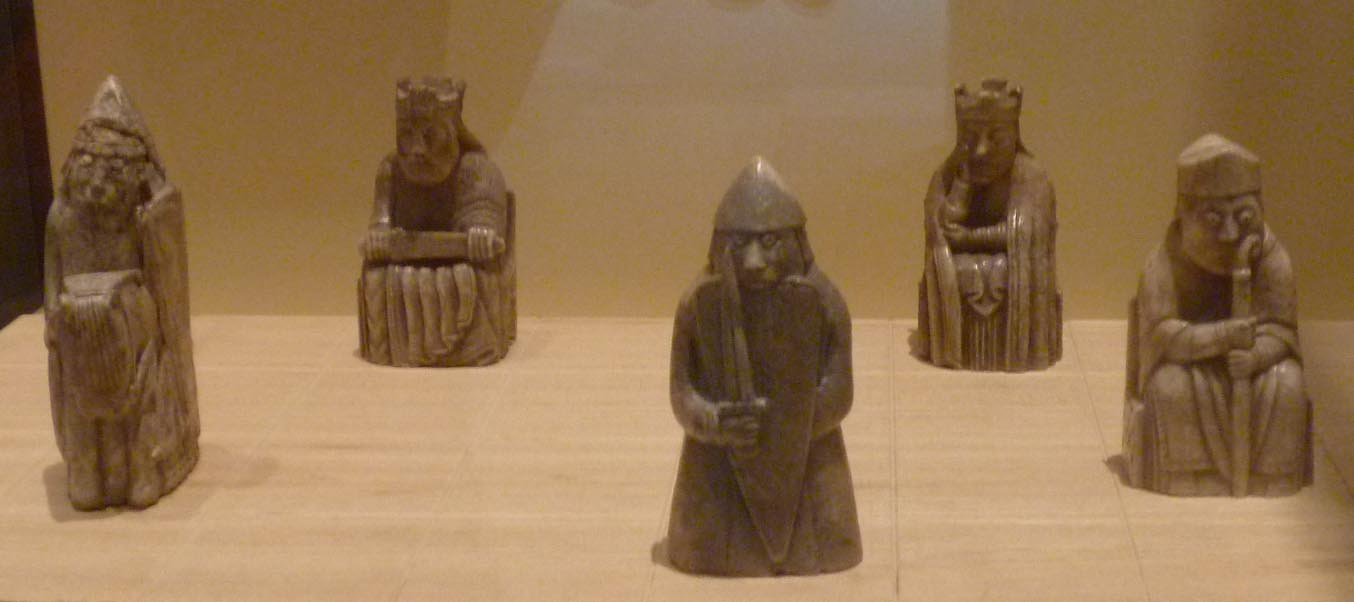
I have now seen ALL the Lewis chessmen. The mournful – comic faces of these characters have charmed many museum visitors over the years. I’ve seen those held by the British Museum (they have 82 of the 93 known) and now I’ve seen the 11 at the National Museum of Scotland. There are enough pieces for at least four chess sets, and ironically (based on our recent travels) they are believed to have been carved in Trondheim, northern Norway, in the 1200s.
The figures were discovered in 1831, in a stone cist built into a dune on the beach at Uig (Isle of Lewis). There is enough speculation about when and why to fill several mystery stories, though at the time, the coast of Scotland was controlled by Vikings, and its suggested the pieces were property of a merchant who may have intended to sell them to wealthy local leaders in Ireland. It is remarkable that they have only been divided into two groups over the years. They are carved from walrus ivory (teeth). Notice the center figure is biting his shield, a characteristic of Scandinavian “berserkers,” though as a chess piece it is a rook. There are excellent close ups of these figures. Lewis chessmen close-up views, National Museum of Scotland
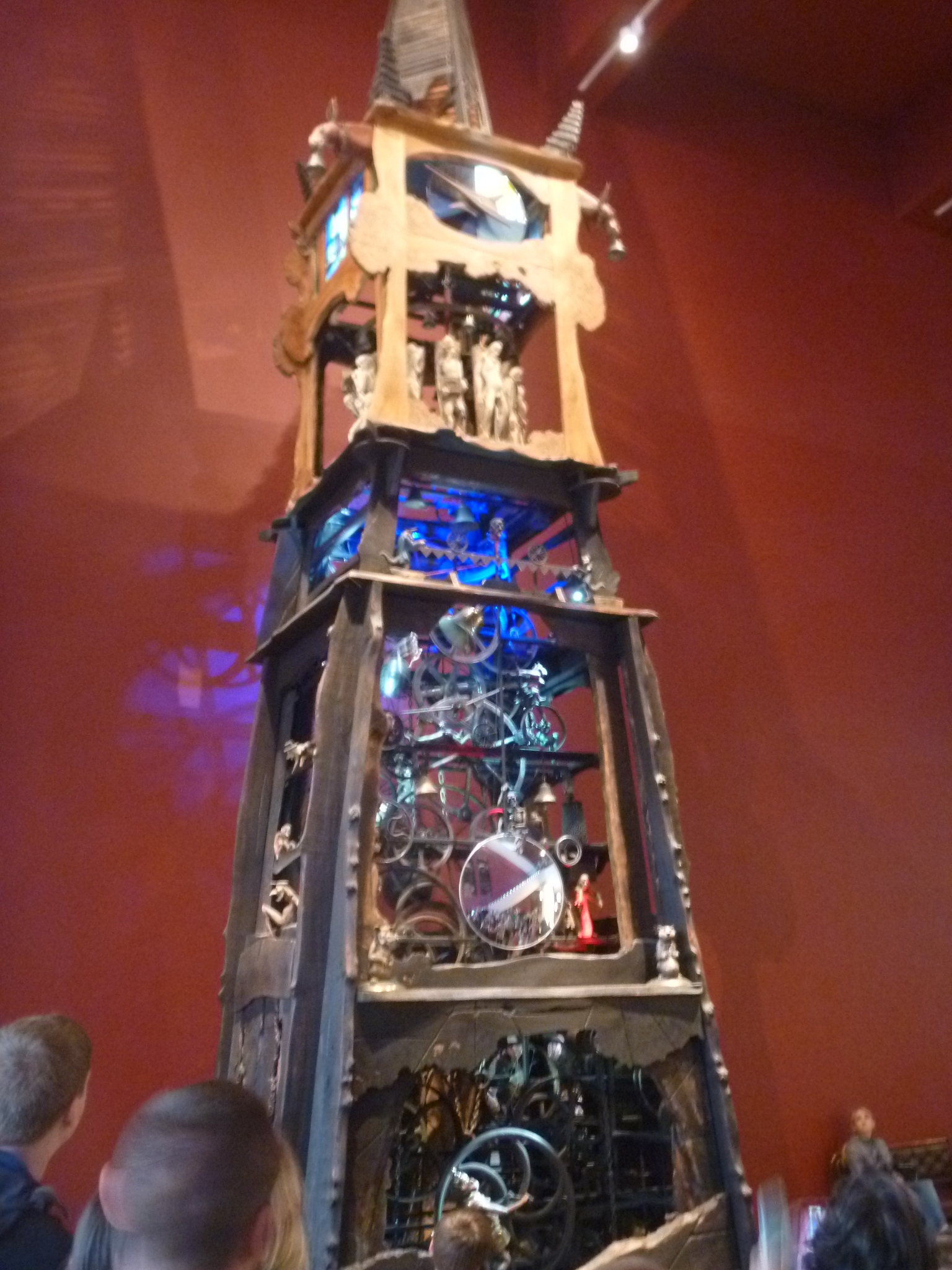
The National Museum of Scotland is loaded with other exhibits and activities, including a wacky clock that chimes every hour–lasting about 15 minutes–with whirling figures and flashing lights.
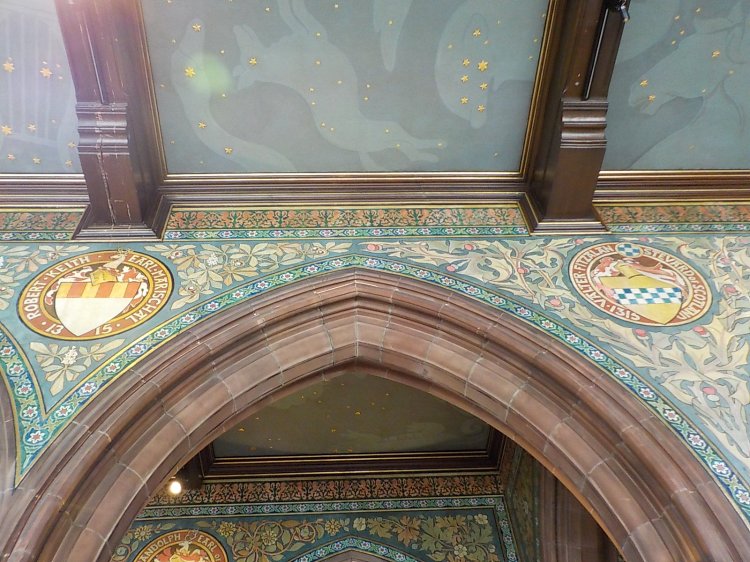
Our next museum stop was the Scottish National Portrait Gallery. The portrait gallery was built to be shared with the Society of Antiquaries of Scotland, which it did until 2009. The structure has a shimmering frieze of figures from Scottish history that looks like something from a Byzantine church, busts of famous Scotsmen, and a small, more recent exhibit of famous Scotswomen.
A room full of Scottish notables under a frieze of historical characters..
Detail includes constellations on the ceiling.
There are many more museums to see in Edinburgh, and plenty of rainy days to enjoy them.
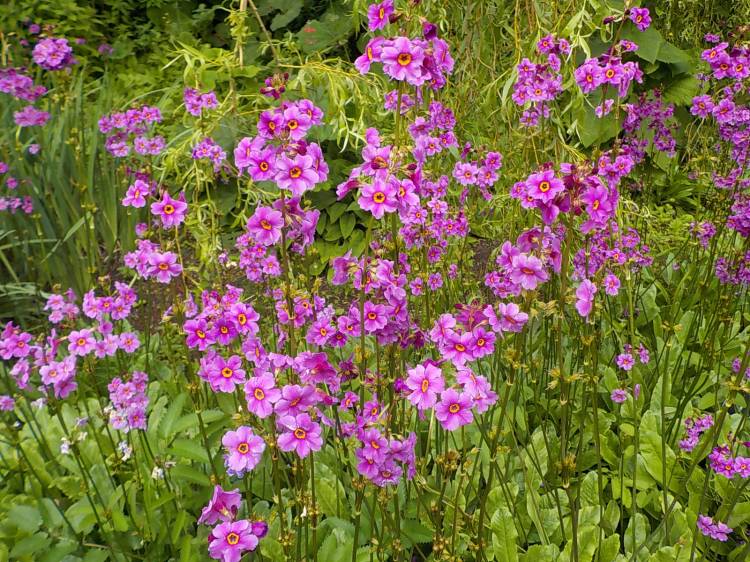
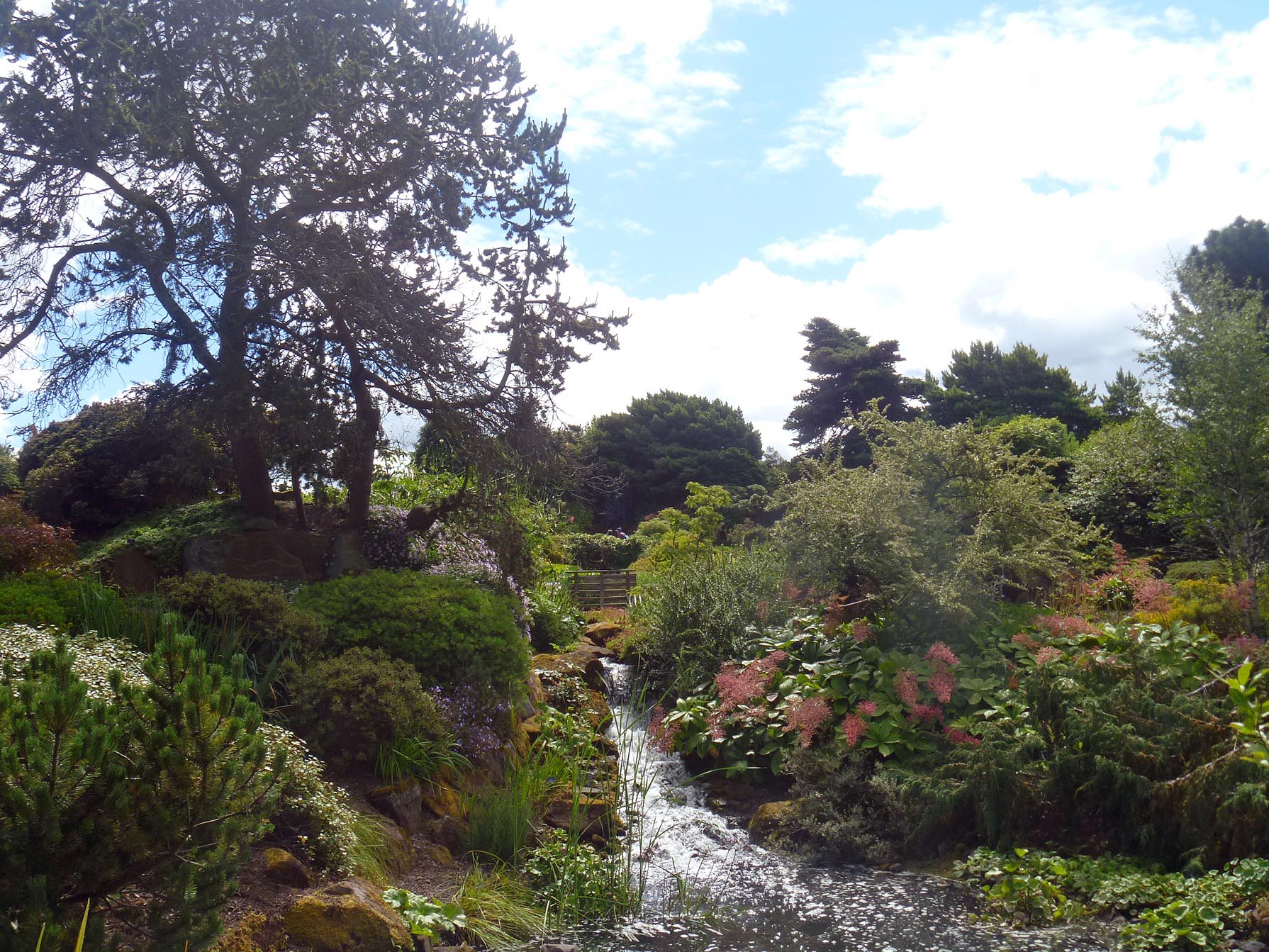
Two days of sunny weather let us take advantage of the natural world in Edinburgh, the Royal Botanical Garden, and the Edinburgh zoo. Both have their high points. The Botanical Garden is very large and has many different gardens, though I misread Scottish Heath Garden as Scottish Heather Garden, and was mildly disappointed until I figured that out. The flowers were all in bloom, though a grounds keeper told us he thinks it is at its best in May when the rhododendrons are blooming.
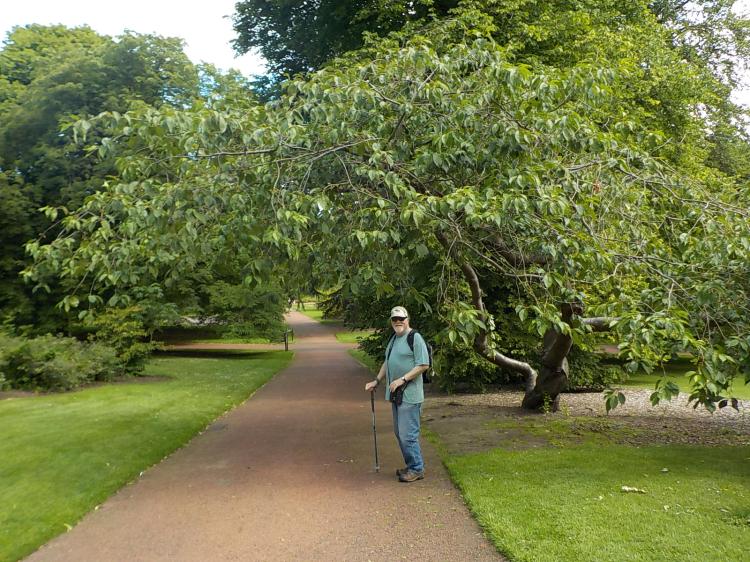
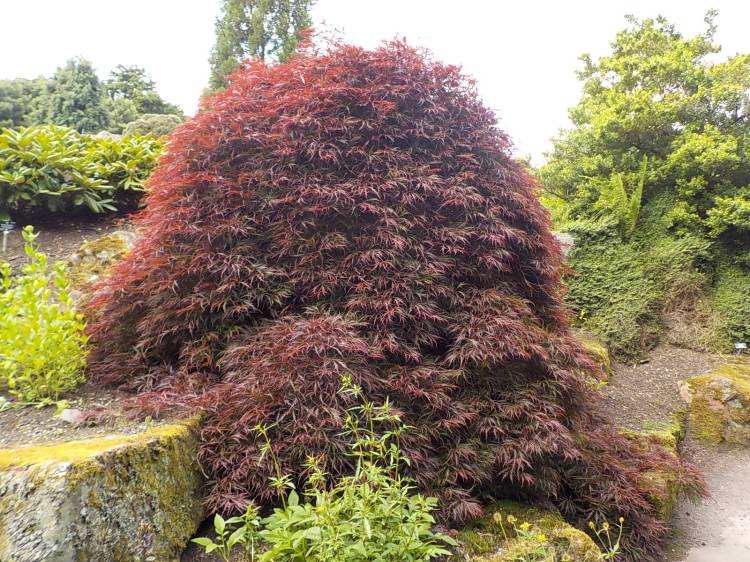
There were trees with interesting shapes.
Sculpture and artwork is included in a number of places.
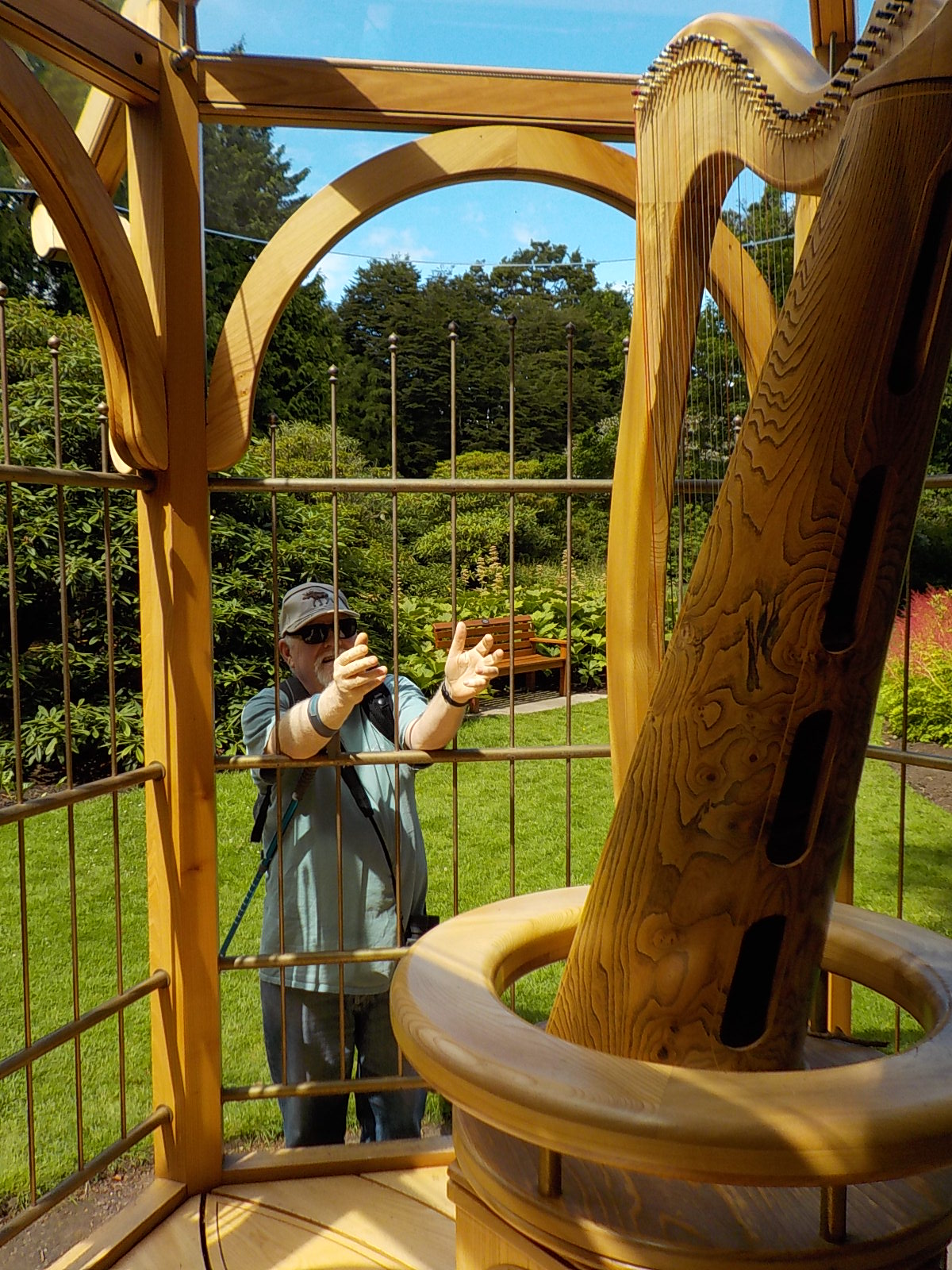
Jonathan wanted to play the aeolian harp, but he couldn’t quite reach the strings.
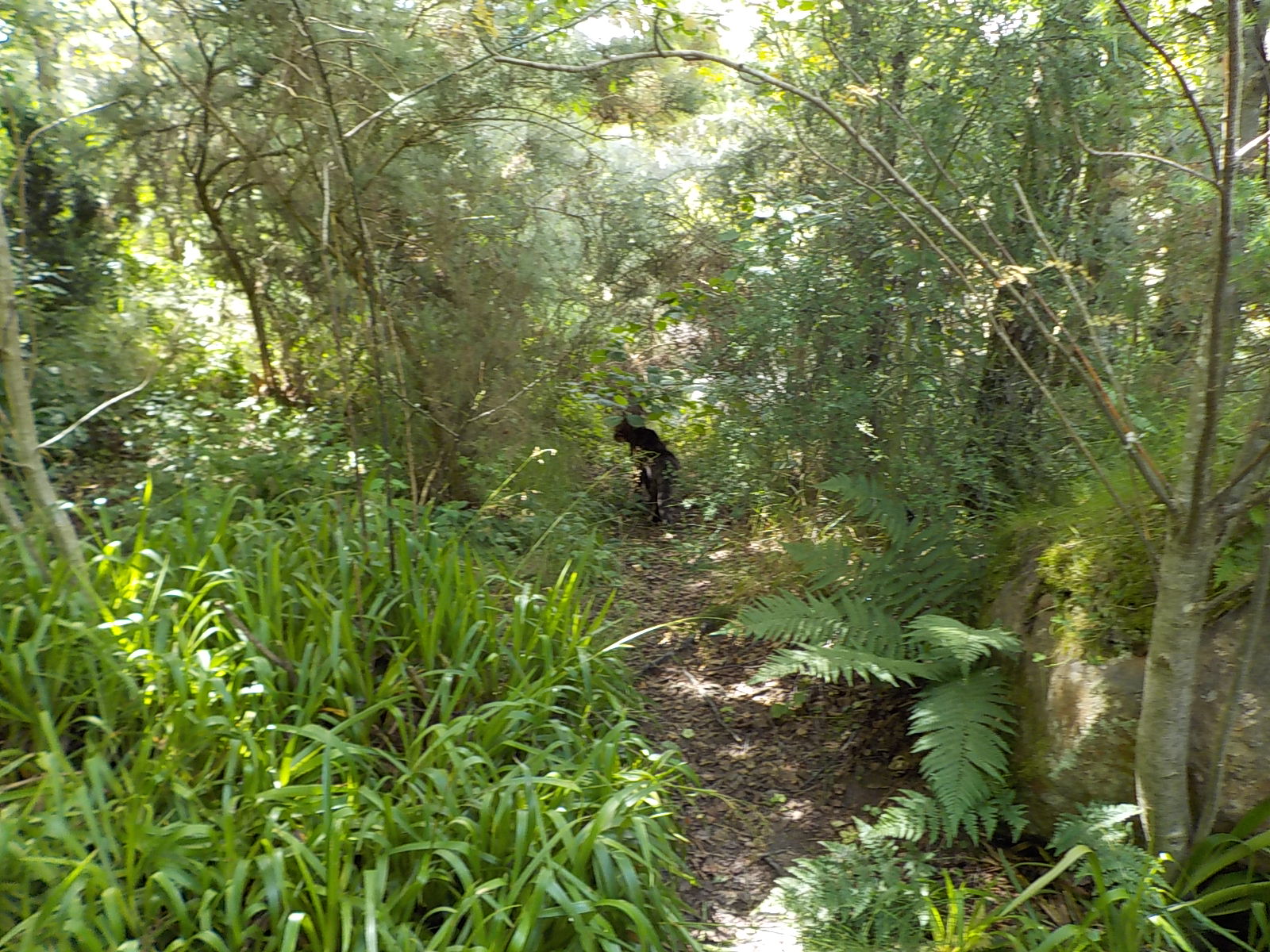
We saw a wild animal in the bushes, possibly stalking a fat pigeon.
Despite the fact that this looks like a panther, it is a cat at the botanical gardens.
We thoroughly enjoyed our stroll around the garden.
On we went to the Edinburgh Zoo.
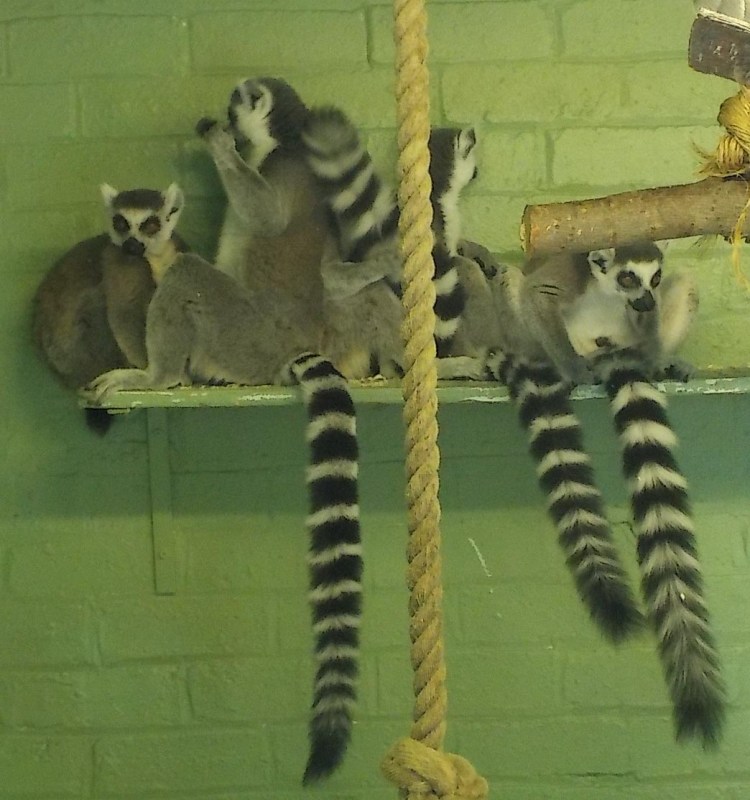
There were many fun parts of our zoo visit. The movie celebrities were entertaining.
Lemurs-Madagascar
Meerkats–Lion King
The Edinburgh Zoo makes it clear that it is heavily involved in research and conservation. It participates in projects in Scotland and all over the world. It also holds animals that are not commonly seen. That way it doesn’t directly compete with the very largest zoos, though they do have a giant panda. We dutifully went to look, but the female is off display because of breeding, and the male had just lumbered out of sight when we arrived. I guess it’s pandacam for us.
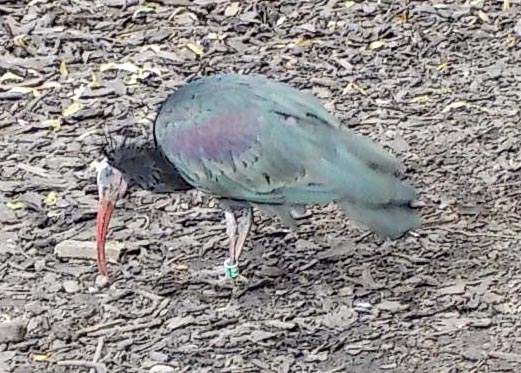
We did see the bald ibises that we were unable to see in Morocco, their largest remaining breeding area. They aren’t lovely, but there is a flock in Edinburgh and we could see their peculiar bald heads.
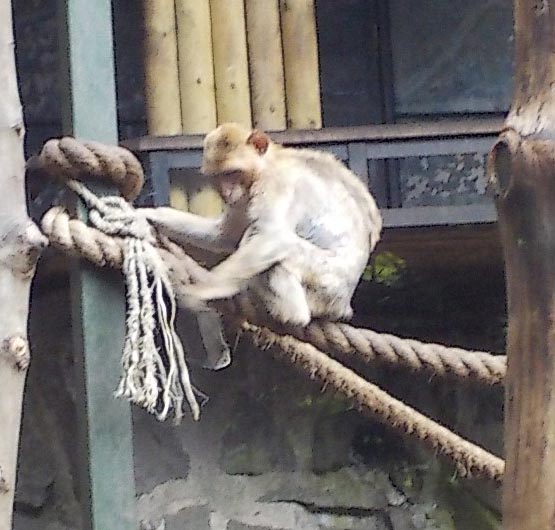
Another species we saw in Morocco has adapted well to Edinburgh, the Barbary macaque. The “wild” macaques (unconfined might be more accurate) we saw begging by the road in Morocco were obese from eating food provided by visitors.
The group in the Edinburgh zoo was livelier. This young macaque was chewing his way through a rope end. The zoo also participates in a chimpanzee project in Uganda. I even saw a Callimico monkey, from Bolivia, where my former colleague Leila Porter studies them.
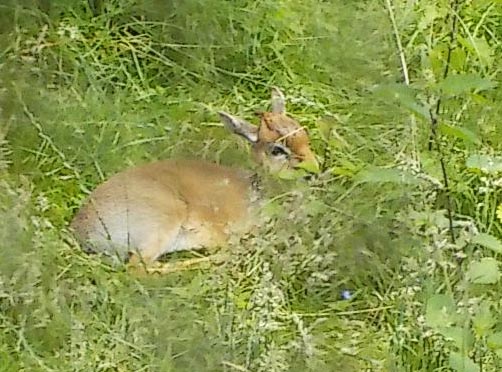
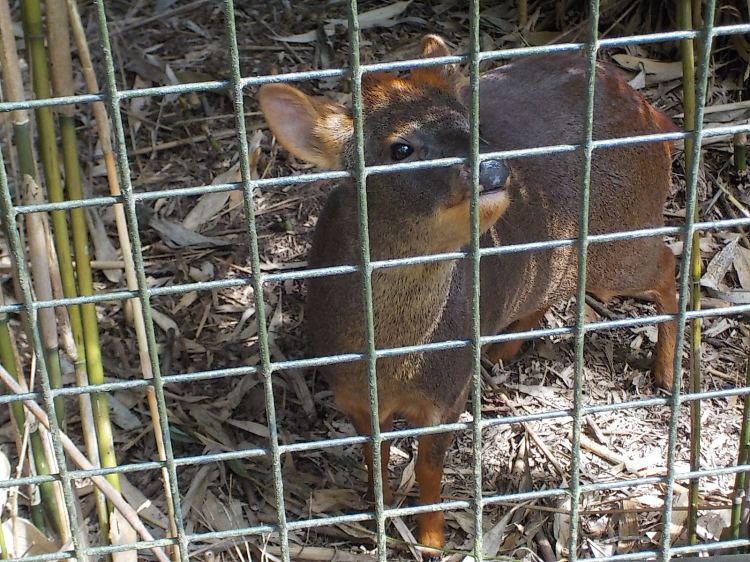
There were a pair of dik-diks, each the size of a fawn, and a pudu, a Chilean species that I had never heard of before.
Dik-dik
Pudu
A local rarity is the Scottish wild cat. This animal has a tough time keeping its dignity, because it looks exactly like a tabby cat unless you look VERY very closely. I even read a conservation article that questions how many resources should be invested in saving this endangered species if it isn’t certain there are any left that aren’t part house cat.
I have to admit, the differences are slight enough that I think some DNA testing is in order.
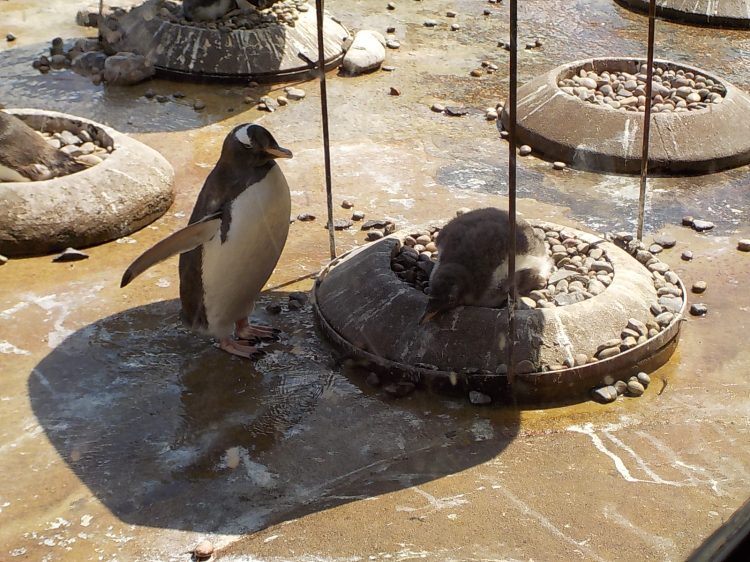
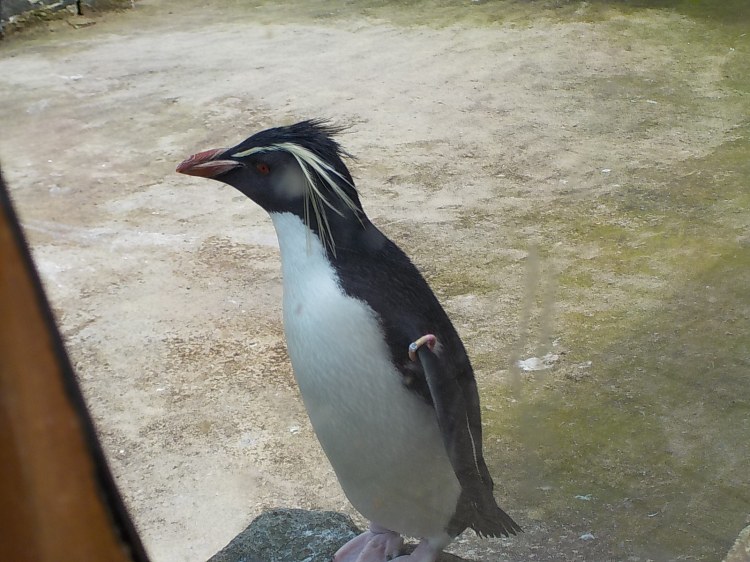
The penguins are always fun and Edinburgh has a large colony of gentoo, rockhopper and King penguins. The penguins go for a walk every day led by keepers, but (!),
“Please Note:
The penguin parade is run on an entirely voluntary basis. It is the penguins choice to take part, we do not encourage them with food. Unfortunately this does mean that occasionally the parade is cancelled if they do not wish to go out.” (Edinburgh zoo web site)
Gentoo and big chick
JH and his buddies
Rockhopper eyeing Jonathan’s performance
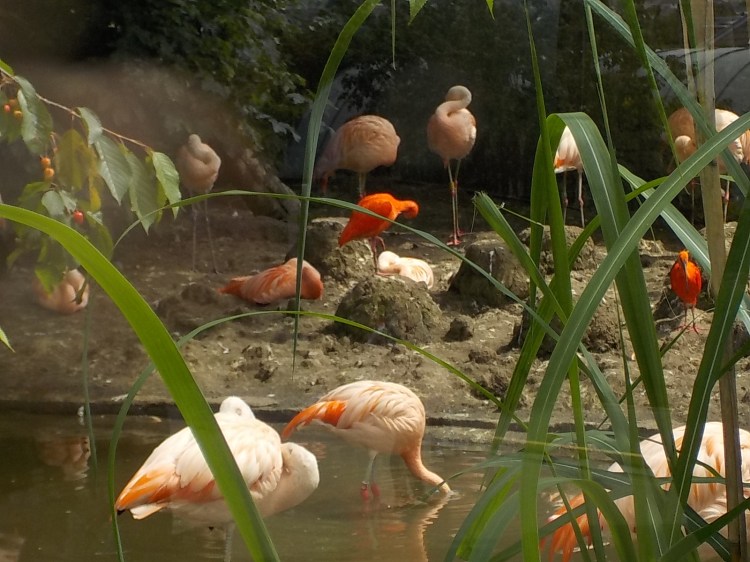
I also love all the birds. We saw the world’s largest pigeons, who strolled right out under visitors’ feet, a large stork, Chilean flamingos far from home, and scarlet ibis that you can see if you visit Trinidad (or northern South America).
The zoo property was purchased from a private owner in the early 20th century and the elaborate house is still present, right in the middle of the grounds. It’s now used as an event venue, “The Mansion.”
It is the kind of house that a child looks at and says, “I want to live in that house in the zoo.” I agree.
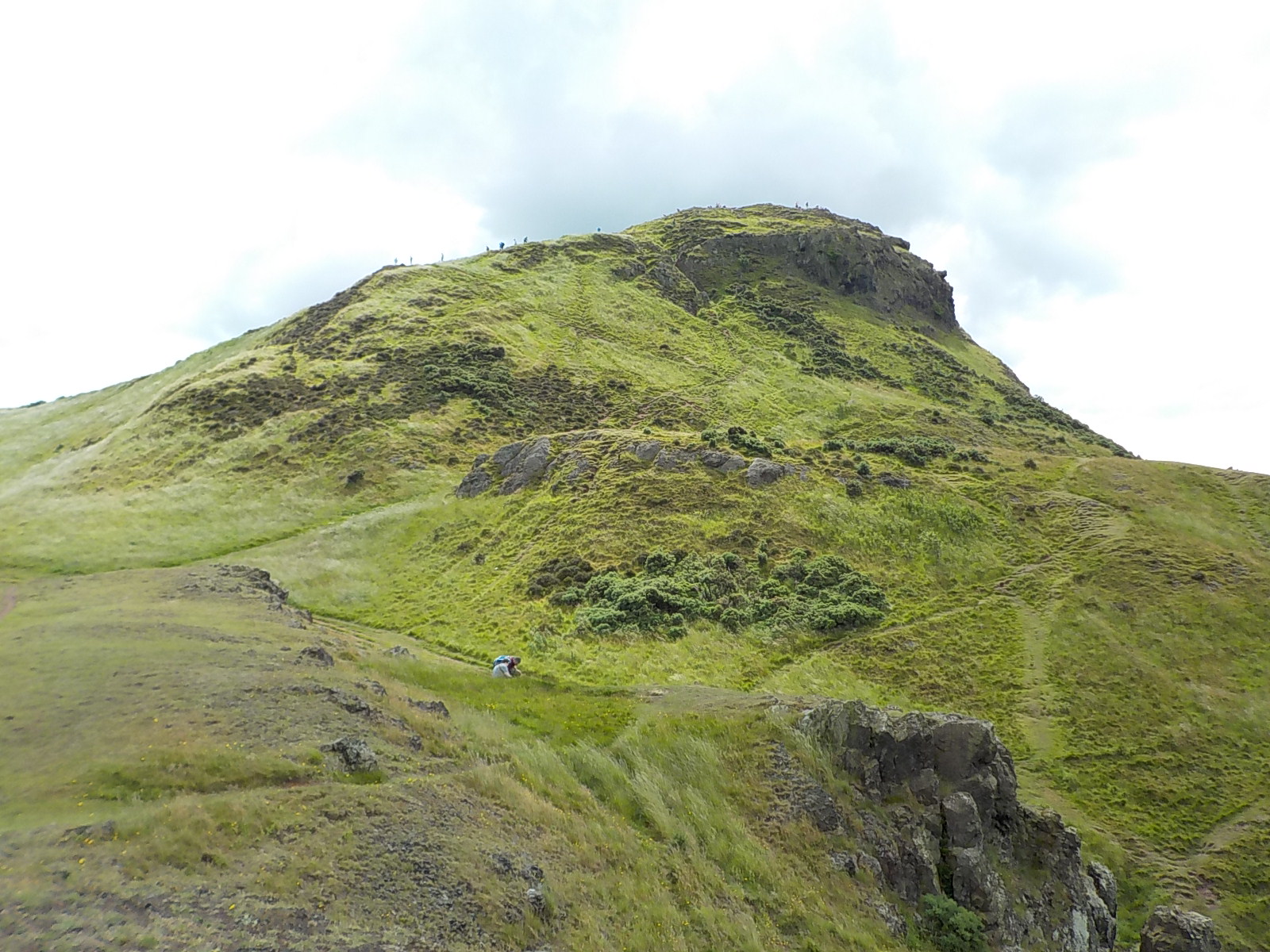
A good park takes planning and Holyrood Park began as a hunting preserve long before 1541 when James V enclosed the area with a wall. Though adjacent to Holyrood Palace at the east end of the Royal Mile (where the Queen was recently in residence), the former hunting grounds are now a world-class park that encompasses Arthur’s Seat, a popular walk to the highest point overlooking Edinburgh. Arthur’s Seat is the remains of the heart of a volcano, highly eroded over the years and scraped by glaciers during the ice age. There are a few low junipers and grasses. (There are also gorse bushes, but I haven’t seen any. As a reader of Winnie-the-Pooh, I must see some.) It’s the high point Holyrood Park, 650 acres now surrounded by Edinburgh and its suburbs. We took only one walk of many possible paths that include several slightly lower hills and an area of cliffs, the Salisbury Crags. There is historic significance here, too, as James Hutton, the father of modern geology, made some of the observations that led him to propose the theory of uniformitarianism from viewing the geology of the area. He concluded that the earth’s crust, the surface of the land, was formed by continuing processes over long periods of time.
At the time, this was a fundamental, crucial change in thinking, because the history of the world was still viewed as very recent, so Hutton had to brave criticism of those who believed strongly and devoutly that the world was only a few thousand year old. Unimaginably long periods of time before people existed was rarely even discussed.
Hutton recognized that erosion and deposition along with volcanic action could explain the layers seen in any geological cross-section. It changed geology from the observation of curious features to a puzzle that could be solved. Based on Hutton’s principle, any section, even any landscape, could be explained by tracing the sequence of deposition and erosion. Geologists and archaeologists still rely on the underlying significance of uniformitarianism.
Guidebooks tell you the walk to Arthur’s Seat takes 45 minutes. That figure assumes you won’t be stopping to take photos, chat, look around,or breathe. We did all those things, so it took us a bit longer, but the view was excellent, the day was perfect, cool and comfortable, and there was no rain. The upper part of the route is uneven underfoot, slick from wear and rain in places, with exposed rock waiting to trip you. We got to the top and back without any (additional) twisted ankles, but it is not a hike for everyone, despite the deceptively smooth green view from a distance.
At places, it’s surprising to remember that we are within the city. The park seems vast when you are in the center. (I dreamed of an endless green landscape afterward.) Yet the city is just over the hill in every direction.
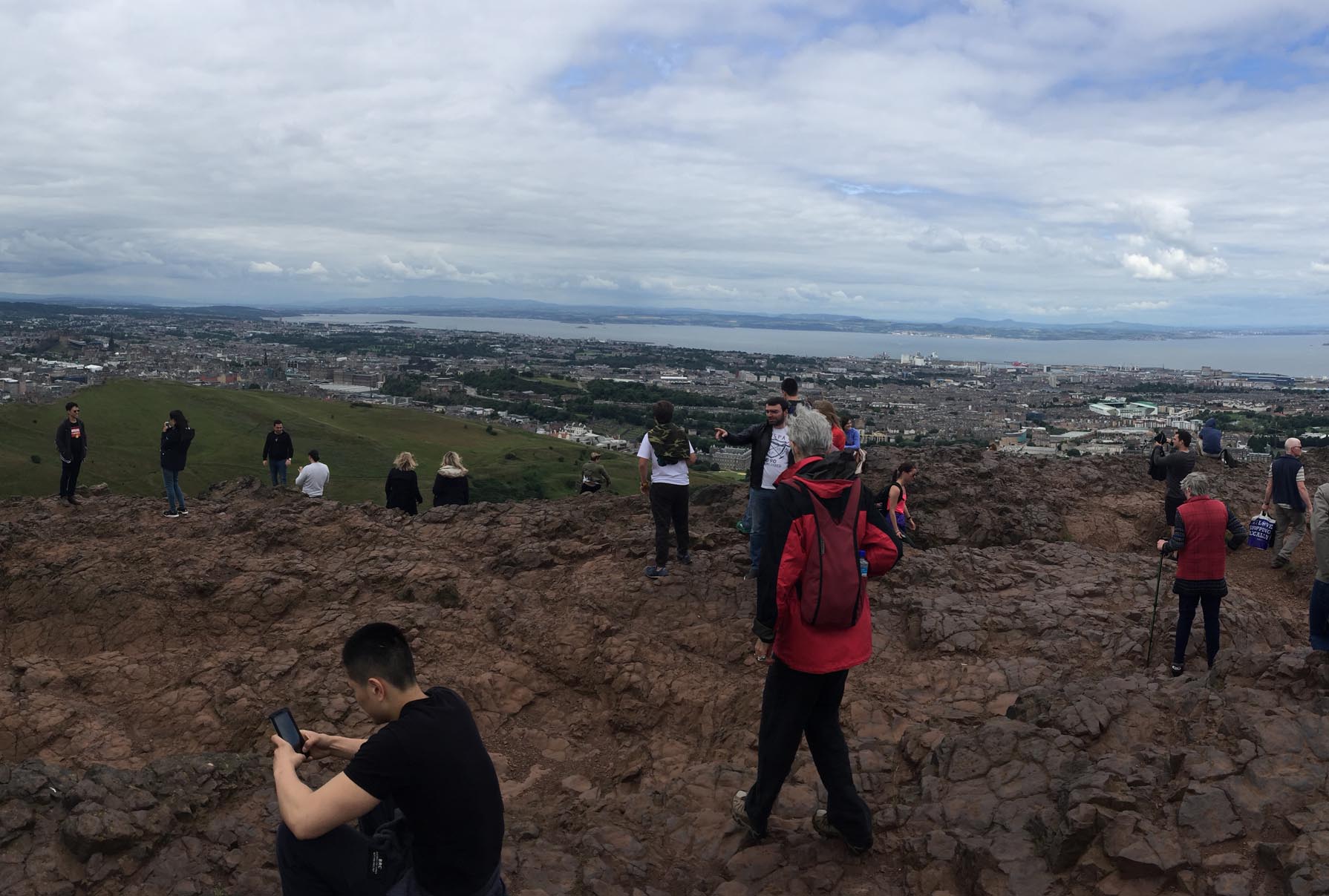
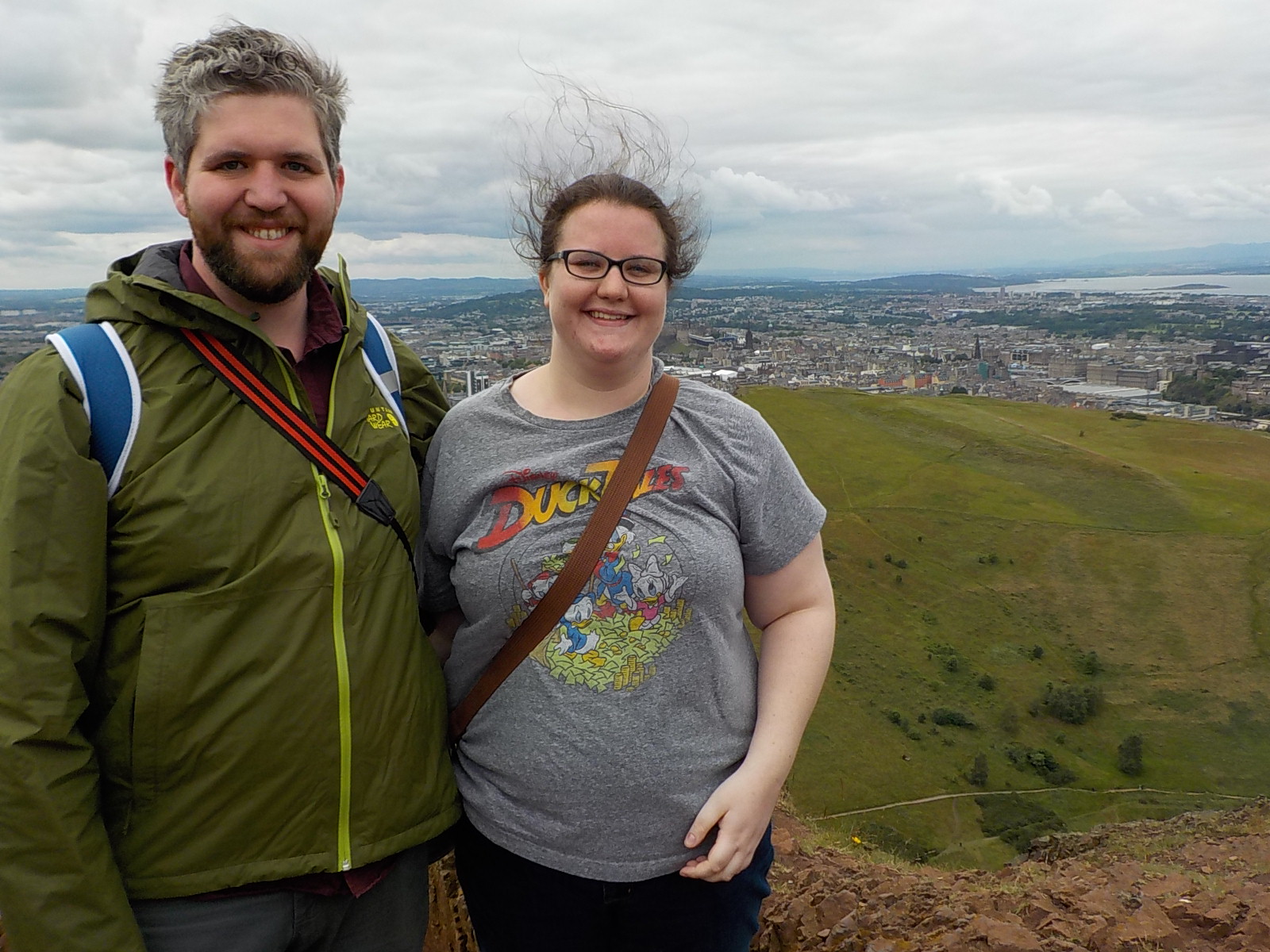
We made it to the top where we promptly took a selfie, now posted on Facebook. What you don’t see from my bucolic photos is the number of other people on the same walk. It shows you how we edit what we see and experience.
You can have a personal stroll to Arthur’s Seat despite the hundred or so other visitors coming and going.
Lillian’s hair loved the top of Arthur’s Seat. It stood up and did a dance.
Getting to Edinburgh Castle was an adventure all its own, because we had to find a route that was short enough that Jonathan’s ankle would still function after we arrived. We pored over the street map and ended up taking a bus to the center and walking up “the mound” to the castle. It was a lot shorter than on my previous visit with Paula and Emily where we walked to North Bridge and up the Royal Mile.
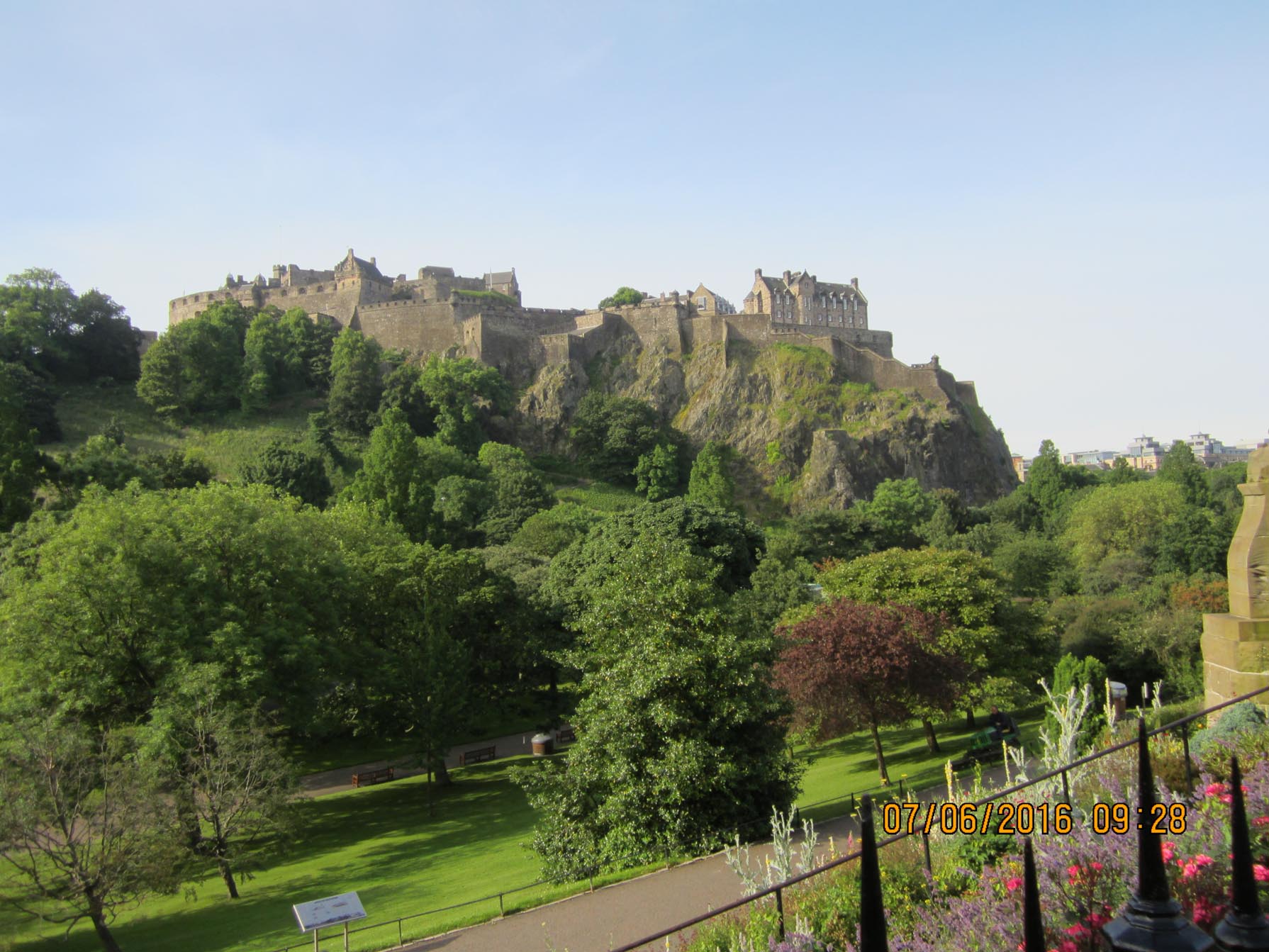
Imposing from every angle.
The portcullis is still the entrance.
The parade ground after the portcullis is marred a bit during the summer by the huge metal stands that engulf the space, setup for the Edinburgh Tattoo military show that takes place every night in August. There is still plenty of pageantry for those of us who won’t be staying until then.
The guards change with a bit of the pomp you see at Buckingham palace. They also rotate services. Today was Beefeaters. Another day were men in green with flat caps.
Weaponry as decor.
The crown jewels of Scotland were impressive, though the Stone of Scone, displayed with them is a puzzling display of patriotism. The tale goes that ancient kings of Scotland were crowned while standing on the stone, a small featureless block that now has a couple of iron rings set in it. When Scotland signed the treaty that made it part of England, the block was carried off to Westminster in 1296 and stored in a drawer below the seat of a custom-made throne designed by Edward I. It stayed there until 1950, more than 650 years later (!), when it was stolen by Scottish students. Despite a wide search, the stone was not recovered by the police, but was returned early in 1951 after only four months in hiding. Scottish nationalism built up over the years since then and in 1996, the stone was returned to Scotland. That doesn’t seem to have quelled nationalism, and Scotland may again one day be an independent state. The Stone of Scone rests with the crown jewels while they wait.
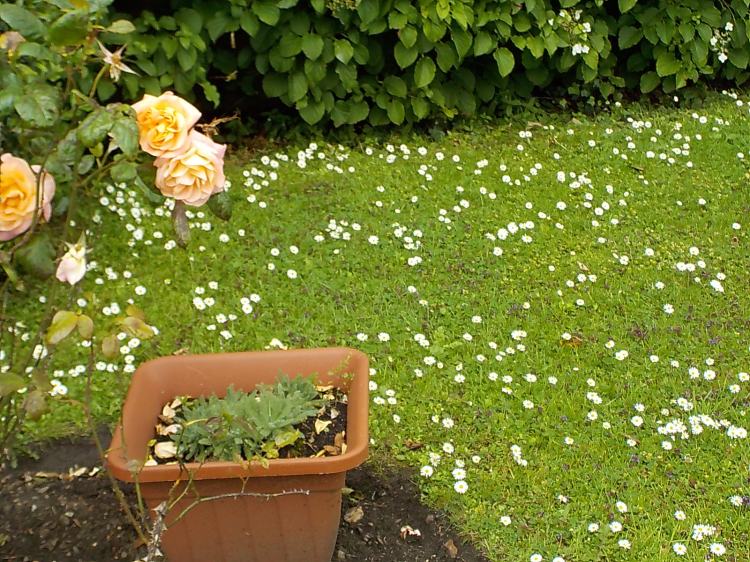
Edinburgh is as green as anywhere you can imagine. Yes, it has been raining, sometimes heavily, but the payoff is that the gardens are beautiful and the flowers in perfect bloom.
We’ve arrived in Scotland at an unusual time. The Brexit vote was just over a week ago, and like many others, we were unprepared for a decision for the UK to leave the EU. The pound sterling is at a record low, this morning $1.29 = £1. This has no visible effect on daily life, though it will help our end-of-month budget accounting. Comparing Scotland with Norway and the other places we’ve visited is an inexact science because most statistics are for the UK as a whole. The population of Edinburgh itself is around 500,000 or around the size of Albuquerque. Average income is about $35,000 per year. That’s lower than Norway, but higher than anywhere else we’ve been, more than twice the average for Portugal, for example, and Portugal is also a member of the EU (for now). Every site that notes average income points out there is huge variability. The Human Development Index is .907, almost as high as Norway, and life expectancy is relatively high, 78 for men and 80 for women.
I made my first visit to Edinburgh Castle with Paula and Emily (her daughter-in-law) before Emily returned to her conference in Glasgow and Paula left for Italy. We had a ROYAL moment at the castle, when the car carrying Princess Anne to a war memorial event passed right by us. (She didn’t wave, but there she is.)
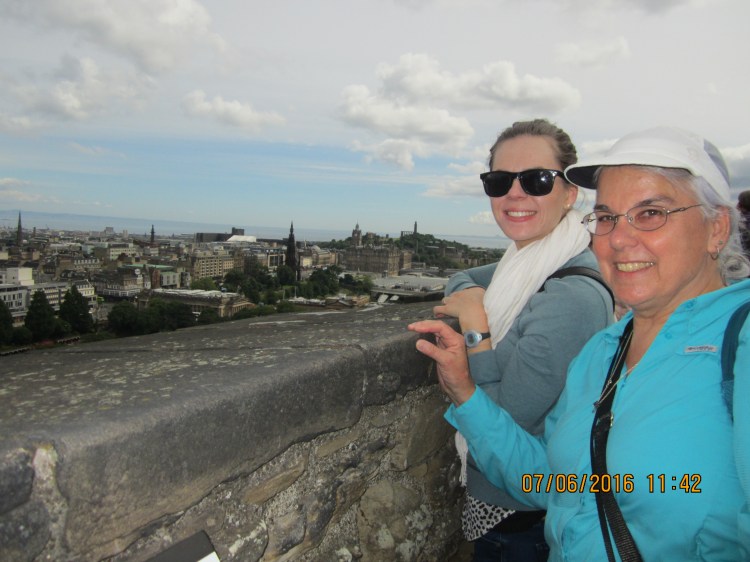
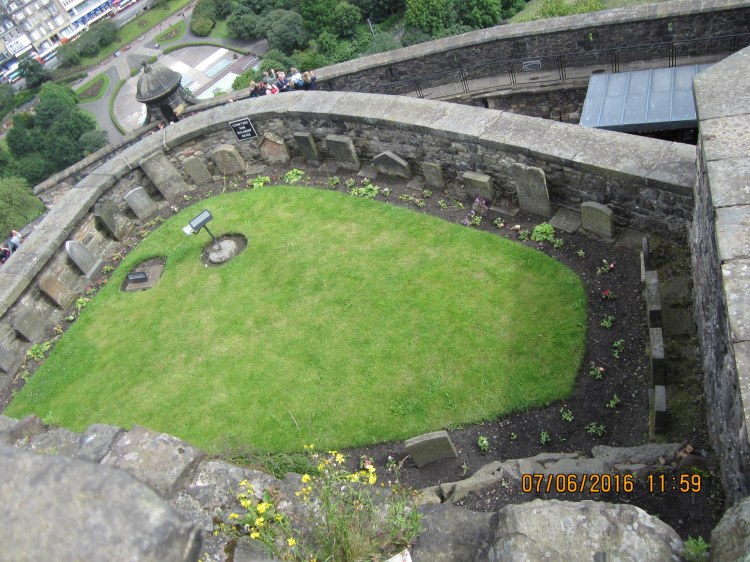
After that excitement, we liked the views from the castle best, along with the dog cemetery. I invested in a membership to Historic Scotland (£34.50 each) that will allow me to revisit Edinburgh castle and visit many others.
Emily (L) and Paula
Pet headstones
This was our first sunny day, and we had coffee on the Royal Mile, admiring the sun on the steeple of St. Giles cathedral.
There are already lots of things of note.
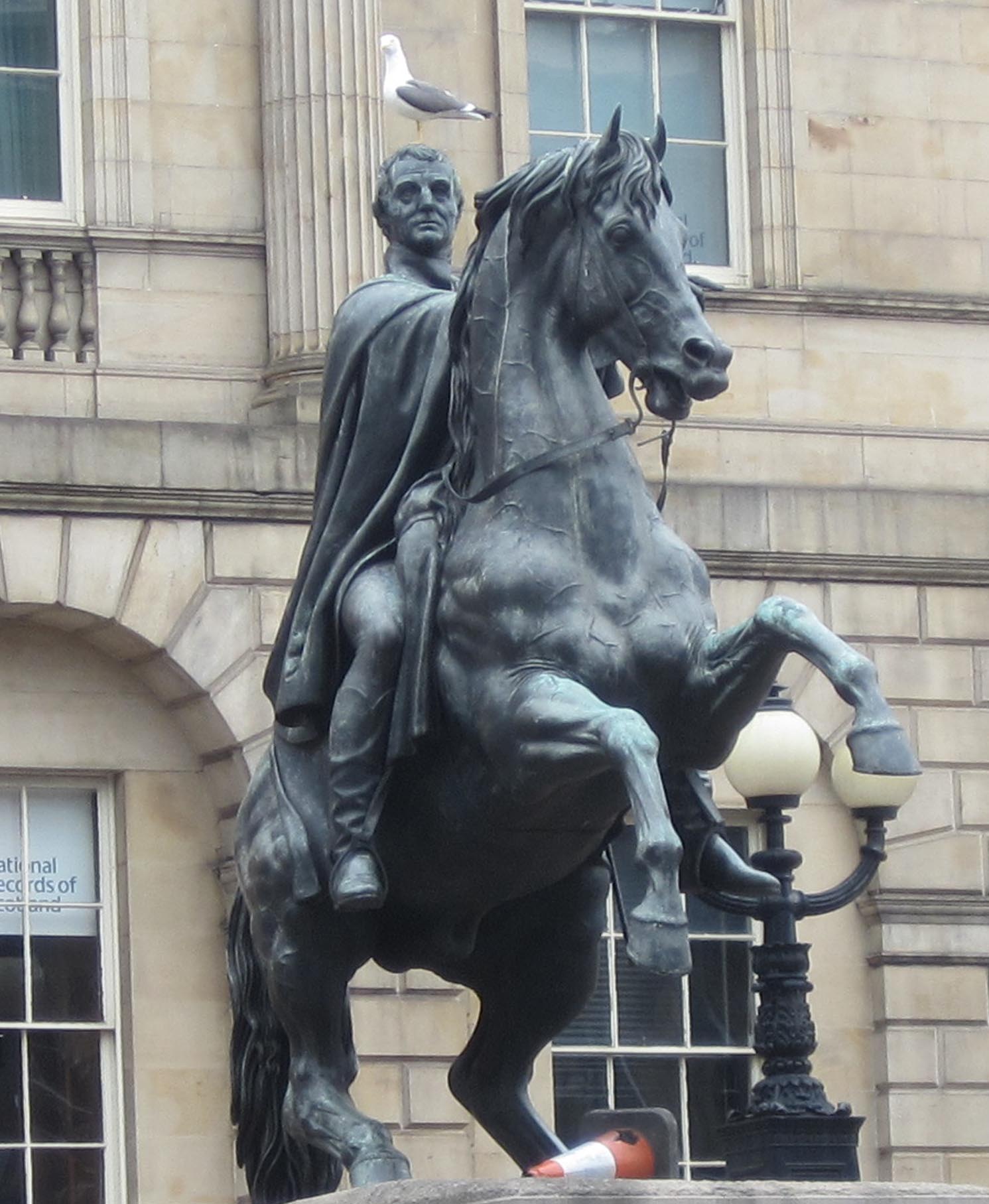
There are many, many statues of famous Scotsmen that always seem to have a bird standing on their head. I will be vigilant in documenting them–I’ve never been in a city with so many bronze men standing around on pedestals.
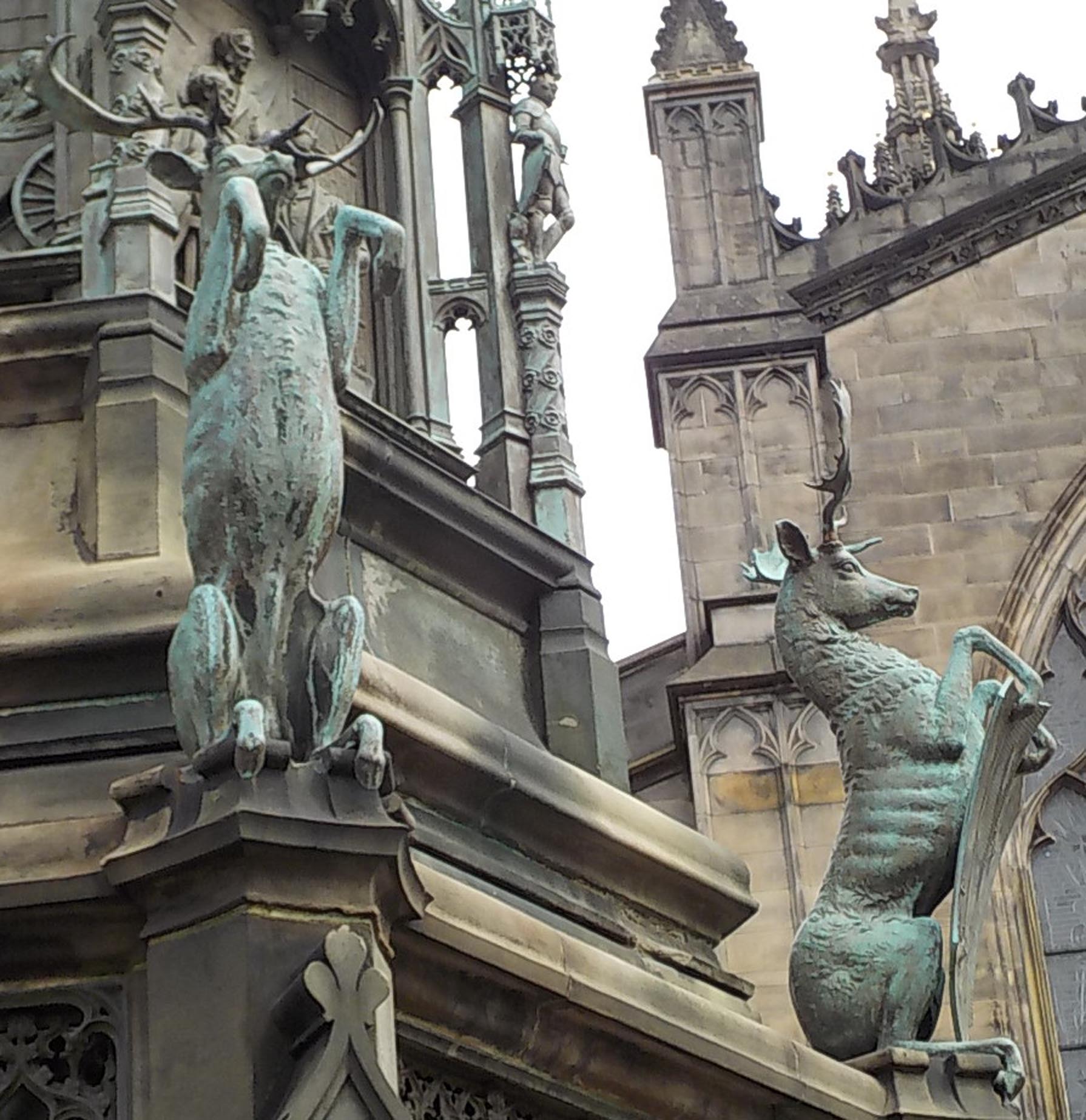
There are also animals, sometimes in preposterous poses. Here are some rearing elk.
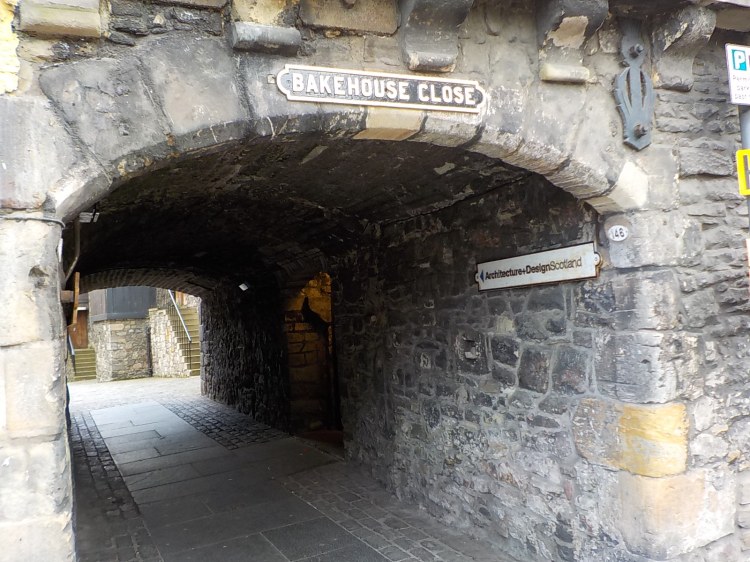
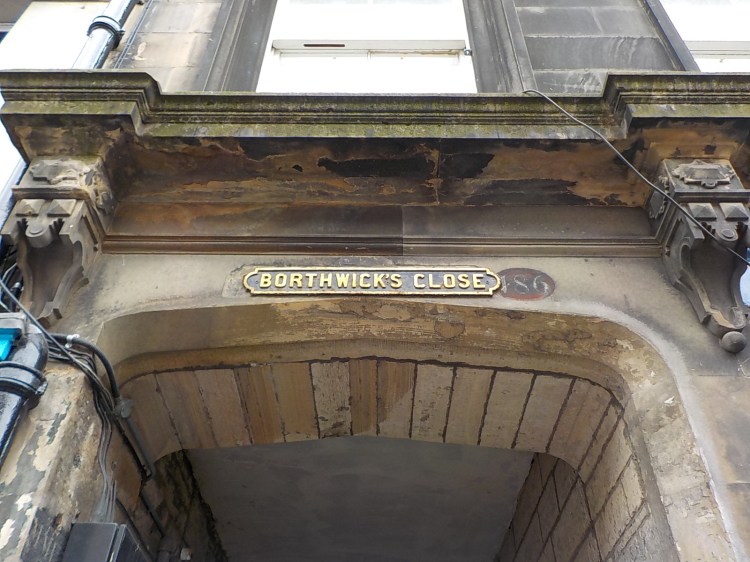
Narrow passages lead off the Royal Mile, each considered an alley, or close.
There are unusual shapes, too.
Curved facade
The Market Cross
Roof tower
And romantic views out over the city.
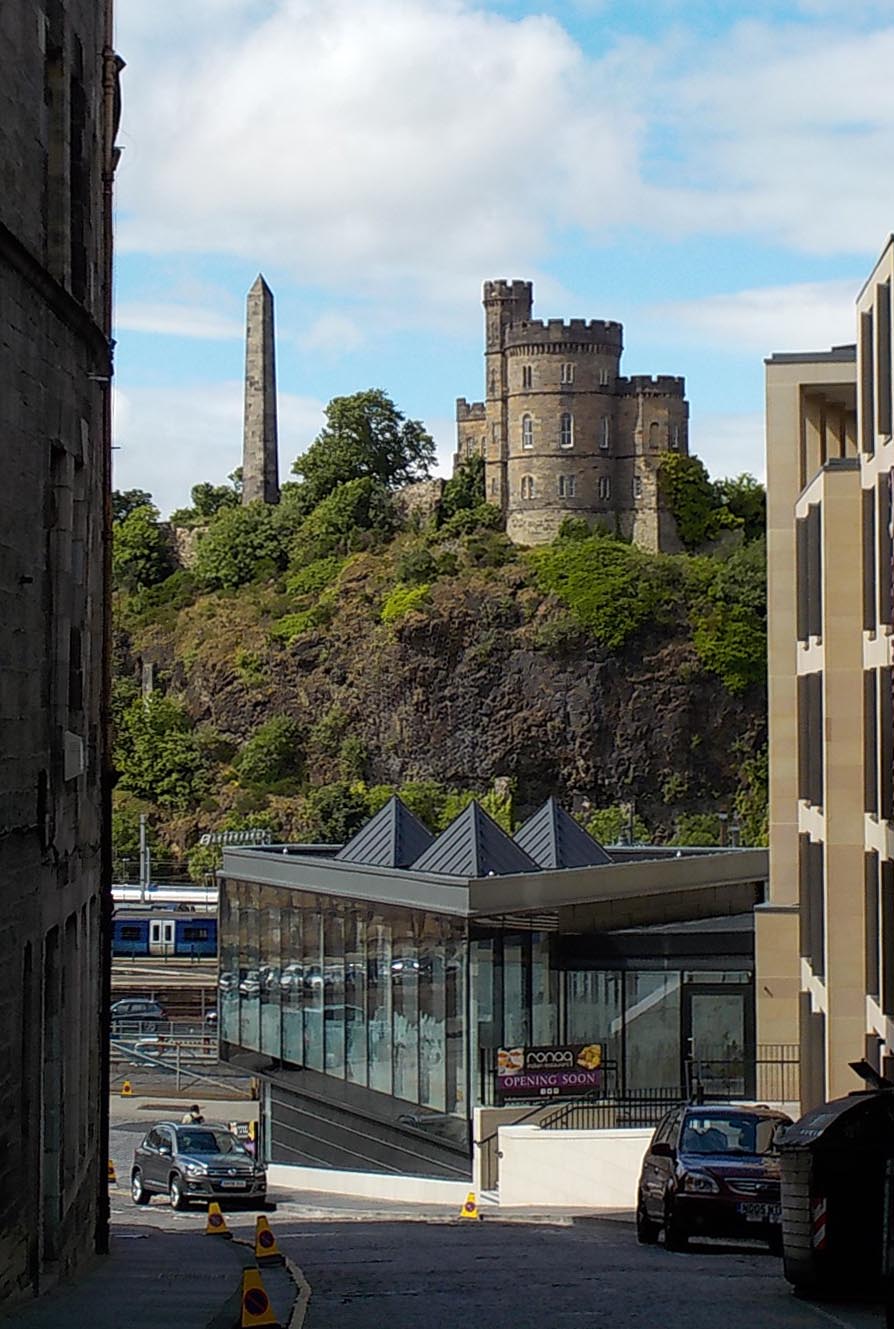
The old towers over the new, looking from the Old Town toward Calton Hill.
Our apartment is a recently renovated three bedroom, one bath place on Murrayfield Road, and it suits us very well. We are a short walk from the bus into Princes Street, the center of the city, and only a couple of blocks from a bus that goes directly to a large Sainsbury’s, where we can do almost all of our shopping. We’ve bought 4 week bus passes that give us unlimited bus/tram transport on Lothian Buses, including the airport bus (£27 each). Here are some photos of our new spot.
After a week of rest, Jonathan’s ankle still hurt a lot. I crossed the street to the Murrayfield Medical Office and asked about options and was told to go to A&E at the Royal Infirmary. As I was looking up directions I found a reference to the “Minor Injury Clinic” at Western General Hospital and looked it up. Yes! They deal with sprains and “routine fractures” (are there any?). We went down to the corner and were able to catch a cab promptly (it was not raining). The driver dropped us at the door of the clinic, the Porterfield Road entrance of the hospital, and we hobbled in.
It was a miracle. First of all, almost no one was there. Jonathan was seen almost immediately and sent for an xray. He hobbled off to get it, hobbled back ten minutes later and was called in about 5 minutes after that. His foot is not broken! It will mend on its own! No more ace bandage!
Saving the best news for last, your first visit to the Minor Injury Clinic is free, even if you are not Scottish, from the UK or the EU. Free once for anyone. Thank you, clinic and Great Western Hospital.
























 Llywindatravels 2025