We knew the birds would be different in Australia, but we didn’t realize how quickly we would see them. On one of our first afternoons in Tasmania, driving home across dry, sandy colored farmland, we swerved to a halt to see a flock of cockatoos! If you haven’t been to Australia you will never see this because cockatoos are really big and even zoos usually have two or maybe four of these birds. To see eight or a dozen big white birds land in the branches of a tree, pop up their yellow topknots, and start squawking causes us childish delight. Look! We can see them! It’s just like the pictures!
One day we saw a flock of around 100 cockatoos swirling over our heads. It was amazing. The specks are cockatoos, and this photo is by Jonathan.
We carry our binoculars everywhere because you never know what you will see. While making a U-turn, a frequent activity of ours, Jonathan spotting something moving and we pulled over and got a look. It was a Superb Fairy Wren. What a name! What a bird! Who wouldn’t want one of these in the yard? It turns out that these lovely little birds are not uncommon in Tasmania, it’s seeing one for the first time that is such a treat.
We’ve seen other delightful and interesting birds, including native hens (a bit like the gallinules of New Zealand), hawks, and falcons, but the birds with bright colors are the ones that amaze me most.
[As usual, most of my bird photos come from the internet. Thanks, internet! If you’d like to see fabulous bird photos look on Instagram at awbirder for the photos of professional bird guide Andy Walker.]
I started to summarize our month in Tasmania and couldn’t remember anything but this week’s weather. One day the temperature is in the 90s, the next day the high 60s, changing more than 30° (F.) in twelve hours. Yesterday, I swam in the ocean, today’s forecast is 54° with smoke. Yo-yo temperatures and huge fires have distracted us. We check the internet often to make sure a fire alert hasn’t been issued for our area, only to find that we are miles from the nearest fire despite the smoke.
Forest fires have been been burning the entire month but the smoke has only become a statewide issue in the last few days. We are fortunate that it is just an inconvenience for us. More than 300 people in towns south of Hobart have been evacuated for several days, living in a local gymnasium. We are on our way to Melbourne shortly, where it will still be hot, though perhaps not as smoky.
In Tasmania we focused on nature, walking miles of beaches, admiring the changing landscape and marveling at the features that are similar to other places we’ve been. There are steep rocky hills, towering forests, dry rolling hills, and beaches one Australian we met called “Caribbean without palm trees.”
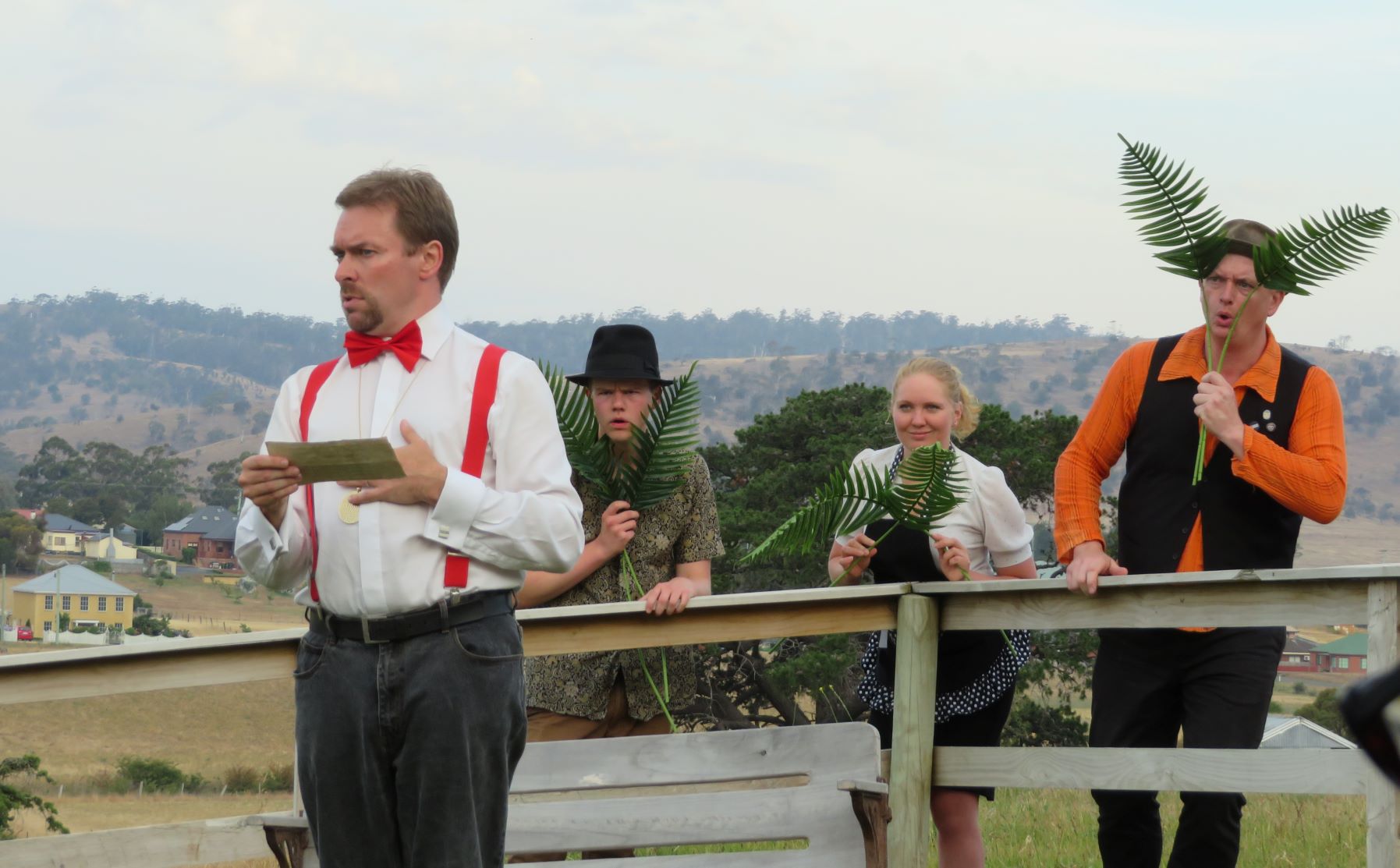
Though we stuck close to nature in Tasmania, we took in some entertaining and quirky places. Our evening of heavily revised Shakespeare at the Pooley Winery was one highlight,
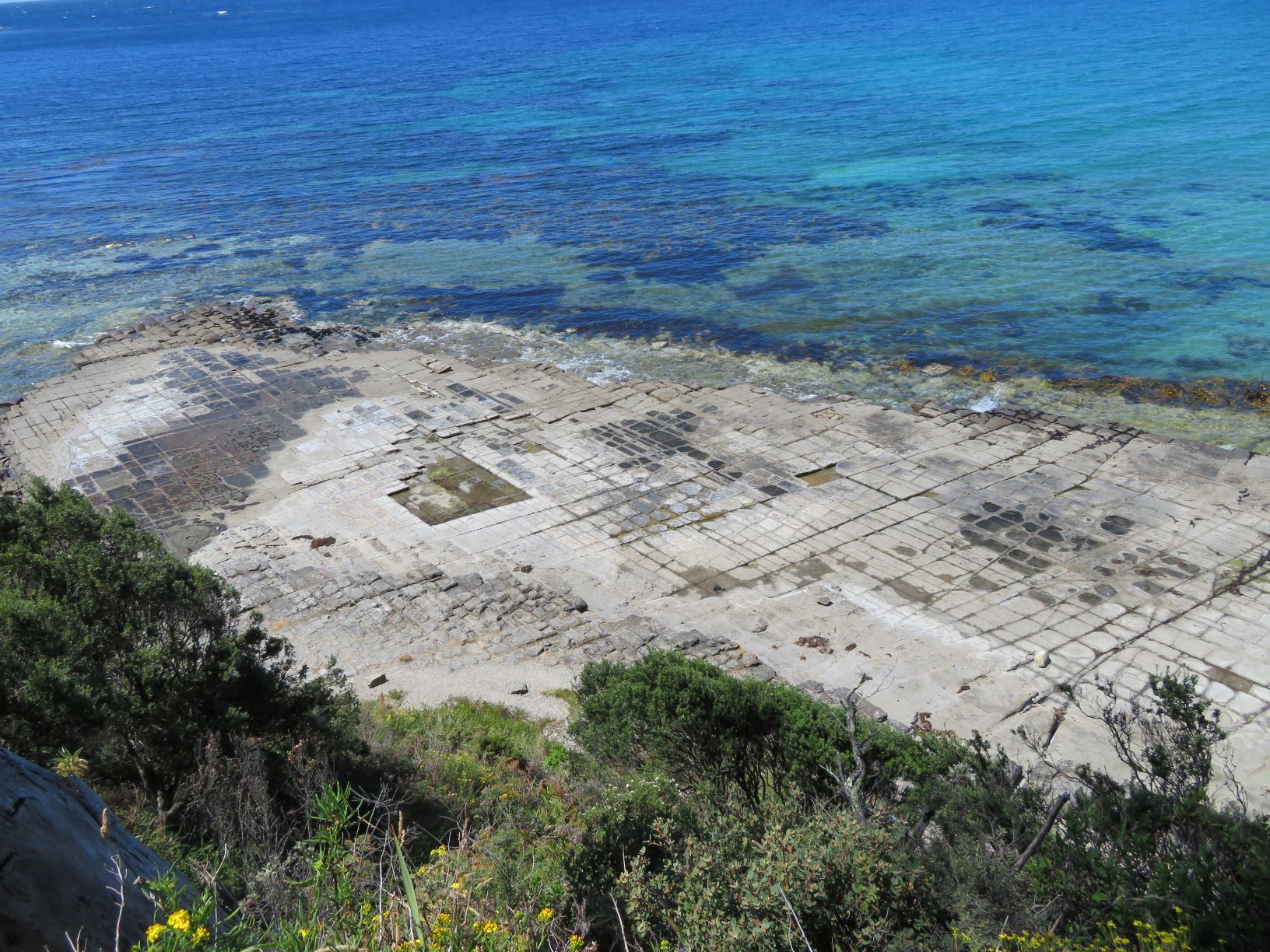
The Spiky Bridge, outside Swansea, and the Tessellated Pavement, on the Tasman Peninsula are other interesting places we visited. Some of them come from the website Atlas Obscura. It’s a way to look up curiosities near where you happen to be. You can join and add sites you find, too. https://www.atlasobscura.com/. The Tesselated Pavement is a geological feature, even though it looks like flooring or paving squares.
Fossil Cove held layers of fossil imprints.
Our month here was delightful. No wonder Tasmania is Australia’s favorite vacation spot.
More than fifty fires are burning in Tasmania. With the forecast for temperatures in the mid-90s on Friday, we decided to go to the east coast. It was a sunny morning, but when we opened the door of our house to load the car, we were shocked to find the breeze was already hot as midday in Tucson. The fire danger is high in our region north of Hobart though there were no fires burning near us. As we drove north and east, a red-edged smoky cloud filled our rearview mirror. We outran the cloud somewhere northeast of Campbelltown.
Friday, 100°
We made it to Binalong Beach, the southern end of the Bay of Fires, named after rocks that can appear flame-red in the setting sun–no burning involved. The beach is postcard perfect blue-green water. Waves crash against soft white sand. The outdoor temperature was over 100° at that point. Our sunglasses weren’t enough to keep us from squinting. We retreated to eat lunch indoors at Lichen, a very good restaurant overlooking the beach. We took our time in the heat but eventually had to leave and decided to go for a swim.
The white sand of Binalong Beach doesn’t get scorching hot the way darker sand does, and we scuffed through the sand in the blinding sun and superheated air until we had to get wet or shrivel up and blow away. The water was cool and refreshing, though the return walk to the car dried us thoroughly. Jonathan had double-checked to make sure we had an air-conditioned motel room, and it was a good thing, as initially we seem to have booked a room with broken AC. That being fixed in advance, we had a smooth arrival at Blue Seas Holiday Villas in Scamander. A week ago, we thought we’d go to Launceston for the weekend and found there were no rooms. It was MONA-FOMA, a massive art and music festival. We postponed our trip and opted for the east coast this weekend, not realizing that THIS weekend includes Australia Day, a major holiday, but we prevailed. The hotel was fine and the manager gave us good advice on where to eat, Fearless Freddie’s Cafe.
It was a good day to be on the road, at the beach, in air conditioned restaurants, and air conditioned motel rooms. The air was hot, the breeze was hot, everything we touched was hot. We have been in weather as hot as this in the US southwest, when the temperature edged up over 100 while we were doing archaeological field work. It’s still a pretty rare condition for us, though it sounds like we may experience more days like this during our coming month in Melbourne. Tasmania isn’t usually like this. It’s where mainlanders come to escape the heat–usually.
As peculiar as any aspect of our day in the fiery furnace was how quickly it ended. On islands the weather can change rapidly, but I’ve never felt the changes like Tasmania. With temperatures over 100 on Friday afternoon, the wind picked up, a front blew through, and Saturday was completely changed, with temperatures in the high 70s-lower 80s. I was the casualty of this change, with a bad headache most of the morning from the change in pressure. We spent the cooler day visiting spots along the shore between Scamander and Swansea, including a visit onto the Freycinet peninsula.
Saturday, 78°Sat. 6 pm. 65°
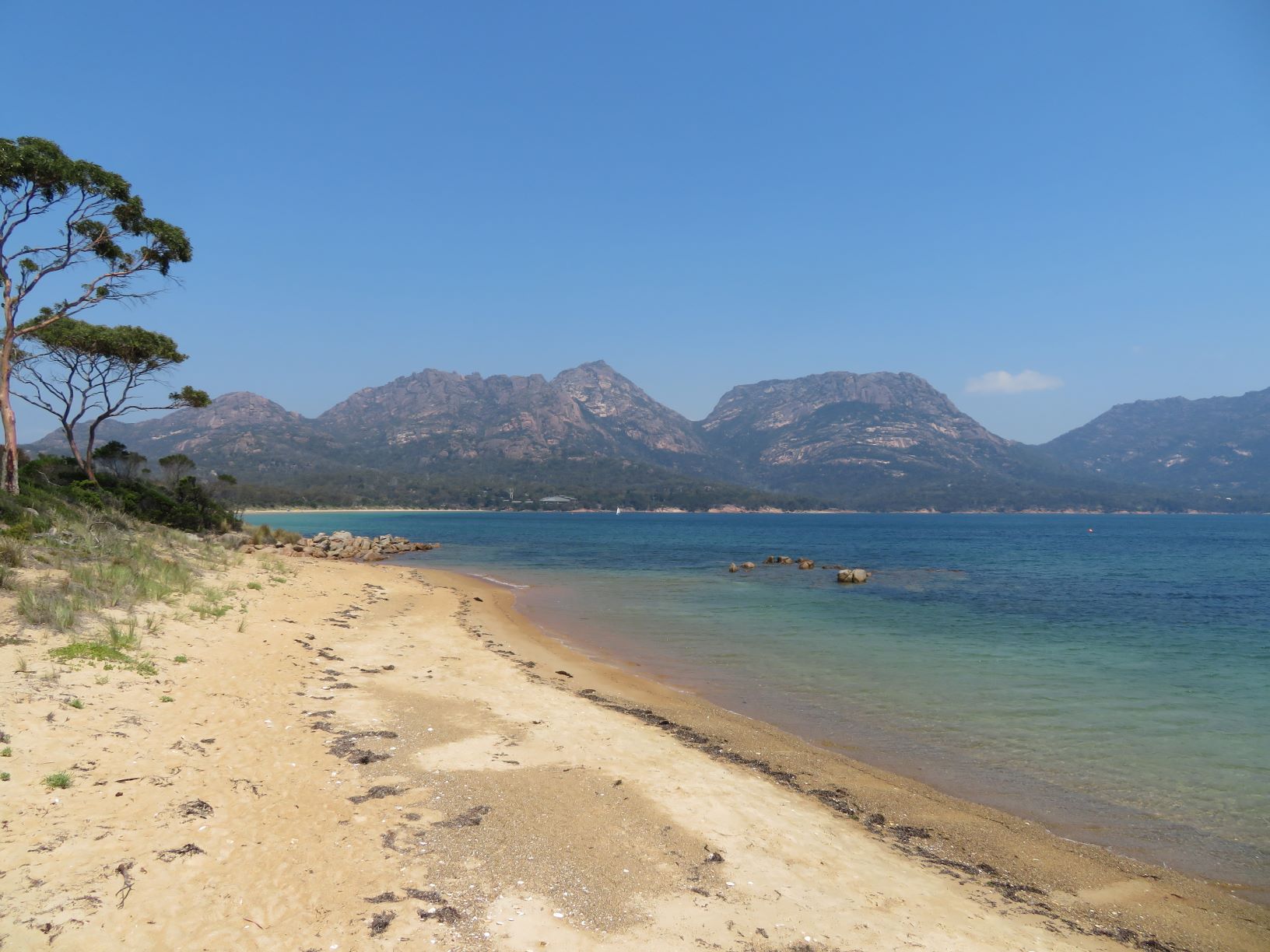
We didn’t make the walk to Wineglass Bay, 90 minutes each way up and down between the hills in this photo. “Everyone” goes to see Wineglass Bay, but there are many gorgeous beaches that don’t require such a hike. Even on one of the busiest holiday weekends of the year, beaches were uncrowded.
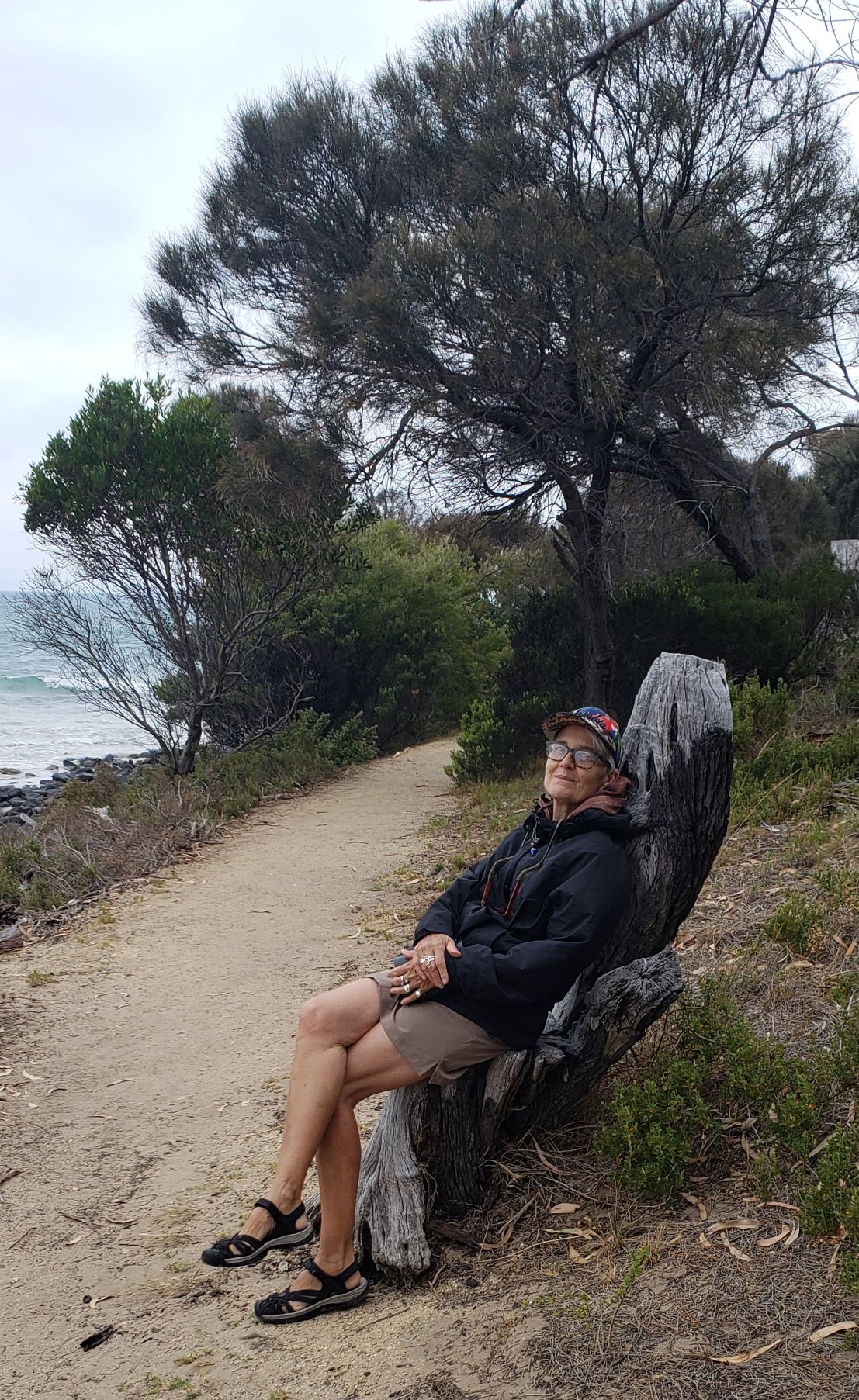
Late Saturday afternoon we arrived in Swansea. The day had cooled even further, the wind was up, and I was back in my hoodie and rain jacket to stay warm enough to take a walk along the shore. The cool spell was as brief as other weather phenomena and Sunday dawned bright and beautiful.
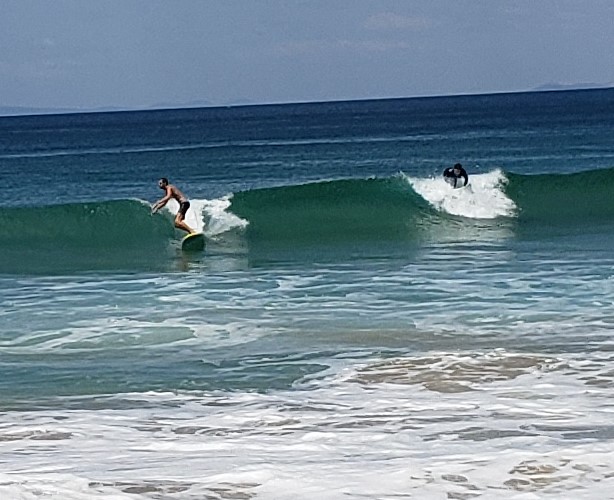
On on way back to Tea Tree on Sunday we stopped at Bolton’s Beach for a last dip, where we had only a couple of surfers for company. There are houses and a campground nearby, and it was glorious weather, yet we were the only people on the beach. We went home happy.
Crepuscular: Active at twilight or before sunrise.
We started our day late, arriving at the Bonarong Wildlife Sanctuary when the day was already hot. Failing to learn the lesson of our visit to the albatross sanctuary on a similarly bright day, we entered to find that most of the animals are not very happy when it’s hot outside. The many Forester kangaroos that have the run of the place sprawled on the ground. Most couldn’t be bothered to approach the visitors eagerly holding out handfuls of kangaroo food that each person is given on entering. We saw a couple of kangaroos licking crumbs of oatmeal and kangaroo chow (?) off the ground from a largely prone position. It was pretty funny.
The listless kangaroos were a harbinger of what all the other animals were up to, resting in the shade. That meant that we couldn’t see the wombat, or any quolls–they were all deep in their burrows or clumps of tall grass avoiding the sun. We did see echidnas and a variety of birds. The koala was very cooperative because all they ever do is sit on a tree branch. We saw a Tasmanian devil. They look like little chubby puppies apart from their prominent toothy mouth.
We made the best of our visit, and even spotted a new bird, the noisy miner. Following the intelligent lead of the animals, we lay low for the rest of the very warm afternoon, catching up on writing. It turns out there are many different hopping pouched animals, including tree kangaroos, rat kangaroos, wallabies, quokkas, pademelons, wallaroos, euros, potoroos, and bettongs. I had never heard of most of these.
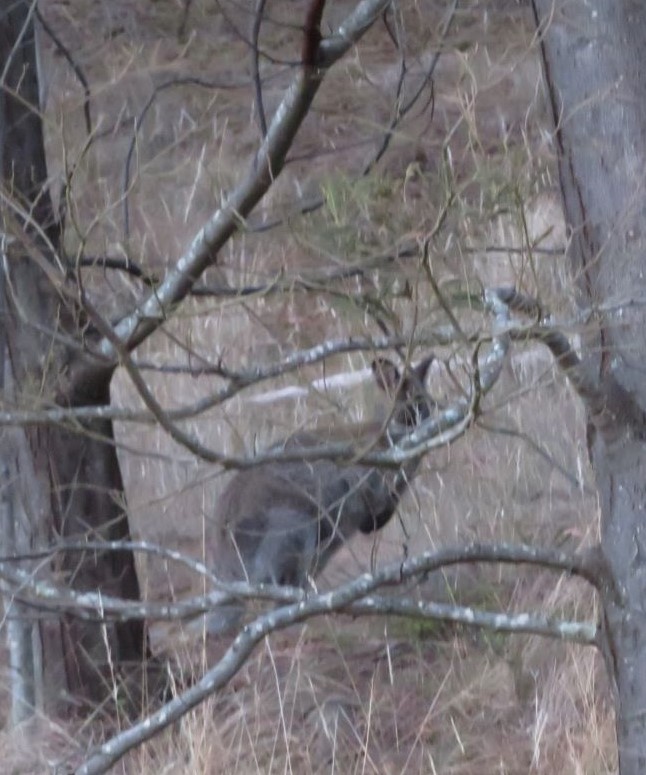
We ate dinner on the deck, looking across the valley, where two nights ago Jonathan spotted a flock of cockatoos roosting in trees at the far end of the valley. We decided that if they came again we’d try to find them. They were out again, almost 50 big white birds clustered on four or five trees. It was 8:30 pm, the sun was about to set, but there was still time to drive a mile. We turned off the highway onto a dirt road that wound into the hills toward the stand of trees covered with cockatoos. As we worked our way along, it became apparent that the trees were not accessible by road. We continued, hoping the road would turn again, when we were distracted by three wallabies hopping across the road. One stopped long enough for me to get its photo.
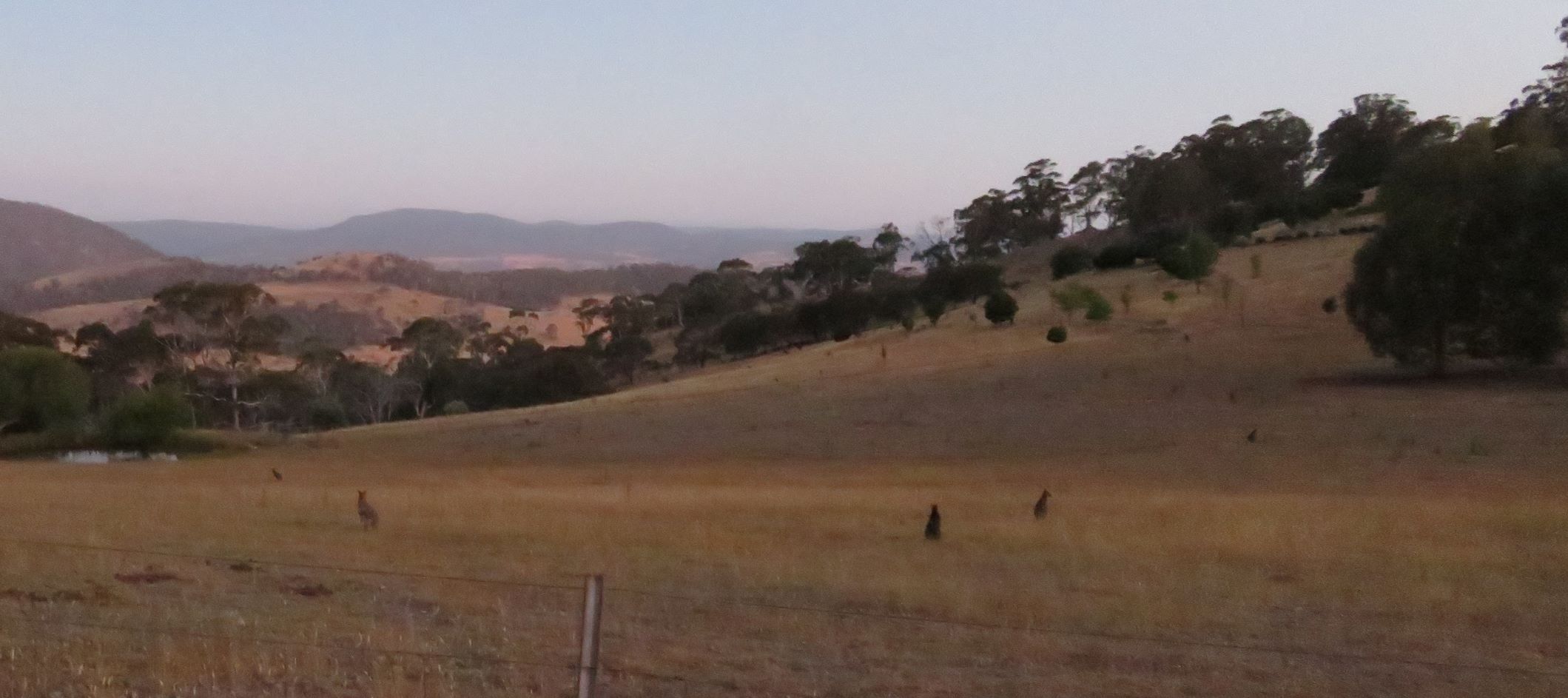
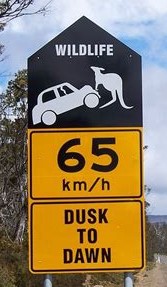
We moved on slowly to avoid spooking the animals, which is impossible. The reason there are so many dead wallabies and kangaroos by the roadside is because their instinct is to jump, which puts them in the middle of the highway on the first leap, often too late to take another. We kept going because we kept seeing wallabies. The road curved upward and we looked across fields full of wallabies. Our photos are “hidden pictures”. Find the six or seven wallabies staring at us.We never did find the trees full of cockatoos, but we saw fifty wallabies, maybe more. We got so good at recognizing wallabies that we knew we’d spotted something different on our way home. A bit of research showed we saw a pair of pademelons, a smaller pouched marsupial. We wondered whether these “crepuscular marsupials” settle down when it is really dark. Is all the roadkill a phenomenon of the hour after sunset and before sunrise? The wallabies we saw are safely tucked away in a sparsely populated rural area, but every time we go out in the car we see the remains of others. Evening speed limits don’t seem to help.
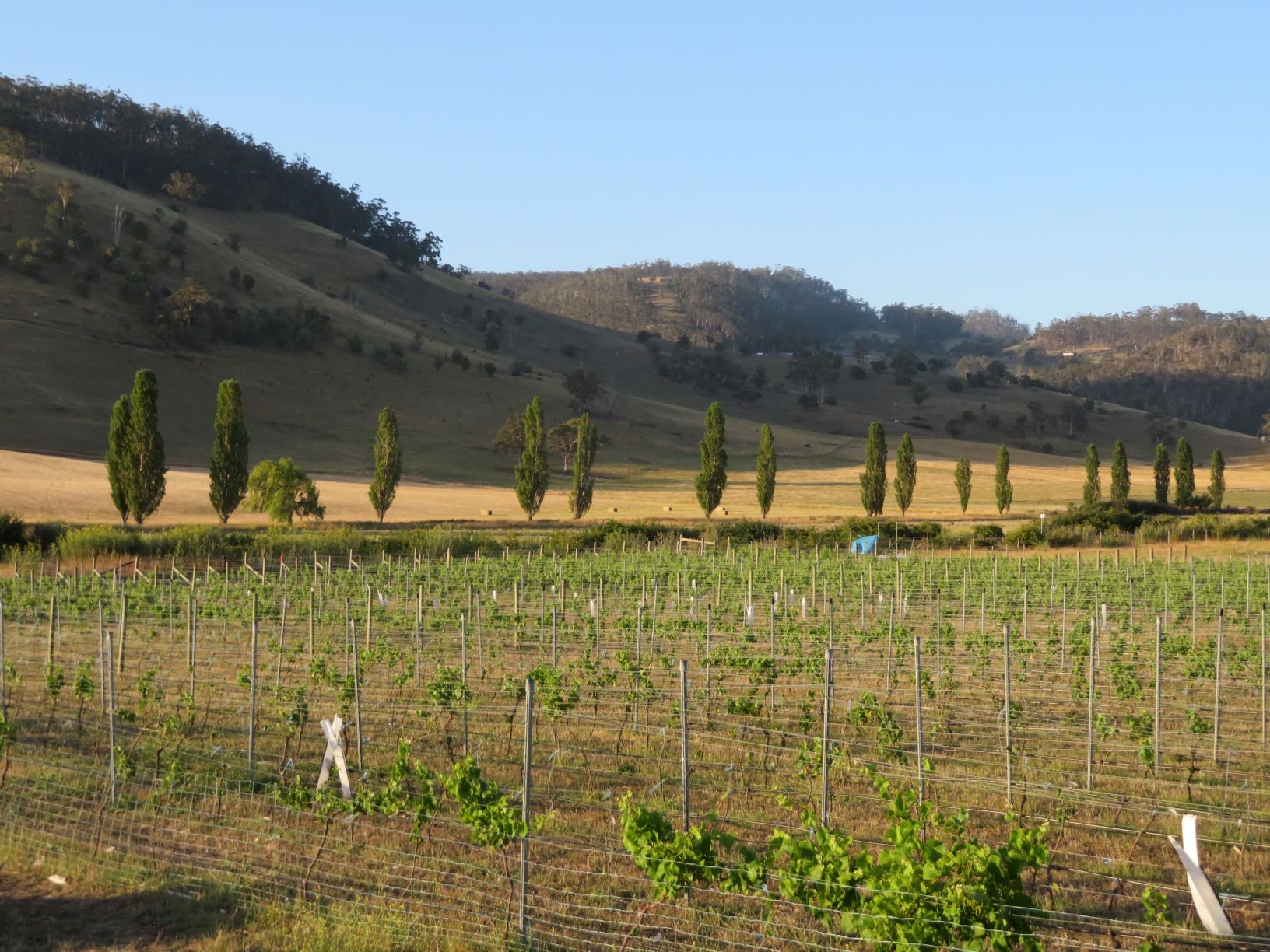
This month our home is a small vineyard outside Hobart, Tasmania. Though the property itself is only a few hectares, it is surrounded by hills of grazing land and it feels like we are in the center of a huge farm. Our house is the only dwelling, the owners live elsewhere. The owner and her two workers come and go, and a couple of repurposed shipping containers are the farm outbuildings. It is a small operation.
For me, this is the best of farm life, the beauty and the comfort of country routines like opening and closing the gate, watching the ducks, geese, sheep, cattle, horses, yet without any of the chores. Across the fence is the water for the geese and ducks. They drift over to the water, then out among the vines to nibble, then back again, all day long. Ten short “baby doll” sheep spend some days browsing among the vines. They are intended to keep the grass down between the rows, though we do see them chewing the vines. I don’t have to feed or water any of the animals, and when the geese all escaped and began browsing along the road, I didn’t have to round them up, put them back in their pen and fix the gap in the fence.
I lean on the gate while Jonathan chats with our host and one of her workmen. The breeze is cool and comfortable and I soak up the sun and the gentle swish of the wind. When we return from our trip to the beach, I hang the laundry out to dry on a rotating clothesline like we used when I was a kid. The scene takes me back to those days, helping my mom hang clothes on the line, and the delicious smell of sheets dried outdoors. Firewood sits in a heap on one side of the yard. I don’t need to think about starting a fire because it is the middle of summer; the pile shelters a family of bunnies that run in and out.
I walked to the top of the hill beyond us one afternoon, following the fenceline past the cattle. Looking over the hill, then back on our house, I see other small farms with their flocks of sheep, horses, and a pasture holding a single ostrich. The stillness and permanence of the landscape in the fading sunlight impresses me with the vastness of the land next to one person. That unchanging presence of the land compared to my tiny being makes me want to see what is just beyond the horizon. There I am in a nutshell. I’ve always wanted to see what’s just around the corner, the next bend in the shoreline, over the next hill, and I always will. The illusion that I am alone meditating on life in a great still silence lasts until the next car passes, and the train pulling its daily load of timber chugs by. I head for home.
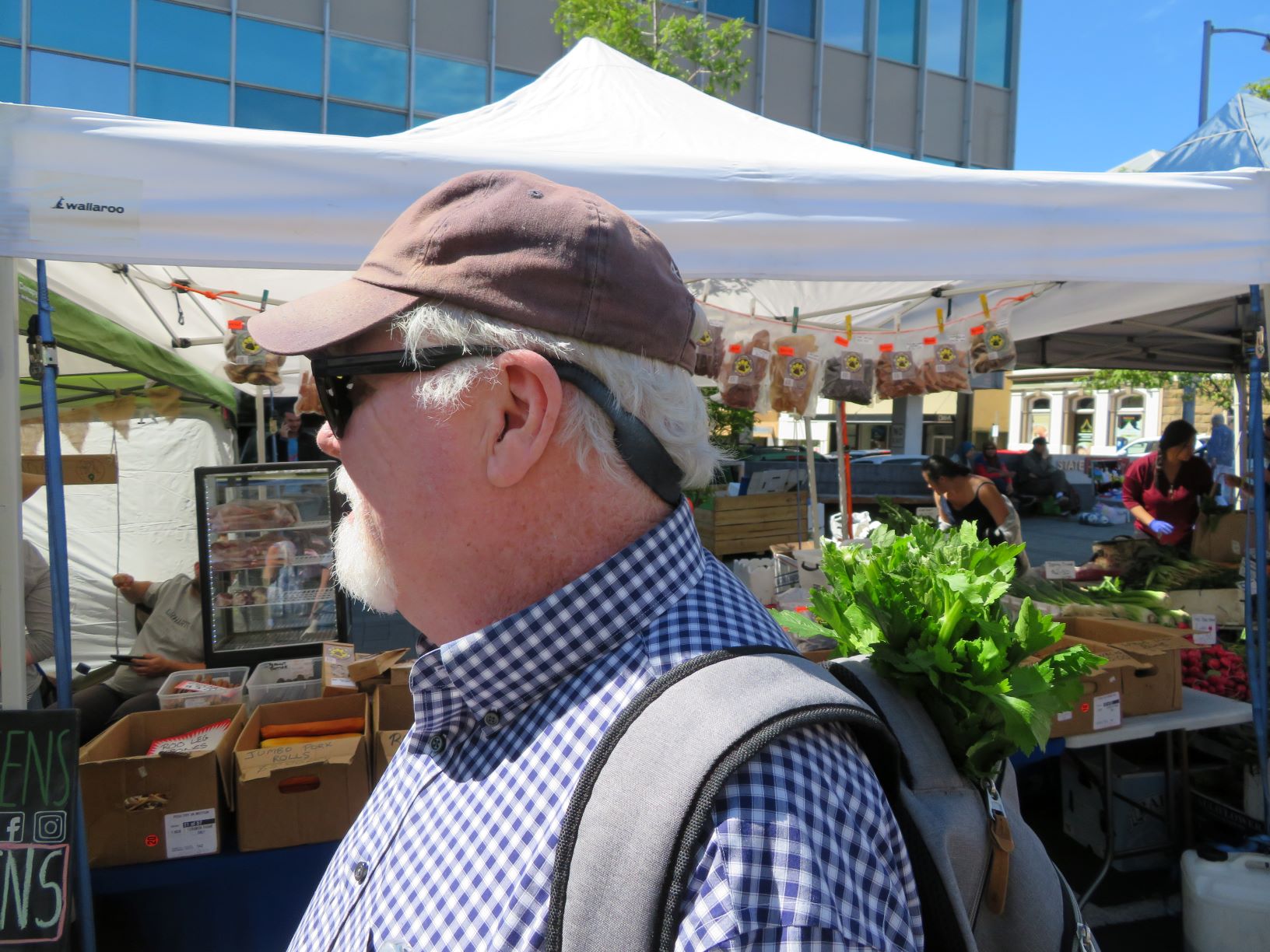
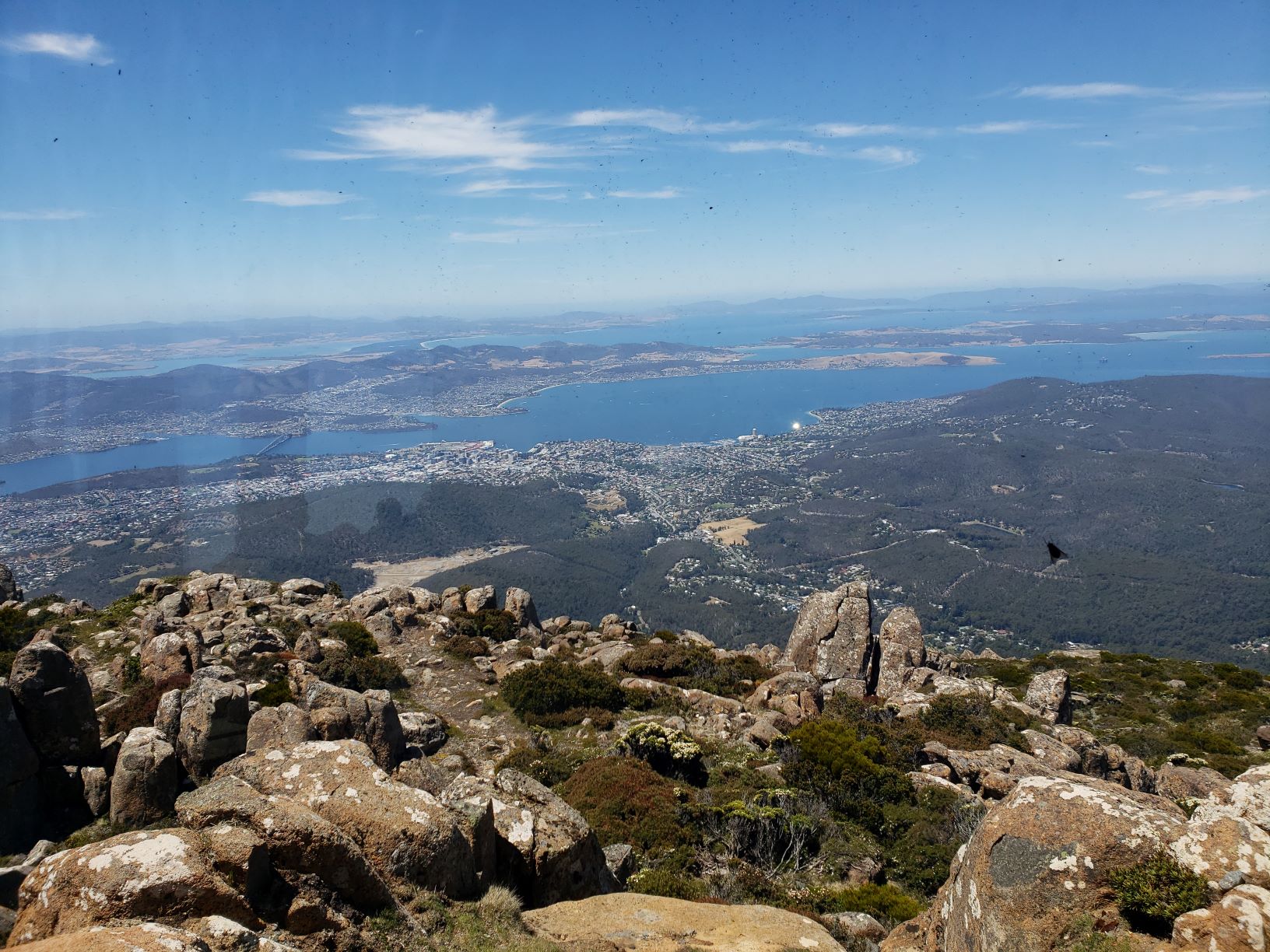
What a week! We visited beaches as beautiful as you can imagine, saw wallabies jumping across a rural road, parrots only found in Tasmania, and flocks of cockatoos landing in the trees! We ended the week with a visit to the Sunday farmer’s market in Hobart–Tasmania has excellent celery, among other things. Then a stop at the flea market at the Hobart Showgrounds, and it was barely noon. We decided to head to the top of Mt. Wellington, and as promised, the view was stunning.We used our visit as a giant atlas, reviewing some of the places we’ve been and spotting new ones. Southeast Tasmania around Hobart has a very long coastline because of the many peninsulas. Each one provides is laced with walking trails, beaches, and vantage points. We are going to visit as much of the coast as we can.
Sunday Farmer’s Market, Hobart: This is also called the Farm Gate market, or Bathurst market, as it’s on Bathurst St. between Elizabeth and Murray Sts. Not large, but with produce, cheese, meat, and baked goods that are really excellent. One stand had a long line the entire time we were there. They make donuts with exotic cream fillings (e.g. saffron ginger). Another stand makes really delicious cinnamon rolls and croissants. There are no bargains here, it’s all top quality at a corresponding price. We parked in a nearby parking structure–first two hours free!
Flea Market, Hobart Show Grounds: This is a large spread of vendors. There’s lots to look at both indoors and out. Outdoor vendors were thinking about packing up early on the day we visited because the sun was so hot! No admission or parking fee.
About Mt. Wellington: This all-ages destination has a road to the very summit, free parking, paths (with stairs) to different viewing spots, and fabulous views. It is up to 10° (C) cooler than Hobart, so take a sweater, even on a sunny day.
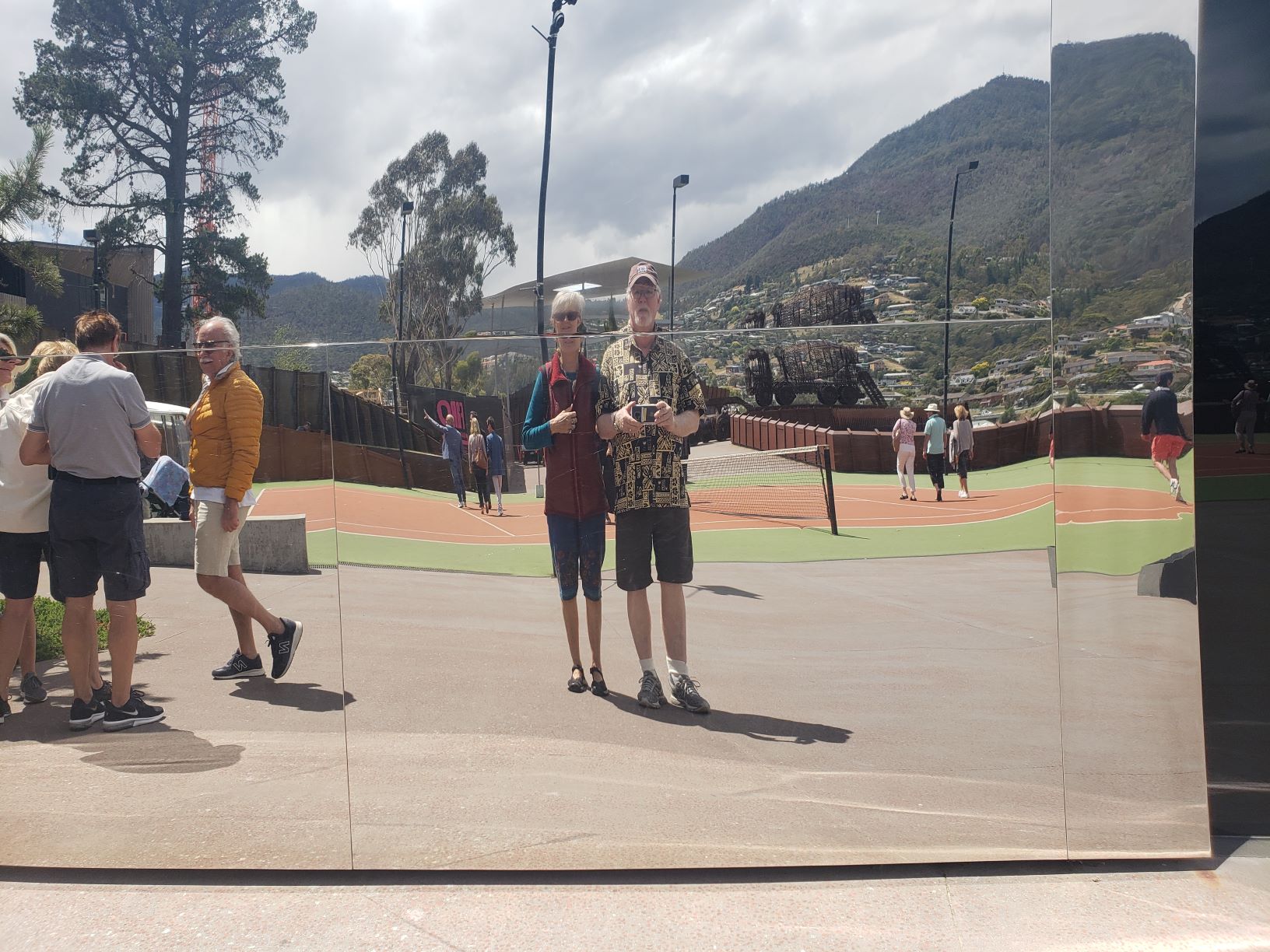
MONA is a new phenomenon just outside Hobart, a huge museum meandering up and down over three floors built into the side of a hill. Visitors arrive via ferry from the city, getting a great view of the Derwent River and the MONA facade as they arrive. Drivers walk down a path beside a band shell and lawn, past a barbecue restaurant and bar, the entrance to the Moorilla winery that is part of the property, and if they’re not lost yet, descend a zig-zag set of stairs and ramps to arrive at the front door of the museum. Clad in mirror-finish brass, it’s a bit disorienting, but that seems to be the point.
I started our visit by sitting on a stool held up by a gloved “Mickey Mouse” hand.
We rambled along the suggested route, from the lowest level upward, then took a break to go off-site for a picnic lunch break. Tickets are good for multiple entries on a single day, and no one paid much attention to our in and out. Musicians were playing in the band shell from around noon until after we left. We didn’t like the music much, but it was entertainment, and people were sitting on the lawn listening.
I enjoyed the moments of participation. We arrived in one room during the period when visitors are allowed to add to a pile of broken glass piled against a section of white wall within the dark room. If you hit the wall with the bottle given to you, a bright light goes off.
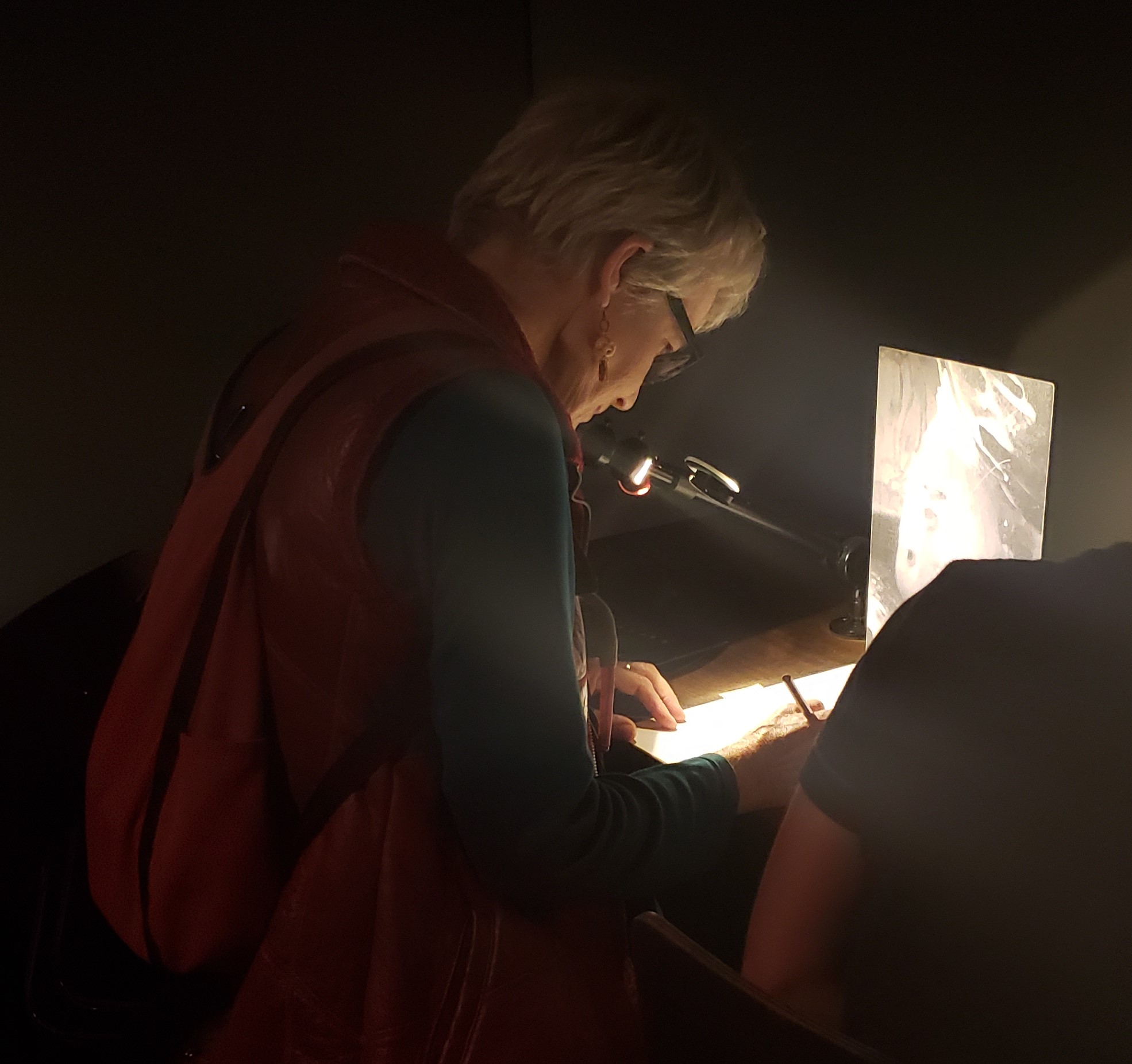
Another installation is a recreated studio of Vermeer with a discussion of whether artists of his period used lenses to project images to enhance the accuracy of their painting. I sat before a blank page with an inverted image pasted on the wall and a lens angled in such a way that I could draw the image on the blank page as if I was tracing it. I did a pretty good job if I do say so.
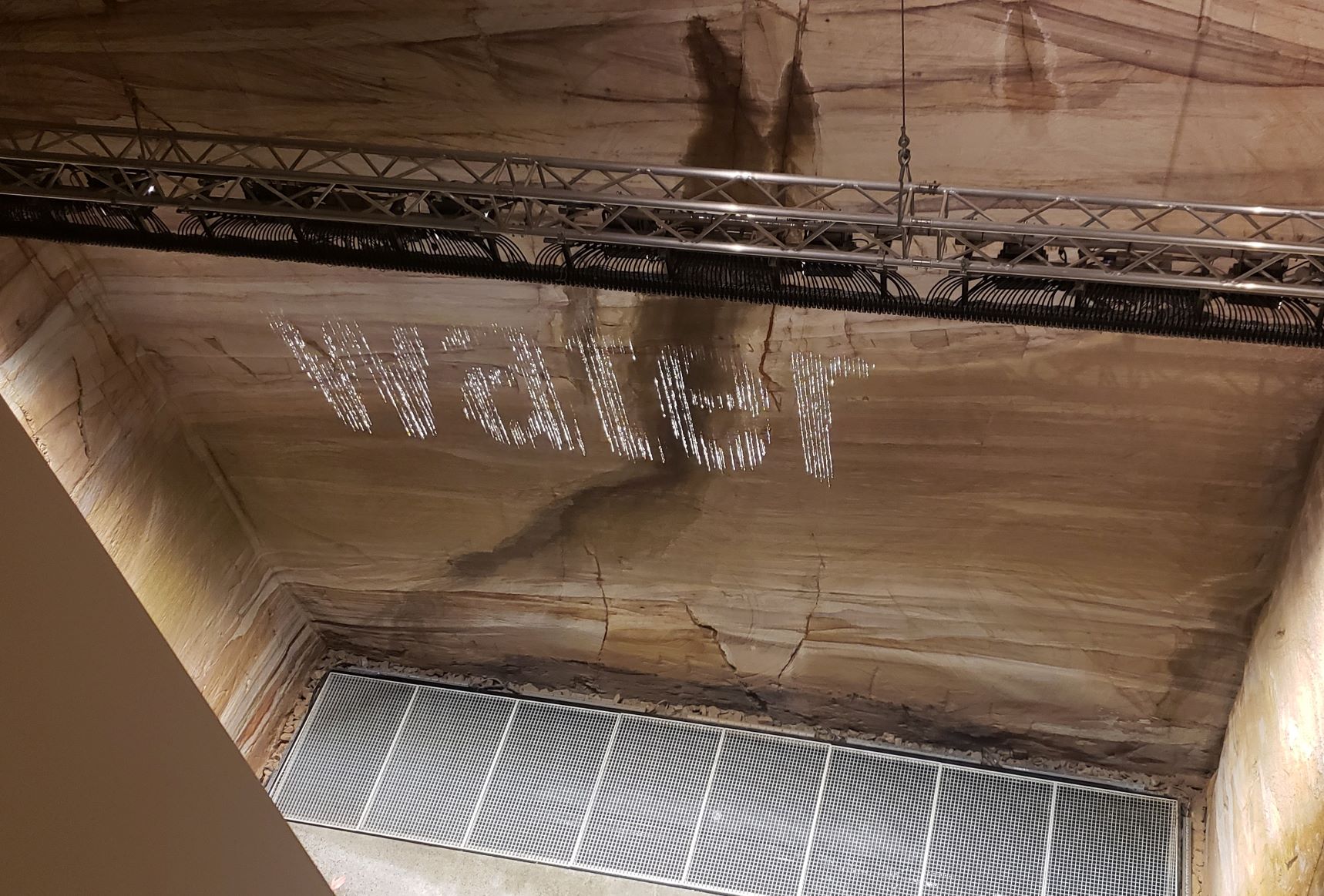
An ingenious piece emits water droplets in patterns that create words out of the falling water. I listened to an interview with the artist who revealed that as soon as he presented his piece he was besieged with requests to use it for advertising. He refused, and someone promptly worked out how he did it, creating a similar device to be used for advertising. It is already in use, with the artist gaining neither credit or money for it.
There was one piece that impressed me as a work of art and a commentary on life and art. This machine was created by Jean Tinguely (1925-1991) as a commentary on the machine age as it runs constantly and does nothing but wear down. The intent was that eventually it would destroy itself. It was created long before Steampunk–I consider Tinguely the grandfather of Steampunk. Watch a very short video of the contraption working:
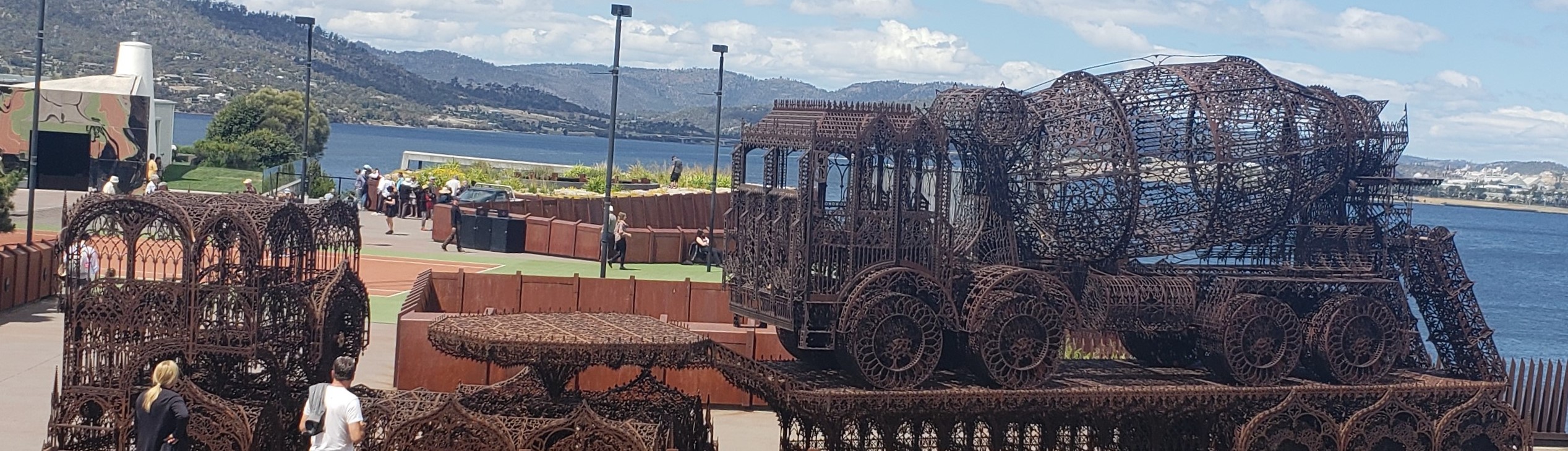
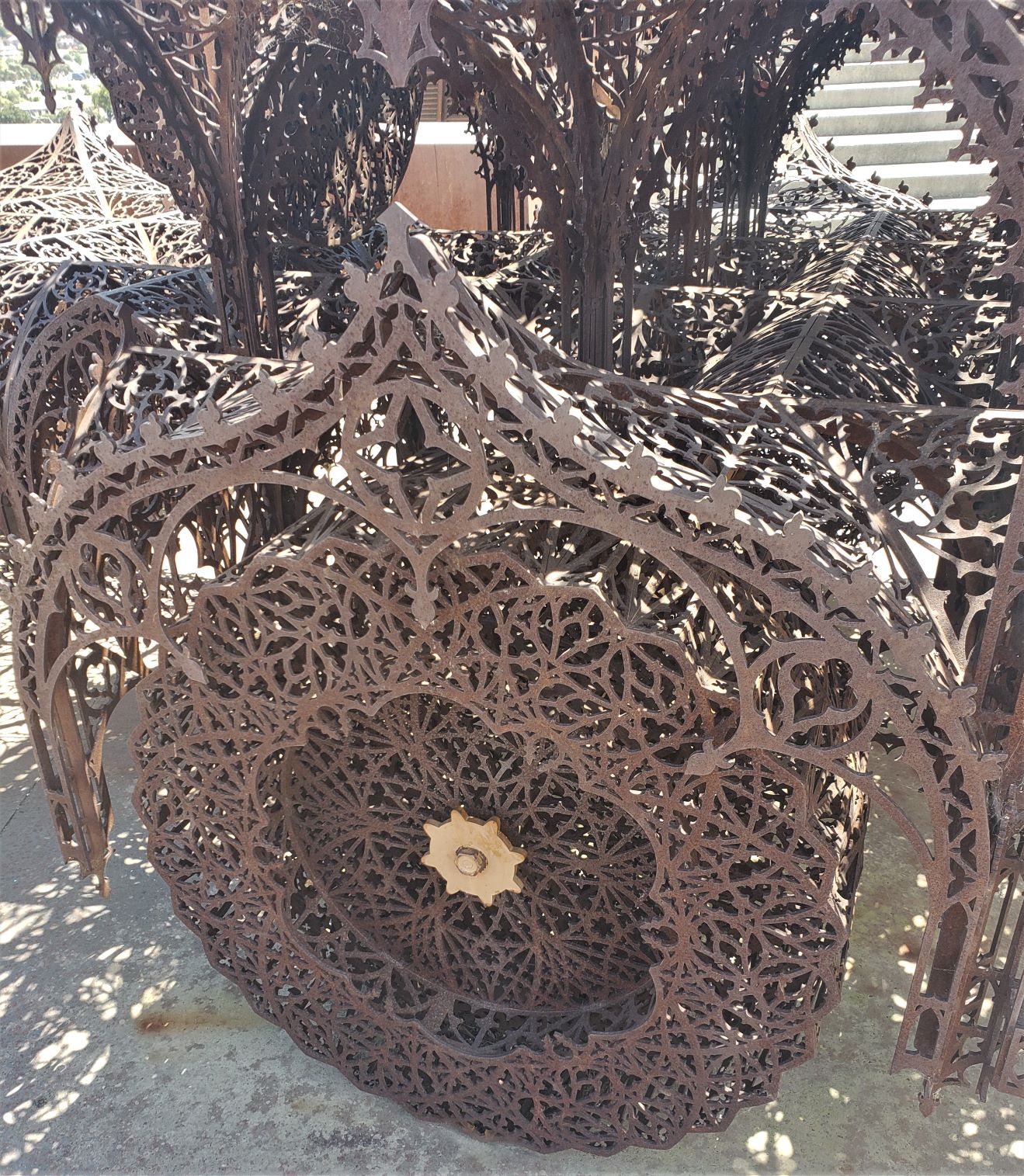
Outdoors was a life-size sculpture of a semi trailer carrying a cement mixer. The strange difference was the fact the entire piece was created from gothic style arches cut into steel.
Whether or not visitors like the art is beside the point. MONA provides all visitors with an “O” device that works easily and well, providing text about all the pieces. Press the button and O reveals what is nearest to you, click on the photo to read a basic description, then on other icons for more extensive comments. Sometimes there is a music or video link, though these are underutilized. The device was an excellent way for the museum to avoid labels and allows them to move things around at any time. The device elicits a “love”, “hate” reaction to each piece, and allows viewers to comment. I liked it better than an audio guide.
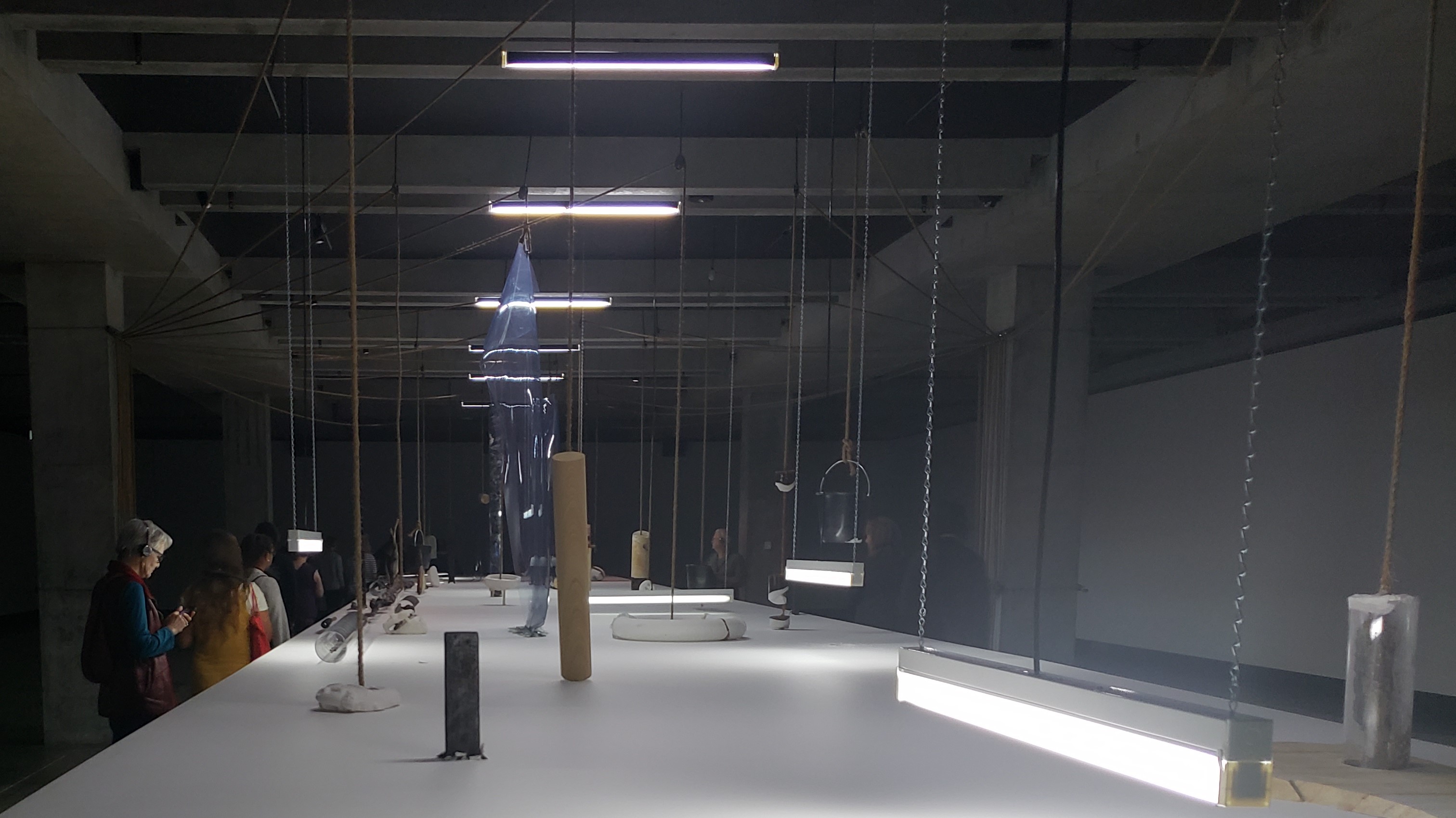
With the O device in hand, a visitor could easily spend many hours viewing and commenting on the pieces. But why? The pieces are sometimes boring, like the white table filled with random bits, or the Porsche covered with fiberglass, aka, the “Fat Car.”
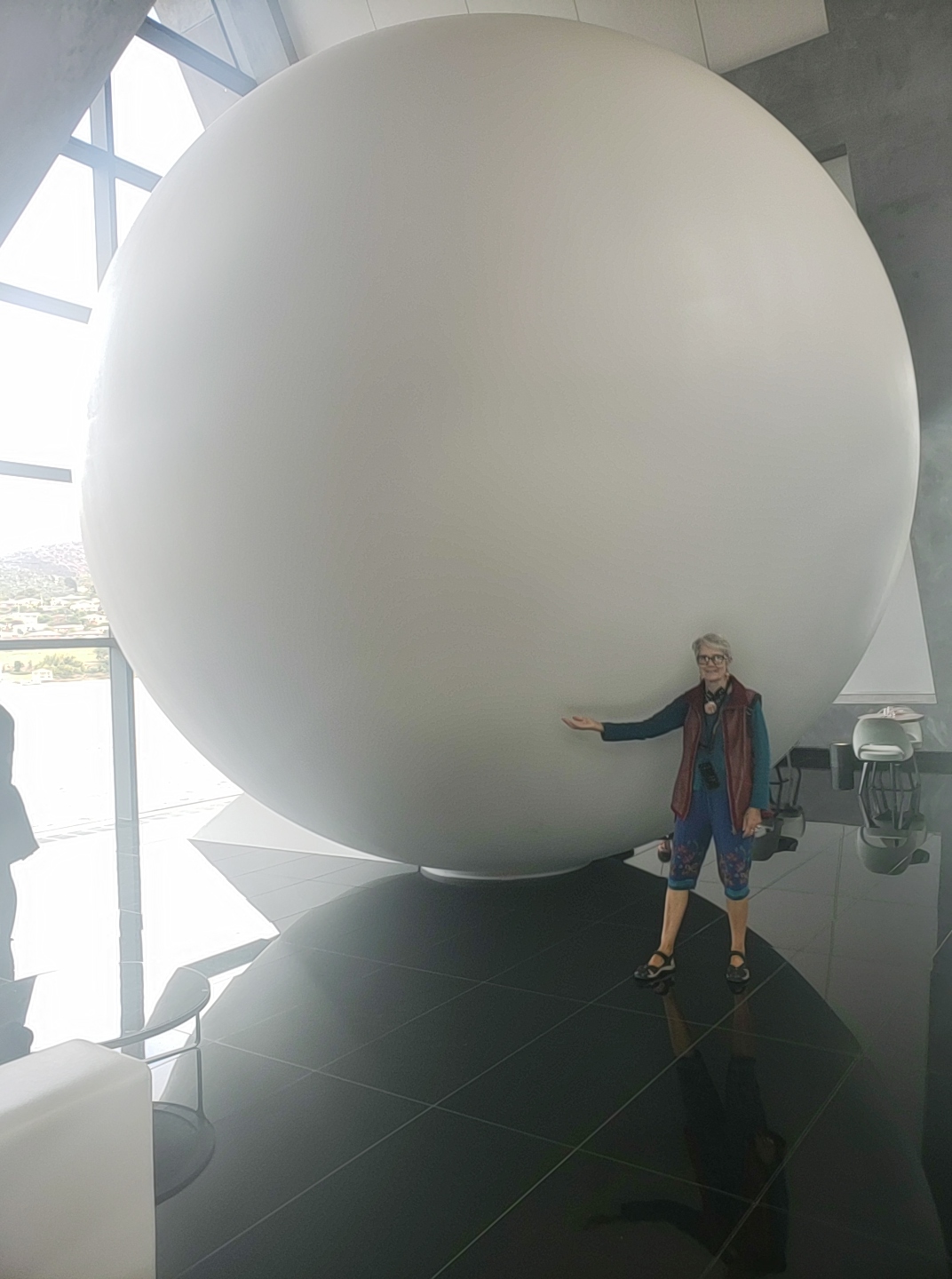
Later, I looked at the MONA web page that shows some of the items in the collection. Most of them were items that I did not see during our visit. It looks like they do rotate material frequently. The web page doesn’t exactly keep up. That is probably intentional. MONA intends to do everything differently, for good or bad. Museum staff are numerous, friendly, and helpful. For example, they ask you not to take in water bottles, and provide water at all the bars/restaurants. There are many opportunities to purchase food and drink, souvenirs or “enhanced visits.” I opted not pay extra to go inside the white sphere. For another opinion of MONA, here is Jonathan’s review of MONA from TripAdvisor:
MONA is a difficult institution to review. Is it a museum, as implied by the name? Not really. It is mostly a money-making entertainment venue. The next big question is: is it art? Well, kind of. It is a bizarre collection made by the wealthy owner with no real focus except “sex and death”. Much of it seems deliberately designed to shock or stymy the visitor and it does succeed at both of those. Does it inspire a greater understanding of anything? Not that I can see. We spent four hours wandering around the dark tunnels and “exhibit” spaces. It’s hard to get really lost, but you do wind up backtracking a lot. My wife and I were reminded of the Dali Theatre-Museum in Spain, where the visitor is invited to put aside traditional pathways and explore the Museum as you wish. The difference is that Dali was a creative genius and the curators of his museum do a stunning job of displaying Dali’s art (and related artists). Mona on the other hand has depressingly little of creative genius and the curators do a particularly bad job of presenting mediocre fare. Go, have a good time, but don’t expect to be enlightened.
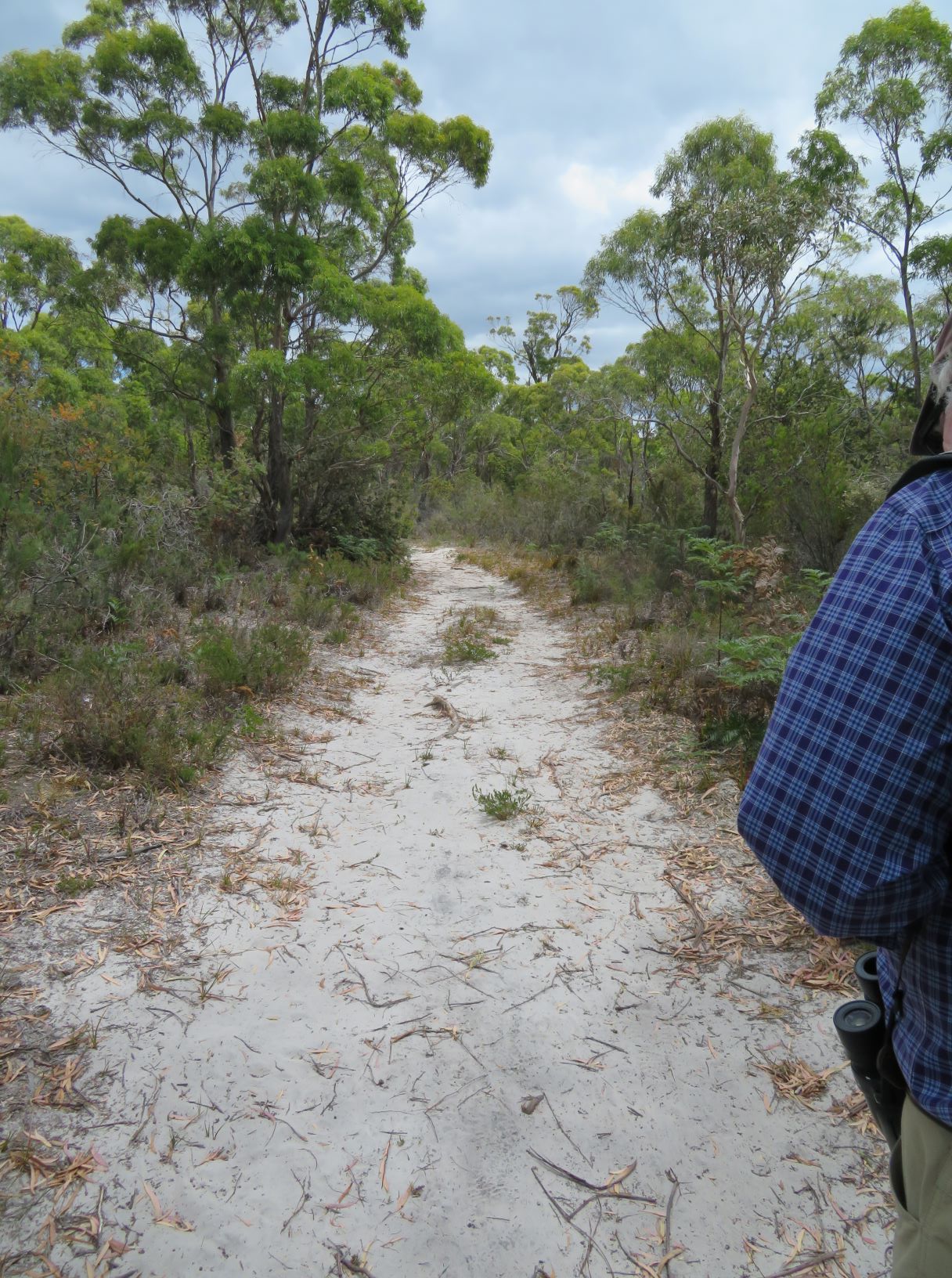
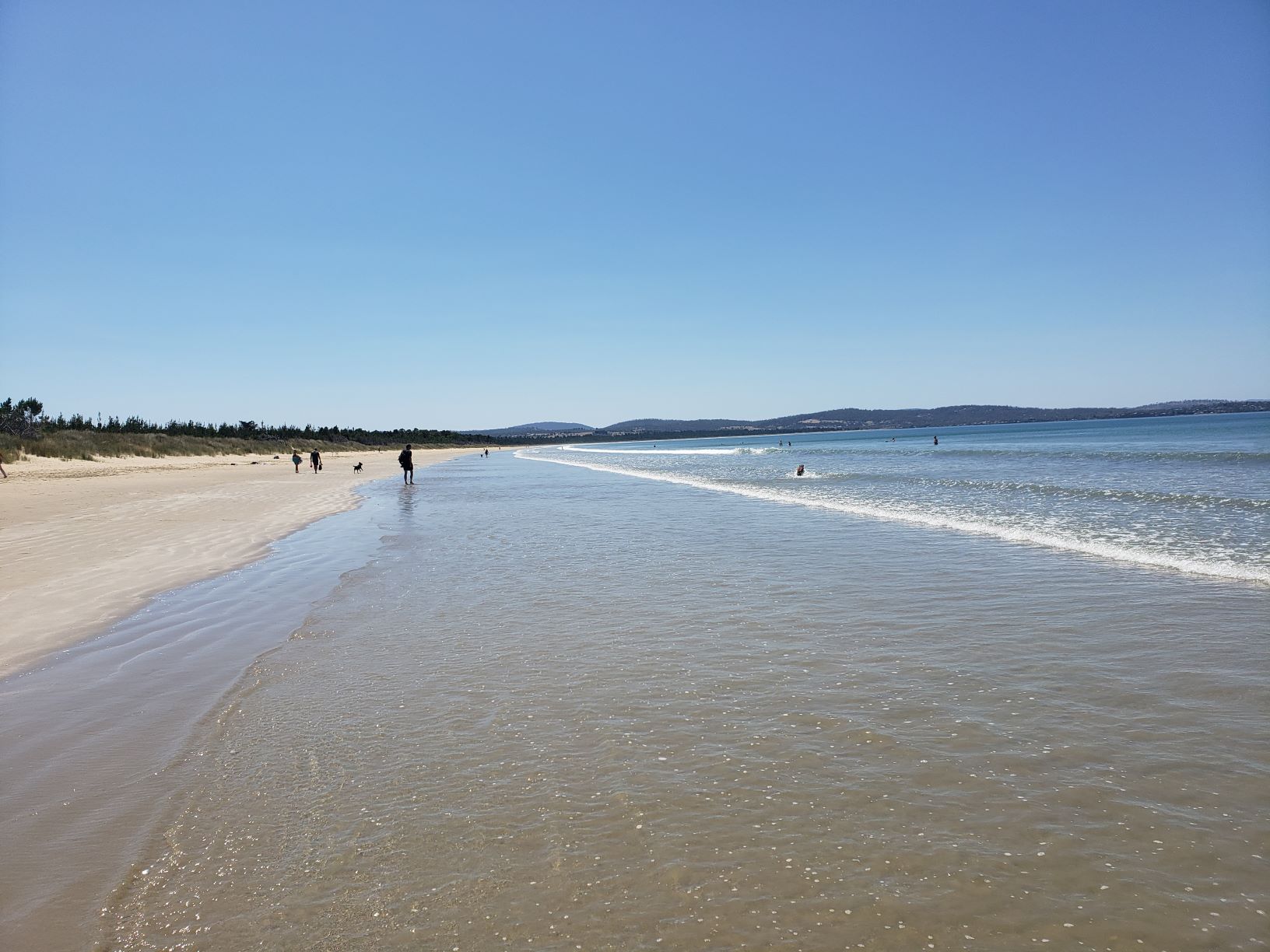
Taking advantage of lovely weather, we’ve been to Seven Mile Beach (where the weather changed), Nine Mile Beach (above, near Swansea), and today Lagoon Beach at the end of the Tasman Peninsula. The peninsula is a big hook, and at the end is the Lime Bay State Reserve. The road ends at a campground bordering the reserve. From there, a trail crosses to the west side of the peninsula at Lagoon Beach. It was an easy walk on a broad, sandy path to a beautiful beach. When the sun shone full on the sand, it looked like the Caribbean.
We picnicked among the dunes with a bit more blowing sand than is ideal, then strolled the shore looking at the seashells, the driftwood, the wombat poop. Wait! What! Yes, we recently read this article and as a result were able to identify wombat scat with 100% accuracy.
We didn’t see a live wombat, as they are mostly “crepuscular and nocturnal” (out at sunset and night). I think they would be afraid of us, but they are biggish (40-70 lb) and I wouldn’t want to get between a wombat and its destination.
We had a lovely walk and beach visit, and an encounter with a wombat’s neighborhood.
We found strange, brown cubes on the edge of the beach, and based on our recent scientific reading, realized that there are wombats living nearby! We didn’t see any, but we saw the undeniable evidence. (click below)
We landed in Hobart around 9 pm, after delays leaving Christchurch and Melbourne. Straight to the hotel and sleep, we woke up to a heat wave! Expecting cool weather similar to New Zealand, it was a bit of a shock when the temperature hit 90° (F.) by mid afternoon when we were settling in to our house in the middle of a vineyard. I was missing the coast already.
The next morning the forecast was for hot, hot weather and we headed for Seven-Mile Beach, just north of Hobart. Arriving midday, the sand was too hot to go barefoot, so we scuttled down to the tide line and took a long walk splashing in the shallows. Lots of people were on the beach under small tents or umbrellas and we strolled toward the end of the line. Not having a tent, we perched our bags on the edge of the sand and went for a dip. It was perfect, cool water and flat seas, barely a tiny wave to ride in on. We got out planning to find shade for a picnic, when a cloud covered the sun for a moment. We looked up and a long line of clouds were reaching across the sky. It would be overcast soon. A puff of wind came up as I dried myself, steadily increasing in speed. By the time I picked up my capris, the wind was blowing them sideways. We looked out at the water and it was covered in whitecaps. The temperature was already dropping. We were standing on the beach while a front passed through. We trudged back to the car against the now-strong wind and by the time we got there, the temperature dropped from 94° to 78° (F.).Now in a house where the TV works easily, we watched the news about the forest fires elsewhere in Tasmania, which explains the reddish tinge to the clouds. In the morning, the air was faintly misty and smelled of smoke. In another swerve, the following morning both the mist and scent of fire were gone because the wind changed direction. Welcome to Tasmania, land of changes.
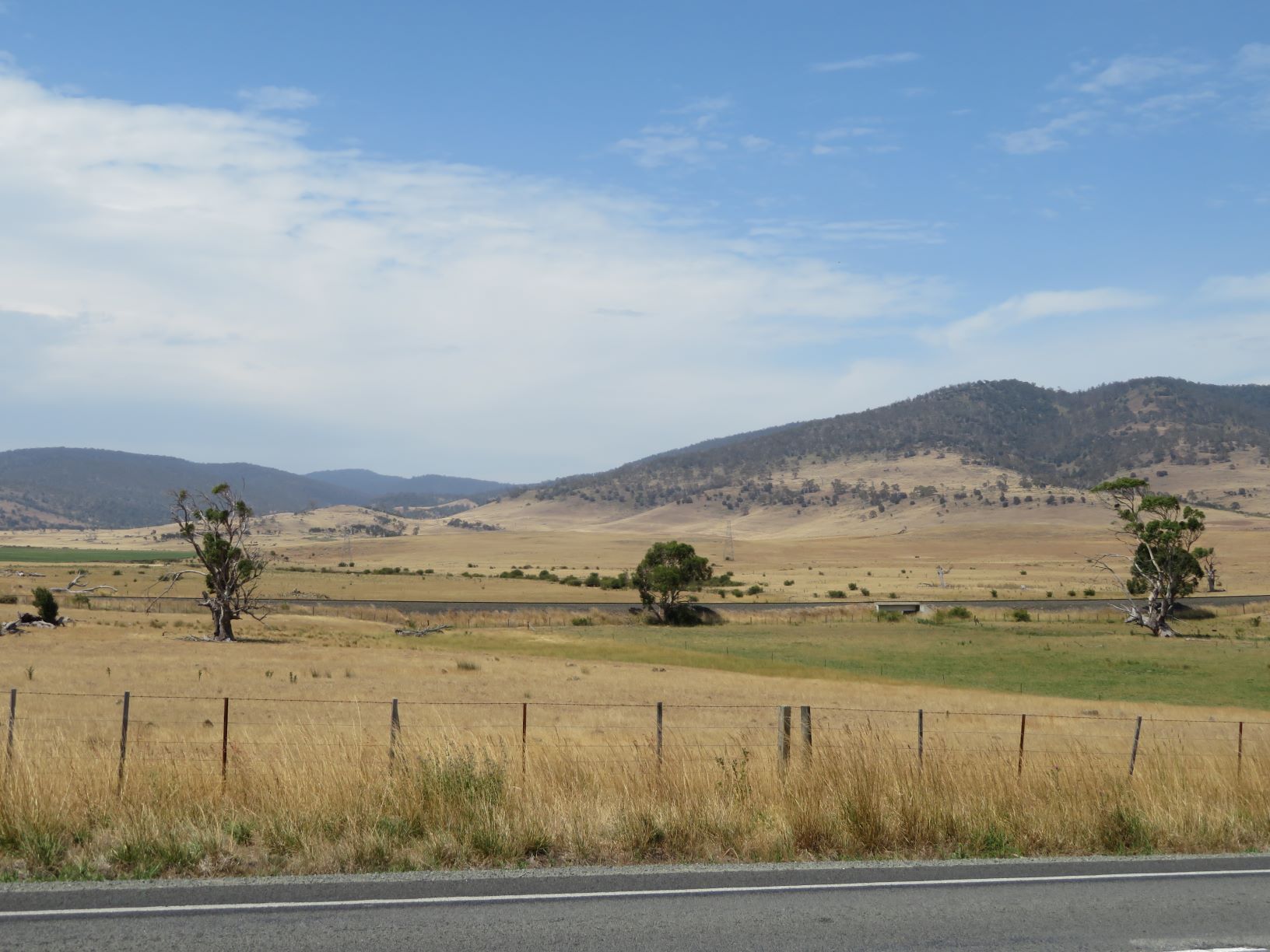
The weather has settled a bit and resembles what I had expected, cool at night, warm at midday. The land is much drier than I expected, looking more like Italy or California than New Zealand. After our shocking intro, though, it’s just fine. Below is the view out our window.
We have just spent two months in New Zealand, a truly wonderful place. People are interested in nature and the outdoors, conservation is important, and kids are taught to carry their trash home from the beach at the same time they are taught to surf. I like the balance. Our interests are the outdoor variety and we leave happy. As always, we could have spent more time everywhere we were and we could have spent all our time in other equally wonderful places. No one place is really a must-see. As our daughter Lyra says, there’s no need to take the Hobbiton tour, the entire country is a movie set for Lord of the Rings.
Places we really wanted to see were beaches, the bush (forest), which is amazingly dense and different, birds, and Milford Sound.
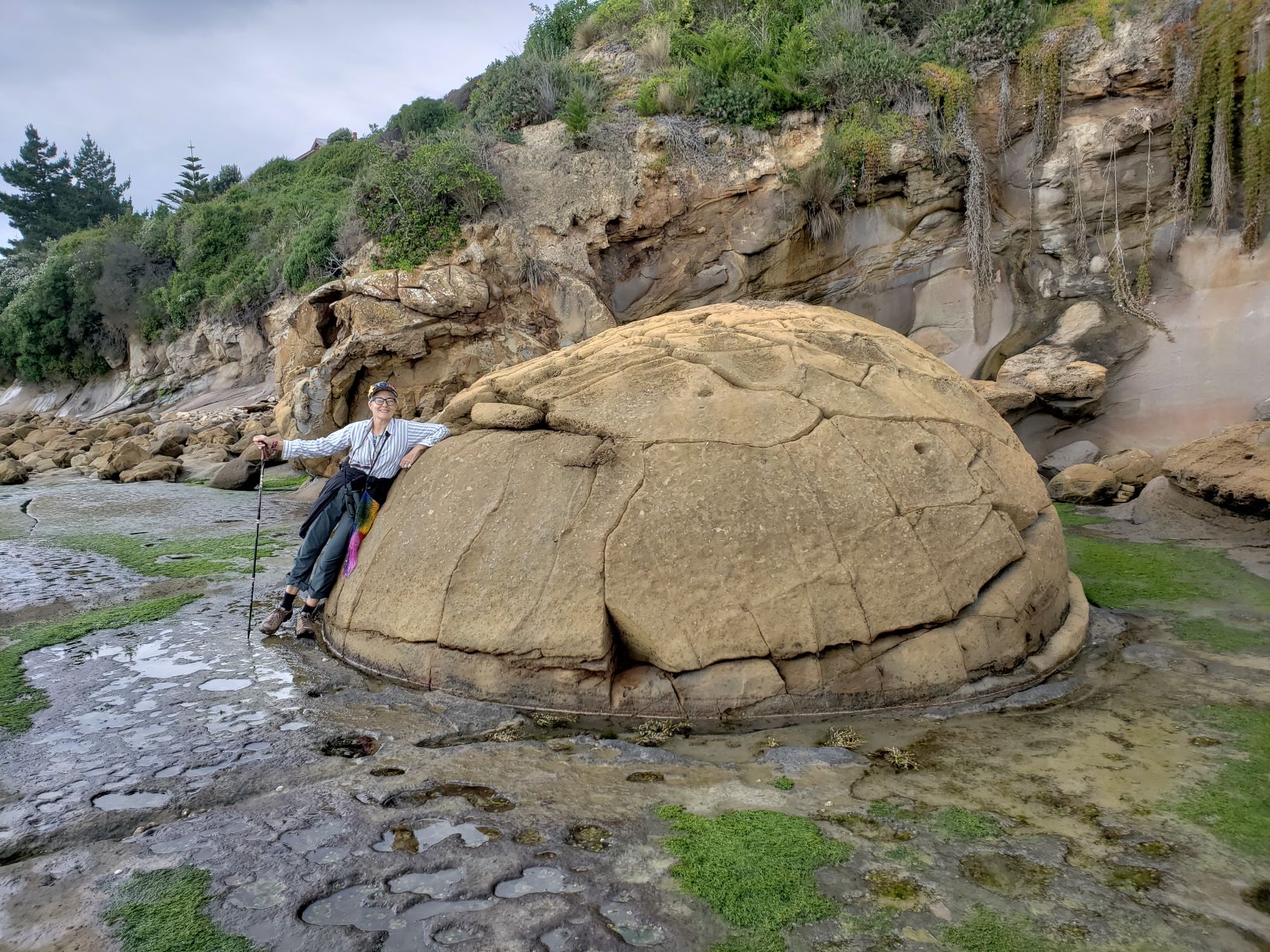
We saw what was on our list, but also ended up with favorites that we hadn’t known about, like the round boulders on the coast near Shag Point, not far from the better known Moeraki boulders.
We were amazed at the number of unique, endemic birds we managed to see. New Zealand has a remarkably large native pigeon, a giant purple chicken (gallinule), and a bell-bird that has a song much larger than its size. And others. We saw a kiwi!!
Efforts to tame nature result in hedges at least 12 feet high that encircle–empty fields. Others surround houses with only a driveway opening. I liked the one with a “window” cut into it. Some hedges were so high that they couldn’t be trimmed into shape. Imagine large trees growing out of the top of your hedge.
I like New Zealand because I felt welcome. People were friendly, and took time to chat. The eye doctors I visited (!) I would like them as my friends. Their advice was excellent, too.
We had some fun with language, finding that we didn’t always understand people. There are entertaining names for things:
Biscuit—Cookie
Caravan—RV
Eftpos—Payment by credit card. The first time someone looks at you and says “Eftpos?” can be confusing. (The technical name for a credit card payment made by a machine in a store is: Electronic Financial Transaction at Point of Sale: Eftpos!)
Forecourt Concierge—Gas station attendant
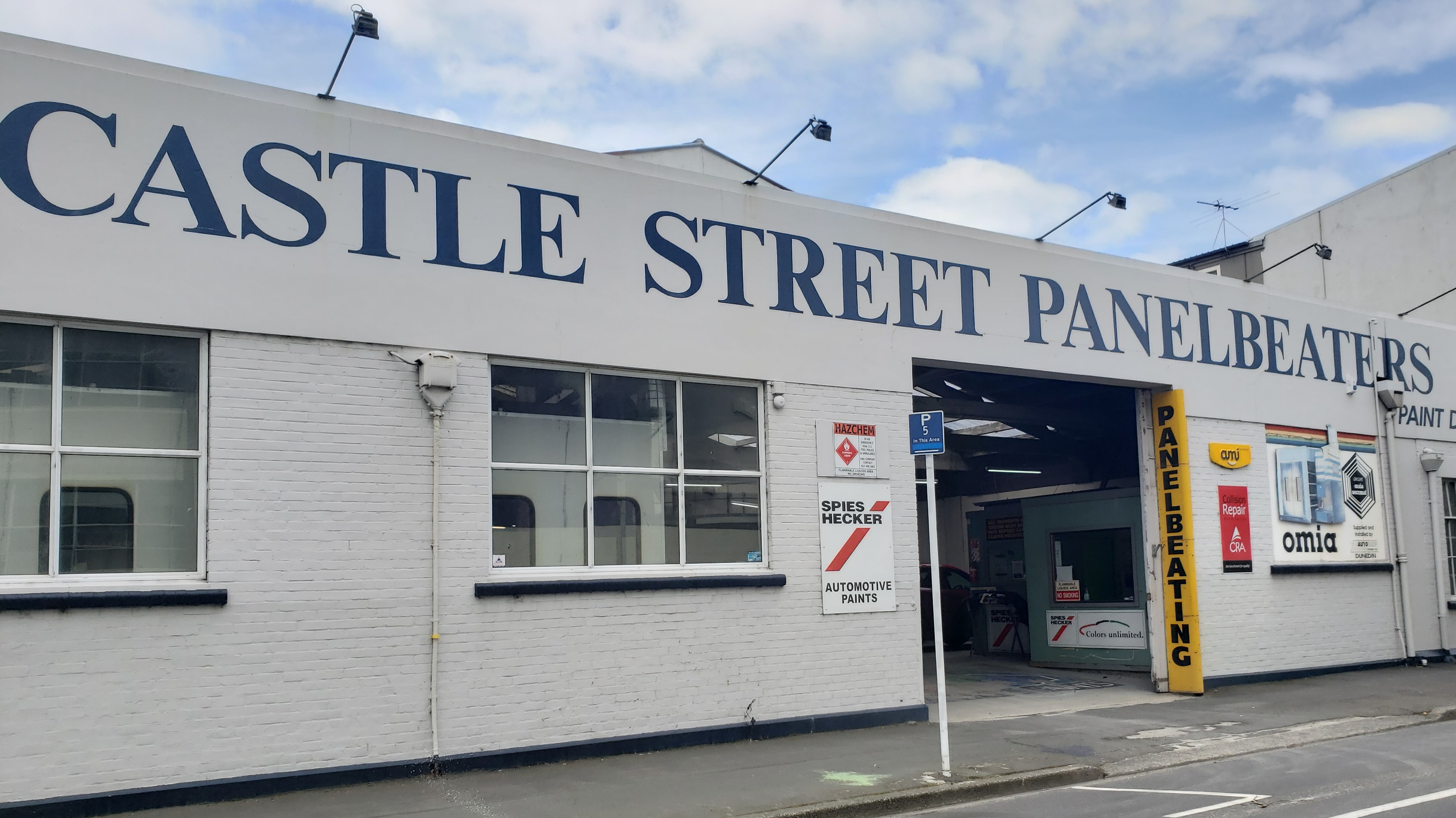
Panelbeaters—Auto body shop
Trolley—Shopping cart
Good to Know About New Zealand
They know we’re coming! The roadside is regularly punctuated with billboards of advice for visiting drivers: you’ll need extra time getting anywhere in New Zealand. They are correct. Take your time, rest if you feel sleepy, don’t use your phone. There was a billboard telling us not to drink coffee while driving, What!!!!!????
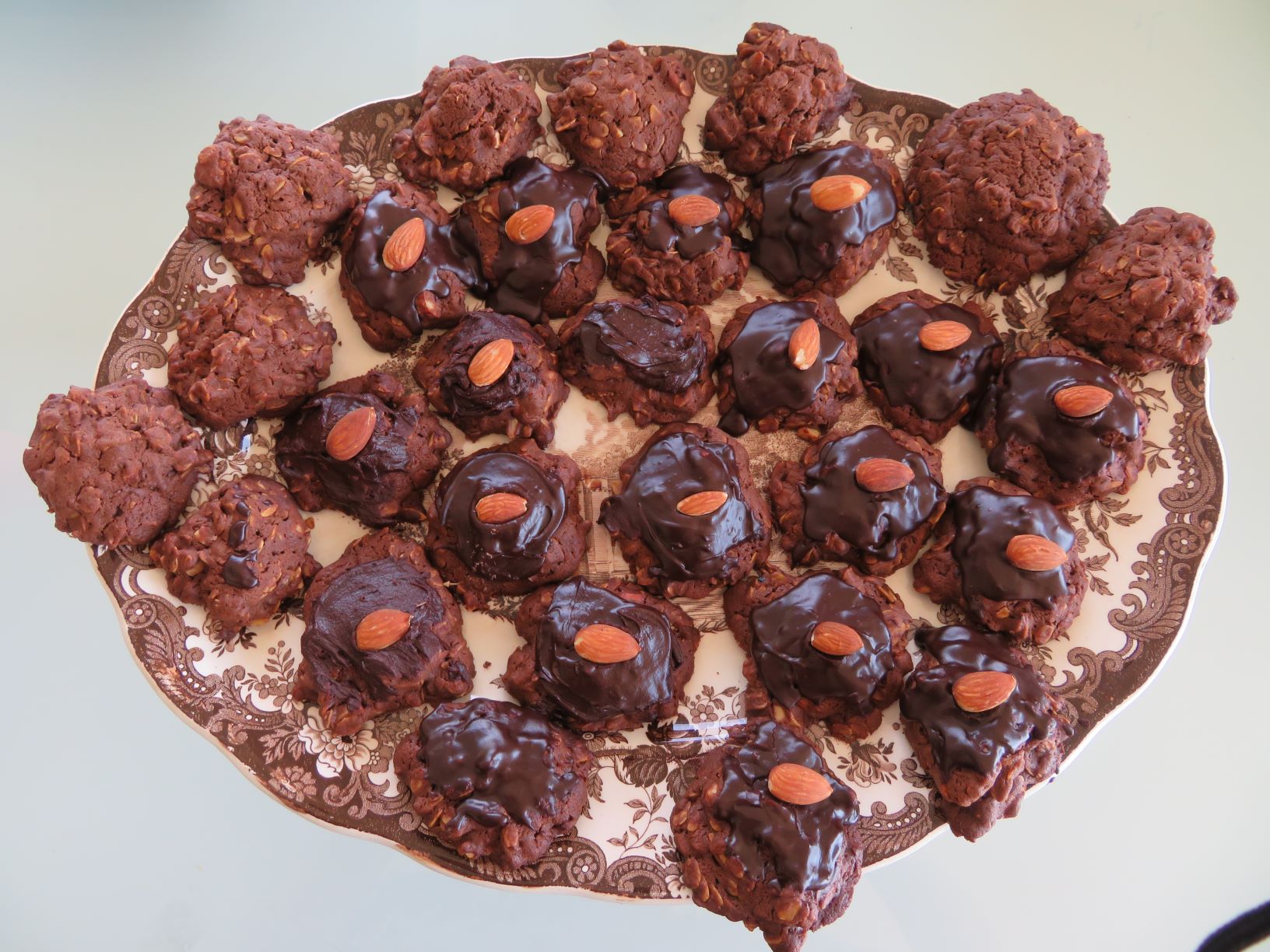
My version of Afghan biscuits.
Biscuits (Cookies): There are crazy and beloved sweets like lolly cake (broken up meringue-like neon colored candy in a paste of sweetened condensed milk and vanilla wafers. Other cookies harken back to the early 20th century wars that New Zealand took part in, the Boer War, and WWI & II. Women sent sweets to soldiers, including Afghans and Anzac biscuits, durable concoctions of corn flakes, oatmeal, coconut, chocolate and such.
Cafes: Our favorite cafe was the Bus Stop Cafe in Te Horo. Say hello to Kirsty for me when you are there. We also liked the corner store in Piha on weekends when they have delicious pastry.
Coffee: New Zealanders (do I have to call people Kiwis?) drink their coffee very, very strong. Order a flat white, but remember, it only looks white.
Driving: Drivers were rational, if generally opposed to passing. That’s not a bad thing, just don’t be in a hurry. We did not find any speed cameras or meet any of the local constabulary. On the other hand, we were never in a hurry. Some roads are narrow and lack shoulders, like places in Ireland and Scotland. You get used to it, sortof.
Sheep vs. Cows: Dairy products are uniformly delicious, from butter and cream to yogurt, cheese and anything else they make. I believe the dairy industry is creeping up on the famous woolen/lamb industry. We didn’t see as many sheep as we expected based on the statistic that there are 23 sheep for every person in New Zealand. All the merino wool products we saw for sale were blended with possum fur in a conservation theme for tourists. (Possums are an invasive pest with very soft fur. I bought gloves.)
Restaurants: We don’t eat out often, but Fleur’s Restaurant in Moeraki is very much worth a visit.
Shopping: Even the grocery store was friendly. The New World chain offers their discount card in visitor form, no local address required, yet it gives you shopping and gas discounts. Thanks, NW.
Weather: We timed our visit to be in the North Island in their Spring season (Nov.) and South Island in their Spring (Dec.), and both proved mostly cool and regularly rainy. People said that “Last Year”….it was much warmer in the spring. If I visit again, I guess I’d wait until January or maybe even February. New Zealand is never hot, it’s a bit like Ireland. People wear heavy wet suits to go in the water in the summer. Children and adults alike swim in wet suits with ear-covering caps. We admired their enthusiasm and did 99% more beach-walking than swimming.
Wine: We did not select a favorite wine since the country is wall to wall wine, but we did like the pink Pinot Gris from Weaver Estate. We visited a number of “cellar doors” (tasting rooms). Tasting is inexpensive compared to California, though wine prices are comparable.
Visa: No visa is required if you stay less than 90 days. That makes life easy. Contrast this with my post on trying to getting a six-month tourist visa for Australia. Stick to 90 days if you can.
 We knew the birds would be different in Australia, but we didn’t realize how quickly we would see them. On one of our first afternoons in Tasmania, driving home across dry, sandy colored farmland, we swerved to a halt to see a flock of cockatoos! If you haven’t been to Australia you will never see this because cockatoos are really big and even zoos usually have two or maybe four of these birds. To see eight or a dozen big white birds land in the branches of a tree, pop up their yellow topknots, and start squawking causes us childish delight. Look! We can see them! It’s just like the pictures!
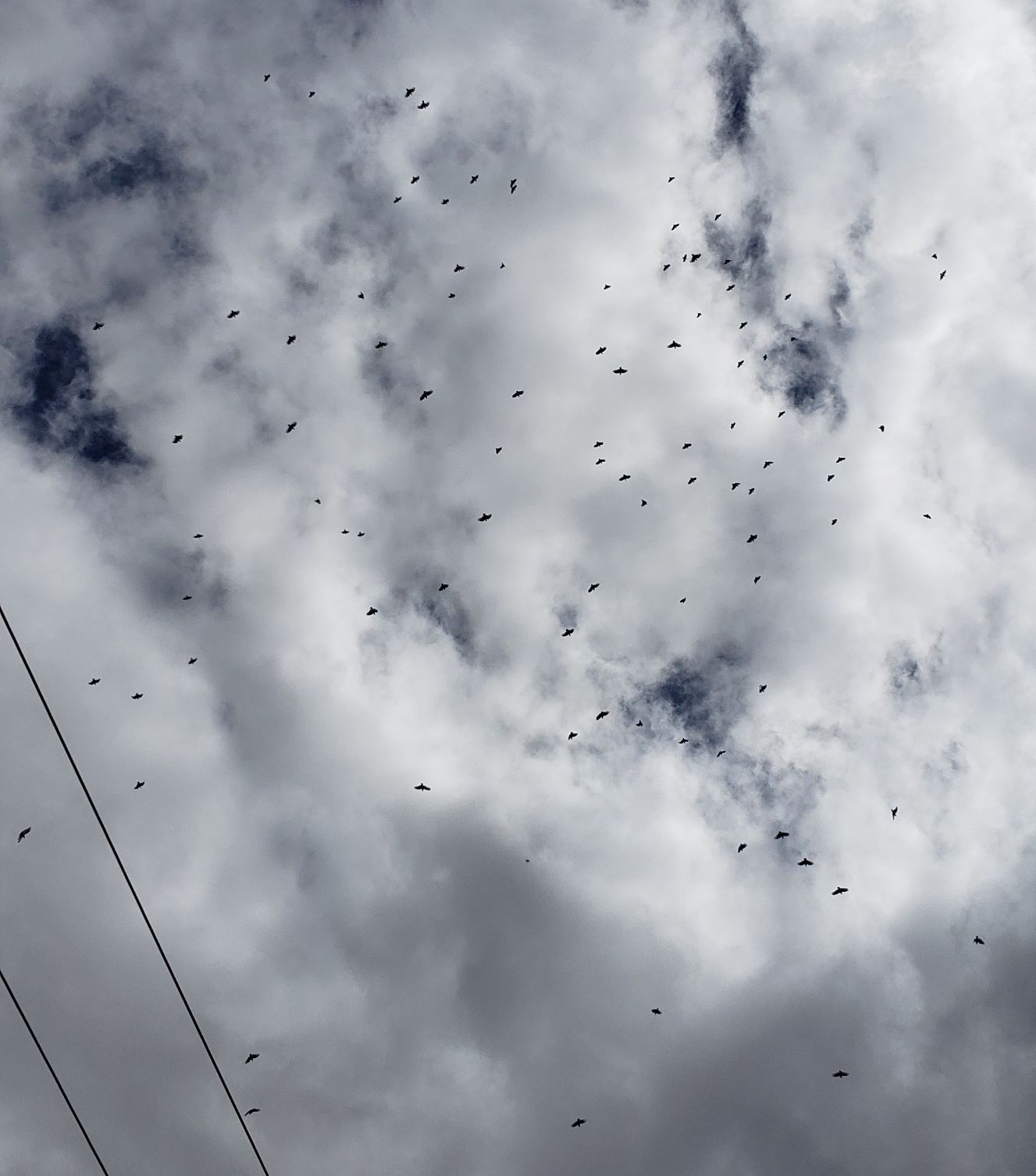 One day we saw a flock of around 100 cockatoos swirling over our heads. It was amazing. The specks are cockatoos, and this photo is by Jonathan.
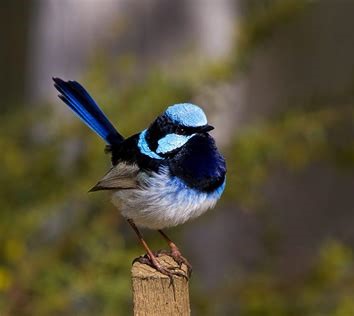 We carry our binoculars everywhere because you never know what you will see. While making a U-turn, a frequent activity of ours, Jonathan spotting something moving and we pulled over and got a look. It was a Superb Fairy Wren. What a name! What a bird! Who wouldn’t want one of these in the yard? It turns out that these lovely little birds are not uncommon in Tasmania, it’s seeing one for the first time that is such a treat.


























 Llywindatravels 2025