A perfect summer day in Seattle

We didn’t know it was going to be the best day of the summer when we left for the ferry from Bainbridge Island to Seattle. The sun was bright and the day was warm. I carried a jacket with me, the only sensible thing to do, but I never needed it. We parked in a lot near the ferry landing ($13.50), not full at all, and walked down to the waiting area, also not full, and onto the boat after a short wait. There is no charge for passage from Bainbridge to Seattle, though there is on the return trip ($4.75 each for seniors).

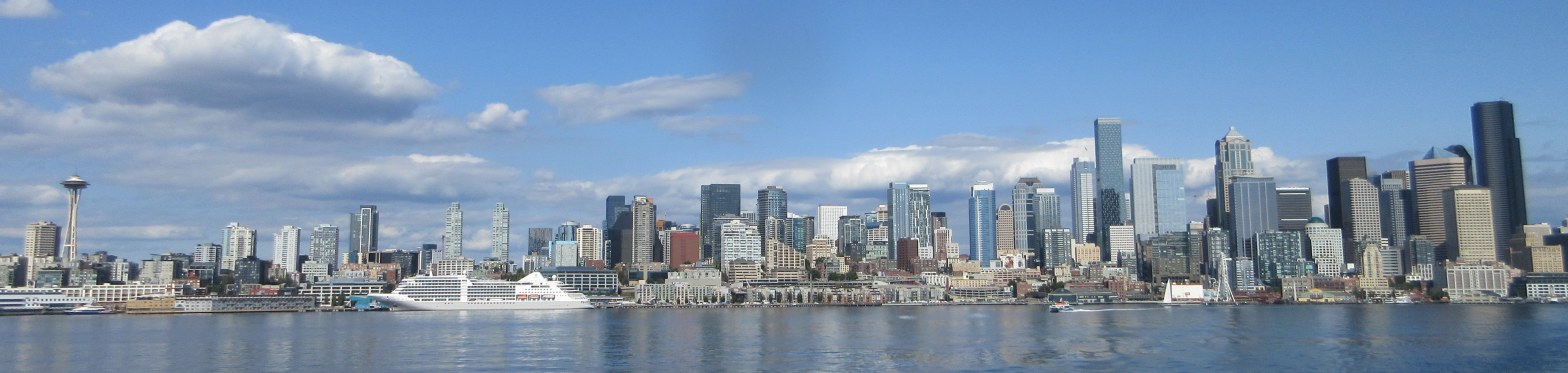
We sat near the front, so that we could watch the city in the distance. From the front deck just beyond, the city approached, tall buildings blue and misty in the distance, then towering over us as we landed. Waterfront construction gives way to piers, restaurants, a giant Ferris wheel, and small park areas. A crosswalk and signs directed us toward the Pike Street market. After following a trail through a parking garage we found an elevator up to the market level.

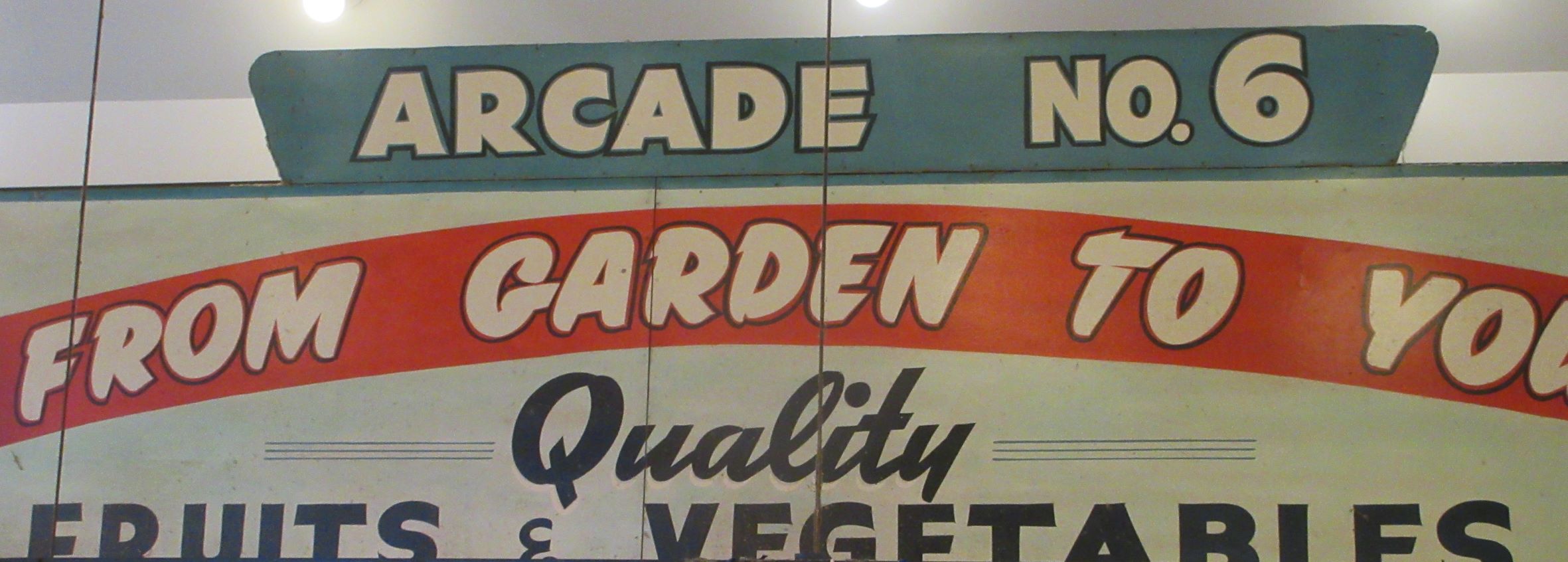
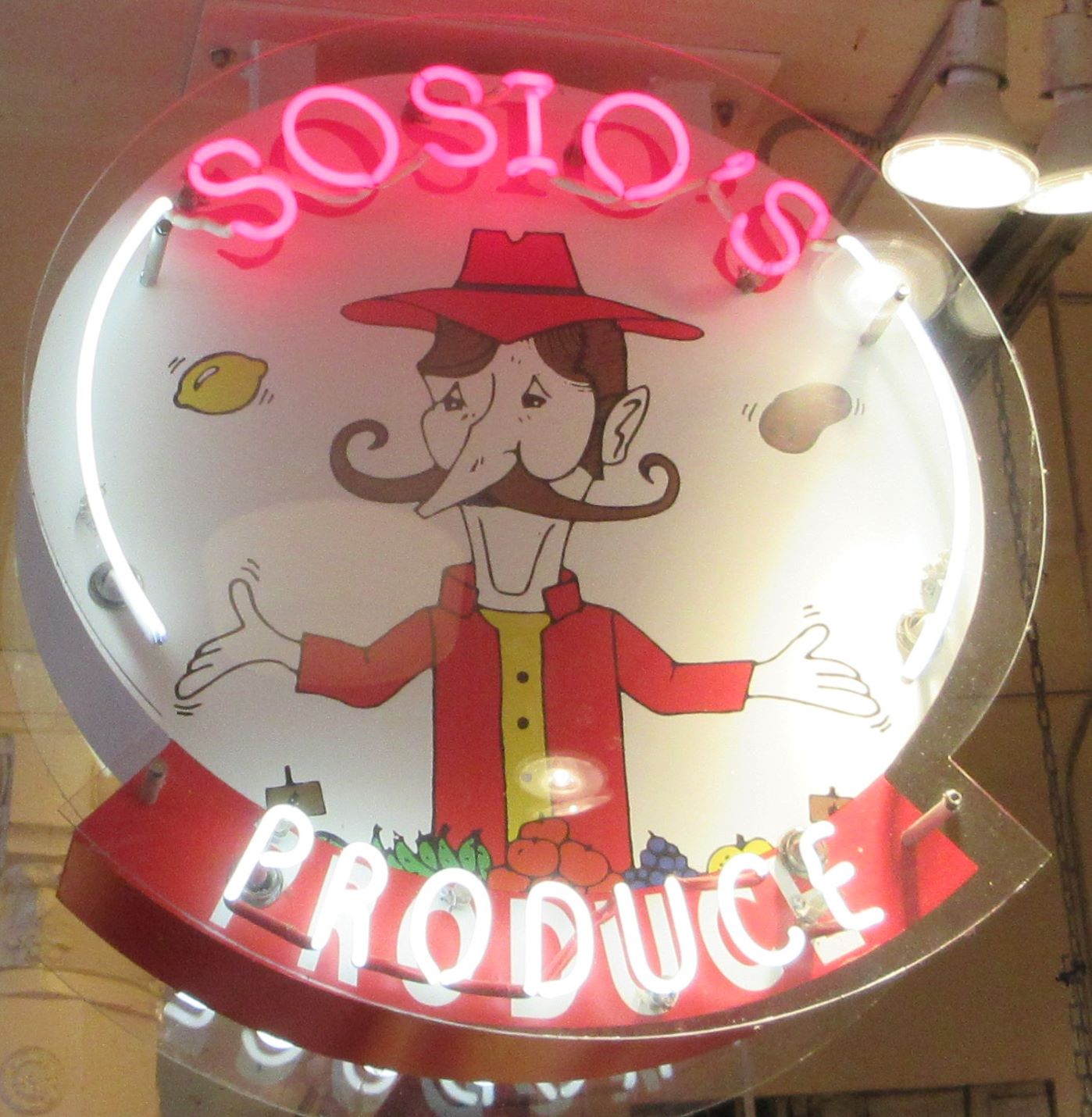
Is there someone who has been to Seattle and not visited this market? It was thronged with masked visitors making their way down the single very long market hall. The fish-sellers are the highlight, mostly hidden behind the counter and a table full of ice and fish. On this visit, the icy table held a whole monkfish staring out at the crowd, its huge mouth a sagging cavern, open in a half-hearted snap at the passers-by. Until salespersons changed its name to be palatable to consumers, this was often called frog fish or sea devil, a fish you were advised to eat without seeing the pictures.

Every half hour or so, a man wearing wader/overalls comes out from behind the counter. He starts with some sales patter and then picks up a good sized fish (5 lb+) and throws it over the counter where a colleague catches it. The guys shout, the crowd cheers and is urged to cheer louder. More fish fly back and forth, more shouting, more cheering, then it’s over until next time. Employees have to be sideshow barkers as well as fishmongers. Fish is the highlight of the market, and on our way home we stopped and bought Dungeness crab and halibut cheeks, delicate and delicious.

One tour up and down the market and it was time for lunch. We went up a floor to look at a restaurant where table service would allow us to sit and rest while we ate. It was mobbed. I recalled a place that looked empty as we came into the market, and sure enough, when we arrived at the Pike Place Bar and Grill, we were immediately seated in a booth by an open window. On this sunny day, it was perfect. We could see out over the rooftops and have a breather. We ate Manila clams steamed in a buttery, garlicky broth, and a smoked salmon club sandwich that consisted of a large chunk of smoked salmon and the usual blt items. Both were very good. I had a glass of wine because I wanted to try a white Roussanne wine on the menu.
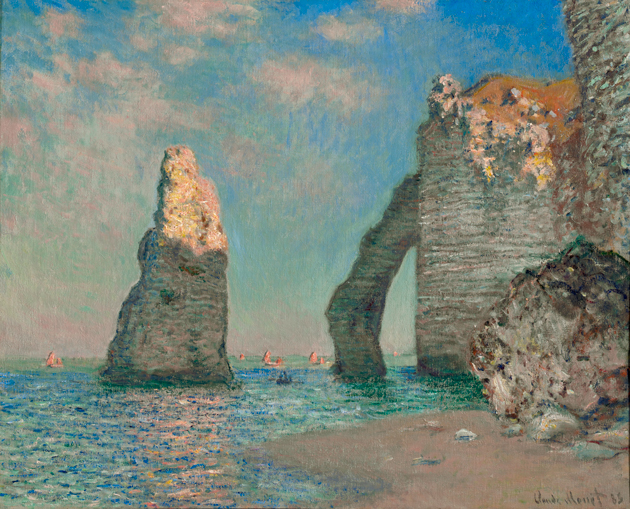
The Cliffs at Étretat, 1885, Claude Monet

Our lunch stop was the perfect break, and newly reenergized, we took a brief look in Northwest Tribal Art, then headed for the Seattle Art Museum (SAM) and their current headline show, “Monet at Étretat.” Tickets were available to enter immediately, and in we went, transported to the Atlantic coast of France where dramatic steep cliffs and offshore stacks have intrigued many painters. The exhibit opens with a spectacular view of the cliffs by Louis-Eugene Boudin,

Etretat The Upstream Cliff.

As we continued, I wished we were on the coast at Étretat beach combing in the bright sun or standing in the waves. Impressionist paintings generally show the weather as perfect, blue skies with a few puffy clouds passing overhead, casting momentary shadows on the ground that race by and disappear. The notes on the walls of the exhibit describe Monet trying to paint when it poured rain, finding an upstairs space with a window that allowed him to look out and paint even when the weather made it impossible to venture outdoors.

After Monet, we were almost out of steam, and though we had a quick look at the adjacent exhibits, there’s a lot to see on our next visit. We retraced our steps to the market, bought our fish, and wound around to the ferry landing. Naturally, the previous ferry had departed ten minutes earlier, but the wait was less than an hour, and there were places to sit. I was happy to have lugged my backpack all around, as we had our water bottle, chapstik, eye drops, ibuprofen, and coffee candies, all the little things a person wants at the end of an odyssey.

I took more photos as we left the wharf, getting a view from the Space Needle to the docks. The ferry ride is only 35 minutes, and in no time we were back on Bainbridge Island and heading home, full of the day.
Busy on Bainbridge

Whatever is going on in the rest of the world, people are visiting Bainbridge Island in droves. Yes, once again people wear their mask indoors, and we, personally, haven’t had an indoor restaurant meal since arriving, but there are lots of events, mostly outdoors, and well-attended.

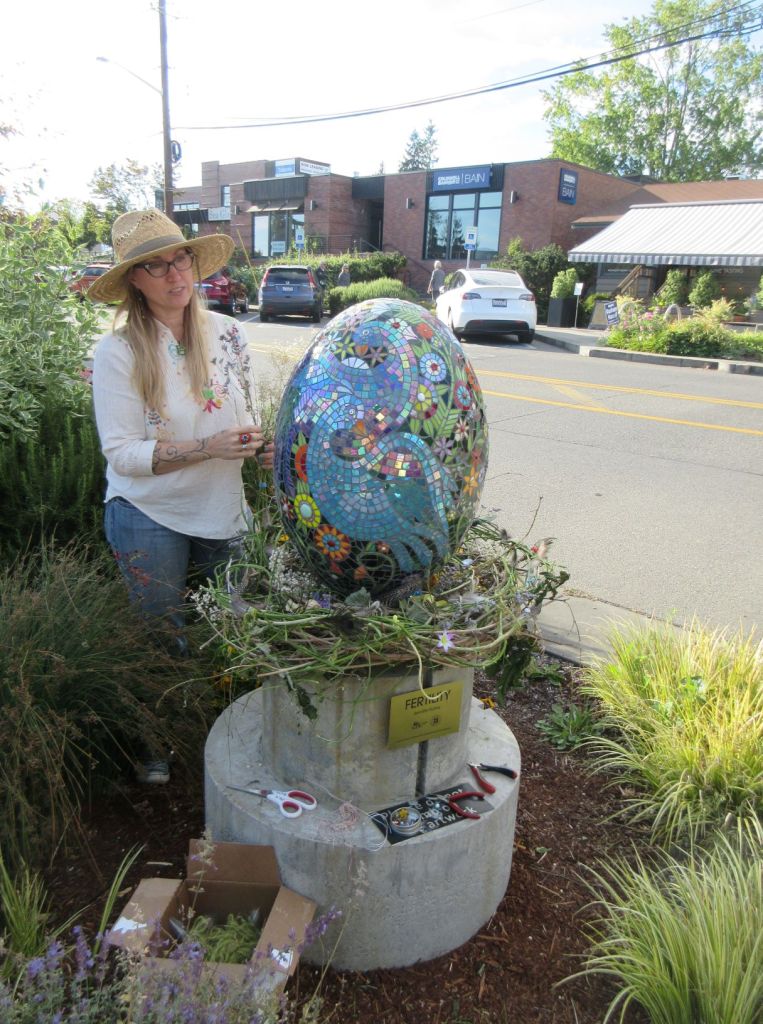
“Fertility” temporary installation, Winslow, WA

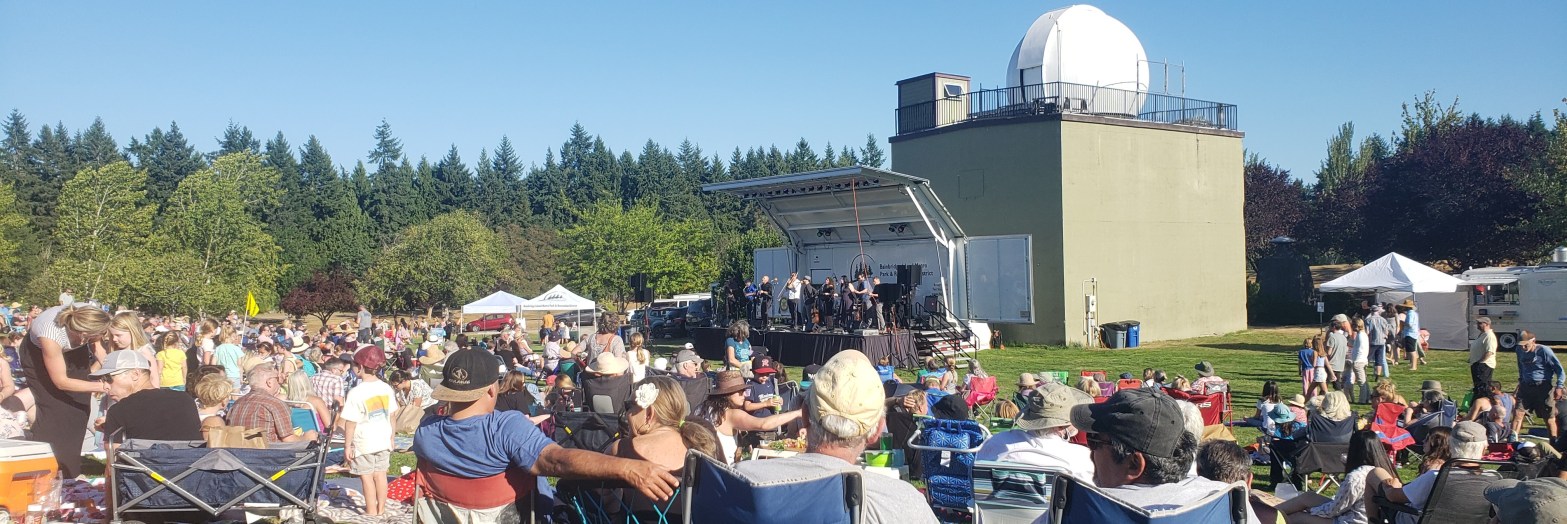
Thanks to Jonathan’s internet research, we jumped right in. We arrived on a Sunday, shopped and unpacked on Monday, and got involved immediately. There was a concert in a nearby park the evening after we arrived, a Van Morrison tribute band, Backstreet Jellyroll (See the post’s banner photo). This was their first live performance in a year and a half and the group was energized by the crowd. Concerts continue with a different group every week while we’re here. The next night was another concert downtown, in Winslow. Friday night, was “First Friday,” with merchants open late, new public art pieces being installed, galleries offering wine, and restaurants doing a booming business, even with everyone wearing masks indoors.

Grave of Sealth (Chief Seattle), Suquamish, WA

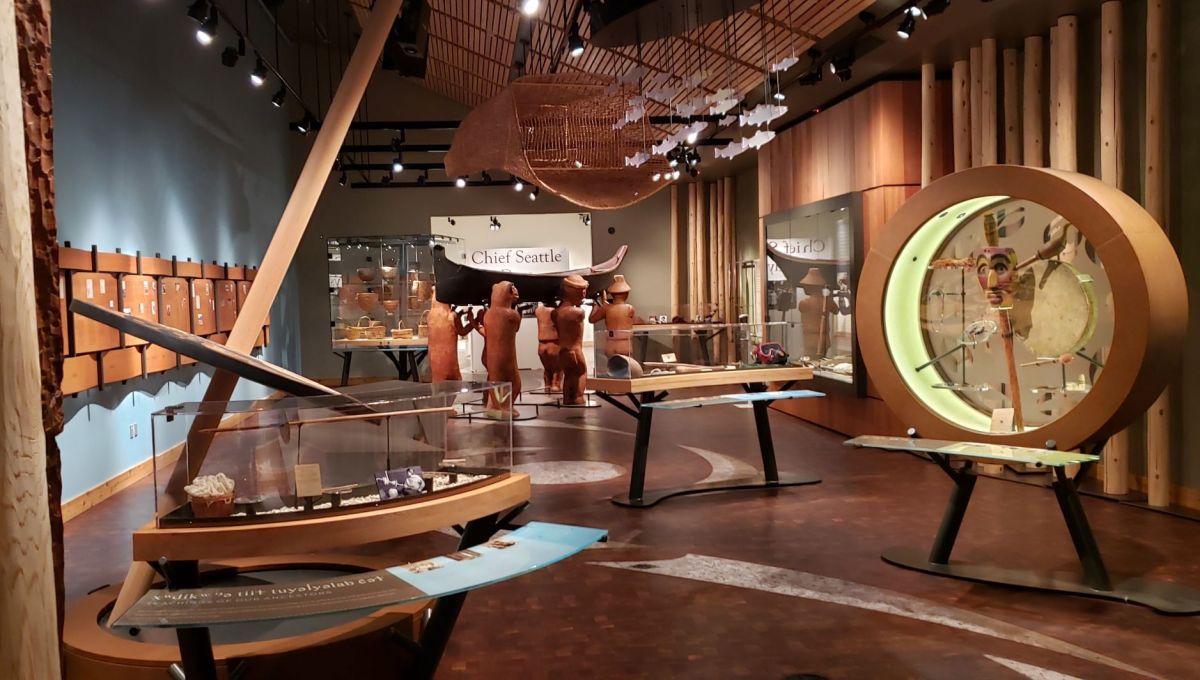
We visited the Suquamish Museum, a gem of a tribal museum, just across the Agate Passage that separates Bainbridge Island from the mainland. Suquamish is a well-documented community that hosted the first European visitors to the region, including the eventual founders of Seattle. Treated badly, as many native groups were, the survivors managed to cling to a spot in Suquamish near the original location of the chief’s house. The museum has a relatively plain exterior, but the exhibits inside are impressive, and we spent quite a while reading and looking.

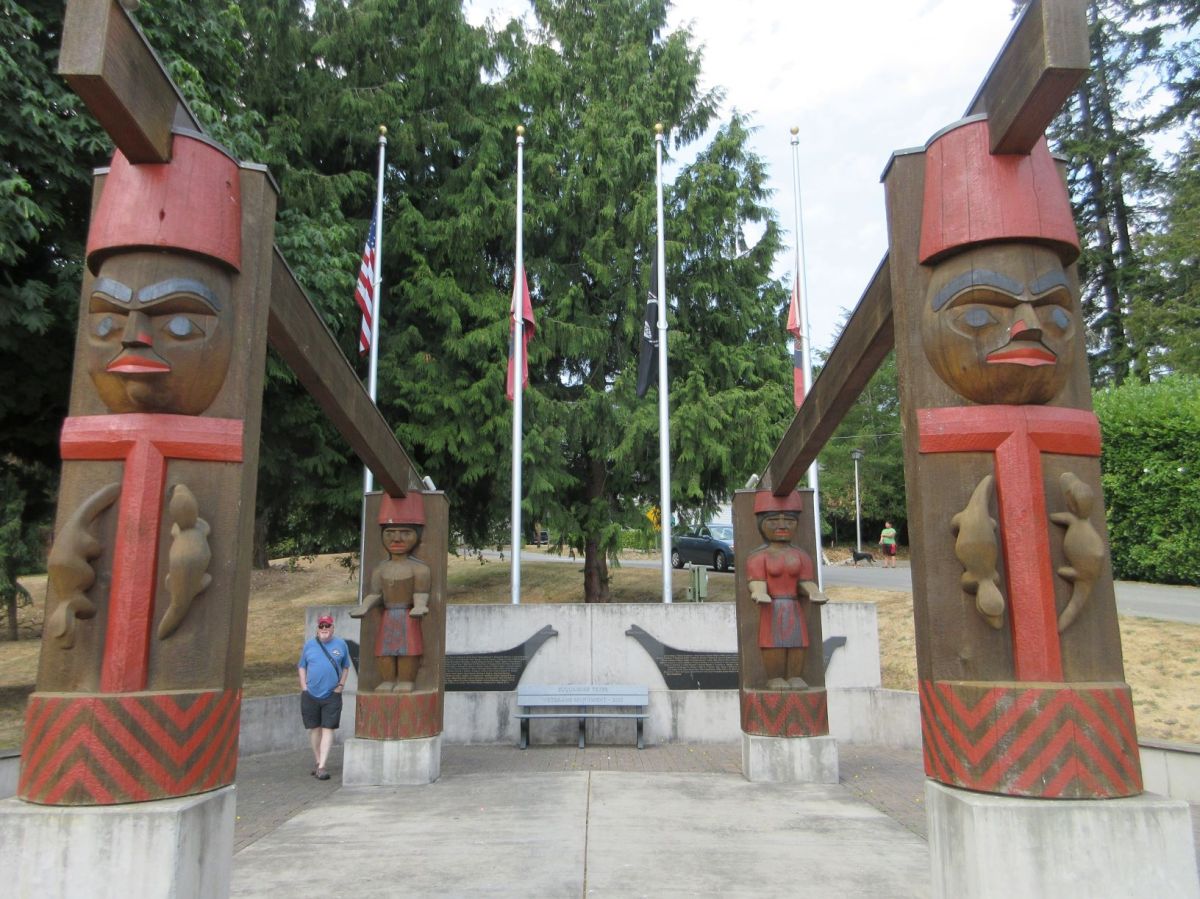
Suquamish Veterans Memorial

From the museum, we strolled toward the shore and visited Chief Seattle’s (Sealth) grave. It’s a peaceful spot overlooking the water. We continued to the shore and found ourselves outside the community house with the sounds of basketball coming from inside, and kids playing outside. Walking uphill to the car, we stopped for a breather at the Veteran’s Memorial flanked by large male and female-featured carved posts.

Himalayan blackberries, scourge of gardeners, source of pie

The two farmer’s markets, in Winslow, and just over the bridge in Poulsbo, are both held on Saturdays from 10am-2pm, and we hit both of them on our first Saturday in town. The peaches were perfect, along with lots of other delicious things. We’ve visited the Safeway and the Town and Country Market, “T&C” to those in the know. We bought halibut at a fish store, and picked wild blackberries to make both blackberry crumble and seedless blackberry jam. We won’t go hungry.

Sunday, we visited the Bainbridge Island Art Museum and I was impressed with the quality of the works exhibited. A lot of the objects were created by artists from the immediate area and the Pacific Northwest. The contemporary works were imaginative and inspiring. It’s an excellent small museum. Their summer art show and sale was on, and we browsed the booths outside the museum.

Bainbridge Studio Tour

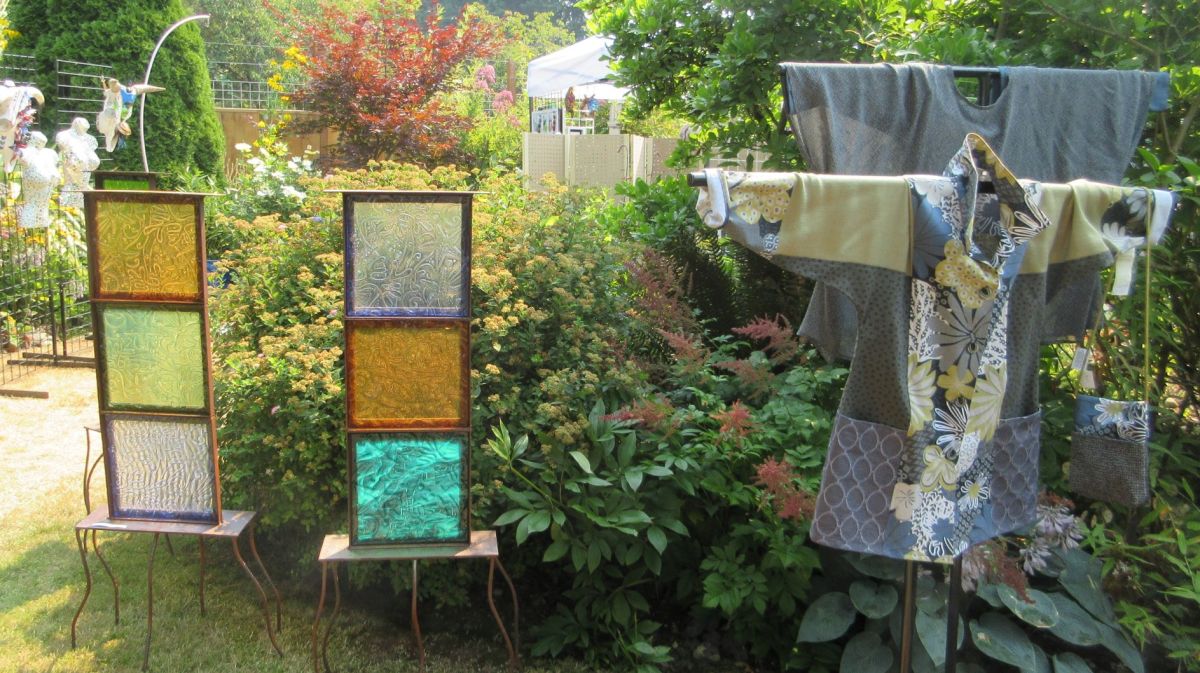
August is the month of local fairs and festivals. Every weekend a different group has an open house or art fair. We spent our second weekend visiting the five artist studios part of this summer’s Bainbridge Island Studio Tour (There’s another one in December.) At each studio, a number of artists set up their work, for a total of thirty-six artists in all. It was a lot to take in, and included some truly creative, interesting, inventive things. I stopped to chat with a woman about how she makes items out of metal clay that become solid metal after being baked in a kiln. Everyone was happy to talk about what they made and how they made it. Flocks of women my age fluttered around racks of colorful summer weight jackets and wraps, or admiring the soft scarves of merino/silk felt.

Capping off the first day of the artist studio visits was the periodic oyster night at the Eleven winery. We sat in the shade and tasted wines, sharing a dozen oysters. There were three kinds (Agate, Bayside, and ?). The oysters were harvested earlier in the day and had that perfect flavor of the sea.

There are a few more cultural stops to make, and we’ll continue to keep our eyes open for more activities, but we’ve now attended more fairs and concerts in two weeks than we have in the past two years, so for the moment we are content to slow the pace a bit.

Monterey, CA to Bainbridge Island, WA

Time to move on; the car was packed and we were out of our driveway in Monterey by 10 am with the goal of reaching Eureka, CA in time to have dinner with Amanda and Jim. We stopped in Mountain View to drop off a few more things with Lyra, exchange hugs, and pet Pandora, then blasted off for Northern CA. We saw a lot of beautiful trees, which is what the northern part of the state has to offer. Arrived at our hotel at around 6:30 pm, having stopped for gas a couple of times. We connected with Amanda, stopped by Siam Orchid to collect our Thai dinner, and settled in for a family evening. I admired home improvements and the recently acquired “rodeo fish,” Quentin McWhorter, named after the winning cowboy at the recent rodeo in Fortuna. The evening passed quickly as we ate dinner together, chatted, and watched the Olympics.

We returned the next morning to share hugs and pet the dogs before setting out for Cowhorn Vineyard and Gardens outside Jacksonville, OR. This meant heading inland from Eureka and across the Oregon border, driving through miles of pine forest, beautifully green on this sunny day. Our substantial detour was an adventure to pick up wine for my sister and have a wine tasting in beautiful surroundings. It was a perfect half-way stop. Cowhorn is best known for viogniers, though it produces rose, grenache, and syrah. The tasting room looks out over sun-heated meadows and mountains–we were happy to sit in the A/C, taste, sip, and spit for a little while. Courtney was the host for our visit, friendly and helpful.
It was a few more hours drive to our motel in Eugene, but there is an advantage to stopping overnight in a major university town. (U of Oregon is in Eugene.) Good food. Our dinner came from The Taste of India, near the campus. Our shrimp korma and lamb tikka masala each came in delicious preparations.

Coffee from Cafe Roma the next morning got us on the road, with Bainbridge Island in our sights. We did not drive into Seattle and take the ferry. Though scenic, it would make the day a couple of hours longer, so we opted to turn north at Tacoma and loop around to the north end of the island and across a short bridge over the Agate Passage. Our house this month is toward the north end of the island, and it was convenient to arrive this way. We had no trouble finding the house or getting in. Our host emailed us the code to the door lock a day or two back, and we walked right in. Such a pleasure to arrive easily.

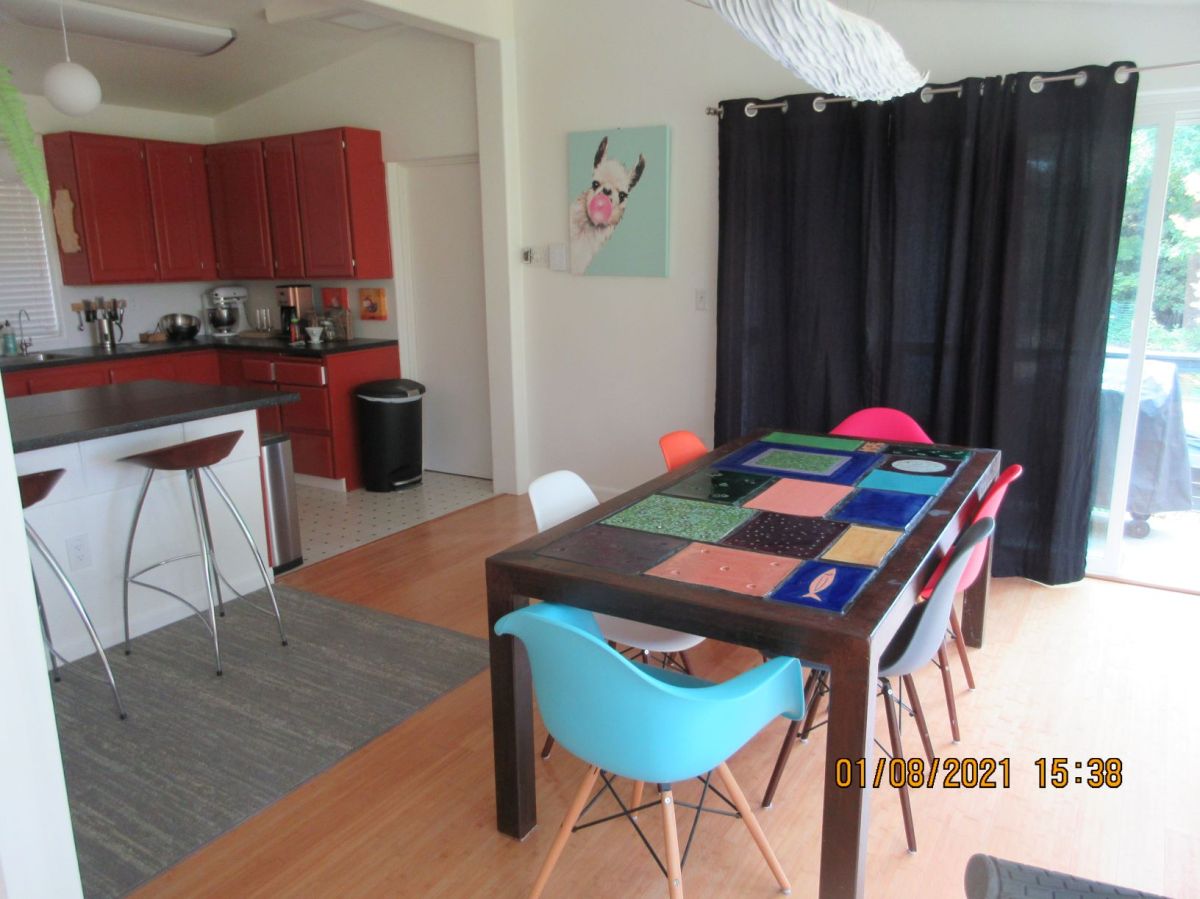
Two nights on the road, stops with family and tasting wine, and now we are at our destination, settling in for the month. Our house is mid-century, with an effort to match the decor to the architecture in the public areas. Colorful, comfortable, surrounded by woods; so far so good.

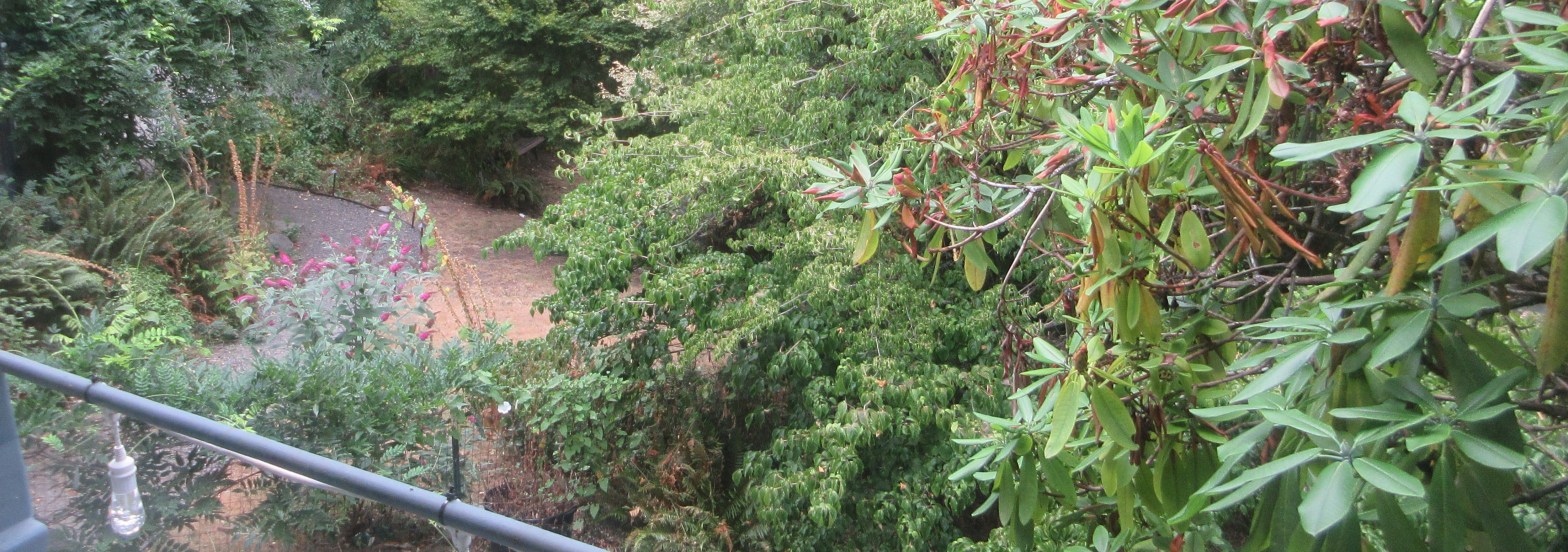
Here’s the complete view from our living room windows.

Transformed: -1 house, +2 suitcases

I am grateful that our packing is as uncomplicated as it is, but it still takes me several days to organize all the things I want to take to the next stop as we try and get back into two suitcases mode. After eight months in one house, the nooks and crannies have started to fill with “stuff,” and paring down is not my favorite activity.

The studio is the area I pack first. Sorting my materials, findings, finished pieces of jewelry, and tools before I pack anything else, makes it easier to unpack at the next stop. We accumulated a surprising quantity of sea glass over the months, and we’ll deal with that, too.

My tables full of materials and projects condensed into two small boxes, a bag of tools and two packets of findings.

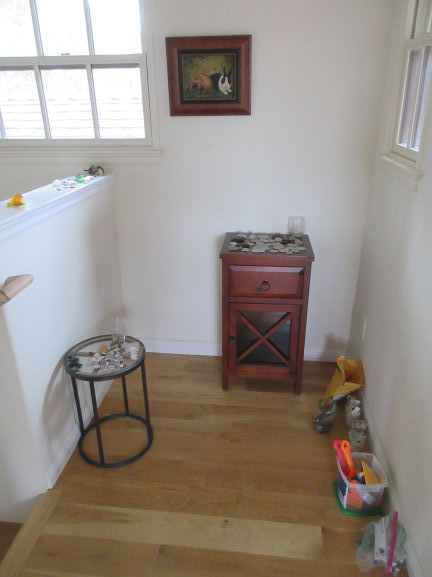
Rather than throw our beach-combing treasures and extra beach glass straight into the ocean, we took it back to the beach and built a little shrine on the low tide line. We hope the waves will wash it all back into the ocean and that other people will have a chance to find some of these interesting things once again.

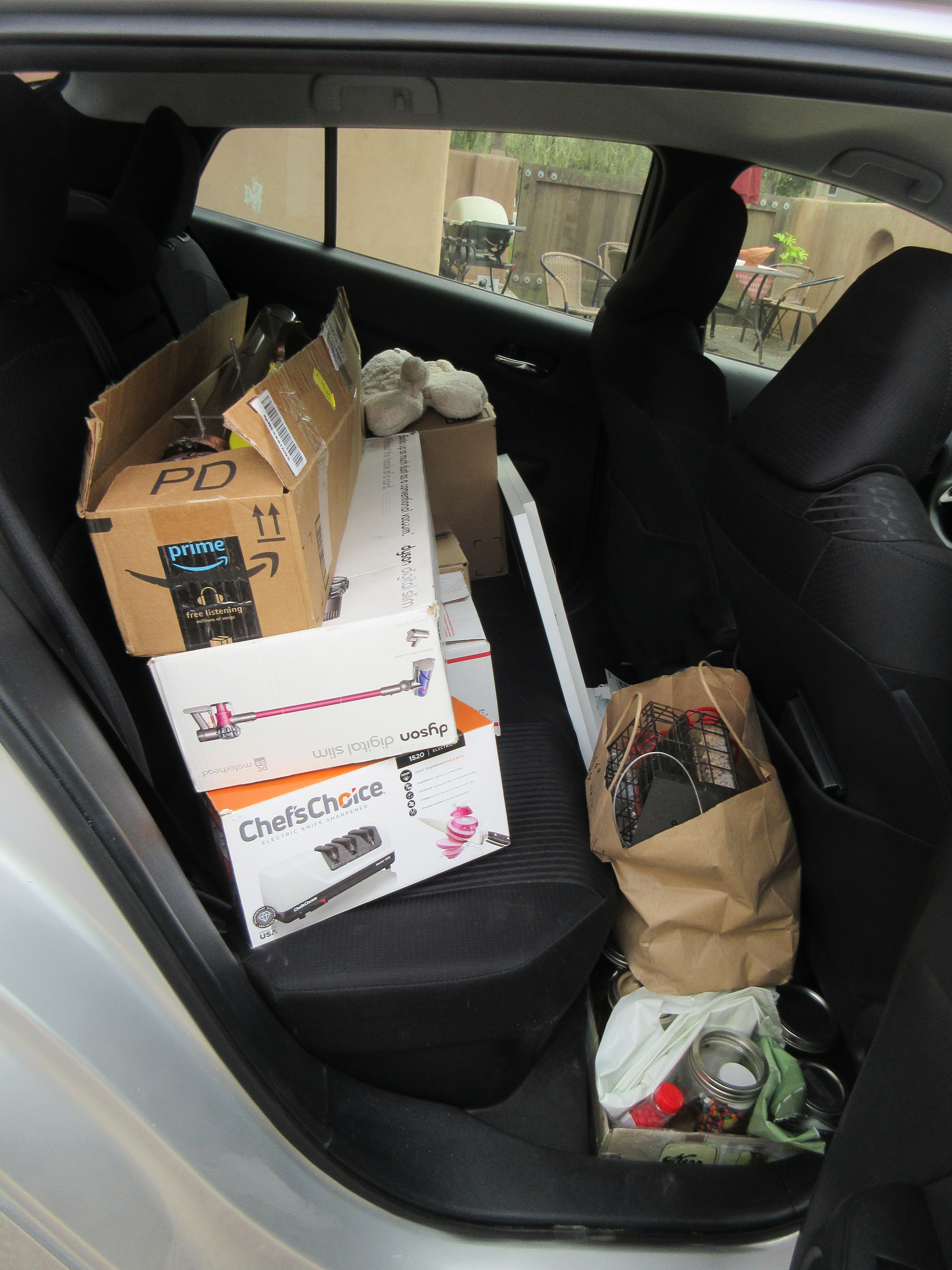
Once my projects have been packed, I move on to the house. We have purchased household goods that we won’t use after this stop. Fortunately, our daughters expressed interest in adopting most of our unneeded items. Also helpful, Lily and Neil will be coming west to pick up our car and drive it to Champaign, IL. That will let them take a box or two of our things back to the midwest, where I’ll be able to sort them again and swap a few things before we leave for Peru for the winter.

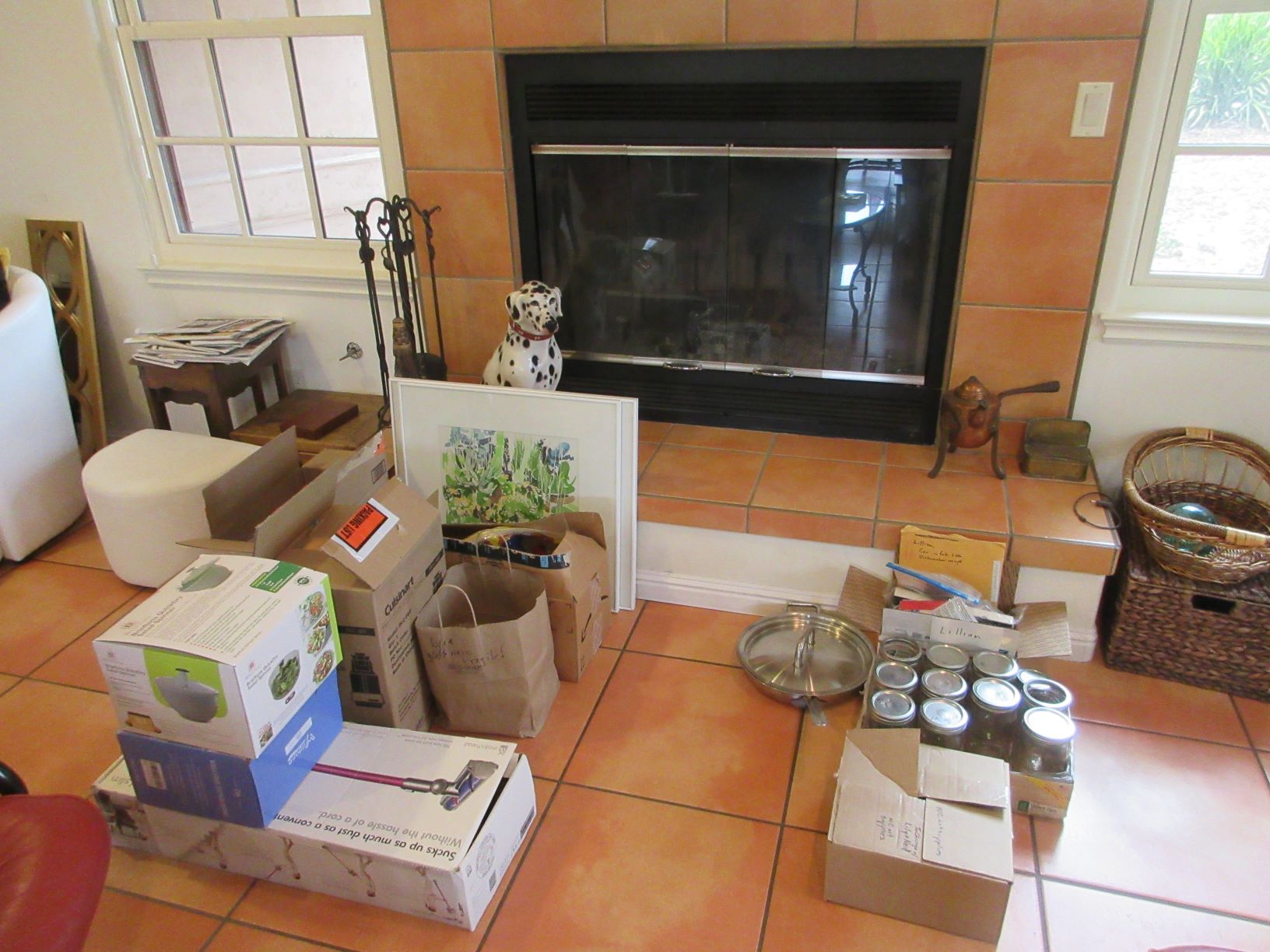
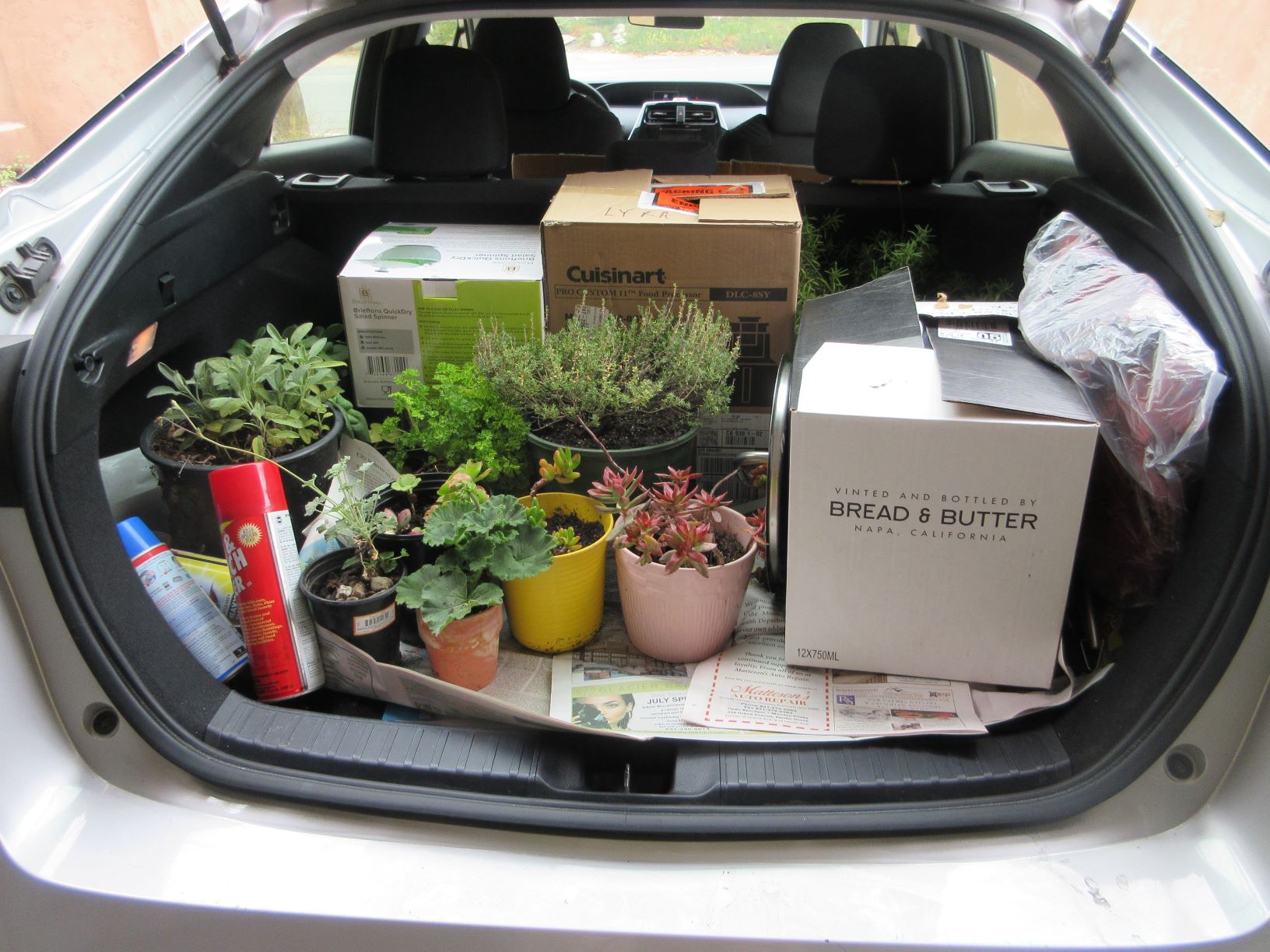
Piles in the living room became piles of boxes in the car. Crammed in were a dozen plants. I enjoyed growing herbs and sprouting succulents, and am delighted that Amanda is willing to add them to her own collection.

Once we dropped off the carload of “gifts” at Lyra’s, to be picked up/dropped off to the other sisters at a later time, we had the rest of the house to pack. This interim phase is the biggest mess, when everything is out waiting to be put in boxes, and nothing is in its final location. Not to worry, 48 hours later everything was packed.

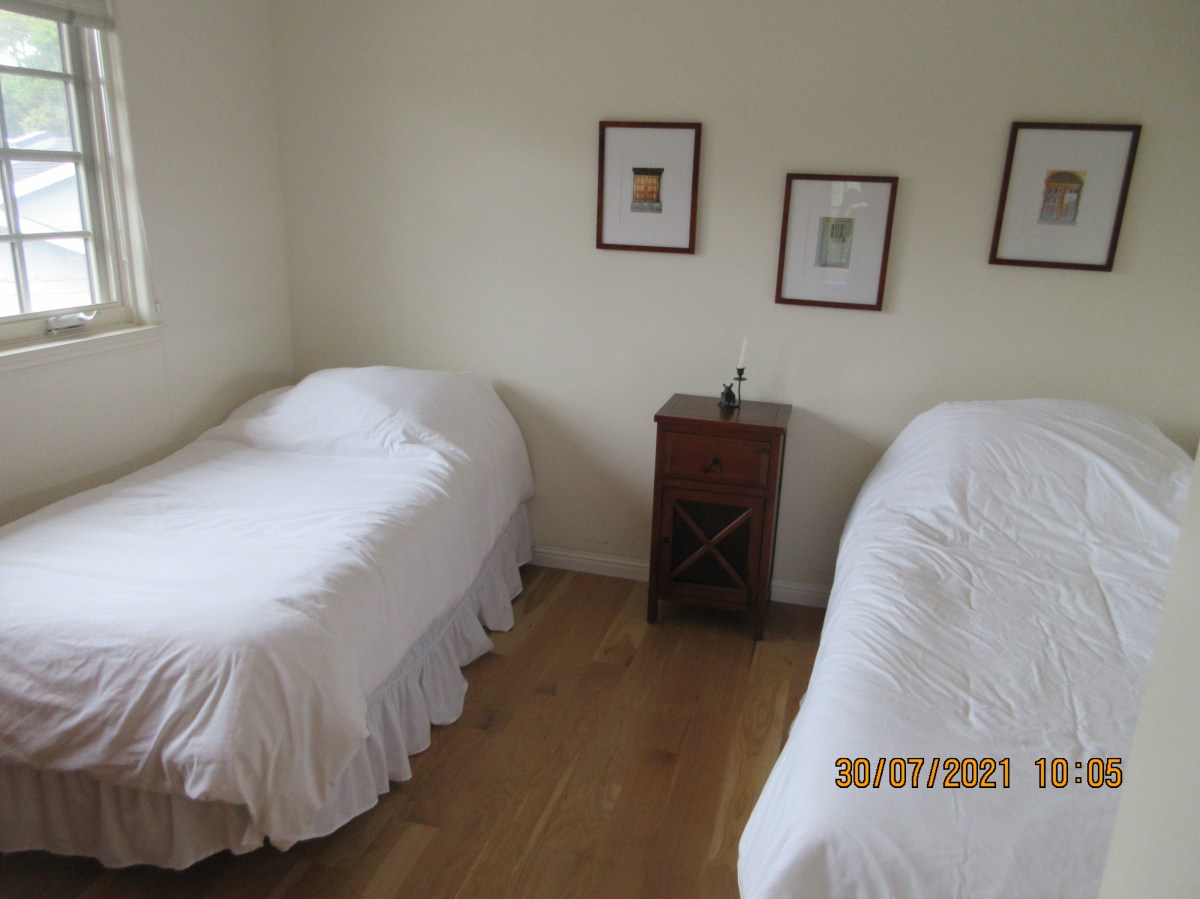
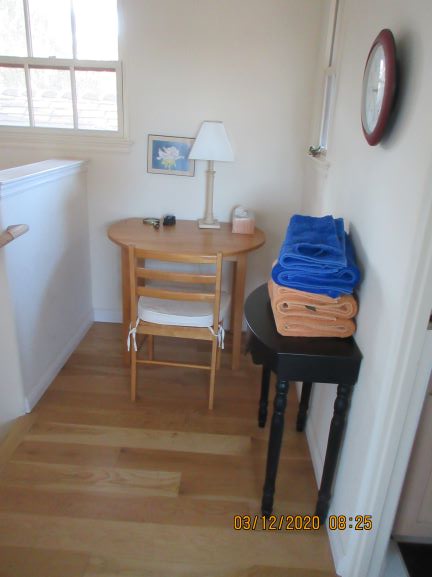
I completed restoring the upstairs to its arrival-date condition, minus the linens that are now in the closet.

Finally, on the day we left, I took photos of the entire house just in case any issues arise after we leave. California has lots of protections for renters, and I’m confident we’ll get our deposit returned minus the cleaning fee. (We were happy to let someone else take care of the final cleaning.) I always take photos, both to remember the house and just in case.

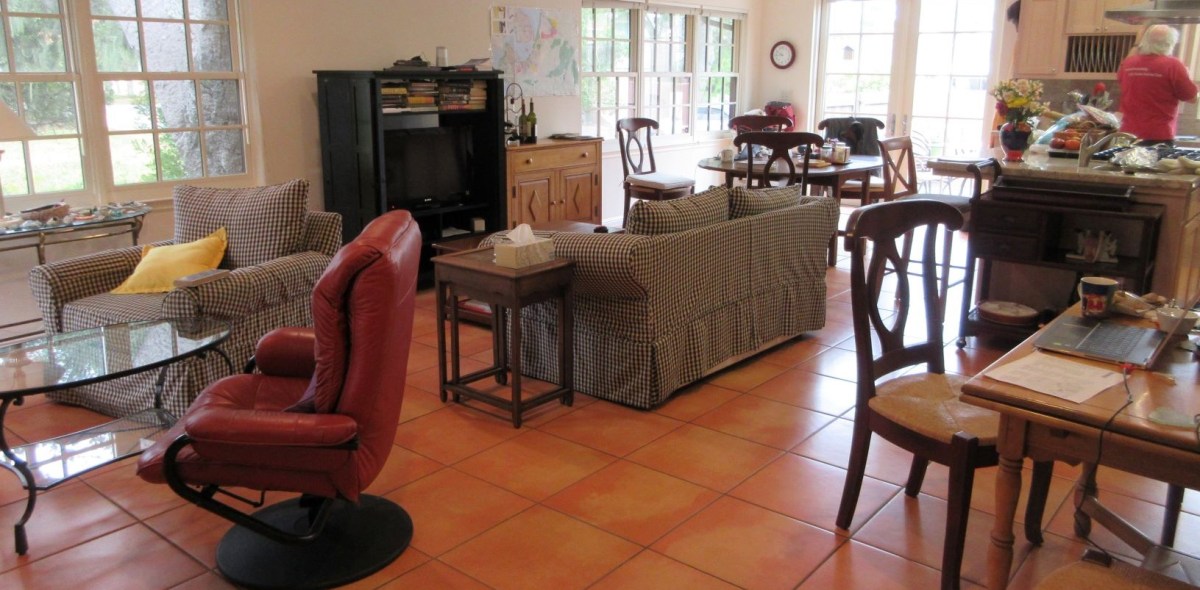
During our stay, we rearranged the living area so that the most comfortable seating was in front of the TV, rather than in front of the fireplace. We switched the dining table for a table that was intended as a desk, because the “desk” was larger. It all worked very well, and we easily rearranged everything before we left. This was a comfortable house that we’ll remember fondly as the place we rode out most of the pandemic.

Last but not least, a few photos that didn’t fit any particular theme.

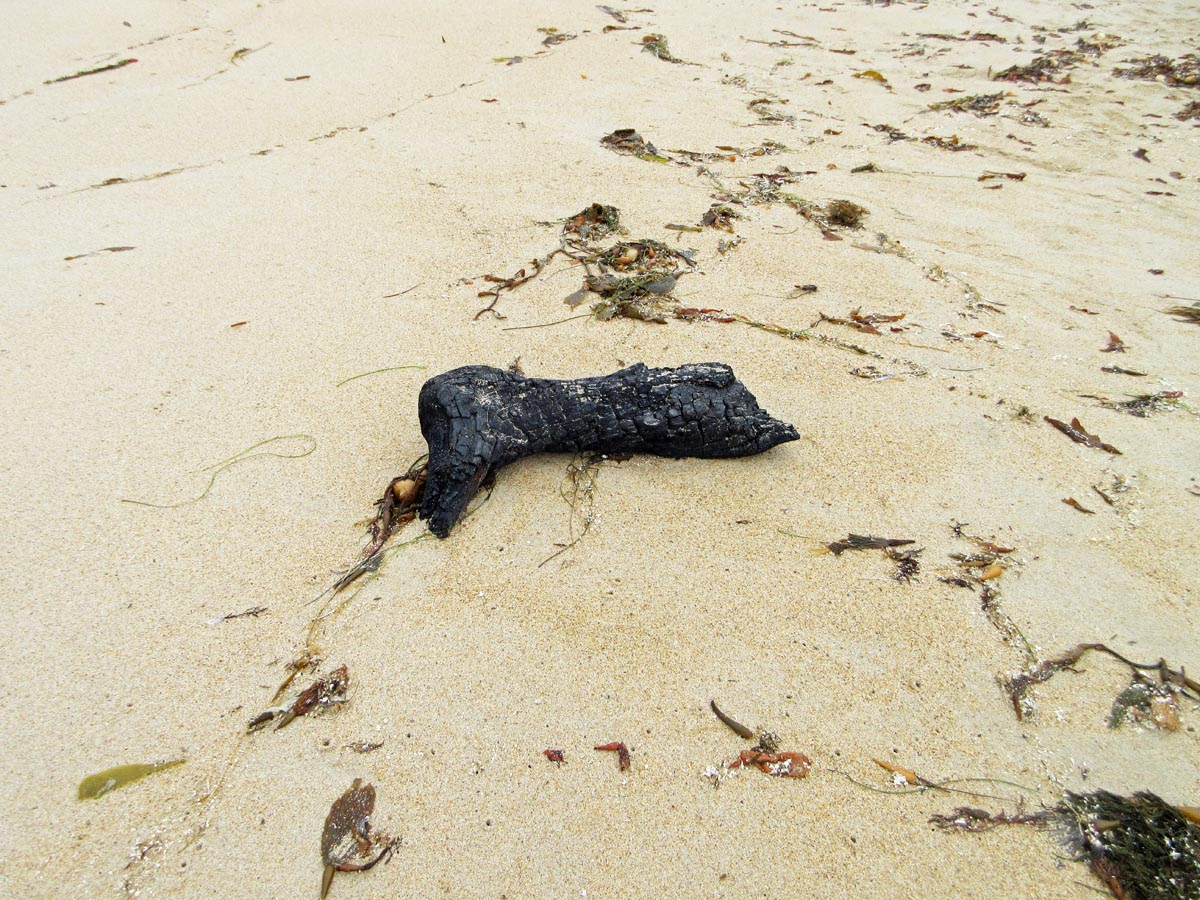
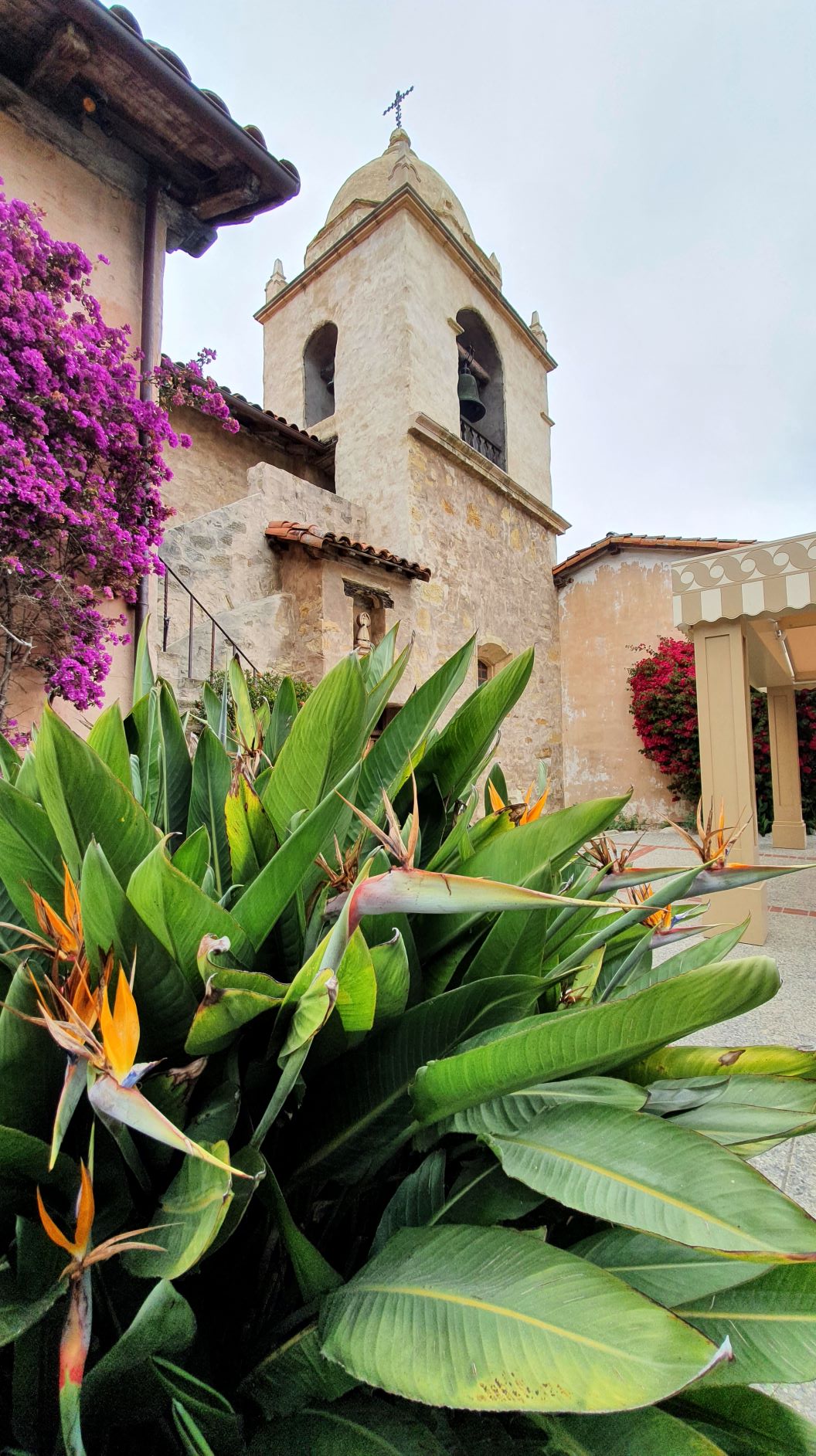
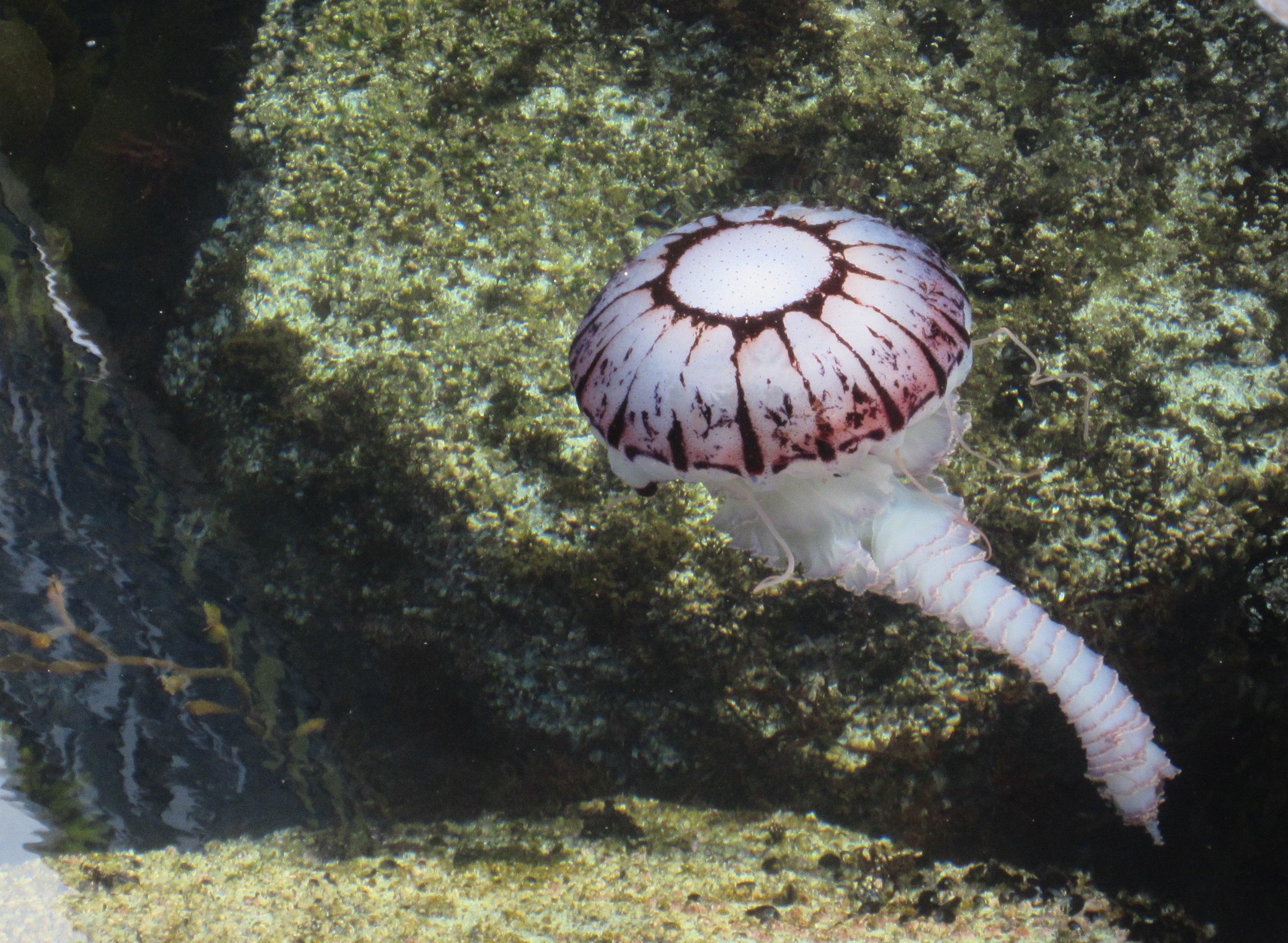
Clockwise from upper left: Neighborly buck stops by to look in the window and say goodbye; Carmel Mission with my favorite bird-of-paradise flowers; “boot” of charred wood, Sand City beach; Flowers along Malpaso Creek trail; Jellyfish, Monterey Coast Guard pier; Historic Casa Soberanes garden path lined with old bottles; Cormorants and a sea lion in Monterey Bay;

One Last Festival

The weekend before our departure from the Monterey area was the regionally-well-known Artichoke Festival. Trivia fans know that Castroville, CA is the Artichoke Capital of the World. (The festival is sometimes called the Castroville Artichoke Festival.) We were pleased to hear the festival would take place live and in person, and were determined to attend. We’ve driven by the fields of artichokes and admired the many artichokes waving at the end of their stems. I heard a home gardener complain that her artichoke plants only yield 4 or 5 artichokes, while the commercial growers may easily get a dozen or more.

Production of artichokes may center on Castroville, but the festival was held at the centrally-located Monterey County Fairgrounds. A mile or two from the coast, the day was hot and sunny, with lots of people filling the parking lots by 11:30 am when we arrived. There was still space for us, and we paid our admission and went in. First stop was the event area, where a local dance school was winding up their program, bringing about 100 K-12 students to the stage.

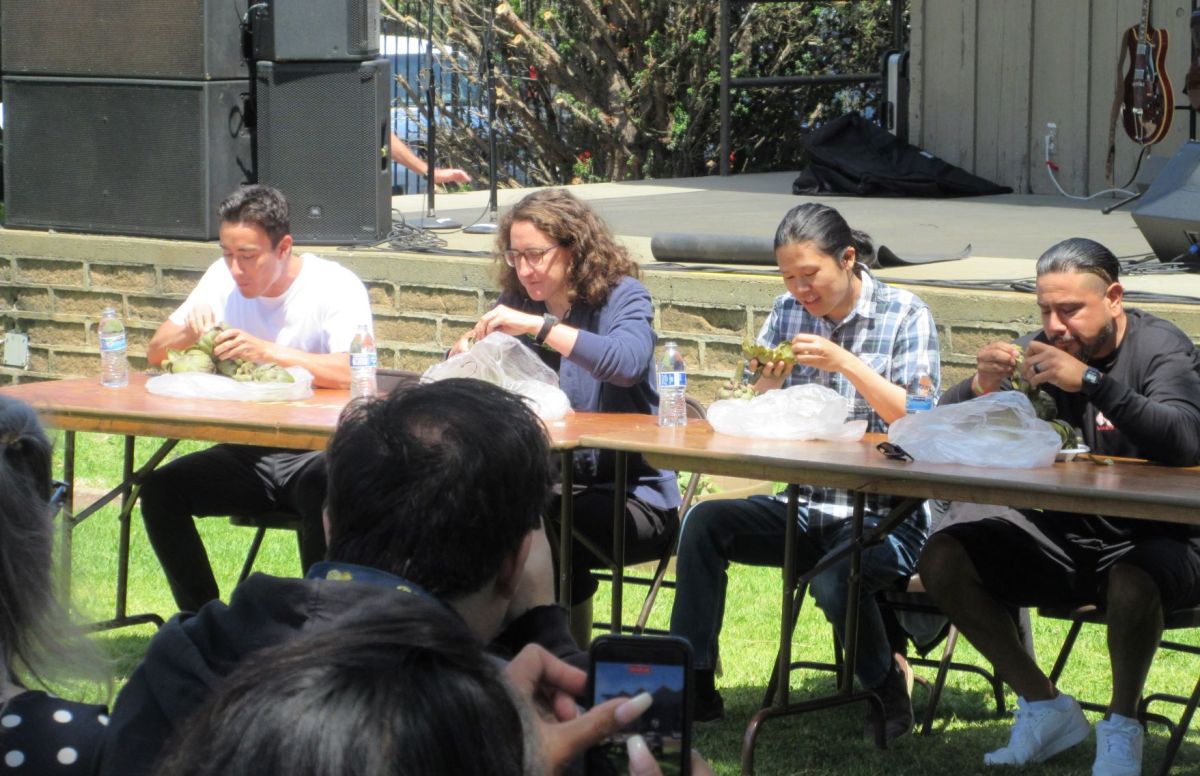
Entertainment was followed by the artichoke-eating contest. We have no idea how the six participants were selected, four men and two women. The MC had his hands full trying to pump up the crowd and the participants, as they awaited their bags of steamed artichokes. No melted butter! This was as difficult as the potato-judging in Ireland, where the judges tasted nine boiled potatoes without butter or salt. At the artichoke-eating contest, each participant was given a bag of steamed artichokes that had been weighed. The person whose bag weighed the least at the end was the winner.

There was some discussion of how long the eating would go on. This wasn’t to set a record, but to see who ate the most in a determined time. Once the time was set for three minutes, the MC’s watch didn’t keep the right time, and an additional 45 seconds was added. We don’t really know how long the contest continued.

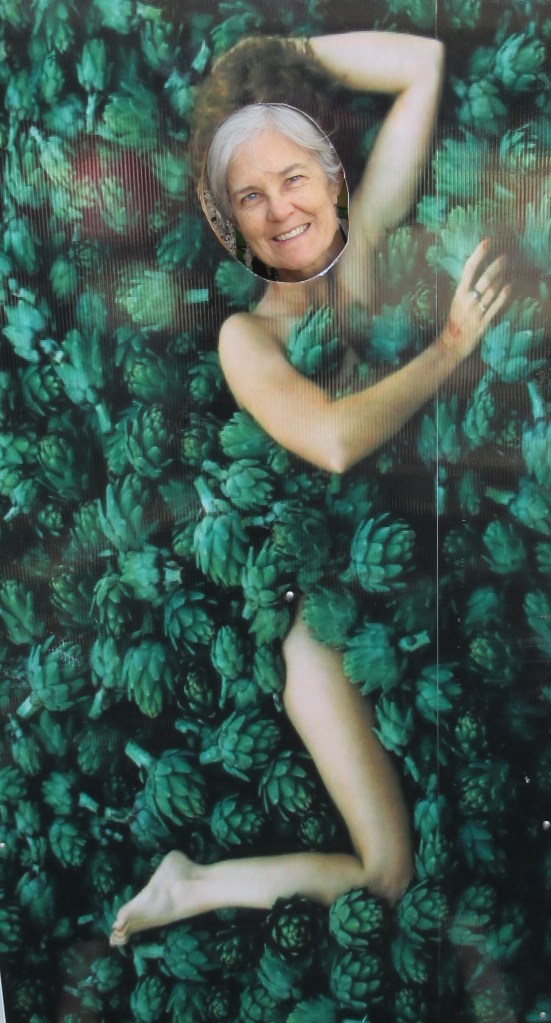
We watched the various strategies of artichoke eating, mostly the contestants tore each in half and ate the center. However, there were also the “eat from the bottom” group. The MC assured us that it was a way to maximize how much of the artichoke could be eaten without bothering to remove the center choke, the prickly part. The chipmunk-cheeks of the eaters were something to see, especially in the final moments when they each tried to get as much artichoke in their mouth as possible before time was called. I went for a photo with Mr. Artichoke while they were weighing the bags.

A stocky young man in the center of the group was my bet for the winner. He had used the “eat from the bottom” technique and had artichoke bits all over his face. Others had their favorites, and we all applauded while the judges weighed the bags of leftovers. I was amazed to find that one of the women won! I believe the prize was all our applause.

We went on to the producers tent, where growers were selling boxes of about 40 artichokes each. We overheard a seller offer to set aside a box for one person, saying that he fully expected to sell out his huge pile of boxes by mid-afternoon. What do you do with 40 artichokes?!

There was a quilt contest of artichoke-themed small quilts. Quilts are an interesting medium for showing artichokes, as the leaves provide an interesting shape for a lot of different textures and colors of green. Jonathan and I particularly liked the prize winning quilt of a blue and red parrot sitting on an artichoke.

You know the old saying, “You could eat off that…..”?!

We admired some of the fancy cars that were on display, too. They don’t have anything in common with artichokes, but there was a lot of participation and enthusiasm.

We had to eat something, and went for fried artichokes. There was nothing wrong with the batter-dipped pieces of artichoke that wouldn’t have been improved with a squeeze of lemon or vinegar, some salt, or hot sauce, or mayonnaise, or remoulade sauce, or something. Artichoke hearts don’t have a strong flavor, and when dipped in batter and fried, neither batter nor artichoke seemed to gain flavor. They just tasted fried. There was a long line to get a boiled or grilled artichoke, and we should have known that might have been a better choice. We have eaten fried artichokes, however, and there you have it.

I was hoping to get a souvenir from the sales tent, because we’d passed a couple wearing black t-shirts with a pair of big purple and green smiling artichokes on the front and in tall gold lettering “Okie-Dokey, Artichokey!” We were disappointed to find none of these. We saw the couple again, and asked them where they got their wonderful shirts. “Amazon!” I did get a lovely souvenir photo of me as the goddess of artichokes.

We enjoyed the festival, because it seemed a pretty local event, with everyone from the growers, entertainers, and visitors from the region, all appreciating the Castroville area as the source of America’s artichokes.

On the way to the beach

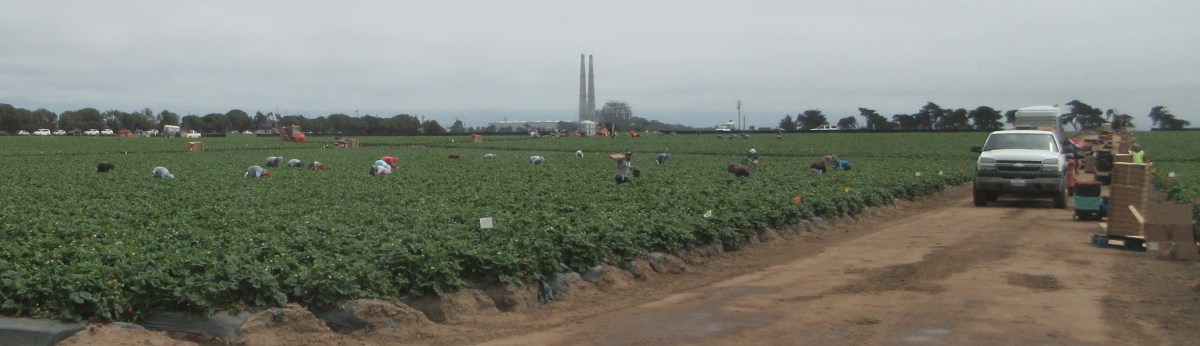
We set out for Zmudowski State Beach, just north of Moss Landing, where the Salinas River meets the ocean. There’s a sign that points off the highway, and the road goes left, right, left, right, through field after field. The long zigzag brings us to a quiet, sandy area, good for a long walk to watch the waves.

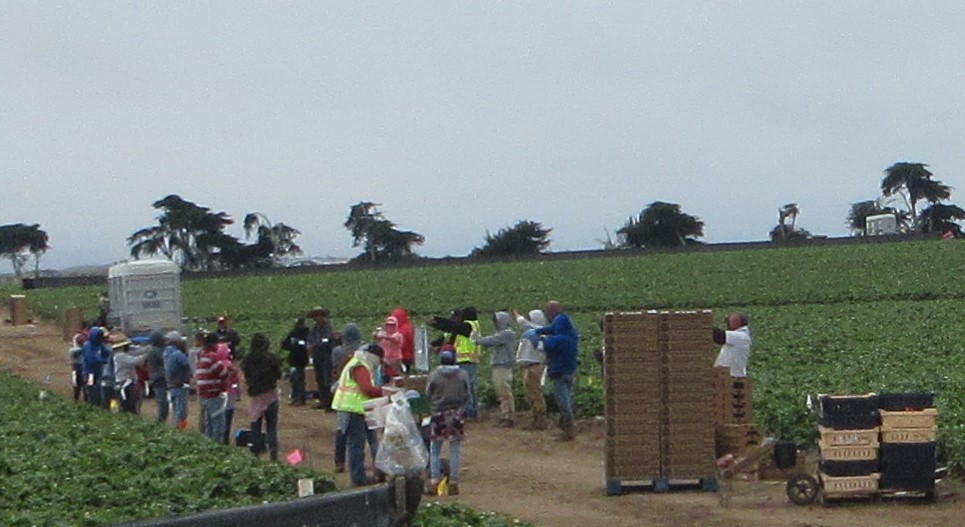
Our goal was the beach, but we were captivated by the activity in the fields. Many of the fields are planted with strawberries, though there is lettuce, cabbage, broccoli, brussel sprouts, and artichokes. We passed cluster after cluster of thirty to forty people, accompanied by a bus or truck towing portajohns, and a long line of parked cars. We passed numerous groups and figured there must have been 300-400 people at work. On the way in, around one pm, we saw people sitting on folding chairs in a circle near one of the vehicles. On our way out a couple of hours later, everyone was picking, and the lawn chairs were gone.

We saw people running with empty trays from the truck to the fields, or carrying full trays from the fields to the truck–they probably get paid by the box. Most of the people we saw were harvesting strawberries, doubled over from the waist or crouched down to pick berries. Either technique tires one part of the body or another. The next time we eat strawberries, I’ll be wondering about the person who picked them for me.

Crew doing some stretching exercises before returning to work after the lunch break.

Discovering Ft. Ord

A disused Army base, Ft. Ord National Monument, now is managed by the Bureau of Land Management (BLM) and is open to the public. From Ft. Ord Dunes along Monterey Bay (see banner photo for this post) to hilly inland scrub, it’s a huge park, more than 14,000 acres. We’ve explored the long stretch of beach and driven around an extensive neighborhood of abandoned barracks just a few blocks inland. The collapsing structures are within a fence, and some are boarded up but obviously visited many times over the years since the fort closed in 1994. There is supposed to be redevelopment, especially new housing, but it’s going very slowly, 30 years on with little change.

Most of those 14,000+ acres are inland, and there are miles and miles of trails. It took us a while to become interested in visiting, as most of the area is closed to vehicles, with permanent gates across all the roads into the property. It’s a long hike into the heart of the park, and we don’t take long hikes anymore. There is even a section closed to the public because live ordnance may be present. Earlier this year, the local papers ran stories about metal detectorists getting run off the closed area, as the BLM was concerned someone would blow themselves up.

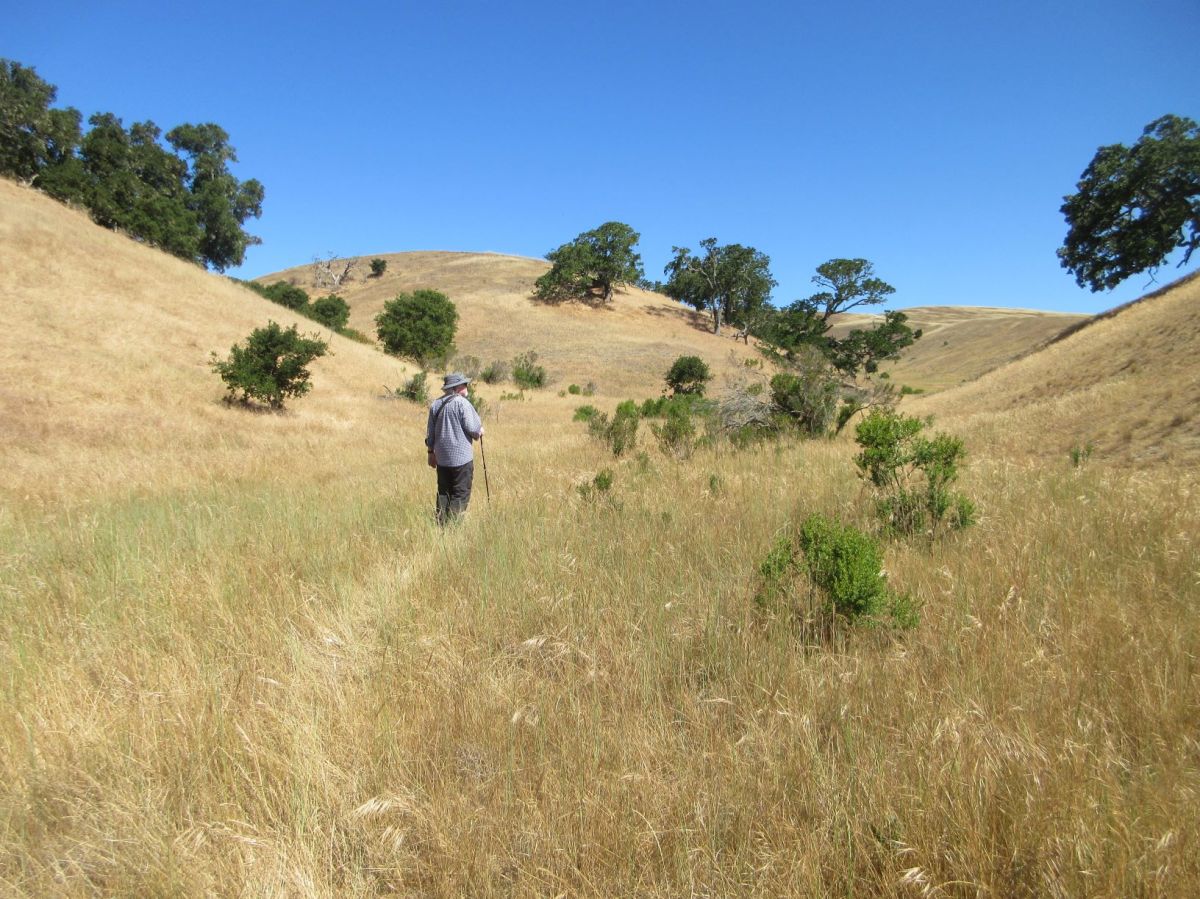
Our first visit beyond the beach started at the Ft. Ord National Monument marker and took us along trails through grassland and patches of oaks. We looked at birds and admired some of the gnarled tree trunks. We agreed that we needed to visit as early in the day as possible, as the grasslands heat up rapidly. The current high heat warning affecting most of the western US hasn’t reached us, but bright sun feels hot enough.

On another exploration, we approached the inland part of the park from its western side, where four lanes of Gen. Jim Moore Blvd. divides the densely urbanized town of Seaside from the completely undeveloped part of Ft. Ord. When we found the parking area/trail head, we realized that the trail headed straight out into grassland with few trees in sight for almost a mile. We decided that perhaps this wasn’t a walk we wanted to take.

Not far away, we walked down a dirt road, the Jerry Smith Access Corridor, and onto trails that go in many directions. It’s almost a half mile along the corridor to the actual trails, which takes up a lot of our walking energy. We met other walkers on the paths, many with their dogs. Though we didn’t see many birds, we enjoyed the walk, and got to pet lots of friendly dogs.

Our best hike so far started at the Creekside Trailhead. There isn’t a creek that we could identify, and all the tiny lakes in Ft. Ord have dried up. This limited our expectations for bird watching, as birds seem to prefer staying near a water source.

The trail headed uphill, and we could see hikers at the peak of a ridge overlooking the parking area. We didn’t think about getting that far up, but the trail climbed up and up as we walked. We arrived at a break in the rock of the ridge, a gateway to the top. Through the “gateway,” we walked out to the end of the ridge, surprised that we’d reached the top. Some compassionate soul installed a park bench there, where we sat to enjoy the view.

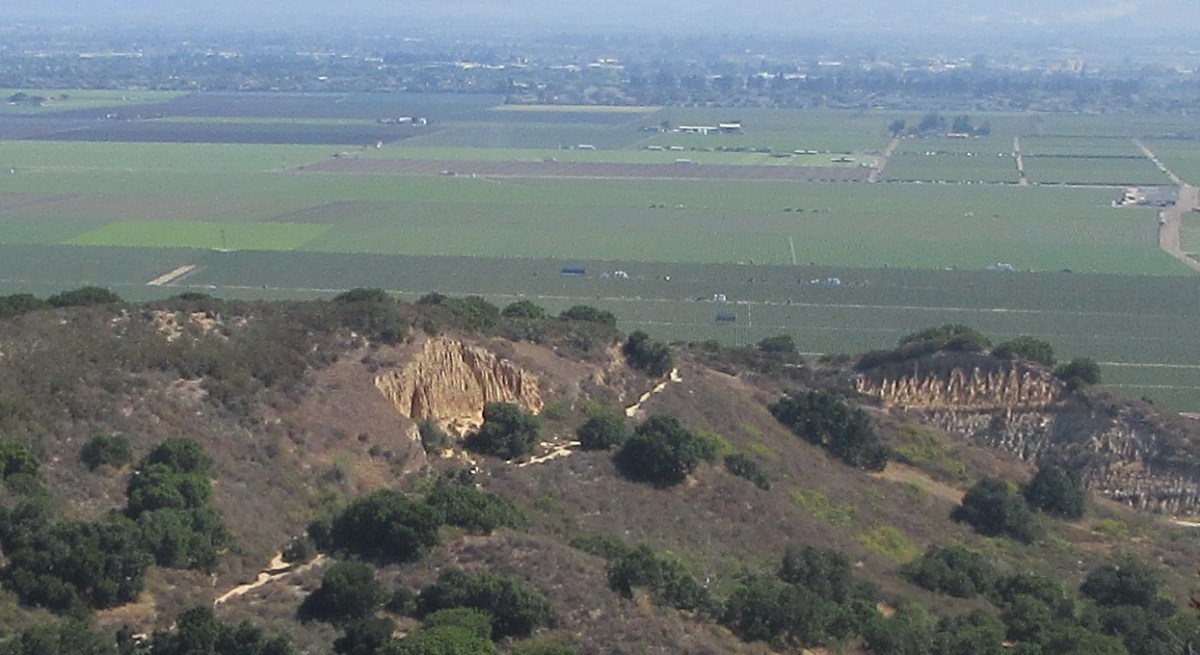
There’s a remarkable change between the grass and chaparral-covered hills of Ft. Ord, and the valley of the Salinas River that is immediately adjacent. From our seat looking out to the north, we could see the layer of marine fog hanging over the ocean on our left, while to our right, hills became mountains off in the distance. Straight ahead of us was the flat, dark green plain of America’s market basket, the Salinas Valley. Every inch of the valley floor is a checkerboard of housing facing off against agriculture. On the one had is the need for reasonably-priced housing in California, and on the other is the nation’s reliance on the Salinas Valley for a huge volume of fruits (strawberries, cherries, peaches, plums, nectarines, apricots, citrus, apples) and vegetables including the famed artichokes of Castroville. The annual Artichoke Festival is coming up on July 24-25.

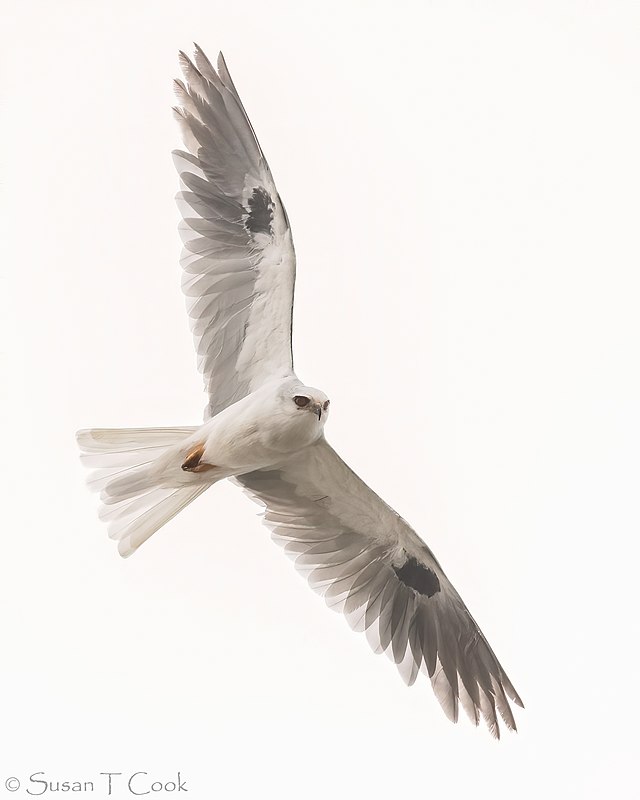
While we were resting on our wonderfully located park bench, we looked down on a white-tailed kite circling in big loops over the terrain, watching for an unwary ground squirrel or rabbit. There is no other hawk sized bird that is so white, and the triangular white tail is easy to recognize. We watched until it flew out of sight over another valley.

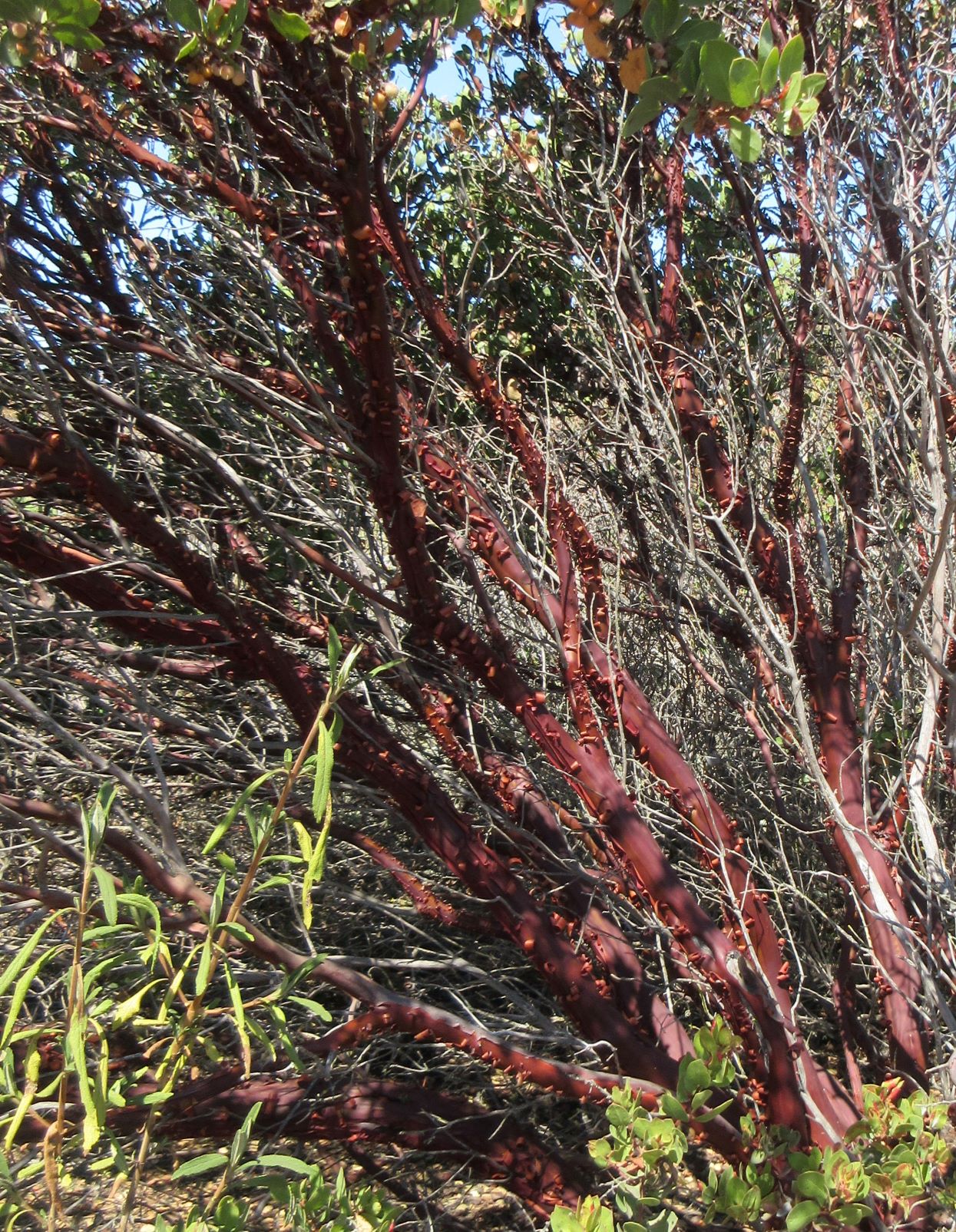
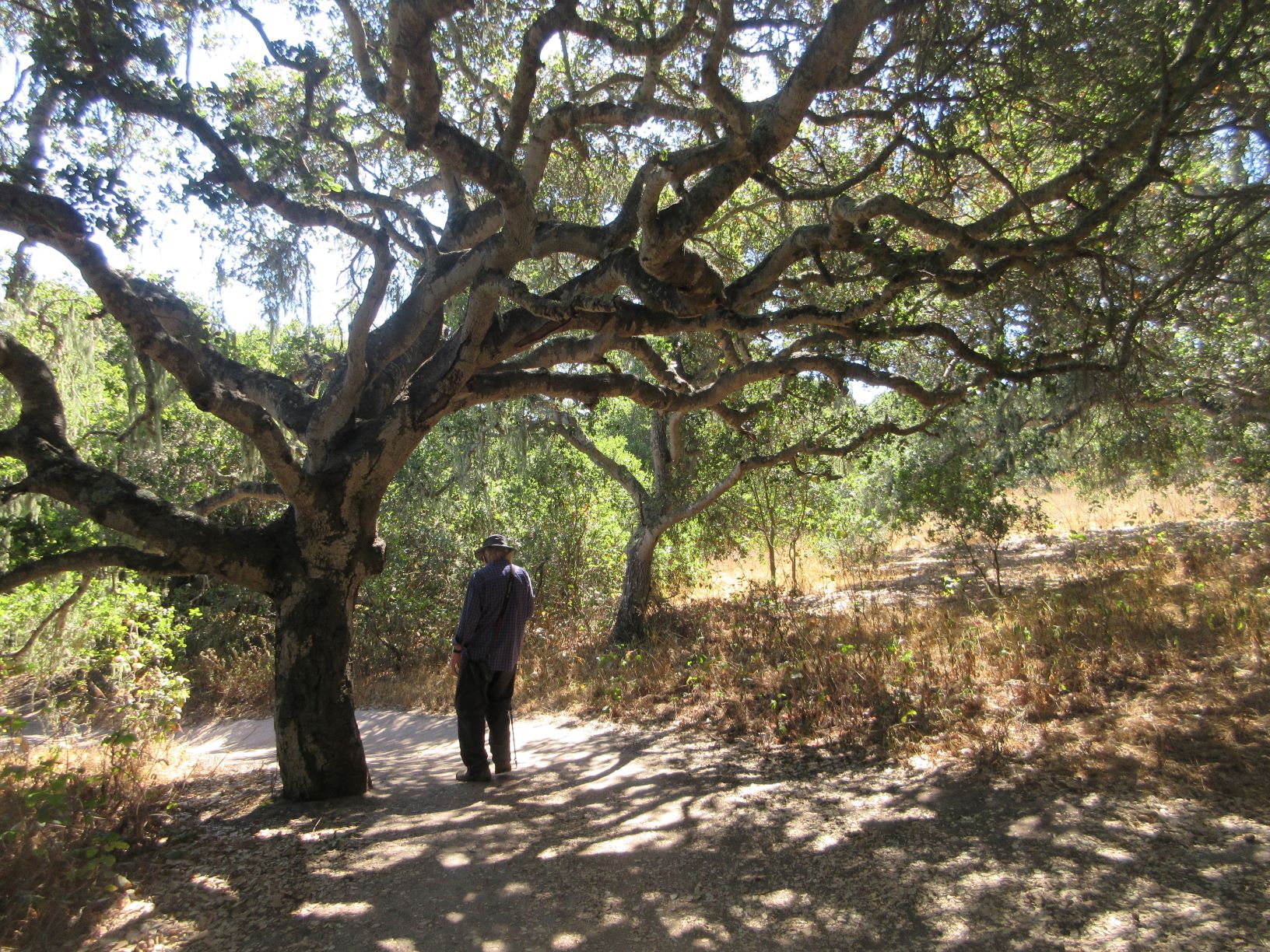
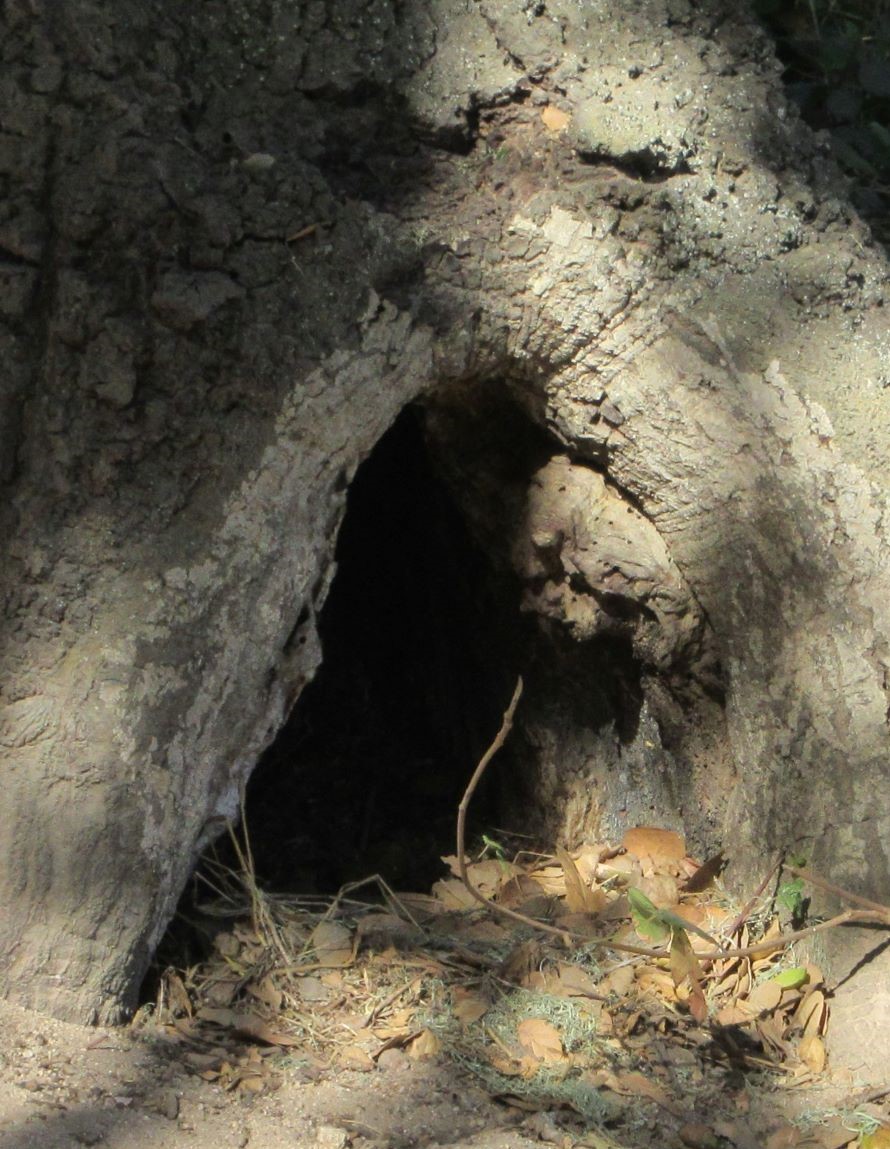
L-R: Madrone; heading down the trail; entrance to the Hall of the Mountain Kings?

As we turned to walk back along the escarpment we noticed the deep red bark of madrone, a tree with distinctive red-orange bark. It appears to grow on the mesa tops here, but we found no more growing once we crossed through the gap in the rocks and went down hill. The trail puts a bit of stress on the knees, but it was a lovely walk, the sun was out, and nothing could be better. We intend to keep visiting Ft. Ord to see more of those miles of trails.

Quirks of Beachcombing

We usually look for sea glass at the lowest of low tides, when gravelly patches appear that often hold glass fragments right at the waterline. When we saw there were no more low tides this month, we decided to try something new. We’d go to the beach after high tide, as the water was receding toward the low tide line, leaving bits and pieces behind. Genius, right?

It turns out that lots of people have come to this conclusion, and it appears to work very well at our favorite beachcombing place in Sand City, CA. It works so well that people arrive to begin collecting as soon as it is light out. We turned up around 9 am to find at least a dozen people wandering up and down with their buckets and bags. Footprints were everywhere. By the time we were getting down the beach a ways, Jonathan pointed out that everyone else had already left. I guess I would have, too, if I’d gotten up a half hour before sunrise.

We always enjoy a walk on the beach, and we did find a few small pieces of beach glass, though nothing like what we’ve found on other days. We got a few things to add to the trash can (above) and our donation box (below):

Letting go of our mooring ropes

Having mulled over what I love about this area in my previous post, I have to face what it will take to get us on the road again. We’ve made ourselves comfortable here; after all, we will have been here 3/4 of a year. Unweaving the strands of connection that tie us here will take some effort. Here are some of the things on my mind.

The mechanics of leaving our house:

We’re in a rental that has required us to take over all the utilities and services. Between Jonathan and I we have to detach ourselves from the house:

  • Property management company: End lease, final cleaning, security deposit
  • Terminate accounts: Water, sewer, gas &electric, cable & internet—return cable box and related stuff
  • Change all shipping addresses: Amazon, prescriptions by mail. I have to think about whether there is anyone who corresponds with me by mail, who I might lose on this next move.

Inside the house there are different tasks:

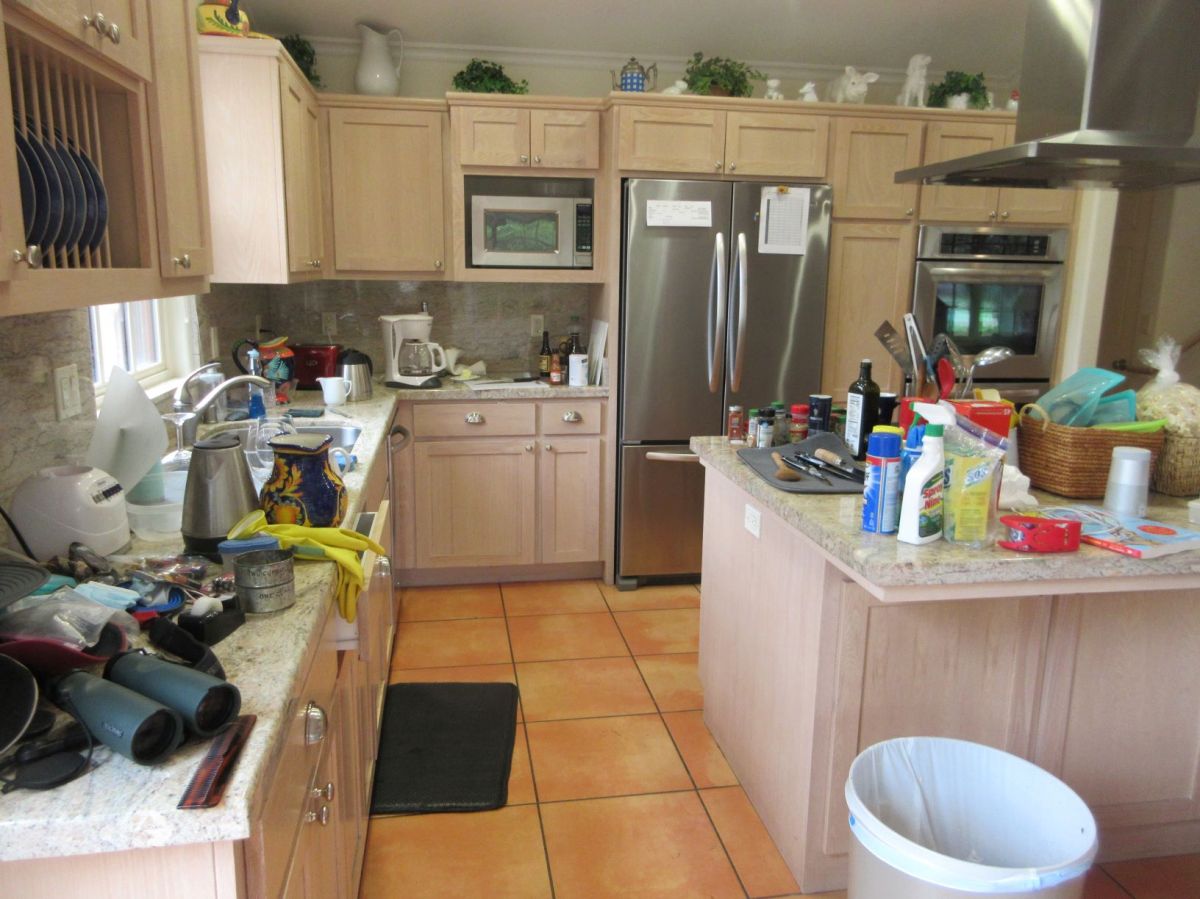
  • Figure out what is ours and what belongs to the property. This is a tricky one, as we seem to add things by stealth; they just appear, especially in the kitchen. Now we have to hold up each implement and ask, “Is this ours?” This isn’t just because we want these things, we often don’t, but we don’t want a complaint from the realtor that we left “junk” behind.
  • Rearrange the furniture to its original configuration. Fortunately, I took photos.
  • Offer excess goods to family, return borrowed items and a few new things to Lyra in Mountain View, and offer some things on Next Door.
  • Donate what is left to a local charity thrift shop that I like. A few of the items originally came from it.

Packing

Our goal is two suitcases, plus carry-on. We still have our Prius, so we will take along a couple of plastic bins of pantry items. Each of us manages our own suitcase, and the volume of clothing and toiletries is limited by how we each pack. I already have a pile of clothing to donate. I’ve replaced three worn-out tops with others, replaced a pair of pants, and decided to leave another pair behind just to keep the numbers down. I’ll be abandoning a very worn pair of shoes and donating another just to get back to the two pairs of shoes I started with 18 months ago. I still have too many pairs of pants.

The Studio

When we arrived in California, I was very low on beach glass, and after our first few outings to the beach, I wondered whether I’d be able to make much of anything. Then we hit our stride, and now I have an Etsy site: http://llywindatreasures.etsy.com, that shows all the things I’ve made.

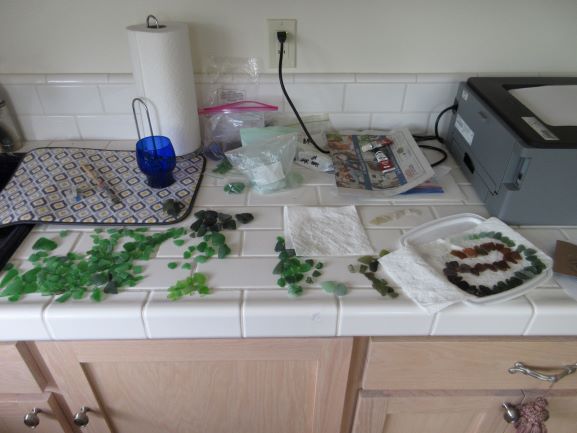
There is glass covering the tops of two tables, and a variety of tools, my Dremel, findings, beads, and miscellaneous items we’ve collected on the beach.

When to stop making jewelry is another question. I have a necklace in progress, and pieces for another that Jonathan has already drilled for me. Yet another is on a tray waiting to get drilled. I have just completed a pair of earrings and a new brooch, and I have lots of pieces for earrings that are drilled and waiting. I’ve been trying something new, and the experimental pieces are almost ready to contemplate. At some point, I have to stop and put everything away, but I have another week or two before I have to face that.

Sorting out what to leave behind is a particular torture. I am trying to divide up the beach glass, keeping the most rounded pieces. As soon as I’ve made a couple of piles, I think of some of the nice things I’ve made from irregular pieces, and I wonder whether I am saving enough. I will have several pounds, so I am probably ok.

My growing collection of jewelry making supplies: rings, hooks, chain, silver wire, etc, has to be packed carefully so that I can find what I need without dumping everything onto a table top. Clearing up the studio often takes longer than any of my other packing. I have about three times as much stuff as when we arrived.

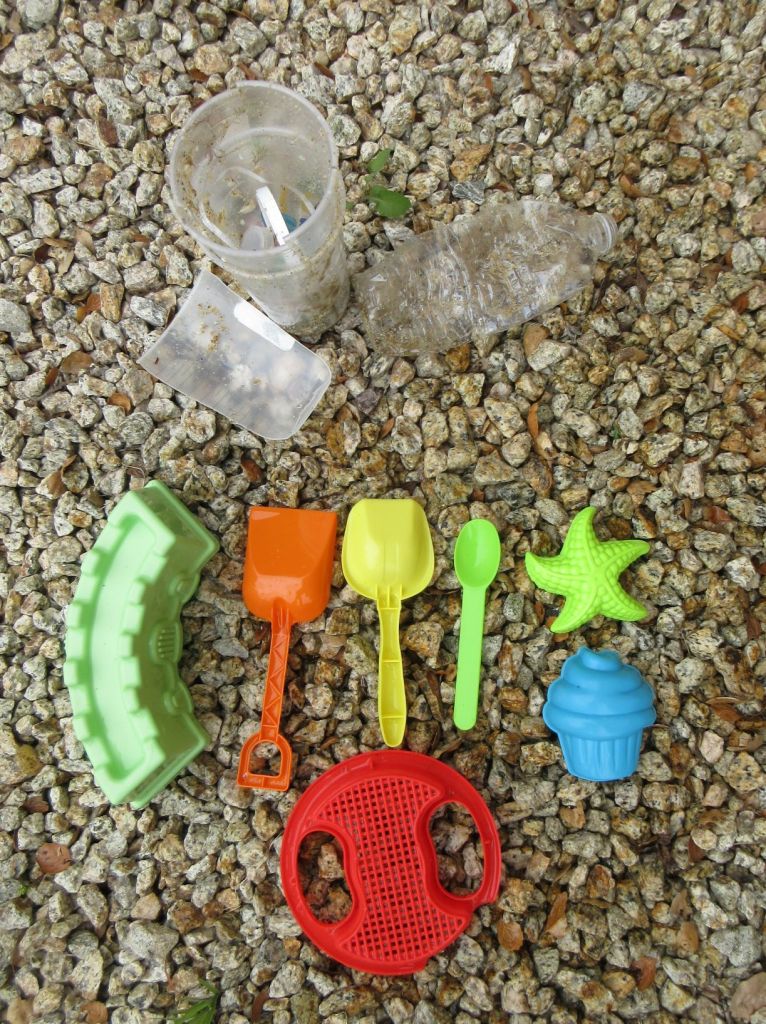
As we go beach combing, we collect odds and ends that look interesting, and we now have a table covered with abalone shells, strangely shaped rocks called “hag stones,” various plastic toys, a crab trap clip, and a bucket full of beach toys. During one of the next low tides, we’ll take some of the rocks, shells, and beach glass and put them back on the beach, but the plastic will have to go (I’ll donate the bucket of toys).

Leaving Town

A couple of other ties are the mail service (should I have mail forwarded to our next address or to Chicago?), and regular doctor’s appointments. I have found that my insurance company assigns payment for my eye injections to a single provider for one year. Before I leave, I have to get that arrangement un-done, or I will be unable to get treatment at my next stop. This has already happened to me a couple of times and it takes about a week to sort out, during which time it is very stressful to sit and wait, knowing my symptoms will worsen. Following up on the health insurance has become mandatory housekeeping.

We have tried to reduce the paper mail we receive, but there are utilities, like our current sewer service, that do not use electronic payment systems. How can that be? Medical organizations still send out a lot of paper, too, and I’ve been stashing all the receipts that might be needed in a pile. Now I have to sort through them. I will photograph anything that could prove useful, but keep only a few, like the title to the car. It only takes about an hour to go through everything, but I usually put it off until our last week.

What has happened to our Covid-19 concerns during this time? California is not suffering too much right now, though cases are not decreasing. We really hope that the newest variant doesn’t lead to a new wave of cases. We travel with a box of disposable masks and another of disposable gloves, though these are remnants of the past year rather than anything new. Like everyone else, now that we’re vaccinated, we’d like to put the pandemic behind us if that’s possible.

Travel Plans

I may have the easier part of preparing for our departure, as Jonathan is making all the travel arrangements. As we know now, many people are on the move. Airbnb properties are not as numerous as they were in the past, prices have gone up, gas prices are up, National Parks are bursting at the seams, and motel prices match all the other increases. To keep track of everything, he creates a Word document that lists each element of our trip, where we will drive each day on our way north, where we will spend the night, confirmation numbers, and later, flight numbers, rental car information, and directions to new Airbnbs. It’s helpful to have a paper copy of all this information in case phone service is not good. We currently have USmobile phone service, which gives us unlimited calls and text and more data than we can use for $30 each per month. However, it also means we sometimes have no service at all. These days, the worst reception is inside our house (Sigh).

On the bright side, we will head north and spend our first night in Eureka, CA so that we can hug Amanda and Jim one more time on our way out of their state. The next day, we make a brief detour to the Cowhorn Winery, Jacksonville, OR. We’ll pick up wine for my sister Paula in Portland, OR and perhaps have a tasting, then continue on our way north. The next night will find us at our new home on Bainbridge Island, WA and I’m sure by that point I will have forgotten all the steps it took to cast off and look forward to landing in a new place.

My favorite things, Monterey edition

In just under four weeks, we’ll set out from the Monterey Peninsula, where we’ve spent eight months sheltering from Covid and its aftermath. We’re not leaving the US yet, but moving on to Bainbridge Island, Washington, for the month of August. Much as we are looking forward to exploring a new region, and taking a ferry ride into Seattle at least once during the month, I am sorry to go.

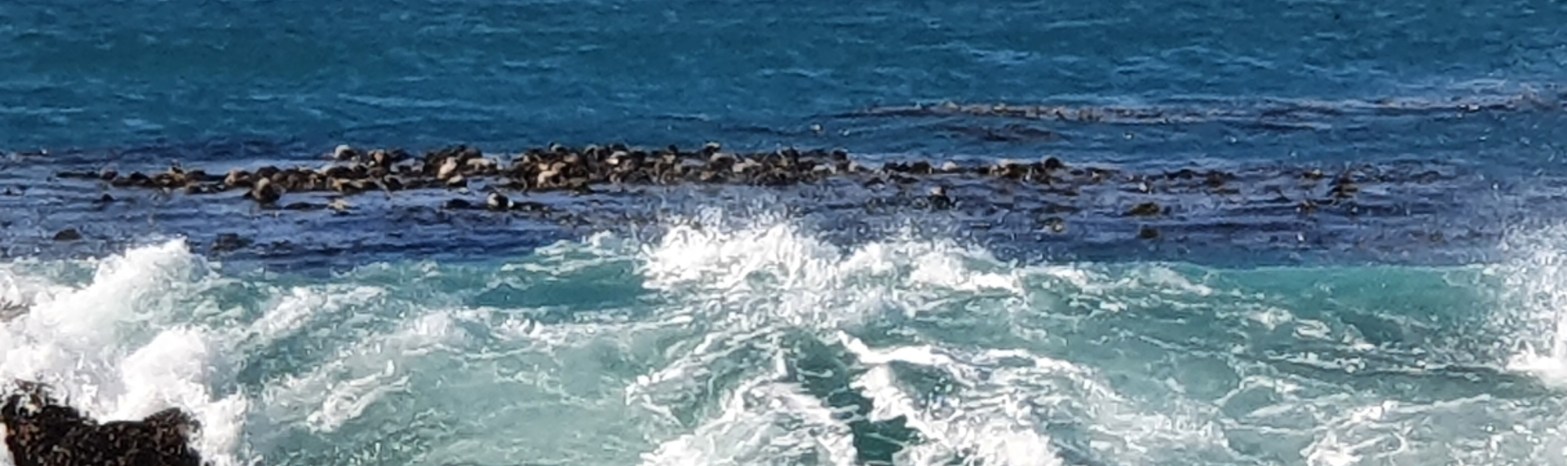
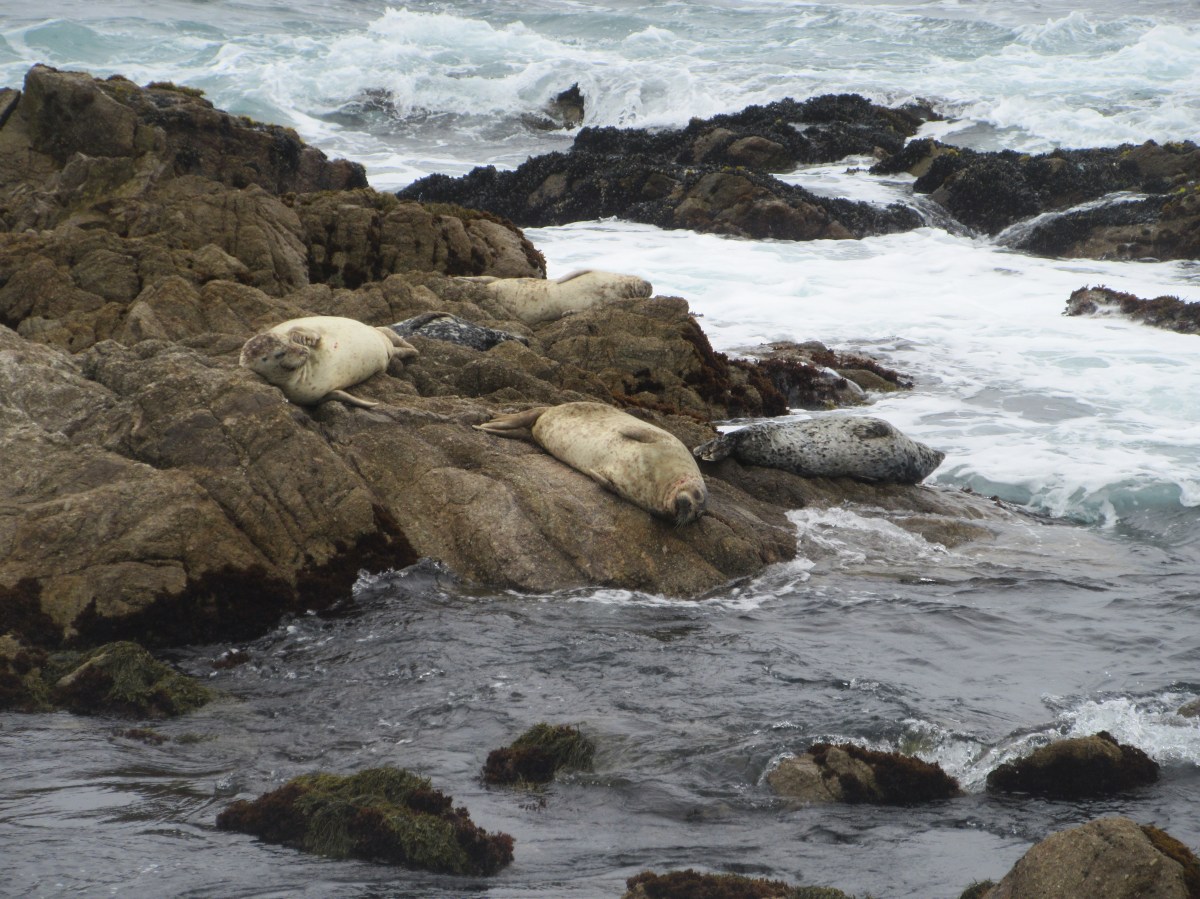
Above all, deciding to leave reminds me how much I like this this part of the California coast. We may even settle here when our roaming days are ending. During the winter months, the Monterey area has much milder weather than most of the US. We saw whales spouting offshore during many of our afternoon walks in December and January. Seals lounge on some of the beaches, while sea lions bark from their perches under the wharf. Sea otters float on their backs and munch little sea creatures (the banner for this post is a raft of sea otters in kelp), then dive down to get more. Gulls circle around, trying to steal the otters’ catch. On one of our first walks by the shore, I saw the outline of a dolphin in the side of a cresting wave.

Harbor seals loafing on the rocks. They are like big sausages with animal heads and tiny appendages.

We ate a lot of nature’s bounty, too. When they are in season, there is nothing better than Dungeness crab. Now there is line-caught salmon from Monterey Bay itself, the definition of fresh seafood.

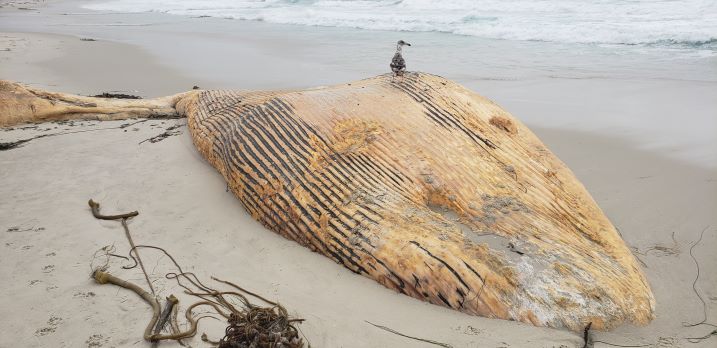
Part of a fin whale on Asilomar beach

We’ve seen a surprising number of other animals, too, considering that we live in a neighborhood right in town. On our walks to and from the beach nearby, we’ve seen a bobcat, young coyotes, even a fin whale, or what’s left of it.

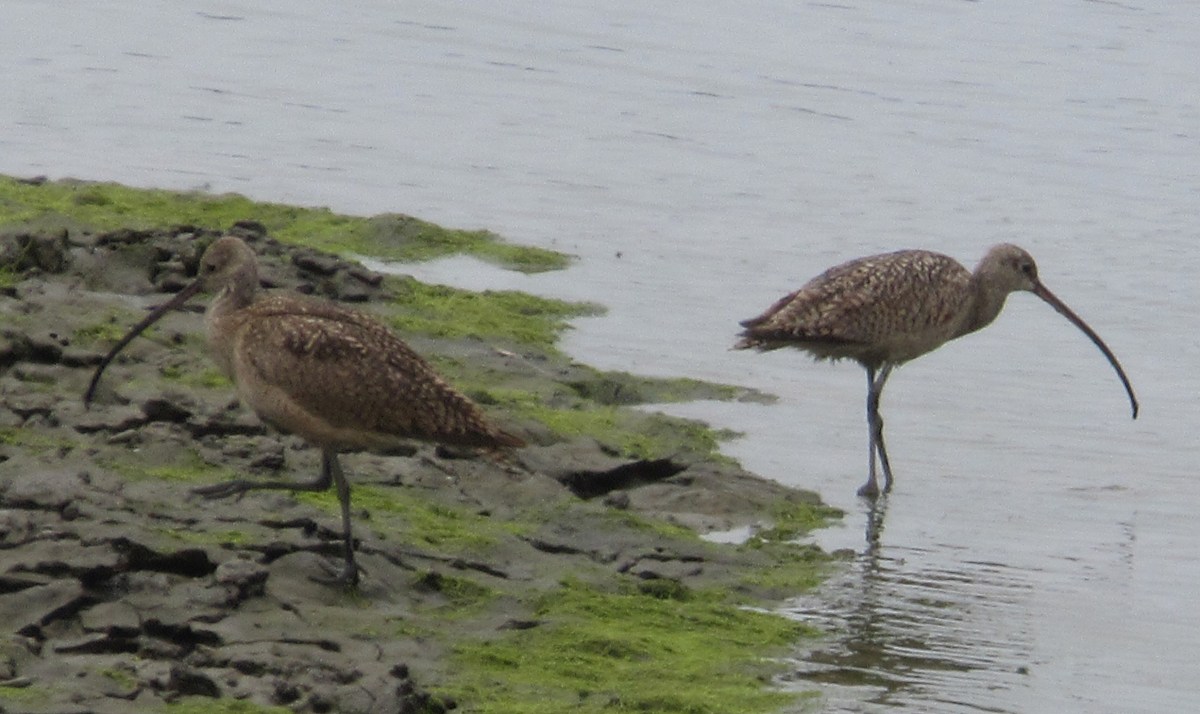
Curlews

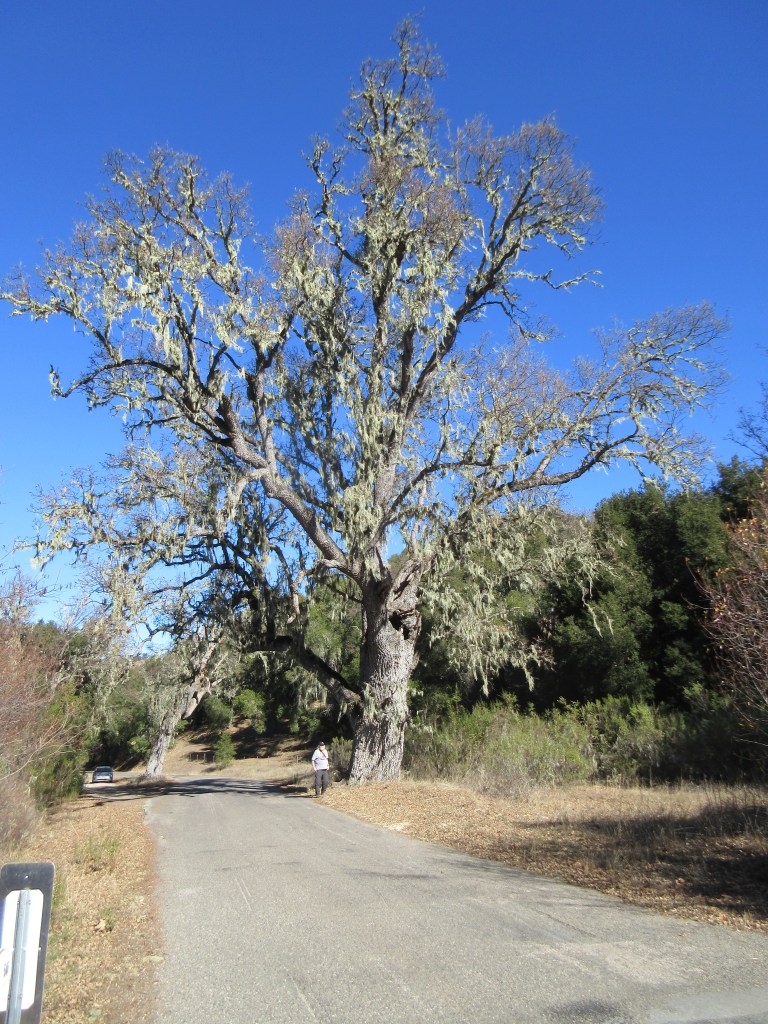
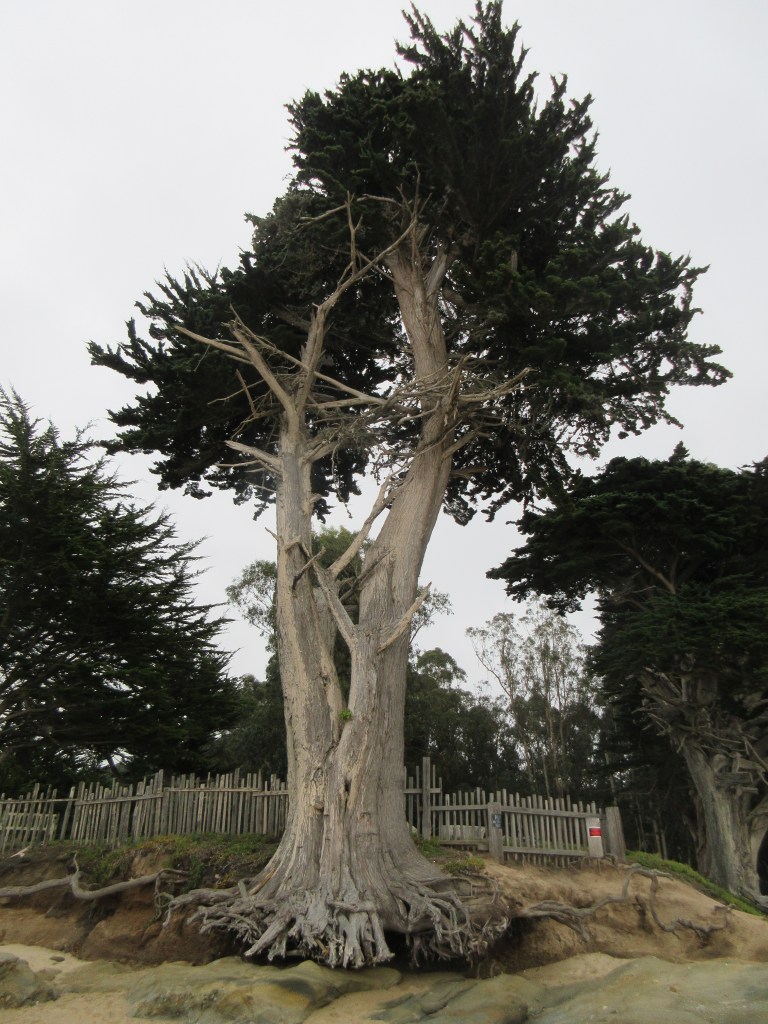
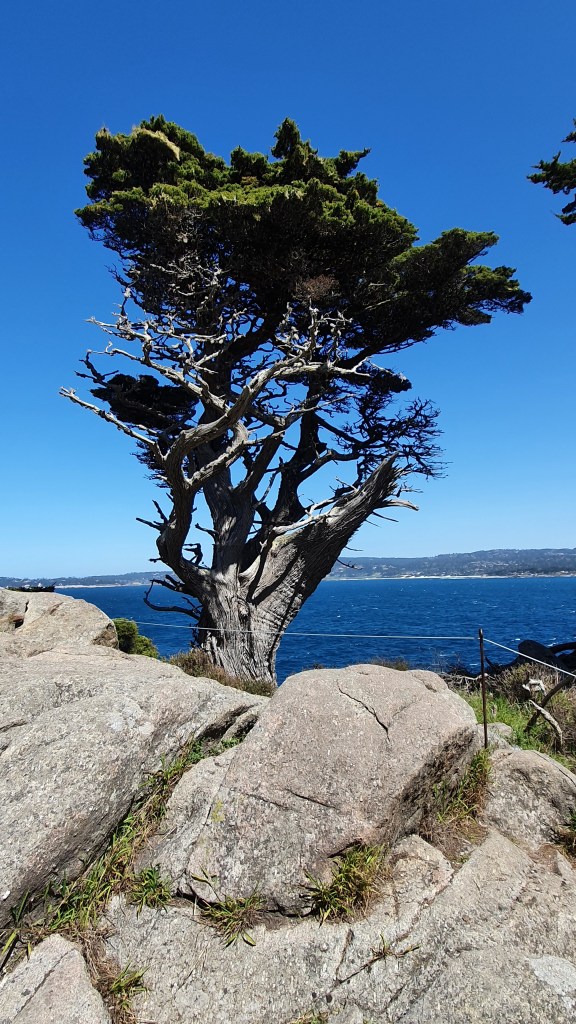
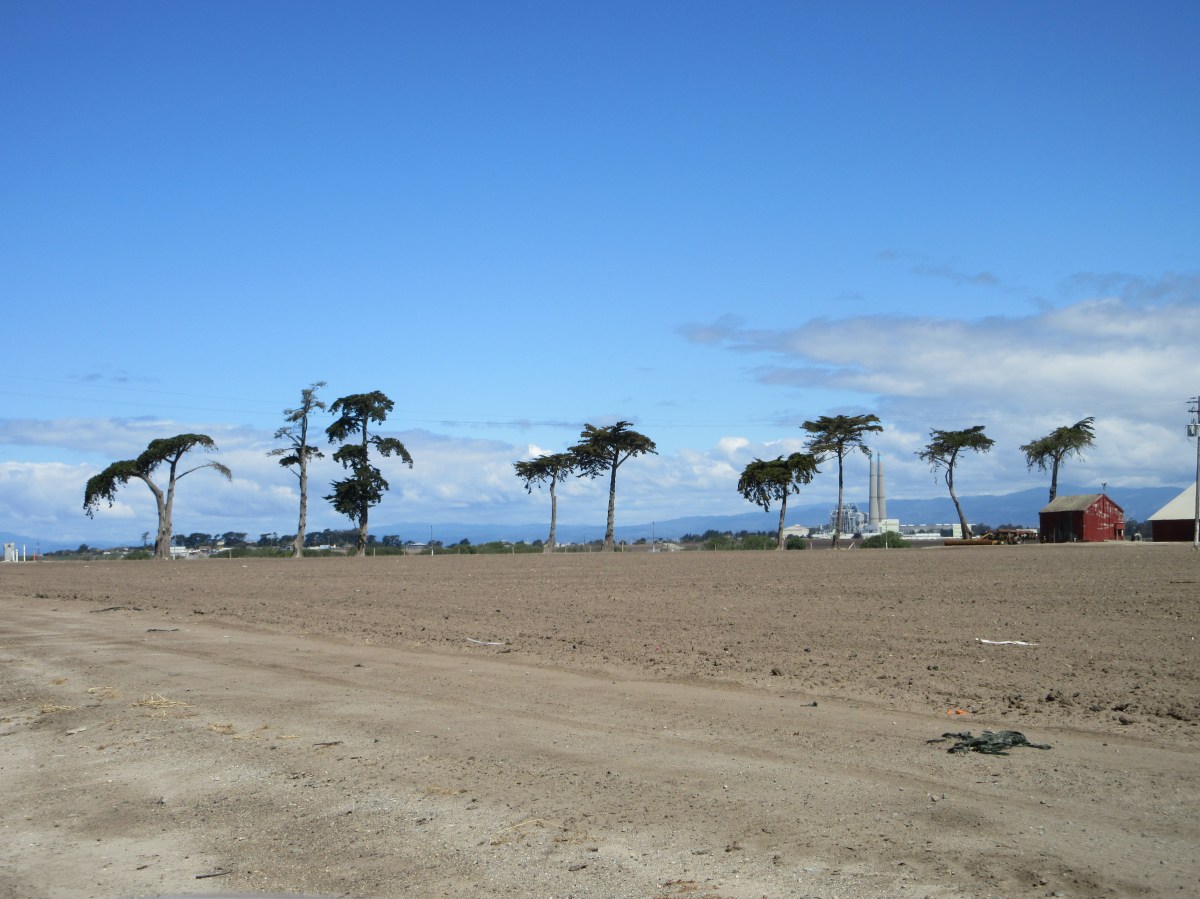
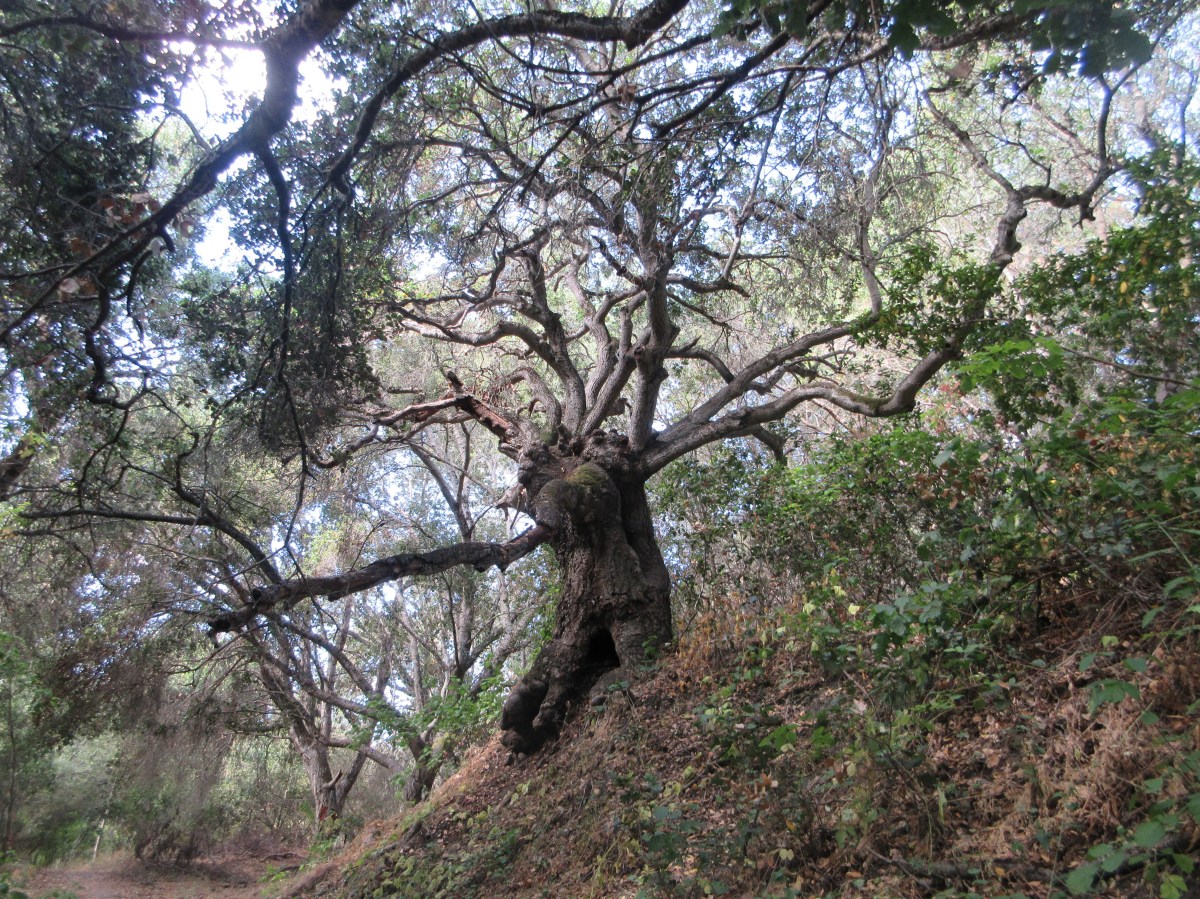
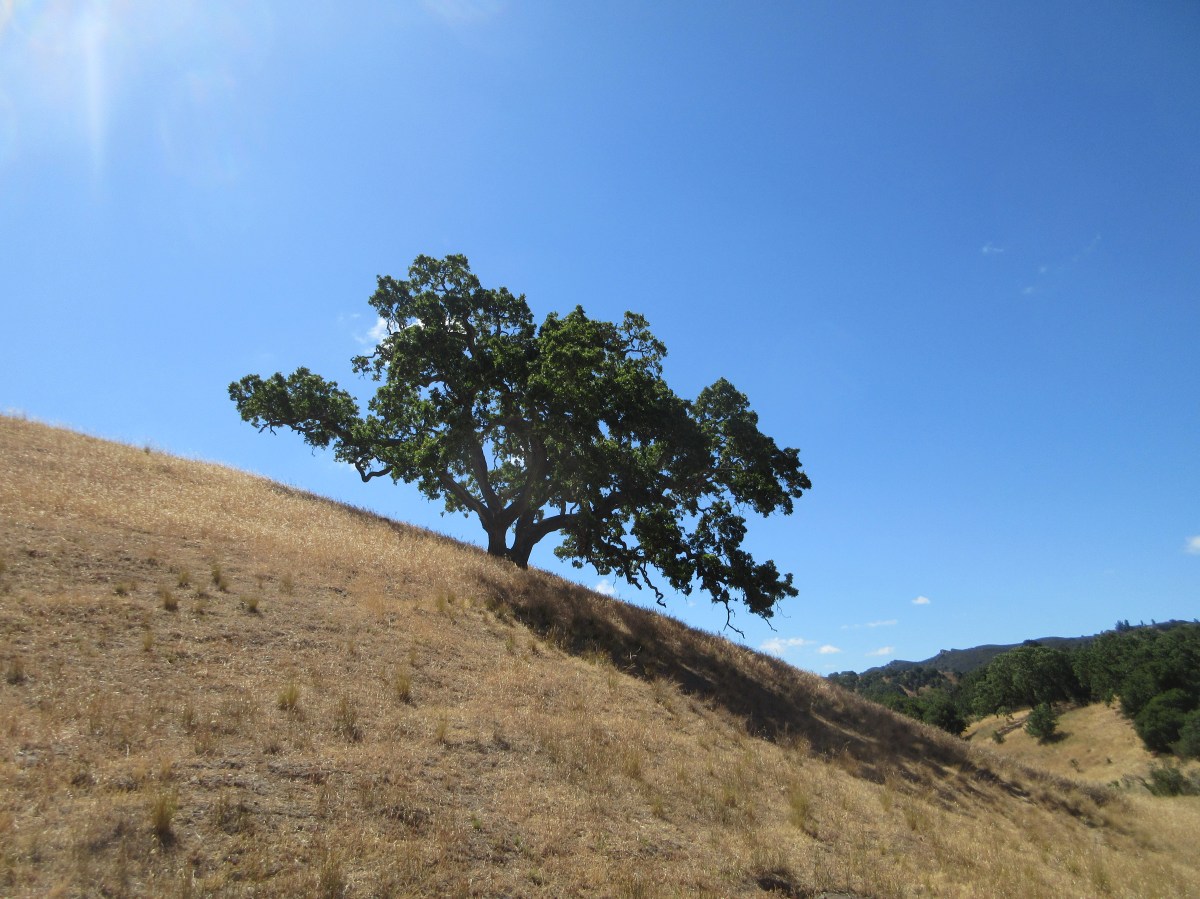
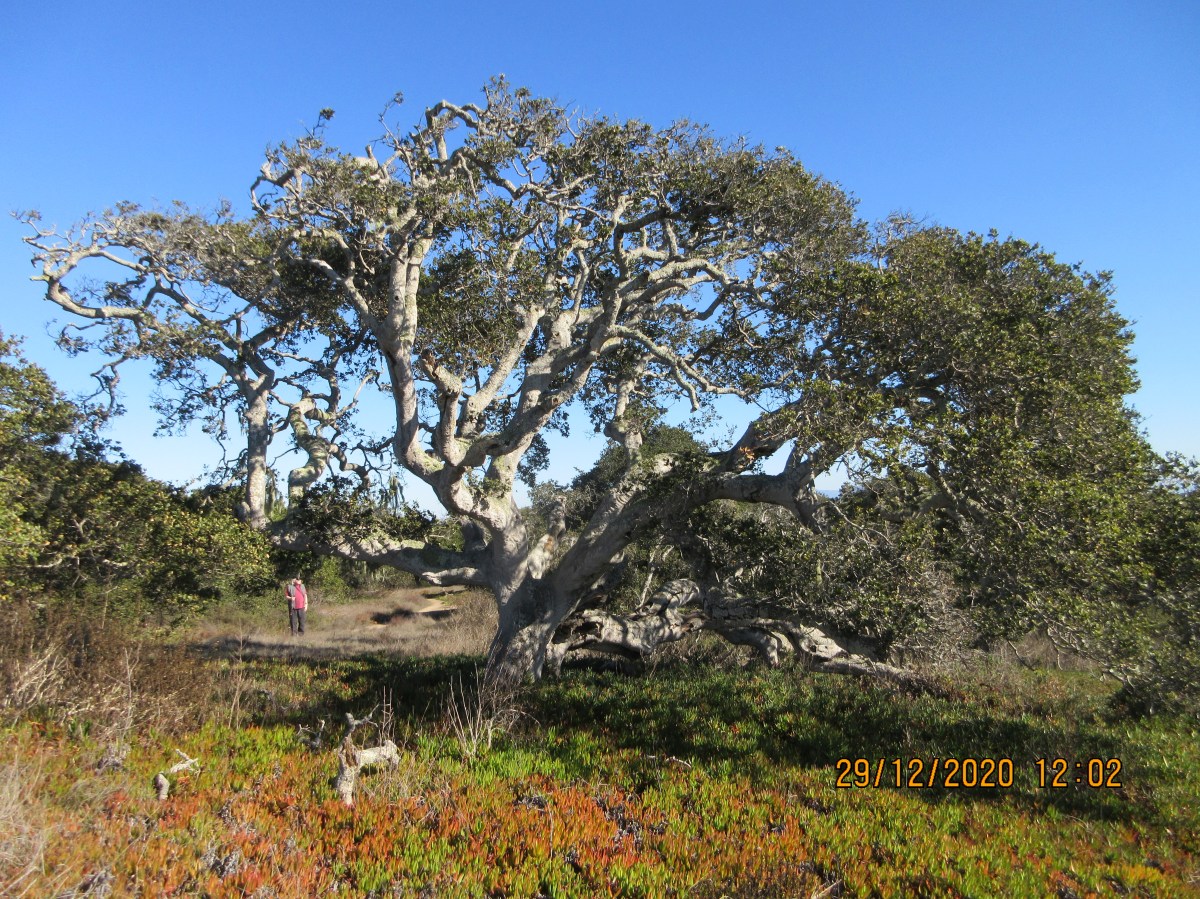
Our bird watching has been rewarded over and over again, with everything from bluebirds to peregrine falcons. About the only local species we haven’t yet seen a California condor. That population might have to grow a bit more, as there are still only about 60 condors known to be alive, mostly in Big Sur. That’s a lot more than the days where there were no condors left in the wild, but there’s a ways still to go in bringing them back. Our bird walks have taken us by unusual gnarled tree trunks and enough picturesque conifers to fill a calendar, or two (see the end of this post).

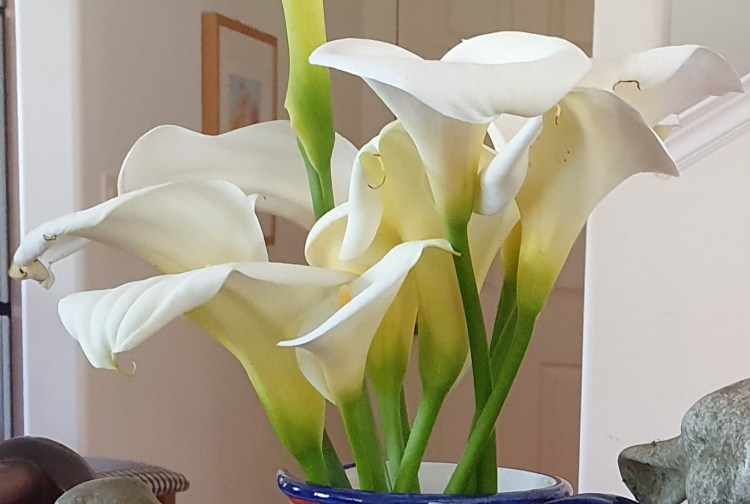
Fires are a tremendous danger around us, so who would believe that flowers are one of my strongest memories in this rapidly browning landscape? I love calla lillies that grow everywhere during the spring, including front yards and vacant lots. Many, many, flowering trees and plants begin to open in February and are still showing off their colors in early July.

Despite our daily adventures, there are still places to visit. We’ve have yet to make it inland as far as Pinnacles National Park. There are still miles of trails on the former Ft. Ord to investigate, and we haven’t seen the blue grosbeak that many birders reported there.

Pfeiffer State Beach

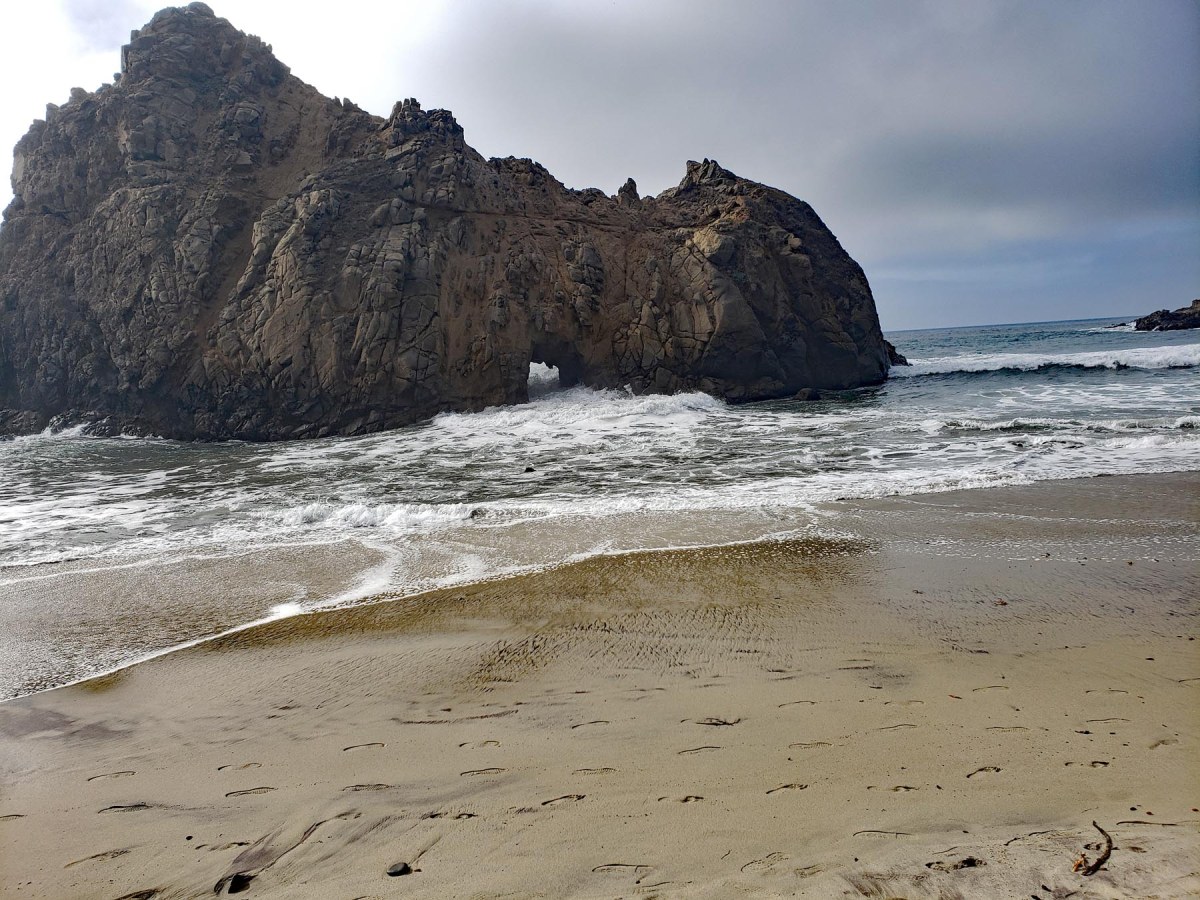
All this and I haven’t even mentioned Big Sur. The drive south is always spectacular and the light is different at each time of day. From Carmel, the first place you pass is Point Lobos, and it’s usually so crowded that we keep going, though our off-season senior pass let us stop in a few times. My current favorite walk is Soberanes Point. Andrew Molera State Park is another. Pfeiffer Beach is justly famous for sunset through its sea arch. The very limited parking is an issue, and don’t bother stopping there on a day with strong wind or you’ll be sandblasted, with nowhere to hide.
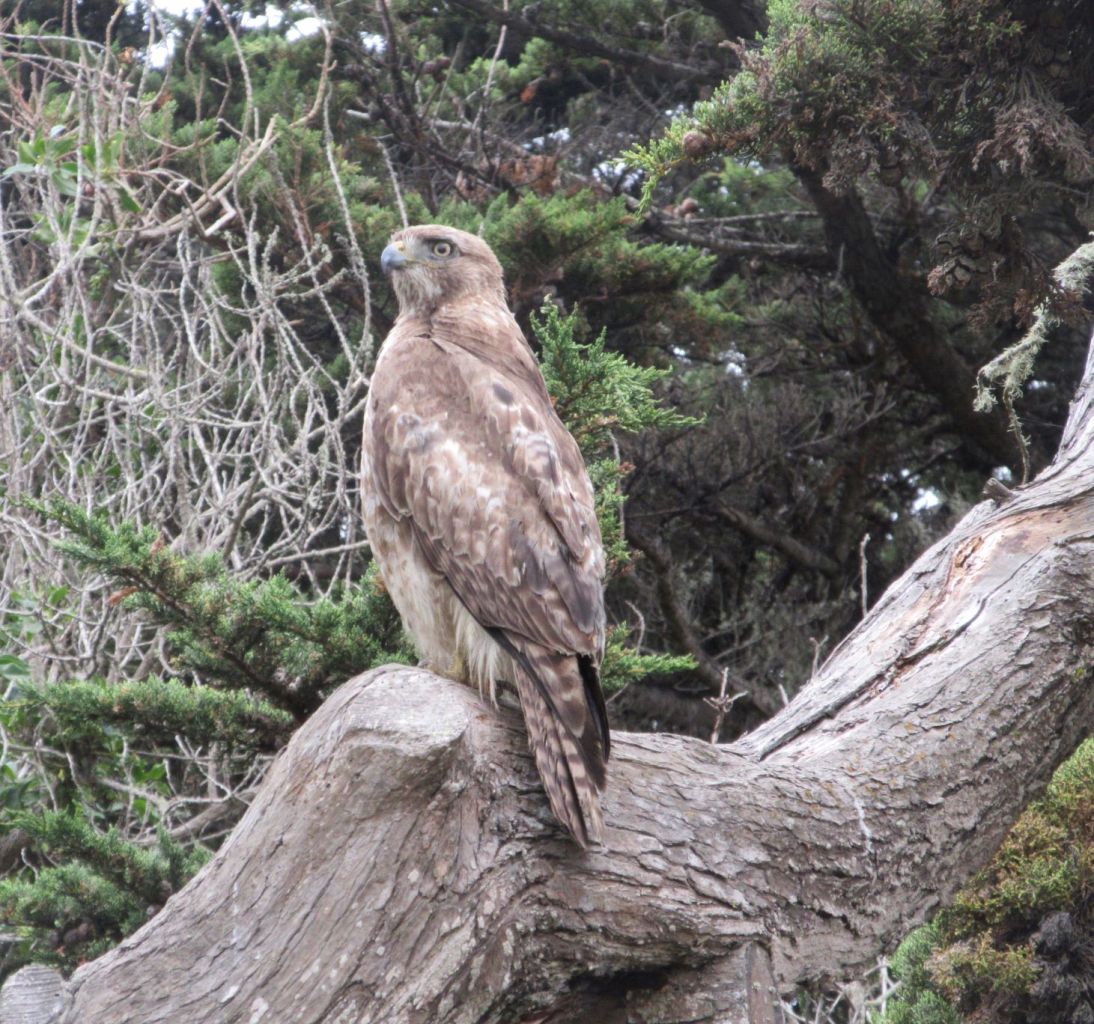
[I cannot get the photo of the hawk to stay in a small size. I guess he just wants to show off…]

Young red-tailed hawk

We’re still in the early days of visiting museums and historic houses, and won’t get to all of them before we move on. That’s ok, we’ll probably be back. We visited local events on July 4th, and enjoyed the small town atmosphere of Pacific Grove’s music and bouncy castle event. In the afternoon, the Monterey Pops played in downtown Carmel. It was our first live concert in ages, and we enjoyed the patriotic favorites.

Flags fluttered and music played on the 4th of July in Pacific Grove.

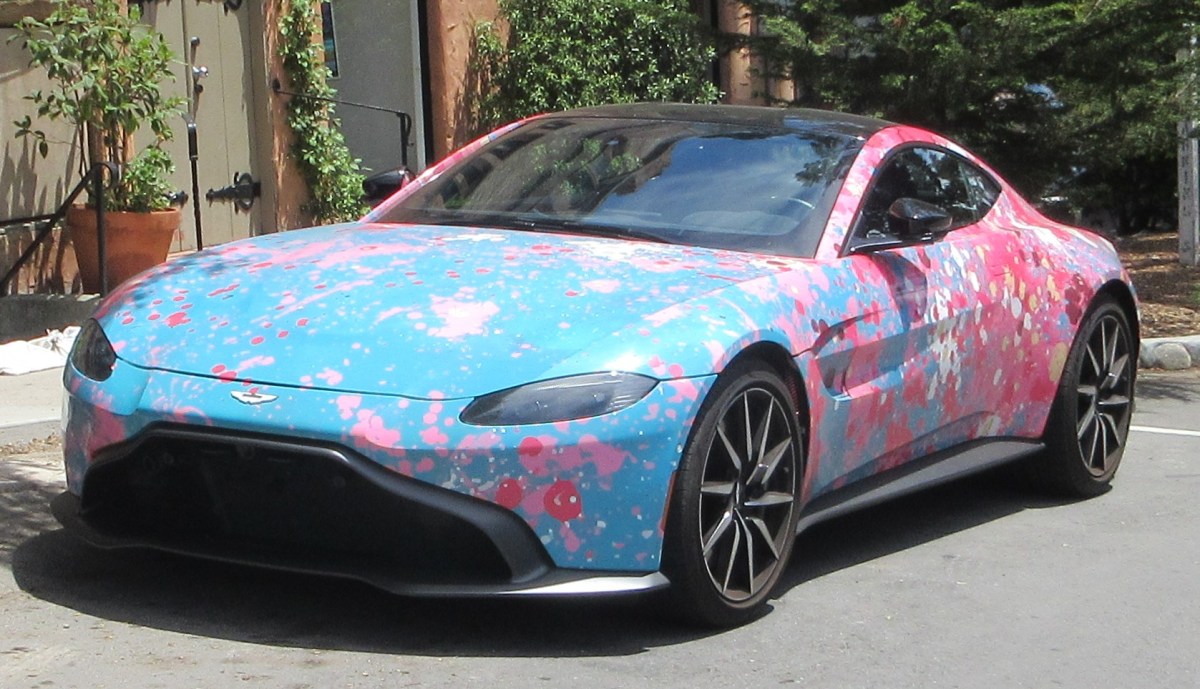
There is lots of local quirkiness as a complement to the natural beauty. California is known for old cars and fancy cars, because there is no winter and no road salt to create rust. Sadly, contemporary Maserati and Bentley sedans look just as boring as other sedans, but now and then we see a beautiful paint job or a classic car parked by the side of the road. Just on our street are two different vintage pick-up trucks, each painted bright yellow.
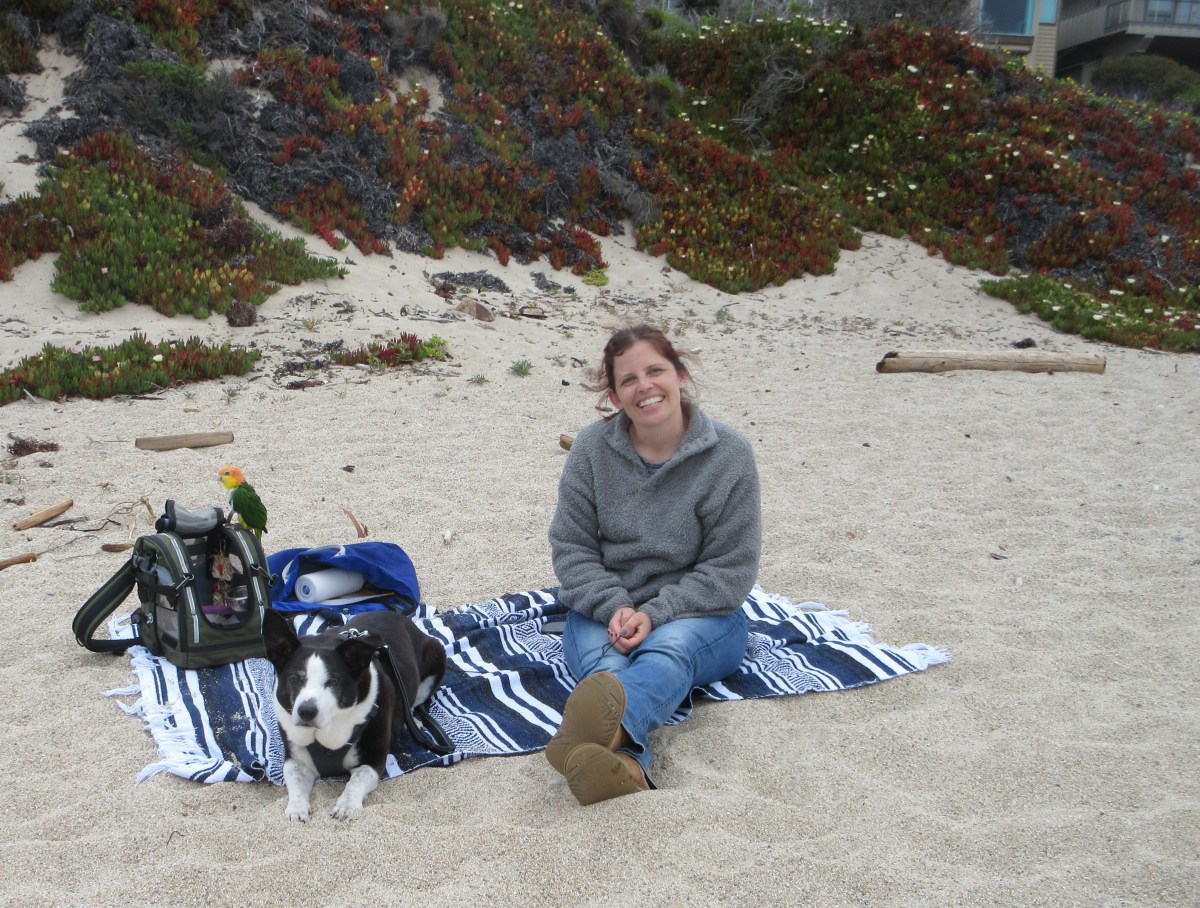
Note the litte bird by the dog (It’s a caique).

People are always a community’s greatest resource, and though we have met only a few thus far, we’ve really enjoyed some of the people we’ve had a chance to meet. When Jonathan complimented a man on his dapper look, he discovered that he designed and sold shirts. Jonathan now owns one. On another day, we passed a woman and her dog on the beach, then noticed she also had a bird on her shoulder. Long time lovers of tropical birds, we know how difficult they are to keep as pets, so we stopped to chat. Her bird is a caique, a small parrot that is bred in the US for the pet trade, though the species originates from northern South America.

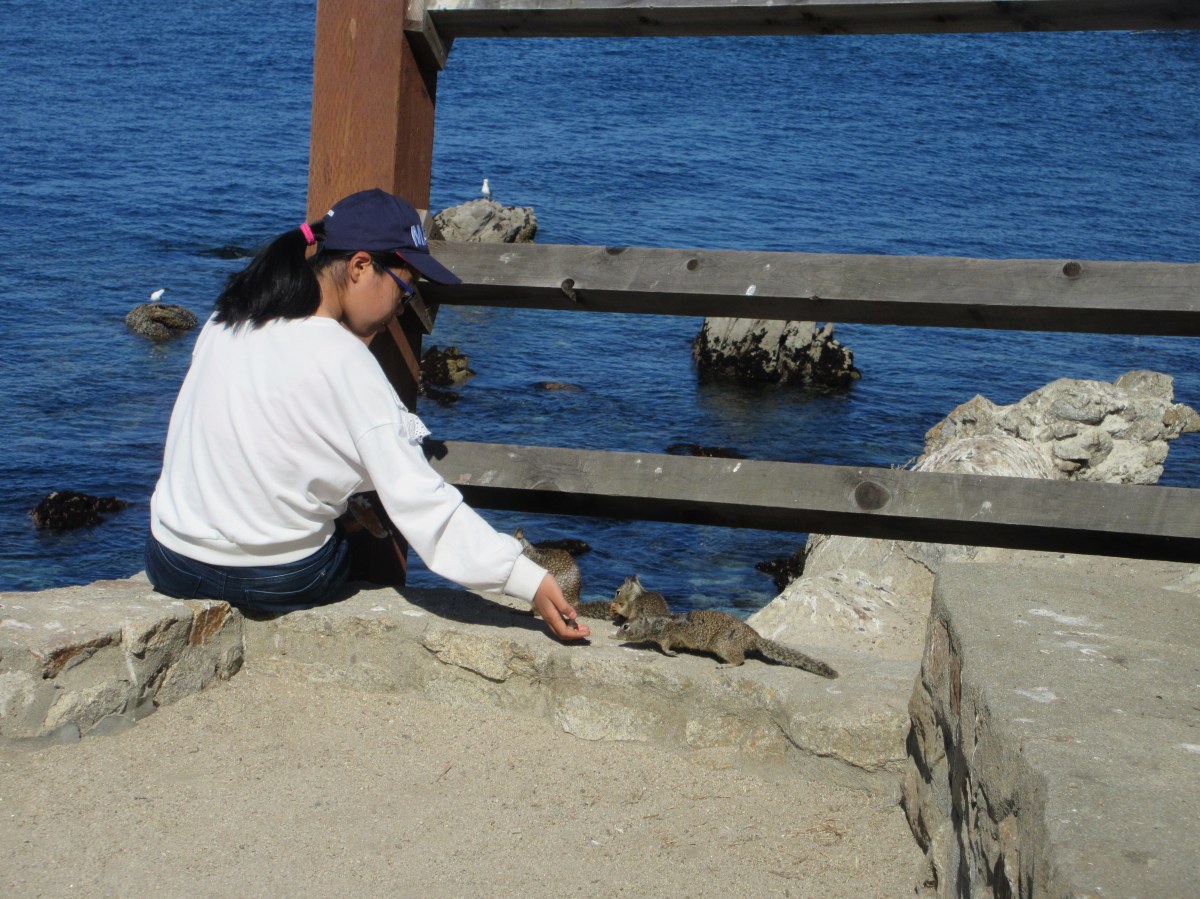
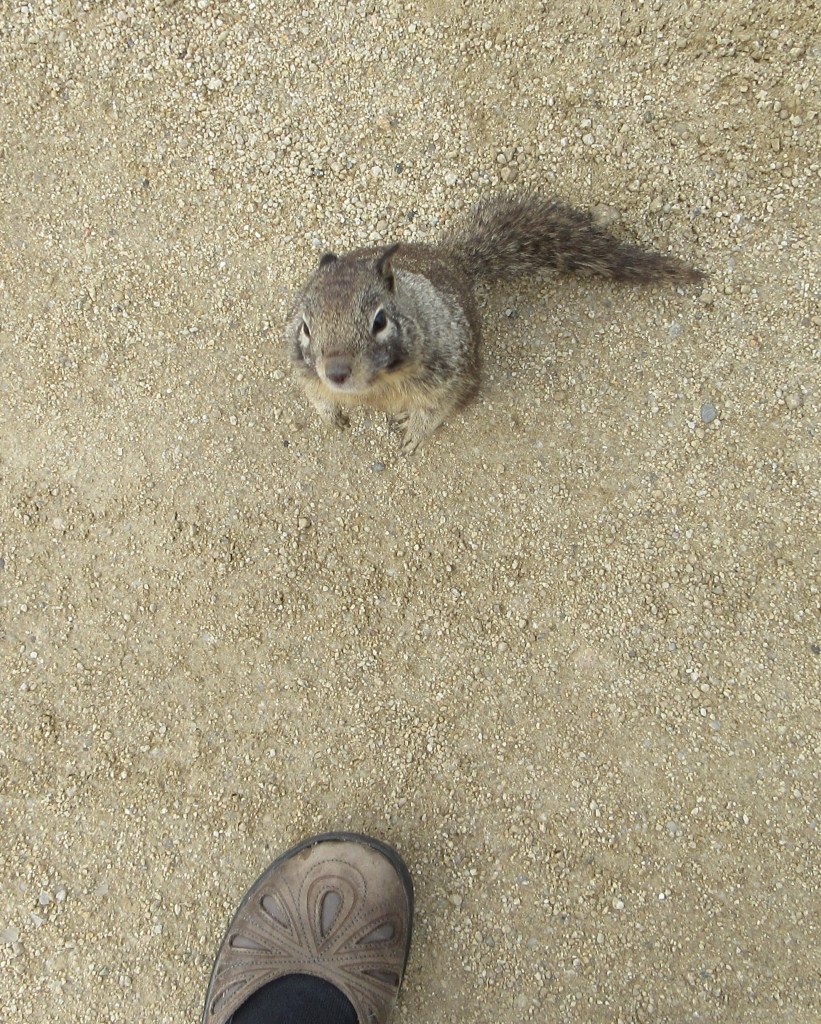
In Monterey, we watched a young woman feeding the ground squirrels that live in very large numbers along the shore. Later, a ground squirrel showed us its begging skills (we don’t feel the animals).

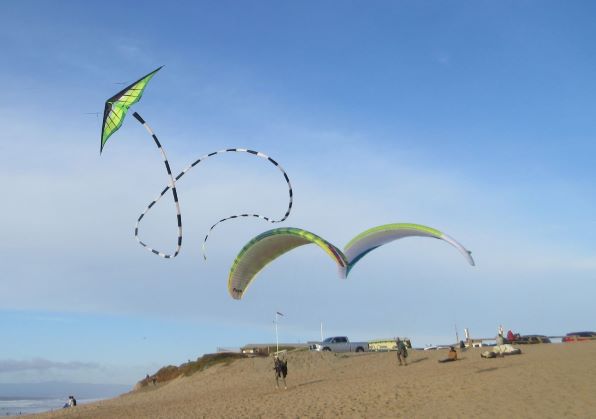
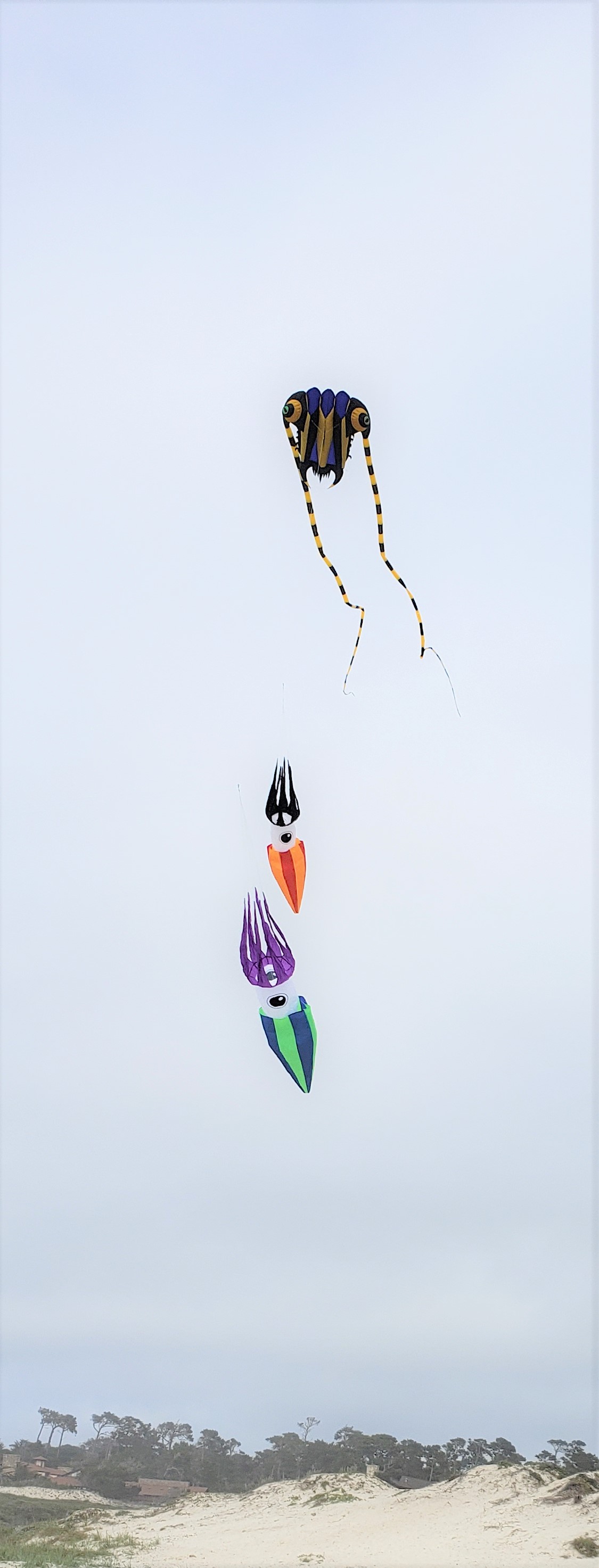
There are also surfers, kite surfers, hang gliders, parasailers, and kite flyers, many of whom are highly skilled at their activity. There’s an endless stream of people and sights.
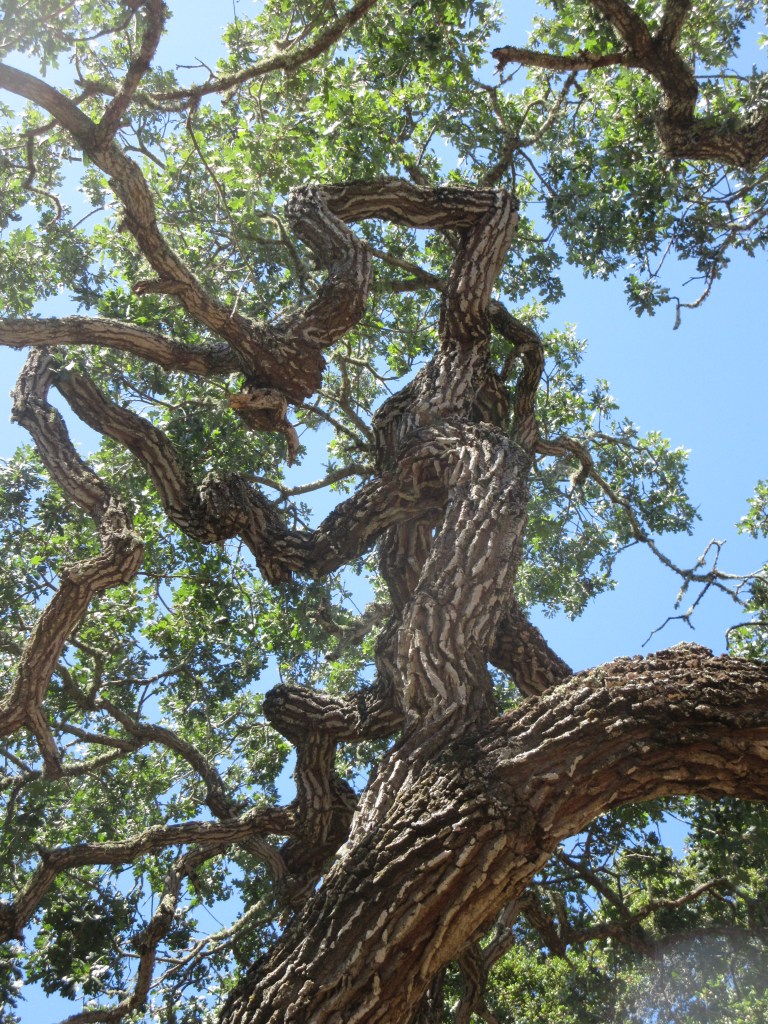
I have so many favorite things that I can’t fit them all here. I love the storybook houses in Carmel, and all the other architectural gems that dot this region. I like the excellent seeded sourdough from Ad Astra Bakery, and ice cream from Revival, in Monterey.

And naturally, I like every beach I’ve walked on, from Big Sur to San Francisco. There are still a few beaches left that I haven’t visited, but I’ll get to the rest of them before too long. Below is a slide show of some of my favorite trees.