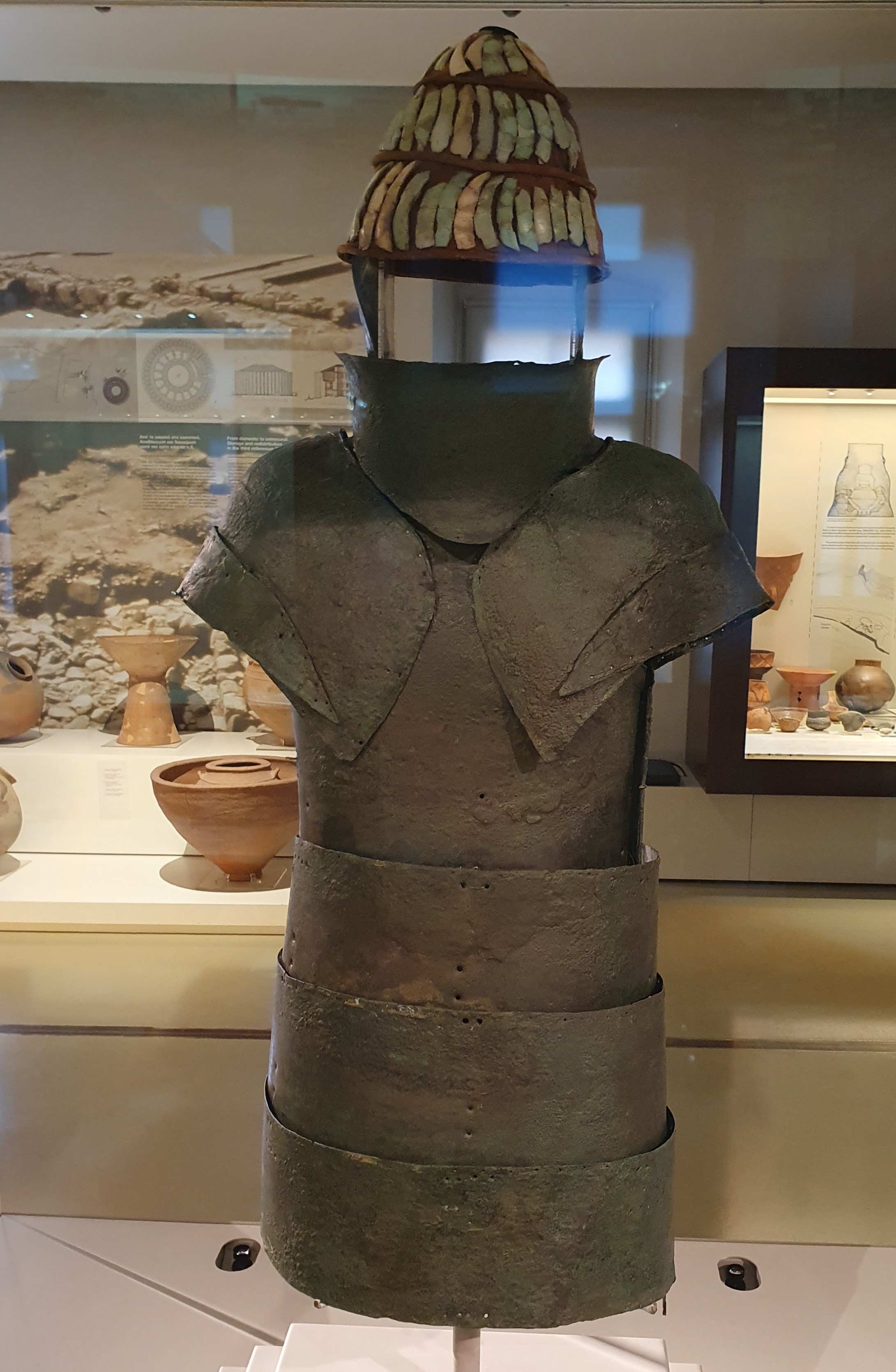
We began the day with a stroll through Nafplio, a lovely seaside town, where I could easily imagine spending a couple of weeks in the summer. There’s even a seaside rock swimming pool that reminded me of the Sydney area. Nafplio was the first capital city of the modern Greek state, 1823-1834. It would be very different today had Athens not taken over as capital. We ended our walk at the fortress that overlooks Nafplio, and stopped in at the museum. As in other places, the Nafplio museum holds treasures from ancient sites. One of the best known is a full suit of ancient Greek armor including a helmet made of boar’s teeth.
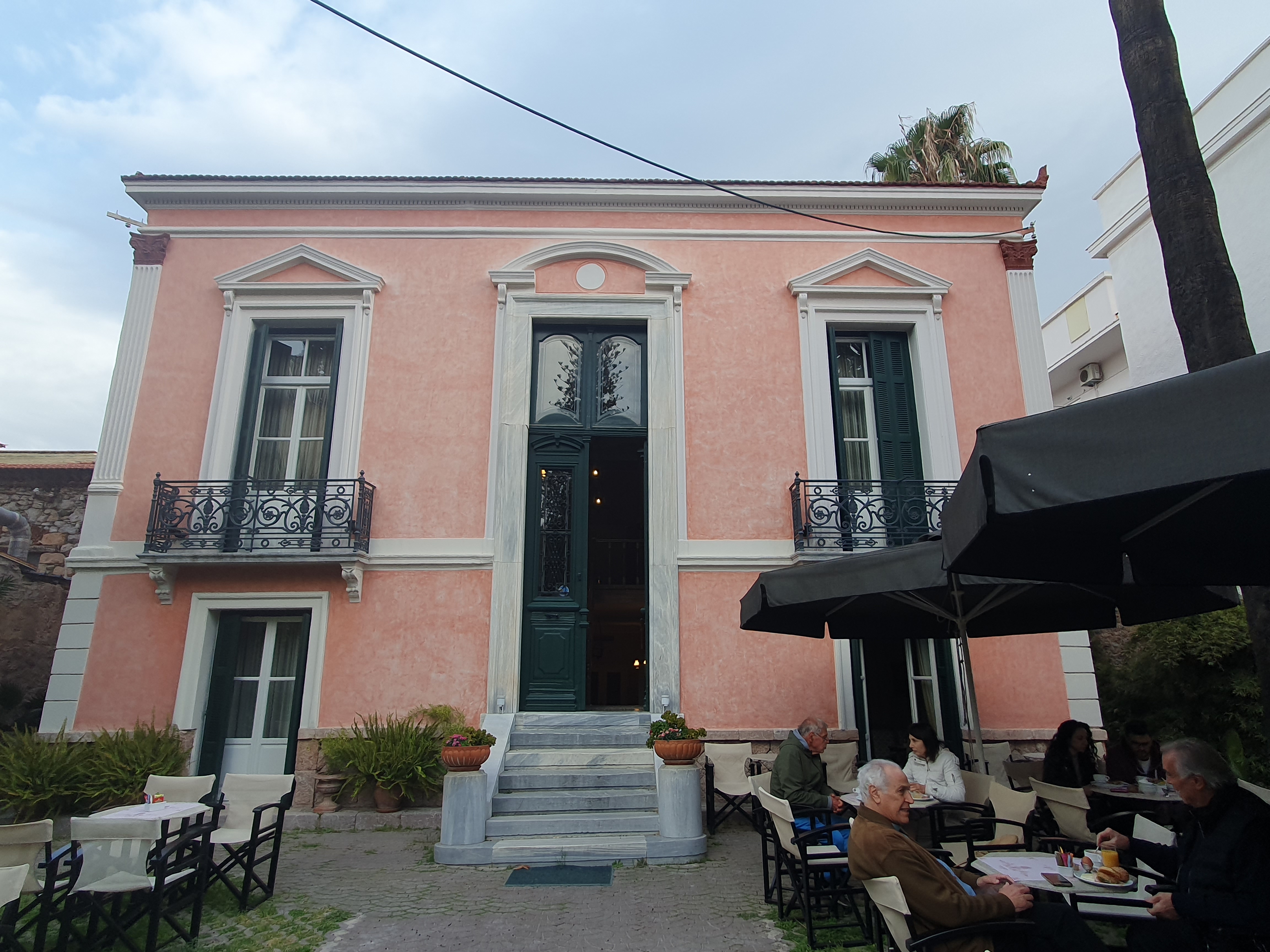
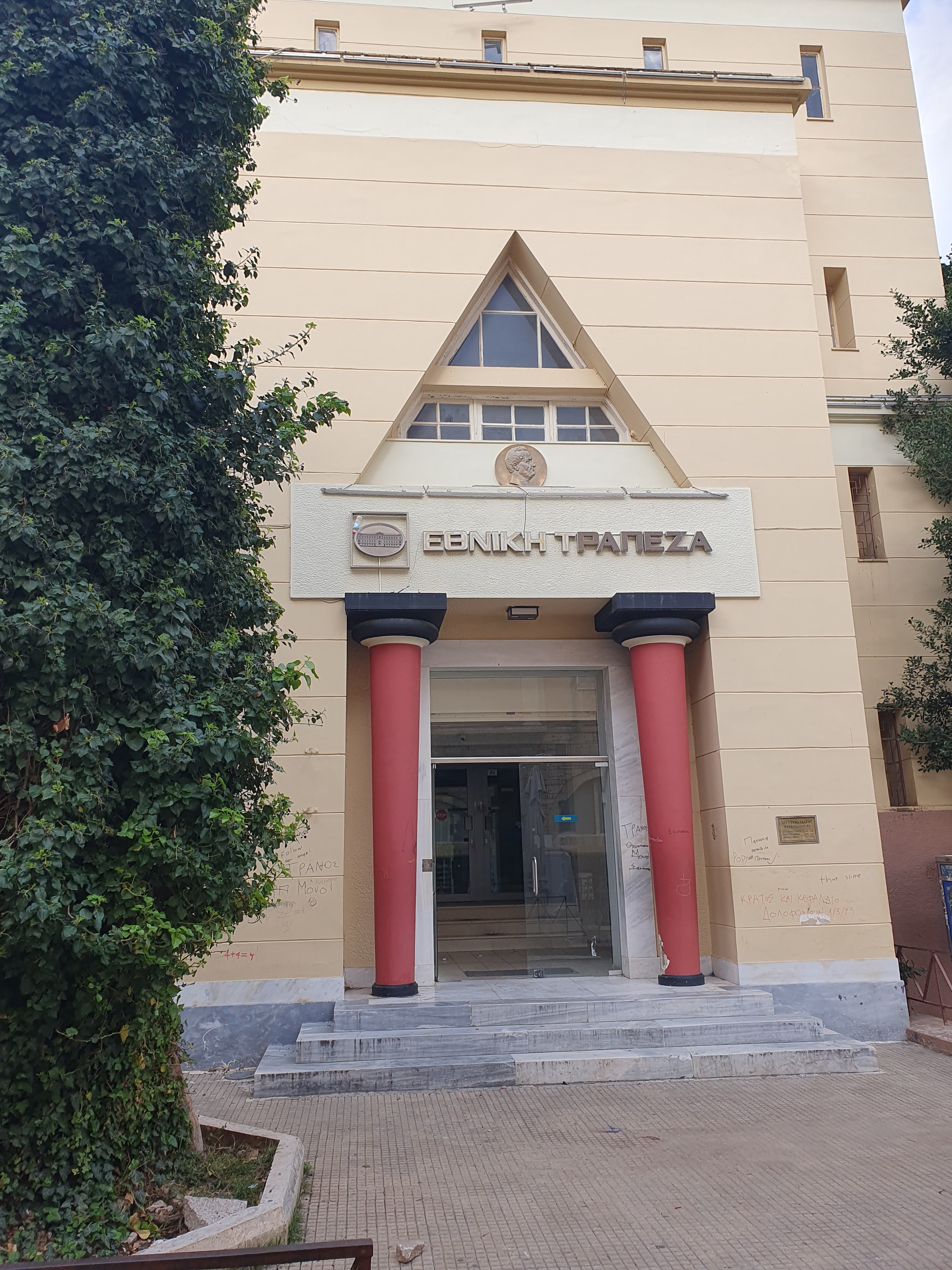
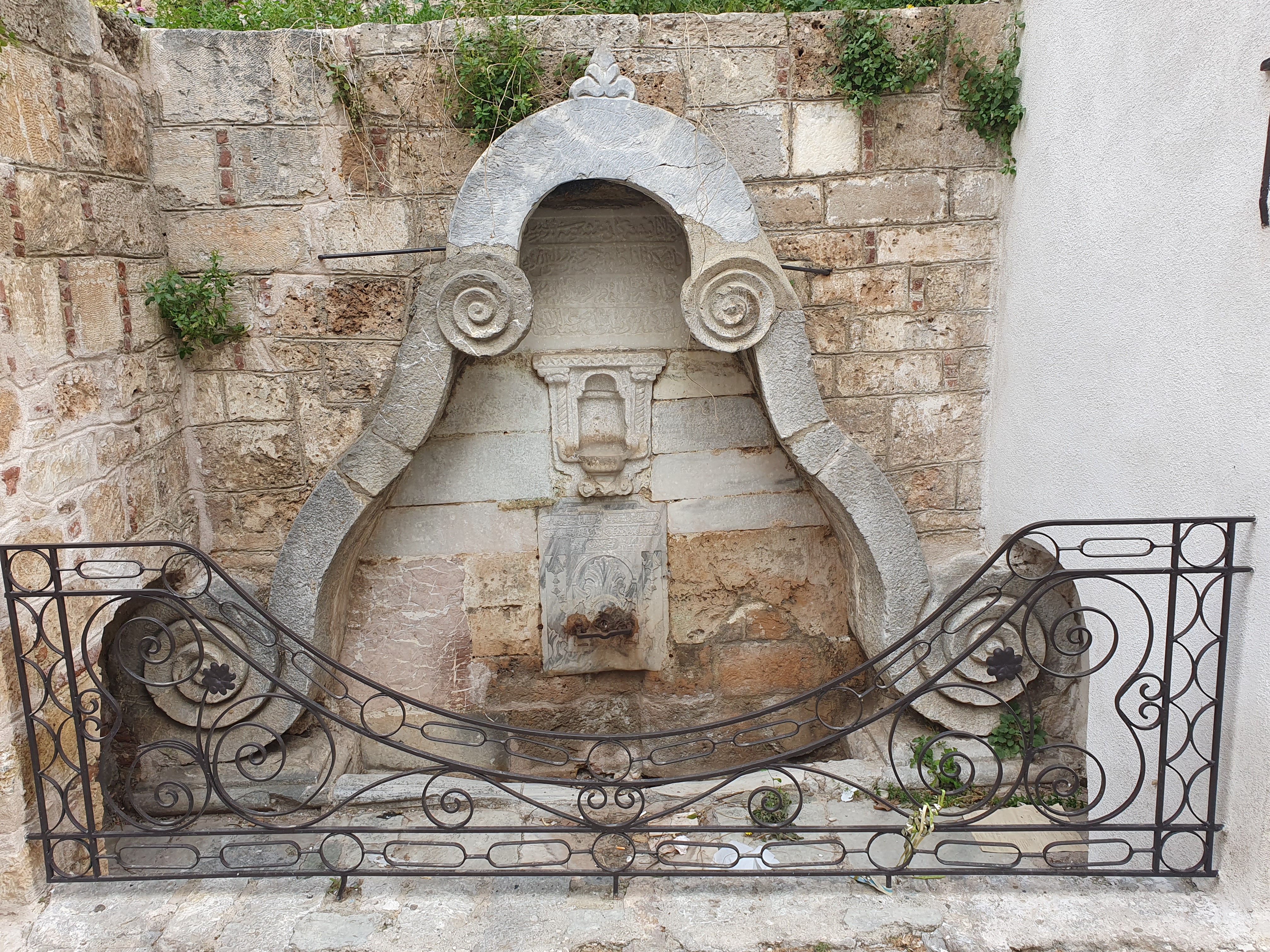
Clockwise from upper L: Nafplio; Ocean swimming area; An Ottoman fountain incorporating earlier Venetian architectural elements; Ancient armor & boar tooth helmet; “Mycenaen” style bank building in Nafplio; Street scene; Our hotel.
From Nafplio, we turned toward our first monumental ruin of the day, Epidaurus. This ancient city claims to be the birthplace of Asclepius, a son of Apollo, hero and god of medicine. The shrine of Asclepius at Epidaurus was the largest and best known healing center of the Classical world. From 600 BC to AD 500, people came from all over to be treated. There was a large dormitory/guest house with 160 rooms.
The large complex of rooms for people seeking healing at the Asclepion of Epidaurus
Part of the treatment was an overnight stay in the “incubator”, the enkoimeteria, where supplicants slept and were visited in their dreams by the healing god who instructed them on how to cure themselves. After dreaming, people visited the shrine, made offerings, perhaps bathed in nearby springs, and were cured. Interesting to think about the placebo effect in this setting–did focusing on one’s illness and how to cure it actually help with a cure? The size of the site is what impressed us. Little of the major temple to Apollo still stands, but the site goes on and on.
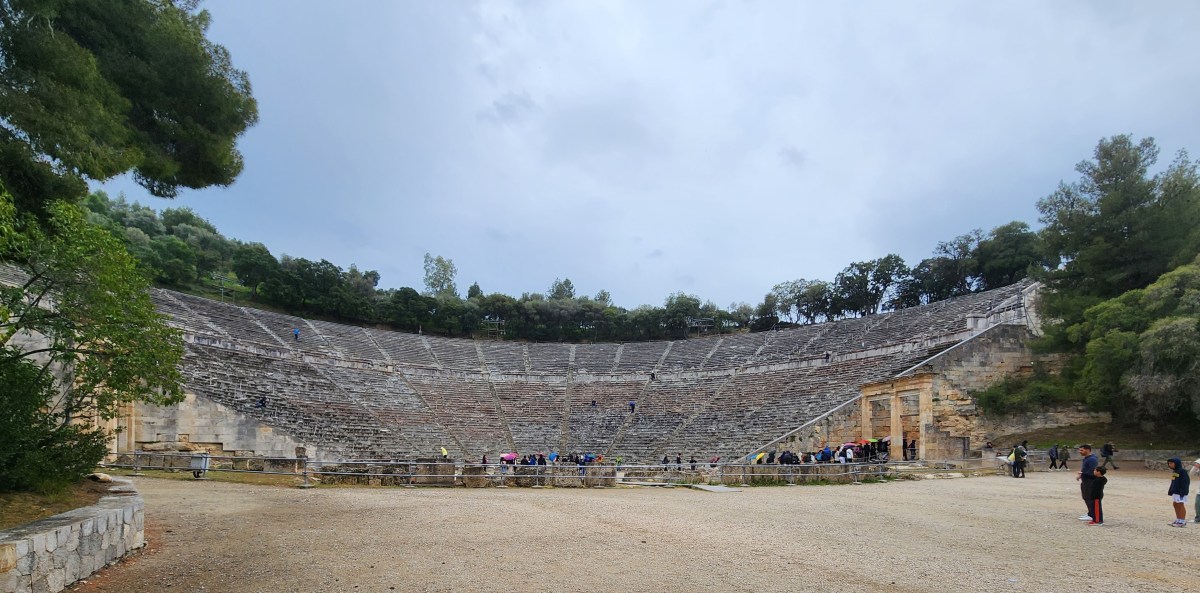
The fame of Epidaurus as a place for healing made it prosperous. The theater seated 14,000 people and there are exaggerated claims of its excellent acoustics. When we visited, school groups were busy declaiming to the upper seats.
The theater of Epidaurus
We drove to Tolo for lunch, slightly out of the way, but it was worth it. Maria’s restaurant is a seafood place, and we shared marinated sardines, spicy shrimp, mussels in lemon sauce, and scallops served in the shell. They were delicious! For dessert, we had what they call spoon fruit, halfway between stewed and candied fruit. Ours was bergamot, which I only know from flavoring Earl Grey tea. Definitely an acquired taste.
Leonidas, the archtypal Spartan
A bit of a drive later, we reached Sparta. It was drizzling, but that meant we had the site to ourselves. Sparta needs no introduction, famed for conquest, disciplined troops, and competition with Athens. We wanted to visit, because it’s Sparta. Sparta! Aristotle provided a fountain of knowledge as we looked out over the theater. Much of the remaining site is covered by olive trees, and it looks untouched, though archaeological excavations have taken place periodically since the 1890s.
Perhaps because of the rain, our visit was a bit melancholy. Sparta was a world capital in its day, praised and vilified in myth and history, yet the archaeological site of Sparta is often skipped on a tour of the Peloponnese today, because the ruins are not on the same scale as other sites.
The theater of Sparta, a broad grove of olive trees that covers more ancient settlement, and the modern city of Sparta.
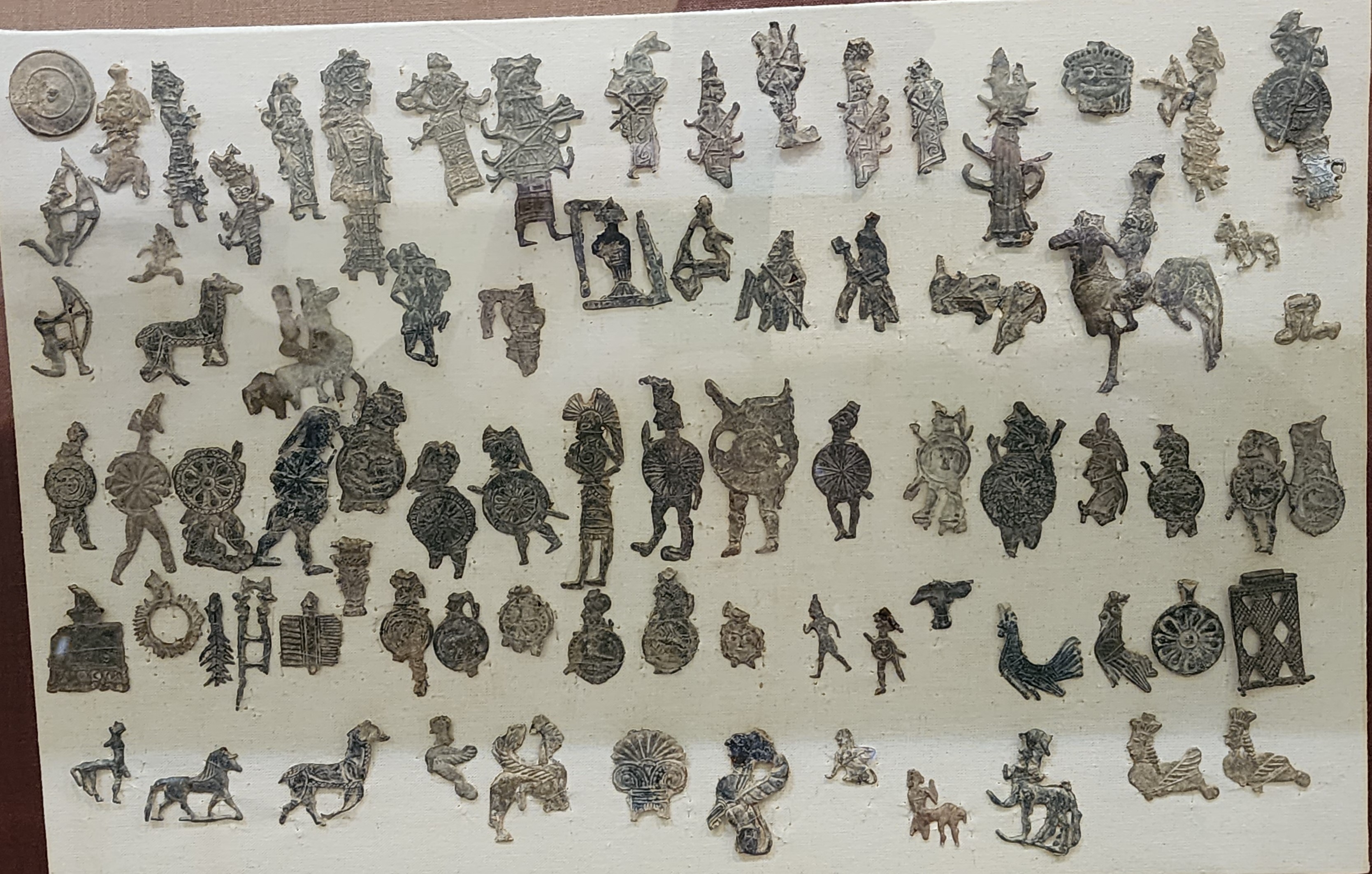
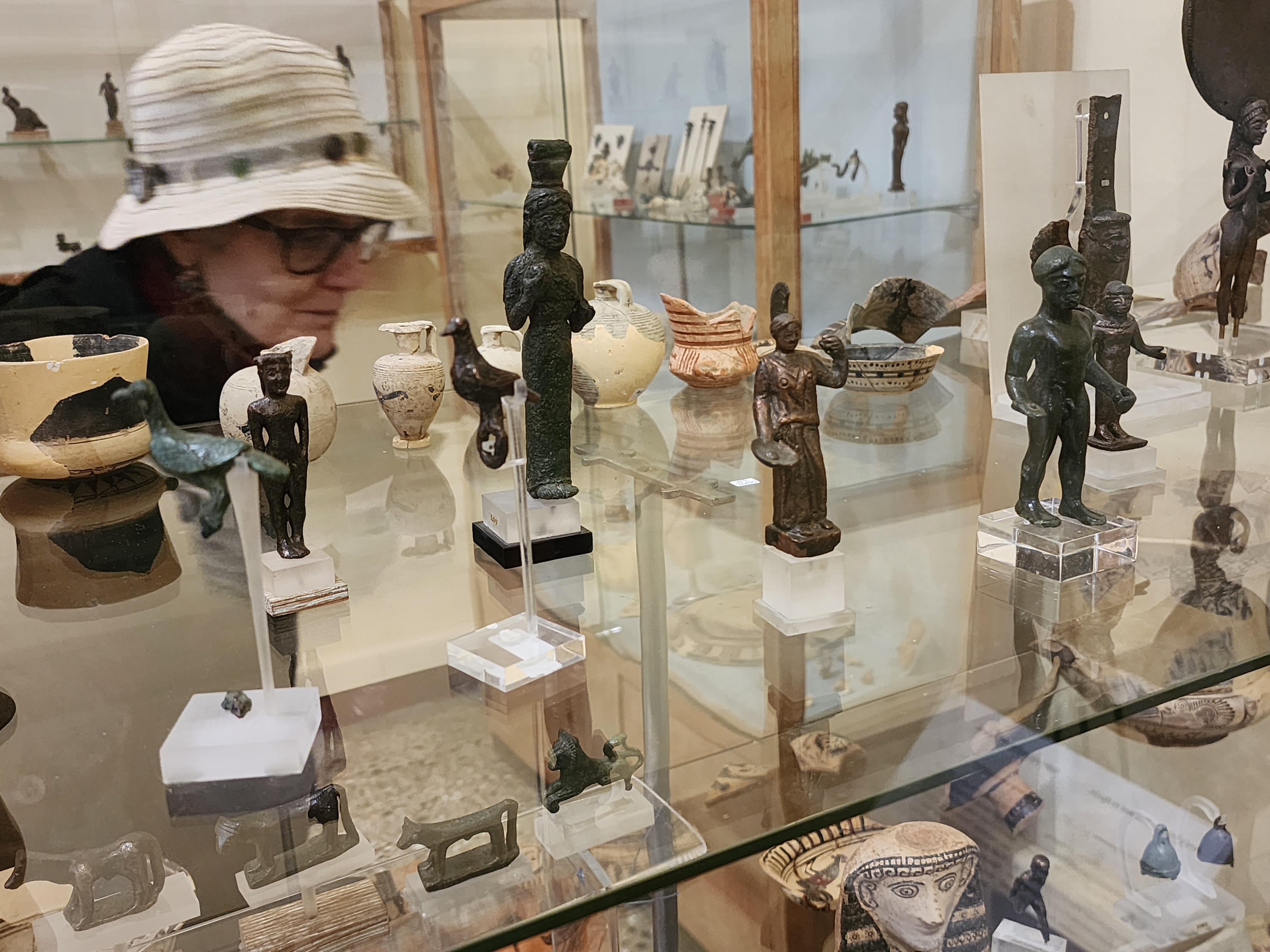
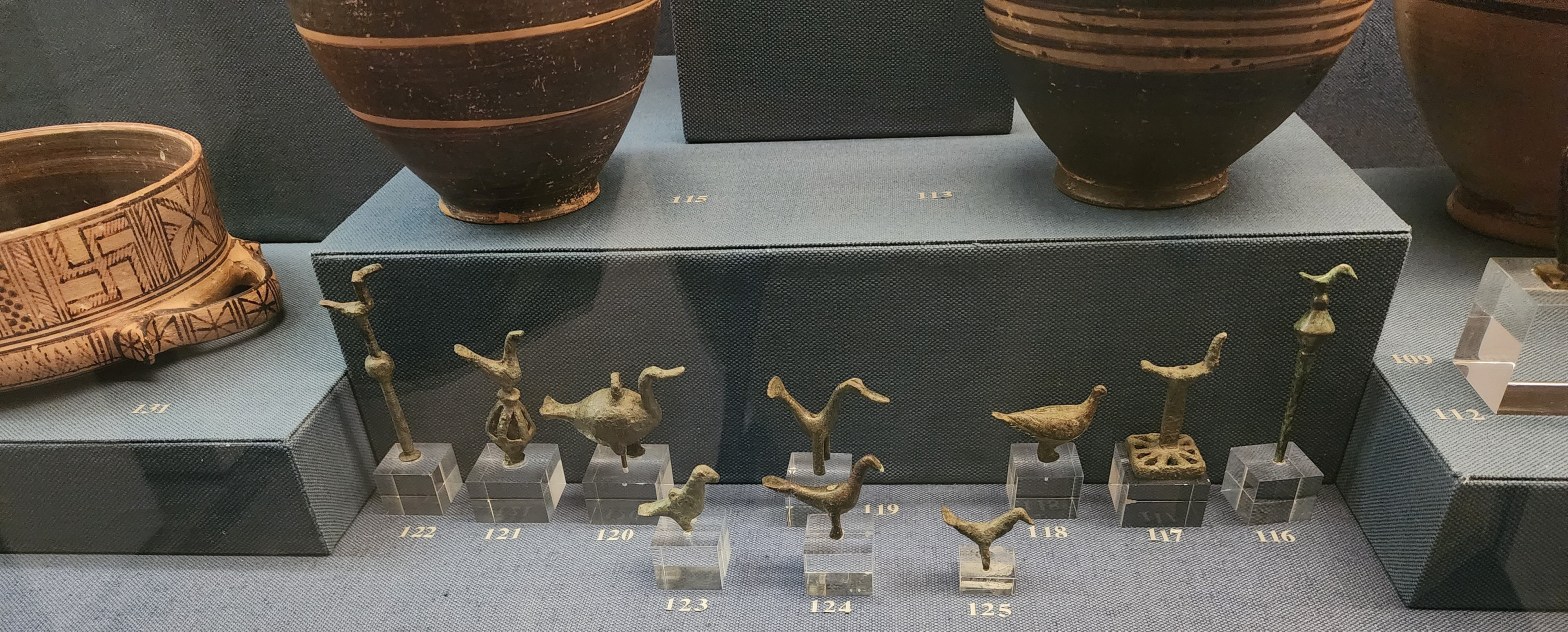
The museum at Sparta was full of rewarding things to see. Thousands of votive offerings from small cut-out bone and metal shapes to cast bronze figurines were buried over the centuries in and around the temple of Artemis Orthia, by people who wished for a favor from the gods.
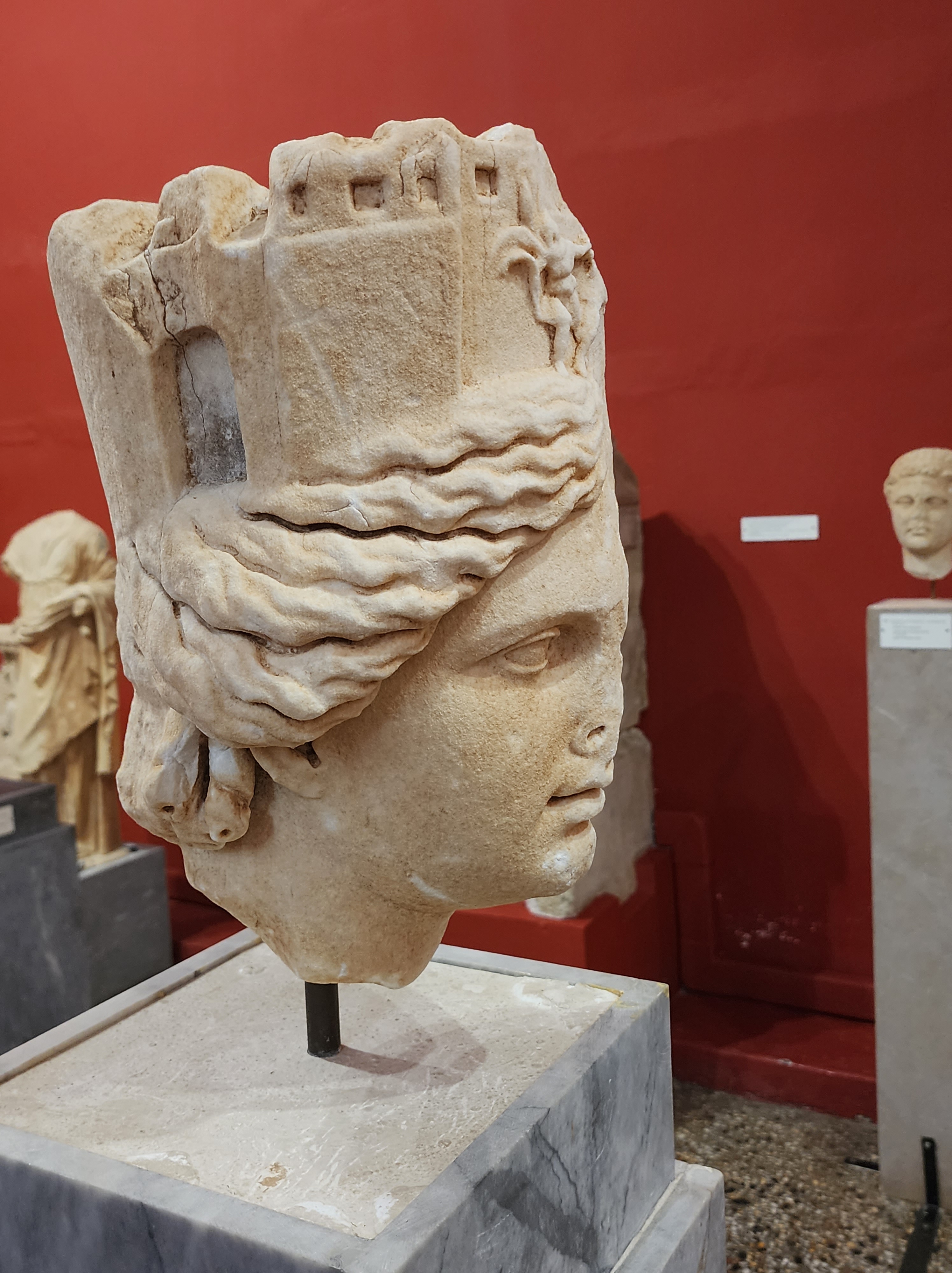
Other pieces were interesting for their detail:
(L-R): Mosaic of a triton; carving of wild boar; “Head of the goddess Tyche (Fortune), the city goddess of Sparta. Her tower-like turreted crown has relief representations of the walls of the city.
Our day ended on a drippy note. The entire week was forecast to be rainy, yet only the afternoon at Sparta and the next morning at Mystras were wet. I can’t complain.
Lunch: Maria’s, Tolo
Dinner and Overnight: Mystras Grand Palace Resort and Spa
We started the day with ancient Corinth, Akrokorinth, a very large site, an ancient city. When I read a brief history of Corinth, I found there is no brief history. Corinth was founded by a descendant of Zeus, the Triton Oceanus, or Sisyphus, depending on what myth you like best. The city was visited by Herodotus (484-425 BC), Thucydides (460-400 BC), Aristotle (384-322 BC), and Pausanias (traveler and writer, 110-180 CE).
Corinth minted coins, developed the trireme (widely used ship on the Mediterranean in ancient times), and was known for it’s decorated pottery. The setting is distinctive, with the city on a broad plain with a high hill in the distance. Corinth became a province of Rome during the first centuries AD, and on top of all the Greek settlement were Roman villas with elaborate mosaic floors, baths, and more temples.
From Corinth, we went on to Nemea, where Hercules completed one of his labors by slaying the Nemean lion. Today, the site of Nemea is known for the temple whose columns appear to have been shaken apart by an earthquake.
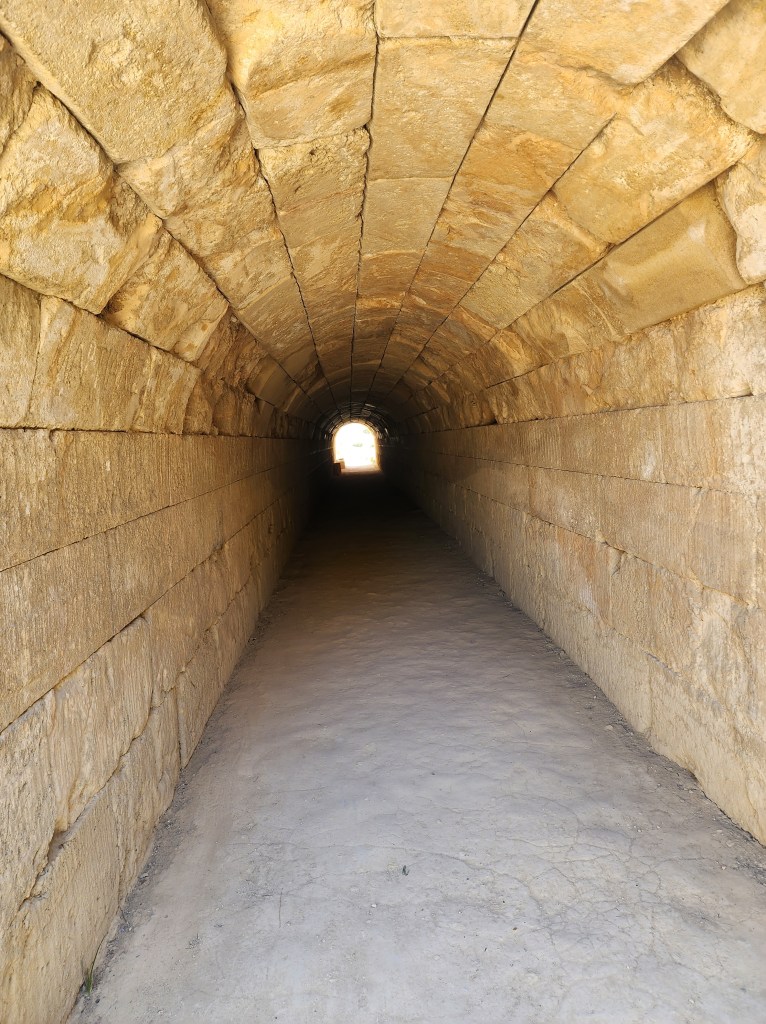
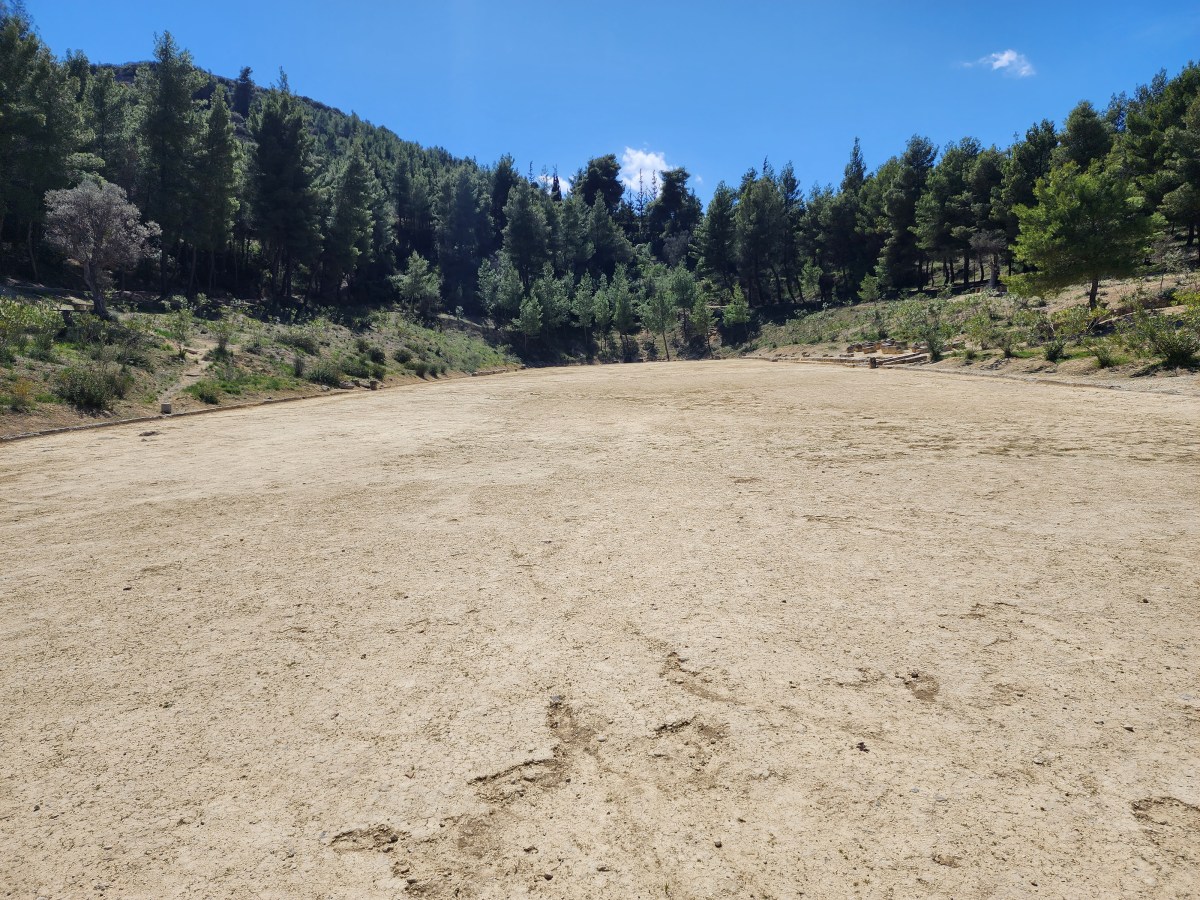
We also found that the tradition of athletes running onto the field from a tunnel in the side of the stadium predates the NFL by many centuries. A true stadium always included an access tunnel for the athletes, even when a hill had to be constructed in order for the tunnel to be dug.
The stadium at Nemea, complete with tunnel, lacking only cheering crowds.
After a break for lunch, we visited one of the high points of the week for me, the site of Mycenae. For this site, we go back in time to 1600-1100 BC, the Bronze age, when Greek city-states were just forming as clusters of settlement around fortified palaces, and Mycenae is the best known example. The tall, fortified walls were nearly impregnable, and the entry way was narrow and angled to make it impossible for more than a few people to enter at a time.
In The Iliad, Homer describes Mycenae as “rich in gold” and as the starting place of the Trojan War, when Myceneans went to war with Troy to return Helen, wife of the king of Greece (Menelaus), who had been abducted by Paris, prince of Troy. The king’s brother was Agamemnon, ruler of Mycenae, and he led the battle against Troy to recapture Helen.
Mycenae has been the focus of study by historians and the very earliest archaeologists, including Heinrich Schliemann. I’ve read a lot about Schliemann, and I have mentioned that his techniques were not exactly scientific, and his ego knew no bounds (who lies in their own diary, in hopes it will one day be published?), but he wanted to show that Mycenae, Tiryns, and Troy, mentioned in the Iliad, were real places, and not dramatic inventions. After his great success at excavating treasure at Troy, Schliemann moved on to Mycenae, where he again named his finds after places in the Iliad. We posed beneath the Lion Gate.
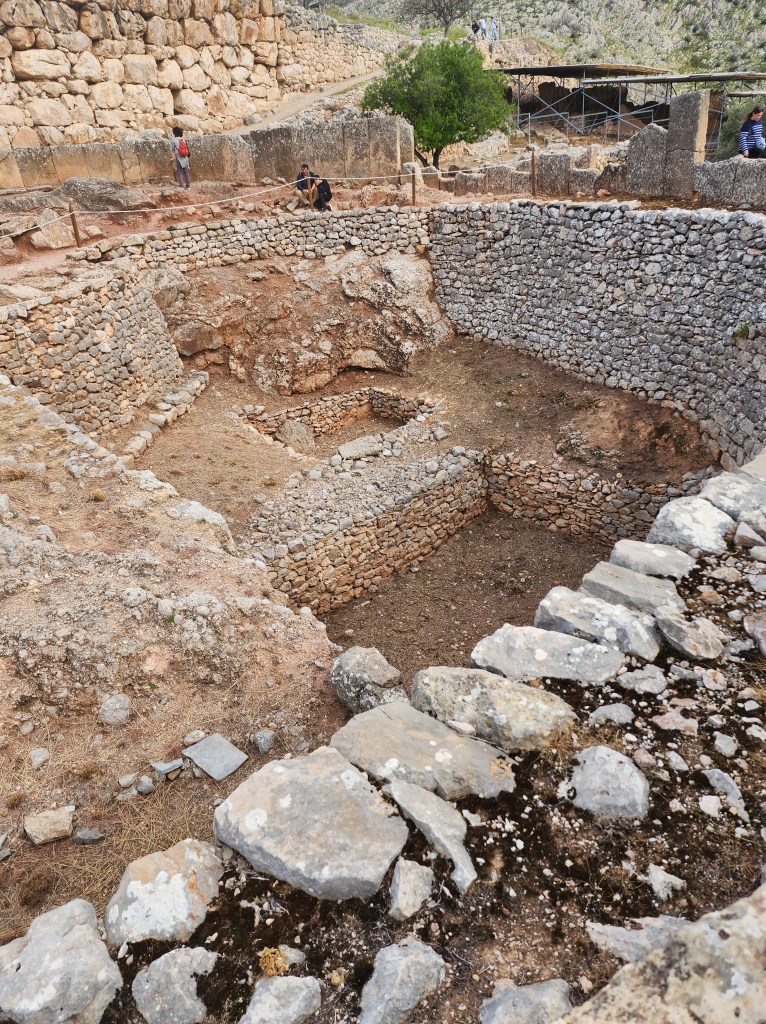
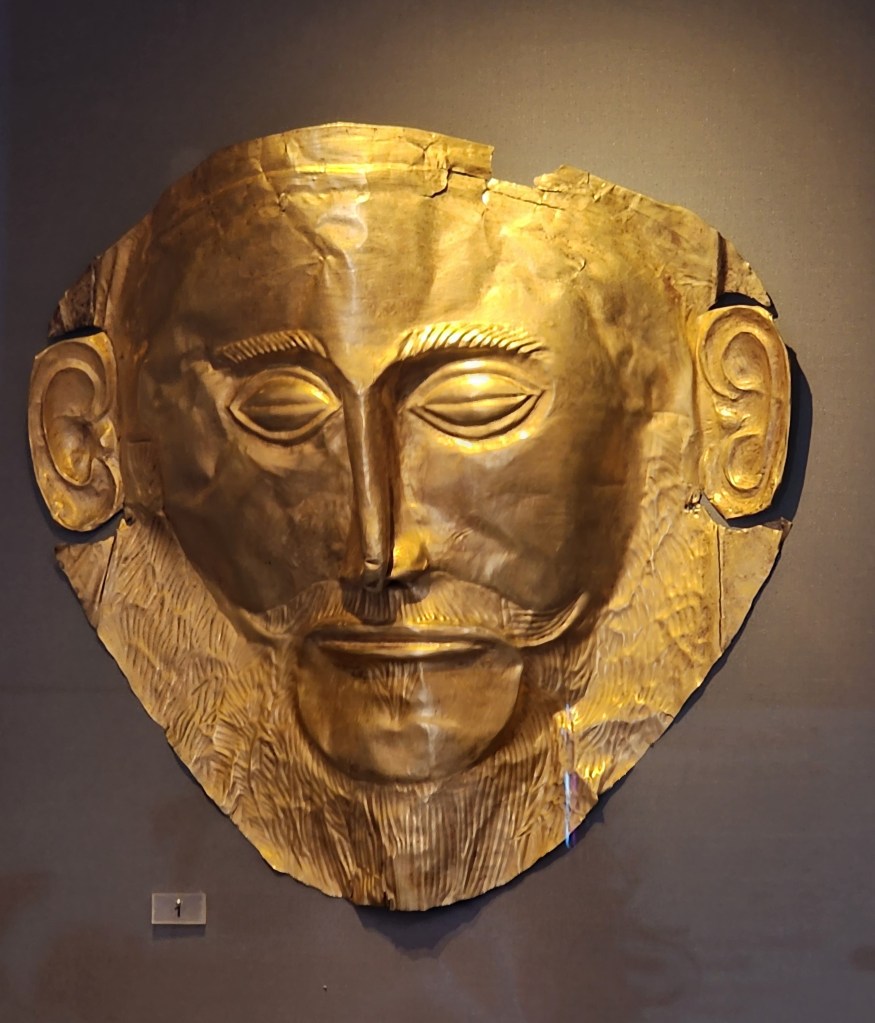
Schliemann’s next great discovery at Mycenae was the gold-laden Grave Circle A (1876). In this part of the site were several stone tombs. The richest of these included the beaten gold mask the inspired Schliemann to send a telegram to the king of Greece, saying, “I have gazed upon the face of Agamemnon.” He was so convinced that the graves were those described by Pausanias that he ceased excavations after finding five tombs, because only five were mentioned by Pausanias. His Greek colleague Panagiotis Stamatakis found a sixth tomb the following year. All the description, cataloguing, and photography of the finds at Mycenae was carried out by Stamatakis, who was assigned to supervise Schliemann’s work, and who Schliemann detested for his efforts to slow the pace of excavation by carefully recording what was found. Stamatakis is the unsung hero of the excavations, because his work lets us know where things were actually found.
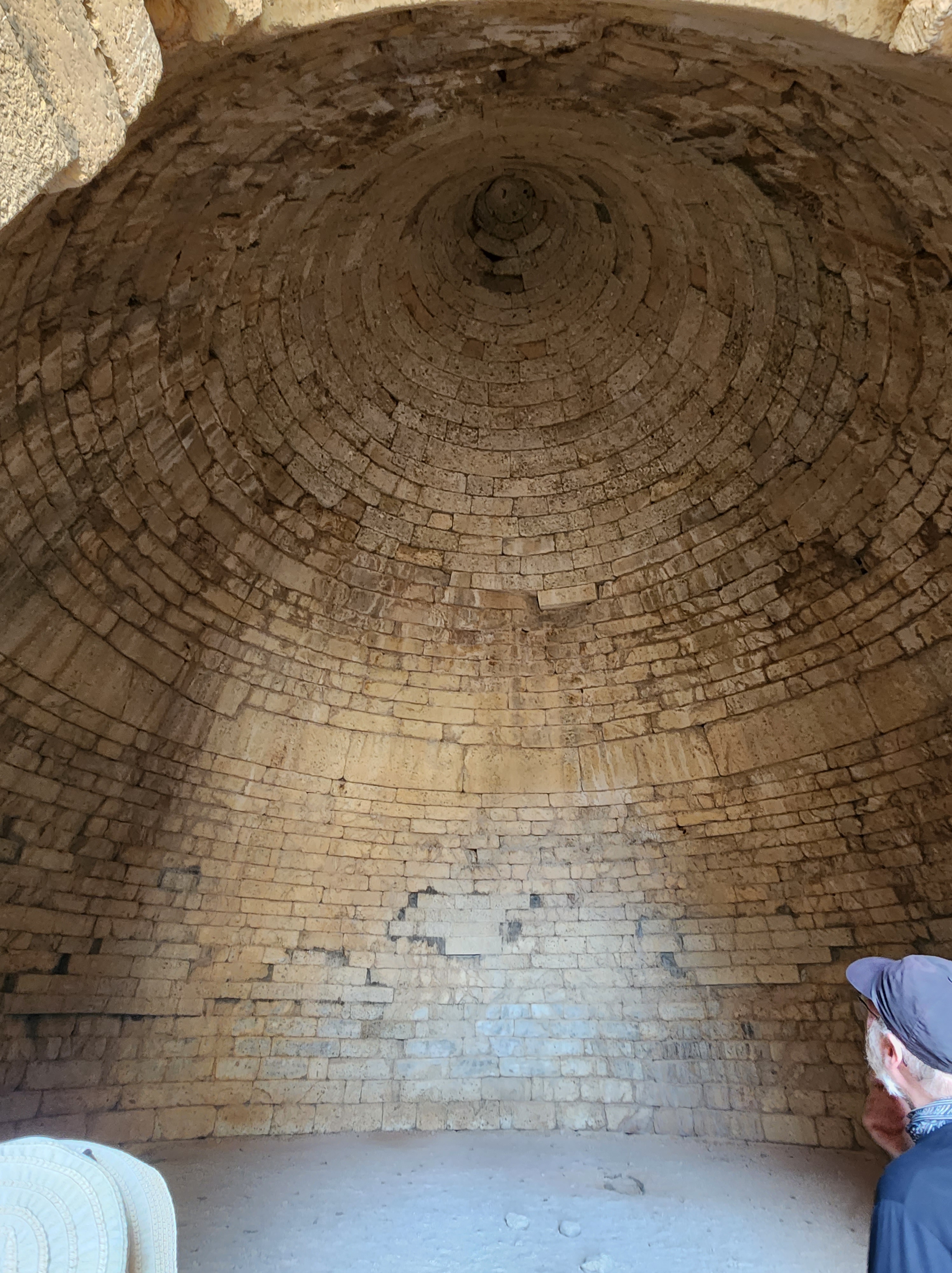
So many stories, so little time! We visited the huge beehive tomb, or tholos, at Mycenae, called the Tomb of Clytemnestra, and another called the Treasury of Atreus, that could have been the actual tomb of Agamemnon, as Shliemann’s grand statement about Agamemnon was never accurate.
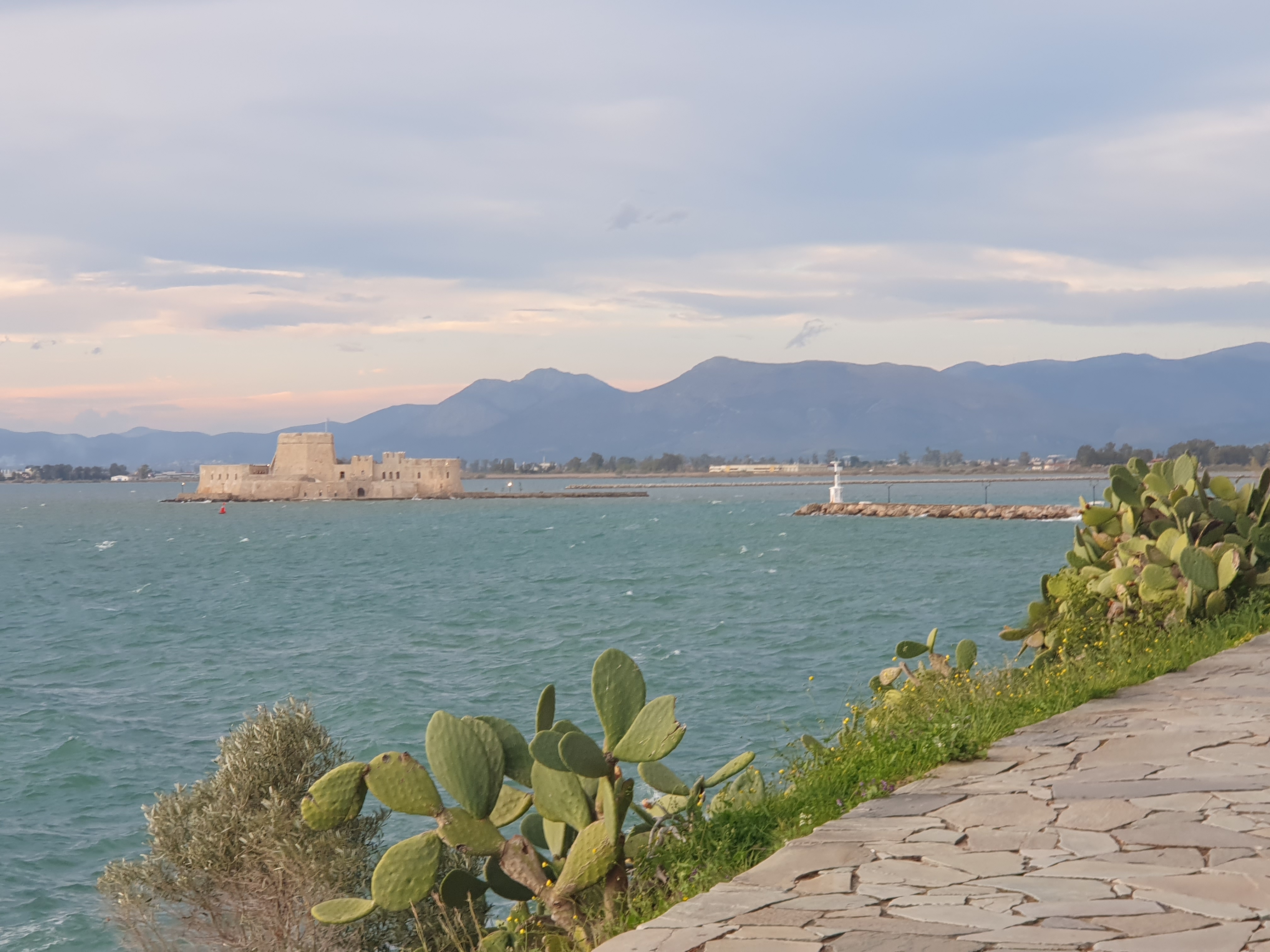
We had an excellent day, arriving at our hotel in Nafplio in time to head to a small beach just over the hill from our hotel. Once we were there, our phones indicated that the best way to get to our dinner spot was by walking around the point. We asked a man fishing if the path went all the way to the seafront on the opposite side and he said, “It’s not allowed, but everyone uses it.” Off we went. The walk took much longer than we had planned, but the spectacular views were worth it. We arrived in time for dinner at Savouras after a gorgeous stroll. After dinner, on our way to the hotel, we saw the illuminated Palamidi fortress on the top of the hill that towers behind Nafplio (bottom of page).
Lunch: Kolizeras, Mykines (specialty is roast lamb)
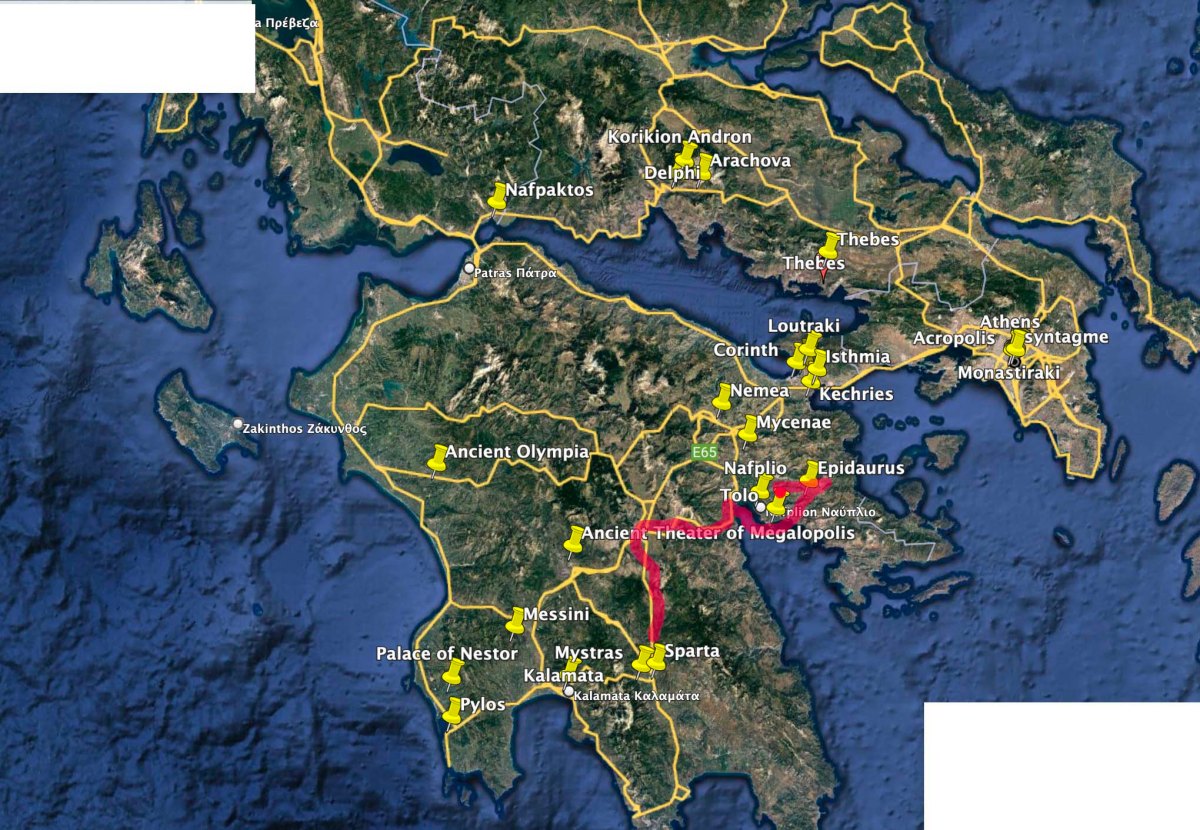
We booked a week-long private tour to see archaeological sites in the Peloponnese, home of Sparta and Mycenae, the “sandy Pylos” of Homer, and other wonderful spots.
One of the reasons we tried a private tour is that we are such terrible tour participants. We’ve each led more tours than gone as participants, and we don’t seem to play well with others. I don’t like to get on a bus at 7:30 am, see four or five places in a day, eat a very tame meal and do it all again the next day, yet that seems to be how tour companies deliver value. Our tour was very expensive, but our tour manager, George, is quite good, and I would recommend you consider contacting him if you have something special you’d like to see in Greece. Contact information is at the end of the post.
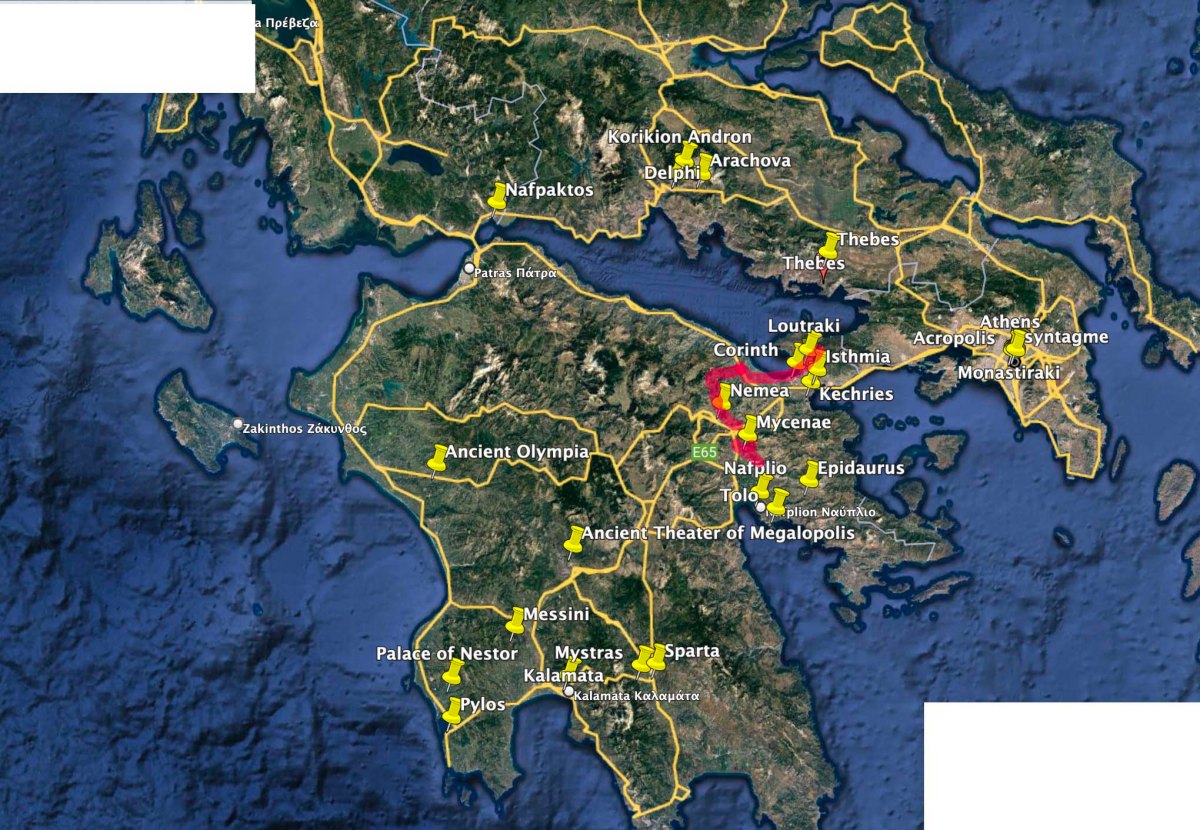
We negotiated over the stops on the tour and came up with an itinerary that took us vaguely clockwise around the Peloponnese. We stayed on the coast whenever possible so that I could squeeze in some beachcombing at the end of the day. Our departure time in the morning was 9 am, with the promise that we would finish each day by about 5 pm. Breakfast and lunch were included, and we decided to get dinner on our own to have greater variety in restaurants and dishes. With some restaurant suggestions from George, it worked out well. We ended up being able to include a stop in Delphi toward the end of the trip, and we were all for it, hoping for our own personal prophecies.
Aristotle and I at the temple of Hera, Loutraki
The first big success was our guide, a wonderfully interesting archaeologist and Star Wars/Star Trek fan. Aristotle has an encyclopedic knowledge of Greek history from the beginning of time to the present, but particularly ancient Greece. I was bowled over by his explanations, and every time either of us had a question about a site, or a specific feature, Aristotle had looked into it and knew all the details.
At times, we renegotiated the conversation, because Aristotle is also a fan of military history and as a reenactor, willing to rhapsodize about great battles of the ancient past in detail. He is also rather charming. He wore a succession of archaeology themed tshirts that were highly entertaining. The last day he wore the piece de resistance of his own design, a trowel made into a Millennium Falcon, archaeologizing across the universe. We admired his skill as a tour guide, knowledge, and good humor. We heard lots of good stories.
We were collected from our Airbnb in Athens and headed to Corinth. We stopped to look at the Corinth Canal, a surprisingly deep and narrow channel cutting through the Isthmus of Corinth. Because of the canal, the Peloponnese is technically an island. Cutting a canal in this area was a dream of many, from the ruling Tyrant in the 7th century BC, to Nero, to the 19th century, when it was actually created as a way to shorten the sea route from Sicily, southern Italy, and Venice to Athens. Ironically, it never really worked because it is deep, narrow, and subject to landslides. It would be a treat to make the trip in a trawler or other pleasure craft, almost the only boats that make the transit today.
The Corinth canal, straight as an arrow for 4 miles.
Preserved section of diolkos, stone road built in the 7th c. BC to tow boats across the Isthmus of Corinth, with ruts from the vehicles.
Much as I enjoyed the story of the canal, our day was just beginnning. We spent the rest of the morning at Isthmia, known for the Isthmian Games, held from 582 BC through the first century AD. There are well-preserved mosaics showing sea creatures.
Tritons carrying Nereids (both are creatures of the sea).
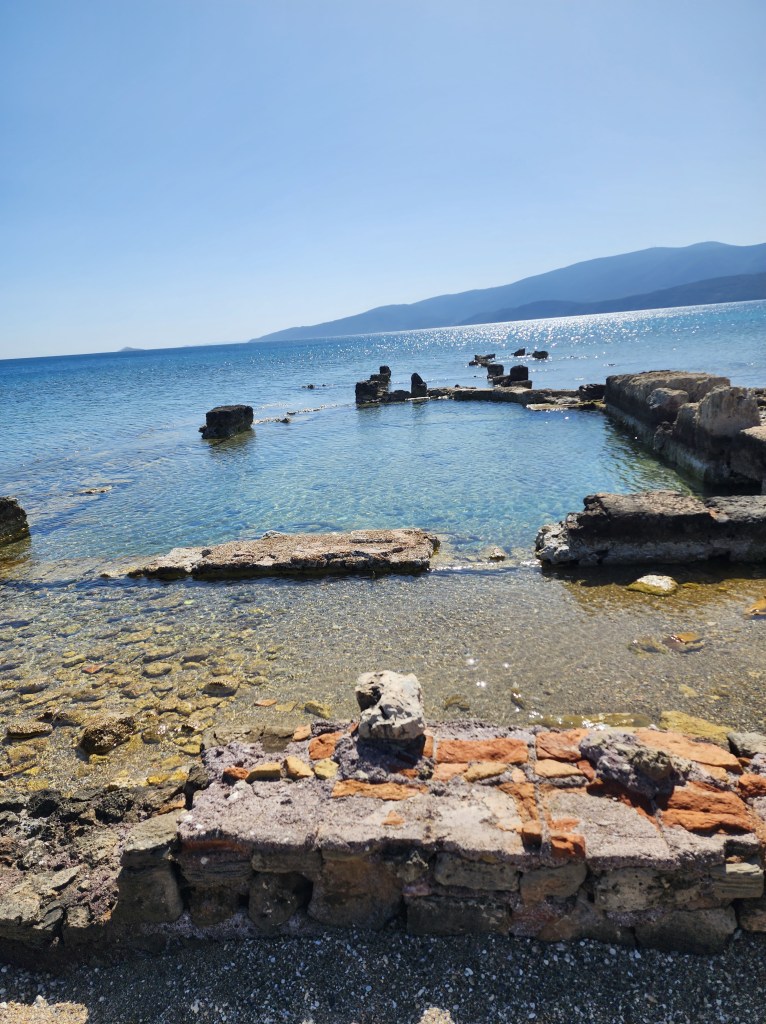
We stopped at Kechries, the ancient port of Corinth. Now partially submerged, it looks like a wonderful snorkeling site.
Kechries, ancient port of Corinth on the Aegean (Saronic Gulf)
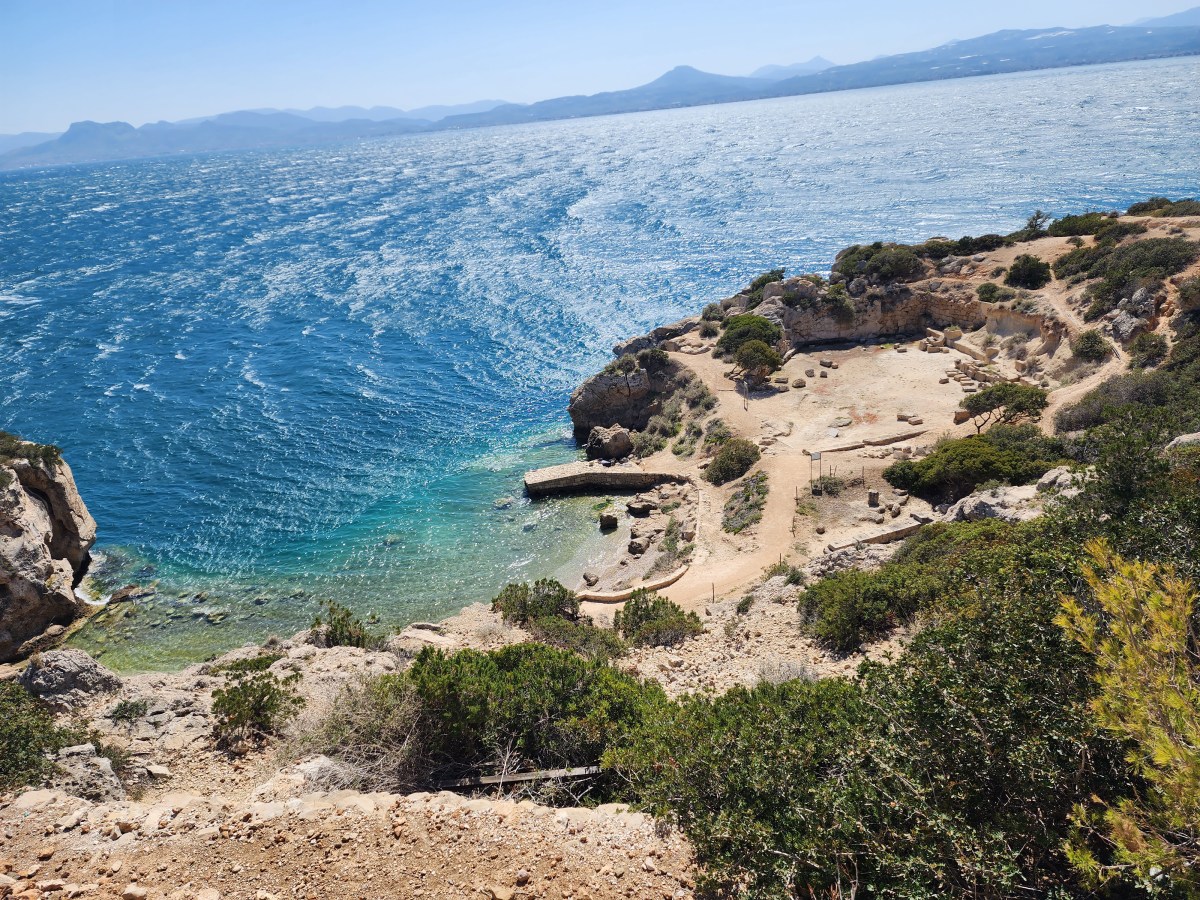
After a stop for lunch in Loutraki, we headed to the Temple of Hera, or Heraion, on a promontory that extends into the Gulf of Corinth. A gorgeous seaside spot, the temple was used for almost 1,000 years, and may have had an oracle during part of that time. Aristotle had reconstruction sketches of what the structures looked like in their heyday. The spot was so beautiful in the afternoon sun that we stayed for a while just to enjoy the day.
Temple of Hera
Aristotle shows a reconstruction of the temple
As promised, our tour day wrapped up around 5 pm. Our hotel was on the water in Loutraki, a beach town just east of Corinth. We were able to spend an hour or so beachcombing our way along the shore and have dinner at the restaurant recommended by George. The food was good and the view was excellent, across the Bay of Corinth at sunset.
Did you notice, that we did, in fact, make five stops? Three were very short (canal, diolkos, port of Kechries), but I do have to laugh at myself for criticizing tours with numerous stops.
Lunch: Paladar, Loutraki
Dinner: Maistrali, Loutraki
Overnight: Club Casino Hotel, Loutraki
Tour Organizer: George, Pictours of Greece, +30 697 202 6519
While it’s still fresh in my mind, here are a few impressions that might help you plan your visit to Greece. We stayed for six weeks: a month in Athens, and a week plus in the Peloponnese. We didn’t visit the islands, but for some great information about Greek islands I recommend posts at https://thegenxtravels.com/ by Lori. Her descriptions of Crete, Santorini, and other Greek islands will help you plan your trip, or possibly extend it…
Athens is full of orange trees. In late March and early April, the trees begin to bloom and the air is scented with orange blossoms for at least two weeks. It’s lovely to walk down the street and breathe in the spring air. March may be the best time of year to visit Athens. The weather is cool and the crowds are not bad. It was perfect for us.
For swimming, snorkeling, and boating, however, later in the year will be better. We saw a few people in the water on Aegina and in Loutraki, but I didn’t even consider going for a swim, even if it was the Aegean. I’d recommend May or September for warm water and at least somewhat diminished crowds, but the Greek coast and islands are always popular. The islands are the most famous destinations, but the beaches and towns of the Peloponnese, Loutraki, Nafplio, Kalamata, Pylos, as well as other smaller communities like Tolo, would be lovely vacation spots on the water.
Lots to do in Athens
Athens is a world capital. People have been living here for thousands of years. Since tourism is a big part of the modern economy, you’ll find ruins revealed under your feet all over the city. Sometimes these are labeled, like the area at the Acropolis Museum. Other times, you’ll find a small rectangle of mosaic beneath thick plexiglas in the middle of the sidewalk. Stop and look at some of these, just for fun.
Someone is losing at “Simon Says” (Kerameikos Museum)
Stay in Athens longer than you think you need to. The big museums have treasures, but so do the small museums, and they are often quiet, with only a few other visitors. Try the museum at Kerameikos, for instance. You also need time to walk to the top of Filopappous Hill, take the aerial tramway to the top of Lycabettus Hill, and visit the cafe at the Benaki Islamic Museum (see The Benaki Museums).
“Symposium”= men carousingWomen not allowed to attend symposiumCurse laid on those getting home late from the symposium
(Kerameikos Museum)
We had a wonderful Airbnb for the first month, and stayed at AD Luxury Rooms and Suites for the final three nights. The hotel was comfortable and quiet, yet only a few steps from the Acropolis metro stop. The rooftop dining area has a spectacular view of the Parthenon, and the included breakfast offers expresso, cappucinos, etc. (On our tour, most hotels only offered brewed coffee from a machine.) The staff is helpful and pleasant. One downside though, the lobby and halls are highly scented. Don’t ask me why. I was grateful that the inside of our room was not.
Food and Drink
Greek food is delicious, and with a bit of help from Trip Advisor you can avoid endless meals of grilled meat and Greek salad and eat more adventurously, even in the tourist heart of Athens. We ate the steamed greens that are often on the menu, and in egg/lemon sauce they were a favorite. For restaurants, we liked Mani Mani (Manh Manh), Liondi, and Arcadia, right in the Acropolis area. If there is a down side to Greek restaurants, it is the generous portions. We often left behind more than we ate. There seemed to be no way to get a smaller portion size. We didn’t get started on drinking Greek wine. The house wines were just ok. We drank some ouzo and were often given a bit of mastic liqueur from Chios at the end of a meal (“a digestive!”). Ya mas! (Salut!)
Scallops at Maria’s in ToloCeviche in NafplioSalmon liver in SpartaSea bass in PylosDiscussing the menu in ArachovaLunch with a view
Transportation and Communication
The taxi app, FreeNow, was very useful. We never waited long for a cab, either in the heart of the city or further out. I only used it in Athens, though it may work in the other large cities of Greece. The fare is required to be the same as other cabs, though we saved money by using the app near the Acropolis (see the end of this post). We found the convenience to be worth using the app.
We rode the Athens Metro. Tickets are easy to purchase at machines at the entrance to each stop. We purchased two round trip tickets at a time for just over 4 E. You scan your ticket going into the station and when you come out. (Try not to lose your ticket before you scan out at the end of your ride.) Tickets are good for 90 minutes of onward travel. That means you can get from Athens to Piraeus and change for the tram down the coast for the price of a single ride. There are excellent deals for month-long tickets, and tickets for students and older people if you are willing to take the time to set them up. You can get nearly unlimited rides for about 20 E per person per month; web pages have the details.
We each used a SIM card for Greece from the local Vodafone store for calls. You need to have an unlocked phone. I believe most phones come unlocked now. There are now eSIM cards you can use that will eliminate the whole trip to the store. BUT, if you go into a phone store and purchase a SIM card, the sales person will install it and make sure it works. You can try calling them, and getting access to your data before leaving the store, so you know it all works.
I got a data eSIM for Jonathan from our US carrier (USMobile) before we left and it never worked at all. In the US, eSIMs are new. Jonathan’s new Samsung S22 has the capacity to use them. My Samsung Galaxy S10 does not.
The down side of getting a new SIM is that you have a different number. Having a local phone number was helpful for a few things in Athens, but not for staying in touch with home. We used WhatsApp very successfully for that. You should get the app and get the people you want to be in touch with to set it up, too, before you leave the US. I was able to get to my existing contacts on WhatsApp without difficulty with my Greek SIM installed. Why go to all this trouble? Our Greek phone service cost 12 euros a month per person. US phone service in Europe usually runs $10/day/pp.
Attractions
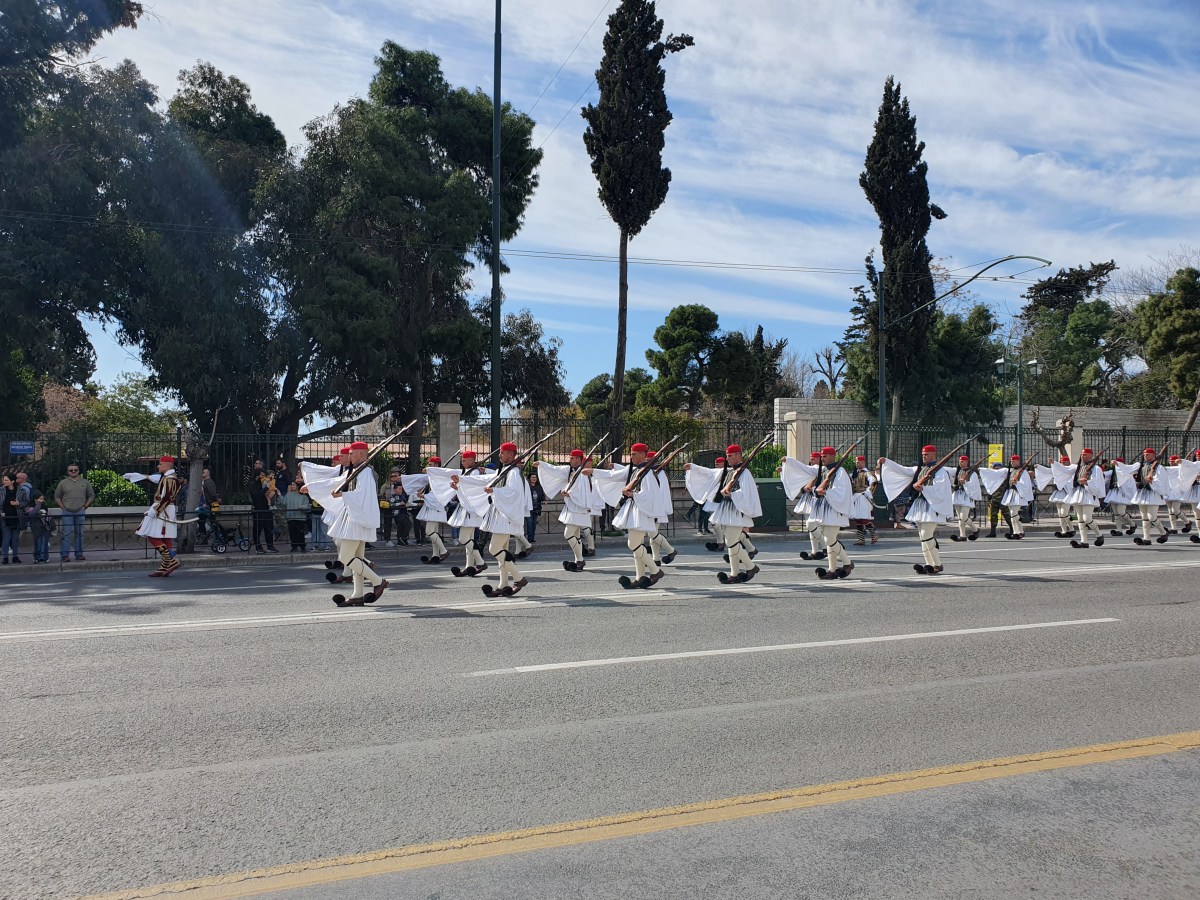
Our first Sunday in Athens, we went to watch the changing of the guard at the Parliament in Syntagma square. It’s a real military pageant, complete with a band. For us, though, the best view was not with the crowd in the square, but around the corner on Leoforas Vasilissis Sofias street. Traffic is stopped and the entire parade, squads of soldiers brightly dressed the traditional Greek uniforms, parades down the block going away from the square at the end of the event. The crowd is thinner and you can easily see all the marchers.
Changing of the guard from Leoforo Vasilissis Sofia
The changing of the guard from Syntagma
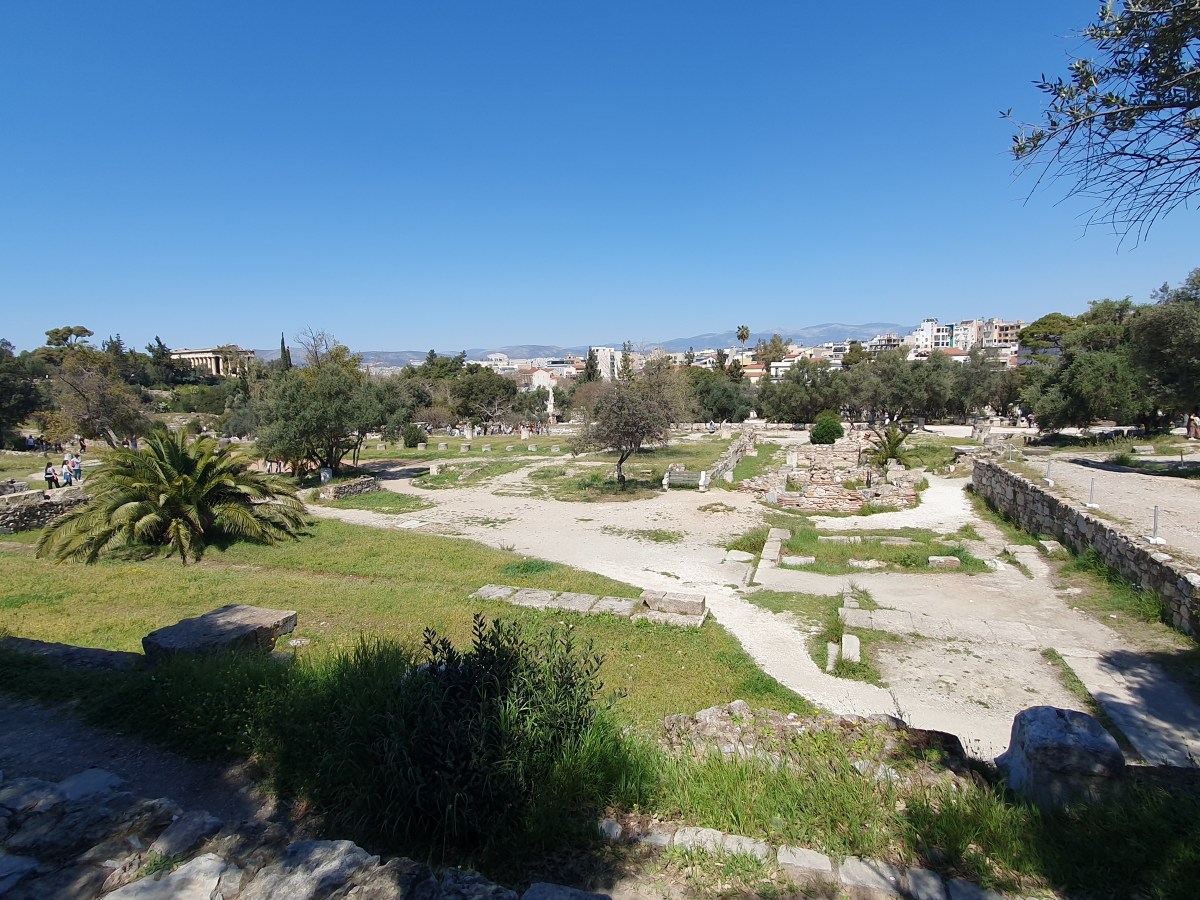
After that, we spent time in the slow lane. Athens doesn’t have many parks for a city its size, but the National Gardens has winding paths, pools of turtles, koi, and ducks. We enjoyed our stroll there. Several of the large archaeological sites are park-like, including Kerameikos, the Temple of Olympian Zeus, and the Agora.
A pool full of turtles in the National Garden
Athens agora
We also visited Athens First Cemetery, but it is not a green cemetery, it is wall to wall monuments. I wanted to see the grave of Heinrich Schliemann, the first person to read Homer’s Iliad, and then excavate to see if he could prove it was a historic account rather than poetry alone. His archaeological technique left a lot to be desired, but he showed that Troy was a real place. A philhellene (lover of all things Greek) to the core, his monument is built like a Greek temple, complete with a frieze of heroic scenes around three sides. On the fourth side, the relief sculptures show his excavations and the carrying-off of treasures, with he and his wife presiding. The man had a healthy ego, but he did leave most of his treasures to Greece.
A few issues with Athens
As a result of its long history, huge sprawling size, and population, Athens has all the big city issues. There is lots of graffiti, sidewalks are often narrow, restaurants have shills out in front trying to steer you in. There are beggars, people who sleep in the street, and pickpockets. Greece may be the home of Arcadia, but it’s not Arcadian all the time. You get used to most of the urban issues, as you would anywhere.
For example, everyone has to put all their trash in streetside dumpsters, and that seems to include construction debris, discarded furniture, appliances, and restaurant garbage. Two of the three dumpsters on our block were set on fire during the demonstrations following the terrible train accident, and people piled trash in the place where they had been until they were replaced about a week later. We are convinced that trash collectors are the hardest working people in Athens. The dumpsters may also be a recycling location. One day we saw a stack of 10 lb weights, a training rope, and a speedbag all piled neatly beside a dumpster. There are places to recycle glass bottles and cardboard, but not other materials.
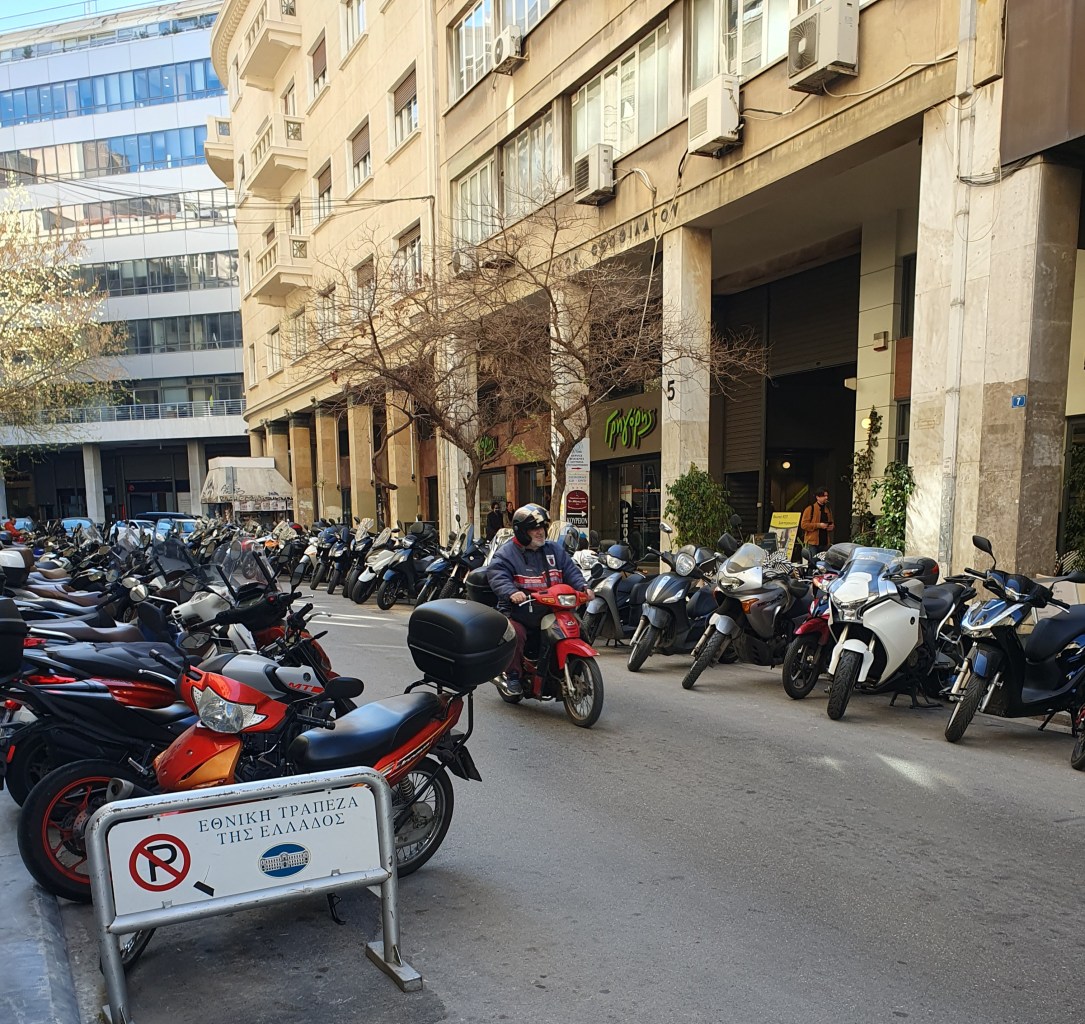
GraffitiRenovation candidate Parking woes
Though the proportion of the population that smokes is only 10% higher than in the US, we noticed a lot of cigarettes and smoke. Restaurants allow smoking in any outdoor seating, even if it is walled in with plexiglas or tented. That can be uncomfortable for non-smokers.
Cat on car, and near the car, and under the car…..
Athens has too many cats. People put out food and water for feral cats, and they are everywhere. There’s a tradition of allowing cats to roam the Acropolis that doesn’t appeal to me. Someone said they kill rats and eat cockroaches, but they also eat millions of songbirds. I am an indoor-cat only person.
When you hear birdsong, it’s usually finches or canaries hanging outdoors in cages. There are invasive monk parakeets, and ring neck parrots, house sparrows, pigeons, and a few blackbirds, but that’s pretty much it.
Last but not least, stay safe. Keep your eyes open and beware of anyone who starts a conversation with you on the Metro. We began to cringe when someone opened a conversation “Hello! Where are you from?” because it was the opening line of the pickpocket group that got Jonathan’s wallet from a zipped front pocket (!) while they distracted us both. There were three of them, acting like they were not together, a gray haired man, a tall young man, and a woman dressed to go to work. It’s a shame to be unfriendly, but don’t talk to people on the Metro. Stand with your back to a wall, or sit with your backpack in your arms. If you need help, stand in line at the ticket window, don’t let kind passers-by assist you, as they may help themselves to your wallet in the process. We didn’t lose as much as we might have, and learned our lesson. Nothing else was stolen during our trip.
Athens is worth visiting, though like every city it has its ups and downs. If you take a bit of time to look carefully, you will see wonderful things. When Heinrich Schliemann brushed the last bit of dirt off the golden mask from Mycenae (below), he said, “I have gazed upon the face of Agamemnon!” It may not have been true, but is a wonderful thought. You can see that same face, and only in Athens.
Gold mask from Grave Circle A at Mycenae (National Archaeological Museum, Athens)
Airbnb: Hosted by Iason. Not always listed.
Hotel: AD Luxury Rooms and Suites, near the Acropolis. Perfectly fine, with a very good location
Restaurants we liked: Mani Mani (Manh Manh), Liondi, and Arcadia, are all very good and near the Acropolis
Sights we recommend: Any national holiday, changing of the guard at Syntagma Square, Sundays at 10 am.
Athens has a renowned Archaeological Museum that holds treasures of ancient Greek culture, but it also has an impressive group of museums started by the Benaki family. The collections started out in a large family house, and the family’s cultural interests seem to have struck a chord in Athens. Expansions were made to the original house to include the numerous additions to the collection donated by other families, and today the collection holds artifacts from the early Neolithic through the founding of the Greek State.
A Greek family of wealth, the Benakis were not longtime Athenians, but Alexandrians. Greeks, English, Lebanese, Turks, and Syrians formed a vibrant polyglot society in 19th century Alexandria, and Antonis Benaki became wealthy working in the cotton industry there. The British takeover of Egypt, the two world wars and the development of Egyptian independence changed everything. The multi-cultural mix of Alexandria became politically precarious, and most, though not all foreigners, left Alexandria either to former home countries, or to Australia, South Africa, and Argentina. Antonis Benaki’s father had been a strong supporter of Greek independence and active in government. The family moved permanently to Athens by 1926. In 1930, Antonis Benaki donated his collection and house to the Greek state.
Today, in addition to the Benaki Museum of Greek Culture near Syntagma Square, there is the Benaki Islamic Museum near Kerameikos, the Benaki Toy Museum in Palaio Faliro, workshops, collections, and homes of several artists (Yianni Pappa, Nikos Hatzikyriakos-Ghikas, Penelope Delta), as well as the home of Patrick Leigh Fermor, writer and Hellenophile, who donated his house in the Peloponnese to the Benaki Museum to be used by researchers and to be open to the public. A recent addition to the Benaki portfolio is Piraeus 138, the Benaki Museum Cultural Center. We visited the two largest museums, the Benaki Museum of Greek Culture, and the Benaki Islamic Museum.
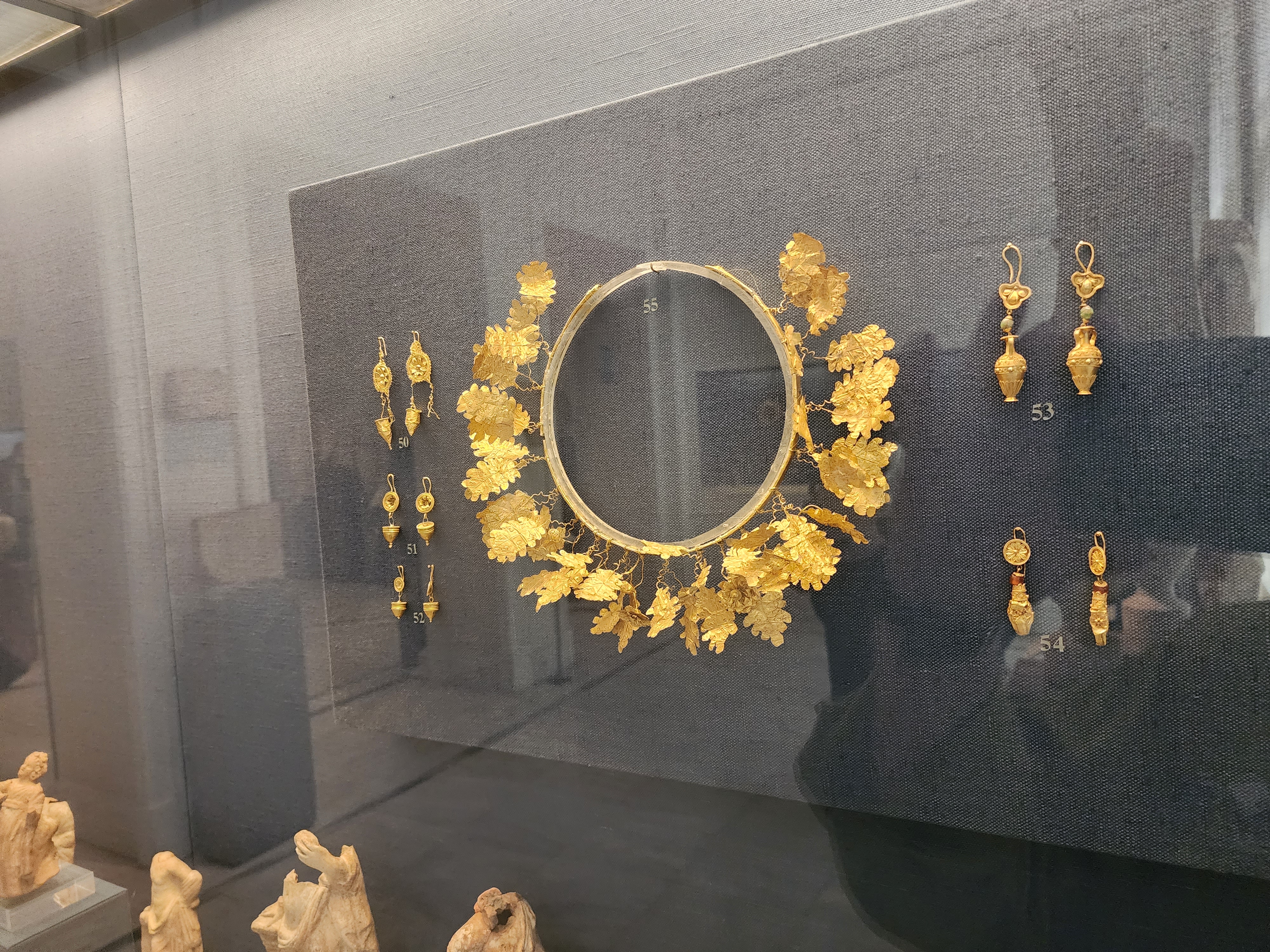
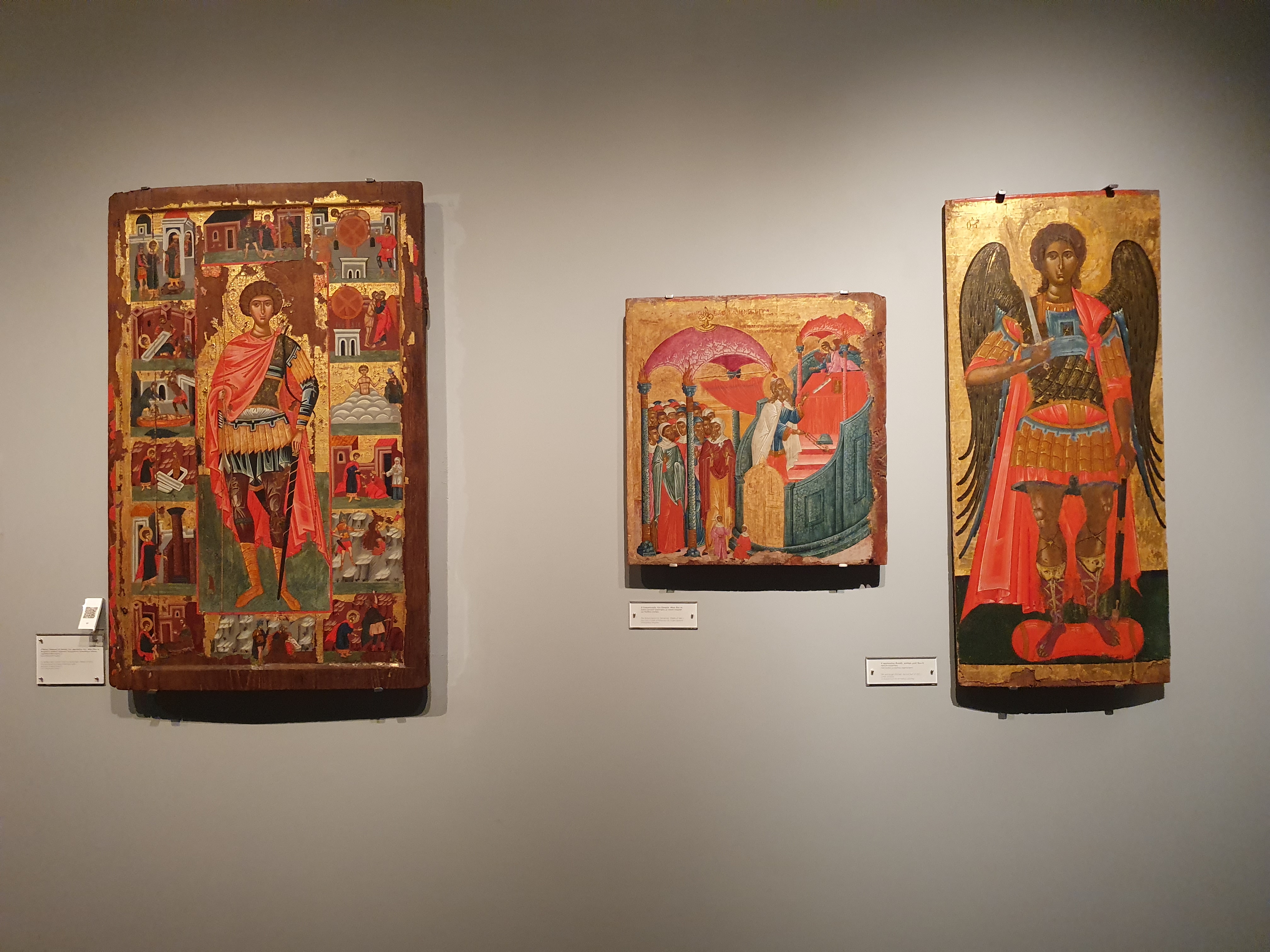
Clockwise from top L: Ancient pottery; Gold leaf crowns (knockoffs are sold on every street corner in the Acropolis area); Detailed embroidery of a ship; Vivid red in Byzantine art
The Benaki Museum of Greek Culture is near Syntagma Square in what was a large family home remodeled to its museum purpose. The collections go from oldest on the ground floor and proceed through ancient history as you go up. The top floor has an educational exhibit spanning ancient history and is presently recommended as the starting spot, with visitors working their way back down and moving back through time.
We saw wonderful things, topped off by an entire room of a 19th century house that was collected from a site that was going to be demolished.
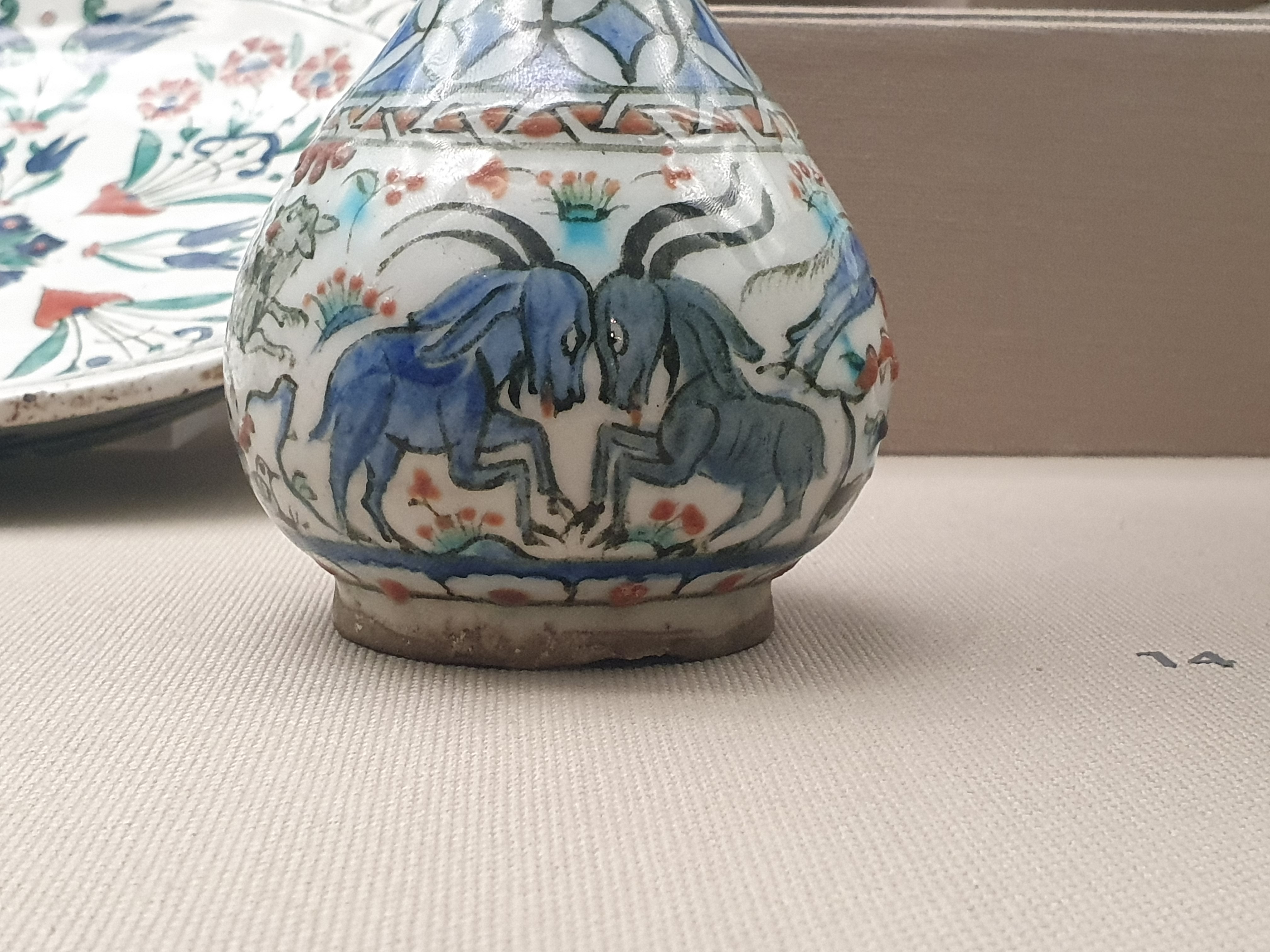
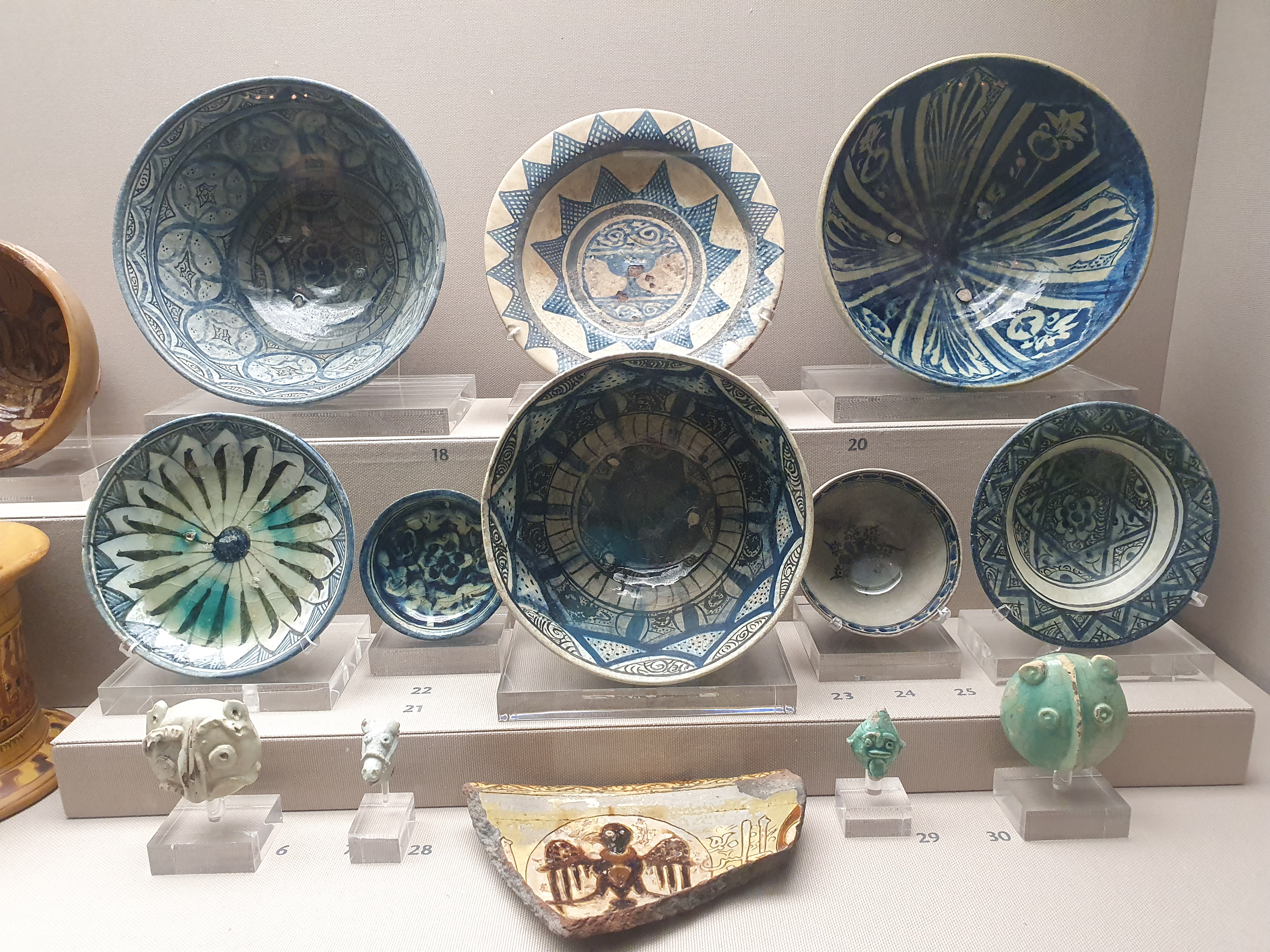
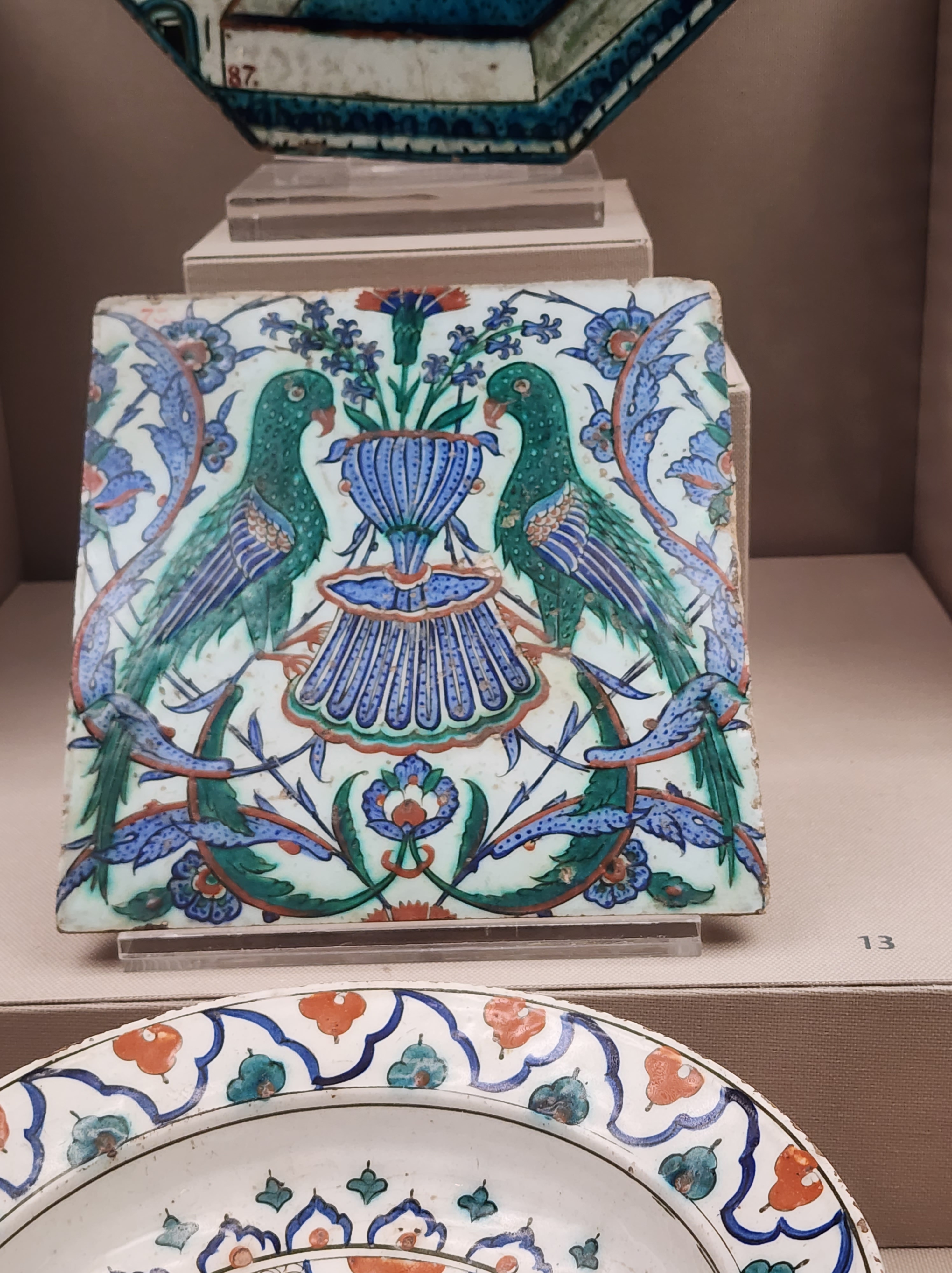
The Benaki Museum of Islamic Culture is a smaller, though full of interesting pieces of art from the entire span of Islamic history, from the 7th century AD to the present. Pottery from Iran to Egypt and glass from the earliest glass-making places caught my eye.
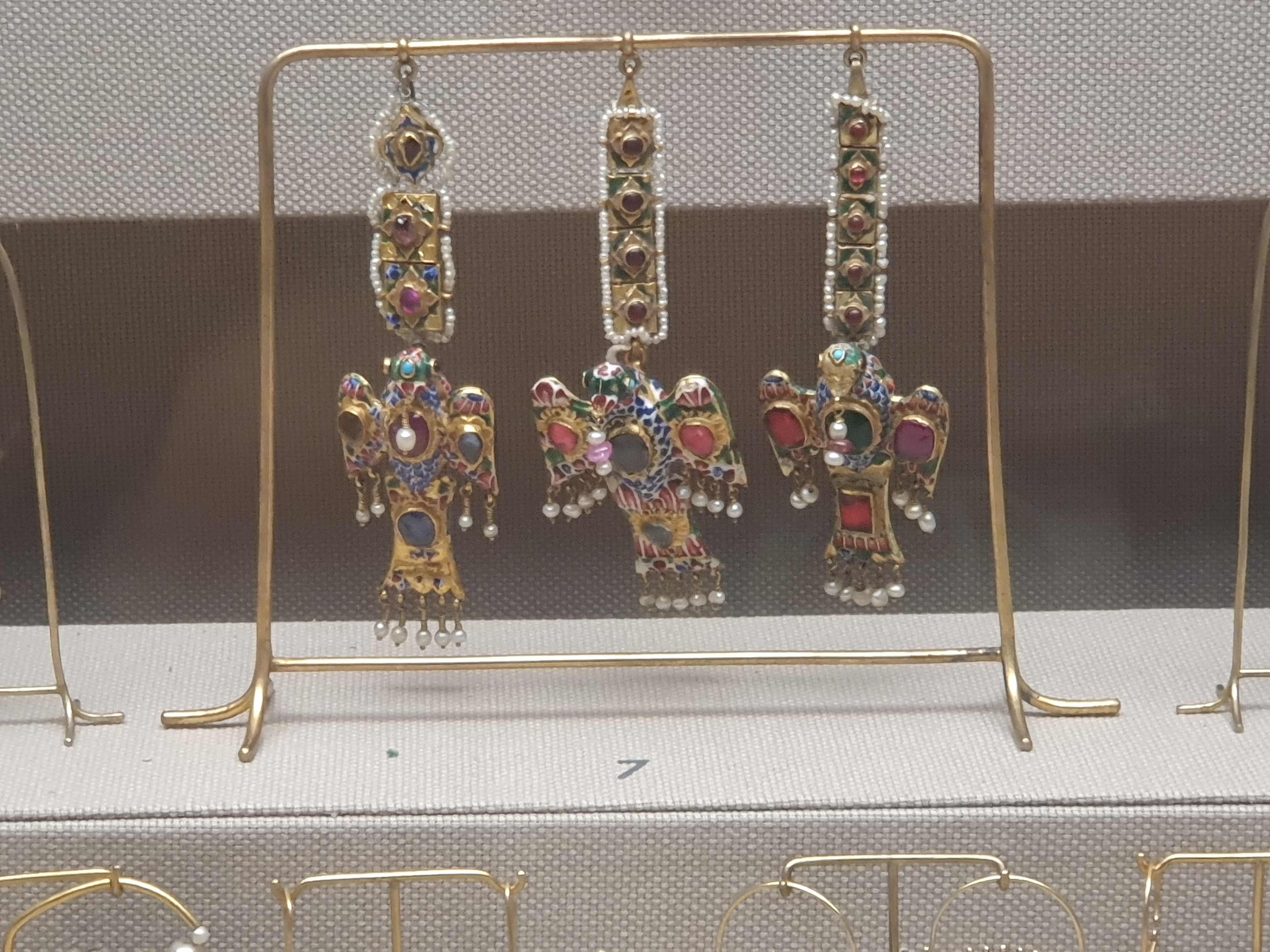
Elaborate jewelry, too.
I was intrigued by the figures painted around the edge of a plate (R). Perhaps it was the monochrome coloring, but it reminded me of the drawings of Marjane Satrapi, author of the graphic novel, Persepolis (which I recommend!).
The Benaki Museum of Islamic Art also has a secret–their cafe. It is lovely, and looks out over the Agora, Filopappos Hill and the Acropolis. Another reason to time your visit to include a coffee break.
The Benaki Museum of Greek Culture is only closed on Tuesdays, while the Benaki Museum of Islamic Art is closed Monday through Wednesday. Check the times before you plan your visit.
Everyone assumes that you’ll visit Greek Islands. They are all so famous, Mykonos, Santorini, Rhodes, and many others. We decided to stick with a one day trip from Athens to Aegina, one of the islands in the Saronic Gulf very close to Piraeus.* We could take the metro from Omonia all the way to Piraeus, walk down the street to the landing, take the fast ferry and be on Aegina an hour later.
We spent a fine day in Piraeus the week prior to our visit, scoping out where exactly the ferry landing is. Guidebooks and information online says Gate E8, but when you get there, E8 extends for about a quarter of a mile, and the ferry to Aegina leaves from just about the farthest point. We were glad to know where we were going in advance. We spent the rest of that day exploring Piraeus, visiting the archaeology museum, having lunch overlooking the sea. It was delightful.
We got up early on a Tuesday, drank our coffee and walked to the Omonia station to catch the metro. About 20 minutes later we were in Piraeus, and we headed for the ferry landing, a 10 minute walk. We arrived well in advance of the 9:30 am fast ferry, bought our tickets and waited to board. The ferry left on time, and I was surprised to find face masks mandatory, since elsewhere in Athens (on the metro) masks are mandatory and only about half the passengers wear them. Boarding was not allowed until the mask was in place. We had reserved seats, though it appeared that others did not.
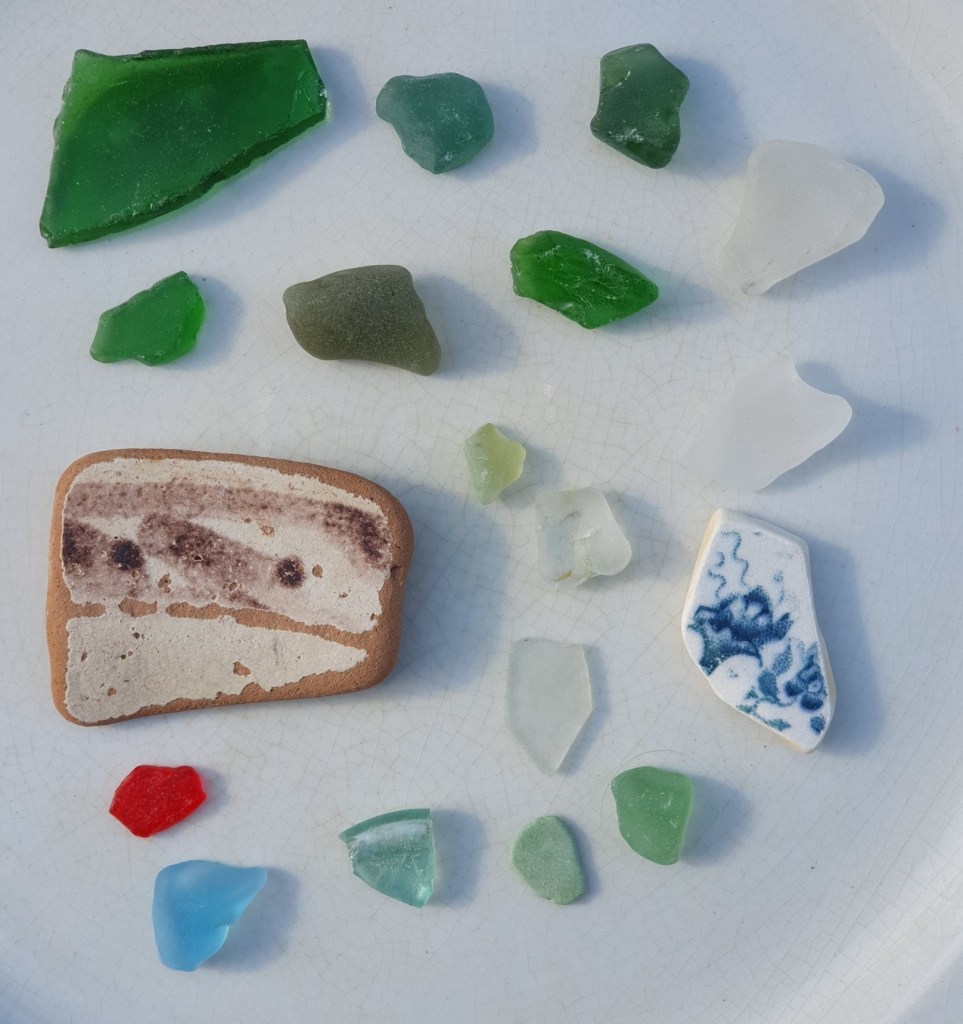
The ride went smoothly, and we disembarked in the center of Aegina town, on the west side of the island. We headed straight for a cafe for cappucino, watching the harbor, the visitors, and the beautiful day. I decided that we had to do some beachcombing, so we strolled south until just beyond the harbor, where we found a small section of beach. A lot of eelgrass had come in on the tide, but there was enough exposed sand and gravel to hunt around a bit. We picked up a few pieces of sea-worn glass, though most of our finds were quite recent and we tossed them back to get a little more polish. Jonathan found a piece of red glass, and that’s quite rare, and pointed out a tiny blue-green piece that may be very old. It has a bit of patina and a folded shape. I found the rim of an old soup plate, and a few other things.
We couldn’t keep going very far, as the beach area was small and there are miles of rocky coast. Perhaps if we’d had a car, we could have looked for more places to visit, but we were content to go on to the next order of business: visiting an archaeological site.
Aegina has several ancient sites, as people have lived there from the late Neolithic around 3000 BC to the present. One of the best known sites is the Temple of Aphaia. We were going to get a taxi out to the site, but decided to look it up first to be sure it was open. It was not. Our fallback choice was the Temple of Apollo on Kolona Point, just north of the port. The site was much larger than it first appeared, as people have lived there for so long. Successive layers of occupation by ancient Greeks, Romans, the later Byzantine empire, and even later groups cover the entire hill.
We began with the museum at the base of the site. We’ve found that the small museums (Kerameikos, Piraeus) sometimes have interesting things to see.
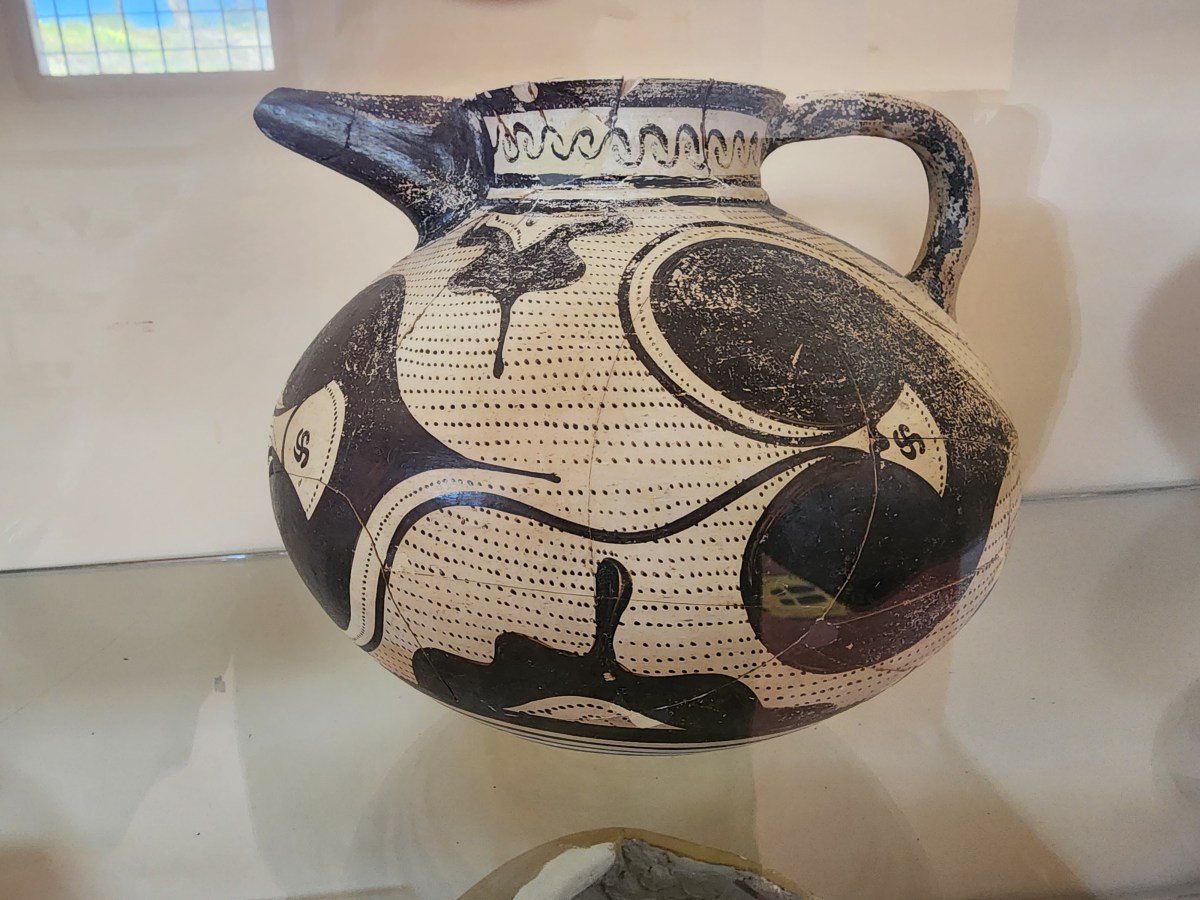
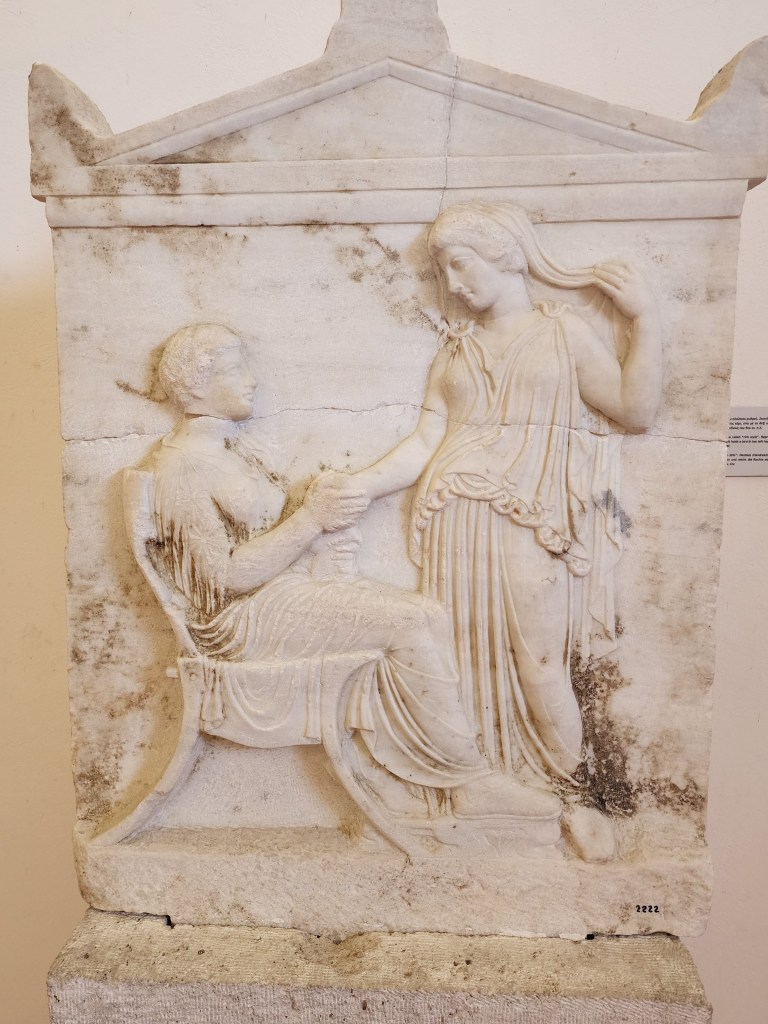
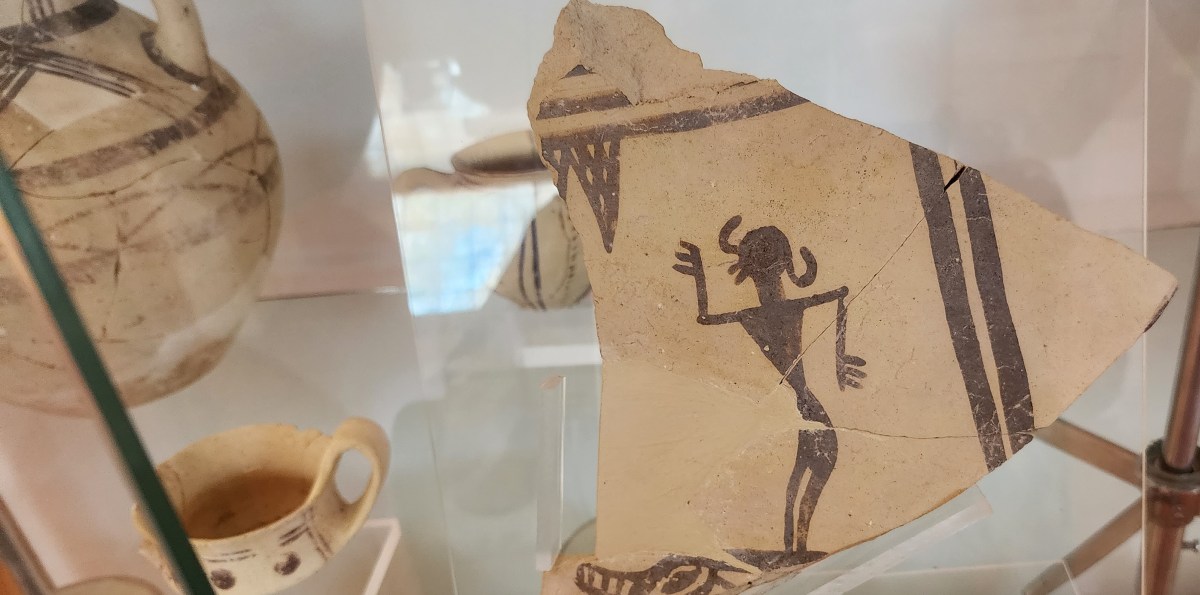
A beautiful potA remarkably well preserved grave markerDancer decoration on pottery that reminds of of the Hohokam in the American SouthwestA strange sphinx
After the museum, we climbed Kolona Point to the site. Only a single column remains of Apollo’s Temple. Like other sites, the ground is covered with excavated features and piles of column fragments that cannot be reconstructed. A German group excavates at the site each year; there were signs in Greek, English, and German explaining many of the details and showing the different layers of occupation that are difficult for visitors to identify. The view out over the gulf is spectacular, and we strolled around the point on some of the many paths to admire the view.
Despite the mild weather, I wasn’t interested in taking a swim, but we noticed a number of tourists sunbathing on the beach. We saw some of them on the return ferry in the afternoon, a few burned lobster red.
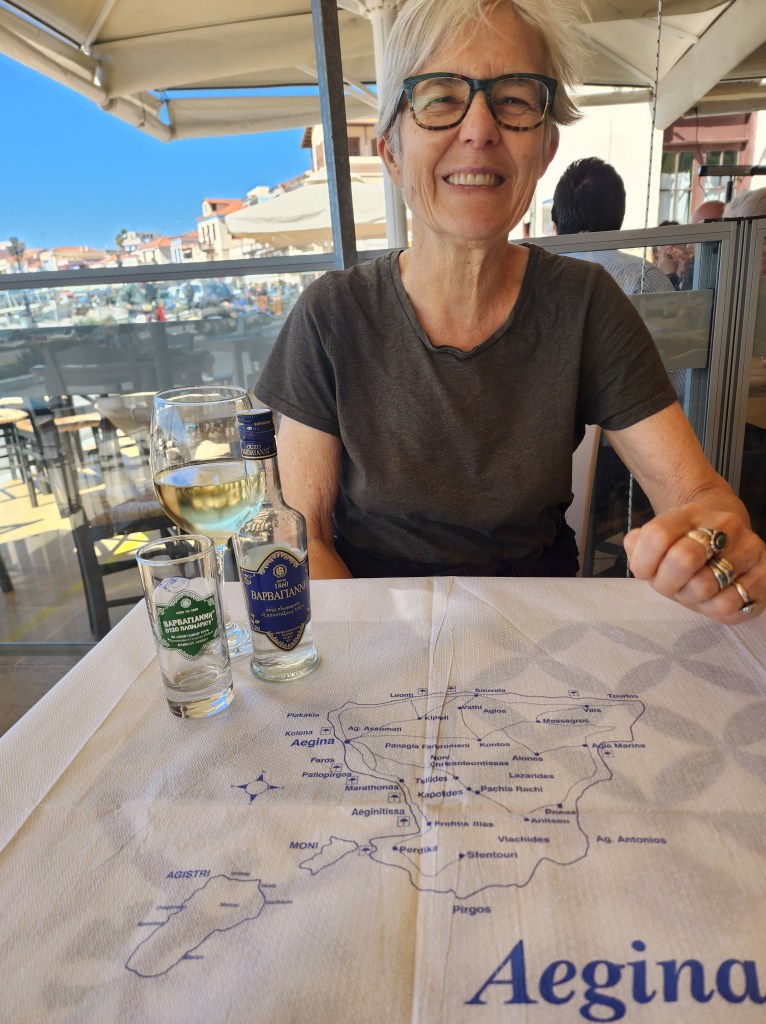
I liked the tablecloth with the map of Aegina.
Having exerted ourselves by climbing the hill and exploring the site, we turned to the important business of having lunch. One of the restaurants recommended to us would involve a cab ride, and we had let it get rather late. We wanted lunch promptly and overlooking the water, so Jonathan consulted his phone and came up with O Pelaϊsos. Once seated, we decided that this stop would take up most of our afternoon. We had more than enough to eat, with taramosalata, saganaki, and fried calamari. Jonathan drank ouzo, and I had white wine. We idled away quite a while people watching and eating. Finally, we had to move.
On the way back toward the port, we stopped to buy pistachios, the Aegina specialty. A local cooperative packages most of the local production, the woman selling them said that every family on Aegina finds space for at least a few trees. The pistachios are a bit smaller than I am used to, but they have excellent flavor, and were not oversalted. The sales crew are generous with samples. We bought a small bag to eat immediately, and more to take home as gifts. It’s something distinctly Greek, and delicious.
Back at the harbor, we found a partially shaded bench and sat to await our ferry, not knowing we would witness the drama of the afternoon. As we sat, the wind got stronger and stronger until I had to jam my hat on my head so it wouldn’t take off. The wind turned the sea into a mass of churning waves exploding across the seafront. A tour boat had left its mooring on the wharf to sit out on the water in the rough sea. Passengers began arriving to board, but the sea had started to break over the wharf, splashing and spraying. The tour boat approached the wharf, ready to extend its gangplank. Bounding on the waves, the crew had difficulty getting a line to shore. After heaving up and down for a bit, the ship pulled offshore again and made another approach, but was still unable to near the wharf without tremendous bobbing up and down. There seemed no way the gangway could be extended safely. On the next try, the crew almost landed, but at the last minute pulled in the gangway and set off again. This kept up for more efforts without success. Part of the problem was that the ship was designed to back in and sit with its narrow stern at the wharf. In rough seas, with everything rising and falling 4 or 5 ft with each wave, the ship was extremely unsteady. It didn’t appear to be equipped to moor with its side to the wharf.
Late to depart, all the tour boat passengers had gathered, some people climbing on the cement planters to keep out of the waves sloshing onto the wharf. Normally, there’s one or two ticket takers, but not anyone to manage the crowd, and some of the waiting passengers were getting panicky, no doubt wondering whether they were about to be stranded for the night on Aegina. As the boat moved offshore again, passengers crowded onto the wharf, retreating only when the captain began another try at backing in. On about the sixth try, the captain brought the boat in at the far end of the wharf, where a large car ferry had just departed. Perhaps there was more protection from the sea, but for whatever reason, the crew got lines across and finally lowered the gangway. I was concerned there’d be a rush to board, and it looked pretty dangerous, but the passengers hustled onto their boat, and it left on their return trip. A very dramatic end of their afternoon. It took five or six tries over almost a half hour for it to get close enough to board people safely. It was quite a performance and a tribute to the captain.
I was happy to be going on the Aero 2 fast ferry, a heavy catamaran that barely rocked in the heavy seas. The wind blew strongly all the way back to Piraeus and on into the night. When we disembarked in Piraeus, the wind blew us down the street to the metro. In no time we were home, though it was almost 8 pm. One of our longest days out, but Aegina was worth it.
* For those who might be wondering WHY we skipped those famous islands, it’s mostly because they are so hilly. Sometimes there are very steep stairs between the road and the beach. Our knees are not up to that any more.
I was startled out of my sleep on Friday by the sound of low-flying jets–a terrifying sound. It happened again a while later, and when we emerged from the apartment, I asked Sassa, our local cafe owner, what was going on. She smiled. “They’re practicing for tomorrow, Independence Day.” “There’s a big parade.” “You should go.”
The availability of places to park on our street shows it was an unusual day.
So we did. The sound of fighter jets was still unnerving, but at least we weren’t under attack. The parade began at the civilized hour of 11 am, which gave us a chance to go to our local Saturday farmer’s market first. When we went down the street, we noticed everything was closed. Oh, yes, it’s a national holiday. There was no farmers market this week. The only thing to do was head to the parade route, just a few blocks from us.
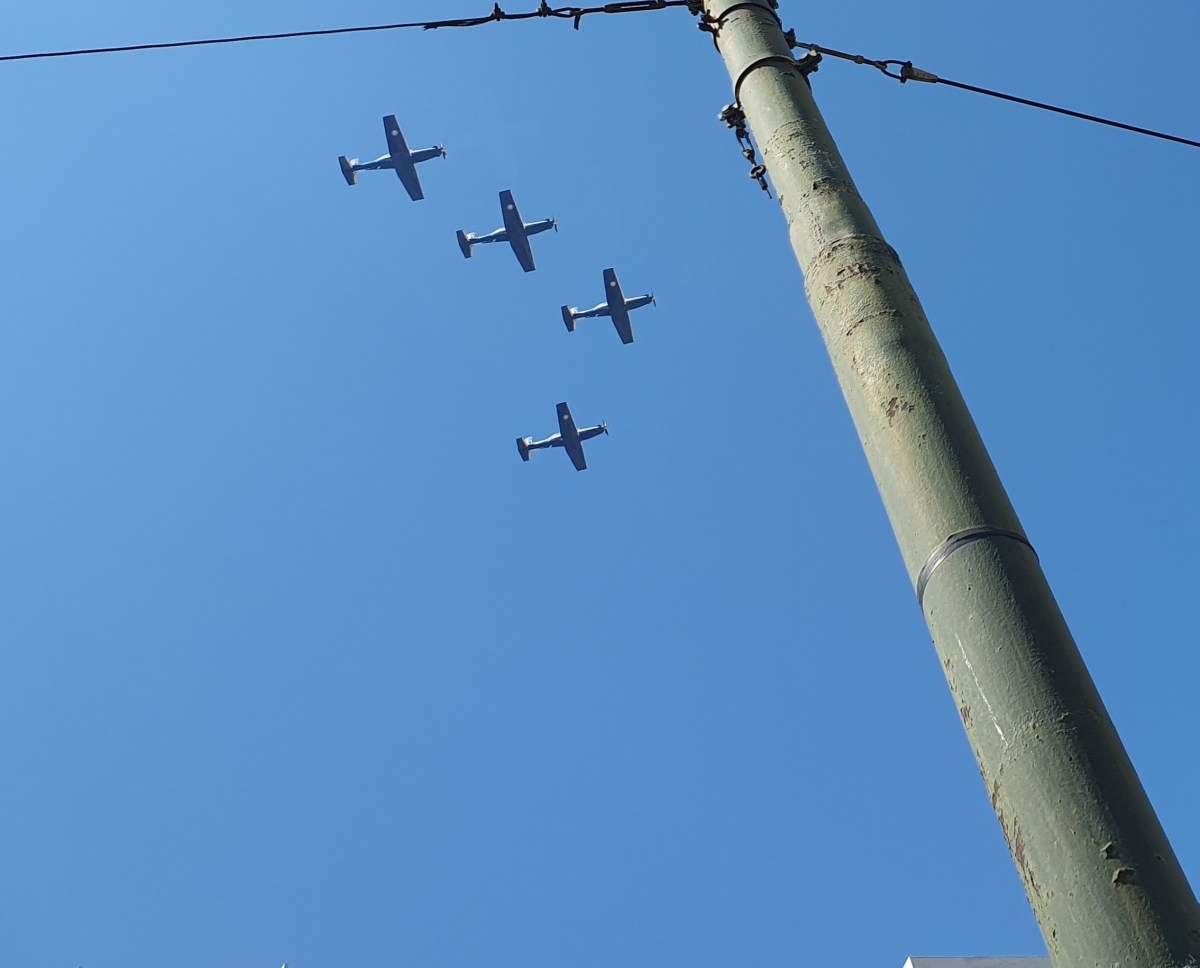
We found a coffee shop that still had tables free. I claimed a table while Jonathan waited in the very long line, but in the end we had coffee and a place to sit until the parade got underway. It may have started at Syntagma Square in the heart of downtown at 11 am, but it didn’t get down the parade route to us by the university until after 11:30. The fighter jet overflight kicked it off, followed by three more groups of four jets zooming overhead, then planes, then helicopters. (The jets went by too fast for me to get a photo.)
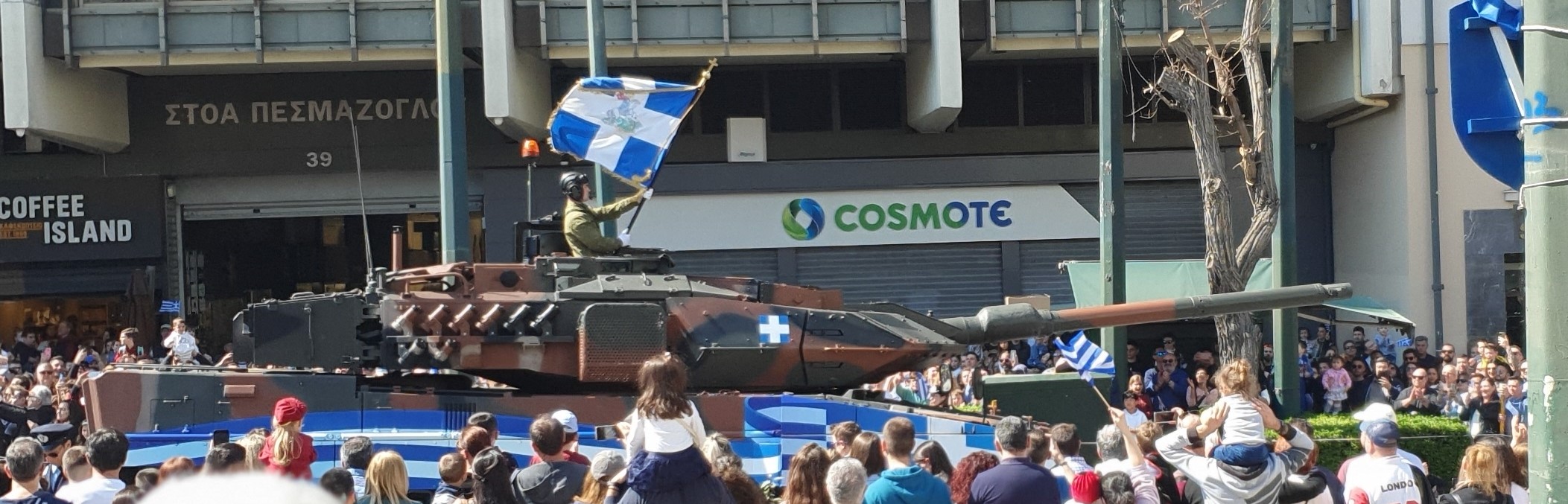
I don’t think I’ve ever been to a real military parade before. Right after the motorcycles came the artillery, troop carriers, tanks with long guns, a truckload of drones, another of missiles, and trucks full of launchers and troops in battle dress. It made me very uncomfortable.
I wondered whether the Greek government went big on military hardware as a warning to those who participated in the recent protests. Those people may not have been in attendance, as the crowd applauded the passing groups, and generally seemed strongly supportive of the military. There were supply trucks, and Red Cross trucks, but they came at the end, right before the fire trucks. The noise from the military hardware made the sides of the buildings vibrate.
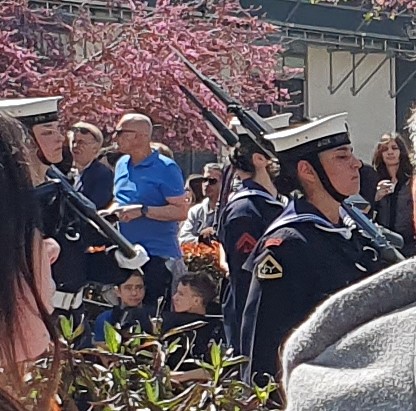
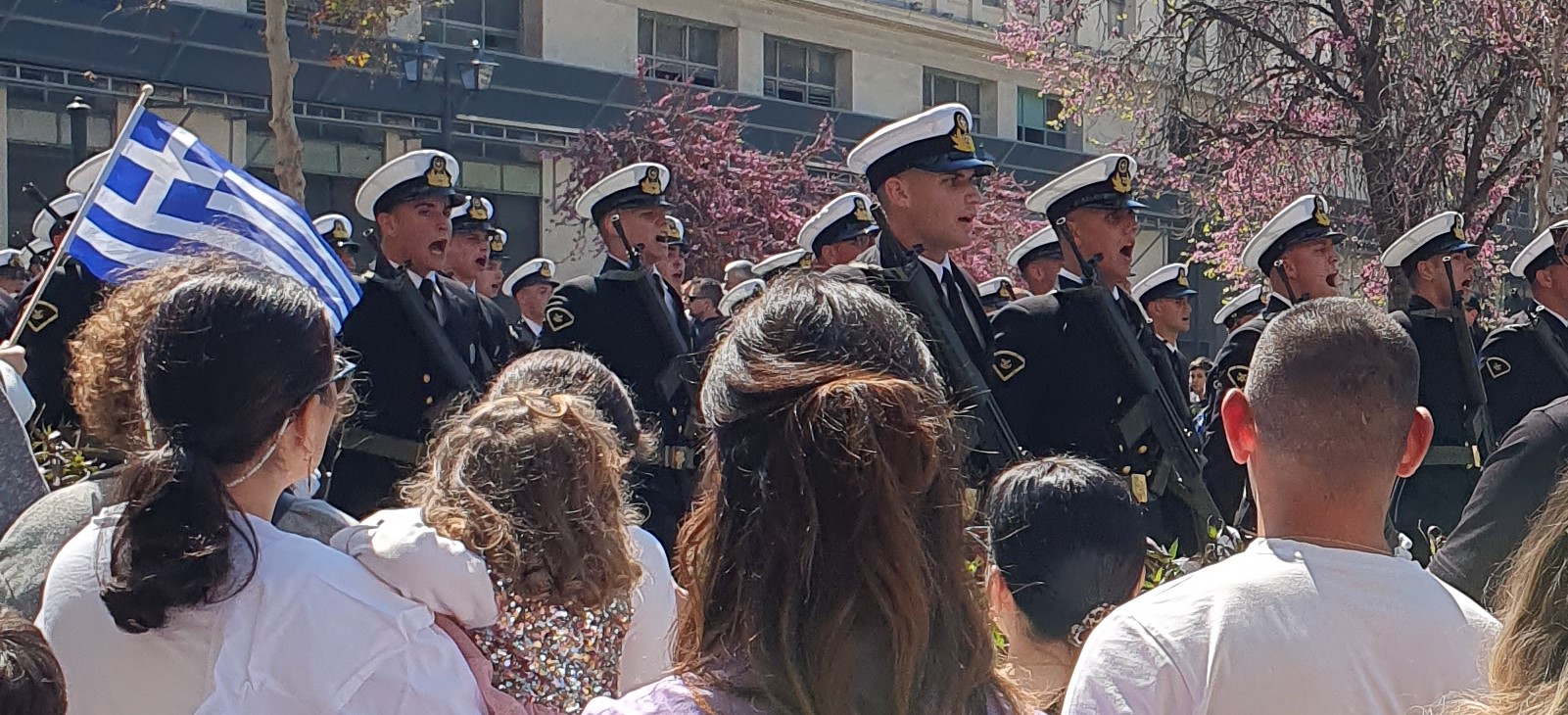
After the show of force there was a gap of another 20-30 minutes, probably because the military hardware was driven along the route going about 20 mph, while the people marching were going about 3 mph. Eventually, squads of soldiers came by, in every possible kind of uniform, hatless, red beret, green beret, helmets, flat caps, even a squad of officers all wearing navy blue jackets with gold epaulets and collar pins. There were firemen, and in their final row, a line of divers carrying scuba tanks on their backs.
It was a gorgeous sunny day, and most of the marchers must have been suffering from the heat, but they all strode along in step. Every three groups or so was a uniformed marching band. I watched a drum major hurl his baton way up in the air and saw it somersaulting back down into his hand. Impressive. I liked the music best–much less threatening than the rest of the parade.
More planes flew over, more helicopters, more groups marched. When the last group filed by, the street filled with people following the marchers toward Omonia Square, where the parade route ended. It was quite a show of military might and Greek patriotism. Lots of people waved small Greek flags and a couple of children were in traditional dress. I found it curious that the traditionally-garbed soldiers of the Parliamentary Guard who are on display every Sunday at the changing of the guard did not walk the parade route. Everyone else was there!
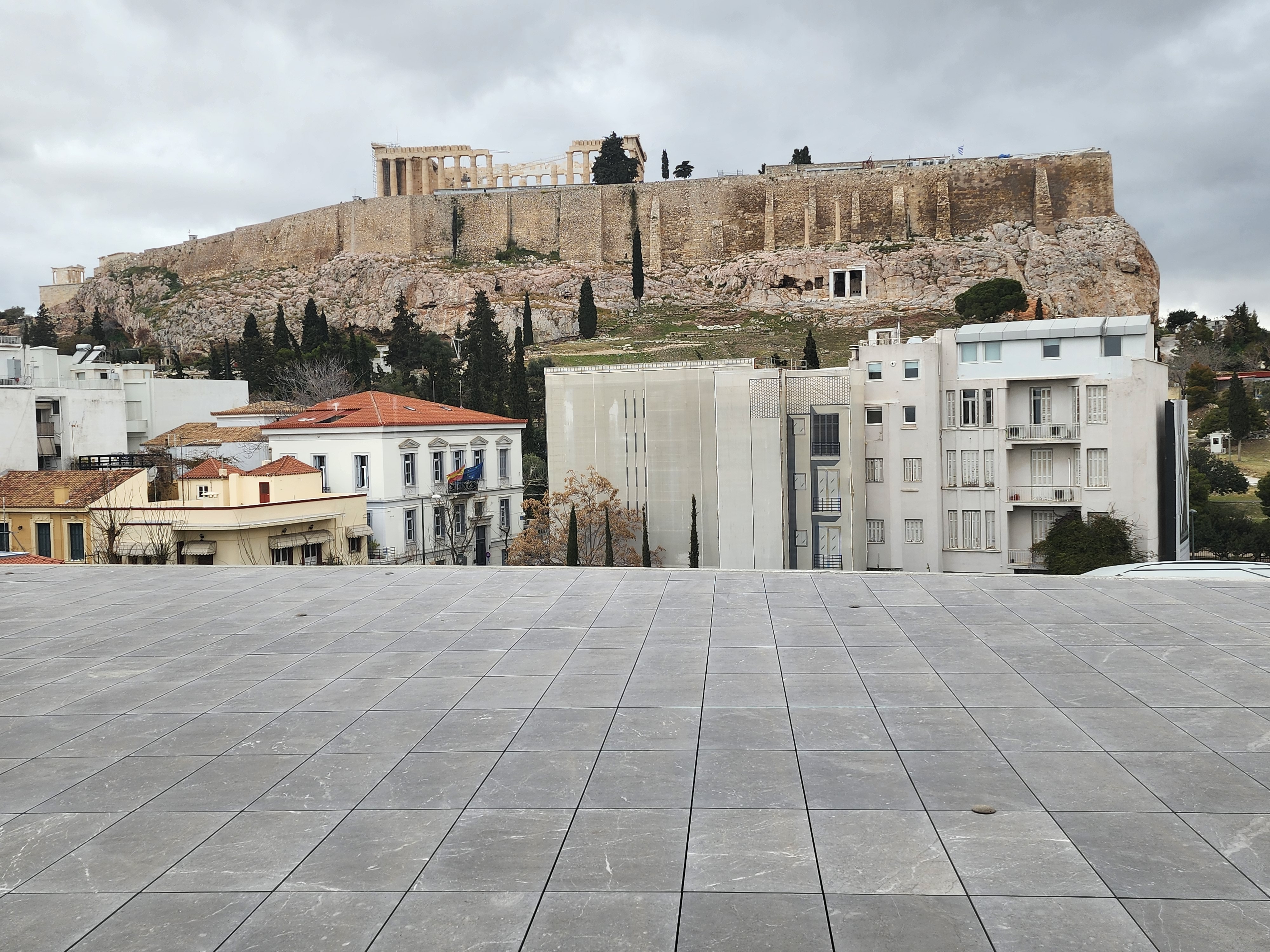
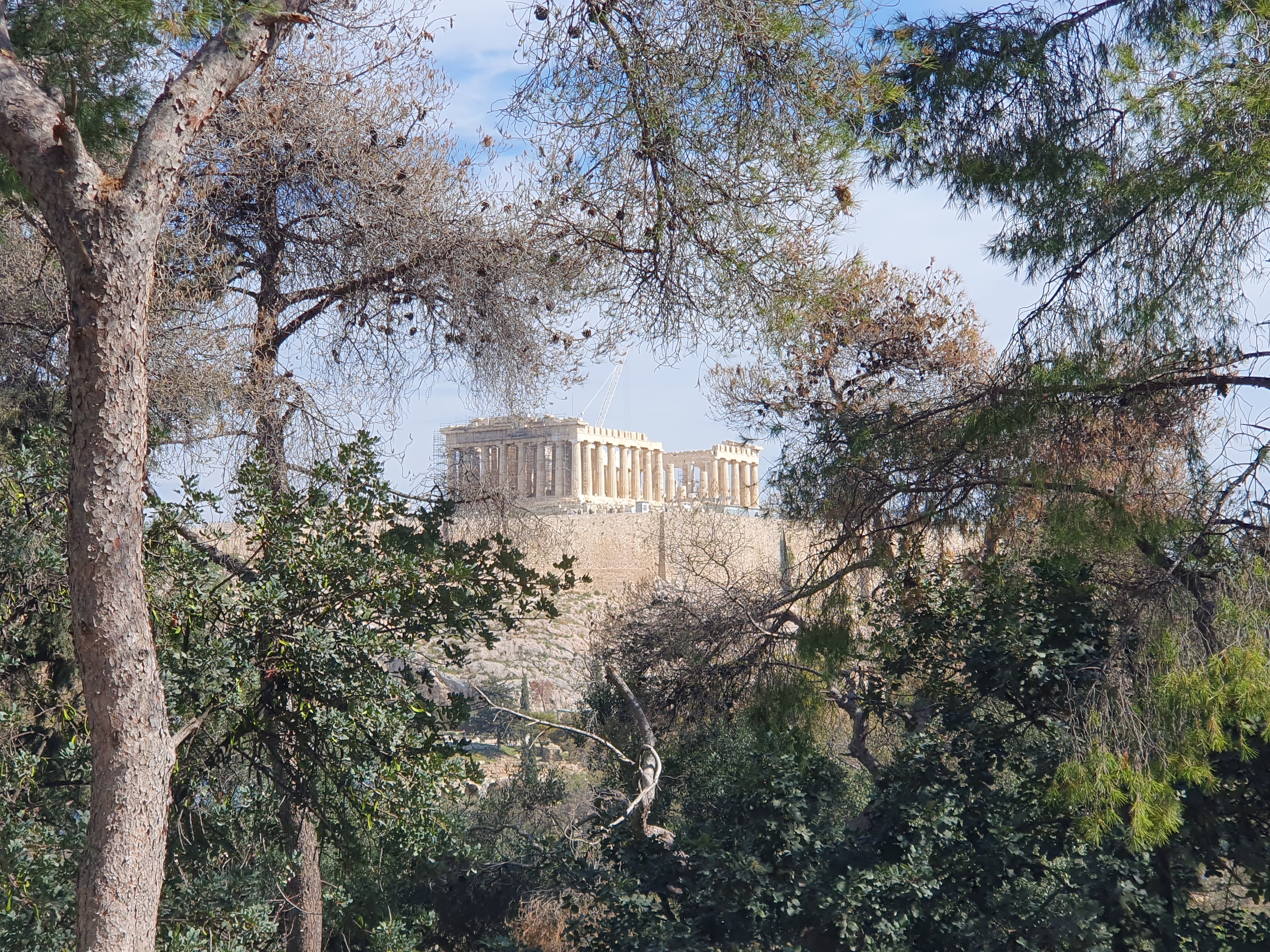
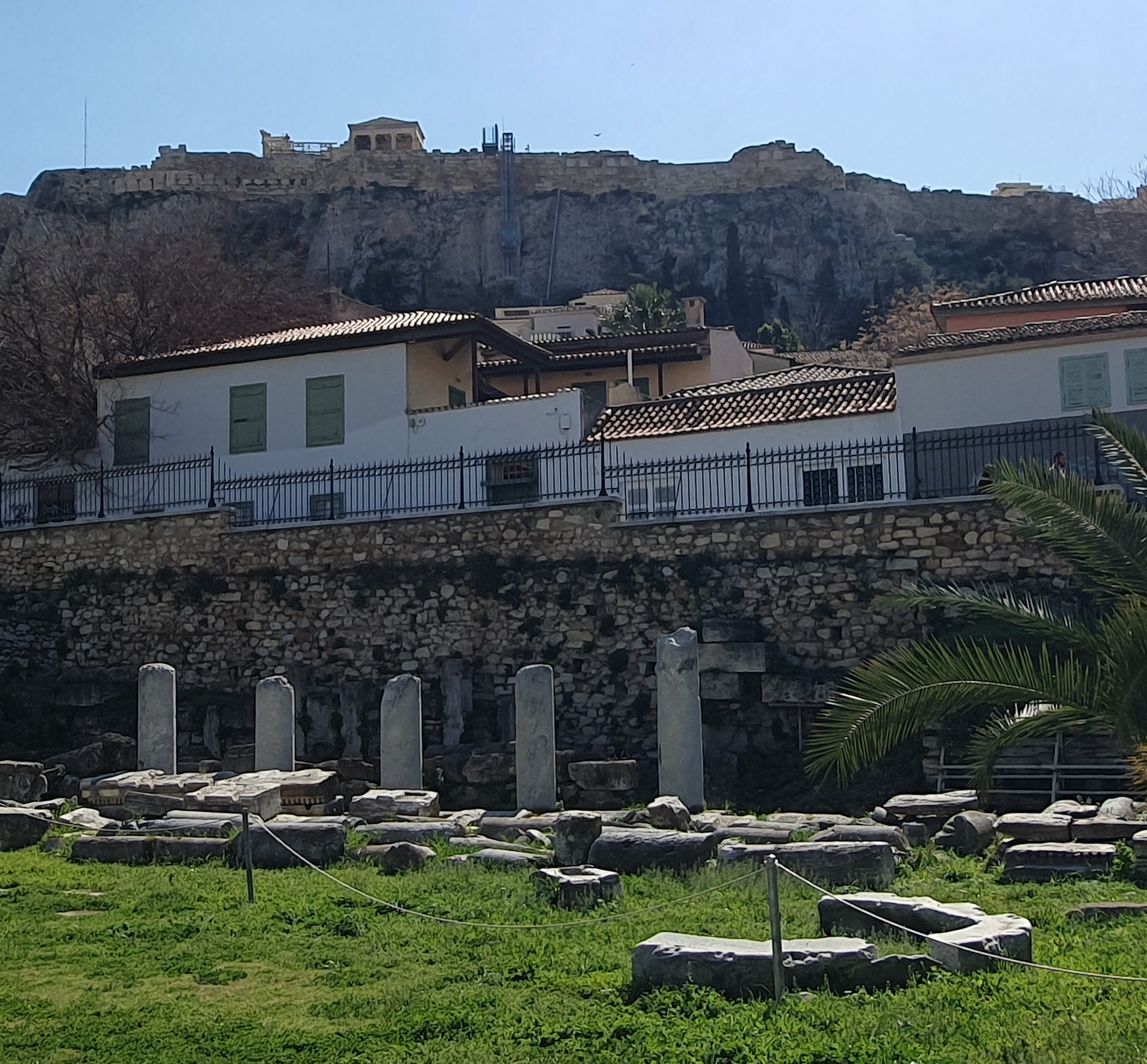
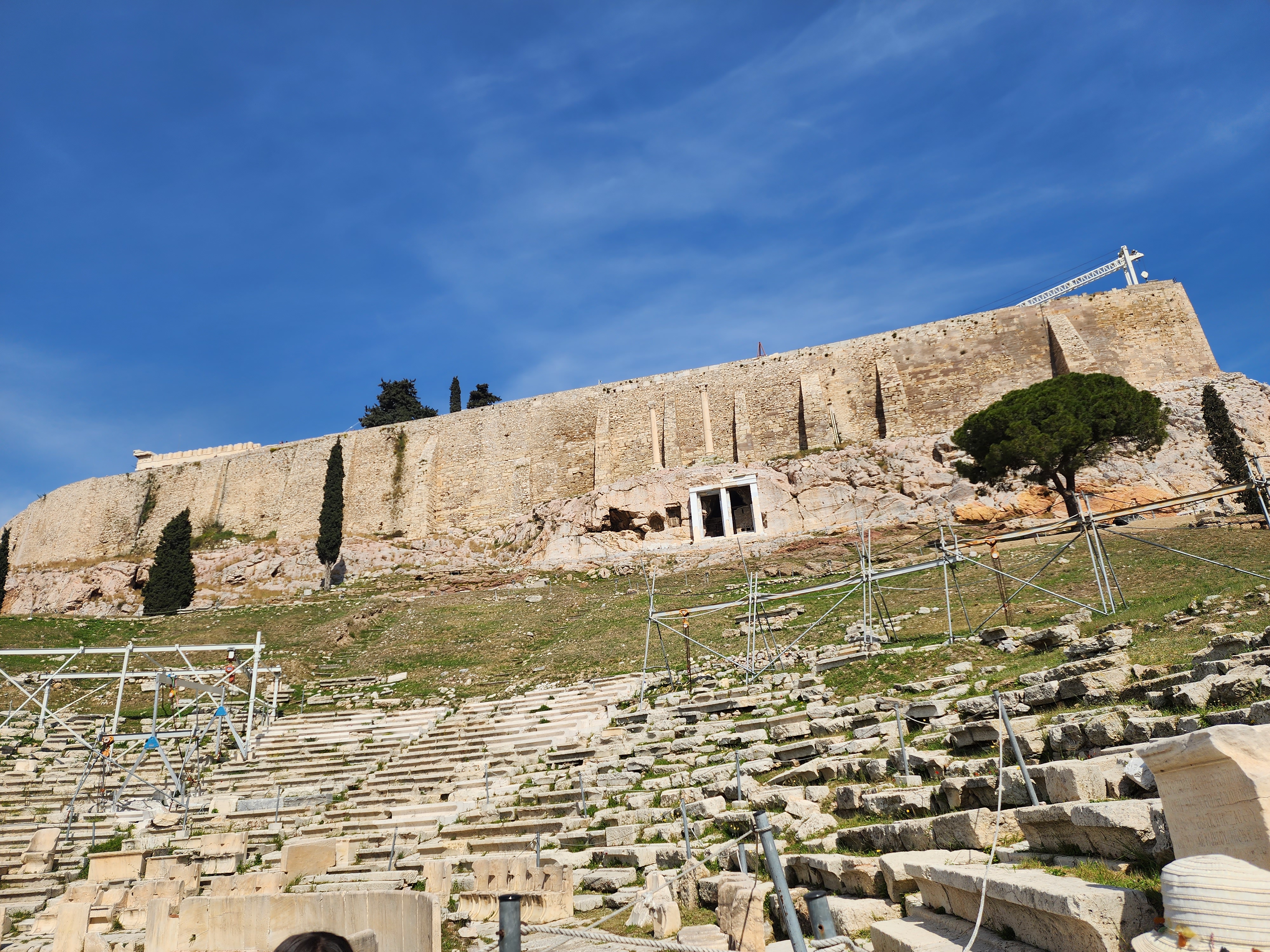
We developed our visit to Athens by seeing the Acropolis from different angles, from the tops of the nearby hills, and from the base of the hill on different sides. The Parthenon is the big central temple, and the day came when it was time to climb to the top and see it up close for ourselves.
Clockwise from upper left: Acropolis from Acropolis Museum (S); from Filopappou Hill (SW), from Lycabettus Hill (NE); from Monastiraki flea market (N); from Roman agora (N).
We’ve had lovely weather almost the entire length of our visit, and I recommend March as a good time to be in Athens–unless you are planning to swim.
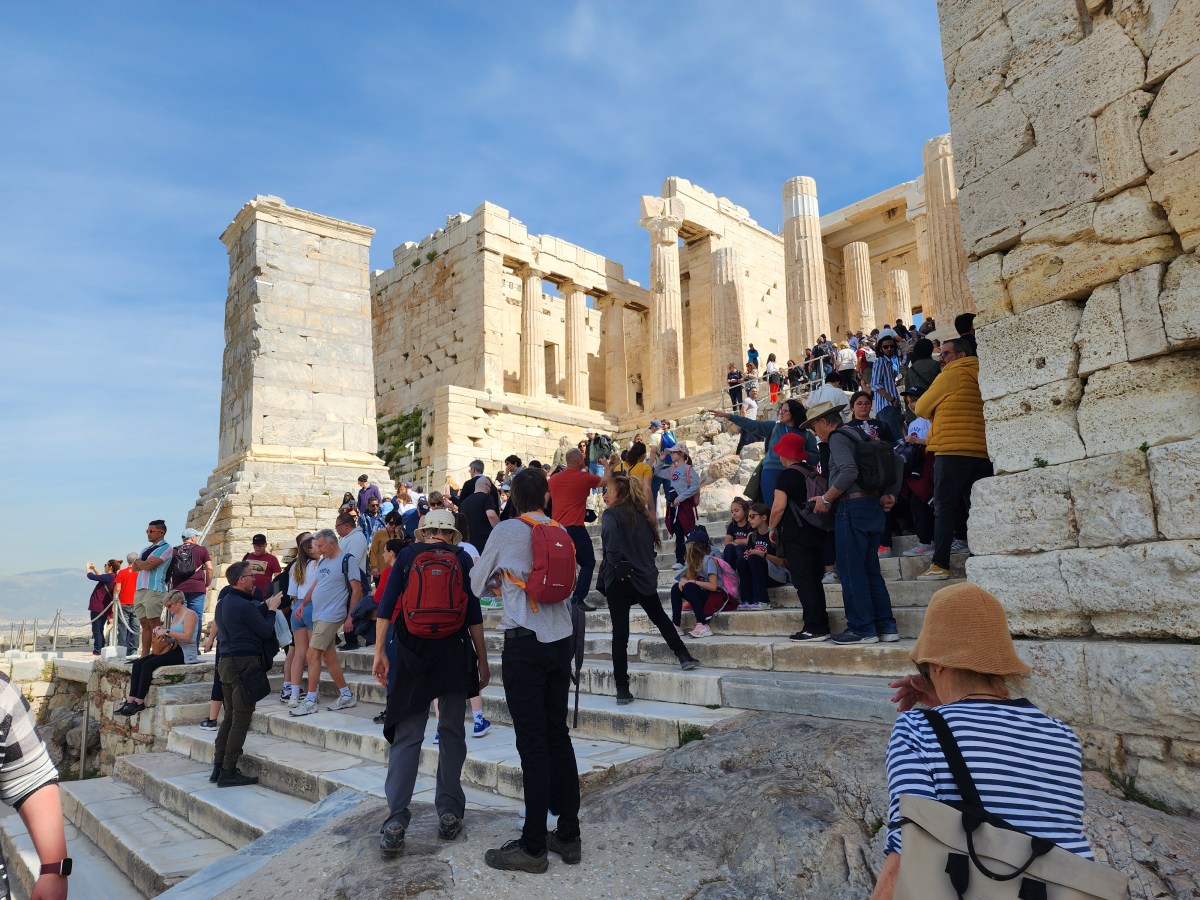
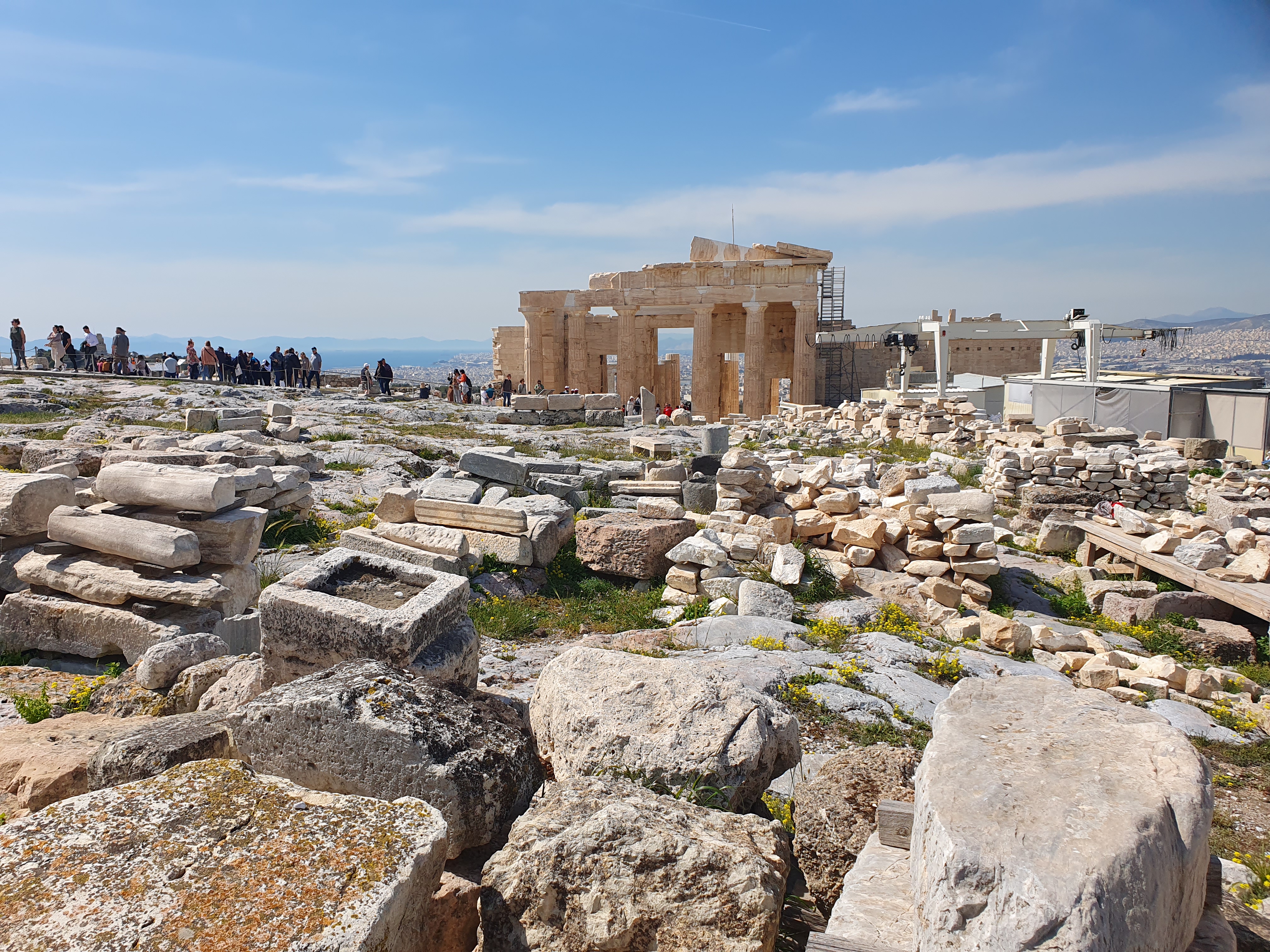
The day we chose to climb up the Acropolis was sunny and warm. By the time we reached the top, I’d shed my gloves, scarf, sweater and tied my jacket around my waist. The Propylaia was the grand entrance to the Acropolis and is still the principal entry point.
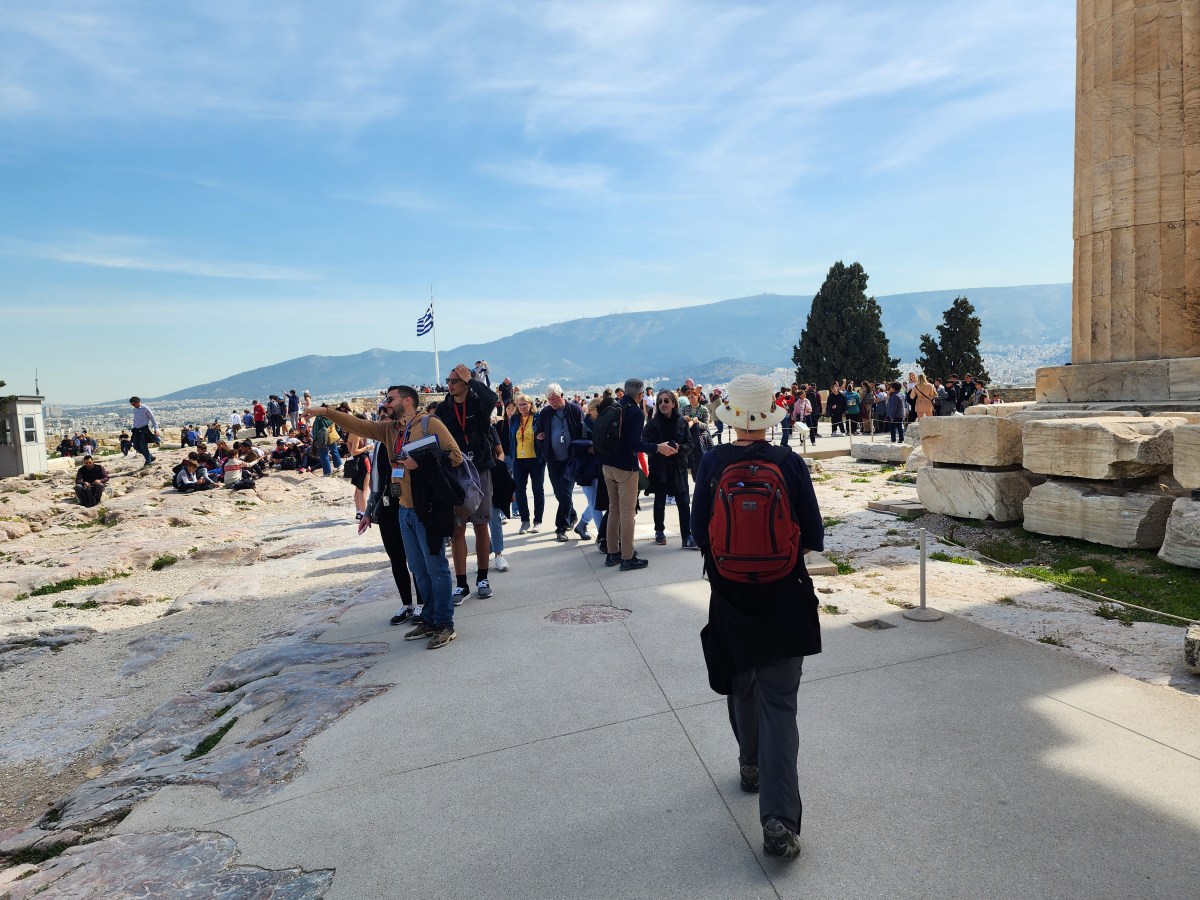
Even in March, the Acropolis is popular, and there were hundreds of our fellow visitors. (There is an average of 16,000 visitors every day, all year long.)
On the Acropolis with a few of our fellow travelers.
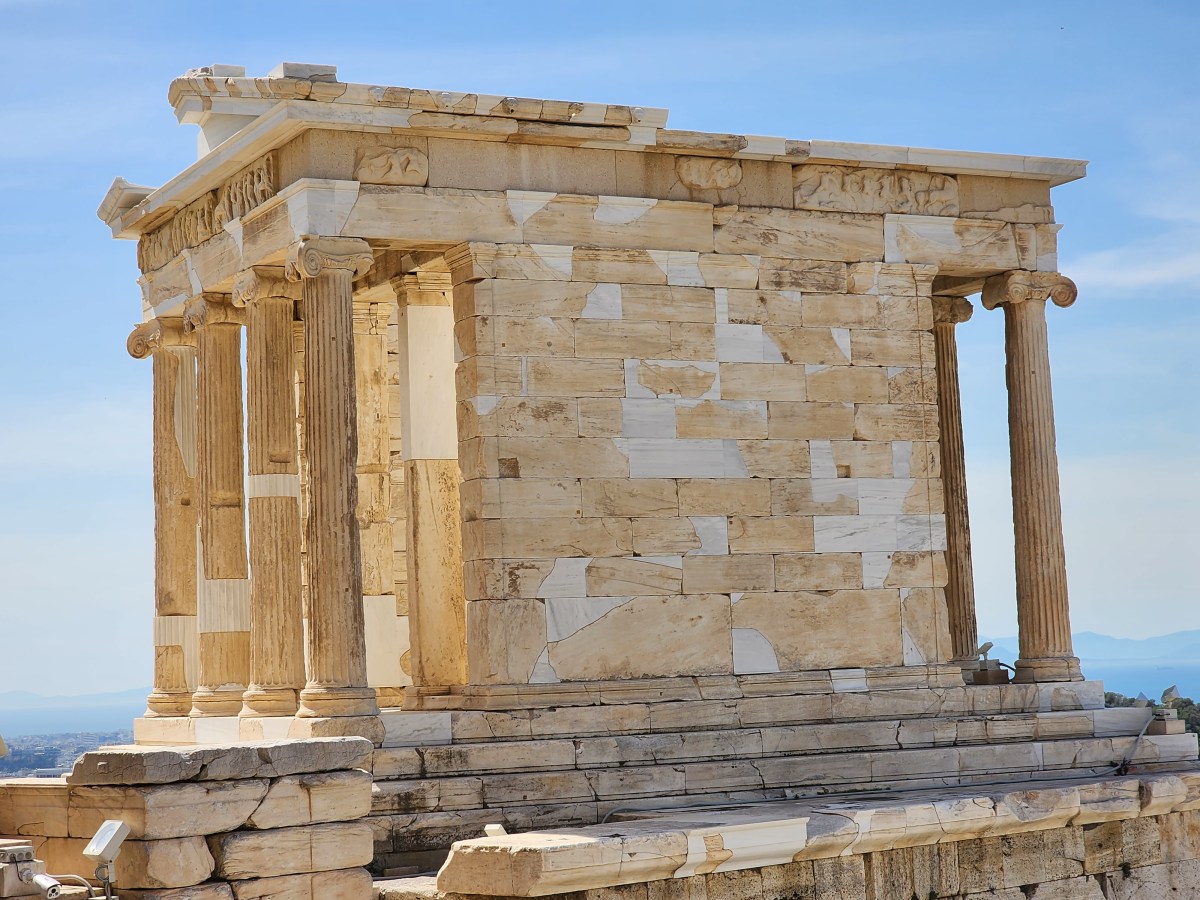
We picked our way from structure to structure, appreciating the monumental undertaking of piecing ancient temples back together from scraps. The Temple of Athena Nike (below) is a good example. First build around 425 BC, it has been completely dismantled and rebuilt, twice! Remaining carvings are in the National Museum, with replicas displayed on the reconstructed building.
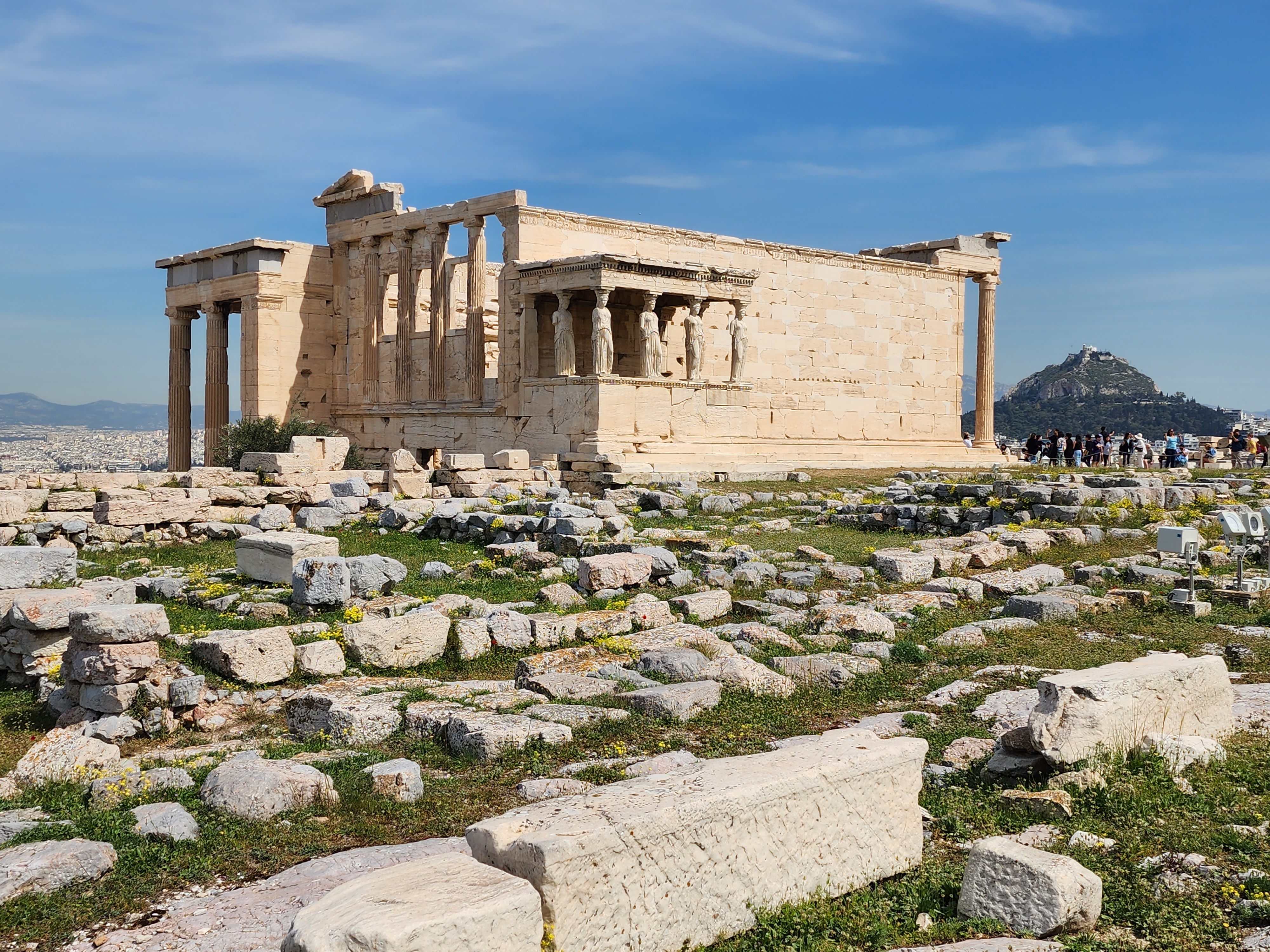
The Erechtheion is not well known to visitors, but has my favorite features of the Acropolis, the Caryatid pillars, six columns in the form of women that hold up the roof of a small side porch. The opposite side of the building has another porch that appears overly tall, as the ground slopes away and the columns fill in the space.
The Caryatid porch of the ErechtheionThe original Caryatids are now in the Acropolis Museum
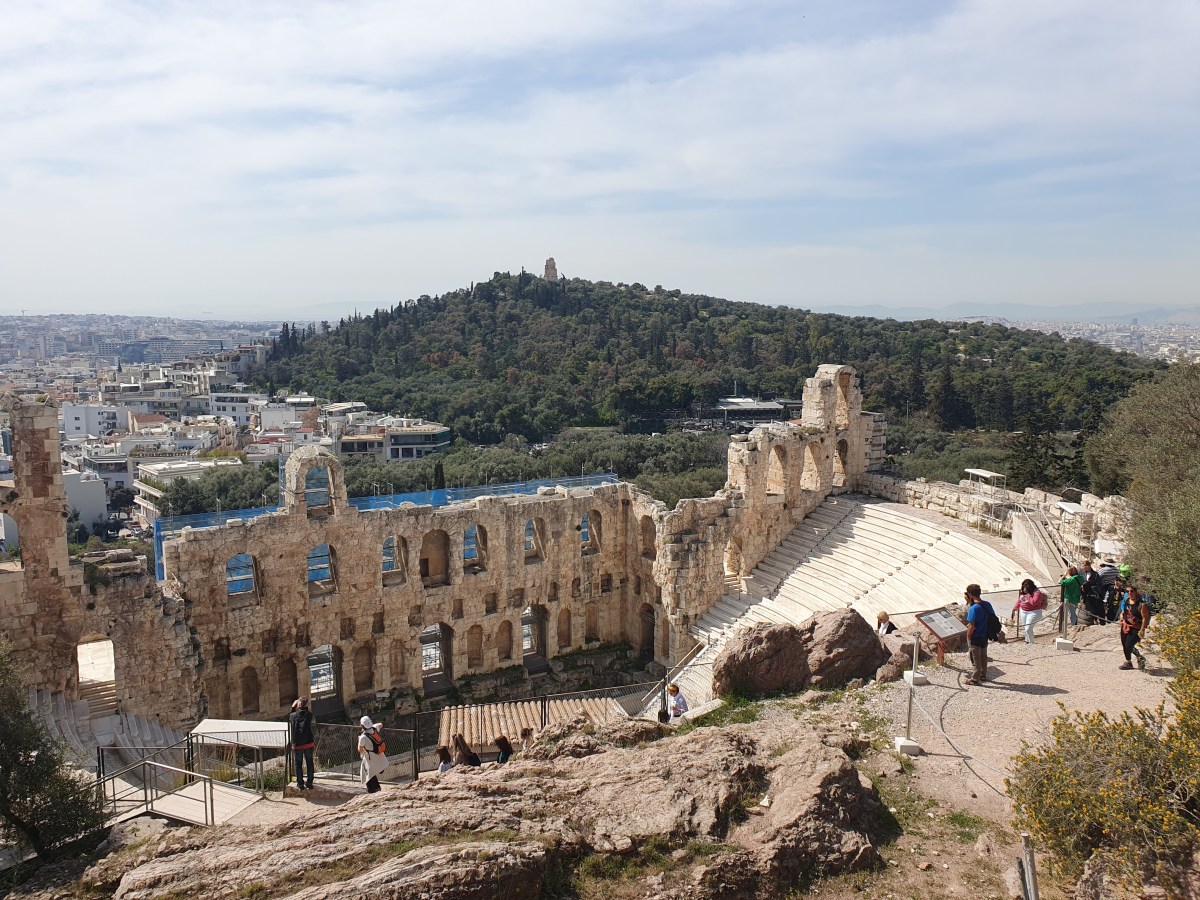
There are two amphitheaters built into the side of the Acropolis. The one below, the Odeon of Herodes Atticus, is used for some performances during the summer. Wouldn’t it be wonderful to see an opera or concert here?
The Odeon of Herodes Atticus is used as a theater today. Filopappous Hill in the background is where the mortar was positioned that blew up the center of the Parthenon in 1687.
The Dionysian Theater is larger, and seated 17,000 people when it was complete. This is where the famous authors of ancient Greece declaimed their work, and the front rows were marble thrones.
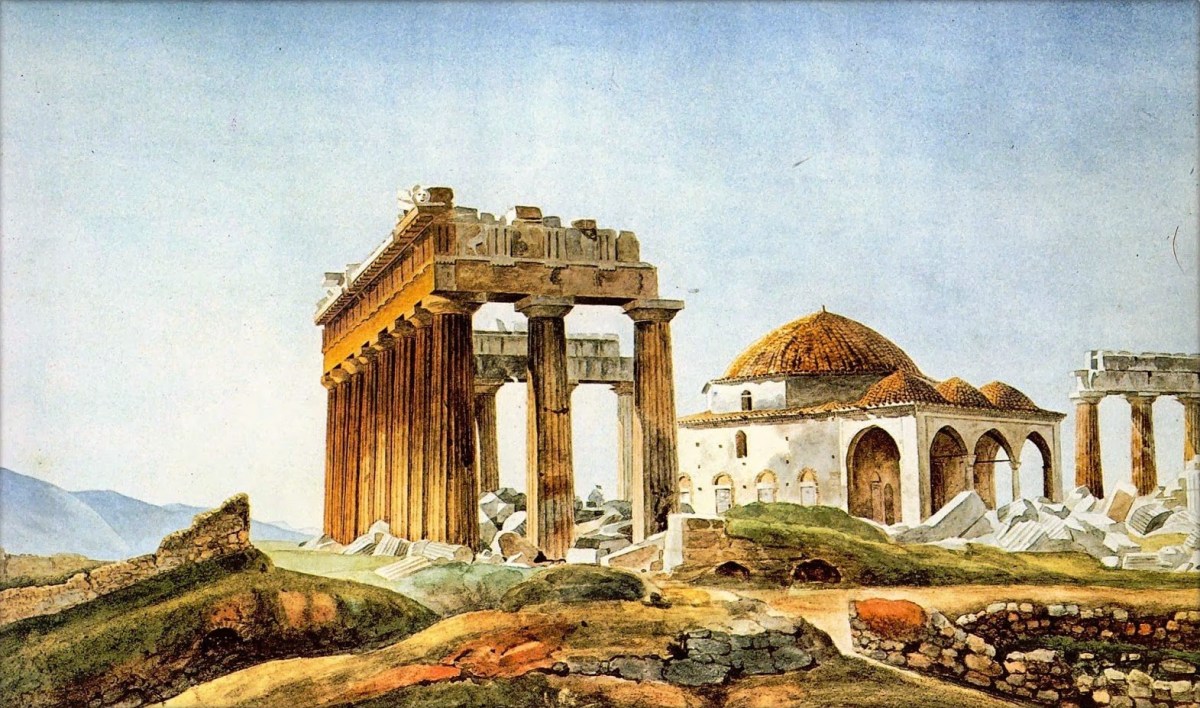
Jean-Pierre Eugene Peytier, Mosque in the ruins of the Parthenon, painted 1830s.
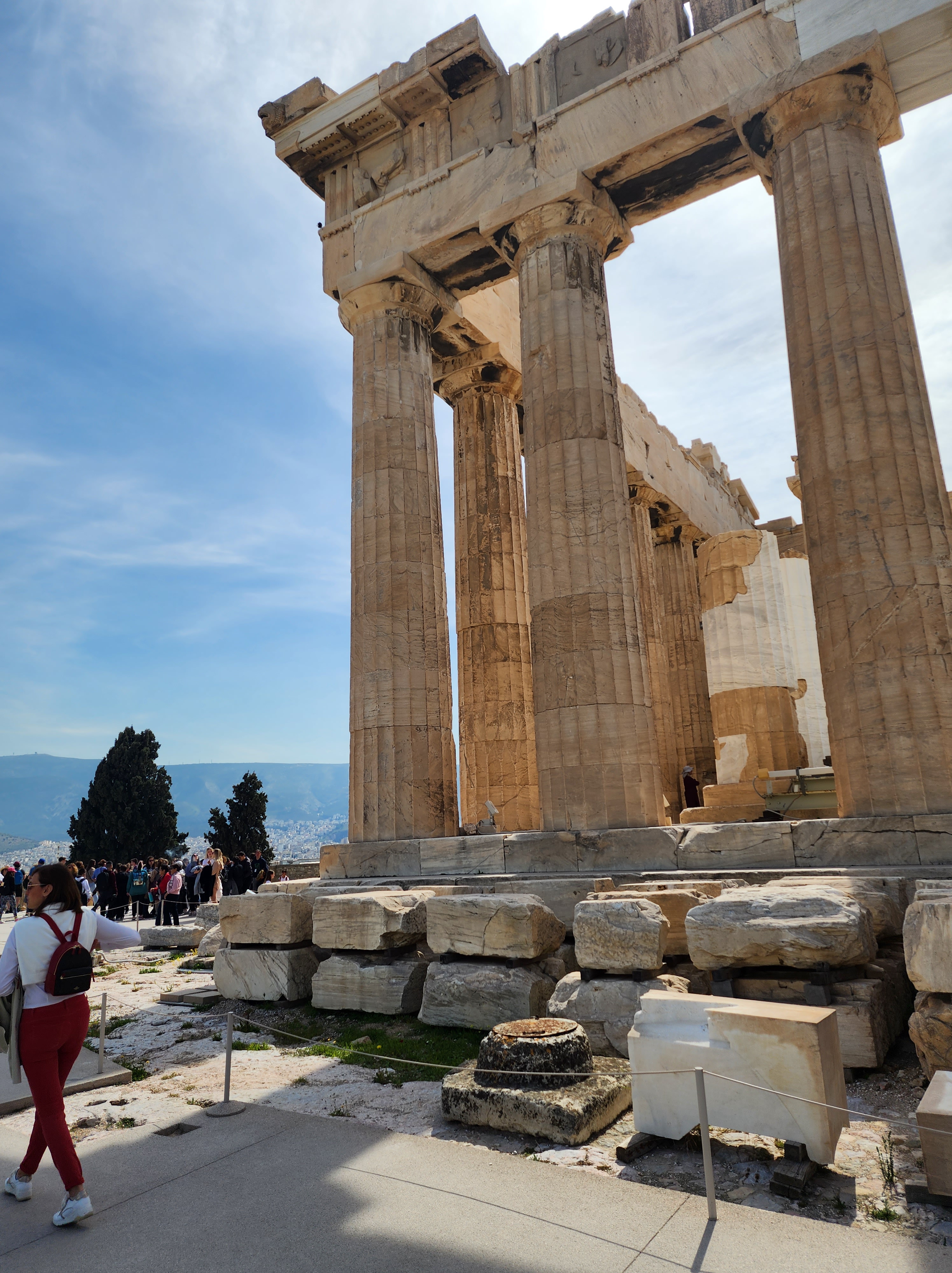
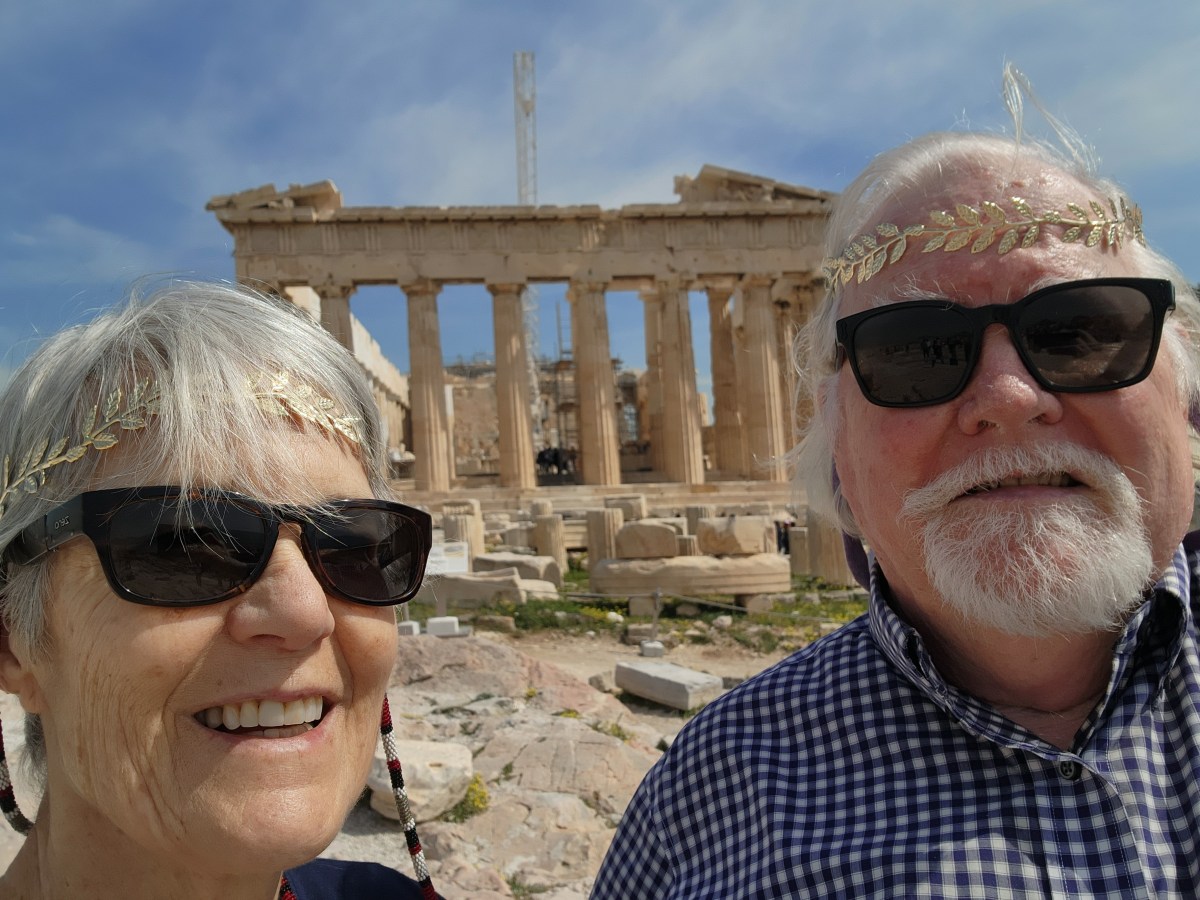
The Parthenon is very different from the Temple of Athena Nike. It is huge, and though never moved, it was reused as a Byzantine church, a Roman Catholic cathedral, and a mosque, as well as for gunpowder storage. Contemporary restoration began in 1900-1917, though that restoration was all replaced starting in 1975. Today, restoration continues, and though there is no public information, it appears that full reconstruction of the Parthenon to its original dimensions with all of its original columns is the project’s goal.
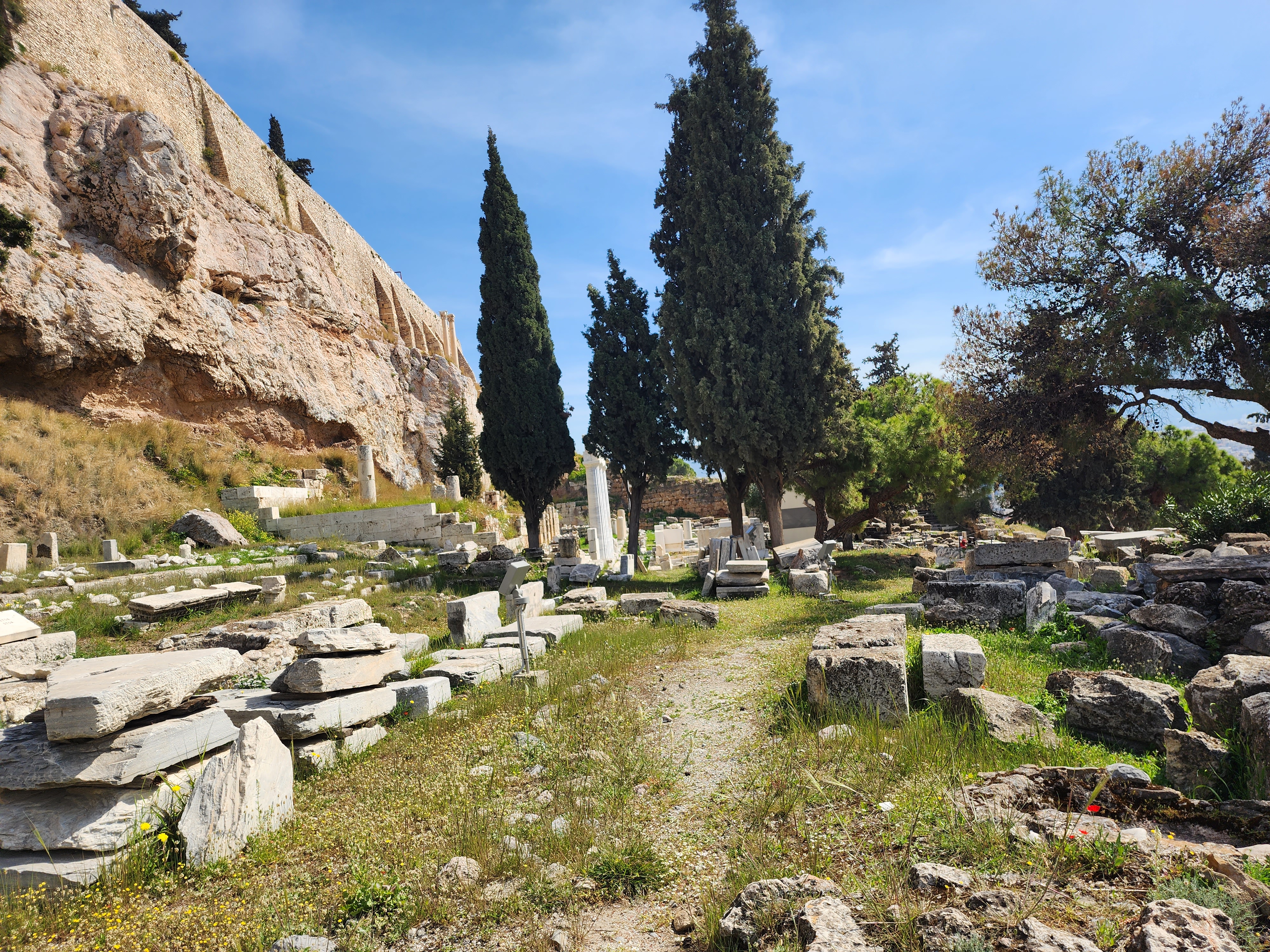
Restoration is ongoing, as we could tell from the huge crane, layers of scaffolding, and construction trailers that compete with temples for space on the Acropolis. There are a lot of pieces of columns and blocks still waiting for something to happen.
Our selfie as gods of the Athenian sphere.
The crowds didn’t bother us too much, though we had to wait our turn to take some photos while others posed for their Instagram shots. We had to pay attention to the ground, too, as it’s worn smooth from all the visitors shoes and is not only very uneven, but slippery. The climb to the top isn’t difficult, though it is uphill. There’s a lift, but it is tiny and mostly used by people in wheelchairs.
There are also lovely views out over the city and the hills we’ve climbed during our stay.
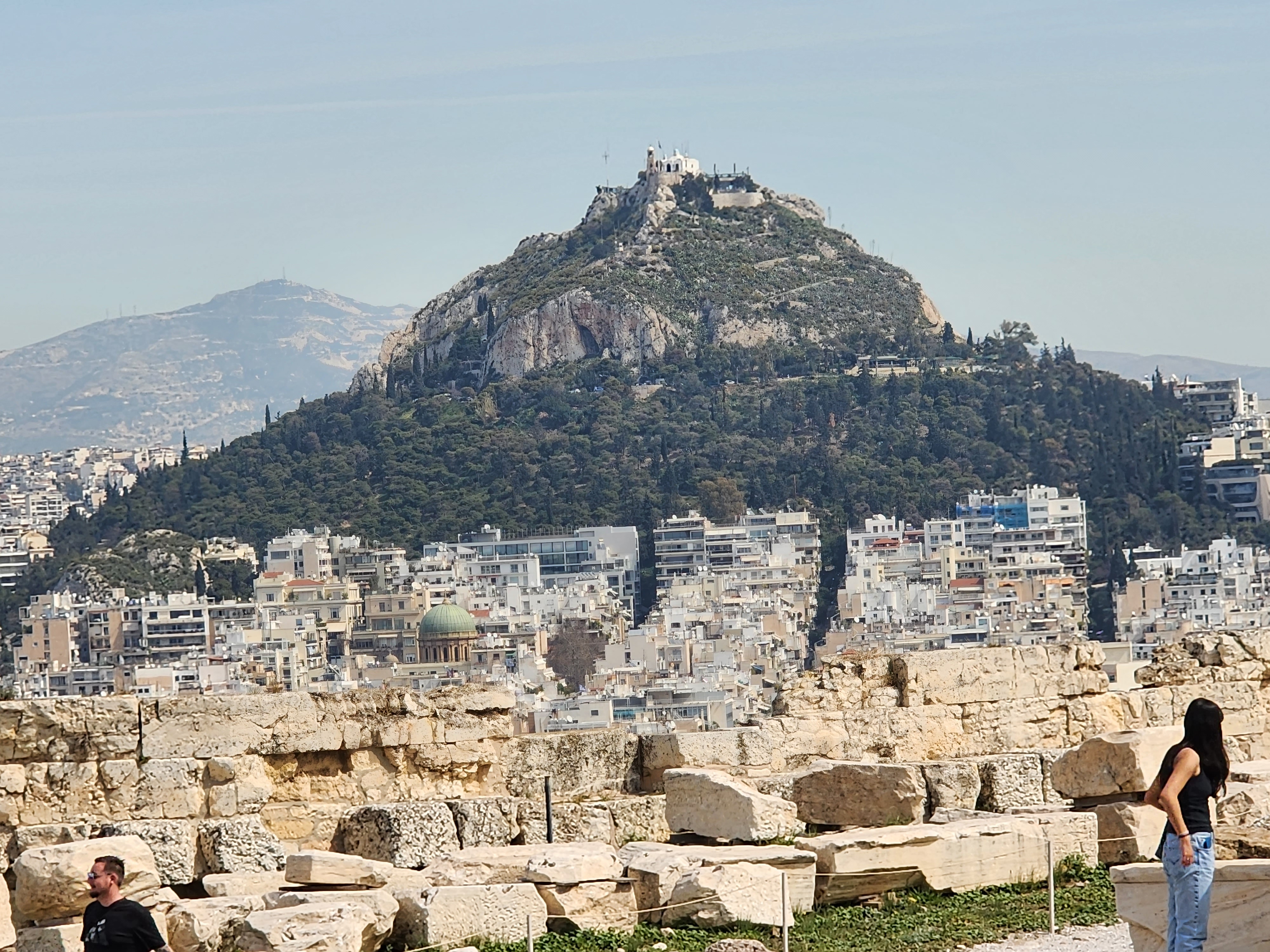
L: Looking over the ancient agora and Athens R: Lycabettus Hill from the Acropolis
We left with more questions than when we arrived. It was an excellent field trip.
Some years ago when Greek authorities were trying (again) to convince the British Museum to return the marble sculptures from the roof of the Parthenon (the Elgin Marbles), it was said that should the sculptures be returned, the Greeks didn’t even have a decent place to put them. That stirred people up.
Everything in Athens is built on ruins, these are under the Acropolis Museum
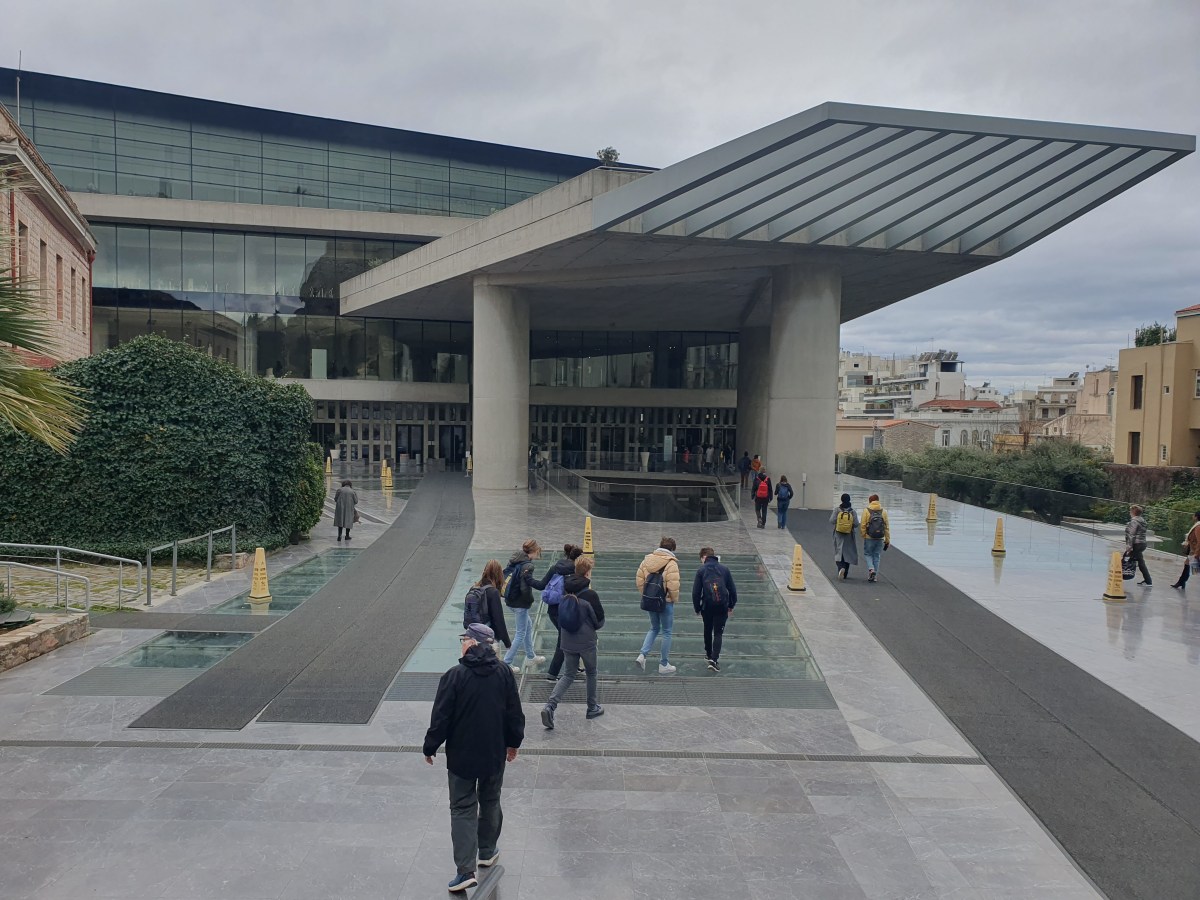
The Acropolis Museum is the Greek response. Completed in 2009, it is a spacious contemporary space tucked in at the foot of the Acropolis. There was a small museum on the Acropolis itself that was chock full of finds from continuing excavation and restoration. The new museum displays many of these items, like votive statues buried to honor Athena, or pottery offered to the various shrines on the Acropolis. As you enter the museum, the main hall is a ramp leading up, lined with cases that show fine examples of pottery, metal work, stone carving, and jewelry. There is information about each type of craft product.
Arriving on the landing of the second floor, you are surrounded by statuary, and there is a lot to see. The highlight for me was the caryatid statues, pillars in the shape of women, that held up the porch of one of the important buildings on the Acropolis, the Erechtheion. The figures are indoors now, and copies have taken their place as porch supports.
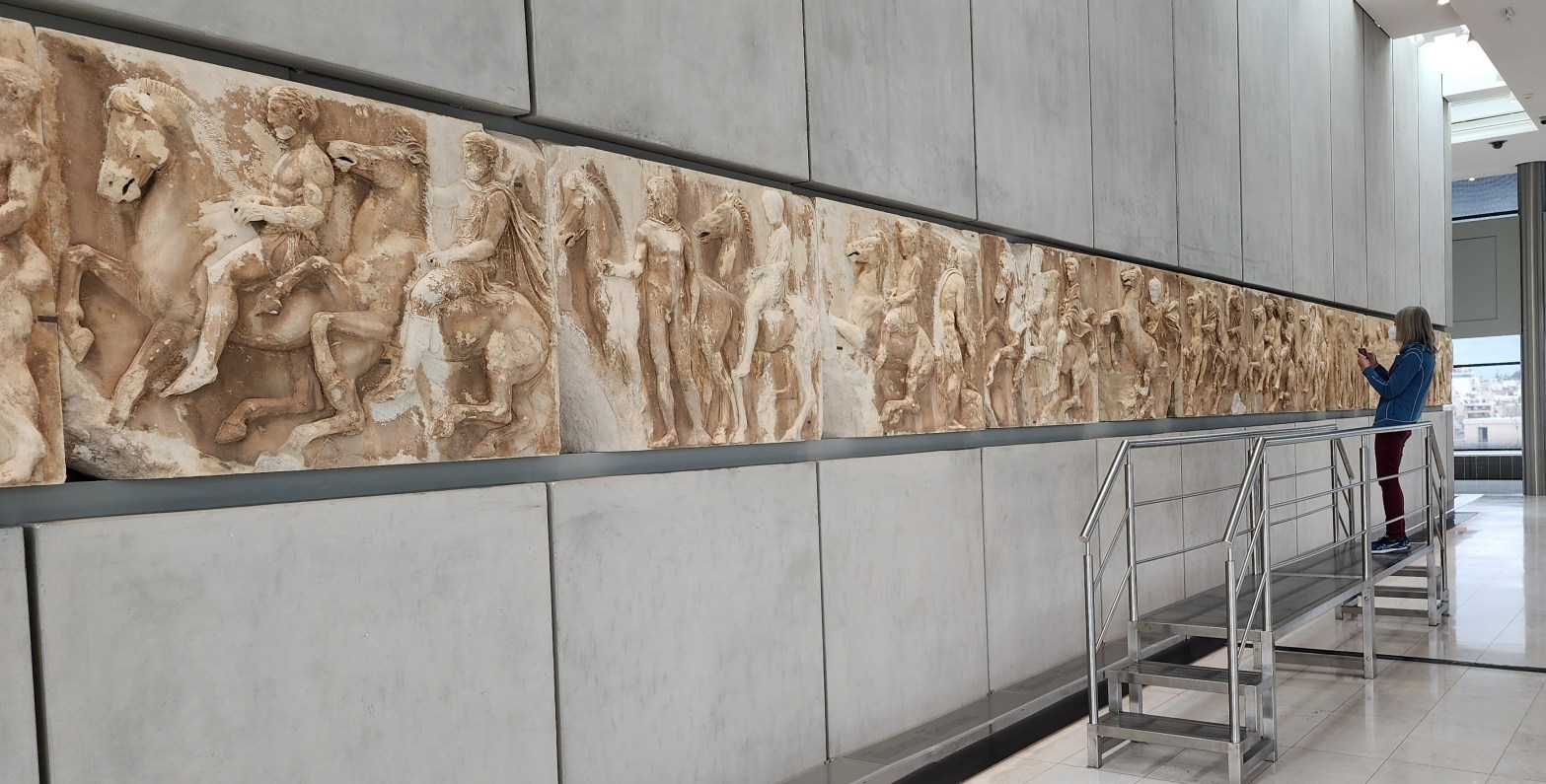
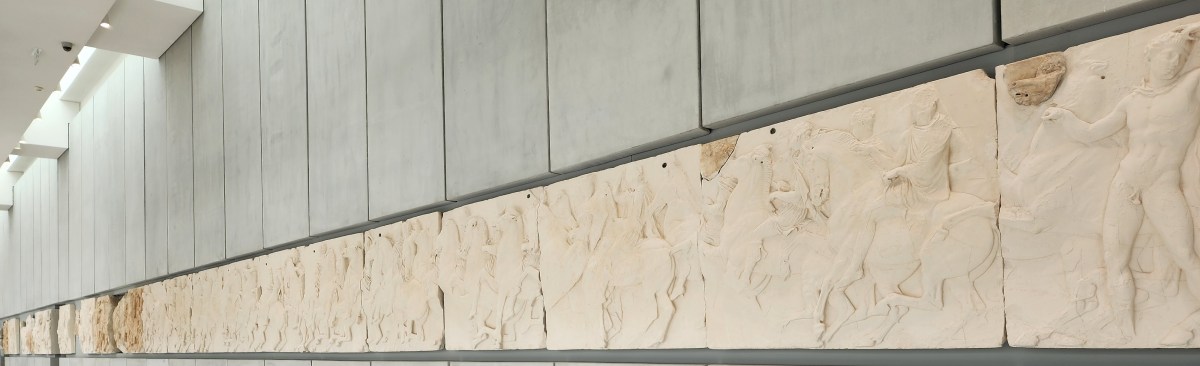
The highlight of the museum is intended to be the third/top floor, where the surviving sculptures from the roof of the Parthenon are positioned at eye level. You can see all the detail of the pieces, AND you can see the spaces that are available for the pieces still in London, should a deal ever be struck to return them to Athens. No one can say there isn’t an appropriate place waiting for the fragments of sculpture to be returned.
There is lots more to this story. During the early 1800s, Thomas Bruce, 7th Earl of Elgin, was a diplomatic representative of Britain to the Ottoman Empire, and at the time, the Ottomans controlled Greece. As part of his diplomatic mission, Bruce commissioned drawings of ancient monuments and artifacts in Greece with the goal of making Greek culture more widely appreciated back in Britain. The sculptures called The Elgin Marbles were collected by employees of Bruce from the ruins of the Parthenon.
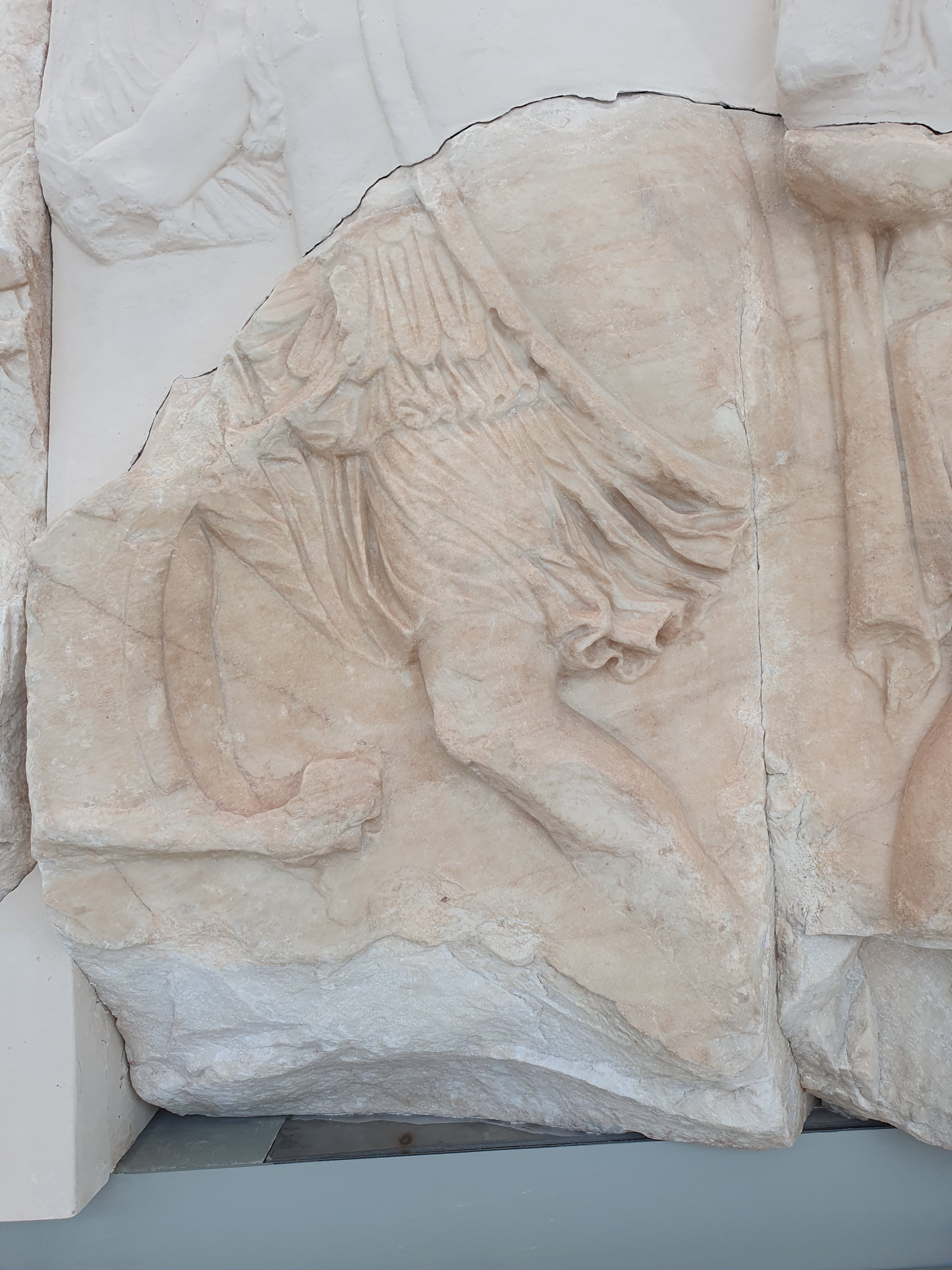
Original pieces of this frieze are the darker tan color, the paler sculpture is a reproduction. As pieces are found or repatriated, they are added. Sketches made in the 1600s were used to create what is missing.
Have you noticed that the sculptures are all in pieces, sometimes small ones? Explosions from gunpowder stored in different structures on the Acropolis demolished the Propylaea in 1656, and the main structure of the Parthenon under shelling in 1687. When the earl’s artist and laborers began to copy remains on the Acropolis around 1800 (more than 100 years later) they found pieces of sculpture on the ground and began to collect them. The ambitions of the group shifted from copying to recovery, and surviving pieces were collected, taken down from the surviving sections of the roof, and shipped to England. Elgin was eventually investigated for taking the remains illegally. He claimed possession of a firman, or permit, to collect what his people could find. He was cleared of charges in England, and the collection was purchased for the nation in 1816. They’ve been in the British Museum ever since.
That is just the short version of the tale. Shipwreck lost the collection, divers recovered it after three years; Elgin and his wife were crossing France on their return to England when war broke out and he was held prisoner, eventually released with a promise to return to France if required. Elgin’s pregnant wife was allowed to return to England before him, and he got home to find her having an affair with a good friend. He sued both of them, for divorce and monetary damages (and won). He remarried and had an additional seven children, but ended his days back in France, where he moved to escape his creditors. He took a bath on the sale of the marbles, getting paid only half of what it actually cost him to move the sculptures to England. (Does this sound like a curse to you?)
Wikipedia has a lot of detail, and there is controversy among scholars around the world on whether the acquisition of the sculptures was legal in the first place.
In recent years, the repatriation of important works of art to their countries of origin has happened with increasing frequency, but in the case of the Elgin Marbles, the UK is a holdout.
Another tiny piece of the sculpture was returned to Greece from Sicily in 2022. The fragment was originally obtained by the collector and British consul to Sicily in 1809, Robert Fagan, who bequeathed it to his wife. She sold it to the Royal Museum of the University of Palermo, an entity from which the Regional Archaeological Museum was formed and from where the piece was returned.
And so it goes. The Acropolis Museum stands ready to receive its ancient patrimony, if and when ongoing secret negotiations between Greece and the UK lead to an agreement. The museum is well worth a visit, and there could be a great adventure novel written about the sculptures.
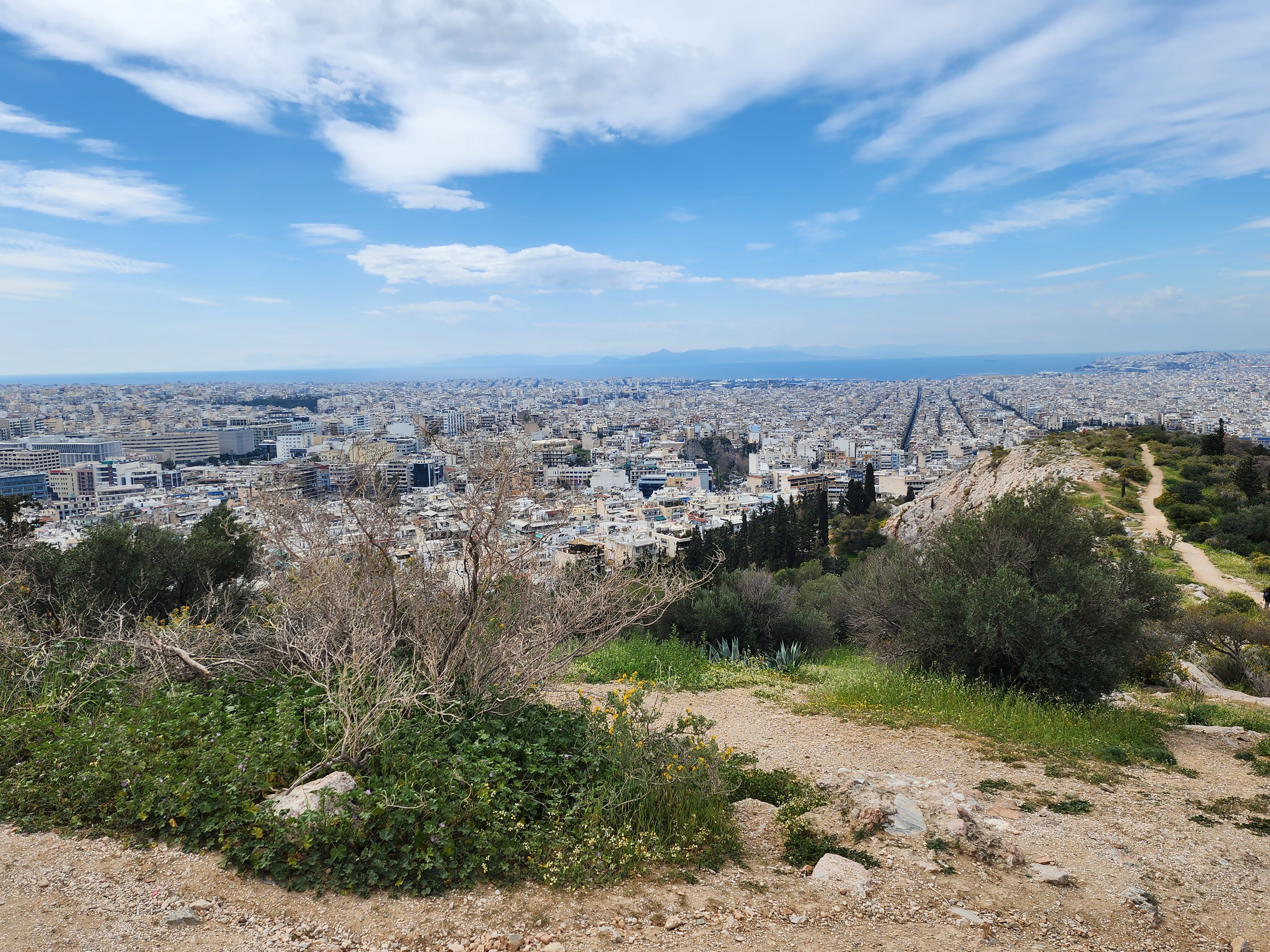
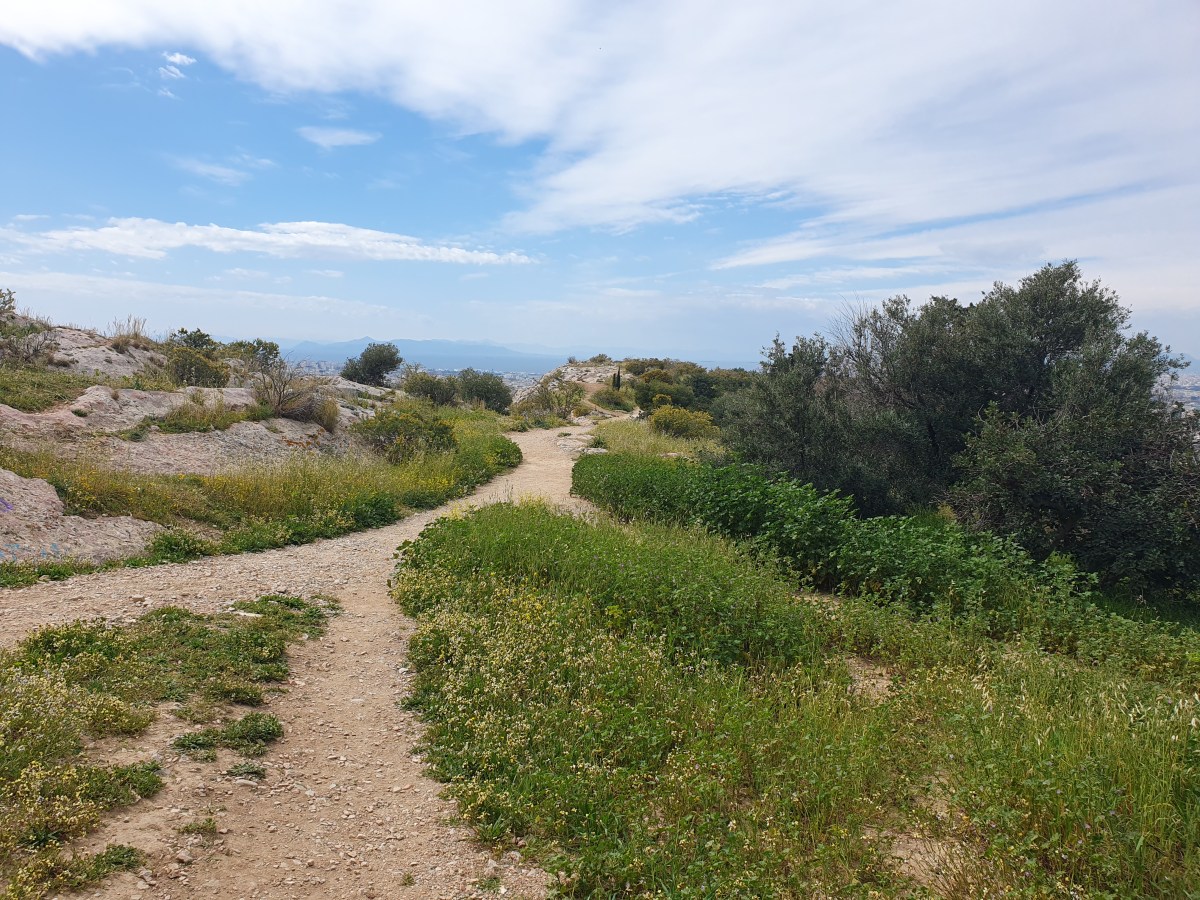
An advantage of spending an entire month in Athens is being able to take walks without feeling our time will vanish. Yes, we’re visiting archaeological sites and museums, but we took another walk up a hill, this time overlooking the Acropolis from the south. Filopappou Hill is a park with a few ancient monuments on it. The entrance is across from the tour bus entrance to the Acropolis. Paths crisscross the slopes, and it’s an easy walk to the top.
Just a few steps into the park we heard birdsong and spent a few minutes birdwatching. We’d even brought our binoculars. A Great Tit, Coal Tit, and a Chiffchaff (gotta love bird names), and we went back to strolling. Tiny wildflowers are in bloom, white stars, yellow cups, and very small deep red poppies.
The peak of the hill holds the Monument of Filopappos, the remains of a monument to a Roman consul built about 500 years after the Parthenon. Not much remains. From the top, there is a walk down a spur of the hill to the south with a view over the sea in the distance.
The park extends quite a bit further to the south and west, but we decided to stick with the hill and went to overlook the Acropolis. Every step provides a slightly different view. We walked back and forth taking photos.
View of the Acropolis, with Lycabettus Hill in the distance (to the right of the Parthenon)
Filopappou is much closer to the Acropolis than Lycabettos, my previous hill, which we could see on the opposite side of the Acropolis. The view of the ruins is even more spectacular at this closer spot.
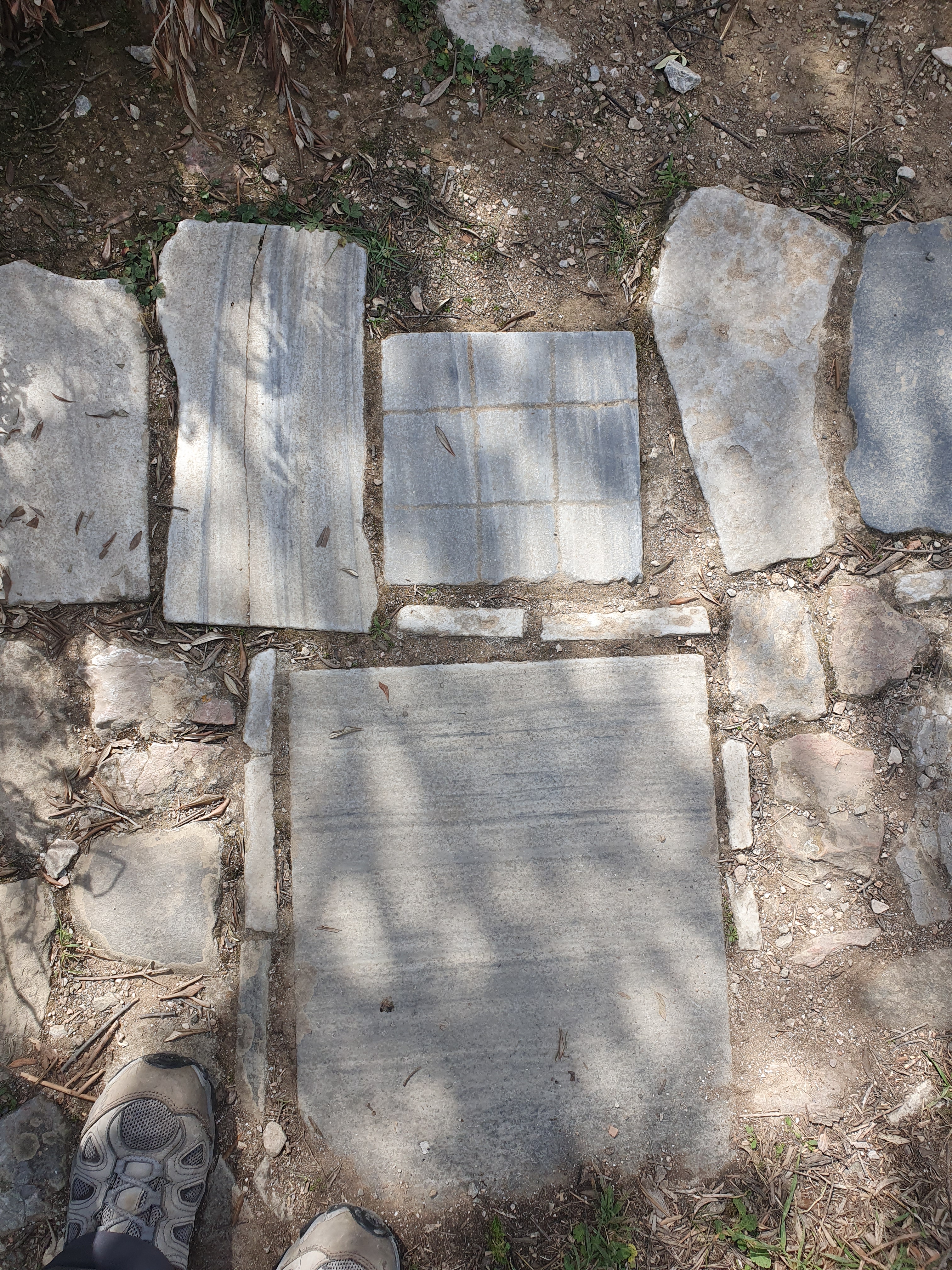
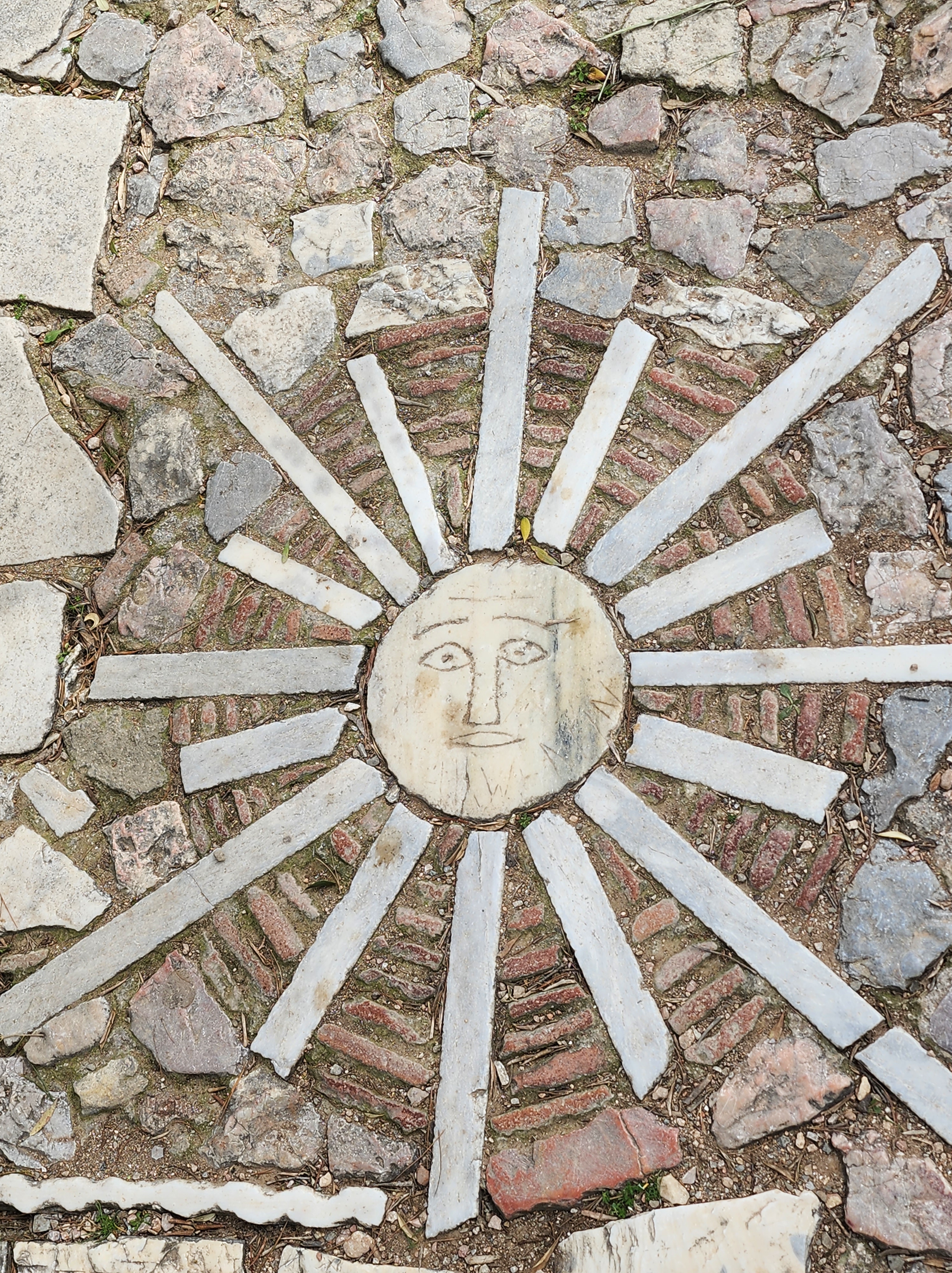
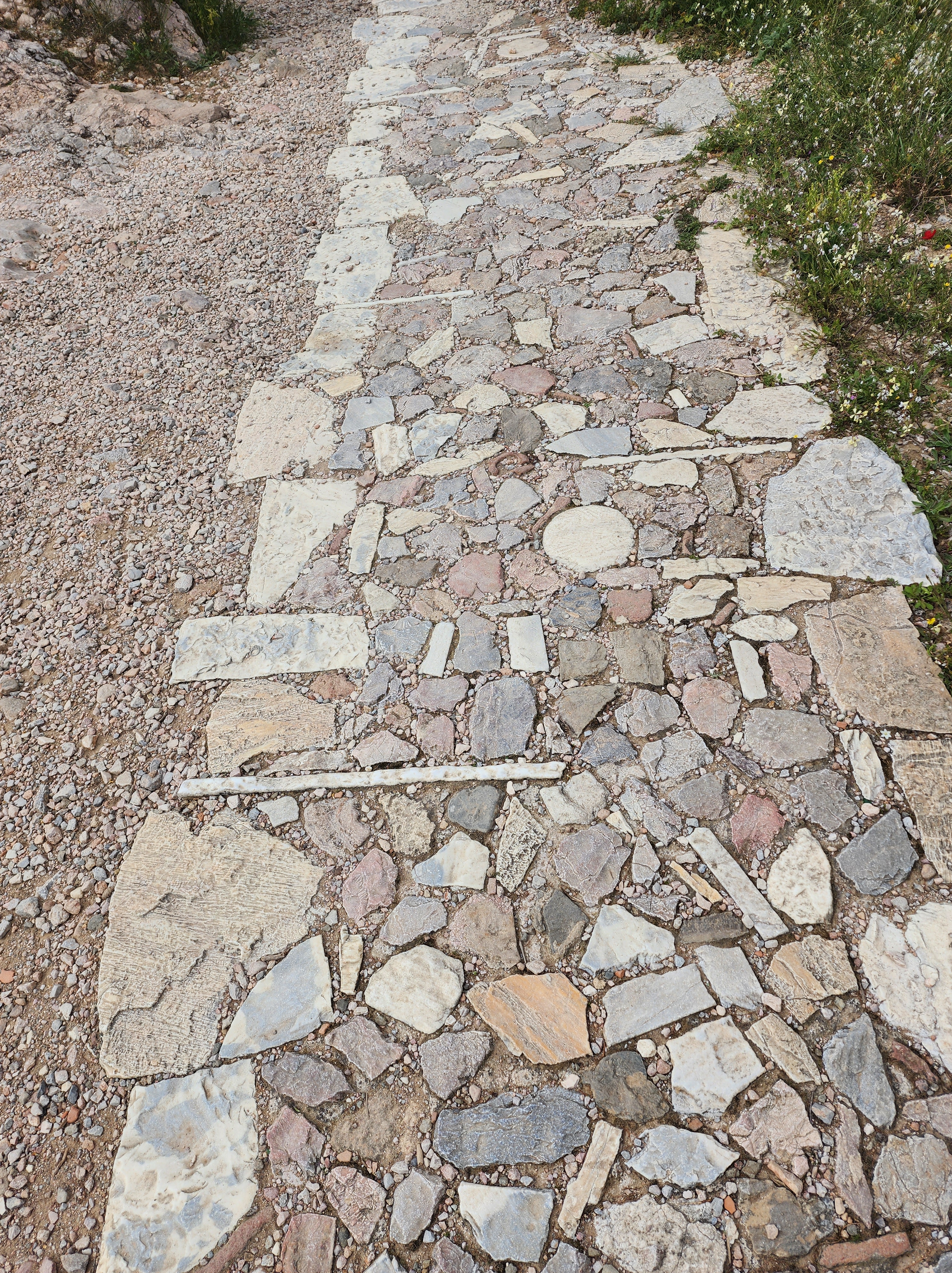
There are some decorative patterns set in the path up the hill. The materials include pieces of marble, worked and unworked, along with local stone. It’s interesting to walk along and look for reused pieces, and for the different patterns.
At the end of our walk, we stopped at Dionysus Zonar’s. There is a Zonar’s cafe nearer our house that was recommended to us. This is the Acropolis version. We sat outdoors with a view over the Acropolis and had drinks and shared a club sandwich. My passionfruit spritz was delicious. No one seems to mind when we share an item to eat, and it keeps us from taking home leftovers most of the time. The restaurant was nearly empty at 1 pm. If tour groups don’t stop here, the crowds won’t build up until later in the spring. (Fine with us.)
Getting Around
We took a taxi to the starting point, partly because it’s a bit of a walk from the nearest Metro station (Akropolis) to the starting point by the bus parking and we wanted to put our energy into the walk, not the to and fro. I’m very happy with the taxi app our Airbnb host recommended, FreeNow. Taxis arrive right away and there’s no need to load a credit card, as the drivers will take cash. The furthest from us a taxi has arrived is across the street. With Uber in the US, I’ve had to walk a block or two to my meeting point (getting charged for being late).
FreeNow helped us get home, too. When we emerged from our stop at Zonar’s, there was a line of cabs along the sidewalk, but when we spoke to a driver, he spun us a story about how there might be a demonstration (we knew there was not), and he’d have to make a big circle, thus the price would be 15 E. Apparently, drivers wait for tourists from the Acropolis, alarm them with tales of strikes and police action, and charge double. We thanked the guy, tried a second driver in line with the same results, then used the app, got picked up in two minutes, and paid 8 E for the same trip (gave him 10 E, just because). I recommend the FreeNow app for Athens.










































































 Llywindatravels 2025