We followed “The Pictish Trail” around our area, checking out the Pictish Stones. These highly carved upright stones may have been grave markers, and were carved between about 200-800 AD, mostly in northern Scotland. The Picts are a mysterious group, best known for these distinctive carved stones. They were early converts to Christianity, said to have been converted by St. Columba. This also explains the crosses that are usually carved on one side of these stones.
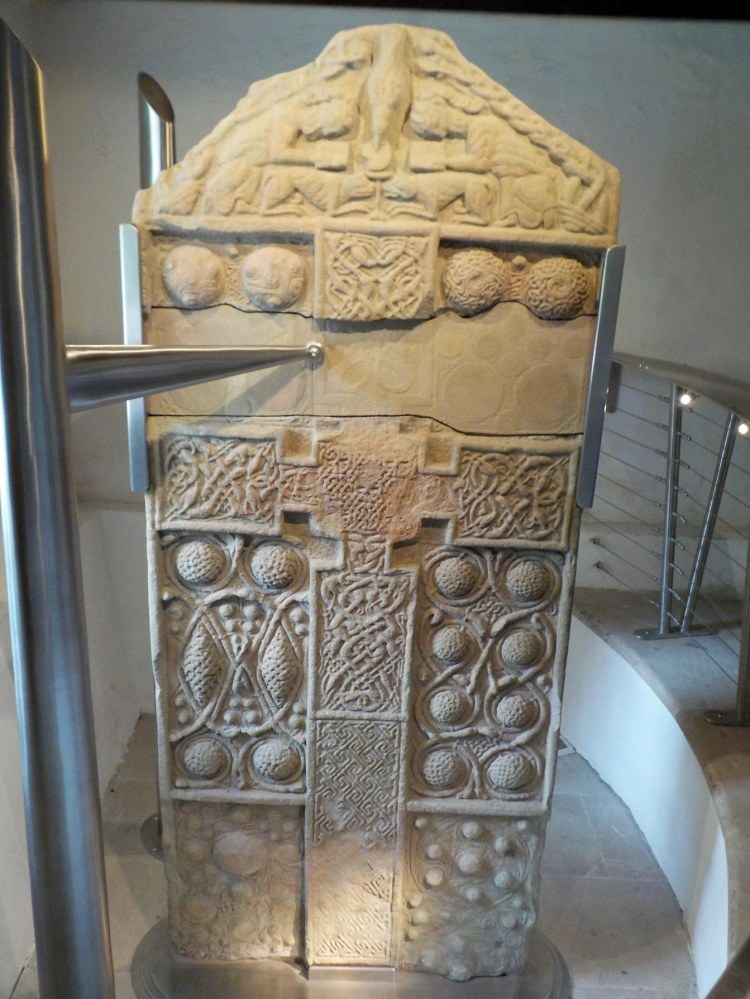
Hilton of Cadboll stone
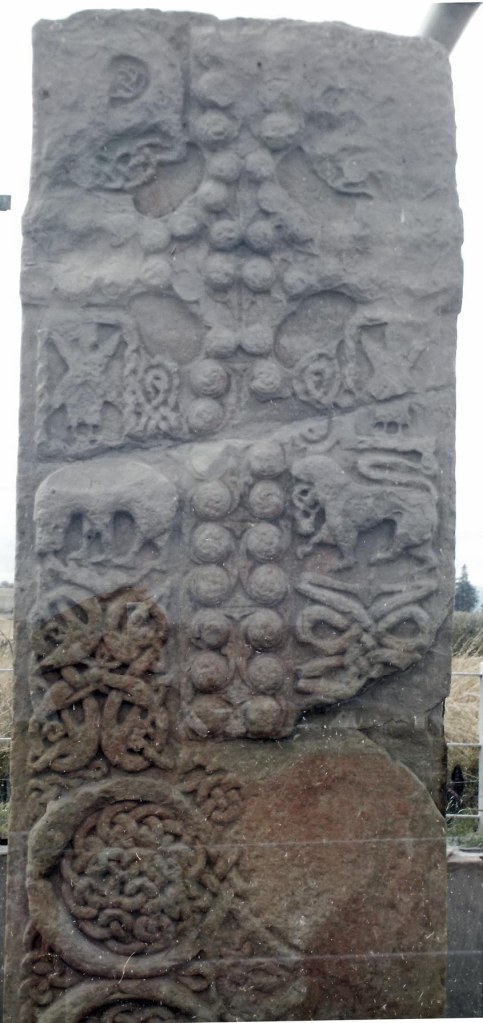
Nigg Old Church stone. The crosses are the most elaborate of the Pictish stones.
Shandwick Stone
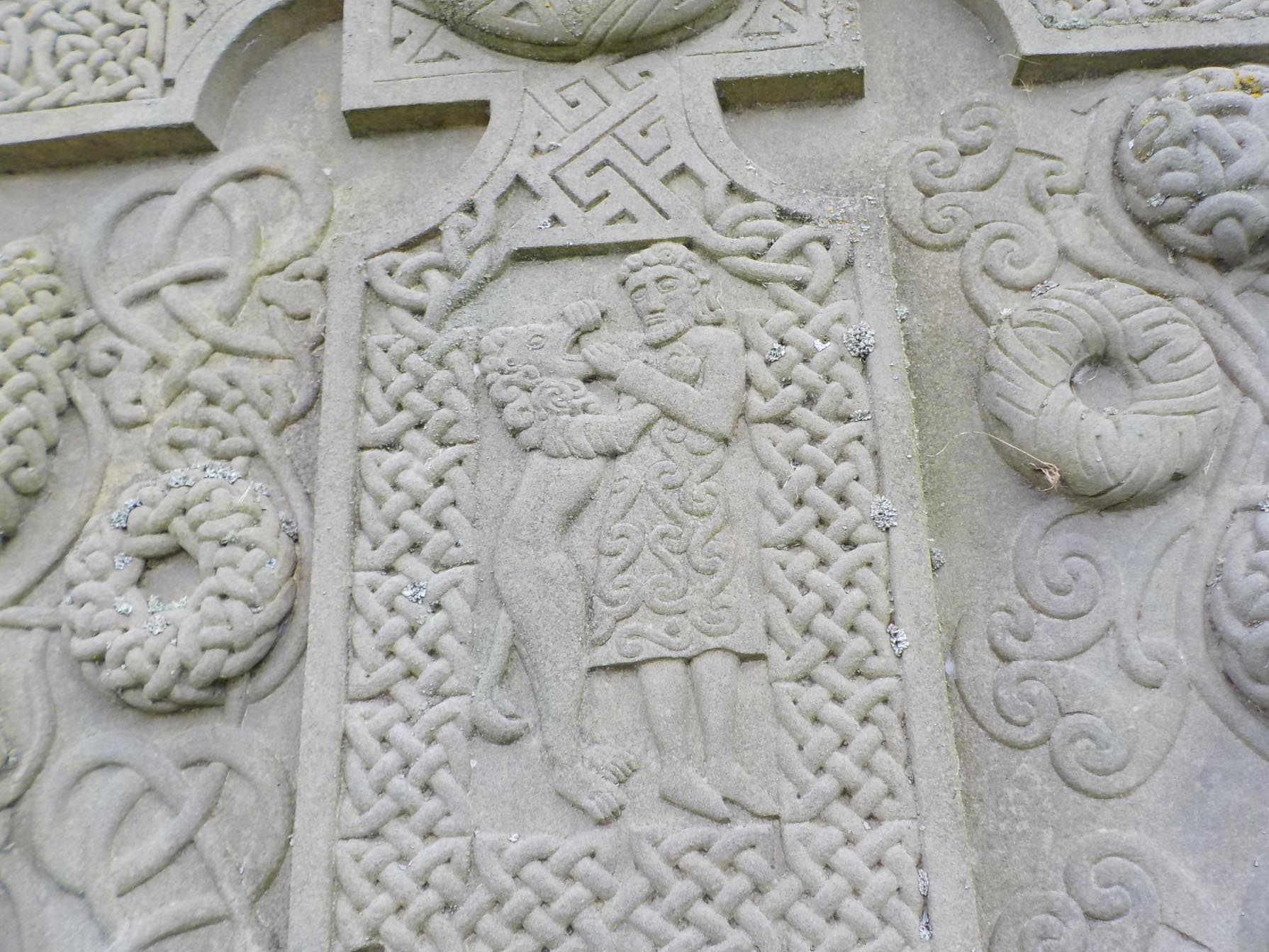
The reverse sides may have scenes from the Old Testament, such as Daniel and the Lion (right) from the Hilton of Cadboll stone.
Hunting scenes are often present. If you look carefully, you see two additional horsemen below the horse and rider in relief on the Edderton Churchyard stone.
On the HIlton of Cadboll stone is a hunt scene with a woman riding sidesaddle, two men with hunting horns, a stag, dogs, other riders, as well as a mirror and comb to the left of the woman rider. Why these were important images is not known.
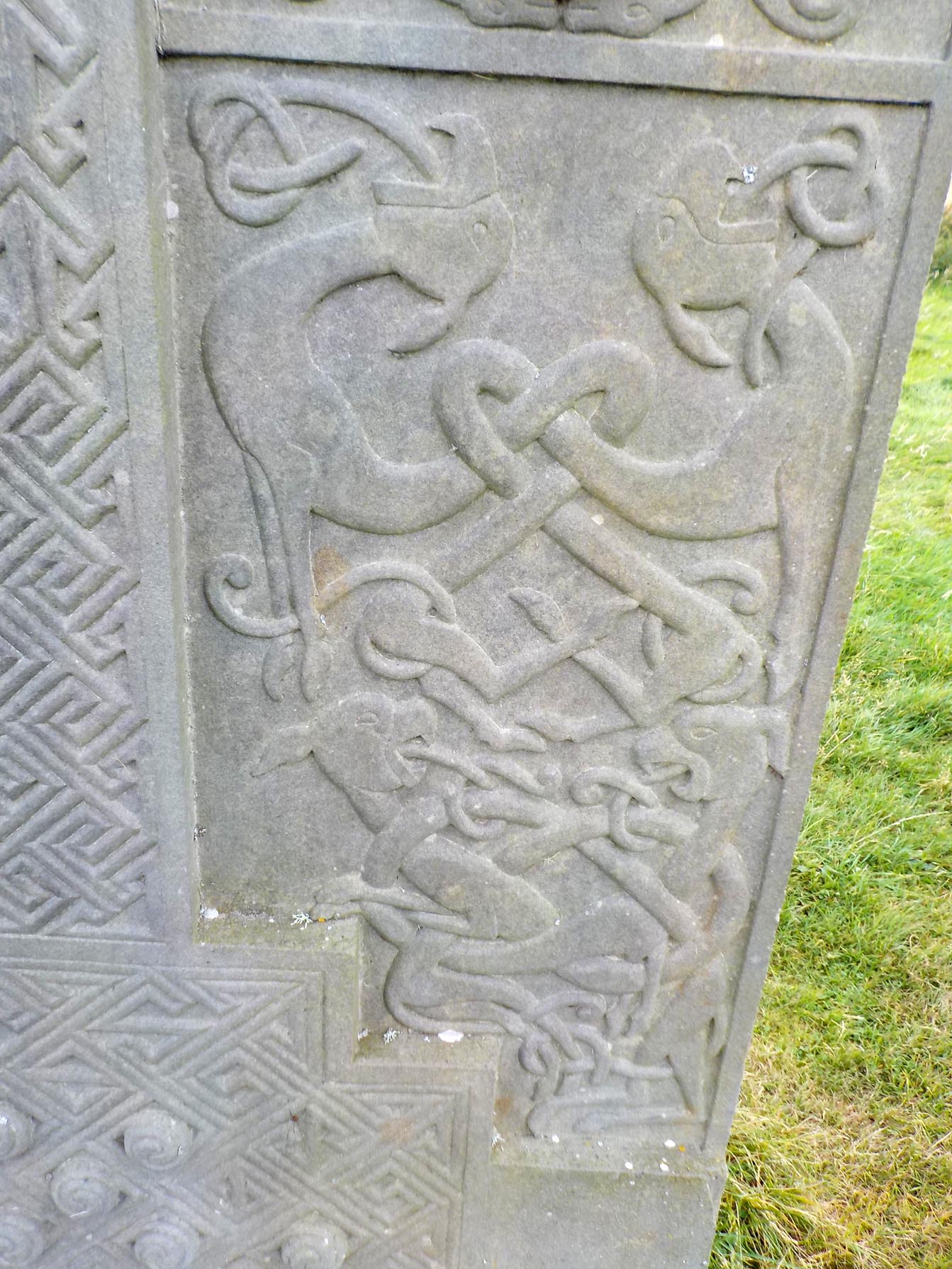
Other slabs only have symbols, and though these may include a fish, mirror, comb, elaborate ‘V’ and ‘Z’ marks. They also include wild boar, wolf, and/or something called the Pictish Beast. This is clearly a four-legged animal, but the head is so unusual that the Beast has never been specifically identified. I don’t have a good image of the Pictish Beast, but there are more stones to see if we have time. As you can see from the photos, there is a lot of geometric design on these stones, as well as animals entwined with linear motifs (plants, tails, necks, etc.)
I leave you with an image of the Tongue-Tied Beast(s).
In addition to the stones mentioned, we visited Dunrobin Castle where there are several Pictish stones, but photography is not permitted. This has much less to do with the Pictish imagery than the fact that the stones are housed in a building that is festooned with more than 100 mounted animal trophy heads. I was told that some might find the display offensive–though they aren’t considering taking it down–so they don’t allow photos. Unfortunately, they don’t even have postcards of their Pictish stones available in the gift shop. The castle’s main draw are its fairytale main building and formal gardens.
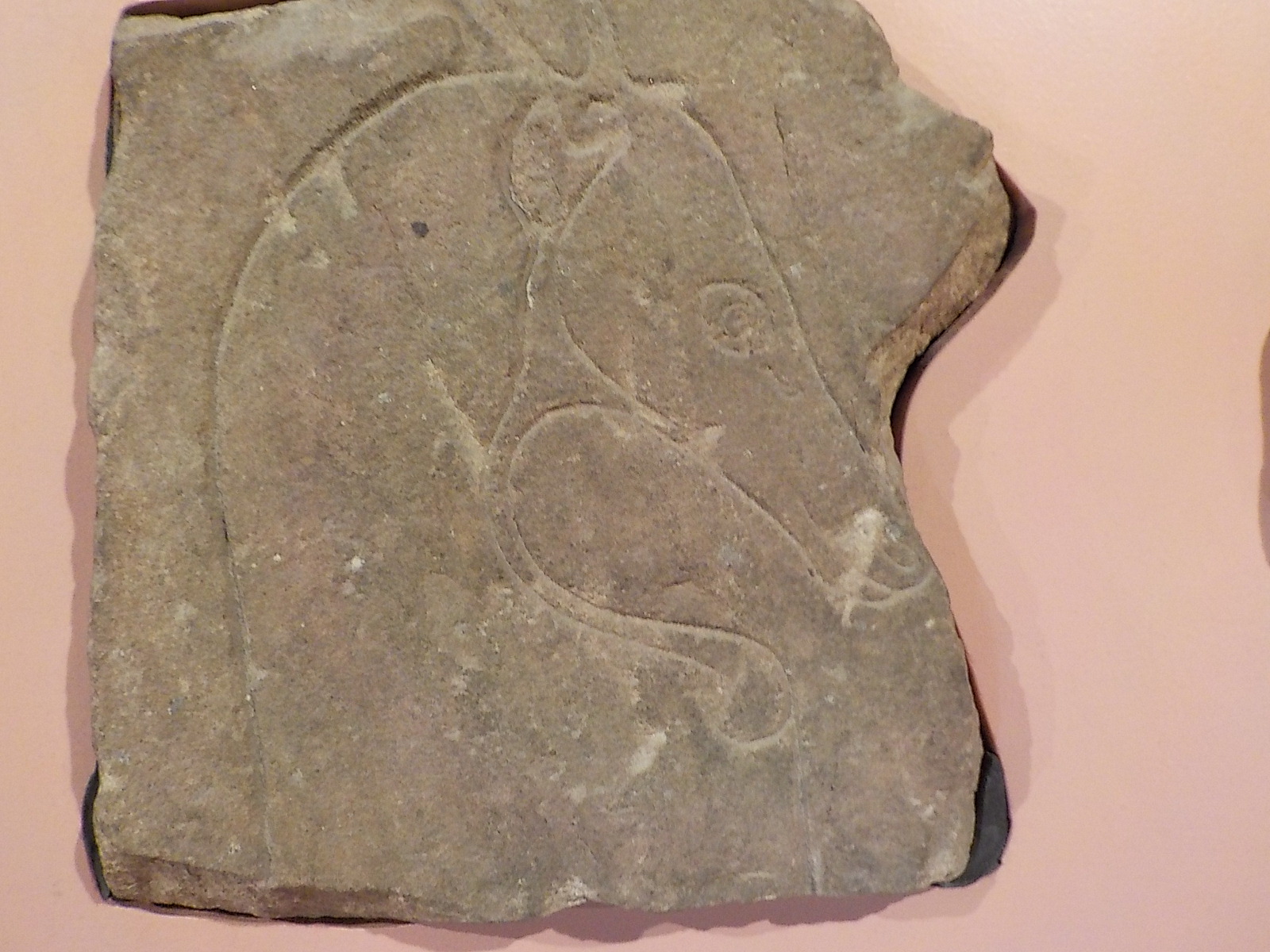
In Inverness, we saw the Ardross Wolf stone (above), and the head of a Pictish beast (below),Still to visit are Portmahomack and Fortrose where there are small collections of Pictish stones to see. We’ve seen all the freestanding outdoor stones in our area that have visible marks on them. There are others all over Scotland from Aberdeen to Iona, but we are visiting stones from Inverness to the west and north. There is an excellent guide to the Pictish Trail in this area. This link takes you to a pdf of “The Highland Pictish Trail: A Guide to Pictish Sculpture from Inverness to Dunrobin” by the Highland Council.
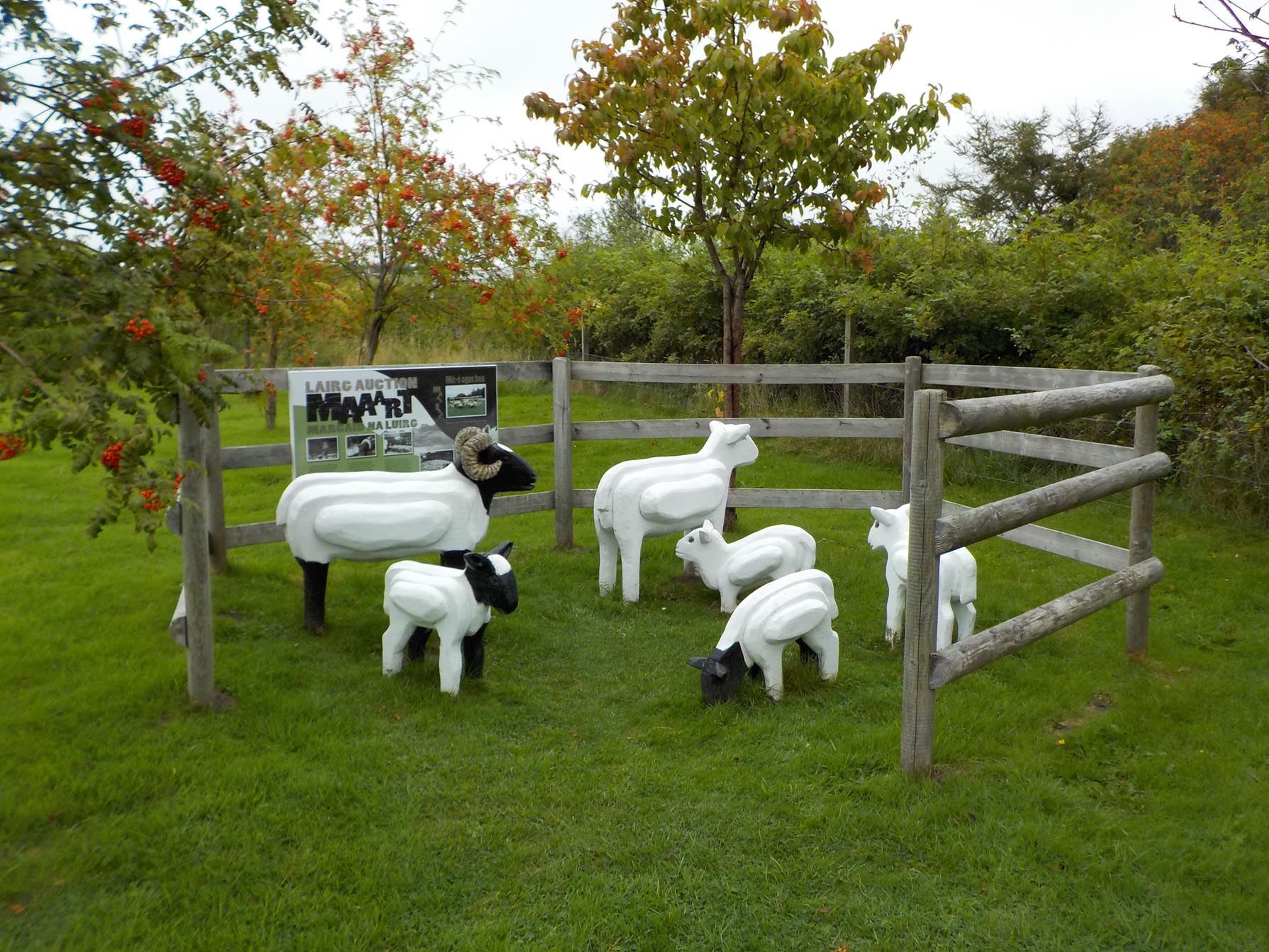
We wanted to see what the highlands are about, so we drove to the middle. Lairg is about 50 miles from the east, west, and north coasts of Scotland.The town sits at one end of Loch Shin, surrounded by hills covered with heather and gorse, green pastures filled with sheep and tan fields of barley.
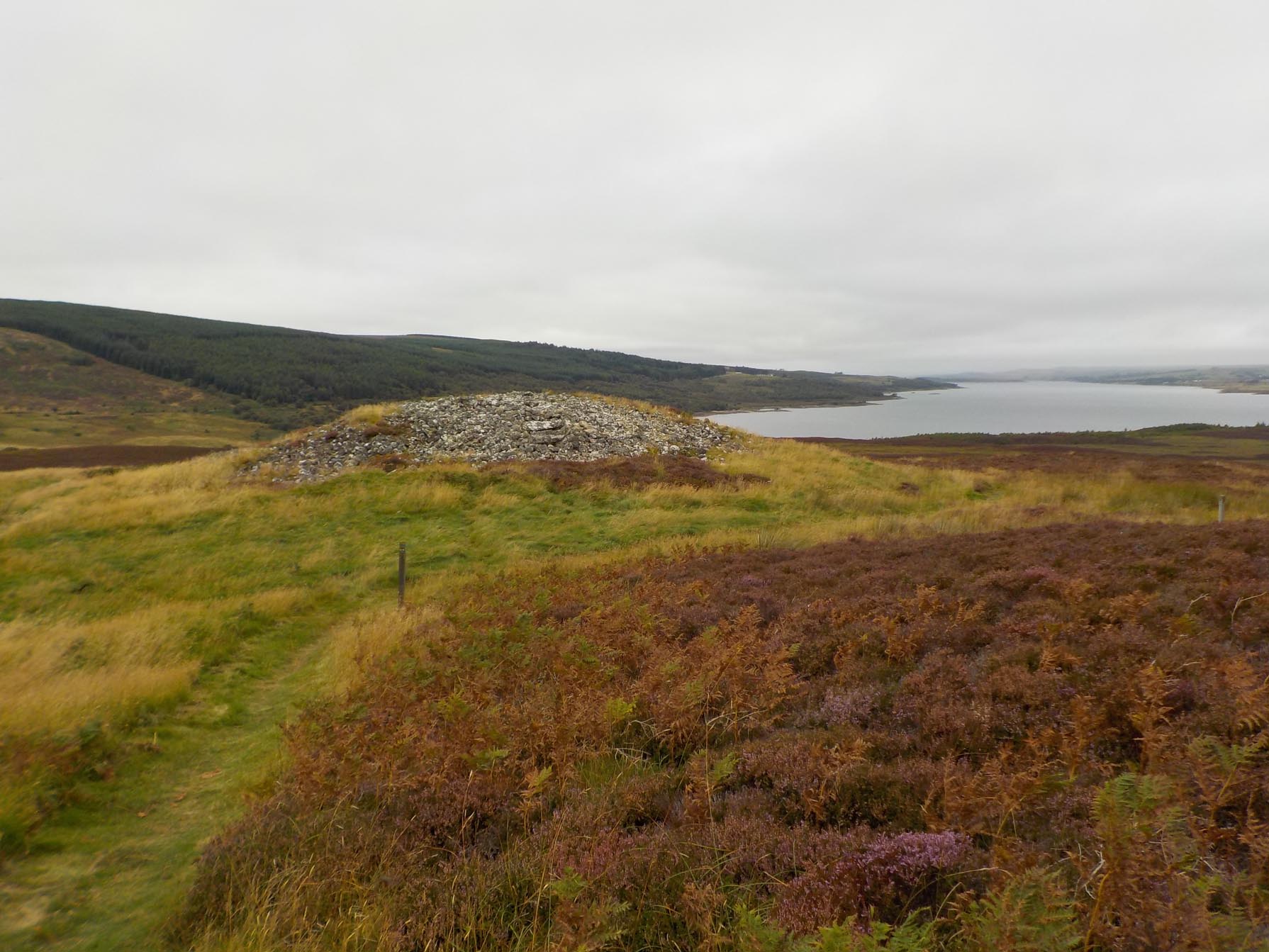
The Ferrycroft visitors center at the edge of town, has a number of playful outdoor spaces, indoor exhibits and is the start of a trail around the Ord Cairns, a series of archaeological remains including hut circles and cairns, that also include two large burial cairns that overlook Loch Shin.Each cairn looked a bit different.The large radio tower on top of the hill didn’t take away from the interesting sights, even though I’ve cut it out of my photos. The large hydroelectric plant didn’t intrude either. We were interested to find that the highlands look a lot like the rest of Scotland.
We stopped at Tain Pottery just because it was there. What an accommodating place! The showroom displays patterns and finished items, but they also have a page with all the shapes and sizes they make, and another with all their patterns. You can order any shape and size in any pattern. They’ll make anything not on the list as well. In addition, visitors are welcome to wander through the production area. It was Monday, and no one was decorating, but one kiln was running and another was still warm. One man explained that he was placing overly damp pieces in the kiln to dry them a bit more in the residual heat before they were fired.
The man in the photo was producing giant snakes of pottery clay. I wondered how he put up with such a boring job. I asked him a couple of questions and discovered (oops) that he was the potter and was preparing his clay on this Monday that he would be throwing into a variety of shapes during the rest of the week. First hand quality control.
Since our visit, I’ve seen Tain pottery in several places. Today I went in a restroom in a visitors center in Lairg and saw a large plate of potpourri on the counter. Around the edge of the plate was the inscription “The Highland Council–Loo of the Year 2009”. It looked familiar somehow, so I pushed aside the potpourri to see the decoration on the plate and I found the distinctive tartan and thistle pattern of the Tain pottery.
The Black Isle gets its name from the dark form of the island in winter. When viewed from afar, Inverness, for example, it looks black. Surrounded by water, snow doesn’t stick (they don’t get very much). Cromarty is a small town at the tip of the Black Isle. It has varied and interesting architectural details, and some nice shops including the only Dutch cheese shop in Scotland (don’t ask me why).
The thatched roof building is the birthplace of Hugh Miller (1801-1856), and the Carnegie library is dedicated to Miller as well. Hugh Miller was a proponent of the study of geology in the early 1800s. In this era before Darwin, this was a very new endeavor.
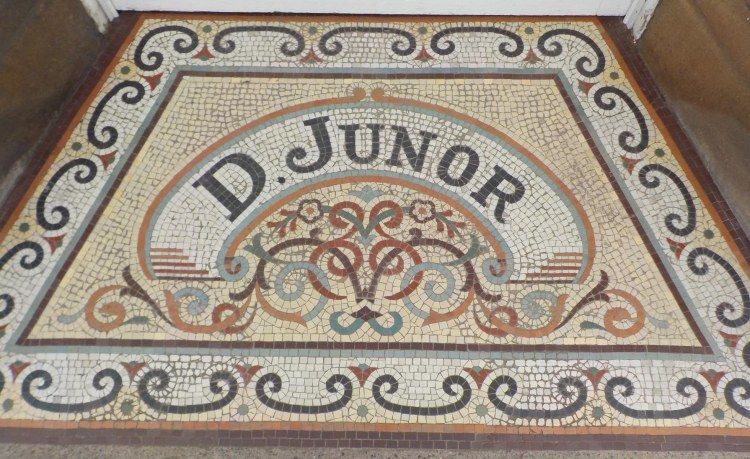
An interesting building in Cromarty, and the tile entrance to an antique store that had a great variety of things.
There’s always a ruin to be visited, so we walked up a path from town to the Gaelic Chapel, the ruins adjacent to the village churchyard. You can barely see the chapel walls in this photo and we are on the inside of the structure.
We spent a very nice day in Cromarty, and even stopped to watch birds in Cromarty Firth on the way home.
This is our third month in Scotland, and everything looks really good. No boredom, no shortage of activities, and the weather is crazily good for early September. Two sunny days and a mostly sunny day–out of three.
This slideshow requires JavaScript.
Our neighborhood is a strip of houses 1-2 blocks wide along the side of Cromarty Firth.
Cromarty Firth from the yard. Note the oil rigs.
A neighbor’s topiary
Behind the houses is a huge hay field and beyond that the highway north. All the farmers are haying now, and sometime I feel like I am riding around in a Brueghel harvest scene.
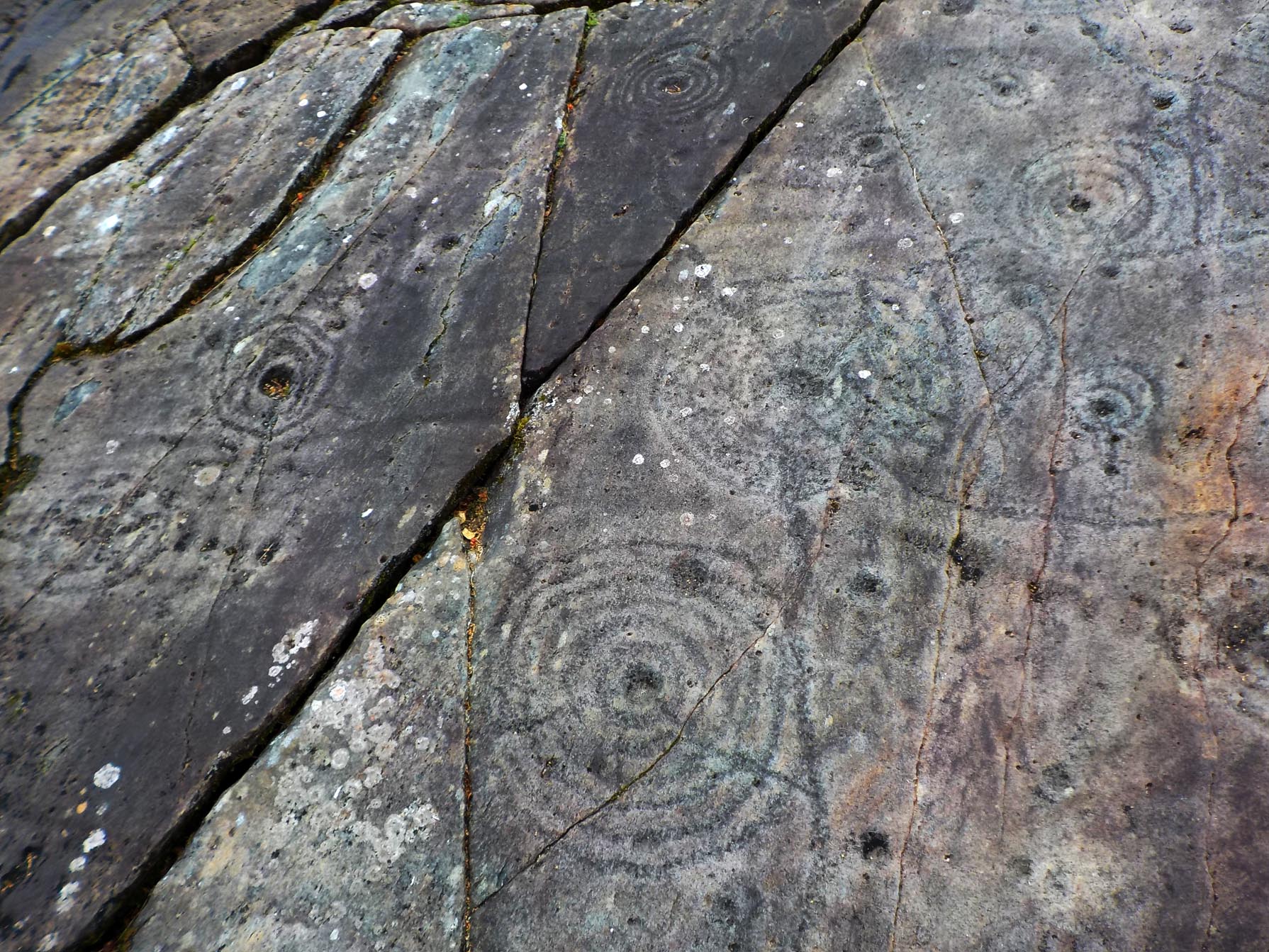
We found this hidden gem of Scotland by looking for a place to visit on our way north in the site guide from Historic Scotland. There were so many sites in this one small area that we decided to make an archaeological detour. No one comes to this area without planning, there are direct routes to most places that don’t include Kilmartin. It was great, everyone there was interested in seeing the archaeological sites and rock art. We could chat with everyone about what to see and what we each had already seen.In the area around Kilmartin are hundreds of stones marked by concentric circles, man-made indentations called cup marks, also circles, lines and dots. Kilmartin Glen has the densest concentration of ancient rock art and related archaeological sites in all of Scotland.
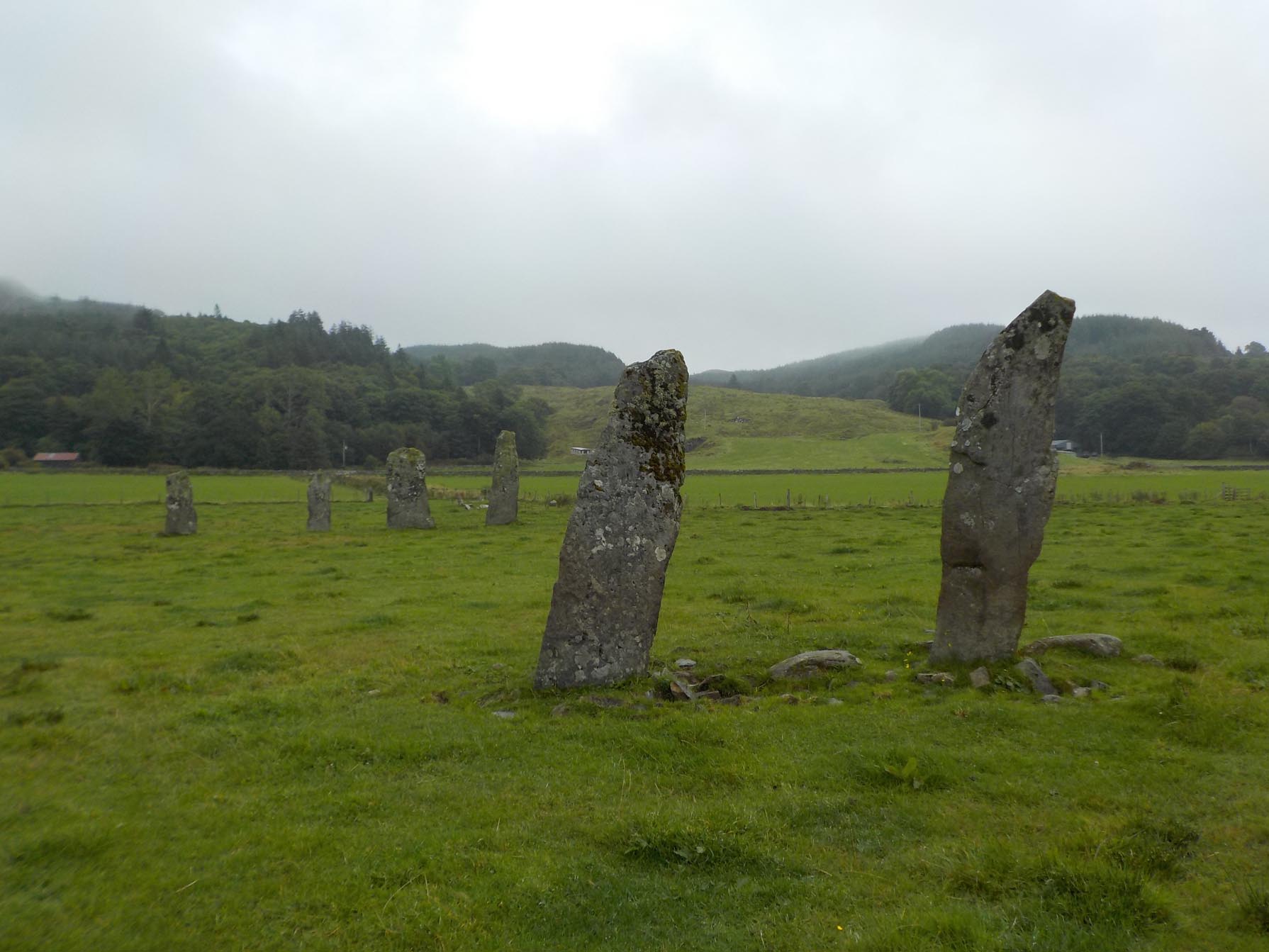
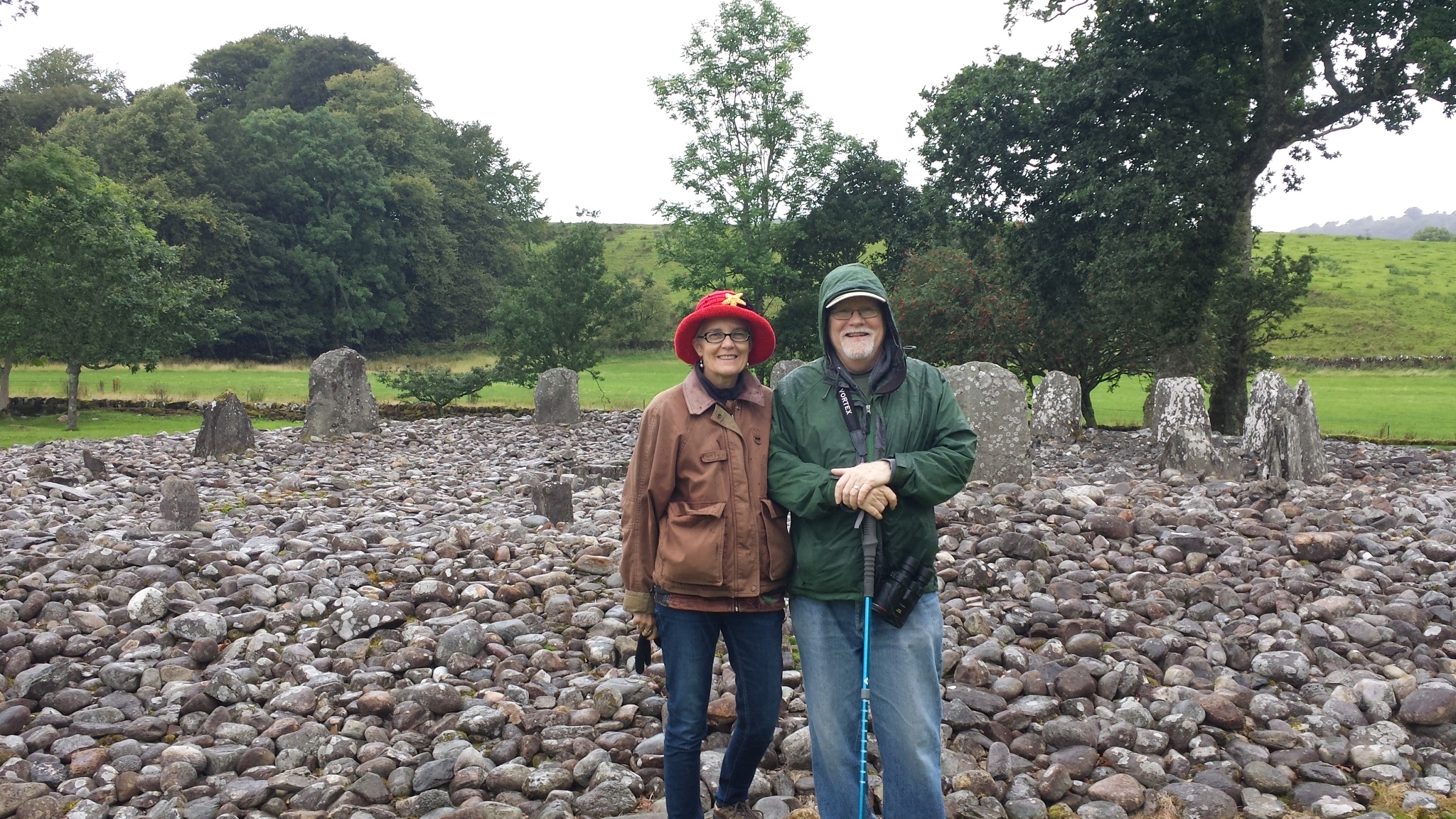
Clustered with and near the rock art are several groups of standing stones.
Some of these may have astronomical alignments, marking the winter or summer solstice.
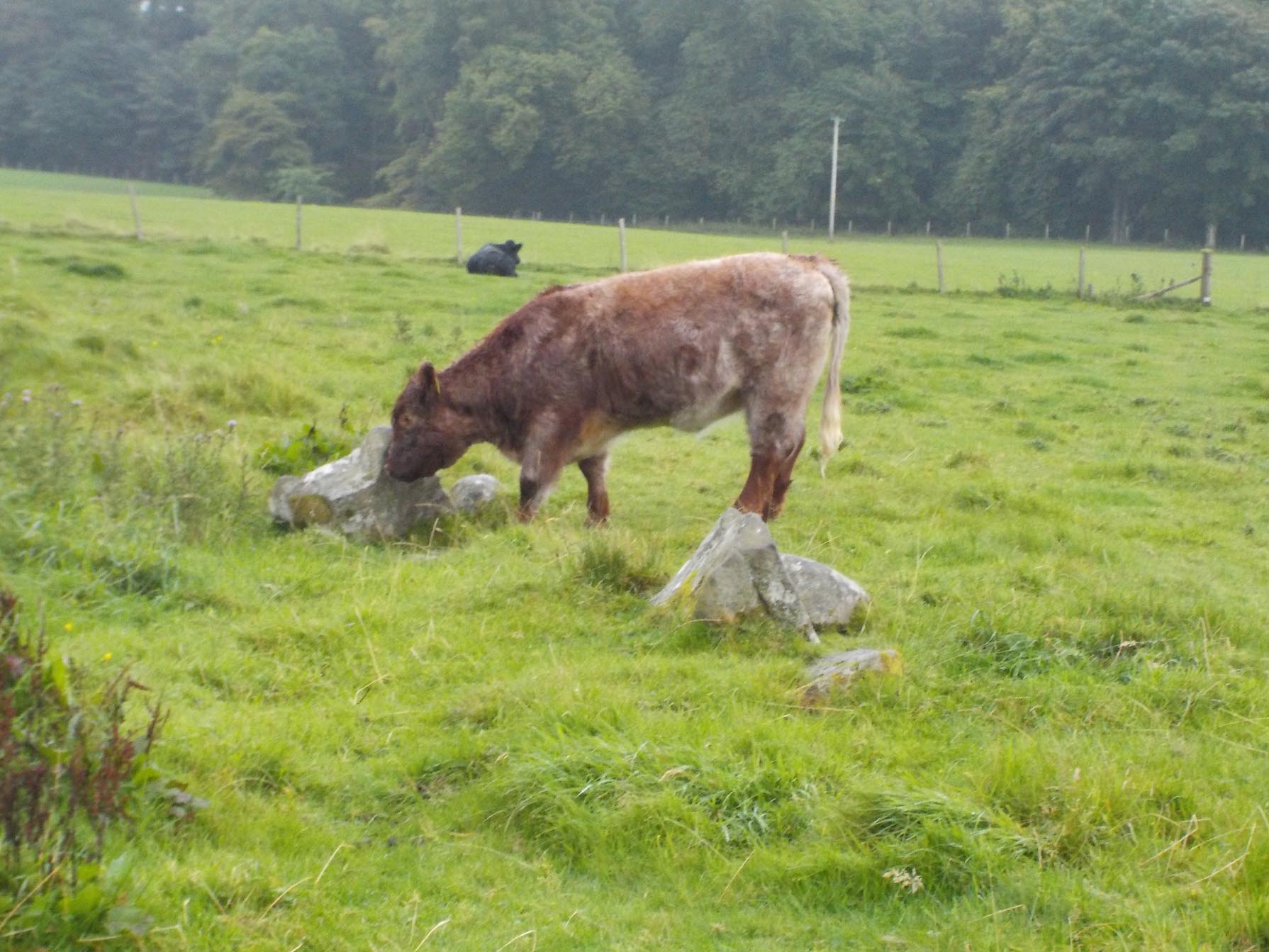
This steer wants to be an archaeologist.
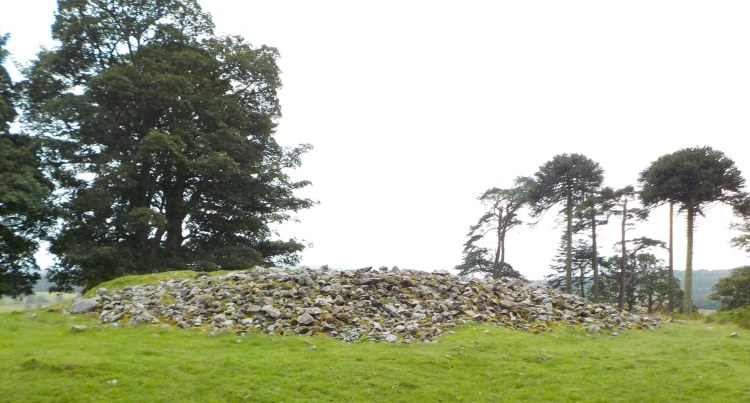
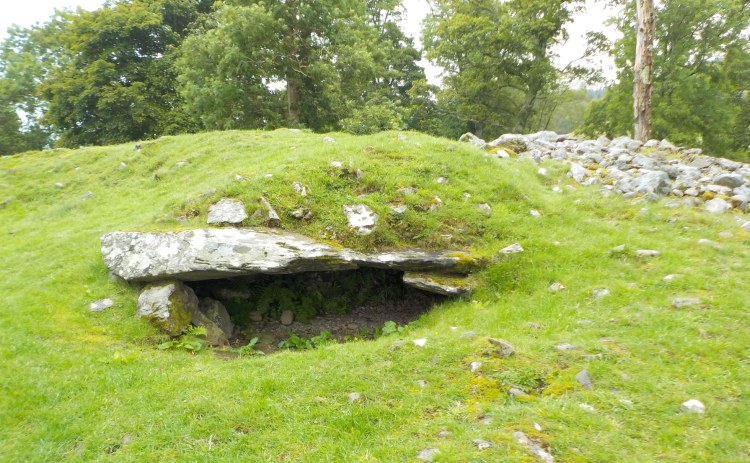
Cairn burials created by placing piles of rocks over small square burial cists are found in the valley bottom and associated with some of the standing stones. In one area there is a line of five huge cairn burials over about a mile. Each was about 9 ft high and 30-50 ft. long. Several were excavated in the 1930s, but the stone was then used in road work. What remains today is smaller, though still imposing.
Opening into the cairn at left
We met a pair of women visiting from Spain, then took a photo for a young couple from England. We met people who were hiking the trails nearby, and people who were there to sit in places they perceived to hold ancient power. It rained off and on all day, which didn’t deter anyone. Even the woman carrying a baby had a raincoat that fit over her baby carrier.
We were undeterred.
Some of these sites go back to 3000 BC, but for those interested in more recent history, there are carved grave stones in the Kilmartin churchyard that date from about AD 900-1700. We stayed at the Old Manse B&B, run by Di and David. We were very comfortable and admired Dave’s woodwork. He makes everything from doorstops and drums to thin bowls made from tree boles. http://www.turning.me.uk
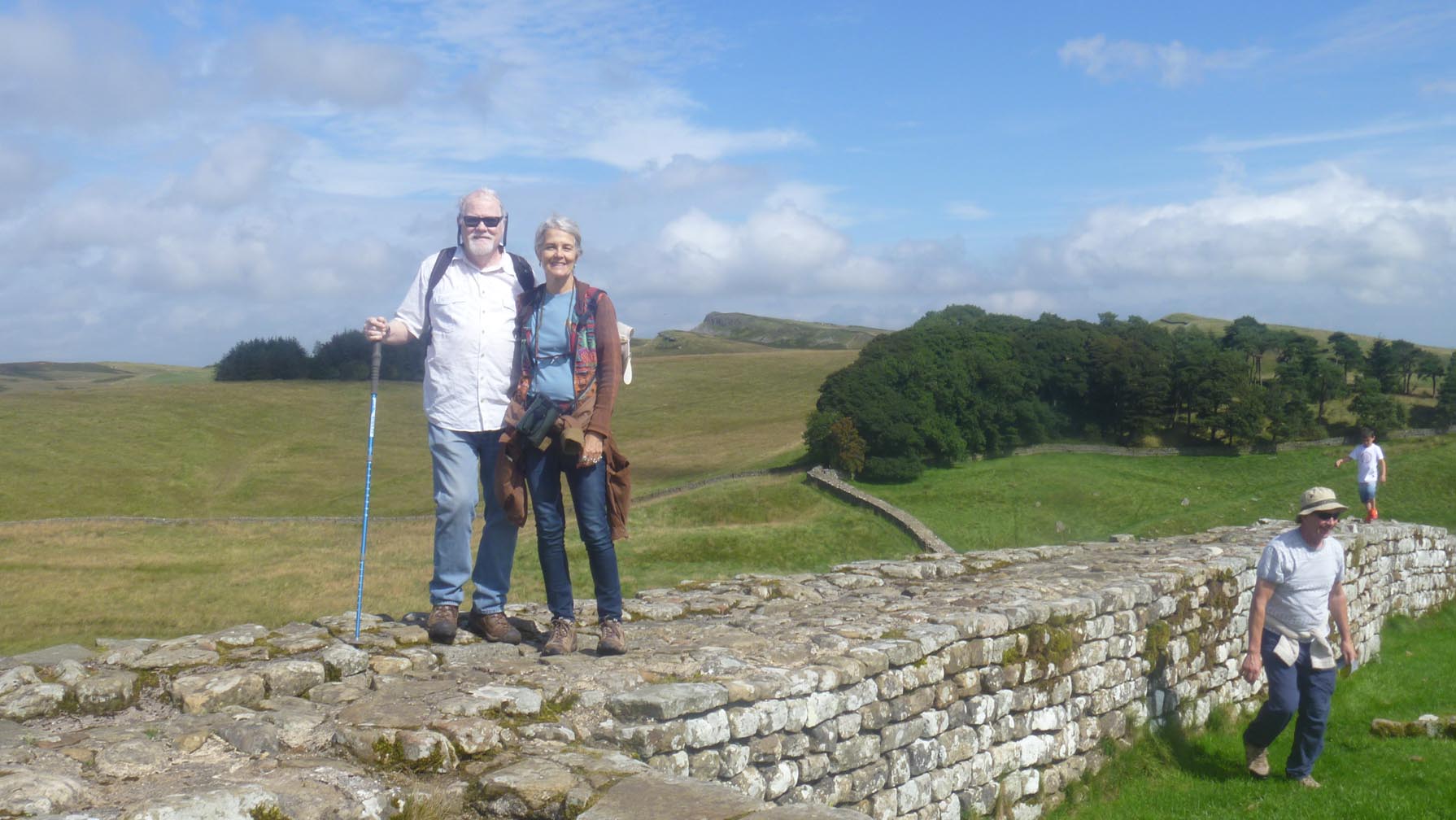
What archaeologist can resist visiting Hadrian’s Wall? Hadrian’s Wall was an attempt by the Romans to protect the northern border of their empire in Britain.
Built starting in AD 122, it spans the width of northern England from Newcastle to Carlisle. Walls like this have never been very successful and Hadrian’s Wall managed to monitor the border for about 200 years, though I wonder who it kept in and who it kept out.
One long rectangular room like the one in the foreground housed 8 men. The area you can see in this photo was home to 80 men.
We spent the day visiting two places, Housesteads Fort and Cawfields. Housesteads was built out from the main “Wall” in a great stone square. Excavations have revealed the Roman barracks, the main administrative buildings, baths, wells, and ovens that were part of the fort. There was also a small town or vicus just outside the walls of the fort.
Even on the far edge of the empire, Housesteads had Roman amenities including a bath house. Here, you can see the hypocaust, the space under the floor of the bath house that was heated. It must have been wonderful in the winter in northern England.
Toilets were communal. Jonathan thinks he would fit right in. The original toilet is on the left.
The museum at Housesteads shows many of the artifacts recovered during excavations. There are lots of horse trappings and sandals, a few coins, and pieces of glass. Amazing that it all ended up so far from Rome. There are other forts along the wall at Birdoswald (I thought the town was Birdos-wald. It’s Bird-Oswald), and at Vindolanda, as well as a museum with Roman artifacts in Carlisle. We passed a young man who was hiking the entire 84 miles. He looked sweaty, as though the sunny day caught him by surprise. We also chatted with a couple who live in Wallsend, in Newcastle, where the wall ends. That’s a great address.
We drove along the coast until we found a place to walk, and ended up at Nun Mill Beach. Believe it or not, late August has had mostly sunny days and today was another. We ate our picnic by the water and found lots of beach glass. The fields beside the shore are a brilliant green and we followed a path up the hill to look out over Solway Firth and across to the Lake District.
On our walk, Jonathan pointed out a roe deer strolling across the field. This beautiful action photo by Alasdair Middleton shows just the reddish-brown color of its coat.
Late summer seems so intense–the sun (when it’s out), the fields, the animals are all in perfect health, we’re in a special moment poised between the seasons.
Southern Scotland is full of castles. How do you choose which ones to visit? After I realized that we couldn’t visit them all, we chose a couple from a range of time periods to see whether we can see any changes over time.
What I found is that castles didn’t change much between the 12th and 16th centuries. They range from a very small tower (Orchardton) to a large tower with an extra bit added (MacLellan). Not until the 17th century did castles become the showplaces we see today.
When I decided to focus on visiting castles, I didn’t pay think about visiting any of the old abbey sites. They are fewer in number, and had a religious focus, so I didn’t think I’d be interested, until we drove by Dundrennan Abbey on our way somewhere and pulled in to have a look. (I include photos of Dundrennan at the end of this post.) It was both an irony and a revelation. The power was in the Church, obvious from a first look around. Dundrennan is much larger and ornate than any castle built before the late 1600s, AND most of it was built before 1200. I seem to have been following the wrong team. It also explains why Henry VIII (and other kings) wanted to take over the Church. It was obvious the clergy held much more power than the king and were far wealthier. A good example is Henry VIIIs advisor Cardinal Woolsey. Woolsey built Hampton Court Palace (near London) for himself, but Henry admired it so much that he made Woolsey give it to him.
Castles, however, capture our imagination. Here’s a tour through time with Scottish castles.
EARLIEST CASTLES
The oldest castles are no longer standing, though some remain as footprints in the ground that have been excavated or mapped. You can see the oldest church at Holyrood Abbey in Edinburgh, founded in 1128. Compare Holyrood’s Old Abbey, established in 1128, with the footprint of the original castle at Caerlaverock, built in the 1200s. (Holyrood is bigger.) A great deal may be known about these barely visible castles from documents that have been preserved through the centuries. The depth of historic records in the UK is impressive.
Here is the outline of an older portion of Cardoness Castle
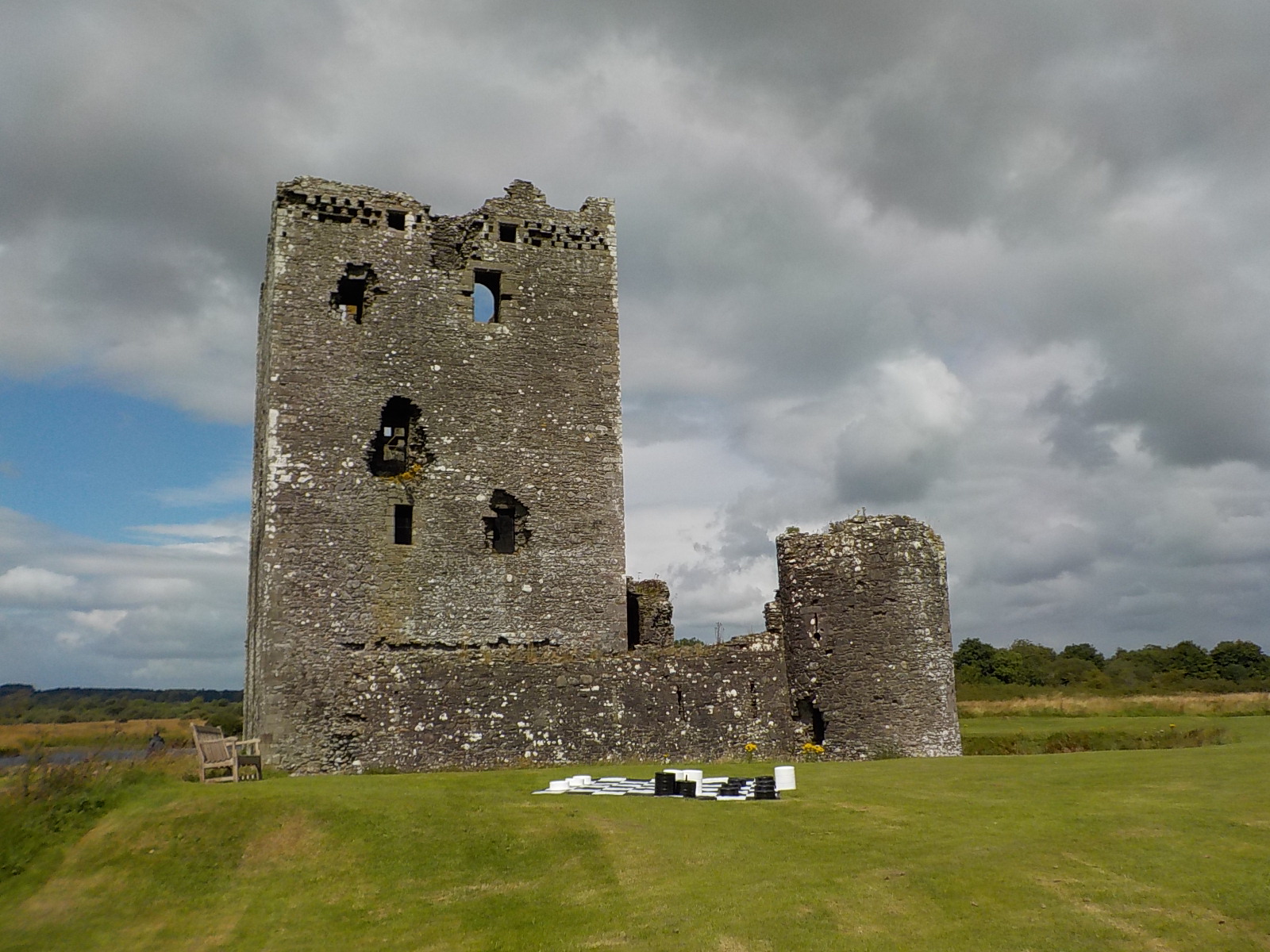
14th century Castles (1300s), Threave Castle
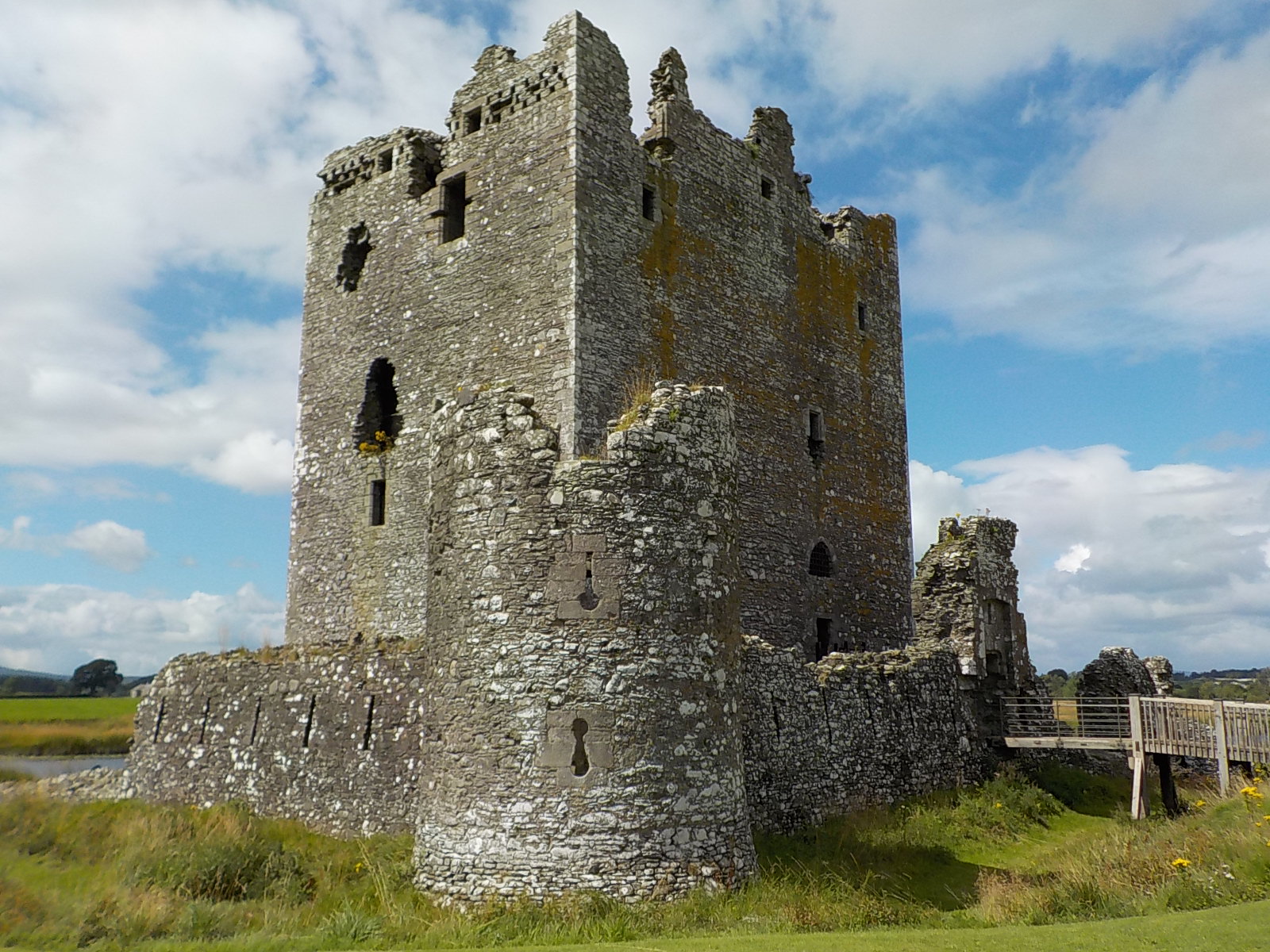
Skip forward a mere 100 years, and many castles from the era remain standing. During the late 1300s, Threave Castle was built on an island in the river Dee, not far from today’s town of Castle Douglas. Threave was well protected for its time, with a natural moat flowing around it, accessible by boat up and down the river. Like the first castle Caerlaverock, it was damp, but unlike that castle, Threave was never moved to a drier spot.
Threave was home to Archibald Douglas, known as Archibald the Grim for his terrible face in battle. Archibald inherited his title from James Douglas, known as both James the Good and The Black Douglas. James Douglas spent his career, most of the 1300s, moving from battle to battle in support of William Wallace and Robert Bruce. The black in the Douglas name refers to barbaric incidents such as the “Douglas Larder.” At that time, the Douglas family properties had been confiscated and James Douglas was intent on regaining them. On Palm Sunday 1307, he and a band of men hid outside Douglas Castle (now demolished) until the soldiers went to a nearby church for services. Douglas and his men broke in, captured those present, then gathered all the stores of the castle in a great heap, splitting open wine casks and splintering the wood. He had all the captives beheaded and set atop the ruined goods then lit on fire. Local people dubbed the event the Douglas Larder and James’ ruthlessness became part of his legend.
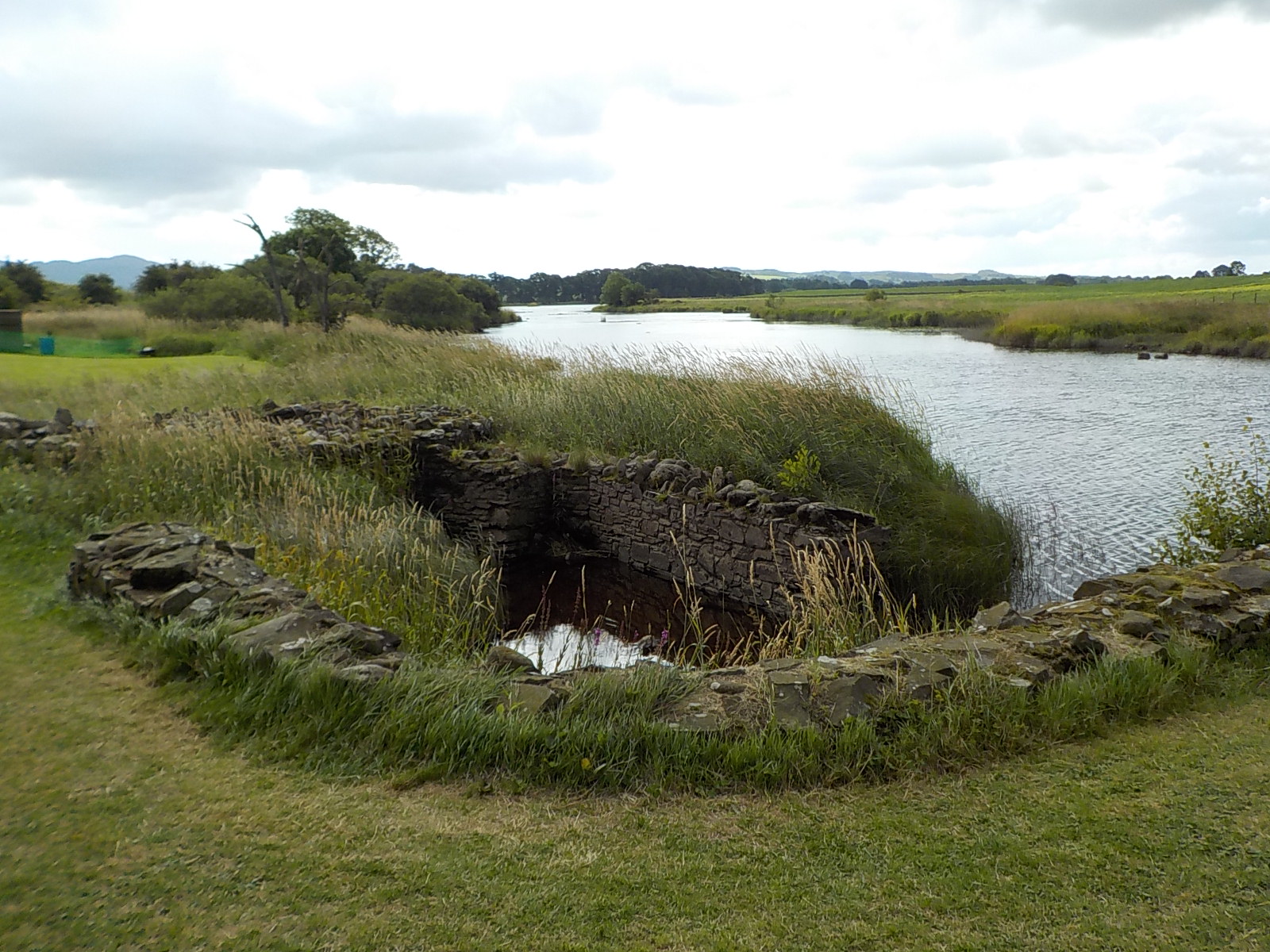
The harbor at Threave castle is very small.
By Archibald’s rule at the end of the 1300s, the Douglas name was a prominent one, and earned the enmity of English kings. Archibald the Grim was succeeded by his son Archibald, yet the Douglas’ were constantly under attack. This culminated in the siege of Threave Castle in 1455. In the end money succeeded where a siege could not. Threave surrendered and was partly dismantled. Put back together by the next owners (the Maxwells of Caerlaverock Castle-they were all interrelated over time). This next siege of Threave Castle came in the 1600s.
From 1637-1688 religion in Scotland was declared to be based on the Book of Common Prayer, led by Episcopal ministers, as declared by the king. This sounds straightforward except for the fact that in Scotland, the Presbyterian Church of Scotland was the dominant practice, and many Scots believed that a king could never be the head of a church, the role they believe was a spiritual position filled by Jesus Christ. A declaration to that effect (the Covenant) was signed by many in Scotland who were called Covenanters. To suppress opposition to his dictates, the king ordered Covenanters to hunted and killed in an effort to institute religion according to the king’s will. It was treasonous to oppose the religious rules of the king and the siege of Threave Castle by Covenanters was an effort to drive out non-Scottish Episcopal believers. Once again Threave fell due to negotiations but this time the castle was not reoccupied.
15th century Castles (1400s) Cardoness Castle
Castles got taller over the next century based on our visit to Cardoness Castle. The castle was owned by the Cardoness family by 1220, but the present structure is a tower house from the 15th century when it was owned by the McCulloch family.
The McCullochs were involved in feuds and raids throughout the region of Dumfries and Galloway. The castle was acquired from the Cardoness family through marriage. The tale goes that the head of Cardoness was furious that he had nine daughters and no sons. His next child was a boy, and the laird insisted on holding a huge party on the surface of the frozen loch at the foot of the castle. In the midst of the festivities, the ice gave way and all were killed but the one daughter who had stayed back with a cold. She then married a McCulloch who was interested in her wealth and castle.
This two story storage chamber could hold supplies for a long, cold winter.
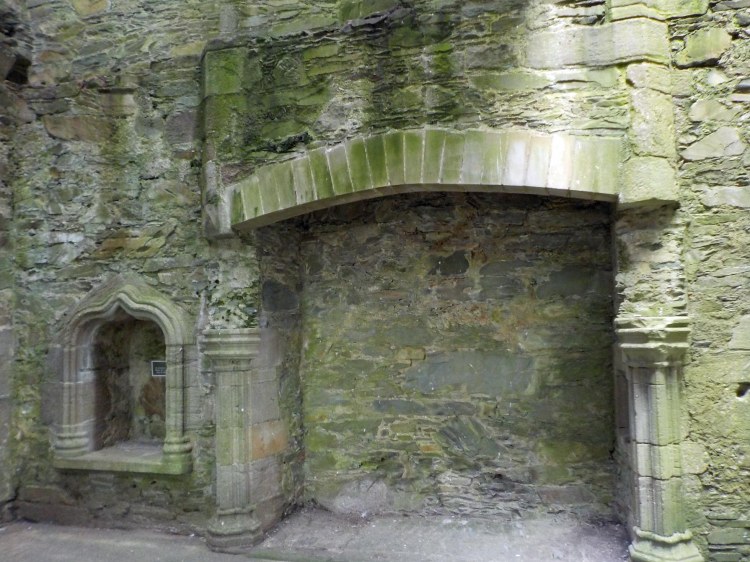
Decorative details of the fireplace area showed off the McCulloch wealth.
The interior of the castle displays wealth in the abundance of carved stone mantelpieces, niches and window seats. Cardoness is also structurally very strong.
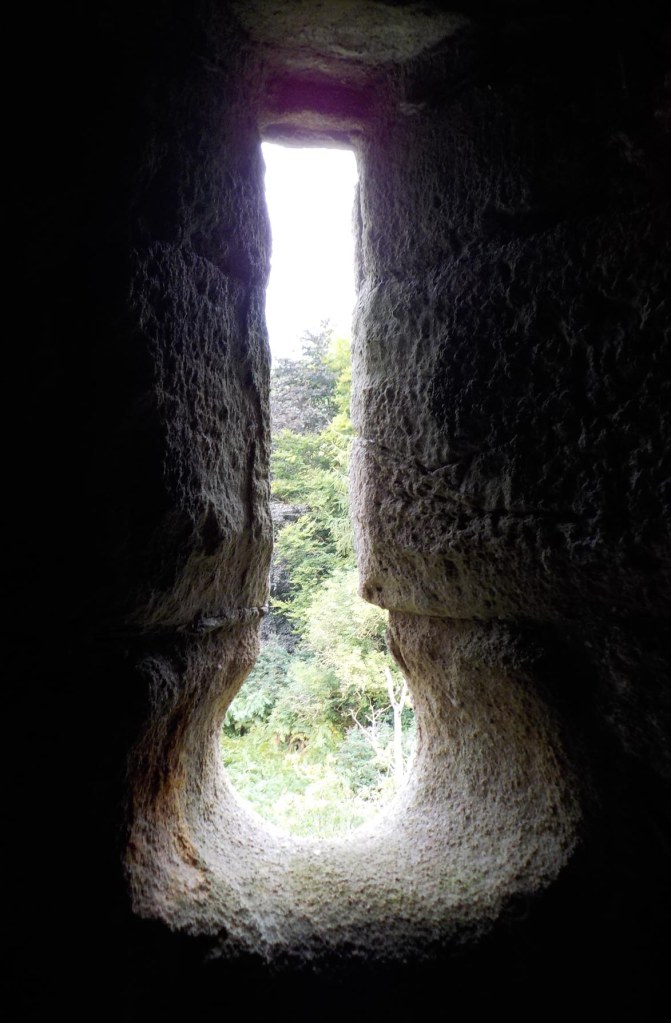
Gun ports were a new feature in 15th century castles.
The view from the top with Solway Firth in the distance. Cardoness Castle had a strategic location.
Two of the four sides are doubled by having a narrow passage between the outer wall and the inner living rooms. These were for the servants to move about unseen, but had the effect of adding structural support and insulation to the walls. Between 1700 when the castle was abandoned, and 1927 when the ruins were given to Historic Scotland, Cardoness did not deteriorate as much as many other abandoned castles.
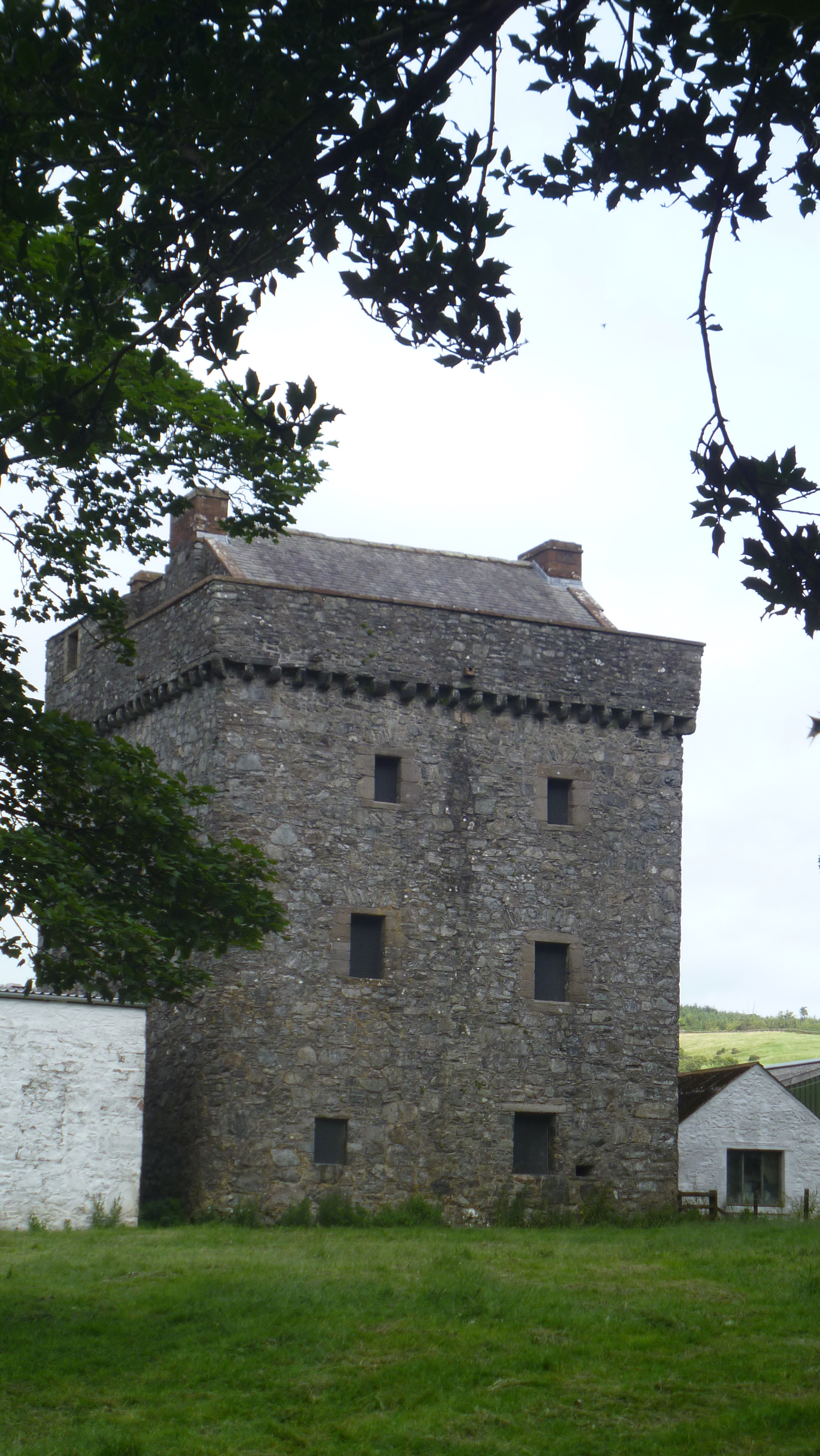
Even more structures from the sixteenth century are still around. We visited Drumcoltran Tower, MacLellan’s Castle, and Carsluith Castle. Drumcoltran Tower is the most remote. It is only a mile or two off the road, but it is a good thing there are signs, because the road runs through farmland. The final sign points to the side of the road: “Parking.”
However, a dedicated path leads to the tower from the roadside. There is information on signs outside and inside the tower, including a reminder not to get in the way of the workings of the modern farm that is all around. Historic Scotland has managed the property since 1951. It is in very good condition, a roof is in place and the windows screened to keep out birds. The door was open though there was not an attendant.
Drumcoltran Tower was built in the mid 1550s, to control a road between Dumfries and Dalbeattie. It is in the middle of a farmyard, with barns and buildings on three sides. Though it seems incongrous to us, this is very much like the tower’s original setting, when Edward Maxwell lived in the tower, surrounded by the hamlet he managed.
The view from the top of Drumcoltran Tower reveals a broad expanse of farmland, full of grazing animals. The sheep tried to prevent us from leaving, but we did find a way.
The corner tower of MacLellan’s Castle in Kirkcudbright looks a bit like the Drumcoltran Tower. Not surprising, as it was built about the same time, with construction underway by 1577.
I find it impressive to read that in 1569 Thomas MacLellan of Bombie was given the site of a ruinedGreyfriarsmonastery in the town of Kirkcudbright. That means there are documents that record this, preserved for more than 400 years. Perhaps because this castle is in the center of town, there are more displays at MacLellan’s Castle. Jonathan went to help in the kitchen.
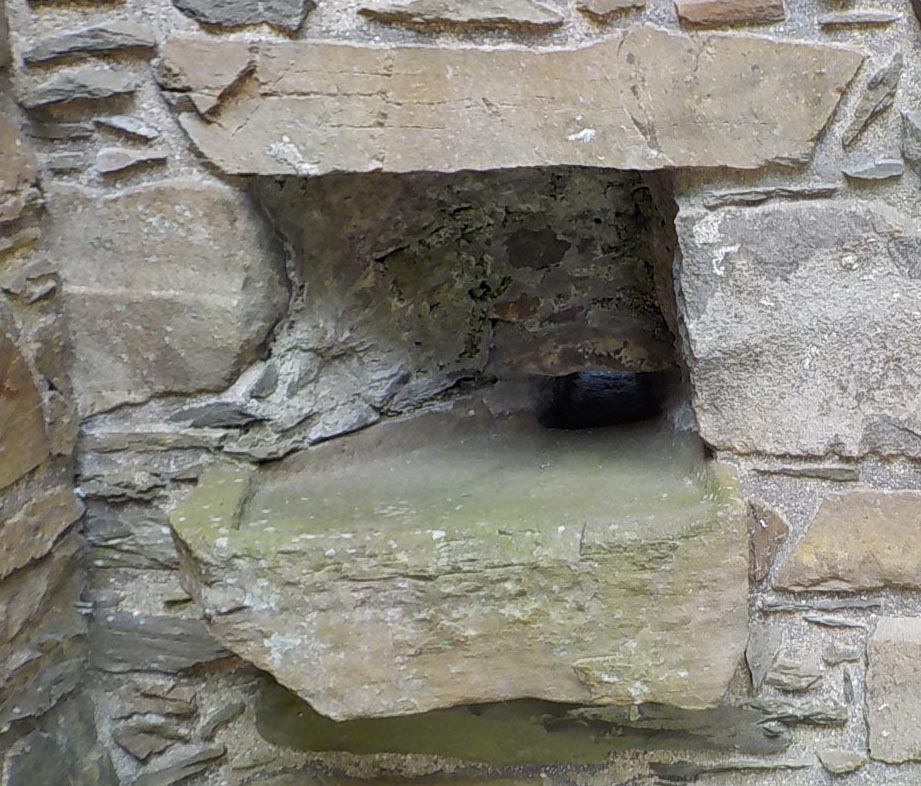
Carsluith Castle is similar to the others, different in being open to the elements (pigeons), and located by the side of the road. One feature still visible (below) is a sink, where you could stand while a servant poured water over your hands for washing. The water drained out the side of the building just behind where Jonathan is standing. Solway Firth is just to the left, so waste eventually made it there.
The space between floors in most castles is open now, as the wood floors have not been replaced or restored, but it is possible to see the notches that supported roof beams, and the features in each room. Here you see the second and third floors at Carsluith. The second floor had a window seat, a fireplace and a niche that could have held shelves for storage or display. The third floor was for a lesser member of the household. The fireplace is smaller and there are no built in features.
17th century Castles (1600s) Caerlaverock Castle
We have visited two castles that were at least partly built during the 17th century. The most fun was probably Caerlaverock Castle. I happened to see on their web site that it was the setting for The Decoy Bride, a very silly romantic comedy that I watched on the recommendation of my daughter, a David Tennant fan.
He seems to have strayed into this film by accident (possibly between better gigs). I went back and watched it again, and enjoyed seeing how the castle was worked into the film.
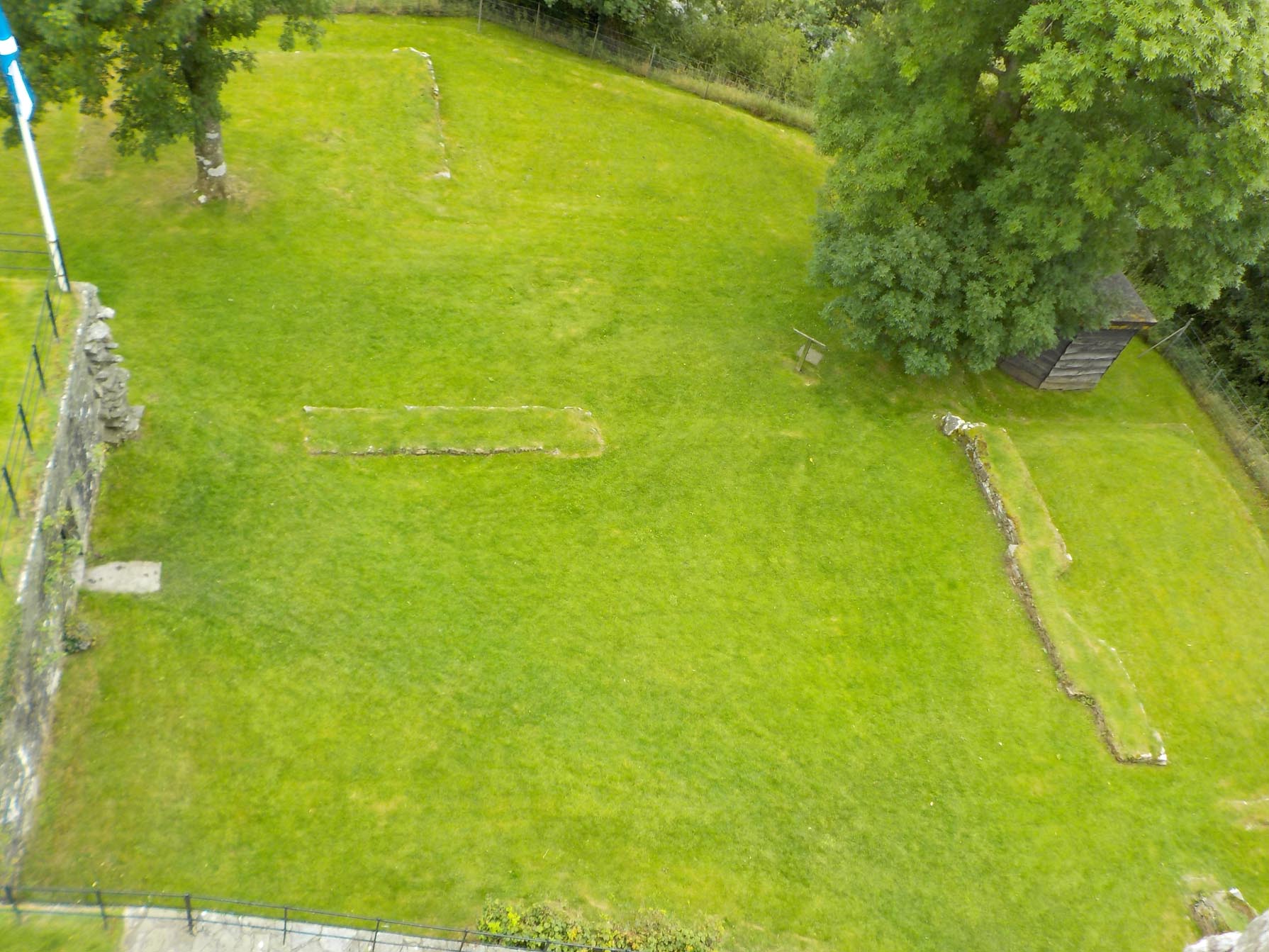
The foundations of an early Caerlaverock Castle built around 1230 were excavated some years ago and lie in a clearing near the surviving castle. On the edge of a stream, it’s no surprise that the first castle was abandoned because of the damp, make that soggy, surroundings.
A few hundred meters away, the new castle was built by surrounded by a moat, easy to create in the wet surroundings, and then a ditch and palisade.
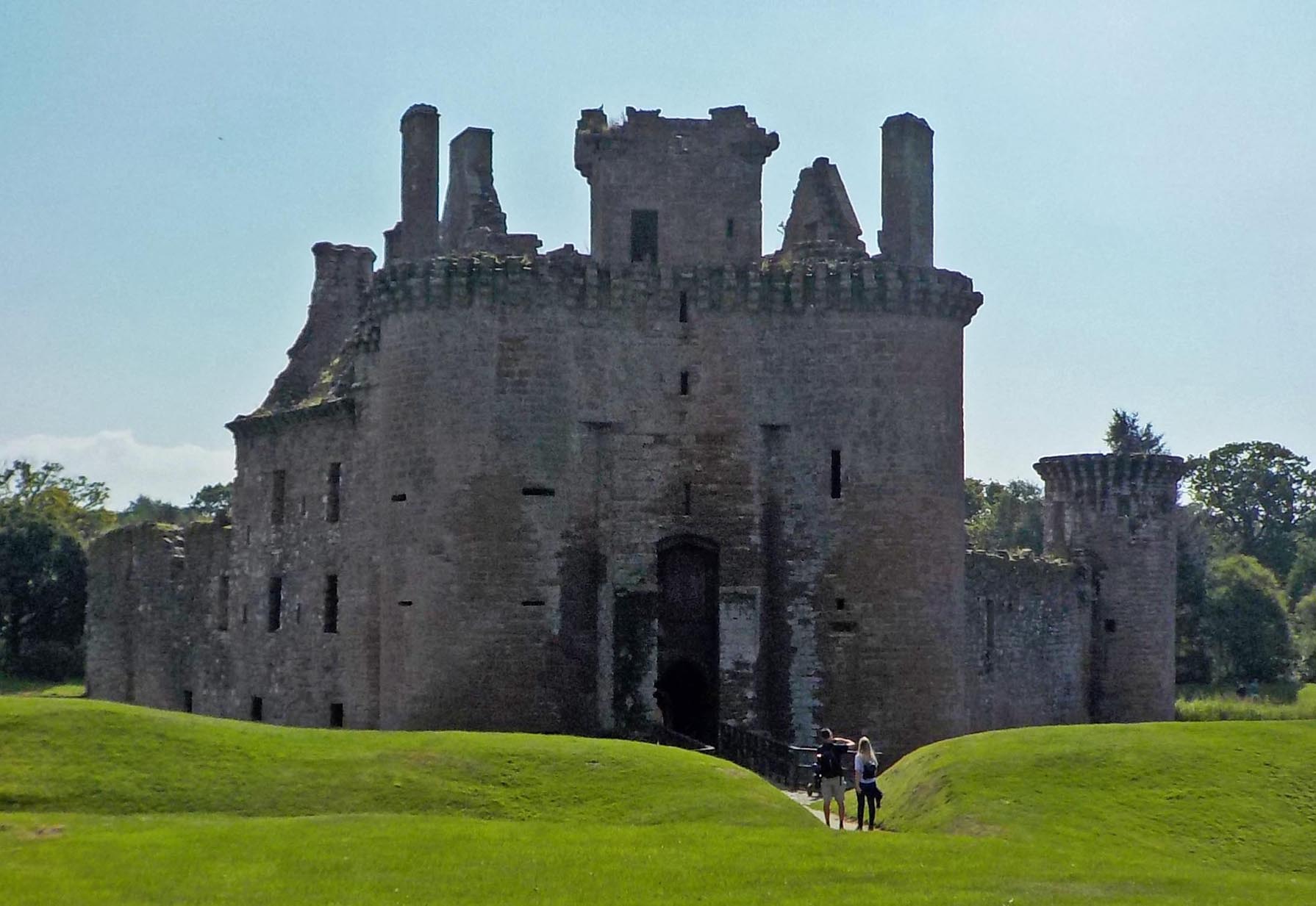
Distinctive at Caerlaverock is its moat (right), triangular shape (first photo), and the much later building inside the castle.
Called the Nithsdale Lodging, this Renaissance style building (completed 1634) was a departure from previous architecture because of its numerous large windows and decorative carvings over the windows. It is very different than the rest of this and the other castles we’ve seen and it was intended to impress the neighbors and competitors with Robert Maxwell’s new title of Earl of Nithsdale granted around 1620. The panels over each window are an unusual mix from my perspective, but perhaps were appropriate at the time. Most have some mythological reference, but some are allegories of love and honor, while the top three are examples of what happens to your enemies. Prometheus having his liver pecked out, for example.
For more on Caerlaverock Castle, try this very interesting blog post:
The great irony is that Caerlaverock Castle fell to a siege in 1640, only six years after the new construction was completed. It was partially dismantled once again, a practice used to keep a structure from being used in future battles. Caerlaverock Castle was never reoccupied.
Drumlanrig Castle (1679-1689)
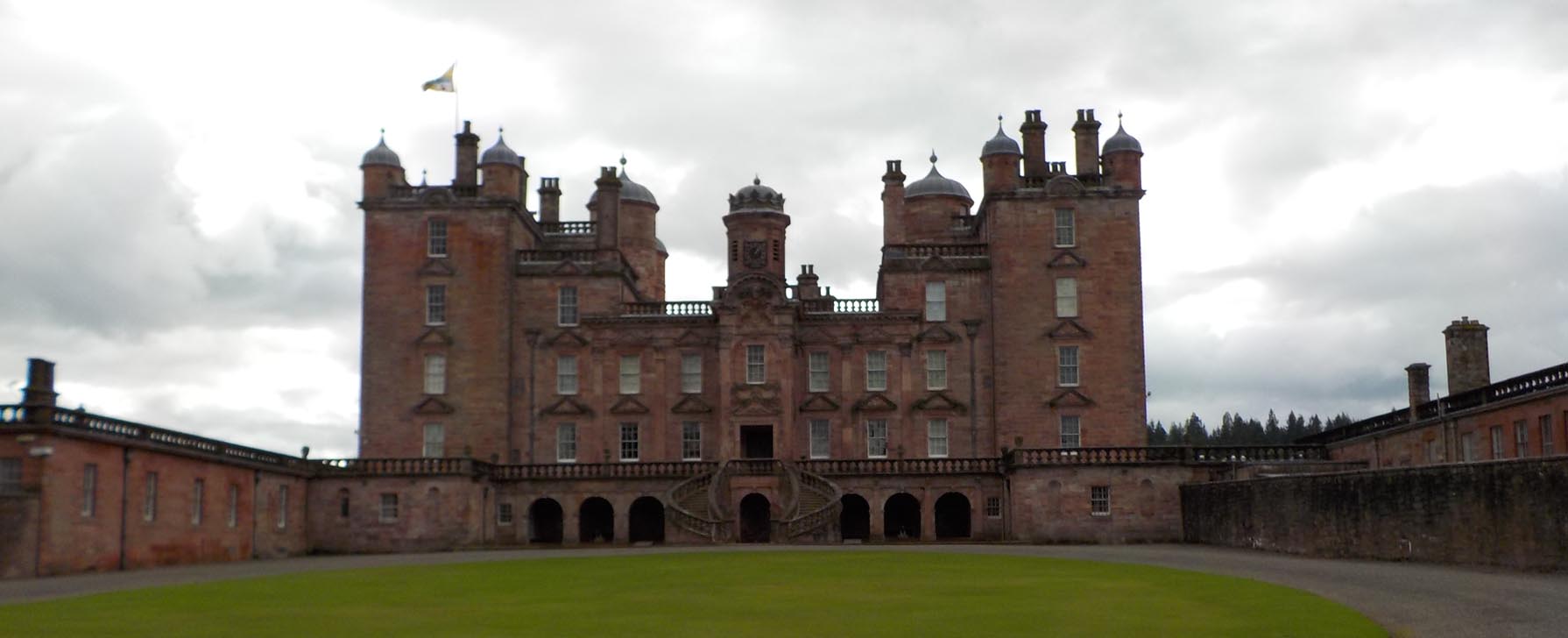
By the time Drumlanrig was built, castles had become as we imagine them today, huge (120 rooms), turreted lavish homes set in extensive grounds.
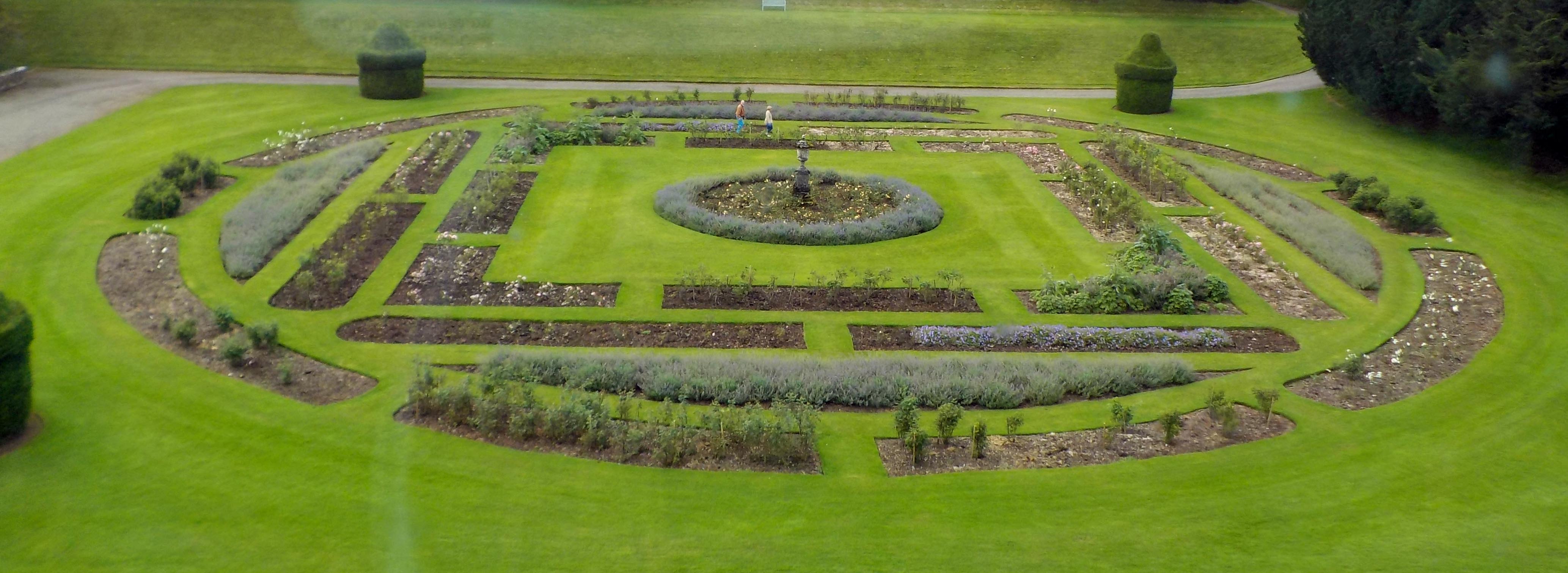
They could be defended, but not as easily as in the days before cannon. The castle interior is hung with Old Masters of greater (Rembrandt) and lesser distinction. Our young guide was proud of his association with the castle and the Buccleuch (Bu-KLOO) family. I was surprised and a bit taken aback to find that the Earl owns 90,000 acres just in the area around the castle, AND is the largest private property owner in Europe, with hundreds of thousands of acres. Why should we congratulate this person? Why on earth should we be paying to visit his castle? Oh, and by the way, he rarely even visits, he has a palace he prefers down the road. It has only 60 rooms. We were not allowed to take photos of the interior of the castle, though I took a photo out one window of the formal garden. My overall impression of Drumlanrig is that it displays the worst of inherited wealth. The castle is used as an event location, just to keep something going on at the property. Our visit coincided with the Galloway Country Fair, another summer to-do with dogs displaying their skills, and more sheep races. It was fun, but I was a sobered by learning about its place in the larger political/economic system. Do these people need land reform?
Hounds still root out “problem animals” on farms, even though fox hunting is banned.
A sheepdog showing his skills with a small herd of geese.
And they’re off!! More sheep races.
Dundrennan Abbey-Last but far from Least
It was quite an eye-opener to see the huge abbey church at Dundrennan. Even as a ruin it impresses. The idea of a cloistered order is a bit difficult for me to get my head around, a place where the brothers all prayed a lot, grew much of their own food, kept to themselves, all during the 1100s, almost a millennium ago. It’s suggested that they also died young because of the privations of the order. A tough life, though the cloistered monks did rely on “lay brothers” to perform especially heavy work. Despite the hard life, the grandeur of the surroundings may have been something of a reward compared to the kind of home a local family or even a noble would have had at the time.
The circles are the remains of supporting pillars of the nave of the church. What you see in the photo is the transept, a small portion of the original church structure. (It was massive.)
This view inside the transept of Dundrennan shows you the scale of the place. It was completed before the earliest of the castles I’ve mentioned.
Later portions of the abbey like this one were completed by the end of the 1200s, much earlier than anything comparable in castle construction.
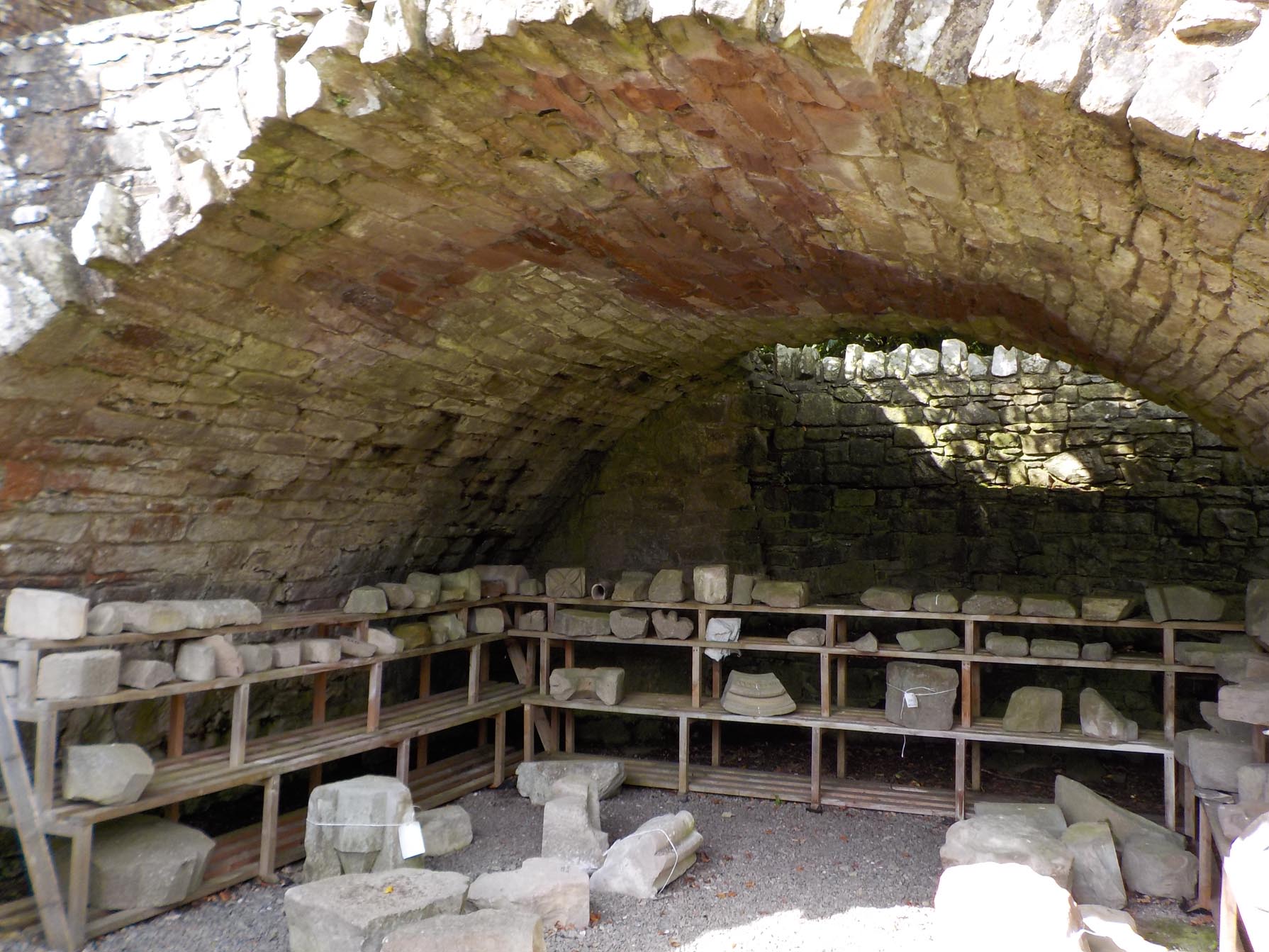
There are a lot of pieces in storage that have been collected as the abbey gradually falls apart.
I think I’ll switch to visiting abbeys and give Scottish castles a break. They are all rectangular towers, have the same layout, a barrel-vaulted storeroom(s) on the bottom, a great hall above, residence above, retainers above that. Kitchen, brewhouse, bakery and servants all were in structures around the exterior of the tower and are not ordinarily preserved, though it should be great for archaeological excavation. All those broken dishes and ale tankards…….
We drive down narrow roads, rarely passing anyone, heading for the shore. Our only company is the landscape and the sheep and cattle grazing.
We arrive at the end of the road a few steps from the rocky beach. The tide is out so far that you can’t see the water. This is a huge mud flat.
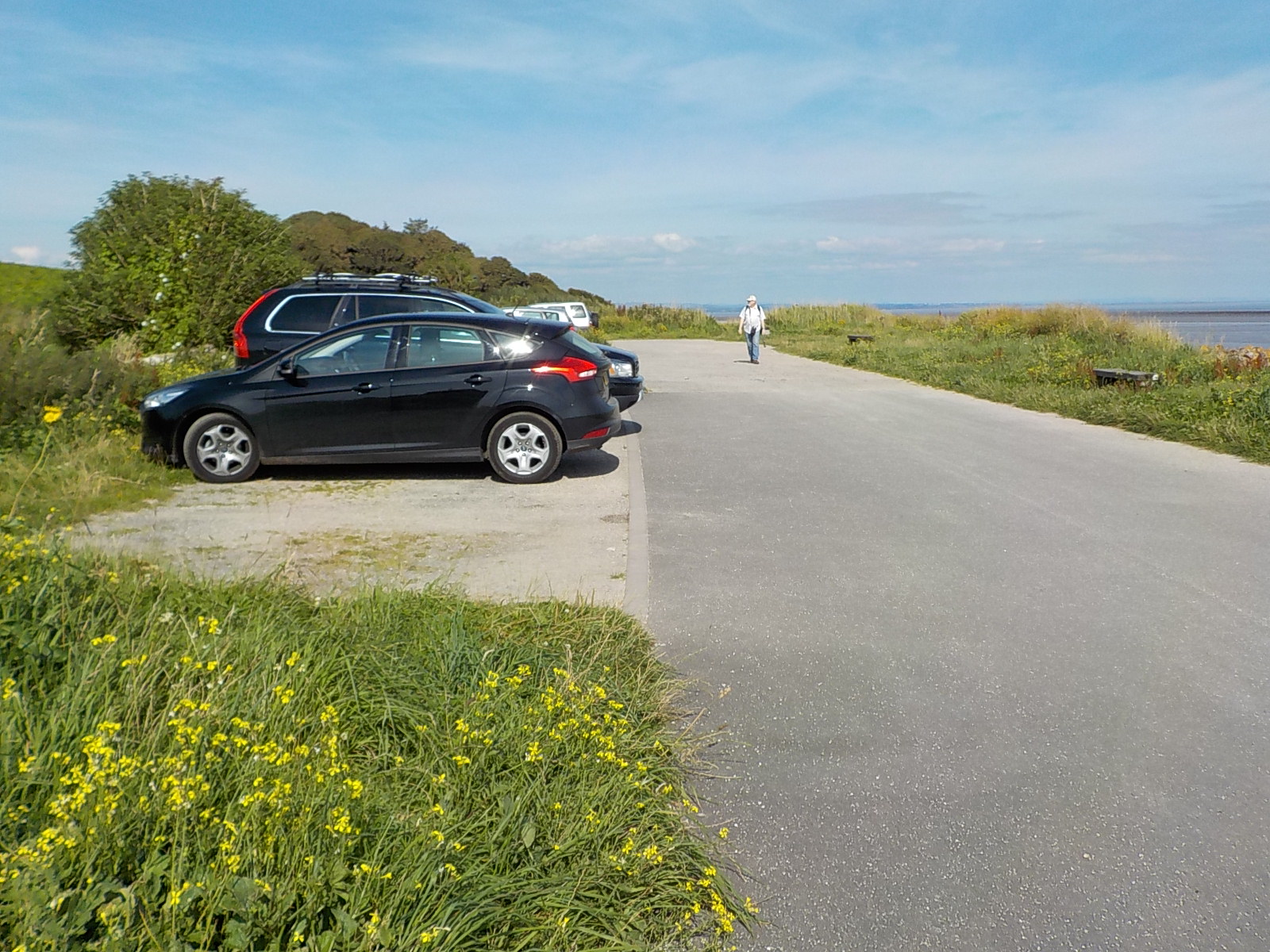
What do we find upon turning the corner? A car park for 15 cars, half full, with people camped on the beach for the day.
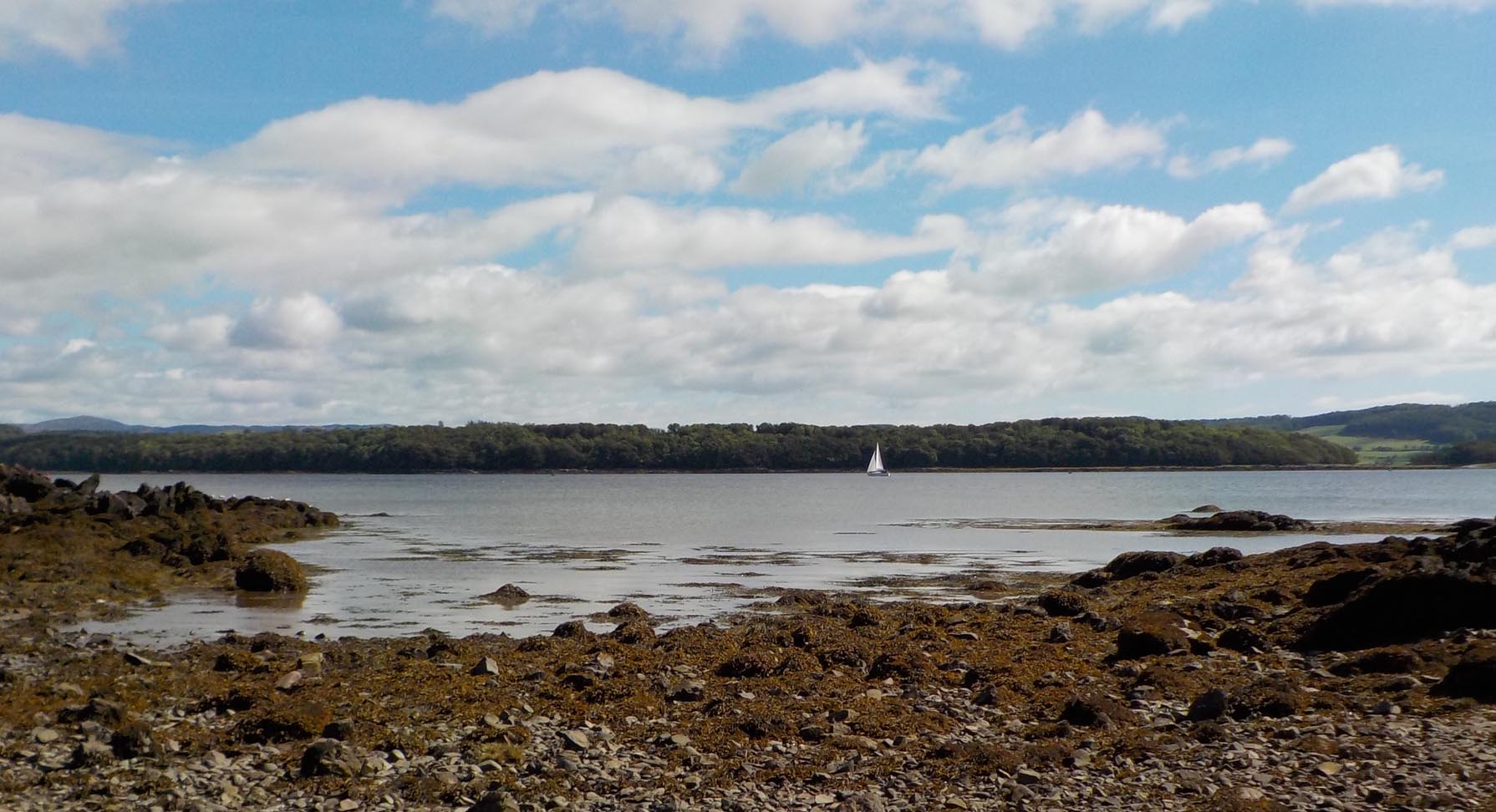
The immense tide flats were harvested of their cockles (small clams) for years. Today, cockling is prohibited along the Solway coast, with the promise that eventually it will be allowed under a strict system of permits to protect the clams from over-harvesting again. Even without cockling, when the tide comes in there is swimming, sailing, and windsurfing, hiking along the shore and beachcombing.
Where does everyone come from? Why are they in this place that seems remote until you get here?
I believe that the answer is in changing times. Southern Scotland was a political hotbed up until de facto union with England in 1603. That means that the peak construction and use of castles was centuries ago. Since 1603 there have been huge changes to the world. In its early days, the industrial revolution aided this region, the Solway coast, as ports were needed to move goods by ship. The coming of the railroads turned many of these small ports into ghost towns. 150 years ago the coastal town of Carsethorn was the shipping harbor for Dumfries. Railroads took over much of the commercial movement of goods. Today Carsethorn is a stop along a coastal walking trail, known for its pub.
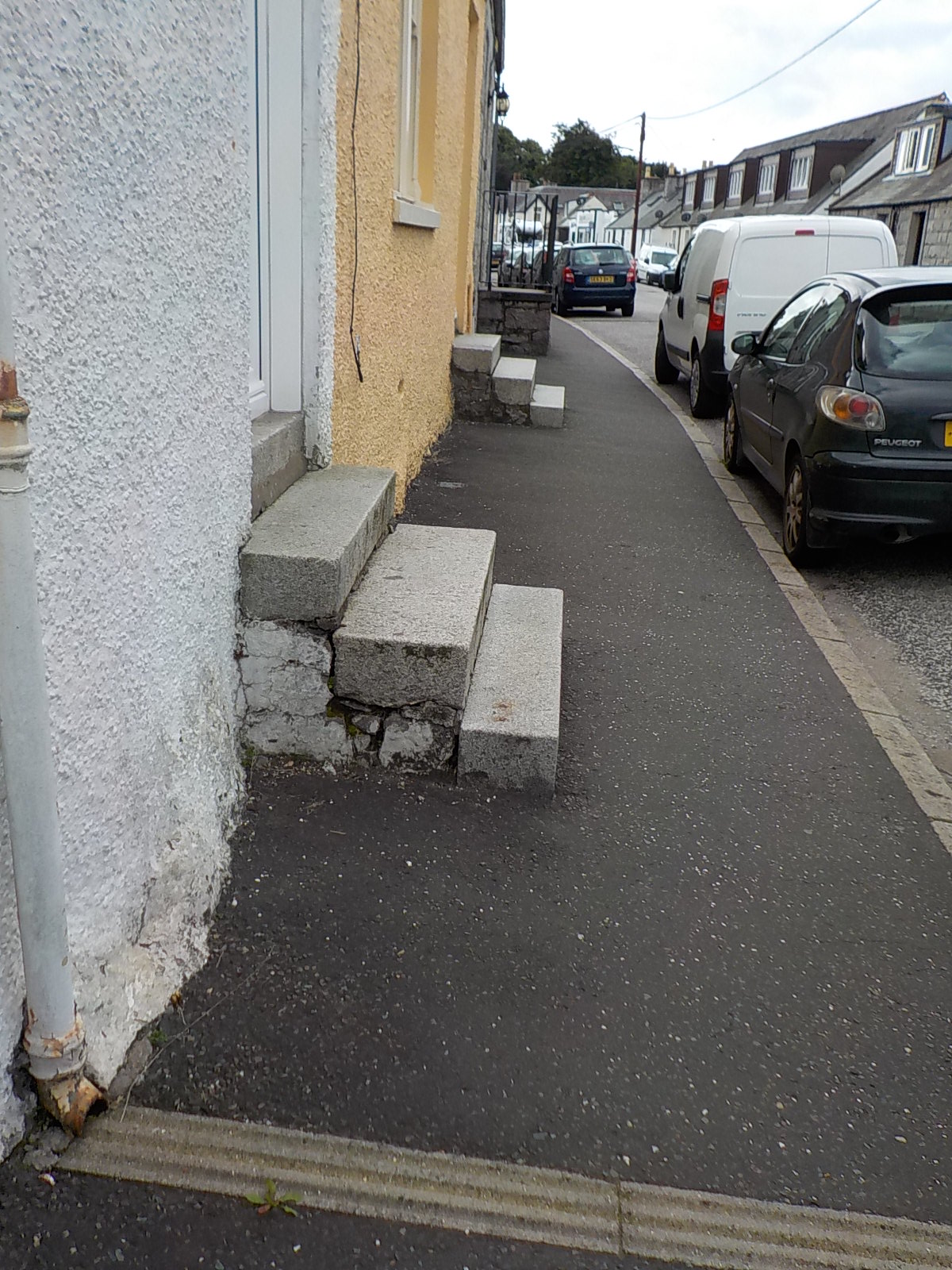
For much of the same period and beyond, granite and slate quarries produced building material that was used locally, also shipped to London and beyond. Slate is still used for roofing in this region, while in the US it is costly, a premium material. Granite quarried here is not the figured granite used in contemporary counter tops, but granite used to build stock exchanges, railroad stations, and paving stones. Most homes in Dalbeattie have granite steps (below, left).
There is some very fine work in granite. I like this combination of granite and small stones on the facade of a house in Gatehouse of Fleet (right).
Slate is also used creatively (below), as well as in roof tiles.
Most of the quarries are no longer in use, and many, including two adjacent to the town of Dalbeattie, are now forested parks with walking trails used by walkers, runners, mountain bikers and other cyclists.
One of the solutions to the economic bust that followed the boom of the Industrial Revolution is the substitution of tourism for business travel. Though we don’t meet very many American tourists, we do see the occasional American, French or German visitors. We do come across lots and lots of visitors from elsewhere in Scotland and the UK. People have second homes in the Dumfries and Galloway region, they come in RVs/camper vans, they hike and camp or stay in B&Bs. And now they use Airbnb like we do. This explains why we see visitors at every archaeological or historic site we stop at, every castle, every beach. There are cafes in many places that have no other services locally. The festivals that seem to be taking place every weekend all summer in every small town in southern Scotland are a combination of annual reunion for those who have moved away and activity for those who are visiting.
Economic continuity comes from farming, cattle, sheep and pigs. Endless green fields bordered by stone walls carpet the area and hundreds of animals graze across them as you drive by.
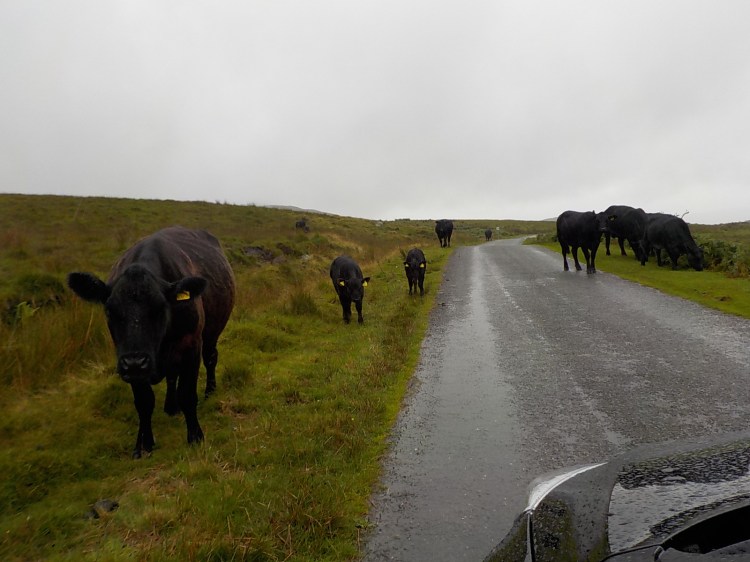
These cows were grazing on the farm around an archaeological site we visited and seemed happy to check us out. Scots in this region have long been farmers and that is still an important part of the economy.

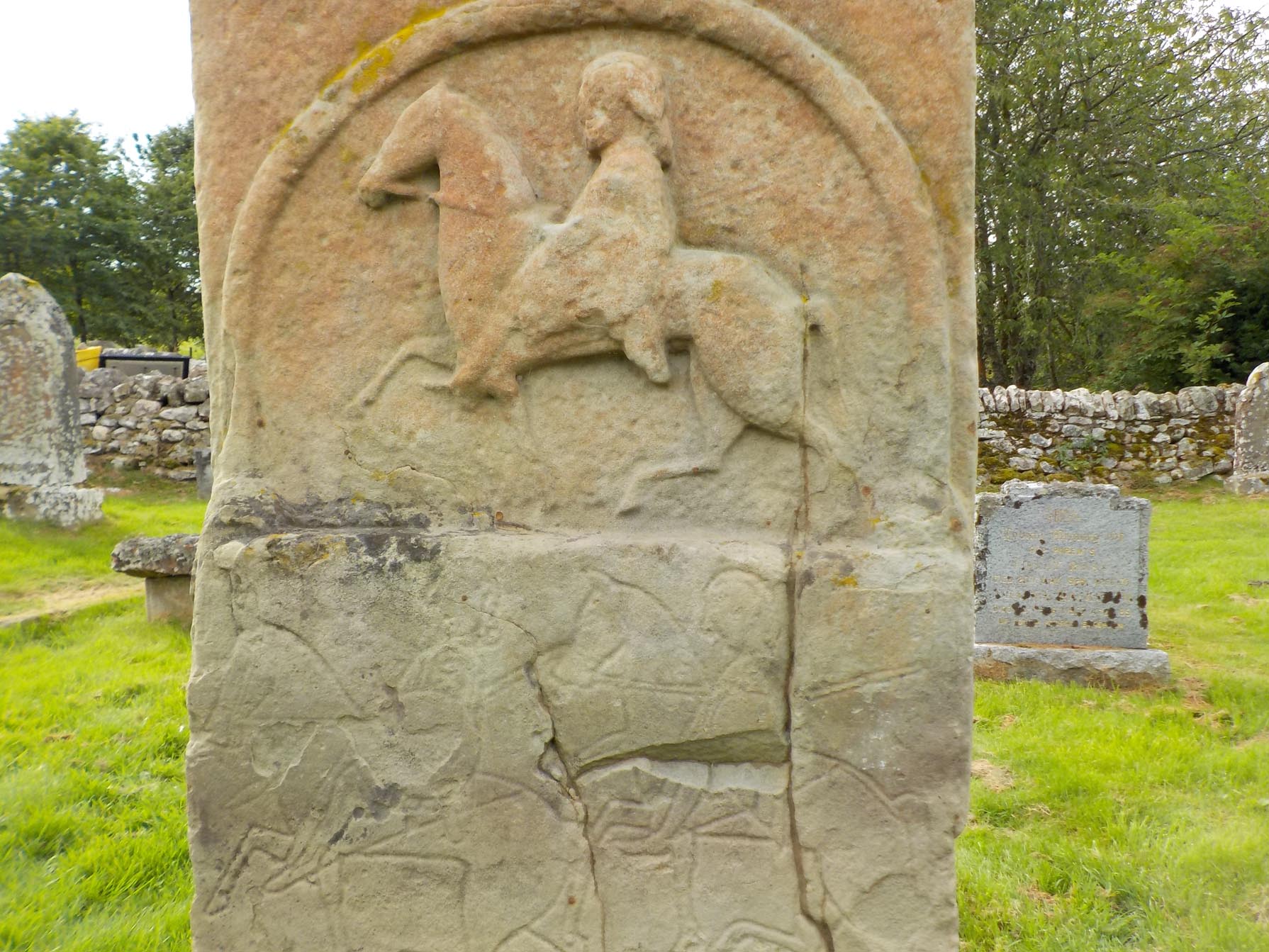 Hunting scenes are often present. If you look carefully, you see two additional horsemen below the horse and rider in relief on the Edderton Churchyard stone.
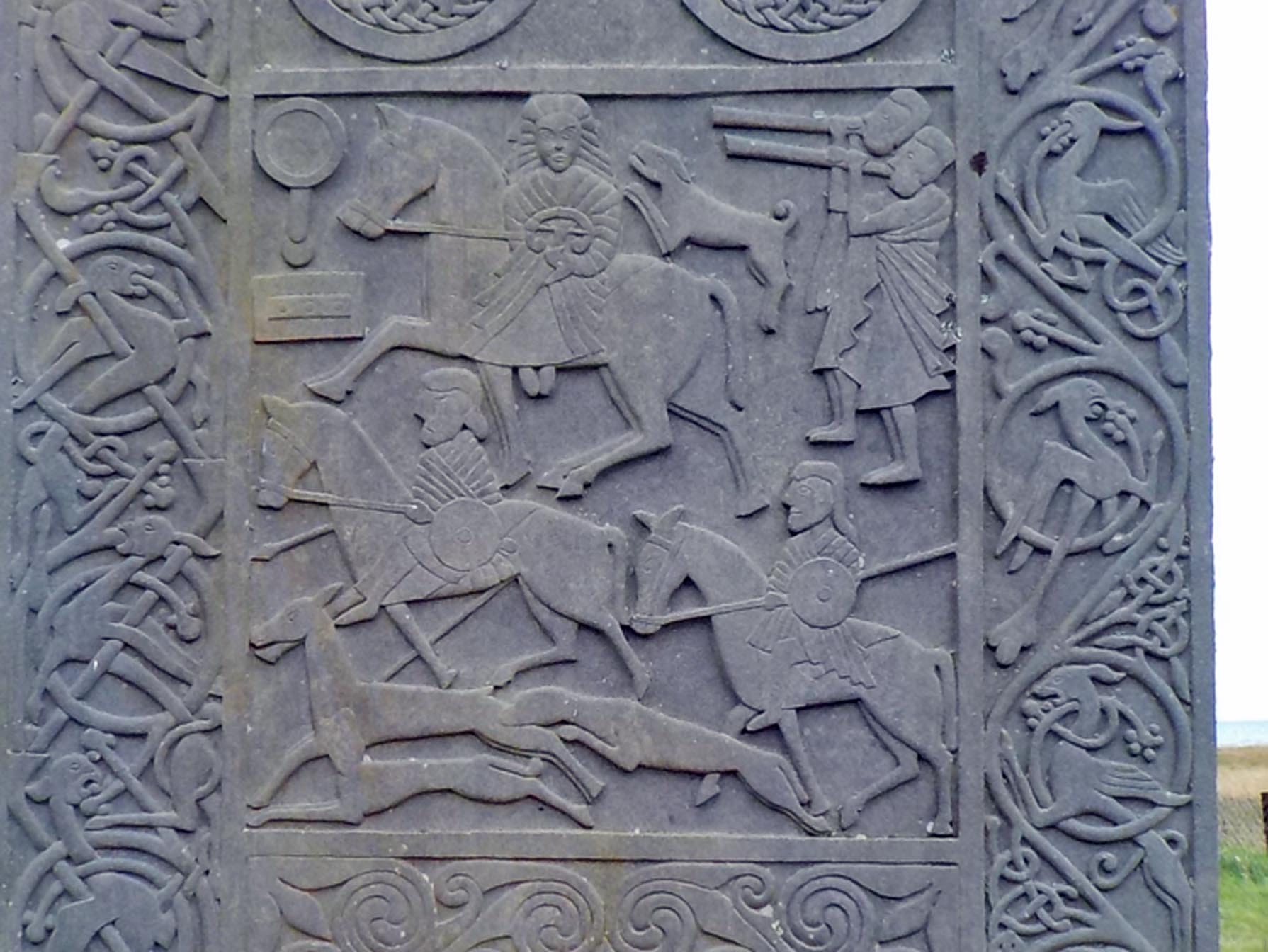 On the HIlton of Cadboll stone is a hunt scene with a woman riding sidesaddle, two men with hunting horns, a stag, dogs, other riders, as well as a mirror and comb to the left of the woman rider. Why these were important images is not known.
 In addition to the stones mentioned, we visited Dunrobin Castle where there are several Pictish stones, but photography is not permitted. This has much less to do with the Pictish imagery than the fact that the stones are housed in a building that is festooned with more than 100 mounted animal trophy heads. I was told that some might find the display offensive–though they aren’t considering taking it down–so they don’t allow photos. Unfortunately, they don’t even have postcards of their Pictish stones available in the gift shop. The castle’s main draw are its fairytale main building and formal gardens.
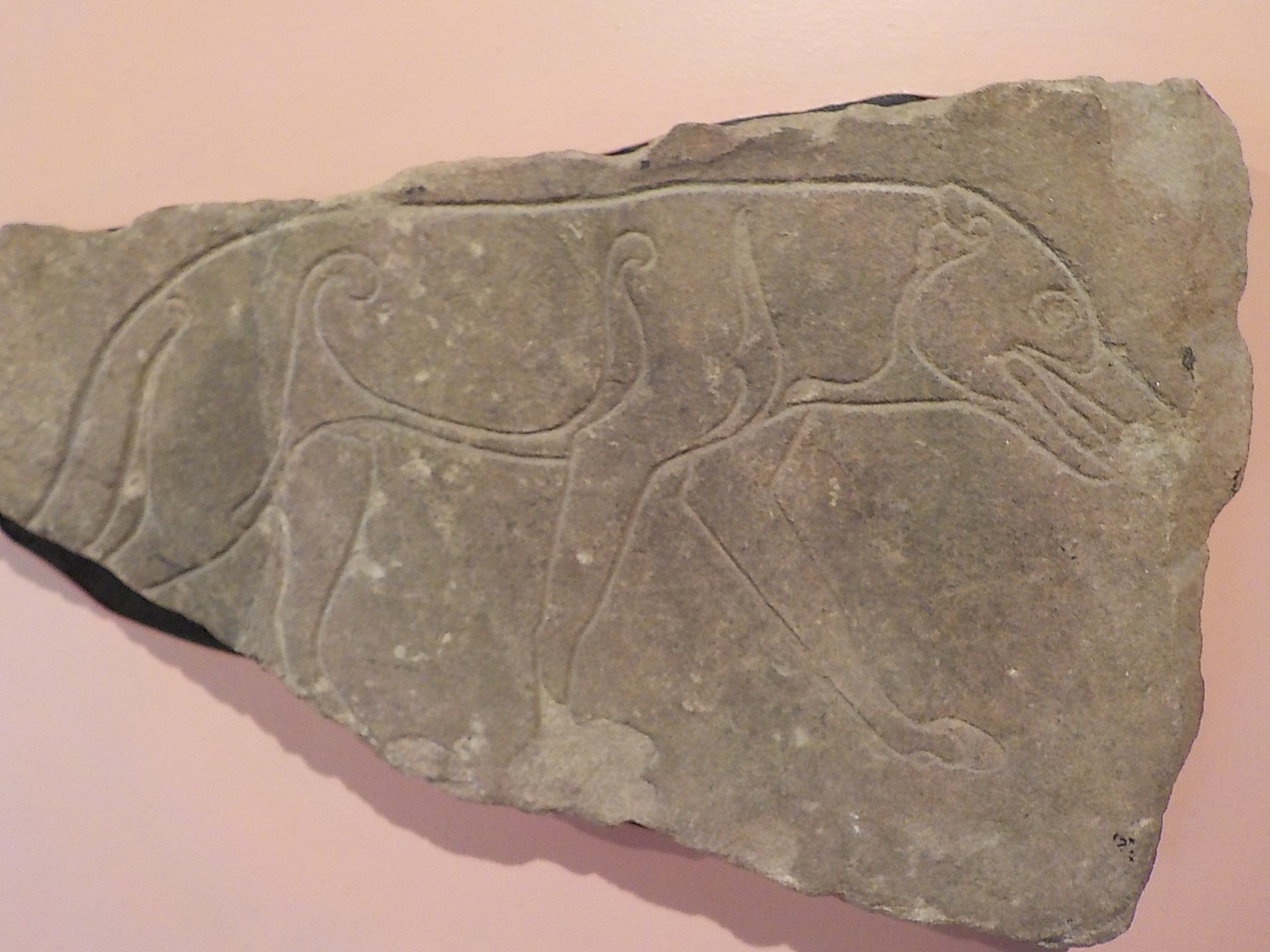 In Inverness, we saw the Ardross Wolf stone (above), and the head of a Pictish beast (below),
 Still to visit are Portmahomack and Fortrose where there are small collections of Pictish stones to see. We’ve seen all the freestanding outdoor stones in our area that have visible marks on them. There are others all over Scotland from Aberdeen to Iona, but we are visiting stones from Inverness to the west and north. There is an excellent guide to the Pictish Trail in this area. This link takes you to a pdf of “The Highland Pictish Trail: A Guide to Pictish Sculpture from Inverness to Dunrobin” by the Highland Council.




























 Llywindatravels 2025