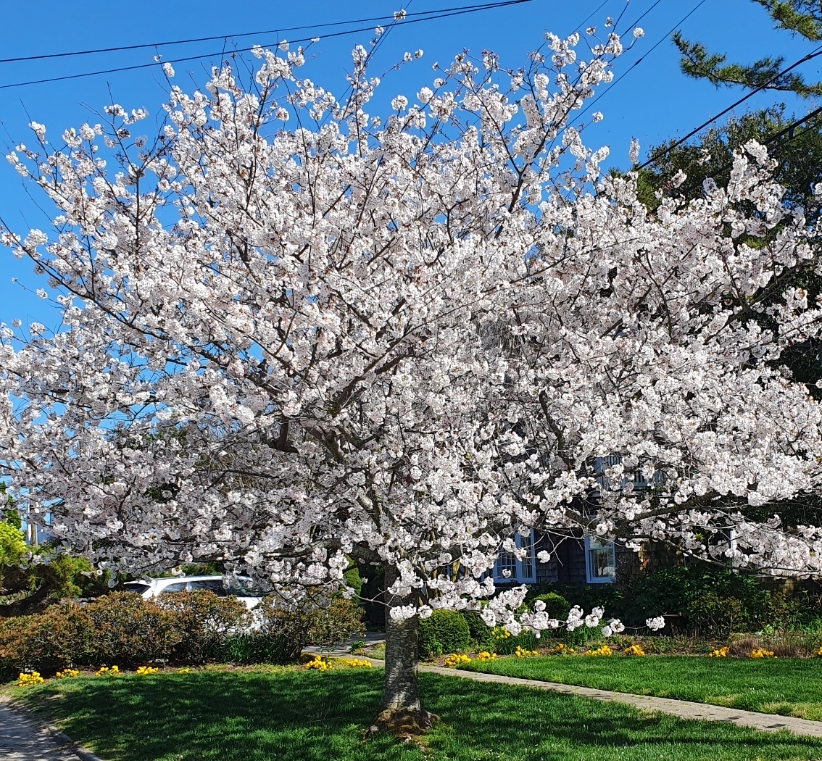
We’ve spent a lot of time visiting parks this month as the weather shifted toward spring and warmer temperatures. There are miles of trails through state and city parks, national wildlife reserves, and beaches. We’ve visited a few markets and museums, yet at this time of year, the outdoors is the place to be. The azaleas and dogwoods hit their peak and are now turning from pink and white to leafy and green. There were a gorgeous couple of weeks where every tree bloomed.
Pleasure House Point was our first discovery, a park not far from our house with a trail that winds along a bit of Crab Creek and Pleasure House Creek, both of which open on the mouth of Chesapeake Bay. Another trail circles two small ponds. We see shore birds and land birds depending on which way we walk.
Jonathan along Pleasure House Pt. trail
Warbler in a tree
Even closer to where we live is First Landing State Park. On our first visit, we went into the park by car, and walked along the shore, doing a bit of beach combing (fishing weight and hook), and checking out the birds. We tried the northern entrance to First Landing, too, where we found the best place to see warblers yet. Raised walkways extend into the marsh, and there are excellent places to stop and listen for birds, then try to find them in the trees. We saw four different warblers on the afternoon of our visit, and we plan to go back.
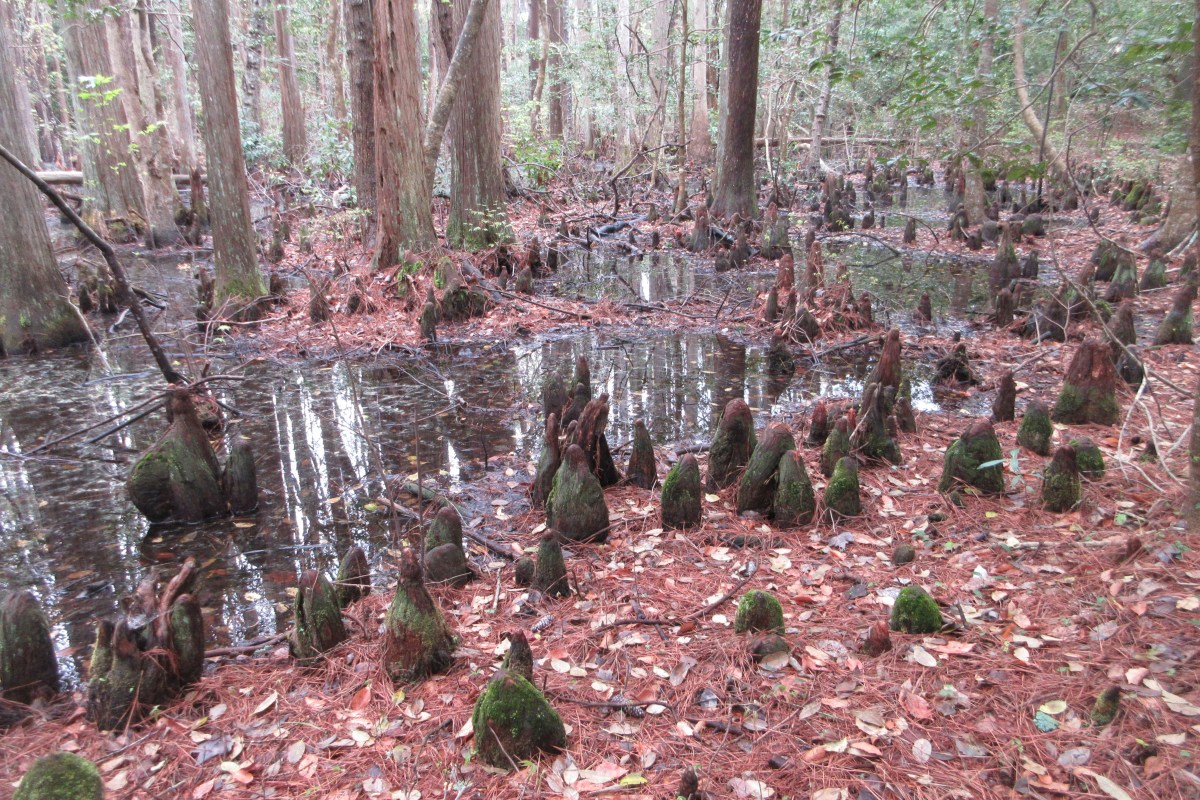
Cypress knees in First Landing SP
We don’t even have to get in the car to visit First Landing, as our street dead ends at the park’s eastern edge. We walked west into the park along raised ridges that head across the park toward the water. The area was drained and logged in the early 20th century but is now overgrown with secondary forest. We didn’t see many birds, but the forest is beautiful, with cypress knees growing in the low spots, and extravagant fungi sprouting from fallen logs.
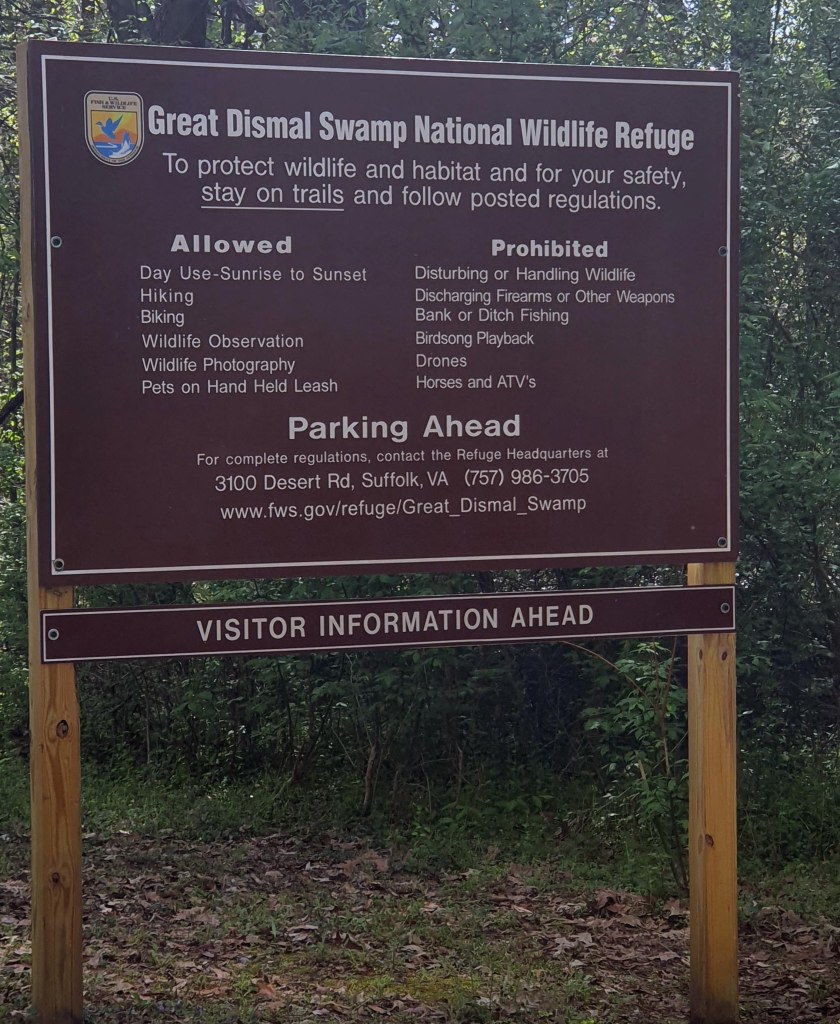
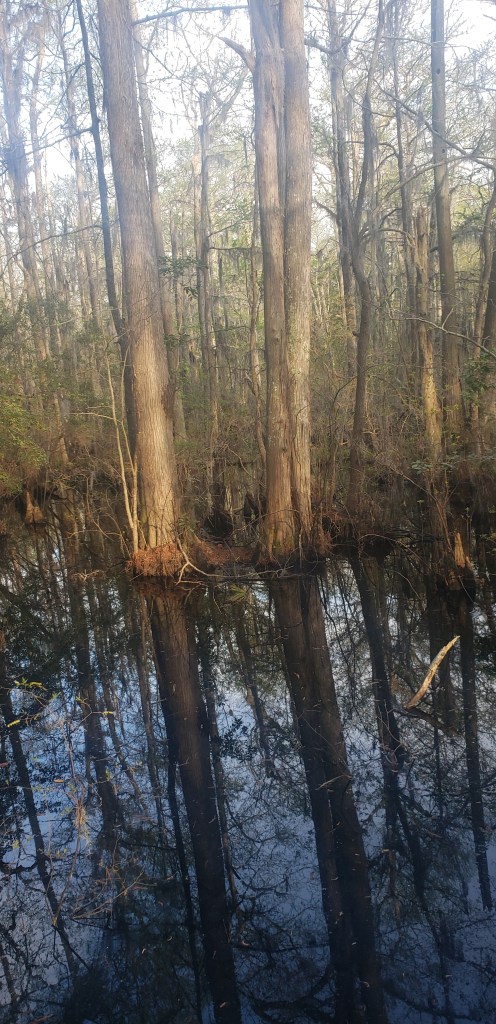
Next on our itinerary came Great Dismal Swamp. With a name like that, I knew we had to visit. We headed to the area recommended for bird watching, walking a section of Jericho Lane, and the brushy sides of the road were perfect warbler habitat. Several different species sang and hopped in front of us, along with kinglets and cedar waxwings. The sun was out, it was relatively warm, and not at all dismal.
First Landing SP looked like our imagining of Great Dismal Swamp
We haven’t spent all our time in the swamp, though that’s often where the birds sing the loudest. We had another excellent day at Back Bay National Wildlife Refuge, south of Virginia Beach. There were fish shoaling offshore, because every bird in the neighborhood was out fishing. We watched a pelican gulping fish with its head in the water while ospreys crashed into the water and flew off with fish in their talons. Terns dove for fish from the sky while cormorants ducked under the surface to do their fishing. It was quite a show and we wondered whether it was always that busy a fishing area. We plan a return visit to drive a bit further down the narrow peninsula south of Virginia Beach that ends beyond Back Bay to False Cape State Park, though I’m not sure how we could see more birds than we have already.
On a sunny day, turtles perch on every log. They are canny things, plunking into the water just as I get my camera focused on them. Some are much larger than the aquarium turtles I’m used to. In ponds, the turtles paddle around, ignoring us.
Though some days have been chilly, I hesitate to complain because there are no bugs. I understand that this area cultivates a pretty thick cloud of mosquitoes once it warms up. I’m enjoying the outdoors at the perfect season.
We try not to drive more than two hours from our home base unless we’re going to stay the night. We pushed our limit to get from Virgina Beach to Chincoteague, a few miles shy of the Maryland border. We wanted to see the town, visit Assateague Beach and see the famed ponies.
Lunch at Bill’s
We drove through the Chesapeake Bay Bridge Tunnel and down the road for quite a long way through farm country and tiny towns like Assawoman that have suffered badly from the lack of visitors over the past two years. There are a lot of unusual place names, but the strangest place we passed was Meat Hunk Fen. (I couldn’t find a tale explaining its name.) Arriving on the island and town of Chincoteague we were ready for a break. We stopped at Bill’s Prime Seafood and Steaks for a bite of lunch. We had delicious fried oysters and a soft shell crab BLT, especially good.
Birds in the distance across acres of tidal marsh
My vision of Chincoteague was of a cute Victorian downtown to stroll after lunch, but that was completely in my imagination. Chincoteague had few or no stores until well into the 20th century. Stores are dispersed along Main St. south of the causeway, but on a chilly weekday, there’s not much to see. It appears that many businesses don’t bother opening until Easter or even Memorial Day. Our overall impression was of a slightly down at heel seaside community, not the tourism powerhouse described in my copy of the Chincoteague Beacon. A headline read, “Assateague Island announces record shattering 2021 attendance.” (Over two million visitors).
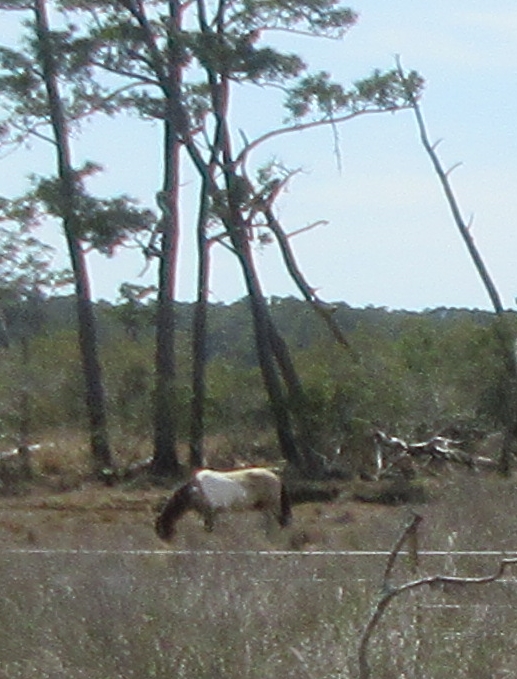
Assateague pony
Chincoteague and Assateague Islands are known for the ponies that lived wild there for over a century. The children’s book, Misty of Chincoteague, published in 1947 and made into a movie in 1961, drew people to the islands who weren’t interested in fishing. Today, groups of ponies that make up the herd live on Assateague Island, managed by a combination of the National Park Service, the US Fish & Wildlife Service, and the Chincoteague Volunteer Fire Department. Once a year, the ponies (150) and their foals (60-70) are rounded up, herded to Chincoteague by swimming a short channel, and paraded through the streets to the sales ring. This has become the centerpiece of Chincoteague tourism, now the principal industry. There are two smaller roundups during the year, but the pony swim and parade are the biggest draw. Most foals are sold to maintain the size of the herd at 150, with proceeds supporting the animals during the year.
After lunch, as we drove toward Assateague Beach, we found cars parked along the roadside. We slowed, then stopped to watch the ponies grazing just across the fence. Children, parents, and grandparents took photos and picked out their favorites. The ponies have a good story, even if it is largely fictional. [They probably did not originally come from the wreck of a Spanish galleon, they are no longer wild, and anyone can purchase one.]
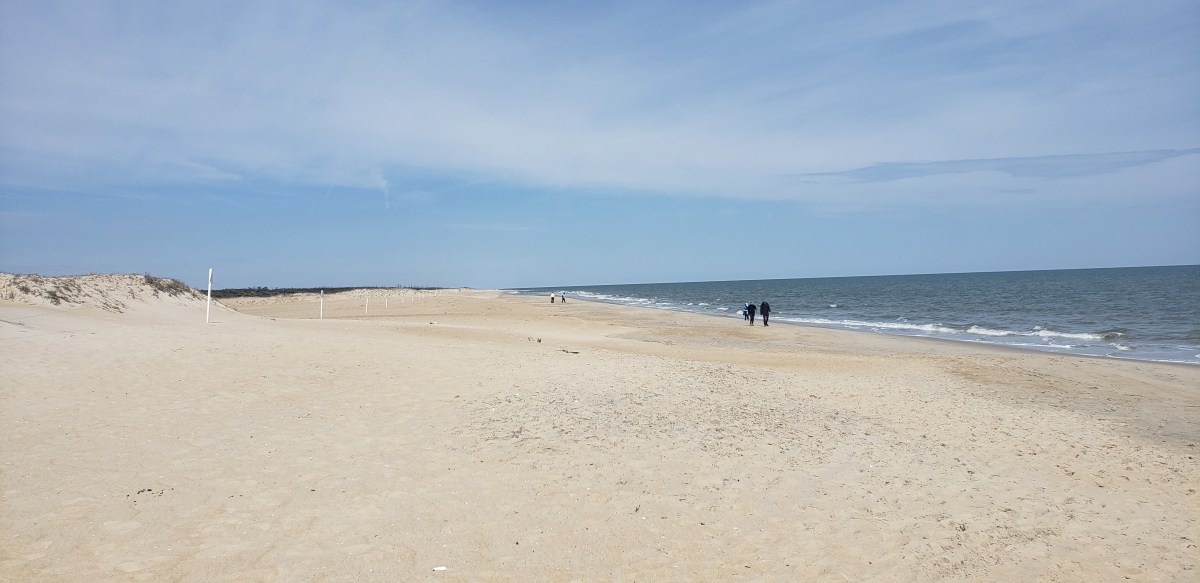
Assateague Beach
We continued on to Assateague Beach, a long stretch of sand. Getting out of the car, we noticed the air was much colder than in town, and the wind was much stronger. We added all our layers and set off for a walk. There were other walkers, picnickers, a couple using a metal detector, joggers, and people fishing. We were passed by a couple headed down the beach with their picnic. About 200 yards past us they turned, and went straight back to their car. Somewhere between invigorating and freezing, we enjoyed the walk despite the cold. Jonathan picked up a big fish hook and swivel, and there were lots of interesting shells, but none we had to keep, and no beach glass at all.
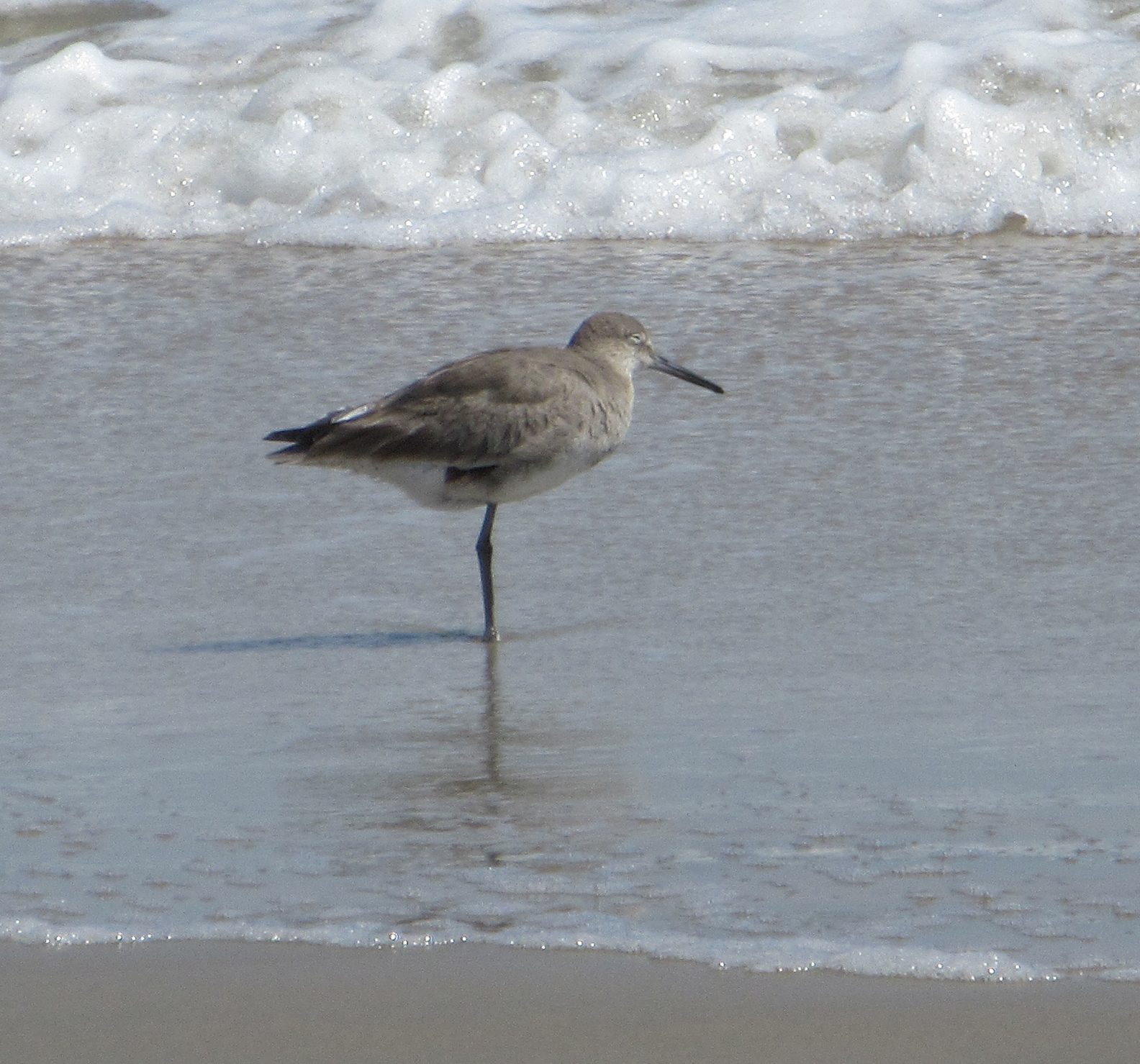
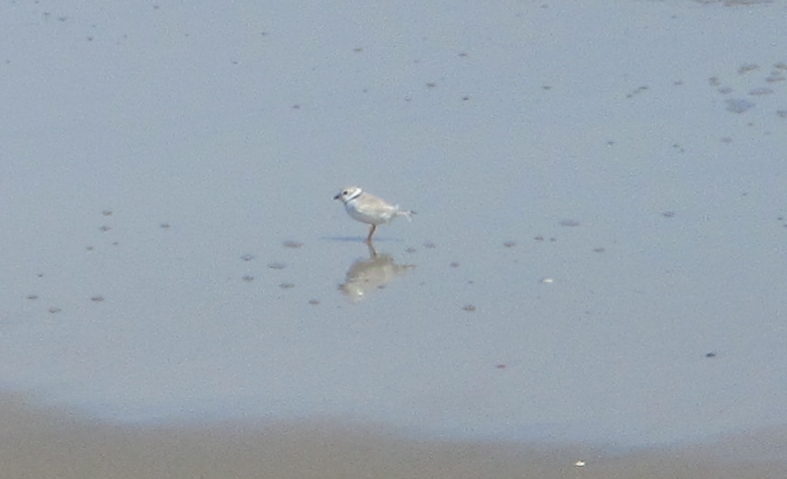
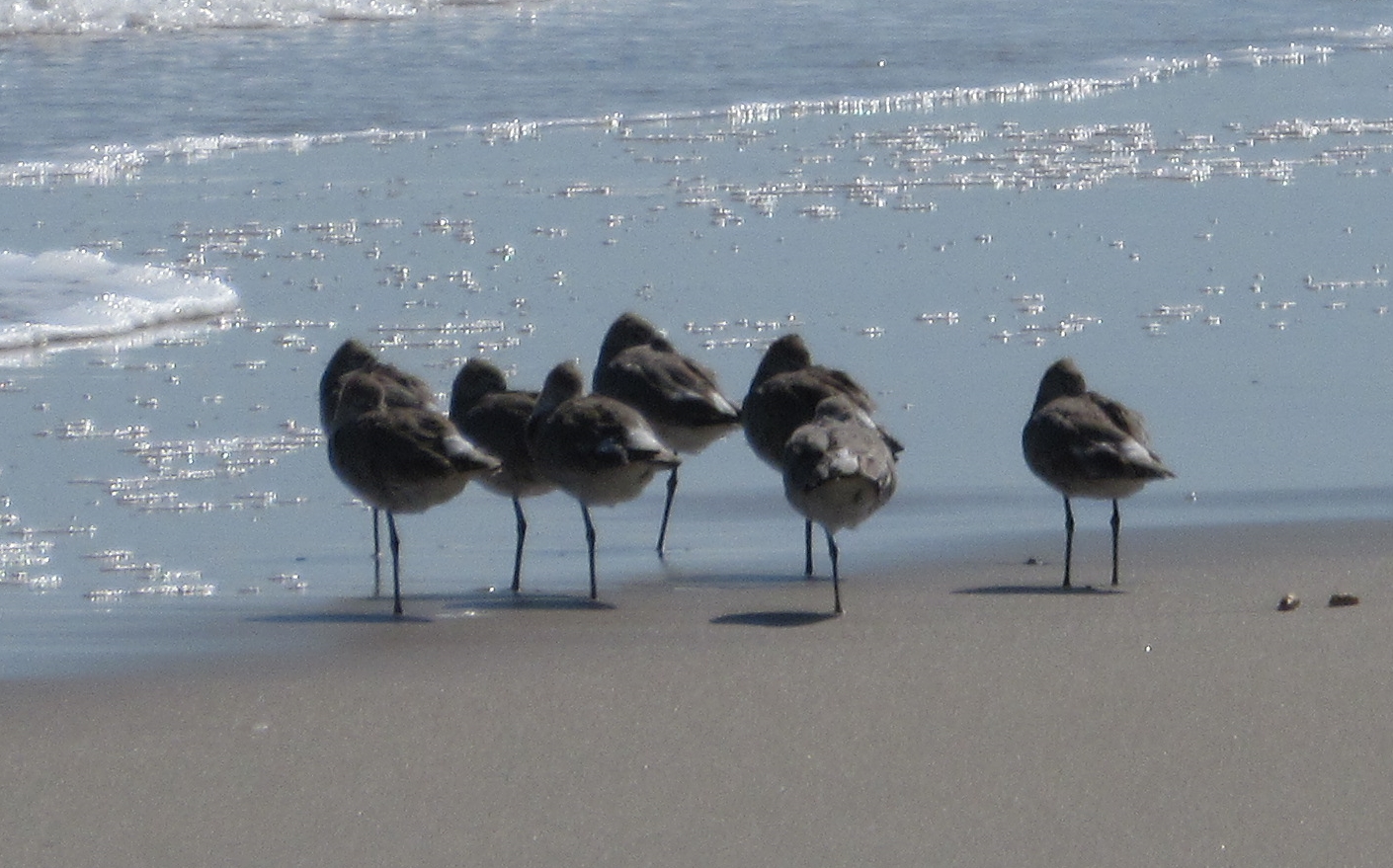
Clockwise from upper left: Willet, mergansers and snowy egret, piping plover, white-rumped sandpiper, the beach.
Birdwatching was good. We saw ospreys and vultures, gulls, willets, and the three species that nest on Assateague, piping plover, skimmer, and least sandpiper. By the time we got back to the parking area, I was happy to sit in the sun-warmed car, scout the roadside for ice cream (Island Creamery, Maddox Blvd.), and enjoy the ride home.
A Note About Blog Posts
You would never think that a house might lack paper, but in our efforts to reduce our luggage, I seem to have left all notepaper behind. I have two small books of post-its large enough for a grocery list. Our Airbnb is newly renovated, and there is not one slip of paper in it that we have not already used the back of. I wanted to take some notes during our day trip to Chincoteague and Assateague and all I found was an old NYT Sunday Fashion issue from late 2021.
As a result, my notes are written across an ad printed in a light color. Once I got going, I decided to make my writing fit the page. It worked out rather well, and I was able to decipher my script when we got home. Here’s what it looked like–I have purchased a pad of notepaper since I wrote this.
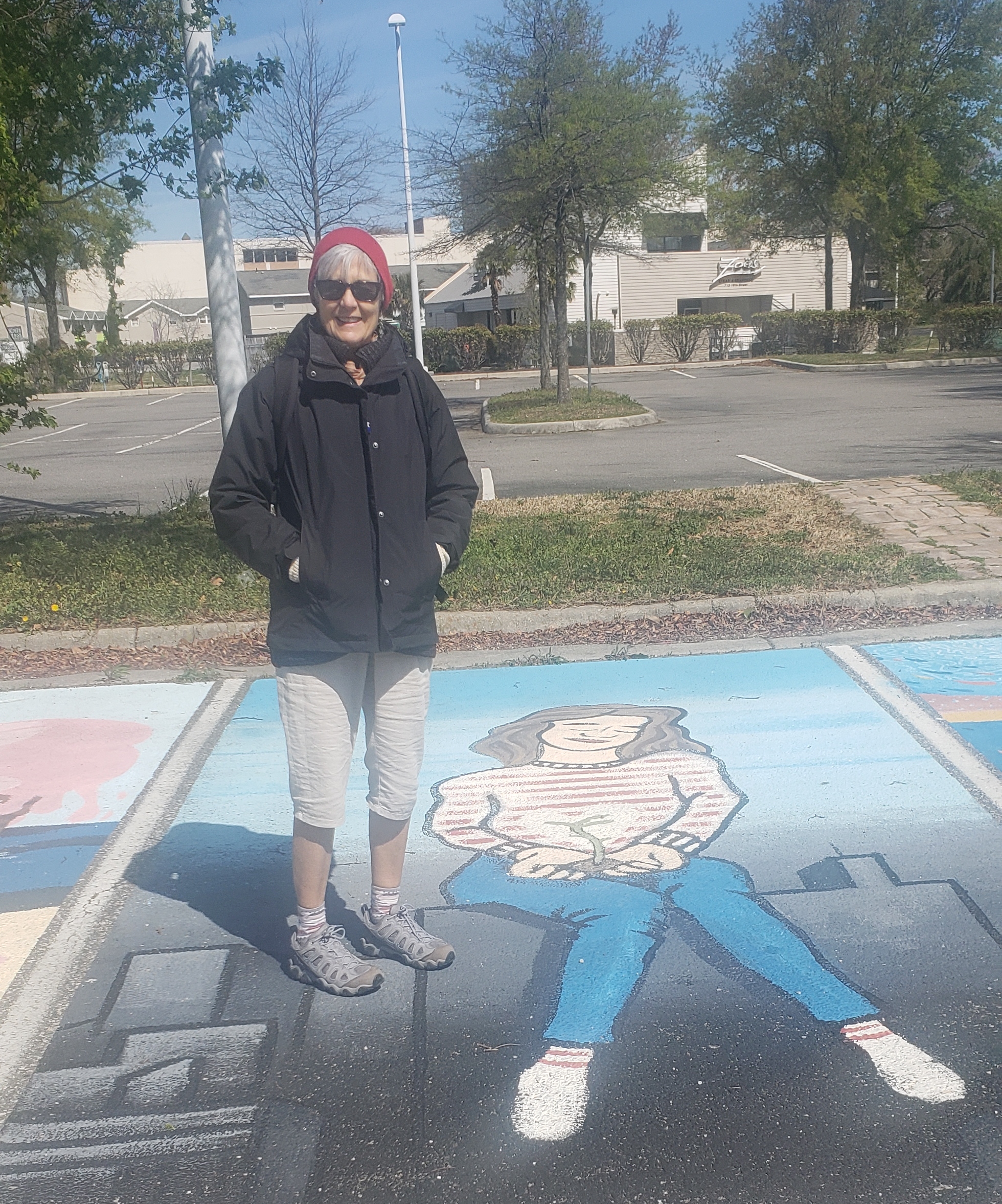
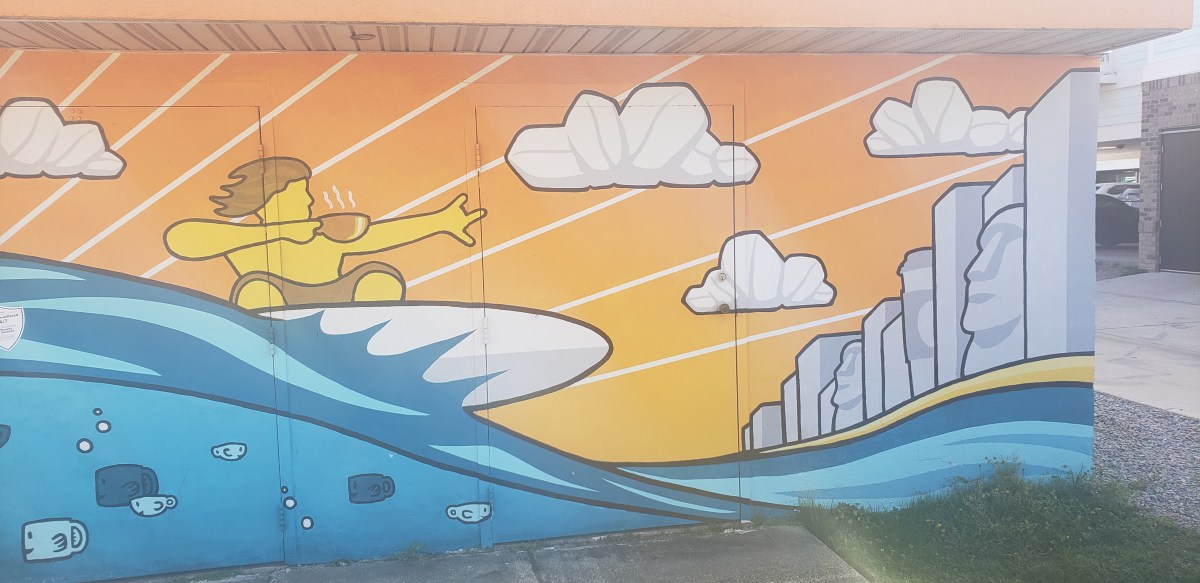
There’s a section of Virginia Beach that’s been dubbed the ViBe district. As we walked around the area between 17th and 20th streets from the convention center to the hotels along the beach, businesses, civic groups, and the Virginia Beach Arts Center have collaborated to create murals on a number of buildings. School groups have made other murals on walls and fences. Some businesses have been in place for a while, like the old time rock shop with specimen geodes three feet high in the entry, and all kinds of rocks and beads for sale. Coffee shops, restaurants, and a distillery are recent additions, and there’s lots of room for more. Today (April 2), the Old Beach Farmers Market gathered for the first time this year. Only a few brussels sprouts and some kale were available in the fruit and veg department. The selection will expand as we move toward summer, and in the meantime, baked goods, coffee, meat products, jam, honey, and artisan items were available.
The ViBe neighborhood is unprepossessing, with a lot of single story buildings and businesses spaced among parking areas and vacant lots. What’s obvious is the city’s commitment to making this neighborhood into an important part of the city. In the building stage, ViBe is like Freemantle before it became hip, or even Brooklyn in the ’00s. It looks like a good opportunity for the future. We will go back for the third Saturday flea market, to see whether there are some new products at the farmers market, and for the energy of the place.
Wonderful to be back at the beach! Any beach! I was itching to see what our shore is like, though we arrived late in the day at our latest Airbnb and had to unpack just a little. By then it was dark. We can see birds from our deck and hear them all around our house (half a house) at the end of a dead end street, peaceful apart from the chirping. We’ve already met a nice neighbor, too.
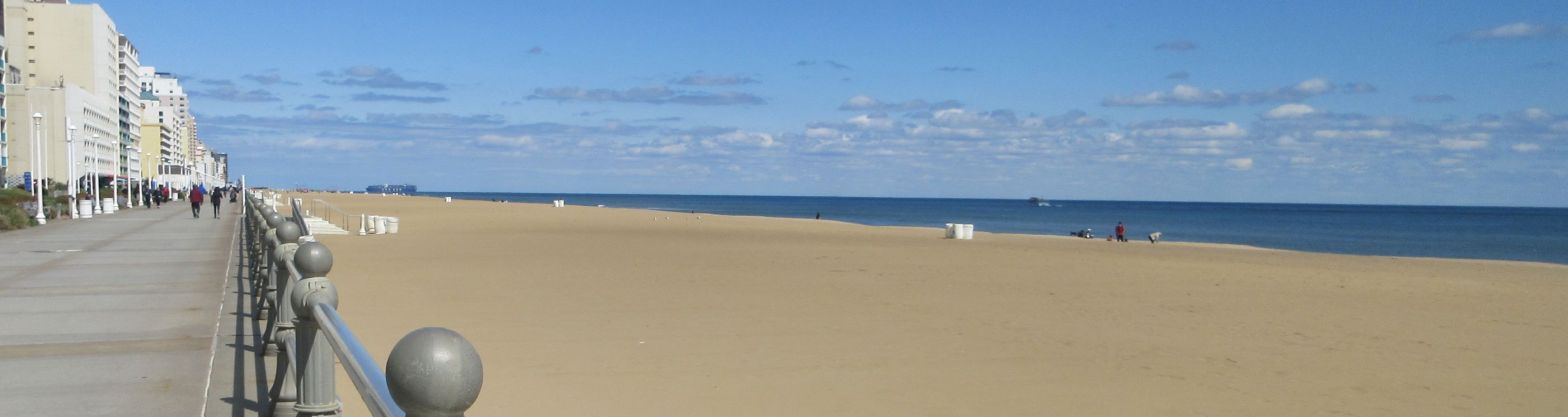
It’s two blocks to the beach, and unlike some of the other places we’ve been (Bainbridge Island, I’m looking at you), there is public access at the end of every street. The beach is broad and extends a long way. Offshore lie huge ships waiting to enter the port of Norfolk. We watched an immense container ship heading out of the estuary into the open sea. It was amazingly large, and once at sea, it moved surprisingly fast. (We also saw the giant cloud of pollution its diesel motors emit to achieve that pace.)
Our house is lovely, just renovated, with a deck and gas grill. It only took Jonathan a few tries to get the TV working-I threw in the towel when I pressed “power” on the remote and got fuzz. (I love finding the folded paper of symbols that comes with the remote and no other instructions. No I don’t.)
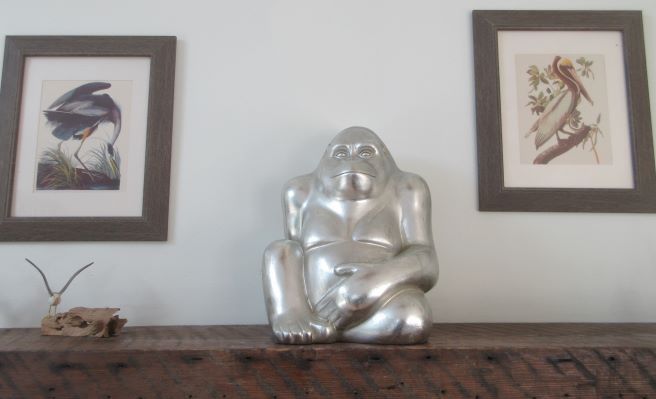
Decor is beachy, with some Audubon prints that I like, and one strange item. What on earth is this? Does anyone know if it has special significance in Virginia, or is it just the usual case of decorating a property with a combination of Ikea and Christmas presents you don’t dare regift?
Jonathan hasn’t done too much cooking, because once we were settled, we found the gas stove isn’t working. A couple of calls to our property manager revealed that we are the first guests after an extensive renovation, and no one checked to make sure the utilities were all reconnected. We did not hang around to meet the gas guys on Saturday morning, thinking that the province of the manager, and consequently, were not home when the gas guy came by and couldn’t put the gas back on. With luck, we’ll have gas on Monday. Good thing Jonathan found the fuel for our barbeque. That and a microwave, and we’re fine for now.
Virginia Beach has swimming, surfing, body boarding, even horseback rides along the sand. Boat tours run up and down the shoreline. However, it’s not a beachcombers delight. Little sweeps of broken shell line the high tide margin, just where we expect to find beach glass, but nothing is there. We plan to expand our search area in the coming week.
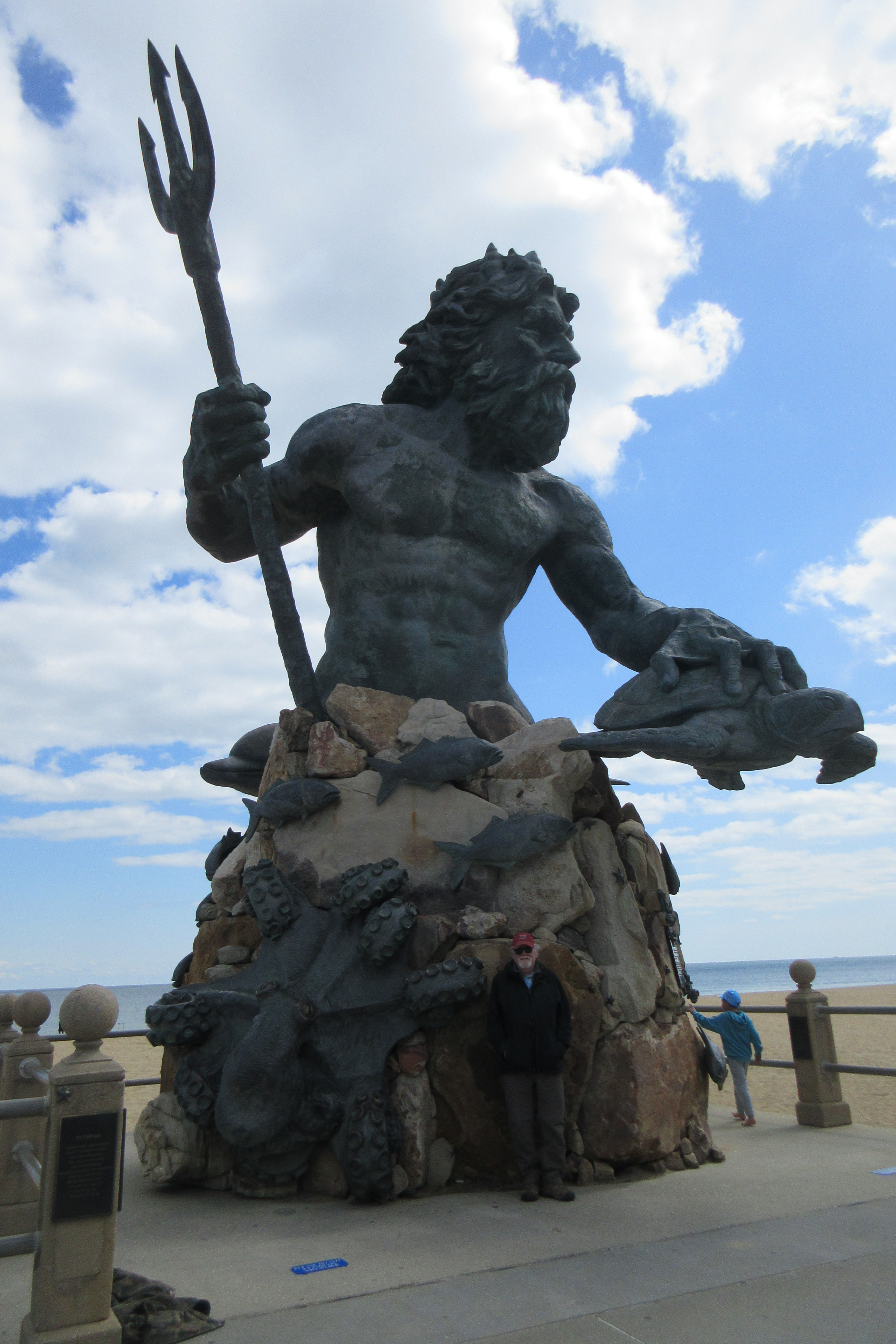
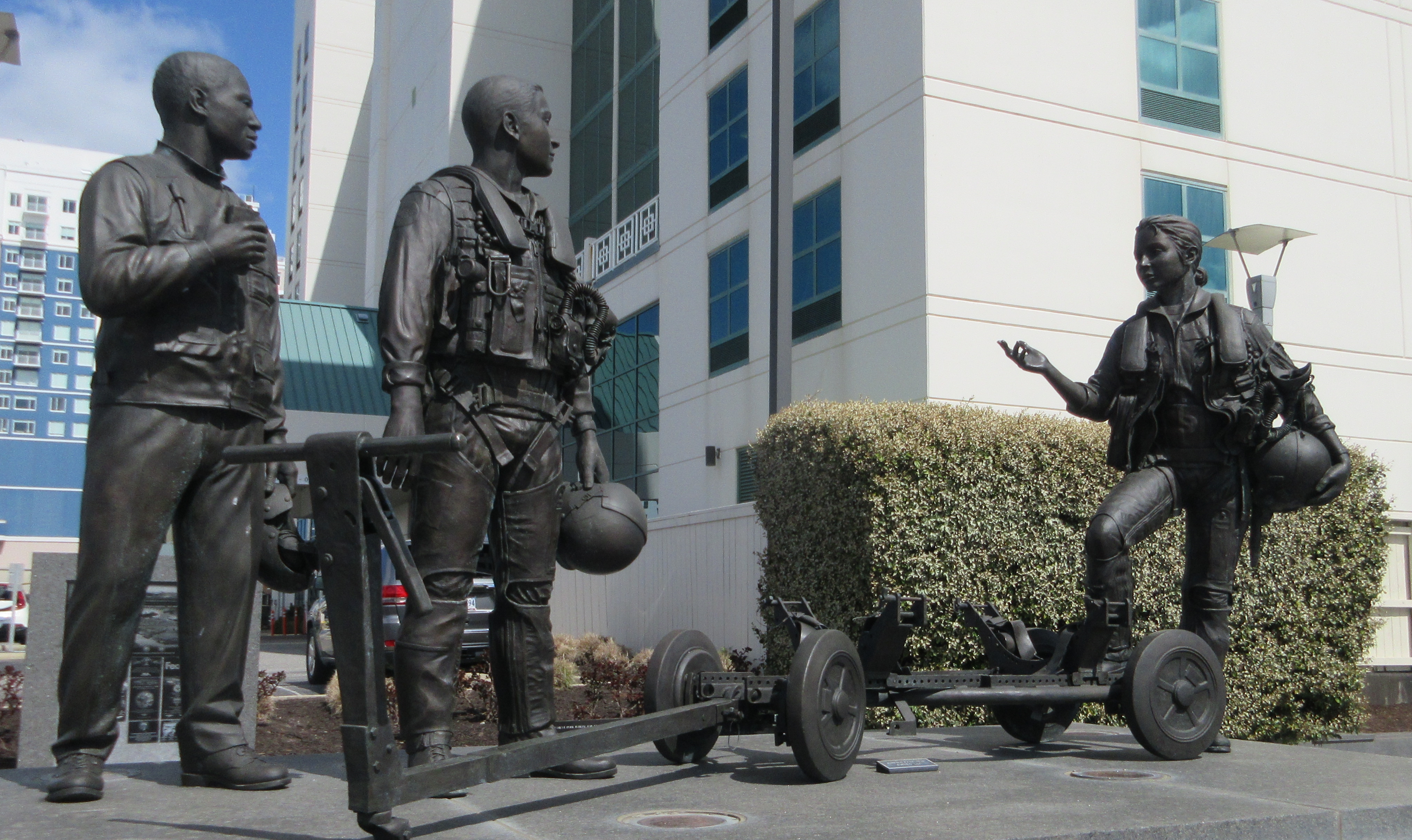
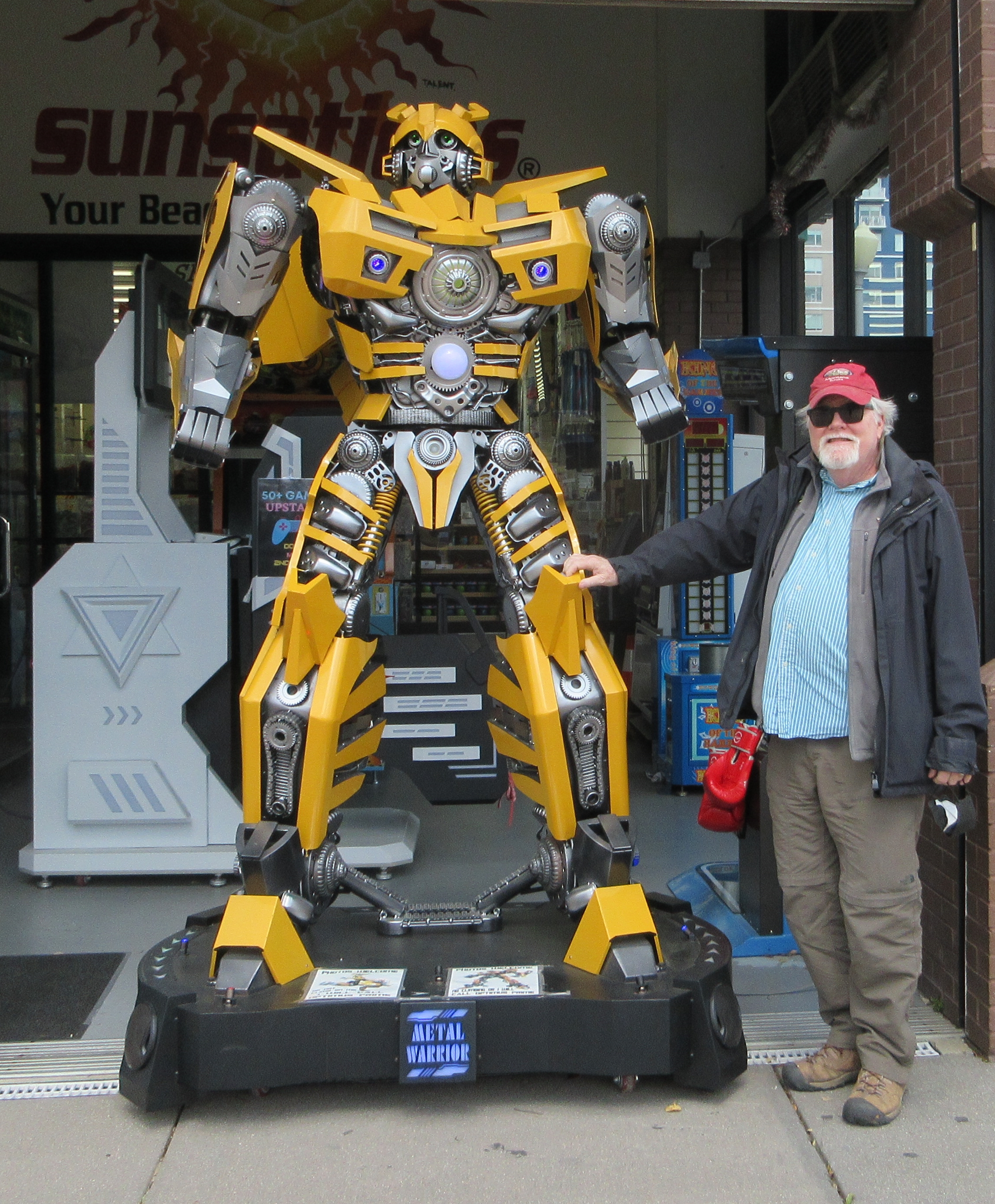
We began our local exploration at the extensive boardwalk that runs for about a mile past identical hotels, balconies empty now, but likely to be full on Easter weekend. The boardwalk is lovely and broad, with a separate lane for bicycles and pedal carts. We stopped at a number of sculptures along the way, and passed people playing on the beach. As we passed what looked like a game of rugby on the sand, the group broke up, with about ten of the players heading down to the water’s edge, where they lined up and then ran together into the water for a very quick dip. The air temperature was in the mid-50’s (F). The water temperature was probably similar.
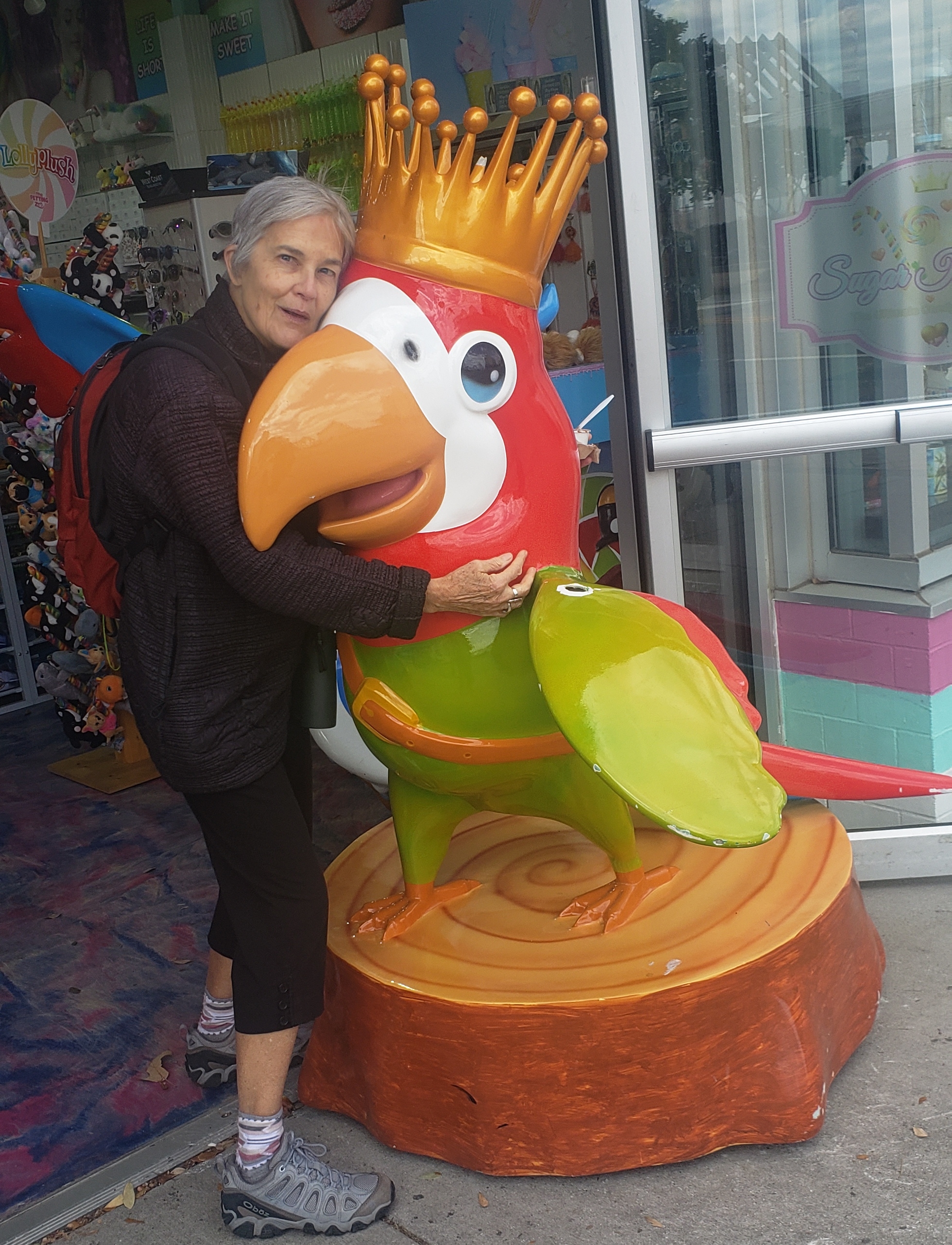
Clockwise from upper left: King Neptune with Jonathan hidden in front; Contemporary airmen memorial reminds me of my niece Julia, an Air Force flyer; me with parrot friend; Jonathan with robot friend; Jonathan with shell; Norwegian lady and I face Moss, Norway, where a companion monument is located, both dedicated to victims of a shipwreck.
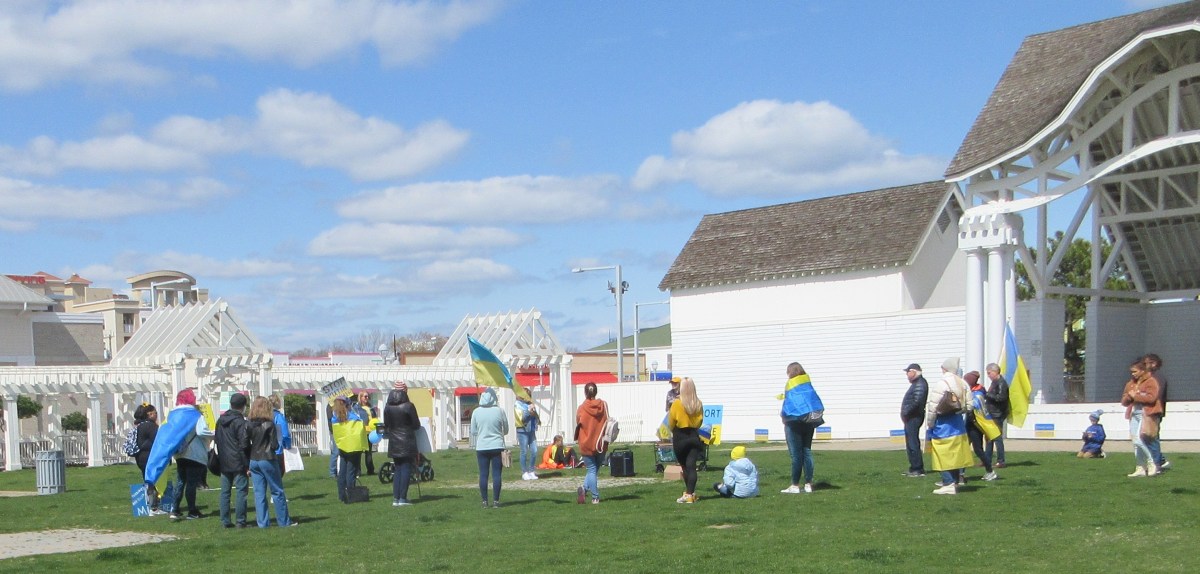
We also passed a rally in support of Ukraine.
Rally in support of Ukraine’s fight against Russian invasion.
All this in one walk, and there is more in either direction. It was pretty cold outside, with a brisk wind. We may put off our next stroll until later in the week when it is scheduled to warm up. For now, the beach and the sun is a good introduction.
We’ve managed to get around our self-imposed two suitcase limit since we returned from Hawaii last fall (when you fly, you really need to keep your luggage to one checked bag). When we went to Peru in November, we had things we needed to move there, and when we returned in February, we were trying to bring back items that would not survive shipping.
We’ve been in the Chicago area for five weeks, and tomorrow we turn in our car and fly to Norfolk, VA, pick up a different car and head to Virginia Beach, VA for a month. I am looking forward to new surroundings, and I don’t mind packing, but I didn’t realize how much stuff we extracted from the storage unit while we were here. It all had to go back.
Craft supplies
I also hadn’t realized how much beach glass, rocks, beads, shells, and metal bits I brought back from Peru. My packing usually begins with craft supplies, so that I know what needs to be stored, and I don’t run out of time and have to jumble everything into boxes. Little did I know! After three afternoons of sorting bits of glass and deciding what I might be able to make in Virginia without a lot of equipment, I surveyed my table and could barely tell any difference.
In the end, I filled one of those under-bed type storage boxes to the brim with materials, measuring spoons, future resin casting projects, even a small sewing project that I am just not going to get to in the next 24 hours. In addition, there was a box of finished items too bulky to take along (I am taking my entire inventory of jewelry…lol…must keep my Etsy shop going http://Llywindatreasures.etsy.com). Another box held paper, stationery, and envelopes, and another was random items that didn’t fit a category, like the finial from our porch railing in Peru that just came off during repairs in February. It’s an odd, handmade shape, and I decided to keep it. Some people’s sentimental items are family heirlooms. I have a finial from my front porch.
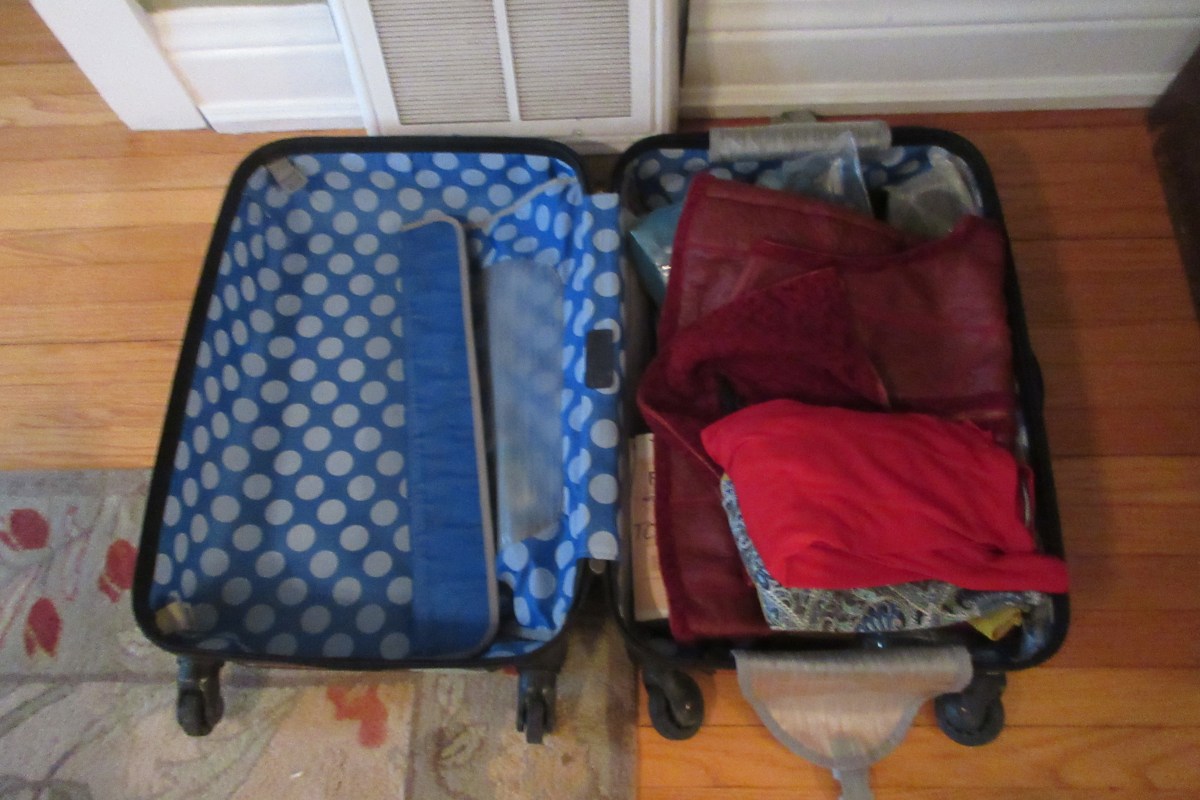
The “next trip to Peru” suitcase
I filled one half of a suitcase with items I want when we return to Peru at the end of May. I left the other half for Jonathan, who dutifully filled it with things he will want before we leave the US again.
Yet another suitcase was filled with clothing we are leaving in storage for the present. A box was full of kitchen items, and another had a Christmas ornament I brought back from Peru, a book I just finished reviewing, and a tea cozy that needs stuffing.
After that, we each packed the suitcase we are taking with us. I hated giving up my extra pairs of shoes, and my bedroom slippers. I travel with walking shoes, sandals that double as water shoes, and flip flops that are also my slippers. I will miss my various shoes of other colors, shapes, and materials.
I dropped two bags of clothing and household goods at Goodwill, threw a few outworn items in the trash, and we still had a full carload of suitcases and boxes to stow in the storage unit. It was raining while we were there passing suitcases and boxes across the deep puddle that forms in front of our unit every time it rains. The rain ended just as we returned home (surprise!).
On the bright side, I met my packing goal of not having to wrestle with closing my suitcase. It zipped without anguish, and easily fit my pillow in the top section that I save for the purpose. My carry-on is biggish, but that is due to my Etsy collection. We’ll have a fresh start in Virginia Beach–I can’t wait.
My mom is 97 this year, and though she’s still mobile with her cane or her walker, she doesn’t go out much, apart from medical appointments. On my visit to her last week, I mentioned needing to stop at Walmart to buy a new case for my smartphone. Mom perked up and said she’d like to go along.
We made a list. Mom wanted a watch with a large enough face for her to tell time. That is pretty much impossible, because the current state of her macular degeneration means she sees best out of the corner of her eye. Staring at a watch face is not the best way for her to figure out what time it is. Yelling, “Alexa, what time is it!?” works much better. She does that a lot.
Mom has wanted a dustbuster since at least my previous visit last November. I figured that if she still remembered that she wanted a dustbuster, it was probably time to buy one. I figured we’d be away from home for 45 minutes to an hour. Silly me.
There weren’t any of the electric carts at the entrance, so I positioned mom on a bench where a young man was staring at his phone. I went off to see if I could find her a cart. A helpful staffer found a cart in the parking lot and brought it in, then drove it to the entrance where I’d left mom. Mom was not anxiously waiting, but had engaged the young man in conversation. When I approached, she said, “This is Toby, are we going anywhere near James St? He missed his bus and we could give him a ride.” She then launched into his life story that she’d extracted in the four minutes that I was gone. I pointed out that we had just arrived at the store, and his bus would probably arrive before we finished shopping. He agreed, thanked us, and mom got in the cart.
She took off, heading down the clear aisle. Head down, focused, she was going toward the registers and the exit, rather than into the store. I hurried to her. “Mom, we have to go the other way.” Head down, no response. “Mom!” …nothing. Finally, “STOP!” By now, people are staring. She jerked to a halt and looked at me, mildly surprised at the fuss. I indicated the way we needed to go, she backed up , and we entered the store.
Down one aisle, I find someone who points us toward electronics. We get there, I discover that though they “should” have the case I want, they don’t. My trip to Walmart is done.
We find another person and ask directions to dustbusters. It’s at the opposite end of the store. We head that way with me holding on to the front of the cart. I’m not sure I could stop her if she hit the accelerator, but I could try. We make our way down the broad aisle until we find vacuum cleaners and finally hand-held devices in a narrower aisle. Mom wants to hold each one, turning it over, asking where the on button is, how is it emptied, how much it costs. The sample devices are attached to wires, and we maneuver her cart close enough that she can feel each one. A single model is in an open box, and we remove it, test how the parts go together, it’s size, and weight, eventually opting to purchase it. I reassemble the pieces, close the box, and think we are done. I feel a bit sweaty after the interrogation about dustbusters, but we had success.
As we head toward the front of the store, mom takes one hand off the steering and points upward. “Talcum powder!” she shouts as the cart swerves violently to the left. “That’s what I need.” We ask directions, she swerves in a U, narrowly avoiding a display of piled boxes, and we change direction, rolling toward the pharmacy. We have some trouble finding baby powder, and we’re probably in the wrong aisle, but I couldn’t find the adult powder section, and mom seemed pleased with the size of the baby powder container. Into the basket it went.
Once again, I thought we were done, when we rolled down the aisle with Easter candy, and mom remembered that she needed cinnamon hard candy. She couldn’t understand why there was no hard candy among the Easter chocolates. She picked out a bag of Cadbury chocolate eggs and put them in the cart. We found a person who could direct us to the candy aisle–it was not nearby. We needed to turn around near the front registers and mom seemed to have gotten the hang of driving her cart. I let go of the front while she turned into a narrow space between a displays backing onto the registers. She was almost through when it happened. Mom hit the gas to make the last turn and crashed into a group of wire stands, strewing small bags and boxes. One section leaned over on her, other sections were pushed askew. It looked a mess. Mom looked puzzled, a sort of “Moi?” look on her face. She was obviously uninjured, nothing had landed on her. I pushed the tilted display back as three guys came hustling up. I thought they’d yell, but after making sure she was ok, they immediately went to work setting things back in place.
A young woman in a Walmart vest appeared beside us, hands on hips, and again, I feared the worst. Would mom be banned from Walmart for life? “Jeanne, are you all right?” she asked. I stared. How did she know mom’s name? Was mom already notorious at Walmart?. Mom looked at her vaguely. Despite her glasses, she really doesn’t see much. “It’s me, Tiny,” the woman said. “From Loretto.”
“Oh, Tiny, hi, how are you.” They chat.
This young woman, whose name is not Tiny, worked at mom’s independent living facility that is owned by the Loretto Health and Rehabilitation Center Co (hence called Loretto). Mom, in her politically incorrect way, nicknamed this woman Tiny when she met her. Yes, the woman is under five feet tall, but in the United States it is customary to call people by their name, not by whatever nickname you happen to free associate with them. Mom is undaunted by contemporary manners.
When they’ve finished reminiscing, mom remembers that we were looking for hard candy. Tiny shows us the way. Having arrived, Mom drove along while I searched for cinnamon candies, found them, and put the bag in her hands. They passed muster, and again I thought we were done.
We’d already walked up and down and around for almost an hour, but we weren’t done yet. I’d forgotten the watch. Jewelry is toward the front of the store, and in hopes of leaving, I directed us to the area where we could look for a watch. Mom held each watch, squinting at the face, trying to read the time. Most were impossible for her to read. A young salesperson appeared and was very helpful, showing mom watch after watch. She’d squint, guess the time, and hand each one back to the woman. Eventually, after about twenty watches, we had a man’s wristwatch, and a pocket watch. She held the pocket watch and said, “the twelve is up here, right?” (by the stem). “No, the stem is by the three.” “Hold it like a book.” She decided she could see the time, so we clicked the case closed. She couldn’t get it open again. We tried a few more times and she managed to get it open, deciding the pocket watch would work. I had some doubts because it was a bit heavy and I imagined her wearing it on a chain around her neck. She was sure this was the best thing ever, and we added it to our little pile. At last, we were done.
Mom managed to thread her cart through the checkout without toppling anything new, and we headed to the parking area. Her young friend from the entrance bench was gone, so we didn’t have to give him a ride home. In the car, she opened her cinnamon candy, to make sure they had enough zip.
Home again, I saw we had been gone for just over two hours. On the way in, mom offered everyone she passed a cinnamon candy. I was ready for a nap. Mom was delighted by her finds, and wanted to vacuum with her dustbuster immediately. Once she’d given it a test drive, she put her talcum powder in the bathroom, and sat down with her new watch. She couldn’t get it open despite having been able to do so in the store. I tried bending the clasp, but couldn’t make it work in a way that made it easier to open. We let it sit until the next day.
When I went to put the candy on the shelf, I found an existing bag of cinnamon candies, AND a bag of butterscotch candies, AND a bag of Werther’s caramel candies. Mom hadn’t needed candy at all. She’d once again forgotten what was on her shelf. When I went to look for a baking dish, I also discovered a large bag of chocolate bars, meaning her bag of Cadbury’s chocolate eggs was also utterly unnecessary. These days, an unfortunate number of things on her shelf go bad from being ignored, probably because she forgets they are on the shelf in the first place.
Two days later, I went back to Walmart, returned the chocolates and the watch. I probably should have returned the dustbuster, as mom’s probably already forgotten where we hung it, behind a chest in the den. I would have returned the cinnamon candy if mom hadn’t opened them in the car.
Two hours at Walmart, one plastic container of talcum powder and a dustbuster. That doesn’t tell the whole story though, does it?
(four other items, one life story, one car crash, one reminiscence with an old friend, two returns).
My brother Tim, Mom, and me, having dinner at Carrabba’s during my visit.
We need to obtain residence visas (carne de extranjeria) for Peru in order to be able to open a bank account. We are back in the US for about 90 days with the goal of obtaining the necessary paperwork here. When we return to Peru, we will use a service to process the paperwork for us, and hopefully expedite the process a little bit.
One of the more difficult aspects of the process is understanding what is involved. I’ve read about this several times and now have 1) the application form downloaded from the gob.pe website:
Though people ask you to get a carne de extranjeria, that is the second step in the process. We must first request a change in our immigration status from that of tourist to that of “annuitant,” that is, someone who has retirement income. Filling out the form is straightforward.
2) Next is the background check. We were told to get a background check covering the previous five years in the place where we live, not an INTERPOL background check. There were several options, and we looked for the most convenient rather than the least expensive. In the winter weather, spending a day at the police administrative offices in Chicago was not appealing.
We found a business licensed to do background checks using the Livescan system, with the advantage of being located nearby. I made appointments and we drove over, finding ourselves outside a building with no sign of BioScan Tek on the outside, and without the matching street number anywhere. After driving around, we decided to go inside and ask someone. We found the building number we were looking for inside the complex, on the door of a rental workspace and went in. The workspace appeared to be empty, with cubicles, seating areas, dining area, vending machines, standing silently waiting for clients. At the end of the hall was a cubicle with the door open, lights, and one person puttering. That turned out to be BioScan.
The confusing location didn’t make much difference, as the equipment for both State of Illinois and FBI background checks was in place. We filled out the forms, listened to the required advice, and each took our turn getting fingerprinted. I took a bit longer to get finished because my fingerprints don’t show up very well–I probably should have become a spy, I don’t appear to leave much trace–. After trying several times and using different compounds on my fingertips in an effort to make them visible, my prints were submitted. We will receive email notices, and letters in the mail with our results.
That afternoon, I received a call from our fingerprinter. My prints were rejected by the FBI system. I agreed to go over again the next day to try again. I was advised to put vaseline on my fingers and wear gloves overnight to enhance my prints. I did as instructed and went back the next morning. We struggled to get better prints, and Marie, my fingerprinter, called to see whether they would be accepted. Though we weren’t sure, they were sent on.
The good news is that someone actually looked at the scan and decided it would work. Three days later, I received email confirmation that my background is clear according to the FBI. I downloaded a copy of the letter and now await the physical letter arriving in our maibox. Jonathan is still awaiting his FBI letter, and we both are awaiting our State of Illinois background checks. Marie mentioned that Illinois has a hefty backlog of requests from the Covid years.
What we requested:
1) Illinois State Police Background Check
2) FBI Criminal Report for Personal Review
We went in for our fingerprinting on Feb. 28, 2022
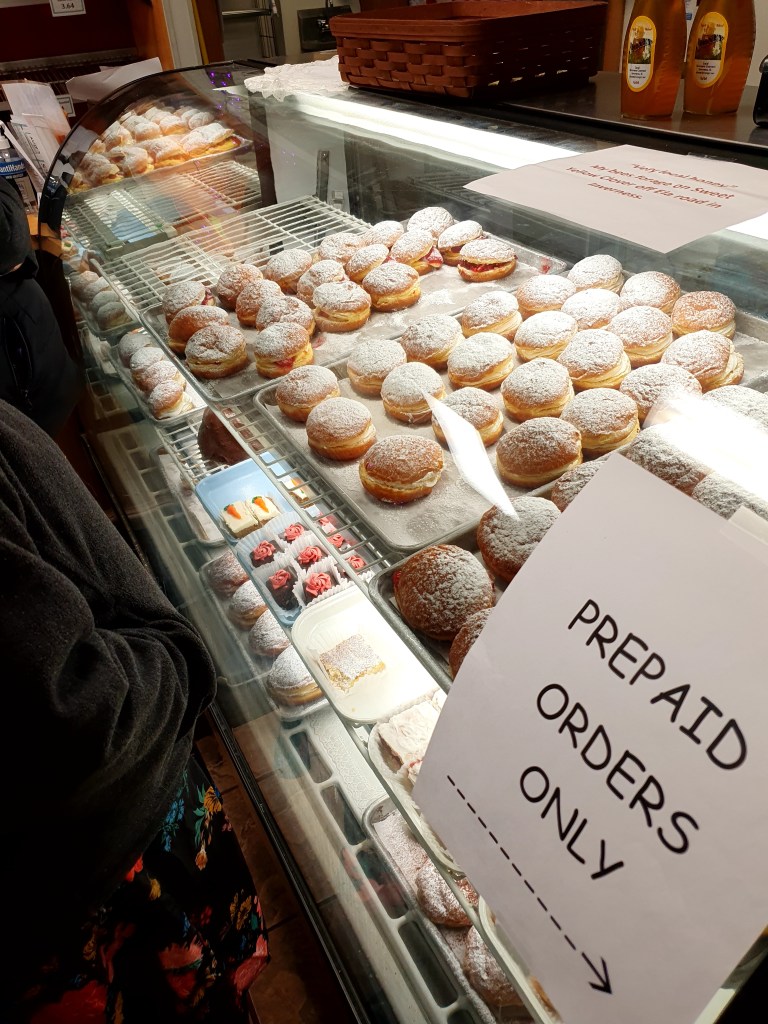
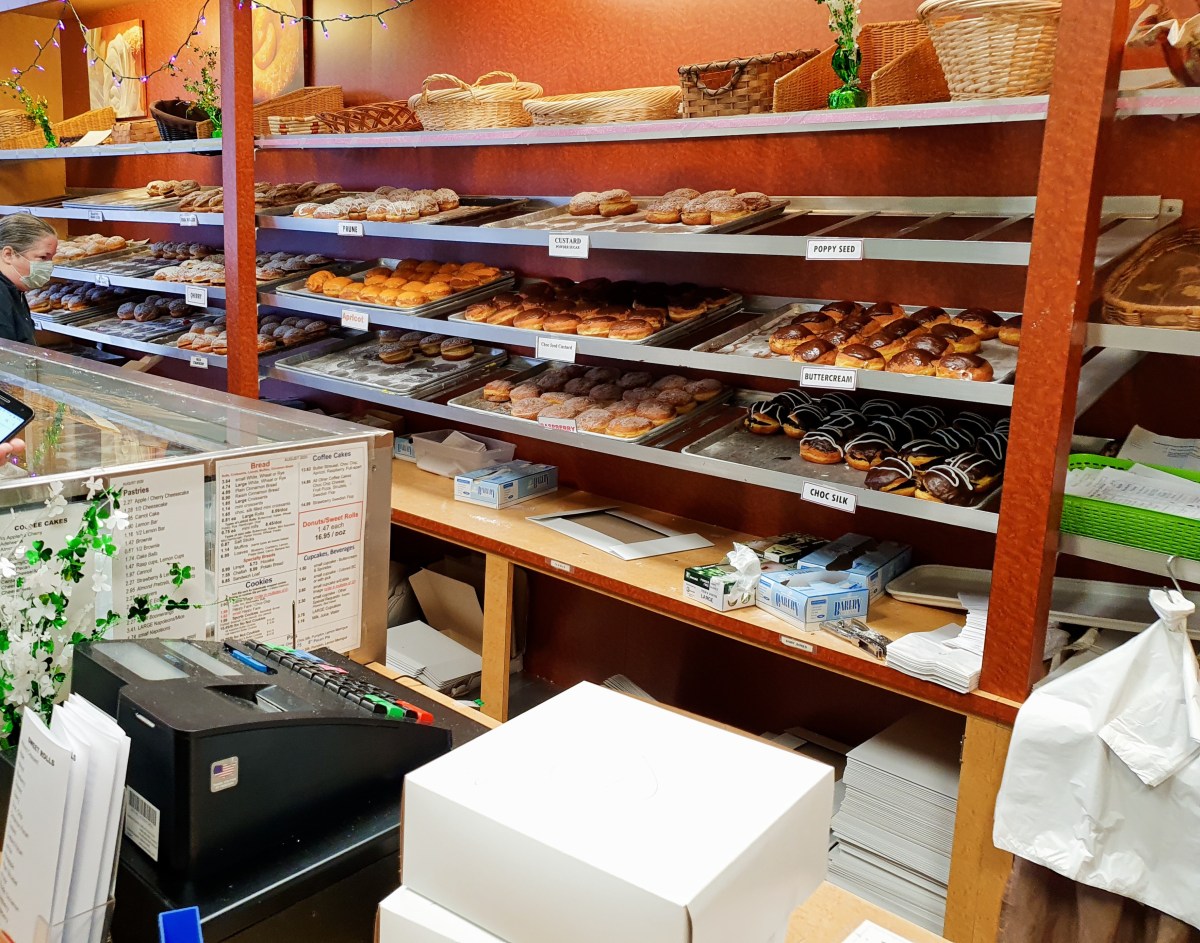
I knew nothing of Paczki until we moved to the Chicago area years ago. For those who haven’t heard of them, think: filled donuts. Originally a Polish specialty, paczki are now deeply Chicagoan. Available all year round at certain bakeries, their big day is Mardi Gras, when everyone with or without Christian heritage can have one last big treat before the forty days of Lent begins.
Even if you have no plans to go on a diet, stop eating meat, or any other mortification of the flesh between now and Easter, Mardi Gras reminds me that once in a while we should eat these treats. Traditionally, paczki came with apricot jam, prune, or poppyseed filling. Today, the sky’s the limit. I ordered my Fat Tuesday paczki from Lilac Bakery, just down the street from us. They make about twenty different fillings. New this year was banana, and key lime. I stuck to tradition because I like prune and poppyseed fillings and don’t usually find them in any other pastry, but I also got lemon and cherry/cream cheese, and all of them were a treat.
Even if I forget all about paczki until next year, I have a tasty memory of this year’s Mardi Gras, without a trip to New Orleans.
I am among the world’s most fortunate people. I can travel, though if I want to, I can stay home. I am warm, dry, and fed. My life is not threatened. I am retired and on a fixed income, but I have more than enough.
As I was about to embark on this post, focusing most of my energy on how cold I feel now that we are back in the Chicago area, I realized that my gripes are awfully small when compared to the rest of the world. If you are thinking about this, too, please consider donating to any charity that will help people suffering elsewhere in the world. We favor Doctors Without Borders, CARE, and the International Red Cross, but there are many groups doing good. You may know of one.
Yes, we are back in the Chicago suburbs, in the house we stayed in exactly two years ago on our return from Peru when Jonathan broke his shoulder. His shoulder brought us back this time, too. It’s been bothering him, and we believed he would need replacement surgery. Nothing is simple, however, and the surgeon he consulted advised against a replacement for a number of reasons. A cortisone injection decreased the pain Jonathan has been feeling, and increased his mobility. For the present, that is enough.
We’ve chased summer around the world since 2014, but winter finally caught up to us here, with temperatures in the teens last week, and in the 20s this week. After years in warmer climes, I seem to have trouble warming up, and my fingers and toes get sooooo cold!
Regulars to this blog know we normally spend an hour or two outdoors every day. Determined to get outdoors, I bundled up, added multiple layers everywhere, bought gloves (my NZ merino/possum gloves wore out completely), and off we went. We started with a short walk around the neighborhood, then we strolled a section of the nearby the Prairie Path. The birds never let us down, and we even saw a flock redpolls (that we’ve never seen in the US before).
We returned to one of our favorite parks, Churchill Woods. There are always birds, and even on the coldest day, we saw a pair of hawks circling in the frigid air. We spotted a muskrat, which we only recognized because another walker explained the difference between a muskrat (narrow tail) and a beaver (wide tail). There is a beautiful beaver lodge along the river at Churchill Woods. Many beaver dams are considered nuisances because they cause flooding, but this lodge is positioned where any associated dam is unlikely to flood anything new.
Beaver lodge in the DuPage River at Churchill Woods.
These familiar stomping grounds give us a deep pleasure. We like the birds, the animals, our fellow walkers. There’s no high speed trail through here. Most walkers are out for a breath of air, or with their dog. For a few minutes, at least, I’m distracted from the cold by the beauty of nature.
We did pretty well when you take in the big picture, but on our final Sunday night in Peru, we both were about to have our heads explode. Too many loose ends needed tying up and we were running out of time. Most of our luggage was packed, but we still didn’t know whether we would be able to arrange to ship some of our favorite handicrafts back to the US. We didn’t know whether we’d be able to open the bank account that we need to deposit the proceeds from the sale of our house, if it occurs. I wasn’t entirely sure that the last of my things would actually fit in the suitcases, even with a first class allotment of two 70 lb bags each. We still needed Covid tests, 24 hours or less prior to departure. We didn’t think there could be a winter storm in the US to delay our travels (It didn’t).
On Monday, I crammed more items into each suitcase, until each was as full as it could be. No suitcase ever reached 70 lb, but they were heavy.
I called the notary and the lawyer to see if there was any progress on finding a bank that would allow us to open an account. Unfortunately, it seemed that none of the banks in Barranca would allow foreigners to open an account without a foreign residency visa. We do not have resident visas, as we’ve never needed them. Until 2020, a tourist could stay in Peru for up to 6 months per year, and we usually stay 4 months. For a number of years, 2000-2012, we had a bank account in Peru, but the fees added up, so we closed it. For the last ten years or so, we have not needed a bank account in Peru. We pay our US bills online, and our Peru bills in person (by the caretaker). We get cash from an ATM, and all has been well.
Now we find that when you sell property, you cannot wire the proceeds directly out of the country, the money must go into a bank here first, then get sent onward. Cash transactions are limited to about US $1,000. Any greater sum must be moved by check or electronic transfer. We need to have a bank account if we sell our house. Our papers are in order to sell the house, and we are represented by a real estate agency, so though we can sell the house at this point, we cannot do anything but hold on to the check until we have a bank account in Peru. I had scheduled our pre-travel Covid tests for 2 pm at Suiza Lab, so our departure time from Barranca for Lima was set at 9 am, to make sure we arrived on time for our tests.
There was another important step that seemed to be at a dead end. We need a person who we trust who can sign sale papers for our house if we are not in Peru when a sale is ready to be completed. Though we don’t have anyone lined up to purchase the house, we have to be ready. For a power of attorney, however, one needs a form filled out, the “power” itself, and also a “minuta,” a contract of who can do what. The notary wanted to include the bank account number in the minuta, to specify where the money from the sale would go. We were getting nowhere with banking, and we did not want to leave Peru without having someone in charge. I called and explained that we needed the power of attorney so a sale could theoretically be completed, though the bank check for the proceeds would have to be held until there was an account.
To explain this, we went to see the notary, and he agreed to what we needed, though we’d also have to see the lawyer in Lima. There were more papers to legalize (notarize), signatures with a fingerprint beside them, and lots and lots of proof-reading. If you get one letter or number wrong (or leave out your middle name that appears on your passport but not in your signature, as in my case), the official agency that registers property can refuse to approve your sale.
During our last afternoon in Barranca, Jonathan heard from the potential shipping company, and found that a contract would need to be prepared before we left town the next morning. He had to learn to use WhatsApp, in order to show the representative our goods, and then he had to convince the man that he did not need to notarize his passport. When we went to the notary’s office, Jonathan got one set of papers for the shipper, while we awaited others for the power of attorney (the lawyer in Lima prepares the power of attorney, while the notary in Barranca prepares the minuta).
It was after six pm when it was all done. We were both tired from sitting on the edges of our chairs while people phoned back and forth and typed. We agreed to stop by the office of the lawyer in Lima after our Covid tests on Tuesday. It was Valentine’s Day, but we were content to eat leftovers, watch some funny TV, and get some sleep.
On Tuesday, we were up and getting dressed by 7:45 am, with the goal of leaving Barranca by 9 am. I continued to agonize over art supplies, and how much more I could stuff in the cracks of my full suitcases. We left right on time, waving goodbye to our houseguests, Brian and Eliana, who are staying on for a bit. Fellow archaeologists and excellent houseguests, they had projects of their own to attend to. We enjoyed having dinner together, walking on the beach, and each doing our own thing the rest of the time.
We left our house in the hands of good friends
We arrived in Lima with enough time to drop our luggage at the Hotel Senorial, our regular hotel for the past 22 years. Suiza Lab, our stop for Covid tests, was a bit chaotic, and it took about a half hour to get our 30 second sample swabs taken. Once completed, I checked with the lawyer, with whom I’d agreed to meet at 3 pm. He had initially suggested 4 pm, and when I called, he had indeed forgotten I wanted to meet earlier, and had just gone for lunch.
Moving on to our lawyer’s office at 4 pm, we explained that the bank account was a dead end. Optimistically, the lawyer said that he heard the Banco Pichincha allowed accounts to be opened with a notarized copy of one’s passport. We looked at each other and explained that we had to be at the airport at 6 am the next morning, so investigating another banking possibility was no longer possible. He understood, though this means we’ll need to return to the US, put together the papers required for a temporary residence visa (application, proof of solvency, FBI background check, each notarized and apostilled). We pointed out that we really had to have a useable power of attorney before we left, even without a bank account number on it. We then went through another version of the previous day’s anxiety as we waited while the final power of attorney was prepared. Because we were in Peru, we had to get in the car and go down the street to a different office to get the final papers notarized. It has to do with who does favors for whom and when and under what circumstances. Thus, our lawyer uses a notary down the street rather than the one in his own office. We didn’t ask.
Once again, it was after six pm when we were finished, but with the power of attorney in hand, and promises that it would be appropriately registered and recorded the next day, we returned to the hotel.
Carlos, our driver, had stuck with us all day, and agreeing to take us to the airport at 5:30 am, he left for the evening. We decided to reward ourselves by walking down the street to Punta Azul, a very good fish restaurant, that serves lunch to people from Lima (mostly) and dinner to foreigners (mostly). I had forgotten that the decline in tourism over the course of the pandemic would slash their evening trade, and indeed, Punta Azul was closed. We were crushed, and tired. Two blocks down, we stopped at a place that had pizza and pisco sours, grateful to have made it through as many of our to-do list items as we had.
Our Covid test results arrived on schedule: NEGATIVE!
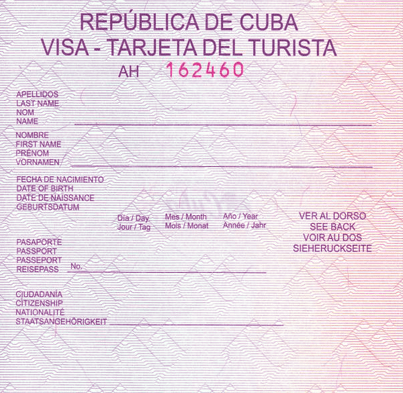
The outstanding issue now is our need to obtain residency visas, and open a bank account. Once we’re in the US, we can use the 90 days that we must stay out of Peru (the country now lets tourist visit for 90 days, then requires them to remain outside the country for 90 days) to collect our paperwork. When we can return, we’ll file our applications, and open a bank account as soon as we are able to do so. Then we’ll really be ready to sell our house.
Everything else is underway and pending: sale of the house, shipping of our goods, further travel.
Our flight left right on time at 9 am, Delta to Atlanta. The flight was long, but the seats were very good, much better than on the Lima to Miami, American Airlines flight we usually take. We had a three hour layover in Atlanta, but the airport is so vast that it took the first hour to go from landing to find our suitcases. Endless corridors have cheery signs like “Only 10 minutes more walking to your next stop.”
A brief stop in a lounge, and it was on to Chicago. Jonathan went to collect the rental car while I corralled the luggage and rolled it out to the curb. We found our Airbnb in Lombard easily, since we stayed there two years ago. We were completely exhausted.
The next day we crawled out of bed, went to our storage unit for winter clothing, and then to the grocery store. We arrived home about 1 pm, just as the first flakes of snow began to fall. The wind picked up and howled the rest of the day, while snow flew sideways and we gratefully stayed supplied and indoors. Today we got up to find it is clear and sunny, 2 inches of snow, and about 4 degrees F (-15 C). We are glad to be here, we think.



















 Llywindatravels 2025