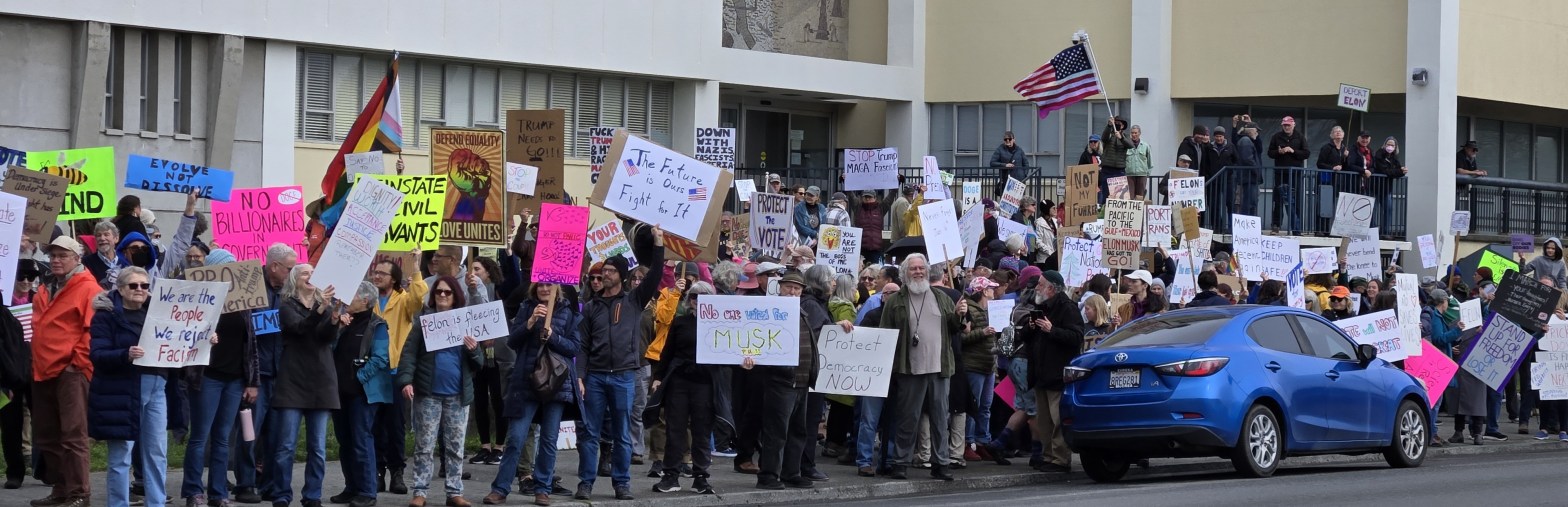
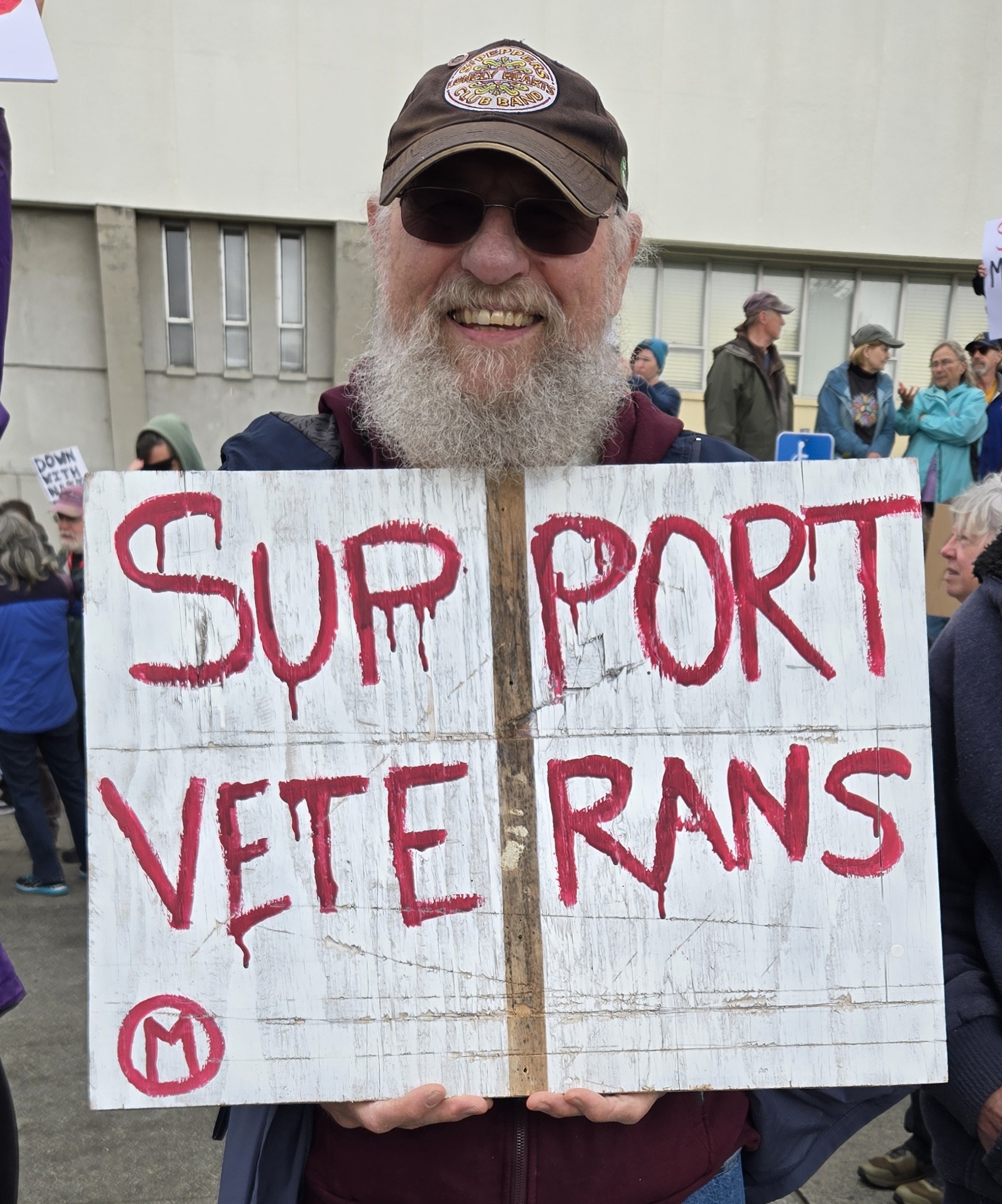
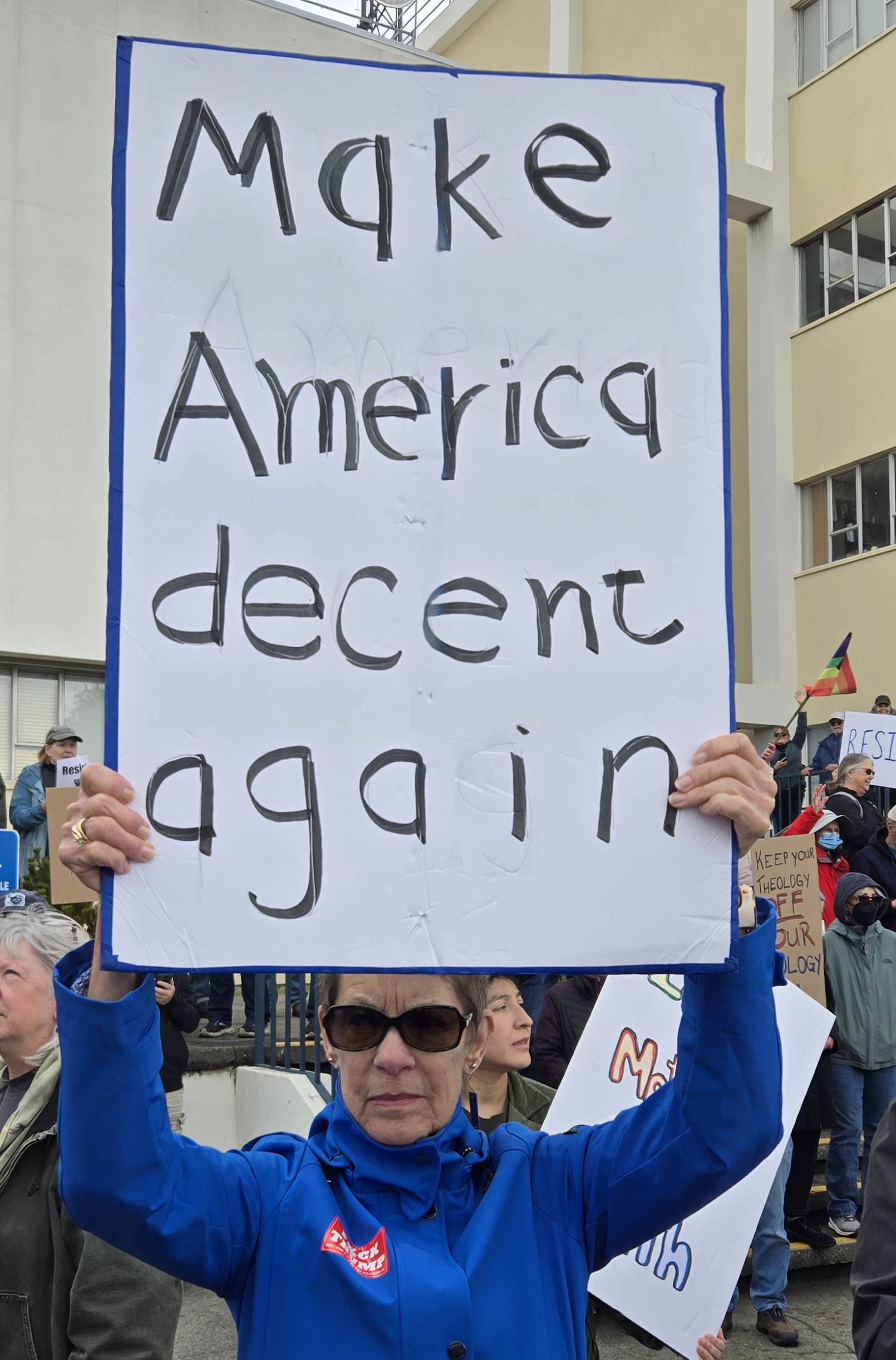
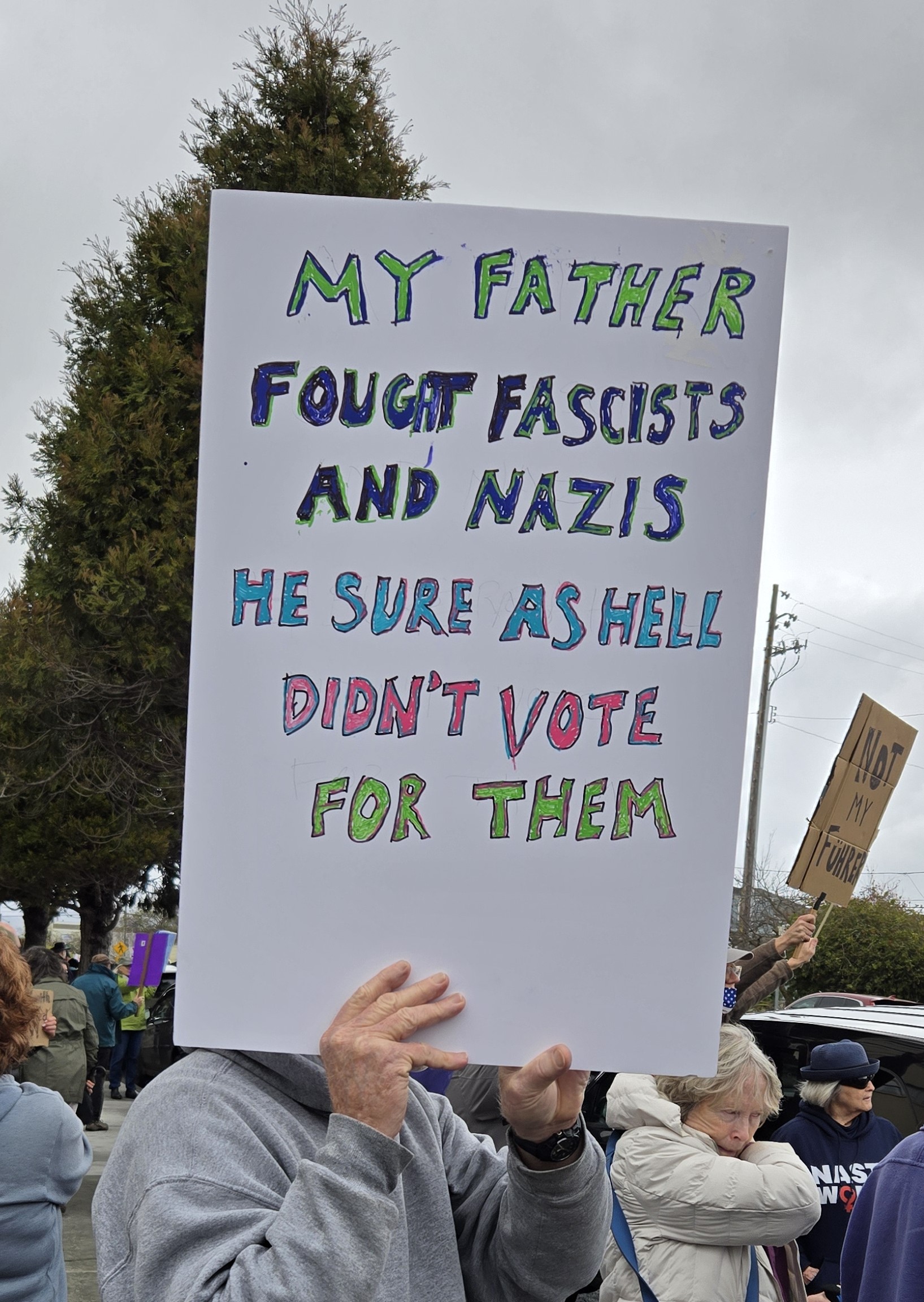
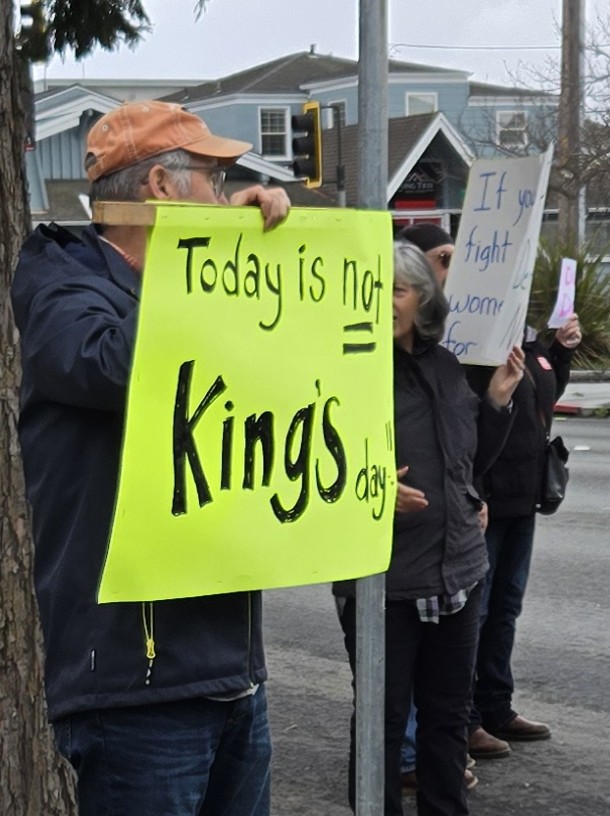
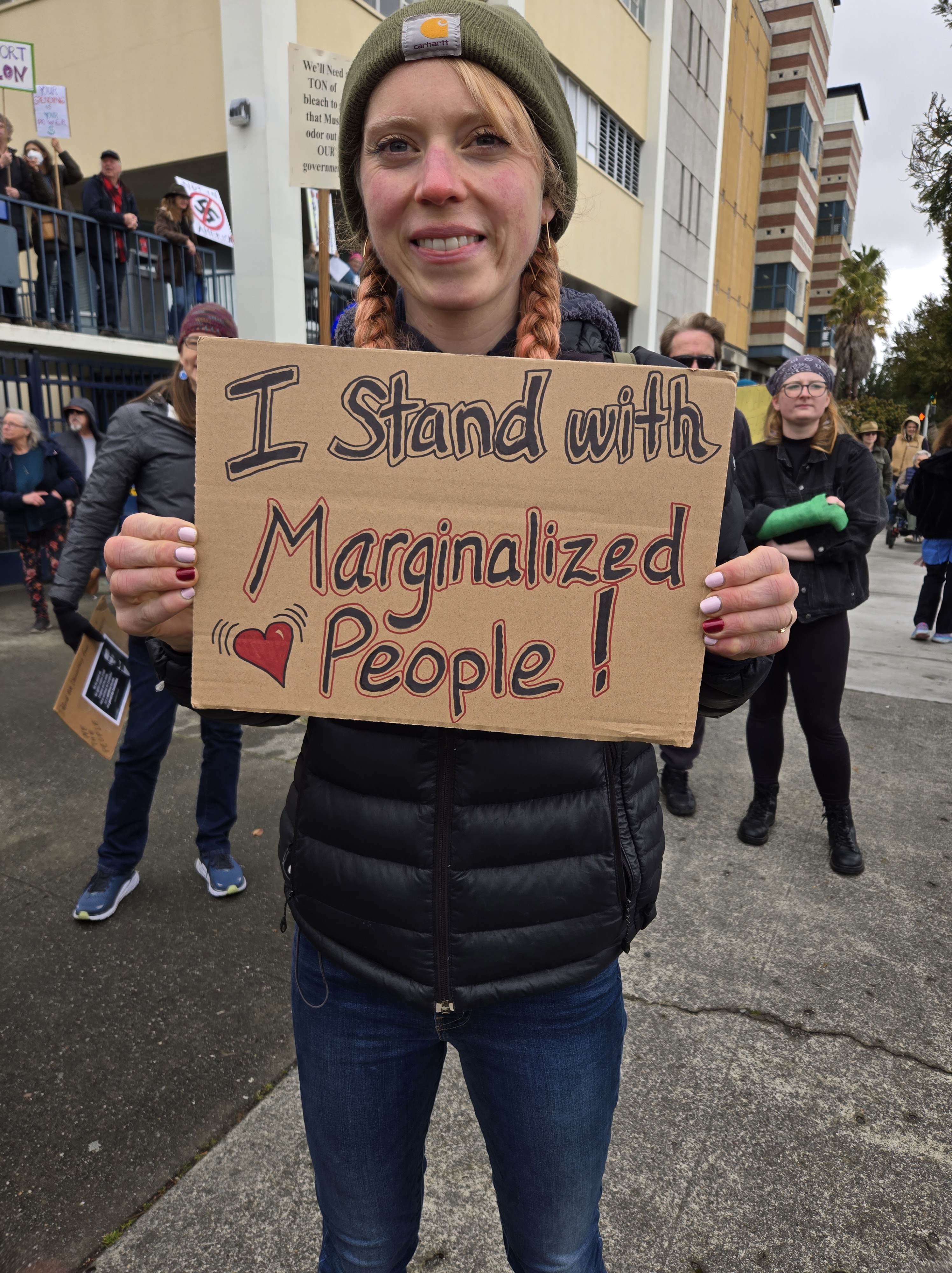
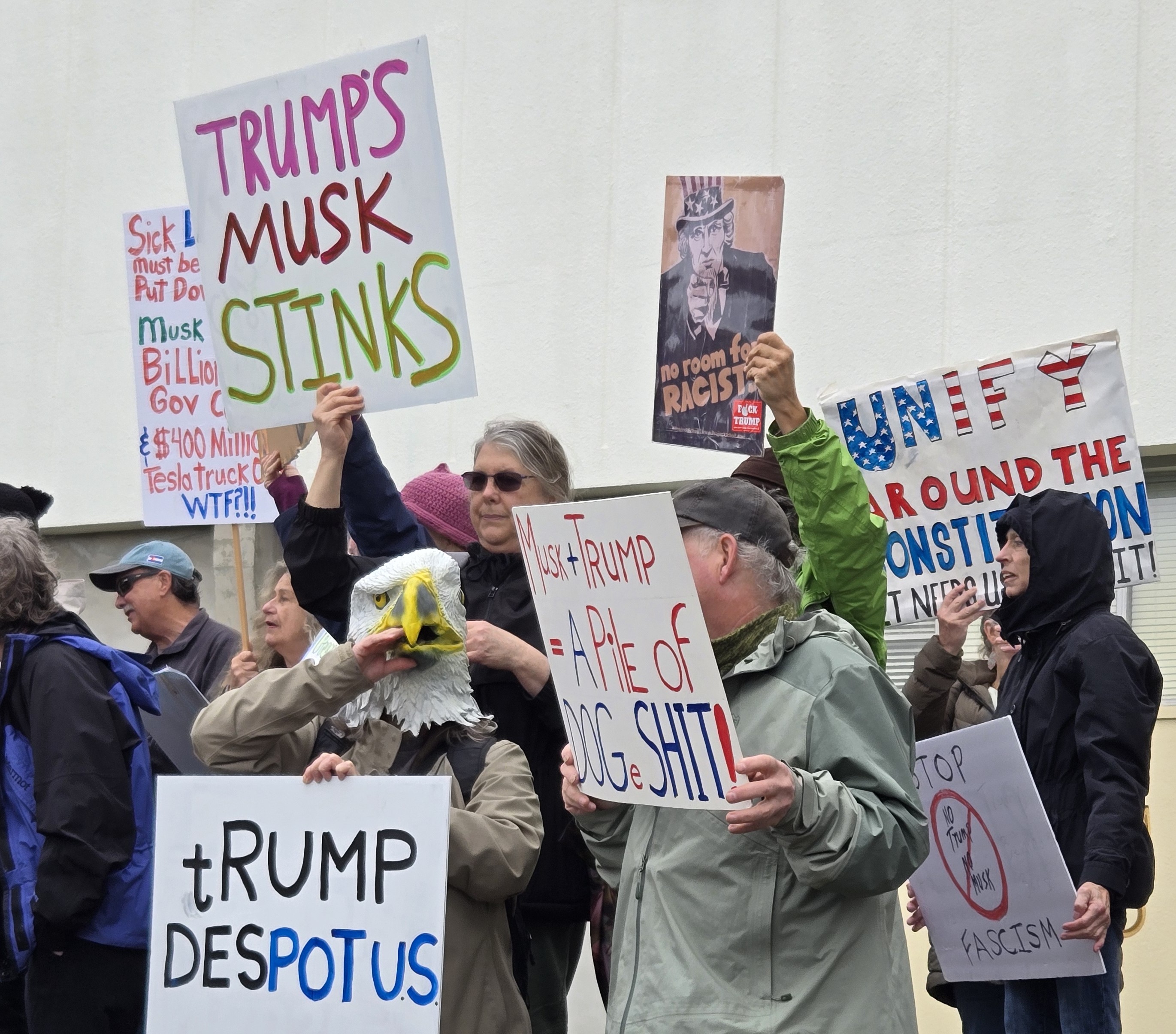
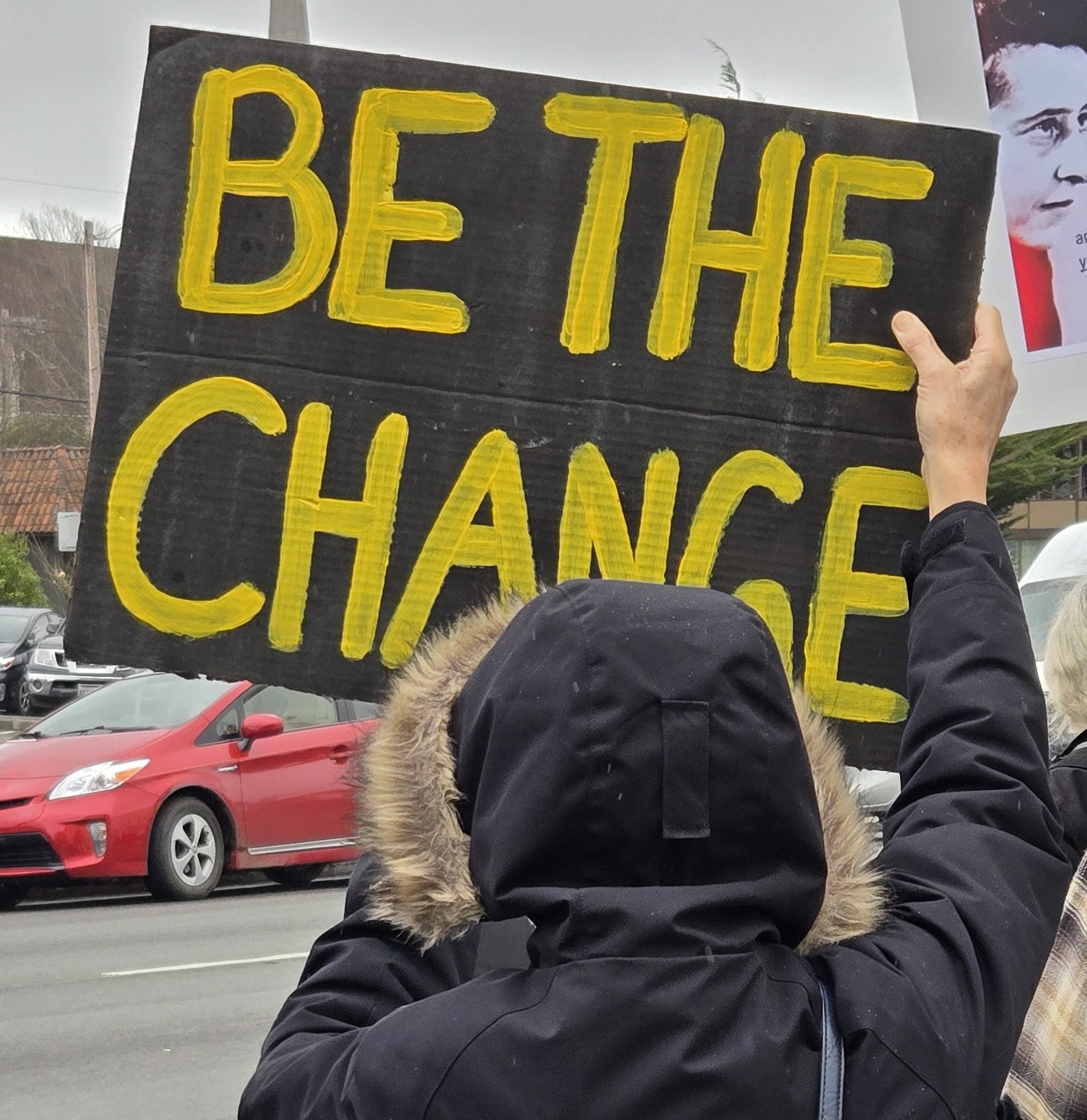
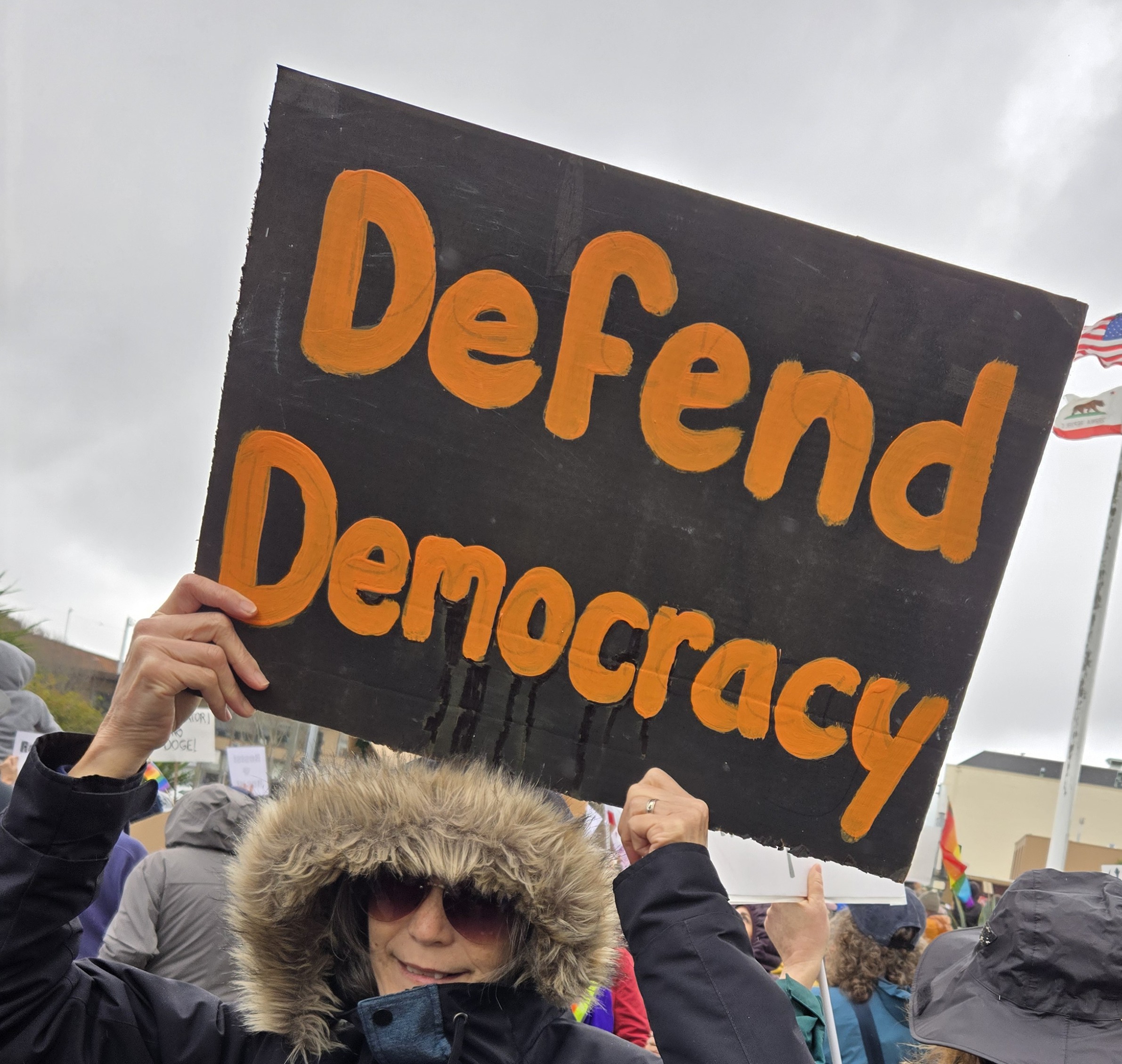
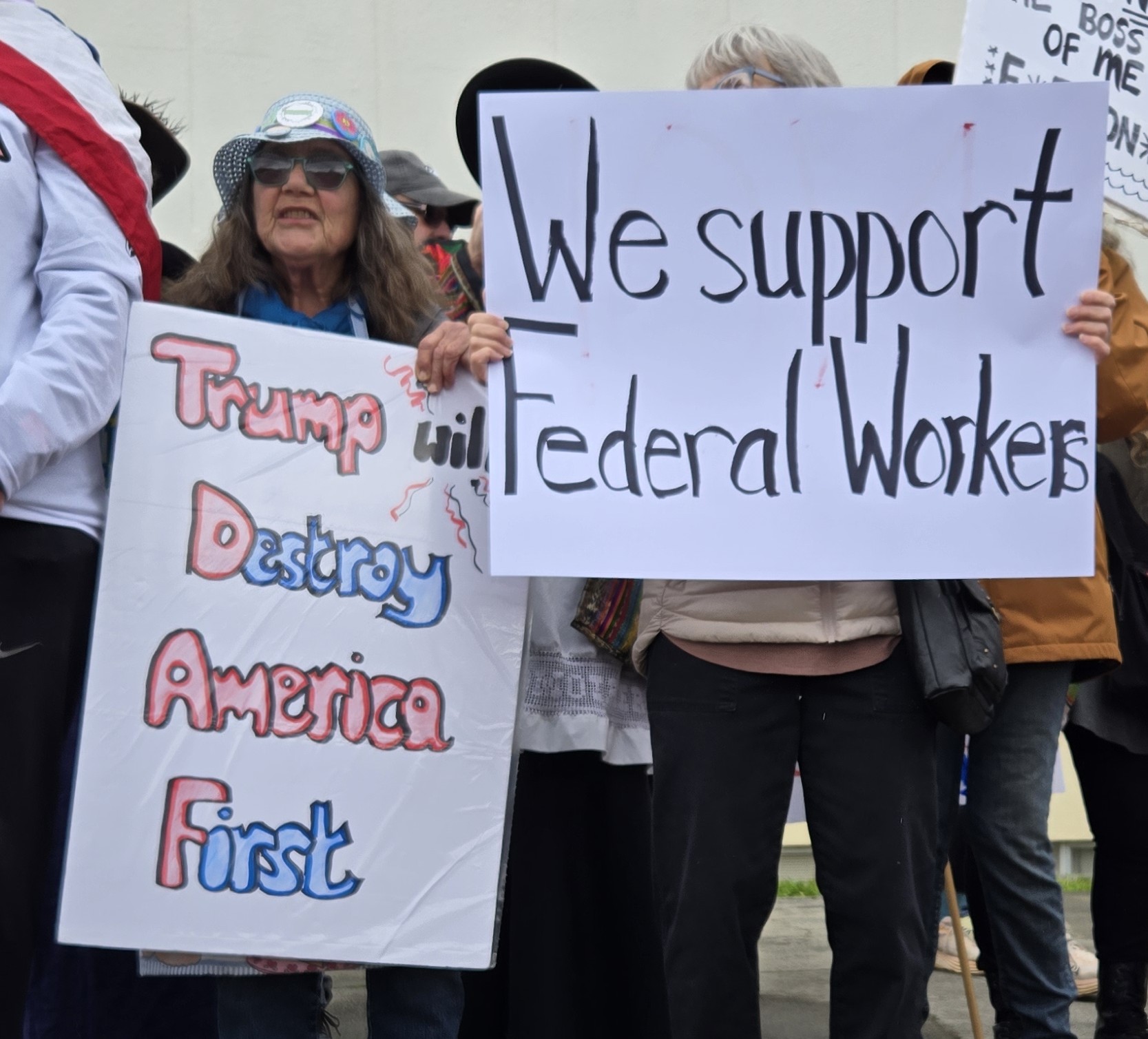
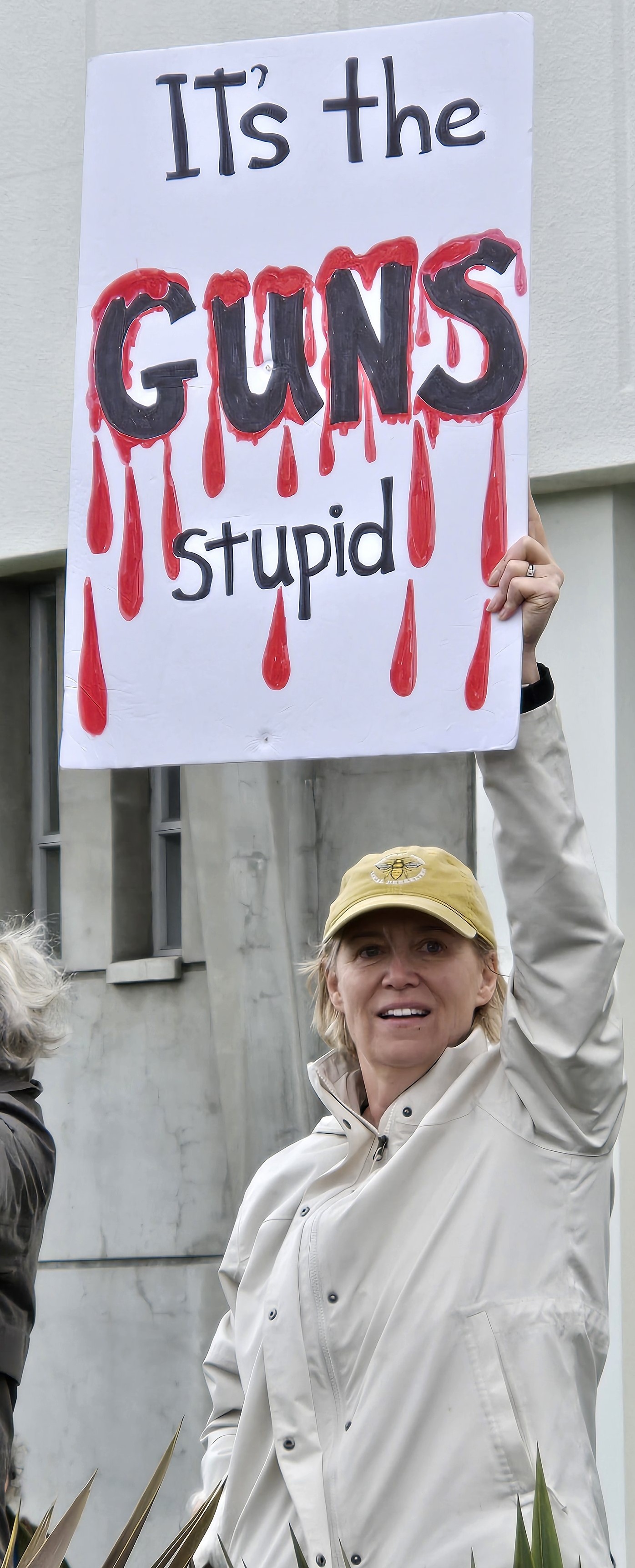
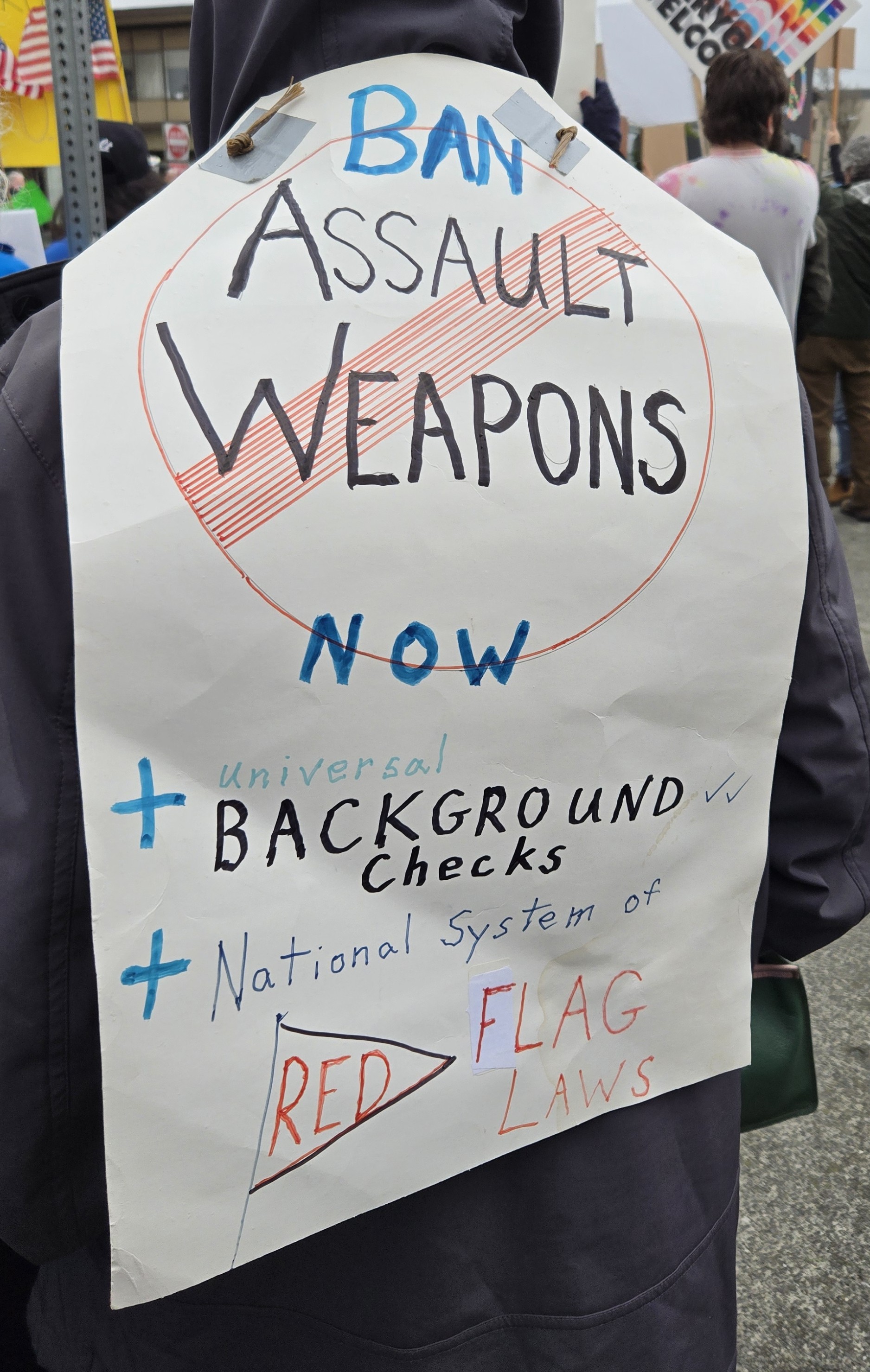
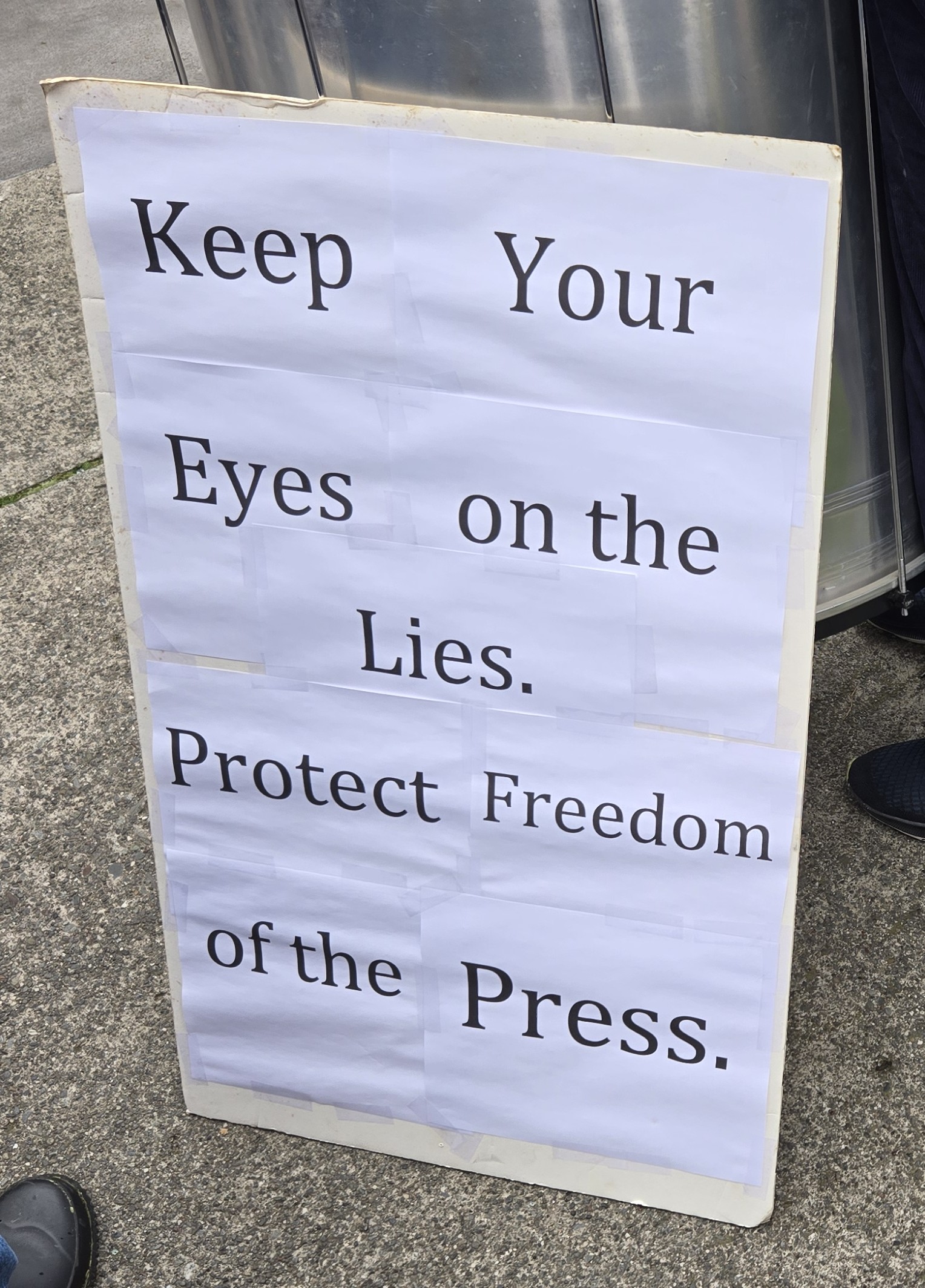
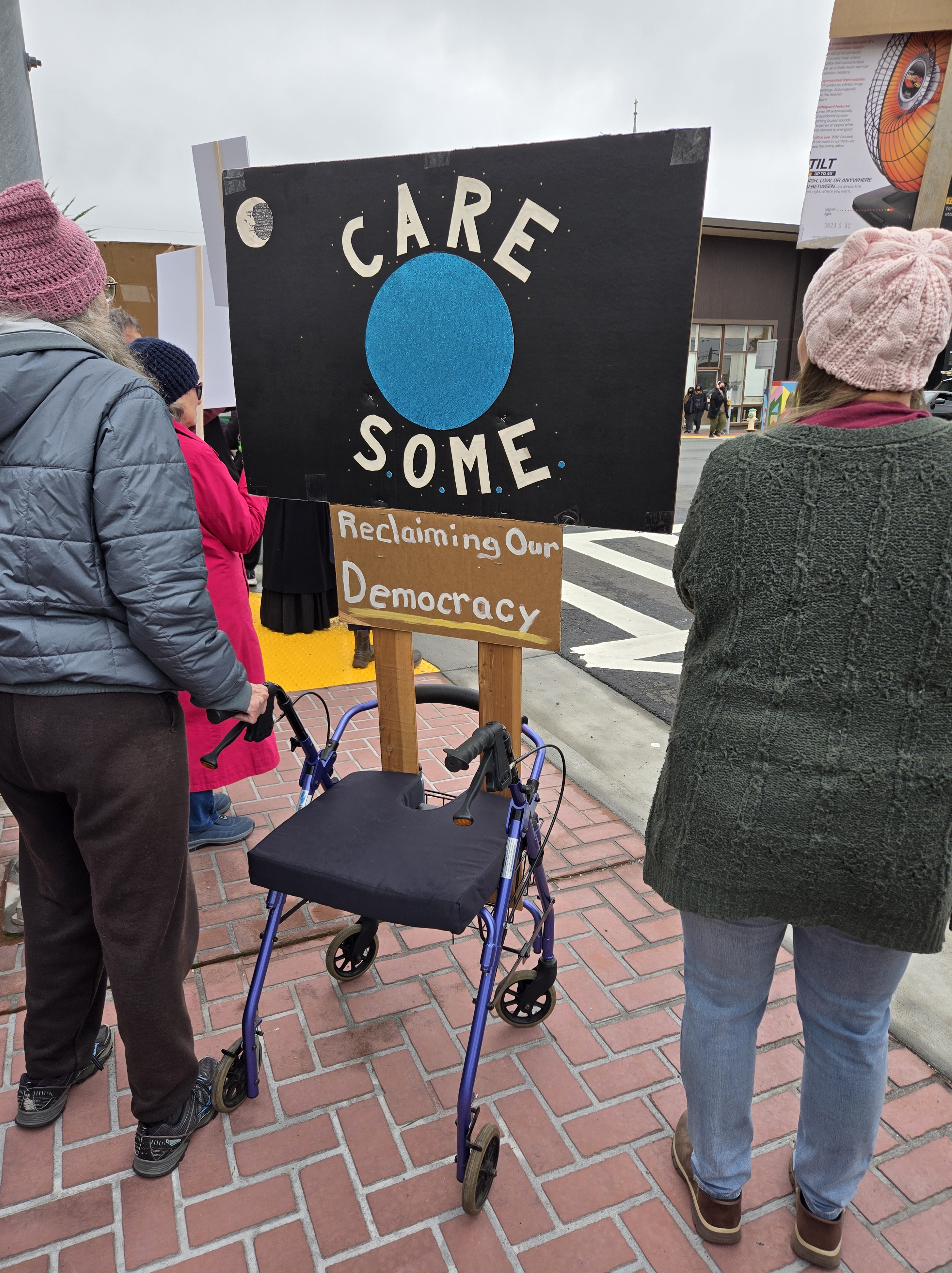
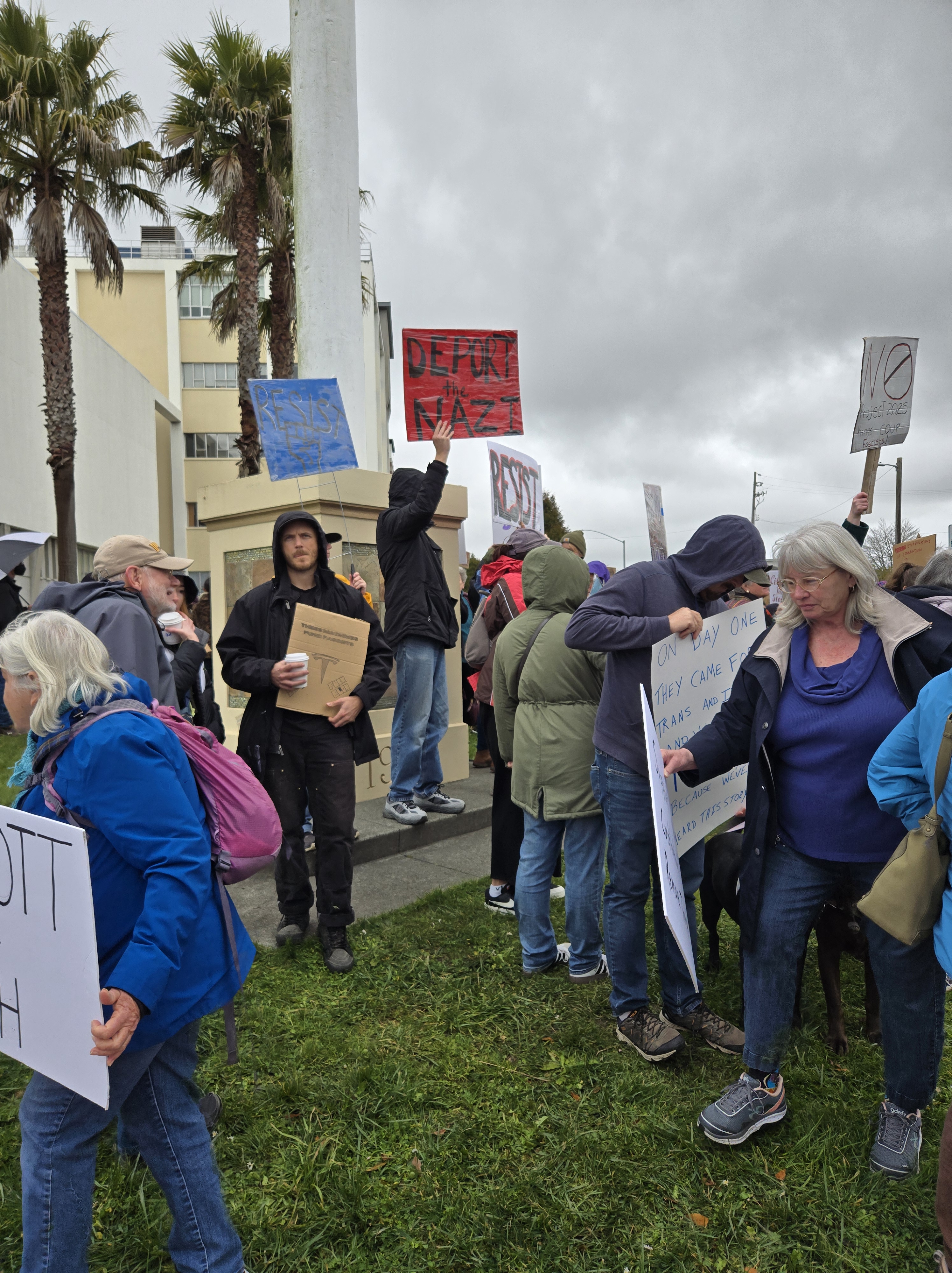
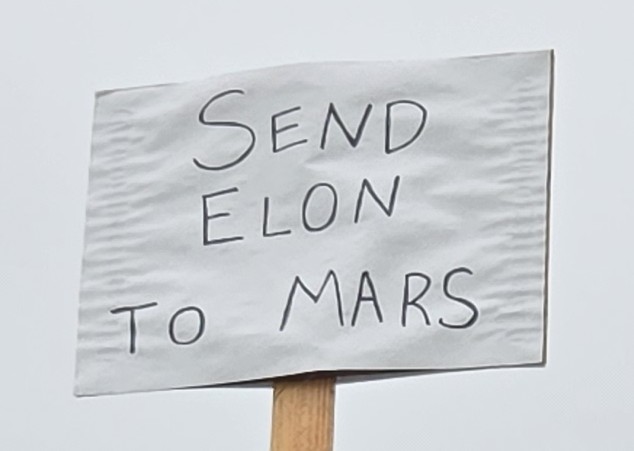
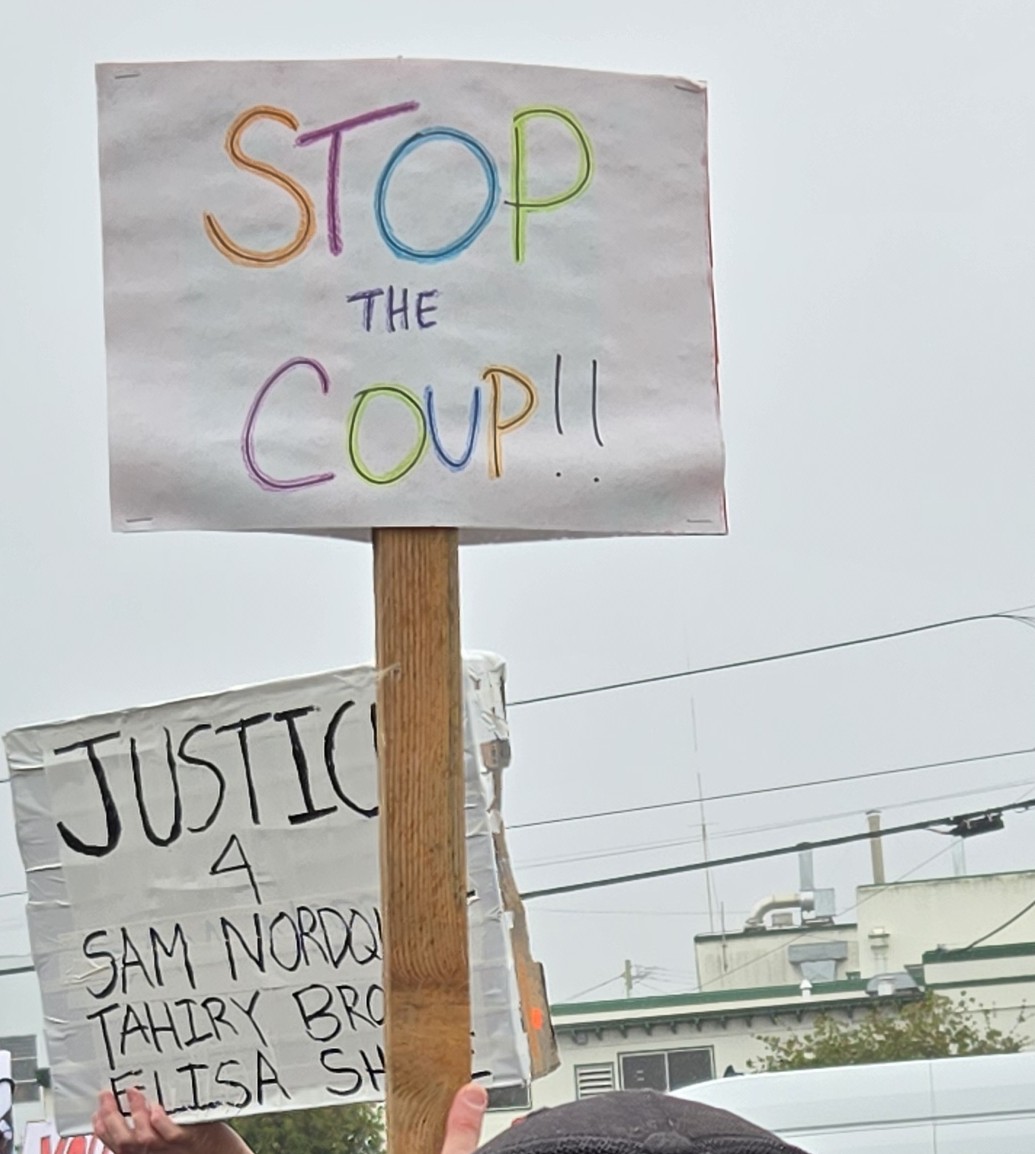
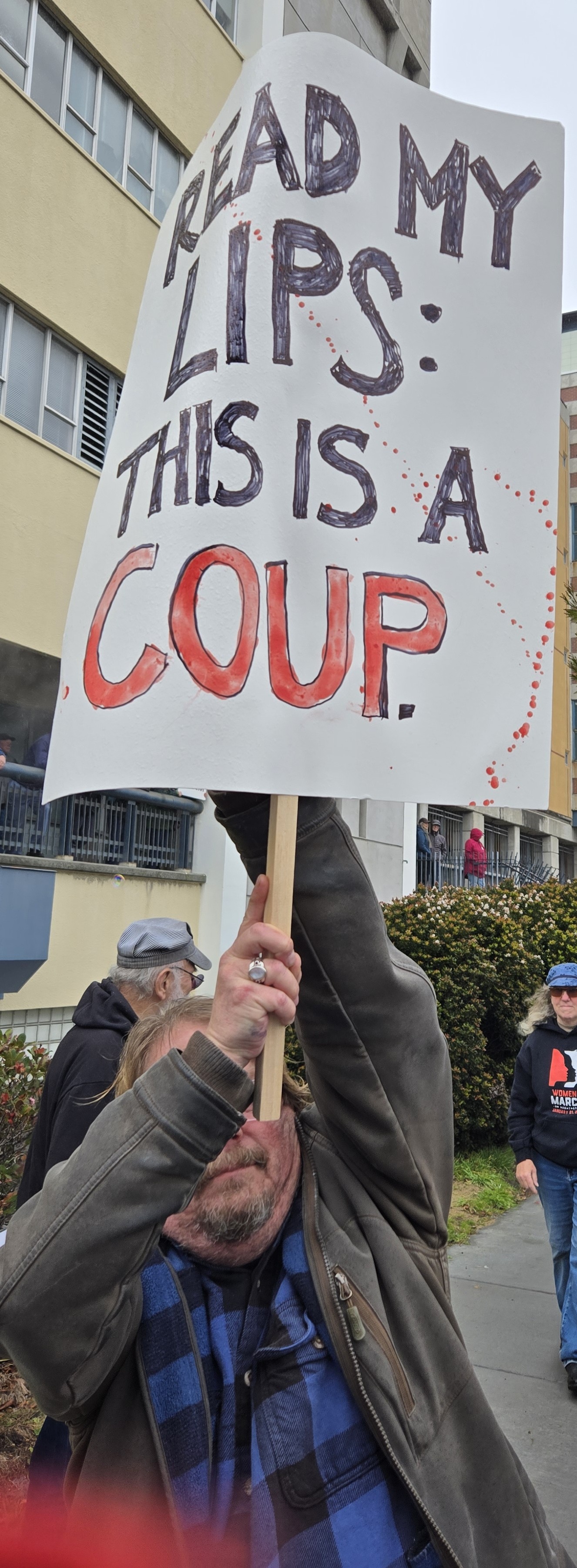
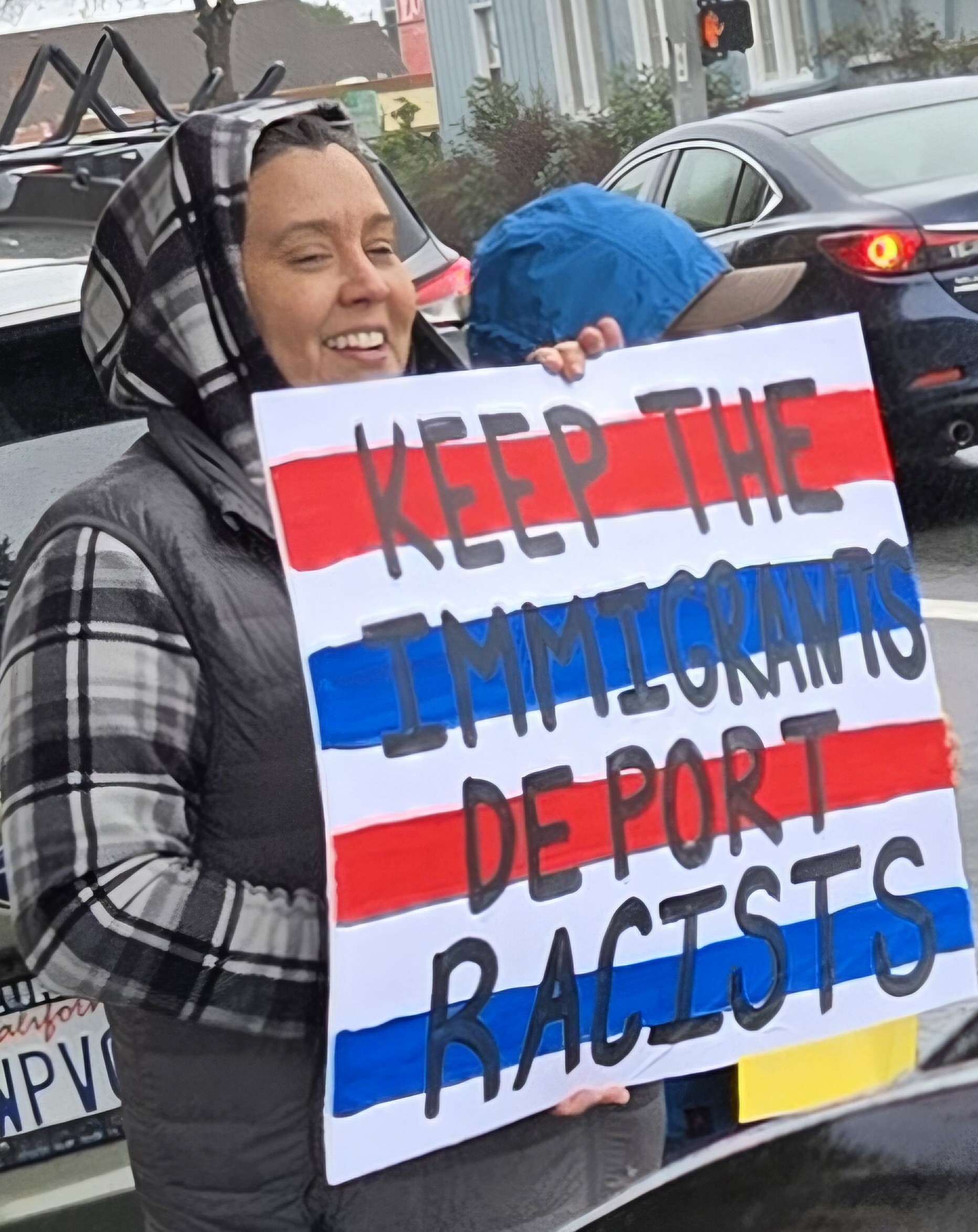
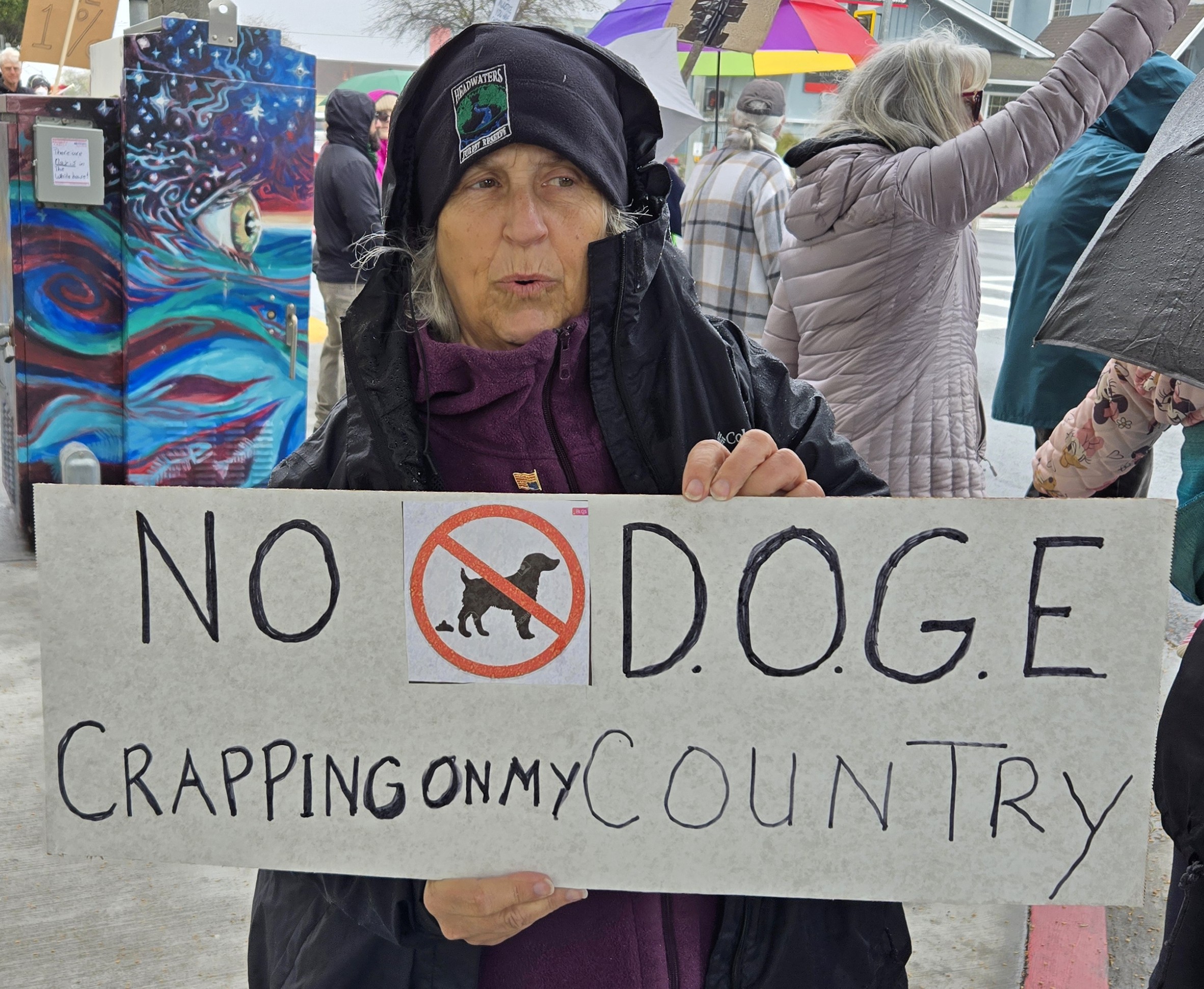
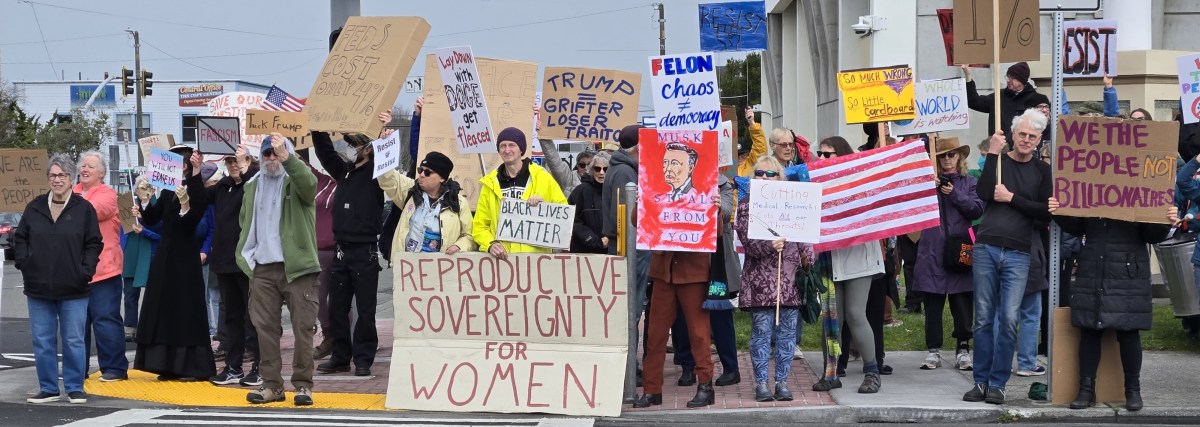
I went to a protest against what is wrong with our government today, and discovered that a lot of people think there are a lot of things going wrong. It may be difficult to address these issues overall because there are so many of them. Most people could agree on one thing:
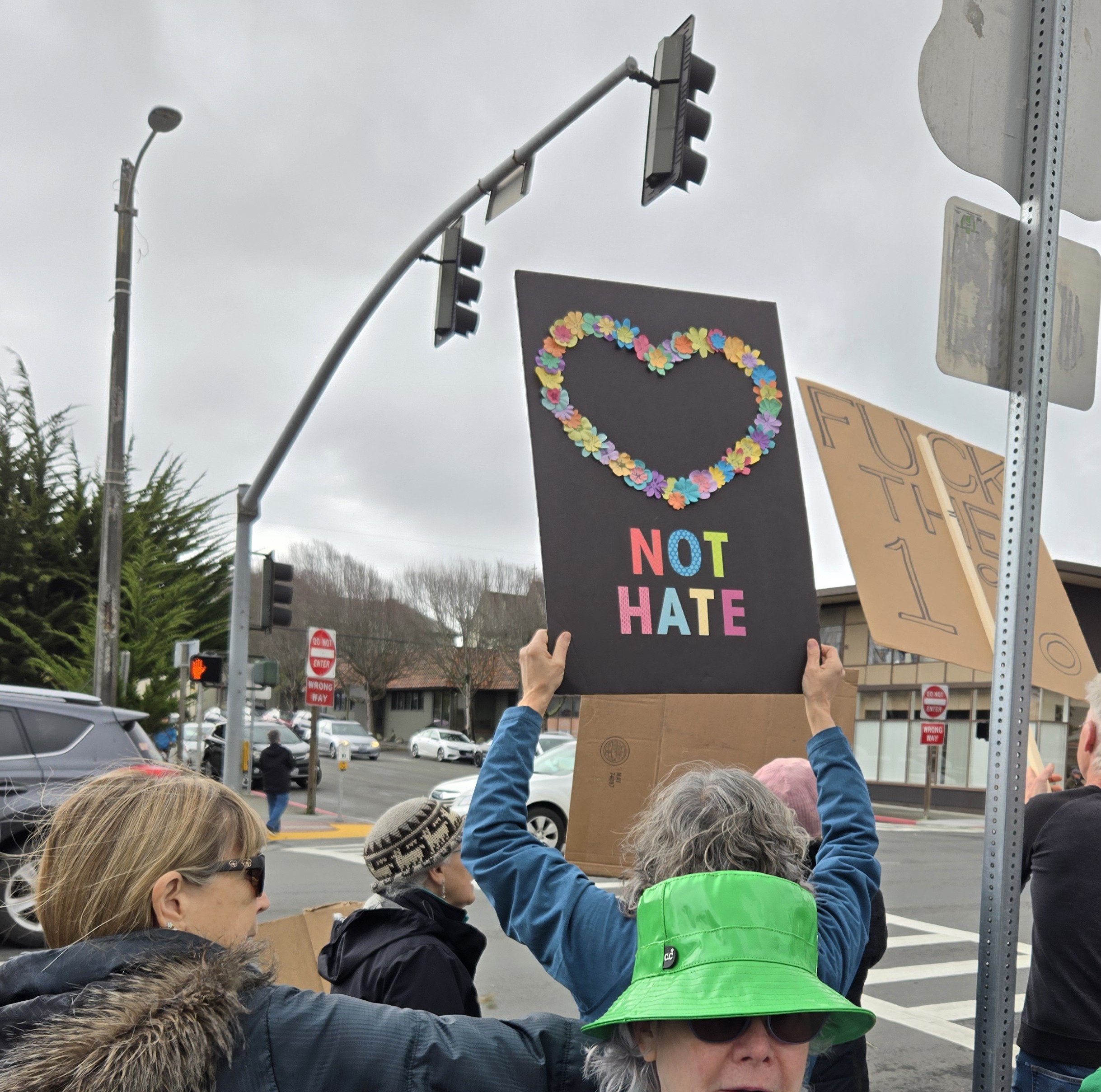
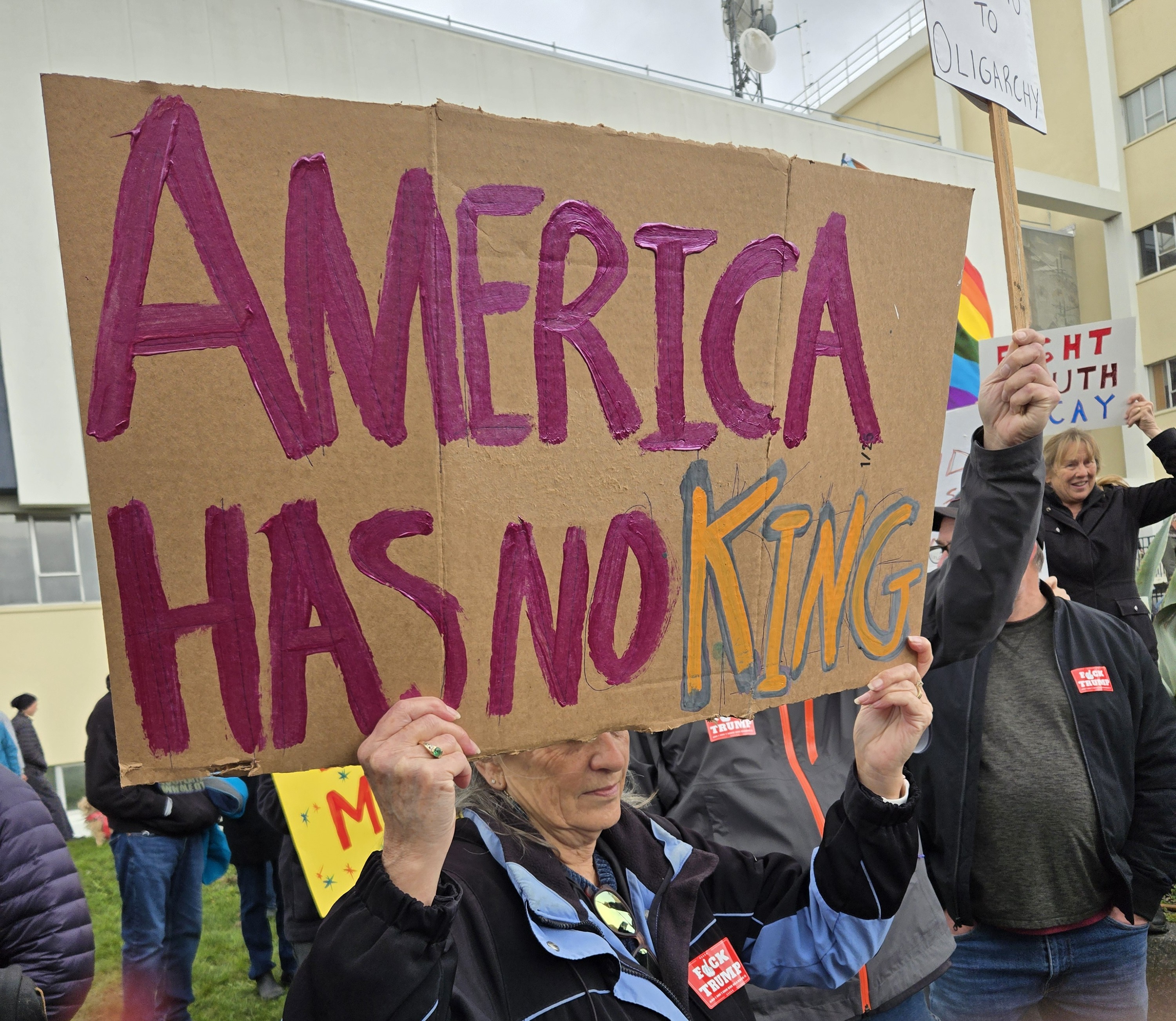
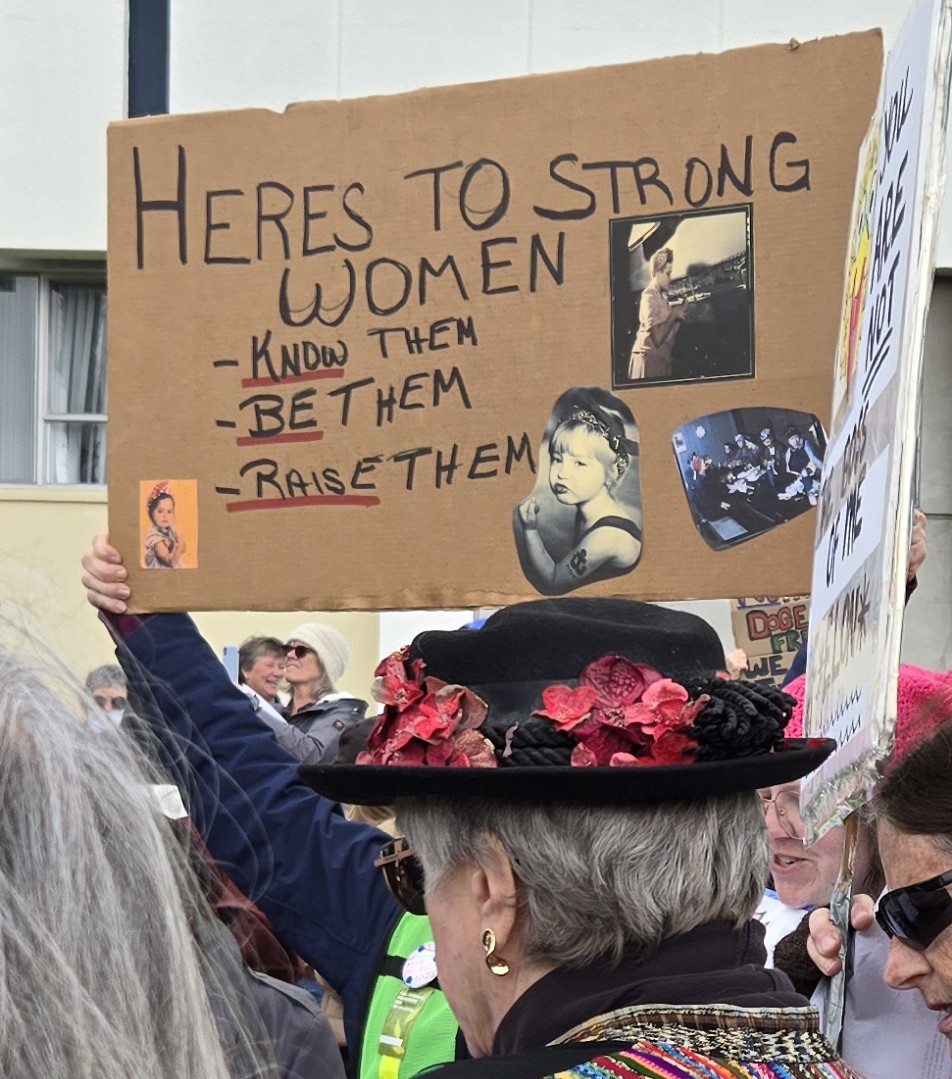
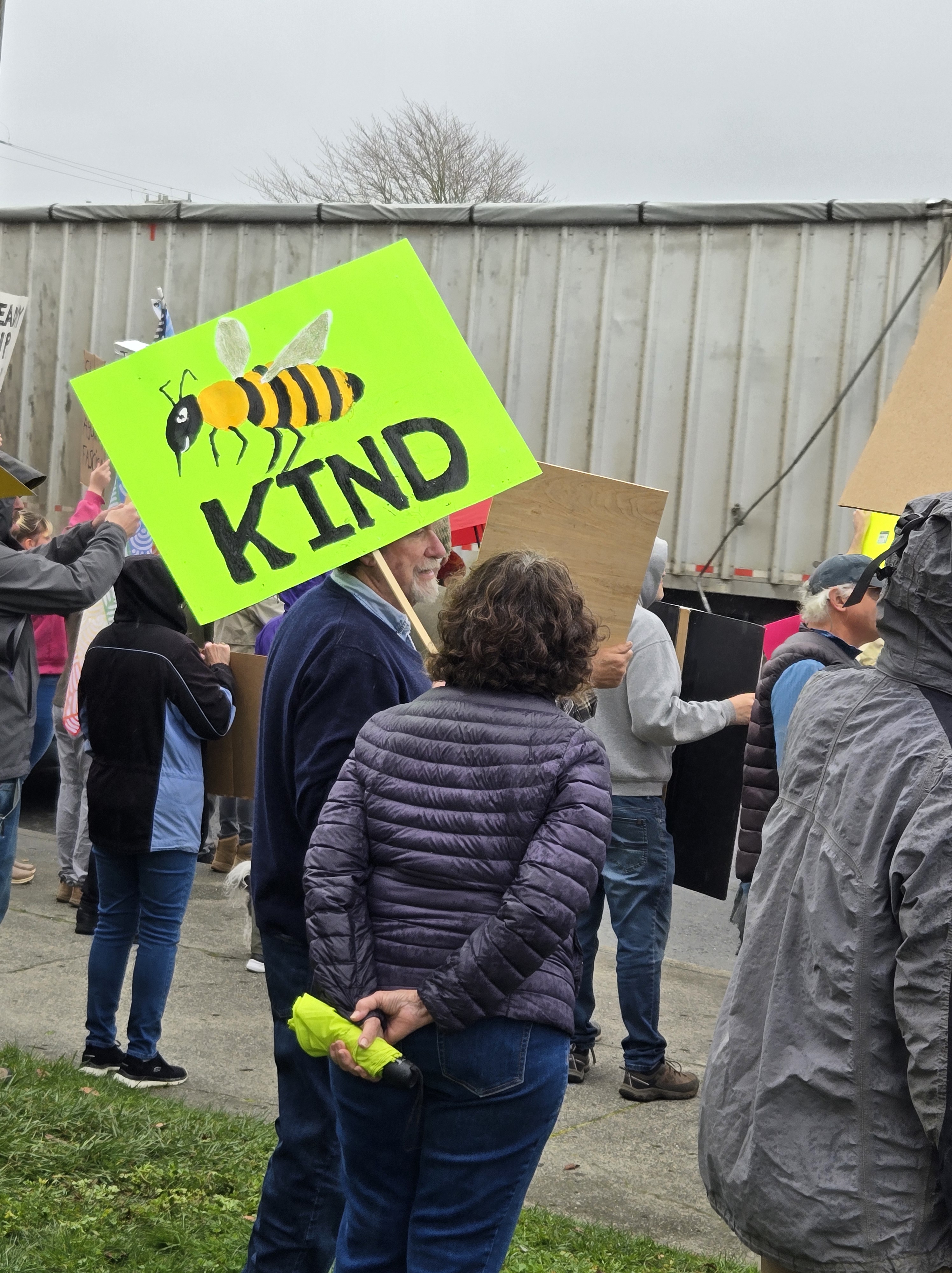
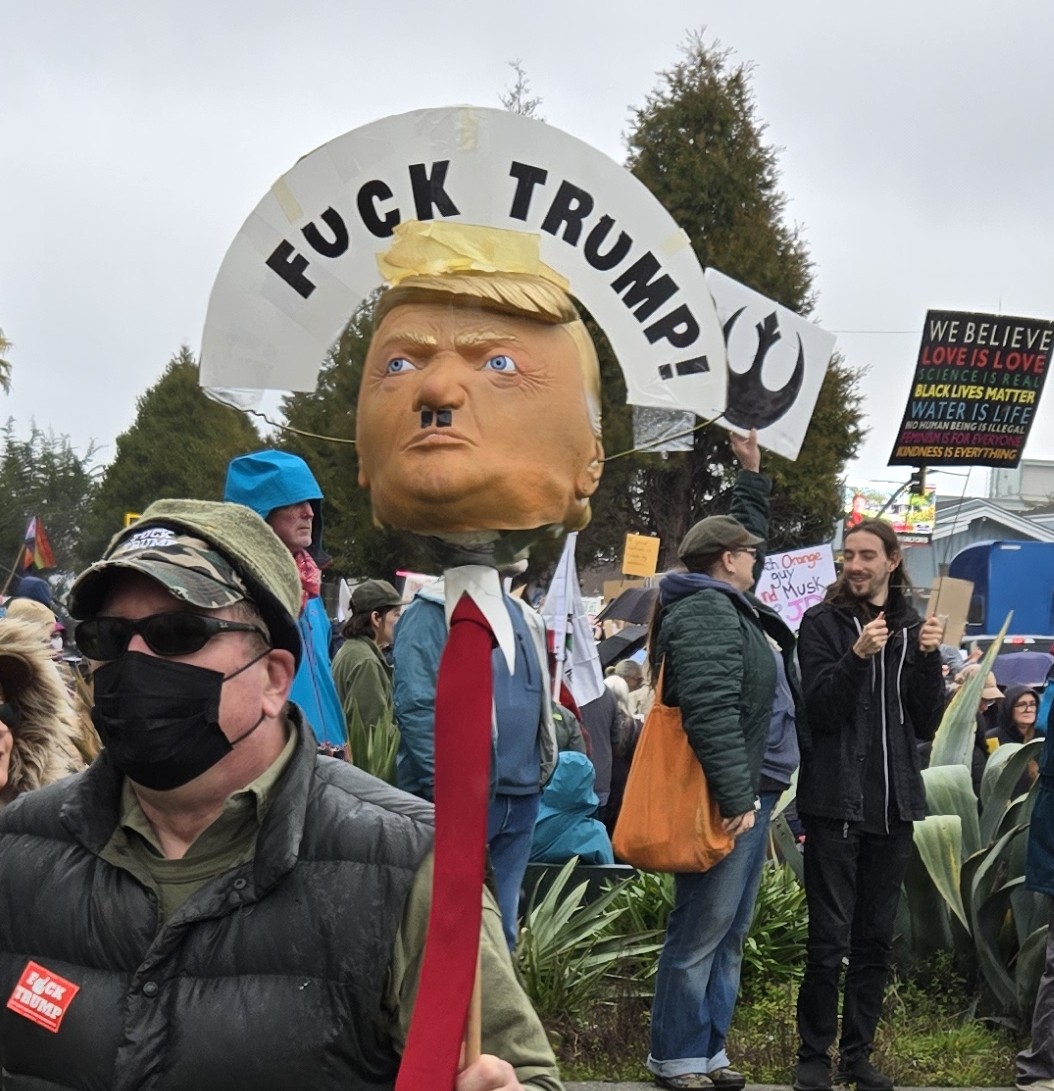
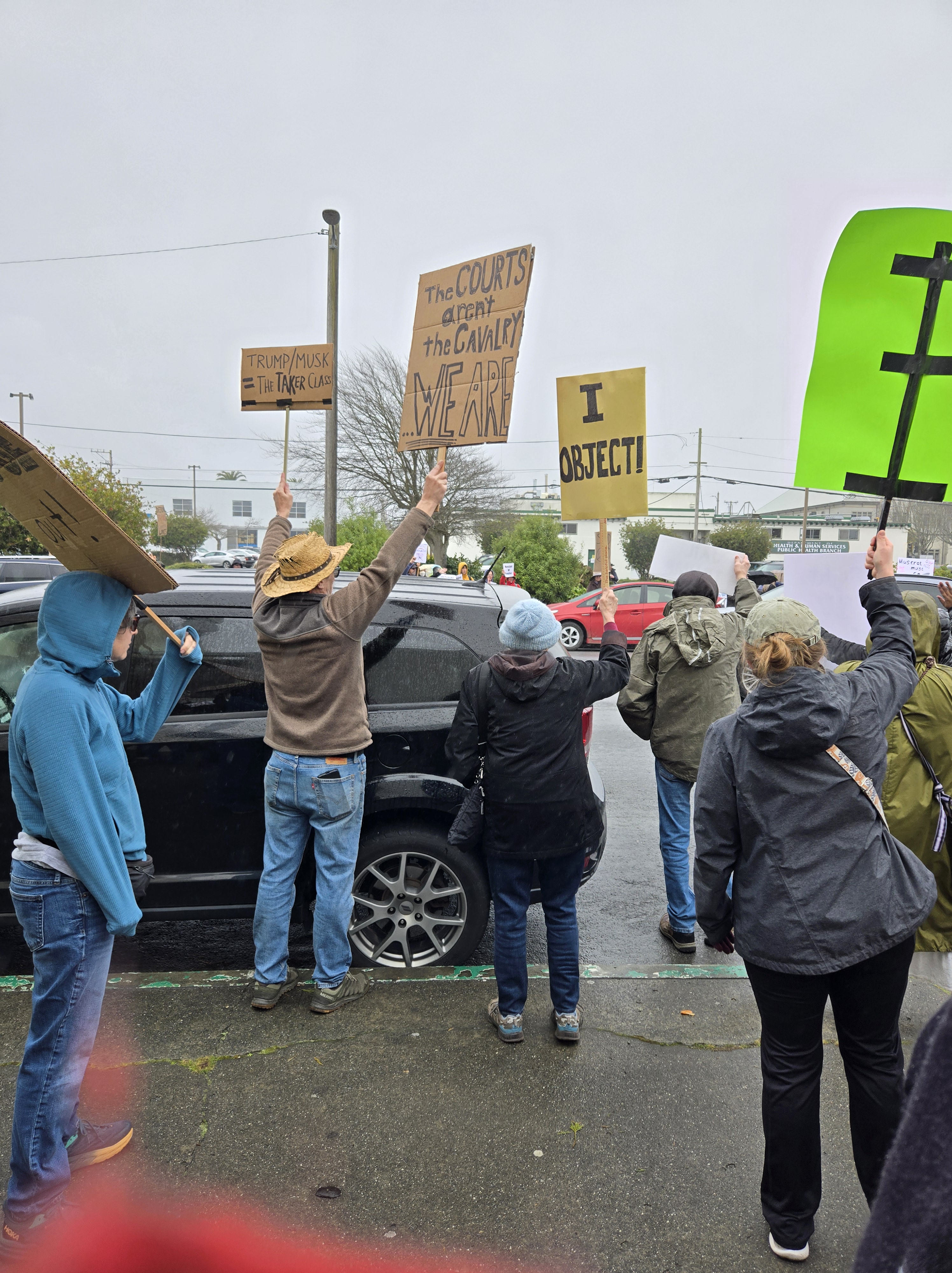
There were 300 people gathered at the courthouse, perhaps more. Many were my age, people who are retired, but there were lots of parents and younger people who chose to spend their President’s Day holiday demonstrating for issues that are important to them.
There were drums, there was chanting, and the onset of some rain didn’t slow people down. I stayed for an hour but then I left to do other things. Demonstrating takes time and effort. Some people put a lot into it. If demonstrations are held every month, I’ll go back next time with my own sign: Grandmothers for a better future!
I submitted an entry for the member exhibition at the Arts Council. Just a few days later, I found that my piece was accepted, and will get some kind of recognition at the Jan. 4, 2025 awards event.
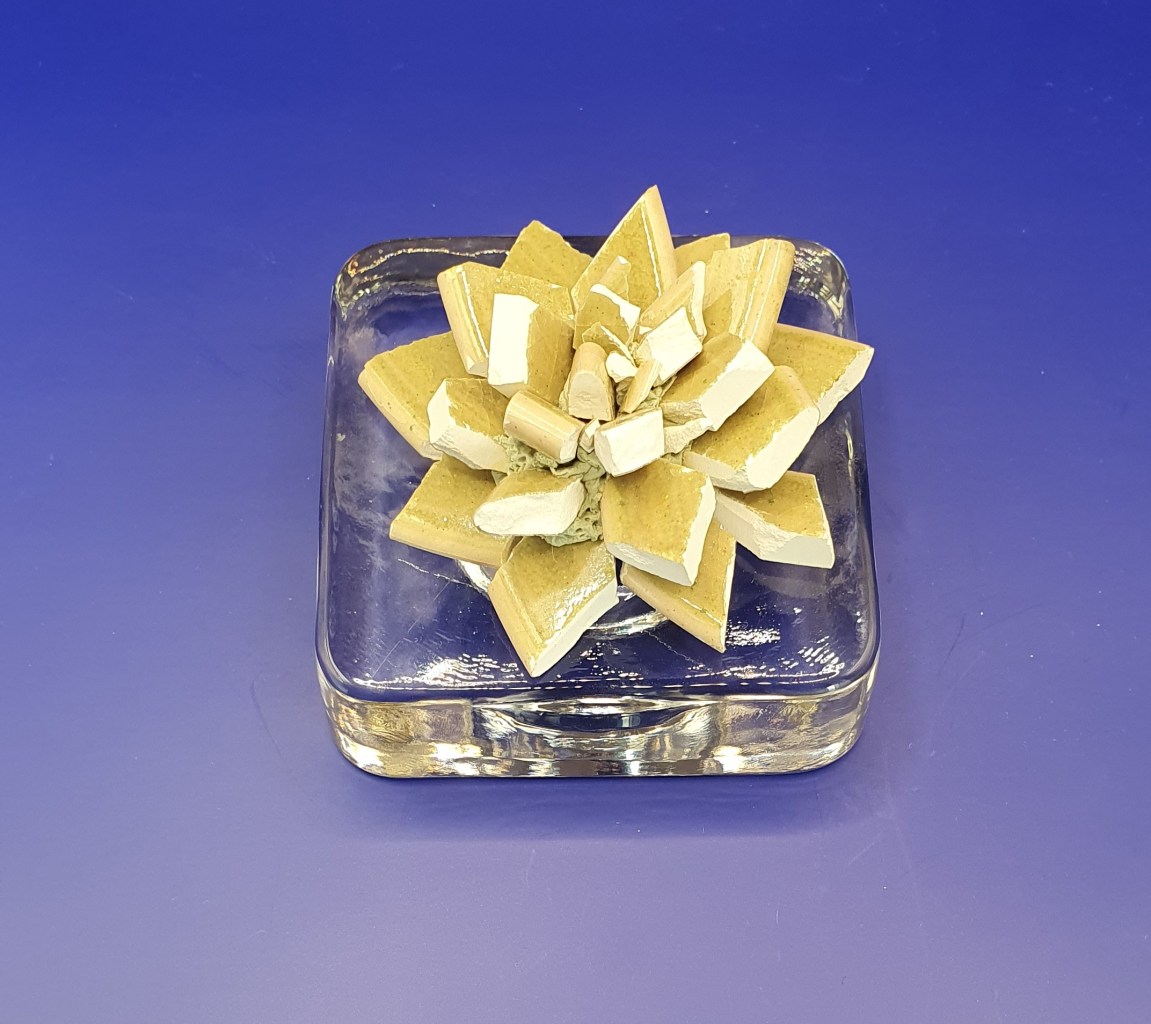
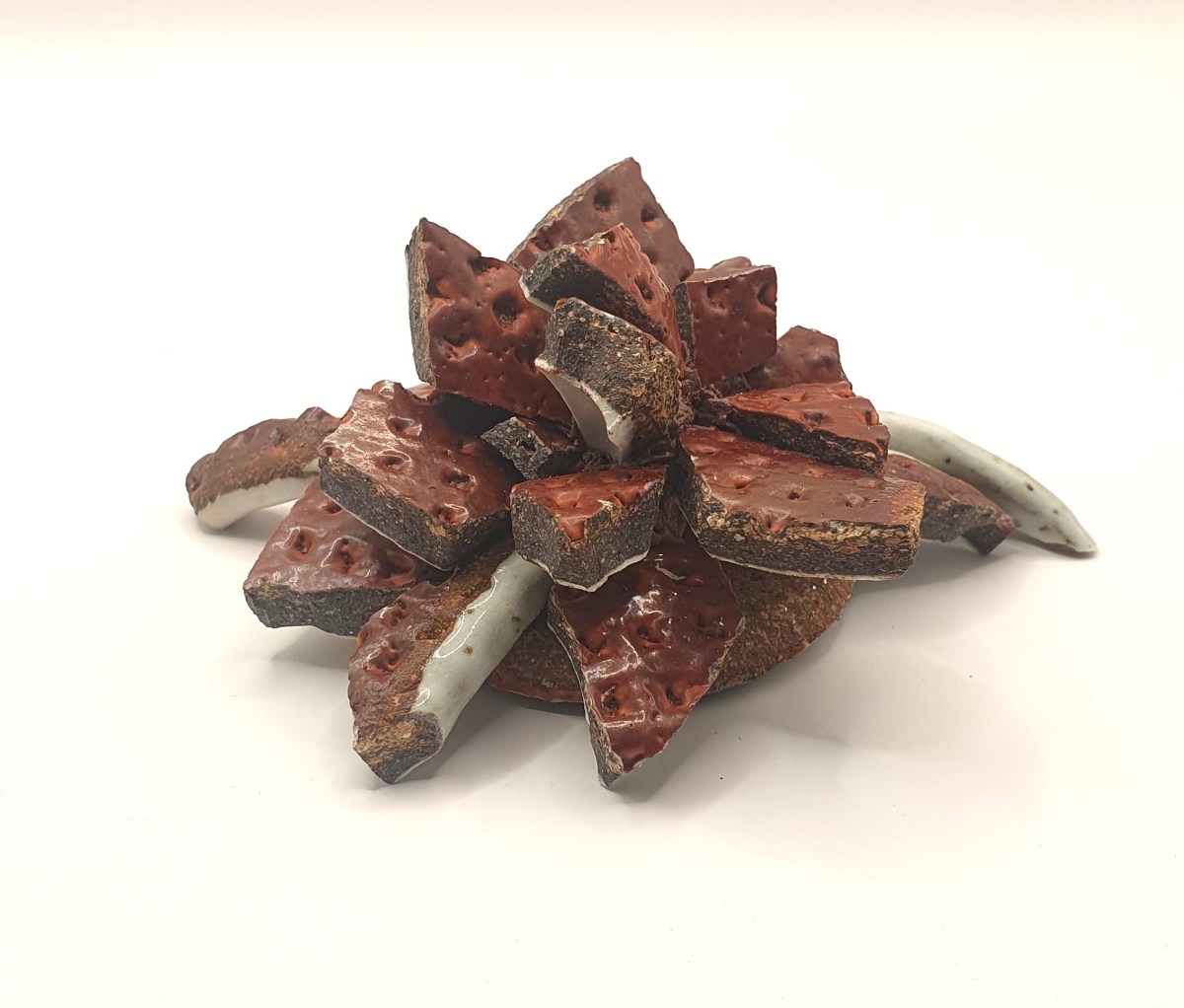
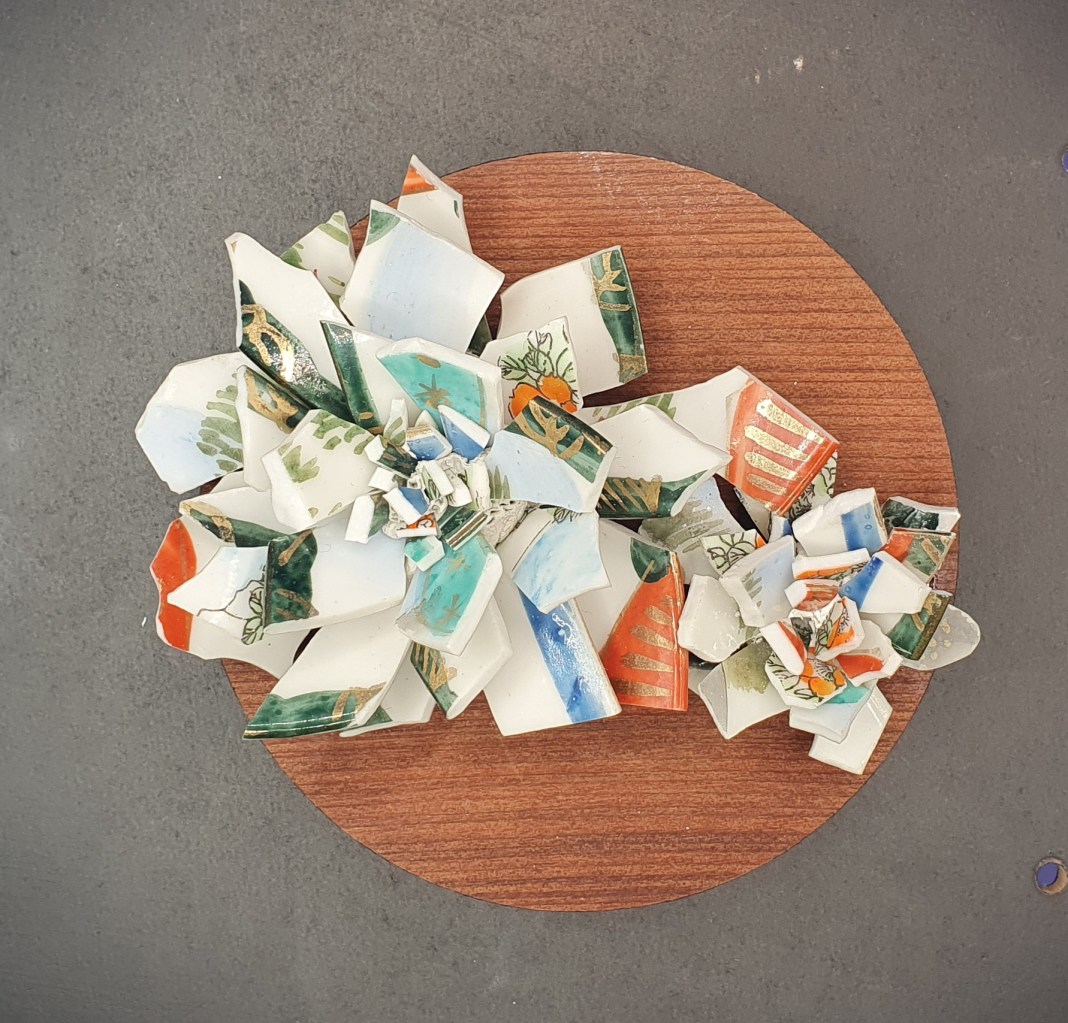
This is the first time I’ve entered an exhibit with something that was not a piece of jewelry. For a few months, I’ve been making mosaic flowers and succulents from broken china after taking a class from Cheryl Cohen. I don’t recall how I found her, but I was captivated by her projects. Her studio is in Holliston, MA, but there’s an online video version of her class that worked very well. https://cherylcohenmosaics.com/ I like making new things out of broken ones, and chipped and broken pottery is easy to come by. The local tradition of “free piles” on the sidewalk yielded everything I use.
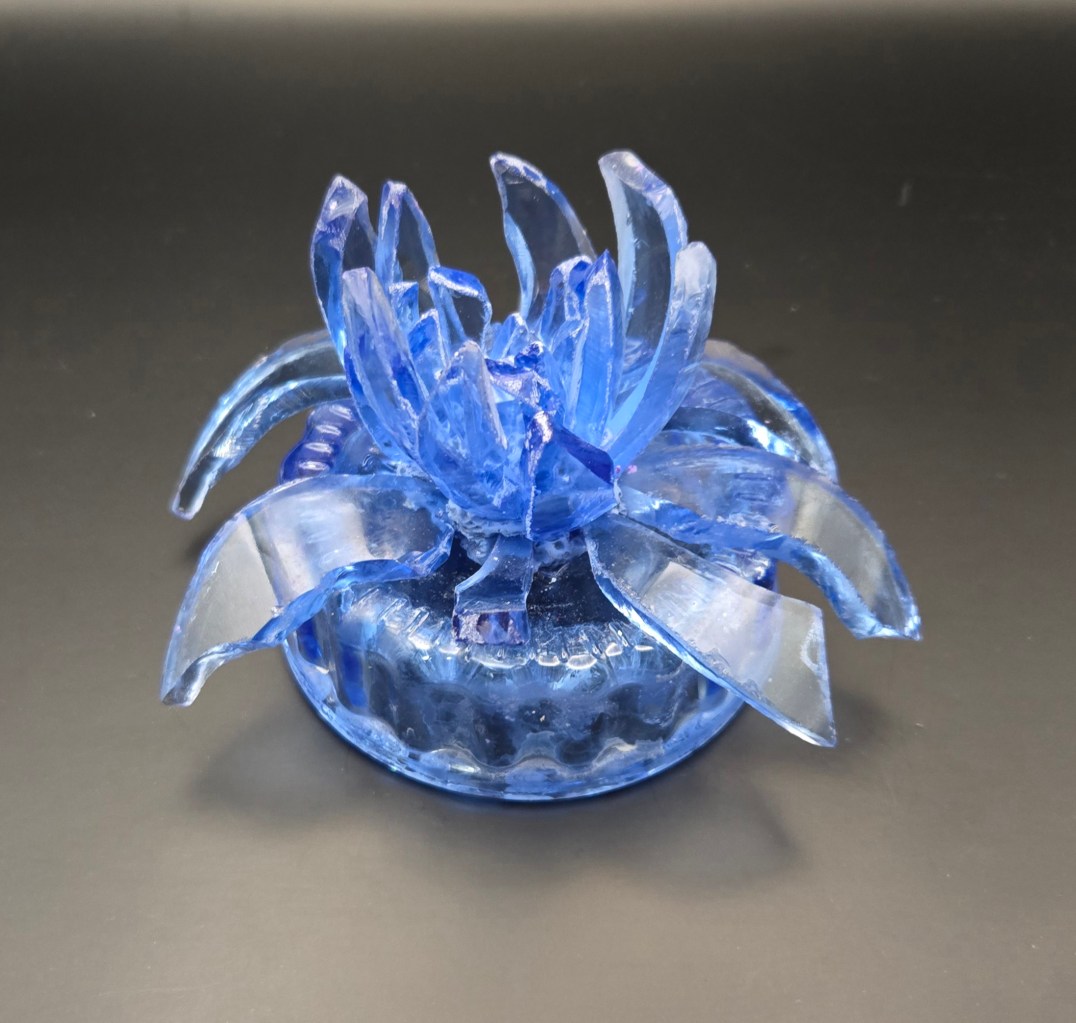
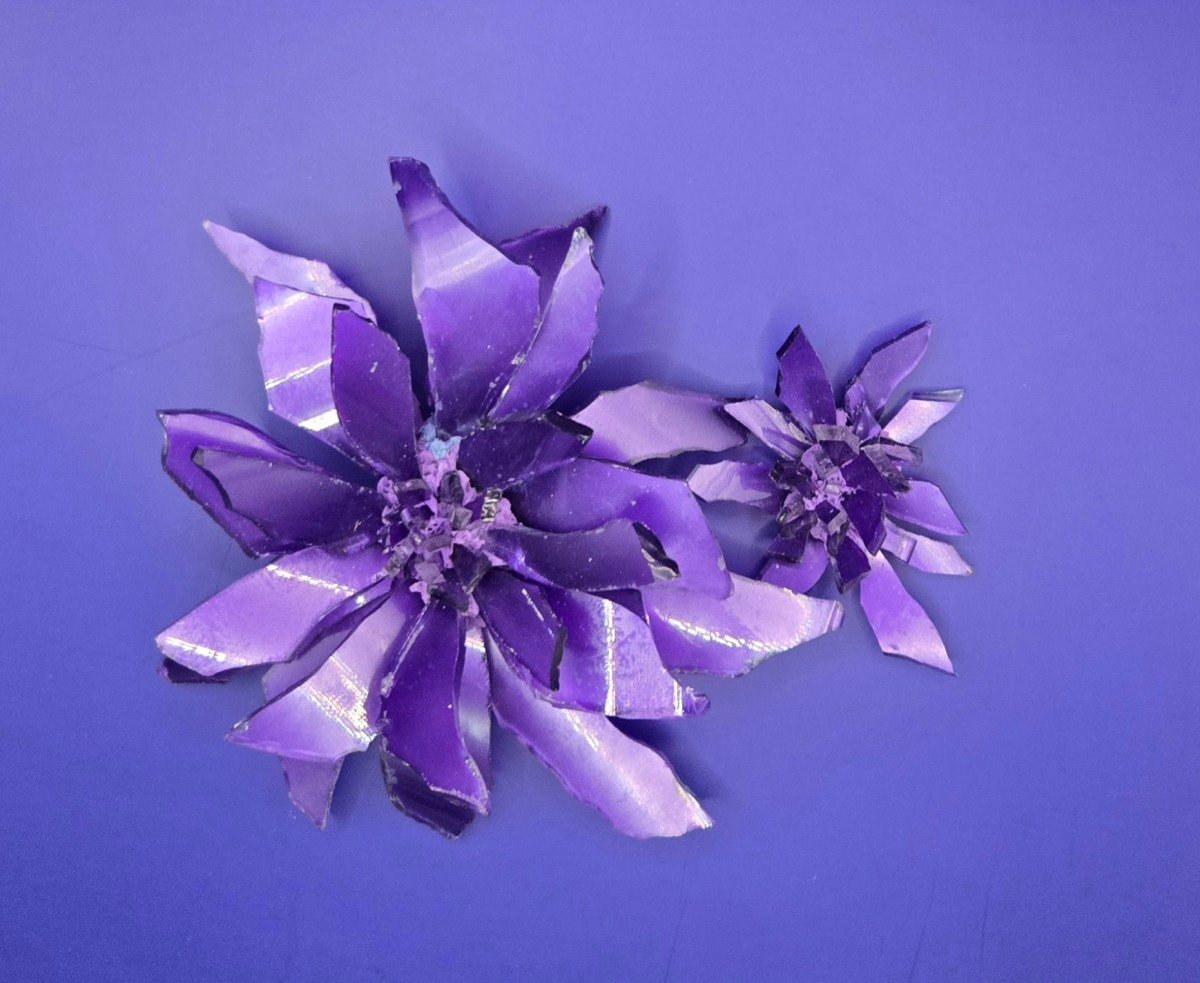
I branched out into broken glass, and made a few lethal flowers…
When I found a broken figurine, I thought about putting it in the center of a piece, and ended up with something I liked. Unlike the flowers, though, I wanted the bird to hang on a wall, and I had to figure out how to get a chunk of mosaic to stay attached to a vertical surface.
The oval frame and mat were in a free pile at an estate sale. I love oval frames, so I picked it up. The frame is metal, dark brown, and the mat is old, and brownish.
I could glue the mosaic piece in the center of the frame if I had a strong backing. I found a thin piece of plywood. My son-in-law cut the oval I needed from it. Once the piece was ready, I still wanted to support the mosaic with something more than glue. I marked gaps between the pieces of ceramic and drilled holes through the plywood for tacks. The tack ends that extend through the plywood support the mosaic piece. After I put down glue, I fit the piece over the points, and let it dry.
A day later, mt mosaic was ready to hang. I had to add a wire on the back, and it was good to go.
The finish that was on the plywood works well as a background. I couldn’t imagine a better one. Title: The Noble Bird.
Postscript: A visitor to the exhibit (not someone I am acquainted with) purchased my piece!
Quick! Before you completely forget what you felt when you first knew the election results, sit down and write down the first things that popped into your head. At the end, add a couple of thoughts you’ve had since. We’ll come back and read these in a few years and see what we think.
I was on the losing side in this election. I peeked at the New York Times election dial just before I went to bed around 11 pm PST, and it looked bad. In the morning, it was all over.
My first thoughts included concern that violence and bullying among adults will increase. If people are free to express sexist and racist feelings, and to lie about their actions and intentions, what is to prevent people from acting on unfriendly impulses? If you live in a rural area, or are a minority, what will keep your neighbors from knocking down your mailbox, torching your woodpile, or bumping you off the road should you disagree with them? Good will? Self-restraint? Laws?
My second thought is that if Donald Trump supports Netanyahu, and Netanyahu is dead set on bombing Iran, will nuclear war begin during the next four years? I hope not, but I don’t think it’s impossible.
Those were my first thoughts. Now it is a few days later and I will add a couple of things. First, Kamala Harris lost. Accusing her of wrong-doing, running a bad campaign, and a litany of other sins has no place in my world. She lost, leave her alone and get on with figuring out what comes next.
The Lorax lost once again. Let’s keep snatching the last tree out of the fire and replanting. What else is there to do?
My favorite piece in last year’s Junque Arte exhibit was “The Little Library of Banned Books,” a sculpture made entirely of reused, recycled materials, mostly books. It clearly showed the arbitrary nature of banned books. The artist who made it described the little library outside her own house and the number of times it was vandalized because she included Charlotte’s Web and a few other banned titles. I was impressed.
Simon, young, has all his feathers (2003-2019)
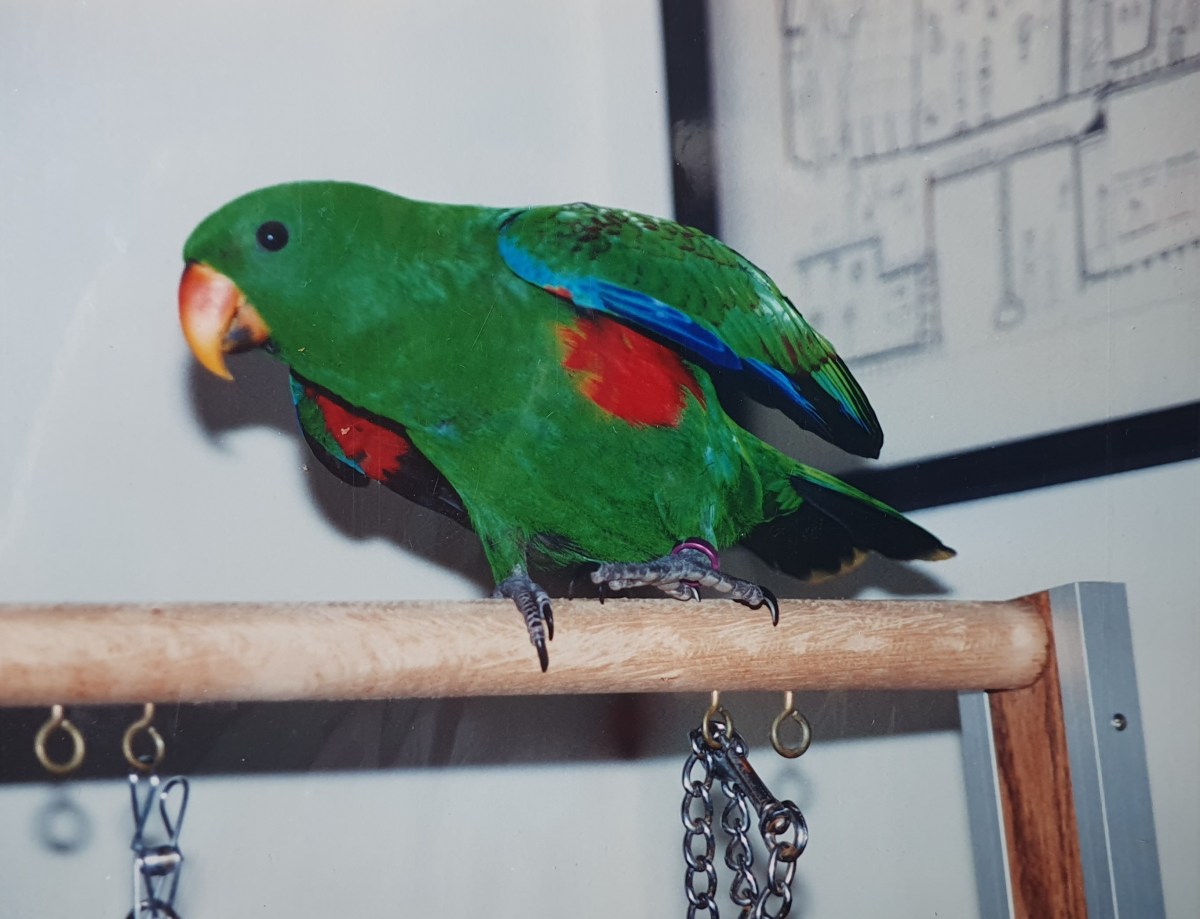
Raoul (1994-1998)
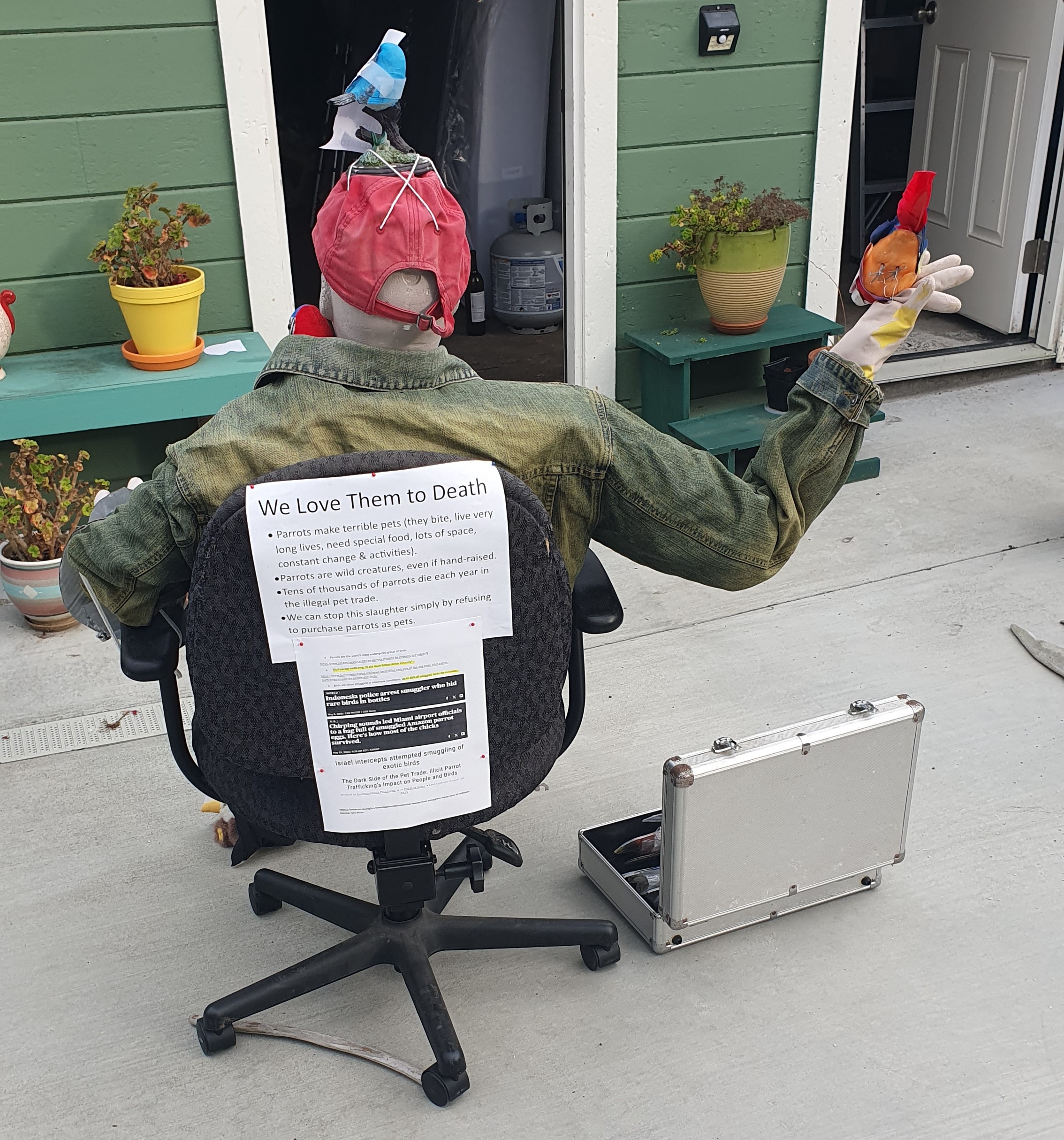
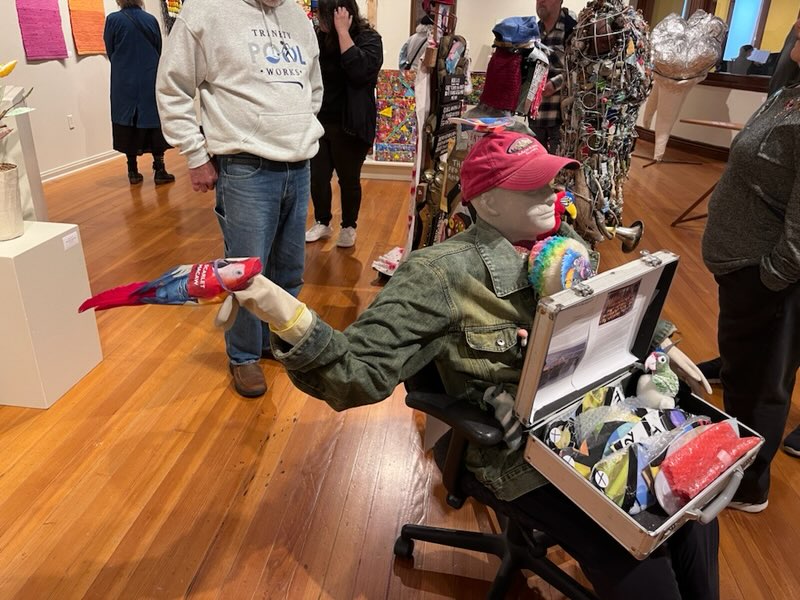
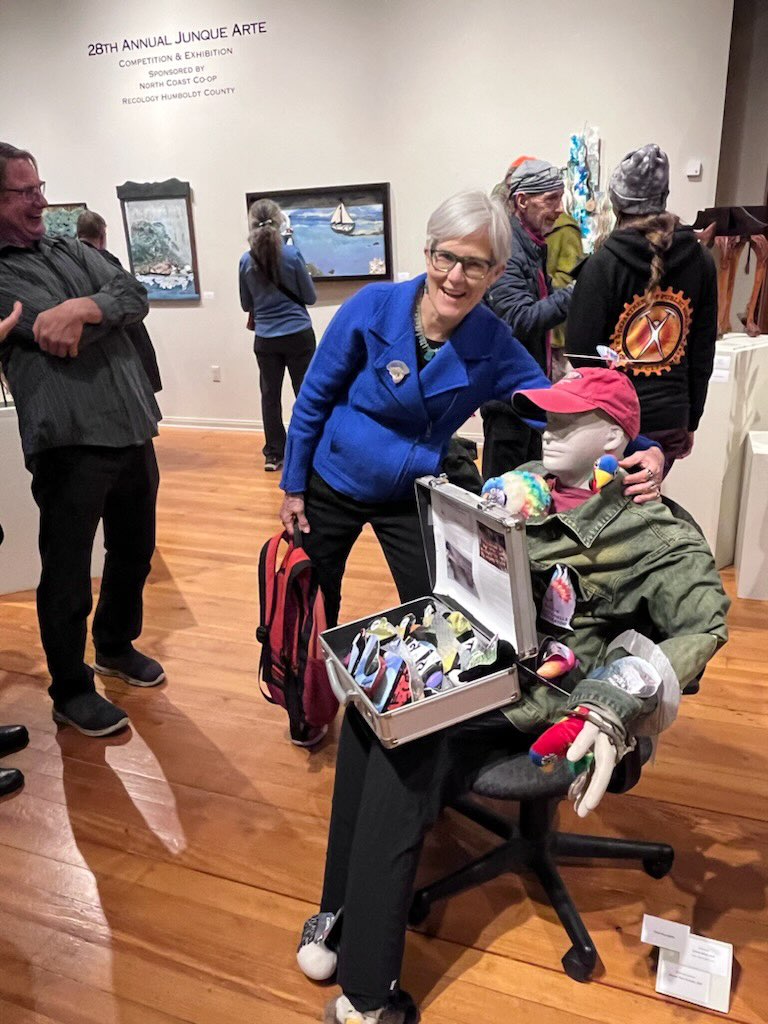
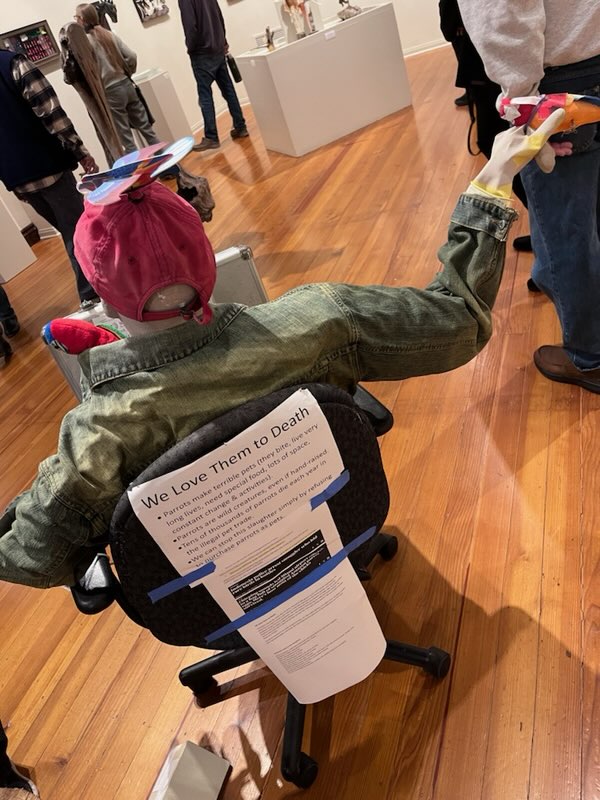
This year, I contributed a sculpture of my own, based on my experience with pet parrots and macaws. I have had a pet parrot (male Eclectus, named Raoul, d. 4 yrs old), and a pet macaw (male red-fronted macaw, named Simon, relinquished 2019, age aprox. 20 yrs). These experiences proved to me that these birds do not make good pets, no matter how much we may appreciate them and try to care for them. I still feel bad about giving up Simon to a rescue, even though we were unable to keep him while we traveled. I am not tempted to see if he is still alive and available for re-adoption, either. What does that tell you?
I’ve become aware that trade in exotic birds is a multi-million dollar industry that results in high mortality among birds that are removed from the wild and illegally shipped around the world (est. 40%). People involved in this trade have to be utterly without morals, as they routinely kill birds, or allow birds to die, merely as the cost of doing business. The title of my sculpture is, We Love Them To Death.
I wanted a figure handcuffed to a chair, with birds hidden all over him. I made a few calls, but couldn’t get an entire mannequin to use, and pieces for this exhibit must be made entirely of reused or recycled materials. In addition to hunting for a mannequin, I kept my eyes open for a chair, clothing, a briefcase, and stuffed toys in the form of birds. You would be surprised how few bird-shaped stuffies end up at local thrift stores.
In July, I wheeled home an only slightly broken office chair that was left in the street near our house on trash day. A little grubby, but dark gray, so you don’t really notice. The back is coming loose, but it was fine for my purposes.
I found a number of items in “free” piles around the neighborhood during the year, including a metallic-looking attache case, a few bird items, and a denim jacket.
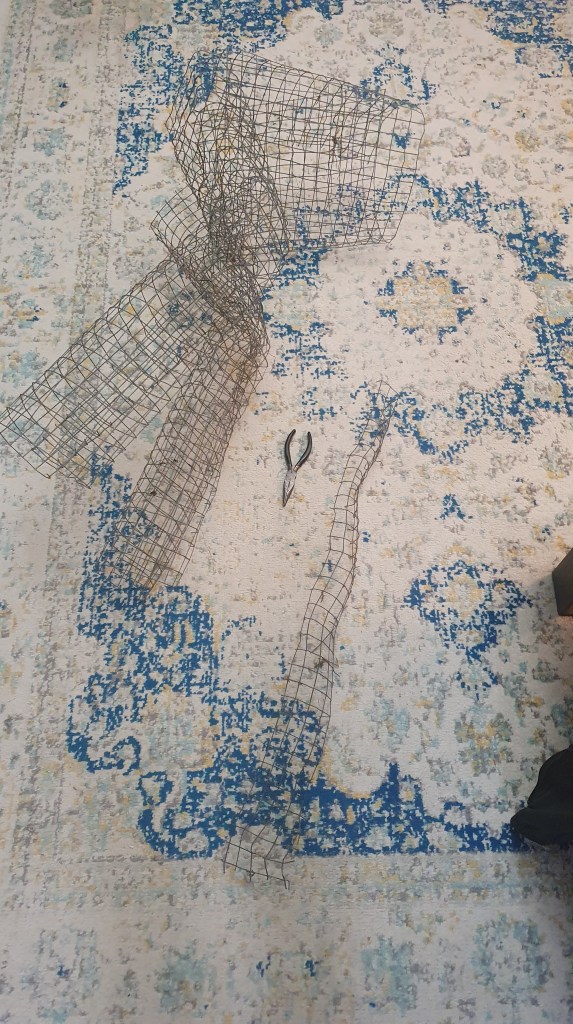
This year’s entry date was published, and I began to work on my sculpture. I approached my neighbor Nick about using some of the wire he had left over from protecting his new trees to make my figure. With his ok, I cut a couple of pieces and began shaping my person.
It was difficult to see the shape until I put some clothes on him, castoff pants and shirts of Jonathan’s. Suddenly, someone was sitting in the chair!
Friends came to the rescue with a styrofoam head, so I mixed up some paint and gave it a neutral color over all. I was going to paint facial features on him, but in the end I ran out of time, and besides, I’m not much of a painter. I painted my old kitchen gloves the same color for his hands. His handcuffs are made of cardboard painted silver.
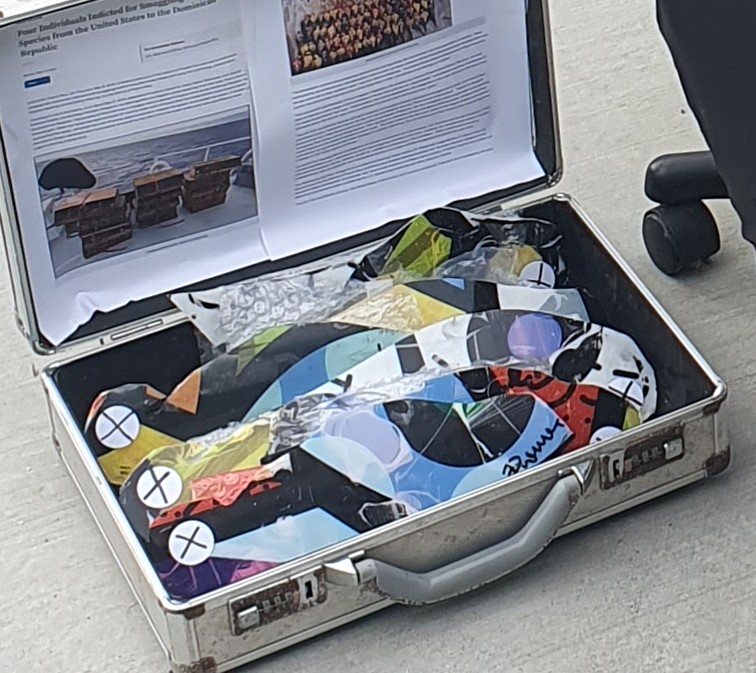
Once I had my figure, I needed to add the birds he was smuggling. I had very little luck finding stuffed parrots, cockatoos, or any other birds among the many animals at resale shops. I wanted to show the inhumane conditions in which birds are smuggled by having my person carry a briefcase full of dead birds. All year, I kept an old suitcase to use its colorful plastic for bird cutouts, so I borrowed my son-in-law’s Sawzall and began cutting. What a mess! I ended up using a handsaw, a Dremel, the Sawzall, my bandsaw, and a box cutter to get my shapes. Cutting plastic is tricky because if it melts, tiny bits of hot plastic begin to pelt your face and arms. It’s not hot enough to burn, but it makes you reconsider your methods.
Inspiration for my briefcase was the story of birds being smuggled out of Puerto Rico by boat. When the Coast Guard stopped the boat, all the cages of birds were thrown overboard. By the time they were fished out, all 100+ birds were dead. (It would take at least 10 years to breed that many parrots. That’s a single shipment.)
My final piece looks like this:
I wasn’t happy with the stuffed birds, as only two were parrots, so I printed images of parrots and macaws (all endangered or extinct) and pinned, taped, or tied them to the stuffed animals representing them. The loon on one foot became a palm cockatoo, while the other foot is now a Spix’s macaw, extinct in the wild.
I submitted my piece this week at the Morris Graves Museum in Eureka, where the show will be held, and got my acceptance notice yesterday. The opening is Nov. 2 where the awards will be announced. I got a peek at some of the other entries when I went to drop off the prisoner, and some are really impressive. It’s always fun to chat with the other people there about what they made and why. Maybe I’ll find inspiration for my next artwork.
PS:
I was asked to answer a few questions about my participation in the exhibit by a reporter for the local paper, the Eureka Times-Standard. The resulting article about the Junque Arte exhibit is very nice and has great photos.
In the opening photo above, you should notice the tall buildings of the business district of Sacramento, the low, gray bulk of the Crocker Museum in the trees along the far bank of the river, and the rider on the jet ski who was swirling up and down the river as we watched. There’s Sacramento for you, some of everything.
Food
Over my 2 1/2 weeks in Sacramento, I had a number of very pleasant and very good meals. We looked for restaurants near our hotel, starting with Origami Asian Grill. The ramen was excellent. I wondered how it would be–the large neon on the front of the restaurant says “best fried chicken”. (I thought we were in the wrong place.) On our way back to the car, we walked by One Speed and decided to go there the next evening. We had delicious pasta, though they are known for pizza.
Two days before Jonathan went into the hospital for surgery, we splurged on dinner at Ella, with its Michelin star. It was pricey, but the duck liver mousse was outstanding, and everything else was delicious.
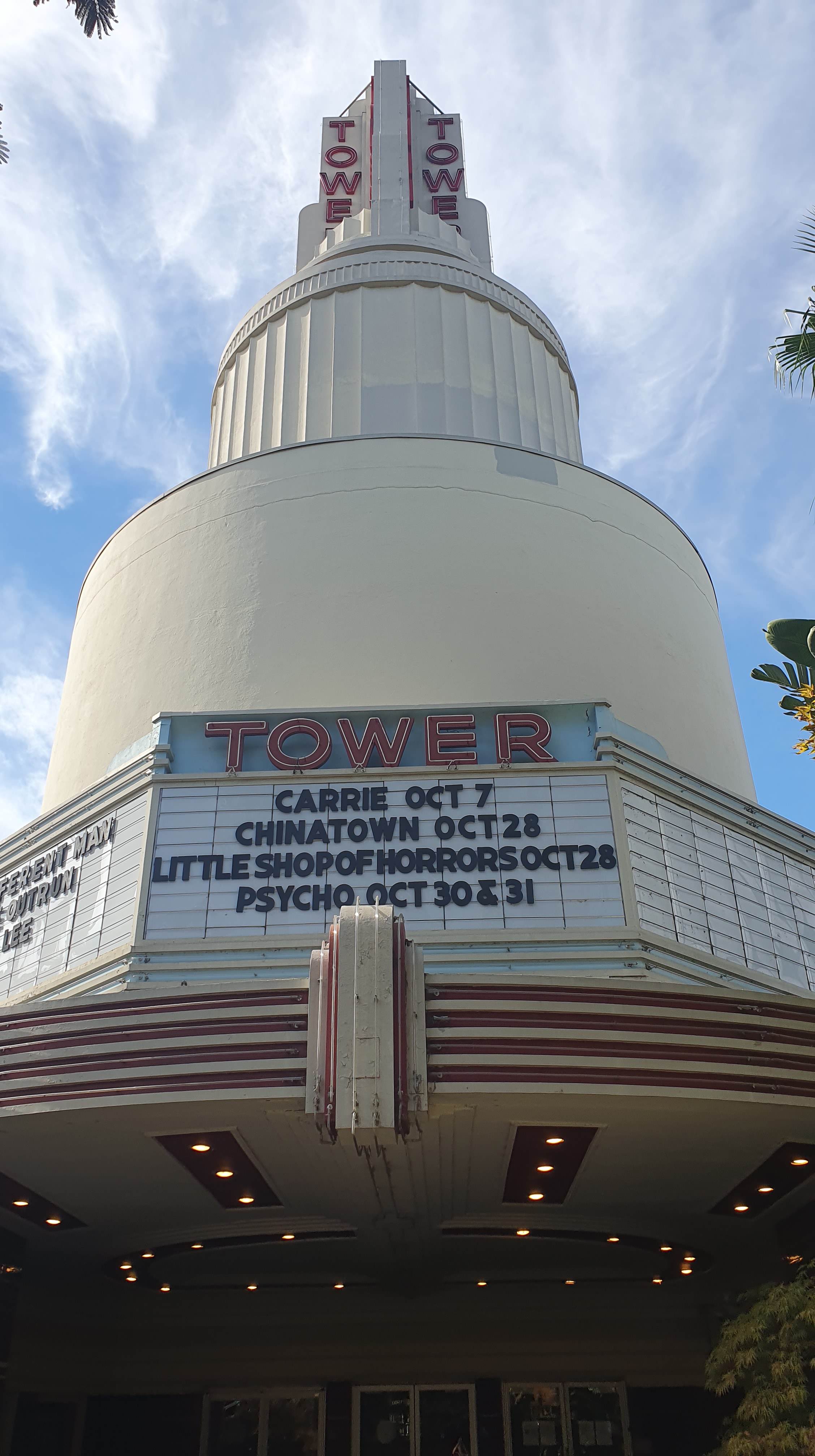
While Jonathan was in the hospital recovering, I reconnected with a woman I knew from college. We went to Bacon and Butter, which serves excellent breakfast fare. I went wild with waffles and peaches. Suzy also introduced me to the prettiest eatery in Sacramento, the Tower Cafe, just outside the Tower Cinema. (The cafe was the original drugstore where Tower Records began.) Outdoor tables are set in a garden full of tall trees and shrubs, wonderfully cool on all but the hottest days in Sacramento. We had good chile rellenos for lunch. I’d go back there any time.
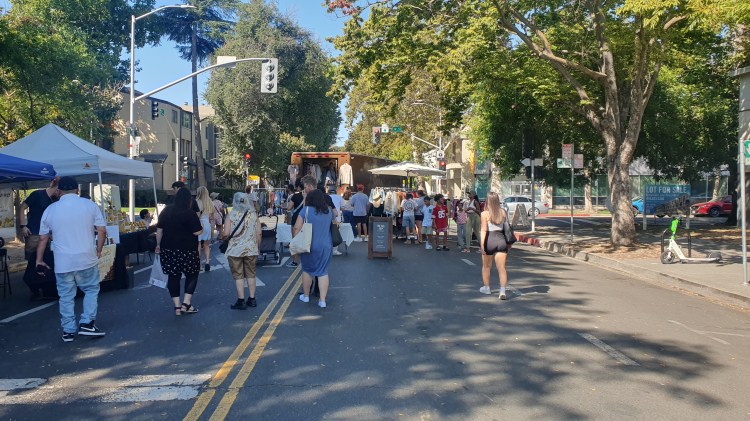
I had a chance to make brief visits to two of the many farmer’s markets in Sacramento. I began with the Oak Park market, small and friendly, where I bought pumpkin spiced pound cake and plums. Later the same Saturday, I went to the Midtown Farmers Market that extends outward several blocks in each direction from 20th and K Sts., just north of the State Capitol complex. I could have spent much more time at this market, there were all kinds of vendors from fruit (mostly Asian pears, plums, and grapes), vegetables (tomatoes, squash, and early fall produce) to food, beverages, and crafts.
I also squeezed in a trip to one of Sacramento’s favorite ice cream parlors, Gunther’s, where they have a lot of uncommon flavors. After a lot of deliberation, I tried black walnut and orange chocolate, both delicious. If I weren’t out of time, I’d go back for the two seasonal flavors for October, pumpkin and licorice!
Culture
I dabbled in a bit of culture, as well. Suzy, her daughter Molly, and I, made a visit to the Crocker Museum, which has grown very large. There is so much interesting art that it was clear a single visit was not nearly long enough to explore it all. In the gift shop I found a postcard of Pies, Pies, Pies by native son of Sacramento, Wayne Thiebaud, and beautiful notecards featuring California birds by Molly Hashimoto.
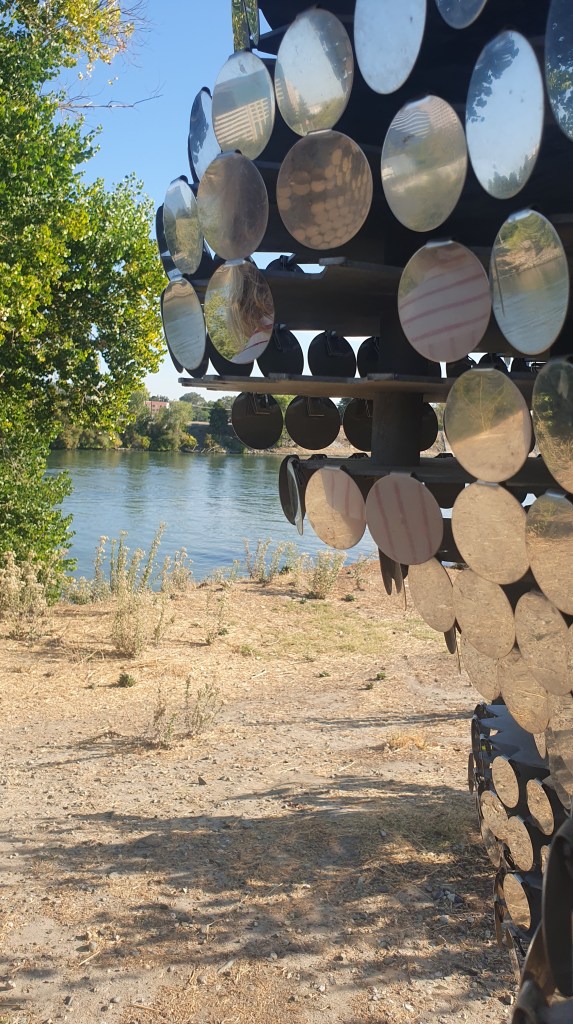
Suzy, Molly, and I then went on an adventure out of Atlas Obscura. For those of you not familiar with it, AtlasObscura.com keeps lists of unusual sights in many different locations. It provides a source of brief visits along any given route of travel, or day trips from any place you happen to be. There is a substantial list for Sacramento, and we chose one that Suzy hadn’t known about, the sculpture called Subtile, installed on the bank of the river in West Sacramento in 2017. By Czech artist Federico Diaz, the work is a large armature covered with small, silver-toned polished disks that move in the wind. The piece is shaped vaguely like a group of shrubs or trees, and shimmers like wind through tree branches.
I wanted to see the shore of the river, so we slithered down the embankment to find that the river’s edge is rather plain. However, looking back up, the sculpture was particularly fine against the blue sky. The good photos repaid us a bit for the struggle to climb back up the embankment.
[The video above is best with your volume turned down or off]
Our visit to Sacramento was intended to be very focused on medical issues. I didn’t realize I’d be here long enough to see a bit of the city and start to find my way around. I am grateful to Suzy Underwood for taking so much time out of her schedule to show me around and share in some of these adventures while Jonathan was in the hospital.
Jonathan and I were lucky to be leaving Sacramento on Oct. 10, despite the many things still to see. All the hotels were booked solid and have been for 6 months! It’s Aftershock, a four day music festival. The reception staff at our hotel said we were smart to be leaving before the traffic gets really bad. I looked up the festival, https://aftershockfestival.com/
Not my thing, but I did recognize a number of the bands playing. I also noticed an influx of green and purple haired, tour tshirt-wearing people the morning we checked out.
I’m sure they’ll have their own great visit to Sacramento.
Sacramento would be a lovely place to live if only they could do something about the weather. It’s October, yet the late afternoon temperature has hit 100 degrees about half of our days here. People quickly learn to get out early and finish walking the dog, taking a stroll, jogging (if they must), because by 10:30 am it’s pretty hot outside. The heat keeps rising, too, so that between 4 and 5 pm, it is often still well over 90, and I can say from recent experience that is not a good time to try and walk anywhere. My advice is to visit Sacramento between November and May.
Apart from the heat, the city has a lot going for it. The Sacramento river flows alongside downtown, and was important for transportation of people and goods via big river steamboats from the 1800s through the 1930s. Old photos show bustling wharves with ships moving in and out.
The paddle wheel ship on the far right is now a hotel.
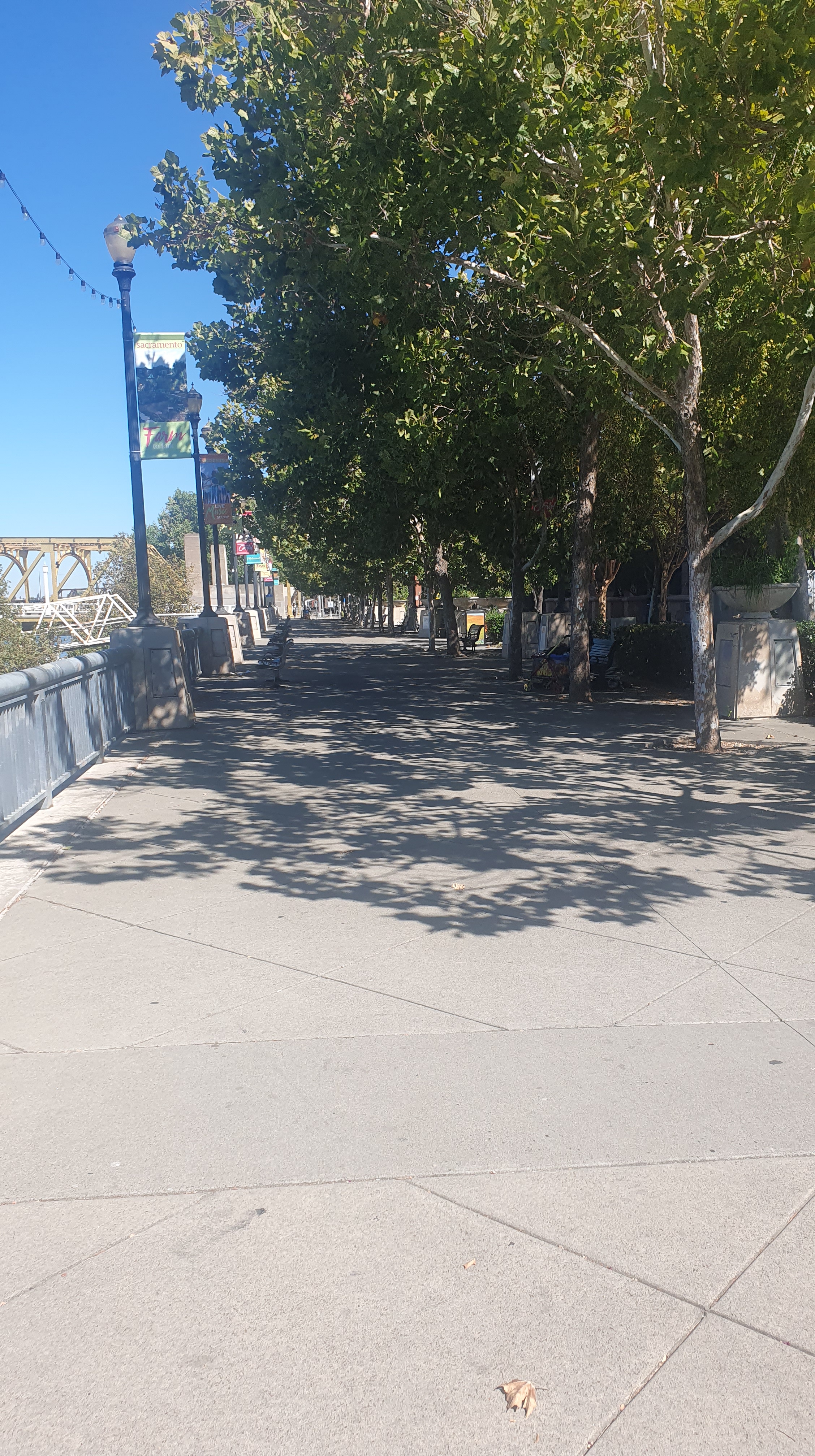
A broad, paved walk along the river includes plaques inscribed with quotes from Wind in the Willows about river life along with informational pieces.
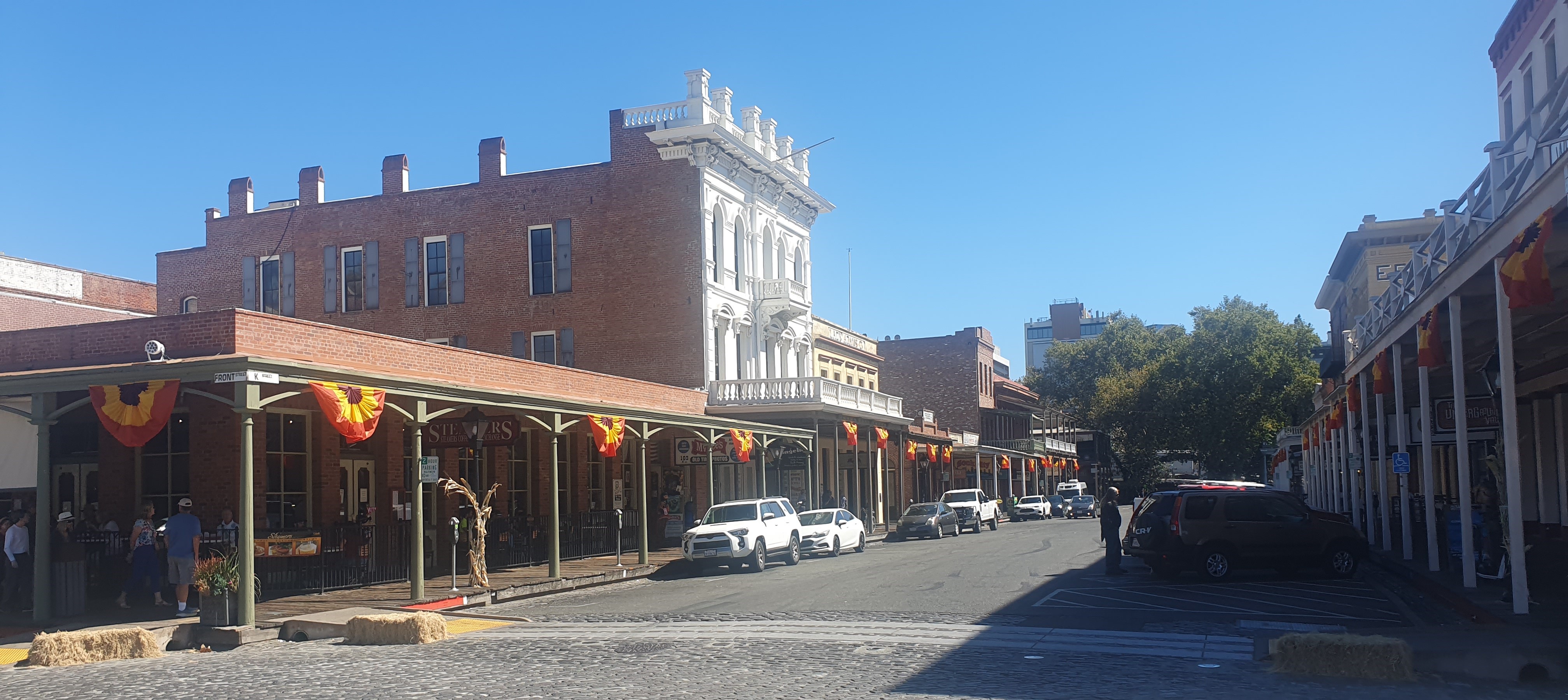
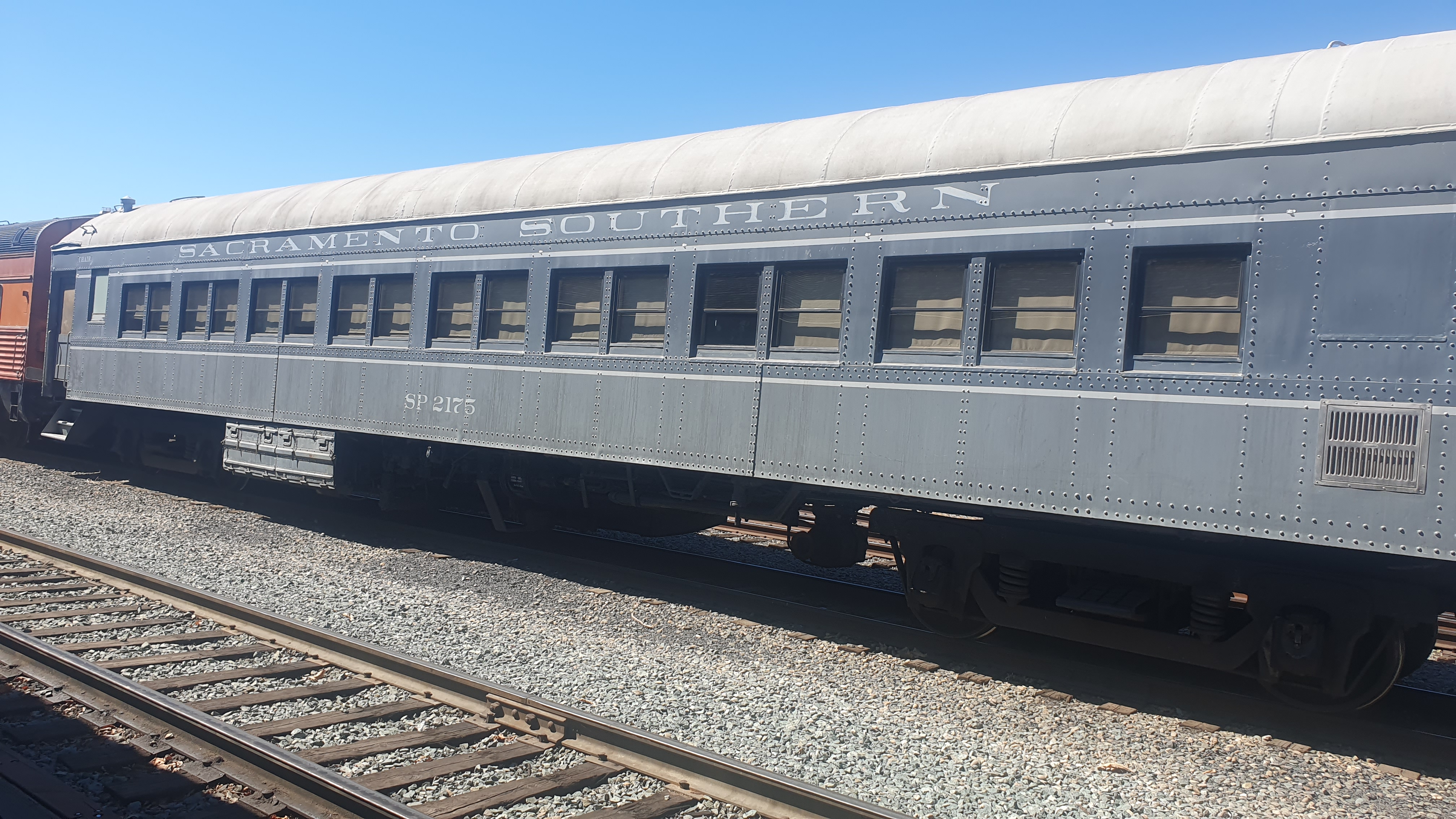
Today, Old Sacramento covers just a few blocks adjacent to the river. Historic storefronts and brick streets give a glimpse into the past, as does the Railroad Museum.
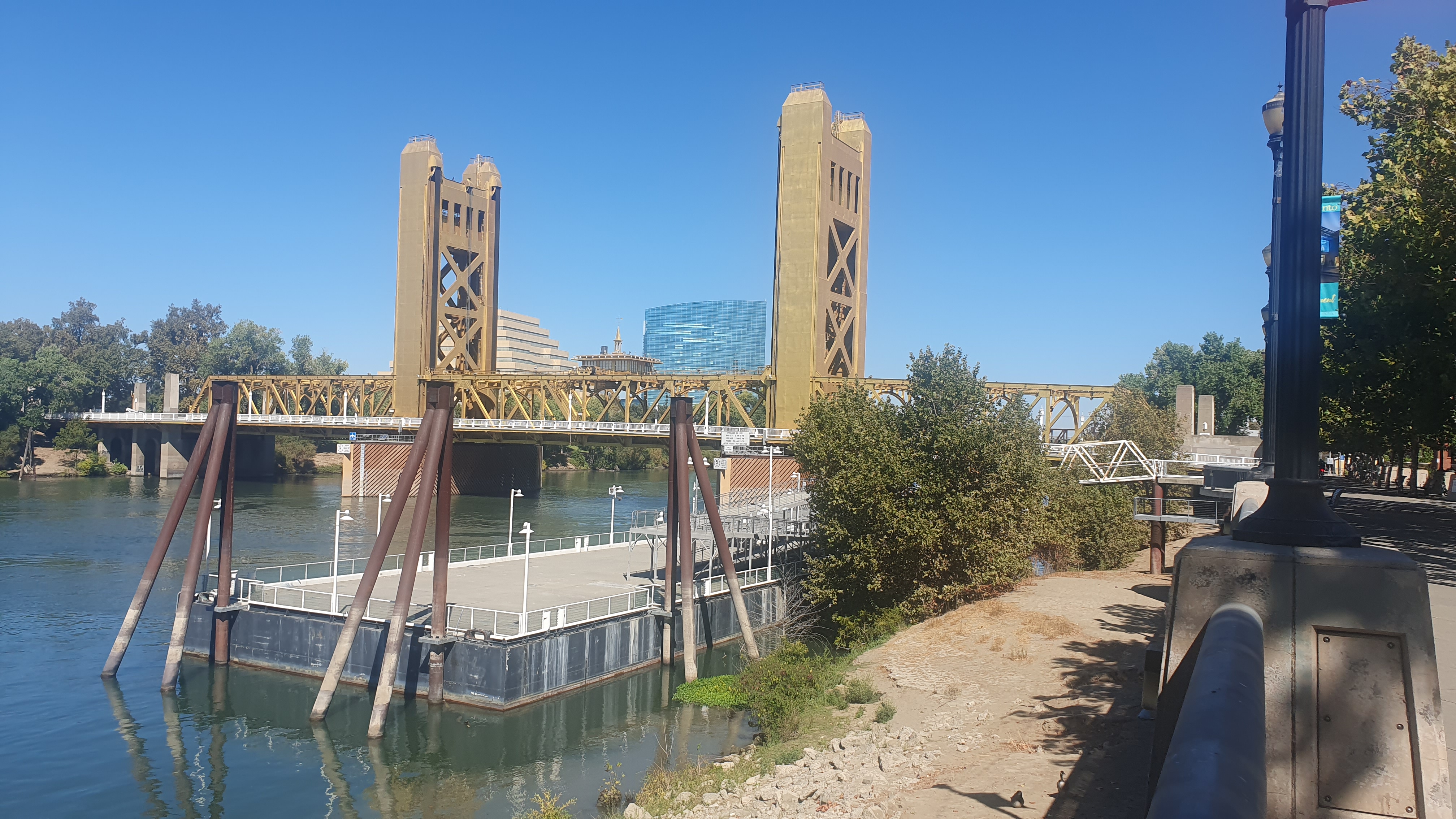
Spanning the river from one corner of Old Sacramento to West Sacramento is a beautiful and historic bridge. A vertical lift bridge, it can be raised to allow boats to pass underneath. The center section can be raised 100 ft. above the high water mark. Built in 1934, the distinctive style is Streamline Moderne (I love that name!), and though the color of the bridge is hotly debated each time it’s redone, the current gold color shimmers in the afternoon sun.
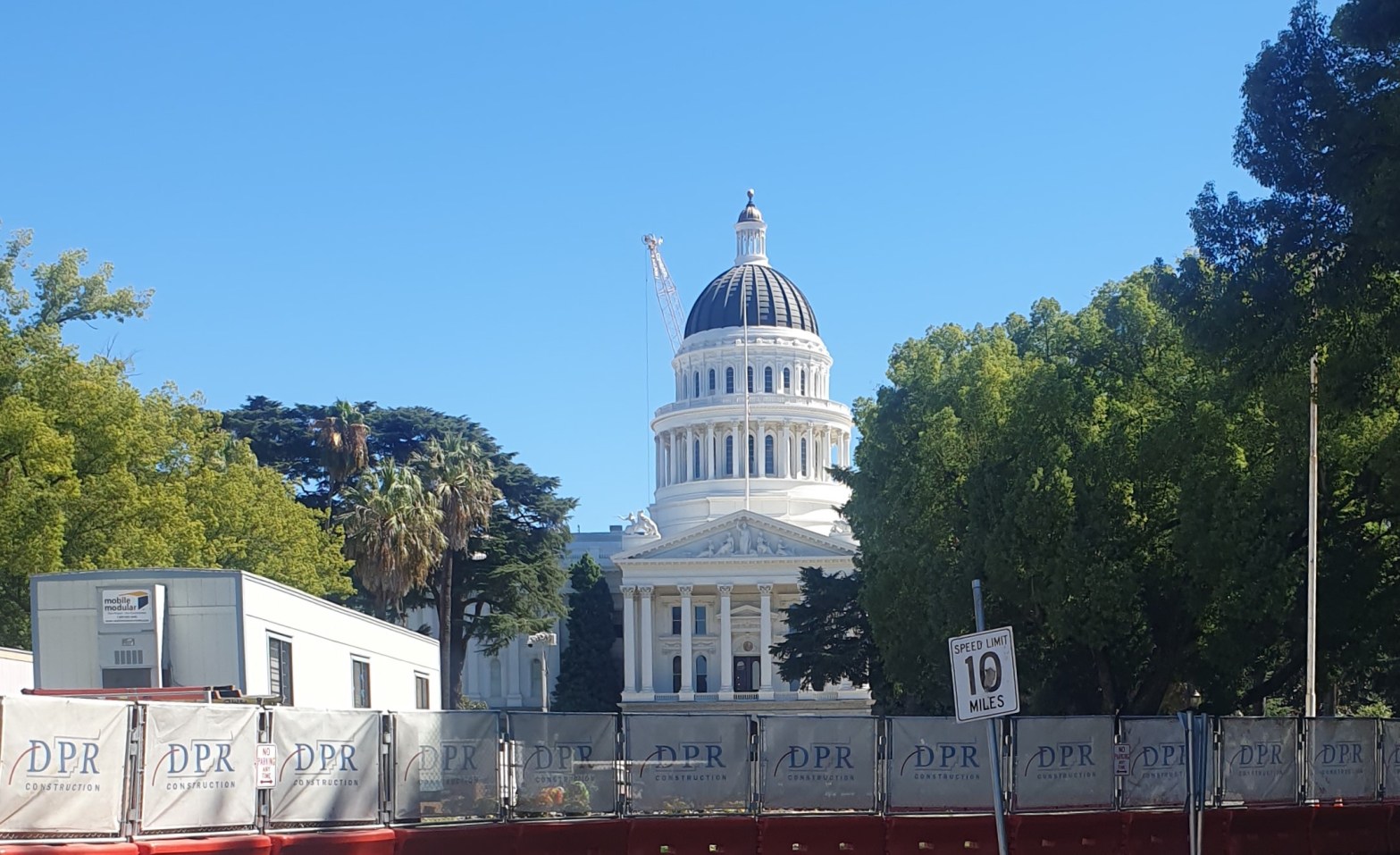
Old Sacramento is at one end of the Capitol Mall, and the iconic state Capitol Building is at the other. On a different day, I visited the State Capitol Museum with my friend Suzy. Rooms on the main floor have been renovated as period examples of state government offices. They show off the gorgeous woodwork, mosaics, and rather elementary office machinery from the turn of the 20th century.
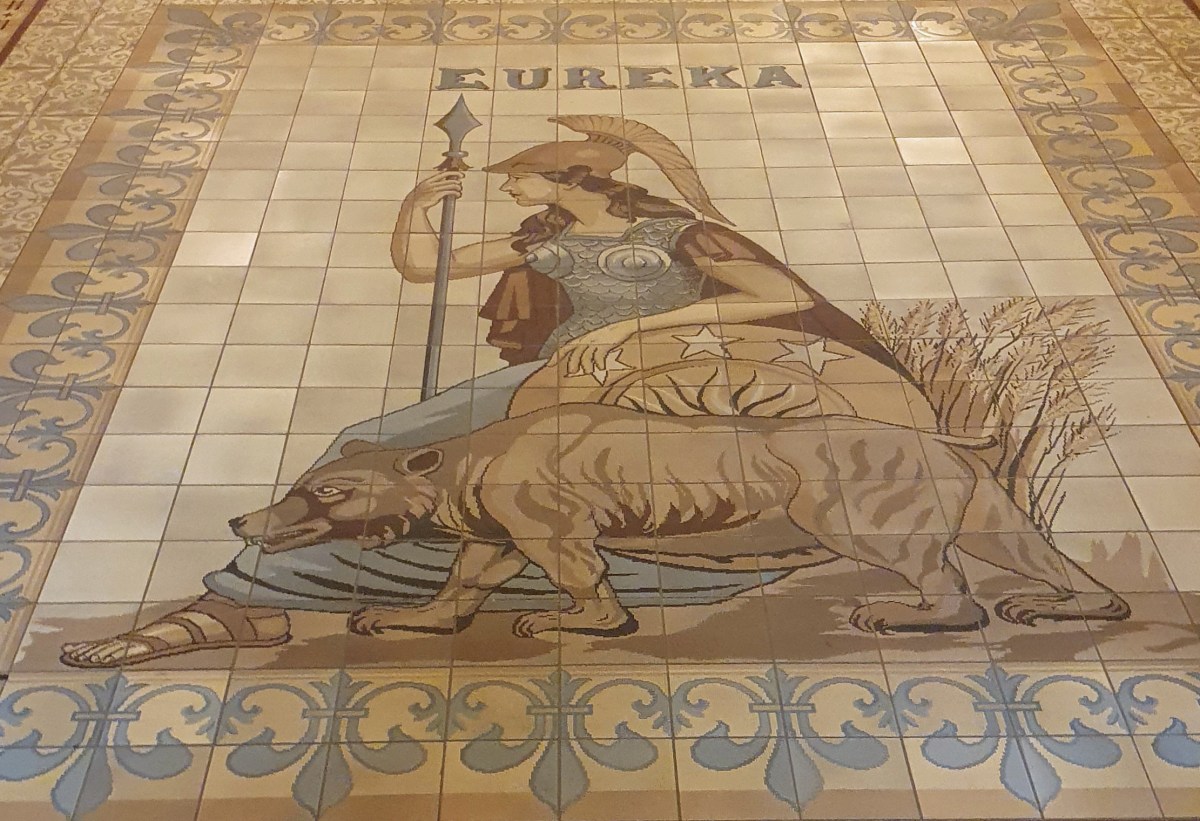
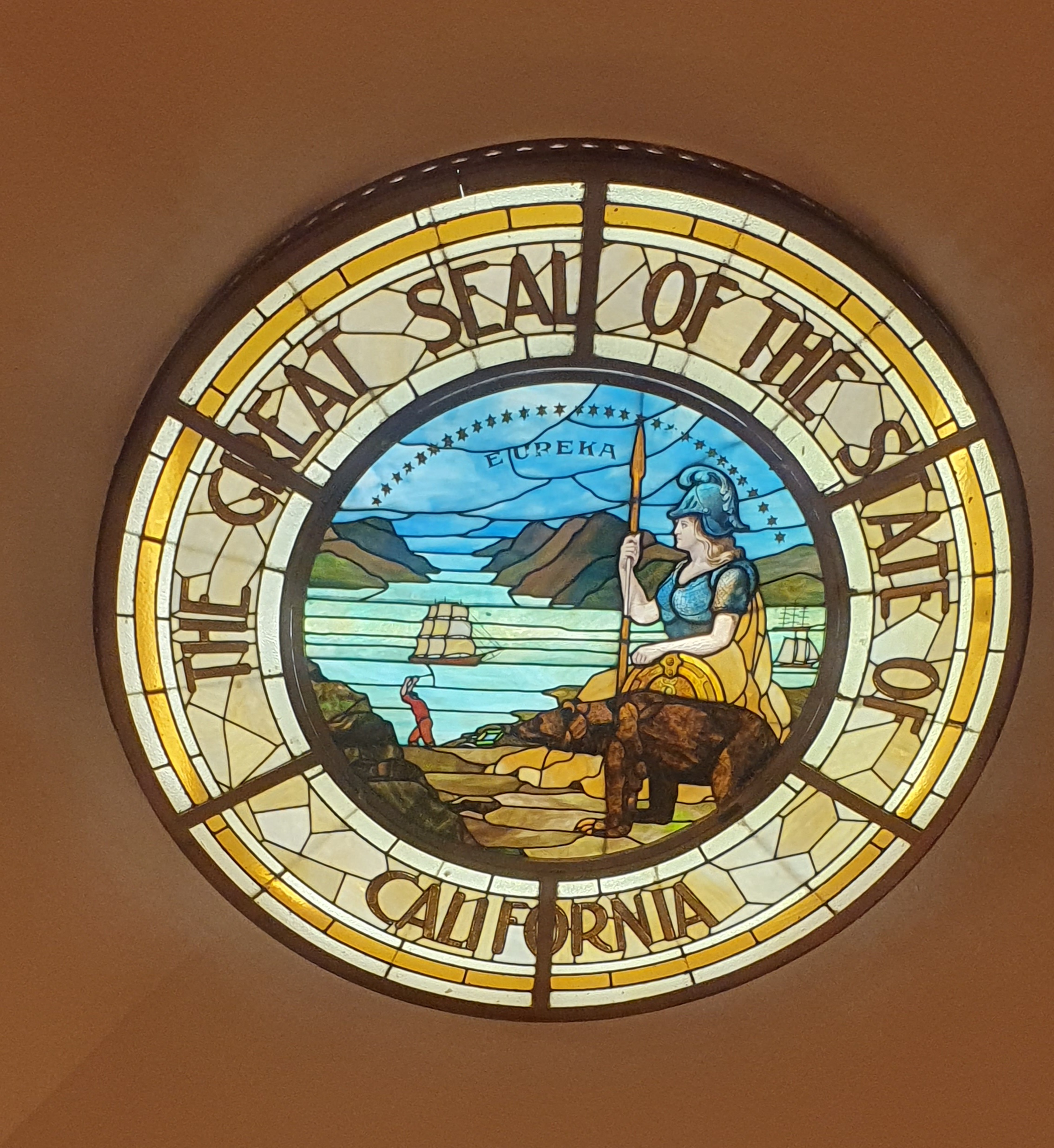
As a resident of Eureka, I was pleased to see the motto of California, “Eureka,” shown prominently in the Capitol.
(L-R): Restored woodwork, the Capitol dome, the Great Seal of the State of California.
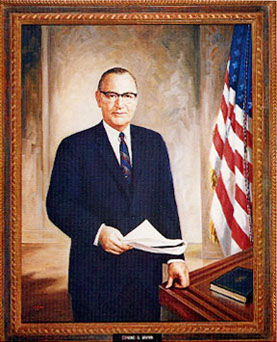
Last but not least, we looked at the official portraits of past governors of California. These range from the wing collars and black suits of the late 19th and early 20th century, right up to…..Jerry Brown. His is the only official portrait not painted in a traditional style. I give him high marks for choosing something really different, but that is actually a reasonable likeness.
Official Portraits of CA governors (L-R): James Gillett, Pat Brown [father of=], Jerry Brown and visitors.
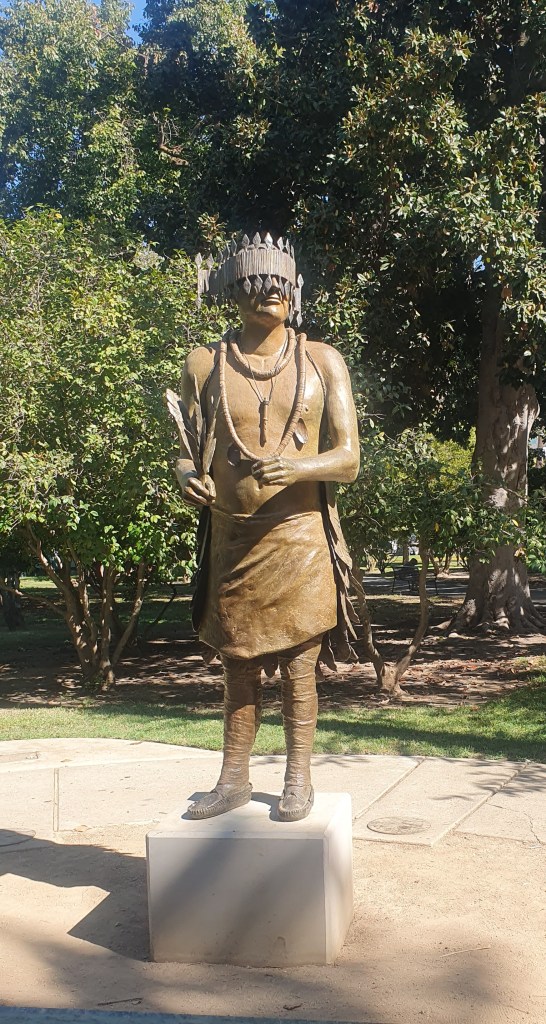
Having toured the historic portion of the capitol, we exited and found ourselves by a figure of a Miwok man. The Miwok are one of the many indigenous groups in California. This is not everyday clothing, this is a man dressed for a dance or ceremony, wearing a distinctive headdress.
The Capitol building is the eye of a storm for the next few years. We were able to visit, but a lot of the area is fenced off as a substantial new office complex is constructed onto the rear of the capitol building. It will increase the space available for offices without taking back the beautifully restored historic rooms. With the need for earthquake-resistant construction, it sounds like the work will be underway for 5-7 years. In the meantime, the machinery of the state goes on around the machinery of construction.
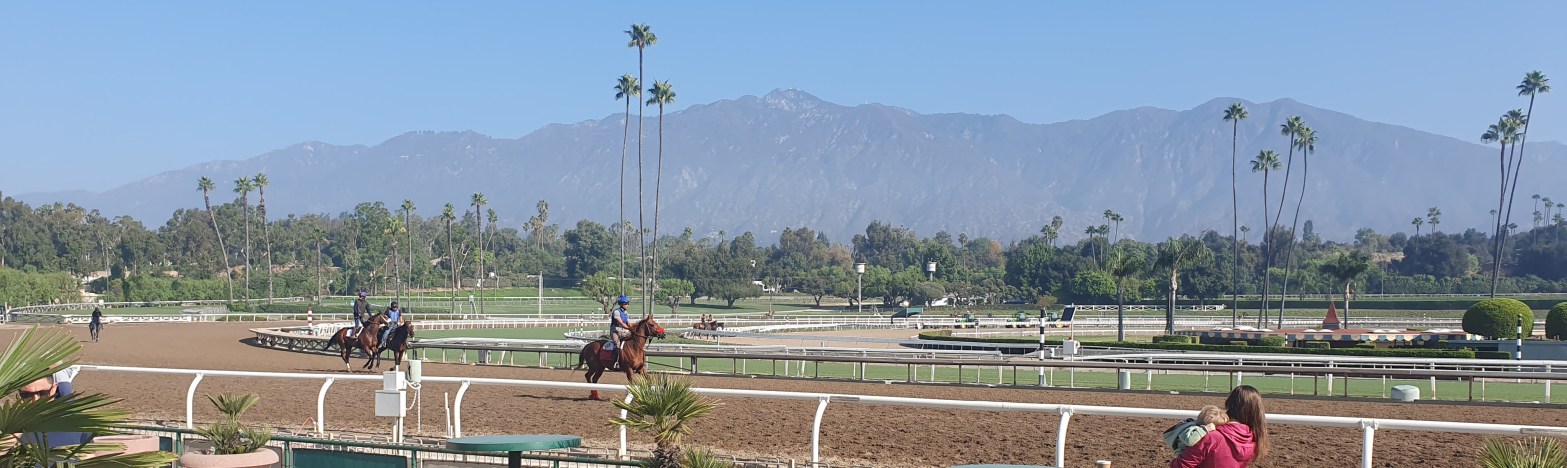
Santa Anita morning workout (Photo by Lynn Ruane Tuttle)
I didn’t think about horses when we were invited to meet up for breakfast the morning after my nephew’s wedding. I was unaware that it is possible to stroll from the Le Meridien Hotel to the track at Santa Anita, either. I wasn’t staying at the wedding hotel, so I followed GoogleMaps to Clocker’s Corner, but found myself off the roads shown by Google, in the middle of a parking area at the racetrack with a big gate and a guard.
Pulling up, I asked if Clocker’s Corner was nearby, and surprisingly, the guy gestured forward, saying, “Park anywhere, it’s around that fence.” So we did.
I had wondered why my brother emphasized meeting at 9 am. “They close at ten!” he said. I knew he must be mistaken, because what coffee shop closes at ten am? We walked around the indicated fence and found ourselves right alongside the racetrack at Santa Anita. Clocker’s Corner is exactly what its name indicates, a place where you can drink coffee, get a bite, and time horses during their morning workouts. The stand closes at ten because all the workouts are over by then.
It was a real pleasure to see such beautiful horses up close, and to watch them run past. I regretted not arriving earlier to see more. If you are in Pasadena, or anywhere near the Santa Anita track, find out if Clocker’s Corner is open, and be sure to get there early!
My nephew Cy and his fiancee Yessenia got married in the Los Angeles area over this past weekend. It was a small wedding, about 60 guests. The families didn’t know each other well. It could have been a quiet, polite, and only slightly dutiful wedding, yet few of us have ever been to such a lovely ceremony followed by an all-out rock-and-roll party of a reception. What a time we had!
Pre-Wedding Festivities
I arrived around midday on Friday, and by the time I was settled, it was time to head to Pasadena for the barbecue and pool party hosted by my daughter Amanda and her husband Jim, held at his mother’s home in Pasadena. It’s a lovely big house that’s in a neighborhood popular with TV producers, very scenic.
Every time the dogs barked, a new family swung through the gate into the back yard. It’s been a few years since we had a family wedding, so there were new children, new dogs, and lots of hugs. Those who could brought food or beverages, and there was plenty for an end of summer barbecue. The weather has been hot in Los Angeles, yet we had a relatively mild afternoon, just warm enough to swim. Most of the cousins, the generation of the groom, came to the wedding, reviving a periodic get-together the dozen or so of them call “Cousin-Palooza.” Those in the wedding party had to leave early in order to get to the rehearsal, while the rest of us stayed on into the late afternoon.
At 8 pm, while the wedding party was still rehearsing, guests were invited to meet in the lobby bar of the Le Meridien, the designated wedding hotel, to meet up with others who came to town for the event. The groom’s family included friends going back as far as elementary school (the best man), high school, and college. There were Creamer aunts and uncles, Greer aunts and uncles, and more cousins. We’ve all met before at funerals and weddings, and lubricated by the generous distribution of drink tickets, the very nice cocktail menu at the Le Meridien, and good company, conversation grew from polite chatter to a roar. A few children braved the celebration with their parents, while adults caught up with family they hadn’t seen for a while. No one made plans for the next day, we all intended to rest before the wedding ceremony. …
I did not stay until the crowd broke up. By the time the wedding party arrived, I was winding down, but I understand the fun continued for quite a while.
The Wedding Ceremony
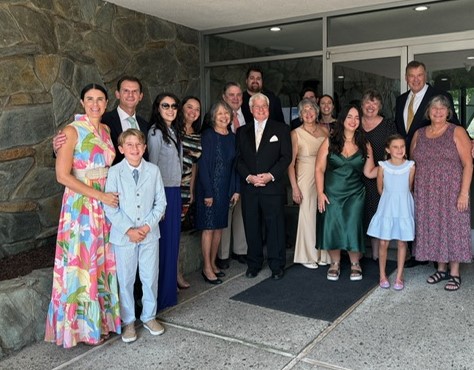
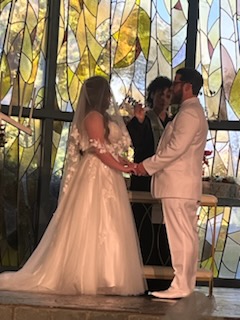
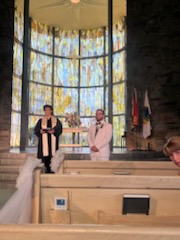
Yessenia and Cy’s ceremony was held at non-denominational The Santa Anita Church, a beautiful setting. Everyone took photos of everyone before the service began.
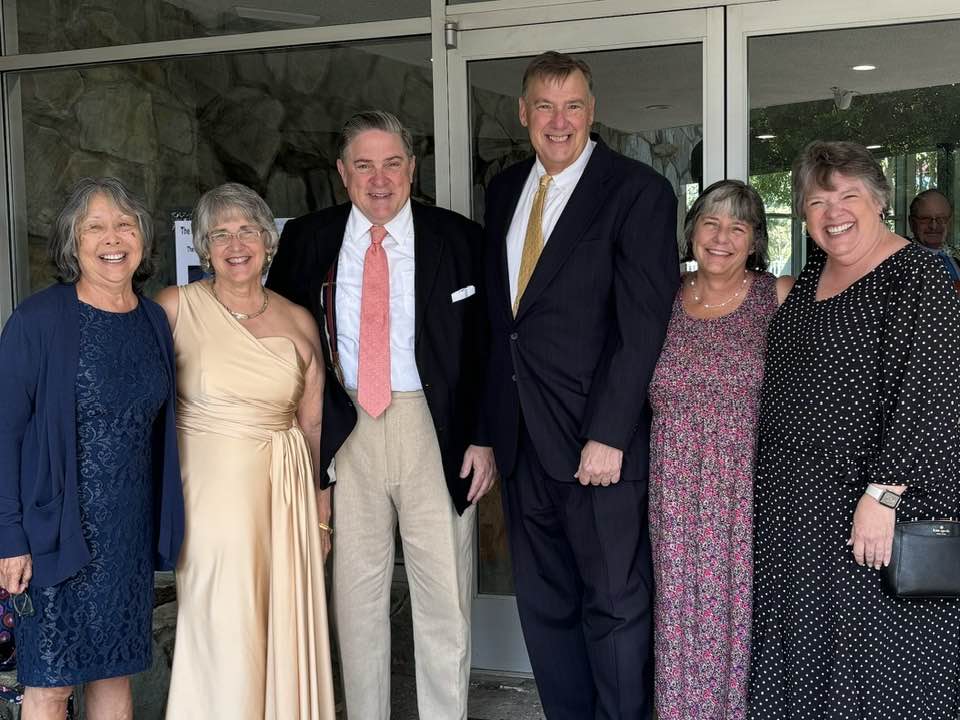
L: Father of the groom’s family (Creamer) R: Mother of the Groom’s family (Greer)
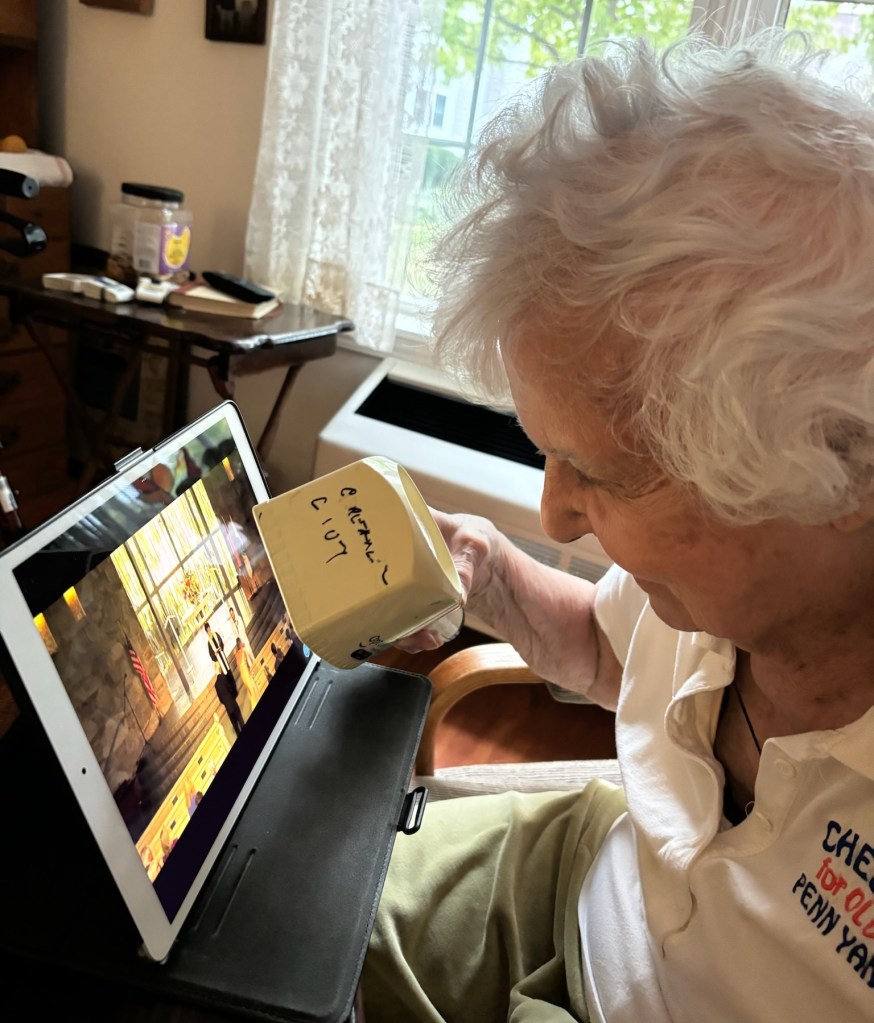
I sent the photo of my sisters and brother and I to our mom. At 99, with low vision, mom couldn’t make the trip west, but stayed glued to her zoom screen during the ceremony thanks to the groom’s brother Terry who set it all up. Grandma sent a personal message to the bride and groom.
At the Santa Anita Church, a lovely stained glass window behind the altar looks like feathers or leaves. The officiant led a truly non-denominational ceremony that stressed commitment and kindness. There was no homily, but good advice for us all in the words exchanged by the bride and groom. The young couple chose simple vows, an exchange of roses, and lighting candles as symbols of their shared future. It made a unique and moving wedding.
Reception
The reception that followed the wedding was held in the function room of Raffi’s Catering, not far from the church. The space was just right for our group, and had the bonus of being next door to the kitchen, so the Mediterranean themed food arrived fresh and hot.
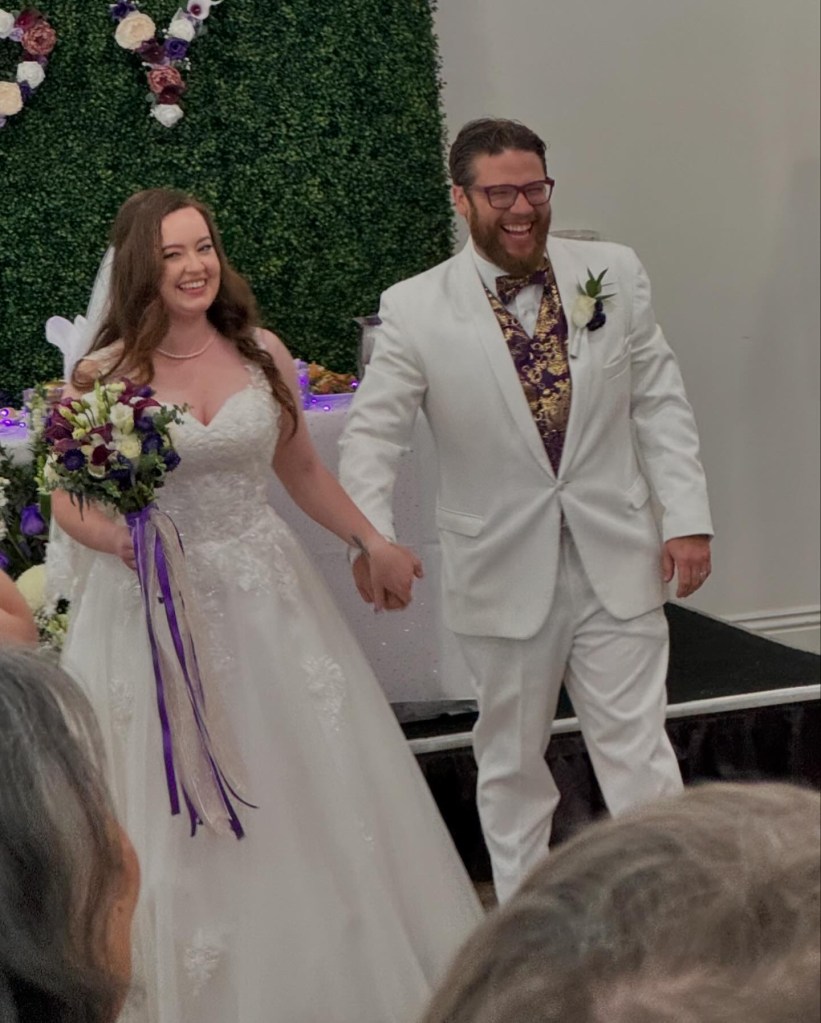
The bride and groom arrived, looking as happy as they could possibly be. There were toasts with anecdotes of Cy and Yessenia in earlier days.
The food was delicious, and the people were delightful. Everyone had a chance to relax after the wedding and to move around a bit chatting with others. The next big moment was when the DJ began playing music. The bride and groom had their first dance. There was a mother-son dance, and a father-daughter dance. Next they broke out a few bars of Grandma Jeanne singing “Always” at a previous wedding that segued into Frank Sinatra finishing out the song. It was quite romantic. After that came the rock and roll dance party favorites, and before long, everyone in the room was dancing, from 7 year old Julianne to the over-70 crowd of aunts and uncles (Julianne put us all to shame, of course).
When were you at a wedding when no one was sitting at the tables because we were all on the dance floor? It was as much fun as anything you can imagine.
The groom’s family has a tradition of dancing and singing to “Dancing Queen,” led by the bride and groom standing on chairs. This reception was no exception. A really fun time was had by all. You could call it happy pandemonium. I asked my brother how he managed to stay on his feet and dancing for almost every minute of the reception. Very seriously, he said, “Moments like these don’t come along very often. You have to enjoy it.”
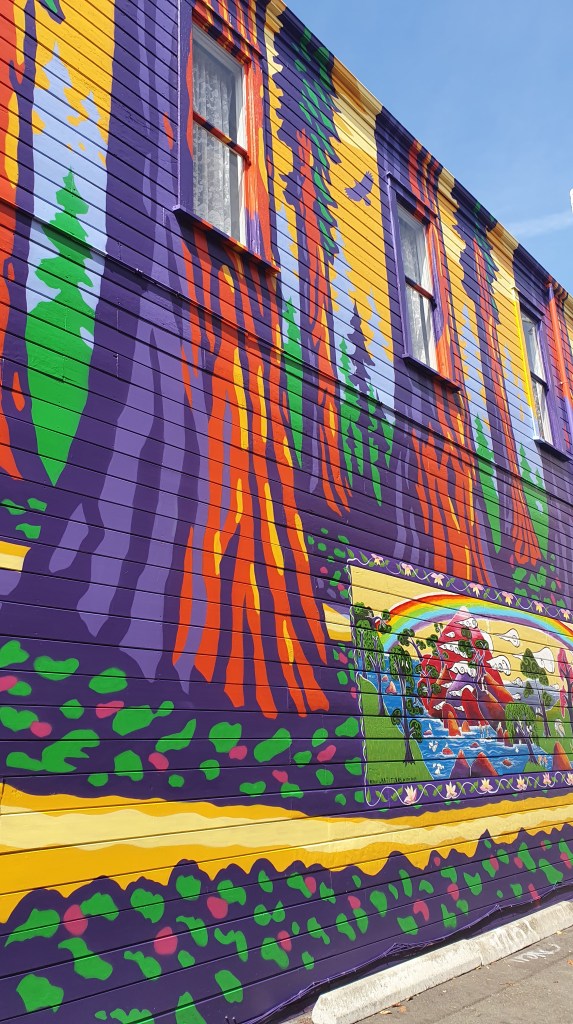
This week, the Eureka Street Art Festival has painters in place at fifteen localities around town, working on new murals. We spent the afternoon driving around town looking at most of the murals indicated on the map for the event.
Map of street art locations for 2024 (By Jenna Catsos, one of the artists, and one of the organizers)
Painters have through the weekend to complete their work, and as a result, there were people at work on most of the sites we visited, and the murals were well along toward completion.
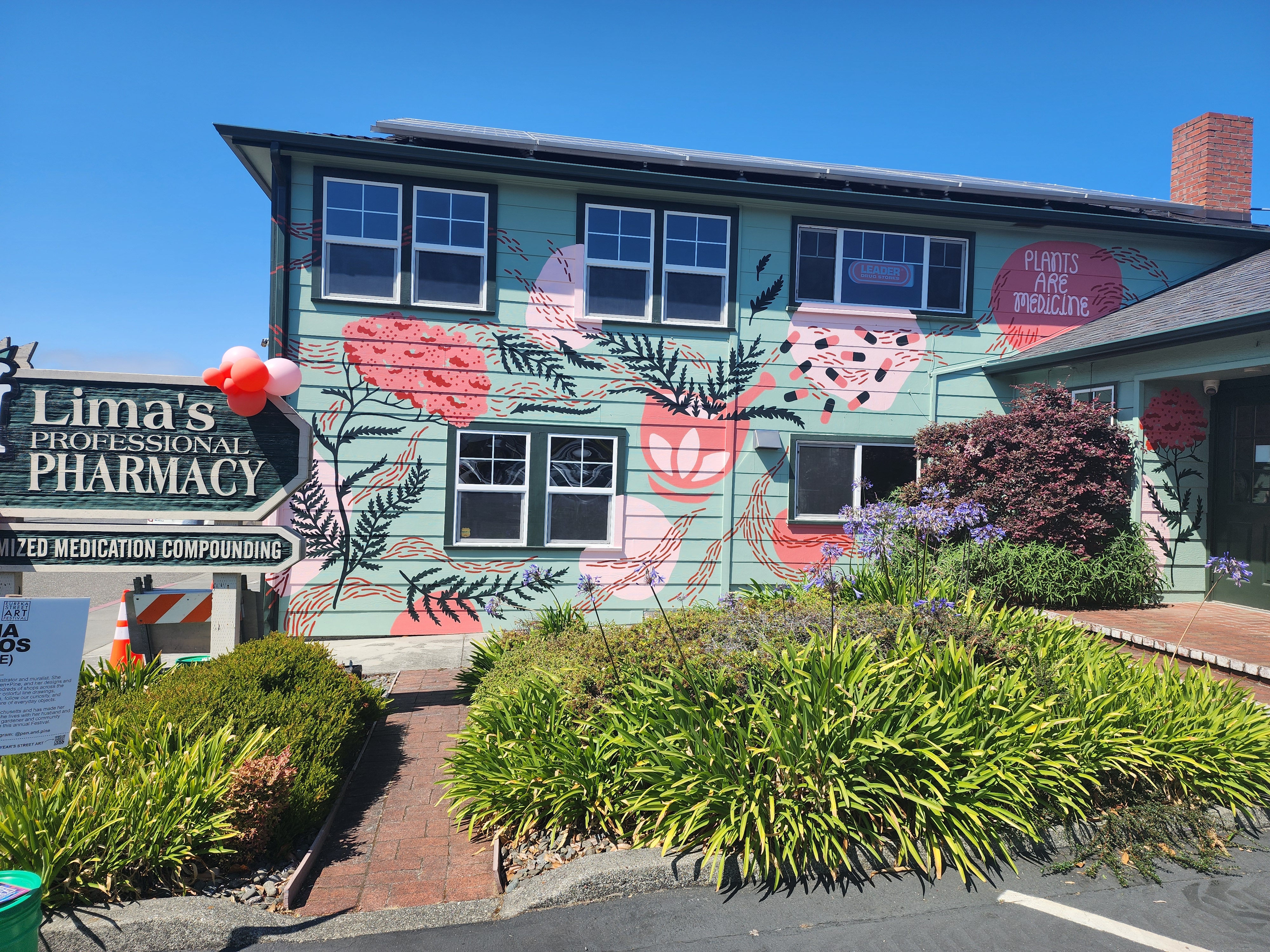
We started at the furthest outlier in terms of location, Lima’s Pharmacy, where a mini festival celebrating the mural was underway. Balloons, a bouncy castle, food and drink, and free pens, all made it a fun stop. The mural depicts medicinal plants in keeping with the pharmacy theme. Every mural has a marker naming the artist and providing a short bio.
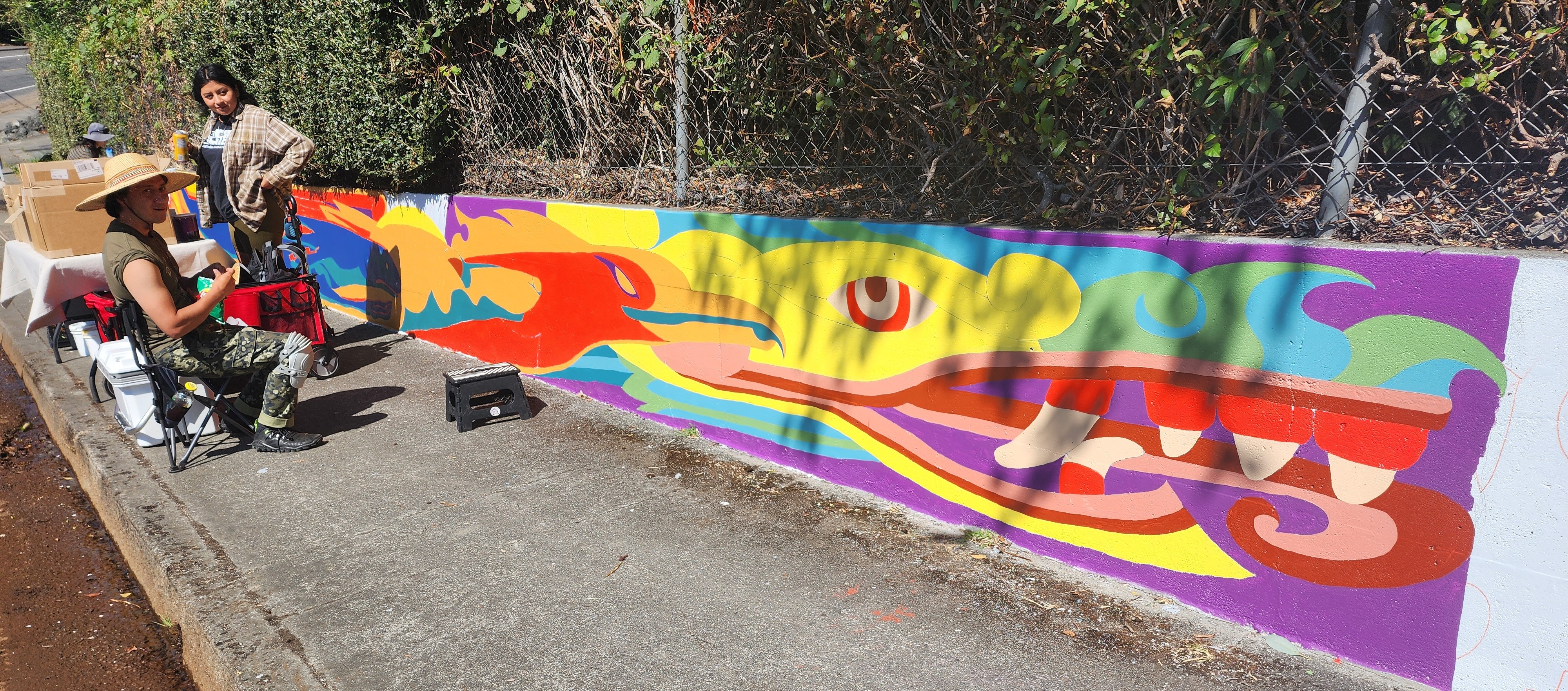
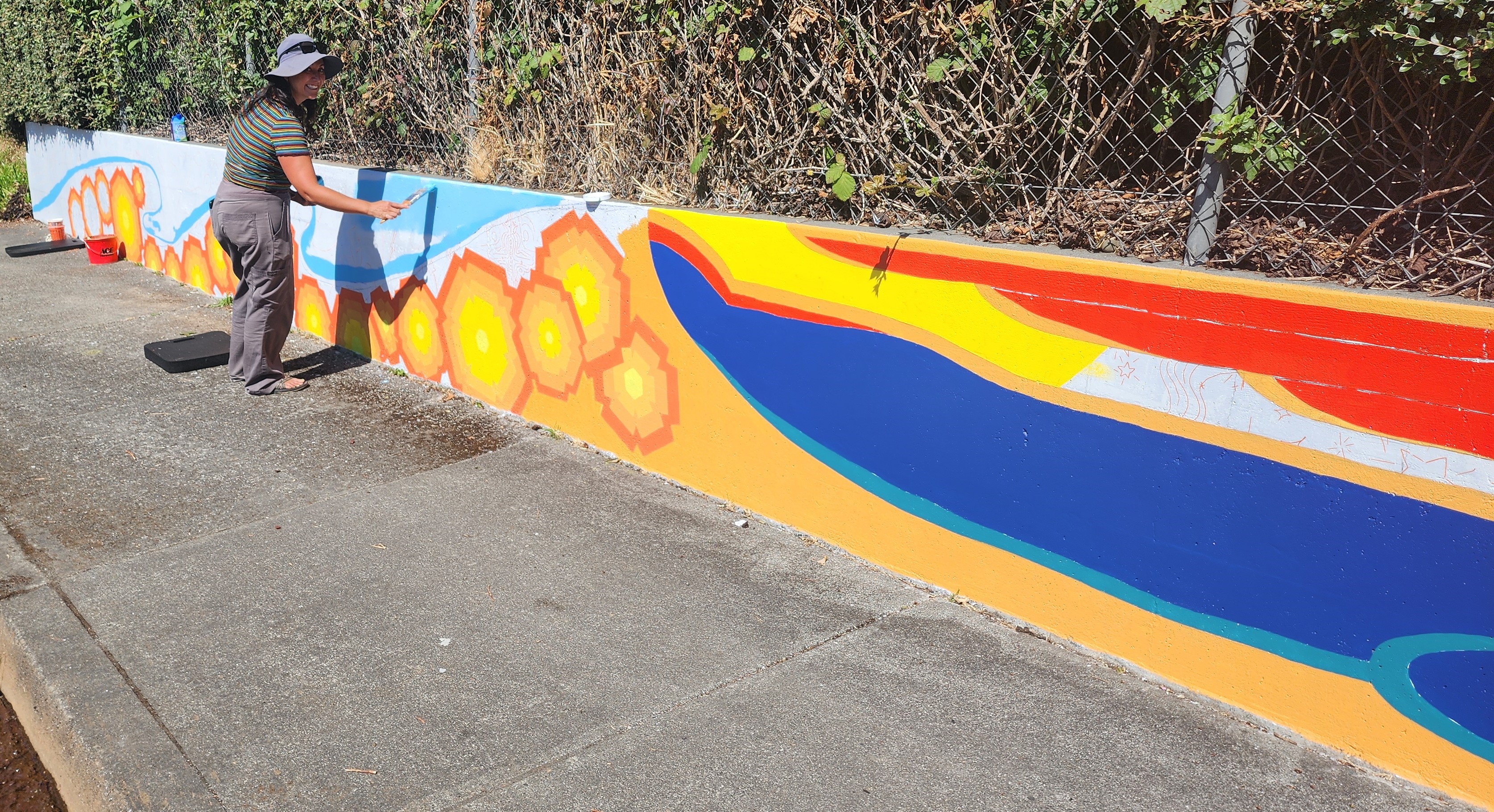
Our next stop was a bit harder to find, since our map was schematic, without most street names. We found it on a section of wall curving down S Street beside a middle school. Jose Moreno and his team were busy painting.
The Journey of Quetzalcoatl (El Viaje de Quetzalcoatl)
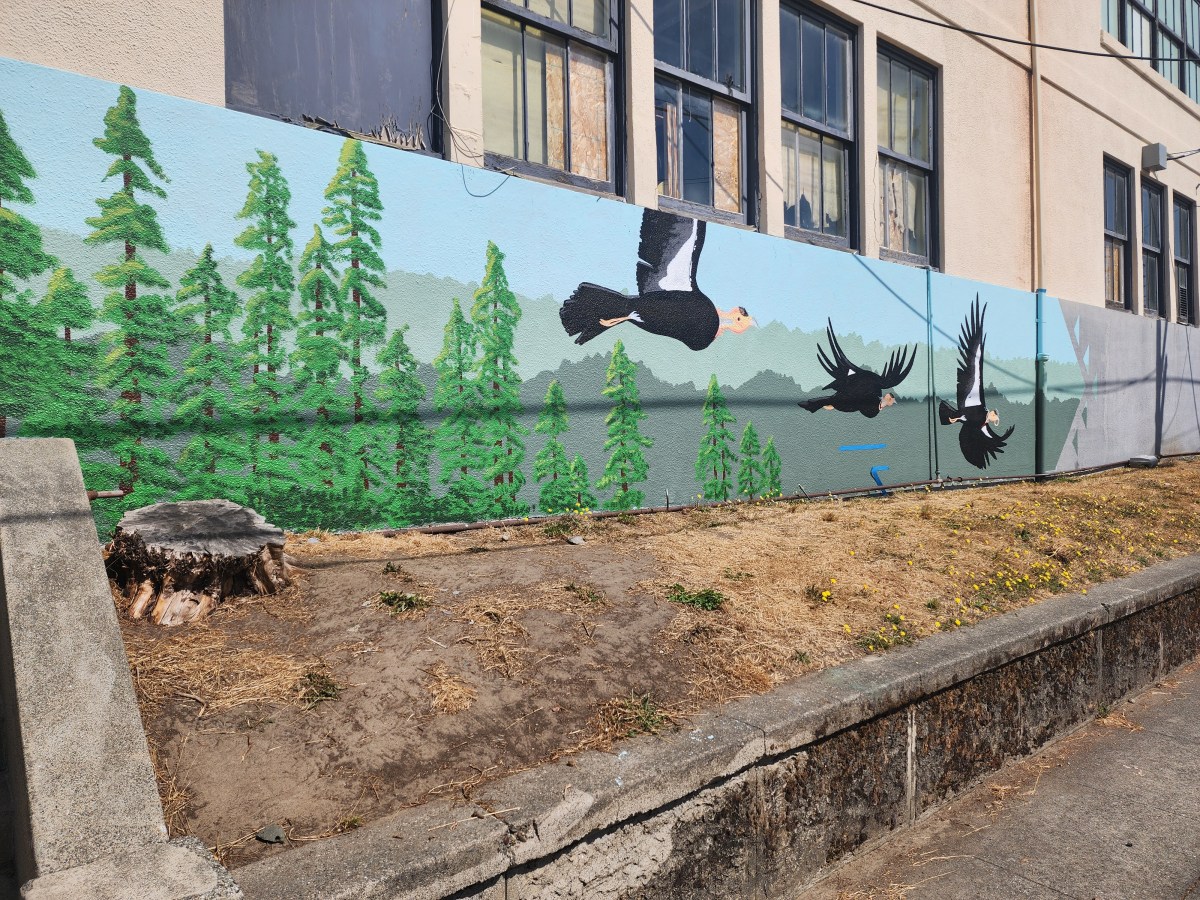
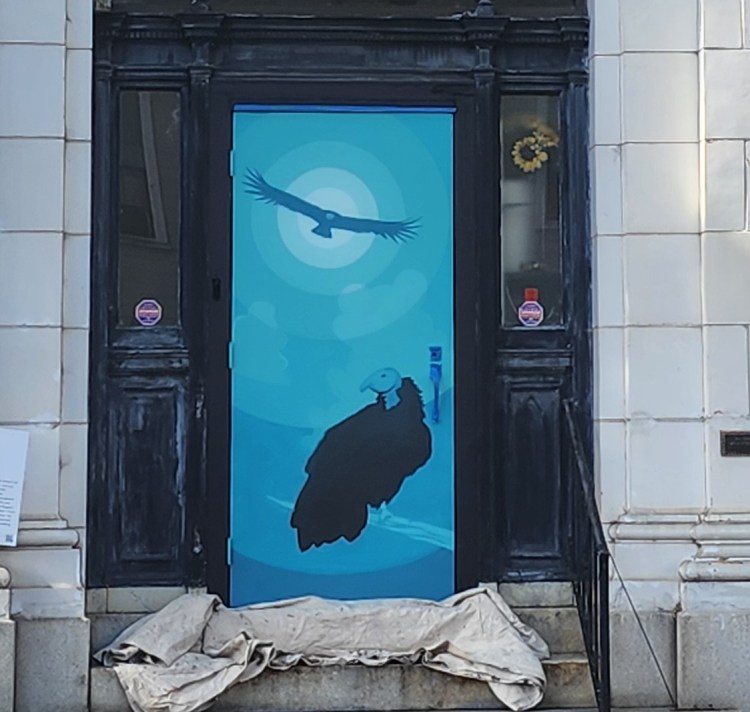
We headed back into Eureka and stopped at the Eureka Municipal Auditorium, where Melitta Jackson was finishing up for the day. Her mural depicts animals that are coming back into this area, the otter and the condor. The title, “Chpaana’r,” means “Stay a Long Time,” in Yurok. Her sponsor is a suicide prevention group.
Our next stop was the Alder Grove Charter School, where a block-long wall was being turned into, “The Lost Pages.” We couldn’t find it, despite driving around the block and up and down neighboring streets. The school isn’t indicated on Google Maps. The schematic map of the mural sites was good, but in the end we moved on. The next morning, on our way to the Farmer’s Market, we drove right by it, a block long and brightly colored, with a painter working from a cherry-picker. It would have been hard to miss. It was nice to see it in the end.
Several more murals were being painted in the downtown area.
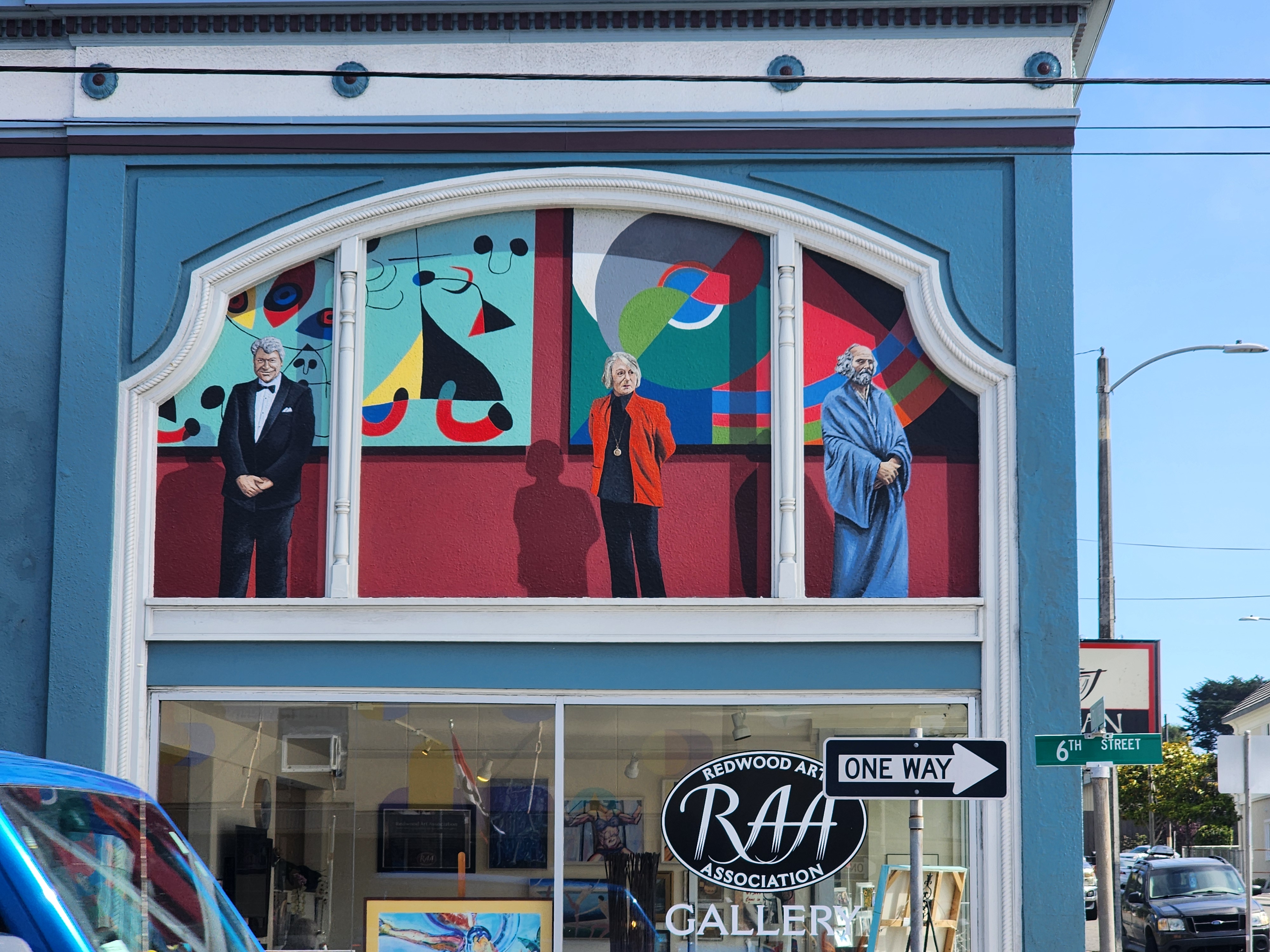
The Decodance mural on the Eureka Theater was fun to examine, as we tried to identify the people and the artwork depicted in each panel. The mural of Billie Holiday on the Opera Alley Bistro was a beautiful piece.
The mural at the far end of Opera Alley was still underway, but I went by two days later and saw the finished version.
Some of the other murals were much smaller. The Clark Historical Museum mural, The Condor Returns, took us a minute to find because we’d just stopped at a few murals that took up the side of a building, and it was painted on a door. The museum is made of stone, and doesn’t have a surface for a mural other than the door.
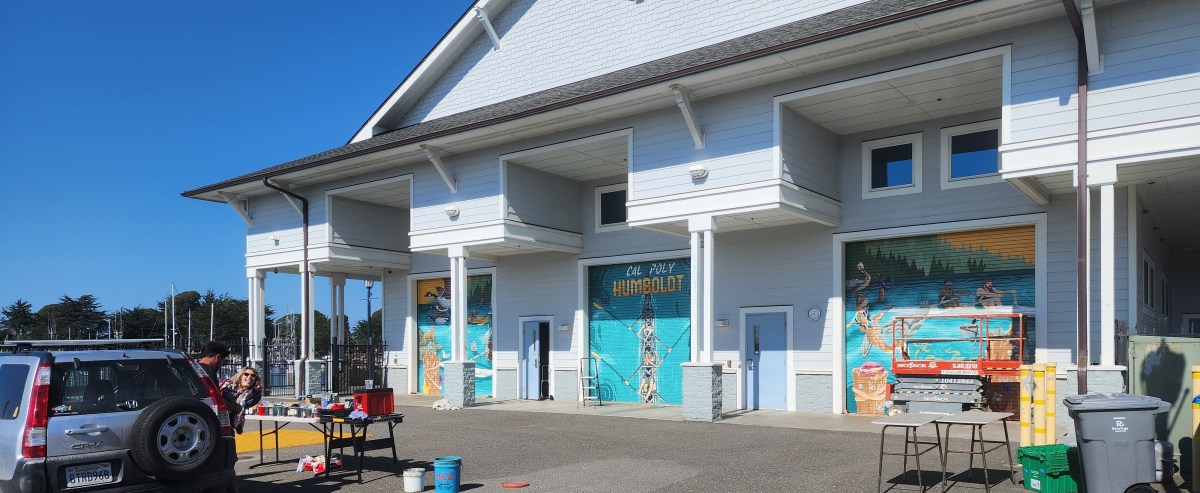
The Humboldt Aquatic Center had three mural panels painted that show rowing, the principal activity at the center. These were attractive, but gated off from visitors and more difficult to see than the others we visited during the afternoon.
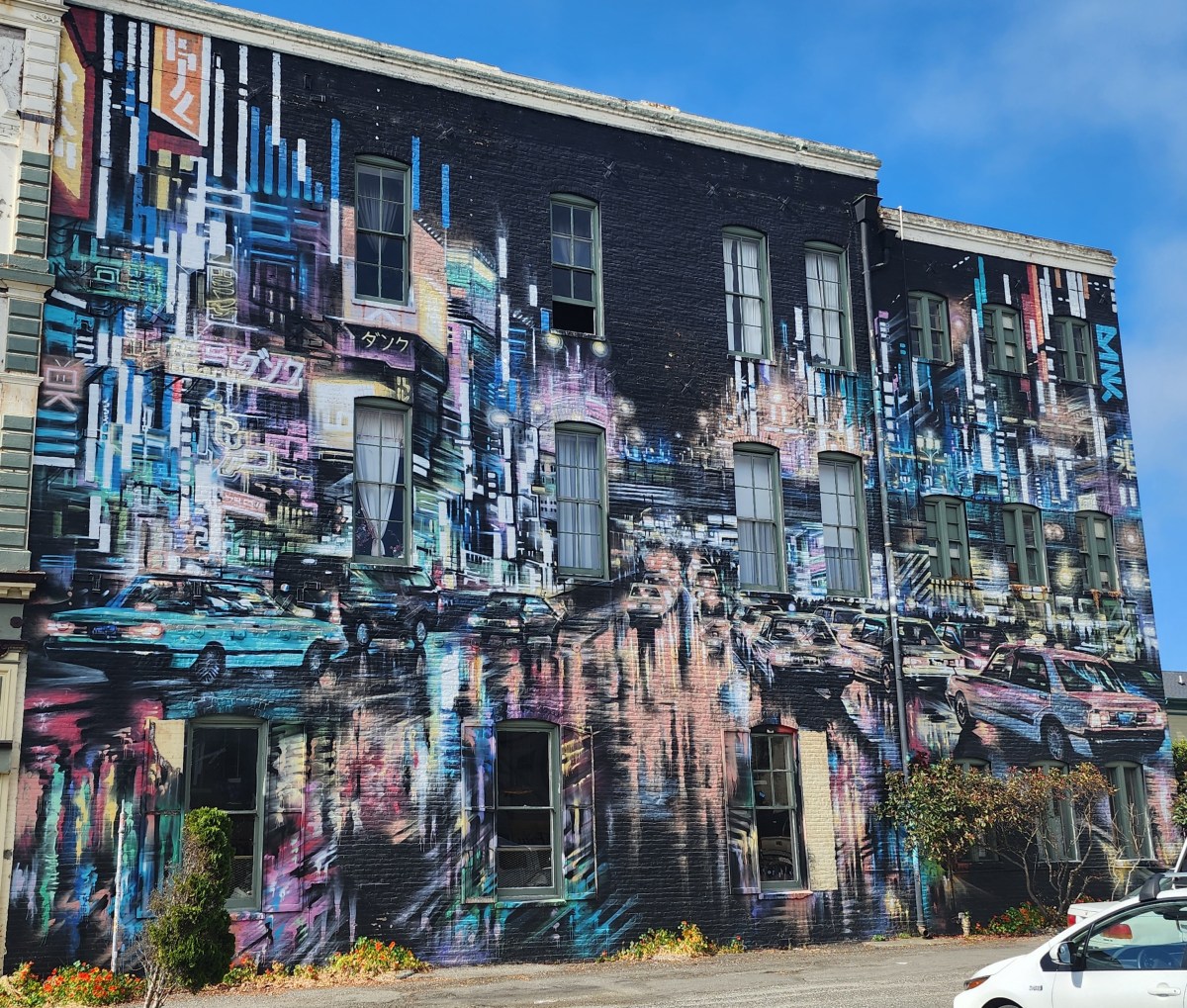
While we were looking for this year’s murals we came across a few impressive works from previous years. Many are marked with the year they were created and ESAF, Eureka Street Art Festival.
The goal of the festival has been to do something creative and uplifting for the city of Eureka. I’d say they succeeded.
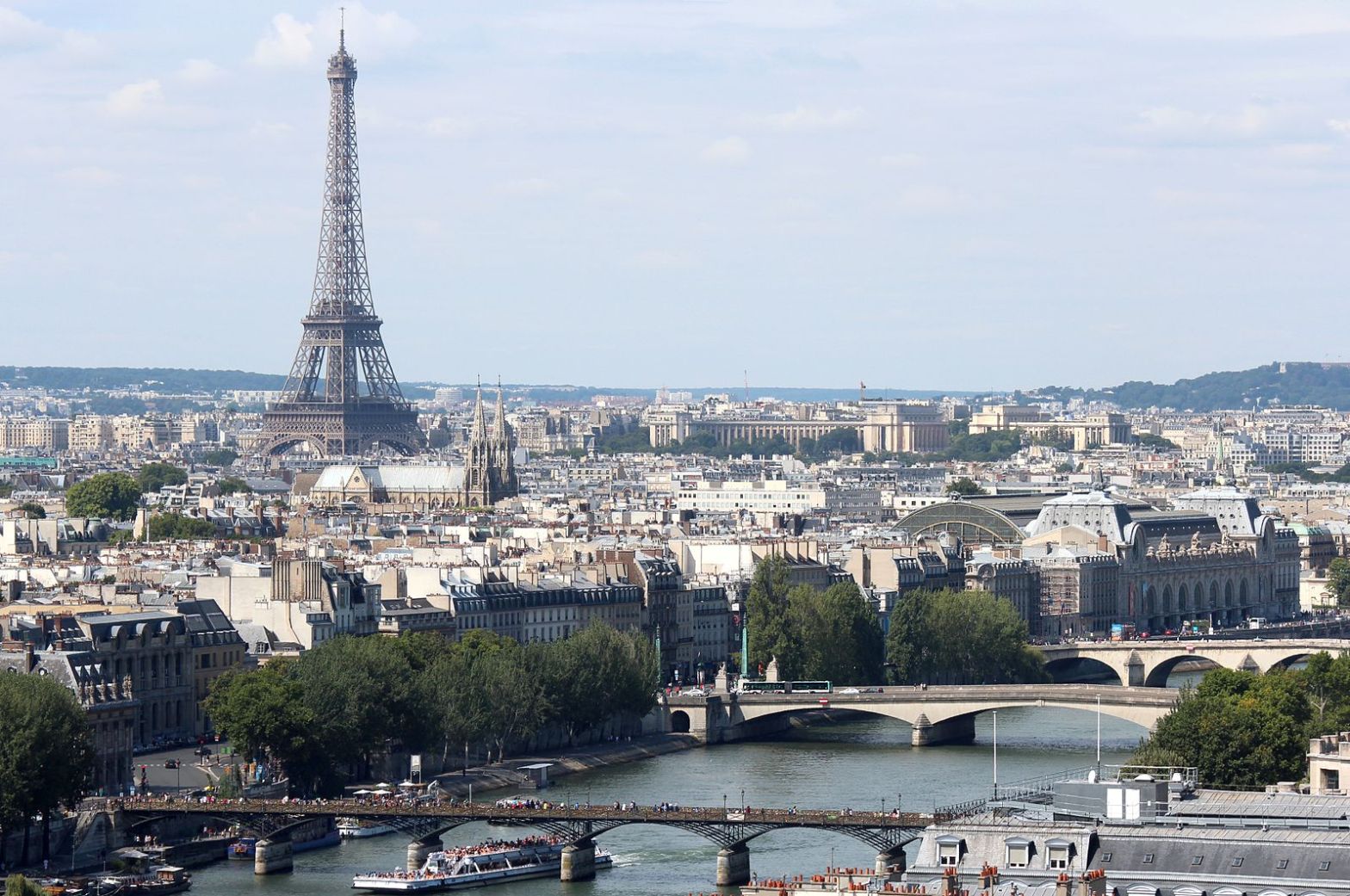
I love Paris. Right now we’re enjoying two solid weeks of Paris sights, boat rides, parades, and fun. We’re watching the Olympic Summer Games, 2024.
A few weeks ago, we decided that we wanted to see a lot of the Olympic events, and found that a subscription to Peacock+ would get us access to all sports, exactly what we wanted. We like to see sports that are not normally on TV.
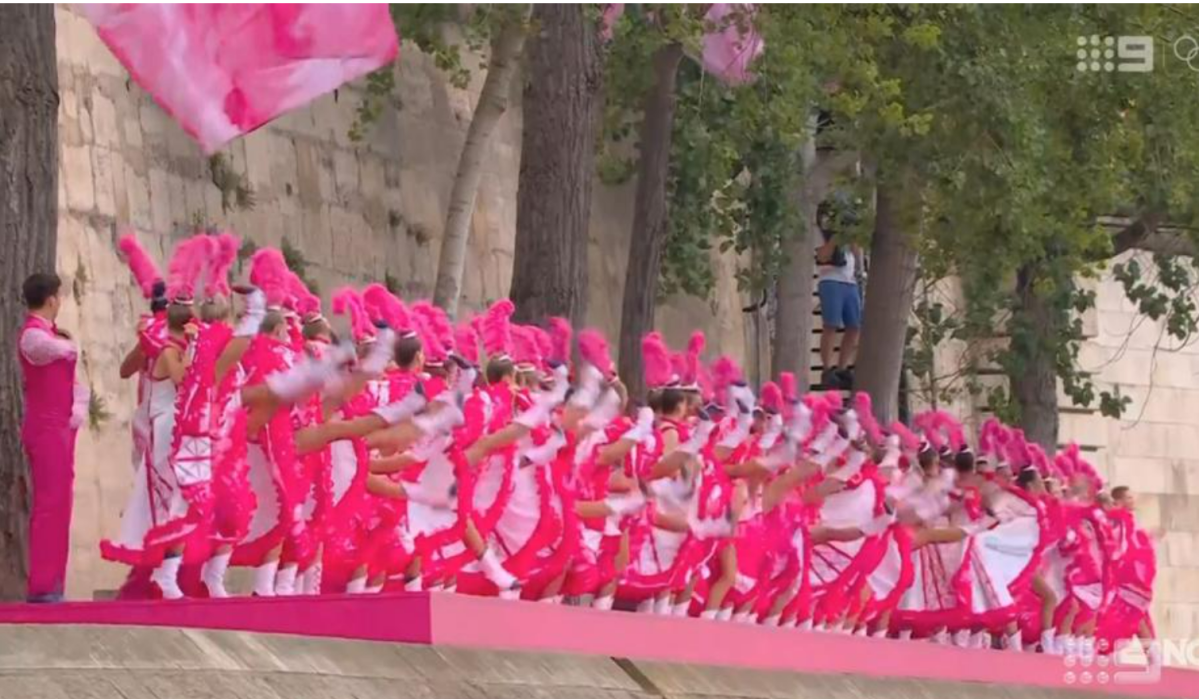
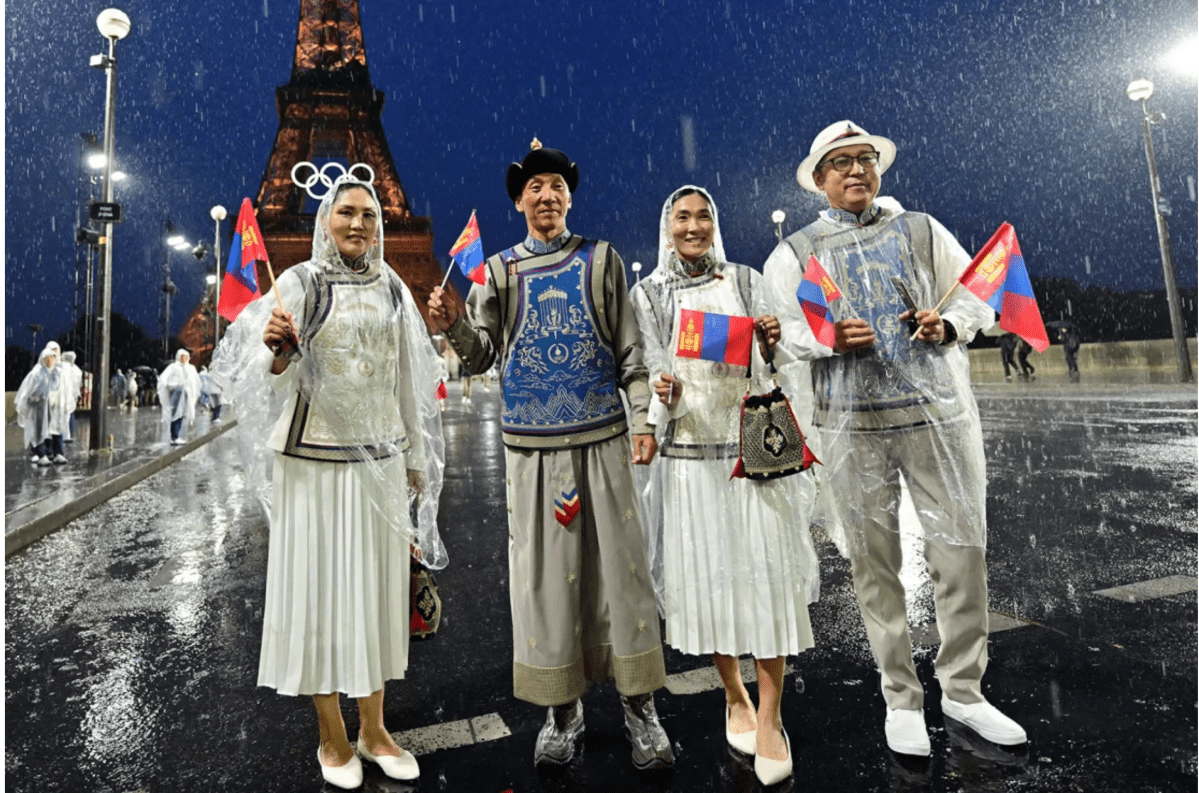
As happy retirees, we were able to watch the Olympic Games Opening Ceremony live, midday our time, when it was evening in Paris. Most of what we saw took place in a downpour. We admired the streetstyle dancers kicking through fountains, making their most energetic moves look fun despite the rain. The long line of cancan dancers had beautiful costumes, but seemed a bit out of their element out in the elements.
The singer Axelle Saint-Cirel appepared to emulate the French icon “Marianne” standing atop the Grand Palais looked brave and wet. We admired her grit.
Mongolia Olympic team
All the entertainment filled the time it took for boats of all sizes to carry all the national Olympic teams down the Seine. Each group wore distinctive outfits, whether their delegation included a small group (Mongolia, 2) or many (Mexico, 107). The rain appeared irrelevant to those floating in the boats and watching from the shore.
2024 Mexico Olympic team
Since the games have gotten underway, we’ve watched amazing feats of skill. I didn’t know there was team handball, using a ball the size of a small cantaloupe, that allows running with the ball and a bit of tackling (I think). The canoe slalom was exciting, too, as we watched women paddling like mad through roiling water. Judo is difficult to understand. Many of the sports we watch have rules that aren’t apparent to the uninitiated.
Air gun shooting is new to me. The guns have barrels about a foot long, and shoot small pellets. Women from Korea appear to be the dominant players. It was fascinating to see some of the elaborate effects the shooters try, with eye patches and tiny blinders, and to see how carefully they aim.
All the action doesn’t take place in Paris, either. We watched windsurfers waiting for a breeze in Marseille, and surfers blasting through the waves in Tahiti.
We’re not missing out on the popular events. Swimming is shown during prime time at night in the US, and we watched the heavily hyped relay events. We’ll return every evening to see what is held for the largest US audience.
Every day will be another adventure. We’re looking forward to seeing more aerial views of Paris and environs while we chase esoteric sports around the Olympic venues. All I need to make this perfect would be a beautiful, freshly baked flaky croissant.








































































 Llywindatravels 2025