On Old Man River

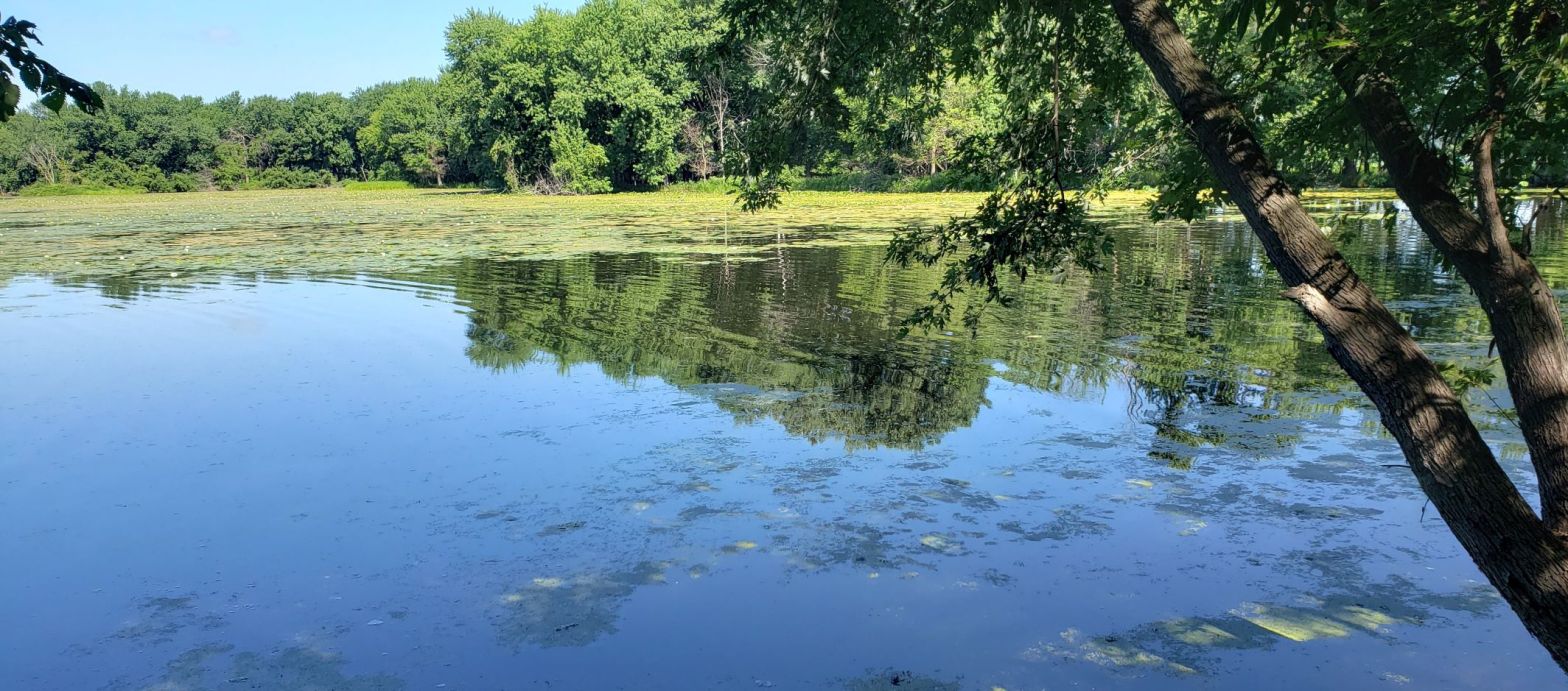
The water was dead calm, smooth as glass, without a ripple. Our host, Phillip, and his wife Tammy, had offered us a ride on their pontoon boat on the Mississippi. We met at the boat landing in Wabasha, MN at 10 a.m. Monday morning. The sky was partially overcast. We could sit socially distant and not risk sunburn. We left the dock for a ride on Lake Pepin, a wide spot in the Mississippi. The conditions couldn’t have been better. The air was still and warm until the boat began to move, then the breeze was cool and comfortable. The pontoons were faintly warm when I rested my arm on them. This was heavenly compared to last week’s ferocious heat.

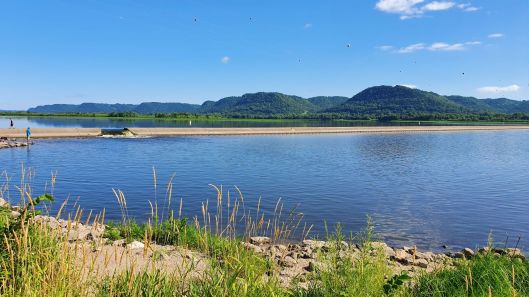
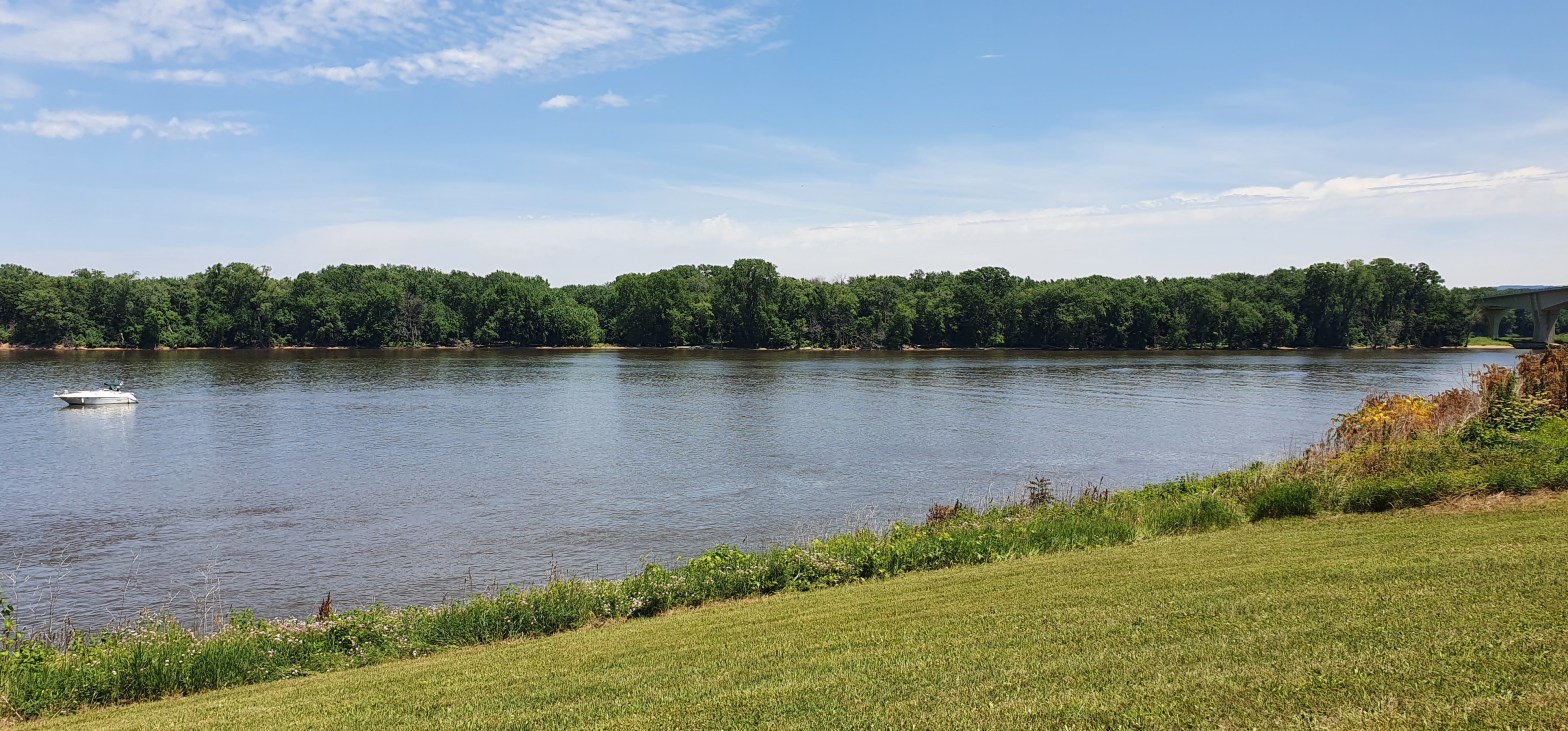
There weren’t many boats out as we headed upstream. You can see why the river is considered a “lake” through here. The water is backed up behind a dam that creates this large pool of water. Parks, beaches, and campgrounds line Lake Pepin.

Our trip took us about halfway up the length of Lake Pepin to Lake City, MN, where a forest of masts in the marina hints at how many sailboats are on the water on weekends. From there we turned downstream to visit the lock and dam at Alma, WI.

Boats that are traveling longer distances use the locks at each end of Lake Pepin that raise and lower them to the next stretch of river. There are about thirty locks on the Mississippi between its starting point in Lake Itasca, MN, and the St. Louis area. The southernmost lock lies at the entrance to the Chain of Rocks canal, a 17-mile-long detour around rapids. Below St. Louis the river is too wide for locks and deep enough that they aren’t needed.
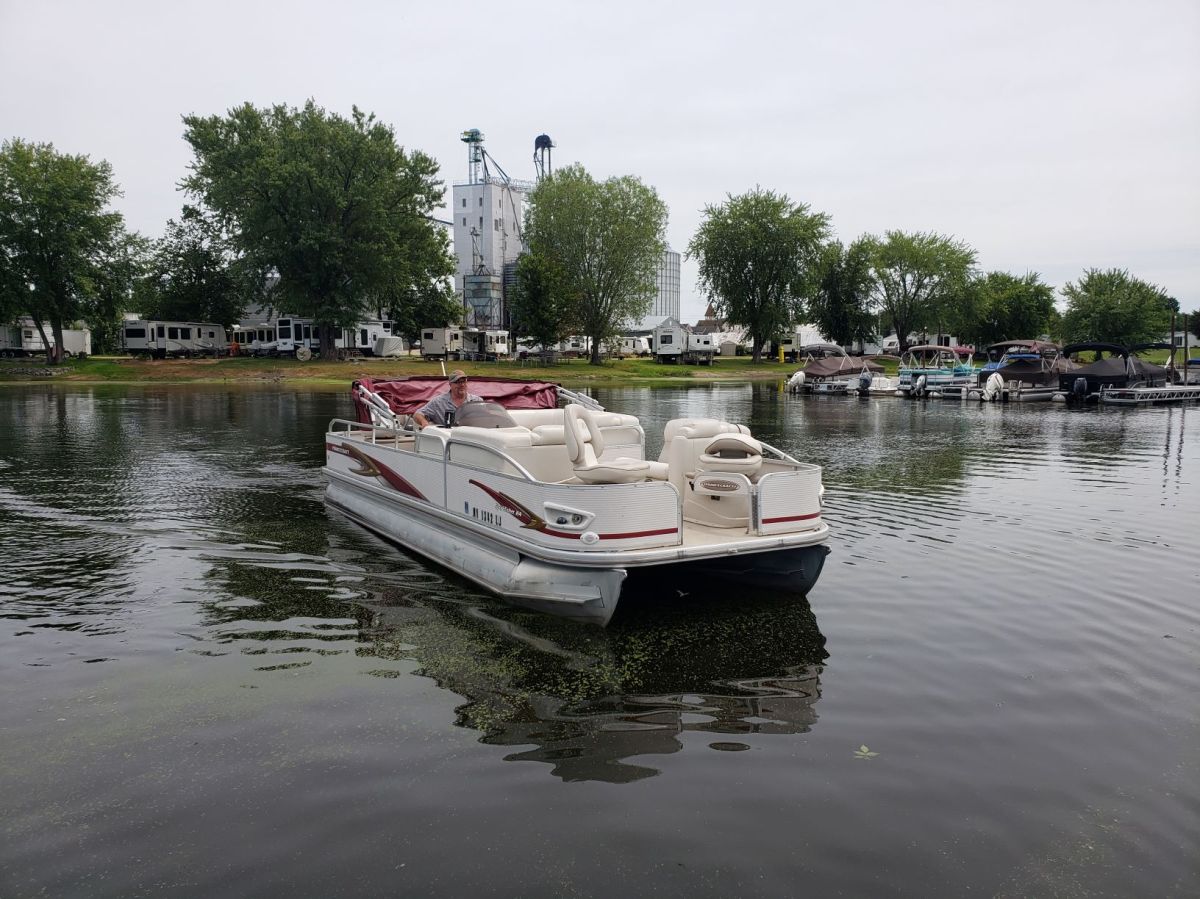
Philip, our host, grew up along the Mississippi near Wabasha, and could name every channel, showing us some that connect to oxbow lakes. He hunted and fished along the river in his teenage years, and he pointed out places like the inlet where he went duck hunting. His work is in real estate, so in addition to knowing the name of every point and inlet, he knew which clusters of houses are summer camp rentals, and which are condos.

We decided not to hike up one of the huge mounds of sand on the shore. Visitors often take on that challenge for a photo, and to slide down afterward. The mounds are sand from dredging. Tributaries dump sand into Lake Pepin, and though it won’t fill in for a very long time, dredging keeps the central channel open for barge traffic.

One downside to living along the Mississippi in either Minnesota or Wisconsin is the fact that the railroads arrived first, and there are tracks laid close to the river on both banks. Phillip and Tammy described sitting down to delicious ribs at a riverside restaurant one weekend afternoon. Just as they were enjoying their first bites, a freight train bore down on them, passing just a few feet from where they were sitting on the restaurant’s screened porch, and rattling everything and everyone. “I should have known,” Phillip laughed. “The railroad is right there, but you forget.”

By the time we finished our circuit of the region, we had seen four bald eagles. They perch along the river waiting to spot fish to catch. In recent years, visitors find that eagles will approach their boat if they toss a fish into the water. Eagles have become partly habituated and don’t immediately fly off when approached by boat, they are waiting to see if they’ll get a snack.

We had such a good time that I suggested Phillip consider putting together a day trip on the Mississippi as an Airbnb “Experience.” Take our boat ride, add a stop to take a dip, and have a picnic, and you’re had a pretty terrific day.

Around noon, when we were heading back to the boat ramp, we started to be passed by large rental houseboats. These looked like a lot of fun, too. We particularly liked the ones with two water slides off the back. Maybe we’ll be back for another visit.

Along the Mississippi

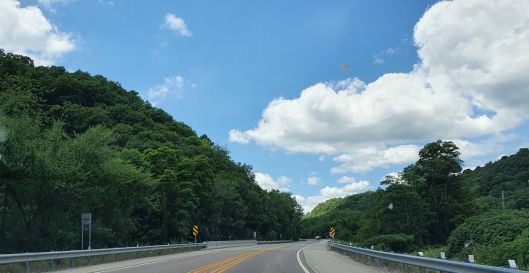
A break in the high humidity gave us a perfect day to drive along the Mississippi, looking for Huck and Jim on their raft. We drove east from Rochester to Winona, MN on Rte. 14, a prettier drive than the interstate, then turned northwest along the river, getting as close as possible to the water on side roads. At Lake City, MN, we turned southwest on Rte. 63 and drove the last leg of our triangular route.

The level lands of the driftless area make good corn and soybean fields, and we passed a lot of them. Approaching the Mississippi, we found rolling hills before arriving in Winona, where a series of large sandbars clog the river but provide an excellent vantage point over the water.

Farther along, we stopped at McNally’s Landing just as a powerboat was being pulled out of the water after a morning fishing trip. Not long after, another truck towing a trailer pulled up and launched a boat. Out on the water, people were fishing, and pontoon boats were lumbering slowly along the channel to keep from swamping the passing kayaks.

We found ourselves alone on a forest path. It was just right for birds, sunny and shaded, near water, not too late in the morning. Following birds with our binoculars as they jumped from branch to branch, we wished they’d slow down just a little bit so we could get a better look. Sometimes, they cooperated.

Just before Minnesota City, we stopped to have our picnic lunch, looking out over the Mississippi and enjoying the beautiful day. A quick loop through Minnesota City revealed the secret getaway car emerging from Don’s Auto Body.

The road runs right along the river for a stretch beyond Minnesota City. On this sunny Sunday afternoon, every place where a boat could be launched was lined with trailers, and the river was full of boats. We continued along to Lake City, where we cruised the streets and discovered a beautiful old house. After our visit to Lake City, we headed for home, content with our day, and ready to try the opposite bank of the Mississippi on another day.

Why Minnesota?

One of the questions we get from people when we tell them about our life on the road is–Why? When we decided to make our way west by a northern route the question came up again. This time, our lack of knowledge about Minnesota is part of the reason we decided it might be good to spend a month here in the Land of Ten Thousand Lakes. That’s true, but we have paid a bit of a price for not doing more advance research.

Our Airbnb reservation outside Minneapolis blew up just a few days before our scheduled arrival. We had to find a place to stay, and a perfectly fine, comfortable house in Rochester filled the bill. Once we were here, we discovered that Rochester, and all of southeastern Minnesota, is in the “driftless” region, a level area that was never covered by glaciers during the last ice age. Where there were glaciers, as the ice retreated, it scraped divots in the bedrock that became lakes, and left piles of rock, drumlins, eskers, and other post-glacial hills. We are in the Land of 10,000 Lakes, but in the part without the lakes….

Once we got here, we discovered that Rochester may be famous for the Mayo Clinic, but there’s a limit to what else is here. The downtown is like one giant convention center, a bit like Waikiki without the beach. Large hotels line Broadway, the main street. A few cafes and restaurants are reopening with outdoor seating. The city has made a big effort to create outdoor dining areas by lining up cement barriers where there once was on-street parking. It makes space for outdoor restaurant tables, and gives the downtown a bit of a construction project ambiance. Add in a stretch of 90o days, and downtown Rochester looks like a convention city/convection oven.

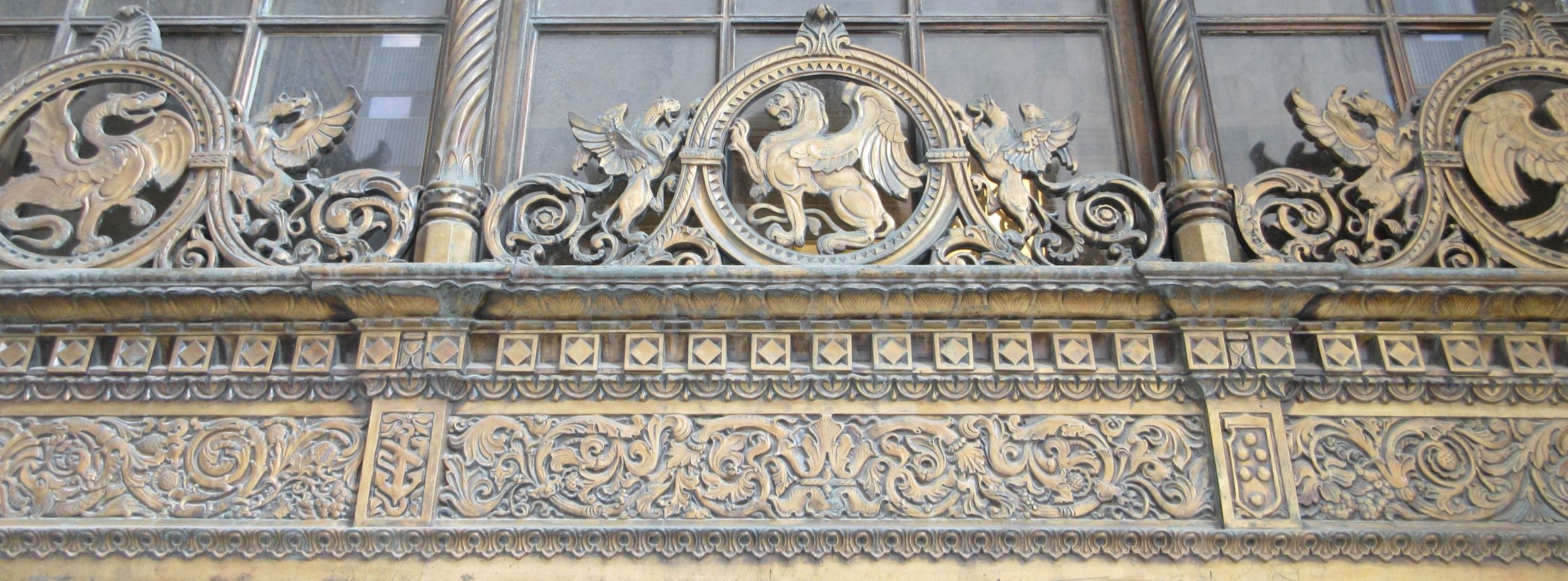
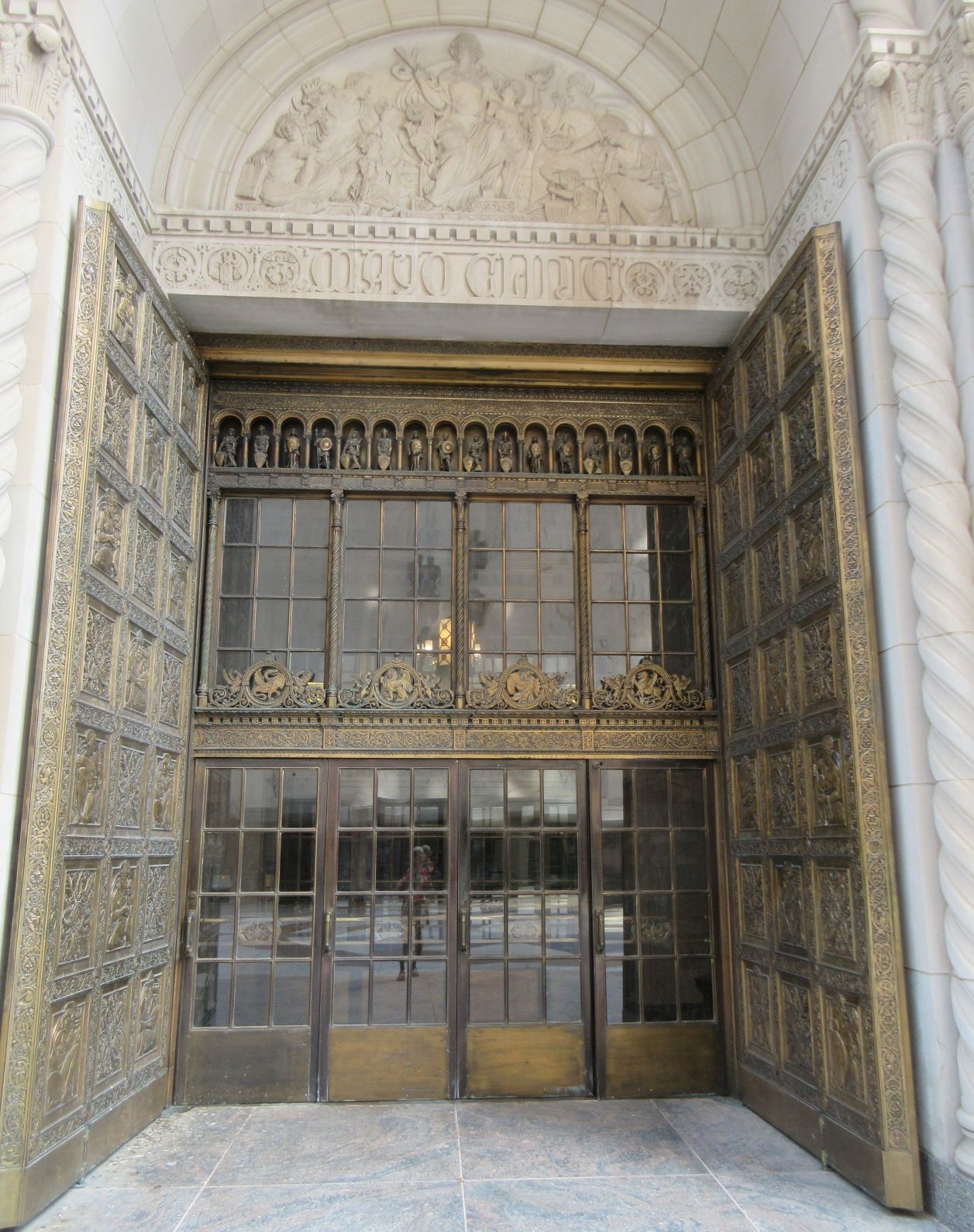
The original Mayo Clinic has brass doors to rival Florence (that seems to have been the intention, at least), and a lot of interesting architectural elements, there are historic exhibits, though the building isn’t open these days.

After my visit downtown while Jonathan was at the dentist, we’ve stuck to Rochester’s parks. They are a real highlight of the city. Quarry Hill Park has miles of bicycling trails, walking paths, a pond, forest, butterfly garden courtesy of the local Master Gardeners, and that’s with the visitor center closed and programs cancelled. We go early in the day before the park fills up, which it does, every day. Also nearby is Bear Creek park, smaller and a bit quieter, with paths along the water that are excellent for birdwatching. We saw a lazuli bunting here, a pretty blue-headed bird. What a treat!

Just a few minutes to west is a trail along the Zumbro River. On our way there, we passed a deer standing in a field of crops, peacefully browsing. We were on the path by 8 a.m., a good idea. By the time we left two hours later, there were individuals and families on bicycles, walkers with and without dogs, runners with and without dogs, and the prize group: a man with two dogs and a baby in a stroller (She was asleep). At least he wasn’t trying to run, too. All this traffic failed to dissuade the birds, who came out to show off their shapes and colors. Though we didn’t see anything exotic or brand-new to us, we enjoyed the hummingbird that sat on a branch so that we could get a good look.

Outside Rochester, state parks provide more places to walk. Forestville State Park is not far, and provided excellent bird watching. Before we even got there we saw a ring-necked pheasant by the side of the road. In the park we walked along the Root River, and passed very few people on the trail. The morning heated up and eventually we returned to the car. On our drive home, the sky got darker and darker, it looked like we were under a slowly swirling, dark gray pancake. Drops began to spatter the windshield as we approached Rochester, though it wasn’t raining very hard when we arrived home. Five minutes later, it was pouring! Rain, thunder, and lightning continued for the rest of the day and long into the night, We took our walk at the right moment. There will be time for others.

Across the Midwest

The month of June ended and we got on the road to the next stop in our journey West. Ohio was lovely, but we are due in California in October, getting there one month-long stop at a time. At one minute to eight a.m. on June 30 we pulled out of the driveway in Conneaut, OH and headed for Chicago. We arrived in time for Jonathan’s physical therapy appointment at 2:10 p.m., five minutes early. We made two pit stops and a stop for gas, wearing our face masks, and washing our hands thoroughly after each stop, finishing with a layer of hand sanitizer when we were back in the car. Fellow travelers were evenly divided between those wearing masks and those not.

What with the temperature hovering above 90o F., the early wake-up time, long drive, and a few hands-on demonstrations of how to assist Jonathan with his exercises, I was worn out. We overnighted at Extended Stay America in Hillside, IL. Most guests wore masks when outside their rooms. This is a place that gives you a hotplate, microwave, and refrigerator. I was disappointed there were no cups and dishes until I saw a card indicating that guests could request any of a long list of clean utensils and appliances. Not long afterward, we had a coffeemaker, toaster, silverware, plates, mugs, and cups, as well as supplies to wash up afterward.

The following day was my monthly eye appointment in Oak Park. This was a big moment because I had my first injection of Beovu, the newest treatment. If all goes well, I will be able to cut back my annual injections by 50%, getting one every eight weeks rather than every four. This first shot of Beovu was my fortieth eye shot, so you can imagine how pleased I will be to have the number of total injections rise more slowly in the future. I took the rest of the day off, mostly because my eye remains dilated after the injection for at least eight hours.

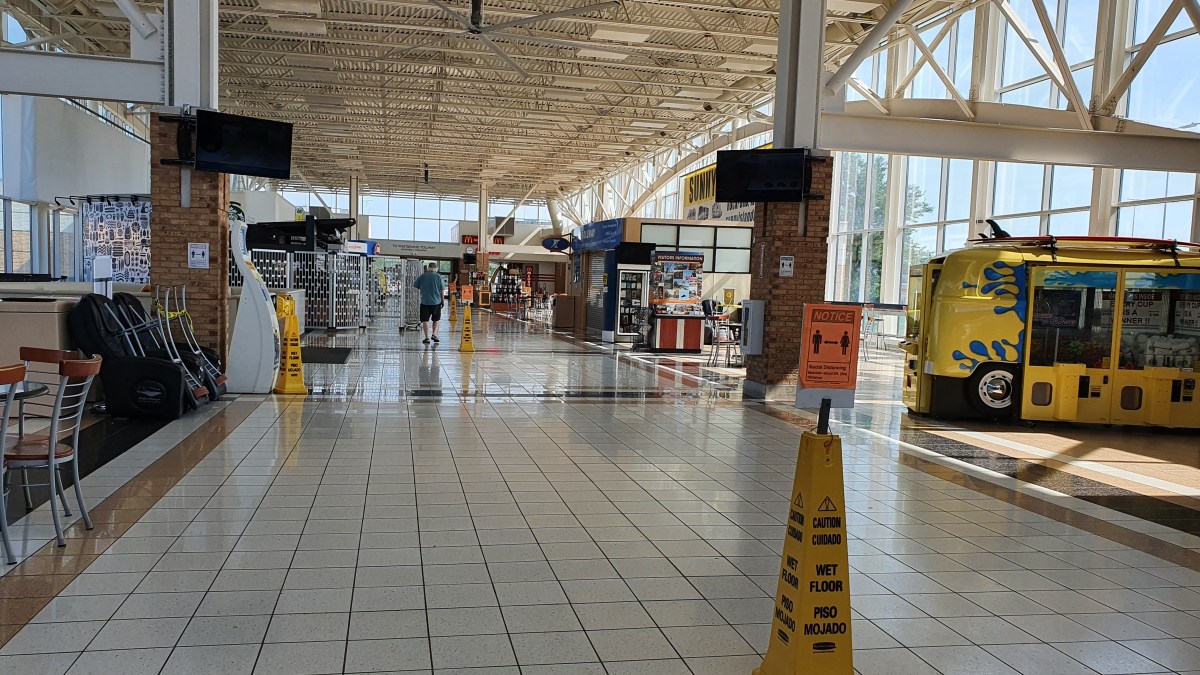
We repacked the car and headed for Minnesota by 9 am on Wednesday, looking forward to stopping at a Starbucks. By the time we found one in a highway rest area in Belvidere, IL, it was almost an hour later, and the Starbucks was closed.

We got coffee, that’s the important part. There were very few people in the rest area, most all wearing masks.

The highway north through Wisconsin surprised us with road work and traffic. Rte. 90 is the main route from Chicago to Minneapolis, but I didn’t think that many people were traveling. Oh, yes, it’s the early end of the July 4th weekend! Maybe that’s it. Jonathan did most of the driving, as he usually does, but I helped.

Castle Rock, WI

We passed the striking rock towers at Castle Rock, WI, then crossed the Mississippi (see the top of this post), and arrived at our new house in Rochester, MN, just after 2 pm. We unpacked a bit and then went to find the grocery store, a big Hy-Vee with a fine selection of items. By the end of that expedition, we were ready to sit still for a while.

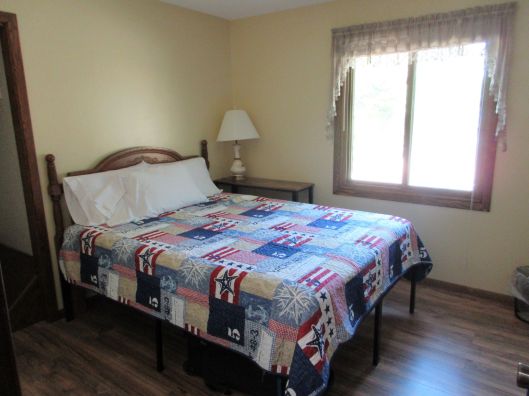
Our Rochester place is much larger than we need, but a snafu just a few days ago left us searching for anything available, and this was it. The house is comfortable and has air conditioning, essential in the heat and humidity.

Our new schedule is to get up at 6 a.m., drink coffee, then have an outdoor field trip before the day becomes unbearable. So far so good. The Quarry Hill park in Rochester is full of trails that are empty in the early part of the day. We saw a variety of birds, including a broad-winged hawk (new!), and were home by ten.

Ohio wildlife

We don’t always get the best wildlife photos. Today we missed the fawn leaping across the road. Other days, as I fumbled for my camera, the young fox stared at us, turned away, and bounded into the bushes. Jonathan saw a badger peeping at us over the top of a mound of dirt. By the time I looked, it was gone. There’s lots of wildlife in Ohio, I just can’t quite get my camera lens on it all.

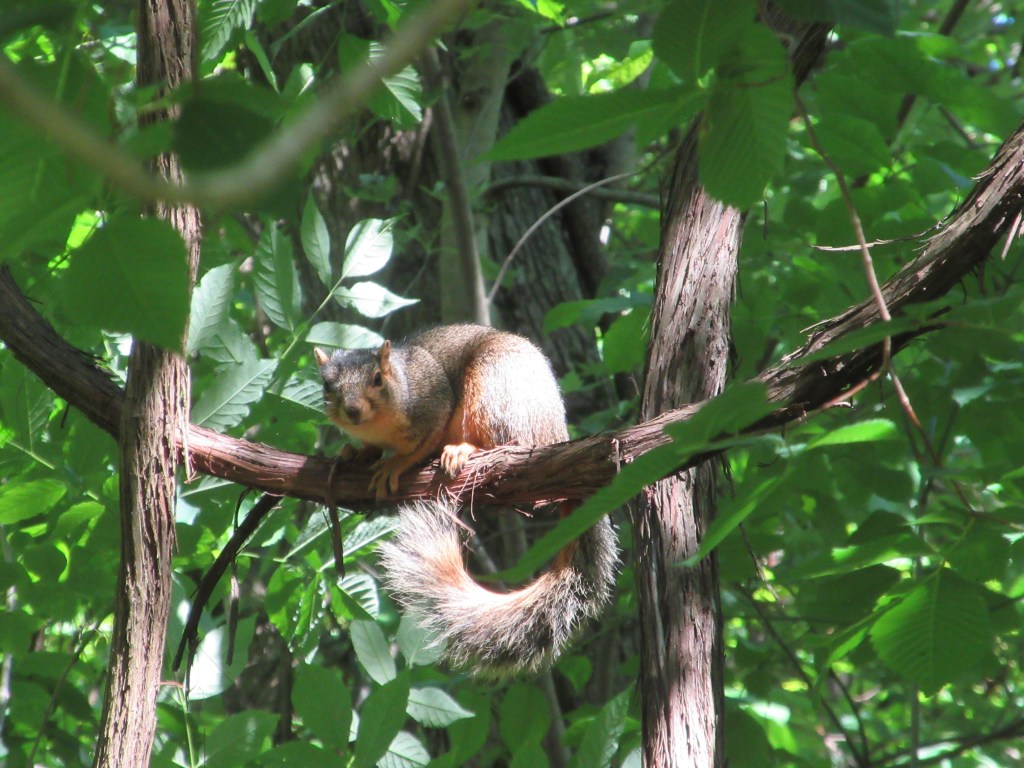
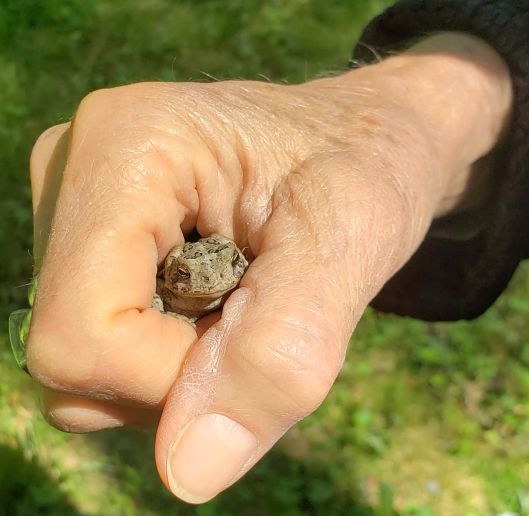
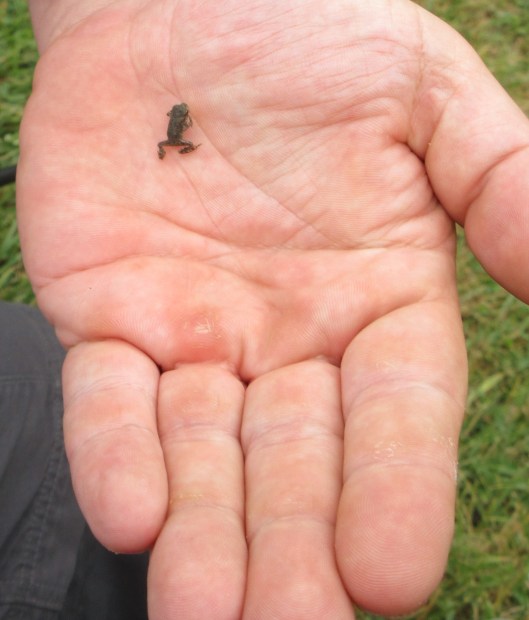
On the other hand, some wildlife freezes when it sees you, and then we get a shot, like a squirrel in a tree, or the cute toad that I held for long enough to take its picture. So cute, in a tiny toad sort of way. A week or so later, we found even tinier toads hopping around in the Peet Camp park.

Birdwatching has been good here, with lots of colorful birds visiting our bird feeder, like goldfinches, cardinals, and orioles. I had to take down our oriole feeder because the squirrel learned that though he couldn’t get into our squirrel-proof feeder full of seeds, he could put his face right into the jelly in the oriole feeder, and once that was gone, he could eat the oranges for dessert. I was worried he’d become diabetic! lol.

I was surprised to find bald eagles are relatively common along the shore of Lake Erie, fishing, and eating fish. They perch on stone jetties, or in the trees. We occasionally see them overhead, patrolling for a snack, their white heads and tails showing they are not the more common turkey vulture.

Nature has given us a good month.

Beachcombing in Ohio

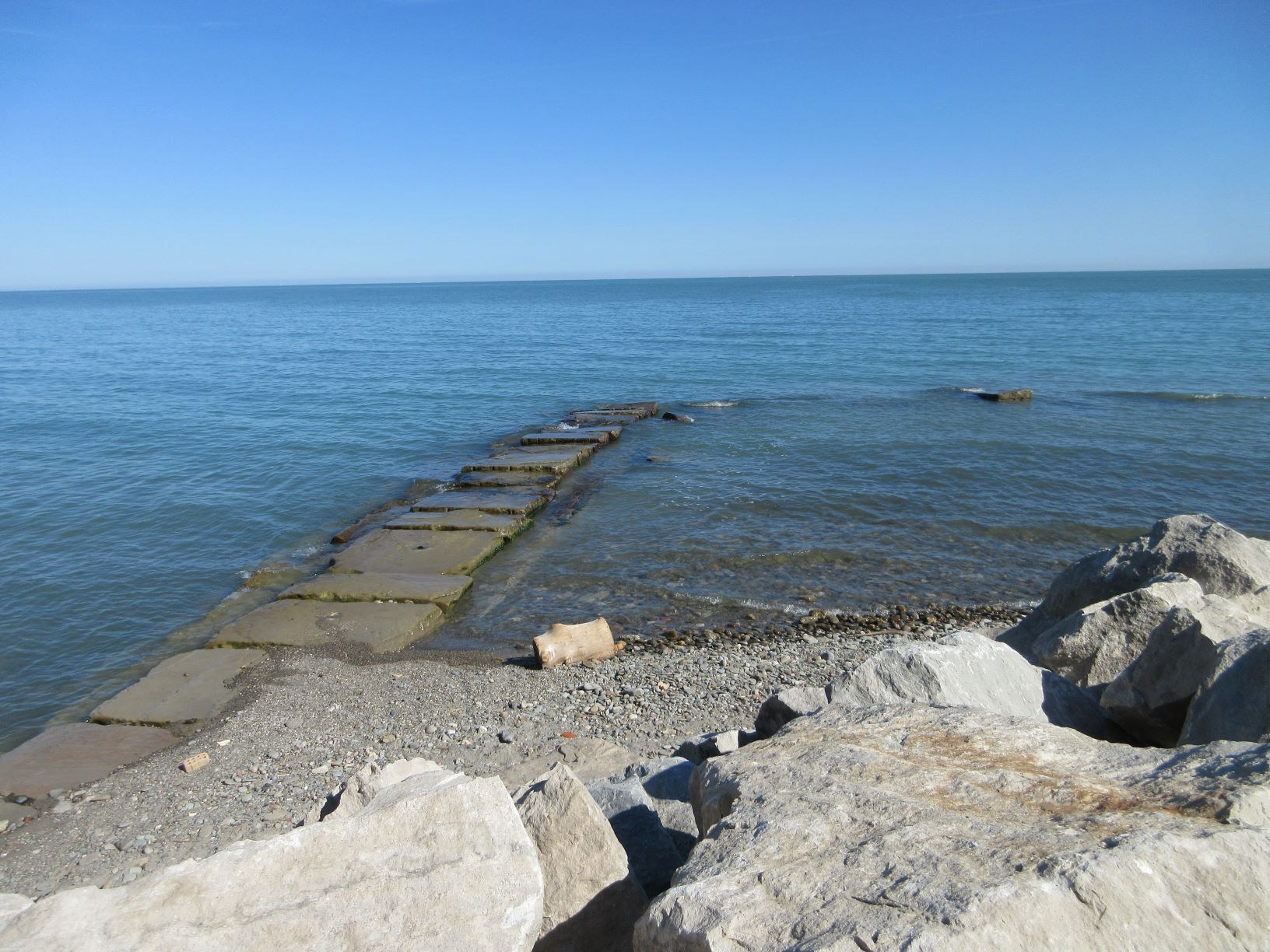
Before we get to beachcombing, let’s talk about the beaches in Ohio. When we arrived, I was chagrined to find that most of the lake shore consists of low bluffs that drop 10-40 ft. to the lake. That means the shore is inaccessible or consists of cliffs in most places. Where you can access the shore, there is no sand! Beaches are usually gravelly. Bring your water shoes! How can beachcombing be a big deal when a) there are hardly any beaches, and b) they are rockslides, not beaches?

Only Ohioans know that beachcombing along the shore of Lake Erie is as rewarding as along any beach in the world. The basic equipment necessary for collecting beach glass here is simple. It’s a ziploc bag. Why? Because here in Ohio, everyone collects much smaller pieces of beach glass than anywhere else I’ve been. Some of the tiny bits will fall through a mesh pocket lining, hence the plastic bag. We’ve seen more people on the beaches, and I mean every, single, beach, than anywhere else in the world. I am speaking as a dedicated beachcomber, too. Honestly, more people visit every beach in Ohio, every day, than we’ve seen from Aruba to Australia. I’m impressed. Also daunted.

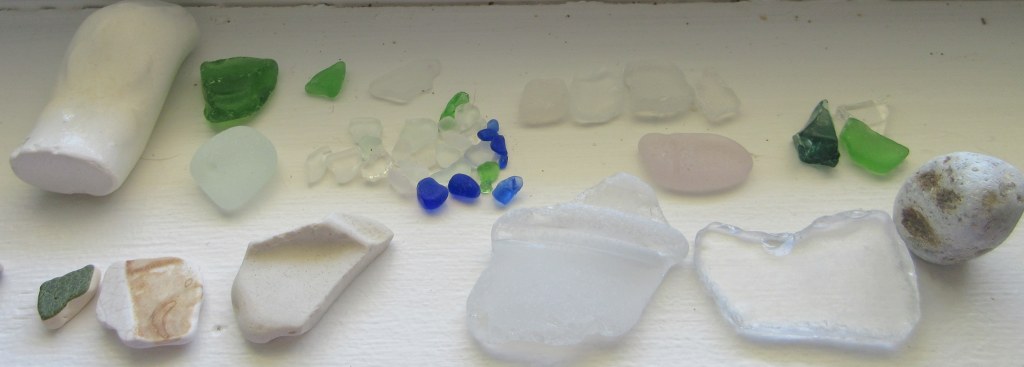
A rainbow of pottery that I found on Lake Erie beaches

When you look at Facebook sites dedicated to Lake Erie beachcombing (there is more than one), you see photos of all colors of glass. More blue glass can be found here than anywhere, and people show off lovely pieces of red, orange, and yellow glass that are rarely found anywhere. In comparison, I have one piece and three crumbs of red glass after six years of beachcombing. It is possible to find marbles along the shore here, too, though I have not found any red, yellow, orange glass, or a marble, in a month of looking. Along the shore of Lake Erie, some people swear by digging in the gravelly shore, others gather glass by visiting isolated beaches by kayak. There are lots of dedicated searchers, including one who posted a photo out his car window at six a.m. as he waited for the town park to open.

At dawn every day, beachcombers get going. By the time I take a stroll down to the tiny beach at the foot of 80+ stairs by our house, there are footprints from previous visitors. Fortunately, the Lake is constantly washing more bits and pieces up on the shore. Whenever I go for a walk on the beach I can find something.

Over the course of our month here, I have accumulated enough glass to begin making earrings and necklaces again. Our biggest haul came from the morning we spent at Edgewater Beach, just west of downtown Cleveland. When we arrived, I looked at the long, smooth shore and despaired of having driven more than an hour. As we walked, though, we found beach glass mixed in the crushed shells along the shore, in the sand, and washing up out of the lake. We came home with an excellent collection and far more than we collected anywhere else in a single visit.
Ohio, I salute you! There is no more avid group of beachcombers anywhere in the world. You may not have an ocean, but Lake Erie is the Mother of all Beach Glass.

A few seconds of Lake Erie waves

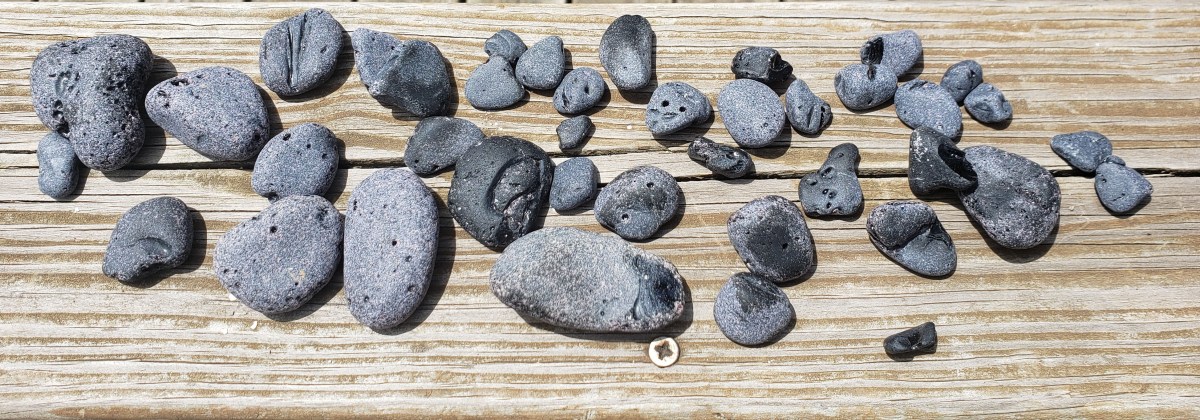
Where does all the beach glass come from? Cities including Cleveland disposed of their garbage in the lake for many years. Factories, too, used the lake as a trash can. A General Electric plant that made glass insulators is said to have emptied the leftover molten glass into the lake at the end of every shift. I collected pieces of this “black” (actually dark purple) glass to experiment with.

I believe there are people who put glass into Lake Erie to try and amplify the supply, but there would have to be a bargeload of glass dumped in every year to take the place of all that is collected.

What do you call a whole lot of carp?

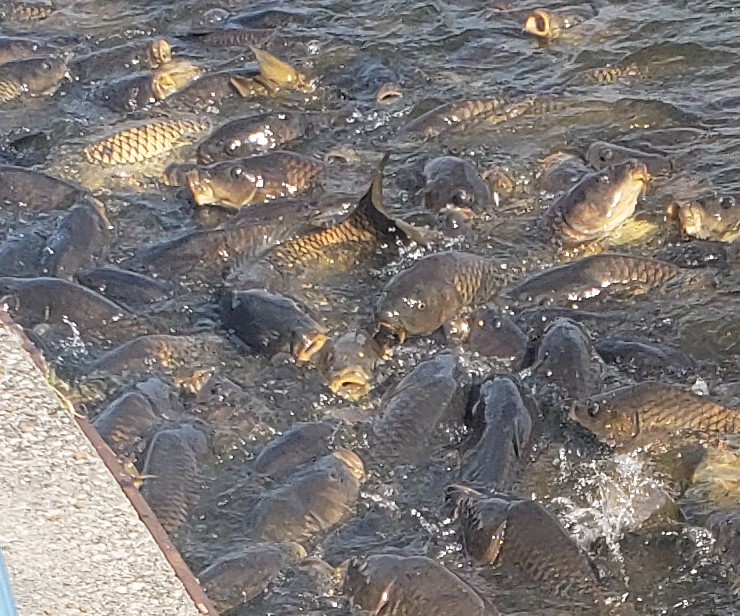
After this, you’ll call it a nightmare of carp. We visited another strange wonder, the Spillway in Linesville, PA. There is a parking area, a concession stand that sells cups of grain to feed the fish, and a long railing marked with red tape “X” marks every six feet (that most people ignore). Though just down a few hundred yards from the Linesville fish hatchery where they raise walleye, the feature here is carp. Fish gather along the spillway waiting to be fed. These aren’t minnows, or pond-size koi, but huge, overfed monsters, many weighing ten pounds or more. And these are the ones you can see easily on the surface!

The fish gather at any shadow cast on the surface by visitors, tilting their bodies upward, opening their big circular mouths that look like the opening of a bottle, and undulating slightly in the water. The little tendrils that project from their mouth (barbels) give them a bit of extra creepiness.

As visitors throw pieces of bread or sprinkle grain from their cup into the water, the fish pack together as tightly as they can, trying to get to the food. The surface writhes with fish, flopping on their sides to try and get to the food. The water looks like it’s boiling. Eeew, it’s gross and fascinating.

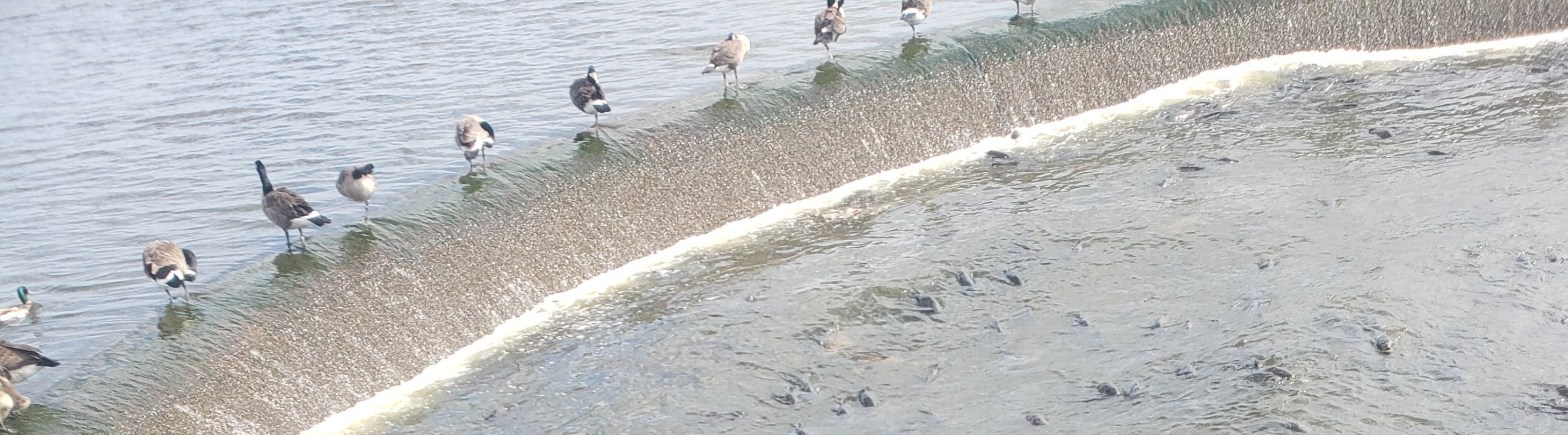
Ads for this location say, “Where the birds walk on the fish!” Sometimes the carp are so thick that the birds have to walk on top of them. Geese and ducks flock on the water just beyond the carp, hoping that a morsel of bread will get tossed their way. Gulls line the spillway watching, and waiting to swoop in and grab some bread.

We were amazed by the quantity of bread people brought to feed the fish. A family parked beside us and got out with a huge carrier bag. Each of the six members of the group (Grandma, parents, older children, younger child) got at least an entire loaf of white bread to feed to the fish. We watched a young man standing along the rail take halves of hamburger buns and throw them as far out as he could, to watch the geese fight over them. I wondered how a goose could swallow something that large in one gulp.

Hundreds and hundreds of geese and ducks circulated along the rail, then out into the reservoir. Small flocks flew to the shore some distance away as though waiting their turn to get into the water and beg. We even did a little birdwatching, looking for different species among the mob of mallards and Canada geese. We spotted a black duck, a ruddy duck, and across the reservoir, a bald eagle sat in a tree, perhaps digesting a recent meal of fresh carp.

Curiosities of the OH/PA border.

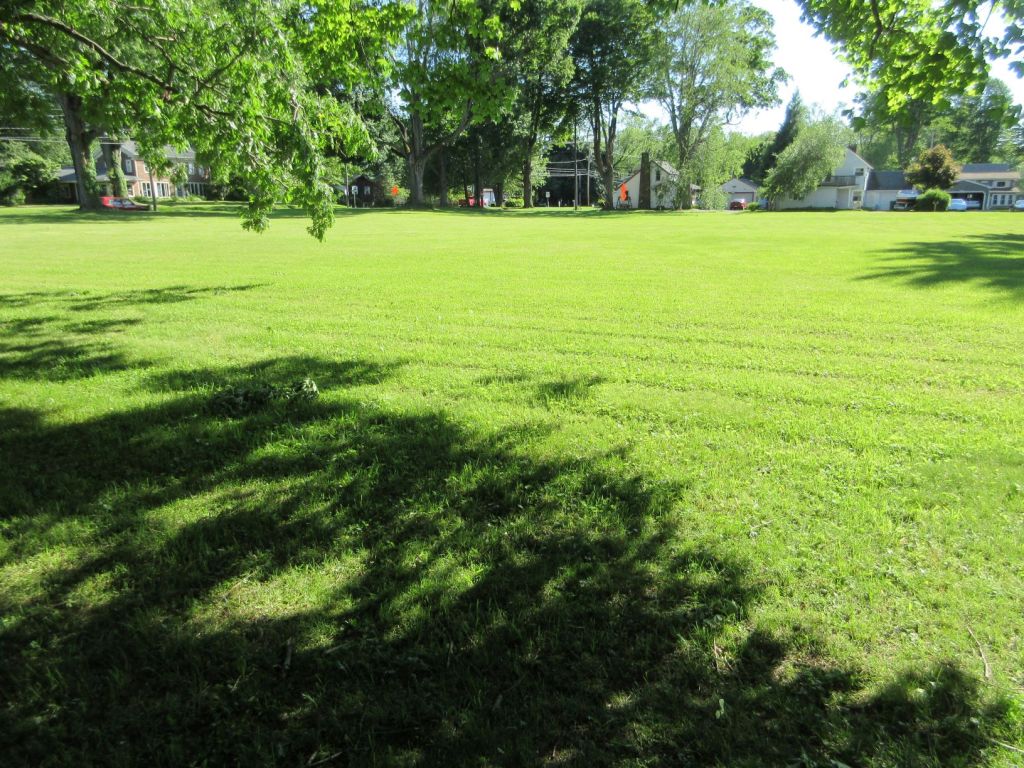
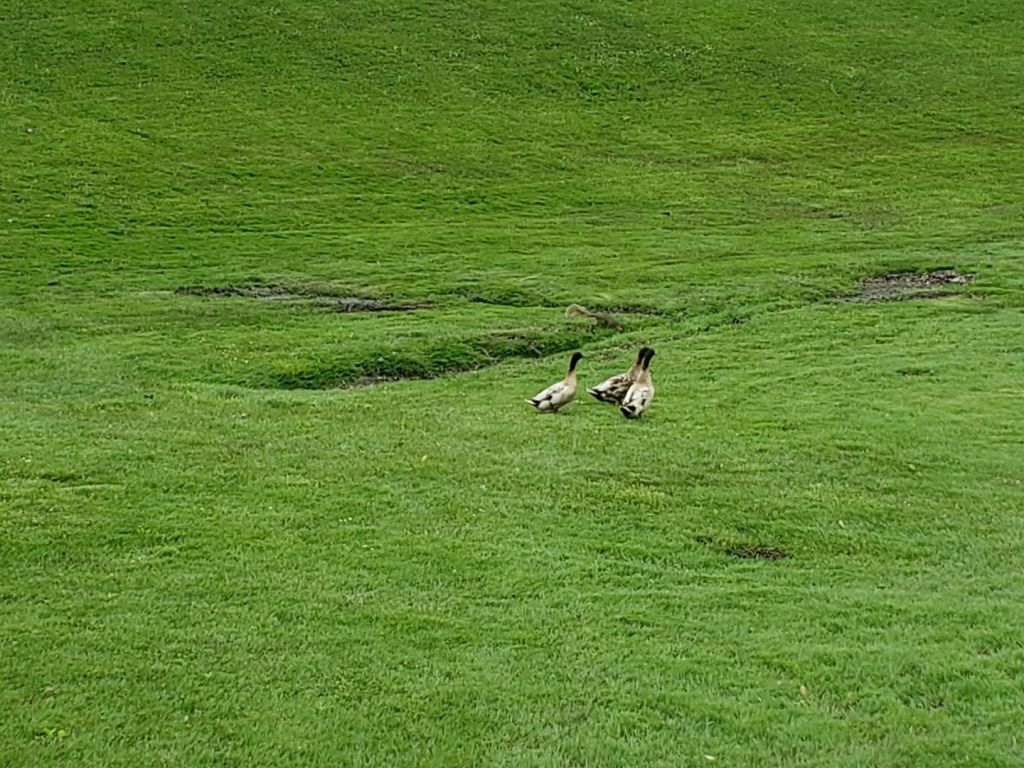
What makes Ohio different from other places we’ve visited? There are a few things that have impressed and surprised us. One is grass–there are huge lawns around many houses, and tracts of open land covered by grass without a house nearby. These are often lovely, but who mows all that acreage? True, there are lots of gray-haired guys on riding mowers–is it really that much fun?

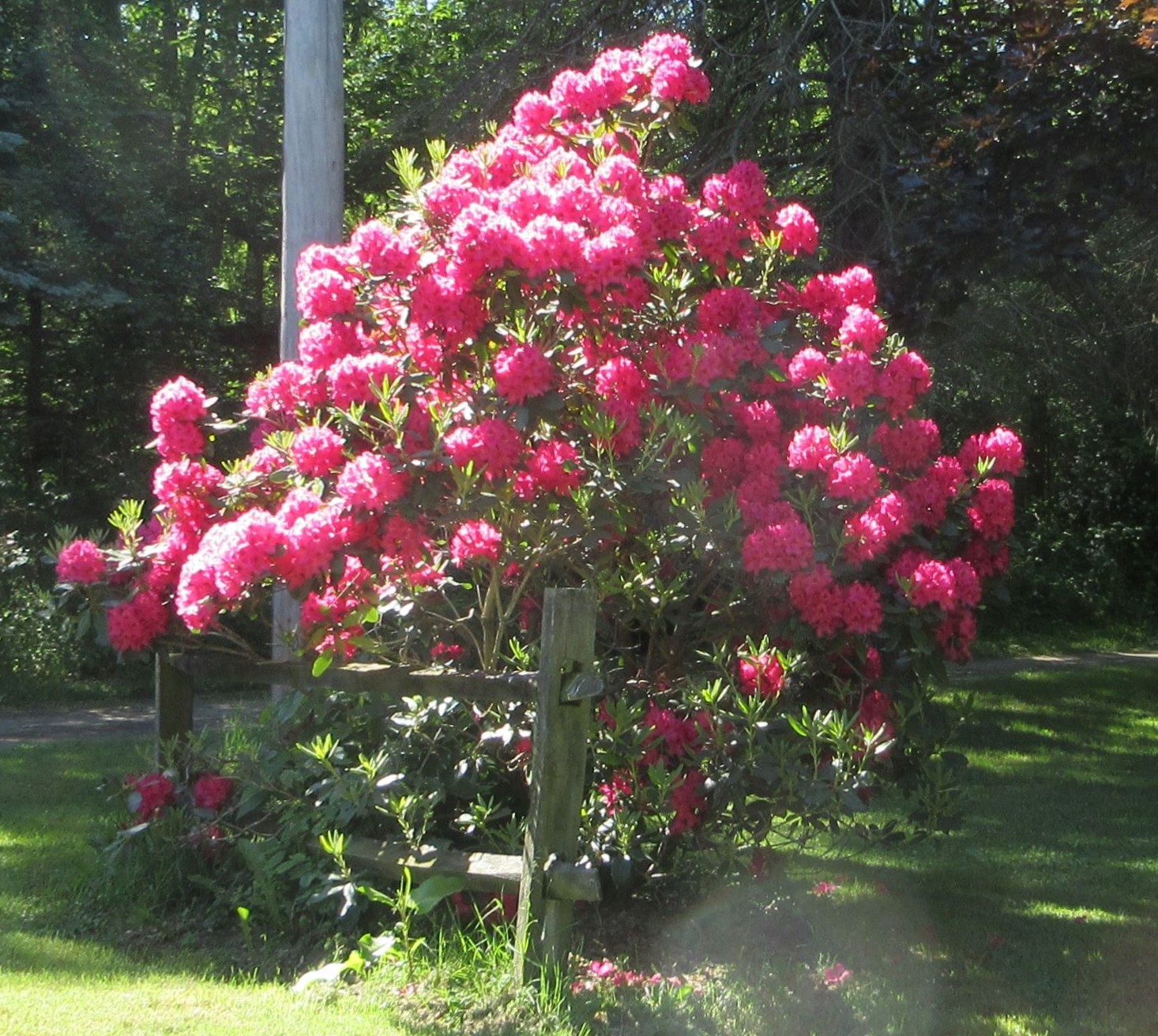
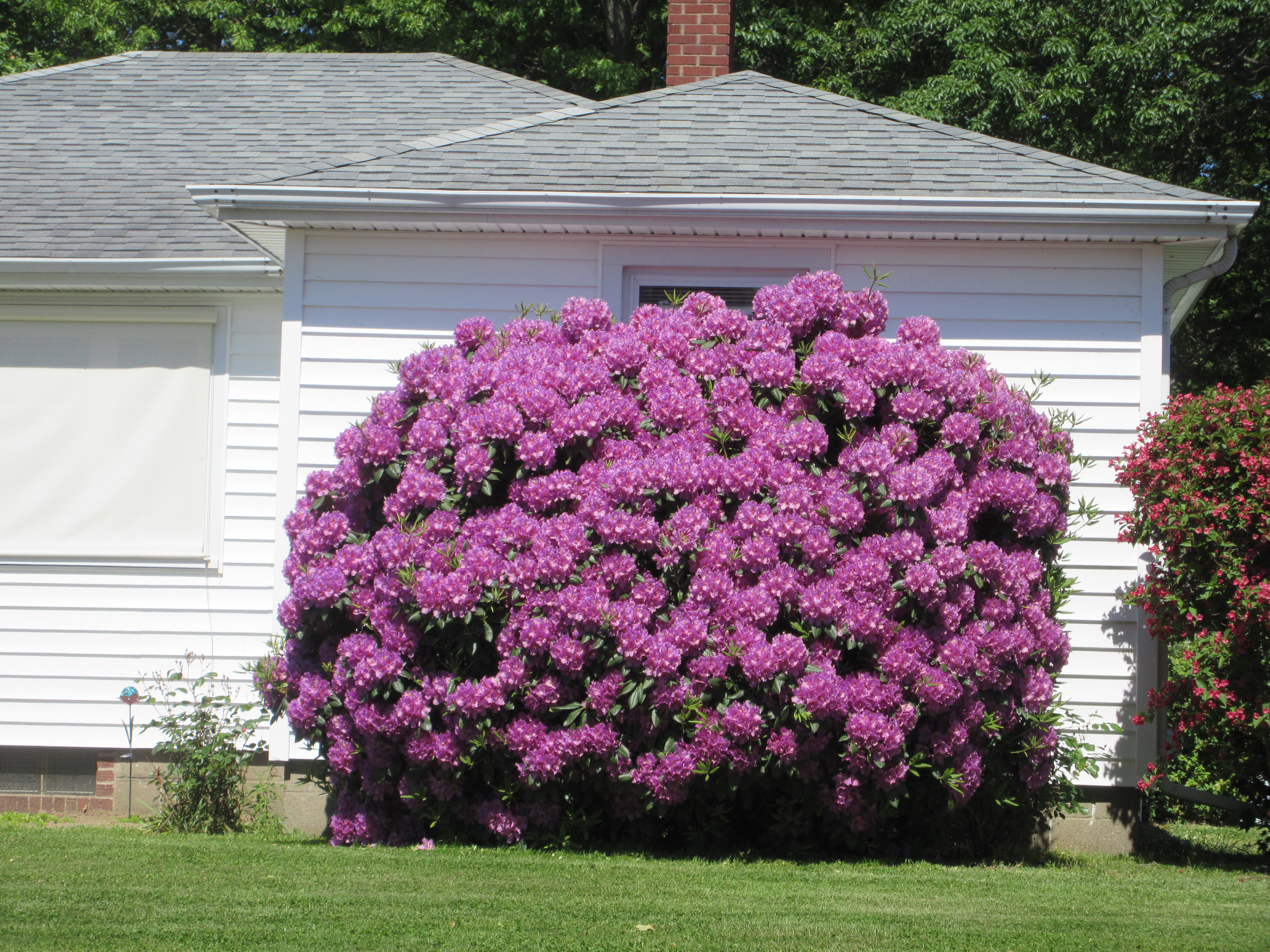
We were impressed by another natural feature, rhododendrons! Huge, enormous rhododendrons, as big as, no, bigger, than the side of a house.

Quirky places are everywhere, including here. We liked the roof without a house:

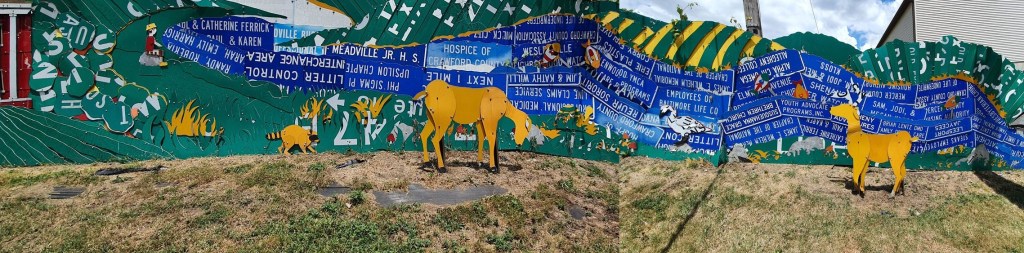
Our current home is just a couple of miles from the Pennsylvania border. In the town of Meadville is the amazing PennDOT Crawford County office. There’s a garden of oversized Seussian flowers and plants on the corner by the stoplight. Along the side of the depot is a remarkable mural panorama of Pennsylvania icons. The mural is bolted to chain-link fencing extending down the road for hundreds of yards. A steady trickle of people visit. No one was there when we arrived, then a couple stopped, took a photo and left. We walked down the edge of the highway looking at the mural, and when we returned to the parking lot, a family was exploring the sculptures.
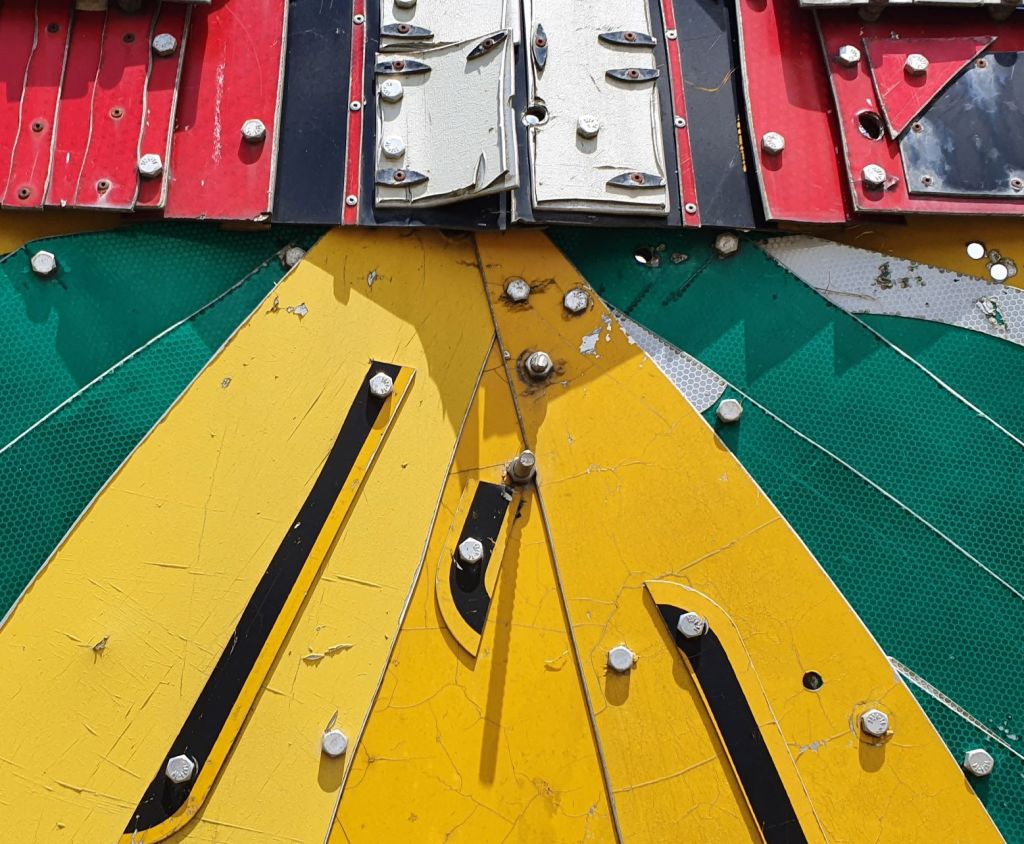
Knock-your-socks-off effort went into making the mural, yet there is no onsite information about this extensive installation. Fortunately, the Uncovering PA website tells the story. Led by a professor from Allegheny College, the sculptures and mural were designed in 2000 and built over ten years, with lots of inspiration and suggestions from students and local residents. So many signs, so many bolts! The material, old road signs, means this is a heck of a durable piece.

The sections show local landmarks, the changing weather, trucks on the highway, and even Lake Erie.

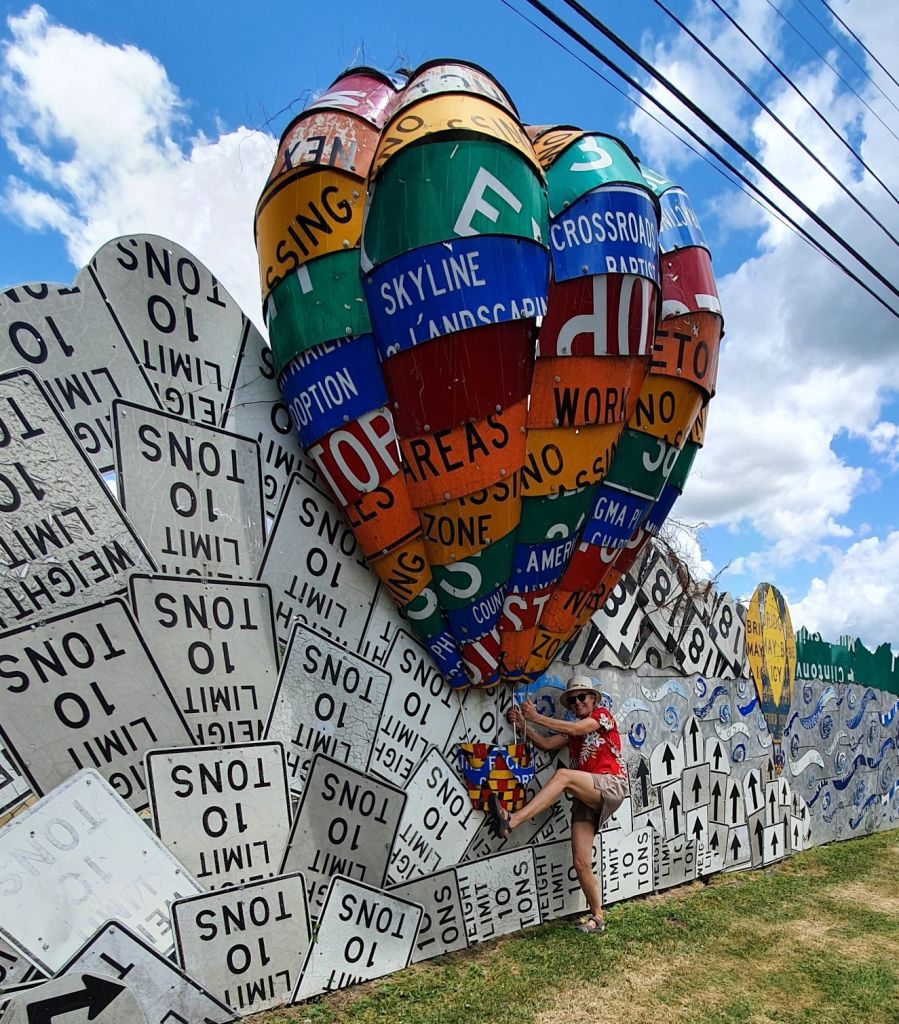
The ferris wheel was missing a few of its seats from wear and tear, but the hot air balloons still looked pretty sturdy. I wanted to go for a ride but I didn’t quite fit into the basket.

Meanwhile, Jonathan hid behind a turkey so that he didn’t have to help with the raking.

This was one of our favorite field trips so far. We even saw some of the animals from the mural. On our route going to Meadville, a fox crossed the road in front of us, while a fawn leaped into the road in front of us on the way home. It was never in danger from the car, and it’s always fun to see the resident wildlife.

We’re looking for more distinguishing characteristics–they don’t seem hard to find.

Northern Ohio begins to reveal its secrets

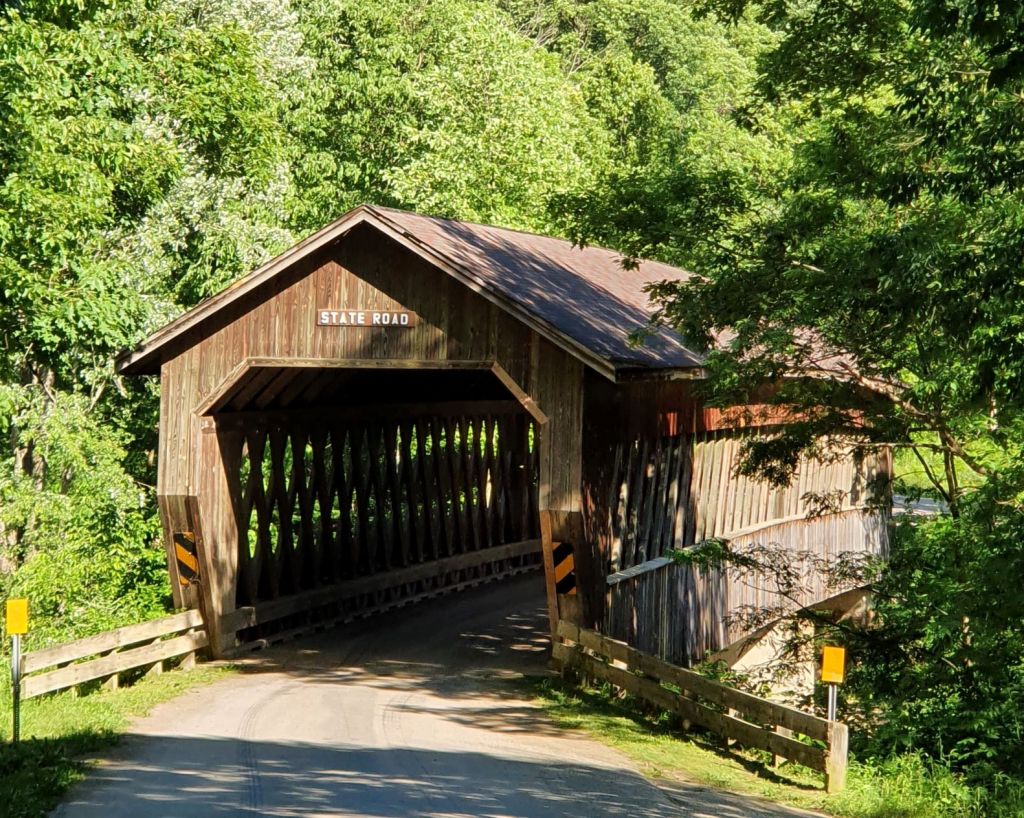
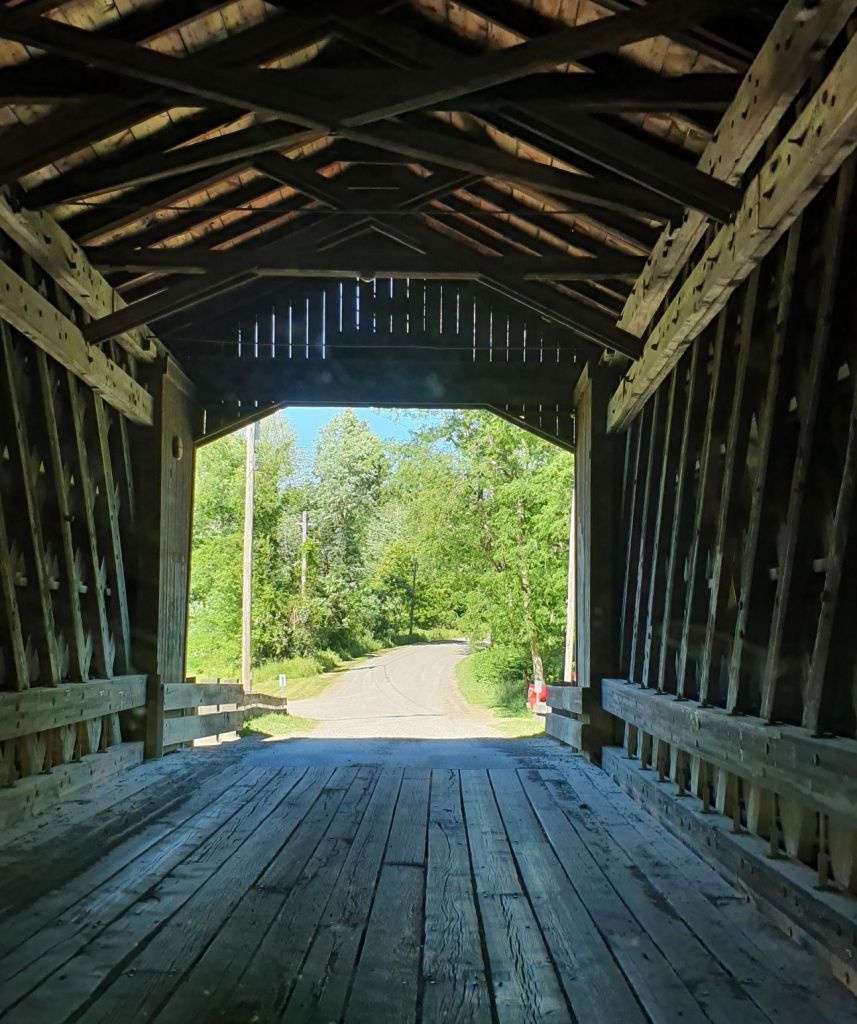
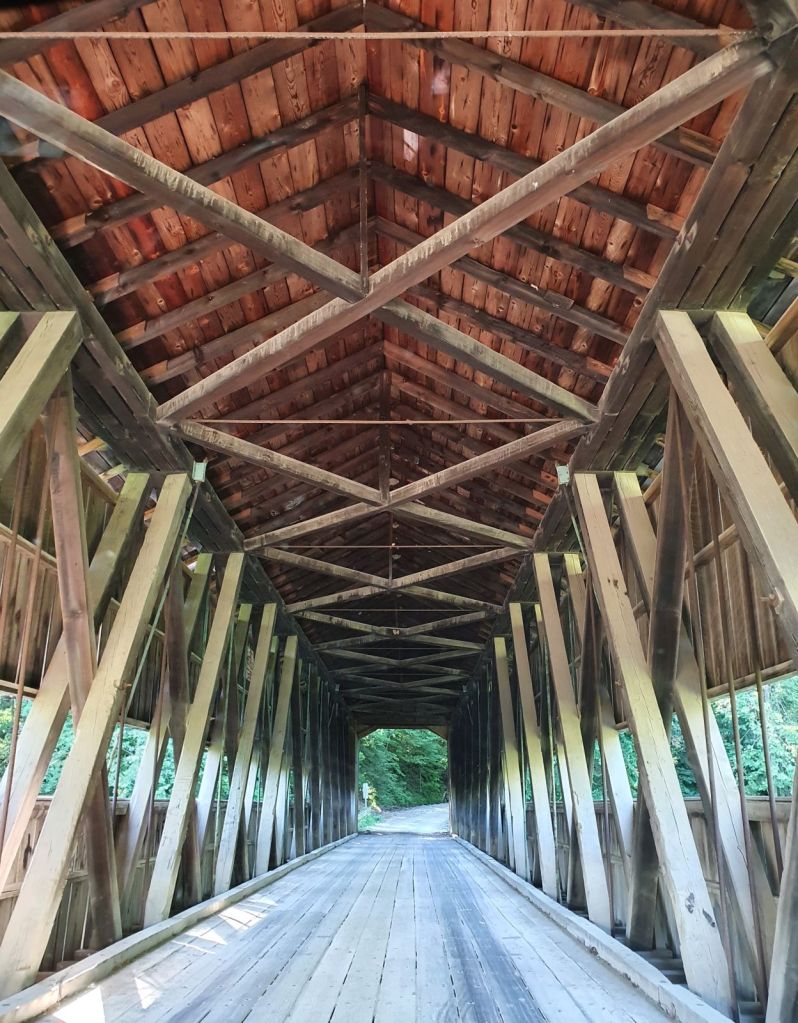
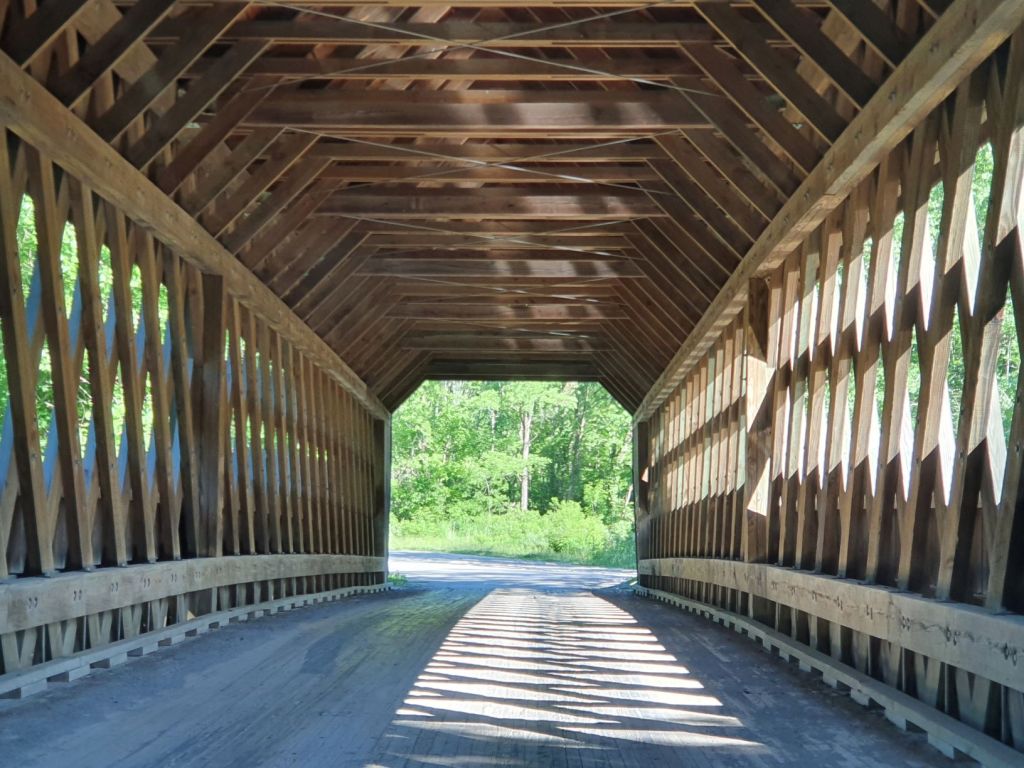
Symbols on a local tourist map turned out to be covered bridges, and on a perfect sunny afternoon we set out to see three that are all very near Conneaut.

Whizzing by on the highway, Ohio is flat and featureless. The creeks that wind their way into Lake Erie are invisible. In contrast, covered bridges predate the interstate, along roads that follow the contours of the land, skirting fields that alternate with stands of woodland, gently curving around low hills. The road dips down toward the creek, turns to cross perpendicular to the stream, then straightens out again and climbs up to the level of the fields.

Farmland now competes with housing, creating a suburban/rural combination that is new to us. Our speed dropped as we navigated the country roads and took time to pull over and admire the sights. We were never more than a few miles from the center of Conneaut, yet the landscape was entirely different. Adjacent to Conneaut Creek are vineyards, part of the local wine industry. With everything closed, we have not been able to taste Ohio wine yet.

Between stops on the covered bridge trail, we passed a huge octagonal barn, a wonderful structure that isn’t built any more. Beyond the next bridge, the map on my phone showed Bear Creek Waterfall, so we stopped. A broad sheet of water runs across the rock, pooling part way down before flowing into the creek. Imagine this as the centerpiece of a vast Japanese garden, water flowing across the rock, serene and constant. We watched the flow of the water for a few minutes before continuing on to the next bridge. At the end of our tour, we were at the opposite end of town, still only a few miles from home. All this in one afternoon!

The more we explore, the more we find. Along our route among the covered bridges, we found the Clara D. Peet Preserve, a grassy trail into the woods that we plan to walk another day. Online, I discovered a map of Ashtabula County parks, including at least two others we’ll enjoy exploring during the remainder of our month here.

Welcome to Conneaut, OH

This month we are in Ohio, enjoying the shore of Lake Erie. Conneaut is pronounced “CONeeOtt,” and our house is a lake cottage that has just had the final touches of renovation added, so everything is new and comfy. The interior paint work is particularly nice, changing from robin’s egg blue to pale mint green with the light (also painted different shades on different walls). It’s a lovely effect.

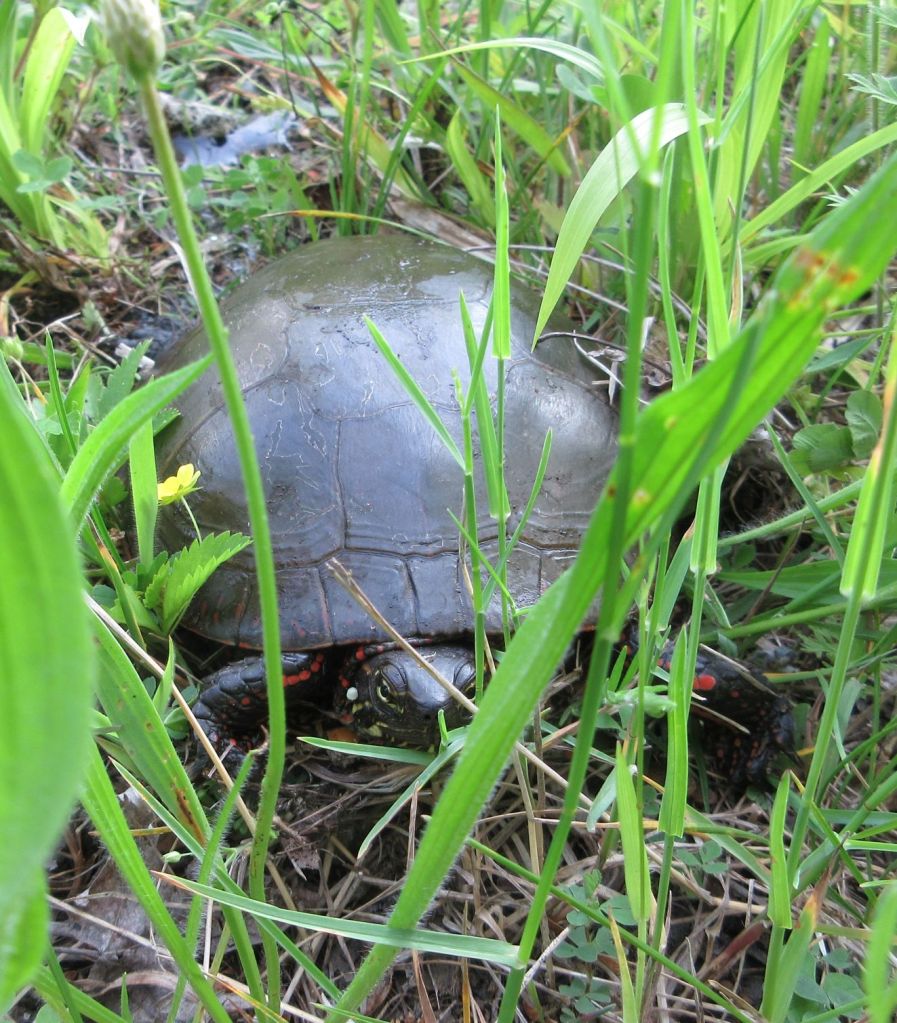
A midland painted turtle on the path

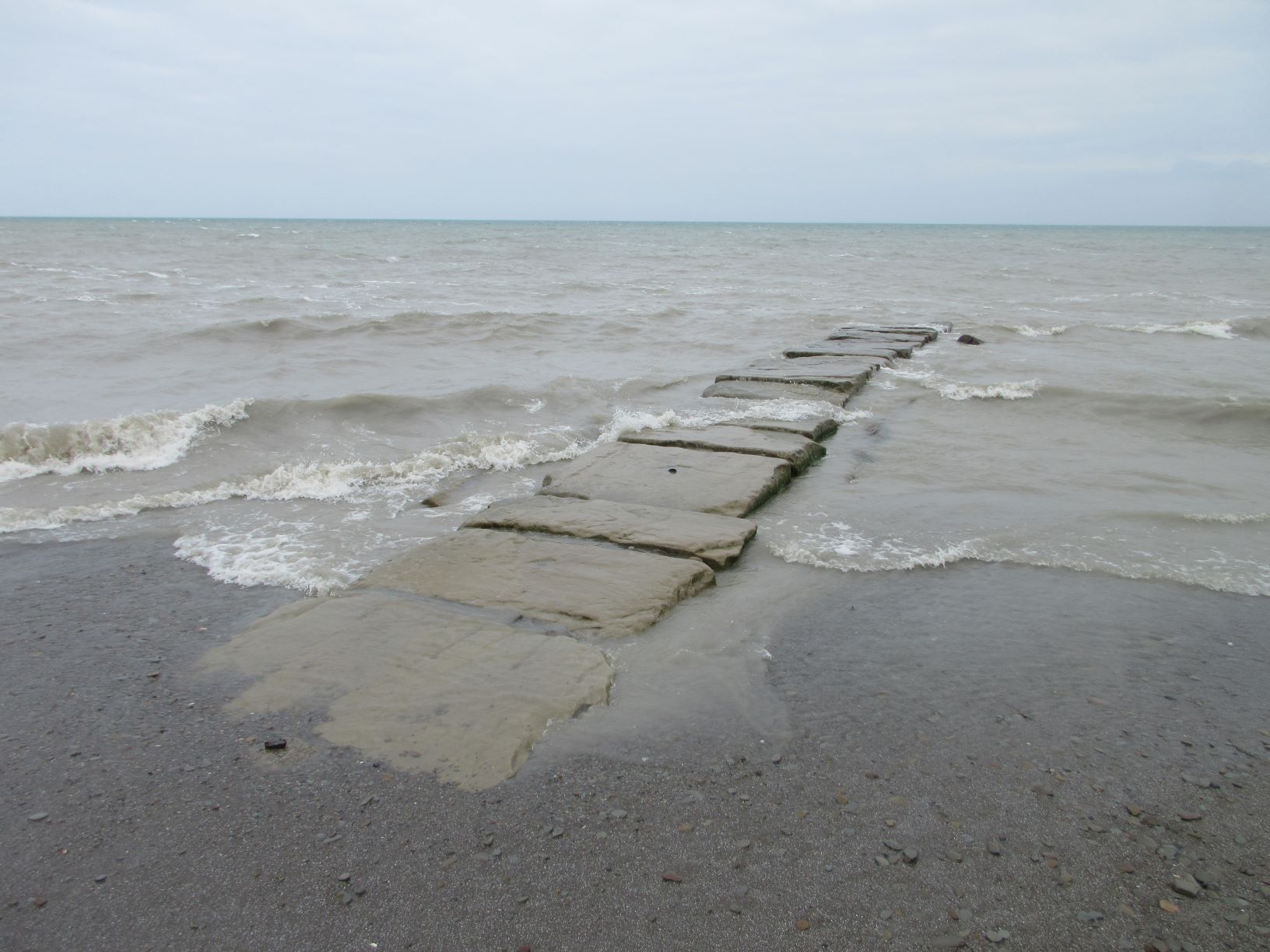
The weather is nicer than that of the Chicago area. It is hot and humid some days, but not as humid as Lombard was. Other days are delightfully sunny and warm with some breeze off the lake. We did have a day of wind and rain, and the lake changed from clear and flat calm to a constant crash of turbulent brown water. When the weather is good, boats of people going out to fish leave from landings all along the shore. Most of the edge of the lake is a bluff 20-40 ft high, so any spot that is low enough to provide a bit of beach and a boat landing is either a public park or marina.

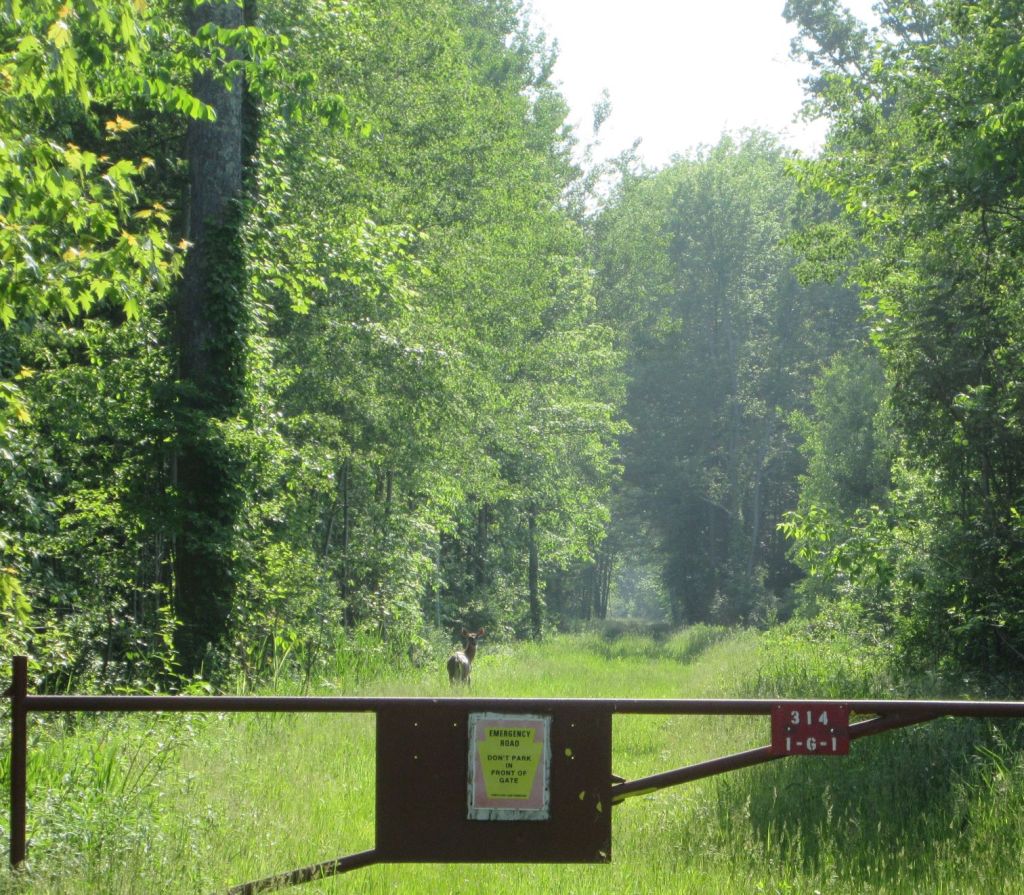
Whitetail deer just before fleeing for the woods

Our first efforts at birdwatching took us to the OH/PA border where there are State Hunting Lands. Though we didn’t see a lot of birds, we saw some of the local wildlife: a woodchuck, deer, turtles on the path, and frogs in the swamp. Birds hide quite successfully in the now fully leafy trees, and we are often frustrated in trying to find them, even if we’ve just watched a bird fly straight in to a particular branch. Fortunately, there are a lot more spots to visit.

Beachcombing is touted on some Facebook pages as a great diversion here, but there is a down side! People have had so much time on their hands during the past weeks of isolation and social distancing that the beaches have been combed and combed. Finding beach glass may once have been easy, but now there are a lot of people spending a lot of time on the shore.

I walked down the 87 steps from the bluff nearest our house to the shore and found a man lounging in his kayak after having walked our tiny stretch of beach. He said he’d found a few pieces, but the lake shore this year is much smaller than last year, so not only are there more people trying their luck at finding beach glass, there is somewhat less shore to search. That’s ok, I always find something. See the pebble that looks the “The Scream”?