We decided to go with natural wonders over wine and we were well rewarded at las Siete Tazas national park, near the town of Radal. We drove north from Talca to Molina, and east into the mountains for 30 km. About 20 km of that was unpaved but relatively level.
Part way along I saw parrots flying overhead. We stopped just as a whole flock perched in a tree across the road. They were burrowing parrots, or loro tricahue, cyanoliseus patagonus, an endangered species. There are flocks of these parrots in several places in Chile, but generally they are endangered by habitat loss and theft of chicks for the pet trade.
These olive green parrots have a yellow belly with a red spot in the center.
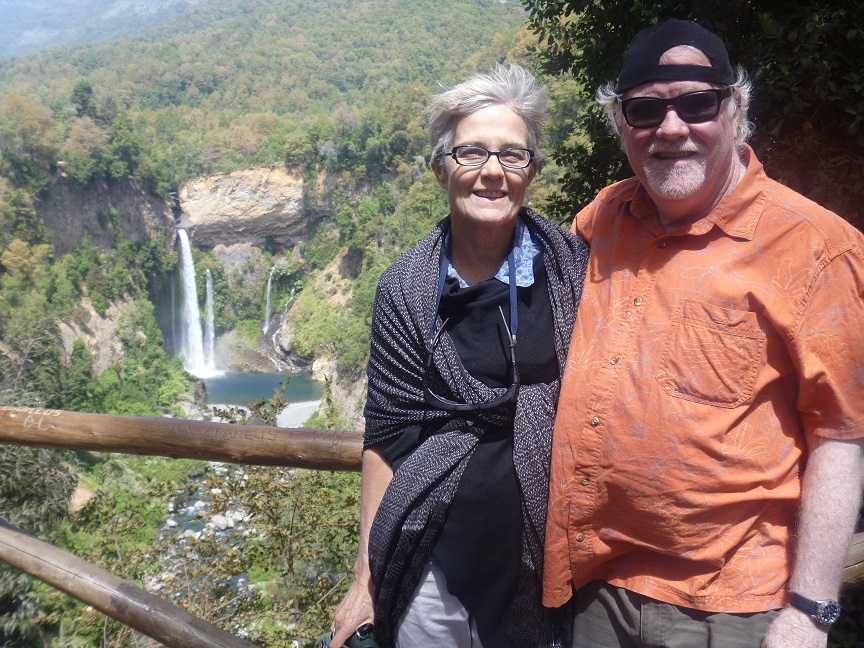
The first scenic spot inside the park is La Vela de La Novia (Bridal Veil) falls, at a pullout along the road. It turned out to be spectacularly beautiful.
Unbelievably beautiful.Very windy, but it blew away the clouds.
Onward to the Siete Tazas, a series of waterfalls that have each carved a basin one below the next. You cannot get all seven in a photo, but you get the idea. The severe earthquake in 2010 changed the waterfalls. For a year the siete tazas were completely dry. The water returned but is not as abundant as it was before 2010. I’ve seen a photo of the waterfall in 2000 and each basin is overflowing with water, now the basins are not quite full and the water flows out a single chute. The theory presented is that the earthquake opened up a fissure that diverted some of the water.
Las Siete Tazas, a wonder of nature.
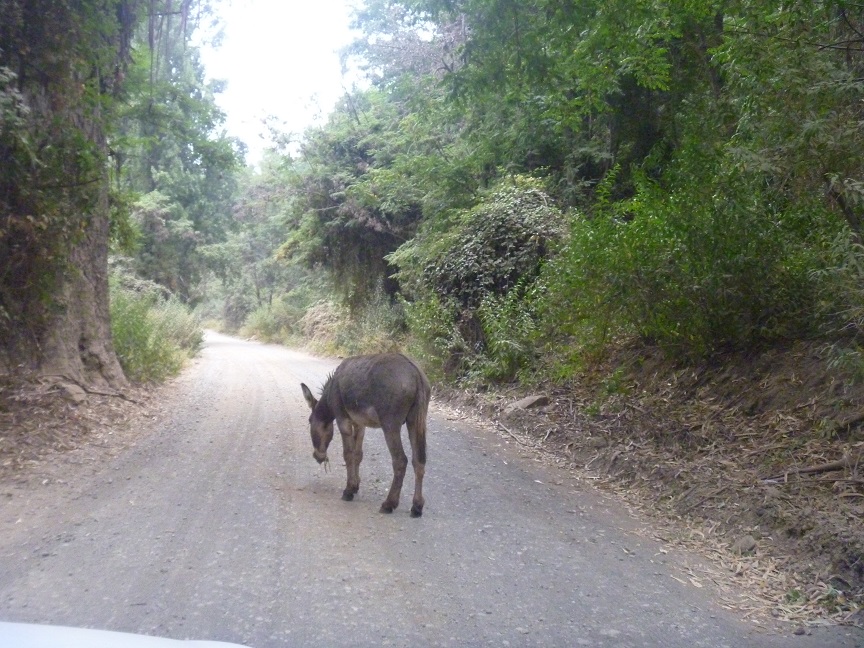
We headed for home, slowed slightly by a stray donkey in the road. He was not very interested in moving.
One of our reasons for coming to Chile was to visit wineries, so we set off to visit the two that do not require advance reservations. Our first stop, Balduzzi vineyards, was easy. The visitor center and tasting room is not far off the main north south highway (Ruta 5). We had a tour with two young men from Montreal who spoke English and French, and ended with a tasting of four wines. We bought a bottle of the sauvignon blanc that we tasted, and a bottle of a very good red that were not offered as part of the tasting.
Not every vineyard was as easy to find:
Even getting out of the car and peering into the bushes, I had trouble seeing which way the arrow pointed.
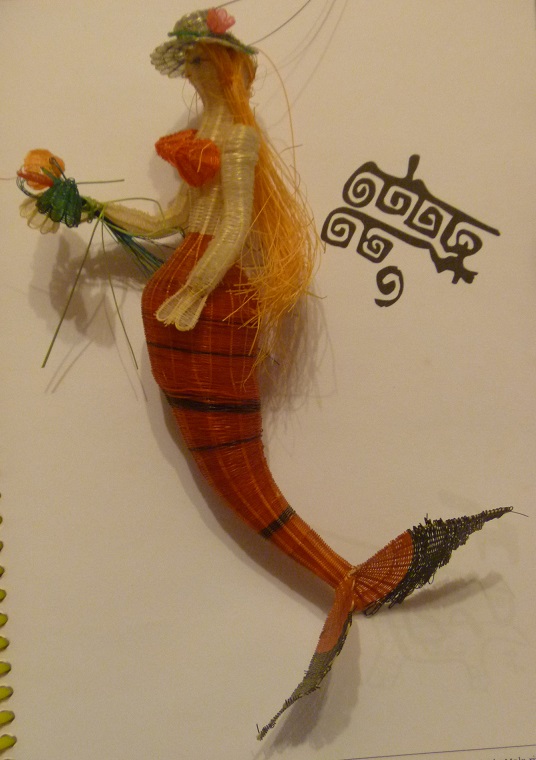
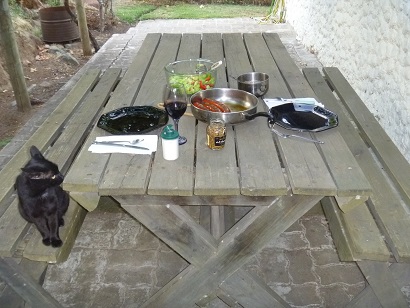
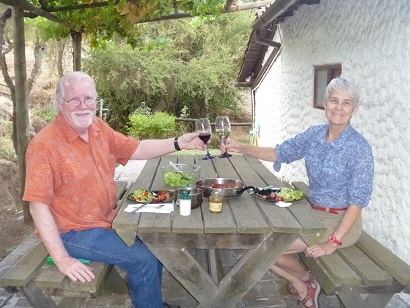
After picnic lunch by the side of the road–it was so hot by now (1 pm) that we ate in the car with the A/C running. Rested and refreshed, we set off for the Gilmore vineyard. We had a dot on a large map and a sketch map on the Gilmore brochure. Once we found the turnoff for Concepcion, the rest was easy, follow the road to km marker 20 and there it is. We did not tour or taste, because Gilmore has a very nice shop with local crafts, yarn, and wine from the winery, but they do not offer tasting. We bought a very intriguing mermaid created from colored and twined horsehair–creative and a good Christmas tree ornament. Most horsehair work in Chile consists of geometric patterned items such as earrings or hair clips.
Mermaid of woven horsehair.
Jonathan did purchase a bottle of wine and we asked whether there were any other wineries along the road toward Concepcion. The young woman in the shop told us that the J. Bouchon winery was 10 km further down the road and very well marked. Since we spent relatively little time at Gilmore we decided to visit Bouchon.
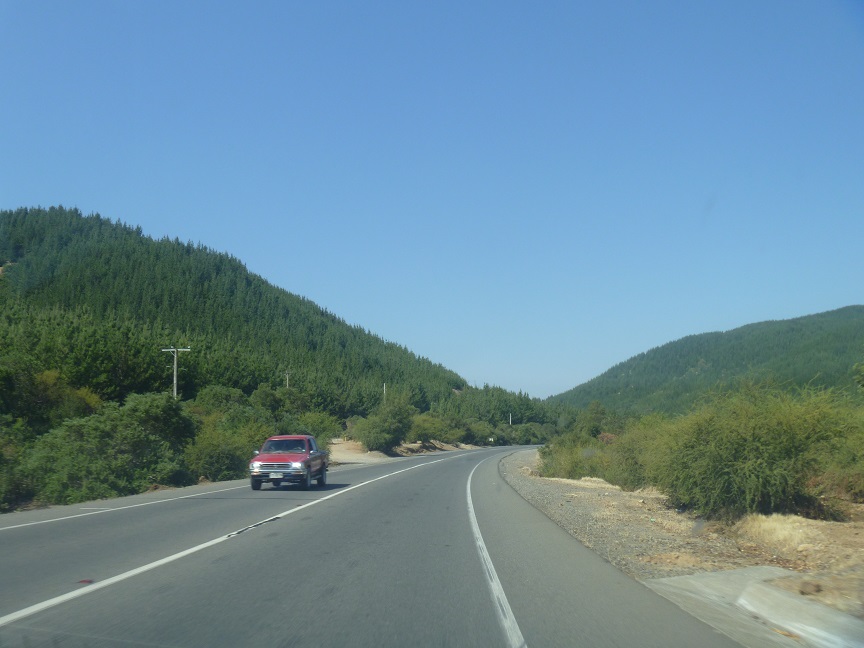
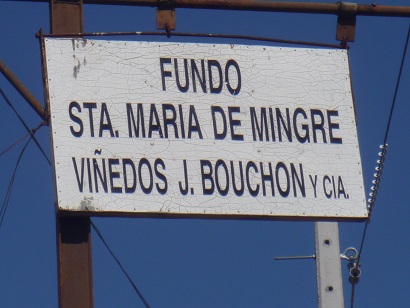
“Well marked” seems to be a relative term. We drove along expecting a sign “J. Bouchon”, or maybe even more than one sign, after all, it was “well marked”. When we had gone another 20 km without sighting anything, we noticed that we had entered an area of pine plantations, and there were no vineyards visible along the road.
Not much room for grape vines.
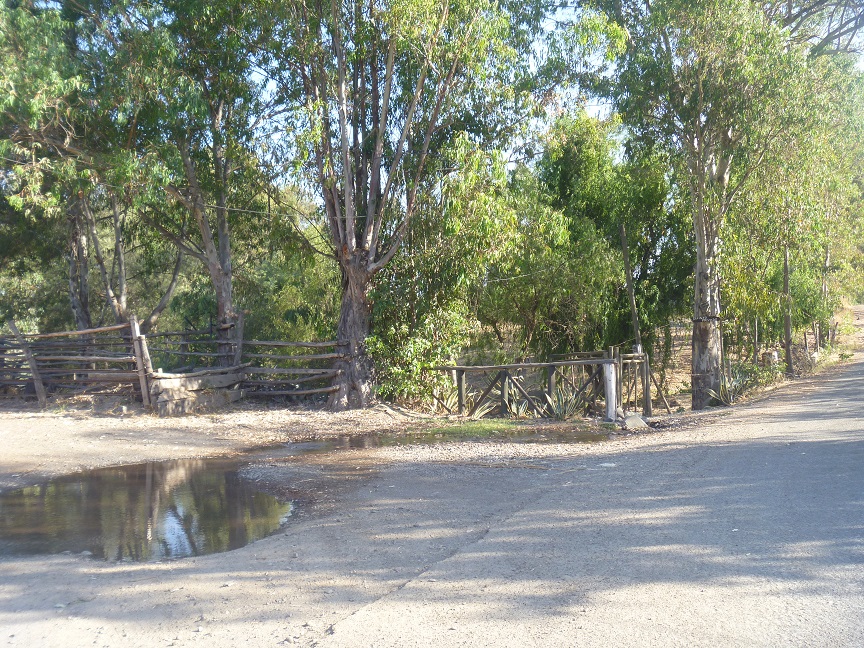
Wondering where we’d gone wrong, we turned back. At the 10 km marker we looked at an intersection, but there was no sign.
When we first drove past, I didn’t think this could be a sign for a “well-marked” vineyard.When Jonathan started laughing, I knew this was the vineyard sign.
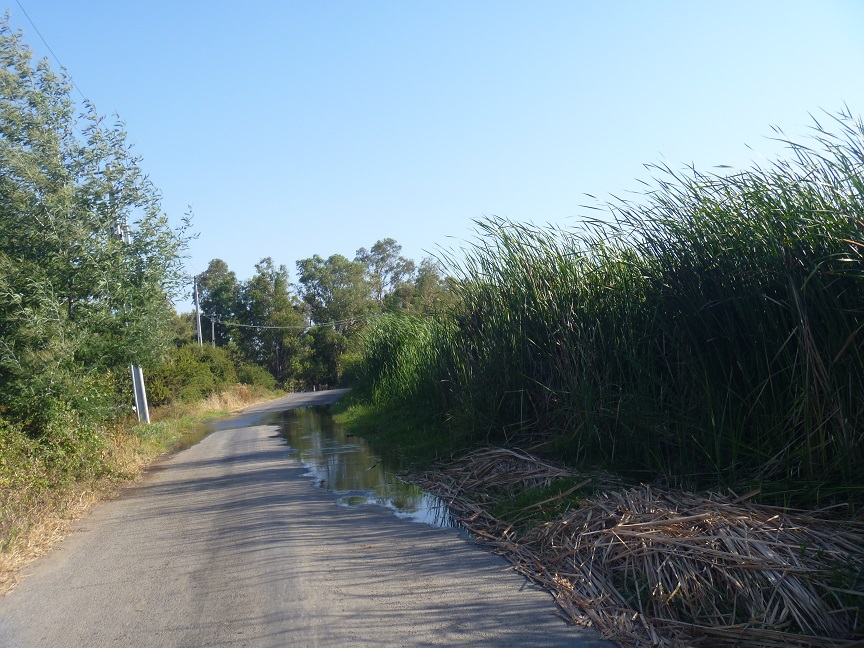
Note that the last words are “J. Bouchon y Cia.” And that wasn’t the end of the road by any means. It wound around and up and down with little evidence of vines.
I still don’t see any vines.Do you see vines in the distance?
Finally,
Here’s the first vines you see. Is this place abandoned?
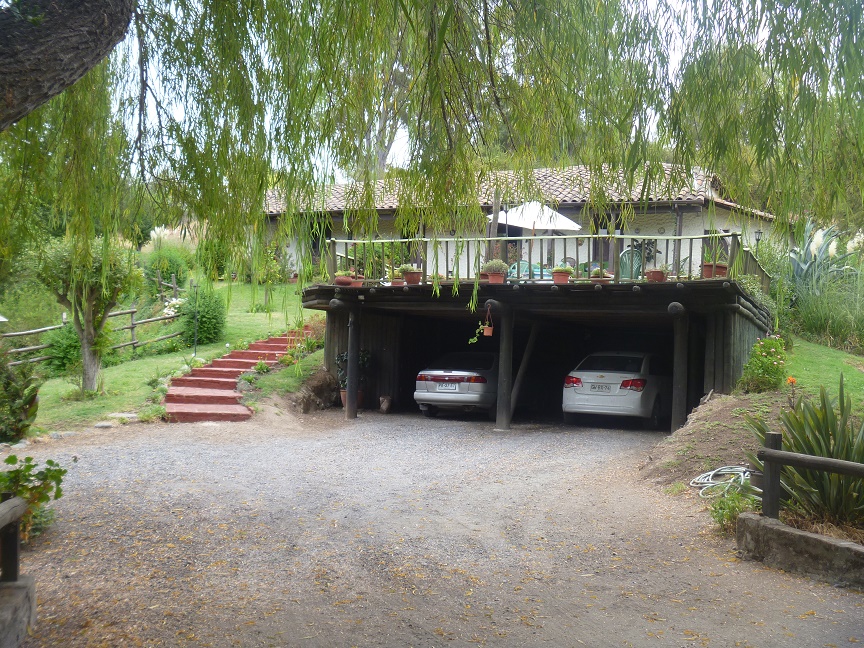
Not at all. J. Bouchon has rental rooms/villas and a large facility, but we didn’t see any people. We found a gardener who directed us toward the back of the corrugated metal building off to one side of the residential zone. Emerging from it we met a young man who was beginning a tour with a pair of young Canadians and their 3 month-old. We joined them. Though J. Bouchon doesn’t offer tours, he was giving us one anyway. We would not be able to taste anything, but could purchase wine at a 20% discount. Though we’ve now been through the winery tour several times, this one was distinguished by the fact that a truckload of machine-harvested chardonnay grapes had just come from the field and we could see it unloaded and sent through the sorter.
Fire hose of chardonnay grapes, machine harvested.
Another load, or several, had already come in, because there was already a dump truck full of the material that was strained out of the grapes: stems, seeds, skins.
Sorter in action, carrying grapes up to the strainer.
This brown mass is used as animal feed (put in a silo first) rather than composted or sold.
Grape detritus.Quail in lower right corner, in the yard of the J. Bouchon winery.
We had a wonderful tour at a place that claimed not to give tours, and our Canadian companions were delightful, including 3 month old Quinn.
Our purchase from J. Bouchon:
Mingre, a premium wine from Gilmore, 40% carmenere, 30% syrah, 30% cabernet sauvignon
Airbnb listings usually provide directions, and Barbara, our hostess for this week, had provided a sheet with landmarks showing the way to her house. In addition, we had a map of the region indicating how to get from the airport in Santiago to the city of Talca. The directions looked straightforward, and the map showed that Barbara’s house was just on the outskirts of town.
Does this look like the outskirts of town, or does it look like “Go back! You are lost!”This looked like a good place to turn around.But then, we saw a driveway….like Hansel and Gretel, the road stretched away into the woods….Does this mean “Keep Out”, or possibly “Come In”?
At the end of this driveway, we began to turn around–again–and saw our destination, Casa Barbara.
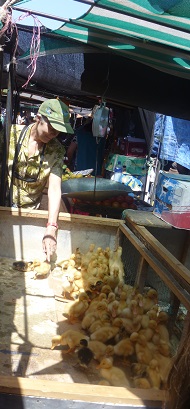
The weather in Talca is like August in the US, cool in the morning and evening and very warm during the day–today’s high was 33 C (91 F). On Saturday, we visited the market in Chillan, a town to the south. It was more than a square block, with booths selling fruit, vegetables, meat, fish & shellfish, clothing, household goods, even some souvenirs. I couldn’t resist petting the ducklings.
We enjoyed seeing the bustle, and noticing that the market was within a block of a HUGE mall. The presence of malls doesn’t seem to have put much of a dent in the markets, at least not yet. There were also some of the unusual things that you sometimes see, like the guy repairing his car across the street from the mall.
Leaving the market, we stopped in the main square, the Plaza de Armas, where there is a huge cross erected in honor of Bernardo O’Higgins, one of the heroes of Chilean independence, born in Chillan. In the plaza we found a very pink flowering tree:
Across the street from the plaza was a small souvenir area where i found silver earrings made from coins dating to 1925.
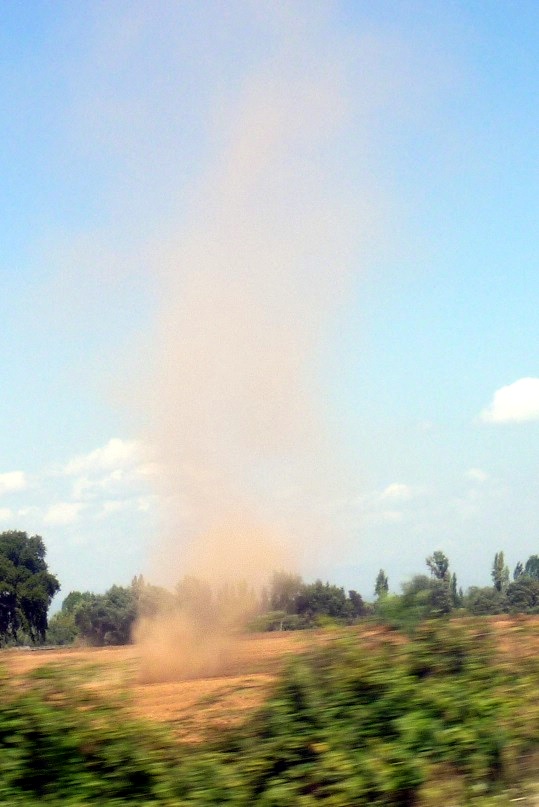
On the way home we passed two dust devils, larger than anything I’ve seen:
From a distance, I thought it was a plume of smoke, but it rose straight into the air, and Chile is rarely without a breeze. The base looked like it was boiling.
Up before dawn, our favorite cab driver, Guillermo, came to pick us up and deposit us at the Aeroparque in Buenos Aires for our 7:50 am flight to Santiago, Chile. The flight was uneventful, though bumpy over the Andes–no surprise there.
In customs we owned up to having cheese, salami, raisins and almonds, all of which were purchased in grocery stores in Argentina, but don’t seem to pass muster in Chile. As he confiscated them, the agriculture guy said, “You can get these in Chile.” (Yes, but I’d like to use the items that I already bought in the grocery store in Argentina.) Not only that, but they didn’t pay any attention to Jonathan’s dried figs. What’s up with that?
We eventually acquired our rental car and headed for Talca, Chile and our airbnb apartment.
Today’s tour guide, Andres, pointed out that everyone in Ushuaia has many names. They are all Fuegians, Patagonians, and Ushuaians, as well as Argentine. We didn’t begin to see the size of the city until our tour bus picked up passengers from several areas that most visitors don’t see. There are two parallel main streets, but Ushuaia stretches along the Beagle Channel for 5 km, perhaps more, and up into the hills around the bay. Very little of this is visible from the downtown area, and the true size of the city is not easily recognized.
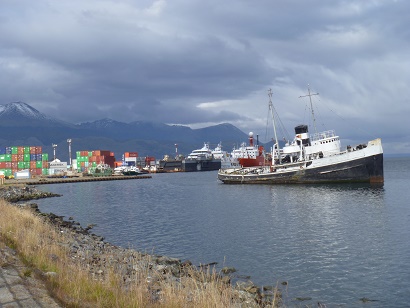
The downtown waterfront features a sunken ship and a pier for cruise and container ships:
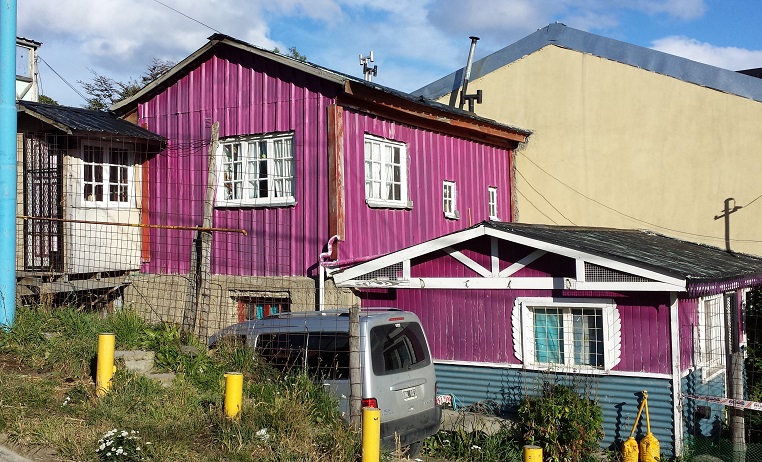
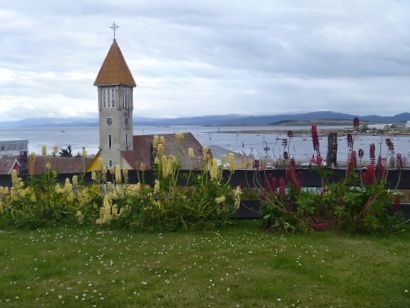
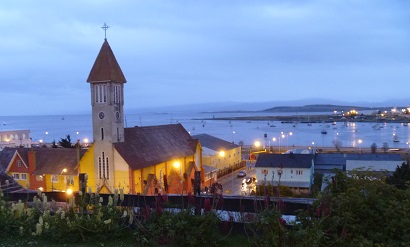
Ushuaia faces the Beagle Channel and the mountains on Navarino Island, Chile, as well as those in the Darwin Range to the west of the city and the mountains that encircle the area. These are stark and beautiful, but Ushuaia itself grew up haphazardly, with little thought for a role in tourism. As a result, powerlines and communications towers mar the view from almost every intersection. There are some attractive, small houses and hotels, but also buildings in disrepair on the opposite street corner. I don’t begin to understand the big picture. There are parts of the city that have an interesting, distinctive look, but it’s not much of a tourist destination. There is about a half day of strolling and shopping to be done and then you need to head for the hills, literally, whether to hike or ski. Otherwise, there’s a whole lot of cafe-sitting in your future. Hotel construction will squeeze out most residential housing in the central part of the city in the near future, similar to cities from Santa Fe to San Francisco.
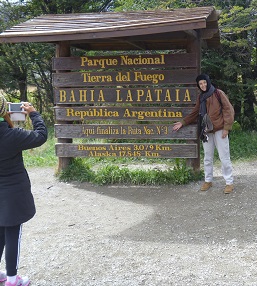
The excursion to the national park focused on visiting the end of the Panamerican Highway, and seeing the shore of the Beagle Channel. The end of the highway is nicely marked, even though it is a parking lot.
We saw black-necked swans:
And we were reminded again that this is the end of the world:
The scenery is indeed majestic:
Darwin Range
A glade in the woods
“And the smoke, it encircled his head like a wreath”
Beagle Channel
Lapataia Bay
The trip is not without its humorous elements. We passed on the ride recreated along the line of the steam train that took the early 20th c. convicts to work every day, and we were not allowed to walk on the archaeological shell mound, though I just wanted to see what was in the excavated area…..Jonathan pouted about something–the rain? (It stopped.)
The weather was much colder than the past few days, not warmer than 50 F and probably colder. There was intermittent rain, as well. It makes the previous two days of temperatures in the 60s F seem balmy. I wore all my clothes and was fine, but I did need everything (long underwear, t shirt, collared shirt, padded vest, scarf, jacket, hat, gloves, socks, boots).
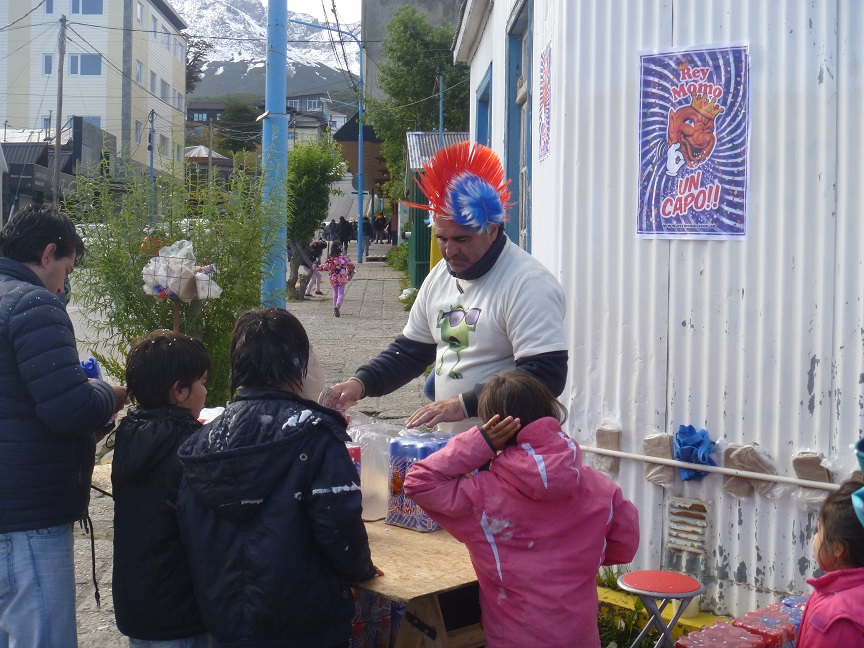
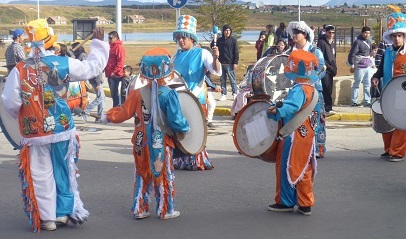
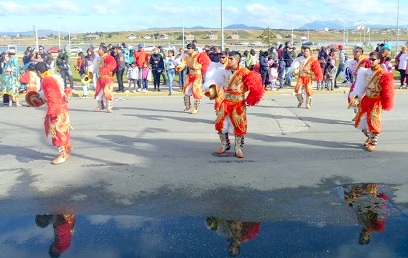
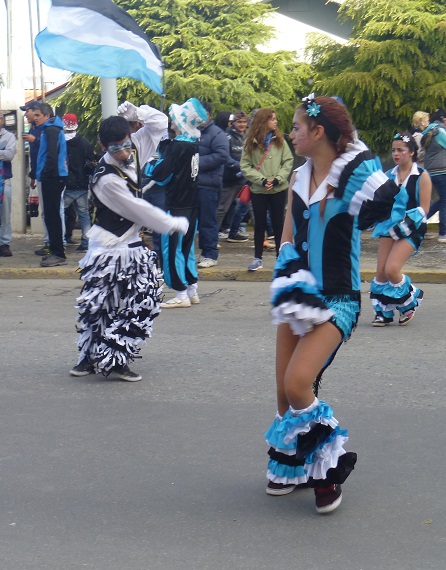
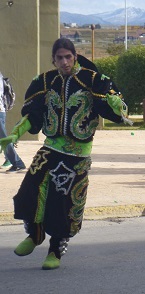
We happened past a sign that announced Carnival parades on Feb. 16 and 17. On the 17th, Tuesday, Mardi Gras, the big day, the parade went along the sea front, from 4-6 pm. Groups performed and kids from 4-18 squirted each other with foam. The more cynical sold the foam:
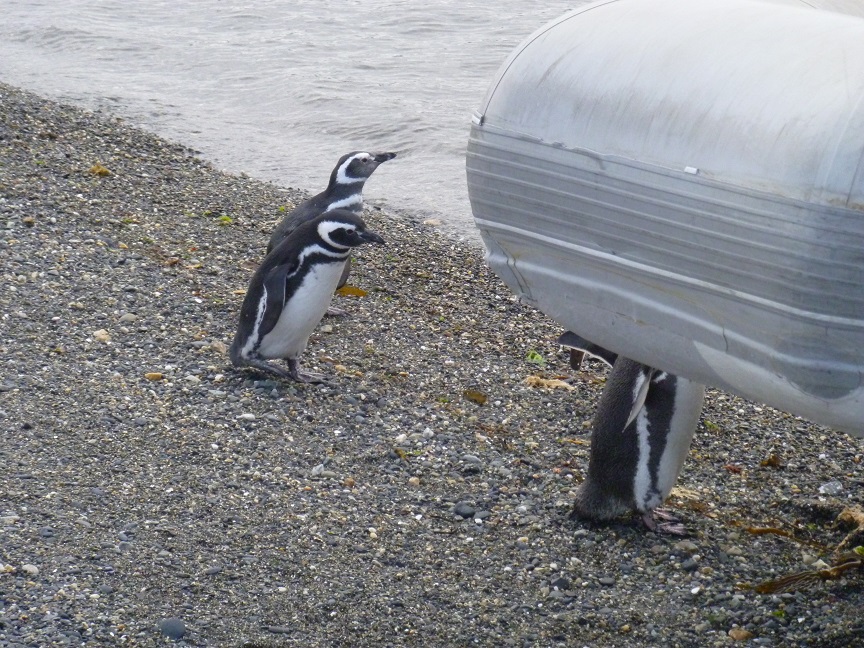
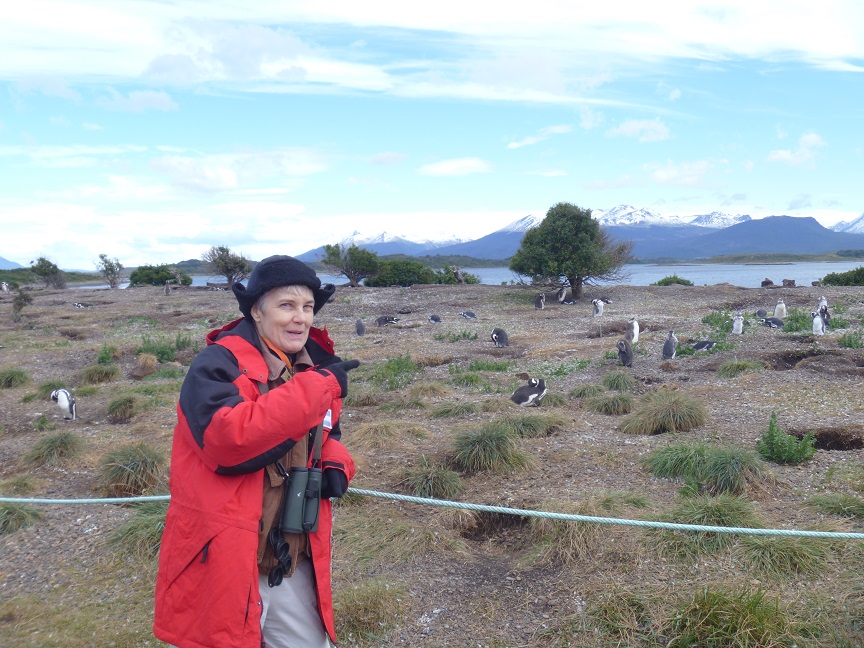
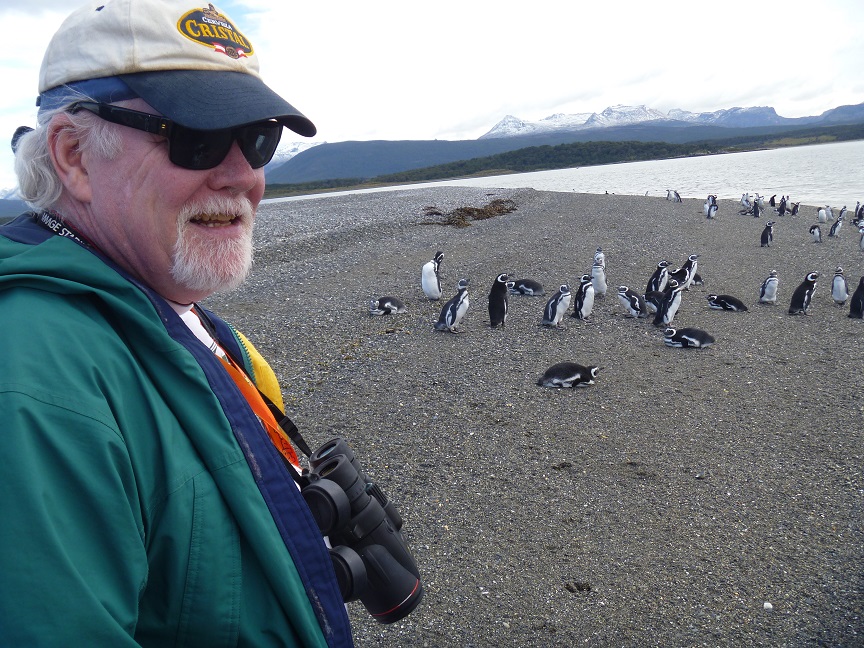
Today was our great adventure, visiting a colony of penguiuns on Martillo Island. We rode a bus for 90 minutes, then we were divided into two groups, about 12 each. Ours visited the museum and then the coffee shop at Estancia Harberton, the oldest settlement in the region. After that we rode for a few minutes in a covered zodiac to Martillo Island, where there were a zillion penguins, just hanging out. We saw Magellanic (black & white), King (cream colored chest) and Gentoo (red feet and beak) penguins.
They came over to the zodiac, “Are you my mother?” “Do you have fish?”
We love them. They make us laugh.
They didn’t run away. They were very, very cute.
This one is in a nest.
These two were asleep (their eyes are shut). These are Magellanic penguins. They aren’t very steady on their feet, so they like to lie down. (Don’t we all?)
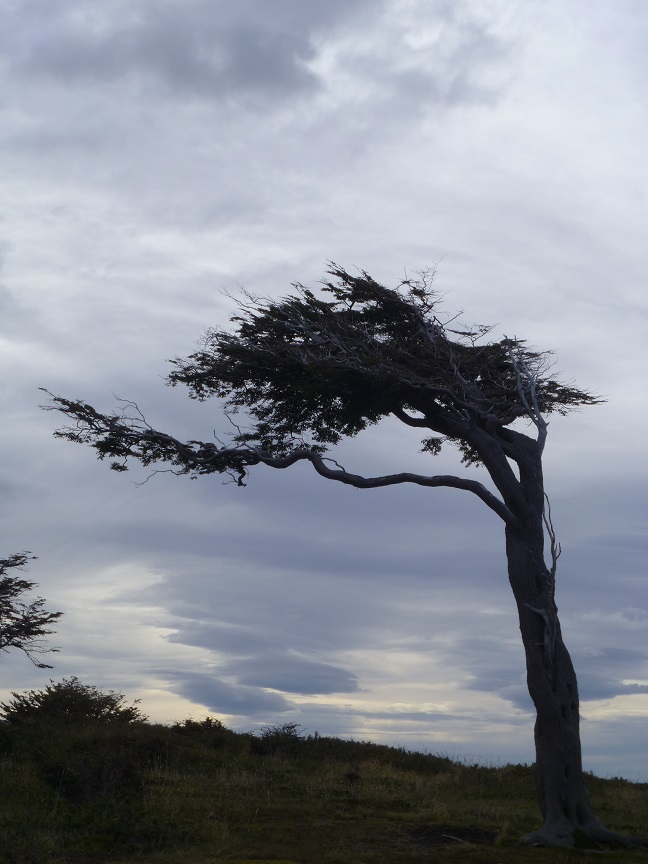
The hour was up and we had to return to the estancia and then to Ushuaia. We saw some interesting things on the way, including trees that show the direction of prevailing winds:

























 Llywindatravels 2025