Setting out cross country to get to Melipilla by the “back route” we discovered that Google Earth has some alignment issues and occasionally requires careful interpretation. We only backtracked a bit, and saw a great roadside shrine in a huge eucalyptus tree.
That was before we got hopelessly lost. Finally regained our route and made it to Melipilla, a fraction of our planned circuit to a national park. Things went better after that and we saw lots of the countryside, including a few father/son duos on horseback. Interesting to see that many riders use some traditional Chilean items of caballero (horseback rider) clothing (hat, short jacket, belt, short boots).
A less-traditionally garbed father-son pair out for a ride.
We stopped to buy water near the turnoff for the park, and the woman behind the counter said that admission to the park was only by previous appointment–the neighbors were concerned about visitors. She indicated where the turn was and we went on but missed the turn entirely. It was a lovely drive and we returned to our base in Buin through the southern portion of the Maipo Valley and Rancagua.
Less than an hour west of Santiago is the Casablanca Valley wine region, best known for the white wines Sauvignon Blanc and Chardonnay, and red Pinot Noir. We headed out that way because the representative of the Ruta de Vinos Casablanca responded to Jonathan’s email with a list of wineries that have tastings and do not require an advance reservation. The list was long, about eight vineyards, but our objective was to be able to keep going if a winery was not offering tastings or we decided not to visit.
Veramonte was the first winery on our list that we got to and we were happy to find that as promised, they offered wine tastings without a reservation. We bought a bottle of the Veramonte sauvignon blanc 2014, and the Primus Carmenere 2011. The grapes for the Carmenere come from the Colchagua Valley, though the wine is made at the winery in Casablanca.
Emiliana, north side of the road just a bit further along. We chatted with our host, Ramon, about the wines and he gave us the name of the distributor for Peru, to see whether we could find any there. We were seated with a young man (Jean-Benoit) who turned out to be from Montreal, traveling in the wine country of Chile. By the end of our tasting and chatting, we asked where he was off to next and found that he’d arrived by taxi with plans to continue on to other wineries as best he could. We offered to take him along with us since he had been good company. We shared our car picnic (air conditioning in the car), and then went on to the next winery.
We tasted four organic wines including Signos de Origen (white blend), and Coyam (red blend). JH bought a bottle of Coyam. The website says we also tasted wines from the Adobe and Nova, their other lines.
The entrance roads to some wineries are very beautiful.
Quintay, north side of the highway after Veramonte, did not have tastings available because they had groups with reservations coming in. They offered us a tasting an hour later, but we kept moving.
Or very imposing…
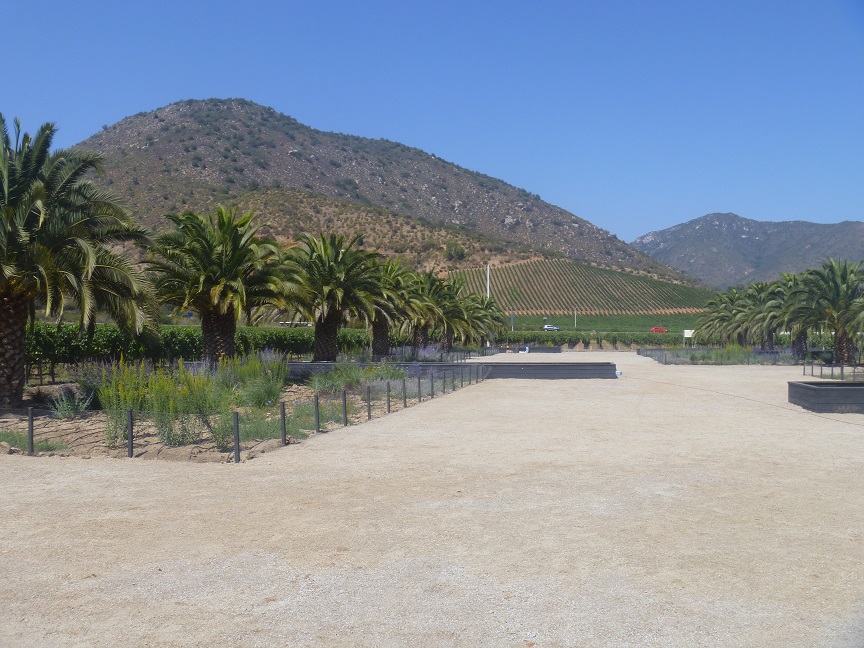
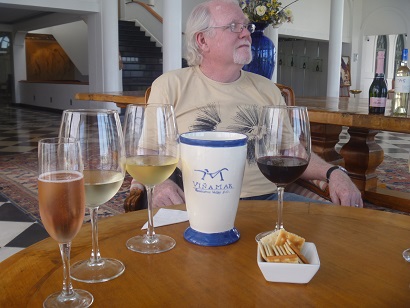
Vinamar was on the south side of the road up against a hill, great view out over vineyards. From the highway you tend not to notice Vinamar because the Indomita winery main building is higher on the hillside and larger. (Indomita either didn’t have tastings or was too expensive). Here we had a sparkling rose, sauvignon blanc, chardonnay and a cabernet sauvignon. My favorite was the sauvignon blanc, which I believe we all liked.
Getting to the William Cole vineyard involved turning off toward Tapihue and going to Km 4.5. We found it without trouble but they were not offering tastings, so we got back on the road. By now it was 3 pm, so we decided to try one more on the list.
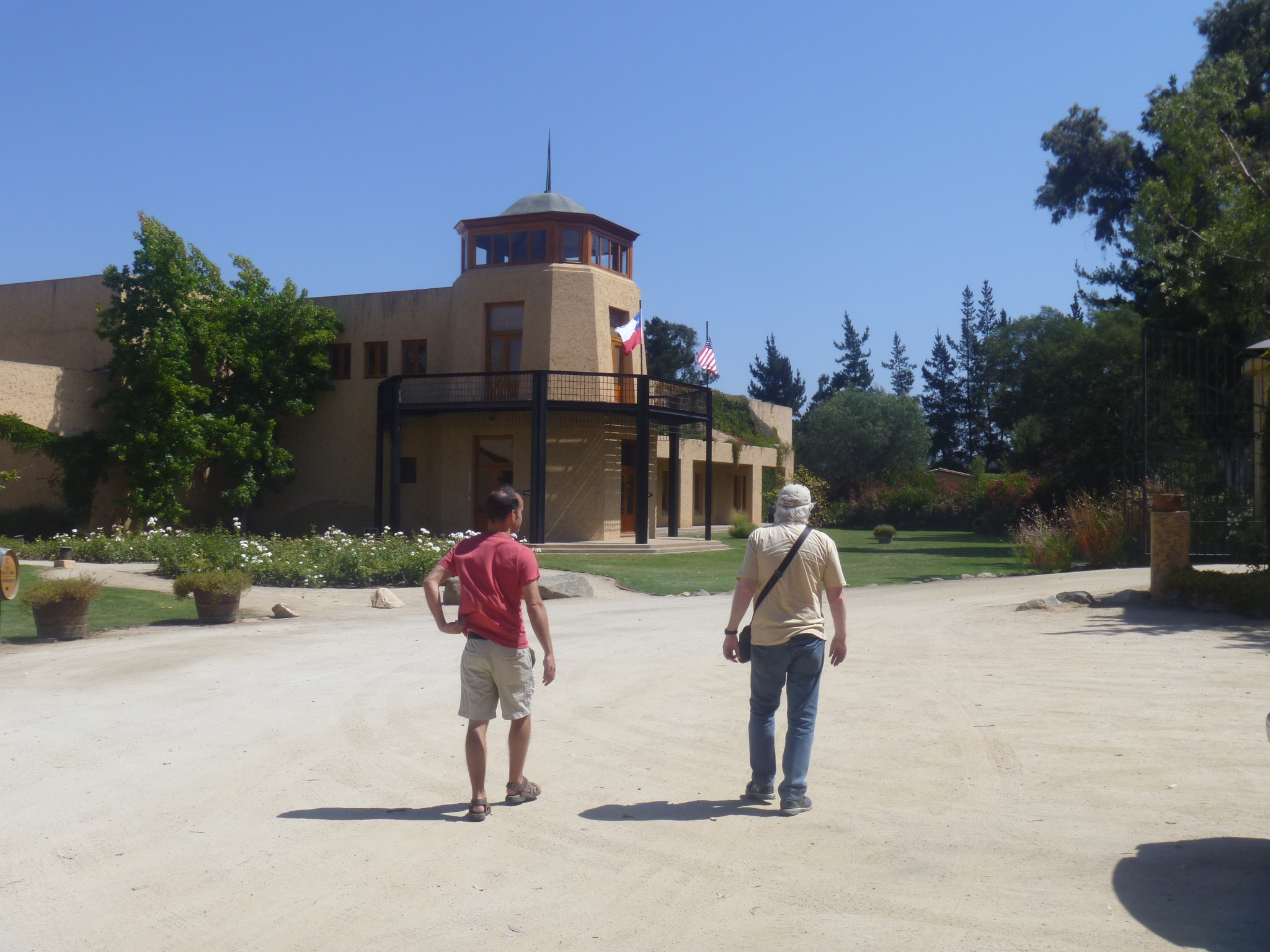
Arriving at Casas del Bosque
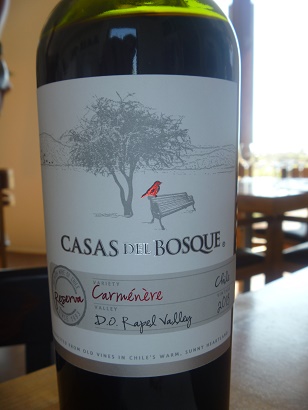
We chose Casas del Bosque as our last stop because it was described as in Casablanca. The rest of the directions said turn onto Padre Hurtado and follow the signs. These took us back out of town, but we did find the vineyard. They have a large restaurant that was busy and also had a number of tastings underway, and a nice gift shop to browse in while you waited for your place to be ready. Our hostess was an interesting young woman who spoke creditable English, and when I asked her about it, she said she learned at school and had never been out of Chile. She hopes to study abroad in France, where she has some relatives in the wine industry. Jean-Benoit encouraged her to learn French and go for it. She answered all our questions, even after being somewhat intimidated by our collective knowledge of wine and languages, but when Jonathan asked whether he could try Carmenere that wasn’t on our tour, she agreed and even opened a new bottle. No one has been as gracious.
With that, we dropped Jean Benoit in the center of Casablanca and headed for home/Buin. It was almost 7pm by the time we arrived, but it was a great day.
According to yesterday’s New York Times, we are senior nomads:
Too much luggage to ride?
(Some of us grew up knowing that if the NYT says so, it’s true. That was before Wikipedia–and the internet in general.) We do fit the image in the story in many ways; take a look.
I’ve seen this advertised throughout Chile and wondered what it was. In Peru, mote is hominy, so I was thinking that it was mote, “with little bones” (hueso = bone, so huesillo = little bone), a dish with meat and hominy. Not even close.
Mote con huesillos
In Chile, mote is wheat berries. Huesillos are dried peaches. The dried peaches are cooked in water with sugar and cinnamon. The cooked wheat berries are added and the treat is chilled and served with a spoon. Once I knew what it was, I had to try it, but I wanted to be sure it was ok to eat–Jonathan found a packaged mote con huesillos in the grocery store, so we got one. It is interesting to look at, but not much to actually eat. The wheat berries taste like cooked pasta (or cooked wheat berries) and the drink is very very sweet and not strongly cinnamon-flavored. The dried peaches, when reconstituted, don’t have a lot of peach flavor left in them. There you have it, mote con huesillos, weird, sweet, and chewy.
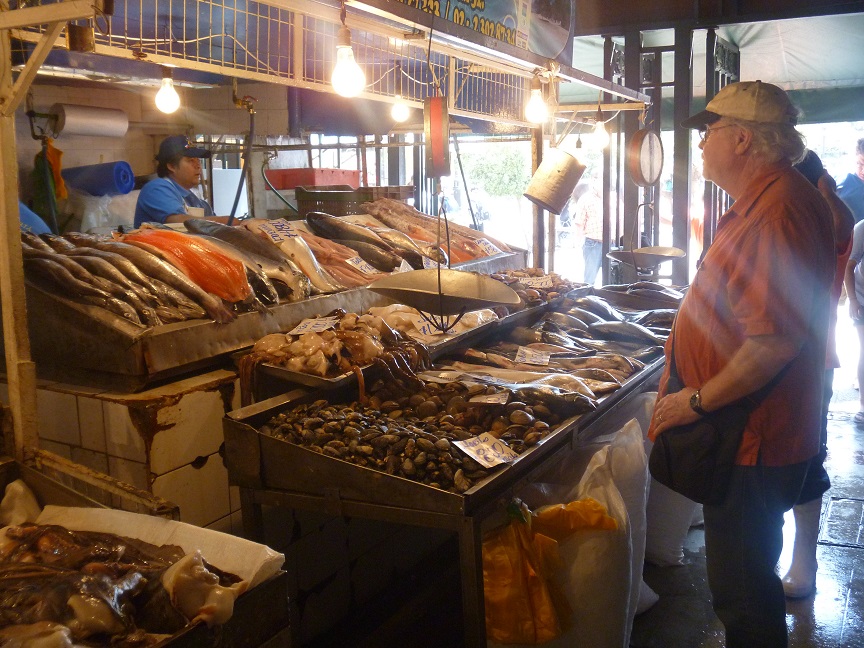
Our rental house is in Buin, a suburb of Santiago. We are in a housing development of small cookie-cutter houses, but it is very secure and with a car, accessible to the city. We headed into the wonderful Central Market, where we found that fish is sold in pieces too large for two people.
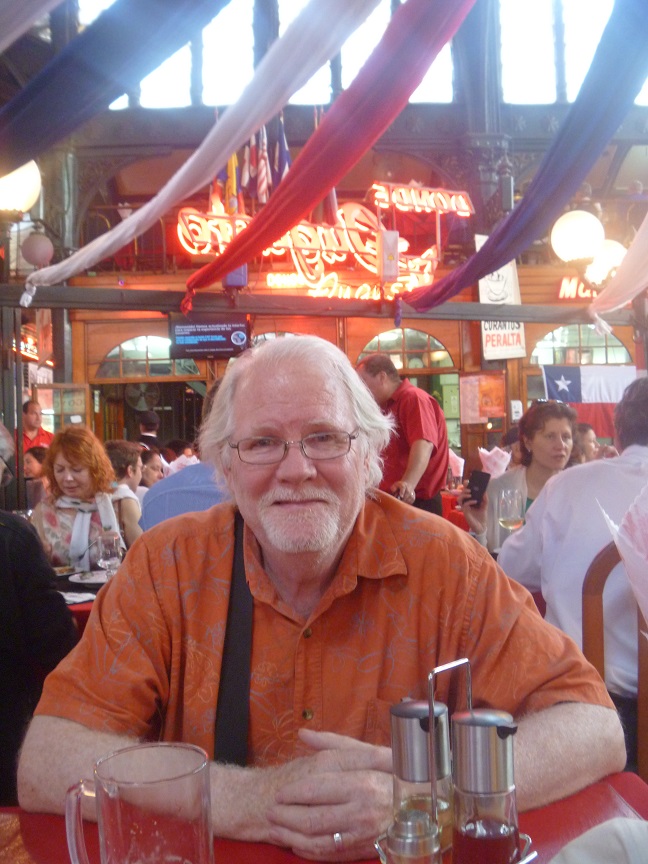
Our solution was to eat lunch in the market. Jonathan chose the winning dish, baby eels in garlic butter. We have only seen them previously in Spain, where they were even more expensive than in Chile–but so delicious.
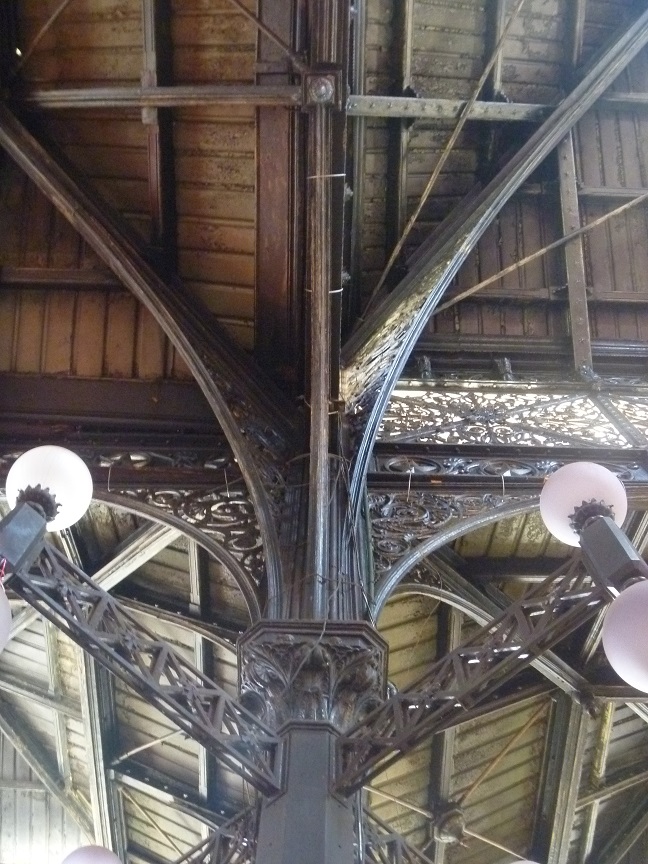
Jonathan after eating baby eels.Roof of the Central Market.
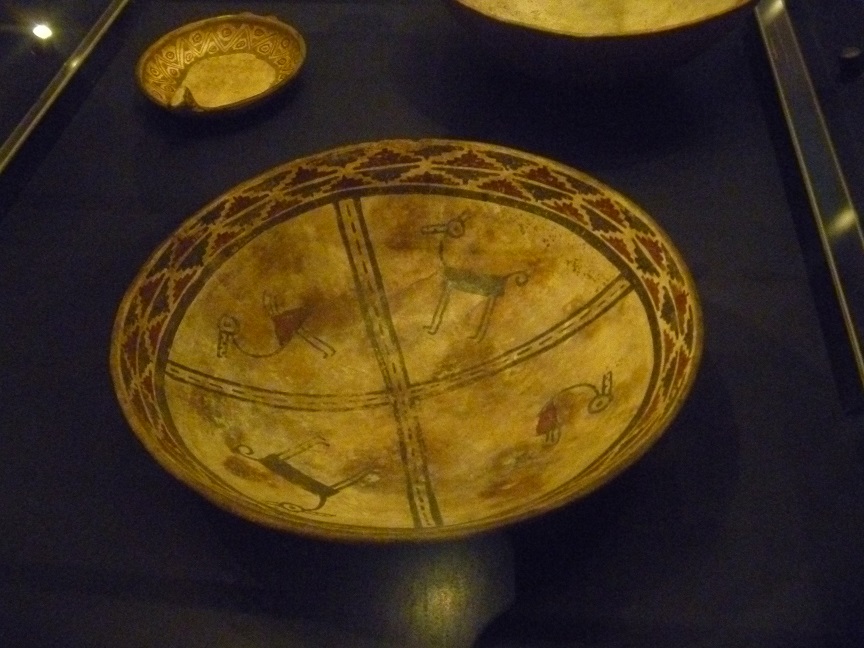
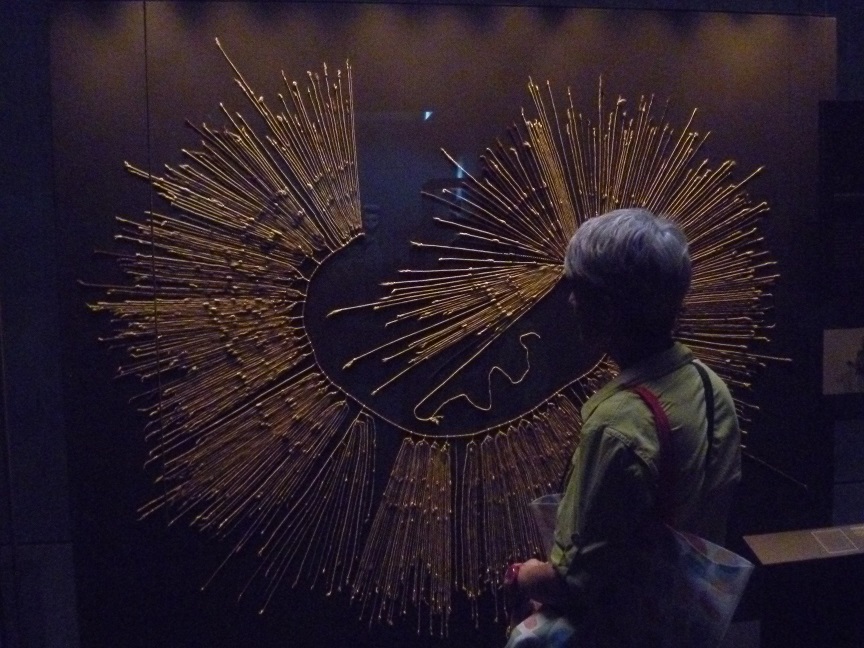
From lunch in the market, we visited the Chilean Museum of Precolumbian Art. They have an exhibit of the highlights of the museum that includes beautiful, impressive ancient pieces from all over the Americas. Many of these (most of these?) were donated by the museum’s founder, an architect and artifact collector, Sergio Larrain Garcia Moreno. The breadth of the collection makes me wonder whether any of the founding items could be fakes–there are so many fabulous items that you begin to doubt they could all exist (Olmec to Aztec, from West Mexico to Chile).
This looks like Mimbres but is Dieguito, from Chile.This fabulous quipu is from Arica, Chile.
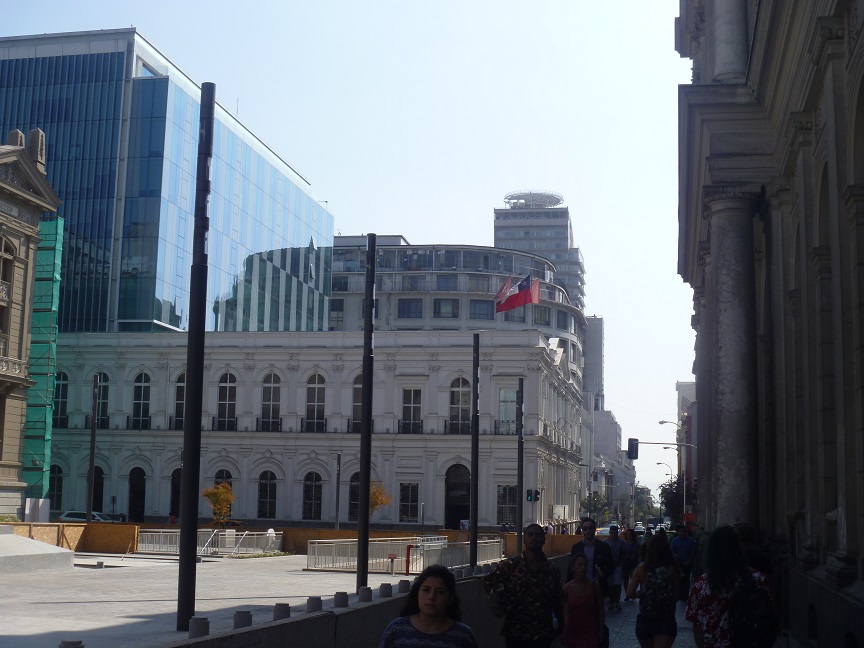
Leaving the museum, we photographed the building below because the reflection makes it look circular, while only the right half is curved. The left half is reflected in the glass-clad building across the street.
When we returned to Buin, I looked up the founder of the precolumbian museum, Sergio Larrain Garcia Moreno, and found that he was an architect who designed the first Modernist building in Santiago in 1929. That curved building in our photo is the Edificio Oberpaur, the structure that made Garcia Moreno’s career.
For a lover of arts & crafts, the drive from Talca to Santiago is difficult to make without a number of stops. My favorite were the wicker stands along the highway, where there were some wonderful lampshades,
We also passed the furniture makers.
And who wouldn’t want a stone fountain or a black-necked swan?
We decided to go with natural wonders over wine and we were well rewarded at las Siete Tazas national park, near the town of Radal. We drove north from Talca to Molina, and east into the mountains for 30 km. About 20 km of that was unpaved but relatively level.
Part way along I saw parrots flying overhead. We stopped just as a whole flock perched in a tree across the road. They were burrowing parrots, or loro tricahue, cyanoliseus patagonus, an endangered species. There are flocks of these parrots in several places in Chile, but generally they are endangered by habitat loss and theft of chicks for the pet trade.
These olive green parrots have a yellow belly with a red spot in the center.
The first scenic spot inside the park is La Vela de La Novia (Bridal Veil) falls, at a pullout along the road. It turned out to be spectacularly beautiful.
Unbelievably beautiful.Very windy, but it blew away the clouds.
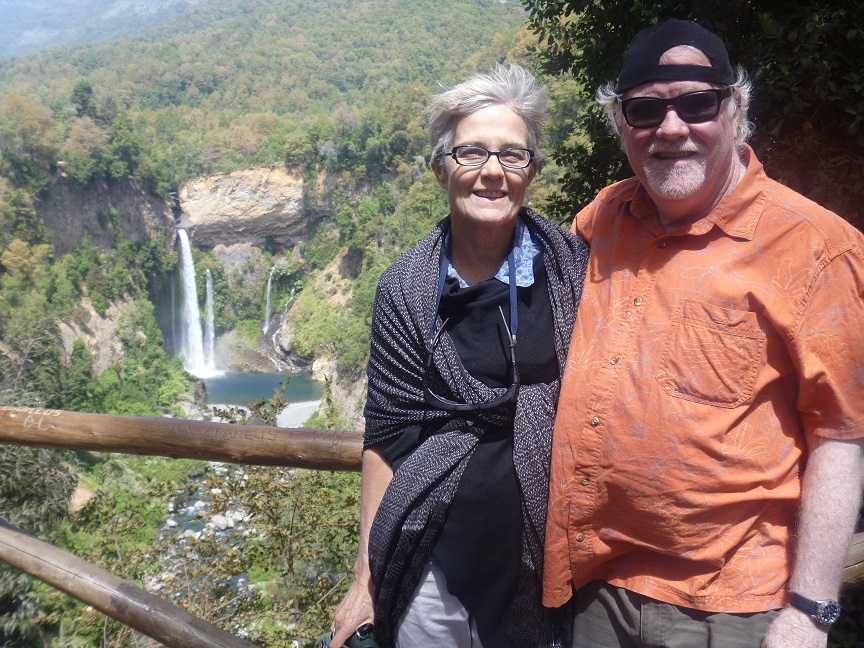
Onward to the Siete Tazas, a series of waterfalls that have each carved a basin one below the next. You cannot get all seven in a photo, but you get the idea. The severe earthquake in 2010 changed the waterfalls. For a year the siete tazas were completely dry. The water returned but is not as abundant as it was before 2010. I’ve seen a photo of the waterfall in 2000 and each basin is overflowing with water, now the basins are not quite full and the water flows out a single chute. The theory presented is that the earthquake opened up a fissure that diverted some of the water.
Las Siete Tazas, a wonder of nature.
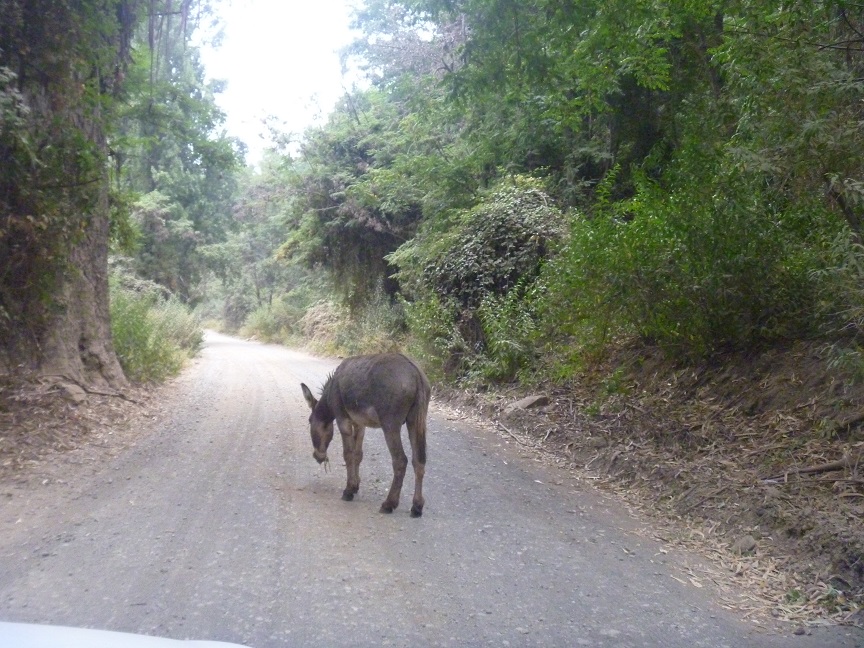
We headed for home, slowed slightly by a stray donkey in the road. He was not very interested in moving.
One of our reasons for coming to Chile was to visit wineries, so we set off to visit the two that do not require advance reservations. Our first stop, Balduzzi vineyards, was easy. The visitor center and tasting room is not far off the main north south highway (Ruta 5). We had a tour with two young men from Montreal who spoke English and French, and ended with a tasting of four wines. We bought a bottle of the sauvignon blanc that we tasted, and a bottle of a very good red that were not offered as part of the tasting.
Not every vineyard was as easy to find:
Even getting out of the car and peering into the bushes, I had trouble seeing which way the arrow pointed.
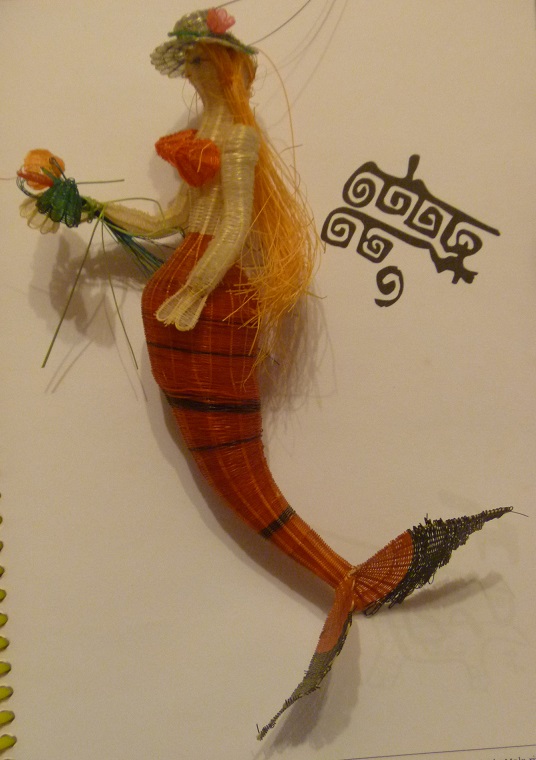
After picnic lunch by the side of the road–it was so hot by now (1 pm) that we ate in the car with the A/C running. Rested and refreshed, we set off for the Gilmore vineyard. We had a dot on a large map and a sketch map on the Gilmore brochure. Once we found the turnoff for Concepcion, the rest was easy, follow the road to km marker 20 and there it is. We did not tour or taste, because Gilmore has a very nice shop with local crafts, yarn, and wine from the winery, but they do not offer tasting. We bought a very intriguing mermaid created from colored and twined horsehair–creative and a good Christmas tree ornament. Most horsehair work in Chile consists of geometric patterned items such as earrings or hair clips.
Mermaid of woven horsehair.
Jonathan did purchase a bottle of wine and we asked whether there were any other wineries along the road toward Concepcion. The young woman in the shop told us that the J. Bouchon winery was 10 km further down the road and very well marked. Since we spent relatively little time at Gilmore we decided to visit Bouchon.
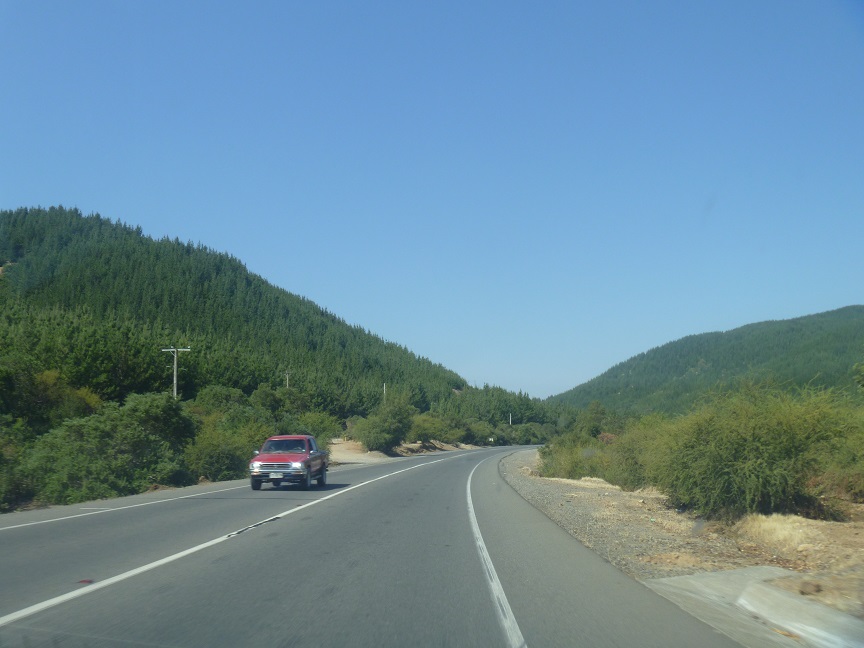
“Well marked” seems to be a relative term. We drove along expecting a sign “J. Bouchon”, or maybe even more than one sign, after all, it was “well marked”. When we had gone another 20 km without sighting anything, we noticed that we had entered an area of pine plantations, and there were no vineyards visible along the road.
Not much room for grape vines.
Wondering where we’d gone wrong, we turned back. At the 10 km marker we looked at an intersection, but there was no sign.
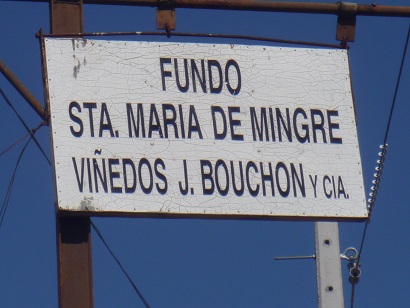
When we first drove past, I didn’t think this could be a sign for a “well-marked” vineyard.When Jonathan started laughing, I knew this was the vineyard sign.
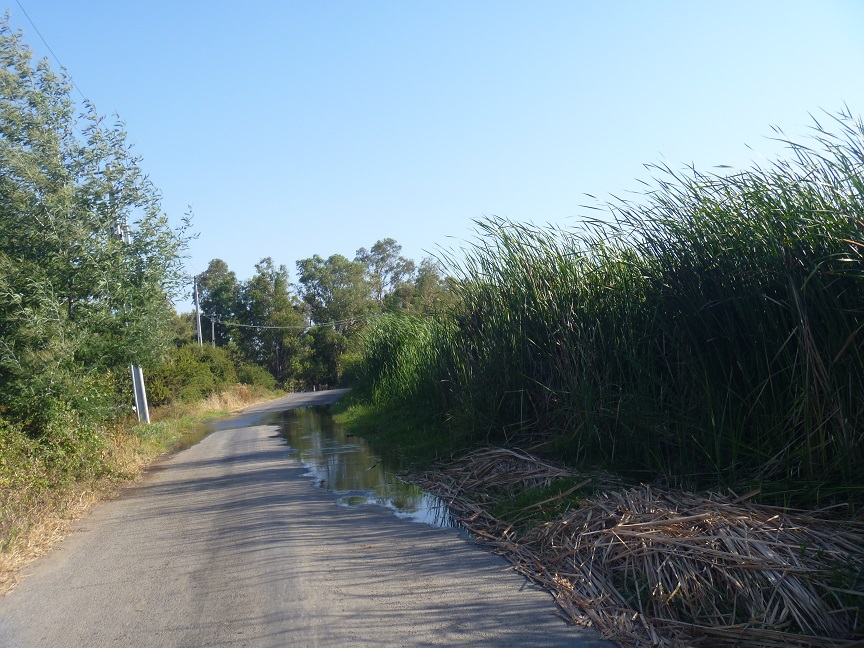
Note that the last words are “J. Bouchon y Cia.” And that wasn’t the end of the road by any means. It wound around and up and down with little evidence of vines.
I still don’t see any vines.Do you see vines in the distance?
Finally,
Here’s the first vines you see. Is this place abandoned?
Not at all. J. Bouchon has rental rooms/villas and a large facility, but we didn’t see any people. We found a gardener who directed us toward the back of the corrugated metal building off to one side of the residential zone. Emerging from it we met a young man who was beginning a tour with a pair of young Canadians and their 3 month-old. We joined them. Though J. Bouchon doesn’t offer tours, he was giving us one anyway. We would not be able to taste anything, but could purchase wine at a 20% discount. Though we’ve now been through the winery tour several times, this one was distinguished by the fact that a truckload of machine-harvested chardonnay grapes had just come from the field and we could see it unloaded and sent through the sorter.
Fire hose of chardonnay grapes, machine harvested.
Another load, or several, had already come in, because there was already a dump truck full of the material that was strained out of the grapes: stems, seeds, skins.
Sorter in action, carrying grapes up to the strainer.
This brown mass is used as animal feed (put in a silo first) rather than composted or sold.
Grape detritus.Quail in lower right corner, in the yard of the J. Bouchon winery.
We had a wonderful tour at a place that claimed not to give tours, and our Canadian companions were delightful, including 3 month old Quinn.
Our purchase from J. Bouchon:
Mingre, a premium wine from Gilmore, 40% carmenere, 30% syrah, 30% cabernet sauvignon
Airbnb listings usually provide directions, and Barbara, our hostess for this week, had provided a sheet with landmarks showing the way to her house. In addition, we had a map of the region indicating how to get from the airport in Santiago to the city of Talca. The directions looked straightforward, and the map showed that Barbara’s house was just on the outskirts of town.
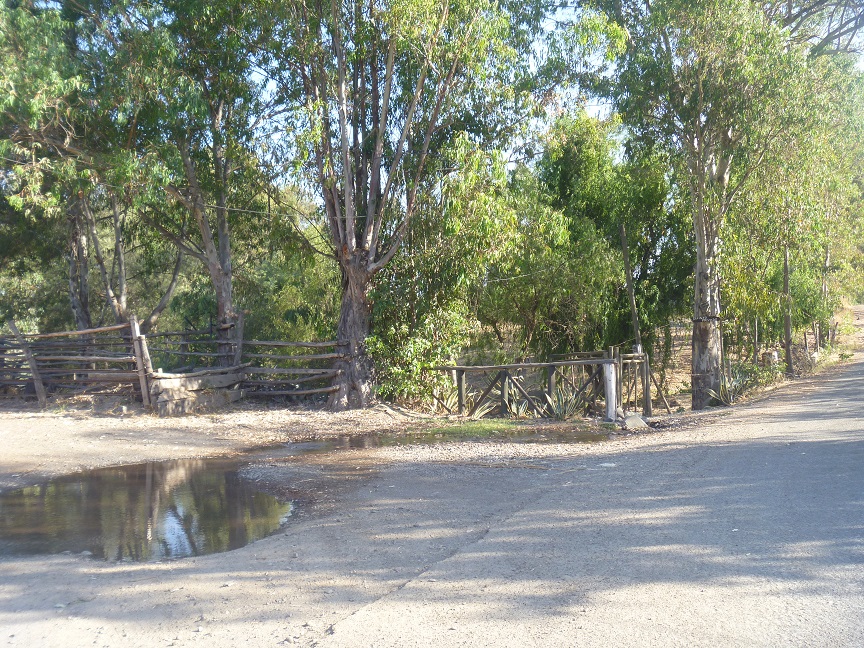
Does this look like the outskirts of town, or does it look like “Go back! You are lost!”This looked like a good place to turn around.But then, we saw a driveway….like Hansel and Gretel, the road stretched away into the woods….Does this mean “Keep Out”, or possibly “Come In”?
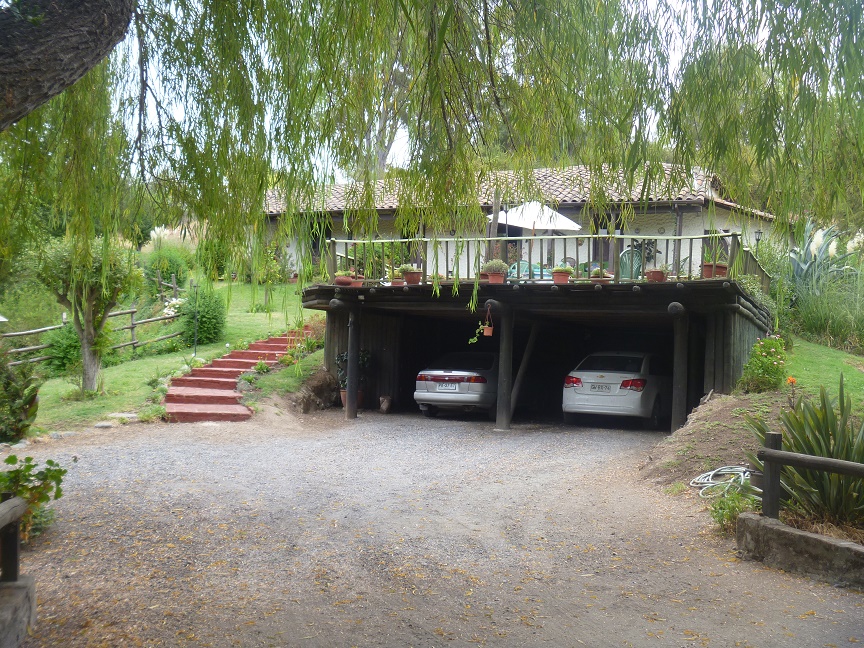
At the end of this driveway, we began to turn around–again–and saw our destination, Casa Barbara.
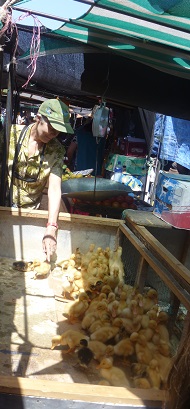
The weather in Talca is like August in the US, cool in the morning and evening and very warm during the day–today’s high was 33 C (91 F). On Saturday, we visited the market in Chillan, a town to the south. It was more than a square block, with booths selling fruit, vegetables, meat, fish & shellfish, clothing, household goods, even some souvenirs. I couldn’t resist petting the ducklings.
We enjoyed seeing the bustle, and noticing that the market was within a block of a HUGE mall. The presence of malls doesn’t seem to have put much of a dent in the markets, at least not yet. There were also some of the unusual things that you sometimes see, like the guy repairing his car across the street from the mall.
Leaving the market, we stopped in the main square, the Plaza de Armas, where there is a huge cross erected in honor of Bernardo O’Higgins, one of the heroes of Chilean independence, born in Chillan. In the plaza we found a very pink flowering tree:
Across the street from the plaza was a small souvenir area where i found silver earrings made from coins dating to 1925.
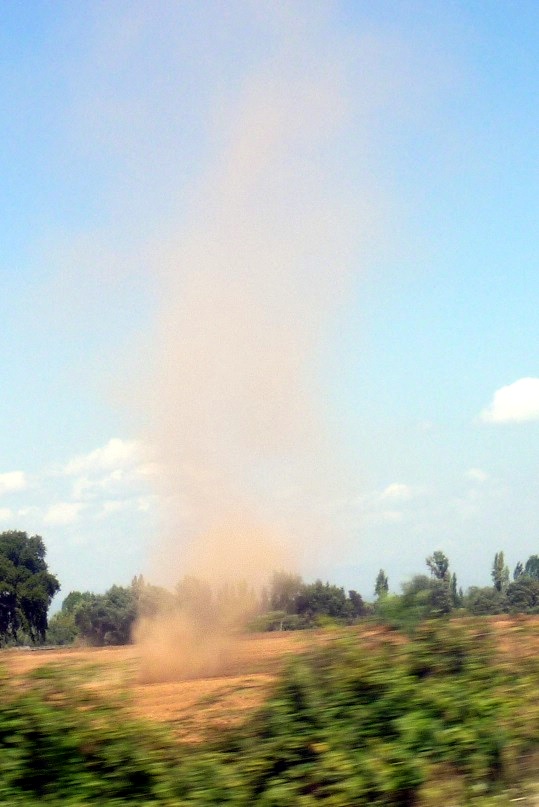
On the way home we passed two dust devils, larger than anything I’ve seen:
From a distance, I thought it was a plume of smoke, but it rose straight into the air, and Chile is rarely without a breeze. The base looked like it was boiling.




















 Llywindatravels 2025