Chilecito, Jan. 29 and 30

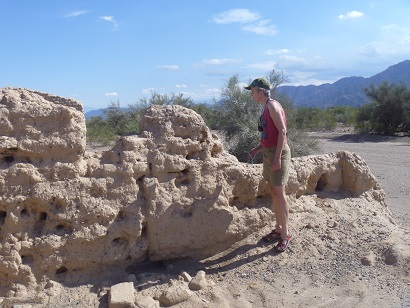
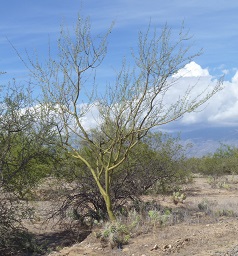
The drive to Chilecito started out looking like Missouri, rolling hills and cows. Then it looked like Kauai, steep hills and cows. After that it shifted gradually toward Arizona, becoming less and less green with more scrub that became lower as we drove west, finally culminating with cactus and low scrub that looks like the Sonoran desert, complete with palo verde and saguaro (?) cactus.

P1030994cropsm
1/29 Details: We left Villa Maria at 9 am, arrived in Chilecito at 5:30 pm having driven 550 km. We figured out that gas costs $6.41/gallon. At first we ran into huge traffic in an area called Valle Hermosa where most of the population of Argentina seemed to be vacationing. Traffic was at a crawl for over an hour. It was like trying to drive through Lake George Village on the 4th of July weekend. Quite similar, too. A big lake, river, fishing, stores selling bait, fruit, treats, beach wear, you name it.

P1030965sm

We crawled to the north end of the valley.
After that there was no traffic all the way to Chilecito. After unloading and getting our room from Silvia, I went for a dip in the tiny but very nice pool. We birdwatched in the adjacent field, where we saw a meadowlark, and a red-brown bird that we still haven’t identified. Later we med Augustina, daughter of the owners, who checked us in.

P1030985sm P1030991
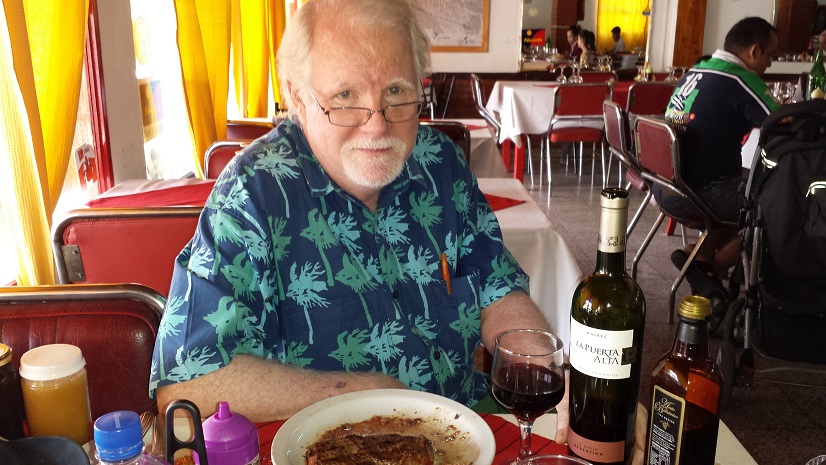
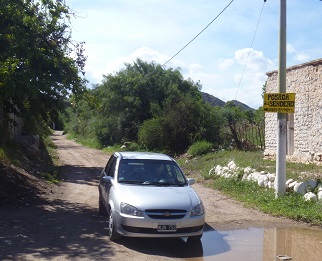
Our hotel, the Posada del Sendero, is easy to find because of the signs put up at the roundabout into Chilecito and at crucial turns in the road. Rooms cluster around a large living area with fireplace. Now that it is summer, however, there are tables and chairs outdoors around the pool and by the outdoor kitchen with large hearth and oven, covered area with picnic table and refrigerator for guests items. We stowed our wine, coke, mineral water, peanut butter, olives, butter…..At 8 pm we went into Chilecito for dinner, understanding that Argentines eat late. We found that the restaurant that was recommended to us was closed until 9 pm, so we went to the main plaza to Robert A. We ordered a bottle of wine and the waiter asked whether we’d like soda and ice (Jonathan laughed) but it turns out that’s how they drink it here. The wine isn’t very good, so soda and ice are just fine. We ended up not having dinner. After 45 minutes, nothing was in sight and we were ready to go home. Our waiter was a bit crestfallen. We stopped for ice cream, Jonathan had flavors with long names, but were mostly vanilla and I had Kion with whisky that turned out to be ice cream with candied kumquats.

ARGENTINA!

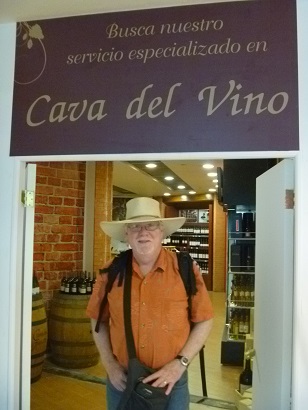
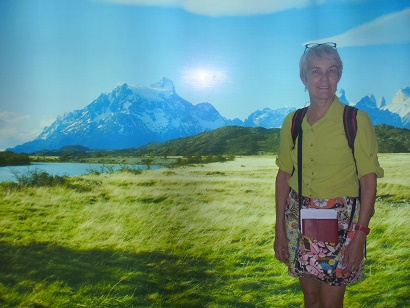
It was a long day getting to Argentina. Not much to take pictures of either, so we each took a photo of what we’d like to see:

P1030953smWe’re fulfilling Jonathan’s dream first, heading for Mendoza via Chilecito, also wine territory.

P1030955sm

Patagonia comes later in the month. Our flights were uneventful, which is a good thing. I do hate paying $6 for a quart of water, but that’s international travel.

1/27Details: Left Hotel Senorial at 9:30 am for Jorge Chavez airport. Our flight departed for Santiago at 12:30 pm, ate a reasonable sandwich and mini glass of wine for the meal and arrived. 4:30 pm. Local time was 6:30 pm. We ate at a Ruby Tuesday in the airport after I found there was no meal on the flight to Buenos Aires. Flight for BA left at 8:30 pm and arrived at the Aeroparque at 10:30 pm. Migracion and customs went rapidly and we arrived at the Alamo rental desk at 10:58 pm to find no one there. We took a taxi to our hotel, Conventillo de lujo, near the airport (100 pesos). It was a good thing we had the address because the hotel was unmarked and looks like an apartment building. It’s a hotel, rental apartment place, and tango tour center, managed by a Colombian woman (didn’t get her name) and Angel.
They have a covered dining area and kitchen on the first floor and covered rooftop terraces with seating and barbeques on the 4th and 5th floor. The elevator only goes up to the third floor, however. The entire place is decorated with tango theme posters and objects, and each room is named, all very funky looking, but clean and comfortable. We stayed in what may be the smallest, the Milongita, but the A/C worked, the shower was hot and we slept well.
1/28 Details: Ran out of hot water after the first shower, glad I took one last night. We met Ray, who owns the hotel with his wife who is Argentine. He went out for bread, then chatted. Ray and his wife lived in Detroit, where he worked at Ford and they gave tango lessons and brought tango groups to Buenos Aires. They couldn’t find a place that had all they needed for their gtooups so they built one. They have a small dance floor with a big mirror, good for lessons and demonstrations. We ate fresh bread with jam, coffee, banana and were offered oatmeal and eggs, which we declined.
Angel went out to find us a taxi in the downpour because the radio taxis were running 40 minutes wait at least and we were already late for the distnce we plan to cover. Left the Conventillo about 9:40 am got to the airport in about 20 min and had no trouble at the rental desk. While JH filled out the paperwork, I got money from an ATM (limit of 700 pesos per transaction) and bought a roadmap. We set off in the downpour and got out of town from the google earth map with directions that JH downloaded. The highway to Rosario and then Cordoba starts out as 6 lanes, goes down to four, then two lanes each way. It’s divided by a big green central area and we can easily go 100-130 km/hr—a lot better than Peru. Here speed bumps are called “lomo de burro”, burro’s back, compared to “rompe muelle” molar breaker, in Peru.
We left the airport around 10:45 am and were in our hotel, Le Parc Hotel and Suites, in Villa Maria by 3 pm. It stopped raining around 1:30pm. That is pretty fast for 550 km; fast compared to Peru, anyway.

Back down the Andes–1/24 and 1/25

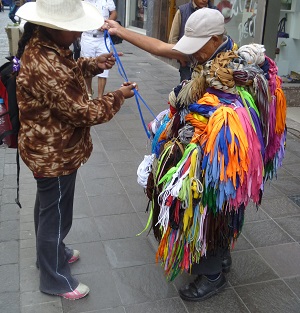
One of the last things I saw in Puno was a shoelace salesman carrying his wares around his neck.

P1030938sm1

As we turned our backs to Bolivia we were again impressed with the beauty of the puna and the range of environments that we crossed. In two days we went from a high of 4400 m to sea level, passing snow capped mountains, the highest navigable lake in the world, the puna grasslands, utterly arid desert and gorgeous waves crashing on the coast. What a place you are, Peru!

P1030947sm

From Puno to Arequipa we saw flocks and flocks of alpaca. It seems to be lambing season, tiny white baby alpaca were postcard cute, trailing around after their mothers or prostrate on the grass resting. There were vicuna, lots of caracara and other birds, high hills in the puna that looked like they were covered with greenish velvet, really tufts of grass. There are flat sea green mosses that spread out in irregular circles, too, looking like they were poured on the ground. It’s a wonderful if difficult environment, with farmsteads spread across the base of the hills. The walk to school must really be 10 miles, uphill both ways.

P1030928sm

The Saturday market we visited was in Imata, drawn by a huge pile of sheep fleeces and alpaca fleeces..

P1030930

Details 1/24: Rain overnight until about 8 am. The sun came out, we left the hotel at 9 am and had no trouble finding our way out of town, even the turnoff for the shorter route. Start mileage 167395. We arrived in Arequipa about 2:30 pm. Total for the day was.

We ate Jonathan’s birthday dinner at the Camaroncito, but with the menu from the adjoining Casona del Virrey. It doesn’t matter which menu you order from, as they are both owned by the same group. The food was excellent, deep fried pork ribs, with potatoes, green beans/carrots; I had osso buco that came with sautéed red pepper, onion and zucchini and pasta with green olives. JH started with the quinoa soup that was creamy but contained no milk products. We came back to the hotel to eat dessert, the complimentary birthday cake, chocolate with coffee/chocolate fudge filling/frosting. The hotel delivered it to our door shortly after we checked in. Very thoughtful to notice the date from his passport.
This hotel, Los Tambos Arequipa, has the best service I’ve ever had. The cake, the help in finding a mechanic who would make a house call, directions, general cheerfulness. I’ve never seen greater willingness of staff to find out information of any kind for a guest. Cost s/. 210 per night. Current exchange rate is just over s/. 3=US$1

Details 1/25: Left Arequipa at 9 am. Weather 21 C. Made our way out of Arequipa within 15 minutes, and that’s saying something, not one U-turn required. Stopped to change drivers twice, and arrived in Nazca at 5 pm. It took 2 hours less going downhill (to Nazca) than uphill (to Arequipa).

Lima to Nasca smP1030949sm
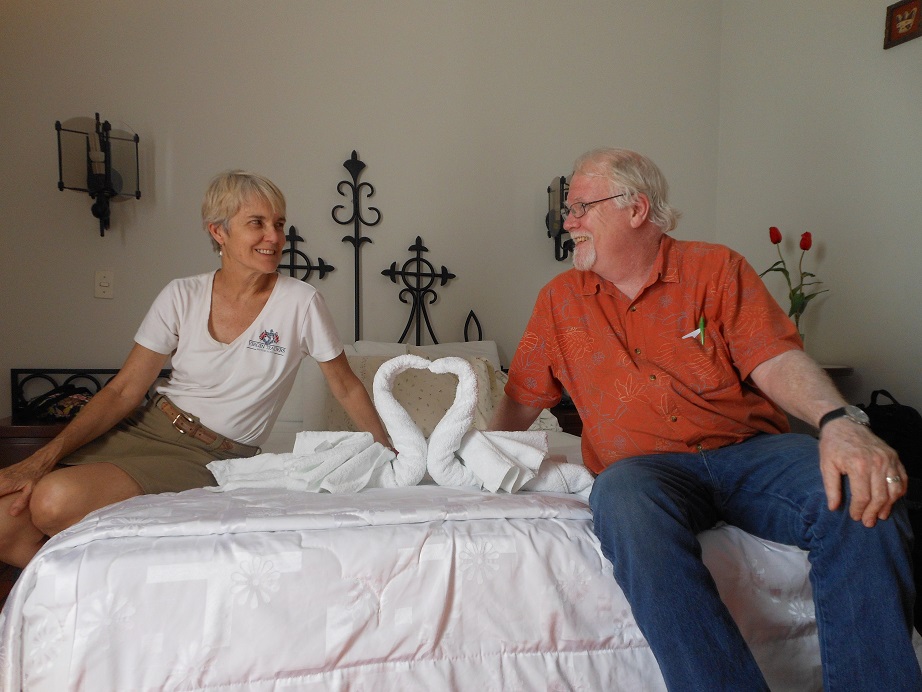
Hotel Nazca Lines gave us the rate we found on booking.com (US$68), exactly what we paid last time. This despite being quoted $140 per night on the phone, and $85 on arrival. They have great towel sculpture. Our first visit is to the right. Our second visit, below. Despite the elephants, we enjoyed our stay less this time, it took 3 tries before they gave us a new remote for the A/C. It just needed new batteries, but the guy was sure it didn’t, until it died and the A/C wouldn’t go on after dinner. Our patio hadn’t been cleaned lately, so anything you set down on the tiled bench came up with a layer of dust. I used a towel to clear an area to set laundry to dry, then the towel was red-brown with dirt. Also turns out that the floor wasn’t cleaned out there either and we had to brush red-brown footprints off the sheets when I came in and put my feet up. We ate in, this time, also a mistake. The pisco sours didn’t have enough ice, though they weren’t strong at all. The pasta with chicken and garlic included no chicken. This was pointed out when the check came and the waiter offered to add some chicken….. This is a great place to stay if you are going to swim and eat dinner in town.

Making Lemonade 1/23

Once the rain stopped it was a gorgeous day. We began by getting up very early, being first in line at the Banco de la Nacion to pay for a car inspection, one of the steps to getting our needed permit. Then on to the police that do the inspection to present evidence that we’d paid where we were told in no uncertain terms that they would do the inspection but we need the original of a document (gravamen) that can only be issued in Lima. This despite the fact that we have an exact official original copy of the required information with the only difference that it was issued in Puno–this duly noted on the form. He was having none of this.

We spent the morning begging favors from our friend Cecelia in Lima, who could get the copy and send it to Puno, but today is Friday. We spent the rest of the morning and through lunch trying to work out alternate plans and hoping something would happen to make a miracle happen.

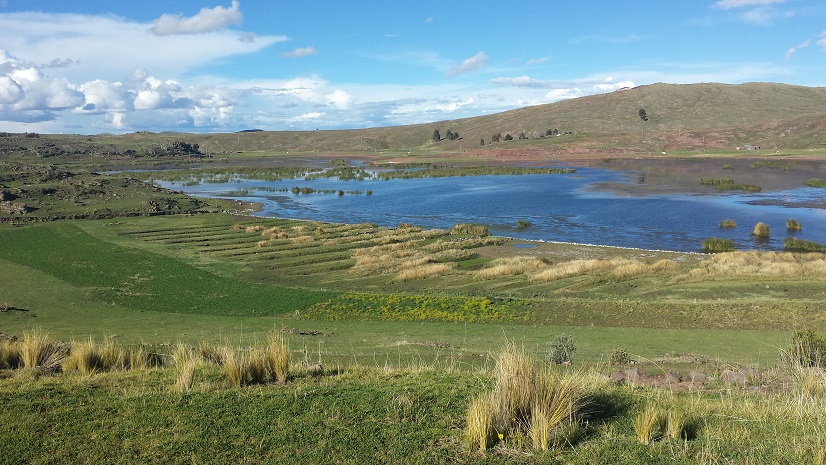
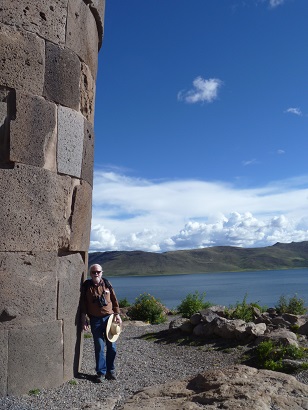
Determined to take the rest of the afternoon off to think, we drove to Sillustani, an archaeological site about a 40 min drive outside Puno. Our friend and fellow archaeologist Arturo Ruiz worked at Sillustani in the 1970s and made a key find of a burial deposit of more than 100 gold objects. Subsequently, and probably due in some part to Arturo’s efforts, the site was developed for tourism. There’s even a commemorative coin of one of the burial towers, or chullpas. It is a beautiful, and a guidebook tipped us off to the birds in the surrounding lake. We saw a family of caracaras (2 adults, 1 juvenile) and several others new to us. It was a dream afternoon.

20150123_163011sm P1030917sm

Driving back to Puno around 5 pm we heard that the form we need could be collected in Lima at 9 am Saturday, put on a bus “express” to Puno and arrive 18 hours later, bringing us to dawn Sunday. Everything is closed. On Monday, we could take the paper to the police, collect our form and then proceed to a customs agent where for somewhere between $250 and the sky’s the limit, we could get the form. The problem–by Tuesday, when we might get all the way out of Peru and maybe into Bolivia after that, we would not be able to make up the days lost and we would lose our reservations everywhere.

We threw in the towel, start our return to Lima tomorrow, and pick up again with a flight from Lima to Buenos Aires on the 27th.


Desaguadero means “Storm Drain”. How about “the pits”?

There are no photos from our drive to Desaguadero. We started off bright and early expecting to get to Bolivia. Instead we got bogged down so deeply in bureaucratic mire that we were barely able to back out and return to Puno. How bad was it? Customs agents seemed to have a real sparkle in their eye when saying that there was no way on earth they could help you get the necessary papers that no one ever mentioned you needed but that you should have known about all along.

None of these papers are available within  a three day drive, and don’t bother with copies, only the originals will do–and there’s no overnight express. Only the 18 hour bus “express”. Possibly the most demoralizing part of this is the genuine pleasure that people seemed to take in not helping. This started with the Peruvian customs post, went on to the customs agents–we visited three before caving in and returning to Puno. Of course we’d gone to Migracion first to get stamped as leaving Peru, and of course only one person could un-stamp our passports, and he just went to lunch. An hour and a half later, we went back to Puno determined to get the papers, find a customs agent, get the temporary export permit for the car and GO. After all, the Bolivians had filled us in on everything that we needed for the temporary import permit, and we have all that paperwork. We didn’t even get a chance to try it out.

See Jonathan’s facebook page for the ugly details.

Change of direction toward Puno 1/21

To ease our way into high altitude, we decided to skip Moquegua and go up to Puno, to have more time at high altitude before crossing the border to Bolivia. We need out wits about us and I didn’t want to be feeling sick.

1/21/2015
Arequipa to Puno. Weather sunny to slight overcast. Temperatures from 23 down to 14 degrees. Car still overheating, but it doesn’t seem to make any difference.

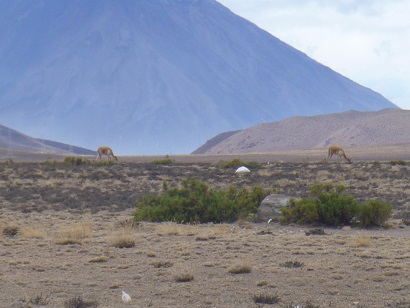
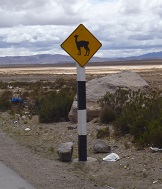
Within an hour of leaving Arequipa we found ourselves in the puna, high altitude grassland that stretches for miles up to the Misti volcano that overlooks Arequipa. Part of this area is a reserve for vicuna and guanaco, the wild relatives of llama and alpaca. I thought Jonathan was kidding when he said, “There’s vicuna, pull over!” We watched the six animals graze for a while. Later we saw mixed flocks, mostly alpaca, but also the occasional sheep, cow and perhaps llama or guanaco. We saw a sharply variegated black and white hawk and Chilean flamingos wading in shallow lakes.

P1030868smP1030865sm

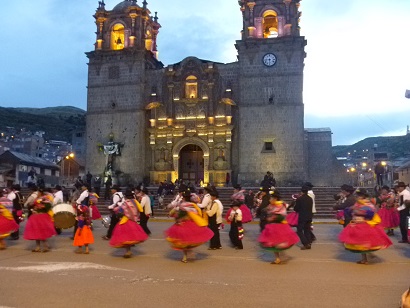
We arrived in Puno around 2:30 pm and were resting by 3. We benefitted from our two days in Arequipa but Puno is 3850 m, about 1500 m higher than Arequipa. You pant going up stairs, sometimes your fingers and toes tingle and you have a slight headache. I hope this will pass overnight. We walked down to the Plaza de Armas and found a pasacalle in full swing. A man carrying a decorative banner announcing the group led men wearing black and white and playing Andean flutes that look like oversized recorders. Beside and behind came two rows of women dancing and whirling in traditional highland multitiered skirts, pollera, singing along with the music. Two women led, marked by wearing many more skirts than the others. The group danced their way around the Plaza, past the cathedral, down the street and away.

P1030878sm P1030882sm

We ate dinner at Mojsas, where I had quinoa soup and Jonathan had alpaca with potatos and a stripe of blueberry (sauco)- chocolate reduction. Very good. The place filled with foreigners as we sat, more languages than we could identify.

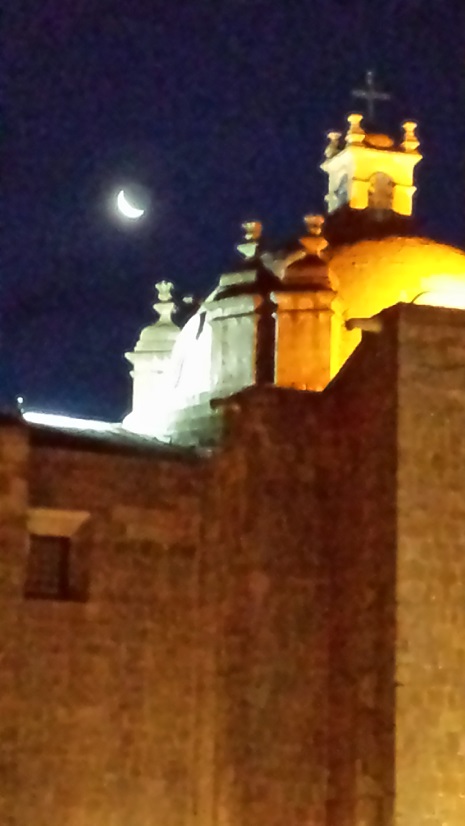
Puno spreads up a hillside in sectors that join along the lake. That means that the walk to almost anywhere is uphill, so we huff and puff from place to place. The cathedral is nicely lit at night, and I could see the crescent moon behind it.

20150122_185801sm

This is high altitude weather, cold in the morning, hot at midday and cold again as soon as the sun sets. Since it’s the rainy season, it has been raining every evening, and for a while in the morning, but much of the day is clear and bright.

The other White City

Jan. 20, 2015. Clear until mid afternoon, high of 23 C, and a beautiful day.

Chicago was called the White City because of the dazzlingly white plaster used on the exterior of buildings at the World’s Columbian Exposition of 1893. Arequipa is called the White City because the oldest buildings were constructed of a pale cream colored volcanic tuff, called sillar locally. It may once have made the city look white, but there is so much newer construction that though the old buildings are lovely the city doesn’t really look white. Some of the historic structures are preserved by their current tenants–banks that have taken pride in restoring the ornately carved facades.

P1030843sm

Jesuit church, 1698

P1030852sm

20 th century theater

Jonathan and I enjoyed a relaxing day both to let his stomach settle and to get used to the altitude. 2000 m is not painful, but we did feel a bit dizzy standing up at first. I also forgot that I had only been able to get Diamox pills in 250 mg size and the dose is half that. Before I remembered that part we had each taken a double portion. Who knows what that caused. My fingertips tingled a bit but now I’m fine. Our hotel, Los Tambos, is very small but nice–possibly because we seem to be the only guests. There is a cafe and balcony on the 4th floor with a view over the rooftops of the city. It’s not Cuzco–the rooftops are pretty miscellaneous, but I enjoyed it very much.

We had coffee at La Boveda, a cafe frequented by old men who drink tiny cups of expresso and debate–everything. If we stayed for more than two days Jonathan would be sitting with them. No, we did not visit the Starbucks. We had dinner in another restaurant that overlooks the cathedral and Plaza de Armas. They offer guests ponchos to keep warm while sitting on the terrace–a great idea.


Not all smooth sailing

Jan. 19, 2015

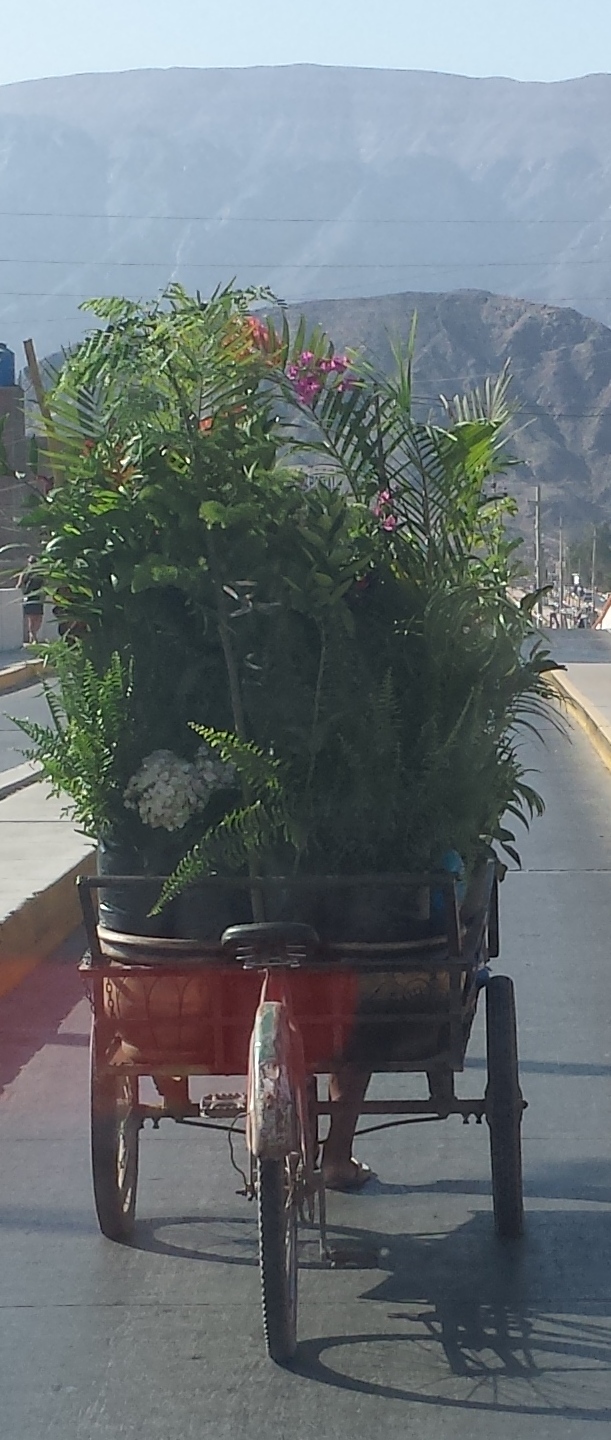
I thought getting stuck behind a cart full of plants was a problem. Ha ha ha ha ha. It was a ten hour day in the end, but so jam-packed with things to see and talk about that it wasn’t bad at all.

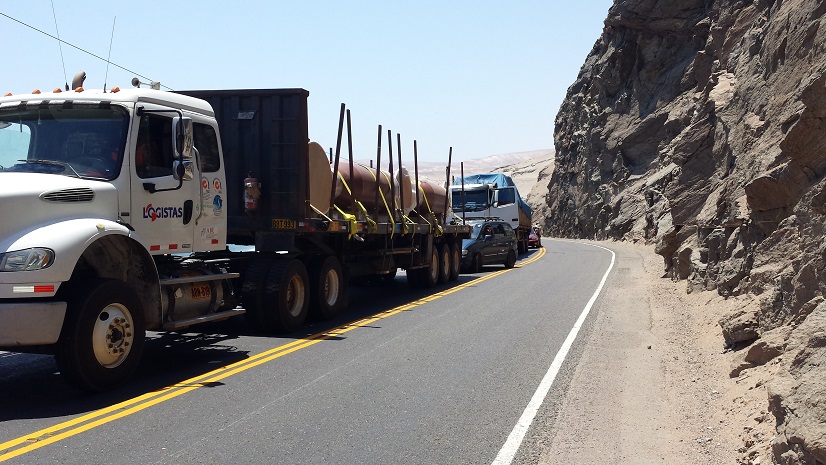
We lost some time on the way to Camana when traffic was stopped dead on a mountainside by a woman swathed head to toe in bright orange. We needed to wait a half hour so that the stripes on the road could be repainted. On the bright side, I pulled ahead of about 20 trucks and their disgruntled drivers to get up to the front to find out what was going on. In Peru, women are seen to be the best enforcers, they direct traffic, hand out parking fines, and manage road blocks. Women are considered more resistant to bribes than men.

20150119_131140sm

We ate lunch while standing around, stretched our legs and finally got going again after we watched all the traffic going downhill let through first–despite there being two lanes. After that we set off, to find that the painting team had probably painted 500 yards of stripes on the road during the better part of an hour when all traffic was stopped.

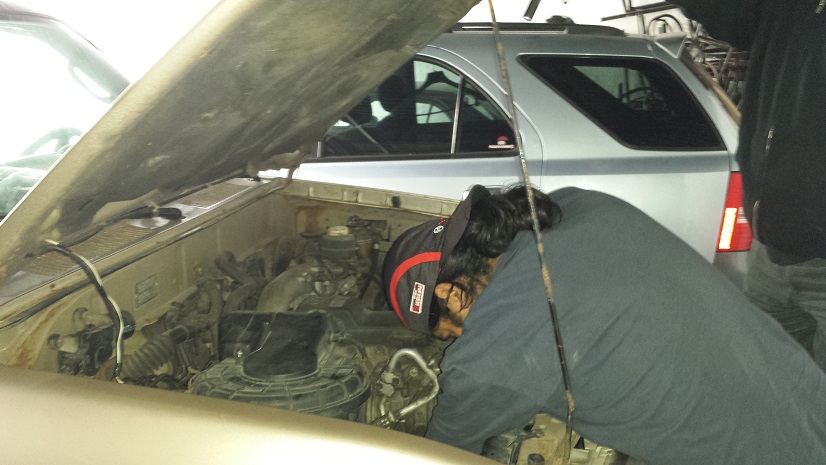
Meanwhile, we decided to try and get to Arequipa with a broken thermostat in the car, because car repair is difficult late on a Sunday afternoon in Nazca. The gauge swung up and down without much reference to speed, use of A/C or gear ratio, though we turned off the A/C and opened the windows when the thermostat went into the red zone periodically. As we neared Arequipa (2,000 m) the air cooled off quite a bit, though the car did not, but we made it, and a mechanic that the front desk found for us came by the hotel at 3:30 pm today (now Tues) to make the repair. He replaced the thermostat (original to the vehicle in 2002), replaced the radiator cap and tightened the fan belts, for $70 including parts.20150120_163055


From the desert coast to the White City, Arequipa

Jan. 19, 2015

The day started clear, sunny and hot with most of the day in the 80s F–27C and ended up at 52 F–11C at 10 pm. Today’s drive was constantly changing and surprising. Anticipating a long day, we left the Nazca Lines Hotel just before 8 am and immediately ran into a problem, literally.

20150119_081827sm

This is a bicycle cart of ornamental plants. The driver decided to pull it across the bridge rather than ride it.

The desert beyond Nazca continued in all directions. The exceptions are the river valleys, few in number and widely spaced. One of the first we passed through was the Yauca Valley, entirely planted in olive trees right out to the edge of the desert (We bought olives). Further along, the Ocona and Camana Valleys are the electric green of rice.

We bought olives from a roadside stand.

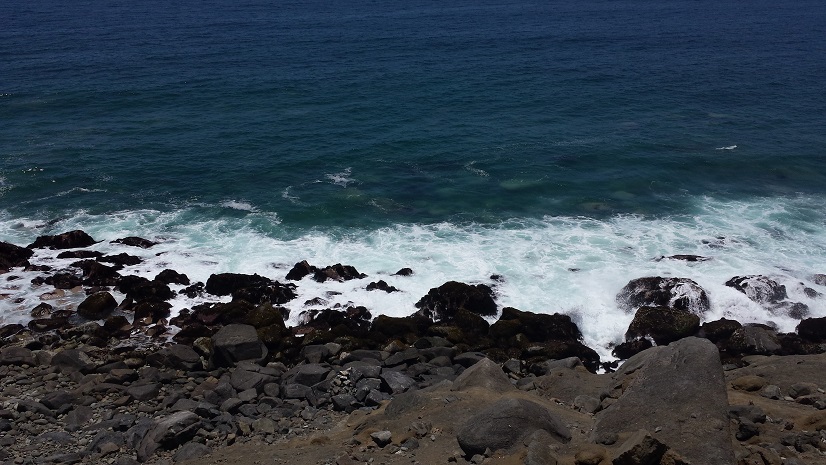
For almost 200 km (100 miles) between Chala and Camana, the rocky coast alternates with sandy beaches. The road curves up and down through hairpin curves to cross the rocky headlands that jut into the ocean. There were sections that we imagined were like driving through the Cinque Terre of Italy with one difference–there is no one there. NO ONE. One hundred miles of empty beach and rocky shore.

The water was beautiful green and blue. This photo was my attempt to show the color that I think of as Winslow Homer blue–it’s not just the waters of New England. Mile after mile of beaches and rocky outcrops.

Then we started up toward Arequipa, both of us surprised at the sand. In some places the dunes have filled in behind the retaining walls intended to hold back the sand to a height of more than 2 meters. Sandbags are perched on top of the retaining walls to prevent sand from sliding over the top and covering the road, but it’s only a matter of time until nature wins.

The approach to Arequipa includes a view of the optimistically named Cerro Verde mine. Only the tailings are visible, dominating the landscape until you reach the city.

20150119_163329sm

We found our hotel Los Tambos, and ended having dinner in a rooftop cafe overlooking the cathedral towers.

20150119_191942

Lima to Nazca! Jan. 18, 2015

Lima to Nasca 118.15

Just south of Lima are several popular surfing and vacation beaches. Along the way, you can purchase anything you might have forgotten. There are also some peculiar decorative objects along the highway. It looks like an elaborate arrangement of plastic strips–on a telephone pole sized stand.

Lima to Nasca 118.15-002sm

There is NOTHING on the road to Nazca. Without the discovery of the lines, this area might be empty. Sometimes the sights are better above the ground, as there is a lot of construction debris and garbage along the Panamerican highway. Despite what you see in these pictures, there are quite a few tolls along the highway. At one point–it was one lane each way with plenty of buses and trucks–we decided they were charging a toll so that they could eventually build a highway.

Lima to Nasca sm118.15-008

Lima to Nasca sm118.15-006

We drove 444 km today. Though it started out cloudy in Lima, it was sunny and hot most of the way, peaking at 32 C (89 F). We took just under seven hours, leaving Lima at 8:45 am and arriving in Nazca at 3:40 pm. In the early afternoon, we discovered that the car was overheating, so turned off the air conditioner, and that seemed to help. Then it didn’t seem to make any difference.

Lima to Nasca sm118.15-009

When we got to Nazca and called Carlos (driver, handyman) he suggested it could be the thermostat. We will have to get it looked at.

Fortunately for us, our day ended at the Hotel Lineas de Nazca, where they have a pool! We went directly to the pool after checking in–exercise, stress reliever and general go-soak-your-head fun. We drank complimentary miniature pisco sours beside the pool before strolling down to the Plaza de Armas. We took a turn around the plaza; at 7 pm every seat on every bench was filled with people waiting to see who else would turn up. We went down the street to the restaurant Los Angeles for dinner. The man waiting on us gave us copies of a very old book by Maria Reiche on the Nazca lines to read while we waited. The copies were falling to pieces, and printed on acidic paper that turned yellow long ago, but they were signed by Reiche herself and the black and white prints of one of the lines aligned with the setting sun on the winter solstice was surprisingly clear.

hotelnazcalines

We have flown over the Nazca lines in the past (Jonathan three times, Winifred twice), so we won’t be stopping for that experience. If you are thinking of making the trip, we strongly recommend flying over the lines. You really cannot get a sense of them from the ground, and from the air they are remarkable. It is surprising, too, that they were not noticed until 1939 when Paul Kosok, a historian interested in canals and ancient agriculture, went to Peru and carried out a rather general aerial survey of the coast. Kosok did not end up working in the Nazca area, and Maria Reiche, a German woman, began looking at the lines and spent the rest of her life among them. Kosok produced a beautiful and informative book called “Life, Land, and Water in Ancient Peru,” that is full of aerial photos of the coast north of Lima with comments about the remains of ancient civilizations that can be seen right on the surface, but that are best viewed from the air. Jonathan and I started our work in Peru in 1999 by looking at Kosok’s photos of the Fortaleza, Pativilca, Supe and Huaura Valleys.

Since we were only in Nazca for an afternoon and evening, the Nazca Lines Hotel was the center of our interest on this trip–it was great. Very clean and light and air conditioning that worked. Breakfast was good, too. They serve the usual bread and fresh fruit but also offered to make eggs to order and had wheat germ and bran and kiwicha (andean grain) to sprinkle on cereal or yogurt.