I needed to get my hair cut, and when we were in the “trendy” Palermo neighborhood of Buenos Aires, I found a reasonable looking place and we walked in. The young man spoke English very well and when I asked him how he came to speak so well, he said he worked for several years in Dubai. In fact, he has only been in Argentina for a year and a half, and since we spoke English the entire time, I have no idea how good his Spanish is—my stylist is Syrian. He left Syria 9 years ago when he was about 19, spent a few years in Dubai and moved to Argentina with a woman. (She does not seem to be in the picture now). He has cut hair since he was in his early teens, and though he doesn’t aspire to cut hair indefinitely, he is pretty good at it, and it does allow him to work almost anywhere. He told a couple of terrorist jokes and we asked whether always being called a terrorist bothered him. He said yes, but he goes with the flow and ignores the fact that he looks as Argentine as he does Syrian. His future plans: go to Carnival in Rio de Janeiro, and anything can happen. I wished him good luck—he should be there by now, as Carnival started today.
Don’t look for a taxi at lunch time, Feb. 12, 2015
We emerged from the Reserva Ecologica at about 1 pm and needed a taxi to get home. We walked over a block to a likely street, and sure enough there were taxis everywhere, coming and going. We stood for about 10 minutes, the longest we’ve ever waited in Buenos Aires, even though cabs were all around us. Why? Cabbies come here to eat lunch and most of the twenty or more cabs around us were sitting in the café on the corner taking their break. You want a ride home? Not right now….. Yes, we did get a cab after a wait. I guess he was having lunch later on.
Bird-watching in the Reserva Ecologica was excellent, we saw at least six new birds. People walked, ran and bicycled by on the broad paths. The reserve has a great story, it was created from the dumping of construction debris in the Parana River off Buenos Aires. When the junk caught sediment and a range of plants grew, it attracted birds, turtles, lizards, snakes, and a colony of nutria. When the city decided to convert the abandoned port area into a new high rise neighborhood (Canary Wharf in London is mentioned as an example), the marshy zone was converted into an ecological reserve with great success. Definitely win-win. Now, if you could put your feet in the river without risk of cholera…..
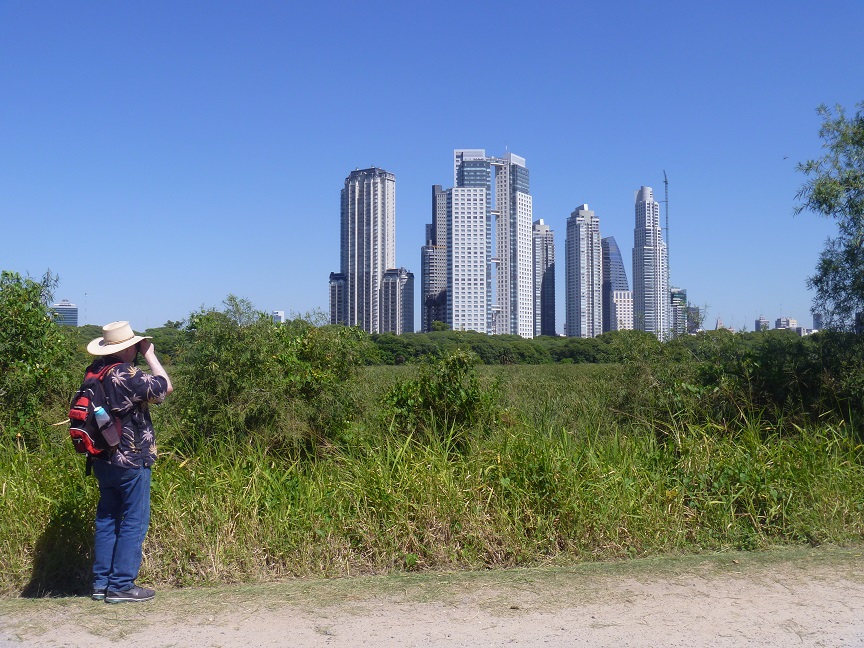
Details: Clear blue sky, very hot by noon (over 30 C). After 5 pm stiff wind for 2 hours that tapered off without any rain. We visited the Reserva Ecologica Costanera Sur, Puerto Madero, Buenos Aires and saw a number of new birds. Some were difficult to identify because they are similar to many others such as a yellow breasted bird with a black beak and large head, much like a kingbird. Others were difficult to identify because they were females, like a grosbeak with a pale yellow breast, and gray/brown back.The distinctive species I managed to identify are below.
I did not take the photos of the birds we saw (below). One of the best nature sites I’ve seen includes photos of birds at the Reserva, by people interested in the area. Thank you to everyone who took such great photos of the birds we saw. The site is available in both English and Spanish with scientific names as well.
http://www.reservacostanera.com.ar/en
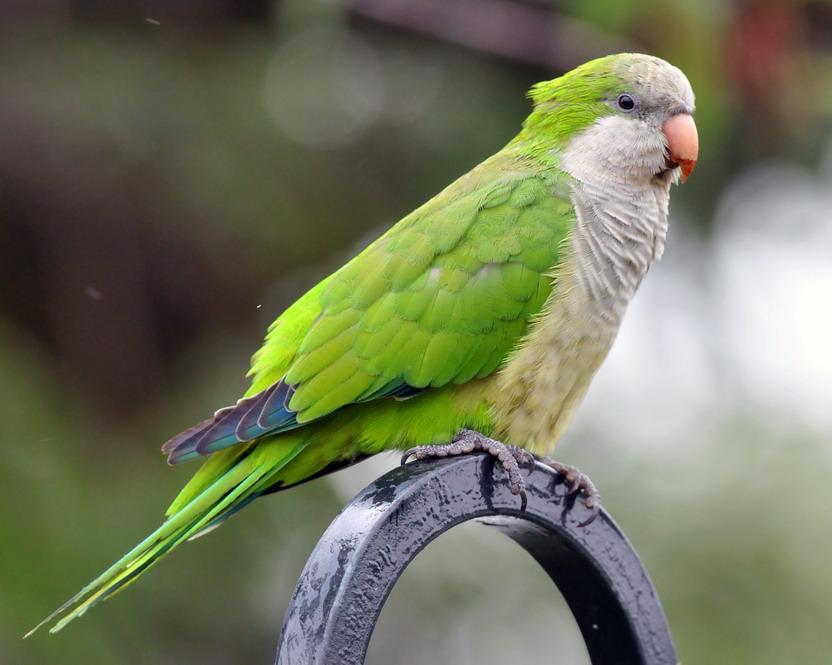
Monk parakeet/Cotorra, green with blue flight feathers, buff/white chest. Very noisy.
Yellow-billed Cardinal/Cardenillo, red head, black throat, white body, this one landed on a bush holding a red berry in its beak.

Glittering-bellied Emerald/Picaflor Comun, has an iridescent back, purple out of the sun, but turquoise/emerald green in sun, green throat, and long red downcurved beak, dark at the end.

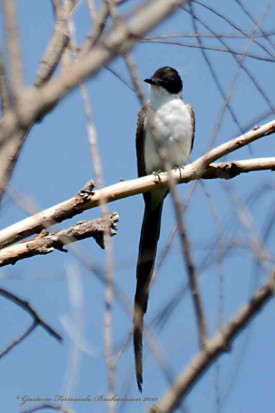
Fork-tailed flycatcher, which we also saw in the Mendoza area (Lujan de Cuyo).
Pato picazo (Netta peposaca), a duck with red above the beak:

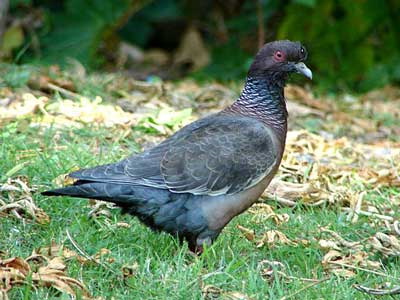
Paloma picazuro/Blue beaked dove (Columba picazuro), these are very big, they look like gray cats sitting in the trees:
One last yellow headed bird, I identified as a yellow grassland finch/Jilguero dorado (Sicalis flaveola).
We might also have seen a tacuarita azul. it looked like a nuthatch with a pale blue chest.
Details: High temperature over 90 F. winds picked up around 6 pm but no rain.
Peron continued, Feb. 11, 2015
We took the Subte=Subterranean=Subway from our stop (Boedo) to the end of the line near the Plaza de Mayo. We looked at the Peru subway stop adjacent, where there are supposed to be restored subway cars running. The tile walls and reproduction turn of the 20th century ads are ok, but not a big deal in my view.
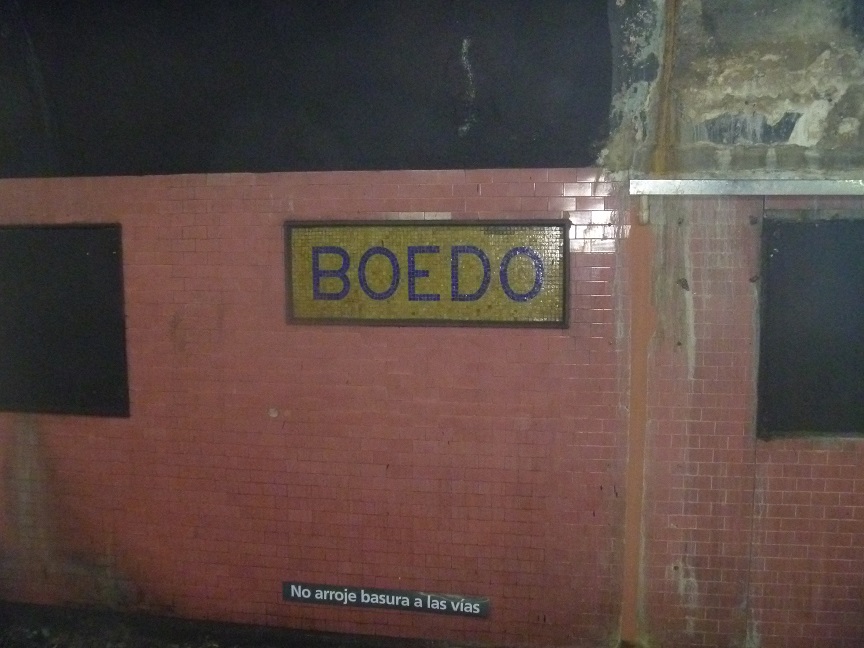
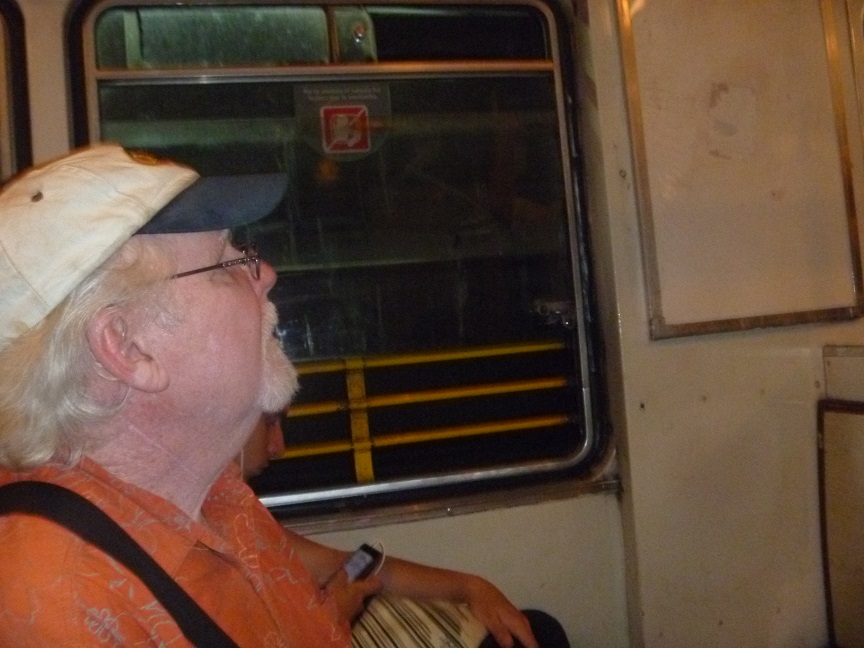
Riding on the train remind you of the New York subway? It should, Buenos Aires is the third oldest subway system in the Americas, right after New York and Boston. I’d forgotten that New York now uses rubber wheels and pneumatic brakes–the BA subway has Not been updated and the screeching metal-on-metal wheels and the piercing sound of the air brakes are more than enough to make you stuff your ears with your fingers.
Out of the subway is the Plaza de Mayo, where mothers of the “disappeared” still walk the perimeter in memory of the dead every Thursday. At one side is the Casa Rosada, the seat of government, though not lived-in today. Evita and Juan Peron lived there, and she made appearances from one of the balconies.
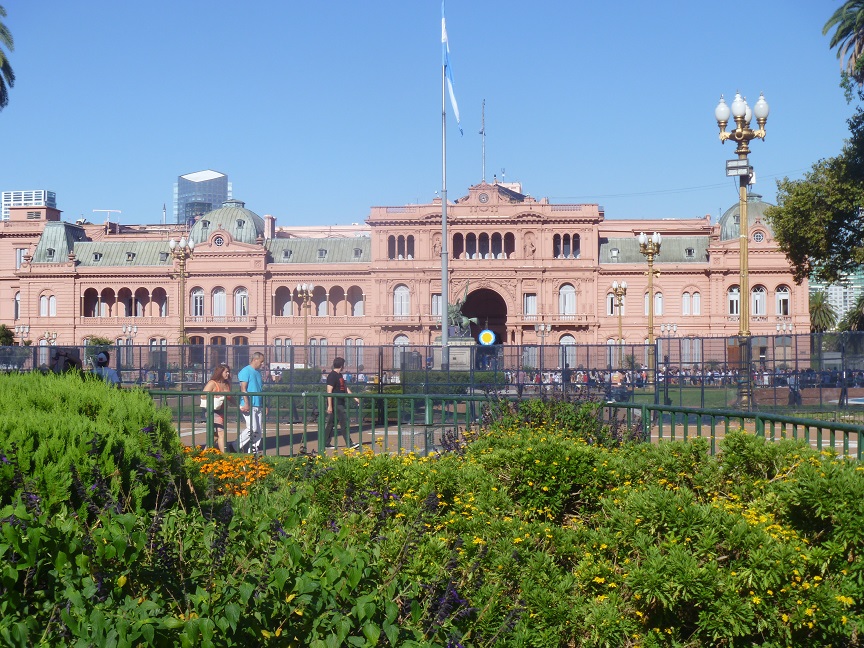
Today a demonstration was underway, complete with t shirts, chanting, drums, singing and dancing and a long line of people waiting to be let in. We were not sure what the cause was, but the vests and t-shirts mentioned social justice.

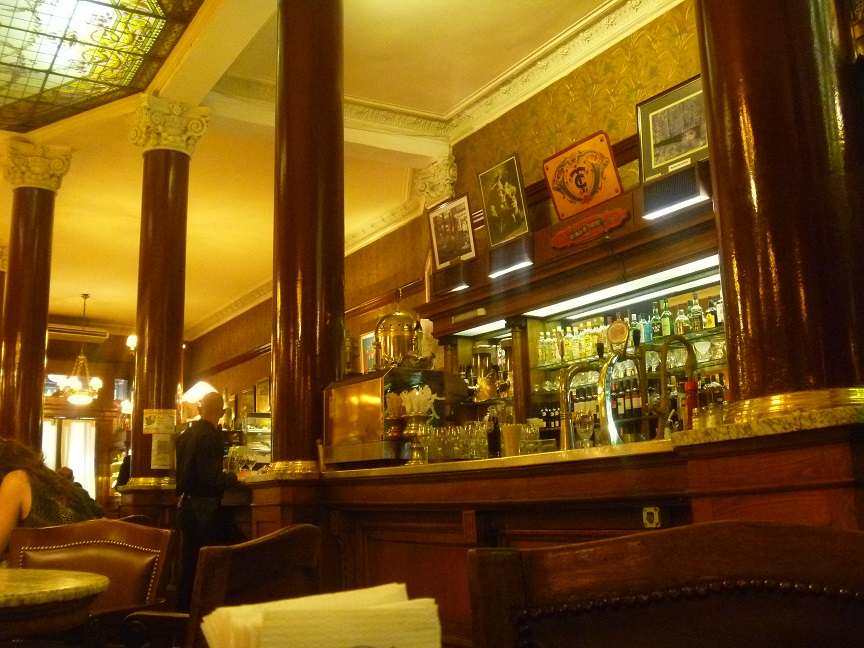
No day is complete without a cafe stop, and today’s was the Cafe Tortoni. Reputed to have been a favorite of Borges, there is a life size sculpture of three people at a back table that is supposed to be Borges and two friends. Looks a bit like the Addams family, but artists like to have their work added to the pieces on the walls, so there is a wide range of quality in the framed art. The turn of the century (20th) ambience is very attractive, despite touristy elements. Someone has even written an ode to the thirteen columns….
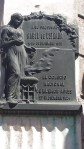
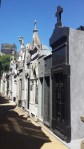
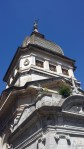
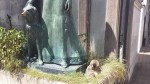
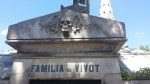
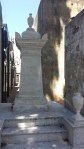
Eva Peron’s Recoleta Cemetery, Feb. 11, 2015
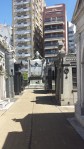
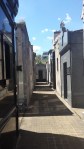
The cemetery doesn’t really belong to Eva Peron, and there are no signposts to her grave though there are signposts to the grave of others. It doesn’t matter because the tour groups flock to Evita’s grave. Though stories tell of heaps of fresh flowers at her crypt, though we saw only one fresh flower and a few plastic blooms. Other tombs include the founders and statesmen of Argentina and the wealthy, though many of the names on the splendid tombs no longer sound familiar.
Recoleta cemetery is in better condition than the Pere Lachaise Cemetery in Paris, with workers busy cleaning and restoring tombs. At the same time, there are tombs that are empty except for buckets and ladders. Who decides which tombs are maintained and which are abandoned? One reason that Pere Lachaise is in much worse shape than Recoleta is that it is much larger and the tombs are spread out more, meaning there is grass and a bit of parkland, while only a few trees and potted plants are present at Recoleta, a compact city of tombs.
Now we’ll all recite a verse of Ozymandias.






Taxi Drivers in Buenos Aires, Feb. 11, 2015
Many taxi drivers in Buenos Aires strike up a conversation immediately. They ask where you are from, why you are in Argentina and then go directly to why they drive a taxi, unemployment, taxes and politics. I’ve found some of them to be quite well-spoken.
One man is a widower and drives a cab to keep buisy. He knows all the streets
of Buenos Aires and which way they run. He also went on to describe his boyhood in the neighborhood of Mataderos. At that time, it was still the slaughterhouse of Buenos Aires and most people worked in related activities. He described a close-knit community where neighbors all went to work together and spent their free time together.
Unfortunately, he blames the change in sense of community on outsiders. His mother taught him to greet everyone. Today in his apartment building, people sweep by without a word. They are not properly educated. According to him, the problem is the influx of immigrants. Not Chileans (we’va always had some of them), but Bolivians, Peruvians, and to a lesser extent Paraguayans (they are very hard workers, even though they are clannish and brutish).
What kind of response can a visitor make to these remarks? Times change, people change, and it is probably not immigrants who change things. If you say something along these lines, your words are swept away with a hand gesture or a word. It is very difficult to alter conventional wisdom.
Today’s taxi driver was a mechanical engineer, working with companies to make machines work. He’s been driving a cab for 15 years. The unspoken explanation is that he was laid off as the Argentine economy collapsed in 2001 and is now permanently underemployed. We are the same age, have the same number of children, though he leads in grandchildren (2). We could all agree on the fact that at our ages one must try to enjoy every minute.
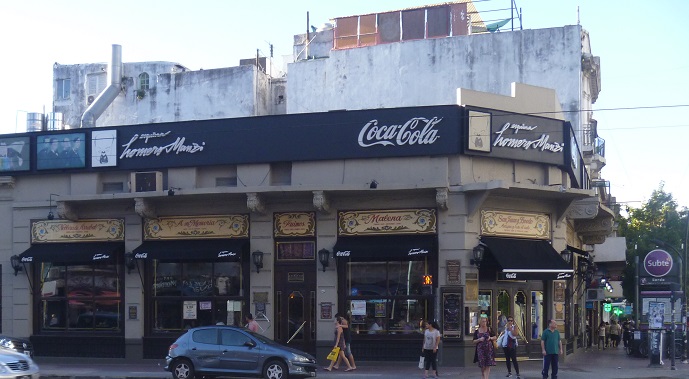
Tango Mania-Competing Corners of Boedo, Feb. 10,2015
In Buenos Aires, everyone has an opinion about tango. The corner of Boedo & San Juan is home to two cafes that still exist, both of which claim to have hosted early 20th century tango stars.


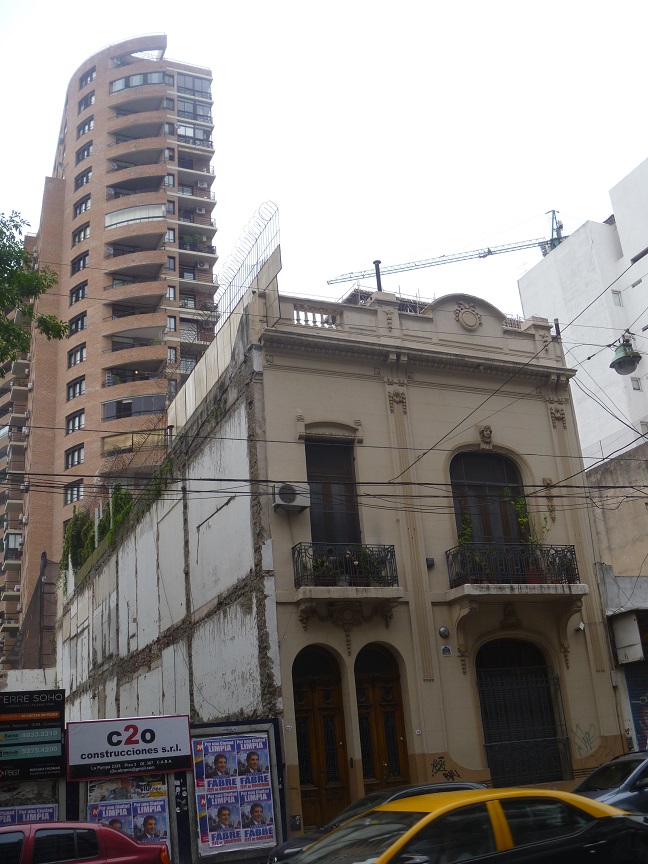
Buenos Aires has many sides, Jan 10, 2015
Buenos Aires is constantly changing. As in other cities, older buildings of 2-3 stories are being replaced with new ones that are 10-20 stories tall.
The Argentine eoonomy relies on ranching, while farming is not as strong a tradition. We have found very few markets of the type that are present in every Peruvian town, a central place with stalls that sell meat, fish, vegetables and fruits. In our Boedo neighborhood, we found the market, though very little of it seems to be still in use for selling food:

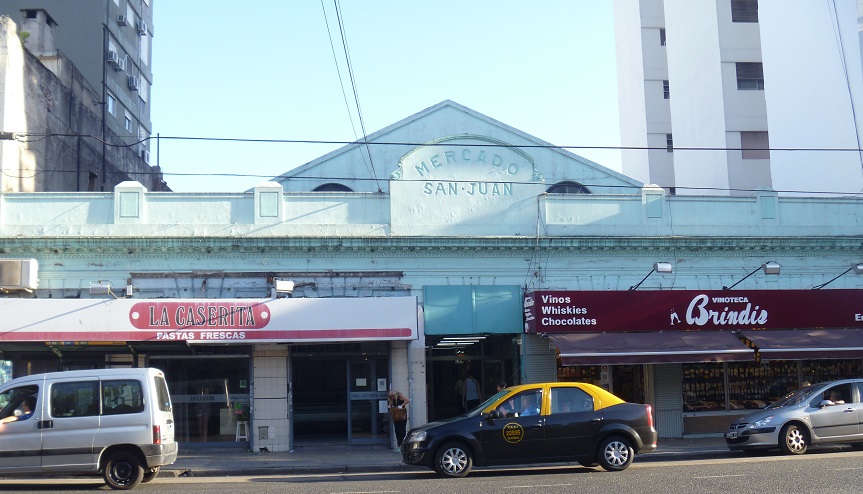 Perhaps more discomfiting than anything else is that everyone in Argentina looks like everyone in the US. A concerted campaign to exterminate native people that began in 1870 was largely successful, and as a result, most Argentines are descendants of Europeans, as are many people in the US.
QED: We all look alike.
Next question–why do many Americans have much easier lives than many Argentines?

Buenos Aires, Feb. 9, 2015
One of the distinctive structures in Buenos Aires is the widest highway in the world, Avenida 9 de julio that runs through the middle of the city, up to seven lanes each way.
http://en.wikipedia.org/wiki/9_de_Julio_Avenue
Unfortunately for us, we rode up and down this landmark both directions while searching for the exit to the neighborhood of our rental apartment. We discovered that highways may have up to three different names AND a number and that all or none of these may appear on road signs. We drove past our exit various times, finally getting off after about six tolls that we didn’t want, but had to pay in order to turn around and head back toward the city.
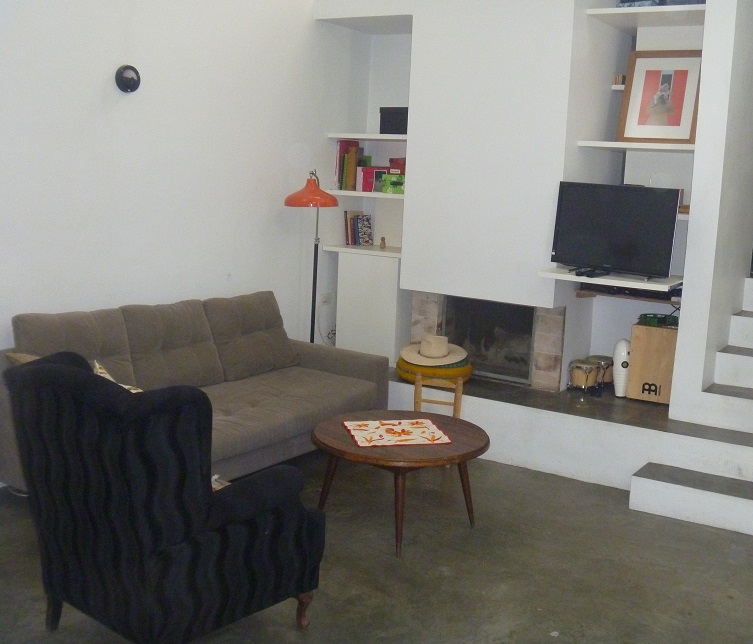
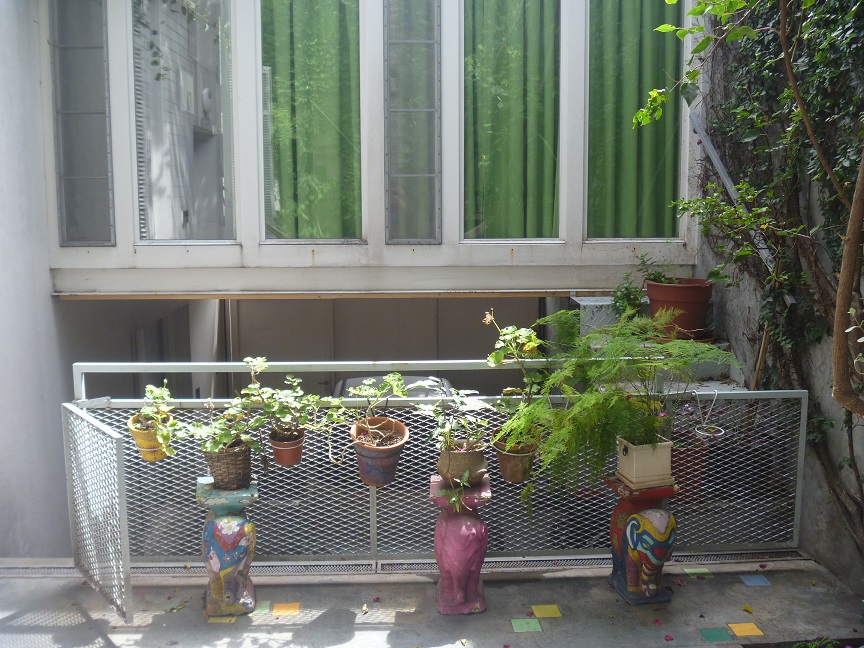
We found it, and the good news is that our apartment is lovely, on Colombres in the Boedo neighborhood.

Rio Cuarto to Rosario, Feb. 8, 2010
Rio Cuarto to Rosario was a day of driving in the rain. We stopped to look at birds, but not much happened on the road. There are some unusual signs along the highway:

I finally saw the nest of the national bird of Argentina, the rufous ovenbird, named for the shape of their nest made of clay. This was on a power pole:

Our apartment in Mendoza, Jan. 31-Feb.6, 2015
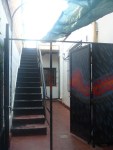
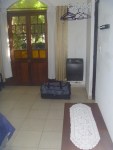
We were hosted in Mendoza, by Carolina Lopez, who manages three apartments rented through AirBNB. Here are a few pictures:




Best ice cream in Mendoza: Ferruccio Soppelsa
 Llywindatravels 2025