Heading North

We decided to visit northern Peru, and headed for Playa Los Organos, on the coast between Piura and Tumbes, stopping for two nights on the way. The first day was familiar territory where we passed familiar archaeological sites. Just north of our home in Barranca is the Fortaleza de Paramonga, southernmost outpost of the Chimu empire. The Chimu are not as well known as the Inca, because in the great battle between opposing empires in 1470, the Chimu lost, and as we all know, the victors write history.
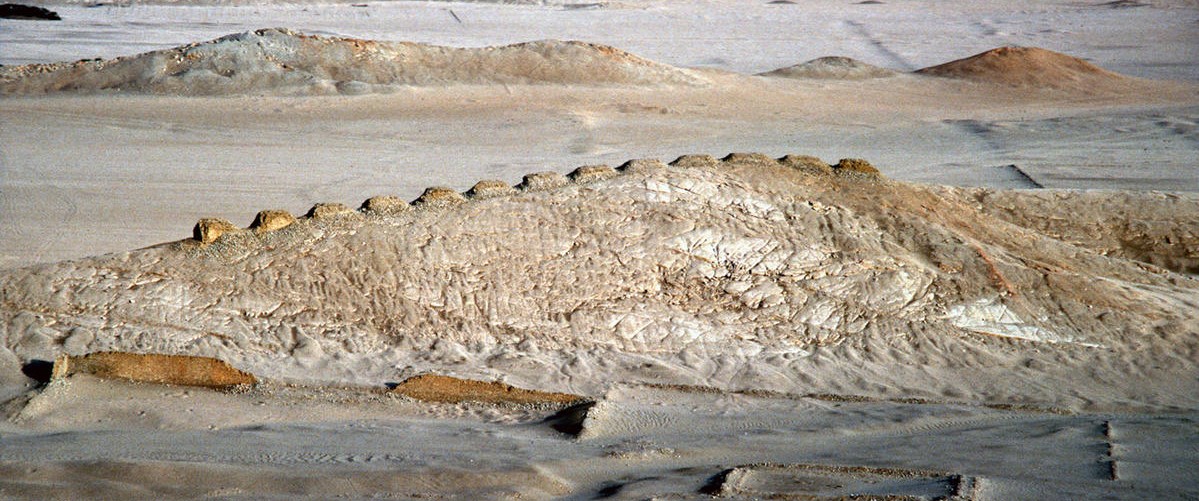
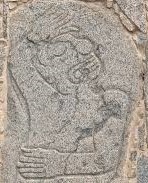
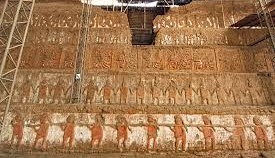
Just outside the Casma Valley is Chankillo, a fortress and ancient observatory built around the 4th c. BC where 13 small towers align with the annual movement of the rising and setting sun. Cerro Sechin is nearby, its main structure lined with carvings of warriors and victims. More sites line each valley until you arrive in the Moche Valley home to two of the great ancient societies of ancient Peru, the Moche and the Chimu. The Huaca de la Luna is the iconic capital of the Moche, who controlled this region from about 100-700 AD. They built vast adobe brick pyramids with brightly colored figures painted on each tier. Its twin, the Huaca del Sol, was mined for the gold in tombs by the first Spanish explorers, by diverting the Moche river to wash away the adobe. Fortunately for us, they left a portion for us. The site museum, completed just a few years ago, displays the trappings of Moche power. Burials found within the pyramid were dressed in wide beaded collars, gold crowns and masks, surrounded by pottery molded into plants, animals, and people, or painted with detailed scenes of ceremony and battle. It is fantastic.
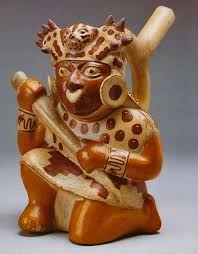
Before leaving town you have to visit the other great empire of the Chimu at one of the royal enclosures of Chan Chan. Each ruler built a new palace, a huge enclosure of adobe with walls more than 15 feet high, sculpted with figures of fish, pelicans and other creatures. Within each royal enclosure was everything the ruler needed, meeting rooms, living space, even a reservoir dug into the water table to provide water. Chimu elite were buried with masks of gold and elaborate pottery. The scale of these buildings is what’s most impressive, and the range of shapes sculpted into the adobe. The Chimu empire developed around 900 AD and died out after the defeat by the Inca in 1470.
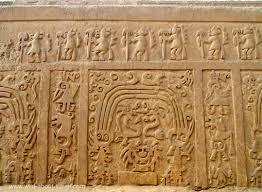
When we stop in this area we always stay at the Hotel Bracamonte in Huanchaco. It is on the beach outside Trujillo and a relaxing stop after a day of visiting archaeological sites. It has a lovely garden by the dining area that you can enjoy while having breakfast. The fruit, yogurt and granola combo is always my choice. Our only mistake this trip was failing to enjoy one of the excellent restaurants in Huanchao for seafood at lunch time. When we went out in the evening for dinner, most places were closed and we ended up eating cake and ice cream for dinner. We won’t let that happen again.
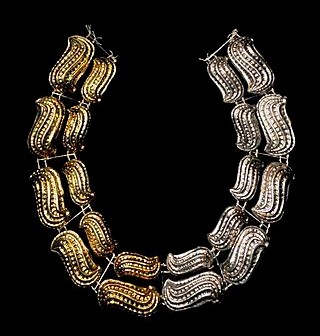
The next morning we headed into new territory. We’ve driven as far north as Chiclayo to see the Museo Tumbes Reales de Sipan, where the golden burial of the “Senor de Sipan” is displayed. This is one of the most elaborate tombs we’ve ever seen. The tomb was found by grave-robbers, taken over by archaeologists who had to camp at the mouth of the tomb and patrol 24/7 until the Peruvian government acted to protect the treasure. The hero of the story is Peruvian archaeologist Walter Alva, who spearheaded the site protection and stuck with the site until the museum was built about ten years later. There are fantastic objects in the museum including  beads on a burial necklace shaped like peanuts made of gold and silver. The site where the tomb was discovered, Huaca Rajada, is also worth a visit. Late Moche tombs like Sipan though not quite as large are still being uncovered periodically. A site museum is usually built for each one, like the Senora de Cao. Once you’ve seen the Sipan museum, though, you’re spoiled by the amazing wealth on display and none of the others is quite as rich.
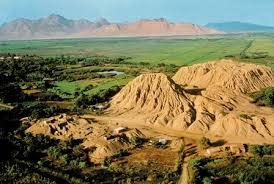
Beyond Chiclayo was new territory for us. There are many other sites along the way, though for us it was a case of so many sites/so little time. We passed Pampa Grande, where Jonathan excavated for part of his dissertation research, Bataan Grande, Tucume, and many others as we drove toward Piura. It took all day to get there with only a stop for gas. The landscape turned dry, and we saw more of the damage done by the 2016/2017 El Nino. Sections of road are washed out and rebuilding is underway but not completed. River basins are scoured out and though you cannot tell from the road, thousands of people still need new housing.

In Piura we stopped at an oasis, the Casa Andina Premium Hotel. Our room had air conditioning, the pool was a great contrast to the heat that was building all day long. We went out for dinner to Tayanti, a restaurant near the hotel with many positive reviews. We had delicious cocktails but found that the menu included only two “fish.” Fish of the day was conger eel, a soft white fish that is the cheapest in the market. Neither of us like it much. The other choice was salmon imported from Chile. We finished our drinks and went to the opposite side of the courtyard to Tao, where we ordered sushi that proved to be delicious with neither conger or salmon involved. We returned to our air conditioned oasis for the night.


New jewelry

For a while, I collected broken watches and then took them apart. As I should have known, watches are all electronic and only contain a few tiny gears, most made of plastic, so watches are not a source of gears as they used to be. Most steam punk style jewelry is made from faux watch parts made in China.
As the watches got pried apart, I found interesting reels of copper wire and decided to use them to make something. This is the result. The center pendant is a coil of wire from a broken external hard drive. Techno-Egyptian revival?


Crafts while the internet is out

We spent a week with almost no internet and I found myself sewing. After dropping my phone in the ocean (!), I needed something to carry my phone and keys when i have no pockets. 

I started with the short sleeve from one of Jonathan’s worn out shirts. I folded the hem together and took the strapping from a water bottle holder that I don’t use and sewed it on to the base and tacked the shoulder strap in place.

The shirt had two pockets, and after I cut both out, I trimmed and folded the edges under and sewed each pocket to one side of the bag. Each one is under the shoulder strap.

The extra fabric above the pocket folds down and forms a protective flap that is held in place under the strap.

I then ran elastic around the edge of the bag to hold the center pocket together. I now have a shoulder bag with three pockets big enough for my phone, keys, hankie, and beachcombing finds. I can keep the sand off my phone by always putting it in the same pocket and always putting my beach finds in the main pocket.

I have another project in mind, but now the internet is back and I have to catch up on writing.


Wari, Peru’s First Empire

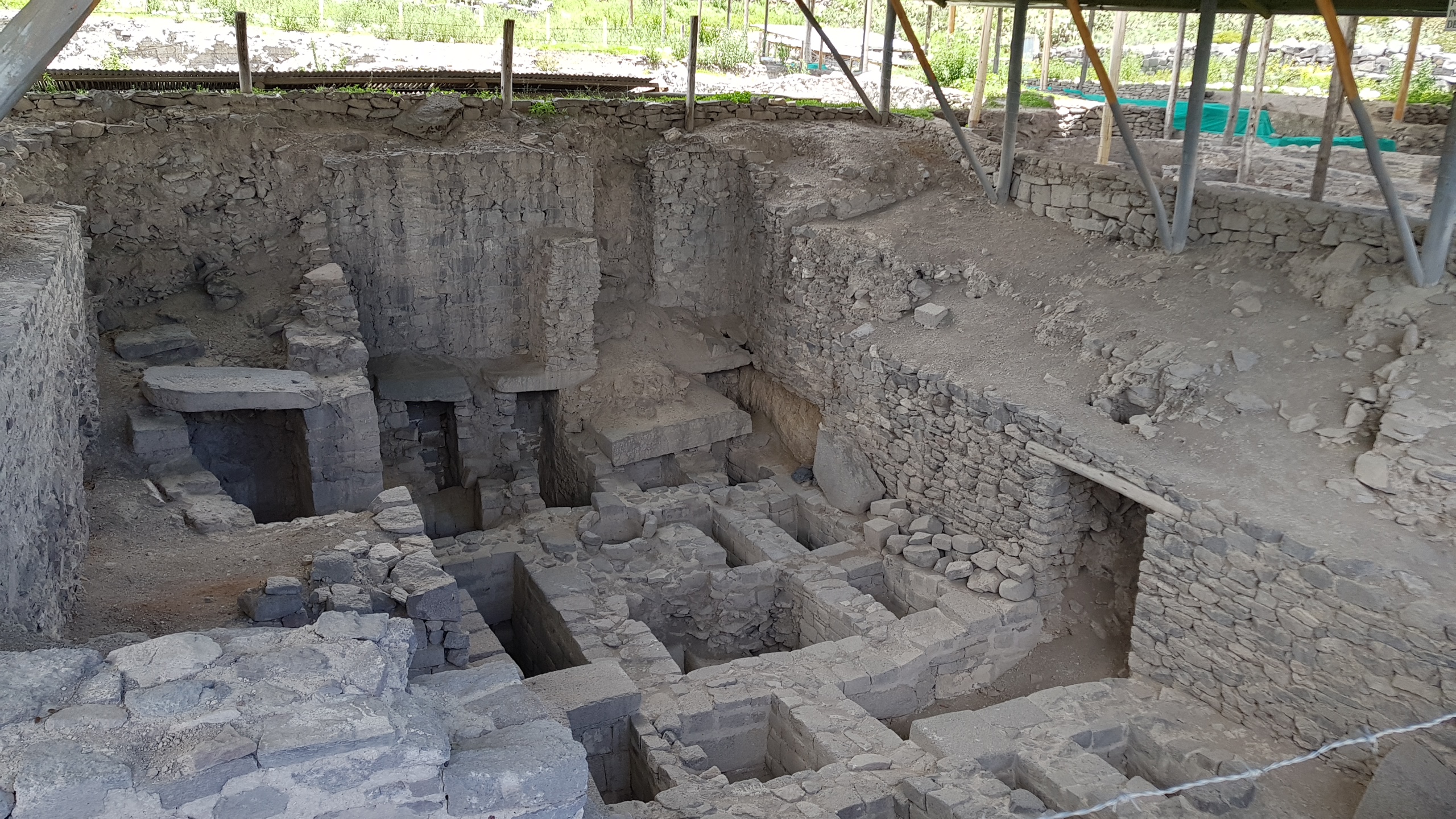
We couldn’t pass up a visit to the ancient capital of Peru’s oldest empire, Wari. The site is northeast of Ayacucho and not difficult to find. The site is huge, covering 1800 h (about 4,500 acres). As a capital city, Wari was home to rulers, priests, bureaucrats, craftspeople, and farmers. Circular spaces were probably for ritual activities, perhaps with statues in each of the niches.  Lots of stone was used to build high walls and small rooms, and there is a similarity among Wari sites no matter where they are found. They were probably pretty forbidding places.

There are still a lot of questions about Wari. This group of people was considered to have formed an empire. Larger than a state-level society, empires incorporate unrelated groups of people in an extensive territorial political unit. The Wari included settlements from the Moquegua Valley in far southern Peru to the Cusco area, and as far north as Cerro Patapo near Chiclayo in the north. That is almost as large an area as the much later Inca Empire. The Wari built some of the network of roads that the Inca took over and made famous. The Wari also introduced terracing hillsides to expand agricultural land, another innovation that is attributed to the Inca.

Some excavated areas are covered and walking paths connect the excavated areas.

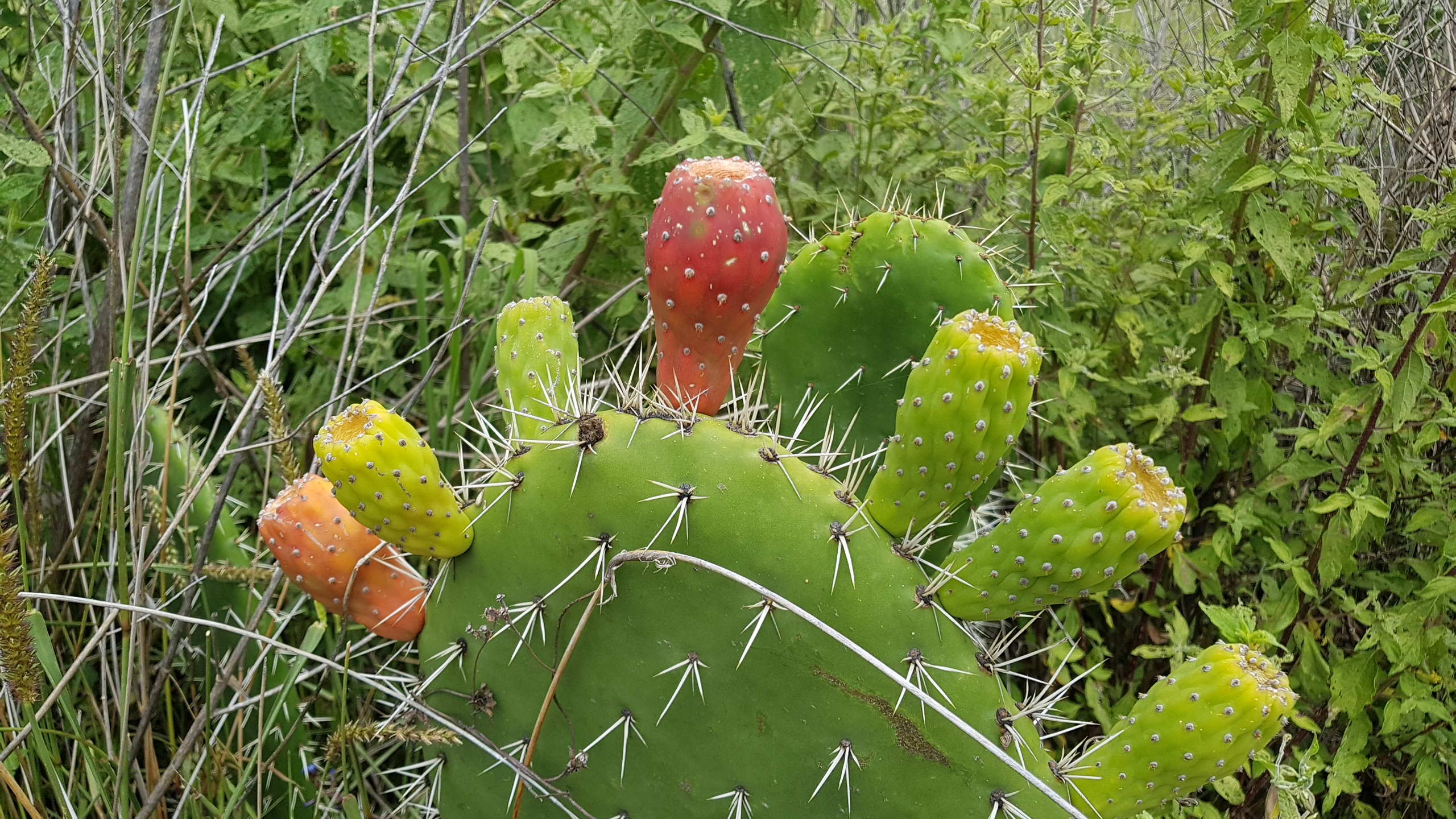
Most of Wari is covered by a thick growth of cactus making it difficult to see areas that have not been excavated or cut down. It keeps people on the path! This huge site would be a great candidate for LIDAR, the technique of mapping with aerial sensors that has been used to map sites in the Maya area covered with heavy plant growth.

The site represents only a small part of the Wari empire, and the small site museum holds only a few items of Wari material culture. Elsewhere there are spectacular weavings, stonework, metalwork, and ceramics. From Feb. 28 – May 28, 2018, the Metropolitan Museum of Art in New York has an exhibit, Golden Kingdoms, that showcases Andean art, including some from Wari. Here’s an example of a four cornered hat. Wari designs are highly stylized though you can make out the bird heads on this hat.  There is elaborately painted Wari pottery and stone tools made from obsidian. During our visit to the site, we found fragments of decorated pottery and of obsidian lying on the path.

Jonathan bought a cap embroidered with the Wari figure of the staff god from one of the vendors outside the site entrance. Most of what was for sale were crates of “tuna” the fruit of the opuntia cactus. They are pretty but neither of us is interested in eating them. Too many seeds, too little flavor. We returned to Ayacucho from the land of cactus.

Ayacucho’s Artisans

One of our goals in Ayacucho was to look at some of the crafts that the region is known for. There are ceramics, weaving, embroidery, metalwork, saddlery, retablos (tableaus of religious and secular life), and silver filigree. I’m probably forgetting something. There is also at least one artisan from Sarhua, a villlage about three hours drive south of Ayacucho.

Known far and wide as an artisan center, we did not expect to have much difficulty in finding material to look at, but though there are many artisans in Ayacucho you have to do your homework. The local artisan market “Shosaku Nagase” has many stalls. They sell woven goods and smaller ceramics and pieces made of “piedra de huamanga”, local alabaster. To see larger examples or more work, you need to visit workshops or studios. After we figured this out, and with the aid of some business cards, flyers, displays in our hotel, and the Tourist Office, we were able to visit three artisans.

We called each artisan in turn and made an appointment to visit. We were instructed to give a cab driver the address but then call enroute and hand the phone to the driver. Each trip seemed to involve driving up several steep interconnecting streets to where the paving ended. In one case, the driver couldn’t find the correct location even with the phone in one hand, so Sr. Berrocal, the person whose studio we were visiting, came out to the nearest street corner to find us.

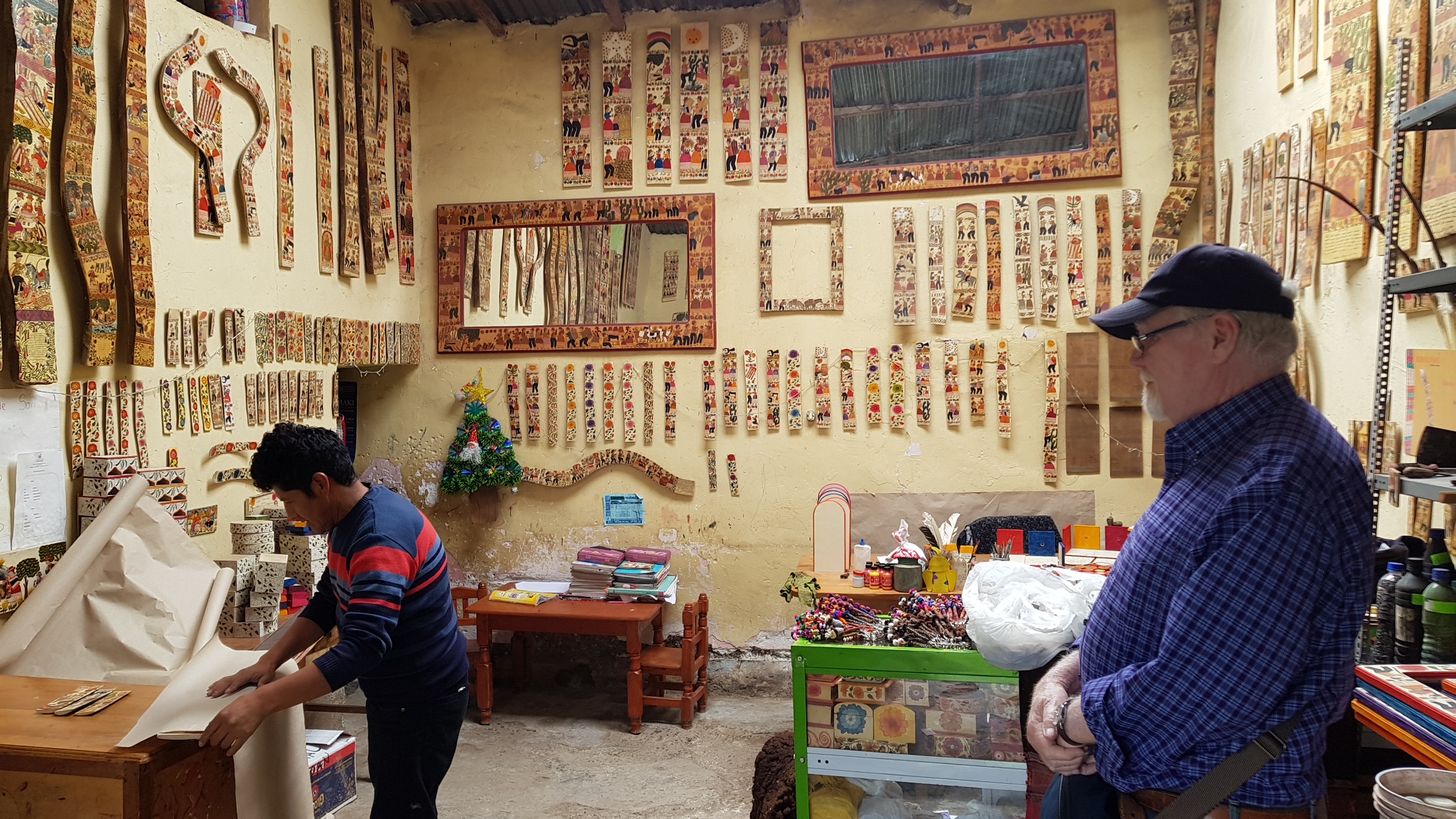
Marcial Berrocal Evanàn is a painter from Sarhua. Originally, a painted beam was included in every newly built house in Sarhua. Since these aren’t portable, today, the painted boards for sale are thin, lightweight slices of alder in a variety of sizes. Scenes depict myths, courtship, and daily life.

Berrocal has won recognition for many of his pieces. He has most of his prize-winners on display, and some are very creative, especially the paintings on sinuous planks. He is unwilling to sell any of his award-winners, so the selection of items for sale focuses on the smaller pieces. We were able to purchase two.

  • Marcial Berrocal Evanán, Tablas Pintada de Sarhua
  • Jr. Amauta 418 Vista Alegre, Carmen Alto Ayacucho
  • Mercado artesanal Shosaku Nagase Stand 55-A
  •  Email: MarcialBerrocal@hotmail.com
  • 966-127-204

Our next stop was the weaving studio of the Sulca family. They have a shop in Cusco, and would like to sell more of their work in Ayacucho. Our visit involved another taxi ride up the hills of Ayacucho, and we realized that asking a taxi driver to wait was another essential part of visiting studios.

Textiles are on display on the lower floor of the house. The weavers work upstairs where the light is better. Many of the patterns are very detailed, using motifs from ancient Inca and Wari textiles. Embroiderers work on runners, pillowcases and textiles.

We bought a textile embroidered with flying shaman figures similar to ancient Paracas textiles.

I lost the card with contact information on it that I got from our hotel, DM Hoteles Ayacucho, 9 de setiembre, just north of the Plaza de Armas in Ayacucho.

There are many, many other textile workshops in Ayacucho and most create contemporary textiles. One of the best known themes is a belt or stripe that appears three-dimensional. There are all qualities, designs and colors of these.

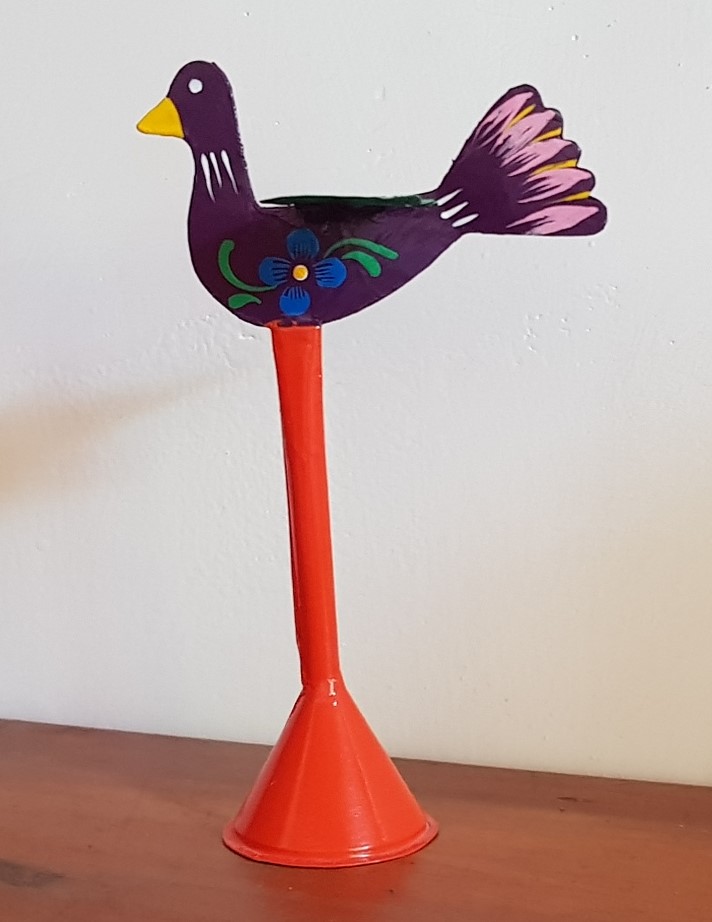
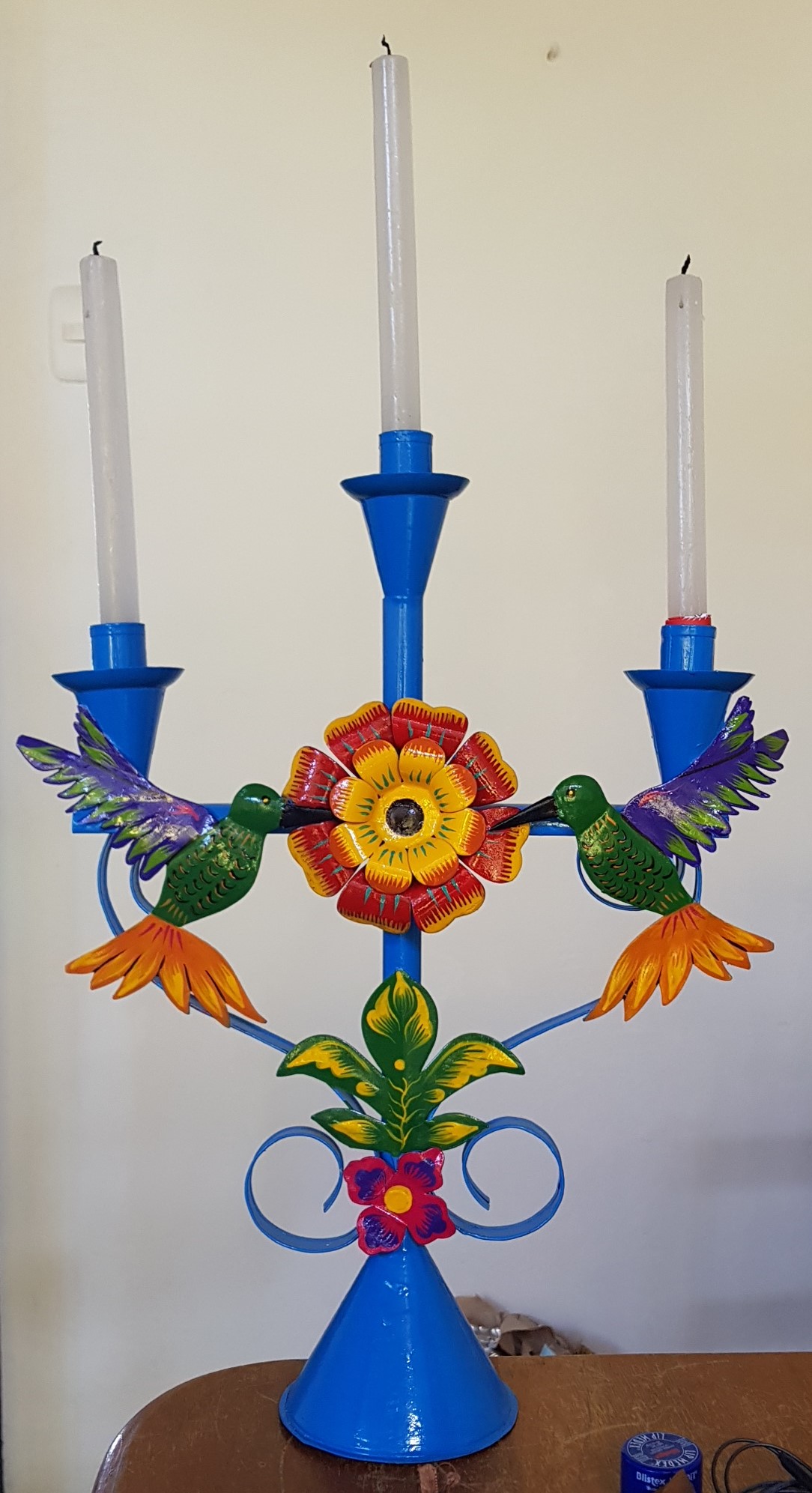
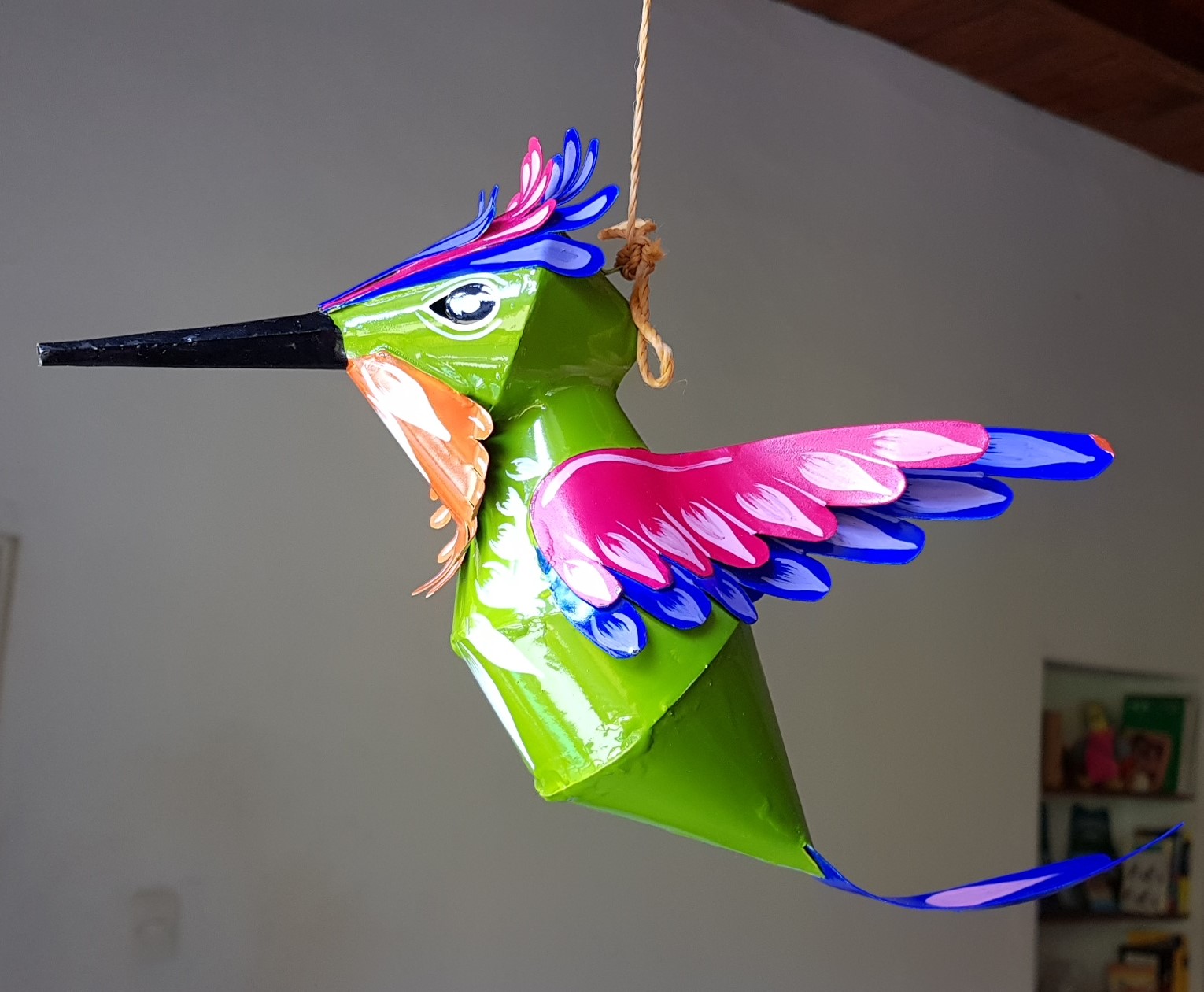
Our last stop for the day was Hojalateria Araujo, the workshop of a family of metalworkers. Each family member has their own style. One of the sons only works in metal without paint. Others make different objects. We purchased one of the most traditional items, a brightly colored candelabra. We like birds, and ended up with birds made by one of the sons and the daughter.


We learned from our visit that it takes time to connect with craftspeople. We planned to purchase a large ceramic pot of some kind, but didn’t manage to connect with an artisan or workshop before our time ran out. One alternative would be to join a tour. Workshop tours were not on on offer from the travel agencies that line the streets off the Plaza de Armas, but an interested visitor could probably arrange one. If I visit again, I would check out the Santa Ana neighborhood that is said to be home to many weaving workshops and other craftsmen. I’d also use the list below, it includes names of artisans and the type of work they do.

Rutas Artesanales de Ayacucho

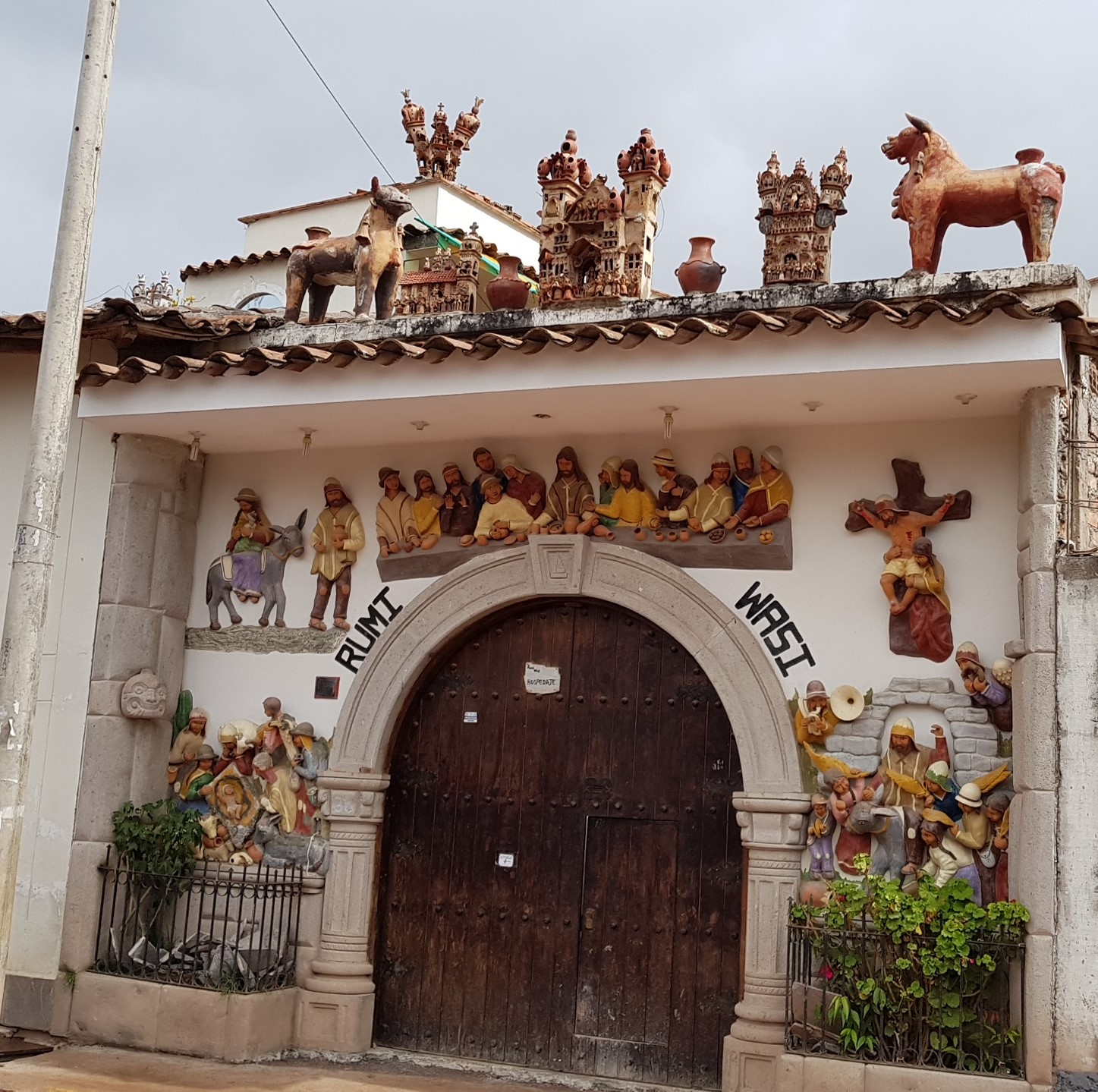
The town of Quinua is touted as the place where ceramics are made. A 33 km drive from Ayacucho (and 50 speed bumps), we saw this great facade, but did not encounter artisans or workshops of the highest quality work. I wouldn’t drive out again unless I had a specific artisan to visit.

We spotted a lovely studio on the way back to Ayacucho from Quinua and bought two of the undecorated bowls of the type we were looking for. No one was working while we were there and though classes had taken place in the studio at some point, there were only a few pieces for sale, leftovers, perhaps. In general, plastic has overtaken pottery for table ware, and decorative pieces are more valuable to sell.  We’ll continue to use our cracked bowls from Ayacucho until they fall apart.

If you’ve been to Ayacucho and visited workshops or studios, let me know where you went and what you liked best. Some people don’t like the word artisan, they are artists who work in clay, or metal, or weaving. People want respect for the work they do. I’d be interested to hear your experience with that, too.


From the Sea to the Mountains, Paracas to Ayacucho

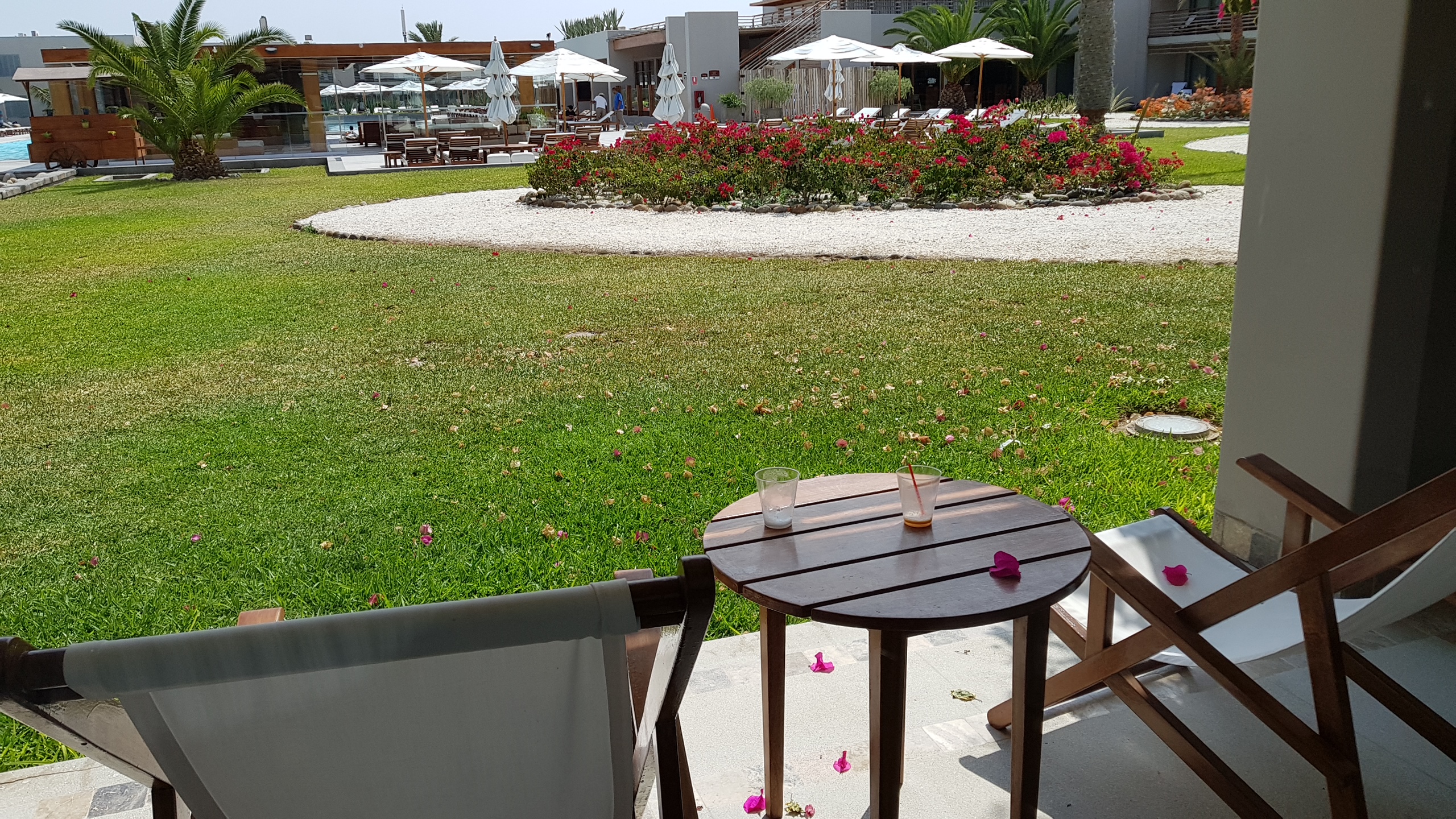
We have wanted to visit Ayacucho for a long time and finally left Lima headed south. It’s a very long drive and we decided to break our trip in Pisco. We couldn’t find any reasonable hotels. We tried Paracas where there are two categories of hotel, cement box and deluxe resort. Taking advantage of the Doubletree Hilton Paracas resort was easy. I swam in the pool, sat in the hot tub, and we had our welcome pisco sours on the patio outside our room. Dinner in the restaurant was very good. The next morning we headed back to Pisco and up into the Andes for the 5-6 hour drive to Ayacucho.

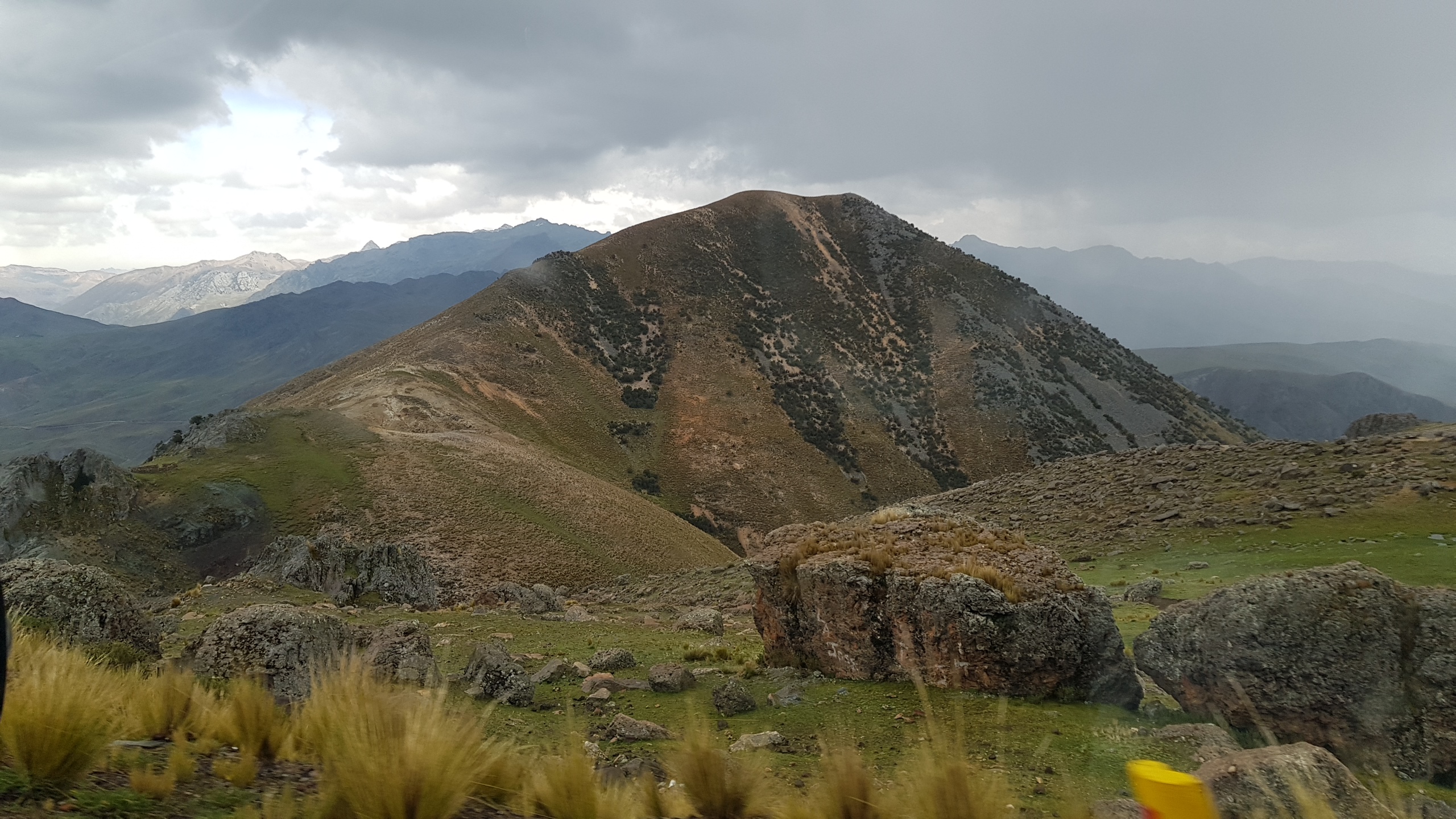
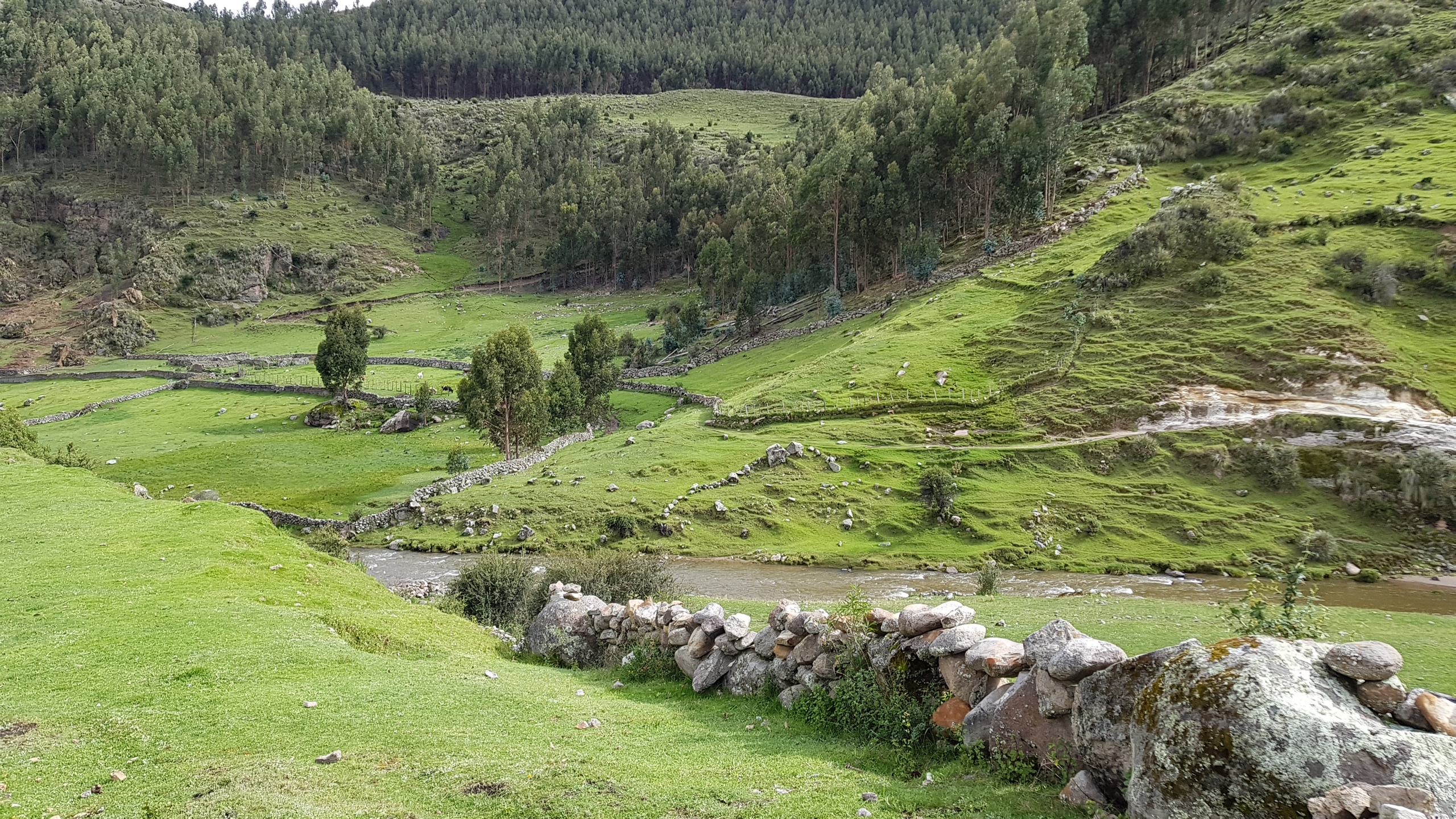
Along the way it started to rain, something very unusual for us in Peru. I heard thunder and it took me a minute to figure out what it was.We stopped to take pictures at one point where Peru looks just like Ireland.Ayacucho was founded on a small level area in a steep-sided valley. To enter the city, we descended a road sandwiched between a cliff and the abyss. Our hotel is near the Plaza de Armas and the city was just winding up Carnival celebrations and all the streets were blocked off. Jonathan pulled over two blocks from the hotel and I walked over to explain the situation. A staff member came with me and showed us where to park, which we would never have found on our own. We immediately lay down to counteract the effects of altitude. Though its only about 9000 ft in Ayacucho, we crossed a pass at 15,400 ft earlier in the day. I took Diamox as recommended and so far don’t have either the headache or nausea associated with altitude sickness.

Welcome to Ayacucho!

Fiesta Weekend 2018

This year the Fiesta of the Virgin of Lourdes is once again the biggest weekend of the summer. People return to Barranca from all over the world to visit family. I’ve met people who live in Austria, Israel and the US all back to visit and enjoy the summer and participate in the festival. There are two statues of the Virgin, one from France whose purchase was organized by the mother of Jorge Marquez, who formerly owned our house. A newer statue was made by an Italian craftsman more recently and presides over the tiny chapel.

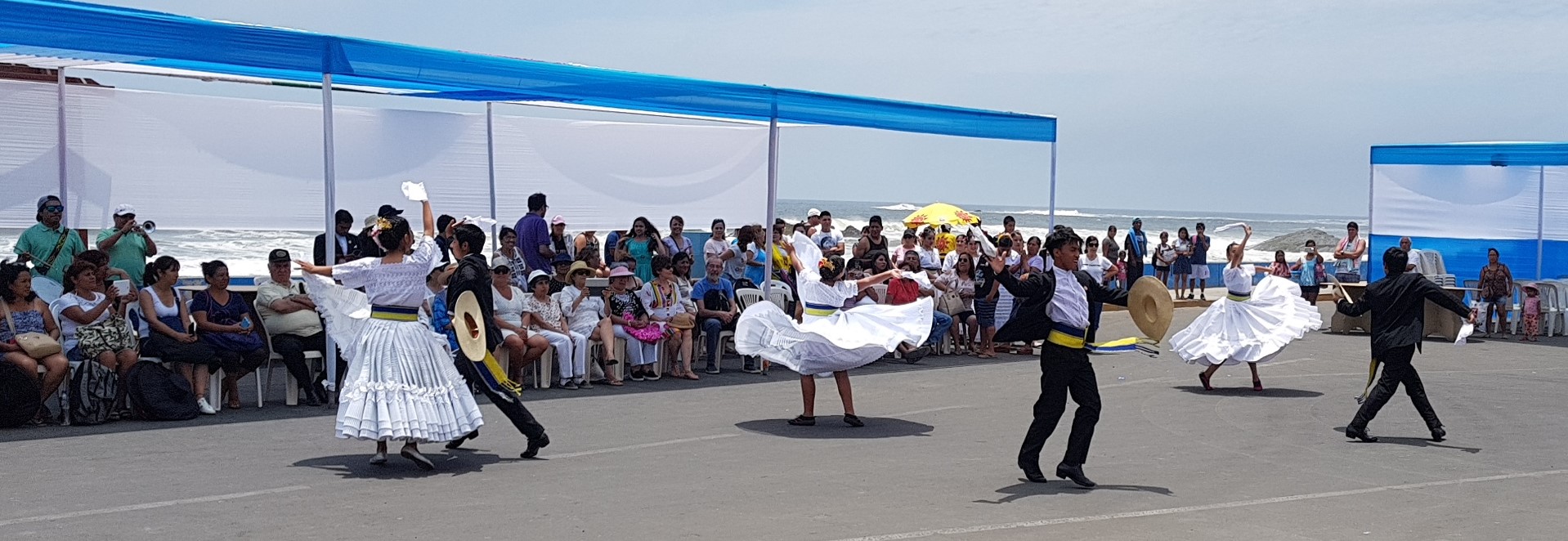
This year the day was sunny but not too hot and the dancers put on their best performance ever. The marinera, traditional Peruvian dance typical of the coast, was beautiful to watch with the ocean in the background.

The festival includes a novena and concludes with Sunday mass, though many more people come to see the dancers and the fireworks. Saturday evening was the yunza, an Andean tradition of erecting a tree that is decorated with prizes. A traditional band plays as neighbors take turns hacking at the trunk. Beer is distributed as the singing, dancing and clapping continue. The yunza is not supposed to be quick, and many people whack at random places on the trunk to prolong the process. After about an hour and a half, the final blow comes and everyone grabs for one of the prize bags. It shows we never entirely grow up. People are as enthusiastic about a bag of Skittles as any of their kids. Besides, the kids had their own yunza Saturday morning. The person who delivered the final blow that downed the tree is the patron, responsible for the tree, gifts, band and beer next year.

One of the only good things you can say about machismo is that the men aren’t afraid to dance.


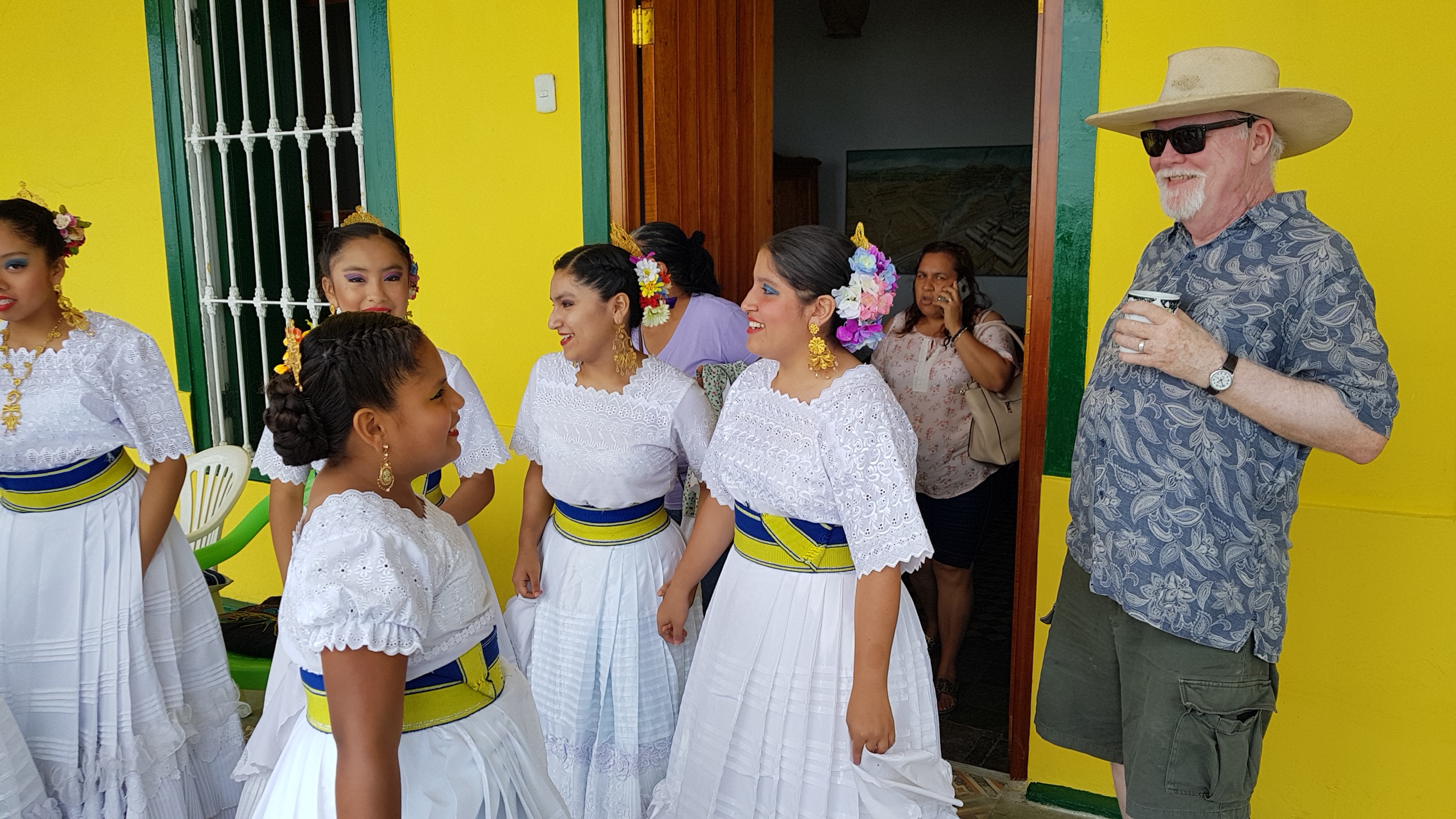
The women are always beautiful.


Jonathan loves hosting the dancers on our patio where there is shade and room to prepare.


Nor can he resist getting in on the action.


Nothing says “I ♥ Our Lady of Lourdes” like giant spinning fireworks.

Good Neighbors

Good neighbors are a treasure. First Berta comes by with a box of fresh strawberries. These are always perfect, because they are from her daughter and son in law who are growers. They were delicious with brown sugar and lime juice.

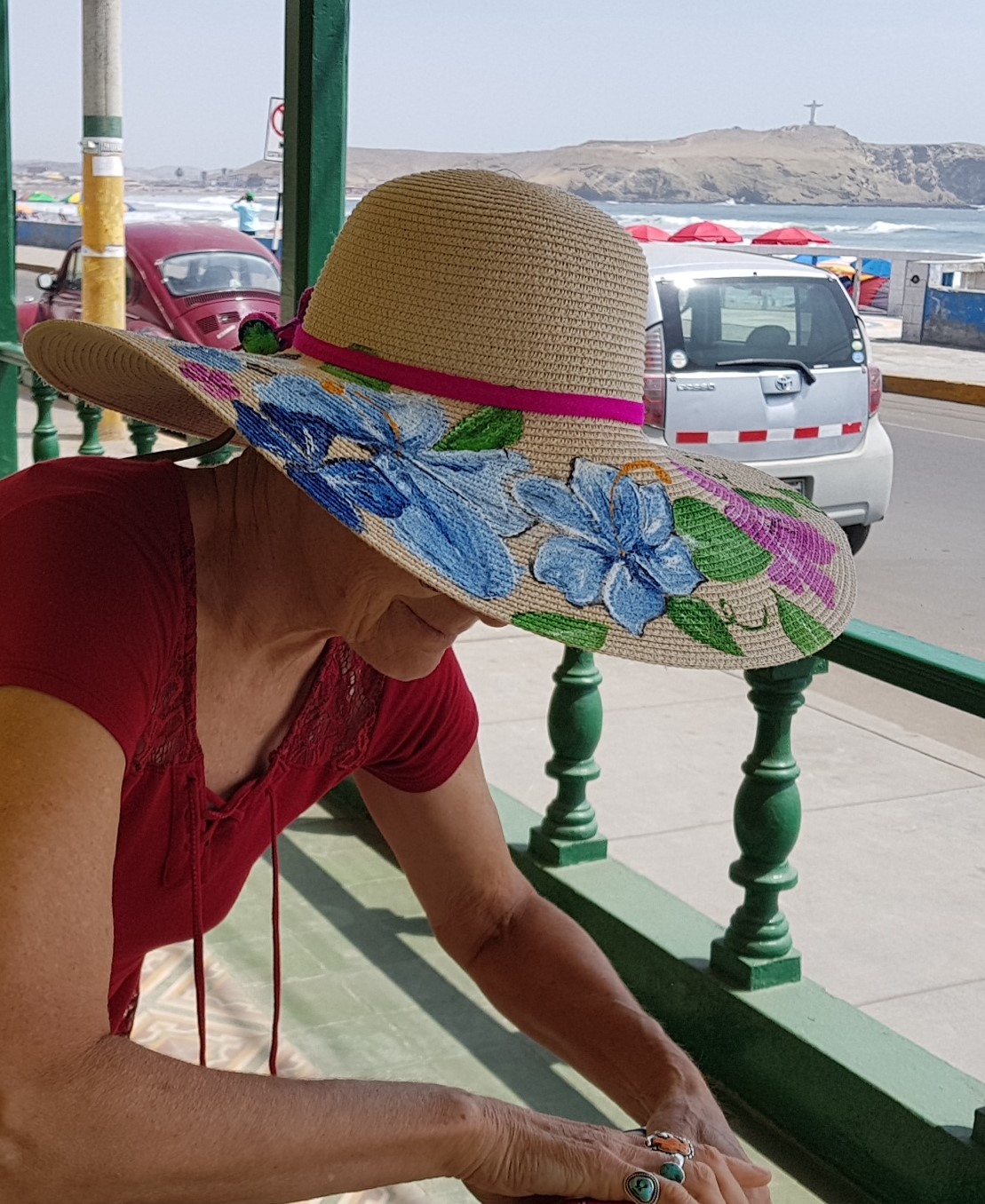
The doorbell rings and Leila comes in, holding a beautiful straw hat painted with flowers. She says, “This is for you, you wear big hats.” Yes, I do, and thanks!  It’s perfect for summer in Peru, with a big brim and those great flowers. Leila even added the band and matching pompoms at the back. I couldn’t find a hat like this if I looked everywhere.

Days like this are why I always say that what is best about Peru is my wonderful neighbors.

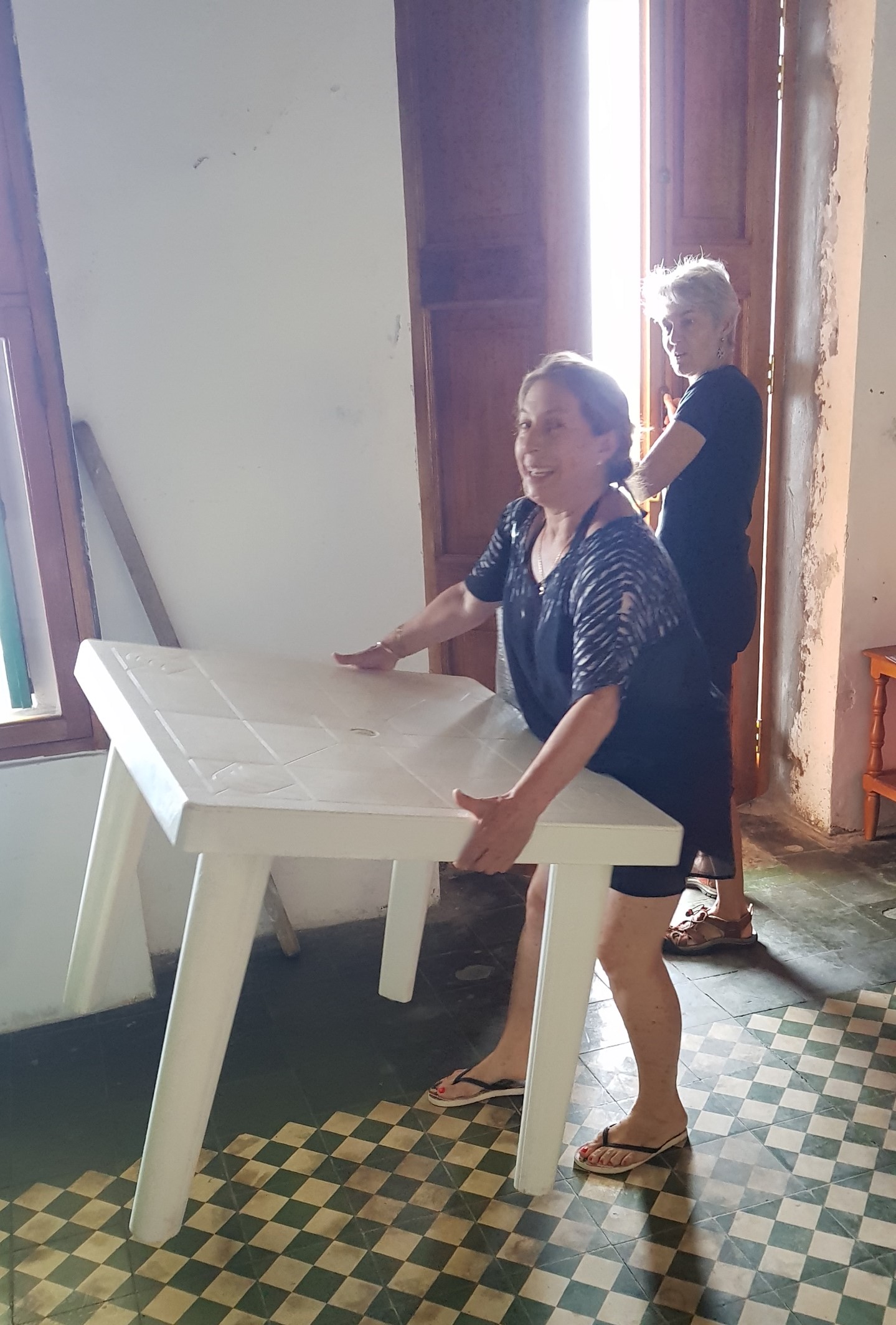
Sometimes there’s a chance to chip in a little, like lending a plastic table and chairs for a few days, or cutting some parsley from the garden.

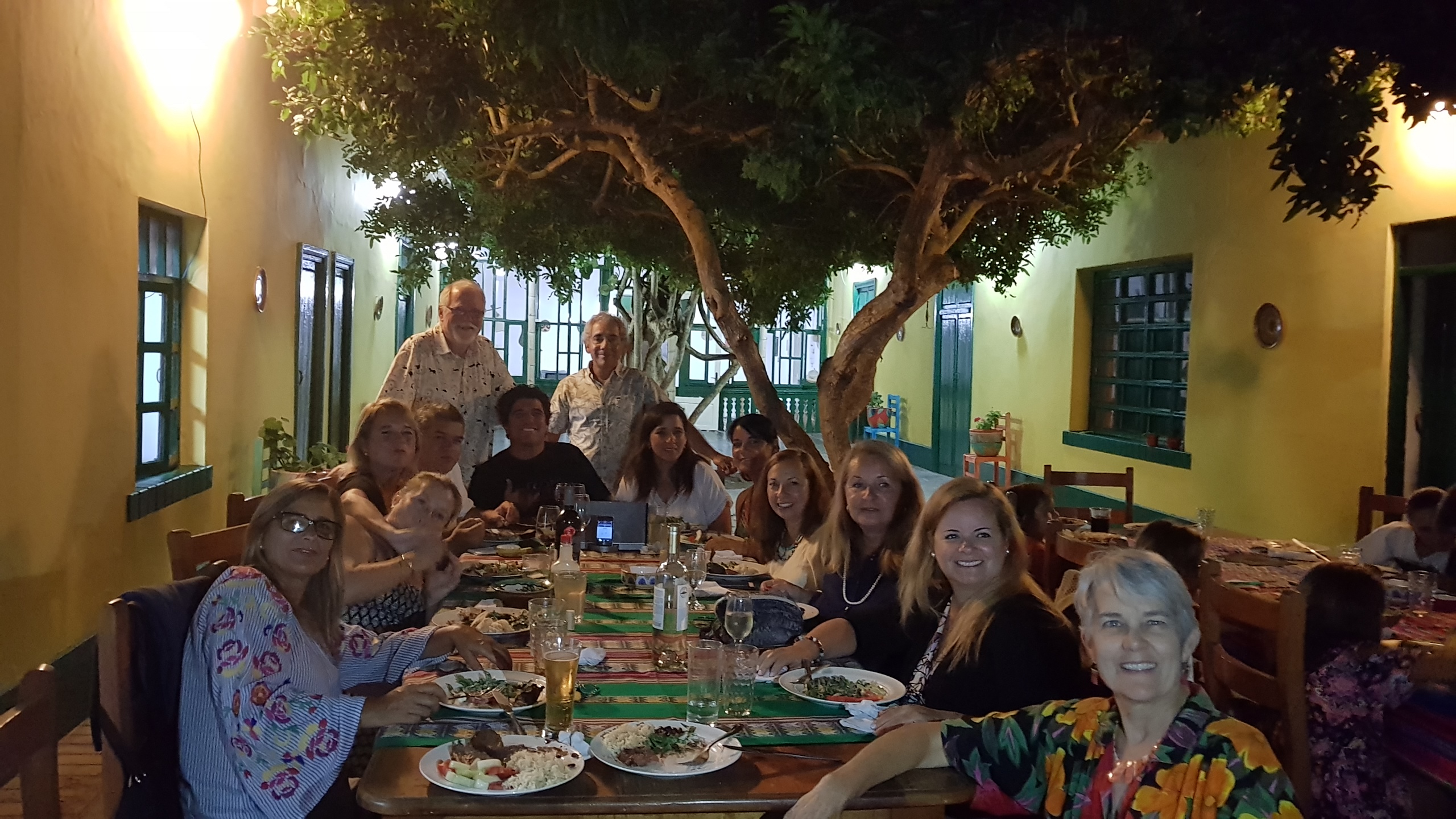
We had a get-together for Maria-Louisa and her sisters and their families. Many years ago, the sisters spent part of their summers in the house that is now ours. Having dinner together was a lot of fun and the sisters reminisced about what it was like when they spent the summer. The oldest sister remembers when their family owned a neighboring house, but that was when she was an only child……The children were only moderately interested in the fact that their mothers, aunts and grandmothers used to live here, but the adults enjoyed it thoroughly.


A Week of Whimbrels

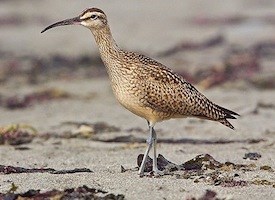
There is always something new on the beach. I’ll post weekly with what’s been going on. This week we determined that there are at least two whimbrels on the beach, and possibly four, two pairs. These fanciful birds are long-beaked shore birds, a bit smaller than their cousins, the curlew. Bird guides list them as uncommon in our area, but every year we seem to have a few that visit. (Internet photo of bird)


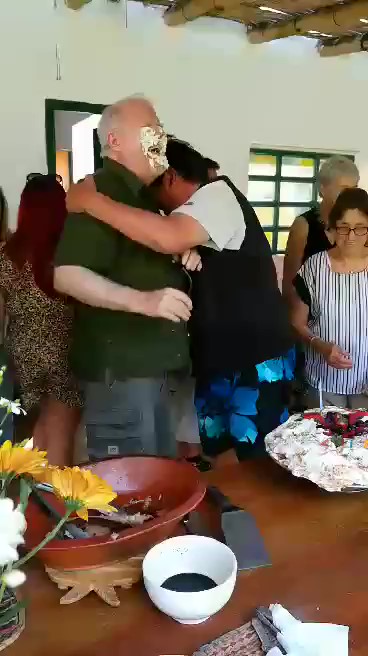
Saturday was Jonathan’s birthday pig barbecue. All our friends and neighbors who were at the beach for the weekend came by to help celebrate. Jonathan inaugurated his new barbecue patio and Dona Berta brought one of her magnificent cakes. Pablo (R in photo), visiting from Cusco, said that in Cusco one kisses the cake and when Jonathan leaned over to comply his head was dunked in the whipped cream to roaring laughter.

The cake is vanilla layers filled with manjar blanco, (caramel), canned peaches and fresh strawberries. It is frosted lavishly with whipped cream and topped with fresh berries. Not a crumb was left over.

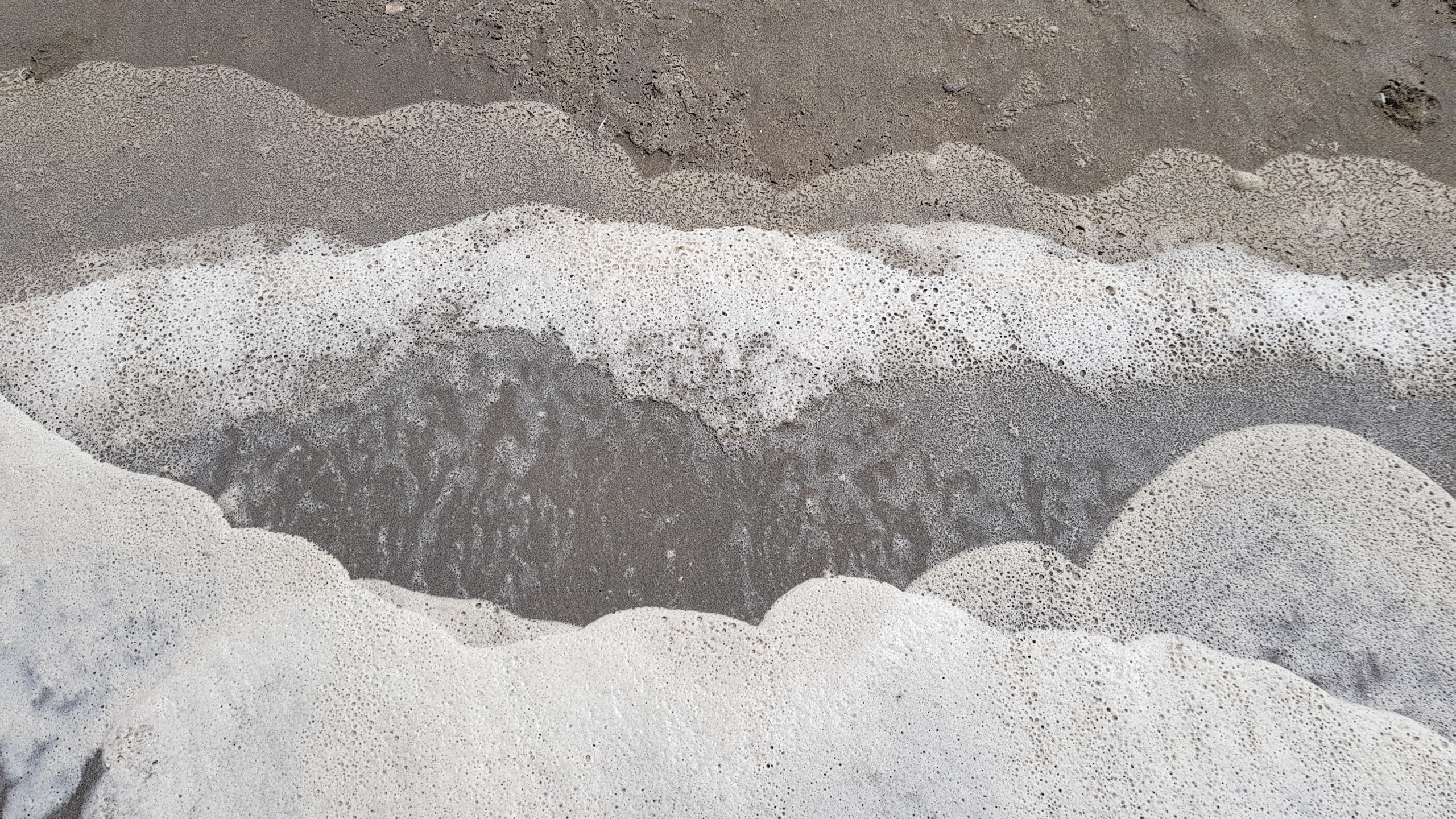
Sunday–For a few days an algae bloom washed in, turning the waves red-brown and leaving foam on the shore. Not pleasant for swimming, but the foam made patterns on the sand.

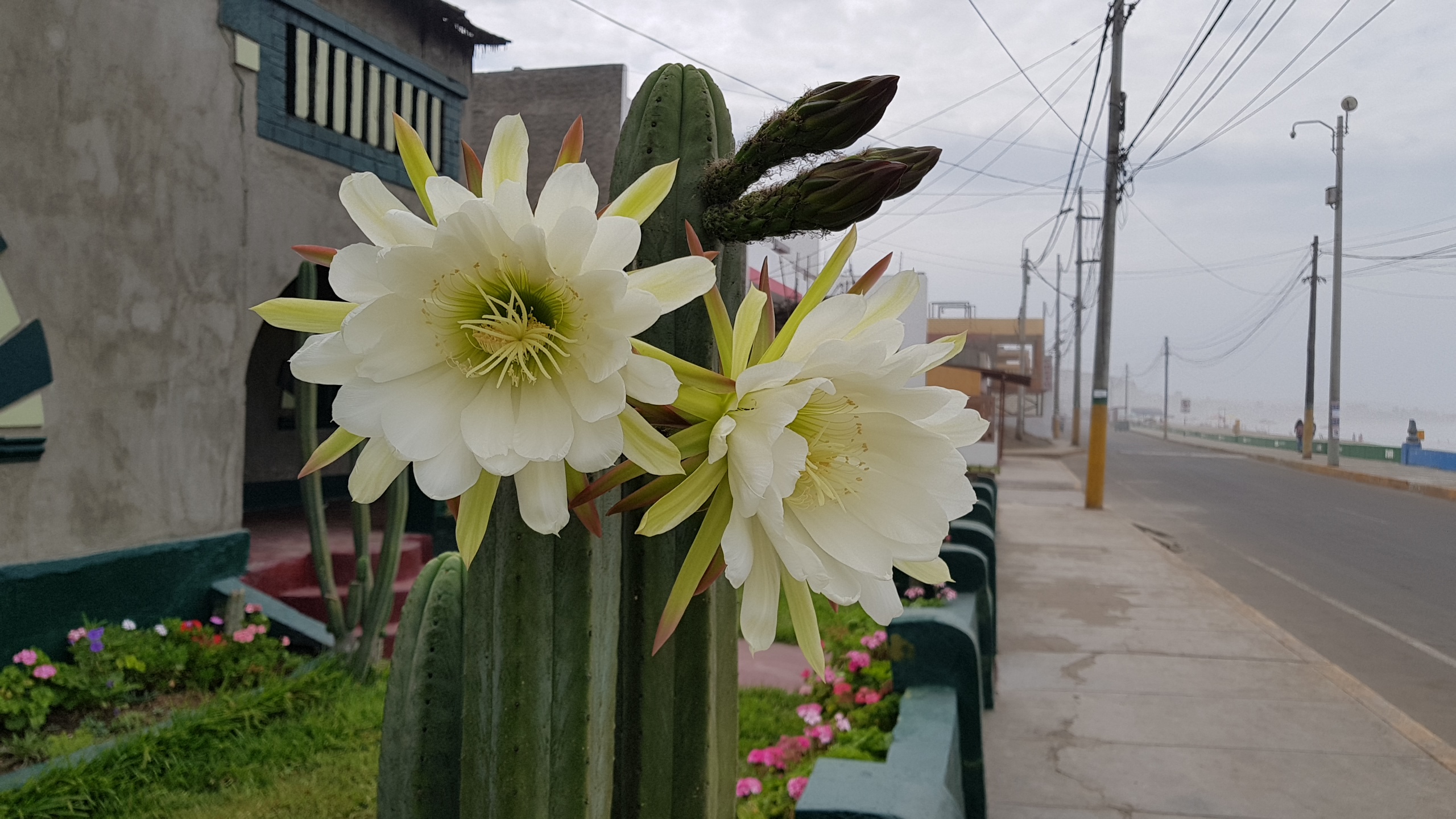
Monday–Today the San Pedro cactus down the street bloomed. The flowers come out about every second year and last only a few days.


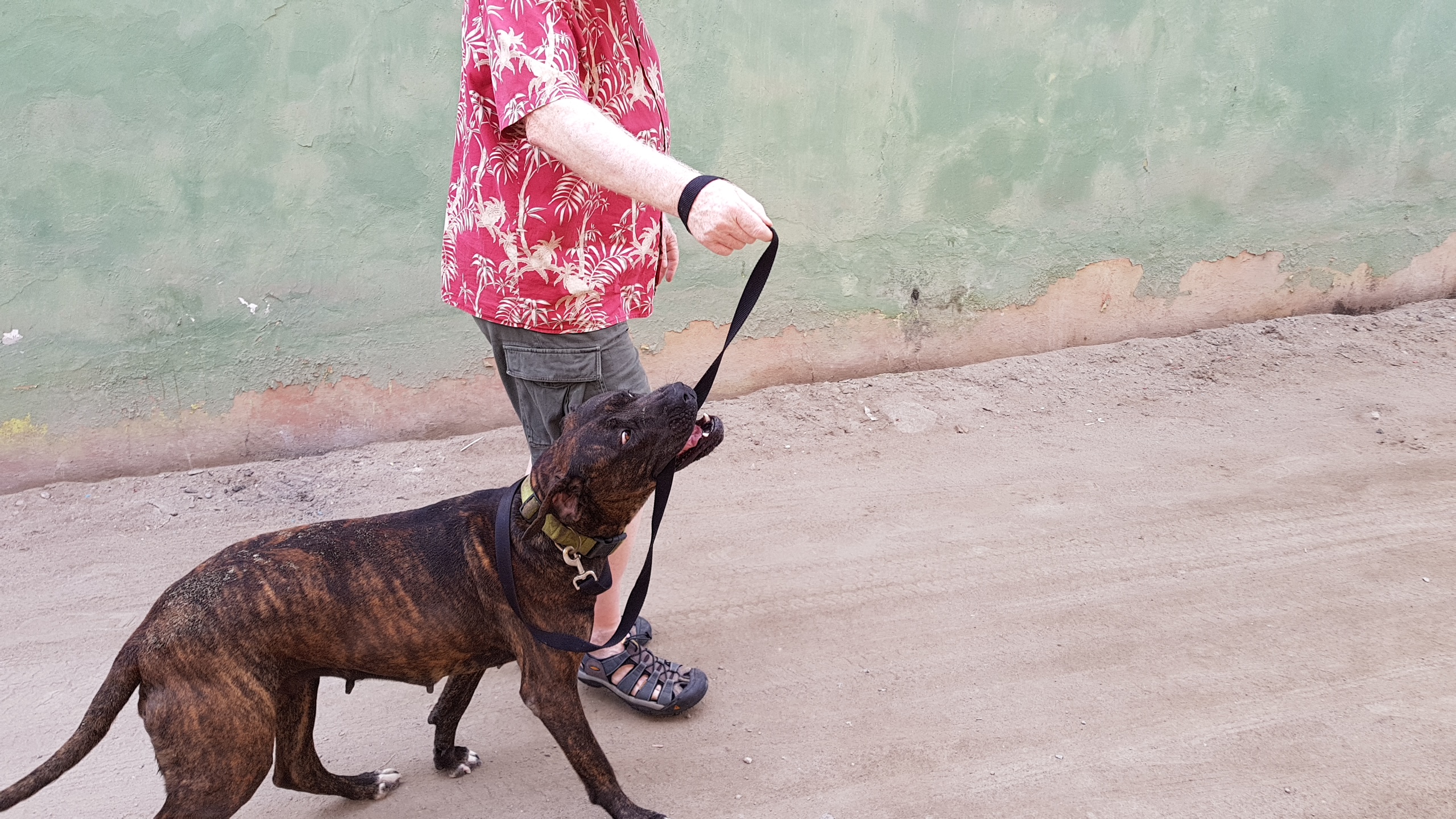
Tuesday–Thick, thick mist that dissipated only for a couple of hours in the afternoon. Orca was so anxious to go on her walk that she tried to drag Jonathan to the sidewalk.


Thursday–The tide is as low as I’ve ever seen it, thanks to the Blue Super Moon predawn on the 31st. The water is also even colder than usual, 63°F, I’d guess. Even with sleeves and a short wet suit my swim was brief.

Friday–Nothing day. We both ended up with stomach pains and spent the day resting and eating crackers. It’s not always paradise.